Aogami Steel
An Independent Guide
Aogami N2, commonly called Aogami #2, Blue #2, or Blue Paper Steel #2, is one of the most respected traditional Japanese carbon steels used for high-performance kitchen knives and other cutting tools. It is particularly appreciated for its combination of high hardness, excellent edge retention, fine edge stability, relatively good toughness for a hard carbon steel, and outstanding sharpening characteristics.
For many knife enthusiasts, Aogami steel represents the classic Japanese approach to high-performance carbon blades: high carbon content, carefully controlled alloying, traditional heat treatment, and a focus on producing a very sharp and refined cutting edge.
Aogami #2 occupies an interesting position in the Blue Paper family. It contains slightly less carbon than Aogami #1, while maintaining the tungsten and chromium additions characteristic of the Blue series. This gives it an excellent balance between hardness, wear resistance, toughness, and sharpening performance.
This guide explains what Aogami #2 is, its approximate composition, hardness, edge retention, corrosion behavior, sharpening requirements, maintenance, and how it compares with Aogami #1, Aogami Super, Shirogami, VG10, 1095, M390, ELMAX, and other popular knife steels.
What Is Aogami N2?
Aogami N2 is another designation sometimes used for Aogami #2, a traditional Japanese high-carbon tool steel.
The more common English terminology is:
- Aogami #2
- Blue #2
- Blue Paper Steel #2
- Aogami 2
The term Aogami refers to the traditional “Blue Paper” family of Japanese steels. The number identifies the grade.
Aogami #2 is closely related to Aogami #1, but it contains slightly less carbon. This difference may appear small chemically, but it can influence the balance of properties that knife makers are trying to achieve.
The Blue series traditionally combines high carbon with alloying elements such as tungsten and chromium.
This gives Aogami steel characteristics that distinguish it from simpler carbon steels such as Shirogami.
A properly manufactured Aogami #2 kitchen knife can provide:
- Very high hardness
- Excellent edge retention
- Excellent sharpening response
- Good edge stability
- Good wear resistance
- A very fine cutting edge
- Traditional carbon-steel characteristics
However, it is important to remember that steel composition is only one part of knife performance.
Heat treatment, geometry, blade thickness, grind, edge angle, and manufacturing quality can have an enormous effect on the finished knife.
Why Is It Called Blue Steel?
The name “Blue Steel” does not mean that the finished knife blade is blue.
Aogami is traditionally associated with the colored paper used to identify the steel product.
The Blue Paper family includes several grades, most notably:
- Aogami #1
- Aogami #2
- Aogami Super
The equivalent traditional White Paper family includes:
- Shirogami #1
- Shirogami #2
The names are therefore historical steel-industry designations rather than descriptions of the blade’s appearance.
A finished Aogami #2 knife can have a polished, kurouchi, migaki, or other surface finish. It may eventually develop a natural gray, blue-gray, purple, or dark patina through normal use.
Aogami #2 Steel Composition
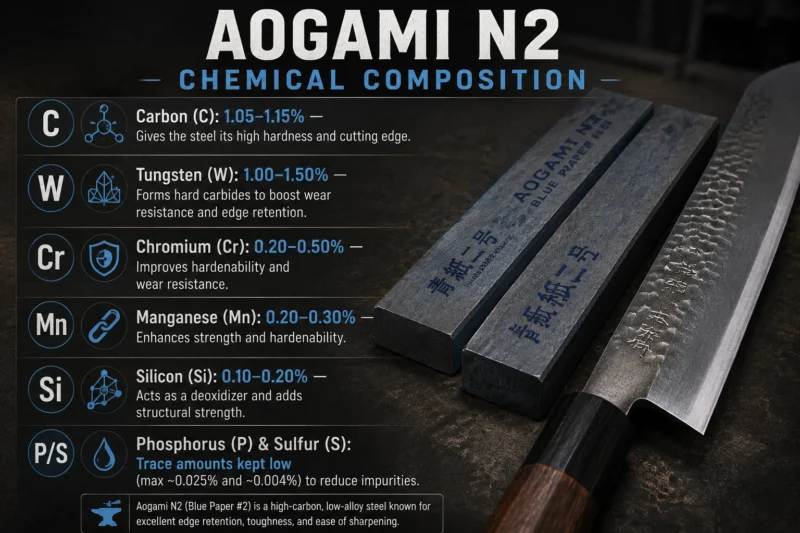
The exact chemical composition can vary according to the particular specification and manufacturer, so published ranges should be treated as approximate rather than as an absolute specification for every blade.
Typical Aogami #2 composition is characterized by approximately:
- Carbon: around 1.05–1.15%
- Tungsten: around 1.0–1.5%
- Chromium: around 0.2–0.5%
- Iron: balance
Other elements may be present in smaller quantities.
The most important characteristics are the relatively high carbon content combined with tungsten and chromium additions.
This is what makes Aogami steel different from simple high-carbon steels.
Carbon
Carbon is essential for achieving high hardness and forming carbides.
The carbon content of Aogami #2 is high enough to allow excellent hardness when the steel receives appropriate heat treatment.
This contributes to:
- Edge retention
- Edge stability
- Wear resistance
- High hardness
- Fine cutting performance
Tungsten
Tungsten is particularly important in the Blue series.
Tungsten can contribute to the formation of hard carbides, which can increase wear resistance and influence the steel’s cutting characteristics.
This is one reason Blue steels are often associated with excellent edge retention.
Chromium
Aogami #2 contains a relatively small amount of chromium compared with stainless steels.
This chromium does not make the steel stainless.
Instead, it contributes to hardenability and interacts with the overall alloy system.
Aogami #2 should therefore still be treated as a reactive carbon steel.
Aogami #2 vs Aogami #1
This is probably the most important comparison for someone deciding between the two grades.
Aogami #1 contains more carbon than Aogami #2.
That higher carbon content allows Blue #1 to reach very high hardness and can provide excellent wear resistance and edge retention.
Aogami #2 contains slightly less carbon and is often regarded as offering a very attractive balance between hardness, toughness, edge retention, and sharpening behavior.
Aogami #1
Generally associated with:
- Higher carbon content
- Very high achievable hardness
- Excellent edge retention
- Excellent wear resistance
- Fine edge capability
- Traditional carbon-steel maintenance
Aogami #2
Generally associated with:
- Slightly lower carbon content
- High achievable hardness
- Excellent edge retention
- Good toughness relative to hardness
- Excellent sharpening characteristics
- Traditional carbon-steel maintenance
The difference is not simply “better versus worse.”
For many kitchen knives, Aogami #2 offers an exceptionally practical balance.
This is one reason Aogami steel remains popular among Japanese knife makers and enthusiasts.
Check Our guide Aogami Blue Steel N1
Aogami #2 vs Aogami Super
Aogami Super is another member of the Blue family.
It contains additional alloying compared with standard Aogami #2 and is particularly known for its combination of high hardness, wear resistance, and useful toughness.
Aogami Super can provide excellent edge retention and is widely used in premium Japanese knives.
Aogami #2, however, remains extremely capable.
The difference between the two should not be exaggerated.
A well-heat-treated Aogami #2 blade with excellent geometry can easily outperform a poorly heat-treated Aogami Super knife.
The quality of the finished blade matters enormously.
Aogami #2 vs Shirogami #2
Shirogami #2, or White #2, is another famous Japanese carbon steel.
The two steels are often compared because both are traditional Japanese carbon steels.
The primary difference is their alloy composition.
Shirogami is relatively simple and pure.
Aogami contains additional alloying elements, particularly tungsten and chromium.
This gives the Blue steel family greater wear resistance.
Shirogami #2
Known for:
- Extremely clean sharpening response
- Excellent fine-edge capability
- High hardness
- Excellent cutting feel
- Relatively low alloy content
Aogami #2
Known for:
- Excellent edge retention
- Greater wear resistance
- High hardness
- Good sharpening characteristics
- Fine edge capability
- Traditional carbon-steel behavior
If sharpening experience and extremely refined edge feel are the highest priorities, Shirogami can be fascinating.
If longer edge retention is more important, Aogami #2 can be a better fit.
Aogami N2 Hardness
Hardness is one of the most important characteristics of Aogami #2.
Well-made Japanese kitchen knives using this steel are commonly found around 60–64 HRC, depending on the manufacturer, heat treatment, geometry, and intended use.
There is no single hardness value that applies to every Aogami #2 knife.
A knife maker may deliberately choose a slightly lower hardness to improve toughness, or a higher hardness to maximize edge retention and cutting performance.
This flexibility is important.
A knife at 61 HRC and a knife at 64 HRC can behave differently even though both are made from Aogami #2.
Why Hardness Matters
Hardness affects several aspects of knife performance.
A harder blade generally has better resistance to:
- Edge deformation
- Wear
- Rolling
- Loss of sharpness
This can produce excellent edge retention.
However, hardness has to be balanced with toughness.
A very hard blade may be more vulnerable to chipping when subjected to impacts or lateral forces.
Therefore, the goal is not simply to maximize HRC.
The goal is to achieve the appropriate combination of:
Hardness + toughness + geometry + heat treatment.
This balance is particularly important with Japanese kitchen knives.
Check Our Guide What Is HRC? Understanding Rockwell Hardness in Kitchen Knives
Hardness vs Toughness
Hardness and toughness describe different properties.
Hardness
Resistance to deformation and wear.
Toughness
Resistance to cracking and fracture.
A hard Aogami #2 knife can maintain a very fine edge, but it should not be abused.
Avoid using a high-hardness Japanese kitchen knife for:
- Bones
- Frozen food
- Hard shells
- Prying
- Twisting
- Chopping through hard objects
- Cutting on glass or stone
The knife should be used for the work it was designed to perform.
Check Our Guide Wear Resistance vs Toughness
Aogami #2 Edge Retention
Edge retention is one of the main reasons people choose Blue #2.
The combination of high carbon content, alloying elements, high hardness, and appropriate carbide formation gives this steel excellent wear resistance.
However, edge retention is not simply a property of steel composition.
It depends on:
- Hardness
- Heat treatment
- Edge angle
- Blade thickness
- Grind
- Cutting board
- Food being cut
- Cutting technique
- Sharpening quality
A well-designed Aogami #2 knife can retain a sharp working edge for a long time.
But the same steel can perform very differently in another knife if the geometry or heat treatment is different.
Check Our Guide Edge Retention Explained
Aogami #2 and Edge Geometry
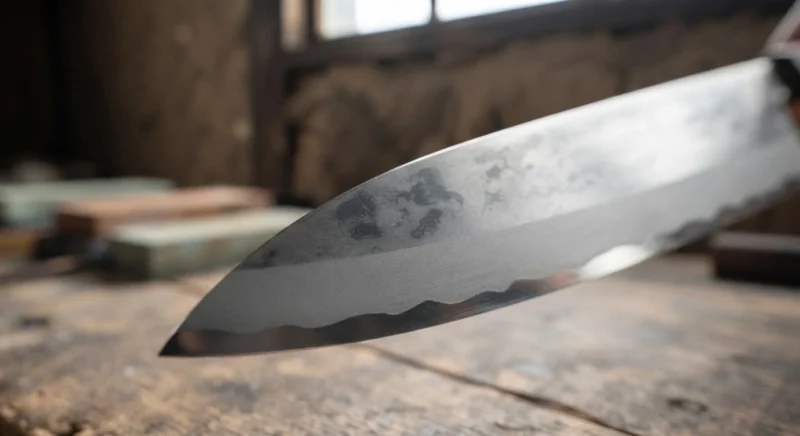
Edge geometry is especially important with Japanese knives.
Aogami #2 can support a very fine edge when properly heat treated.
This makes it suitable for knives designed for precision cutting.
Examples include:
- Gyuto
- Santoku
- Nakiri
- Bunka
- Petty
- Kiritsuke
- Yanagiba
- Deba
A thin edge reduces cutting resistance and allows the blade to move through food efficiently.
However, a very thin edge also requires careful handling.
A hard Japanese knife should not be twisted or used as a pry bar.
Is Aogami #2 Stainless?
No.
Aogami #2 is a reactive carbon steel.
This is one of the most important characteristics potential buyers need to understand.
The chromium content is far below the level required for stainless behavior.
Consequently, the blade can develop:
- Patina
- Discoloration
- Oxidation
- Rust if neglected
For experienced carbon-steel users, this is not necessarily a disadvantage.
A natural patina can become part of the character of the knife.
For users accustomed to stainless steel, however, Aogami #2 requires a little more attention.
Aogami #2 Patina
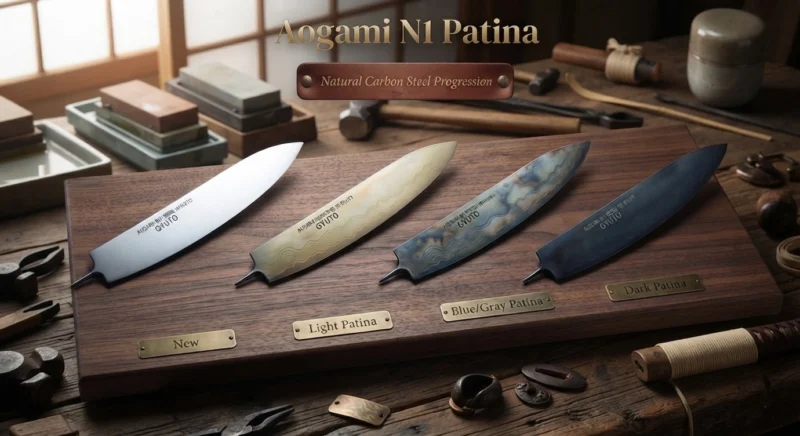
Patina is a natural surface change that develops when reactive steel interacts with food, moisture, and oxygen.
Over time, an Aogami #2 blade can develop colors such as:
- Gray
- Blue-gray
- Purple
- Brown
- Dark gray
- Almost black
The exact appearance depends on the foods being cut and the environment.
Acidic ingredients can accelerate patina formation.
Common examples include:
- Tomatoes
- Citrus
- Onions
- Apples
- Vinegar
- Certain fish and seafood
Patina is generally not a defect.
It is a normal characteristic of traditional carbon steel.
Patina vs Rust
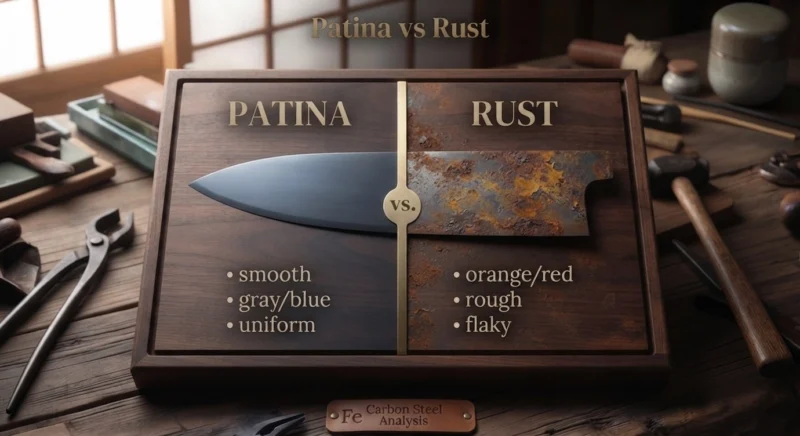
It is important to distinguish patina from rust.
Patina
Usually:
- Smooth
- Thin
- Gray, blue, purple, or dark
- Relatively uniform
Rust
Usually:
- Orange or reddish
- Rough
- Powdery
- Flaky
- Progressive
Rust should be removed.
The simplest way to prevent rust is to keep the blade clean and dry.
If you have just purchased an Aogami #2 knife, developing a controlled patina can actually make the maintenance process easier because you become familiar with how the steel reacts.
How to Maintain an Aogami #2 Knife
Maintaining Aogami #2 is simple once the correct routine becomes automatic.
After use:
- Wipe away food residue.
- Wash the blade by hand when necessary.
- Rinse thoroughly.
- Dry immediately.
- Never leave the knife soaking.
- Store it in a dry location.
- Apply a thin layer of food-safe mineral oil for long-term storage.
Do not place an Aogami #2 knife in a dishwasher.
Dishwasher temperatures, detergents, moisture, and contact with other objects are all unsuitable for a high-performance carbon-steel knife.
Aogami #2 and Acidic Foods
Acidic foods can cause rapid patina formation.
This is not a reason to avoid them.
Instead, wipe the blade periodically when working with acidic ingredients.
For example, if you are cutting tomatoes or citrus for several minutes, wiping the blade occasionally can reduce excessive discoloration.
After finishing, wash and dry the knife.
With regular use, the steel develops a characteristic appearance.
Many enthusiasts consider this one of the most attractive aspects of traditional Japanese carbon knives.
Sharpening Aogami #2
One of the biggest advantages of Aogami #2 is its sharpening behavior.
Despite its high hardness, the steel can respond beautifully to quality water stones.
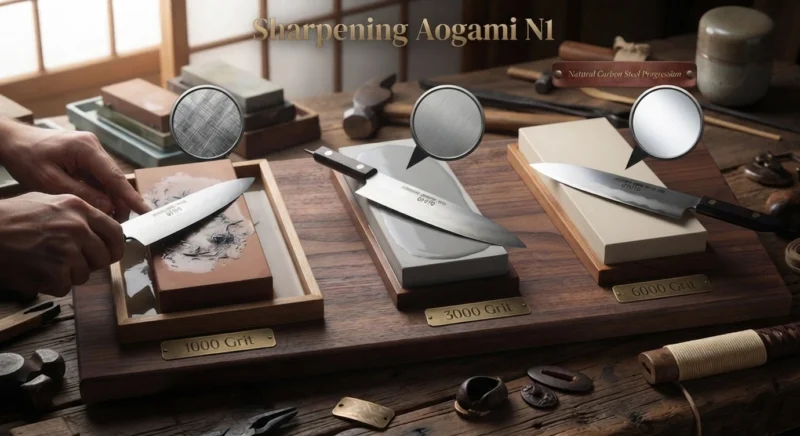
A typical sharpening system might include:
- 800–1000 grit
- 2000–3000 grit
- 4000–6000 grit
- Optional higher-grit finishing stone
You do not need every grit for every sharpening session.
For routine maintenance, a medium or fine stone may be enough.
If the knife is very dull, begin with a coarser stone.
If the edge only needs refinement, use a finer stone.
Check Our Guide All Kinds of Knife Sharpening Tools
Best Sharpening Stones for Aogami #2
Japanese water stones are a natural choice for this steel.
A practical progression might be:
1000 grit
Used for:
- Establishing the edge
- Correcting moderate dullness
- Removing small amounts of steel
3000 grit
Used for:
- Refining the edge
- Removing coarse scratches
- Producing a refined working edge
5000–6000 grit
Used for:
- Finishing
- Polishing
- Producing a very refined edge
For most kitchen work, an extremely high-grit finish is unnecessary.
A medium-fine finish can provide excellent bite and slicing performance.
Aogami #2 and Stropping
Stropping can help refine a freshly sharpened edge.
Leather or another suitable stropping material can remove microscopic burr remnants and improve edge refinement.
However, aggressive stropping can round the apex.
With a very sharp Aogami #2 knife, controlled technique is more important than excessive polishing.
Aogami #2 Sharpening Angle
There is no universal sharpening angle that applies to every Aogami #2 knife.
The appropriate edge geometry depends on:
- Blade thickness
- Grind
- Knife type
- Hardness
- Intended use
- Cutting technique
A thin gyuto may support a relatively acute edge.
A heavier deba requires a more robust edge.
The best practice is to preserve the manufacturer’s intended geometry unless you have a specific reason to change it.
Aogami #2 for Gyuto Knives
Gyuto is one of the most attractive applications for Blue #2.
A gyuto is a versatile Japanese chef knife suitable for:
- Vegetables
- Meat
- Fish
- Herbs
- General kitchen preparation
Aogami #2 can give a gyuto:
- Excellent edge retention
- High hardness
- Fine edge stability
- Excellent cutting feel
- Traditional carbon-steel character
The combination of thin geometry and hard steel can produce exceptional performance.
However, users should remember that a high-performance gyuto is not a cleaver.
Use controlled cutting technique.
Check Our Japanese Gyuto Knife Guide: Everything You Need to Know
Aogami #2 for Nakiri Knives
Nakiri knives are specialized Japanese vegetable knives.
Their straight cutting edge makes them particularly effective for:
- Cabbage
- Carrots
- Potatoes
- Onions
- Leafy vegetables
- Herbs
Aogami #2 works very well in this format.
The steel can maintain a fine edge while the knife’s geometry provides efficient vegetable cutting.
Because nakiri blades can be very thin, avoid hard impacts and twisting.
Check Our Guide Santoku vs Nakiri: Which Japanese Kitchen Knife Is Better?
Aogami #2 for Santoku Knives
Santoku knives are versatile Japanese kitchen knives.
They are commonly used for:
- Vegetables
- Meat
- Fish
Aogami #2 can provide excellent edge performance in a santoku while retaining the traditional carbon-steel characteristics that many Japanese knife enthusiasts prefer.
The main consideration is maintenance.
The user needs to keep the blade dry and avoid prolonged contact with moisture.
Aogami #2 for Petty Knives
Petty knives are small Japanese utility knives.
They are particularly useful for precision work.
Typical applications include:
- Garlic
- Small fruits
- Herbs
- Small vegetables
- Trimming meat
- Detailed preparation
Aogami #2 can make an excellent petty knife because the steel supports a very refined edge.
The small blade is also easy to clean and maintain.
Check Our Guide Petty Knife vs Paring Knife: Key Differences Explained
Aogami #2 for Bunka and Kiritsuke Knives
Bunka and kiritsuke-style knives often have distinctive pointed profiles.
These points are useful for:
- Precision vegetable cutting
- Fine slicing
- Detail work
- Portioning
- Garnishing
Aogami #2 can provide excellent edge performance in these knives.
However, the pointed tip should never be used as a lever.
The tip is designed for controlled cutting, not prying or twisting.
Aogami #2 for Yanagiba
Traditional yanagiba knives require exceptional edge quality.
They are commonly used for sashimi and precision fish slicing.
Aogami #2 can be an excellent steel for this purpose because it can achieve high hardness and a refined cutting edge.
When properly sharpened, the knife can produce extremely clean slices.
For seafood preparation, the condition of the edge is particularly important.
Any damaged or poorly sharpened edge can negatively affect the quality of delicate fish cuts.
Aogami #2 for Deba Knives
Deba knives are designed for fish preparation.
They are considerably heavier than typical gyuto or nakiri knives.
Aogami #2 can be used successfully for deba knives, but the blade must still be used according to its intended design.
Even a heavy deba should not be treated as an unlimited bone-cleaving tool.
The exact geometry determines which fish-processing tasks are appropriate.
Aogami #2 for Seafood
Blue #2 is particularly attractive for seafood preparation because of its ability to maintain a fine edge.
It can be used for:
- Fish preparation
- Slicing
- Filleting
- Sashimi
- Seafood trimming
- Precision cutting
However, seafood introduces an additional maintenance concern.
Salt and moisture can accelerate corrosion.
After preparing fish or seafood, clean and dry the blade thoroughly.
For detailed seafood preparation techniques, see our Complete Guide to Cutting Seafood.
This is also a natural place to connect your Aogami content with your seafood content cluster.
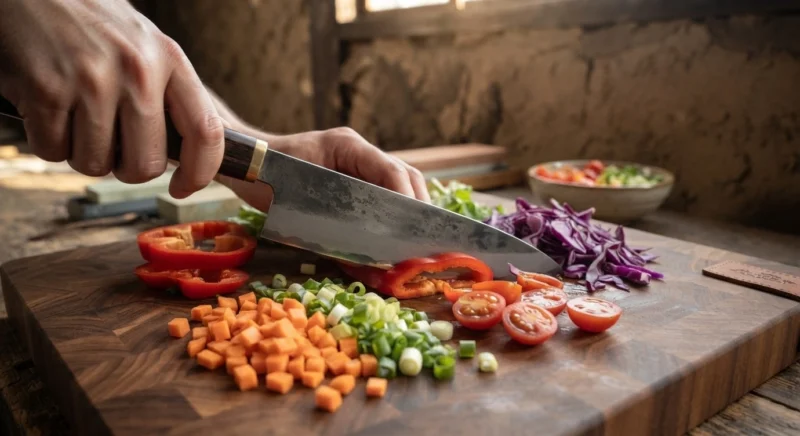
Aogami #2 and Cutting Boards
The cutting board has a surprisingly large influence on knife-edge life.
A hard, unforgiving surface can damage a finely sharpened Aogami #2 edge.
Good choices include:
- Walnut
- Cherry
- Maple
- Rubber
- Quality HDPE
Less suitable surfaces include:
- Glass
- Marble
- Granite
- Ceramic
- Stone
For high-hardness Japanese knives, a stable but relatively forgiving cutting surface is ideal.
For more information, see our Complete Guide to Cutting Boards.
Aogami #2 vs Stainless Steel
The most obvious difference between Aogami #2 and stainless steels is corrosion resistance.
Aogami #2
- Reactive
- High hardness
- Excellent edge retention
- Excellent sharpening response
- Natural patina
- Requires drying
Stainless steel
- High corrosion resistance
- Easier maintenance
- Wide range of hardness
- Wide range of edge retention
- Excellent choices for busy kitchens
Modern stainless steels can provide extraordinary performance.
Choosing carbon steel does not mean choosing “better steel.”
It means choosing a different balance of characteristics.
Aogami #2 vs VG10
VG10 is one of the most popular Japanese stainless steels.
Compared with Aogami #2, VG10 has substantially better corrosion resistance.
VG10 is therefore easier for users who want a low-maintenance knife.
Aogami #2 provides the traditional carbon-steel experience.
It is particularly appealing to users who enjoy:
- Sharpening
- Patina development
- Fine edges
- Traditional Japanese knives
VG10 may be more convenient.
Aogami #2 may be more rewarding for the enthusiast.
Check Our Guide VG10 Steel Review: Pros, Cons, Edge Retention, Toughness & Real-World Performance
Aogami #2 vs AUS-8
AUS-8 is a stainless steel known for useful toughness and corrosion resistance.
It is generally easier to maintain than Aogami #2.
Aogami #2 can achieve substantially higher hardness and stronger edge performance when properly heat treated.
AUS-8 is generally more forgiving.
Therefore:
AUS-8 = convenience and toughness
Aogami #2 = hardness, edge performance, and traditional carbon-steel character
Check Our Guide VG10 vs AUS-8 Steel: Which Knife Steel Is Better?
Aogami #2 vs 1095
1095 is a simple high-carbon steel used in many knives and tools.
Both steels are reactive.
However, Aogami #2 contains tungsten and chromium additions that distinguish it from simple 1095.
Aogami #2 is specifically designed to provide excellent cutting performance in applications where hardness and edge retention are important.
1095 is valued for its simplicity, toughness, affordability, and easy sharpening.
Both can be excellent steels when correctly heat treated.
Aogami #2 vs M390
M390 is a modern powder metallurgy stainless steel with extremely high wear resistance and excellent corrosion resistance.
Compared with Aogami #2:
M390 offers:
- Excellent corrosion resistance
- Very high wear resistance
- Long edge retention
- Modern stainless performance
Aogami #2 offers:
- Traditional carbon-steel behavior
- Excellent sharpening response
- High hardness
- Fine edge capability
- Natural patina
These steels appeal to very different users.
Check Our Guide M390 vs Elmax: Which Premium Knife Steel Is Better?
Aogami #2 vs ELMAX
ELMAX is a premium powder metallurgy stainless steel.
It is known for a strong combination of:
- Wear resistance
- Toughness
- Corrosion resistance
- Edge retention
Aogami #2 is more reactive and requires more maintenance.
ELMAX is therefore more practical for users who want modern stainless performance.
Aogami #2 remains attractive to people who value traditional Japanese carbon-steel characteristics.
Aogami #2 vs D2
D2 is a high-chromium tool steel with very high wear resistance.
It is sometimes described as semi-stainless because it has more chromium than traditional carbon steels, although its corrosion behavior depends on many factors.
Aogami #2 has a different metallurgical balance.
It prioritizes traditional high-carbon Japanese knife performance rather than maximum corrosion resistance.
D2 can offer excellent wear resistance.
Aogami #2 offers a more traditional sharpening and cutting experience.
Check Our Guide D2 Steel Review: Is D2 Still One of the Best Knife Steels?
Aogami #2 Toughness
Aogami #2 is not generally chosen because it is the toughest steel available.
Its attraction comes from the balance of:
- Hardness
- Edge retention
- Wear resistance
- Fine edge capability
- Sharpening response
At very high hardness, any steel can become less forgiving.
Therefore, the knife’s intended use is important.
A thin Aogami #2 gyuto should be treated very differently from a heavy outdoor tool.
Common Mistakes With Aogami #2
1. Treating It Like Stainless Steel
The blade should be dried after use.
2. Leaving It in the Sink
Even a few hours of moisture can encourage corrosion.
3. Cutting Bones
Unless specifically designed for that purpose, a fine Japanese kitchen knife should not be used to cut bones.
4. Cutting Frozen Food
Frozen food can generate excessive impact and stress.
5. Using a Glass Board
Glass is far too hard for a fine knife edge.
6. Twisting the Blade
Do not twist the knife sideways while cutting.
7. Ignoring the Edge
Regular light sharpening is better than allowing the knife to become extremely dull.
8. Overusing Abrasive Sharpening
Removing too much steel unnecessarily shortens the useful life of the blade.
Is Aogami #2 Good for Beginners?
Yes, but it depends on the beginner.
A person who is willing to learn basic carbon-steel maintenance can use Aogami #2 successfully.
The routine is simple:
Wash → dry → store properly.
The main adjustment is understanding that the blade should not remain wet.
Beginners should also learn basic sharpening technique and avoid damaging the edge on inappropriate cutting surfaces.
If those habits are established early, Aogami #2 is not particularly difficult to maintain.
Who Should Buy an Aogami #2 Knife?
Aogami #2 is especially suitable for users who:
- Want excellent edge retention
- Enjoy Japanese knives
- Appreciate traditional carbon steel
- Want high hardness
- Enjoy sharpening
- Prefer fine cutting edges
- Do not mind patina
- Are willing to maintain the blade
It may not be ideal for people who:
- Want completely maintenance-free knives
- Frequently leave knives wet
- Need maximum corrosion resistance
- Put knives in a dishwasher
- Regularly cut hard materials
- Prefer extremely tough, forgiving blades
How Long Does an Aogami #2 Edge Last?
There is no universal number of hours or meals that an Aogami #2 knife will remain sharp.
Edge life depends on:
- Hardness
- Heat treatment
- Edge angle
- Blade geometry
- Cutting board
- Food
- Cutting technique
- Frequency of use
- Sharpening quality
A properly made Aogami #2 knife can maintain excellent cutting performance through substantial kitchen use.
However, professional cooks may sharpen more frequently than occasional home users simply because they use their knives much more often.
Does Aogami #2 Rust Easily?
Aogami #2 is reactive enough that it can rust if it is left wet.
It is not stainless.
However, preventing rust is relatively easy.
The most important habits are:
- Keep the blade clean.
- Dry it immediately.
- Do not leave it in water.
- Wipe acidic food residue away.
- Use food-safe mineral oil for storage.
A natural patina can also develop over time and is generally considered normal.
Can You Use Aogami #2 for Tomatoes?
Yes.
Aogami #2 can cut tomatoes extremely well.
The acidity of tomatoes may accelerate patina formation, but that does not mean the knife cannot be used for them.
Simply wipe and clean the blade afterward.
The same principle applies to:
- Citrus
- Apples
- Vinegar
- Onions
- Other acidic ingredients
The goal is not to prevent every color change.
The goal is to prevent active corrosion.
Can Aogami #2 Be Used for Fish?
Yes.
Aogami #2 can be excellent for fish preparation.
Its ability to maintain a fine edge makes it particularly useful for precision slicing and traditional Japanese fish knives.
However, fish preparation requires careful maintenance because moisture and salt can accelerate corrosion.
Always clean and dry the blade after working with seafood.
Can You Use an Aogami #2 Knife Every Day?
Absolutely.
In fact, regular use can be beneficial because it allows the owner to develop a consistent maintenance routine.
Many users eventually find carbon-steel maintenance extremely simple.
The basic routine is:
Cut → wipe → wash → dry → store.
With that routine, an Aogami #2 knife can remain an excellent everyday kitchen tool.
Aogami #2 and Professional Kitchens
Aogami #2 can be an excellent choice for professional cooks who understand carbon-steel maintenance.
Professional users may appreciate:
- Long edge retention
- High hardness
- Fine cutting performance
- Sharpening response
However, commercial kitchens can also be demanding environments for carbon steel.
Frequent exposure to:
- Water
- Acidic foods
- Salt
- Humidity
- Multiple users
can increase maintenance requirements.
For a professional kitchen, the user’s habits are therefore just as important as the steel.
Aogami #2 and Japanese Knife Craftsmanship
The appeal of Aogami #2 is not limited to its chemistry.
Traditional Japanese knife making places enormous emphasis on:
- Heat treatment
- Grinding
- Edge geometry
- Polishing
- Sharpening
- Blade balance
A high-quality Aogami #2 knife can demonstrate how metallurgy and craftsmanship work together.
The steel provides the potential.
The maker determines how much of that potential becomes useful performance.
What Makes Aogami #2 Special?
The most attractive feature of Aogami #2 is its balance.
It is not simply the hardest traditional Japanese carbon steel.
It is not simply the toughest.
It is not the most corrosion resistant.
Instead, it offers a combination of characteristics that works exceptionally well for kitchen knives.
A well-made Aogami #2 blade can provide:
- High hardness
- Excellent edge retention
- Good toughness
- Excellent sharpening response
- Fine edge stability
- Traditional carbon-steel character
This balanced performance is why Aogami steel continues to attract professional cooks and knife enthusiasts.
Aogami #2 Maintenance Checklist
For everyday use:
- Wash by hand.
- Dry immediately.
- Never leave the blade soaking.
- Wipe acidic foods from the blade.
- Use a suitable cutting board.
- Avoid bones and frozen foods.
- Store the knife safely.
- Sharpen before the edge becomes excessively dull.
- Use food-safe mineral oil for long-term storage.
- Inspect the blade regularly for rust.
These simple habits are enough to keep an Aogami #2 knife in excellent condition.
Aogami #2 Pros and Cons
Advantages
Excellent edge retention
A properly heat-treated Aogami #2 blade can maintain a sharp working edge for a long time.
High hardness
The steel is capable of high hardness suitable for premium Japanese knives.
Excellent sharpening
Despite its hardness, it responds well to appropriate sharpening stones.
Fine edge capability
The steel is well suited to precision cutting.
Traditional character
The natural patina and reactive behavior are part of the appeal.
Excellent balance
Aogami #2 offers an attractive combination of hardness, wear resistance, toughness, and sharpening response.
Disadvantages
Reactive
It can develop rust if neglected.
Requires maintenance
The blade should be washed and dried after use.
Not ideal for abuse
Hard Japanese knives should not be used as pry bars or heavy-duty cleavers.
Patina development
Some users may prefer a completely unchanged stainless blade.
Final Verdict: Is Aogami #2 a Good Knife Steel?
Aogami #2 is one of the most attractive traditional Japanese carbon steels for high-performance kitchen knives.
It offers an excellent balance of:
- Hardness
- Edge retention
- Wear resistance
- Toughness
- Sharpening response
- Fine edge capability
Compared with Aogami #1, Blue #2 contains slightly less carbon and is often chosen when a balanced combination of hardness and toughness is desired.
Compared with Shirogami #2, it offers greater alloying and generally greater wear resistance.
Compared with modern stainless steels such as VG10, M390, or ELMAX, it sacrifices corrosion resistance in exchange for the distinctive characteristics of traditional carbon steel.
For users who appreciate Japanese knives, this tradeoff can be worthwhile.
A properly heat-treated Aogami #2 gyuto, nakiri, santoku, bunka, yanagiba, or deba can provide outstanding cutting performance.
The most important point is that the steel itself is only part of the equation.
Heat treatment, geometry, blade thickness, grind, edge angle, sharpening, cutting technique, and cutting board all influence the final result.
A well-made Aogami #2 knife can be an exceptional kitchen tool.
For someone who wants high hardness, excellent edge retention, a refined cutting edge, and the traditional experience of reactive Japanese carbon steel, Aogami steel remains one of the most compelling choices available.
And for many knife enthusiasts, Aogami #2 represents one of the best compromises in the traditional Blue Paper family: enough hardness and wear resistance for excellent edge retention, while retaining the sharpening characteristics and practical balance that make traditional Japanese carbon knives so enjoyable to use.
Aogami #2 FAQ
Is Aogami #2 the same as Blue #2?
Yes. Aogami #2, Blue #2, and Blue Paper Steel #2 generally refer to the same traditional Japanese steel grade.
Is Aogami #2 stainless?
No. It is a reactive carbon steel and can rust if it is not properly maintained.
Is Aogami #2 better than Aogami #1?
Not necessarily. Aogami #1 contains more carbon and can achieve very high hardness and edge retention. Aogami #2 offers an excellent balance of hardness, toughness, wear resistance, and sharpening performance.
Is Aogami #2 better than Aogami Super?
Neither is universally better. Aogami Super has additional alloying and can provide an excellent combination of hardness, toughness, and wear resistance. Aogami #2 offers a more traditional Blue steel composition and remains an excellent performer.
What hardness can Aogami #2 reach?
Japanese kitchen knives made from Aogami #2 are commonly found around 60–64 HRC, although the actual hardness depends on heat treatment and the manufacturer’s design.
Does Aogami #2 develop patina?
Yes. A natural patina is a normal characteristic of this reactive carbon steel.
Is patina on Aogami #2 bad?
No. A smooth gray, blue-gray, purple, or dark patina is generally normal. Rough orange or red corrosion is rust and should be removed.
Is Aogami #2 easy to sharpen?
Yes. It is highly regarded for its sharpening response on suitable water stones, despite its relatively high hardness.
What is the best cutting board for Aogami #2?
A relatively forgiving wooden or rubber cutting board is an excellent choice. Avoid glass, granite, marble, ceramic, and other very hard cutting surfaces.
Is Aogami #2 good for a gyuto?
Yes. Aogami #2 is particularly well suited to gyuto knives because it can support a hard, fine, long-lasting edge.
Is Aogami #2 good for vegetables?
Yes. It is especially effective in thin Japanese vegetable knives such as nakiri.
Is Aogami #2 good for seafood?
Yes. Its ability to maintain a fine edge makes it suitable for fish and seafood preparation, although the blade must be cleaned and dried carefully because moisture and salt accelerate corrosion.
Can Aogami #2 go in the dishwasher?
No. Hand washing and immediate drying are strongly recommended.
Does Aogami #2 need oil?
Not necessarily for every use. For everyday cooking, washing and immediate drying are usually sufficient. A thin layer of food-safe mineral oil is useful for longer-term storage.
Is Aogami #2 good for beginners?
It can be. The steel requires more maintenance than stainless steel, but the basic routine is simple: use the knife correctly, wash it by hand, dry it immediately, and sharpen it appropriately.
Is Aogami #2 worth buying?
For someone who values high hardness, excellent edge retention, fine cutting performance, traditional Japanese carbon steel, and good sharpening response, Aogami #2 can be an excellent choice.
This article is for independent informational purposes only and is not affiliated with, sponsored by, or endorsed by any steel manufacturer. All product names, trademarks, and registered trademarks are the property of their respective owners.