Aogami Blue Steel N1
An Independent Guide
Aogami Blue Steel N1 is one of the traditional Japanese carbon steels associated with high-performance kitchen knives and fine cutting tools. Known in Japan as Aogami #1, Blue Paper Steel #1, or simply Blue #1, it is valued by knife enthusiasts for its combination of high carbon content, excellent edge retention, strong sharpening response, and ability to take a very refined edge.
For cooks who enjoy Japanese knives, Aogami N1 represents an interesting point in the traditional carbon-steel spectrum. It offers more carbon than Aogami #2 and can deliver exceptional cutting performance when properly heat treated. At the same time, it remains a reactive carbon steel, meaning it requires more care than stainless alternatives.
This guide explains what Aogami Blue N1 is, how its composition affects performance, how hard it can become, how it compares with other Japanese steels, how to sharpen and maintain it, and which types of kitchen knives are best suited to this steel.
What Is Aogami Blue Steel N1?
Aogami Blue Steel N1 is a traditional Japanese high-carbon tool steel commonly known as Aogami #1 or Blue Paper Steel #1.
The word Aogami is commonly translated as “Blue Paper,” referring to the blue-colored paper wrapping historically associated with Hitachi’s specialty steel products. The number identifies the specific grade.
Aogami #1 belongs to the family of traditional carbon steels that includes:
- Shirogami #1
- Shirogami #2
- Aogami #1
- Aogami #2
- Aogami Super
The Blue steels are generally alloyed with chromium and tungsten in addition to their high carbon content. These alloying elements contribute to improved wear resistance and hardenability compared with simpler white steels.
Aogami #1 is particularly interesting because it contains more carbon than Aogami #2.
That higher carbon content allows a properly heat-treated blade to achieve very high hardness and excellent edge retention.
However, hardness alone does not determine whether a knife is good.
The final performance depends on several factors:
- Chemical composition
- Heat treatment
- Hardness
- Blade geometry
- Edge angle
- Grinding quality
- Blade thickness
- Sharpening technique
- Cutting board
- Cutting technique
A beautifully heat-treated Aogami N1 knife with excellent geometry can outperform a poorly made knife using a theoretically superior steel.
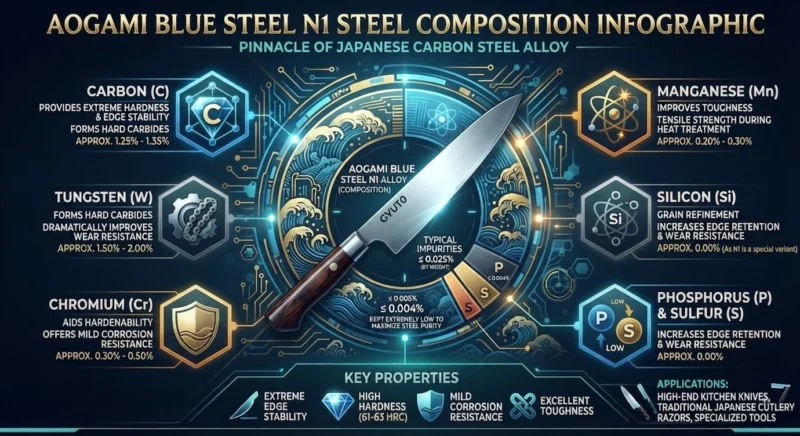
Aogami Blue Steel N1 Steel Composition
Aogami #1 is a high-carbon Japanese steel.
Exact compositions can vary slightly depending on specification and manufacturer, but the steel is characterized by approximately:
- Carbon: around 1.25–1.35%
- Chromium: around 0.3–0.5%
- Tungsten: around 1.5–2.0%
- Iron: balance
The exact chemistry should always be confirmed from the steel manufacturer’s current specification when precise composition is important.
The combination of high carbon, tungsten, and chromium gives Aogami #1 its characteristic performance.
Why Carbon Matters
Carbon is one of the most important elements in knife steel.
Higher carbon content can allow the steel to form a greater amount of hard martensitic structure after appropriate heat treatment.
Carbon also contributes to carbide formation.
In practical terms, this can translate into:
- High attainable hardness
- Excellent edge stability
- Strong wear resistance
- Good edge retention
- Ability to take a very fine edge
But higher carbon also comes with disadvantages.
Aogami N1 is not stainless steel.
It can develop:
- Patina
- Dark discoloration
- Surface oxidation
- Rust if neglected
Therefore, this steel is best suited to users who appreciate traditional carbon-steel maintenance.
Check Our Guide Carbon Steel Myths
Why Is It Called Blue Steel?
The name “Blue Steel” can be confusing because the steel itself is not blue.
Aogami refers historically to the colored paper used to identify the steel product.
The main grades are generally referred to as:
- Blue #1
- Blue #2
- Blue Super
The corresponding white steels include:
- White #1
- White #2
The naming system therefore describes traditional steel grades rather than the physical color of a finished knife blade.
| Steel | Carbon | Hardness potential | Edge retention | Toughness | Reactivity |
|---|---|---|---|---|---|
| Aogami #1 | High | Very high | Excellent | Moderate | High |
| Aogami #2 | High | High | Excellent | Good | High |
| Aogami Super | Very high | Very high | Excellent | Good | High |
Aogami #1 vs Aogami #2
One of the most common questions is how Blue #1 differs from Blue #2.
The primary difference is carbon content.
Aogami #1 contains more carbon than Aogami #2.
This can allow Blue #1 to reach higher hardness and potentially provide greater edge retention when heat treated properly.
Aogami #2, however, is extremely capable and is often preferred by makers who want a slightly more forgiving balance.
Aogami #1
Typical characteristics:
- Higher carbon content
- Very high achievable hardness
- Excellent edge retention
- Excellent fine-edge capability
- High wear resistance for a traditional carbon steel
- Reactive
- More demanding than stainless steels
Aogami #2
Typical characteristics:
- Slightly lower carbon content
- Excellent hardness
- Excellent edge retention
- Very good toughness for its hardness
- Reactive
- Excellent sharpening characteristics
Neither steel is universally “better.”
Aogami #1 is attractive when maximum edge performance is the priority.
Aogami #2 can be attractive when the maker wants a somewhat more balanced combination of hardness, toughness, and sharpening behavior.
Aogami N1 vs Shirogami
Aogami and Shirogami are often compared because both are traditional Japanese carbon steels.
Shirogami, or White Paper Steel, is generally characterized by extremely high purity and a relatively simple alloy composition.
Aogami adds alloying elements such as tungsten and chromium.
This changes its behavior.
Shirogami
White steels are famous for:
- Extremely clean sharpening response
- Very fine edges
- Excellent cutting feel
- High achievable hardness
- Relatively simple metallurgy
Aogami
Blue steels generally offer:
- Greater wear resistance
- Longer edge retention
- More alloying
- More complex carbide structure
- Excellent high-performance cutting
For a chef who loves sharpening and wants an exceptionally responsive traditional carbon steel, Shirogami can be fascinating.
For someone who wants longer-lasting edge performance between sharpening sessions, Aogami N1 is particularly attractive.
Aogami N1 vs Aogami Super
Aogami Super is another famous Japanese carbon steel.
It is closely related to the Blue steel family but contains additional alloying that gives it a different balance of properties.
Aogami Super is particularly famous for combining high hardness with good toughness.
Aogami #1 is often selected for its very high carbon content and excellent edge performance.
The actual difference between two knives may be less dramatic than expected because heat treatment and geometry can have a much larger influence than steel designation alone.
A well-made Aogami #1 knife can be outstanding.
A well-made Aogami Super knife can also be outstanding.
The choice should therefore consider the individual knife rather than only the steel name.
Aogami N1 Hardness
Hardness is one of the defining characteristics of Aogami #1.
A properly heat-treated Aogami N1 kitchen knife can commonly be found around 61–64 HRC, although actual hardness depends on the maker’s heat-treatment process and intended use.
Some makers may target different hardness levels.
The important point is that Aogami #1 is capable of very high hardness.
Why High HRC Matters
Hardness can improve:
- Edge stability
- Wear resistance
- Edge retention
- Resistance to deformation
A harder blade can maintain a fine edge under demanding cutting conditions.
However, higher hardness is not automatically better.
As hardness increases, toughness can decrease.
That means a very hard knife may be more susceptible to chipping if it is abused.
This is particularly relevant for Japanese kitchen knives with thin geometry.
Check Our Guide What Is HRC? Understanding Rockwell Hardness in Kitchen Knives
Hardness vs Toughness
Hardness and toughness are not the same property.
Hardness describes resistance to deformation and wear.
Toughness describes resistance to cracking and fracture.
A very hard knife can have excellent edge retention while still being relatively vulnerable to impacts.
This is why an Aogami N1 knife should not be treated like a heavy-duty cleaver.
Avoid:
- Bones
- Frozen food
- Hard shells
- Twisting cuts
- Forceful lateral movements
- Cutting directly on hard surfaces
For a deeper explanation, see our guide to wear resistance vs toughness
Aogami N1 Edge Retention
Edge retention is one of the major reasons knife enthusiasts choose Blue #1.
Its high carbon content and alloying elements allow it to achieve excellent wear resistance for a traditional Japanese carbon steel.
When properly heat treated, an Aogami N1 blade can remain sharp through extensive food preparation.
However, edge retention is not determined by steel alone.
A knife’s geometry is extremely important.
A very thin blade with a fine edge may cut more efficiently but can also be more delicate.
A thicker blade with a more robust edge may sacrifice some cutting performance for greater durability.
Therefore, comparing steels only by their names can be misleading.
Aogami N1 Edge Geometry
The edge geometry of a knife determines how it interacts with food.
Aogami N1 is particularly well suited to thin, high-performance kitchen knives.
Possible applications include:
- Gyuto
- Santoku
- Nakiri
- Petty knives
- Bunka
- Kiritsuke
- Yanagiba
- Deba
- Traditional Japanese blades
The correct geometry depends on the knife’s purpose.
A thin vegetable knife can use a very refined edge.
A heavy deba needs a completely different geometry.
The steel does not determine the geometry by itself.
Is Aogami N1 Stainless?
No.
Aogami N1 is a carbon steel, not a stainless steel.
This is one of the most important things to understand before purchasing an Aogami N1 knife.
The blade can develop a natural patina through normal use.
Patina is a controlled surface oxidation that changes the appearance of the steel.
It may appear:
- Gray
- Blue-gray
- Purple
- Brown
- Dark gray
- Almost black
A patina is not necessarily a problem.
In fact, many carbon-steel knife owners appreciate the unique appearance that develops over time.
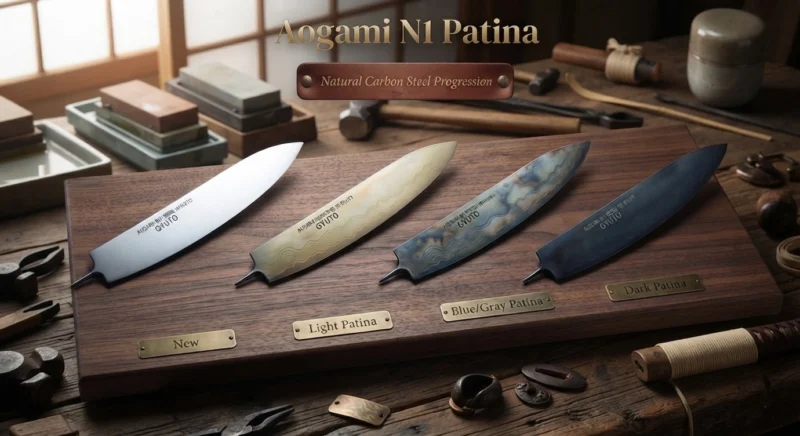
Aogami N1 Patina
Patina is one of the distinctive characteristics of traditional Japanese carbon knives.
When food acids and moisture react with the steel, the surface changes chemically.
Ingredients such as:
- Onions
- Citrus
- Tomatoes
- Apples
- Vinegar
- Fish
- Other acidic foods
can accelerate patina formation.
A controlled patina can provide some additional resistance to further surface oxidation.
However, patina should not be confused with active rust.
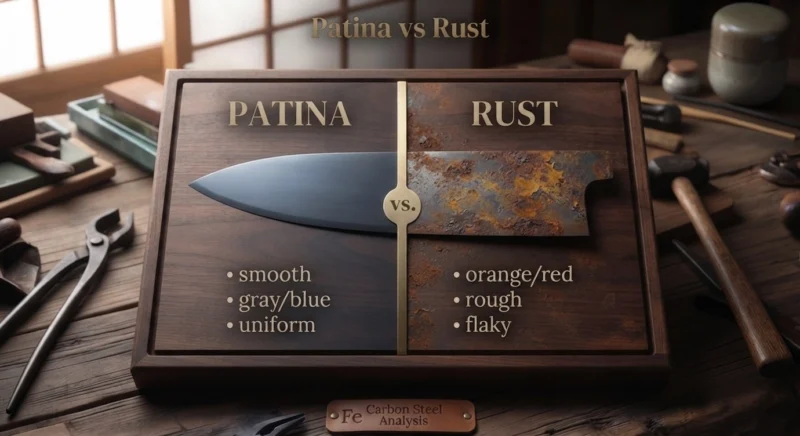
Patina vs Rust
The difference is important.
Patina
Usually:
- Smooth
- Thin
- Relatively uniform
- Gray, blue, purple, or dark
Rust
Usually:
- Orange or reddish
- Rough
- Powdery or flaky
- Progressive
Rust should be removed and the knife dried thoroughly.
The best way to prevent rust is simple:
Keep the blade clean and dry.
How to Maintain an Aogami N1 Knife
Maintenance is straightforward once it becomes a habit.
After using the knife:
- Rinse or wipe away food residue.
- Wash the blade with mild dish soap when necessary.
- Dry immediately.
- Do not leave the knife soaking in water.
- Store it somewhere dry.
- Apply a thin layer of food-safe mineral oil for longer-term storage.
Do not place a carbon-steel knife in a dishwasher.
The combination of heat, moisture, detergents, and contact with other objects can damage both the blade and handle.
Aogami N1 and Food Acidity
Acidic foods can accelerate patina development.
This is not necessarily a reason to avoid tomatoes, citrus, or onions.
Instead, simply wipe the blade regularly during preparation.
If you are cutting highly acidic ingredients for an extended period, clean and dry the blade afterward.
Over time, the steel will develop its own appearance.
Many owners consider this part of the character of a carbon-steel knife.
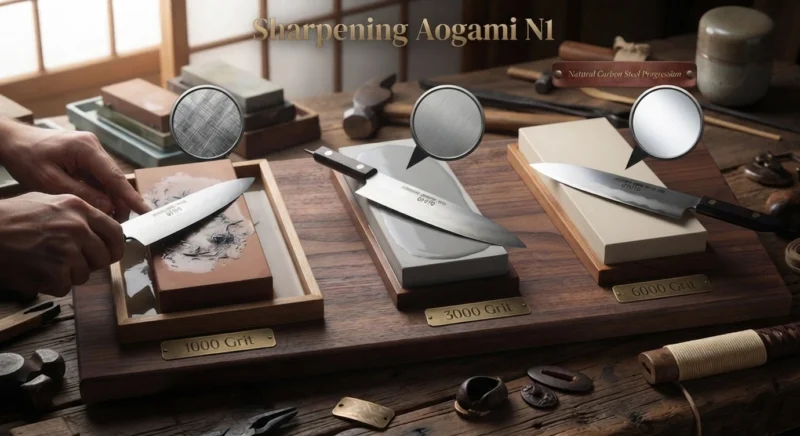
Sharpening Aogami N1
Aogami #1 is famous for its excellent sharpening behavior.
Despite its high hardness, it can respond very well to quality water stones.
A typical progression might include:
- Coarse stone for repairs
- Medium stone for establishing the edge
- Fine stone for refinement
- Polishing stone for an extremely refined edge
The exact progression depends on the knife and desired edge.
For routine maintenance, a medium-to-fine stone is often sufficient.
Check Our Guide All Kinds of Knife Sharpening Tools
What Sharpening Stones Work Best?
Water stones are particularly well suited to Japanese carbon steels.
Common combinations include:
- 800–1000 grit for establishing an edge
- 2000–3000 grit for refinement
- 4000–6000 grit for polishing
- Higher grits for specialized finishing
There is no need to use an extremely high grit for every kitchen knife.
A 3000–6000 grit finishing edge can be exceptionally effective for kitchen work.
The ideal finish depends on the food and cutting style.
Aogami N1 and Stropping
Stropping can refine the edge after sharpening.
A leather strop can remove small burr remnants and improve the final feel of the edge.
However, excessive stropping can round a very fine apex.
For a high-performance Aogami N1 knife, controlled stropping is preferable to aggressive polishing.
Aogami N1 and Edge Angles
There is no single perfect sharpening angle.
The appropriate angle depends on:
- Blade thickness
- Edge geometry
- Knife type
- Hardness
- Cutting style
- Intended ingredients
A thin gyuto may perform beautifully with a relatively acute edge.
A heavy deba should use a more robust geometry.
The best approach is to follow the maker’s intended geometry whenever possible.
Aogami N1 for Gyuto Knives
Gyuto knives are among the best applications for Aogami N1.
A gyuto combines:
- Thin geometry
- Long cutting edge
- Versatility
- Excellent slicing ability
- Rocking and push-cutting capability
Aogami N1 can provide a gyuto with exceptional edge stability and retention.
A well-made Blue #1 gyuto can be an outstanding tool for:
- Vegetables
- Meat
- Fish
- Herbs
- General kitchen preparation
Because the steel is reactive, the owner must be comfortable with carbon-steel maintenance.
Aogami N1 for Nakiri Knives
Nakiri knives are specialized Japanese vegetable knives.
They often have very thin edges and excellent food-release characteristics.
Aogami N1 is particularly attractive for nakiri because the steel can support a hard, refined edge.
A properly sharpened Blue #1 nakiri can glide through vegetables with minimal resistance.
This combination is especially attractive to cooks who value precise vegetable preparation.
Aogami N1 for Santoku Knives
Santoku knives are general-purpose Japanese kitchen knives.
They are commonly used for:
- Vegetables
- Meat
- Fish
Aogami N1 provides the hardness and edge retention necessary for a high-performance santoku.
However, the user should understand that a hard carbon-steel santoku is not designed for rough treatment.
Avoid twisting the blade inside food.
Aogami N1 for Petty Knives
Petty knives are small Japanese utility knives.
They are useful for:
- Small vegetables
- Fruit
- Garlic
- Herbs
- Precision cutting
Aogami N1 works particularly well in this format because the small blade can be maintained easily.
A carbon-steel petty knife can become an extremely useful precision tool.
Check Our Guide Why Every Home Cook Needs a Petty Knife
Aogami N1 for Kiritsuke and Bunka Knives
Kiritsuke and bunka knives combine precision cutting with distinctive Japanese blade geometry.
Their pointed profiles are useful for:
- Fine vegetable work
- Garnishing
- Protein preparation
- Precision slicing
Aogami N1 can provide excellent edge performance in these designs.
However, the pointed tip should be treated carefully.
Never use it as a lever or pry tool.
Aogami N1 for Yanagiba
Yanagiba knives are specialized Japanese slicing knives traditionally associated with sashimi preparation.
They require extremely refined edges and precise sharpening.
Aogami steels are commonly used in traditional Japanese sushi knives because they can achieve excellent sharpness and edge retention.
For sashimi preparation, the condition of the edge is particularly important.
A properly sharpened carbon-steel yanagiba can produce exceptionally clean slices.
Aogami N1 for Deba Knives
Deba knives are heavy Japanese fish-processing knives.
They are designed for tasks that are more demanding than those performed by a typical gyuto.
However, even a deba should not be used indiscriminately through hard bones.
Aogami N1 can provide an excellent deba when properly heat treated.
The edge geometry should match the intended fish-processing technique.
Check Our Guide Japanese Fish Knives
Aogami N1 for Seafood Preparation
Aogami N1 is particularly interesting for seafood preparation.
Its ability to maintain a fine edge makes it useful for:
- Fish slicing
- Filleting
- Sashimi preparation
- Precision seafood cutting
However, seafood can contain moisture and salt that accelerate corrosion.
This makes cleaning especially important.
After preparing fish or seafood, wipe and dry the blade thoroughly.
For a complete guide to seafood cutting techniques, see our How to Prepare and Cut Seafood guide
Aogami N1 vs Stainless Steel
The biggest practical difference is maintenance.
Aogami N1
- Excellent edge retention
- Very high hardness
- Excellent sharpening response
- Can develop patina
- Requires drying
- Can rust
Stainless Steel
- Better corrosion resistance
- Easier maintenance
- Usually more forgiving for busy kitchens
- Wide range of hardness and edge performance
A stainless steel knife is not automatically inferior.
Modern stainless and powder steels can provide exceptional performance.
The choice is primarily about priorities.
Choose Aogami N1 if you appreciate traditional carbon-steel performance and do not mind maintenance.
Choose stainless steel if corrosion resistance and convenience are more important.
Aogami N1 vs VG10
VG10 is one of the best-known Japanese stainless kitchen knife steels.
Compared with Aogami N1, VG10 offers much better corrosion resistance.
Aogami N1 generally offers a more traditional carbon-steel sharpening and cutting experience.
VG10 is often easier for everyday users because it requires less maintenance.
For a user who enjoys maintaining knives and wants maximum traditional carbon-steel character, Blue #1 is extremely attractive.
For a busy kitchen where knives are frequently exposed to moisture, VG10 may be more convenient.
Check Our Guide VG10 Steel Review: Pros, Cons, Edge Retention, Toughness & Real-World Performance
Aogami N1 vs AUS-8
AUS-8 is a relatively tough stainless steel commonly used in affordable and mid-range kitchen knives.
It is considerably easier to maintain than Aogami N1.
However, Aogami N1 is capable of substantially higher hardness and greater edge performance when properly heat treated.
The tradeoff is maintenance and potentially greater edge fragility.
Check Our Guide AUS-8 Steel Review: Pros, Cons, Edge Retention, Toughness
Aogami N1 vs 440C
440C is a stainless steel known for relatively high hardness and good wear resistance.
It offers significantly better corrosion resistance than Aogami N1.
However, the two steels have very different personalities.
Aogami N1 is a traditional Japanese carbon steel designed around fine edge performance.
440C is a stainless alloy offering corrosion resistance and useful wear resistance.
Neither is universally better.
Check Our Guide 440C Steel Review: Is 440C Still a Good Knife Steel
Aogami N1 vs M390
M390 is a modern powder metallurgy stainless steel with extremely high wear resistance.
Compared with Aogami N1, M390 offers:
- Excellent corrosion resistance
- Extremely high wear resistance
- Long edge retention
- Modern powder-steel metallurgy
Aogami N1 offers:
- Traditional carbon-steel character
- Excellent sharpening response
- High hardness
- Fine edge capability
- Natural patina
For users who want maximum corrosion resistance and wear resistance, M390 is attractive.
For traditional Japanese knife enthusiasts, Blue #1 remains compelling.
Check Our Guide M390 Steel Review: Pros, Cons, Edge Retention, Toughness
Aogami N1 vs ELMAX
ELMAX is another high-performance powder stainless steel.
It offers an excellent balance of:
- Wear resistance
- Toughness
- Corrosion resistance
- Edge retention
Aogami N1 is more reactive and requires more maintenance.
The choice therefore comes down to whether you prefer modern stainless performance or traditional carbon-steel behavior.
Check Our Guide ELMAX Steel Review
Aogami N1 vs 1095
1095 is a simple high-carbon steel widely used in knives and tools.
Both steels are reactive.
However, Aogami N1 contains additional alloying elements and is designed for high-performance Japanese tool applications.
A properly heat-treated Blue #1 kitchen knife can achieve excellent hardness and edge retention.
1095 is often appreciated for simplicity, toughness, ease of sharpening, and affordability.
Aogami N1 Toughness
Toughness is an area where users need to be realistic.
A very hard Aogami N1 knife is not a heavy-duty abuse tool.
Thin Japanese knives should be used with controlled technique.
Avoid:
- Frozen food
- Bones
- Hard shells
- Twisting
- Prying
- Cutting on glass
- Cutting on stone
- Excessive lateral pressure
Use the knife for the job it was designed to perform.
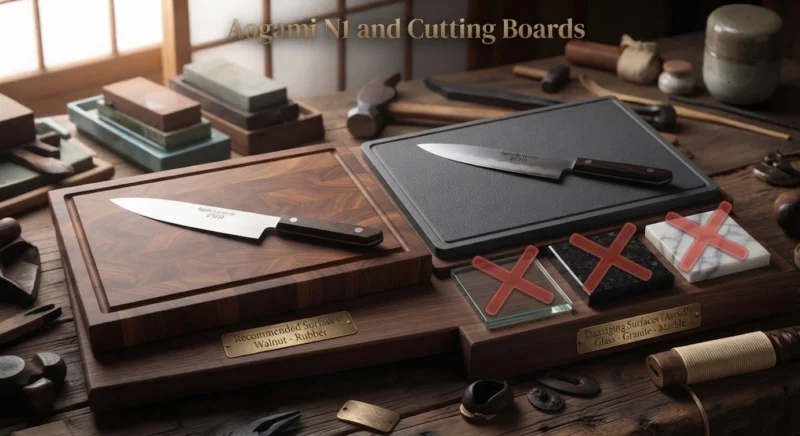
Aogami N1 and Cutting Boards
The cutting surface can have a major influence on edge life.
A very hard board can damage a fine edge.
For Aogami N1, excellent choices include:
- Walnut
- Cherry
- Maple
- Rubber
- Quality HDPE
Avoid:
- Glass
- Granite
- Marble
- Ceramic cutting surfaces
A soft, stable cutting board helps preserve the refined edge of a hard Japanese carbon-steel knife.
For a detailed comparison of board materials, see our Complete Guide to Cutting Boards
Aogami N1 Knife Care Checklist
For daily use:
- Keep the blade dry.
- Wipe the blade during acidic food preparation.
- Wash by hand.
- Dry immediately.
- Use an appropriate cutting board.
- Avoid bones and hard shells.
- Store safely.
- Sharpen with quality stones.
- Monitor the edge regularly.
- Oil the blade when storing for extended periods.
This simple routine can keep an Aogami N1 knife performing beautifully for many years.
Common Mistakes With Aogami N1
Mistake 1: Treating It Like Stainless Steel
Aogami N1 will react to moisture.
Never leave it wet.
Mistake 2: Cutting Hard Materials
High hardness does not mean the knife can cut everything.
Avoid bones, frozen products, and hard shells.
Mistake 3: Using a Glass Cutting Board
The hard surface can quickly degrade a fine edge.
Mistake 4: Ignoring the Patina
A gray or blue patina is generally normal.
Do not mistake every discoloration for rust.
Mistake 5: Sharpening Too Aggressively
A very hard knife still benefits from controlled sharpening.
Removing unnecessary amounts of steel shortens the knife’s life.
Mistake 6: Using Excessive Force
Sharp knives should cut through food with controlled technique.
If you need excessive force, check the edge, geometry, and cutting method.
Who Should Buy an Aogami N1 Knife?
Aogami N1 is an excellent choice for users who:
- Appreciate Japanese knives
- Want very high hardness
- Value edge retention
- Enjoy sharpening
- Prefer traditional carbon steel
- Do not mind patina
- Are willing to wipe and dry the blade
- Want an extremely fine edge
It may not be ideal for users who:
- Want completely maintenance-free knives
- Frequently leave knives wet
- Put knives in a dishwasher
- Work with very hard ingredients
- Want maximum corrosion resistance
Is Aogami N1 Good for Beginners?
It can be, but it requires more care than stainless steel.
A beginner who is willing to learn proper knife maintenance can absolutely use Blue #1.
The most important habits are simple:
Keep it dry.
Use the correct cutting board.
Do not abuse the edge.
Learn basic sharpening.
Once those habits become routine, maintaining an Aogami N1 knife is not particularly difficult.
Is Aogami N1 Worth It?
For the right user, yes.
The appeal of Aogami #1 is not simply its chemical composition.
It is the combination of:
- High carbon content
- High achievable hardness
- Excellent edge retention
- Fine edge capability
- Traditional Japanese craftsmanship
- Excellent sharpening response
- Unique patina development
A modern stainless powder steel may outperform it in certain categories.
But performance is not the only reason people buy traditional Japanese carbon knives.
There is also the experience of using, sharpening, maintaining, and gradually developing the character of the blade.
Final Verdict: Aogami Blue Steel N1
Aogami Blue Steel N1 is a high-performance traditional Japanese carbon steel designed for demanding cutting applications.
Its high carbon content allows it to achieve very high hardness, while its chromium and tungsten additions contribute to wear resistance and overall performance.
A properly heat-treated Aogami N1 kitchen knife can offer:
- Exceptional sharpness
- Excellent edge retention
- High edge stability
- Excellent sharpening response
- Outstanding fine-edge performance
Its main disadvantages are equally clear:
- It is reactive.
- It can rust.
- It requires drying.
- It can be less forgiving than tougher steels.
- It should not be abused.
For Japanese kitchen knives such as gyuto, nakiri, santoku, bunka, kiritsuke, yanagiba, and other traditional blades, Aogami N1 can be an exceptional choice.
The most important thing to remember is that steel alone does not make a great knife.
Heat treatment, hardness, geometry, blade thickness, grind, edge angle, sharpening, and cutting technique all work together.
A beautifully made Aogami N1 knife with excellent geometry can provide an extraordinary cutting experience.
For the knife enthusiast who enjoys traditional Japanese carbon steel, wants a highly refined edge, and does not mind regular maintenance, Aogami #1 remains one of the most interesting steels available for premium kitchen knives.
This article is for independent informational purposes only and is not affiliated with, sponsored by, or endorsed by any steel manufacturer. All product names, trademarks, and registered trademarks are the property of their respective owners.