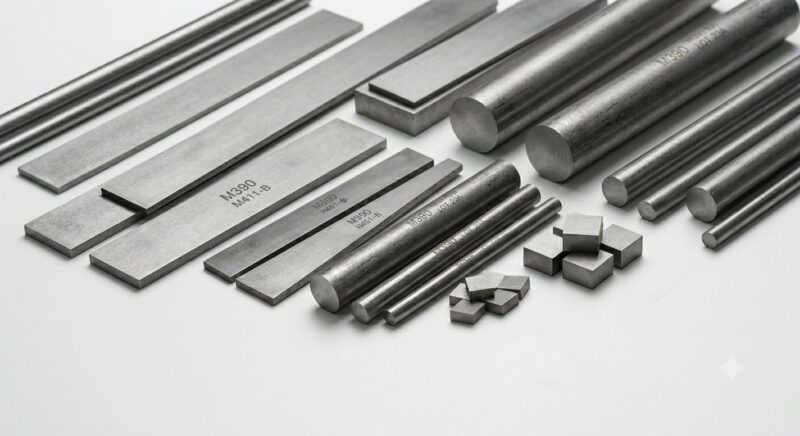
M390 Steel Review
An Independent Guide
Introduction
When discussing premium knife steels, few names generate as much attention as M390. M390 has become one of the most respected stainless steels in the knife industry and is often considered a benchmark for modern high-performance blade materials.
Over the past decade, M390 has appeared in countless premium folding knives, hunting knives, custom blades, and high-end everyday carry (EDC) knives. Knife enthusiasts frequently praise its outstanding edge retention, exceptional corrosion resistance, and excellent wear resistance.
Many manufacturers market M390 as a “super steel” capable of outperforming traditional stainless steels such as 440C, AUS-8, VG10, and even D2. But does it truly deserve its reputation?
In this comprehensive M390 steel review, we’ll examine its chemical composition, performance characteristics, advantages, disadvantages, ideal applications, comparisons with competing steels, and whether M390 remains one of the best knife steels available today.
Quick Answer
M390 is a premium powder metallurgy stainless steel known for exceptional edge retention, excellent corrosion resistance, high wear resistance, and outstanding overall performance. It is widely regarded as one of the best all-around stainless knife steels available.
What Is M390 Steel?
M390 is a third-generation powder metallurgy steel.
Unlike conventional steels that are poured and solidified through traditional methods, M390 is produced using powder metallurgy technology.
This process creates:
- Extremely fine carbide distribution
- Improved steel uniformity
- Better wear resistance
- Enhanced toughness
- Superior edge stability
M390 was originally developed for industrial applications requiring extreme wear resistance and corrosion resistance. Knife manufacturers quickly recognized its potential and began using it in premium blades.
Today, M390 is commonly found in:
- High-end folding knives
- Premium EDC knives
- Hunting knives
- Custom knives
- Collector knives
Why Is M390 Called a Super Steel?
The term “super steel” is not an official metallurgical classification.
However, knife enthusiasts often use it to describe steels that combine:
- Exceptional edge retention
- High wear resistance
- Excellent corrosion resistance
- Advanced manufacturing methods
M390 qualifies because it excels in nearly every major performance category.
Unlike many steels that sacrifice one characteristic to improve another, M390 offers remarkable balance.
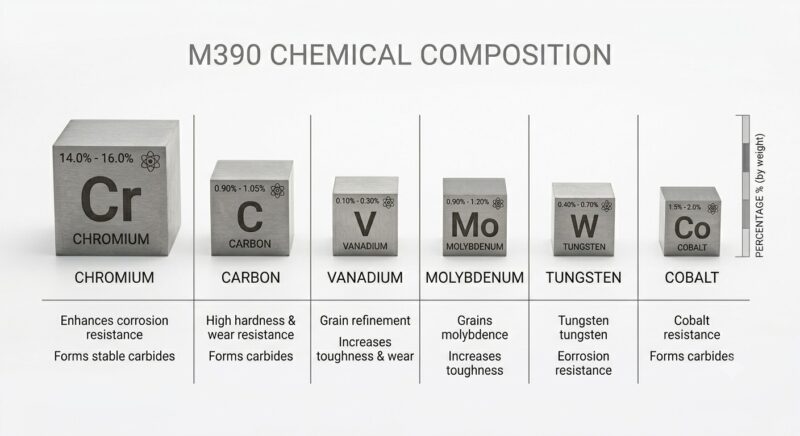
M390 Chemical Composition
M390’s performance begins with its sophisticated alloy composition.
| Element | Percentage |
|---|---|
| Carbon | 1.90% |
| Chromium | 20.00% |
| Vanadium | 4.00% |
| Molybdenum | 1.00% |
| Tungsten | 0.60% |
| Manganese | 0.30% |
| Silicon | 0.70% |
This combination creates a steel capable of delivering extraordinary cutting performance.
Carbon
M390 contains approximately 1.9% carbon.
Benefits include:
- Increased hardness
- Improved wear resistance
- Better edge retention
Chromium
At around 20% chromium, M390 offers outstanding corrosion resistance.
Benefits include:
- Rust resistance
- Stain resistance
- Durability in humid environments
Vanadium
Vanadium plays a major role in M390’s reputation.
Benefits include:
- Increased wear resistance
- Fine grain structure
- Improved edge stability
Molybdenum
Molybdenum contributes:
- Corrosion resistance
- Strength
- Toughness
Tungsten
Tungsten improves:
- Hardness
- Wear resistance
- Edge retention
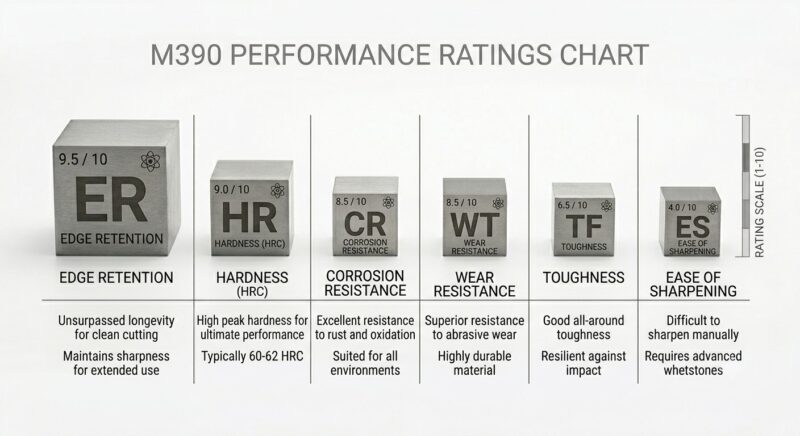
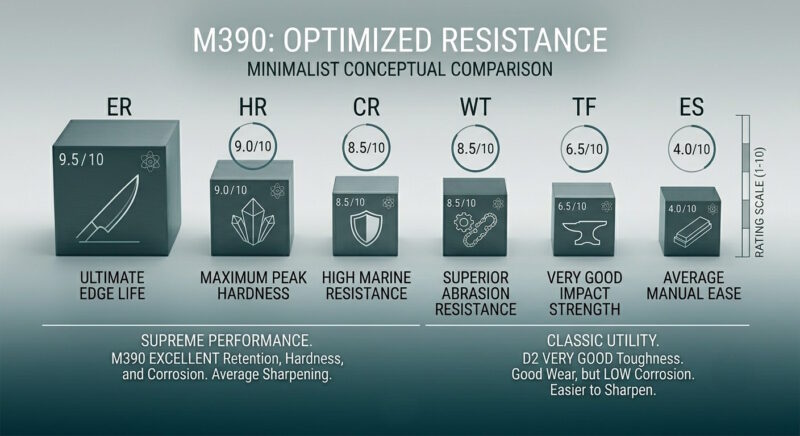
M390 Steel Performance Ratings
| Property | Rating |
| Edge Retention | ★★★★★ |
| Corrosion Resistance | ★★★★★ |
| Wear Resistance | ★★★★★ |
| Toughness | ★★★★☆ |
| Ease of Sharpening | ★★★☆☆ |
| Overall Value | ★★★★★ |
Few steels score this consistently across all categories.
Hardness (HRC)
Most M390 knives are heat treated between:
60–62 HRC
Premium manufacturers often push M390 to:
62–64 HRC
At these hardness levels, M390 delivers exceptional edge retention while maintaining good toughness.
Proper heat treatment is critical.
A well-treated M390 blade can significantly outperform poorly heat-treated alternatives.
Edge Retention
Edge retention is arguably M390’s greatest strength.
The combination of:
- High carbon content
- Vanadium carbides
- Powder metallurgy structure
allows M390 to maintain sharpness for extended periods.
Compared to steels such as:
- 440C
- AUS-8
- VG10
- 1095
M390 generally retains a working edge much longer.
This makes it highly attractive for users who prefer minimal maintenance.
Hunters, EDC enthusiasts, and professionals often appreciate how long M390 stays sharp under demanding use.
Corrosion Resistance
M390 is one of the most corrosion-resistant knife steels available.
Its chromium content approaches levels typically associated with industrial stainless steels.
Benefits include:
- Excellent rust resistance
- Superior stain resistance
- Low maintenance requirements
M390 performs exceptionally well in:
- Humid climates
- Coastal environments
- Food preparation
- Outdoor applications
For users seeking premium stainless performance, M390 is difficult to beat.
Wear Resistance
Wear resistance measures how well a steel resists abrasion and edge degradation.
M390 excels in this category.
Its large volume of hard carbides allows it to maintain cutting performance through extensive use.
Benefits include:
- Longer edge life
- Reduced sharpening frequency
- Consistent cutting performance
This is one reason why many collectors and enthusiasts consider M390 a premium steel worth the investment.
Toughness
Toughness refers to a steel’s ability to resist chipping and fracture.
M390 offers respectable toughness, especially considering its hardness and wear resistance.
While it is not as tough as steels such as:
- MagnaCut
- CPM CruWear
- 1095
it remains more than adequate for most knife applications.
Proper heat treatment plays a significant role in determining real-world toughness.
Most users experience excellent durability during normal cutting tasks.
Ease of Sharpening
Every advantage comes with a trade-off.
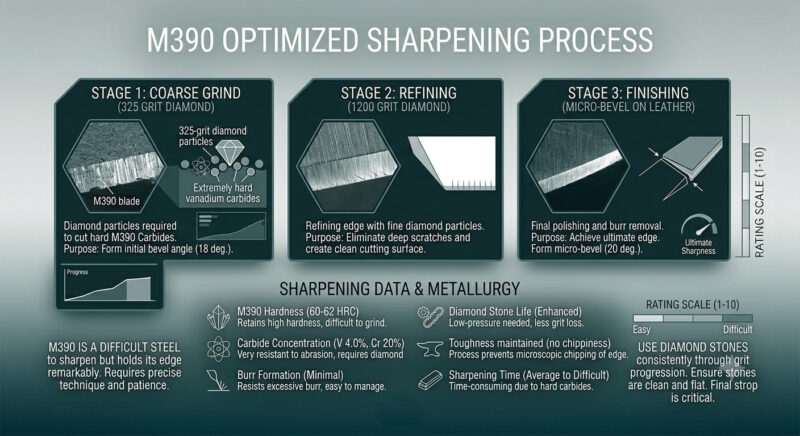
The same carbides that provide M390’s excellent wear resistance also make sharpening more challenging.
Compared to steels like:
- AUS-8
- 440C
- 1095
- VG10
M390 requires more time and effort to sharpen.
Diamond stones or high-quality ceramic systems often produce the best results.
However, many users accept this trade-off because sharpening is needed far less frequently.
M390 in EDC Knives
Everyday Carry (EDC) knives are arguably where M390 shines brightest.
Most EDC users need a knife that can handle:
- Opening packages
- Cutting rope
- Food preparation
- Utility work
- Daily tasks
without requiring frequent sharpening.
M390 excels in this role because of its outstanding wear resistance and edge retention.
Many premium EDC manufacturers offer M390 versions of their flagship models because customers appreciate:
- Long-lasting sharpness
- Excellent corrosion resistance
- Premium performance
- High resale value
For serious EDC enthusiasts, M390 remains one of the most desirable blade steels available.
M390 in Hunting Knives
Hunters often demand a knife capable of processing an entire animal without losing its edge.
This is one area where M390 performs exceptionally well.
Benefits include:
- Excellent edge retention
- Corrosion resistance
- Low maintenance
- Consistent cutting performance
When field dressing large game, M390 can often complete the job without requiring touch-ups.
This advantage becomes especially valuable during extended hunting trips.
M390 in Outdoor Knives
Outdoor users appreciate steels that resist:
- Moisture
- Dirt
- Food acids
- Weather exposure
M390 handles these conditions extremely well.
Common outdoor applications include:
- Camping knives
- Hiking knives
- General utility blades
While some users prefer tougher steels for extreme bushcraft tasks, M390 performs admirably for most outdoor applications.
M390 in Kitchen Knives
Although less common than VG10 or SG2, M390 is increasingly appearing in premium kitchen knives.
Advantages include:
- Exceptional edge retention
- High corrosion resistance
- Fine cutting performance
- Reduced sharpening frequency
Professional chefs who value long-lasting sharpness often appreciate M390’s performance.
The downside is that sharpening requires more effort compared to traditional kitchen knife steels.
🔪 Looking for a Professional-Grade Chef Knife?
M390 vs VG10
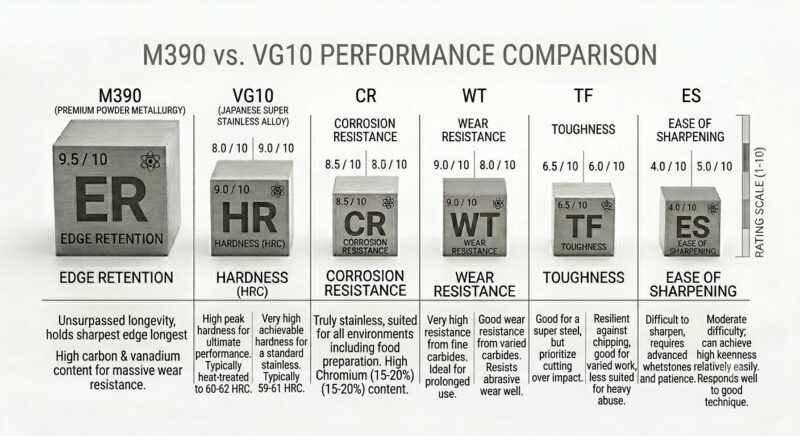
VG10 is one of the most popular Japanese knife steels.
Edge Retention
M390 clearly wins.
Corrosion Resistance
Both perform extremely well.
Toughness
Comparable depending on heat treatment.
Sharpening
VG10 is easier to sharpen.
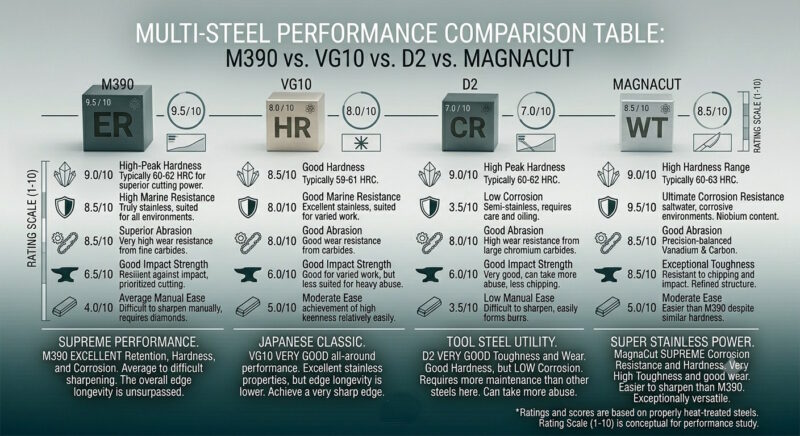
| Property | M390 | VG10 |
|---|---|---|
| Edge Retention | Excellent | Very Good |
| Corrosion Resistance | Excellent | Excellent |
| Toughness | Good | Good |
| Sharpening | Difficult | Moderate |
Overall winner: M390
Check Our Guide VG10 Steel Review
M390 vs D2
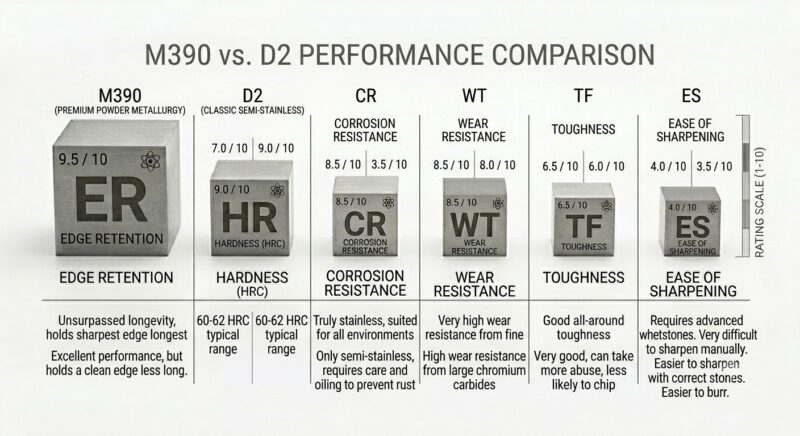
D2 remains one of the most widely used tool steels in the knife industry.
Edge Retention
M390 generally performs better.
Corrosion Resistance
M390 wins by a large margin.
Toughness
Comparable.
Maintenance
M390 requires less maintenance.
| Property | M390 | D2 |
| Edge Retention | Excellent | Very Good |
| Corrosion Resistance | Excellent | Moderate |
| Toughness | Good | Good |
| Sharpening | Difficult | Moderate |
Overall winner: M390
Check Out Guide D2 Steel Review
M390 vs S35VN
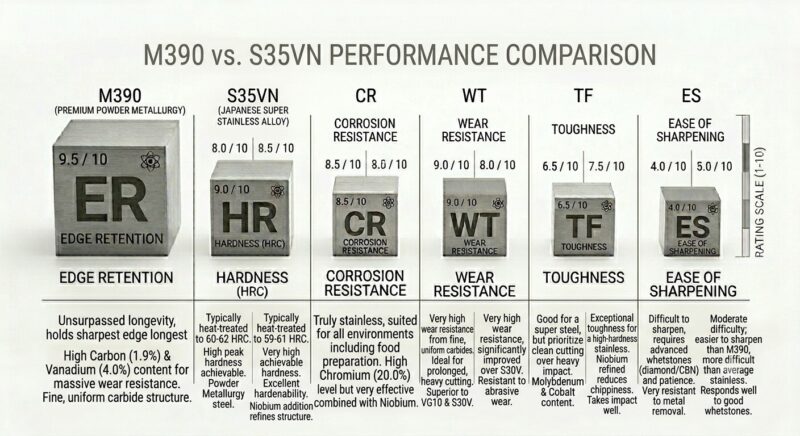
This comparison is extremely common among knife enthusiasts.
Edge Retention
M390 holds a slight advantage.
Toughness
S35VN often performs better.
Corrosion Resistance
Both are excellent.
Sharpening
S35VN is usually easier to sharpen.
| Property | M390 | S35VN |
| Edge Retention | Excellent | Very Good |
| Corrosion Resistance | Excellent | Excellent |
| Toughness | Good | Very Good |
| Sharpening | Difficult | Moderate |
Neither steel dominates completely.
The choice often depends on personal priorities.
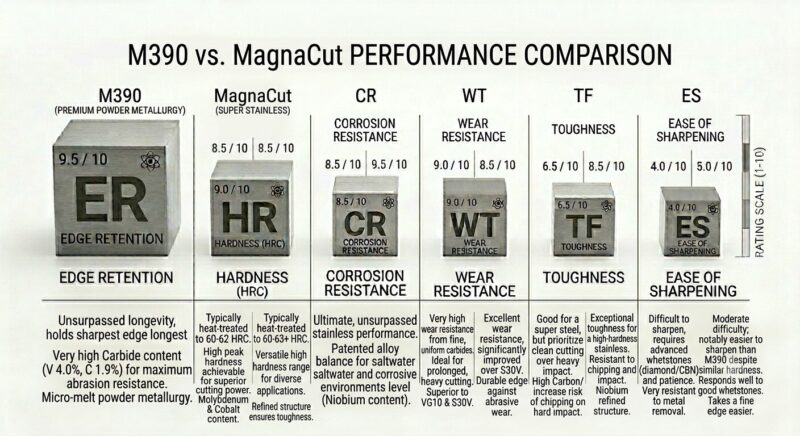
M390 vs MagnaCut
MagnaCut is frequently viewed as M390’s biggest competitor.
Edge Retention
Very close.
Corrosion Resistance
Both perform exceptionally well.
Toughness
MagnaCut generally wins.
Sharpening
MagnaCut is often easier to sharpen.
| Property | M390 | MagnaCut |
| Edge Retention | Excellent | Excellent |
| Corrosion Resistance | Excellent | Excellent |
| Toughness | Good | Excellent |
| Sharpening | Difficult | Moderate |
Overall winner for most users: MagnaCut
However, M390 remains one of the strongest alternatives available.
Check Our Guide What Is San Mai Steel?
Advantages of M390 Steel
Exceptional Edge Retention
M390 stays sharp longer than most traditional knife steels.
Outstanding Corrosion Resistance
Excellent performance in humid and wet environments.
Premium Wear Resistance
Designed to resist abrasion and edge wear.
High Value Retention
M390 knives often maintain strong resale value.
Excellent Overall Balance
Few steels perform this well across so many categories.
Disadvantages of M390 Steel
More Expensive
M390 knives generally cost significantly more than knives made from budget steels.
Difficult to Sharpen
The same carbides that provide wear resistance also increase sharpening difficulty.
Not the Toughest Steel
While durable, M390 is not ideal for extreme impact applications.
Requires Quality Heat Treatment
Poor heat treatment can significantly reduce performance.
Common Myths About M390
Myth #1: M390 Never Rusts
No steel is completely rust-proof.
While M390 is highly corrosion resistant, neglect can still cause staining.
Myth #2: M390 Never Needs Sharpening
Even the best steel eventually becomes dull.
M390 simply takes longer to reach that point.
Myth #3: M390 Is Indestructible
M390 is excellent, but misuse can still damage the blade.
Myth #4: M390 Is Only for Collectors
Many users rely on M390 as a practical everyday steel.
Real-World Performance
The reason M390 has become so popular is simple:
It delivers.
In daily use, M390 consistently provides:
- Long edge life
- Excellent rust resistance
- Reliable cutting performance
- Premium feel
Many knife enthusiasts consider M390 one of the safest choices when purchasing a high-end knife because it performs exceptionally well in nearly every category.
Its reputation is not based on marketing alone—it is supported by years of real-world use and testing.
Is M390 Steel Worth the Money?
For many knife enthusiasts, M390 represents the point where performance and practicality meet.
While there are newer steels on the market, M390 remains one of the most respected premium stainless steels because it delivers exceptional real-world performance.
The biggest advantages include:
- Extremely long edge life
- Outstanding corrosion resistance
- Excellent wear resistance
- Premium fit for high-end knives
- Proven reputation
The primary drawback is cost.
Knives made from M390 typically cost significantly more than comparable models made from:
- AUS-8
- 440C
- 14C28N
- D2
- 1095
However, many buyers feel the performance justifies the price.
If you value long-lasting sharpness and minimal maintenance, M390 is often worth the investment.
Who Should Buy M390?
M390 is an excellent choice for:
EDC Enthusiasts
If you carry a knife every day, M390 offers:
- Long edge retention
- Excellent corrosion resistance
- Premium performance
Hunters
Hunters benefit from:
- Extended cutting performance
- Low maintenance requirements
- Excellent durability
Outdoor Users
Campers and hikers often appreciate M390’s ability to resist rust and stay sharp.
Collectors
Many collectors actively seek M390 because it has become one of the most respected modern knife steels.
Professionals
Tradesmen and professionals who rely on cutting tools daily often appreciate the reduced sharpening frequency.
Who Should Consider Other Steels?
Despite its strengths, M390 is not ideal for everyone.
Choose MagnaCut If:
You want:
- Better toughness
- Similar corrosion resistance
- Comparable edge retention
Many consider MagnaCut the next evolution beyond M390.
Choose S35VN If:
You want:
- Easier sharpening
- Better toughness
- Lower cost
Choose VG10 If:
You want:
- Excellent kitchen performance
- Easier maintenance
- Better value
Choose 1095 If:
You prioritize:
- Toughness
- Simplicity
- Easy field sharpening
Choose D2 If:
You want:
- Strong edge retention
- Lower cost
- Good overall performance
Why Premium Knife Makers Love M390
Many of today’s leading manufacturers use M390 extensively.
Reasons include:
Customer Demand
M390 has become a recognized premium steel.
Many buyers specifically search for it.
Consistent Performance
Properly heat-treated M390 delivers predictable results.
Premium Market Positioning
M390 helps manufacturers position knives in the high-end segment.
Proven Reliability
Years of real-world testing have demonstrated its capabilities.
The Future of M390
The knife industry constantly evolves.
New steels such as:
- MagnaCut
- Vanax
- CPM S45VN
- CPM CruWear
continue to gain popularity.
Despite this competition, M390 remains highly relevant.
Its combination of:
- Wear resistance
- Corrosion resistance
- Edge retention
- Availability
ensures it will likely remain a major player for years to come.
Many enthusiasts still consider M390 one of the safest choices when purchasing a premium knife.
Final Verdict
M390 has earned its reputation as one of the finest stainless knife steels ever developed.
Its strengths include:
- Exceptional edge retention
- Outstanding corrosion resistance
- Excellent wear resistance
- Proven long-term performance
- Premium overall balance
Although newer steels such as MagnaCut may surpass M390 in specific categories, M390 remains one of the best all-around knife steels available.
For users seeking a premium blade capable of maintaining sharpness through extended use while resisting rust and corrosion, M390 remains an outstanding choice.
If your budget allows, an M390 knife is rarely a disappointing purchase.
It continues to represent one of the highest performance levels available in production and custom knives.
FAQ
Is M390 steel good for knives?
Yes. M390 is widely considered one of the best premium stainless knife steels because of its excellent edge retention, corrosion resistance, and wear resistance.
Is M390 a super steel?
Most knife enthusiasts consider M390 a super steel due to its advanced powder metallurgy manufacturing process and outstanding performance.
Does M390 rust?
M390 is highly corrosion resistant but is not completely immune to rust if neglected.
Is M390 better than D2?
Generally yes. M390 offers better corrosion resistance, wear resistance, and overall performance.
Is M390 better than VG10?
M390 usually provides superior edge retention and wear resistance, while VG10 is easier to sharpen.
Is M390 difficult to sharpen?
Yes. Compared to many traditional steels, M390 requires more effort and higher-quality sharpening equipment.
What hardness is M390?
Most M390 knives are heat treated between 60 and 64 HRC.
Is M390 good for hunting knives?
Absolutely. Its edge retention and corrosion resistance make it an excellent hunting steel.
M390 vs MagnaCut: Which is better?
MagnaCut generally offers better toughness while maintaining similar corrosion resistance and edge retention.
Is M390 worth the extra cost?
For users who value premium performance and long edge life, M390 is often worth the additional investment.
https://yashkadesigns.com/santoku-knives
https://yashkadesigns.ecrater.com/c/2444216/santoku-knives
This article is for independent informational purposes only and is not affiliated with, sponsored by, or endorsed by any steel manufacturer. All product names, trademarks, and registered trademarks are the property of their respective owners.