D2 Steel Review
An Independent Guide
Introduction
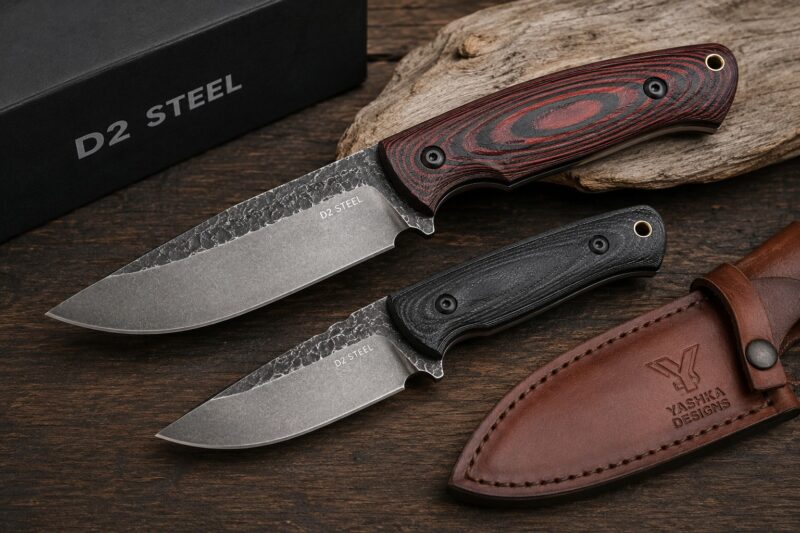
When knife enthusiasts discuss the best steels for hunting knives, bushcraft knives, EDC knives, and custom blades, D2 steel is almost always part of the conversation. For decades, D2 has maintained a reputation as one of the most practical high-performance steels available, offering an excellent balance of edge retention, toughness, wear resistance, and affordability.
Even with the arrival of modern powder metallurgy steels such as CPM S35VN, CPM MagnaCut, CPM 3V, and M390, D2 continues to be widely used by custom makers and production knife manufacturers around the world.
But what exactly is D2 steel? Why has it remained popular for so long? Is it still worth buying in 2026, or have newer steels completely replaced it?
In this comprehensive D2 steel review, we’ll examine its composition, performance, strengths, weaknesses, ideal applications, maintenance requirements, and whether it deserves a place in your knife collection.
🔪 Looking for a Professional-Grade D2 Steel Knife?
What Is D2 Steel?
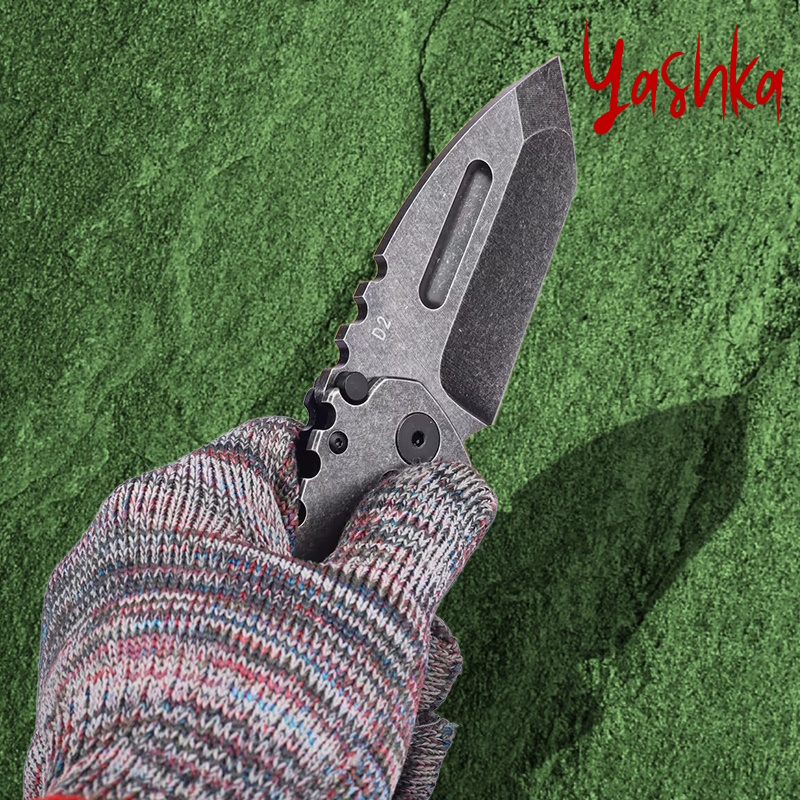
D2 is a high-carbon, high-chromium tool steel originally developed for industrial tooling applications.
It was designed to withstand heavy wear in manufacturing environments where cutting tools needed to retain sharpness for long periods.
Over time, knife makers discovered that the same characteristics that made D2 excellent for industrial tools also made it outstanding for knives.
Typical D2 composition:
- Carbon: 1.50%
- Chromium: 11–12%
- Vanadium: 0.80%
- Molybdenum: 0.90%
- Manganese: 0.60%
- Silicon: 0.60%
The exceptionally high carbon content allows D2 to achieve impressive hardness, while the chromium contributes to wear resistance and corrosion resistance.
Is D2 Stainless Steel?
This is one of the most common questions knife buyers ask.
Technically, D2 is not considered a true stainless steel.
Although it contains approximately 12% chromium, much of that chromium forms hard carbides rather than remaining free to protect the steel from rust.
Most experts classify D2 as a “semi-stainless” steel.
This means:
- More corrosion resistant than carbon steels
- Less corrosion resistant than stainless steels
- Requires basic maintenance
- Can develop patina or rust if neglected
For many users, this compromise is acceptable because D2 offers significantly better wear resistance than many stainless alternatives.
Why D2 Became So Popular
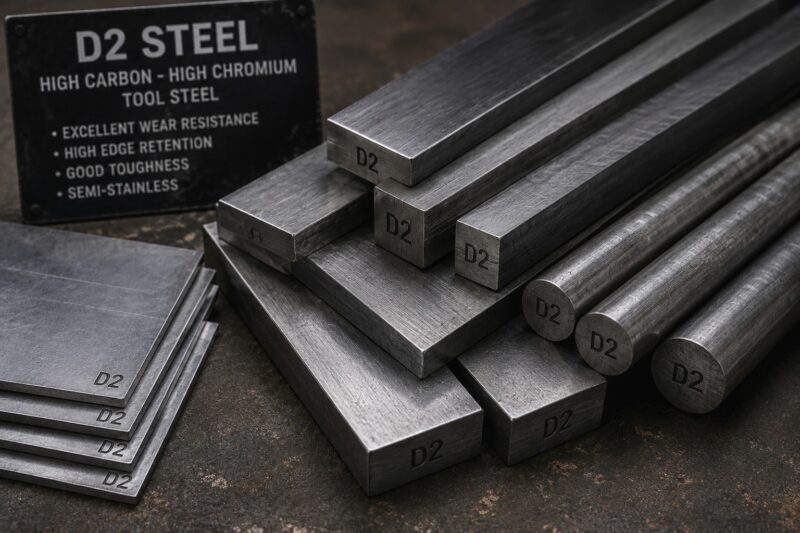
Before premium powder metallurgy steels became widespread, D2 occupied a sweet spot in the knife world.
It provided:
- Excellent edge retention
- High hardness
- Good toughness
- Reasonable corrosion resistance
- Affordable pricing
Many hunters, outdoorsmen, and custom knife collectors discovered they could obtain premium performance without paying premium-steel prices.
Even today, D2 remains one of the best values in the knife industry.
| Property | Rating |
|---|---|
| Edge Retention | ★★★★★ |
| Corrosion Resistance | ★★★☆☆ |
| Toughness | ★★★☆☆ |
| Wear Resistance | ★★★★★ |
| Sharpening Ease | ★★☆☆☆ |
| Overall Value | ★★★★★ |
Hardness of D2 Steel
Most knife makers heat treat D2 between 58 and 62 HRC.
The exact hardness depends on the maker’s intended use.
Typical ranges:
- 58–59 HRC: tougher, easier sharpening
- 60–61 HRC: balanced performance
- 62 HRC+: maximum edge retention
At approximately 60–61 HRC, D2 delivers excellent real-world cutting performance.
Edge Retention
One of D2’s strongest characteristics is edge retention.
Thanks to its large chromium carbides and high carbon content, D2 resists wear extremely well.
Many users notice that D2 stays sharp significantly longer than:
- 1095
- 5160
- AUS-8
- 440A
- 420HC
In practical terms, a properly heat-treated D2 knife can process multiple animals, extensive camp chores, or weeks of everyday use before requiring sharpening.
For hunters, this is a major advantage.
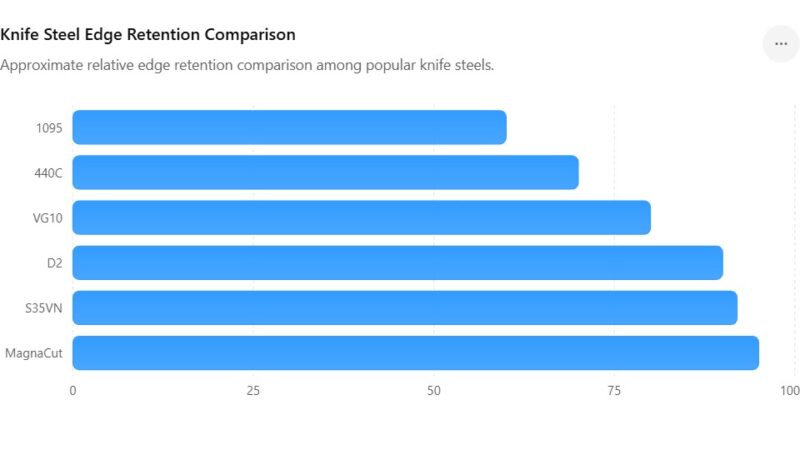
Note: Edge retention ratings are approximate and depend heavily on heat treatment, blade geometry, hardness, and intended use. The chart is designed for general comparison rather than laboratory measurement.
Wear Resistance
D2 is famous for wear resistance.
Wear resistance refers to the steel’s ability to resist abrasion during cutting.
Tasks involving:
- Rope
- Cardboard
- Leather
- Wood
- Hide
- Fibrous materials
are handled exceptionally well by D2.
This is one reason many custom hunting knives and work knives use D2 steel.
Toughness
Toughness is where D2 becomes more controversial.
Although reasonably tough, D2 is not considered a “super tough” steel.
Compared with:
- CPM 3V
- A2
- 5160
- CruWear
D2 is less resistant to chipping under extreme stress.
For normal cutting tasks this is rarely an issue.
Problems arise when users attempt:
- Batoning large logs
- Prying
- Digging
- Heavy impact work
D2 performs best as a cutting steel rather than a prying steel.
Corrosion Resistance
D2 offers moderate corrosion resistance.
It performs better than traditional carbon steels like:
- 1095
- O1
- W2
However, it falls behind:
- MagnaCut
- S35VN
- VG10
- 14C28N
- M390
If exposed to:
- Saltwater
- Humidity
- Blood
- Acidic foods
D2 can stain or rust.
Regular cleaning solves most issues.
D2 Steel for Hunting Knives
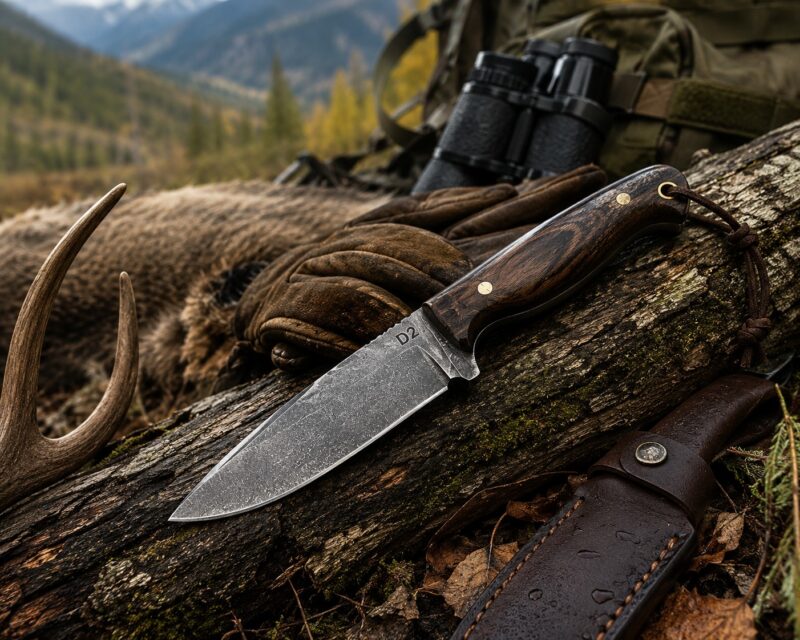
D2 has become one of the most respected hunting knife steels available.
Hunters appreciate:
- Long edge life
- Excellent slicing ability
- High wear resistance
- Ability to process multiple animals
Field dressing generates significant abrasion from hide, cartilage, and connective tissue.
D2 handles these materials extremely well.
For many hunters, D2 remains one of the best choices available.
D2 for Skinning Knives
Skinning demands:
- Fine edge retention
- Smooth slicing
- Precision control
D2 excels in all three areas.
A sharp D2 skinning knife can often process an entire deer without needing touch-ups.
This is why many custom skinners are made from D2.
Check Our Guide: How to Choose a Skinning Knife: The Complete Guide for Hunters
D2 for Bushcraft Knives
Bushcraft users often have mixed opinions.
Advantages:
- Excellent carving performance
- Long-lasting edge
- Great wood processing
Disadvantages:
- Less tough than 3V
- Less forgiving during batoning
- Harder to sharpen in the field
For light to moderate bushcraft tasks, D2 works extremely well.
For survival-focused heavy abuse, tougher steels may be preferred.
Please check Our Guide: One Knife for Hunting and Bushcraft: Is It Really Possible?
D2 for EDC Knives
D2 has become incredibly common in everyday carry folders.
Reasons include:
- Excellent cutting performance
- Affordable pricing
- Long edge retention
- Availability
Many budget-friendly folding knives now feature D2 blades.
This has helped introduce thousands of users to higher-performance steels.
D2 for Kitchen Knives
D2 is less common in kitchen knives but can still perform well.
Benefits:
- Excellent sharpness
- Great edge retention
- Fine cutting performance
Drawbacks:
- Lower corrosion resistance
- Requires drying after use
- Not ideal for acidic foods left on blade
Most kitchen users prefer stainless steels for convenience.
Sharpening D2 Steel
D2’s wear resistance makes sharpening more challenging than softer steels.
Many beginners are surprised that D2 takes longer to sharpen.
Recommended tools:
- Diamond stones
- Ceramic stones
- Quality water stones
Basic sharpening progression:
- 400–600 grit for repairs
- 1000 grit for sharpening
- 3000–5000 grit for refinement
- Optional stropping
Patience is important.
Once sharp, D2 rewards the effort with long-lasting performance.
Maintaining D2 Steel
Fortunately, maintenance is simple.
After Use
- Clean the blade
- Dry thoroughly
- Remove moisture
Long-Term Storage
- Apply light oil
- Store in dry environment
- Avoid leather sheaths for extended periods
Food Preparation
- Wash immediately
- Dry completely
- Avoid prolonged exposure to acidic ingredients
These simple steps dramatically reduce rust risk.
| Steel | Edge Retention | Corrosion Resistance | Toughness |
|---|---|---|---|
| D2 | Excellent | Moderate | Moderate |
| 1095 | Good | Low | High |
| 440C | Good | Excellent | Moderate |
| VG10 | Very Good | Excellent | Moderate |
| MagnaCut | Excellent | Excellent | Excellent |
D2 vs 1095
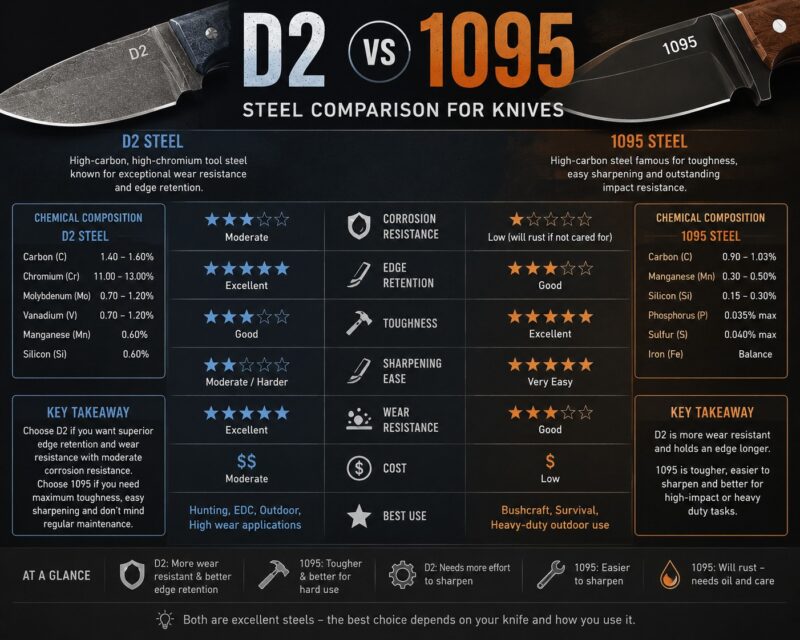
D2 Advantages
- Better edge retention
- Better wear resistance
- Better corrosion resistance
1095 Advantages
- Easier sharpening
- Better toughness
- Simpler field maintenance
Hunters often choose D2.
Bushcrafters frequently choose 1095.
D2 vs CPM 3V
3V offers:
- Superior toughness
- Better impact resistance
D2 offers:
- Better wear resistance
- Lower cost
For hard-use outdoor knives, 3V wins.
For cutting efficiency and value, D2 remains competitive.
D2 vs S35VN
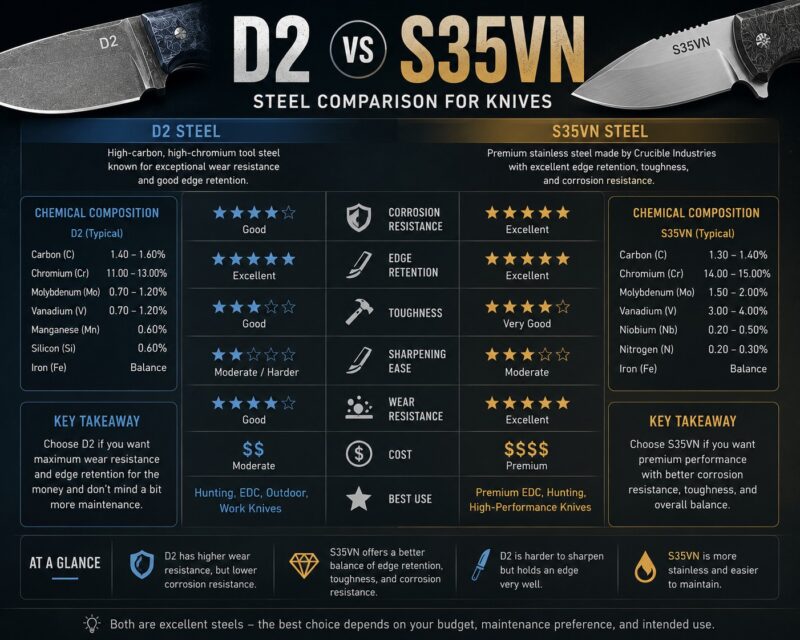
S35VN provides:
- Better corrosion resistance
- Better toughness
- Similar edge retention
D2 provides:
- Lower price
- Easier manufacturing
S35VN is objectively more balanced, but D2 remains an excellent budget-friendly option.
D2 vs MagnaCut
MagnaCut is one of the most advanced knife steels available.
Compared to D2:
MagnaCut
- Better corrosion resistance
- Better toughness
- Similar edge retention
D2
- More affordable
- Easier to find
- Proven track record
Magna Cut outperforms D2 technically, but costs significantly more.
Pros & Cons
Pros
✔ Outstanding edge retention
✔ High wear resistance
✔ Great value for money
✔ Popular among hunters
✔ Excellent for EDC
Cons
✘ Not fully stainless
✘ Can rust if neglected
✘ Harder to sharpen
✘ Less tough than 1095
Common Myths About D2 Steel
Myth #1: D2 Is Stainless
False.
D2 is semi-stainless.
Myth #2: D2 Never Rusts
False.
It can rust if neglected.
Myth #3: D2 Is Difficult to Sharpen
Partially true.
It sharpens slower than simple steels but remains manageable.
Myth #4: D2 Is Obsolete
False.
Many premium custom makers still use D2 successfully.
Buying a D2 Knife
When evaluating a D2 knife, focus on:
Heat Treatment
A well-treated D2 blade dramatically outperforms poorly treated D2.
Maker Reputation
Choose trusted manufacturers or custom makers.
Intended Use
D2 excels in:
- Hunting
- Skinning
- EDC
- General outdoor use
Is D2 Steel Worth the Money?
For many users, absolutely.
D2 continues to deliver one of the best performance-to-price ratios in the knife industry.
You receive:
- Excellent edge retention
- High wear resistance
- Proven reliability
- Affordable cost
While newer steels may outperform D2 in specific categories, few offer the same overall value.
Final Verdict
D2 steel has earned its reputation through decades of real-world performance. It remains one of the most trusted steels for hunting knives, EDC knives, custom knives, and outdoor tools.
Its combination of edge retention, wear resistance, affordability, and proven reliability makes it an outstanding choice for users who prioritize cutting performance.
If you’re looking for a knife that stays sharp for a long time, performs exceptionally well in hunting and outdoor environments, and delivers excellent value for money, D2 steel remains one of the smartest choices available.
FAQ
Is D2 steel good for hunting knives?
Yes. D2 offers excellent edge retention and wear resistance, making it one of the best hunting knife steels available.
Does D2 steel rust?
D2 is semi-stainless and can rust if neglected, but proper maintenance prevents most issues.
Is D2 better than 1095?
For edge retention and corrosion resistance, yes. For toughness and field sharpening, 1095 may be preferable.
Is D2 difficult to sharpen?
It requires more effort than softer steels but sharpens well using diamond or quality sharpening stones.
Is D2 steel good for bushcraft?
Yes, for general bushcraft tasks. For extreme batoning and heavy abuse, tougher steels may perform better.
How long does D2 stay sharp?
A properly heat-treated D2 blade can maintain a working edge significantly longer than many traditional knife steels.
https://en.wikipedia.org/wiki/Tool_steel
This article is for independent informational purposes only and is not affiliated with, sponsored by, or endorsed by any steel manufacturer. All product names, trademarks, and registered trademarks are the property of their respective owners.