One Knife for Hunting and Bushcraft
For outdoor enthusiasts, few questions generate more debate than whether a single knife can effectively serve both hunting and bushcraft purposes.
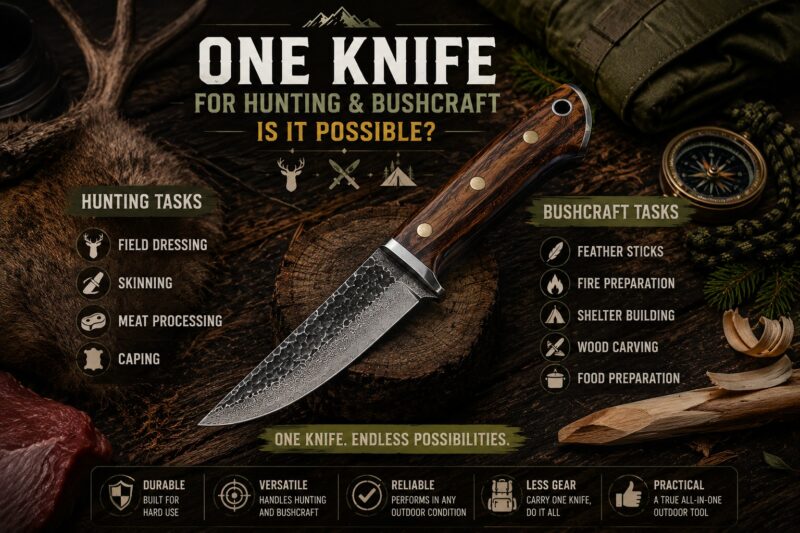
Hunters often prefer specialized blades designed for skinning, field dressing, and meat processing. Bushcrafters, on the other hand, tend to favor knives optimized for carving, shelter building, feather sticks, and campcraft.
So, can one knife successfully do both?
The short answer is yes—but with compromises.
The perfect hunting knife and the perfect bushcraft knife are not identical. However, there is a middle ground where a well-designed knife can perform both roles remarkably well. For hunters who camp, bushcrafters who hunt, or outdoor enthusiasts who simply want to carry one reliable blade, understanding the key design elements is essential.
In this guide, we’ll examine what makes a good hunting knife, what makes a good bushcraft knife, and how to choose a versatile knife capable of handling both tasks.
🔪 Looking for a One Knife for Hunting and Bushcraft?
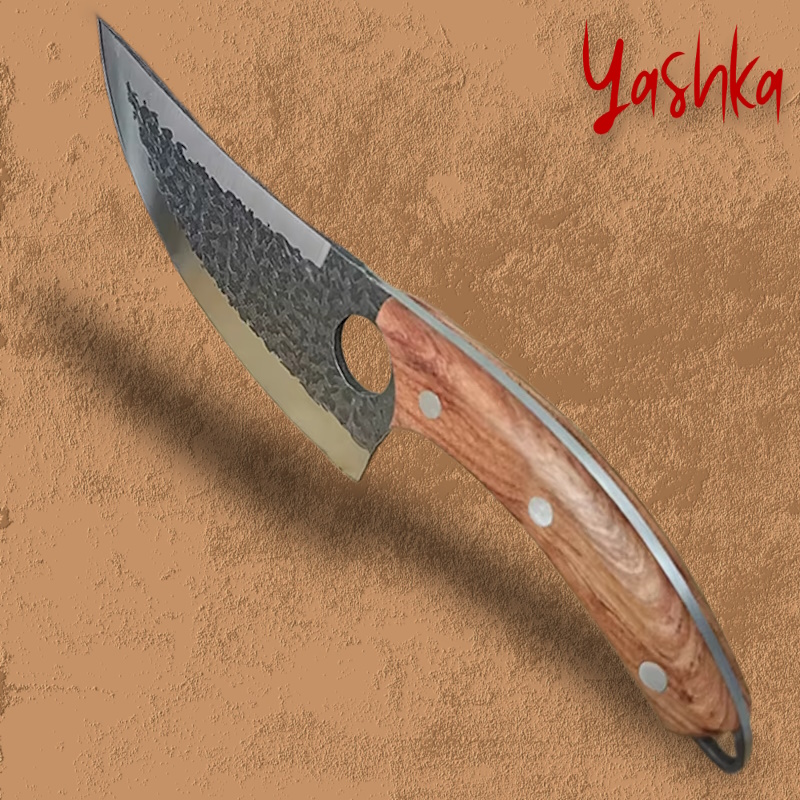
https://yashkadesigns.com/chef-kitchen-knife-butcher-boning-bbq-home-cutting-cooking-tool-ring-hole
Understanding the Difference Between Hunting and Bushcraft Knives
Although both are outdoor tools, hunting and bushcraft knives often have different priorities.
Hunting Knife Priorities
A hunting knife is primarily designed for processing game.
Common tasks include:
- Field dressing
- Skinning
- Quartering
- Meat trimming
- Caping
The ideal hunting knife emphasizes control, precision, and maneuverability.
Bushcraft Knife Priorities
Bushcraft knives focus on survival and campcraft tasks.
Common uses include:
- Feather sticks
- Fire preparation
- Wood carving
- Shelter building
- Food preparation
- Camp chores
Bushcraft knives emphasize durability and versatility.
Why Most Outdoor Enthusiasts Want One Knife
Carrying multiple knives has advantages, but many people prefer simplicity.
One knife means:
- Less weight
- Less gear
- Easier carry
- Lower cost
- Simplified maintenance
For backpackers, hunters, campers, and survivalists, reducing equipment can be a major benefit.
The Ideal Blade Length
Blade length is perhaps the most important factor.
Too Short
A knife under 3 inches may struggle with:
- Wood processing
- Food preparation
- Larger game
Too Long
A blade over 6 inches may become cumbersome for:
- Skinning
- Detailed work
- Fine carving
The Sweet Spot
Most experts agree that 4 to 5 inches provides the best balance.
This size offers:
- Adequate reach
- Excellent control
- Versatility across tasks
A blade around 4.5 inches is often considered ideal.
Check Our Guide What Size Knife Is Best for Camping?
Choosing the Best Blade Shape
Blade geometry determines how well a knife performs different jobs.
Drop Point
The drop point is widely considered the best compromise.
Benefits include:
- Strong tip
- Excellent control
- Good slicing ability
- Versatility
It performs well in both hunting and bushcraft situations.
Clip Point
Clip points offer excellent penetration and precision.
However, thinner tips may be less durable for heavy bushcraft use.
Spear Point
Strong and symmetrical but often less efficient for skinning.
Tanto
Excellent strength but not ideal for hunting applications.
For most users, a drop point remains the top choice.
Full Tang Construction
If you’re seeking one knife for both hunting and bushcraft, full tang construction is highly recommended.
Benefits include:
- Maximum strength
- Increased durability
- Improved reliability
Outdoor knives experience considerable stress.
A full tang design helps ensure long-term performance.
Steel Selection
Steel plays a major role in outdoor performance.
Carbon Steel
Advantages:
- Easy sharpening
- Excellent toughness
- Great edge retention
Disadvantages:
- Requires maintenance
- Can rust
Stainless Steel
Advantages:
- Corrosion resistance
- Lower maintenance
Disadvantages:
- Often harder to sharpen
Modern Premium Steels
Many knife makers now offer steels that balance:
- Edge retention
- Toughness
- Corrosion resistance
These are excellent choices for multi-purpose outdoor knives.
Check Our Guide Carbon Steel vs Stainless Steel Knives: Which Is Better?
Blade Thickness Matters
Bushcraft knives often feature thicker blades.
Hunting knives are usually thinner.
For a dual-purpose knife:
Ideal Thickness
Approximately 3–4 mm
This provides:
- Strength for woodwork
- Efficiency for slicing
Check Our Guide Best Blade Thickness for Different Uses
The Best Grind
The blade grind affects cutting performance.
Scandi Grind
Popular in bushcraft.
Excellent for carving.
Less ideal for meat processing.
Flat Grind
Highly versatile.
Performs well across multiple tasks.
Convex Grind
Strong and durable.
Excellent for heavy outdoor use.
For a combined hunting and bushcraft knife, flat or convex grinds are usually preferred.
Handle Design
Outdoor use often involves:
- Rain
- Mud
- Blood
- Snow
Your handle must remain secure under all conditions.
Look for:
- Ergonomic shape
- Comfortable grip
- Non-slip materials
- Rounded edges
Long-term comfort is essential.
Fixed Blade vs Folding Knife
Although folding knives have their place, a fixed blade remains the superior choice for combined hunting and bushcraft use.
Advantages include:
- Greater strength
- Easier cleaning
- Better reliability
When processing game or batoning wood, fixed blades clearly excel.
Check Our Guide Different 9 Types of Best Hunting Knives
Sheath Considerations
A good knife deserves a good sheath.
Features to look for:
- Secure retention
- Comfortable carry
- Weather resistance
- Easy access
Leather and Kydex are popular options.
Can One Knife Process Large Game?
Yes.
A quality 4–5 inch drop-point knife can handle:
- Deer
- Wild boar
- Elk
- Antelope
Many experienced hunters process entire animals with a single blade.
Can One Knife Handle Bushcraft Tasks?
Absolutely.
A properly designed outdoor knife can perform:
- Feather sticks
- Carving
- Fire preparation
- Shelter building
- Camp cooking
Skill often matters more than specialization.
The Importance of Technique
Many people focus too heavily on equipment.
In reality, experience and technique often outweigh knife design.
A skilled outdoorsman can perform most tasks with a simple, well-made knife.
Avoid Extreme Designs
Many knives marketed as “survival knives” feature:
- Sawbacks
- Hollow handles
- Aggressive shapes
While visually appealing, these features often reduce versatility.
Simple designs usually perform best.
Handmade Knives vs Factory Knives
A quality handmade knife offers several advantages:
- Superior craftsmanship
- Better materials
- Unique character
- Customization options
For users seeking a lifelong outdoor companion, handmade knives are often worth the investment.
Check Our Guide Custom Knife vs Factory Knife
The Best Knife Features for Dual-Purpose Use
If you want one knife for both hunting and bushcraft, prioritize:
- Full tang construction
- Drop-point blade
- 4–5 inch blade length
- Comfortable handle
- Durable steel
- Reliable sheath
These features create a balanced outdoor tool.
Common Mistakes When Choosing an Outdoor Knife
Choosing Too Large
Large knives become cumbersome for hunting tasks.
Choosing Too Small
Tiny blades struggle with bushcraft activities.
Prioritizing Appearance
Performance should always come first.
Ignoring Handle Comfort
An uncomfortable handle quickly becomes frustrating.
Real-World Performance
In practice, many hunters and bushcrafters discover that a medium-sized drop-point knife handles nearly every outdoor task they encounter.
It may not be the absolute best tool for every specific job, but it consistently performs well enough across a wide range of activities.
That versatility is exactly what makes it valuable.
Conclusion
So, is one knife for hunting and bushcraft really possible?
Yes.
While dedicated hunting knives and specialized bushcraft knives each offer certain advantages, a thoughtfully designed outdoor knife can successfully perform both roles.
For most users, the ideal choice is a full-tang drop-point knife with a blade length between 4 and 5 inches, quality steel, a comfortable handle, and a durable sheath.
Such a knife can process game, prepare firewood, carve tools, build shelters, prepare food, and tackle countless camp chores without requiring multiple blades.
The best outdoor knife is not necessarily the most specialized one. Often, it’s the knife that can confidently handle whatever challenge the wilderness presents.
FAQ
Q: Can one knife be used for both hunting and bushcraft?
A: Yes. A versatile full-tang drop-point knife with a 4–5 inch blade can handle most hunting and bushcraft tasks effectively.
Q: What blade shape is best for hunting and bushcraft?
A: The drop-point blade is generally considered the best all-around choice for both activities.
Q: What blade length is ideal for a dual-purpose outdoor knife?
A: Most experts recommend a blade length between 4 and 5 inches.
Q: Is carbon steel or stainless steel better for outdoor knives?
A: Both have advantages. Carbon steel is easy to sharpen and tough, while stainless steel offers better corrosion resistance.
Q: Should I choose a fixed blade or folding knife?
A: A fixed blade is generally preferred for hunting and bushcraft because it offers greater strength and reliability.
Q: What grind is best for a multi-purpose outdoor knife?
A: Flat and convex grinds typically provide the best balance for both hunting and bushcraft use.
Q: Is a full tang necessary?
A: While not absolutely required, full tang construction offers superior durability and is strongly recommended.
Q: Can one knife process an entire deer?
A: Yes. A quality 4–5 inch hunting knife is capable of field dressing and processing most game animals.
Q: Are handmade outdoor knives worth it?
A: Handmade knives often provide better craftsmanship, customization, and long-term value than mass-produced alternatives.
Q: What is the biggest mistake when choosing an outdoor knife?
A: Selecting a knife that is too large, too specialized, or uncomfortable for extended use.