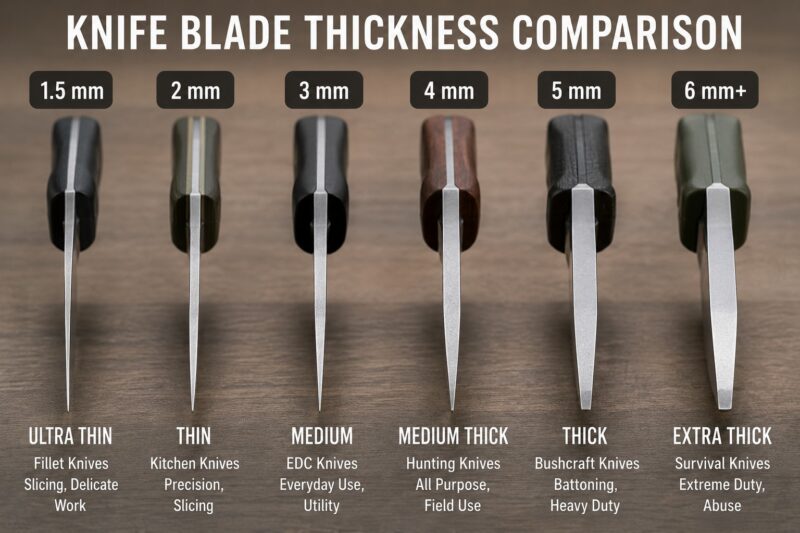
Blade Thickness for Different Uses
Introduction
Quick Answer
For most users, a blade thickness between 3 mm and 4 mm offers the best balance of cutting performance and durability. Thinner blades (1–3 mm) excel at slicing, kitchen work, and fishing tasks, while thicker blades (4.5–6 mm) are better suited for bushcraft, survival, and heavy-duty outdoor use.
When shopping for a quality knife, most people focus on blade steel, handle material, or blade shape. While these factors are important, one specification is often overlooked despite having a major impact on performance: blade thickness.
Blade thickness influences nearly every aspect of a knife’s behavior. It affects cutting efficiency, durability, weight, balance, sharpening characteristics, and even comfort during prolonged use.
Many buyers assume thicker blades are automatically stronger and therefore better. In reality, the ideal blade thickness depends entirely on the intended use. A hunting knife designed for skinning deer requires different blade geometry than a bushcraft knife used for carving wood or a kitchen knife designed for slicing vegetables.
Understanding blade thickness helps you choose the right knife for your specific needs and avoid common buying mistakes.
In this guide, we’ll explain how blade thickness works, why it matters, and what thickness ranges are best for hunting, camping, bushcraft, fishing, kitchen work, everyday carry, and survival applications.
🔪 Looking for a Professional-Grade Kitchen Knife?
https://yashkadesigns.com/bunka-knives
What Is Blade Thickness?
Blade thickness refers to the measurement of the blade’s spine—the thickest part of the blade near the handle.
It is usually measured in:
- Millimeters (mm)
- Inches
Typical knife blade thickness ranges from:
- 1.5 mm (very thin)
- 2.5 mm (light-duty)
- 3–4 mm (general purpose)
- 4–5 mm (heavy-duty)
- 5 mm+ (extreme-duty knives)
While the difference between a 2.5 mm and 4 mm blade may seem small on paper, it dramatically changes how the knife performs.
Why Blade Thickness Matters
Blade thickness directly affects several critical characteristics.
Cutting Performance
Generally speaking:
Thinner blades cut more efficiently.
A thin blade creates less resistance as it passes through material.
This means:
- Easier slicing
- Cleaner cuts
- Better food preparation
- Improved skinning performance
Strength
Thicker blades provide more material behind the edge.
Benefits include:
- Increased durability
- Better resistance to bending
- Greater ability to withstand abuse
Weight
Thicker blades are heavier.
This can be beneficial for chopping but may become tiring during extended use.
Sharpening
Thin blades often sharpen faster and require less effort to maintain.
Precision
Thin blades offer superior control and accuracy for detailed tasks.
Thin Blades: Advantages and Disadvantages
Thin blades typically range from 1.5 mm to 2.5 mm.
Advantages
Superior Slicing
Thin blades glide through material with minimal resistance.
Better Food Preparation
Kitchen knives are often relatively thin because they cut more efficiently.
Improved Skinning
Many skinning knives use thinner blade stock for precise cuts.
Reduced Weight
A lighter knife is easier to carry and maneuver.
Disadvantages
Less Strength
Thin blades can flex under pressure.
Lower Abuse Tolerance
They are not ideal for prying, batoning, or heavy chopping.
Medium Thickness Blades: The Sweet Spot
Many experienced outdoorsmen consider 3–4 mm blade thickness the ideal compromise.
Benefits include:
- Good strength
- Excellent versatility
- Reasonable cutting efficiency
- Broad application range
Most premium hunting knives fall within this range because it balances durability and cutting performance.
Thick Blades: Advantages and Disadvantages
Heavy-duty blades typically start around 4.5 mm.
Advantages
Maximum Durability
Excellent for hard use.
Increased Strength
Useful for survival and demanding outdoor tasks.
Better Batoning Performance
Many bushcraft enthusiasts prefer thicker blades for splitting wood.
Disadvantages
Reduced Cutting Efficiency
Thick blades create more drag.
Additional Weight
Can become tiring during extended carry.
Poor Food Preparation
Thick blades often wedge in food rather than slice cleanly.
Best Blade Thickness for Hunting Knives
Hunting knives are among the most popular outdoor knives.
Most hunting tasks involve:
- Skinning
- Field dressing
- Quartering game
- Meat processing
These activities benefit from cutting efficiency more than brute strength.
Best Hunting Knife Features Explained
Recommended Thickness
2.5–4 mm
Small Game Hunting
Ideal range:
2.5–3 mm
Deer Hunting
Ideal range:
3–3.5 mm
Large Game Hunting
Ideal range:
3.5–4 mm
Most hunters find that approximately 3.2 mm to 3.8 mm offers the perfect balance.
Best Blade Thickness for Skinning Knives
Skinning requires precision.
The knife must separate hide from meat efficiently while maintaining control.
Recommended Thickness
2–3 mm
Benefits include:
- Precise cuts
- Less resistance
- Improved maneuverability
Many professional skinners prefer thinner blades specifically for these reasons.
Best Blade Thickness for Bushcraft Knives
Bushcraft tasks often include:
- Feather sticks
- Carving
- Fire preparation
- Batoning
These jobs place greater demands on blade durability.
Recommended Thickness
3.5–4.5 mm
This provides sufficient strength while maintaining reasonable cutting performance.
Best Blade Thickness for Survival Knives
Survival knives are expected to handle extreme tasks.
They may be used for:
- Chopping
- Batoning
- Digging
- Emergency situations
Recommended Thickness
4.5–6 mm
Strength becomes a priority over slicing performance.
Best Blade Thickness for Camping Knives
Camping knives perform many different jobs.
Typical tasks include:
- Food preparation
- Cutting cordage
- Fire preparation
- General camp chores
Recommended Thickness
3–4 mm
This range offers exceptional versatility and is often considered the ideal all-around outdoor knife thickness.
Best Blade Thickness for Fishing Knives
Fishing knives have unique requirements compared to hunting or survival knives.
Many fishing tasks involve:
- Cleaning fish
- Filleting
- Removing skin
- Precision cutting around bones
- Preparing bait
These jobs prioritize flexibility and cutting efficiency over brute strength.
Recommended Thickness
1.5–2.5 mm
A thinner blade allows for:
- Better control
- Cleaner cuts
- Easier maneuvering around bones
- Less meat waste
For general fishing knives, a blade thickness around 2 mm is often considered ideal.
For dedicated fillet knives, even thinner blades may be preferred.
Best Blade Thickness for Kitchen Knives
Kitchen knives are designed primarily for slicing.
Unlike outdoor knives, they rarely need to withstand heavy impacts or abusive tasks.
Recommended Thickness
1.5–3 mm
Different kitchen knives benefit from different thicknesses:
Chef’s Knives
Ideal range:
2–3 mm
This provides:
- Excellent slicing ability
- Good durability
- Comfortable balance
Utility Knives
Ideal range:
1.5–2.5 mm
Perfect for:
- Fruits
- Vegetables
- Small food preparation tasks
Kitchen knives generally perform best when relatively thin.
Best Blade Thickness for EDC Knives
Everyday Carry (EDC) knives need versatility.
Typical tasks include:
- Opening packages
- Cutting rope
- Food preparation
- Daily utility work
Recommended Thickness
2.5–3.5 mm
Benefits include:
- Lightweight carry
- Efficient cutting
- Sufficient strength
Most premium EDC folders fall within this range.
Best Blade Thickness for Meat Slicing Knives
Slicing knives are designed to create long, clean cuts through meat.
Whether carving brisket, turkey, ham, or roast beef, cutting efficiency is critical.
Recommended Thickness
1.5–2.5 mm
Advantages:
- Minimal drag
- Cleaner slices
- Better presentation
- Reduced tearing
This is why professional carving knives tend to be relatively thin.
A thick blade may wedge through meat instead of slicing smoothly.
Best Blade Thickness for Fillet Knives
Fillet knives represent one of the most specialized blade categories.
These knives need:
- Extreme flexibility
- Precision control
- Fine cutting ability
Recommended Thickness
1–2 mm
Benefits include:
- Easy movement around bones
- Reduced meat waste
- Smooth filleting action
Most professional anglers prefer very thin fillet blades.
Blade Thickness vs Blade Grind
One of the biggest misconceptions in the knife world is assuming blade thickness alone determines cutting performance.
Blade grind is equally important.
A thick blade with excellent geometry may outperform a thinner blade with poor geometry.
Flat Grind
Flat grinds taper gradually from spine to edge.
Advantages:
- Excellent slicing
- Versatility
- Strong edge support
A 4 mm blade with a high flat grind can still cut exceptionally well.
Hollow Grind
Hollow grinds feature a concave profile.
Advantages:
- Razor sharp edges
- Excellent slicing
Disadvantages:
- Reduced edge durability
Often found on skinning and hunting knives.
Scandi Grind
Popular among bushcraft enthusiasts.
Advantages:
- Easy sharpening
- Woodworking efficiency
Often paired with medium-thickness blades.
Convex Grind
Common on premium outdoor knives.
Advantages:
- Strong edge
- Excellent durability
- Good slicing capability
Many custom knife makers favor convex grinds for hunting knives.
Why Geometry Often Matters More Than Thickness
A knife’s overall geometry includes:
- Thickness
- Grind
- Edge angle
- Blade height
These factors work together.
For example:
A well-designed 4 mm hunting knife can cut better than a poorly designed 3 mm knife.
This is why experienced knife makers focus on blade geometry rather than thickness alone.
Custom Knives vs Factory Knives
Blade thickness is one area where custom knives often excel.
Factory Knives
Factory manufacturers typically design knives for broad appeal.
Advantages:
- Consistency
- Lower cost
- Easy availability
However, they may not optimize thickness for specific users.
Custom Knives
Custom makers can tailor blade thickness for intended use.
Benefits include:
- Purpose-built performance
- Personalized specifications
- Better balance
- Enhanced ergonomics
For example, a custom hunting knife maker may recommend:
- 3 mm for skinning
- 3.5 mm for all-around hunting
- 4 mm for heavy-duty outdoor use
This customization often improves real-world performance.
Common Blade Thickness Myths
Many knife buyers encounter misinformation.
Let’s address some common myths.
Myth #1: Thicker Is Always Better
False.
Thicker blades are stronger but often cut less efficiently.
The best thickness depends on the task.
Myth #2: Thin Blades Are Weak
Not necessarily.
Many professional kitchen knives use very thin blades and perform exceptionally well.
Proper heat treatment and blade geometry matter significantly.
Myth #3: Survival Knives Make Good Kitchen Knives
Usually not.
A 5 mm survival knife is excellent for batoning wood but generally poor for slicing vegetables.
Different tasks require different designs.
Myth #4: Blade Thickness Determines Quality
False.
Quality depends on:
- Steel
- Heat treatment
- Geometry
- Craftsmanship
- Design
Thickness alone says very little about overall quality.
Common Buying Mistakes
Avoiding these mistakes can save money and frustration.
Buying the Thickest Knife Available
Many beginners believe thicker automatically means better.
In reality, they often end up with a knife that cuts poorly.
Ignoring Intended Use
Always choose thickness based on actual tasks.
Ask yourself:
- Hunting?
- Fishing?
- Bushcraft?
- Camping?
- Kitchen work?
The answer should guide your choice.
Overlooking Weight
Extra thickness adds weight.
A heavy knife may become uncomfortable during extended use.
Ignoring Blade Geometry
Geometry frequently has more impact than thickness alone.
Look at the complete blade design.
Choosing Based on Marketing Claims
Many manufacturers advertise “heavy-duty” blades as superior.
However, the most efficient knife is often not the thickest one.
Quick Blade Thickness Reference Chart
| Use | Recommended Thickness |
|---|---|
| Fillet Knife | 1–2 mm |
| Fishing Knife | 1.5–2.5 mm |
| Kitchen Knife | 1.5–3 mm |
| Meat Slicer | 1.5–2.5 mm |
| EDC Knife | 2.5–3.5 mm |
| Hunting Knife | 2.5–4 mm |
| Skinning Knife | 2–3 mm |
| Camping Knife | 3–4 mm |
| Bushcraft Knife | 3.5–4.5 mm |
| Survival Knife | 4.5–6 mm |
Final Thoughts
Blade thickness plays a major role in knife performance, but there is no universal “best” thickness. The ideal choice depends entirely on how the knife will be used.
For most hunters and outdoorsmen, blades in the 3–4 mm range provide the best balance between cutting efficiency and durability. Thin blades excel in food preparation, filleting, and slicing tasks, while thicker blades are better suited to bushcraft, survival, and heavy-duty outdoor use.
Rather than choosing the thickest blade available, focus on selecting a knife that matches your intended tasks. Consider thickness alongside blade geometry, grind type, steel selection, heat treatment, and ergonomics.
The best knife is not the one with the thickest blade—it is the one designed to perform your specific tasks efficiently, safely, and comfortably.
FAQ
What blade thickness is best for a hunting knife?
Most hunting knives perform best between 2.5 mm and 4 mm, offering a balance of durability and cutting efficiency.
Is a thicker knife blade stronger?
Generally yes, but thicker blades often sacrifice slicing performance and add weight.
What blade thickness is best for bushcraft?
Most bushcraft knives perform well between 3.5 mm and 4.5 mm.
What blade thickness is best for kitchen knives?
Kitchen knives typically perform best between 1.5 mm and 3 mm.
Are thin blades easier to sharpen?
Yes. Thin blades generally require less material removal and sharpen more easily.
What thickness is best for fishing knives?
Fishing knives usually perform best between 1.5 mm and 2.5 mm.
Does blade thickness affect edge retention?
Not directly. Edge retention depends primarily on steel type, heat treatment, and edge geometry.
What blade thickness is best for camping?
A thickness of 3–4 mm offers excellent versatility for camping tasks.
Are custom knives optimized for blade thickness?
Many custom knife makers tailor thickness to specific uses, resulting in better overall performance.
What is the biggest mistake when choosing blade thickness?
Selecting thickness based on marketing claims rather than intended use.
Blade Thickness for Different Uses