What Size Knife Is Best for Camping?
When shopping for a camping knife, most people focus on blade steel, handle materials, or overall appearance. While those factors certainly matter, one characteristic often has the biggest impact on real-world performance: knife size.
Too small, and your knife may struggle with common campsite tasks. Too large, and it can become heavy, awkward, and difficult to control. Finding the right balance is essential if you want a knife that performs well around camp, on the trail, and during outdoor adventures.
So what size knife is best for camping?
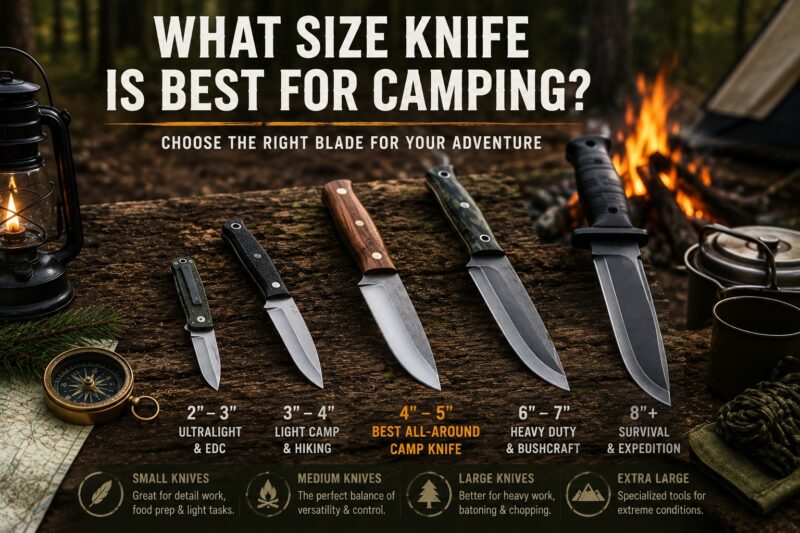
The answer depends on your camping style, but for most people, a fixed-blade knife with a blade length between 4 and 5 inches (10–13 cm) offers the best balance of versatility, control, safety, and portability.
In this guide, we’ll explore how knife size affects performance, compare different blade lengths, and help you determine the ideal camping knife for your needs.
🔪 Looking for a Professional-Grade Camping Knife?
Why Knife Size Matters
A camping knife is one of the most versatile tools you can carry.
It may be used for:
- Preparing food
- Cutting rope
- Processing kindling
- Feather sticks
- Carving tent stakes
- Fire preparation
- Emergency repairs
- Survival situations
Because a camping knife must handle such a wide variety of tasks, size becomes a critical factor.
The ideal knife should be:
- Large enough for outdoor work
- Small enough for precise control
- Comfortable to carry
- Easy to maintain
Understanding Blade Length Categories
Camping knives generally fall into four size categories:
Small Knives (Under 3 Inches)
Examples:
- Neck knives
- Compact fixed blades
- Small folding knives
Medium Knives (4–5 Inches)
Examples:
- General-purpose camp knives
- Bushcraft knives
- Hunting knives
Large Knives (6–8 Inches)
Examples:
- Survival knives
- Heavy-duty outdoor knives
Extra-Large Knives (9+ Inches)
Examples:
- Machetes
- Choppers
- Specialized wilderness tools
Each category has advantages and disadvantages.
Small Camping Knives: Pros and Cons
Advantages
Small knives are:
- Lightweight
- Easy to carry
- Excellent for food preparation
- Ideal for detail work
Many hikers and ultralight backpackers appreciate minimal weight.
Disadvantages
Small blades struggle with:
- Firewood processing
- Batoning
- Shelter building
- Heavy camp tasks
While useful as secondary tools, they are often limiting as primary camp knives.
Medium Camping Knives: The Sweet Spot
For most campers, medium-sized knives offer the best overall performance.
Typical Blade Length
4–5 inches
This size handles:
- Food preparation
- Feather sticks
- Rope cutting
- Wood carving
- Fire preparation
- General campsite work
Why They Are So Popular
Medium knives provide:
- Excellent control
- Comfortable carry
- Sufficient cutting power
- Broad versatility
Many experienced outdoorsmen consider this range ideal.
Large Camping Knives: When Bigger Helps
Larger knives offer advantages in certain situations.
Benefits
- Better chopping ability
- Increased reach
- Improved batoning performance
Drawbacks
Large knives often:
- Weigh more
- Occupy more space
- Reduce precision
- Cause hand fatigue
They are often better suited to wilderness expeditions than casual camping.
Extra-Large Outdoor Knives
Knives larger than 9 inches become specialized tools.
These may include:
- Large survival knives
- Machetes
- Brush-clearing tools
Although useful in specific environments, they are generally excessive for standard camping.
Fixed Blade or Folding Knife?
Knife size should also be considered alongside construction type.
Folding Knives
Advantages:
- Compact
- Convenient
- Easy pocket carry
Disadvantages:
- Less strength
- More difficult cleaning
- Moving parts
Fixed Blade Knives
Advantages:
- Maximum durability
- Easier maintenance
- Greater reliability
For most camping situations, a medium-sized fixed blade remains the preferred option.
The Ideal Blade Length for Most Campers
After decades of outdoor experience and countless knife designs, many experts consistently arrive at the same conclusion:
4–5 Inches Is the Sweet Spot
This size provides enough blade for:
- Camp cooking
- Fire preparation
- Bushcraft tasks
- Emergency situations
While remaining manageable and comfortable.
How Blade Length Affects Safety
Many people assume larger knives are automatically more dangerous.
In reality, safety depends largely on control.
A properly sized knife:
- Provides secure handling
- Allows accurate cutting
- Reduces fatigue
For most users, medium-sized blades offer the highest degree of control.
Food Preparation Considerations
Camp cooking is one of the most common knife uses.
Tasks include:
- Slicing vegetables
- Cutting meat
- Preparing fruit
- Opening food packages
A blade between 4 and 5 inches performs these tasks very well.
Extremely large knives often become cumbersome around food.
Fire Preparation and Feather Sticks
A camping knife should help create fire.
This often involves:
- Splitting kindling
- Making feather sticks
- Scraping tinder
Medium-sized fixed blades excel in these applications.
Wood Processing
Some campers process significant amounts of wood.
Larger knives may help when:
- Batoning wood
- Splitting kindling
- Building shelters
However, for typical camping trips, medium blades remain sufficient.
Bushcraft Applications
Bushcraft activities require versatility.
Common tasks include:
- Spoon carving
- Stake making
- Notch carving
- Trap building
- Campcraft
Most bushcraft experts prefer blades around 4–5 inches.
Backpacking and Weight Considerations
Weight matters.
Every ounce carried over long distances adds up.
A moderate-sized knife provides excellent capability without unnecessary weight.
For backpackers, oversized knives rarely justify their extra mass.
Family Camping Needs
For family camping trips, knife requirements are usually modest.
Typical tasks include:
- Food prep
- Cord cutting
- Light woodwork
A medium-sized knife is more than adequate.
Hunting and Camping Combination Use
Many outdoor enthusiasts hunt and camp simultaneously.
A versatile knife should handle:
- Game processing
- Camp chores
- Fire preparation
Again, the 4–5 inch range performs exceptionally well.
Handle Length Matters Too
People often focus exclusively on blade size.
However, handle size is equally important.
A comfortable handle:
- Reduces fatigue
- Improves control
- Enhances safety
Even the perfect blade length cannot compensate for a poorly designed handle.
Steel Selection and Size
Larger blades place greater stress on steel.
For camping knives, look for steels offering:
- Toughness
- Edge retention
- Corrosion resistance
A balanced steel complements a balanced knife size.
Why Survival Movies Create Unrealistic Expectations
Movies often portray enormous knives as essential survival tools.
In reality:
- Most tasks require precision
- Large blades are often inefficient
- Versatility matters more than size
Professional guides frequently carry moderate-sized knives rather than oversized survival blades.
Common Mistakes When Choosing a Camping Knife
Buying Too Large
Many beginners assume bigger is better.
This often leads to:
- Extra weight
- Reduced control
- Lower comfort
Buying Too Small
Tiny knives may save weight but limit capability.
Choosing Based on Appearance
A knife should be selected for function rather than looks alone.
Does Knife Size Affect Maintenance?
Larger knives require:
- More sharpening
- Larger sheaths
- Additional carrying space
Medium-sized knives are generally easier to maintain.
Camping Knife Recommendations by User Type
Ultralight Backpackers
Blade length:
3–4 inches
General Campers
Blade length:
4–5 inches
Bushcrafters
Blade length:
4–5 inches
Hunters
Blade length:
4–5 inches
Wilderness Survival Enthusiasts
Blade length:
5–7 inches
The Importance of Versatility
The best camping knife is not necessarily the largest.
It is the knife that can successfully complete the widest variety of tasks.
Versatility consistently beats specialization during most camping trips.
Handmade Camping Knives vs Factory Knives
Handmade knives offer advantages such as:
- Superior craftsmanship
- Better fit and finish
- Premium materials
- Unique character
For campers seeking a long-term investment, handmade knives often provide exceptional value.
What Professional Guides Often Carry
Many wilderness guides favor knives in the 4–5 inch range.
Why?
Because they work.
Professional users prioritize reliability and versatility over extreme designs.
One Knife for Everything?
Can one knife handle every camping task?
Almost.
A quality medium-sized knife can perform:
- Food preparation
- Camp chores
- Bushcraft tasks
- Hunting duties
- Emergency work
No knife is perfect for every situation, but a 4–5 inch fixed blade comes remarkably close.
Final Recommendation
If you’re purchasing your first serious camping knife, start with:
- Fixed blade construction
- Full tang design
- Blade length between 4 and 5 inches
- Comfortable ergonomic handle
- Quality steel
- Reliable sheath
This combination offers the greatest versatility for the widest range of outdoor activities.
Conclusion
Choosing the right camping knife is about balance rather than extremes.
While small knives sacrifice capability and oversized knives sacrifice convenience, medium-sized knives provide an excellent compromise. For most campers, hunters, bushcrafters, and outdoor enthusiasts, a blade between 4 and 5 inches offers the ideal mix of performance, safety, portability, and versatility.
Whether you’re preparing meals, carving wood, building a fire, or handling unexpected campsite challenges, the right-sized knife can become one of the most trusted tools in your outdoor kit.
Invest in quality, choose a practical size, and you’ll have a knife that serves you well for years of adventures.
FAQ
Q: What size knife is best for camping?
A: For most campers, a knife with a 4–5 inch blade provides the best balance of versatility, control, and portability.
Q: Is a fixed blade better than a folding knife for camping?
A: Fixed blades are generally stronger, easier to clean, and more reliable for outdoor tasks.
Q: Can a 4-inch knife handle bushcraft tasks?
A: Yes. A quality 4-inch knife can perform most bushcraft activities, including carving, feather sticks, and fire preparation.
Q: Are large survival knives necessary for camping?
A: Not usually. Most camping tasks are better handled by medium-sized knives that offer greater control and comfort.
Q: What blade length is best for food preparation while camping?
A: A blade between 4 and 5 inches works very well for most camp cooking tasks.
Q: Is a 3-inch knife enough for camping?
A: It can handle basic tasks, but it may be limiting for wood processing and other outdoor activities.
Q: What is the best knife size for backpacking?
A: Backpackers often prefer knives between 3 and 5 inches, depending on their needs and weight considerations.
Q: Should beginners choose a large knife?
A: No. Medium-sized knives are usually safer, easier to control, and more versatile.
Q: Does blade size affect knife safety?
A: Yes. Properly sized knives often provide better control and reduce the risk of accidents.
Q: Can one camping knife also be used for hunting?
A: Yes. A versatile 4–5 inch fixed-blade knife can perform both camping and hunting tasks effectively.