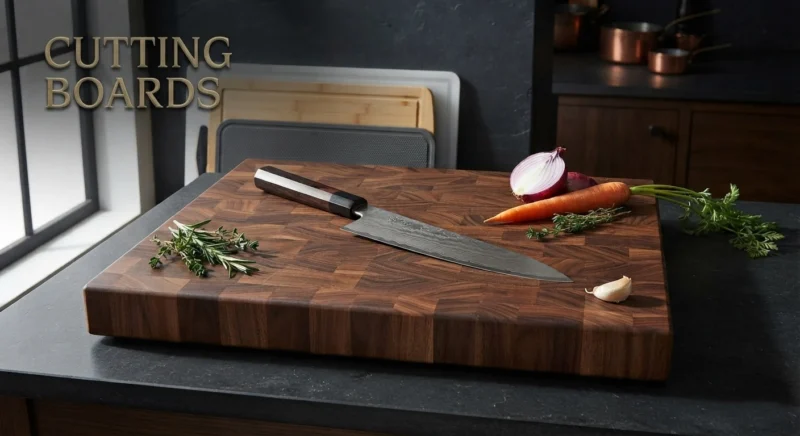
Cutting Boards
Choosing the right cutting surface is one of the most overlooked decisions in a kitchen. A good board does much more than provide a flat place to chop food. The material, hardness, construction, thickness, size, and maintenance routine can affect knife sharpness, cutting comfort, food safety, and even the longevity of your kitchen tools.
For home cooks, professional chefs, and knife enthusiasts, the question is not simply which board looks best on the countertop. The better question is: which cutting surface is appropriate for your knives, ingredients, and cooking habits?
Wood, bamboo, plastic, rubber, composite materials, glass, stone, and silicone all behave differently under a knife. Some are gentle on an edge and pleasant to cut on, while others are extremely hard and can quickly make a finely sharpened blade feel dull.
This complete guide examines the most common Cutting Boards, explains their advantages and disadvantages, compares different construction methods, and shows which materials work best with chef knives, Japanese knives, cleavers, fillet knives, and other kitchen blades.
1. Wood Cutting Boards
Wood remains one of the most popular materials for kitchen cutting surfaces, and for good reason. A well-made wooden board provides a comfortable cutting experience, looks attractive, can last for decades, and is generally much kinder to knife edges than hard materials such as glass or stone.
The performance of a wooden board depends heavily on the species of wood and the way the board is constructed.
Common choices include maple, walnut, cherry, teak, acacia, and beech.
Wood also has an important advantage for knife enthusiasts: it provides a controlled amount of give beneath the blade. Instead of striking an extremely hard surface, the edge meets a slightly yielding material.
This can make a noticeable difference when using high-performance Japanese knives with thin, finely sharpened edges.
Maple
Hard maple, particularly North American hard maple, is one of the classic materials for professional-quality cutting surfaces.
It is hard enough to resist excessive denting but not so hard that it becomes hostile to knife edges. Its relatively fine grain also gives it a smooth cutting surface.
Advantages of maple
- Good balance between hardness and resilience
- Excellent for everyday kitchen use
- Relatively gentle on knife edges
- Attractive light-colored appearance
- Available in end-grain and edge-grain construction
- Suitable for heavy-duty chopping
Maple is particularly well suited to cooks who want one board capable of handling vegetables, meat, herbs, and general food preparation.
It is also a traditional choice for butcher-block style work surfaces.
Disadvantages
Maple requires proper drying and maintenance. Like most natural wood, it should not remain wet for long periods.
It can also develop knife marks over time. These marks are not necessarily a reason to replace the board; many wooden boards can be sanded and refinished.
Walnut
Walnut is one of the most attractive choices for a kitchen board.
Its dark brown color and distinctive grain make it particularly popular for premium kitchen environments.
Walnut is generally somewhat softer than hard maple, which can make it especially pleasant under a knife.
Advantages of walnut
- Excellent knife-friendly surface
- Attractive dark appearance
- Comfortable cutting feel
- Good dimensional stability
- Suitable for premium boards
- Works particularly well with Japanese knives
Because walnut is not excessively hard, it can be a very good choice for thin Japanese blades.
Gyuto, nakiri, and santoku knives can all perform beautifully on a quality walnut surface.
Disadvantages
Walnut can show knife marks relatively quickly because of its comparatively moderate hardness.
It is also generally more expensive than some common domestic hardwoods.
For cooks who prioritize aesthetics and knife comfort over maximum resistance to dents, however, walnut is difficult to beat.
Cherry
Cherry is another excellent hardwood for kitchen boards.
It has a warm reddish-brown color that becomes richer with age and exposure to light.
Cherry is generally softer than hard maple, making it comfortable for knives while still providing enough durability for regular food preparation.
Advantages
- Knife-friendly
- Attractive warm color
- Smooth grain
- Comfortable cutting surface
- Good choice for vegetables and general prep
Cherry works particularly well for cooks who want a traditional wooden board with a softer cutting feel.
Disadvantages
It can develop knife marks more easily than harder woods.
It is also important to remember that softer does not automatically mean better. A board that is excessively soft can become deeply scarred, making it harder to maintain a flat and hygienic surface.
Teak
Teak is naturally rich in oils and has excellent resistance to moisture.
This makes it attractive for kitchen applications.
However, teak is not always the first choice among knife enthusiasts because its natural oils and silica content can make it somewhat less ideal for extremely fine knife edges than softer, fine-grained woods.
Advantages
- Naturally moisture resistant
- Durable
- Attractive appearance
- Good dimensional stability
- Long service life
Disadvantages
- Can contain more silica than some traditional cutting-board woods
- May be harder on delicate edges than walnut or cherry
- Natural oils can make finishing more complicated
Teak can still be an excellent general-purpose board, particularly where moisture resistance is important.
Acacia
Acacia has become increasingly popular because it combines attractive appearance, durability, and relatively affordable pricing.
There are many different species of acacia, however, so boards sold under the same general name can vary considerably.
Some acacia boards are relatively soft and knife-friendly, while others can be quite hard.
Advantages
- Attractive natural grain
- Good durability
- Often affordable
- Reasonable moisture resistance
- Widely available
Disadvantages
- Hardness varies by species
- Quality varies substantially between manufacturers
- Some boards are heavily finished or laminated
When purchasing an acacia board, the construction and actual feel of the surface matter more than the name alone.
Beech
Beech is a traditional European hardwood used in many kitchen products.
It has a relatively fine grain and offers a good balance between durability and knife friendliness.
Advantages
- Fine grain
- Good durability
- Pleasant cutting surface
- Usually affordable
- Excellent for everyday kitchen work
Beech is particularly common in European-style kitchen equipment and can make a very practical everyday board.
2. End-Grain vs Edge-Grain vs Face-Grain
The species of wood is only part of the equation.
The direction in which the wood fibers are arranged can dramatically change how a board behaves.
The three main constructions are:
- End-grain
- Edge-grain
- Face-grain
End-Grain Boards
End-grain boards are constructed so that the ends of the wood fibers face upward.
Imagine cutting through a bundle of drinking straws. Instead of cutting across the long sides, you are looking at the ends.
When a knife enters an end-grain board, the fibers can separate slightly around the blade and then partially close again.
This is one reason high-quality end-grain boards are often described as particularly knife-friendly.
Advantages
- Excellent cutting feel
- Good resistance to deep knife scars
- Excellent for repeated chopping
- Particularly good for premium knives
- Can be resurfaced multiple times
End-grain boards are popular among professional cooks and serious knife collectors.
Disadvantages
- Usually more expensive
- Heavy
- Can be very thick
- Requires careful construction
- Can crack if poorly maintained
Edge-Grain Boards
Edge-grain construction places the long edges of the wood fibers upward.
These boards usually offer a good compromise between cost, durability, and performance.
They are often more affordable than end-grain boards while still being very comfortable under a knife.
For many home kitchens, edge-grain construction provides an excellent balance.
Face-Grain Boards
Face-grain boards are made using the broad surface of the wood.
They are often called flat-grain boards.
They are generally easier and cheaper to manufacture than end-grain boards.
However, knife marks can accumulate more visibly because the blade cuts directly across the surface.
Face-grain boards can still be excellent kitchen tools, particularly for lighter preparation.
3. Bamboo Cutting Boards
Bamboo is technically a grass rather than a hardwood, but it is commonly used for kitchen boards.
Bamboo grows rapidly, which makes it attractive from a sustainability perspective.
It is also relatively hard and moisture resistant.
However, its hardness is exactly why knife enthusiasts sometimes have mixed opinions about it.
A high-quality bamboo board can work well for general kitchen use, but some bamboo surfaces are harder than ideal for very thin Japanese knife edges.
Advantages
- Durable
- Attractive
- Usually affordable
- Renewable material
- Relatively resistant to moisture
- Lightweight compared with thick butcher blocks
Disadvantages
- Often harder than softer hardwood boards
- Can be less forgiving to delicate knife edges
- Quality varies significantly
- Adhesives are commonly used in laminated bamboo boards
Is bamboo bad for knives?
Not necessarily.
Bamboo is not inherently dangerous to kitchen knives. However, some bamboo boards are quite hard, and repeated contact with a hard surface can accelerate edge wear compared with a softer wooden board.
If you use a delicate Japanese knife with a very thin edge, a quality walnut, cherry, maple, or rubber board may provide a more forgiving cutting experience.
For everyday Western-style knives, bamboo can be perfectly practical.
4. Plastic Cutting Boards
Plastic is one of the most practical materials for modern kitchens.
It is inexpensive, lightweight, easy to clean, and available in many colors and sizes.
Plastic boards are especially useful where strict separation between raw meat, seafood, and vegetables is required.
The most common materials include HDPE and polypropylene.
HDPE
High-density polyethylene, commonly abbreviated HDPE, is widely used for professional kitchen cutting surfaces.
It offers a good combination of durability, cleanability, and knife compatibility.
Advantages
- Nonporous
- Easy to wash
- Lightweight
- Durable
- Resistant to moisture
- Good for raw meat and seafood
- Available in large commercial sizes
HDPE is one of the most practical materials for busy kitchens.
Polypropylene
Polypropylene is another common plastic used for kitchen boards.
It is relatively lightweight and resistant to many chemicals and cleaning agents.
Its exact hardness depends on the formulation and manufacturer.
Some polypropylene boards are flexible, while others are rigid.
Flexible Cutting Mats
Flexible plastic mats are convenient because they can be rolled or bent.
They are particularly useful when transferring chopped ingredients directly into a pan.
You can lift the mat, bend it slightly, and slide the ingredients into a pot.
Advantages
- Extremely lightweight
- Easy to store
- Inexpensive
- Easy to separate by color
- Convenient for food transfer
Disadvantages
- Can develop deep knife marks
- Usually less stable than rigid boards
- Thin mats can move during cutting
- Some inexpensive mats wear quickly
Flexible mats are best considered supplementary cutting surfaces rather than the primary board for serious knife work.
5. Rubber Cutting Boards
Rubber boards are increasingly popular among professional chefs and knife enthusiasts.
Unlike hard plastic, quality rubber provides a slightly softer cutting surface.
This can produce a very comfortable interaction with the knife edge.
Japanese professional kitchens in particular have long used rubber-style cutting surfaces.
Advantages
- Excellent knife friendliness
- Good shock absorption
- Quiet cutting
- Non-slip
- Easy to clean
- Excellent for Japanese knives
- Resistant to splitting
Rubber is particularly attractive for knives with thin edges.
A gyuto, nakiri, or high-performance chef knife can feel extremely smooth on a good rubber board.
Disadvantages
- More expensive than basic plastic
- Heavy
- Some rubber boards require specific care
- Can develop knife marks
For cooks who prioritize knife performance, rubber is one of the strongest alternatives to wood.
6. Composite & Paper-Composite Boards
Composite boards are manufactured from engineered materials rather than a single piece of natural wood.
Paper-composite boards are made by compressing layers of paper fibers with resin under high pressure.
They can look similar to stone or dark wood while remaining relatively lightweight.
Advantages
- Durable
- Moisture resistant
- Easy to clean
- Relatively thin
- Good dimensional stability
- Often dishwasher compatible depending on manufacturer specifications
Composite surfaces can be an excellent compromise between natural wood and plastic.
They are generally harder than soft wooden boards, however, so cooks using extremely delicate knife edges should consider the specific product rather than assuming every composite board has identical characteristics.
7. Glass Cutting Boards
Glass boards are attractive, hygienic, easy to clean, and resistant to staining.
Unfortunately, they are among the worst choices for kitchen knives.
Glass is extremely hard and provides virtually no cushioning beneath the edge.
When a sharpened knife repeatedly contacts glass, the edge can lose its fine apex quickly.
Advantages
- Very easy to clean
- Nonporous
- Resistant to stains
- Attractive designs
- Resistant to odors
Disadvantages
- Extremely hard on knife edges
- Slippery
- No cushioning
- Can be noisy
- Poor cutting feel
Is glass bad for knives?
Yes.
If preserving knife sharpness is important, a glass cutting surface should generally be avoided.
Glass may be useful as a decorative or serving surface, but it is not a good primary cutting surface for quality kitchen knives.
8. Stone / Marble / Granite
Stone surfaces such as marble and granite are sometimes used as kitchen work surfaces.
They are excellent for tasks where a cold, nonporous surface is desirable.
For example, marble is useful for pastry work because it stays relatively cool.
But stone is a poor choice for routine knife cutting.
Why?
Stone is extremely hard compared with the steel edge of a kitchen knife.
Every chop or slice creates an impact between the knife edge and a very hard surface.
Over time, the edge becomes duller and can potentially develop microscopic chips, particularly with thin, brittle blades.
Best uses for stone
- Pastry
- Rolling dough
- Serving
- Cheese presentation
- Cold food preparation
Poor uses
- Chopping vegetables
- Slicing meat
- Cutting herbs
- Daily knife work
A stone countertop may be excellent for preparing food, but it is worth placing a proper cutting board on top of it before using a knife.
9. Silicone Cutting Mats
Silicone mats are flexible, lightweight, and easy to clean.
They can be useful in kitchens where storage space is limited.
However, silicone varies greatly in firmness.
Some mats are primarily designed as protective surfaces rather than serious cutting boards.
Advantages
- Flexible
- Easy to store
- Lightweight
- Waterproof
- Easy to clean
- Quiet
Disadvantages
- Can move during cutting
- May be too soft
- Can develop cuts
- Less stable than thick boards
Silicone is best for light preparation and as a supplementary surface rather than replacing a rigid board entirely.
10. Different Board Sizes & Thicknesses
Board size is almost as important as material.
A board that is too small can make even simple preparation frustrating.
A board that is too large may be difficult to clean, store, or move.
The ideal size depends on the ingredients and knives you use.
Small Boards
Small boards are typically suitable for:
- Garlic
- Herbs
- Lemons
- Small vegetables
- Snacks
- Garnishes
They are convenient and easy to store.
However, they are usually too small for serious meal preparation.
A large chef knife needs sufficient space for controlled movement.
Medium Boards
Medium boards are excellent for everyday household cooking.
They provide enough room for:
- Vegetables
- Meat
- Fish
- Herbs
- Fruit
- Small poultry pieces
For many home cooks, a medium board is the best all-purpose size.
Large Boards
Large boards provide substantially more working space.
They are especially useful when preparing:
- Large vegetables
- Whole fish
- Large cuts of meat
- Multiple ingredients
- Large quantities of food
The biggest advantage is organization.
You can chop one ingredient while keeping another part of the board available for prepared ingredients.
Butcher-Block Style Boards
Butcher-block boards are typically thick, heavy, and designed for demanding work.
Their weight prevents movement during chopping.
Large end-grain butcher blocks can be particularly comfortable for heavy-duty preparation.
However, they require substantial counter space and can be difficult to move.
How Thick Should a Cutting Board Be?
There is no universal perfect thickness.
A thin board is easier to store and clean.
A thick board is heavier and more stable.
Typical household boards may range from roughly 10 mm to 40 mm or more.
For a premium wooden board, approximately 25–50 mm can provide excellent stability.
For plastic boards, considerably thinner construction can still work well because plastic does not need to be thick to remain stable when supported properly.
11. Best Cutting Board for Different Knives
Different knives interact with a cutting surface differently.
A thin Japanese blade may benefit from a softer board, while a heavy cleaver may require a more substantial surface.
Chef Knife
A traditional chef knife is highly versatile.
It can be used for:
- Rock chopping
- Push cutting
- Slicing
- Dicing
- Mincing
A medium or large wooden, rubber, or quality HDPE board is an excellent choice.
For heavy chopping, a thick board provides greater stability.
Gyuto
The gyuto is a Japanese all-purpose chef knife.
Many gyuto knives have thin edges and relatively hard steel.
For this reason, a softer cutting surface is highly desirable.
Excellent choices include:
- Walnut
- Cherry
- Maple
- Rubber
A high-quality rubber board is particularly good for users who frequently maintain extremely sharp gyuto edges.
Check Our Guide Japanese Gyuto Knife Guide: Everything You Need to Know
Santoku
Santoku knives typically have relatively thin blades and are designed for vegetables, meat, and fish.
A soft hardwood or rubber board works very well.
Avoid glass and stone if preserving edge sharpness is a priority.
Check Our Guide Santoku vs Nakiri: Which Japanese Kitchen Knife Is Better?
Nakiri
Nakiri knives are specialized Japanese vegetable knives.
They often have relatively thin edges and are designed for precise vegetable cutting.
Because of this, a forgiving board is especially important.
Excellent options
- Walnut
- Cherry
- Maple
- Rubber
A good nakiri should feel smooth rather than harsh when it contacts the cutting surface.
https://yashkadesigns.com/handmade-chinese-cleaver-meat
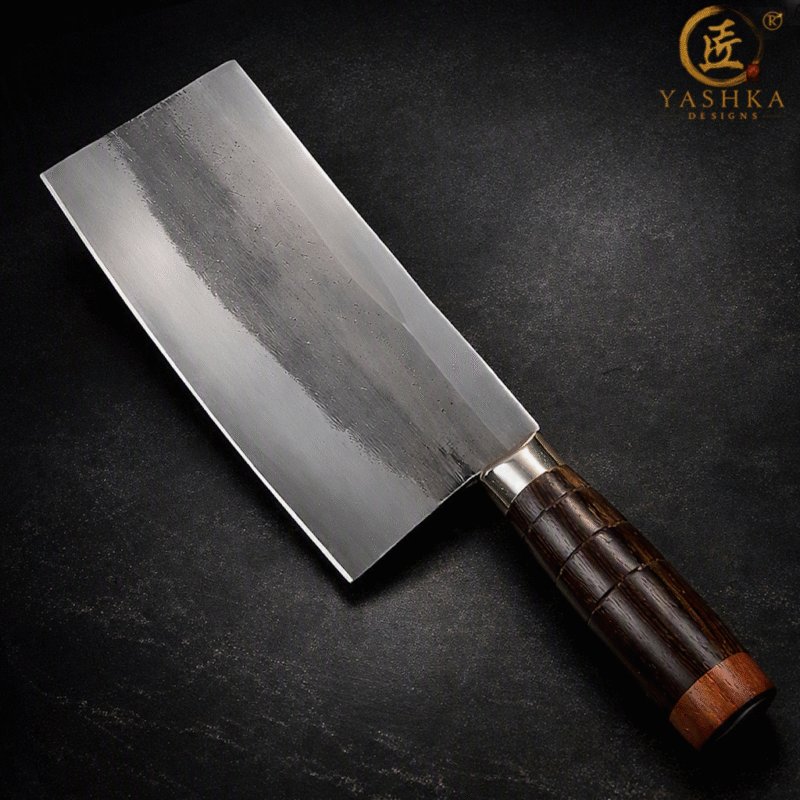
Chinese Cleaver
Not all Chinese cleavers are the same.
Some are thin vegetable cleavers designed for precise slicing and chopping.
Others are substantially thicker and designed for heavier work.
A medium-to-large wooden or rubber board is generally excellent.
For heavier cleaver use, choose a thick, stable board that will not slide across the counter.
Avoid glass and stone.
https://yashkadesigns.com/professional-butcher-knife-9-inch-japanese
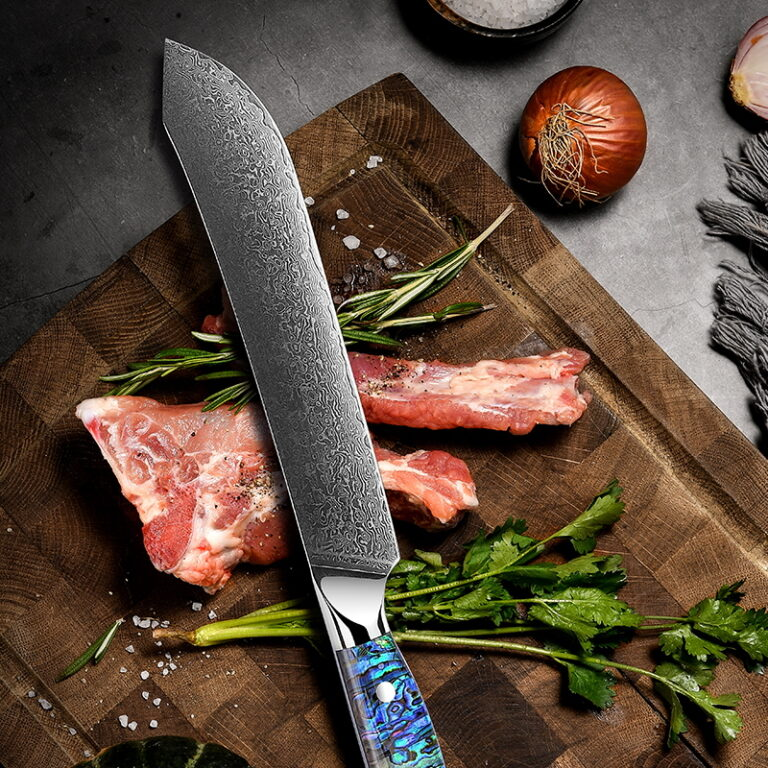
Butcher Knife
A butcher knife is designed for meat processing and heavier work.
A thick HDPE board can be an excellent choice in a professional kitchen because it is easy to clean.
A substantial wooden butcher block is another excellent option.
For raw meat preparation, sanitation and ease of cleaning become particularly important.
https://yashkadesigns.com/kiritsuke-chef-knife-japanese-kiritsuke-damascus
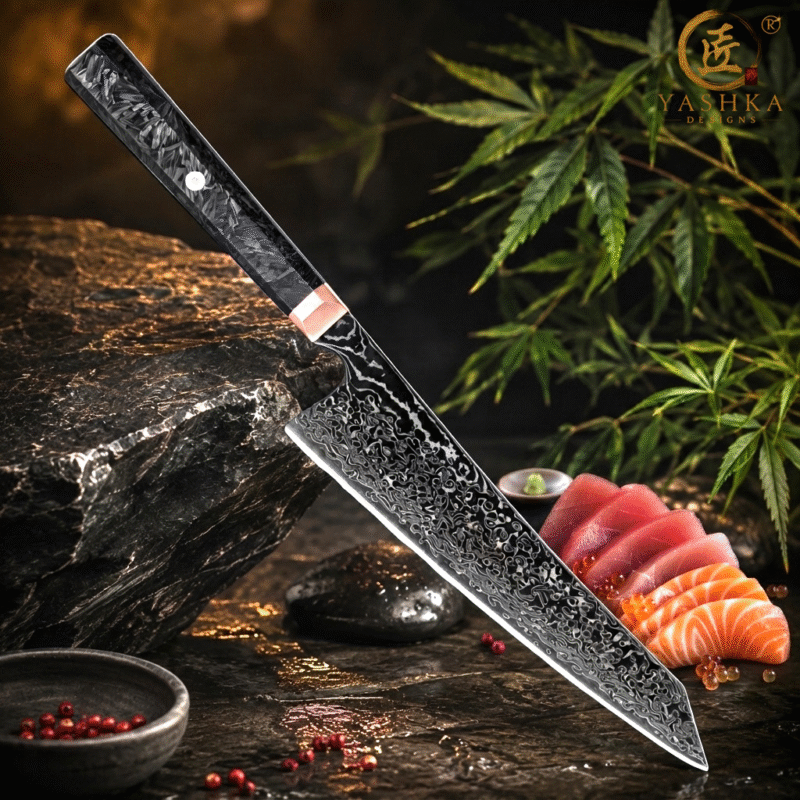
Fillet Knife
Fillet knives require a different approach.
Their blades are long, narrow, and flexible.
A large, stable plastic or rubber board is often ideal.
The surface should provide enough space for the entire fish and allow the blade to move freely.
For fish preparation, a nonporous HDPE board is particularly practical because it can be cleaned and sanitized easily.
12. Which Materials Are Best for Knife Edge Retention?
Knife edge retention depends on many factors:
- Steel hardness
- Edge geometry
- Edge angle
- Blade thickness
- Heat treatment
- Cutting technique
- Food being cut
- Cutting board material
The board is only one variable, but it is an important one.
Generally, softer and slightly yielding materials are more forgiving to knife edges.
Excellent choices for edge retention
Rubber
Excellent combination of stability, cushioning, and knife friendliness.
Walnut
Soft enough to provide a comfortable cutting surface while remaining durable.
Cherry
A pleasant surface for fine edges.
Maple
A classic balance of hardness and knife friendliness.
Quality HDPE
Very practical for professional food preparation.
Less desirable for edge retention
Glass
Extremely hard and unforgiving.
Granite
Very hard and unsuitable for routine knife cutting.
Marble
Useful for pastry but poor for knife edges.
Very hard composite materials should also be evaluated carefully.
The basic principle is simple:
The harder the cutting surface, the less forgiving it tends to be toward a knife edge.
Check Our Guide What Is HRC? Understanding Rockwell Hardness
13. Cutting Boards for Fish & Seafood
Fish and seafood require special consideration because preparation often involves moisture, raw proteins, scales, shells, bones, and strong odors.
A good seafood preparation setup should provide:
- Enough working space
- Good knife stability
- Easy cleaning
- Resistance to moisture
- Separation from ready-to-eat foods
A large plastic or rubber board is particularly useful for fish.
HDPE is popular because it is nonporous and easy to clean.
For whole fish, choose a board large enough to accommodate the fish without forcing the blade into an awkward position.
A flexible fillet knife needs plenty of room.
Preparing Fish
When filleting fish, the board should remain stable.
Place a damp towel or nonslip mat beneath a board if necessary.
The knife should move through the fish with controlled pressure rather than excessive force.
A sharp fillet knife combined with a stable board reduces the need for aggressive cutting.
Preparing Shellfish
Shellfish such as shrimp, crab, lobster, mussels, clams, and oysters require different preparation techniques.
Hard shells can damage a knife edge if you use the wrong blade.
Do not use a fine chef knife to force through shells.
Use an appropriate seafood tool or knife designed for the task.
This is particularly important when working with lobster or crab.
Seafood Preparation and Board Hygiene
Raw seafood should ideally have its own designated preparation board.
If this is not practical, the board must be thoroughly washed and sanitized between different foods.
This is especially important when the same kitchen is used to prepare raw fish and ready-to-eat ingredients.
For more detailed fish preparation techniques, filleting methods, seafood cutting techniques, and preparation of shellfish and crustaceans, dedicated seafood guides can provide more specialized information.
14. Raw Meat vs Vegetables vs Seafood
One of the most important kitchen hygiene principles is preventing cross-contamination.
Raw meat, seafood, and vegetables do not necessarily need three completely different boards in every home kitchen, but having dedicated boards makes organization much easier.
A Simple Color-Coding System
Many professional kitchens use different colors for different food categories.
For example:
- Red — raw meat
- Blue — seafood
- Green — vegetables
- White — bread and ready-to-eat foods
The exact colors are less important than consistency.
If you use color-coded boards, everyone in the kitchen should understand the system.
Separate Boards for Raw Meat
Raw poultry and meat can contain microorganisms that should not be transferred to foods eaten without cooking.
A nonporous plastic board is particularly convenient for raw meat.
After preparation, wash and sanitize the board thoroughly.
Separate Boards for Seafood
A dedicated seafood board can be useful because fish odors can linger.
Plastic and rubber are particularly practical.
Separate Boards for Vegetables
A wooden board can be excellent for vegetables because it provides a pleasant cutting experience.
It also helps protect sharp knives during repeated chopping.
15. How to Clean and Sanitize Different Boards
Cleaning and sanitizing are not exactly the same thing.
Cleaning removes food particles, grease, and visible contamination.
Sanitizing reduces microorganisms to a safer level.
The correct process depends on the board material.
Cleaning Plastic Boards
Plastic boards are generally straightforward.
- Remove food debris.
- Wash with hot water and dish soap.
- Scrub the surface.
- Rinse thoroughly.
- Sanitize when appropriate.
- Allow the board to dry completely.
Deep knife grooves should be monitored carefully.
If the surface becomes heavily scarred, replacement may be more practical than continued use.
Cleaning Wooden Boards
Wood requires more careful treatment.
Wash the board by hand using warm water and mild dish soap.
Do not leave it submerged.
After washing, rinse and dry it immediately.
Place it upright or on its edge so air can circulate around the surface.
Cleaning Rubber Boards
Follow the manufacturer’s recommendations.
Many rubber boards can be washed with soap and water.
Avoid using chemicals that could degrade the particular rubber formulation.
Cleaning Composite Boards
Composite boards vary considerably.
Some are dishwasher safe while others should be hand washed.
Always follow the manufacturer’s care instructions.
Cleaning Glass Boards
Glass is extremely easy to clean.
It can generally be washed with normal kitchen detergents.
The main problem is not sanitation.
The main problem is the damage glass can cause to knife edges.
16. How to Maintain Wooden Cutting Boards
A good wooden board can last many years if it is maintained properly.
The basic maintenance routine includes:
- Washing
- Drying
- Oil treatment
- Wax treatment
- Sanding when necessary
- Odor removal
Washing Wooden Boards
Use warm water and mild dish soap.
Do not soak a wooden board in water.
Do not leave it sitting in a sink full of water.
Extended exposure to water can cause wood fibers to swell.
When one side dries faster than the other, the board may warp.
Drying
Drying is just as important as washing.
After cleaning, wipe the board with a towel.
Then stand it upright or place it so air can reach both surfaces.
Do not store a damp board flat against a countertop.
Mineral Oil
Food-grade mineral oil is one of the most common treatments for wooden kitchen boards.
It penetrates the wood and helps reduce excessive moisture exchange.
Do not use ordinary industrial oils.
Use a food-safe product specifically intended for kitchen equipment.
How to oil a board
- Clean and completely dry the board.
- Apply a generous amount of food-grade mineral oil.
- Spread it evenly across the surface.
- Allow it to absorb.
- Apply additional oil if the wood absorbs it rapidly.
- Wipe away excess oil.
New or very dry boards may require several applications.
Board Wax
Board wax is often made from mineral oil combined with beeswax or another food-safe wax.
It provides an additional protective layer.
After oiling the board, a small amount of wax can be rubbed into the surface and buffed.
Wax is not a replacement for oil.
The two products serve complementary purposes.
Sanding
Eventually, knife marks may become substantial.
If the board is thick enough, sanding can restore the surface.
Start with a suitable coarse or medium grit to remove deep marks.
Then progressively move to finer grits.
Always remove all sanding dust before applying fresh oil.
Do not remove excessive material from a board.
The goal is to restore the surface, not dramatically reduce its thickness.
Dealing With Odors
Wood can sometimes retain strong smells from:
- Garlic
- Onion
- Fish
- Seafood
- Strong spices
A common household approach is to clean the board thoroughly and use coarse salt with lemon as a mild deodorizing treatment.
Afterward, rinse and dry the board.
Do not rely on deodorizing techniques as a substitute for proper cleaning and sanitation.
If a board has persistent odors because of deep contamination or extensive damage, replacement may be more appropriate.
17. When to Replace a Cutting Board
A cutting board does not necessarily need to be replaced simply because it has knife marks.
Wooden boards can often be resurfaced.
However, there are situations where replacement makes sense.
Replace a board when:
- Deep cracks have developed
- The board is splitting
- It has severe warping
- Deep grooves cannot be cleaned effectively
- Mold or persistent contamination is present
- Plastic has become excessively scarred
- The board no longer sits securely
- The surface is structurally damaged
For plastic boards, deep grooves are particularly important.
A heavily scarred plastic board can be difficult to clean thoroughly.
18. Cutting Board Mistakes That Damage Knives
Even an excellent knife can lose its edge quickly when used incorrectly.
Here are some of the most common mistakes.
Mistake 1: Cutting on Glass
Glass is extremely hard.
It is one of the fastest ways to make a sharp knife feel dull.
Mistake 2: Cutting on Stone
Granite and marble countertops should not be used as direct cutting surfaces.
Always place a proper board on top.
Mistake 3: Using the Wrong Board for Heavy Chopping
A thin, unstable board can move during chopping.
This makes cutting less comfortable and increases the chance of accidentally striking the edge against the board or countertop.
Use a heavier, stable board for demanding work.
Mistake 4: Using a Fine Knife to Cut Bones
A chef knife, gyuto, or nakiri is not a bone-cleaver.
Trying to force a thin blade through hard bones can chip or break the edge.
Use the appropriate heavy-duty tool.
Mistake 5: Chopping Through Hard Shells With a Fine Edge
Crab shells, lobster shells, and similar materials can be extremely hard.
Use appropriate seafood tools rather than risking a finely sharpened kitchen knife.
Mistake 6: Scraping Ingredients With the Sharp Edge
After chopping, many cooks use the knife edge to scrape ingredients across the board.
This can damage the apex.
Instead, turn the knife over and use the spine, or use a bench scraper.
Mistake 7: Using a Board That Is Too Small
When a board is crowded, the knife may repeatedly contact the edge of the board or surrounding surfaces.
A larger board provides better control.
Mistake 8: Letting the Board Slide
A moving board makes precise cutting more difficult.
Place a damp kitchen towel or nonslip mat underneath when necessary.
Check Our Guide Edge Retention Explained: 10 Factors What Makes a Knife Stay Sharp Longer?
19. Choosing the Best Board for Your Kitchen
There is no single perfect board for everyone.
The ideal choice depends on your knives, cooking style, cleaning routine, available space, and budget.
For a general home kitchen
A medium or large maple, walnut, beech, or quality plastic board is an excellent starting point.
For Japanese knives
Choose walnut, cherry, maple, or a quality rubber board.
Check Our Guide The Complete Guide to Japanese Knives
For professional meat preparation
A large HDPE board is highly practical.
For seafood
A large plastic or rubber board is particularly useful.
For heavy chopping
Choose a thick, stable wooden butcher block.
For maximum convenience
Plastic is hard to beat.
For premium knife performance
Rubber and high-quality wooden boards are excellent choices.
20. One Board or Several?
Many cooks wonder whether they really need multiple boards.
For a small kitchen, one high-quality board can be sufficient if it is cleaned correctly between tasks.
However, several boards can make food preparation more organized.
A practical setup might include:
Board 1 — General preparation
Medium or large wooden board.
Use for:
- Vegetables
- Herbs
- Fruit
- Bread
- General cooking
Board 2 — Raw meat
Large HDPE plastic board.
Board 3 — Seafood
Large plastic or rubber board.
Board 4 — Small preparation
Small board for garlic, lemons, herbs, and quick tasks.
This arrangement is particularly convenient for people who cook frequently.
21. How Cutting Technique Affects Board Life
The board is only one component of the cutting system.
Technique matters too.
A controlled slicing motion is usually gentler on both knife and board than repeatedly striking downward with excessive force.
For a chef knife or gyuto, use the cutting motion appropriate to the blade geometry.
For a nakiri, a straight up-and-down or push-cutting motion may feel natural.
For a cleaver, the technique depends heavily on whether it is a thin vegetable cleaver or a heavier chopping cleaver.
Avoid using more force than necessary.
A sharp knife should cut food through controlled movement rather than brute force.
22. Cutting Board Hardness and Knife Geometry
Knife geometry is an important part of the equation.
A thick Western chef knife with a robust edge can tolerate more abuse than an extremely thin Japanese blade.
For example, a hard Japanese knife sharpened to a very acute angle may have excellent cutting performance but a more delicate edge.
That knife benefits from a forgiving board.
The same principle applies to handmade and custom blades.
A blade’s steel hardness, thickness, grind, and edge angle all influence how it behaves against the cutting surface.
Therefore, when choosing a board, consider the knife rather than looking only at the board’s material.
23. Cutting Boards and High-Carbon Knives
High-carbon steel knives can offer excellent edge performance and sharpening characteristics.
However, they require more attention to moisture.
A wet board is not necessarily dangerous to the knife for a few cuts, but prolonged moisture exposure can contribute to corrosion.
After cutting wet ingredients, wipe and dry the knife.
This is particularly important with carbon-steel blades.
A wooden board can be an excellent match for carbon-steel knives because the cutting experience is comfortable and controlled.
However, the knife itself should never be left wet on the board.
24. Cutting Boards for Damascus Knives
Damascus is a description of construction or pattern rather than one specific steel.
A Damascus kitchen knife may contain stainless steel, carbon steel, powder steel, or other combinations.
Therefore, the appropriate board depends on the actual blade steel and geometry.
A thin Damascus kitchen knife should generally be treated like any other thin high-performance blade.
Choose a forgiving board such as:
- Walnut
- Cherry
- Maple
- Rubber
Avoid glass and stone.
25. Cutting Boards for Chinese Kitchen Knives
Chinese kitchen knives vary considerably.
A thin vegetable cleaver is designed for precise slicing and chopping.
A heavier cleaver may be designed for tougher ingredients.
For a thin Chinese vegetable cleaver, a medium or large wood or rubber board is ideal.
For heavier chopping, choose a thick, stable board.
The key is matching the board to the blade rather than assuming all cleavers should be used on the same surface.
26. Cutting Boards for Professional Kitchens
Professional kitchens have different priorities from home kitchens.
Speed, sanitation, durability, and organization are extremely important.
Plastic boards are popular because they can be cleaned rapidly and replaced when deeply damaged.
Rubber boards are attractive to chefs who prioritize cutting performance.
Large wooden boards may also be used for specific tasks.
A professional kitchen often benefits from multiple boards with clear food-category separation.
27. Wooden Boards and Food Safety
There has been considerable debate over whether wood or plastic is more hygienic.
The answer is more complicated than simply declaring one material universally safer.
Wood is naturally absorbent, while plastic is nonporous.
However, heavily scarred plastic can develop deep grooves that are difficult to clean.
A well-maintained wooden board can be perfectly suitable for food preparation.
The most important factors include:
- Cleaning
- Drying
- Board condition
- Food separation
- Proper sanitation
- Replacement when damaged
No board material eliminates the need for proper kitchen hygiene.
28. End-Grain Boards and Knife Feel
One of the reasons end-grain boards are so popular among serious cooks is the distinctive cutting feel.
When a sharp knife enters the wood, there is a slight sensation of resistance followed by a smooth release.
This can make repetitive chopping more comfortable.
For cooks who spend hours preparing vegetables, herbs, and meat, this difference can become significant.
End-grain construction is not automatically superior in every situation, however.
A well-made edge-grain board can outperform a poorly manufactured end-grain board.
Construction quality matters.
29. How to Choose the Right Thickness
Thickness should be selected according to stability, weight, and intended use.
Around 10–15 mm
Good for lightweight boards and flexible storage.
Around 20–30 mm
Excellent for many home kitchens.
Around 30–50 mm
Suitable for substantial wooden boards and butcher-block style applications.
Very thick blocks
Useful for professional or heavy-duty preparation but can become difficult to move.
A thicker board is not automatically better.
If you rarely perform heavy chopping, a lighter board may be much more convenient.
30. How to Store a Cutting Board
Proper storage extends board life.
Wooden boards should be stored somewhere dry with airflow.
Avoid placing a damp wooden board flat against a countertop.
If possible, store it vertically.
Plastic boards can be stacked, but allow them to dry completely first.
Do not store boards in a way that traps moisture between them.
Rubber and silicone boards should also be stored according to the manufacturer’s recommendations.
31. The Best Material by Use Case
Here is a practical comparison.
| Use | Recommended Material |
|---|---|
| General cooking | Maple, walnut, beech, HDPE |
| Japanese knives | Walnut, cherry, maple, rubber |
| Gyuto | Rubber, walnut, maple |
| Nakiri | Rubber, walnut, cherry |
| Santoku | Wood or rubber |
| Heavy chopping | Thick hardwood |
| Raw meat | HDPE |
| Seafood | HDPE or rubber |
| Filleting fish | Large HDPE or rubber |
| Professional kitchen | HDPE or rubber |
| Pastry | Marble or stone |
| Maximum portability | Flexible plastic or silicone |
| Serving | Wood, stone, composite |
32. A Practical Two-Board Setup
If you only want two boards, keep the setup simple.
Board A: Large wooden board
Use it for:
- Vegetables
- Herbs
- Fruit
- Bread
- General preparation
Choose maple, walnut, cherry, or beech.
Board B: Large HDPE board
Use it for:
- Raw meat
- Poultry
- Fish
- Seafood
This arrangement provides a good combination of knife friendliness and easy sanitation.
33. A Premium Three-Board Setup
For serious cooks, a three-board system is even better.
Large end-grain hardwood board
For everyday knife work.
Large rubber board
For Japanese knives and precise cutting.
Large HDPE board
For raw meat and seafood.
This combination covers almost every kitchen task.
34. Frequently Asked Questions
Is bamboo bad for knives?
No. Bamboo is not inherently bad for knives, but many bamboo boards are relatively hard. For very thin Japanese knife edges, softer wood or rubber may provide a more forgiving surface.
Is glass bad for knives?
Yes. Glass is extremely hard and can quickly dull a knife edge. It is best avoided as a primary cutting surface.
Is plastic safer than wood?
Neither material is automatically safer in every situation. Plastic is nonporous and easy to sanitize, while properly maintained wood can also be an excellent food-preparation surface. Condition, cleaning, sanitation, and replacement are critical.
What is the best board for Japanese knives?
Rubber, walnut, cherry, and maple are excellent choices. A quality rubber board is particularly popular for thin Japanese blades because it provides a slightly yielding cutting surface.
What board is best for cleavers?
For vegetable cleavers, a large wood or rubber board works well. For heavy chopping, choose a thick and stable board.
Can you put wooden boards in a dishwasher?
Generally, no. Dishwasher cycles expose wood to prolonged heat and water, which can cause warping, splitting, and cracking. Always follow the manufacturer’s instructions, but hand washing is the safer default for most solid wooden boards.
How often should a wooden board be oiled?
There is no universal schedule. Oil the board when the wood begins to look dry or feels rough. New boards may require several treatments before they become properly conditioned.
Can I use olive oil on a wooden board?
It is generally better to use food-grade mineral oil formulated for cutting boards. Cooking oils can oxidize and become rancid over time.
How long should a cutting board last?
A quality wooden board can last for many years, sometimes decades, when properly maintained. Plastic boards may need replacement sooner if deep grooves develop.
Why does my wooden board warp?
Uneven moisture exposure is one of the most common causes. If one side absorbs substantially more water than the other, the wood can expand unevenly.
Can I use a chef knife on a bamboo board?
Yes. A chef knife can be used on bamboo. However, if the knife has an especially thin or delicate edge, a softer surface may provide better edge preservation.
Are end-grain boards better?
End-grain boards can provide excellent knife feel and durability, but construction quality matters. A well-made edge-grain board may be preferable to a poorly made end-grain board.
Should I use separate boards for meat and vegetables?
Using separate boards is a convenient way to reduce cross-contamination risk and simplify kitchen organization, particularly when preparing raw meat and seafood.
Can I cut fish on a wooden board?
Yes, provided the board is properly cleaned and maintained. However, many cooks prefer plastic or rubber for raw seafood because these materials are easy to clean and sanitize.
What is the best board for a fillet knife?
A large, stable plastic or rubber board is an excellent choice. The surface should provide enough room for the entire fish and allow the flexible blade to move freely.
35. Final Recommendations
The perfect cutting surface does not have to be the most expensive one.
For most home cooks, a quality medium or large hardwood board is an excellent foundation.
Maple provides a classic combination of durability and knife friendliness.
Walnut offers a softer cutting feel and premium appearance.
Cherry is comfortable and attractive.
Beech is practical and durable.
Teak provides excellent moisture resistance but may be somewhat harder on delicate edges.
Acacia offers attractive appearance and good durability, although its properties vary considerably by species and manufacturer.
For raw meat and seafood, HDPE plastic is difficult to beat because it is nonporous, practical, and easy to clean.
For Japanese knives, rubber and quality hardwoods are among the best options.
For professional kitchens, a combination of rubber and HDPE can provide excellent performance and hygiene.
For pastry, marble can be useful.
For serving, almost any attractive material can work.
But for everyday knife work, glass and stone should generally remain off the list.
The most important principle is to match the cutting surface to the knife.
A thin gyuto, nakiri, or santoku deserves a forgiving surface.
A heavy cleaver needs stability.
A fillet knife needs space.
Raw meat and seafood benefit from easy-to-clean surfaces.
And a wooden board needs regular maintenance if you want it to last for years.
Ultimately, the best kitchen setup is often not one perfect board but a small collection of boards designed for different jobs.
A large wooden board for everyday preparation, a dedicated plastic board for raw meat and seafood, and a rubber board for delicate knives can cover nearly every kitchen situation.
The right surface protects more than your countertop. It protects your knife edge, improves cutting comfort, makes food preparation easier, and can significantly extend the useful life of your kitchen tools.
When choosing among modern Cutting Boards, focus less on appearance alone and more on material, construction, hardness, size, stability, hygiene, and compatibility with your knives.
A good board should become almost invisible during cooking: stable under your hands, comfortable beneath the blade, easy to maintain, and ready for the next meal.
That is what makes a cutting surface genuinely useful—not simply how it looks on the countertop, but how well it works with the knives and food you use every day.
https://www.fda.gov/consumers/consumer-updates/food-safety-tips-healthy-holidays
https://www.fda.gov/food/retail-food-protection/fda-food-code