Santoku vs Nakiri: The Complete Comparison Guide
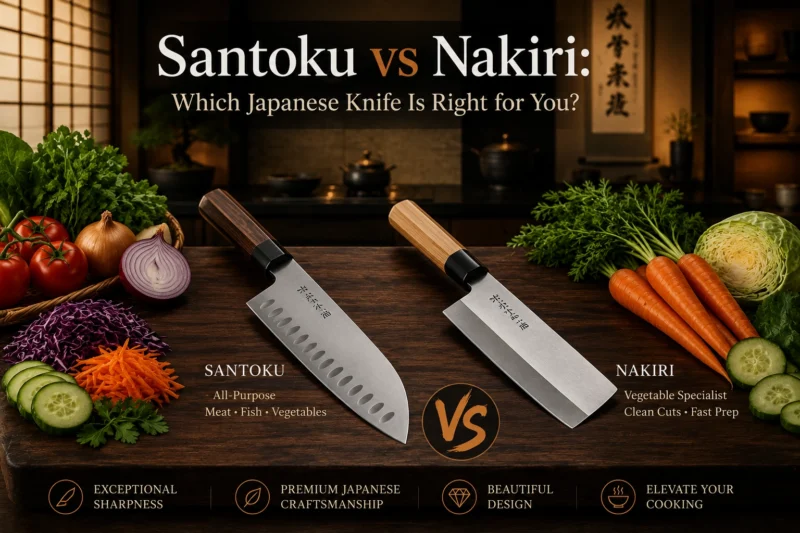
When choosing a Japanese kitchen knife, one of the most common questions is Santoku vs Nakiri. Both knives are highly respected in Japanese cuisine, both excel at precision cutting, and both have become favorites among home cooks and professional chefs around the world. However, despite their similar appearance, they are designed for different purposes.
The Santoku knife is an all-purpose kitchen knife capable of slicing meat, fish, and vegetables with ease. Its name translates to “three virtues” or “three uses,” referring to its versatility. The Nakiri knife, on the other hand, is a dedicated vegetable knife with a rectangular blade designed for fast, clean, and efficient vegetable preparation.
If you enjoy Japanese cooking, prepare vegetables frequently, or are considering your first Japanese knife, understanding the differences between a Santoku vs Nakiri is essential. While both knives can perform many of the same kitchen tasks, each has strengths that make it better suited for certain ingredients and cutting techniques.
In this comprehensive guide, we’ll compare the Santoku vs Nakiri in terms of design, blade shape, steel, edge geometry, cutting style, and intended use. By the end, you’ll know which knife best matches your cooking habits and kitchen needs.
https://yashkadesigns.com/japanese-santoku-knife-chef-kitchen-sushi-sashimi-tool
What Is a Santoku Knife?
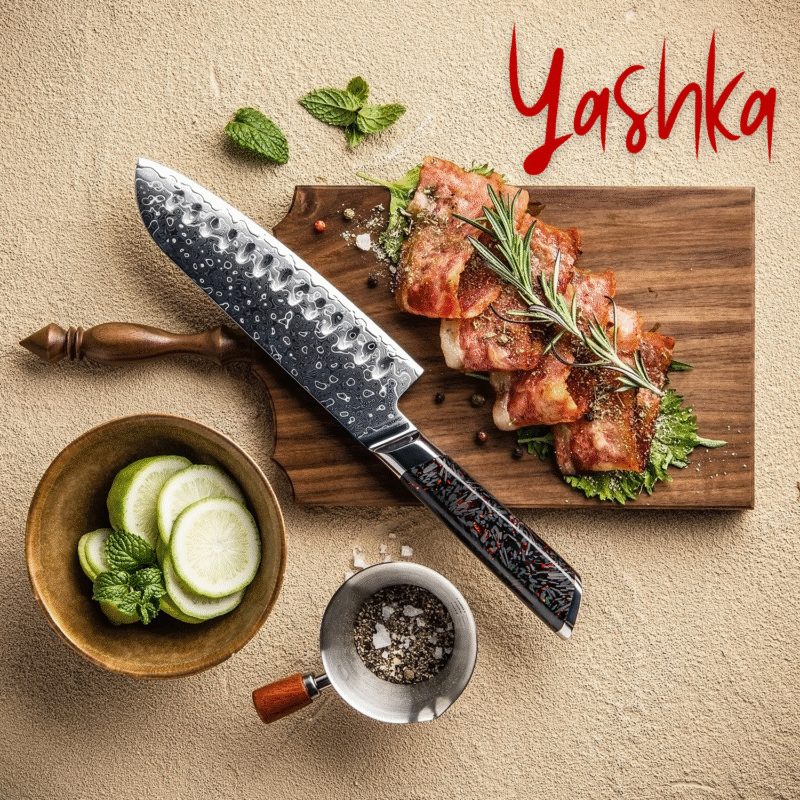
The Santoku knife is one of Japan’s most popular all-purpose kitchen knives. Developed during the mid-20th century, it combines features from traditional Japanese blades with the versatility expected by modern home cooks.
Unlike a Western chef’s knife, the Santoku has a shorter blade, a flatter cutting edge, and a distinctive sheep’s-foot tip. These features make it exceptionally efficient for slicing, dicing, and chopping with a push-cutting motion.
Typical characteristics include:
- Broad blade
- Flat cutting edge
- Sheep’s-foot tip
- Double-beveled edge
- Blade length between 165–180 mm
- Excellent balance
Because of its versatility, many cooks use a Santoku as their primary kitchen knife.
Why Is It Called Santoku?
The word Santoku (三徳) means “three virtues” or “three benefits.”
Most commonly, these three virtues refer to the knife’s ability to handle:
- Meat
- Fish
- Vegetables
Others interpret the name as representing the three primary cutting techniques:
- Slicing
- Dicing
- Chopping
Either way, the Santoku is designed to perform multiple kitchen tasks with a single knife.
Common Uses for a Santoku Knife
The Santoku is suitable for:
- Slicing meat
- Portioning fish
- Chopping vegetables
- Dicing onions
- Mincing garlic
- Cutting herbs
- Preparing fruit
Its versatility makes it one of the best Japanese knives for everyday cooking.
What Is a Nakiri Knife?
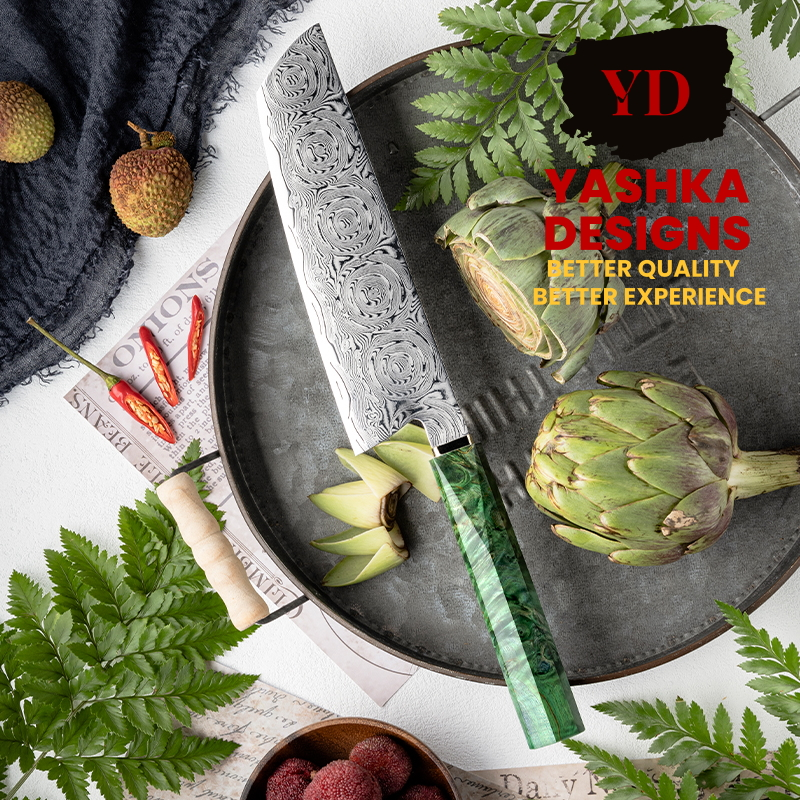
The Nakiri knife is a traditional Japanese vegetable knife specifically designed for preparing vegetables.
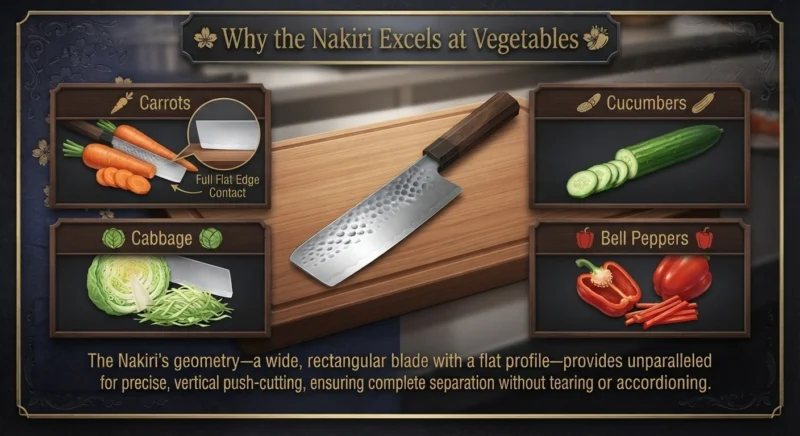
Unlike the Santoku, the Nakiri features a perfectly straight cutting edge and a rectangular blade that allows the entire edge to contact the cutting board simultaneously. This produces exceptionally clean, uniform cuts with very little effort.
Typical characteristics include:
- Rectangular blade
- Flat edge
- Thin profile
- Double bevel
- Blade length between 160–180 mm
- Tall blade for excellent knuckle clearance
Because it is optimized for vegetables, the Nakiri has become a favorite among vegetarians, vegans, and professional chefs who prepare large quantities of produce.
History of the Nakiri Knife
The Nakiri has a much longer history than the Santoku.
It originated during Japan’s Edo period, when vegetables formed the foundation of many traditional meals. Home cooks needed a knife capable of handling everything from leafy greens to dense root vegetables.
Its flat blade made repetitive chopping efficient while reducing damage to delicate produce.
Although modern Japanese kitchens often include a Santoku, the Nakiri remains one of the finest dedicated vegetable knives ever developed.
Santoku vs Nakiri: Design Philosophy
One of the biggest differences in the Santoku vs Nakiri comparison is the philosophy behind each knife.
Santoku
The Santoku is designed to replace multiple knives.
Its goal is versatility.
It should comfortably perform:
- Vegetable preparation
- Meat slicing
- Fish preparation
- General kitchen work
For many households, one Santoku can handle 90% of daily cutting tasks.
https://yashkadesigns.com/nakiri-knives
Nakiri
The Nakiri focuses on one task:
Preparing vegetables.
Every aspect of its design—from the flat edge to the rectangular blade—helps produce smooth, precise vegetable cuts.
Instead of versatility, the Nakiri prioritizes efficiency and consistency.
Blade Shape Comparison
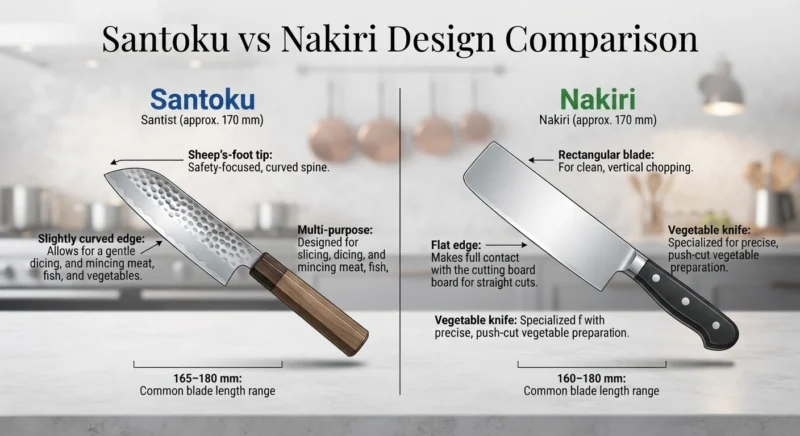
The blade profile is the easiest way to distinguish a Santoku from a Nakiri.
Santoku Blade
The Santoku features:
- Curved spine
- Sheep’s-foot tip
- Flat edge with slight belly
- Broad blade
The rounded front improves safety while maintaining precision.
The slight belly allows gentle rocking, although push cutting remains its primary technique.
Nakiri Blade
The Nakiri features:
- Perfectly straight edge
- Rectangular profile
- No pointed tip
- Uniform blade height
Its flat edge ensures every part of the blade contacts the cutting board simultaneously.
This greatly improves chopping efficiency.
Check Our Guide Blade Geometry Explained
Blade Length
Santoku
Typical lengths include:
- 165 mm
- 170 mm
- 180 mm
The 170 mm size is considered the standard for most home kitchens.
Nakiri
Typical lengths include:
- 160 mm
- 165 mm
- 180 mm
Blade length varies little because vegetables generally require more height than reach.
Blade Height
Blade height influences control, stability, and food transfer.
Santoku
Typically:
45–50 mm
Provides enough knuckle clearance while maintaining agility.
https://yashkadesigns.com/santoku-knives
Nakiri
Typically:
50–60 mm
The taller blade helps scoop chopped vegetables directly from the cutting board into a pan or bowl.
Tip Design
The tip plays a major role in determining what a knife can do.
Santoku
The sheep’s-foot tip offers:
- Precision
- Safety
- Better meat trimming
- Fine slicing
Although less pointed than a Gyuto, it still handles detailed work effectively.
Nakiri
The Nakiri has almost no usable tip.
Instead, it relies entirely on the straight cutting edge.
This design improves chopping performance but limits tasks requiring piercing or intricate cuts.
Blade Thickness
Blade thickness affects cutting resistance and durability.
Santoku
Typical thickness:
2–2.5 mm
The slightly thicker blade provides greater versatility for slicing proteins.
Check Our Guide Best Blade Thickness for Different Uses
Nakiri
Typical thickness:
1.8–2.2 mm
Many Nakiri knives are thinner behind the edge, allowing them to glide effortlessly through vegetables with minimal resistance.
Edge Geometry
Edge geometry determines how efficiently a knife passes through food.
Santoku
Modern Santoku knives usually feature:
- Double bevel
- Symmetrical grind
- Edge angle around 12–15° per side
This provides a balance between sharpness and durability.
Nakiri
Most Nakiri knives also feature:
- Double bevel
- Thin edge
- Edge angle around 10–15° per side
The thinner geometry allows cleaner cuts through vegetables while reducing cell damage.
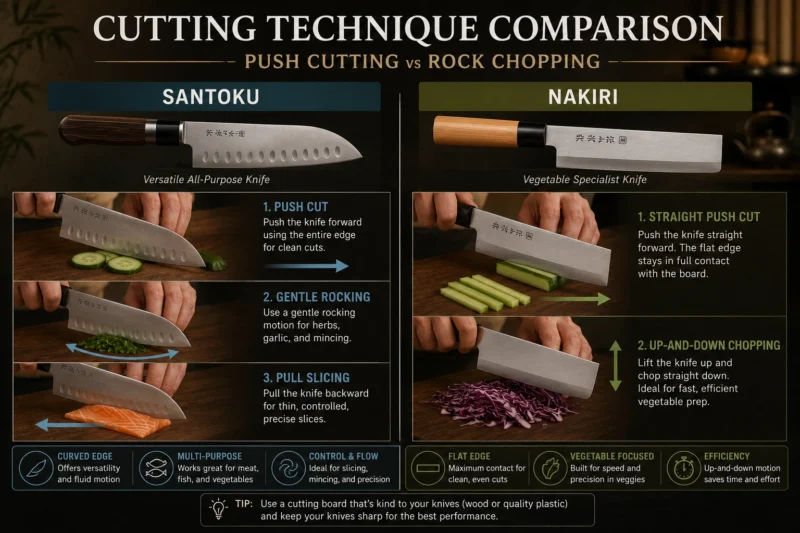
Cutting Techniques
Understanding cutting style is one of the keys to choosing between a Santoku vs Nakiri.
Santoku
Best suited for:
- Push cutting
- Pull slicing
- Light rocking
- Fine slicing
Its slight belly allows limited rocking motion, making it more versatile than many traditional Japanese knives.
https://yashkadesigns.com/damascus-nakiri-knife-home-kitchen-vegetables-cutting-tool-chef-knife
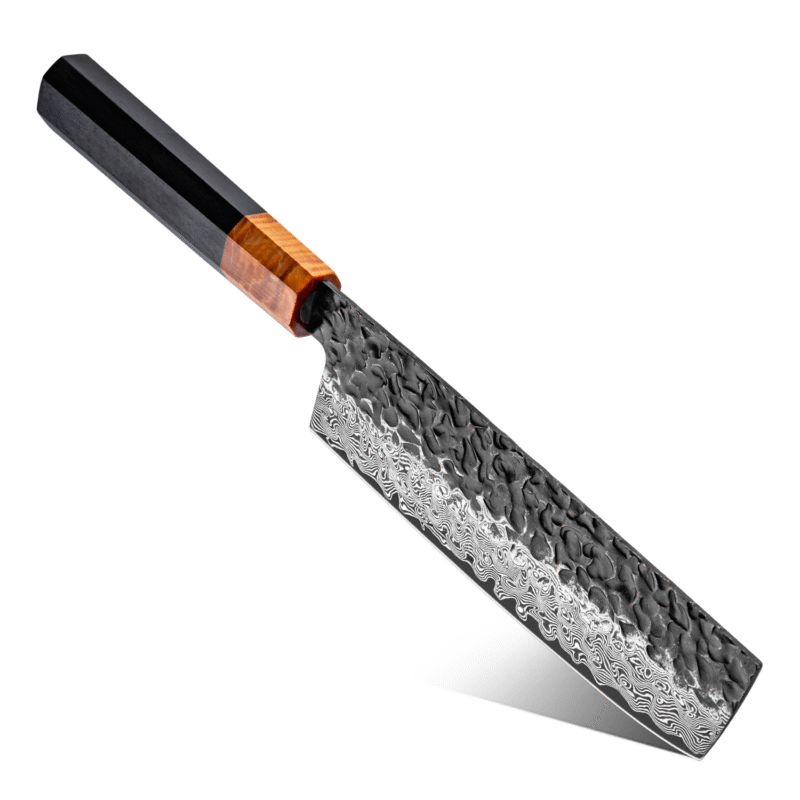
Nakiri
Optimized for:
- Push cutting
- Up-and-down chopping
- Straight slicing
Because the blade has no curve, rocking is less effective. Instead, the entire edge contacts the board at once, creating clean, consistent cuts.
Steel Types
Steel selection has a significant impact on performance.
Common Santoku Steels
Manufacturers commonly use:
- VG10
- AUS-10
- 14C28N
- X50CrMoV15
- 440C
- SG2 (R2)
- Ginsan
These steels provide an excellent balance of edge retention, toughness, and corrosion resistance.
Common Nakiri Steels
Popular Nakiri steels include:
- VG10
- White Steel #2
- Blue Steel #2
- Aogami Super
- SG2
- Ginsan
- AUS-10
Many premium Nakiri knives feature very hard Japanese steels that support exceptionally thin edges.
Hardness Comparison
Typical Rockwell hardness values:
| Knife | HRC |
|---|---|
| Western Santoku | 56–58 |
| Premium VG10 Santoku | 60–61 |
| SG2 Santoku | 62–64 |
| VG10 Nakiri | 60–61 |
| White Steel Nakiri | 61–63 |
| SG2 Nakiri | 62–64 |
Harder steels generally provide better edge retention but require more careful use.
Check Our Guide What Is HRC? Understanding Rockwell Hardness
Handle Types
Both knives are available with traditional Japanese and Western-style handles.
Wa Handle
Common materials include:
- Magnolia
- Walnut
- Oak
- Cherry
- Burnt chestnut
Advantages:
- Lightweight
- Excellent balance
- Comfortable for pinch grip
Western Handle (Yo Handle)
Often made from:
- Micarta
- G10
- POM
- Pakka wood
- Rosewood
Advantages:
- Familiar feel
- Full tang construction
- Slightly heavier
- Good for cooks transitioning from Western knives
Check Our Guide Japanese Wa Handles
Weight and Balance
Although both knives have similar dimensions, they feel different during use.
Santoku
The Santoku is usually balanced near the pinch grip, giving it a nimble, all-purpose feel. This balanced weight distribution makes it comfortable for extended use and quick transitions between vegetables, meat, and fish.
Nakiri
The Nakiri’s taller blade gives it a slightly blade-forward feel. This extra weight helps the knife fall naturally through vegetables, reducing effort during repetitive chopping sessions and making it especially efficient when preparing large quantities of produce.
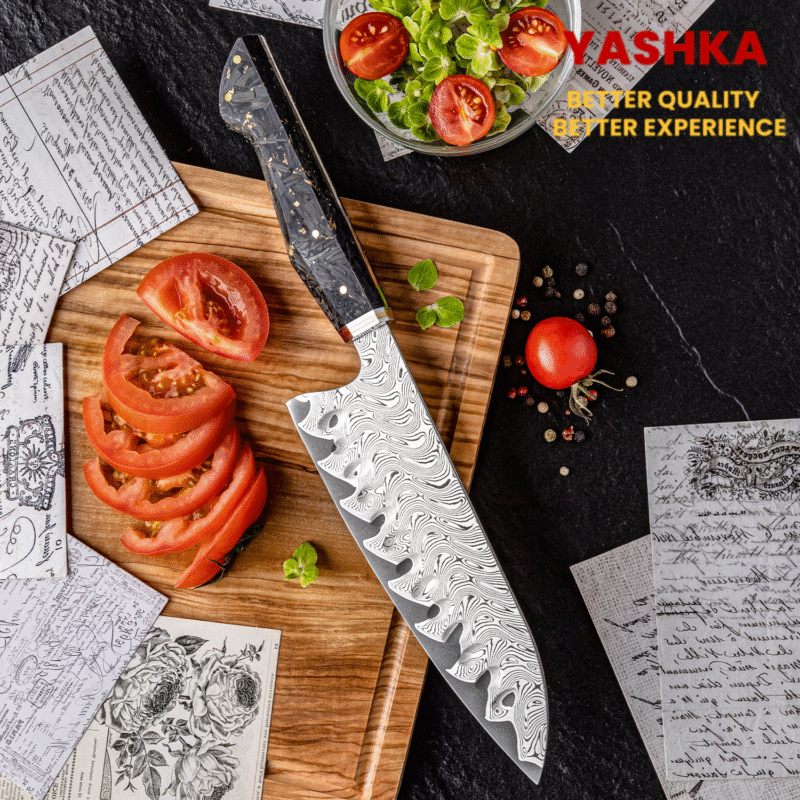
Santoku vs Nakiri: Feature Comparison
| Feature | Santoku | Nakiri |
|---|---|---|
| Origin | Japan | Japan |
| Primary Use | General-purpose kitchen knife | Vegetable knife |
| Blade Shape | Sheep’s-foot | Rectangular |
| Tip | Yes | No pointed tip |
| Blade Length | 165–180 mm | 160–180 mm |
| Blade Height | 45–50 mm | 50–60 mm |
| Edge Profile | Slightly curved | Completely flat |
| Cutting Style | Push, slice, light rock | Push cut, chop |
| Typical Hardness | 56–64 HRC | 60–64 HRC |
| Best For | Meat, fish, vegetables | Vegetables and herbs |
| Versatility | Excellent | Specialized |
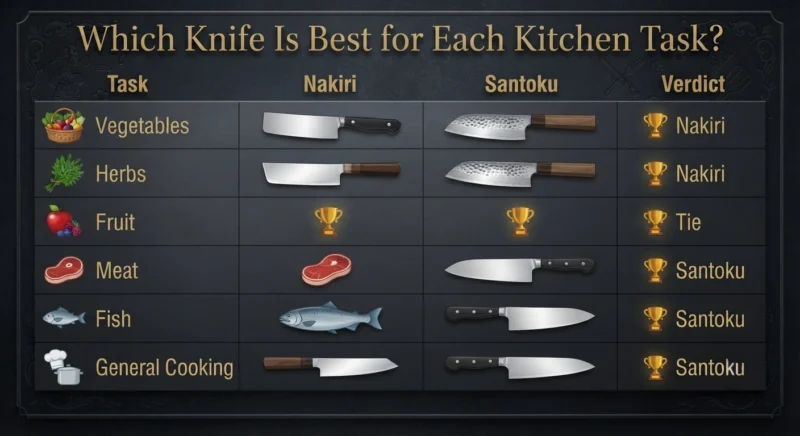
Which Design Is Right for You?
The Santoku vs Nakiri debate comes down to how you cook.
If you want one knife that can handle nearly every daily kitchen task, the Santoku is difficult to beat. It slices meat, portions fish, chops vegetables, and performs well as an all-purpose knife.
If your cooking revolves around fresh vegetables, salads, stir-fries, soups, or plant-based meals, the Nakiri offers unmatched efficiency. Its straight edge and tall blade produce cleaner cuts, reduce food sticking, and make vegetable preparation faster and more enjoyable.
Both knives reflect the precision and craftsmanship of Japanese knife-making, but each serves a different purpose. Understanding those design differences is the key to selecting the knife that best complements your kitchen.
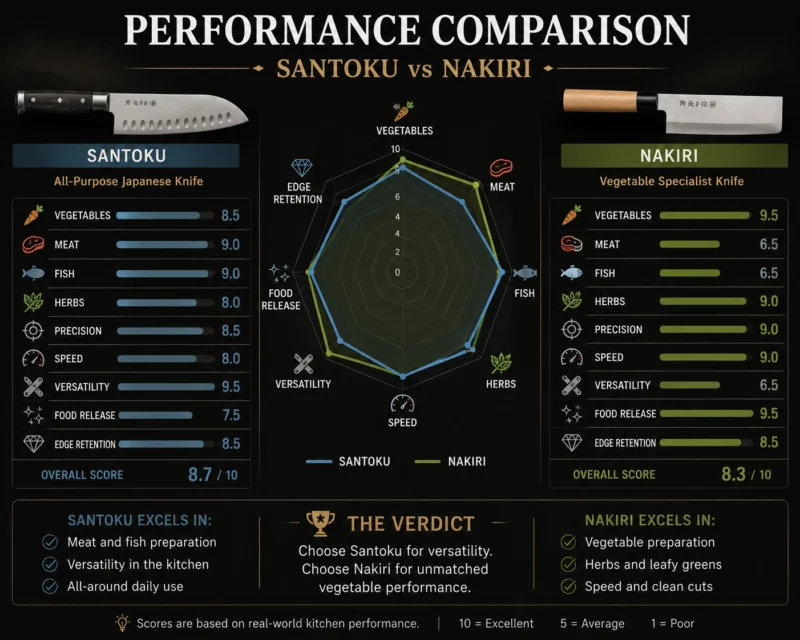
Santoku vs Nakiri Performance Comparison
Performance is where the Santoku vs Nakiri comparison becomes truly interesting.
The Santoku was designed as a multi-purpose knife capable of handling vegetables, meat, and fish with equal confidence. Its balanced blade and versatile shape make it suitable for nearly every daily kitchen task.
The Nakiri, by contrast, focuses on one purpose: preparing vegetables. Its flat edge and thin blade create exceptionally clean cuts while minimizing damage to delicate produce.
Cutting Vegetables
Vegetables are where both knives shine, but they approach the task differently.
Santoku
The Santoku easily handles:
- Onions
- Tomatoes
- Carrots
- Cucumbers
- Potatoes
- Bell peppers
- Mushrooms
Its slightly curved edge allows smooth push cuts and limited rocking.
Advantages
- Versatile
- Excellent control
- Handles mixed ingredients
Nakiri
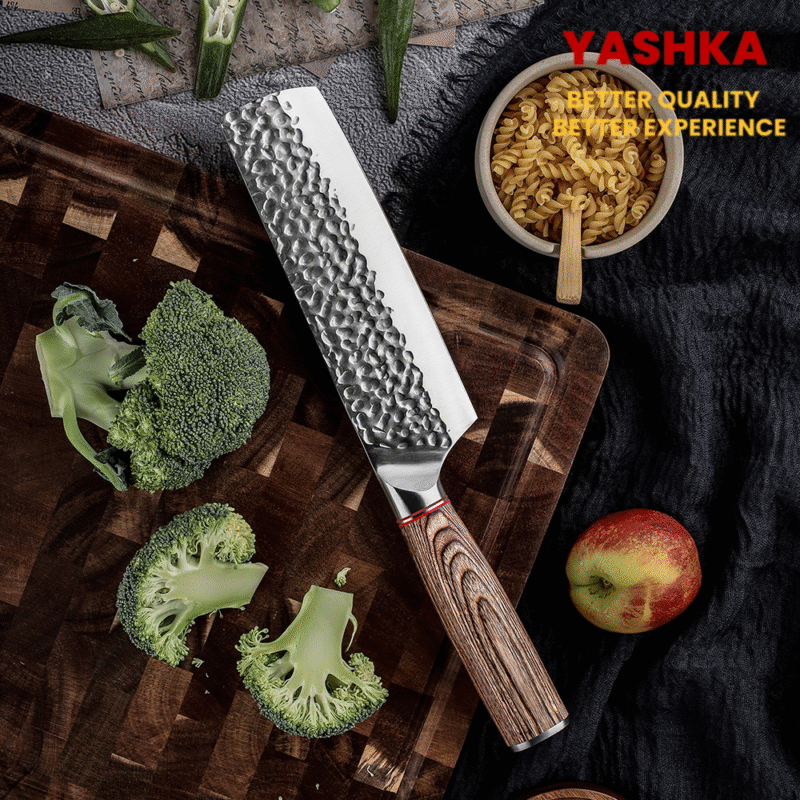
The Nakiri was specifically designed for vegetables.
Its perfectly flat edge ensures the entire blade contacts the cutting board simultaneously.
Benefits include:
- Cleaner cuts
- Less food sticking
- Faster chopping
- Uniform slices
The tall blade also makes transferring chopped vegetables to a bowl quick and easy.
Winner
🏆 Nakiri Knife
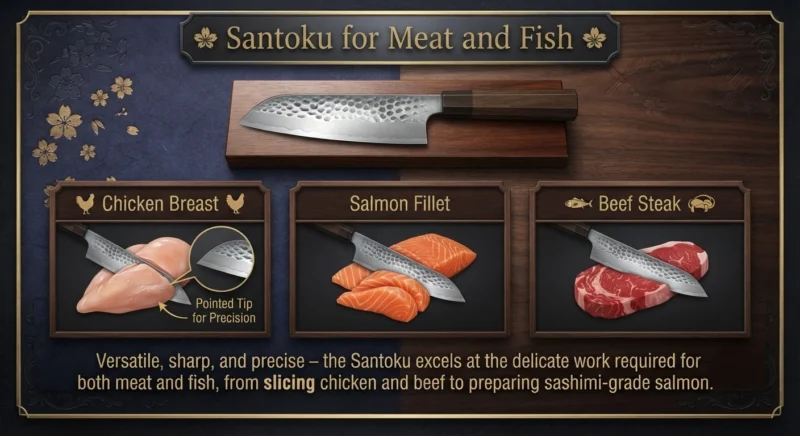
Slicing Meat
Although neither knife replaces a dedicated slicing knife, both perform well with boneless meat.
https://yashkadesigns.com/japanese-santoku-knife-damascus-steel-home-kitchen-tool
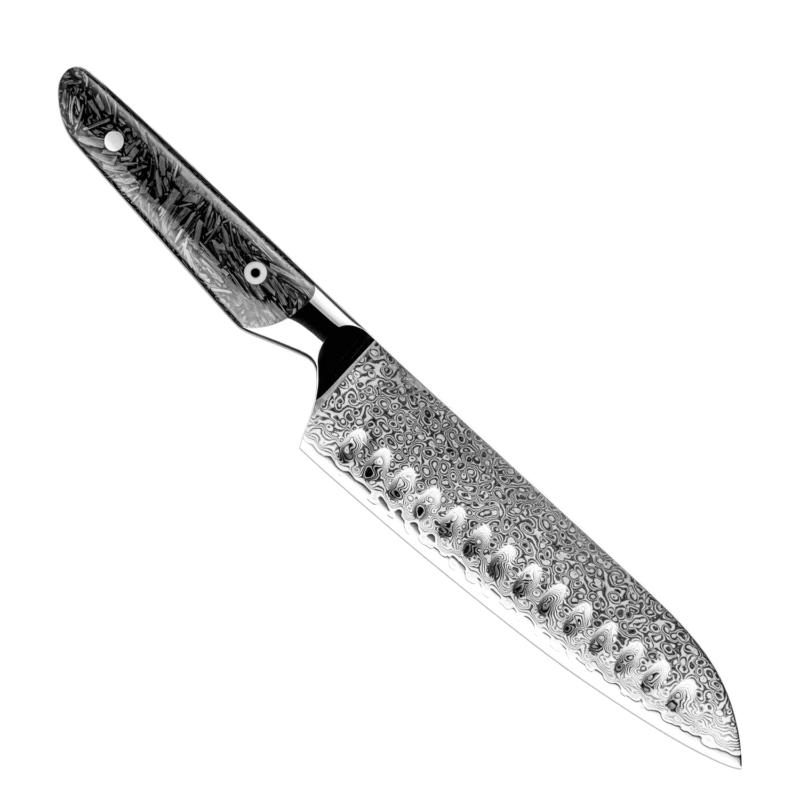
Santoku
The Santoku slices:
- Chicken breasts
- Pork loin
- Beef steaks
- Cooked meats
Its pointed tip also helps trim fat and silver skin.
Winner
🏆 Santoku Knife
Nakiri
The Nakiri can slice boneless meat but lacks a pointed tip for precision trimming.
Because of its rectangular profile, it is less convenient for separating connective tissue.
Preparing Fish
Fish preparation often requires precise slicing and controlled movements.
Santoku
Excellent for:
- Salmon
- Tuna
- White fish
- Portioning fillets
The pointed tip offers greater versatility.
Nakiri
Suitable only for basic slicing.
Not recommended for filleting or trimming.
Winner
🏆 Santoku Knife
Herbs
Fresh herbs benefit from clean cuts that reduce bruising.
Santoku
Can mince herbs effectively using either a push cut or gentle rocking motion.
Nakiri
Produces exceptionally clean herb cuts because the entire edge contacts the board evenly.
Winner
🏆 Nakiri Knife
Fruit Preparation
Both knives perform well with fruit.
Santoku
Ideal for:
- Apples
- Pears
- Melons
- Citrus
- Pineapple
Its pointed tip helps remove cores and stems.
Nakiri
Excellent for:
- Watermelon
- Cabbage
- Pumpkin
- Large fruits
The tall blade supports larger produce during slicing.
Winner
Tie
Precision
Precision depends on blade control.
Santoku
Its shorter length and pointed tip allow accurate slicing and trimming.
Nakiri
The straight edge produces remarkably uniform slices, particularly with vegetables.
Winner
- Vegetables: 🏆 Nakiri
- General precision: 🏆 Santoku
Speed
Professional chefs value efficiency.
Santoku
Quickly switches between meat, vegetables, and fish without changing knives.
Nakiri
When preparing large amounts of vegetables, the Nakiri often works faster because every downward cut contacts the cutting board evenly.
Overall Winner
- Mixed ingredients: 🏆 Santoku
- Vegetables only: 🏆 Nakiri
Push Cutting vs Rock Chopping
One of the biggest differences in the Santoku vs Nakiri comparison is cutting technique.
Santoku
Supports:
- Push cutting
- Pull slicing
- Gentle rocking
Its slight belly provides flexibility.
Nakiri
Designed for:
- Straight push cuts
- Vertical chopping
Because the edge is completely flat, rocking is inefficient.
Winner
Depends entirely on personal preference.
Food Release
Food sticking to the blade slows preparation.
Santoku
Many Santoku knives include Granton (hollow) edges to reduce sticking.
Nakiri
The tall blade naturally separates sliced vegetables.
Premium Nakiri knives often feature excellent food release.
Winner
Slight advantage:
🏆 Nakiri
Edge Retention
Edge retention depends primarily on steel.
Santoku
Typical hardness:
56–64 HRC
Premium steels like VG10 and SG2 maintain sharpness for extended periods.
Nakiri
Often manufactured using harder Japanese steels.
Because vegetables are relatively soft, the edge experiences less stress.
Winner
Tie
High-quality versions of either knife provide excellent edge retention.
Sharpening
Both knives sharpen similarly.
Santoku
Recommended angle:
12–15° per side
Easy to sharpen using quality whetstones.
Nakiri
Recommended angle:
10–15° per side
The straight edge actually makes it easier for many beginners to maintain a consistent sharpening angle.
Winner
Slight advantage:
🏆 Nakiri
Check Our Guide All Kinds of Knife Sharpening Tools
Durability
Both knives are intended for kitchen work—not heavy-duty chopping.
Avoid:
- Frozen food
- Thick bones
- Hard shells
Santoku
More forgiving because of its versatile geometry.
Nakiri
Excellent durability when used for vegetables.
Repeated contact with hard materials can chip very hard Japanese steels.
Winner
🏆 Santoku
Maintenance
To maximize the lifespan of either knife:
- Wash by hand immediately after use.
- Dry thoroughly before storing.
- Use a wooden or soft plastic cutting board.
- Store safely in a knife block, magnetic strip, or blade guard.
- Sharpen regularly using quality whetstones.
Carbon steel versions require additional care to prevent rust.
Check Our Guide
Safety
A sharp knife is safer than a dull one because it requires less force.
The Santoku’s pointed tip demands extra attention during detailed work, while the Nakiri’s squared-off tip reduces the risk of accidental punctures.
Regardless of the knife, always use a stable cutting board and proper cutting technique.
Advantages and Disadvantages
Santoku Knife
Pros
- Highly versatile
- Excellent for meat, fish, and vegetables
- Comfortable for daily use
- Good for slicing and chopping
- Ideal all-purpose Japanese knife
Cons
- Not specialized for vegetables
- Slightly less efficient than a Nakiri for repetitive chopping
Nakiri Knife
Pros
- Outstanding vegetable knife
- Extremely clean cuts
- Tall blade improves food transfer
- Minimal food bruising
- Excellent for push cutting
Cons
- Limited versatility
- No pointed tip
- Less suitable for meat trimming and fish preparation
Who Should Buy a Santoku?
Choose a Santoku if you:
- Want one knife for everyday cooking
- Prepare meat, fish, and vegetables
- Prefer versatility
- Have limited kitchen space
- Are buying your first Japanese knife
For many households, the Santoku is the most practical Japanese kitchen knife.
Who Should Buy a Nakiri?
Choose a Nakiri if you:
- Prepare vegetables every day
- Enjoy vegetarian or vegan cooking
- Make salads, stir-fries, soups, and meal prep
- Appreciate specialized kitchen tools
- Prefer push cutting over rocking
A Nakiri becomes especially valuable when vegetables are the focus of your cooking.
Can a Nakiri Replace a Santoku?
A Nakiri can handle many kitchen tasks, but it cannot fully replace a Santoku.
While it excels at chopping vegetables, it is less effective for trimming meat, slicing fish, and performing detail work because it lacks a pointed tip.
If you only own one Japanese knife, the Santoku is generally the better choice. If you already have an all-purpose knife, adding a Nakiri can greatly improve vegetable preparation.
Frequently Asked Questions
What is the difference between a Santoku and a Nakiri?
A Santoku is an all-purpose Japanese knife designed for meat, fish, and vegetables, while a Nakiri is a dedicated vegetable knife with a straight rectangular blade optimized for chopping produce.
Which knife is better for vegetables?
The Nakiri is widely considered the better vegetable knife because its flat edge produces clean, complete cuts and reduces food bruising.
Is a Santoku good for meat?
Yes. A Santoku slices boneless meat exceptionally well and is one of the most versatile kitchen knives available.
Can a Nakiri cut meat?
Yes, it can slice boneless meat, but it is not intended for trimming fat, separating joints, or cutting around bones.
Which knife is better for beginners?
The Santoku is generally the better first Japanese knife because it performs a wide variety of kitchen tasks with confidence.
Do professional chefs use Nakiri knives?
Yes. Many professional chefs use Nakiri knives when preparing large quantities of vegetables because they provide speed, precision, and consistency.
Which knife stays sharp longer?
Edge retention depends more on the steel and heat treatment than on the knife style. Premium VG10, SG2, and Aogami steels provide excellent long-term sharpness in both Santoku and Nakiri knives.
Can a Santoku replace a chef’s knife?
For most home cooks, yes. A Santoku can perform nearly all the tasks of a Western chef’s knife while offering excellent control and precision.
Is a Nakiri good for herbs?
Absolutely. The Nakiri’s flat blade creates clean, even cuts that help preserve the flavor and appearance of fresh herbs.
What cutting board is best for Japanese knives?
Wooden cutting boards, especially end-grain or edge-grain hardwood, are ideal because they help preserve the sharp edge. High-quality soft plastic boards are also suitable. Avoid glass, marble, granite, and ceramic cutting surfaces.
Final Verdict: Santoku vs Nakiri
The Santoku vs Nakiri debate is not about which knife is objectively better—it’s about selecting the right tool for your cooking style.
Choose the Santoku if you want a versatile, all-purpose Japanese knife capable of slicing meat, preparing fish, chopping vegetables, and handling everyday kitchen tasks. It is an excellent choice for beginners, experienced home cooks, and anyone looking for a single knife that can do almost everything.
Choose the Nakiri if vegetables are the heart of your cooking. Its flat edge, tall blade, and specialized design deliver exceptional precision, faster chopping, and beautifully clean cuts that preserve the texture and appearance of fresh produce.
Many experienced cooks eventually own both. The Santoku serves as the everyday workhorse, while the Nakiri becomes the preferred knife whenever large amounts of vegetables need to be prepared.
Whether you choose a Santoku or a Nakiri, investing in a well-made Japanese knife will elevate your cooking experience with superior sharpness, precision, and craftsmanship.
Santoku vs Nakiri knives.