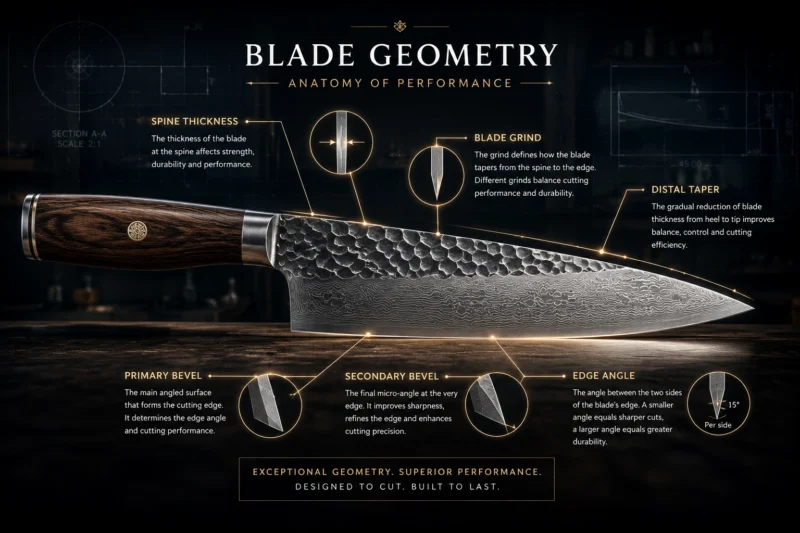
Blade Geometry Explained
An Independent Guide
When people compare knives, they often focus on the steel. Premium steels like MagnaCut, M390, CPM S90V, or VG10 receive plenty of attention, but even the finest steel cannot compensate for poor blade geometry.
Blade geometry determines how a knife cuts, how much force it requires, how long it stays efficient during use, and even how easy it is to sharpen. Two knives made from the exact same steel can perform dramatically differently simply because their geometry is different.
Professional knife makers understand that steel provides the potential, while geometry unlocks that potential.
In this guide, we’ll explain everything you need to know about blade geometry, including blade thickness, grinds, edge angles, blade profiles, distal taper, and why these features matter far more than many people realize.
What Is Blade Geometry?
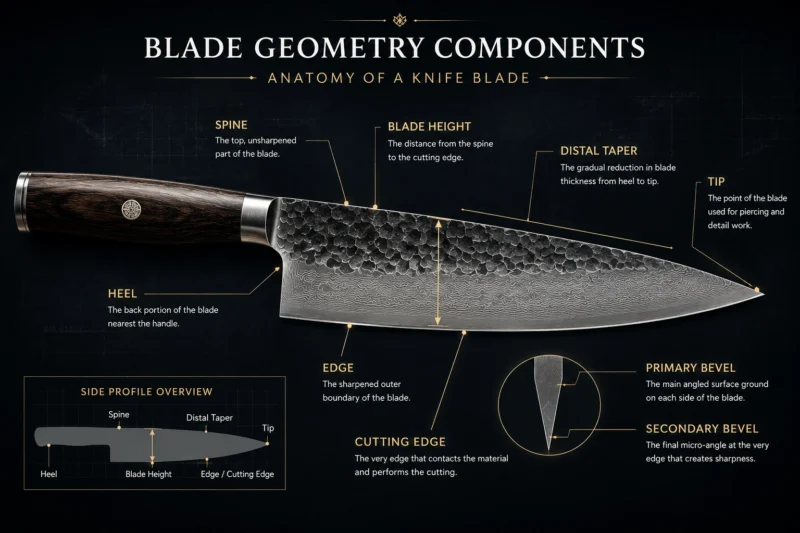
Blade geometry refers to the complete shape of a knife blade from the spine to the cutting edge.
It includes:
- Blade thickness
- Blade grind
- Edge angle
- Blade profile
- Distal taper
- Primary bevel
- Secondary bevel
- Blade width
- Tip geometry
Together, these elements determine how efficiently a knife moves through material.
Imagine pushing two wedges through a piece of wood.
One wedge is thin.
The other is thick.
The thinner wedge requires significantly less force.
A knife works exactly the same way.
The thinner and better designed the blade geometry, the easier it slices.
Why Blade Geometry Matters More Than Steel
Many buyers assume expensive steel automatically creates a better knife.
This isn’t always true.
For example:
A well-ground 14C28N chef knife often cuts noticeably better than an overly thick M390 kitchen knife.
Why?
Because cutting performance depends largely on reducing friction.
As the knife enters food or material, every fraction of a millimeter affects resistance.
Good geometry means:
- Cleaner cuts
- Better food release
- Less hand fatigue
- Improved slicing
- Greater precision
- Higher cutting efficiency
Poor geometry causes:
- Wedging
- Excess drag
- Cracking vegetables
- Difficult sharpening
- Reduced control
This is why many custom knife makers spend more time perfecting blade geometry than selecting steel.
Check Our Guide Edge Retention Explained
The Three Parts of Blade Geometry
Blade geometry can be divided into three major areas.
1. Blade Thickness
Thickness is measured at the spine.
Typical values include:
| Knife Type | Typical Thickness |
|---|---|
| Japanese Gyuto | 2–2.5 mm |
| Western Chef Knife | 2.5–3.5 mm |
| Utility Knife | 2–3 mm |
| Hunting Knife | 3–4.5 mm |
| Bushcraft Knife | 4–5 mm |
| Survival Knife | 5–7 mm |
| Cleaver | 4–8 mm |
Thicker blades provide:
- More strength
- Better impact resistance
- Higher durability
Thinner blades provide:
- Easier slicing
- Less resistance
- Better food preparation
- Higher cutting efficiency
Neither is universally better.
Everything depends on the intended use.
2. Blade Grind
The grind removes material from the blade until it reaches the edge.
It has an enormous effect on cutting performance.
Common grinds include:
- Flat Grind
- Hollow Grind
- Convex Grind
- Scandi Grind
- Saber Grind
- Chisel Grind
Each offers different advantages.
We’ll examine each in detail later.
3. Edge Angle
The final edge angle determines sharpness and durability.
Typical edge angles include:
| Edge Angle (Per Side) | Typical Use |
|---|---|
| 10° | Sushi knives |
| 12° | Japanese chef knives |
| 15° | Premium kitchen knives |
| 17° | Utility knives |
| 20° | Western chef knives |
| 22° | Outdoor knives |
| 25° | Heavy-duty knives |
Smaller angles:
- Slice easier
- Feel sharper
- Require less force
Larger angles:
- Resist chipping
- Handle tougher work
- Stay stronger under impact
The ideal angle depends on both steel hardness and intended use.
Check Our Guide Best Blade Thickness for Different Uses
Blade Thickness vs Cutting Performance
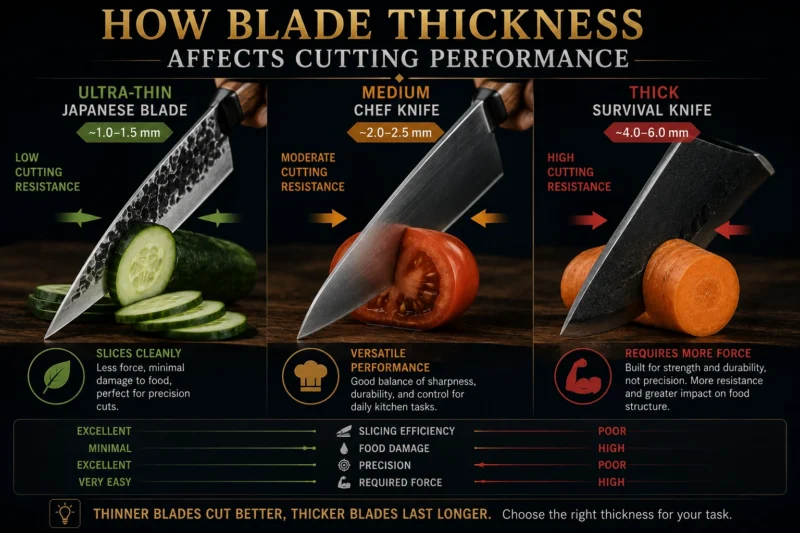
One of the most misunderstood concepts is blade thickness.
Many buyers believe thicker automatically means better.
Actually, the opposite is often true for slicing.
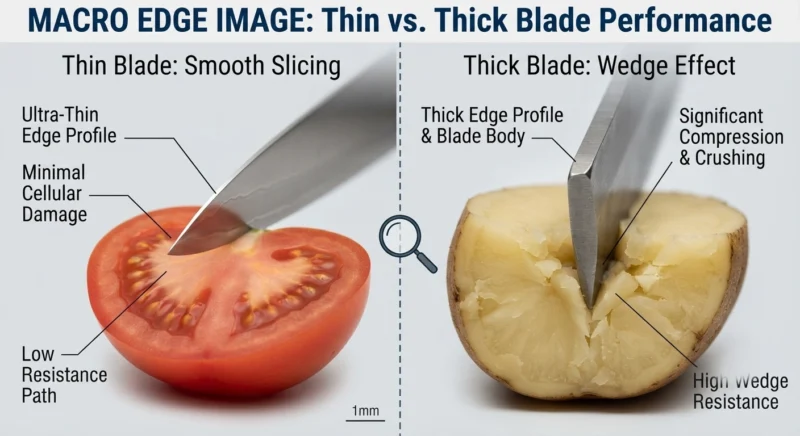
Imagine cutting a potato.
A thin blade slides through.
A thick blade pushes the potato apart before slicing.
That extra resistance is called wedging.
Wedging increases:
- Cutting effort
- Food cracking
- Drag
- User fatigue
This explains why Japanese kitchen knives are often extremely thin.
Their geometry minimizes wedging while maximizing slicing performance.
Thin Doesn’t Mean Weak
A common misconception is that thin knives break easily.
Modern steels combined with proper heat treatment allow surprisingly thin blades to remain very durable.
For example:
A 2 mm MagnaCut chef knife may outperform a 4 mm budget stainless knife in both cutting efficiency and practical durability.
Strength comes from:
- Steel quality
- Heat treatment
- Grind design
- Blade profile
—not simply thickness.
Spine Thickness vs Edge Thickness
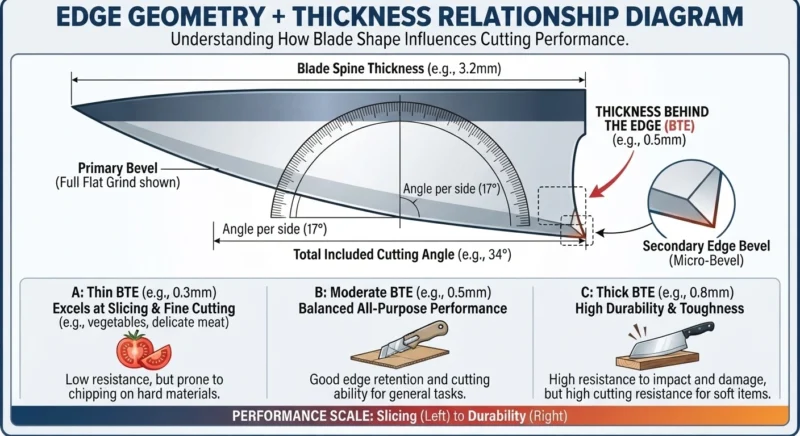
Another important distinction is between spine thickness and edge thickness.
Two knives may both measure 3 mm at the spine.
However:
Knife A may taper aggressively toward the edge.
Knife B may remain thick almost all the way down.
Knife A will almost always cut better.
Professional sharpeners often focus more on edge thickness behind the edge than overall spine thickness.
This measurement dramatically affects real-world performance.
Geometry Behind the Edge
Knife enthusiasts frequently discuss “thin behind the edge.”
This refers to the thickness just above the sharpened bevel.
A knife can have:
- Thick spine
- Excellent strength
- Very thin cutting geometry
This combination produces both durability and outstanding slicing.
Many premium Japanese makers intentionally design knives this way.
The result is excellent cutting performance without sacrificing structural integrity.
Why Premium Knives Feel So Different
Many people notice that a premium knife seems to “fall through food.”
This isn’t magic.
It’s geometry.
Even inexpensive steel can perform exceptionally well when paired with excellent geometry.
Conversely, premium steel with poor geometry often feels disappointing.
Professional chefs frequently value geometry even more than steel composition because geometry affects every single cut they make.
Blade Grind Types Explained
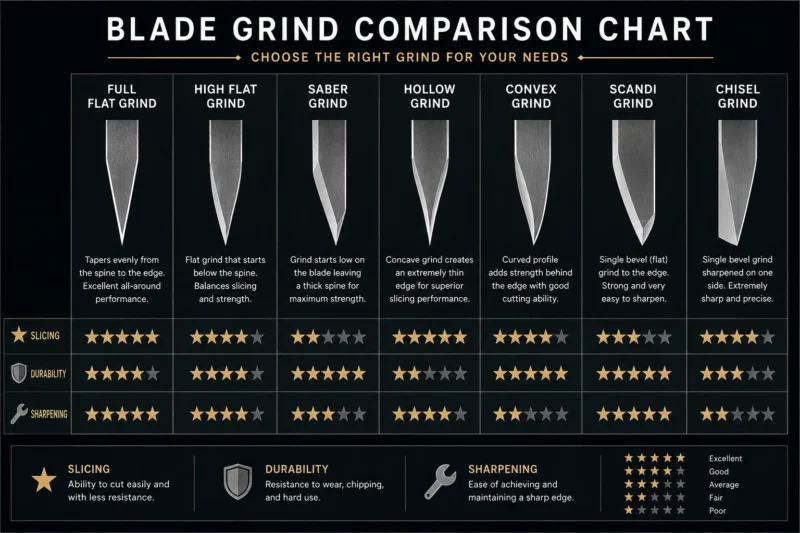
The grind is one of the most influential aspects of blade geometry. It determines how the blade tapers from the spine to the cutting edge, affecting cutting performance, durability, ease of sharpening, and the knife’s intended purpose.
A knife with the perfect steel but an unsuitable grind may perform poorly, while a knife made from a more affordable steel can become an outstanding cutter thanks to excellent geometry.
Let’s examine the most common blade grinds and their strengths.
Full Flat Grind
A Full Flat Grind (FFG) tapers evenly from the spine all the way to the cutting edge.
This is one of the most popular grinds for modern kitchen knives and everyday carry (EDC) knives because it offers an excellent balance between slicing ability and durability.
Advantages
- Excellent slicing performance
- Low cutting resistance
- Easy to sharpen
- Versatile for many tasks
- Good food release
- Suitable for beginners
Disadvantages
- Slightly less durable than thicker grinds
- Can chip if made extremely thin in brittle steels
Best For
- Chef knives
- Utility knives
- Pocket knives
- Outdoor cooking
- Everyday carry
High Flat Grind
A High Flat Grind starts slightly below the spine instead of directly at the spine.
This leaves a little more material in the upper part of the blade while maintaining excellent cutting efficiency.
Many premium outdoor knives use this geometry because it balances strength with slicing ability.
Advantages
- Stronger than Full Flat Grind
- Excellent versatility
- Smooth cutting performance
- Better edge support
Best For
- Hunting knives
- Camping knives
- Utility knives
- Bushcraft
Saber Grind
A Saber Grind begins much lower on the blade, leaving a thick spine and substantial blade body.
The cutting edge is relatively thin, while the upper portion remains robust.
Advantages
- High strength
- Excellent durability
- Resistant to lateral stress
- Suitable for heavy-duty use
Disadvantages
- More wedging
- Higher cutting resistance
- Less efficient slicer
Best For
- Survival knives
- Tactical knives
- Military knives
- Heavy outdoor use
Hollow Grind
A Hollow Grind features concave sides created using a grinding wheel.
The blade becomes extremely thin just above the edge, making it exceptionally sharp.
Advantages
- Razor-like sharpness
- Extremely low cutting resistance
- Excellent for fine slicing
- Easy to achieve hair-shaving edges
Disadvantages
- Less edge support
- Can chip under heavy loads
- Not ideal for chopping
Best For
- Straight razors
- Hunting knives
- Skinning knives
- Fine slicing tasks
Convex Grind
Instead of flat sides, a Convex Grind gently curves toward the edge.
This geometry leaves more steel behind the cutting edge while still providing excellent cutting ability.
Many handmade knives use convex grinds because they combine strength with surprisingly low resistance.
Advantages
- Outstanding edge durability
- Excellent impact resistance
- Smooth cutting action
- Reduced binding
- Strong edge support
Disadvantages
- More difficult to sharpen
- Requires practice and proper technique
Best For
- Bushcraft knives
- Survival knives
- Choppers
- Outdoor knives
- Axes
Scandi Grind
The Scandinavian Grind has a large single bevel that extends directly to the cutting edge without a secondary bevel.
This design is famous among bushcraft enthusiasts.
Advantages
- Very easy to sharpen
- Excellent wood carving control
- Strong edge
- Predictable cutting
Disadvantages
- Less efficient in food preparation
- More drag in soft materials
- Not ideal for kitchen work
Best For
- Bushcraft
- Wood carving
- Camping
- Survival
Chisel Grind
A Chisel Grind is sharpened on only one side.
This geometry is common on traditional Japanese knives and woodworking tools.
Advantages
- Extremely precise cuts
- Excellent control
- Very aggressive slicing
Disadvantages
- Requires experience
- Can pull toward one side
- More specialized sharpening
Best For
- Sushi knives
- Deba knives
- Woodworking tools
Primary Bevel vs Secondary Bevel
Many people confuse these two terms.
Primary Bevel
The primary bevel forms the main taper of the blade.
It creates the overall blade geometry.
Secondary Bevel
The secondary bevel forms the actual cutting edge.
This tiny bevel is sharpened during maintenance.
Changing the secondary bevel angle can significantly alter cutting performance without changing the entire blade geometry.
Distal Taper
Another important feature of premium knives is distal taper.
Distal taper means the blade gradually becomes thinner from the handle toward the tip.
Instead of remaining the same thickness throughout its length, the blade continuously loses thickness.
Benefits of Distal Taper
- Better balance
- Lighter tip
- Improved precision
- Less drag
- Strong heel with fine point
- Easier tip control
Many high-end Japanese chef knives feature significant distal taper, allowing them to perform both heavy chopping near the heel and delicate precision work with the tip.
Blade Profile
Blade profile refers to the overall outline of the cutting edge when viewed from the side.
Different profiles suit different cutting techniques.
Straight Edge
A straighter edge provides maximum contact with the cutting board.
Ideal for:
- Push cutting
- Vegetable preparation
- Precise slicing
Common on Japanese chef knives and Nakiri knives.
Curved Belly
Western chef knives often feature a pronounced curved belly.
Advantages include:
- Excellent rocking motion
- Comfortable herb chopping
- Versatile cutting style
Flat Profile
A flatter edge maximizes slicing efficiency and reduces unnecessary rocking.
Ideal for:
- Push cuts
- Draw cuts
- Professional food preparation
Drop Point
Popular for outdoor knives.
Advantages:
- Strong tip
- Excellent control
- Versatile design
- Safe piercing capability
Clip Point
Recognized by its clipped spine near the tip.
Advantages:
- Fine point
- Excellent piercing
- Precise control
Often found on hunting and Bowie knives.
Tanto Point
Designed for maximum tip strength.
Advantages:
- Reinforced point
- Excellent penetration
- High durability
Less efficient for food preparation but popular for tactical applications.
Thin Behind the Edge: The Secret of Great Cutting
Experienced knife enthusiasts often say a knife is “thin behind the edge.”
This refers to the thickness of the blade immediately above the sharpened edge—not the spine thickness.
Two knives with identical 3 mm spine thickness can perform completely differently depending on how much material remains behind the edge.
A blade that is thin behind the edge:
- Slices with less resistance
- Requires less force
- Produces cleaner cuts
- Reduces food splitting
- Feels noticeably sharper
This characteristic is one of the defining features of premium kitchen knives and is often more important than the blade steel itself.
Blade Geometry vs. Edge Retention
One of the biggest misconceptions in the knife world is that edge retention depends only on the steel. While steel composition and heat treatment are certainly important, blade geometry has an equally significant influence on how long a knife feels sharp during real-world use.
For example, consider two chef knives made from the same steel at the same hardness. One has a thin, full flat grind with a 15° edge, while the other has a thick saber grind with a 20° edge. Despite identical steel properties, the thinner knife will usually slice more efficiently and continue to feel sharper for longer because it encounters less resistance as it passes through food.
This is why professional chefs often place as much importance on geometry as they do on steel selection.
Why Thin Geometry Feels Sharper Longer
As a knife cuts, friction develops between the blade and the material. A thick blade must push more material aside before the edge can complete the cut.
This creates:
- Higher cutting resistance
- Increased wedging
- Greater user fatigue
- More pressure on the edge
A thin blade minimizes these forces. Even after the edge begins to lose some of its initial razor sharpness, efficient geometry allows the knife to continue cutting smoothly.
In many situations, users describe this as the knife “holding its edge,” when in reality the geometry is helping compensate for gradual edge wear.
Wear Resistance vs. Geometry
Wear resistance determines how slowly the edge loses material.
Geometry determines how efficiently that remaining edge cuts.
Think of it this way:
- Steel determines how quickly the edge wears.
- Geometry determines how effectively that edge performs.
Both factors work together.
For example:
A thick knife made from ultra-high wear-resistant steel like CPM S90V may require noticeably more effort than a thin VG10 chef knife simply because the thicker geometry creates greater resistance during slicing.
Check Our Guide Wear Resistance vs Toughness
Blade Geometry vs. Toughness
Blade geometry also plays a critical role in toughness.
Even an extremely tough steel can chip if the edge is ground too thin for the intended task.
Conversely, a moderately tough steel can perform exceptionally well when supported by appropriate geometry.
Thin Edges
Thin edges provide:
- Outstanding slicing
- Precision cutting
- Lower resistance
- Better food preparation
However, they are less suitable for:
- Twisting cuts
- Prying
- Chopping through bone
- Heavy impacts
Thick Edges
Thicker edges provide:
- Better impact resistance
- More edge support
- Reduced risk of chipping
- Greater durability
The trade-off is increased cutting resistance.
Good knife makers balance these characteristics according to the knife’s intended purpose.
Matching Geometry to Steel
Different steels perform best with different geometries.
MagnaCut
MagnaCut combines high toughness with excellent corrosion resistance.
Its toughness allows makers to grind blades thinner without sacrificing durability.
This is one reason MagnaCut has become popular for premium kitchen and outdoor knives.
VG10
VG10 is capable of taking an exceptionally fine edge.
Many Japanese manufacturers pair VG10 with very thin full flat grinds that maximize slicing performance.
However, because VG10 is less tough than MagnaCut, extremely thin edges may chip if abused.
Check Our Guide VG10 Steel Review
D2
D2 offers excellent wear resistance but moderate toughness.
Many makers leave slightly more material behind the edge to reduce chipping.
This produces a more durable edge while preserving respectable cutting performance.
Check Our Guide VG10 vs D2 Steel: Complete Knife Steel Comparison Guide
14C28N
14C28N is known for excellent toughness.
Its forgiving nature allows relatively thin edge geometry, making it a favorite for affordable kitchen knives and outdoor knives.
Check Our Guide 14C28N and Other Swedish Knife Steels Review
1095 Carbon Steel
1095 has very good toughness and is commonly used for bushcraft knives.
Most 1095 outdoor knives feature convex or Scandi grinds that emphasize durability rather than maximum slicing efficiency.
Check Our Guide 1095 Steel Review
Blade Geometry and Sharpening
Geometry affects sharpening just as much as it affects cutting.
Thin Knives Sharpen Faster
A thin blade contains less material behind the edge.
During sharpening, less steel must be removed to recreate the bevel.
Benefits include:
- Faster sharpening
- Less abrasive wear
- Lower maintenance time
- Longer blade life
Professional chefs appreciate this because their knives require frequent touch-ups.
Thick Knives Require More Work
Heavy-duty knives often require significantly more sharpening effort.
A thick blade contains more steel behind the bevel, meaning more material must be removed to restore the edge.
This is one reason survival knives are generally slower to sharpen than chef knives.
Which Grind Is Easiest to Sharpen?
Some blade grinds are much easier to maintain than others.
Full Flat Grind
One of the easiest grinds to sharpen.
- Consistent bevel
- Predictable angle
- Excellent for beginners
Scandi Grind
The entire primary bevel rests flat on the sharpening stone.
Advantages:
- Simple angle control
- Fast sharpening
- Excellent consistency
This is one reason Scandi grinds remain popular among bushcraft enthusiasts.
Hollow Grind
Easy to sharpen initially but requires careful technique to preserve the original geometry over time.
Convex Grind
Convex edges are often considered the most challenging to sharpen.
Maintaining the smooth curved profile requires either:
- Flexible abrasives
- Leather strops with compound
- Experience using slack belts
The reward is outstanding durability and cutting performance.
Blade Geometry and Food Release
One area where geometry makes an enormous difference is food release.
Anyone who has sliced potatoes or cucumbers knows that some knives allow food to fall away naturally, while others cause slices to cling stubbornly to the blade.
The difference is usually geometry rather than steel.
Why Food Sticks
As food is sliced, moisture creates a slight vacuum between the blade and the cut surface.
A perfectly flat blade provides maximum contact area, encouraging food to stick.
Blade geometry can reduce this effect.
Convex Geometry
A slightly convex blade gradually pushes food away from its surface.
Advantages include:
- Better food release
- Less sticking
- Faster food preparation
- Cleaner slicing
Many premium Japanese kitchen knives incorporate subtle convex grinds for this reason.
Blade Height
Taller blades create larger surface areas, increasing the likelihood of food sticking.
Manufacturers often compensate with slight convexity or carefully polished finishes.
Granton (Hollow) Edges
Some chef knives feature shallow indentations known as Granton edges.
These pockets reduce contact area between the blade and food.
While they may improve food release under certain conditions, the effect is often less dramatic than many marketing claims suggest.
Well-executed blade geometry generally has a greater influence on food release than Granton scallops alone.
Japanese vs. Western Knife Geometry
Perhaps the clearest demonstration of blade geometry is the difference between Japanese and Western kitchen knives.
Japanese Geometry
Traditional Japanese chef knives typically feature:
- Thin blades
- Acute edge angles (10–15° per side)
- High or full flat grinds
- Excellent distal taper
- Outstanding slicing performance
These characteristics prioritize precision and efficiency.
Check Our Guide The Complete Guide to Japanese Knives
Western Geometry
Western chef knives generally emphasize durability.
Common features include:
- Thicker spines
- Stronger edge angles (18–20° per side)
- More pronounced blade belly
- Greater edge support
These knives tolerate heavier use and are more forgiving in busy kitchens.
Check Our Guide Best European Kitchen Knives
Which Geometry Is Better?
Neither approach is universally superior.
The best geometry depends entirely on the intended task.
If your priority is effortless vegetable preparation and precision slicing, thin Japanese geometry is difficult to beat.
If you need a durable knife capable of handling varied kitchen tasks with minimal concern about accidental misuse, Western geometry may be the better choice.
Ultimately, the ideal blade geometry is the one that best matches how the knife will actually be used, balancing cutting efficiency, durability, maintenance, and user preference.
Best Blade Geometry for Different Types of Knives
There is no single “perfect” blade geometry. The ideal geometry depends on how the knife will be used. A chef preparing vegetables all day has very different needs than a hunter field dressing game or a camper splitting kindling.
Understanding the relationship between geometry and intended use is the key to choosing the right knife.
Chef Knives
Kitchen knives benefit from geometry that minimizes cutting resistance.
Recommended Geometry
- Full Flat Grind
- High Flat Grind
- Thin behind the edge
- 2–3 mm spine thickness
- 12–15° edge angle per side
- Moderate distal taper
Best For
- Vegetables
- Meat
- Fish
- Herbs
- Daily food preparation
This geometry allows the knife to glide through ingredients with minimal effort while producing clean, precise cuts.
Santoku Knives
Santoku knives are designed primarily for push cutting rather than rocking.
Typical geometry includes:
- Thin blade
- Flat profile
- High Flat Grind
- Fine edge
This combination excels at slicing vegetables, boneless meat, and fish.
Nakiri Knives
Nakiri knives specialize in vegetable preparation.
Ideal geometry includes:
- Very thin blade
- Tall profile
- Full Flat Grind
- Thin behind the edge
The result is exceptional cutting efficiency with minimal wedging, making repetitive chopping easier and more consistent.
Utility and Petty Knives
These smaller knives prioritize precision and control.
Typical geometry:
- Thin blade
- Fine point
- Full Flat Grind
- Acute edge angle
Perfect for trimming meat, peeling fruit, and other detailed kitchen tasks.
Hunting Knives
Hunting knives must balance slicing performance with durability.
Recommended geometry:
- High Flat Grind
- Convex Grind
- Moderate blade thickness
- Strong tip
- 17–20° edge angle
This design handles skinning, meat processing, and general outdoor tasks while maintaining edge stability.
Bushcraft Knives
Bushcraft knives are designed for carving, feather sticks, and wood processing.
Ideal geometry:
- Scandi Grind
- Convex Grind
- Thick spine
- Strong edge support
This allows excellent control during woodworking while maintaining durability under demanding conditions.
Survival Knives
Survival knives must tolerate extreme abuse.
Typical features include:
- Saber Grind
- Convex Grind
- Thick spine (4–6 mm)
- Reinforced tip
- Strong edge angle
These knives sacrifice some slicing efficiency in exchange for maximum durability.
EDC (Everyday Carry) Knives
Everyday carry knives need versatility above all else.
The most common geometry is:
- Full Flat Grind
- Moderate blade thickness
- Thin edge
- Drop Point profile
This combination works well for opening packages, cutting rope, preparing food, and general daily tasks.
Common Blade Geometry Myths
Blade geometry is surrounded by misconceptions. Understanding the facts helps buyers make better decisions.
Myth 1: Thicker Blades Always Cut Better
Reality:
Thicker blades are generally stronger, but they create more resistance during cutting.
A properly designed thin blade almost always slices more efficiently.
Myth 2: Harder Steel Automatically Makes a Better Knife
Reality:
Hardness improves edge retention, but geometry determines how the knife moves through material.
An excellent grind often has a greater impact on cutting performance than a few points of Rockwell hardness.
Myth 3: The Sharpest Edge Is Always the Best
A very acute edge feels incredibly sharp but may not survive heavy work.
The best edge angle depends on the intended application.
Kitchen knives benefit from finer angles, while outdoor knives require stronger, more durable edges.
Myth 4: Premium Steel Solves Everything
Premium steels offer excellent wear resistance, corrosion resistance, and toughness, but they cannot compensate for poor blade geometry.
Even expensive steel performs poorly if the blade is too thick behind the edge.
Myth 5: Hollow Grinds Are Always the Sharpest
Hollow grinds create extremely keen edges, but they are not automatically superior.
Many professional kitchen knives use Full Flat or slightly Convex grinds because they provide a better balance between slicing efficiency, durability, and food release.
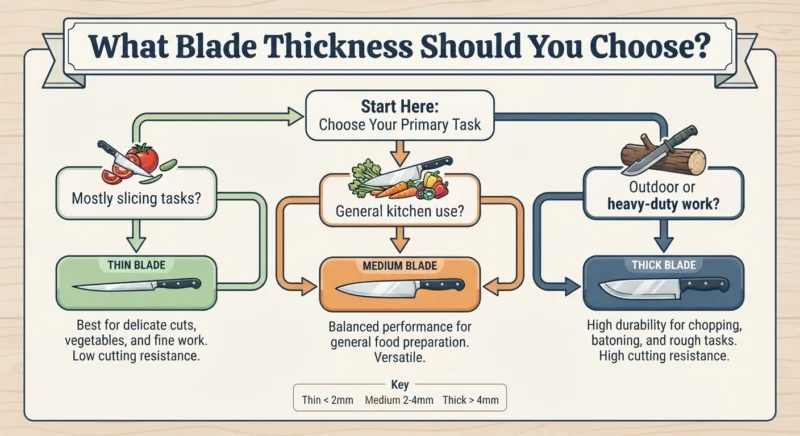
How to Choose the Right Blade Geometry
Before purchasing a knife, ask yourself one simple question:
What will I use this knife for most often?
If your answer is:
Daily Kitchen Cooking
Choose:
- Thin blade
- Full Flat Grind
- High Flat Grind
- Thin behind the edge
Outdoor Camping
Choose:
- Convex Grind
- Moderate thickness
- Durable edge angle
Bushcraft
Choose:
- Scandi Grind
- Thick spine
- Strong edge support
Hunting
Choose:
- High Flat Grind
- Convex Grind
- Fine point
Everyday Carry
Choose:
- Full Flat Grind
- Drop Point
- Medium thickness
Maintaining Blade Geometry
Sharpening removes steel from the edge over time. Improper sharpening can gradually change the original blade geometry and reduce cutting performance.
To preserve the knife’s design:
- Sharpen at the original edge angle whenever possible.
- Use quality whetstones or guided sharpening systems.
- Avoid excessive grinding that thickens the edge behind the bevel.
- Strop regularly to maintain sharpness between sharpenings.
- Use a cutting board made from wood or soft plastic rather than glass, stone, or ceramic.
- Never use a kitchen knife to pry, twist, or cut frozen foods or bones unless it is designed for those tasks.
Proper maintenance helps preserve both the edge and the geometry, extending the knife’s cutting performance for years.
Frequently Asked Questions
Does thinner blade geometry always cut better?
Generally, yes. Thin blades create less resistance and slice more efficiently. However, extremely thin geometry may not be suitable for heavy-duty applications where edge strength is more important than cutting efficiency.
Which blade grind is best for beginners?
A Full Flat Grind is one of the best choices. It offers excellent versatility, predictable sharpening, and performs well in both kitchen and everyday tasks.
Is a convex grind better than a flat grind?
Neither is universally better. Convex grinds excel in durability and impact resistance, while Full Flat Grinds provide superior slicing performance and are easier to sharpen.
Does blade thickness affect edge retention?
Indirectly, yes. Blade thickness influences cutting resistance and how sharp the knife feels during use. True edge retention primarily depends on steel composition and heat treatment, but efficient geometry can make a knife seem sharp for longer.
Why are Japanese kitchen knives usually thinner?
Japanese knives are designed for precision slicing and push-cutting techniques. Their thinner geometry reduces friction, improves cutting efficiency, and produces cleaner cuts, especially when preparing vegetables and boneless proteins.
Final Thoughts
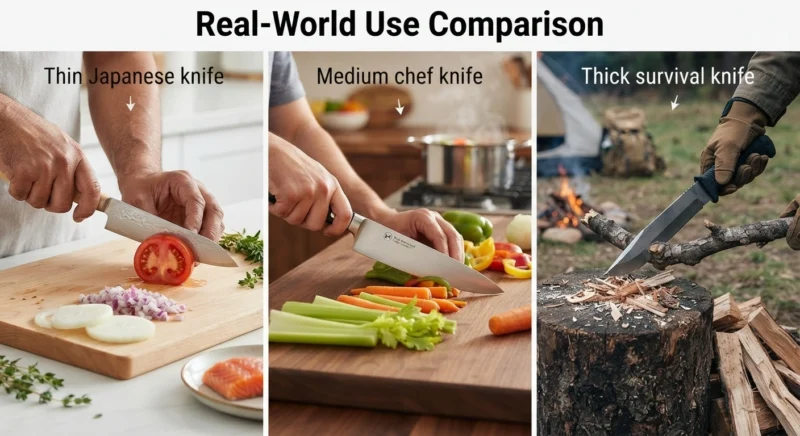
Blade geometry is one of the most important—and often overlooked—factors in knife performance. While premium steels and advanced heat treatments receive much of the attention, geometry determines how efficiently a knife actually cuts, how much force it requires, how comfortable it feels during extended use, and how well it matches its intended purpose.
A well-designed knife is the result of balancing multiple elements: blade thickness, grind style, edge angle, profile, and taper. Together, these features influence slicing performance, durability, sharpening ease, and overall user experience.
Whether you’re selecting a chef’s knife for your kitchen, a bushcraft knife for the outdoors, or an everyday carry knife for daily tasks, choosing the right geometry is just as important as choosing the right steel.
The next time you compare knives, don’t stop at the steel name on the specification sheet. Look beyond the alloy and consider the shape of the blade itself. In many cases, blade geometry is the true secret behind exceptional cutting performance.
This article is for independent informational purposes only and is not affiliated with, sponsored by, or endorsed by any steel manufacturer. All product names, trademarks, and registered trademarks are the property of their respective owners.