Edge Retention Explained
An Independent Guide
One of the first questions people ask when buying a knife is, “How long will it stay sharp?” The answer lies in one of the most important characteristics of blade performance: edge retention.
Whether you’re preparing meals in the kitchen, carving wood outdoors, or opening packages every day, a knife that holds its edge longer requires less frequent sharpening and provides a more consistent cutting experience.
However, edge retention is often misunderstood. Many people assume it depends only on hardness or believe the hardest steel automatically offers the longest-lasting edge. In reality, several factors work together to determine how quickly a knife becomes dull.
Steel composition, heat treatment, carbide structure, blade geometry, sharpening angle, and even the material being cut all influence edge retention.
Understanding these factors will help you choose the right knife steel for your needs and separate real performance from marketing claims.
In this guide, you’ll learn:
- What edge retention actually means
- Why knives become dull
- How edge retention differs from sharpness
- Which factors influence cutting longevity
- Why steel alone doesn’t determine performance
By the end of this article, you’ll understand why some knives remain sharp for weeks while others require frequent maintenance, even when both appear similar on paper.
Check Our Guide Wear Resistance vs Toughness
What Is Edge Retention?
Edge retention is a knife’s ability to maintain a sharp, effective cutting edge during use before sharpening becomes necessary.
In simple terms:
Better edge retention means the knife stays sharp longer.
It does not mean the knife never becomes dull.
Every cutting task gradually wears away the edge. Even the highest-performing knife steel eventually loses sharpness because every cut removes microscopic amounts of material from the blade.
The goal of high edge retention is to slow this process as much as possible.
Why Edge Retention Matters
A knife with good edge retention offers several practical advantages.
It:
- Requires less frequent sharpening
- Maintains consistent cutting performance
- Saves time during repetitive work
- Produces cleaner cuts
- Reduces interruptions during long tasks
For professionals and enthusiasts who use knives daily, these advantages become especially important.
For example, a chef preparing meals for several hours benefits from a blade that continues slicing cleanly without frequent touch-ups.
Likewise, someone processing cardboard or rope appreciates a knife that remains effective throughout the job.
Edge Retention Is More Than Convenience
A sharp knife is not only easier to use—it is often safer.
As knives become dull, users naturally apply more force to complete the same cut.
Greater force increases the risk of slipping, reducing cutting control and potentially causing injury.
Maintaining good edge retention helps preserve predictable cutting performance over longer periods.
What Does “Sharp” Actually Mean?
Many people confuse sharpness with edge retention, but they describe different properties.
Sharpness refers to how keen the cutting edge is at a specific moment.
Edge retention describes how long that sharpness lasts during use.
Imagine two freshly sharpened knives.
Both shave paper effortlessly.
After cutting hundreds of feet of cardboard:
- Knife A still slices easily.
- Knife B struggles to cut cleanly.
Although both started equally sharp, Knife A demonstrates superior edge retention.
Initial Sharpness vs Long-Term Performance
A knife can feel incredibly sharp immediately after sharpening yet lose that edge quickly.
Conversely, another knife may not feel quite as razor-like initially but maintains useful sharpness for much longer.
This distinction explains why experienced knife users evaluate both characteristics separately.
An excellent knife combines:
- High initial sharpness
- Stable cutting edge
- Slow wear
- Predictable performance over time
How Does a Knife Become Dull?
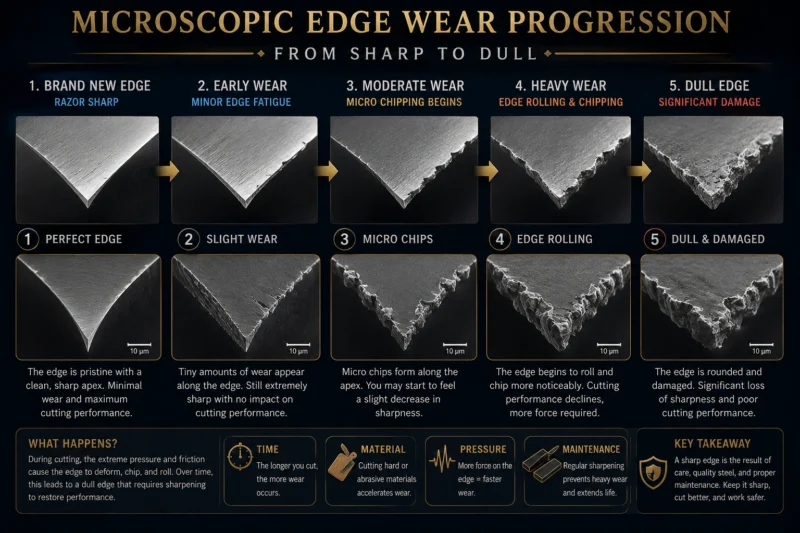
Contrary to popular belief, knife edges rarely become dull for a single reason.
Instead, several microscopic processes gradually change the edge during use.
These include:
- Abrasive wear
- Edge rolling
- Micro-chipping
- Plastic deformation
- Corrosion
- Fatigue
Each mechanism contributes differently depending on the steel and cutting application.
Check Our Guide The Ultimate Guide to Caring for a Damascus Steel Knife
Abrasive Wear
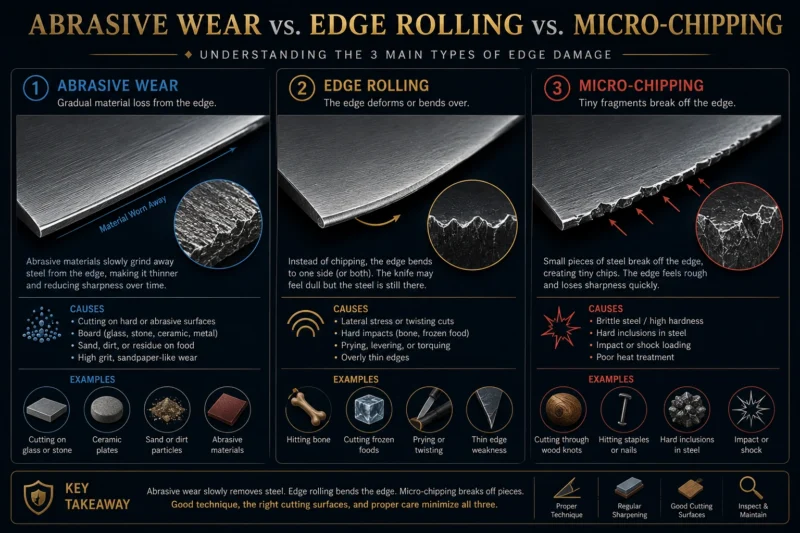
The most common cause of dullness is abrasive wear.
Materials such as:
- Cardboard
- Rope
- Leather
- Wood
- Carpet
- Fiberglass
contain hard particles that slowly grind away the cutting edge.
Although the wear is invisible without magnification, millions of tiny scratches gradually round the edge until cutting performance decreases.
This process is similar to slowly sanding away metal.
Edge Rolling
Not every knife loses sharpness by wearing away.
Some edges actually bend.
When softer steels encounter resistance, the thin cutting edge may roll slightly to one side instead of remaining perfectly centered.
This rolled edge feels dull even though relatively little steel has been removed.
Fortunately, rolled edges can often be restored with honing before full sharpening becomes necessary.
Micro-Chipping
Harder steels sometimes become dull differently.
Instead of bending, tiny fragments break away from the edge.
These microscopic chips interrupt the smooth cutting surface.
Although each chip may be extremely small, together they reduce cutting efficiency.
Micro-chipping commonly occurs when:
- Hard edges strike hard materials
- Blade geometry is too thin
- Toughness is insufficient
- Improper cutting techniques are used
Plastic Deformation
Plastic deformation occurs when the edge permanently changes shape under stress.
Unlike elastic deformation, where the steel returns to its original position, plastic deformation remains even after pressure is removed.
This weakens the cutting edge and reduces slicing performance.
Corrosion Can Also Reduce Edge Retention
Corrosion does more than damage appearance.
Rust attacks the extremely thin cutting edge first.
Even minor corrosion can create microscopic pits that interrupt smooth cutting.
This is especially important for knives exposed to:
- Saltwater
- Acidic foods
- High humidity
- Poor storage conditions
Proper cleaning and drying help preserve edge retention over time.
Check Our Guide Stainless Steel Myths
Fatigue from Repeated Cutting
Every cut places stress on the blade.
Although each individual cut may be small, thousands of repeated cutting cycles gradually weaken the edge.
Tiny cracks begin forming at microscopic defects.
Eventually these cracks grow large enough to contribute to dullness or micro-chipping.
This process is known as fatigue.
Why Different Materials Dull Knives at Different Speeds
Not all cutting materials affect knives equally.
Some materials are surprisingly abrasive.
Low Wear Materials
Examples include:
- Soft fruit
- Boneless meat
- Fresh vegetables
- Bread
- Cheese
These generally produce minimal edge wear.
Moderate Wear Materials
These include:
- Wood
- Plastic
- Rubber
- Rope
- Leather
They create noticeably more abrasion.
High Wear Materials
Some materials dramatically accelerate dulling.
Examples include:
- Cardboard
- Carpet
- Fiberglass
- Dry hardwood
- Composite materials
These contain hard mineral particles that continuously abrade the edge.
Even steels with excellent wear resistance eventually lose sharpness under these conditions.
Common Misconceptions About Edge Retention
Many myths surround knife performance.
Let’s address some of the most common.
Myth 1: Harder Steel Always Holds an Edge Longer
Hardness certainly influences edge retention.
However, hardness alone does not determine performance.
Steel composition, carbide structure, heat treatment, and edge geometry are equally important.
Two steels with identical hardness can display very different edge retention.
Myth 2: Stainless Steel Cannot Hold an Edge
Modern stainless steels cover an enormous performance range.
Some prioritize corrosion resistance.
Others provide outstanding edge retention.
Whether a steel is stainless or carbon-based does not automatically determine its cutting longevity.
Myth 3: Sharper Knives Stay Sharp Longer
Initial sharpness and edge retention are different properties.
A knife may begin extremely sharp yet dull rapidly.
Another may feel slightly less aggressive initially but maintain useful sharpness much longer.
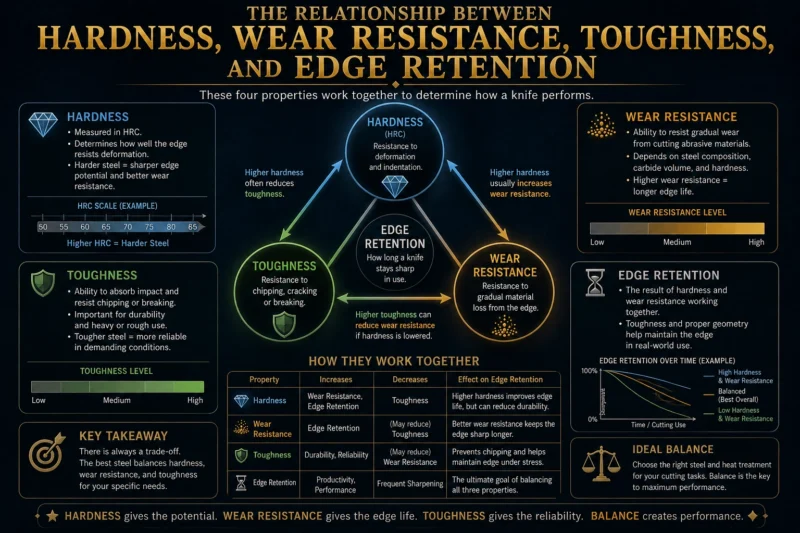
Myth 4: Edge Retention Is the Most Important Property
Excellent edge retention alone does not make a superior knife.
A blade also requires:
- Adequate toughness
- Good corrosion resistance
- Proper hardness
- Stable heat treatment
- Appropriate blade geometry
A balanced knife usually performs better than one designed to maximize a single characteristic.
Why Understanding Edge Retention Matters
Choosing a knife based only on advertised edge retention often leads to disappointment.
A blade that performs exceptionally in controlled laboratory testing may behave differently during real-world use.
For example:
- A kitchen knife encounters very different stresses than a bushcraft knife.
- A rope-cutting knife experiences different wear than a hunting knife.
- A utility knife cutting cardboard requires different properties than a carving knife used on wood.
Understanding what actually affects edge retention allows you to choose the right knife for the job instead of chasing the highest laboratory numbers.
The Science Behind Edge Retention
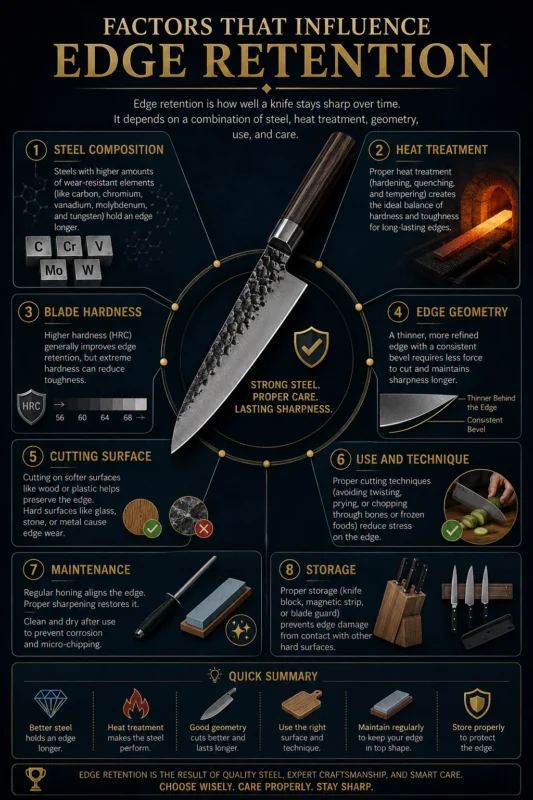
Edge retention is not determined by a single property. Instead, it results from the interaction of several metallurgical and design factors that work together to keep a cutting edge effective.
The most important factors include:
- Steel chemistry
- Carbide type
- Carbide size
- Carbide distribution
- Hardness
- Heat treatment
- Grain structure
- Blade geometry
- Sharpening angle
- Cutting conditions
Understanding each of these elements explains why two knives made from different steels—or even the same steel—can perform very differently.
Steel Chemistry: The Foundation of Edge Retention
Every knife steel begins with a combination of iron, carbon, and alloying elements.
Each element contributes specific characteristics.
Some improve:
- Wear resistance
- Hardness
- Toughness
- Corrosion resistance
- Grain refinement
Others influence heat treatment or carbide formation.
The final balance of these elements determines the steel’s overall cutting performance.
Carbon: The Most Important Element
Carbon is the primary ingredient responsible for hardness.
Without enough carbon, steel cannot develop the hardness required for a durable cutting edge.
Carbon contributes to:
- Higher hardness
- Better edge stability
- Carbide formation
- Increased wear resistance
However, excessive carbon without proper balance may reduce toughness.
Finding the correct amount is essential.
Check Our Guide Carbon Steel vs Stainless Steel Knives
Carbides: The Secret Behind Long Edge Life
If carbon provides hardness, carbides provide wear resistance.
Carbides are microscopic particles formed when carbon combines with alloying elements during heat treatment.
These particles are much harder than the surrounding steel matrix.
As the softer matrix slowly wears during cutting, carbides remain embedded within the edge, protecting it from abrasion.
Imagine walking across a gravel road.
The gravel resists wear much better than the surrounding soil.
Carbides function in much the same way inside knife steel.
Why Carbides Improve Edge Retention
Every cut removes microscopic amounts of material.
The harder the carbides, the slower this process occurs.
Instead of allowing the edge to wear evenly, carbides act like tiny armor plates that resist abrasion.
The result is:
- Longer cutting life
- Better slicing performance
- Reduced edge wear
- Improved resistance to abrasive materials
This is why steels with well-designed carbide structures often demonstrate superior edge retention.
Carbide Volume
One important characteristic is carbide volume.
This refers to how much of the steel consists of carbide particles.
Generally:
Higher carbide volume leads to:
- Better wear resistance
- Longer edge retention
However, increasing carbide volume often reduces toughness.
More carbides create additional hard particles that may serve as starting points for cracks under heavy impact.
Edge retention and toughness must therefore remain balanced.
Carbide Size Matters
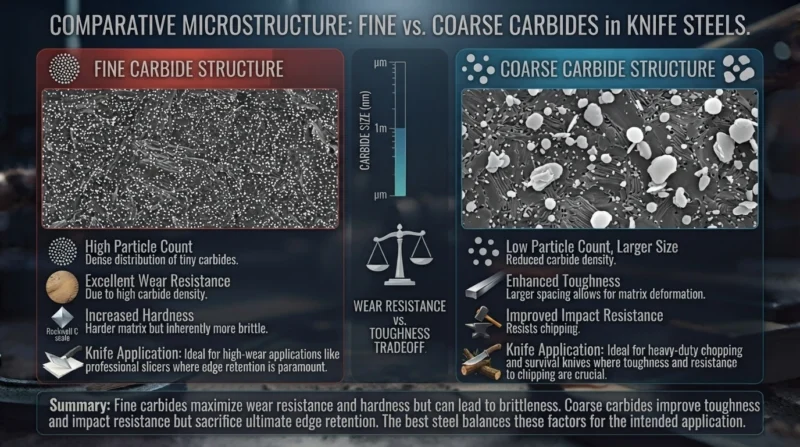
Quantity alone does not determine performance.
The size of carbides is equally important.
Fine Carbides
Small carbides provide:
- Smooth cutting
- Better edge stability
- Easier sharpening
- Improved toughness
- Uniform wear
Because stress is distributed evenly, fine carbides reduce the likelihood of large chips.
Coarse Carbides
Larger carbides can improve abrasion resistance.
However, they may also:
- Increase brittleness
- Make sharpening more difficult
- Produce rougher cutting
- Encourage micro-chipping
Modern metallurgy often focuses on producing finer carbide structures rather than simply increasing carbide quantity.
Carbide Distribution
Even perfectly sized carbides must be distributed evenly throughout the steel.
Imagine placing stones inside concrete.
If they are evenly spaced, the structure remains strong.
If they cluster together, weak zones appear.
Knife steel behaves similarly.
Uniform carbide distribution creates:
- Consistent wear
- Better edge stability
- Improved toughness
- Predictable sharpening
Poor distribution can create localized weaknesses.
Hardness and Edge Retention
Hardness is usually measured using the Rockwell C (HRC) scale.
Generally speaking:
Higher hardness allows:
- Better resistance to deformation
- Improved edge stability
- Longer cutting performance
However, hardness is only one part of the equation.
A very hard steel with poor carbide formation may lose its edge faster than a slightly softer steel with an optimized microstructure.
Hardness alone never tells the complete story.
Check Our Guide What Is HRC? Understanding Rockwell Hardness
Why Hardness Has Limits
Increasing hardness indefinitely is not beneficial.
Beyond a certain point:
- Toughness decreases.
- Chipping becomes more likely.
- Edge stability may decline.
- Sharpening becomes more difficult.
The goal is not maximum hardness.
The goal is appropriate hardness for the knife’s intended purpose.
Heat Treatment: Unlocking Steel’s Potential
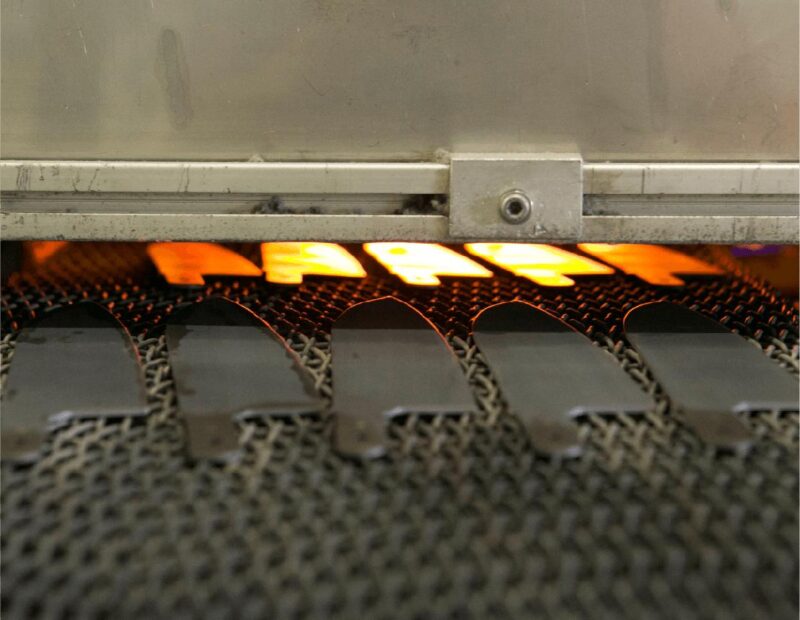
Steel chemistry defines what is possible.
Heat treatment determines how much of that potential is realized.
Two blades made from identical steel can perform very differently depending on heat treatment.
Proper heat treatment controls:
- Hardness
- Toughness
- Carbide formation
- Grain size
- Residual stress
- Edge stability
This is why heat treatment is often considered just as important as steel selection.
Check Our Guide Steel Heat Treatment Explained
Grain Size and Cutting Performance
Steel consists of countless microscopic crystals called grains.
Smaller grains generally improve:
- Toughness
- Sharpenability
- Edge stability
- Fatigue resistance
Large grains tend to reduce edge stability and increase brittleness.
Modern heat treatment techniques emphasize grain refinement because it benefits nearly every aspect of knife performance.
Blade Geometry: Often More Important Than Steel
A common misconception is that steel alone determines edge retention.
In reality, blade geometry may have an even greater influence.
Geometry includes:
- Blade thickness
- Grind style
- Edge angle
- Edge thickness behind the bevel
These factors directly affect how forces are distributed during cutting.
Thin Edges
Advantages:
- Lower cutting resistance
- Better slicing efficiency
- Excellent cutting feel
Disadvantages:
- Higher localized stress
- Greater risk of rolling
- Greater chance of chipping
Thick Edges
Advantages:
- Better durability
- Higher impact resistance
- Stronger cutting edge
Disadvantages:
- Increased cutting resistance
- Reduced slicing performance
The best blade geometry depends on the knife’s intended application.
Check Our Guide Best Blade Thickness for Different Uses
Sharpening Angle and Edge Retention
Many people overlook sharpening angle.
Yet it dramatically influences edge life.
Narrow Angles
Advantages:
- Extremely sharp
- Excellent slicing
Disadvantages:
- Less durable
- Greater risk of rolling
- Increased chipping
Wider Angles
Advantages:
- More durable edge
- Better stability
- Longer service life during heavy cutting
Disadvantages:
- Slightly reduced cutting efficiency
Choosing the correct sharpening angle often improves real-world edge retention more than changing steel.
Cutting Material Makes a Huge Difference
Edge retention depends heavily on what the knife cuts.
For example:
Low Abrasion
- Tomatoes
- Fish
- Soft vegetables
- Fresh meat
These cause minimal wear.
Moderate Abrasion
- Rope
- Rubber
- Plastic
- Leather
Wear becomes more noticeable.
High Abrasion
- Cardboard
- Hardwood
- Carpet
- Composite materials
- Fiberglass
These materials rapidly wear even high-performance knife steels.
A knife used exclusively on cardboard may dull several times faster than the same knife used only for food preparation.
Surface Finish and Friction
Blade finish also influences cutting efficiency.
Smooth finishes reduce friction.
Lower friction means:
- Less cutting resistance
- Reduced heat generation
- Smoother slicing
- Slightly lower edge stress
While surface finish has a smaller effect than steel or geometry, it still contributes to overall cutting performance.
Edge Stability: An Often Overlooked Factor
Edge retention is not simply about resisting wear.
The edge must also remain stable.
Edge stability describes how well the extremely thin cutting edge maintains its shape during use.
Poor edge stability causes:
- Rolling
- Chipping
- Deformation
Good edge stability allows the knife to continue cutting efficiently even after prolonged use.
It depends on:
- Steel chemistry
- Grain size
- Hardness
- Heat treatment
- Blade geometry
The Balance Between Wear Resistance and Toughness
The longest-lasting cutting edge does not always belong to the most wear-resistant steel.
Why?
Because excessive wear resistance often comes at the expense of toughness.
If the edge chips during normal use, practical edge retention may actually decrease despite excellent laboratory wear resistance.
The best-performing knife is usually one that balances:
- Wear resistance
- Toughness
- Hardness
- Corrosion resistance
- Ease of sharpening
This balanced approach explains why many of the most respected knife steels are not necessarily those with the highest wear-resistance ratings.
Comparing Different Categories of Knife Steel
After understanding the science behind edge retention, the next step is learning how different categories of knife steel perform in real-world use.
No steel is perfect.
Some prioritize maximum wear resistance, while others focus on toughness, corrosion resistance, or ease of sharpening.
Rather than asking which steel is “best,” it is more useful to understand the strengths and compromises of each category.
Simple Carbon Steels
Simple carbon steels contain relatively few alloying elements.
Their performance relies primarily on carbon content and proper heat treatment.
Advantages
- Fine grain structure
- Excellent edge stability
- Easy sharpening
- High toughness
- Predictable cutting performance
Limitations
- Lower corrosion resistance
- Require regular maintenance
- Develop patina over time
Although they may not always produce the highest laboratory wear-resistance numbers, many users appreciate their consistent cutting feel and ease of maintenance.
Low-Alloy Tool Steels
Low-alloy tool steels contain moderate amounts of alloying elements that improve wear resistance while preserving toughness.
These steels often provide an excellent compromise between:
- Edge retention
- Durability
- Sharpenability
- Strength
They are commonly chosen for heavy-use outdoor knives because they tolerate demanding work while maintaining respectable cutting longevity.
Stainless Steels
Stainless steels contain sufficient chromium to significantly improve corrosion resistance.
Contrary to popular belief, stainless steels vary enormously in edge retention.
Some emphasize corrosion resistance.
Others are engineered for exceptional wear resistance.
General advantages include:
- Excellent rust resistance
- Low maintenance
- Good food safety
- Wide range of performance options
Their actual edge retention depends far more on steel chemistry and heat treatment than on their stainless classification alone.
Powder Metallurgy Steels
One of the most significant advances in knife steel manufacturing is powder metallurgy.
Instead of producing steel through traditional casting methods, molten metal is converted into extremely fine powder before consolidation.
This manufacturing process creates:
- Smaller carbides
- More uniform carbide distribution
- Cleaner microstructure
- Better consistency
The result is a steel capable of achieving high wear resistance without sacrificing as much toughness as conventional production methods.
Check Our Guide Powder Steels for Kitchen Knives
Conventional Steels
Traditional steel production remains highly effective and continues to produce excellent knife steels.
Conventional steels often feature:
- Lower manufacturing cost
- Easier sharpening
- Excellent toughness
- Proven long-term reliability
Although powder metallurgy offers important advantages, many conventional steels remain outstanding performers in everyday use.
Powder Metallurgy vs Conventional Steel
The differences become easier to understand when compared directly.
| Property | Conventional Steel | Powder Metallurgy Steel |
|---|---|---|
| Carbide Size | Larger | Much finer |
| Carbide Distribution | Good | Very uniform |
| Wear Resistance | Good | Excellent |
| Toughness | Good | Often higher than expected |
| Sharpening | Usually easier | Often more difficult |
| Manufacturing Complexity | Lower | Higher |
Powder metallurgy does not automatically produce a better knife.
Instead, it gives steel designers greater flexibility in balancing wear resistance and toughness.
Laboratory Edge Retention Tests
Many published comparisons rely on standardized laboratory testing.
These tests measure how much cutting a blade performs before reaching a specified level of dullness.
Such testing is valuable because it provides consistent comparisons between steels.
However, laboratory tests cannot perfectly duplicate every real-world cutting task.
Why Laboratory Results Differ From Real Use
A laboratory controls variables such as:
- Cutting pressure
- Cutting speed
- Blade angle
- Material composition
- Number of cuts
Real-world use is very different.
Users apply varying amounts of force.
Different materials contain different abrasives.
Sharpening quality also varies.
As a result, real-world performance may differ significantly from laboratory rankings.
Factors That Influence Real-World Edge Retention
Several practical factors determine how long your knife stays sharp.
Cutting Technique
Proper cutting technique reduces unnecessary stress on the edge.
Poor habits such as:
- Twisting during cuts
- Prying
- Scraping with the edge
- Cutting on hard surfaces
can dramatically shorten edge life regardless of steel quality.
Cutting Surface
The cutting board matters.
Recommended materials include:
- Wood
- End-grain wood
- Soft plastic
Avoid cutting directly on:
- Glass
- Marble
- Ceramic
- Stone
- Metal
Hard surfaces accelerate edge wear and increase the likelihood of chipping.
Blade Thickness
Blade thickness affects edge retention indirectly.
A thinner blade passes through material with less resistance.
Lower cutting force means:
- Less stress on the edge
- Reduced deformation
- Improved cutting efficiency
However, extremely thin blades may become more susceptible to chipping during heavy work.
Edge Angle
The sharpening angle strongly influences cutting longevity.
For example:
A very narrow angle provides outstanding slicing performance.
However, it also concentrates force on a smaller area.
A slightly wider angle distributes stress more evenly and often increases practical edge retention.
The ideal angle depends on intended use.
Heat Treatment Quality
Even the finest steel cannot compensate for poor heat treatment.
Proper heat treatment optimizes:
- Hardness
- Grain refinement
- Carbide formation
- Residual stress
- Edge stability
Two knives made from identical steel may perform very differently if heat treatment quality differs.
Why Some Knives Feel Sharp Longer
Users often describe one knife as “staying sharp forever.”
In many cases, what they actually notice is continued cutting efficiency rather than perfect sharpness.
Several factors contribute to this perception.
Aggressive Cutting Edges
Some steels naturally develop tiny microscopic teeth during sharpening.
Even after the polished apex begins wearing, these micro-serrations continue slicing fibrous materials effectively.
This creates the impression that the knife remains sharp longer.
Stable Edge Geometry
An edge that wears evenly often continues cutting smoothly.
By contrast, an edge that develops chips or rolls may feel dull much sooner, even if relatively little material has been lost.
Consistent wear is often more desirable than maximum wear resistance alone.
Edge Retention Is a System
One of the most important concepts to understand is that edge retention is never controlled by steel alone.
Instead, it results from an entire system working together.
That system includes:
- Steel chemistry
- Heat treatment
- Carbide structure
- Grain refinement
- Blade geometry
- Sharpening quality
- Cutting technique
- Maintenance
- Intended application
Changing any one of these factors can significantly alter real-world performance.
Which Factors Matter Most?
If we rank the factors influencing practical edge retention, a reasonable order would be:
- Heat treatment
- Steel chemistry
- Blade geometry
- Sharpening angle
- Cutting material
- Cutting technique
- Blade maintenance
- Surface finish
Many buyers focus only on steel composition while overlooking the other factors.
In practice, proper sharpening and appropriate blade geometry often have a greater impact on everyday performance than switching to a different steel.
Choosing the Right Level of Edge Retention
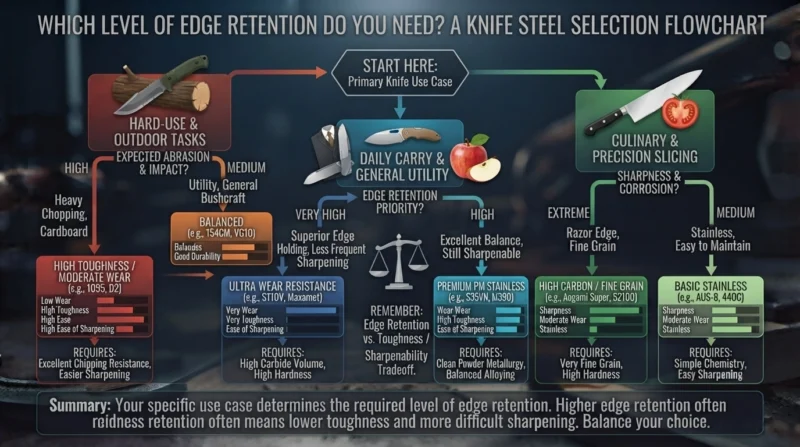
Maximum edge retention is not always the ideal choice.
For example:
A knife used occasionally around the house may benefit more from:
- Easy sharpening
- Good toughness
- Moderate wear resistance
A knife used professionally for repetitive cutting may justify:
- Higher wear resistance
- Longer intervals between sharpening
The best knife is the one that matches its intended workload.
Common Mistakes When Evaluating Edge Retention
Avoid these common misconceptions:
Mistake 1
Choosing steel solely because it ranks highest in wear-resistance tests.
Mistake 2
Ignoring blade geometry.
Mistake 3
Believing hardness alone determines edge retention.
Mistake 4
Comparing laboratory results without considering actual cutting tasks.
Mistake 5
Neglecting sharpening quality and maintenance.
Practical Recommendations
For most users, the ideal knife offers:
- Good edge retention
- Reliable toughness
- Easy maintenance
- Reasonable sharpening effort
- Excellent corrosion resistance when needed
Extreme performance in a single category rarely produces the best overall user experience.
Balanced steels often outperform specialized steels in everyday use because they tolerate a wider range of cutting conditions.
Choosing the Right Edge Retention for Your Needs
The ideal level of edge retention depends entirely on how a knife will be used. While many buyers focus on finding the steel that stays sharp the longest, the best choice is often the one that offers the right balance of edge retention, toughness, corrosion resistance, and ease of maintenance.
Let’s look at how edge retention requirements vary across different applications.
Best Edge Retention for Kitchen Knives
Kitchen knives spend most of their time making clean slicing cuts through relatively soft materials.
Typical tasks include:
- Vegetables
- Fruit
- Meat
- Fish
- Herbs
- Cheese
For these tasks, edge retention is extremely valuable because it allows long periods of food preparation without frequent sharpening.
An ideal kitchen knife should offer:
- Excellent edge retention
- High corrosion resistance
- Fine cutting edge
- Stable geometry
- Good sharpening response
Extreme toughness is usually unnecessary because quality kitchen knives are not intended for chopping frozen food or striking hard bones.
Best Edge Retention for Bushcraft Knives
Outdoor knives perform very different tasks.
These include:
- Feather sticking
- Carving
- Camp food preparation
- Wood processing
- Shelter building
These activities expose the blade to repeated impacts and twisting forces.
For bushcraft, edge retention remains important, but toughness becomes equally valuable.
The ideal balance includes:
- Moderate to high edge retention
- Excellent toughness
- Easy field sharpening
- Strong edge stability
A knife that chips in the wilderness is much less useful than one that simply requires occasional sharpening.
Best Edge Retention for Hunting Knives
Processing game combines slicing with occasional contact against tougher materials.
A hunting knife commonly cuts:
- Hide
- Meat
- Connective tissue
- Cartilage
- Fat
Occasional contact with bone may also occur.
For these applications, an ideal knife offers:
- Good edge retention
- Reliable toughness
- Strong corrosion resistance
- Stable cutting edge
The goal is maintaining sharpness throughout the field dressing process without sacrificing durability.
Check Our Guide Different 9 Types of Best Hunting Knives
Best Edge Retention for Everyday Carry (EDC)
An everyday carry knife encounters the widest variety of materials.
Examples include:
- Cardboard
- Plastic
- Tape
- Rope
- Food
- Fabric
- Rubber
- Packaging
Because the workload constantly changes, balanced performance is more valuable than maximum edge retention alone.
An excellent EDC knife combines:
- Good wear resistance
- Reliable toughness
- Easy maintenance
- Reasonable sharpening effort
Best Edge Retention for Work Knives
Professionals often cut highly abrasive materials throughout the day.
Typical examples include:
- Cardboard
- Carpet
- Plastic strapping
- Rubber hose
- Construction materials
- Packaging
These tasks rapidly wear the cutting edge.
For work knives, priority should be given to:
- High wear resistance
- Stable edge geometry
- Reliable heat treatment
- Good toughness
This combination minimizes downtime while maintaining dependable performance.
How to Make Any Knife Stay Sharp Longer
Even the best steel performs poorly if used incorrectly.
Following a few simple practices can significantly extend edge life.
Use the Right Cutting Surface
Choose:
- Wood
- End-grain wood
- Soft plastic
Avoid:
- Glass
- Ceramic
- Marble
- Granite
- Metal
Hard surfaces quickly damage the cutting edge.
Keep the Blade Clean
Food acids, moisture, and debris can gradually reduce cutting performance.
After use:
- Wash the blade.
- Dry it thoroughly.
- Store it in a dry environment.
Regular cleaning helps preserve both corrosion resistance and edge retention.
Sharpen Before the Knife Becomes Extremely Dull
Many users wait too long before sharpening.
Restoring a severely worn edge requires removing considerably more steel.
Frequent light maintenance helps preserve blade life while reducing sharpening effort.
Use the Knife for Its Intended Purpose
Avoid using a knife as:
- A screwdriver
- Pry bar
- Chisel
- Can opener
These actions create stresses that dramatically shorten edge life regardless of steel quality.
Frequently Asked Questions
What is edge retention?
Edge retention is a knife’s ability to remain sharp during use before sharpening becomes necessary.
Does higher hardness always improve edge retention?
Not necessarily.
Hardness contributes to edge retention, but steel chemistry, carbide structure, heat treatment, and blade geometry are equally important.
Why do some knives become dull faster?
Common reasons include:
- Lower wear resistance
- Poor heat treatment
- Thin edge geometry
- Cutting abrasive materials
- Improper sharpening
- Incorrect use
Is edge retention the same as wear resistance?
Not exactly.
Wear resistance is one of the primary factors influencing edge retention.
However, edge retention also depends on:
- Toughness
- Hardness
- Edge stability
- Geometry
- Heat treatment
Does sharpening angle affect edge retention?
Yes.
A wider sharpening angle generally creates a stronger, more durable edge.
A narrower angle provides better slicing performance but may wear faster.
Can corrosion reduce edge retention?
Yes.
Rust and corrosion attack the extremely thin cutting edge first.
Even minor corrosion can reduce cutting performance.
Why do some edges chip instead of wearing away?
Hard, brittle edges sometimes lose tiny fragments instead of wearing gradually.
Micro-chipping often results from:
- High hardness
- Low toughness
- Large carbides
- Thin edge geometry
- Heavy impacts
Which property is more important: edge retention or toughness?
Neither property is universally more important.
Kitchen knives often benefit from higher edge retention.
Outdoor knives generally require greater toughness.
Most users achieve the best results with a balanced combination of both.
Final Thoughts
Edge retention is one of the most important characteristics of knife performance, but it is also one of the most misunderstood.
Many people assume that harder steel automatically stays sharp longer or that a single steel can outperform every other option in all situations. Modern metallurgy shows that the reality is far more complex.
Edge retention depends on a combination of steel chemistry, carbide formation, heat treatment, hardness, grain structure, blade geometry, sharpening quality, and cutting technique. Every one of these factors influences how long a knife continues to cut efficiently.
At the same time, edge retention should never be considered in isolation. A blade that holds an edge for a long time but chips easily may perform worse in real-world use than a slightly less wear-resistant blade with greater toughness and edge stability.
Rather than searching for the knife with the highest laboratory edge-retention rating, focus on selecting a blade designed for the work you actually perform. The best knife is not the one that stays sharp the longest under controlled testing—it is the one that delivers the right combination of cutting performance, durability, ease of maintenance, and reliability for your specific needs.
Understanding these principles allows you to evaluate knife steels with confidence and choose tools based on real performance rather than marketing claims.
Key Takeaways
- Edge retention is the ability of a knife to maintain a sharp cutting edge during use.
- Wear resistance is the primary contributor to edge retention, but it is not the only factor.
- Hardness alone does not determine how long a knife stays sharp.
- Carbide type, size, and distribution play a major role in cutting longevity.
- Heat treatment is just as important as steel composition.
- Blade geometry and sharpening angle strongly influence real-world performance.
- Different cutting materials wear knife edges at different rates.
- The best knife balances edge retention, toughness, corrosion resistance, and sharpenability.
- Proper maintenance can significantly extend edge life regardless of steel type.
FAQ
Q: What is edge retention?
A: Edge retention is the ability of a knife to maintain a sharp cutting edge during use before sharpening is required.
Q: What affects edge retention the most?
A: Steel chemistry, carbide structure, hardness, heat treatment, blade geometry, sharpening angle, and cutting materials all influence edge retention.
Q: Is edge retention the same as hardness?
A: No. Hardness contributes to edge retention, but it is only one of several factors that determine how long a knife stays sharp.
Q: Does blade geometry affect edge retention?
A: Yes. Edge angle, blade thickness, and grind style influence cutting efficiency, edge stability, and durability.
Q: Why do knives lose sharpness?
A: Knives become dull through abrasive wear, edge rolling, micro-chipping, plastic deformation, corrosion, and fatigue from repeated cutting.
Q: Is higher wear resistance always better?
A: Not necessarily. Extremely wear-resistant steels may sacrifice toughness and become more prone to chipping under heavy use.
Q: How can I improve edge retention?
A: Use an appropriate cutting board, keep the blade clean and dry, sharpen regularly before it becomes excessively dull, and avoid using the knife for tasks it was not designed to perform.
Q: Which knife has the best edge retention?
A: There is no single best option. The ideal balance depends on the intended application, maintenance preferences, and the combination of wear resistance, toughness, corrosion resistance, and blade geometry.
This article is for independent informational purposes only and is not affiliated with, sponsored by, or endorsed by any steel manufacturer. All product names, trademarks, and registered trademarks are the property of their respective owners.
Edge Retention Explained