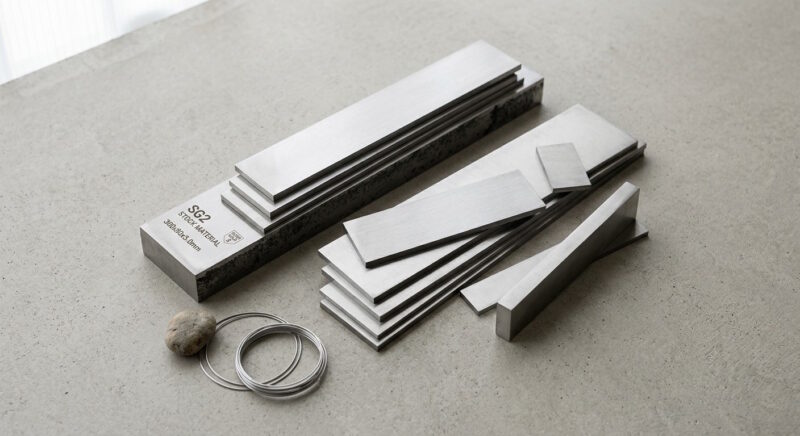
Powder Steels for Kitchen Knives
An Independent Guide
The world of kitchen knives has changed dramatically over the last two decades.
For generations, knife buyers primarily chose between carbon steel and stainless steel. Today, however, a third category has become increasingly important among knife enthusiasts, professional chefs, and custom knife makers: powder metallurgy steels, often called simply powder steels.
These advanced steels represent some of the most sophisticated materials ever used in knife making. They offer impressive combinations of edge retention, toughness, corrosion resistance, and cutting performance that would have been nearly impossible to achieve using traditional steel manufacturing methods.
But powder steels are also surrounded by confusion.
Many buyers wonder:
- What exactly is powder steel?
- Is powder steel better than traditional stainless steel?
- Are powder steel kitchen knives worth the extra cost?
- Which powder steels are best for chef knives?
- Do powder steels stay sharp longer?
- Are they difficult to sharpen?
In this guide, we’ll explore everything you need to know about powder steels for kitchen knives and help you decide whether they are the right choice for your kitchen.
What Is Powder Steel?
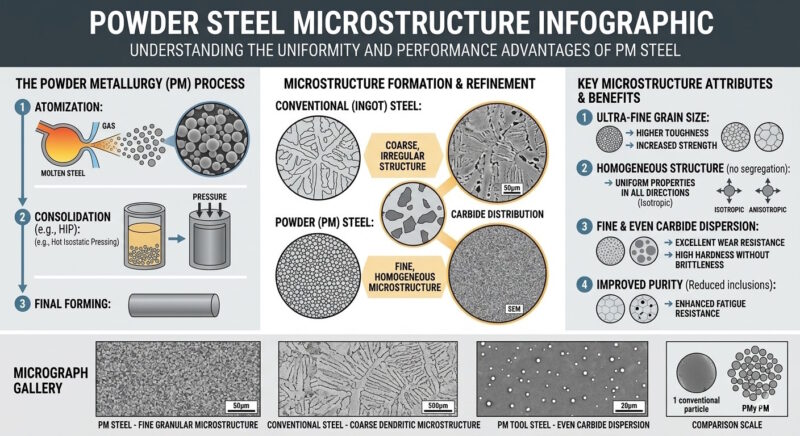
To understand powder steel, we first need to understand how traditional steel is made.
Traditional steel production involves melting alloy ingredients together and allowing the molten steel to cool into large ingots.
While effective, this process creates limitations.
During cooling:
- Carbides may become unevenly distributed.
- Grain structures can become larger.
- Certain alloy combinations become difficult to control.
Powder metallurgy solves these problems.
Instead of solidifying into large ingots, molten steel is atomized into microscopic droplets.
These droplets rapidly cool into tiny steel particles.
The powder is then:
- Collected
- Compressed under enormous pressure
- Heated and consolidated into solid steel
The result is a remarkably uniform steel structure.
This manufacturing process allows steel designers to create alloys that would be difficult or impossible using traditional methods.
Why Powder Steels Matter for Kitchen Knives
The biggest advantage of powder metallurgy is control.
Powder steels often feature:
- Extremely fine grain structures
- Uniform carbide distribution
- Improved wear resistance
- Better edge stability
- Enhanced toughness
For kitchen knives, this can translate into:
- Longer edge retention
- Better cutting performance
- Improved corrosion resistance
- Greater durability
However, these benefits come with trade-offs, which we’ll discuss later.
The Rise of Powder Steel Kitchen Knives
For many years, powder steels were primarily used in industrial applications.
Over time, knife makers realized that these steels could dramatically improve blade performance.
Today, many premium kitchen knives feature powder metallurgy steels such as:
- SG2 (R2)
- S35VN
- S45VN
- MagnaCut
- Elmax
- M390
- CPM 154
- ZDP-189
These steels are now common in high-end Japanese and custom kitchen knives.
SG2 (R2): The King of Japanese Powder Steels
When discussing powder steel kitchen knives, SG2 is often the first steel mentioned.
Also known as R2 steel, SG2 has become one of the most respected kitchen knife steels in the world.
Why SG2 Is So Popular
SG2 combines:
- High hardness
- Excellent corrosion resistance
- Outstanding edge retention
- Fine cutting ability
Many SG2 kitchen knives are hardened to:
60–64 HRC
This allows them to maintain sharp edges for extended periods.
Professional chefs often appreciate SG2 because it reduces the frequency of sharpening sessions.
SG2 Advantages
- Excellent edge retention
- Fine edge capability
- Stainless properties
- Professional-level performance
SG2 Drawbacks
- Higher cost
- More difficult sharpening
- Greater chipping risk compared to softer steels
Nevertheless, SG2 remains one of the most desirable steels for premium chef knives.
MagnaCut: The New Superstar
In recent years, few knife steels have generated as much excitement as MagnaCut.
Designed by metallurgist Larrin Thomas, MagnaCut aims to balance:
- Toughness
- Corrosion resistance
- Edge retention
Unlike many steels that excel in one category while sacrificing another, MagnaCut seeks balance.
Why Chefs Are Paying Attention
Kitchen knives demand more than edge retention.
They also require:
- Corrosion resistance
- Edge stability
- Toughness
- Practical maintenance
MagnaCut performs exceptionally well across all categories.
Many knife enthusiasts believe it represents one of the biggest advances in knife steel development in decades.
Elmax: The European Favorite
Elmax is another highly respected powder metallurgy steel.
Produced using powder metallurgy technology, Elmax offers:
- High wear resistance
- Excellent corrosion resistance
- Good toughness
- Fine edge capability
Elmax often appears in custom kitchen knives where makers want premium performance with stainless characteristics.
Many users describe Elmax as a practical alternative to some of the more extreme super steels.
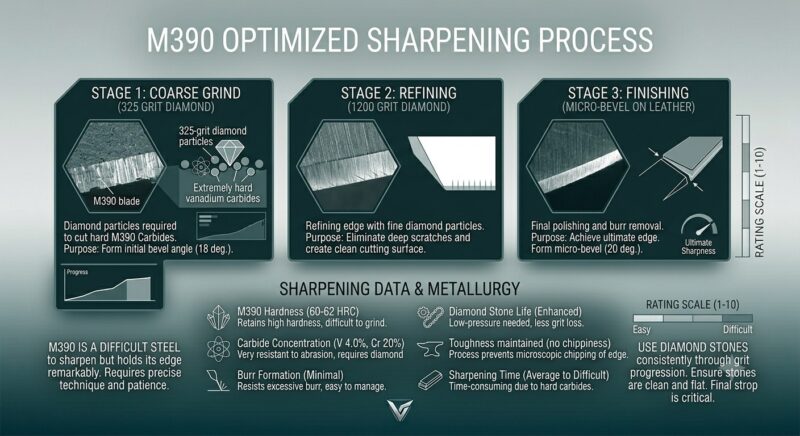
M390: Exceptional Edge Retention
M390 is often considered one of the premier premium stainless powder steels.
Benefits include:
- Outstanding wear resistance
- Excellent corrosion resistance
- Long-lasting edges
In kitchen environments, M390 can maintain working sharpness for remarkably long periods.
However, this advantage comes with trade-offs.
Check Our Guide M390 Steel Review
M390 Challenges
- Difficult sharpening
- Higher cost
- Less forgiving maintenance
For some chefs, the extreme edge retention is worth the extra effort.
Others prefer steels that sharpen more easily.
CPM 154: The Balanced Performer
CPM 154 represents an excellent example of powder metallurgy improving a classic steel.
Compared to conventional 154CM, CPM 154 offers:
- Improved toughness
- Better carbide distribution
- More consistent performance
Many custom makers appreciate CPM 154 because it delivers premium performance without some of the sharpening difficulties associated with more wear-resistant super steels.
ZDP-189: Extreme Hardness
ZDP-189 occupies a unique place in the knife world.
This Japanese powder steel can reach extraordinary hardness levels.
Some knives are hardened beyond:
65 HRC
This allows for incredible edge retention.
However, extremely hard steels often involve compromises.
Potential drawbacks include:
- Increased brittleness
- Greater chipping risk
- More challenging sharpening
ZDP-189 remains popular among enthusiasts who prioritize edge retention above nearly everything else.
How Powder Steels Compare to Traditional Stainless Steels
Many buyers ask whether powder steels are truly superior.
The answer depends on priorities.
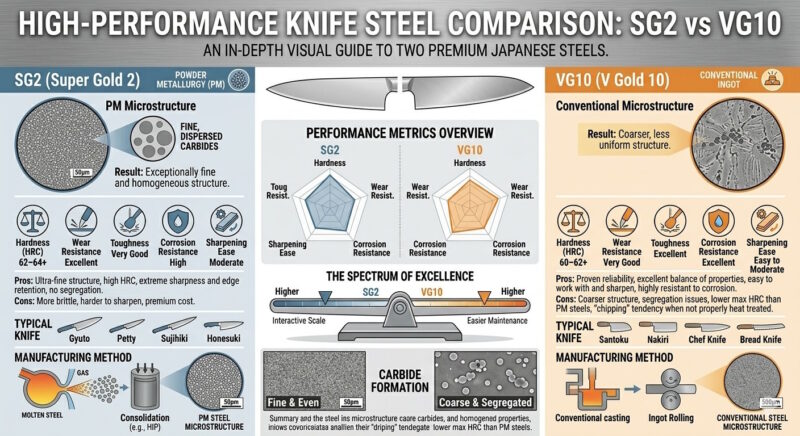
Traditional stainless steels such as:
- 14C28N
- N690
- VG10
- AEB-L
remain excellent knife materials.
In fact, many chefs prefer them.
Traditional Stainless Steel Advantages
- Easier sharpening
- Lower cost
- Greater toughness in some cases
- Simpler maintenance
Check Our Guide Stainless Steel Myths
Powder Steel Advantages
- Longer edge retention
- More advanced metallurgy
- Premium performance potential
- Better wear resistance
Neither category is universally better.
Each serves different users and priorities.
Powder Steel vs Carbon Steel
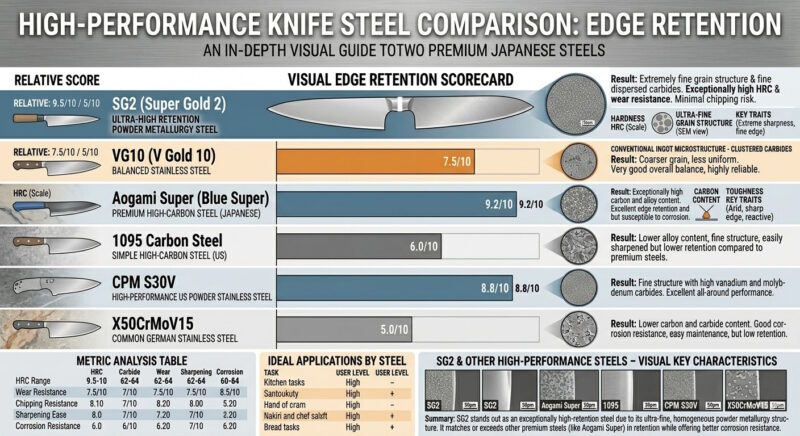
One of the most common questions among knife enthusiasts is whether powder steels are better than carbon steels.
The answer depends entirely on what you value most.
Carbon steels have been trusted by chefs and knife makers for centuries because they offer:
- Exceptional sharpness
- Easy sharpening
- Excellent edge stability
- Traditional craftsmanship appeal
Popular carbon steels include:
- 1095
- White Steel #1
- White Steel #2
- Blue Steel #1
- Blue Steel #2
- 52100
Meanwhile, modern powder steels offer advantages that traditional carbon steels cannot easily match.
Check Our Guide Carbon Steel Myths
Powder Steel Advantages
- Superior corrosion resistance
- Longer edge retention
- Advanced metallurgy
- Reduced maintenance
Carbon Steel Advantages
- Easier sharpening
- Finer edge refinement
- Lower sharpening time
- Traditional cutting feel
Many professional chefs still prefer carbon steel despite the advantages of powder metallurgy because they appreciate the feedback and edge characteristics.
However, users who dislike frequent maintenance often choose powder steels.
SG2 vs MagnaCut vs M390
These three steels are among the most discussed premium steels today.
Let’s compare them directly.
SG2 (R2)
Strengths
- Outstanding kitchen performance
- Excellent edge retention
- Fine cutting ability
- Widely used by Japanese makers
Weaknesses
- Can chip if abused
- More difficult sharpening than traditional steels
MagnaCut
Strengths
- Exceptional toughness
- Excellent corrosion resistance
- Strong edge retention
- Modern balanced design
Weaknesses
- Higher cost
- Less common in kitchen knives
M390
Strengths
- Extraordinary wear resistance
- Long-lasting edge
- Premium reputation
Weaknesses
- Difficult sharpening
- Less forgiving than tougher steels
Comparison Table
| Property | SG2 | MagnaCut | M390 |
|---|---|---|---|
| Edge Retention | ⭐⭐⭐⭐⭐ | ⭐⭐⭐⭐⭐ | ⭐⭐⭐⭐⭐ |
| Toughness | ⭐⭐⭐ | ⭐⭐⭐⭐⭐ | ⭐⭐⭐ |
| Corrosion Resistance | ⭐⭐⭐⭐ | ⭐⭐⭐⭐⭐ | ⭐⭐⭐⭐⭐ |
| Sharpening Ease | ⭐⭐⭐ | ⭐⭐⭐⭐ | ⭐⭐ |
| Kitchen Suitability | ⭐⭐⭐⭐⭐ | ⭐⭐⭐⭐⭐ | ⭐⭐⭐⭐ |
Best Powder Steel for Chef Knives
Different chefs have different priorities.
Best Overall: SG2 (R2)
SG2 remains one of the best kitchen knife steels ever developed.
Reasons include:
- Exceptional cutting performance
- Excellent edge retention
- Proven history
- Wide availability
Many premium Japanese chef knives use SG2.
Best Modern Innovation: MagnaCut
MagnaCut may become one of the most important kitchen knife steels of the next decade.
Its combination of toughness and corrosion resistance is remarkable.
Best Edge Retention: M390
For users who want to sharpen as infrequently as possible, M390 is difficult to beat.
Best Powder Steel for Home Cooks
Professional chefs and home cooks often have different needs.
Most home cooks prioritize:
- Low maintenance
- Easy care
- Long edge life
Recommended options:
SG2
Excellent balance.
CPM 154
Easy to maintain.
MagnaCut
Outstanding all-around performance.
Best Powder Steel for Professional Chefs
Professional kitchens are demanding environments.
Knives may see:
- Hours of daily use
- Moisture exposure
- Frequent food contact
Top choices:
SG2
Still considered a benchmark.
MagnaCut
Increasingly popular among custom makers.
Elmax
Excellent durability.
Are Powder Steels Worth the Extra Cost?
This depends on expectations.
A powder steel knife often costs significantly more than a comparable traditional steel knife.
Reasons include:
- More expensive steel production
- More difficult machining
- More complex grinding
- Higher manufacturing costs
For casual users, the difference may not justify the cost.
For enthusiasts and professionals, the performance advantages can be meaningful.
The Biggest Myths About Powder Steels
Myth #1: Powder Steel Never Needs Sharpening
False.
All knives eventually become dull.
Powder steels simply take longer to reach that point.
Myth #2: Powder Steel Is Indestructible
False.
Even premium steels can chip, crack, or fail if misused.
No steel is immune to abuse.
Myth #3: Harder Steel Always Means Better Performance
False.
Excessive hardness can reduce toughness.
Knife steel design is always about balance.
Myth #4: Powder Steel Is Always Better Than Traditional Steel
False.
Many traditional steels remain excellent choices.
AEB-L, 14C28N, N690, and VG10 continue to perform exceptionally well.
Myth #5: Only Professionals Need Powder Steel
False.
Home cooks can also benefit from longer edge retention and corrosion resistance.
Why Heat Treatment Still Matters Most
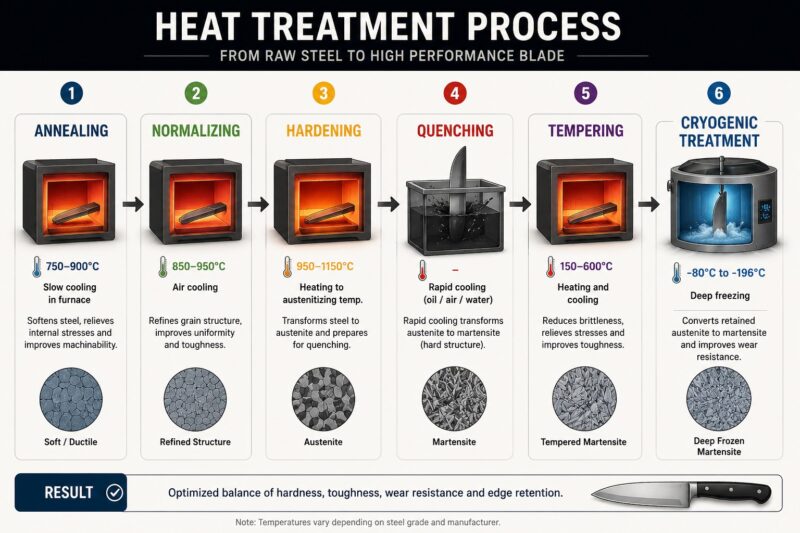
One of the biggest mistakes buyers make is focusing only on steel names.
Steel is important.
Heat treatment is often even more important.
A properly heat-treated SG2 blade may outperform a poorly treated M390 blade.
A properly heat-treated MagnaCut knife may outperform a poorly treated super steel.
Professional knife makers understand that steel selection and heat treatment must work together.
Check Our Guide Steel Heat Treatment Explained
Powder Steel and Handmade Knives
Many artisan knife makers appreciate powder steels because they allow exceptional performance.
However, working with powder steels can be challenging.
Benefits for makers include:
- Premium performance
- Excellent edge retention
- Customer appeal
Challenges include:
- More difficult grinding
- Increased tooling wear
- Higher production costs
This is one reason handmade powder steel knives often command premium prices.
Check Our Guide How a Handmade Knife Is Made
What Steel Should You Actually Buy?
If you’re shopping for a kitchen knife, start by asking:
What matters most?
Maximum Edge Retention
Choose:
- M390
- SG2
- ZDP-189
Best Balance
Choose:
- MagnaCut
- SG2
- CPM 154
Easier Sharpening
Choose:
- CPM 154
- AEB-L
- 14C28N
Best Value
Choose:
- 14C28N
- VG10
- CPM 154
Check Our Guide VG10 Steel Review
Check Our Guide 14C28N and Other Swedish Knife Steels Review
Powder Steel Performance Rankings
| Steel | Edge Retention | Toughness | Corrosion Resistance | Overall Balance |
| SG2 | 9/10 | 7/10 | 9/10 | 9/10 |
| MagnaCut | 9/10 | 10/10 | 10/10 | 10/10 |
| M390 | 10/10 | 6/10 | 10/10 | 8/10 |
| Elmax | 8/10 | 8/10 | 9/10 | 9/10 |
| CPM 154 | 7/10 | 8/10 | 8/10 | 8/10 |
| ZDP-189 | 10/10 | 5/10 | 7/10 | 7/10 |
Quick Questions and Answers
What is powder steel?
Powder steel is produced using powder metallurgy technology, creating a finer and more uniform steel structure than traditional manufacturing methods.
Is powder steel better than stainless steel?
Most powder steels are stainless steels. The advantage lies in the manufacturing process and resulting performance.
What is the best powder steel for kitchen knives?
SG2 and MagnaCut are among the most balanced choices available.
Does powder steel stay sharp longer?
Generally yes. Most powder steels offer superior edge retention compared to traditional stainless steels.
Is powder steel difficult to sharpen?
Some powder steels require more effort to sharpen because of their wear resistance.
Is SG2 better than VG10?
Most knife enthusiasts consider SG2 superior in edge retention and overall performance.
Is MagnaCut good for kitchen knives?
Yes. MagnaCut offers excellent toughness, corrosion resistance, and edge retention.
Final Verdict
Powder metallurgy has transformed modern knife steel development.
By creating finer grain structures and more uniform carbide distribution, powder steels achieve performance levels that were difficult to imagine only a few decades ago.
For kitchen knives, powder steels provide:
- Longer edge retention
- Outstanding corrosion resistance
- Excellent cutting performance
- Premium durability
Among today’s options, SG2 remains one of the most respected choices for chef knives, while MagnaCut represents one of the most exciting modern developments in knife metallurgy.
However, powder steel is not automatically the best choice for every user.
Traditional steels such as AEB-L, 14C28N, VG10, and N690 continue to offer exceptional real-world performance and often provide easier sharpening and lower cost.
Ultimately, the best knife is not determined solely by the steel name.
Blade geometry, heat treatment, craftsmanship, and intended use remain equally important.
For cooks seeking premium performance and long-lasting sharpness, powder steels represent some of the finest materials available today and are likely to remain at the forefront of kitchen knife innovation for years to come.
FAQ
What is powder steel in kitchen knives?
Powder steel is produced using powder metallurgy technology, resulting in a finer and more uniform microstructure than conventional steel.
Is SG2 powder steel good for chef knives?
Yes. SG2 is widely regarded as one of the best kitchen knife steels due to its edge retention, corrosion resistance, and cutting performance.
What is the advantage of powder metallurgy steels?
Powder steels offer improved wear resistance, edge retention, and overall performance through advanced manufacturing techniques.
Is MagnaCut better than SG2?
MagnaCut offers superior toughness and corrosion resistance, while SG2 remains one of the most proven kitchen knife steels available.
Are powder steel knives worth the money?
For enthusiasts, professionals, and serious home cooks, powder steel knives often justify their higher cost through improved performance and longer edge life.
Powder Steels for Kitchen Knives
https://yashkadesigns.com/bunka-knives
https://yashkadesigns.ecrater.com/c/2444222/cleaver-knives
This article is for independent informational purposes only and is not affiliated with, sponsored by, or endorsed by any steel manufacturer. All product names, trademarks, and registered trademarks are the property of their respective owners.