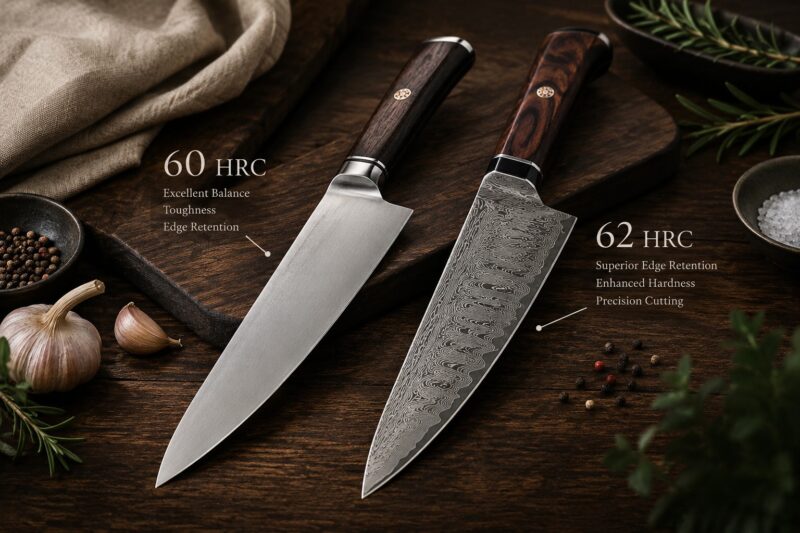
Understanding Rockwell Hardness
An Independent Guide
If you’ve ever researched kitchen knives, hunting knives, EDC knives, or custom handmade blades, you’ve probably encountered a specification called HRC.
A knife description might say:
- 58 HRC
- 60 HRC
- 62 HRC
- 64 HRC
Many knife buyers see these numbers but aren’t entirely sure what they mean.
Is a higher HRC always better?
Does a 62 HRC knife outperform a 58 HRC knife?
Why do some professional chefs prefer lower hardness while others seek extremely hard Japanese blades?
Understanding HRC is one of the most important aspects of choosing the right knife.
In this guide, we’ll explain exactly what HRC means, how it affects knife performance, and what hardness range is best for different types of kitchen knives.
What Does HRC Mean?
HRC stands for Rockwell Hardness Scale C.
It is one of the most widely used methods for measuring the hardness of steel.
The Rockwell test was developed to provide a consistent and repeatable way of measuring how resistant a material is to deformation.
In simple terms:
HRC tells us how hard a knife blade is.
The higher the number, the harder the steel.
For example:
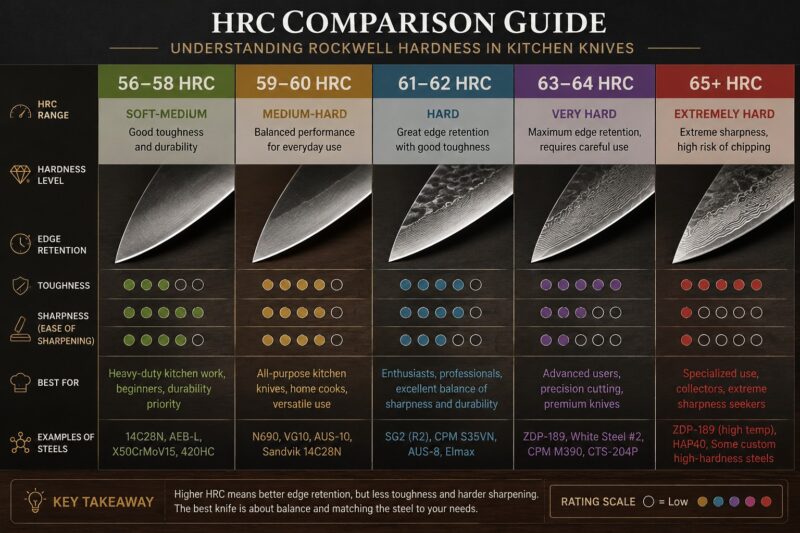
| HRC | Relative Hardness |
|---|---|
| 52-55 | Soft |
| 56-58 | Medium |
| 59-61 | Hard |
| 62-64 | Very Hard |
| 65+ | Extremely Hard |
However, hardness is only one aspect of knife performance.
A harder knife is not automatically a better knife.
How Is HRC Measured?
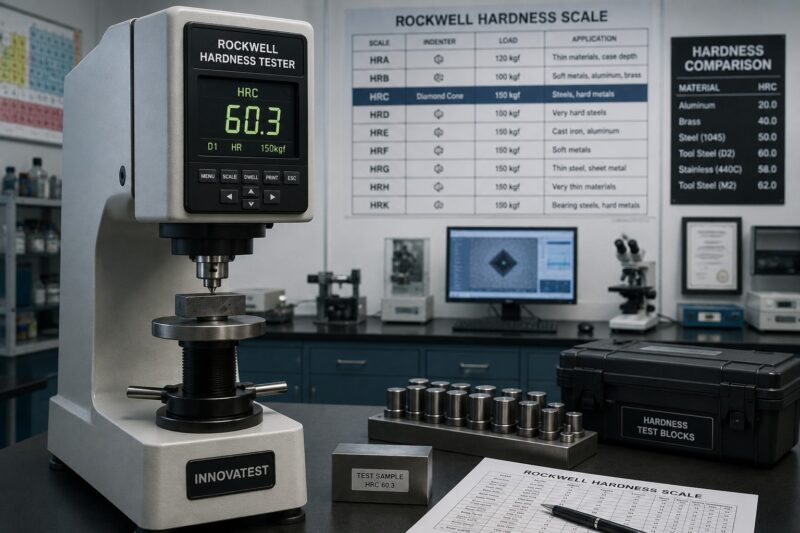
The Rockwell hardness test uses a specialized machine.
A diamond cone-shaped indenter is pressed into the steel under a controlled load.
The machine measures how deeply the indenter penetrates the material.
The less penetration, the harder the steel.
The result is displayed as an HRC number.
Because the process is standardized, manufacturers around the world can compare hardness values consistently.
Why Hardness Matters in Kitchen Knives
Hardness directly affects several important characteristics:
Edge Retention
Harder steels generally maintain sharp edges longer.
This is why many premium Japanese knives are hardened to:
- 60 HRC
- 61 HRC
- 62 HRC
- 63 HRC
The harder steel resists wear better during cutting.
Sharpening Behavior
Harder steels often require more time and effort to sharpen.
Softer steels sharpen more quickly but may need sharpening more frequently.
Toughness
As hardness increases, toughness often decreases.
This means extremely hard blades can become more susceptible to chipping.
Knife makers must balance hardness and toughness carefully.
Edge Stability
Proper hardness helps support a thin cutting edge.
This allows premium kitchen knives to achieve exceptional cutting performance.
The Relationship Between Hardness and Heat Treatment
Many knife buyers focus only on steel type.
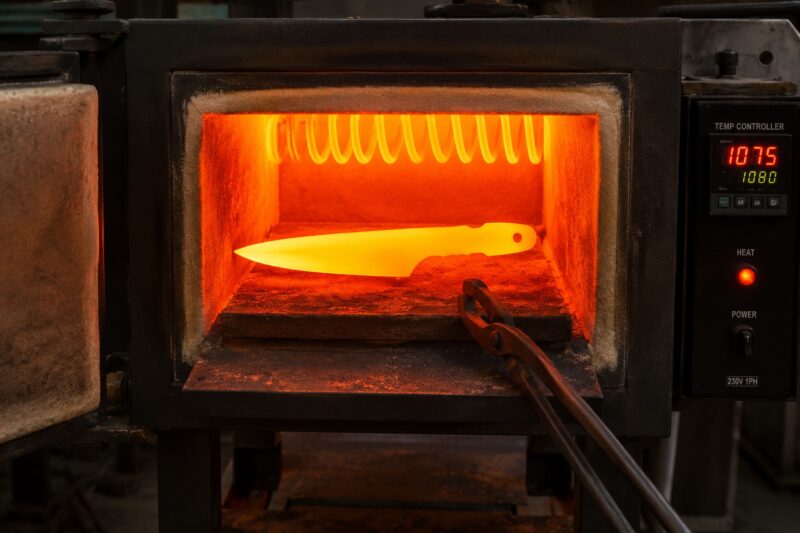
However, hardness depends largely on heat treatment.
Heat treatment involves:
- Heating steel
- Cooling it under controlled conditions
- Tempering the steel
This process determines the final hardness and performance characteristics.
The same steel can perform very differently depending on heat treatment.
For example:
VG10 at 58 HRC performs differently than VG10 at 61 HRC.
This is why experienced knife makers pay enormous attention to heat treatment quality.
Check Our Guide Different Heat Treatment Methods Explained
What HRC Is Best for Kitchen Knives?
There is no universal answer.
Different applications require different hardness levels.
56-58 HRC
Common in:
- Western chef knives
- German knives
- Utility knives
Advantages:
- Toughness
- Durability
- Easier sharpening
Examples:
- X50CrMoV15
- Many commercial kitchen knives
59-61 HRC
Often considered the sweet spot.
Advantages:
- Good edge retention
- Good toughness
- Balanced performance
Common steels:
- N690
- VG10
- 14C28N
- AEB-L
Many custom makers prefer this range.
62-64 HRC
Common in premium Japanese knives.
Advantages:
- Excellent edge retention
- Exceptional cutting performance
Potential drawbacks:
- Increased brittleness
- Greater chipping risk
Examples:
- SG2
- R2
- White Steel
- Blue Steel
Why Japanese Knives Often Have Higher HRC
Japanese knife making traditions emphasize:
- Thin blade geometry
- Sharpness
- Precision cutting
Higher hardness supports these goals.
Many Japanese chef knives operate between:
60-64 HRC
This allows extremely thin and precise edges.
However, these knives often require more careful use than softer Western knives.
Why German Knives Usually Have Lower HRC
German knife makers traditionally prioritize:
- Durability
- Toughness
- Versatility
As a result, many German knives fall within:
56-58 HRC
These knives tolerate:
- Hard cutting boards
- Dense foods
- Heavy kitchen use
better than some ultra-hard Japanese knives.
HRC and Edge Retention
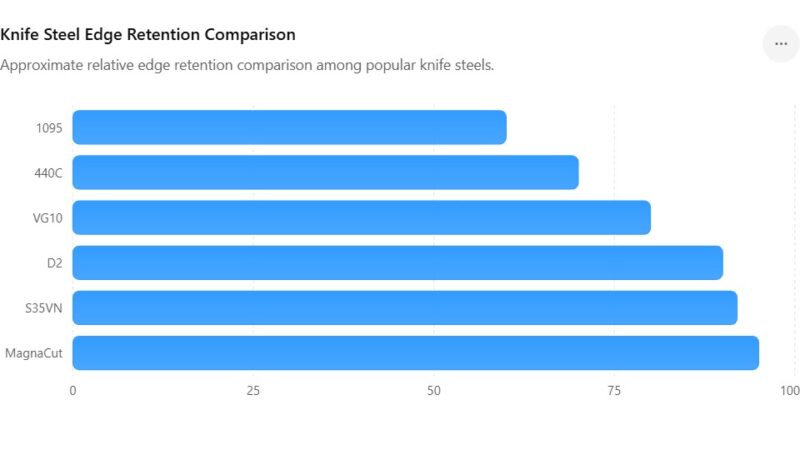
One of the biggest reasons buyers focus on HRC is edge retention.
Generally:
Higher hardness = longer edge retention.
However, the relationship isn’t perfect.
Steel composition also matters.
For example:
A premium powder steel at 60 HRC may outperform a simpler steel at 63 HRC.
This is why hardness should never be viewed in isolation.
HRC and Chipping
A common misconception is that harder is always better.
In reality:
Excessive hardness can increase chipping risk.
For example:
A 65 HRC knife may hold an edge longer but can chip if misused.
Potential causes include:
- Twisting cuts
- Cutting frozen foods
- Bone contact
- Hard impacts
Proper knife use becomes increasingly important as hardness rises.
HRC and Sharpening
Many users notice that harder knives feel different on sharpening stones.
Generally:
Lower HRC
Advantages:
- Faster sharpening
- Easier burr formation
Higher HRC
Advantages:
- Longer-lasting edges
Disadvantages:
- More sharpening effort
This tradeoff explains why some professional chefs still prefer moderate hardness levels.
Typical HRC Values of Popular Knife Steels
14C28N
Typical range:
58-62 HRC
Known for:
- Toughness
- Easy sharpening
- Excellent balance
Check Our Guide 14C28N and Other Swedish Knife Steels
N690
Typical range:
58-61 HRC
Known for:
- Corrosion resistance
- Versatility
VG10
Typical range:
59-61 HRC
Known for:
- Japanese kitchen knives
- Good edge retention
Check Our Guide VG10 Steel Review
SG2 (R2)
Typical range:
62-64 HRC
Known for:
- Premium performance
- Long edge life
MagnaCut
Typical range:
60-64 HRC
Known for:
- Toughness
- Corrosion resistance
- Balance
Check Our Guide Powder Steels for Kitchen Knives
White Steel #2
Typical range:
61-64 HRC
Known for:
- Exceptional sharpness
- Traditional Japanese knives
Common Myths About HRC
Myth #1: Higher HRC Always Means Better Knife
False.
A knife’s performance depends on:
- Steel composition
- Heat treatment
- Geometry
- Craftsmanship
Hardness is only one factor.
Myth #2: Soft Knives Are Bad
False.
Many professional kitchens successfully use knives around 56-58 HRC.
These knives offer toughness and reliability.
Myth #3: HRC Determines Sharpness
False.
Hardness helps support sharpness, but geometry and sharpening quality matter more.
Myth #4: All 60 HRC Knives Perform the Same
False.
Different steels behave differently even at identical hardness levels.
Why Knife Makers Talk About HRC So Much
Hardness provides an easy specification for buyers to understand.
It offers a quick indicator of expected performance.
However, experienced knife makers know that HRC alone never tells the full story.
Two knives with identical hardness values can perform very differently depending on:
- Steel chemistry
- Heat treatment quality
- Blade geometry
- Intended use
Check Our Guide Custom Knife vs Factory Knife
What HRC Should You Choose?
Home Cooks
Recommended:
58-61 HRC
Provides:
- Easy maintenance
- Good durability
- Excellent performance
Professional Chefs
Recommended:
60-63 HRC
Provides:
- Better edge retention
- High cutting performance
Outdoor and Hunting Knives
Recommended:
58-61 HRC
Balances toughness and durability.
Check Our Guide Best Hunting Knife Features Explained
Knife Enthusiasts and Collectors
Often prefer:
62-64 HRC
for maximum edge retention and performance.
Why Handmade Knives Often Outperform Factory Knives
Many buyers assume steel hardness determines quality.
However, a handmade knife often outperforms a factory knife because of:
- Superior heat treatment
- Better geometry
- Careful finishing
- Attention to detail
A well-made 60 HRC handmade knife can outperform a poorly made 63 HRC production knife.
This is why craftsmanship remains critical.
Quick Questions and Answers
What does HRC mean on a knife?
HRC stands for Rockwell Hardness Scale C, a measurement of steel hardness.
Is 58 HRC good for a kitchen knife?
Yes. Many excellent kitchen knives operate in this range.
Is 62 HRC too hard?
No. Many premium Japanese knives use 62 HRC successfully.
Does higher HRC stay sharp longer?
Generally yes, but steel type and heat treatment also matter.
What HRC do professional chef knives use?
Most professional chef knives fall between 58 and 63 HRC.
What is the best HRC for kitchen knives?
For most users, 59-61 HRC provides an excellent balance of sharpness, toughness, and edge retention.
Understanding Rockwell Hardness
Final Verdict
HRC is one of the most important knife specifications because it provides insight into how a blade will perform.
However, hardness should never be evaluated alone.
The best knives combine:
- Appropriate hardness
- Quality steel
- Proper heat treatment
- Excellent blade geometry
- Skilled craftsmanship
Whether you’re choosing a handmade chef knife, a Japanese Bunka, a Santoku, or a custom kitchen knife, understanding HRC helps you make an informed decision.
At Yashka Designs, we believe the best knife is not simply the hardest knife. It is the knife that achieves the right balance of hardness, toughness, edge retention, and cutting performance for its intended purpose.
Understanding Rockwell Hardness
https://yashkadesigns.com/kiritsuke-knives
https://yashkadesigns.ecrater.com/c/2444221/boning-knives
This article is for independent informational purposes only and is not affiliated with, sponsored by, or endorsed by any steel manufacturer. All product names, trademarks, and registered trademarks are the property of their respective owners.