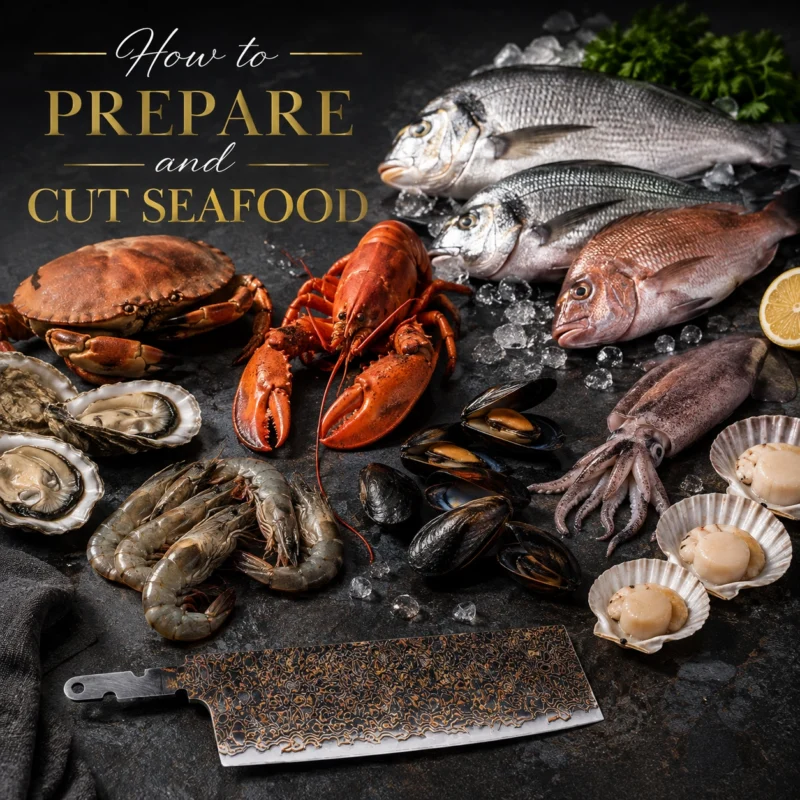
How to Prepare and Cut Seafood
Seafood is one of the most versatile ingredients in the kitchen, but preparing it properly requires a different set of knife skills than working with meat or vegetables. Fish have delicate flesh, irregular bones, slippery skin, and different muscle structures. Shellfish require an entirely different approach, while crustaceans such as shrimp, crab, and lobster need specialized cleaning and cutting techniques.
Learning how to prepare and cut seafood allows you to buy whole fish and shellfish with confidence, reduce waste, improve presentation, and get much more value from every ingredient.
This complete guide covers the fundamentals of seafood preparation, from selecting and storing fresh seafood to scaling, gutting, filleting, skinning, portioning, and preparing different types of shellfish and crustaceans.
You will also learn how to choose the right knife, how to work safely with slippery ingredients, how to remove bones and shells, and how different seafood should be prepared for grilling, frying, steaming, roasting, sushi, ceviche, soups, stews, and other dishes.
Important food-safety note: Seafood is highly perishable. The FDA recommends keeping seafood refrigerated at 40°F (4°C) or below, separating raw seafood from ready-to-eat foods, and cooking most seafood to 145°F (63°C). Raw or undercooked seafood carries additional food-safety risks.
1. Why Proper Seafood Preparation Matters
The quality of a seafood dish depends heavily on what happens before cooking.
A beautifully cooked fish can still be disappointing if the fillet contains pin bones, has ragged edges, has been cut with a dull knife, or has been handled too roughly.
Proper preparation helps preserve the structure of the flesh.
Fish muscle is generally softer and more delicate than meat. Pressing too hard, sawing repeatedly with a knife, or cutting against the wrong direction can crush the flesh rather than produce clean slices.
The goal is therefore not simply to cut seafood.
The goal is to make as few unnecessary cuts as possible while preserving as much usable flesh as possible.
A sharp knife is particularly important.
Instead of forcing the blade through the fish, a sharp knife should glide through the flesh with controlled pressure. This creates cleaner surfaces, better portions, and less damage to the meat.
The same principle applies to shellfish.
When cleaning shrimp, for example, you want to remove the shell and digestive tract without unnecessarily removing meat. When shucking an oyster, you want to open the shell without spilling the valuable liquor inside.
Good seafood preparation is therefore a combination of:
- Sharp knife skills
- Correct knife selection
- Understanding seafood anatomy
- Controlled cutting
- Proper handling
- Temperature control
- Food safety
- Efficient use of the ingredient
2. Understanding the Main Types of Seafood
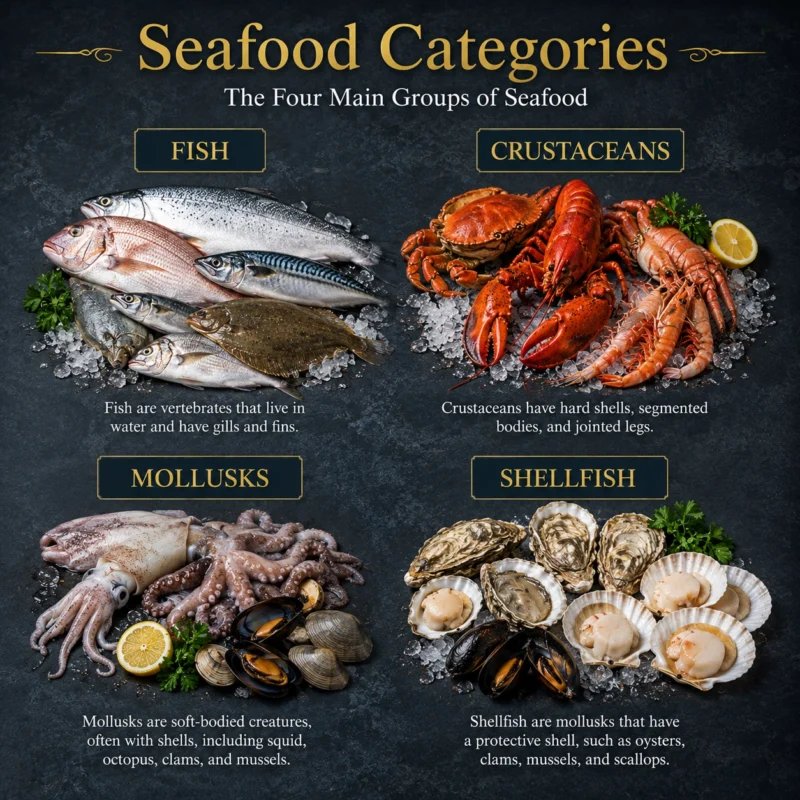
Before learning specific techniques, it helps to understand the major categories.
Finfish
Finfish include species such as:
- Salmon
- Tuna
- Cod
- Haddock
- Halibut
- Sea bass
- Snapper
- Trout
- Mackerel
- Sardines
- Mahi-mahi
- Swordfish
Fish can generally be divided into round fish and flat fish.
Round fish have a conventional body shape with two sides and a backbone running through the center.
Flat fish, such as flounder and sole, have a different anatomy and are usually filleted differently.
Crustaceans
Crustaceans have hard external shells and segmented bodies.
Common culinary examples include:
- Shrimp
- Prawns
- Crab
- Lobster
- Crawfish
Their preparation usually involves removing shells, separating body sections, and extracting meat.
Mollusks
Mollusks include many types of shellfish.
Important culinary examples include:
- Oysters
- Clams
- Mussels
- Scallops
- Squid
- Octopus
Not all mollusks are prepared in the same way.
Bivalves such as oysters, clams, and mussels have two shells, while squid and octopus have completely different structures.
3. Essential Seafood Preparation Tools
You do not need a huge collection of equipment to prepare seafood properly.
A few good tools are much more useful than a drawer full of specialized gadgets.
https://yashkadesigns.com/damascus-chef-knife-3
Fillet Knife
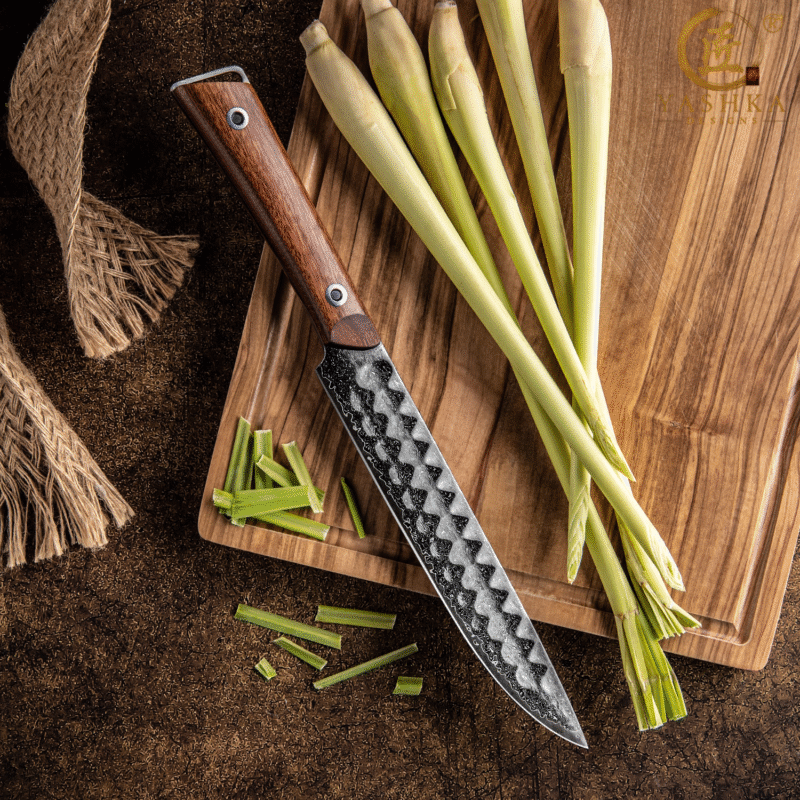
A flexible fillet knife is one of the most useful tools for whole fish.
Its thin, flexible blade allows you to follow the shape of the bones and produce clean fillets.
A blade around 6–9 inches is useful for many common fish.
For larger fish, a longer blade can provide better control.
https://yashkadesigns.com/damascus-67-layer-chef-knife
Chef Knife
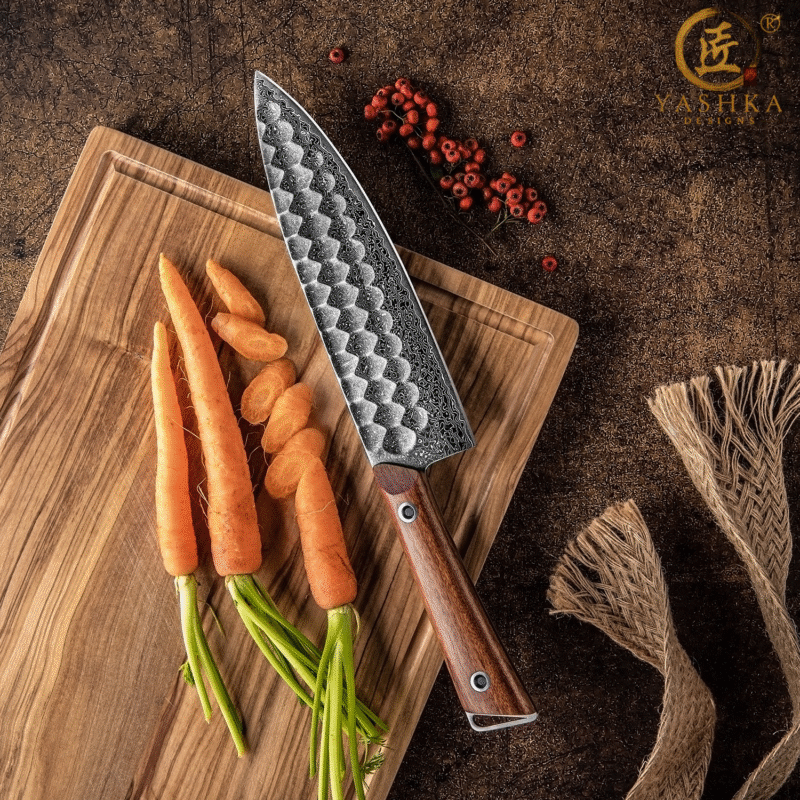
A sharp chef knife is useful for:
- Portioning fillets
- Cutting vegetables
- Removing fins
- Cutting larger fish
- Preparing garnishes
- General kitchen work
A chef knife is particularly useful when you are preparing seafood as part of a larger recipe.
https://yashkadesigns.com/deba-knife-molybdenum-steel
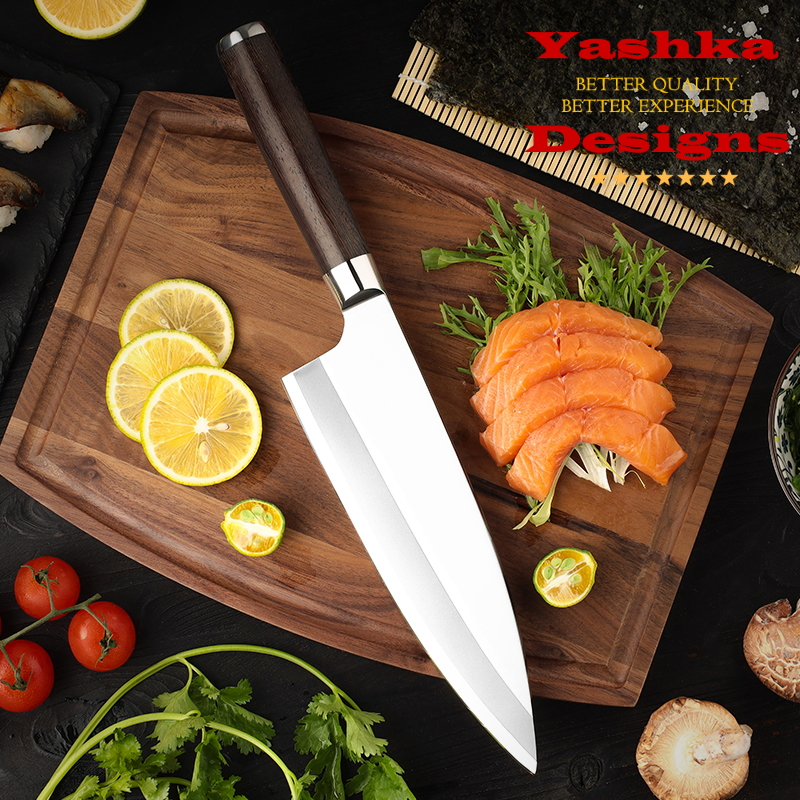
Deba Knife
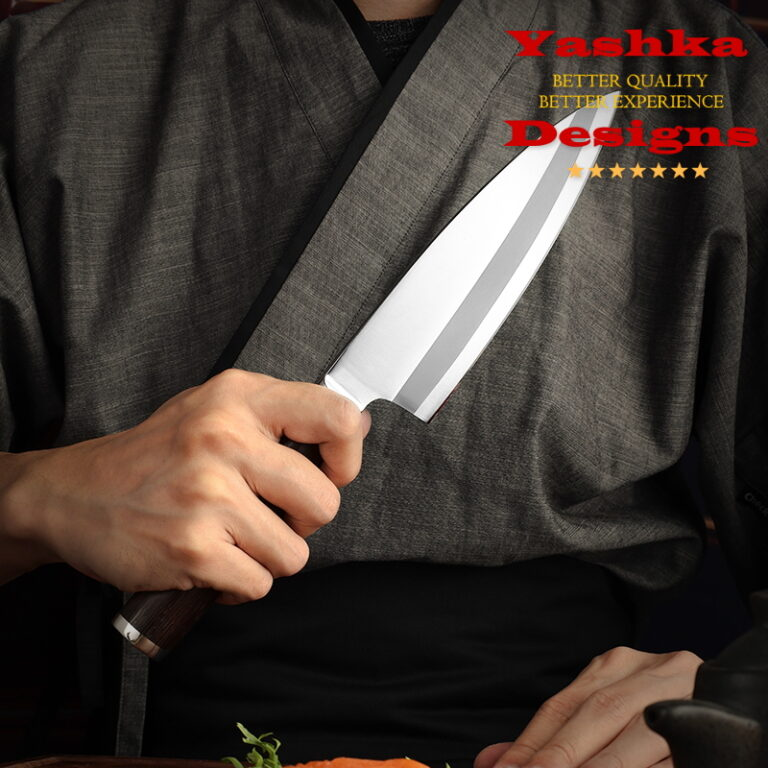
A traditional Japanese deba knife is designed specifically for fish preparation.
Its heavier blade makes it useful for:
- Breaking down whole fish
- Cutting through joints
- Removing heads
- Cutting through smaller bones
However, a deba should be used differently from a flexible fillet knife.
It is designed for controlled cutting and chopping rather than repeatedly forcing the blade through large bones.
https://yashkadesigns.com/chef-knife-japanese-yanagiba
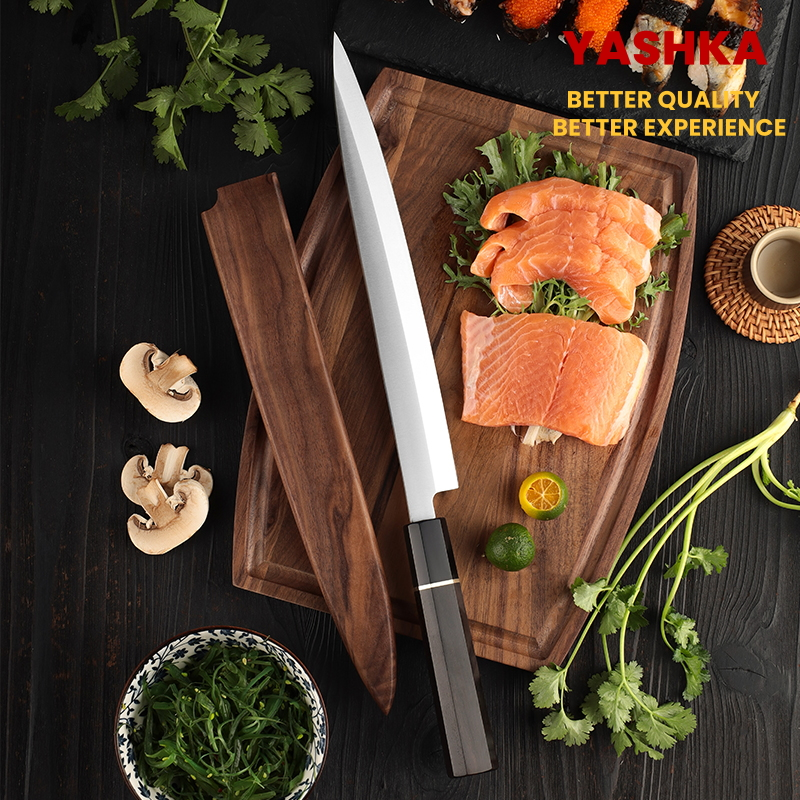
Yanagiba
A yanagiba is particularly associated with Japanese sashimi preparation.
Its long, narrow blade allows a chef to make long, clean slicing motions through fish.
For sashimi, the objective is to create smooth surfaces rather than repeatedly sawing through the flesh.
https://yashkadesigns.com/oyster-knife-home-kitchen-camping-fishing-tool
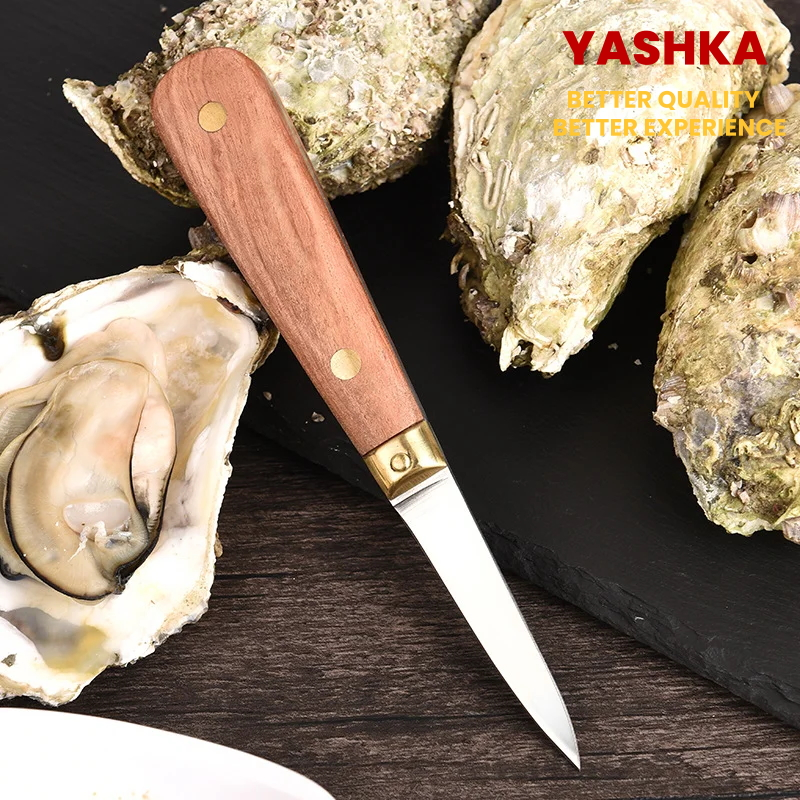
Oyster Knife
An oyster knife is designed specifically for opening oysters.
Do not substitute an ordinary kitchen knife.
Oyster shells are hard and irregular, and attempting to open them with the wrong knife can lead to slips and injuries.
Kitchen Shears
Strong kitchen shears are extremely useful for seafood.
They can be used for:
- Cutting fins
- Removing shrimp shells
- Cutting lobster shells
- Cutting crab sections
- Trimming squid
- Cutting herbs and garnishes
Fish Tweezers
Fish tweezers are useful for removing pin bones.
Their narrow tips allow you to grasp individual bones without damaging large areas of flesh.
4. Choosing the Right Knife for Seafood
Knife selection can make seafood preparation dramatically easier.
For most home cooks, three knives cover a large percentage of seafood work:
1. Flexible fillet knife
For filleting and skinning fish.
2. Chef knife or gyuto
For portioning, slicing, and general preparation.
3. Sturdy fish knife or deba
For breaking down whole fish.
For Japanese-style seafood preparation, you may eventually add a yanagiba for slicing raw fish.
The most important characteristic is not simply the shape of the knife.
It is sharpness and control.
A dull knife tends to slide across slippery fish rather than cutting cleanly. This can make the process slower and increase the chance of accidental movement.
Keep your knife properly sharpened and use a stable cutting surface.
5. How to Buy Fresh Fish
Good seafood preparation begins at the market.
Fresh fish should have a clean, mild smell rather than a strong sour, rancid, ammonia-like, or excessively fishy odor.
For whole fish, look for:
- Clear, shiny eyes
- Firm flesh
- Clean appearance
- Fresh-smelling gills
- Flesh that springs back when gently pressed
For fillets, look for:
- Firm flesh
- Moist appearance
- No excessive drying
- No darkened edges
- No unusual discoloration
The FDA specifically notes that color alone is not a reliable indicator of freshness, because seafood color can be affected by several factors.
When buying shrimp, scallops, and lobster meat, look for a clear or pearl-like appearance and little or no unpleasant odor.
6. How to Store Fresh and Frozen Seafood
Seafood should be kept cold from the moment you buy it.
If you plan to use fresh seafood within two days, the FDA recommends storing it in a clean refrigerator at 40°F (4°C) or below. Otherwise, freeze it properly.
Place seafood in a sealed container or wrap it well to prevent leakage.
For frozen seafood, avoid packages that are:
- Torn
- Open
- Damaged
- Covered in excessive frost or ice crystals
- Showing signs of thawing and refreezing
Frozen fish should remain properly frozen and should not be flexible when purchased.
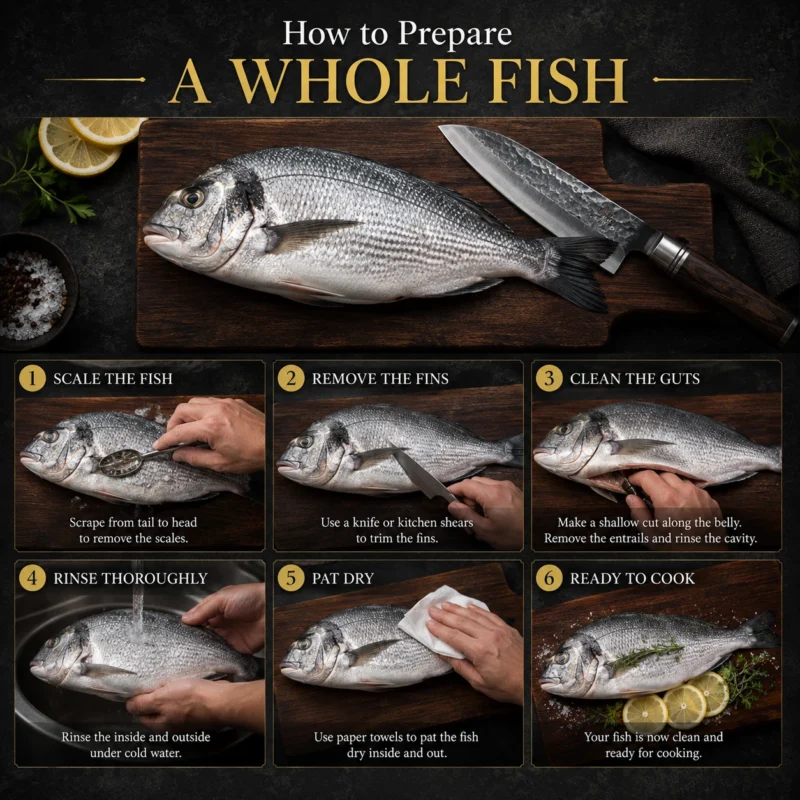
7. Preparing a Whole Fish
Preparing a whole fish may seem intimidating, but the process becomes much easier once you understand the anatomy.
A typical workflow is:
- Remove scales if necessary.
- Remove fins.
- Open the abdominal cavity.
- Remove the internal organs.
- Rinse only as appropriate for the preparation.
- Dry the fish thoroughly.
- Fillet or portion it.
The exact procedure varies according to species.
Some fish are better cooked whole, while others are more efficiently filleted.
Before cutting, make sure the fish is stable.
Place a damp towel underneath your cutting board if necessary.
8. How to Scale a Fish
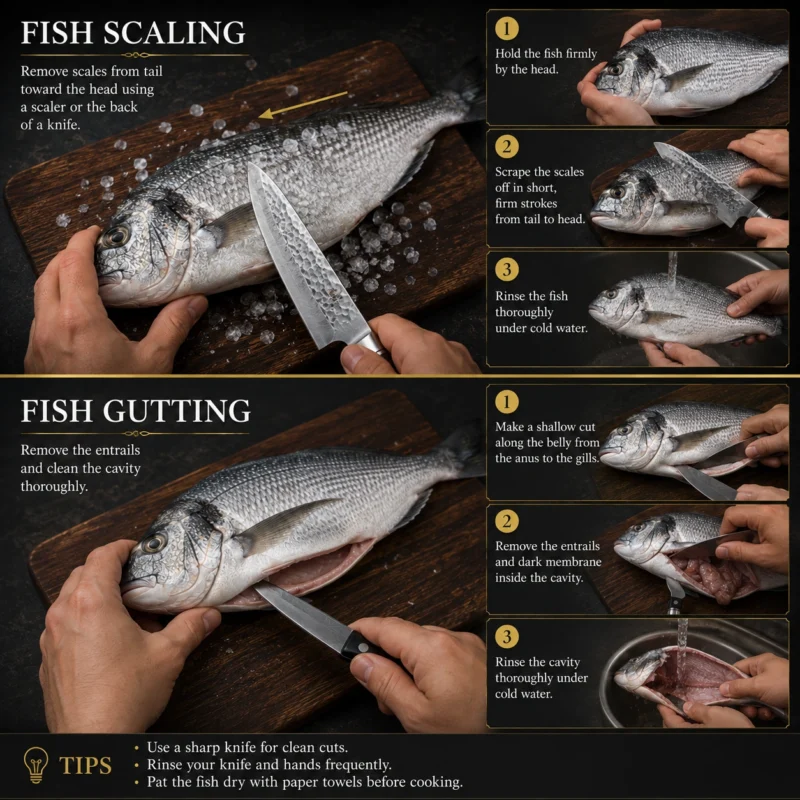
If the fish has scales, scaling should generally be done before filleting.
Hold the fish firmly by the tail.
Using a fish scaler or the back of a knife, scrape from the tail toward the head.
The goal is to lift the scales without cutting deeply into the skin.
Work over a sink or a large tray because scales can travel surprisingly far.
Pay particular attention to:
- Behind the head
- Around the fins
- Along the belly
- Near the tail
After scaling, inspect the fish carefully.
Remaining scales are particularly unpleasant when eating fish with the skin attached.
9. How to Gut and Clean a Whole Fish
Make a controlled incision along the belly.
Do not insert the knife deeply.
The objective is to open the abdominal cavity without puncturing the internal organs.
Remove the organs and inspect the cavity.
Some fish have a dark membrane along the interior. Depending on the species and preparation, this may need to be removed.
Once cleaned, dry the fish thoroughly.
Excess moisture makes knife work more difficult.
For many preparations, drying the fish is more useful than aggressively rinsing it.
If you do rinse seafood, keep the surrounding workspace controlled and clean it afterward to prevent cross-contamination.
10. How to Fillet a Round Fish
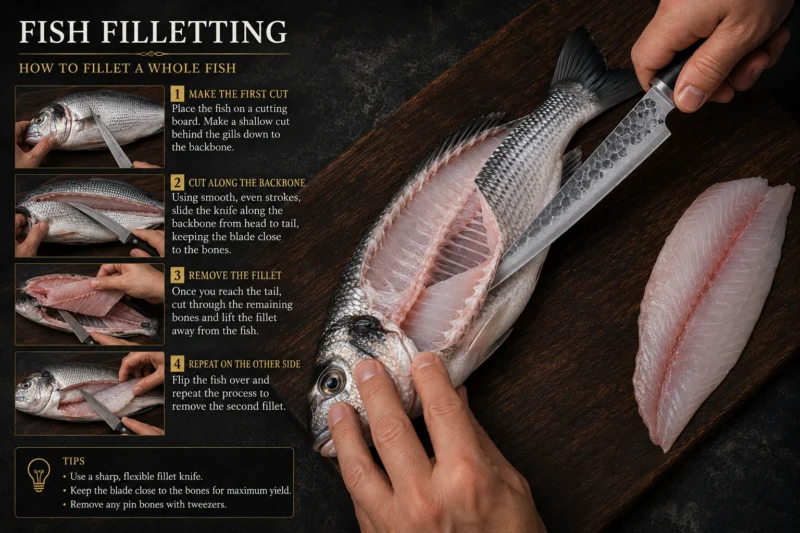
Round fish include salmon, trout, cod, sea bass, snapper, and many other species.
A typical filleting process is:
Step 1: Make the Head Cut
Place the fish on its side.
Make a cut behind the gill plate, angling toward the head.
Do not cut straight through the fish.
Follow the natural structure of the fish.
Step 2: Locate the Backbone
Once you make the initial cut, position your knife above the backbone.
Step 3: Make Long Cuts
Use the longest section of the knife blade possible.
Rather than making many short sawing movements, use smooth strokes.
Keep the blade close to the bones.
Step 4: Separate the Fillet
As the knife progresses, lift the fillet gently with your free hand.
Continue following the skeleton.
Step 5: Repeat
Turn the fish over and repeat the process.
The result should be two primary fillets with relatively little meat left on the skeleton.
https://yashkadesigns.com/japanese-deba-knife-sashimi-sushi-making-tools
11. How to Fillet Flat Fish
Flat fish require a different approach.
Examples include:
- Sole
- Flounder
- Turbot
- Plaice
Instead of two large fillets, flat fish commonly produce four fillets.
The backbone runs through the center, and the flesh extends around it.
Start by making a central incision along the backbone.
Then work the knife outward, following the bones.
Use the blade to separate the flesh from the skeleton.
The key is to let the knife follow the anatomy rather than trying to force a straight cut.
Because flat fish are relatively thin, a flexible fillet knife is particularly useful.
12. How to Remove Pin Bones
Even a well-filleted fish can contain small bones.
These are commonly called pin bones.
Run your clean fingers gently over the surface of the fillet.
You should be able to feel the bones as small hard points.
Use fish tweezers to remove them.
Pull each bone in approximately the same direction in which it is naturally positioned.
Do not simply yank aggressively upward.
The flesh can tear.
After removing the bones, run your fingers over the fillet again.
This second check is important.
13. How to Remove Fish Skin
Skin can be left on many fish, particularly when grilling, roasting, or pan-searing.
When skin should be removed, the process is straightforward with a sharp knife.
Place the fillet skin-side down.
Start at the tail end where there is a convenient section of skin to grip.
Hold the skin firmly.
Place the knife almost flat against the cutting board.
Move the blade forward while gently pulling the skin in the opposite direction.
The knife should separate the flesh from the skin rather than cutting deeply into the flesh.
This is another situation where sharpness matters.
A dull knife tends to grab the flesh and produce an uneven result.
14. How to Portion Fish Fillets
Once a fillet is clean, it can be divided into portions.
The size depends on the cooking method.
For individual pan-seared portions, thicker pieces are often useful.
For grilling, larger portions can help prevent the fish from breaking apart.
For soups and stews, smaller cubes may be appropriate.
For sashimi, the fish should be cut according to the structure of the muscle and the desired thickness.
When portioning fish, try to make pieces relatively uniform.
Uniform portions cook at approximately the same rate.
15. How to Cut Fish for Different Cooking Methods
The best cut depends on the cooking technique.
Pan-Searing
Use relatively thick portions.
Leave the skin attached when appropriate.
Score thick skin lightly if necessary to reduce curling.
Grilling
Larger portions work well.
Skin-on fillets can be easier to handle on the grill.
Baking
Whole fillets or large portions are convenient.
Frying
Cut fish into uniform pieces or strips.
Soup
Cut firm fish into chunks that can withstand cooking without disintegrating.
Ceviche
Use clean, uniform cubes.
Sashimi
Use long, controlled slicing motions to create smooth pieces.
16. Preparing Fatty Fish
Fatty fish include:
- Salmon
- Mackerel
- Sardines
- Herring
- Some tuna varieties
Their higher fat content makes them particularly flavorful but also changes how they behave during cutting.
A sharp knife is essential.
Keep the fish cold.
Cold fish is generally firmer and easier to portion cleanly.
For salmon, remove pin bones before portioning.
The belly portion may contain more fat than the loin.
Depending on the recipe, the belly can be retained or trimmed.
Do not throw away usable salmon trimmings.
They can be used for:
- Fish cakes
- Pasta
- Fried rice
- Soups
- Patties
- Seafood spreads
17. Preparing Lean Fish
Lean fish such as cod, haddock, pollock, and many white fish have relatively delicate flesh.
They can break apart easily if handled roughly.
Use a sharp, thin knife.
Avoid pressing down excessively.
If the fillet is very soft, chilling it thoroughly before cutting can make the process easier.
When portioning lean fish, support the piece with your free hand.
Avoid repeatedly moving it across the cutting board.
18. Preparing Large Fish
Large fish require additional planning.
Examples include:
- Tuna
- Large salmon
- Swordfish
- Halibut
- Large snapper
- Large sea bass
Use a stable cutting board and an appropriately long knife.
Large fish should generally be broken down into manageable sections before final portioning.
The basic principle remains the same:
Follow the anatomy rather than fighting it.
Use the backbone, joints, and natural seams as guides.
Large fish also produce valuable trim.
Do not automatically discard the bones and collars.
Fish heads, frames, cheeks, collars, and trimmings can be used for stocks, soups, sauces, and other preparations.
19. How to Prepare Fish for Sushi and Sashimi
Raw fish preparation requires extra care.
Food safety is particularly important because there is no cooking step to kill many pathogens.
The safest approach is to use seafood specifically sourced and handled for raw consumption and to follow applicable food-safety guidance.
The FDA notes that freezing can kill some parasites, but freezing does not eliminate all harmful germs, so thoroughly cooked seafood remains the safest option.
For sashimi preparation:
- Keep the fish properly chilled.
- Use a clean, sanitized workspace.
- Use an extremely sharp knife.
- Remove bones carefully.
- Remove skin when appropriate.
- Identify the direction of the muscle fibers.
- Slice across the grain as appropriate for the fish and desired texture.
- Make long, clean cuts.
Avoid repeatedly sawing through the fish.
The goal of sashimi cutting is an exceptionally clean surface.
A long slicing knife such as a yanagiba is traditionally suited to this type of work.
Check Our Guide How to Prepare Fish for Sushi, Sashimi & Ceviche
20. How to Prepare Fish for Ceviche
Ceviche uses acidic ingredients such as citrus as part of the preparation.
However, acid does not make raw seafood equivalent to properly cooked seafood from a food-safety standpoint.
Therefore, use properly sourced seafood and understand that raw or undercooked seafood carries risk.
For cutting:
- Remove skin.
- Remove pin bones.
- Trim damaged or excessively fatty sections as appropriate.
- Cut the fish into even cubes.
- Keep the cubes cold.
- Add the fish to the marinade according to the recipe.
Uniform pieces are important because they allow the marinade to contact the fish more evenly.
21. How to Prepare Shrimp
Shrimp are among the easiest crustaceans to prepare once you understand the process.
The basic preparation involves:
- Removing the head if still attached.
- Removing the shell.
- Removing the legs.
- Removing the digestive tract if desired or required.
- Rinsing or wiping appropriately.
- Drying thoroughly.
Some recipes leave the tail attached for presentation.
Others remove it completely.
The shell can also be saved.
Shrimp shells are excellent for making:
- Seafood stock
- Bisque
- Sauces
- Risotto stock
- Seafood soups
22. How to Peel and Devein Shrimp
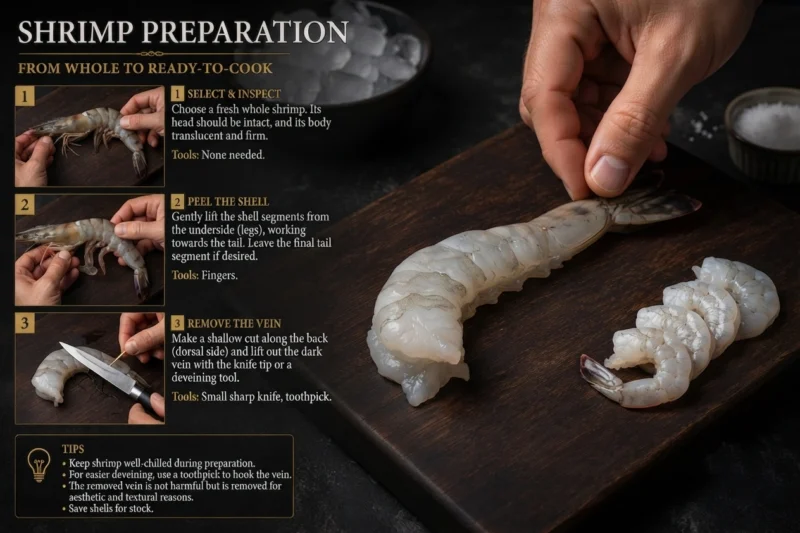
To peel shrimp, start from the underside.
Remove the shell segments and legs.
If keeping the tail, stop before removing the final tail segment.
To devein, make a shallow incision along the back.
Use the tip of a small knife or seafood tool to lift out the dark digestive tract.
The vein is not necessarily a health hazard when properly cooked, but removing it improves appearance and texture.
After cleaning, dry the shrimp thoroughly before cooking.
Wet shrimp tend to steam instead of sear.
23. How to Butterfly Shrimp
Butterflying shrimp creates a larger surface area and makes them particularly attractive for grilling and frying.
After peeling and deveining:
- Place the shrimp on the cutting board.
- Position the knife along the back.
- Make a deeper incision without cutting completely through.
- Open the shrimp.
- Flatten gently.
Do not cut all the way through.
The shrimp should remain connected along one side.
Butterflied shrimp are excellent for:
- Grilling
- Tempura
- Stuffing
- Broiling
- Garlic shrimp
- Seafood appetizers
24. How to Prepare Prawns
Prawns can be handled similarly to large shrimp.
Depending on the species and recipe, you may leave:
- Head
- Shell
- Tail
attached.
Head-on prawns are particularly valuable for dishes where the shell and head contribute flavor.
When removing the shell, save it for stock.
For large prawns, the digestive tract can be more noticeable, making deveining particularly worthwhile.
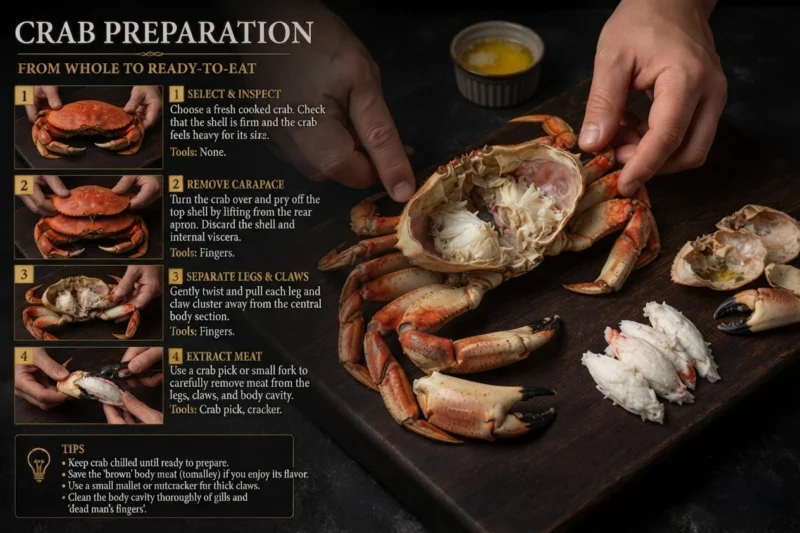
25. How to Prepare Crab
Crab preparation depends heavily on whether the crab is whole, live, or already cooked.
For cooked crab, the goal is to crack the shell and remove the meat without crushing it.
Useful tools include:
- Crab crackers
- Seafood picks
- Kitchen shears
- Small mallet
Separate the legs and claws.
Crack the shells gently.
Remove the meat in large pieces whenever possible.
Crab meat is delicate and can become shredded if handled aggressively.
The body can contain additional edible meat depending on the species.
Always follow appropriate local food-safety and handling practices for live crab.
The FDA advises selecting live crabs that show leg movement because they spoil rapidly after death.
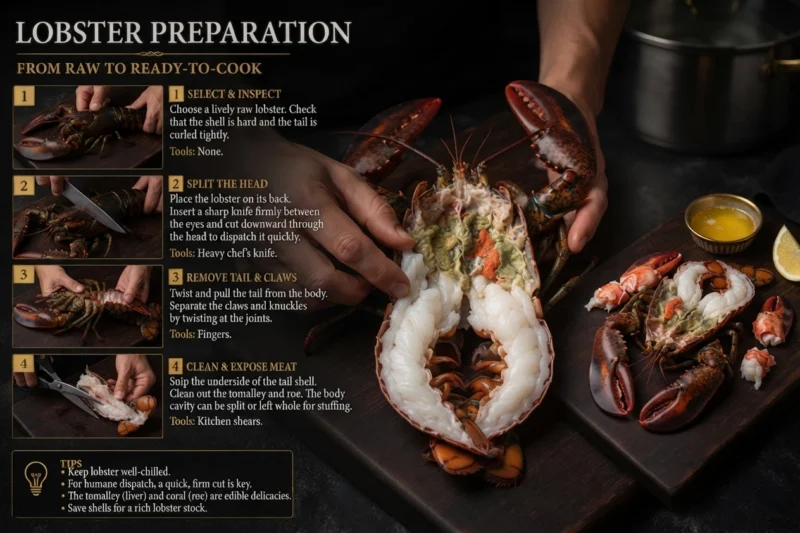
26. How to Prepare Lobster
Lobster requires a sturdy work surface and appropriate tools.
If starting with a whole lobster, preparation should follow an appropriate humane and food-safe procedure.
Once cooked, separate:
- Claws
- Knuckles
- Tail
- Body sections
Use kitchen shears to cut through the softer underside of the tail shell.
Pull the shell apart and remove the meat.
The large claw meat is especially valuable.
Do not throw away the shell.
Lobster shells can provide tremendous flavor for:
- Bisque
- Stock
- Sauce
- Seafood risotto
- Pasta sauce
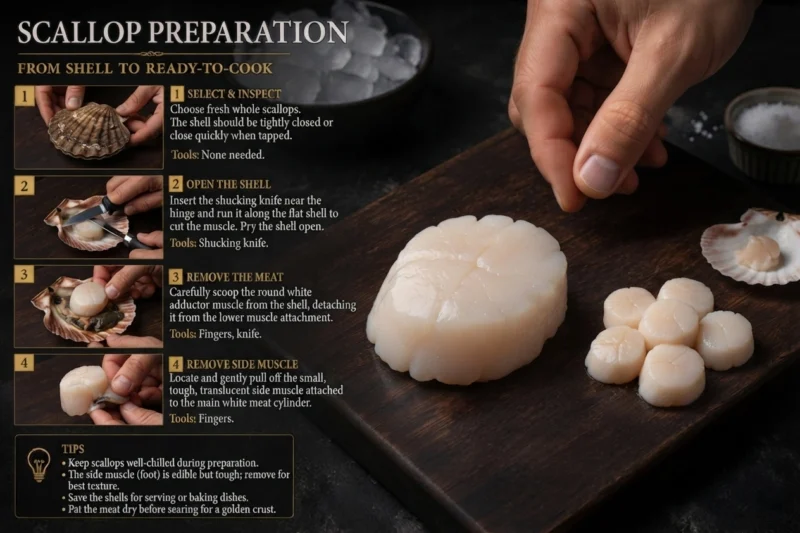
27. How to Prepare Scallops
Scallops are relatively simple to clean.
If using whole scallops, remove the shell and separate the edible muscle.
The side muscle is a small, tougher piece attached to the scallop.
Remove it by pulling it away with your fingers.
Pat scallops completely dry before cooking.
This is particularly important for searing.
Moisture on the surface prevents effective browning.
For presentation, scallops can be served whole or sliced horizontally.
Large scallops can also be cut into smaller pieces for pasta, ceviche-style preparations, or seafood salads.
28. How to Prepare Clams
Fresh live clams should be alive when purchased.
The FDA recommends discarding clams, oysters, and mussels with cracked or broken shells. Live bivalves should close when tapped; those that do not close should not be selected.
Before cooking:
- Inspect the shells.
- Discard cracked shells.
- Tap open shells gently.
- Discard those that fail to close.
- Scrub the shells.
- Rinse as appropriate.
Clams can be steamed, grilled, baked, or incorporated into soups and pasta.
After cooking, discard clams that do not open.
29. How to Prepare Mussels
Mussels require similar inspection.
Look for intact shells.
Remove any damaged shellfish.
Clean the exterior.
Many mussels have a fibrous beard that should be removed.
Grip it firmly and pull it toward the hinge.
Some mussels may require additional cleaning.
Mussels are excellent for:
- Steaming
- Pasta
- Seafood soups
- Curries
- Broths
- Paella
- Grilling
Like clams, mussels that remain closed after cooking should be discarded according to FDA guidance.
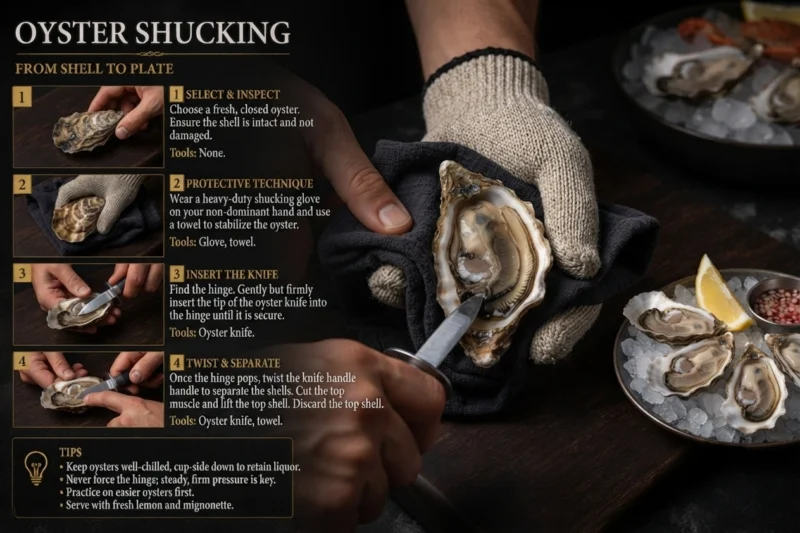
30. How to Shuck Oysters
Oysters require a specialized oyster knife.
Do not use a standard chef knife.
Protect your hand with an oyster glove or folded towel.
The basic process is:
- Hold the oyster securely.
- Locate the hinge.
- Insert the oyster knife into the hinge.
- Apply controlled pressure.
- Twist rather than forcing the knife.
- Separate the shells.
- Cut the muscle.
- Keep as much oyster liquor as possible.
The goal is not simply to open the shell.
A good shucking technique preserves the oyster and its liquid.
Inspect the oyster after opening.
It should have a clean, fresh appearance and smell.
Raw oysters carry particular food-safety risks, and vulnerable groups should avoid raw or undercooked shellfish.
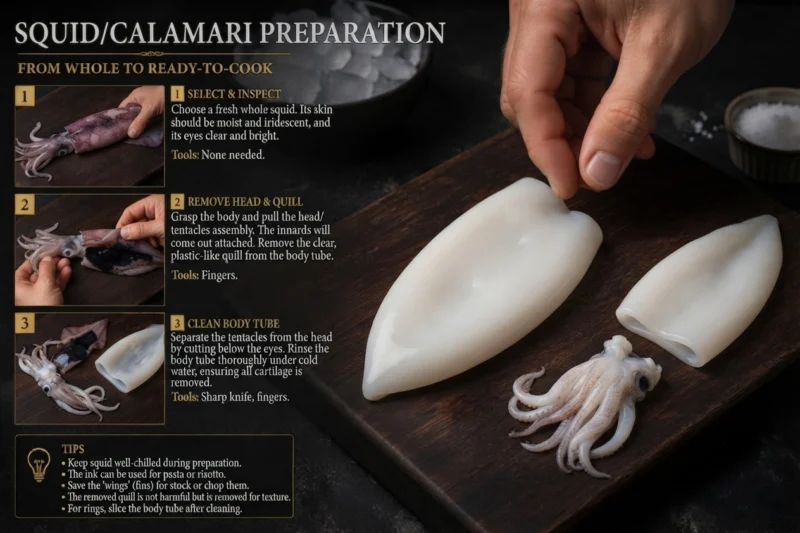
31. Preparing Squid and Calamari
Squid are easier to clean than they initially appear.
A whole squid generally consists of:
- Body
- Tentacles
- Head
- Internal organs
- Cartilage-like internal pen
Pull the head and internal organs away from the body.
Remove the transparent internal pen.
Peel the outer skin if desired.
Separate the tentacles from the head.
Remove the beak from the center of the tentacles.
The body can be:
- Cut into rings
- Opened into a flat sheet
- Stuffed
- Sliced into strips
The tentacles are edible and should not automatically be discarded.
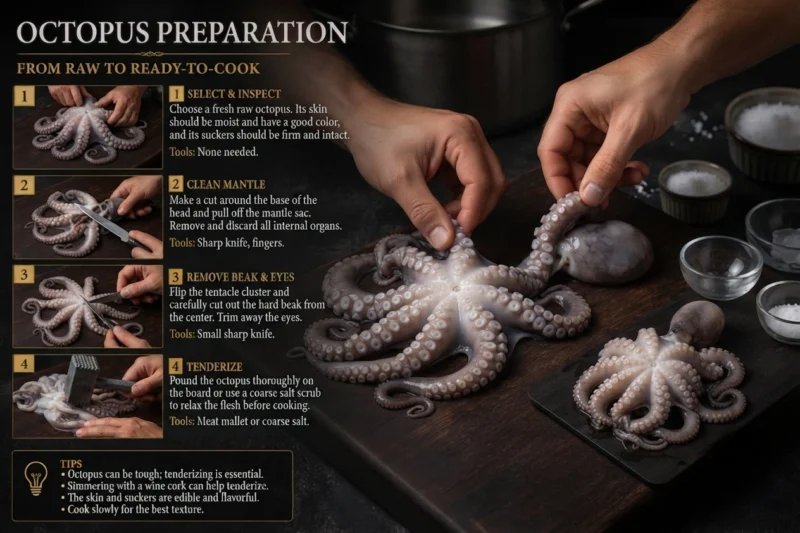
32. Preparing Octopus
Octopus has a different structure from squid.
It has:
- Eight arms
- Head
- Beak
- Internal organs
The arms can be separated from the central head area.
The beak should be removed.
Depending on the preparation, the skin can be retained.
Octopus is often cooked until tender before grilling, roasting, or slicing.
After cooking, the arms can be cut into attractive rounds or diagonal pieces.
A sharp knife helps create clean slices without crushing the flesh.
33. Common Seafood Cutting Mistakes
Many seafood preparation problems are caused by a few recurring mistakes.
Using a Dull Knife
A dull blade requires more force.
More force means less control.
Sharpen your knife before beginning.
Cutting Too Aggressively
Seafood is delicate.
Let the knife do the work.
Using the Wrong Knife
Do not use a delicate fillet knife to chop through hard lobster shells.
Do not use a chef knife to force open oysters.
Use the right tool for the job.
Leaving Pin Bones
Always run your fingers over fish fillets after removing visible bones.
Cutting Against the Anatomy
Follow the bones and natural muscle structure.
The fish itself provides a roadmap.
Working With Wet Seafood
Pat fish, shrimp, scallops, and other seafood dry before cutting or searing.
Excess moisture makes handling more difficult and interferes with browning.
Ignoring Cross-Contamination
Raw seafood should be kept away from ready-to-eat food.
The FDA recommends washing hands with soap and warm water for at least 20 seconds after handling raw food and cleaning boards, utensils, and countertops between raw seafood and ready-to-eat preparation.
34. Seafood Knife Skills for Beginners
If you are new to seafood preparation, focus on five fundamentals.
1. Keep the Blade Sharp
Sharpness is the foundation of control.
2. Stabilize the Ingredient
Do not attempt to cut slippery fish while it is moving around the board.
3. Use Long Cutting Motions
Especially when filleting or slicing fish.
4. Let the Knife Follow the Structure
Bones and joints provide natural cutting guides.
5. Keep Your Free Hand Safe
Never place fingers directly in front of the blade.
When working with oysters or other hard shells, use appropriate protective equipment.
35. How to Reduce Seafood Waste
Professional seafood preparation is not only about producing beautiful cuts.
It is also about using as much of the ingredient as possible.
Fish frames can be used for stock.
Heads can sometimes be used for broth.
Shrimp shells make excellent stock.
Lobster shells can be used for bisque.
Crab shells can add flavor to seafood broths.
Fish trimmings can become:
- Fish cakes
- Croquettes
- Soups
- Chowder
- Pasta sauces
- Dumpling fillings
- Seafood burgers
Even small pieces of salmon or tuna can be repurposed rather than thrown away.
36. Seafood Preparation by Cooking Method
Different cooking methods call for different cuts.
Pan-Frying
Use uniform portions with enough thickness to prevent overcooking.
Deep-Frying
Cut fish into:
- Fillets
- Strips
- Nuggets
- Small portions
Dry the fish before battering.
Grilling
Keep pieces relatively large.
Skin-on fish can be particularly useful.
Roasting
Whole fish, large fillets, and thick portions work well.
Steaming
Whole fish and larger portions are common.
Poaching
Cut fish into relatively large pieces that can withstand gentle cooking.
Soup
Use firm fish cut into chunks.
Pasta
Seafood can be cut into:
- Slices
- Cubes
- Medallions
- Small pieces
Stir-Frying
Cut seafood into relatively uniform pieces.
Shrimp, squid, scallops, and firm fish all work well.
37. Cleaning Your Seafood Knives
After preparing seafood, clean your knives promptly.
Seafood residue can contain oils, proteins, and strong odors.
Wash the knife according to the manufacturer’s instructions.
Dry it completely.
Do not leave a carbon-steel blade wet.
For stainless steel knives, drying is still important even though they have better corrosion resistance.
Never put an expensive knife into a sink where it can be damaged by other utensils.
Clean your cutting board thoroughly as well.
The FDA recommends cleaning cutting boards, dishes, utensils, and countertops with soap and hot water between preparation of raw seafood and ready-to-eat foods.
Check Our Guide All Kinds of Knife Sharpening Tools
38. Complete Seafood Preparation Checklist
Before starting, make sure you have:
Tools
- Sharp chef knife
- Fillet knife
- Cutting board
- Fish tweezers
- Kitchen shears
- Oyster knife when required
- Seafood crackers when required
- Clean towels
- Food thermometer
Workspace
- Clean cutting board
- Clean countertop
- Refrigerator or ice
- Waste container
- Separate plate for prepared seafood
Before Cutting
- Inspect seafood
- Check smell and appearance
- Keep seafood cold
- Sharpen your knife
- Stabilize the cutting board
- Prepare a clean storage container
During Preparation
- Keep raw seafood separate
- Make controlled cuts
- Remove bones
- Remove unwanted skin
- Save usable trim
- Keep seafood cold
After Preparation
- Clean knives
- Clean cutting boards
- Clean countertops
- Wash hands
- Refrigerate seafood promptly
- Sanitize equipment as appropriate
39. Seafood Food Safety: The Basics
Food safety deserves special attention because seafood is highly perishable.
The FDA recommends refrigerating seafood promptly and keeping the refrigerator at 40°F (4°C) or below. If seafood will not be used within the recommended refrigerated period, freeze it.
Frozen seafood should be thawed safely.
The preferred method is overnight thawing in the refrigerator.
For faster thawing, seafood can be placed in a sealed bag and immersed in cold water, or thawed in a microwave if it will be cooked immediately afterward.
Never thaw seafood by simply leaving it on the kitchen counter.
Cross-contamination is another major concern.
Keep raw seafood away from:
- Salads
- Bread
- Cooked seafood
- Fruit
- Vegetables
- Ready-to-eat foods
Use separate cutting boards when practical.
40. How to Know When Seafood Is Cooked
For most seafood, the FDA recommends an internal temperature of 145°F (63°C).
A thermometer is the most reliable method.
For fish, the flesh should become opaque and separate easily with a fork.
For shrimp, lobster, and crab, the flesh should become firm, pearly, and opaque.
Scallops should become opaque and firm.
For clams, mussels, and oysters, shells should open during cooking; shellfish that do not open should be discarded.
Remember that appearance alone is not always enough to determine safety.
41. Raw Seafood Requires Extra Care
Raw seafood includes:
- Sashimi
- Sushi
- Raw oysters
- Some ceviche
- Tartare
- Crudo
These preparations have additional risks.
The safest option is always properly cooked seafood.
The FDA specifically warns that raw or undercooked seafood can carry parasites and bacteria, and freezing does not eliminate all harmful germs.
Pregnant people, children, older adults, and people with weakened immune systems are among the groups at higher risk from foodborne illness and should avoid raw or undercooked seafood.
42. A Simple Seafood Cutting Workflow
If you are preparing multiple seafood ingredients for one meal, organization becomes extremely important.
A professional-style workflow looks like this:
Step 1: Prepare the Workspace
Set out your cutting board, knives, towels, containers, and waste bowl.
Step 2: Keep Seafood Cold
Remove only the seafood you are actively preparing.
Step 3: Process Whole Fish
Scale, gut, and fillet the fish.
Step 4: Remove Bones
Use tweezers.
Step 5: Portion
Cut the fish according to the recipe.
Step 6: Prepare Shellfish
Clean shrimp, mussels, clams, scallops, or other shellfish.
Step 7: Prepare Crustaceans
Clean crab, lobster, or prawns.
Step 8: Dry Everything
Pat seafood dry before cooking.
Step 9: Store
Place prepared seafood in clean containers and refrigerate promptly if it will not be cooked immediately.
Step 10: Clean
Wash and sanitize the workspace.
This workflow minimizes unnecessary handling and keeps the kitchen organized.
43. How to Get Cleaner Fish Cuts
There are several simple techniques that dramatically improve your results.
Keep the Fish Cold
Cold fish is firmer.
Use the Entire Blade
When filleting, avoid making dozens of tiny cuts.
Use long sections of the blade.
Follow the Bones
The skeleton provides a natural guide.
Don’t Press Too Hard
Let the knife glide.
Sharpen Frequently
A sharp knife produces cleaner cuts and requires less force.
Dry the Fish
A dry surface is easier to control.
Practice on Inexpensive Fish
You do not need to start with expensive tuna or premium salmon.
Cod, trout, and other readily available fish can be excellent practice.
44. Fish Cuts Every Home Cook Should Know
Understanding basic fish cuts makes recipes easier to follow.
Whole Fish
The entire fish is cooked intact.
Fillet
The boneless or mostly boneless side of a fish.
Steak
A cross-sectional cut through a larger fish, usually including a section of bone.
Loin
A thicker central section of a fillet, often associated with large fish such as tuna or salmon.
Belly
The fatty lower portion of many fish.
Collar
The area behind the head.
Cheeks
Small pieces of meat around the fish’s head.
These cuts have different textures and fat levels.
Do not assume that the fillet is always the best part.
For many fish, collars and cheeks are prized by experienced cooks.
45. How to Prepare Fish Collars
Fish collars are often overlooked.
The collar is the section immediately behind the head.
It can contain surprisingly rich meat.
Large fish such as salmon and yellowtail can produce excellent collars.
Trim away unwanted portions and cook the collar whole.
Grilling or roasting works particularly well.
Because the collar contains bones and connective tissue, it benefits from cooking methods that allow the meat to remain moist.
46. How to Prepare Fish Cheeks
Fish cheeks are small but flavorful.
They are found around the head and are particularly noticeable in larger fish.
Remove them carefully using a small sharp knife.
Because they are small, they can be pan-seared or incorporated into other dishes.
Fish cheeks are a good example of how proper seafood preparation can reduce waste.
47. Preparing Seafood for Pasta
Seafood pasta benefits from carefully sized pieces.
Shrimp can be:
- Left whole
- Halved
- Chopped
Scallops can be:
- Left whole
- Sliced
- Quartered
Fish can be cut into bite-sized cubes.
Squid can be cut into rings or strips.
Mussels and clams can be served in the shell or removed after cooking.
The key is consistency.
Seafood pieces should be sized according to how quickly they cook.
Small shrimp and thin squid cook much faster than thick fish portions.
Check Our Guide Best Italian Pasta Recipes
48. Preparing Seafood for Stir-Frying
Stir-frying requires quick, even cooking.
Cut ingredients into relatively uniform pieces.
For shrimp, remove the shell and vein.
For squid, cut thin rings or strips.
For fish, use firm-fleshed varieties and cut them into bite-sized pieces.
Scallops can be sliced or quartered depending on size.
Keep the pan hot and avoid overcrowding it.
49. Preparing Seafood for Grilling
Grilling presents a particular challenge because delicate fish can stick or fall apart.
Choose relatively firm fish.
Dry the surface.
Leave the skin attached when appropriate.
Oil the cooking surface according to the recipe.
Use a wide spatula for turning.
Do not attempt to move fish too early.
When the surface has developed enough structure, it will generally release more easily.
Shrimp and scallops can also be grilled.
Skewering shrimp can make them easier to turn.
50. Preparing Seafood for Frying
For fried fish, uniformity is particularly important.
Cut fillets into pieces of similar thickness.
Pat them dry.
Season.
Apply the coating or batter.
Avoid excessive moisture.
For calamari, cut squid into consistent rings.
For shrimp, butterfly large shrimp when appropriate.
The goal is to make sure the exterior becomes crisp before the interior becomes overcooked.
51. How to Organize Your Seafood Knife Collection
If seafood preparation is becoming a regular part of your cooking, you do not need every specialized Japanese knife.
A practical collection might be:
Essential
Chef knife: general kitchen preparation.
Fillet knife: fish preparation.
Kitchen shears: shells, fins, squid, shrimp.
Advanced
Deba: breaking down whole fish.
Yanagiba: precision raw-fish slicing.
Petty knife: detailed trimming.
Specialized
Oyster knife: oyster shucking.
Fish tweezers: pin bones.
The best collection is the one that matches the seafood you actually prepare.
52. How Knife Shape Affects Seafood Preparation
Different blade shapes have different strengths.
A flexible fillet knife can follow curved bones.
A heavier deba can handle fish heads and joints.
A long yanagiba can create a single clean slicing motion.
A chef knife provides versatility.
A petty knife provides precision.
This is why professional kitchens often use several knives rather than one universal blade.
The right knife reduces effort and improves consistency.
Check Our Guide Japanese Fish Knives
53. Seafood Preparation and Japanese Knife Skills
Japanese cuisine places particular emphasis on precision seafood preparation.
Traditional fish knives such as the deba are designed for breaking down fish.
Long slicing knives such as the yanagiba are used for preparing sashimi.
The underlying principle is simple:
Different stages of seafood preparation require different cutting actions.
Breaking down a whole fish is not the same task as slicing sashimi.
Trying to use one knife for everything can make both jobs harder.
54. How to Practice Seafood Knife Skills
If you want to improve, practice deliberately.
Choose one fish and repeat the same process several times.
Focus on:
- Keeping the knife sharp
- Making consistent cuts
- Following the skeleton
- Removing more flesh from the bones
- Leaving fewer ragged edges
- Removing pin bones efficiently
- Producing uniform portions
After each fish, inspect the skeleton.
How much usable flesh remains?
If large amounts remain, your knife angle or technique can probably be improved.
This is one of the best ways to learn.
55. The Most Important Rule: Let the Knife Do the Work
Perhaps the most important seafood knife principle is simple:
Do not force the blade.
A sharp knife should cut with relatively little pressure.
If you find yourself pushing hard, stop and check:
- Is the knife sharp?
- Is the fish stable?
- Is the blade at the correct angle?
- Are you cutting through a bone?
- Are you using the right knife?
Many seafood preparation problems disappear once these questions are answered.
56. Final Seafood Preparation Checklist
Before you begin:
Seafood
- Fresh or properly frozen
- Correctly refrigerated
- No unusual odor
- No damaged shellfish
- Appropriate for the intended preparation
Knives
- Sharp
- Clean
- Appropriate for the task
Workspace
- Stable cutting board
- Clean surface
- Separate raw-food preparation area when possible
- Towels available
Fish
- Scaled if necessary
- Gutted
- Filleted
- Pin bones removed
- Skin removed or retained according to recipe
- Properly portioned
Shrimp
- Shell removed if desired
- Deveined
- Tail retained or removed
- Dried
Crab/Lobster
- Properly cooked or safely handled
- Shell cracked
- Meat removed
- Shell saved for stock if appropriate
Mollusks
- Shells inspected
- Damaged shellfish discarded
- Live bivalves checked appropriately
- Cooked shellfish that remain closed discarded
After Preparation
- Seafood refrigerated promptly
- Knives washed
- Cutting board cleaned
- Countertop cleaned
- Hands washed
Conclusion: Mastering How to Prepare and Cut Seafood
Learning how to prepare and cut seafood is one of the most useful advanced kitchen skills you can develop.
The process becomes much less intimidating once seafood is divided into categories.
Whole fish require an understanding of anatomy and careful filleting. Shrimp and prawns require efficient shell removal and cleaning. Crab and lobster require controlled shell breaking. Scallops require careful trimming. Clams and mussels require inspection and cleaning, while oysters require a specialized shucking technique. Squid and octopus require their own cleaning and cutting methods.
Across all of these techniques, the same principles apply:
Keep seafood cold. Keep your workspace clean. Use the right knife. Keep the blade sharp. Make controlled cuts. Follow the natural structure of the seafood. Avoid unnecessary waste.
A sharp knife is particularly valuable because seafood flesh is delicate. Rather than crushing or tearing the ingredient, a properly sharpened blade allows you to make clean, precise cuts.
For fish, learn to follow the skeleton. For crustaceans, learn where the shell separates naturally. For mollusks, understand how the shell and edible portions are structured.
And remember that preparation is only half the process.
Proper storage, handling, and cooking are equally important. The FDA recommends keeping seafood refrigerated at 40°F (4°C) or below and cooking most seafood to 145°F (63°C). Raw and undercooked seafood requires additional caution because freezing does not eliminate every food-safety hazard.
Once you master these fundamentals, buying whole fish and shellfish becomes much less intimidating. You can choose better-quality ingredients, produce cleaner cuts, create more attractive portions, and make use of parts that are often unnecessarily discarded.
Most importantly, good seafood preparation gives you greater control over the final dish.
Whether you are preparing a simple salmon fillet, breaking down a whole fish, cleaning shrimp for pasta, preparing lobster for a special dinner, shucking oysters, or cutting fish for sashimi, the same foundation applies:
sharp knife, controlled technique, clean workspace, proper temperature, and respect for the ingredient.
That is the foundation of professional seafood preparation.