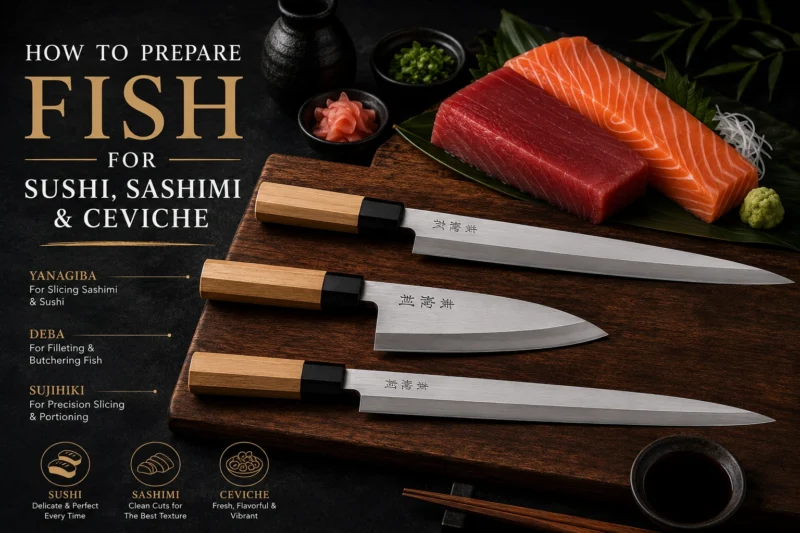
How to Prepare Fish for Sushi
Introduction
Preparing fish for sushi, sashimi, and ceviche is both an art and a skill. While high-quality fish is essential, the way you handle, fillet, trim, and slice it has just as much impact on the final dish.
A clean cut preserves the delicate texture of the flesh, minimizes cell damage, and enhances both presentation and flavor. In contrast, a dull knife or poor technique can crush the meat, leaving ragged edges and causing valuable juices to escape.
Japanese chefs have refined fish preparation techniques over centuries, developing specialized knives for every stage of the process—from breaking down a whole fish to slicing paper-thin sashimi.
In this guide, you’ll learn:
- How to choose fish for raw preparations
- Essential food safety considerations
- The best knives for every stage of preparation
- Step-by-step fish filleting techniques
- How to prepare fish for sushi
- How to prepare fish for sashimi
- How to prepare fish for ceviche
- Professional cutting techniques
- Delicious ceviche recipes
Whether you’re preparing your first salmon fillet or perfecting your sashimi presentation, understanding proper fish preparation will improve every seafood dish you make.
Why Proper Fish Preparation Matters
Many people focus only on buying good fish, but professional chefs know that preparation is equally important.
Correct preparation helps:
- Preserve the natural texture of the fish
- Produce cleaner slices
- Improve presentation
- Reduce waste
- Increase safety
- Make slicing easier
A properly prepared fillet is easier to portion, cooks more evenly when needed, and creates more attractive sushi and sashimi.
Understanding Raw Fish Safety
Before discussing knives or cutting techniques, it’s important to understand food safety.
Raw seafood should always come from a trusted supplier and be intended for raw consumption where appropriate. Fish sold as “sushi-grade” or “sashimi-grade” does not have a universal legal definition in many countries, but retailers often use these terms to indicate fish they consider suitable for raw dishes.
Many species intended to be eaten raw are frozen under regulated conditions to reduce the risk of parasites. Requirements vary by country, so always follow your local food safety regulations and purchase fish from reputable sources.
Good hygiene is equally important:
- Keep fish refrigerated until preparation.
- Wash hands before and after handling raw seafood.
- Use clean cutting boards and knives.
- Prevent cross-contamination with other foods.
- Serve raw fish promptly or store it safely at refrigerated temperatures.
Food safety starts long before the first cut.
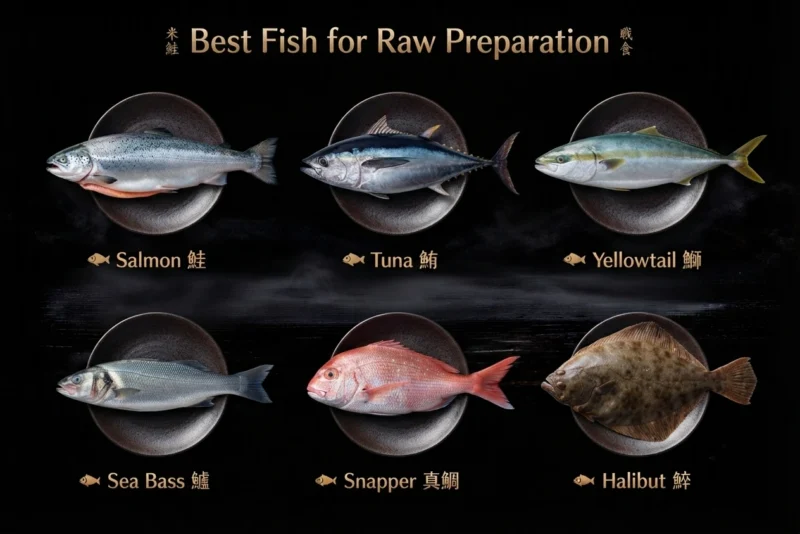
Choosing the Best Fish for Sushi, Sashimi, and Ceviche
Not every fish is suitable for every preparation.
Some species excel as sashimi, while others are better suited to ceviche or cooked dishes.
The best choices combine excellent texture, mild flavor, and consistent quality.
Salmon
Salmon is one of the world’s most popular fish for sushi and sashimi.
Its rich fat content gives it a buttery texture that pairs beautifully with soy sauce, wasabi, and citrus.
Best for:
- Sushi
- Nigiri
- Sashimi
- Ceviche (when sourced appropriately)
Texture:
Soft and buttery.
Difficulty:
Easy for beginners.
Tuna
Tuna is considered one of the finest fish for sashimi.
Different cuts offer different characteristics.
Lean cuts have a firm texture, while fatty belly portions are rich and melt in the mouth.
Best for:
- Sashimi
- Sushi
- Poke
- Ceviche
Texture:
Firm and smooth.
Yellowtail (Hamachi)
Yellowtail has a delicate flavor and moderate fat content.
It is prized in Japanese cuisine for its clean taste and tender texture.
Best for:
- Sushi
- Sashimi
Sea Bream
Sea bream has firm white flesh with a subtle sweetness.
It is often served as traditional sashimi.
Best for:
- Sashimi
- Sushi
- Carpaccio
Snapper
Snapper offers firm flesh that slices cleanly.
It is excellent for both raw and cooked dishes.
Best for:
- Sashimi
- Ceviche
Halibut
Halibut provides dense white flesh that works well for thin slices.
Best for:
- Sashimi
- Ceviche
Sea Bass
Sea bass has a clean flavor and medium firmness.
It is one of the most popular fish for classic Peruvian ceviche.
Best for:
- Ceviche
- Carpaccio
- Sushi
Fish Comparison Table
| Fish | Sushi | Sashimi | Ceviche |
|---|---|---|---|
| Salmon | ⭐⭐⭐⭐⭐ | ⭐⭐⭐⭐⭐ | ⭐⭐⭐⭐ |
| Tuna | ⭐⭐⭐⭐⭐ | ⭐⭐⭐⭐⭐ | ⭐⭐⭐⭐⭐ |
| Yellowtail | ⭐⭐⭐⭐⭐ | ⭐⭐⭐⭐⭐ | ⭐⭐⭐ |
| Sea Bream | ⭐⭐⭐⭐ | ⭐⭐⭐⭐⭐ | ⭐⭐⭐ |
| Snapper | ⭐⭐⭐⭐ | ⭐⭐⭐⭐ | ⭐⭐⭐⭐⭐ |
| Halibut | ⭐⭐⭐⭐ | ⭐⭐⭐⭐ | ⭐⭐⭐⭐⭐ |
| Sea Bass | ⭐⭐⭐⭐ | ⭐⭐⭐⭐ | ⭐⭐⭐⭐⭐ |
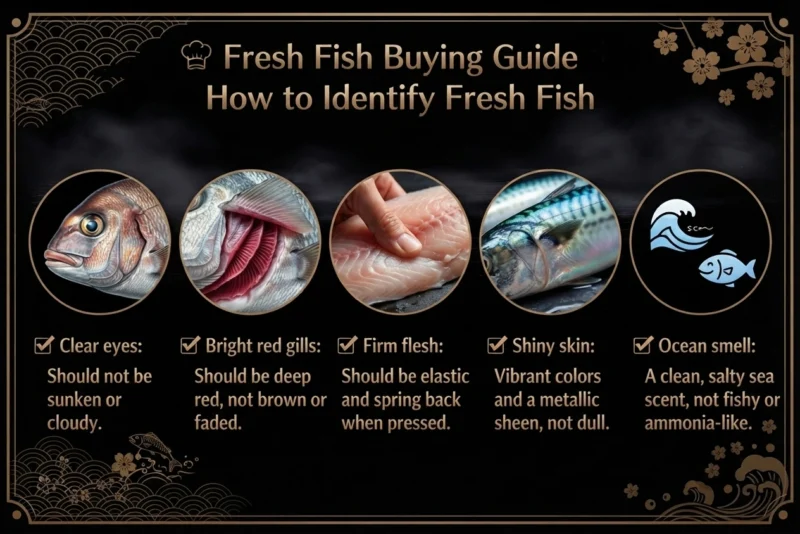
How to Recognize Fresh Fish
Freshness is one of the most important factors when preparing raw seafood.
Look for:
Clear Eyes
Whole fish should have:
- Bright eyes
- Clear appearance
- Slightly convex shape
Avoid fish with cloudy or sunken eyes.
Bright Gills
Healthy gills should appear:
- Bright red
- Pink-red
- Moist
Brown or gray gills often indicate older fish.
Firm Flesh
Press the fish gently.
Fresh fish should spring back quickly without leaving an indentation.
Mild Smell
Fresh fish should smell:
- Clean
- Like the ocean
- Slightly briny
A strong ammonia-like or sour odor is a warning sign.
Shiny Skin
Fresh fish typically has:
- Bright scales
- Moist skin
- Natural shine
Dull or dry skin can indicate reduced freshness.
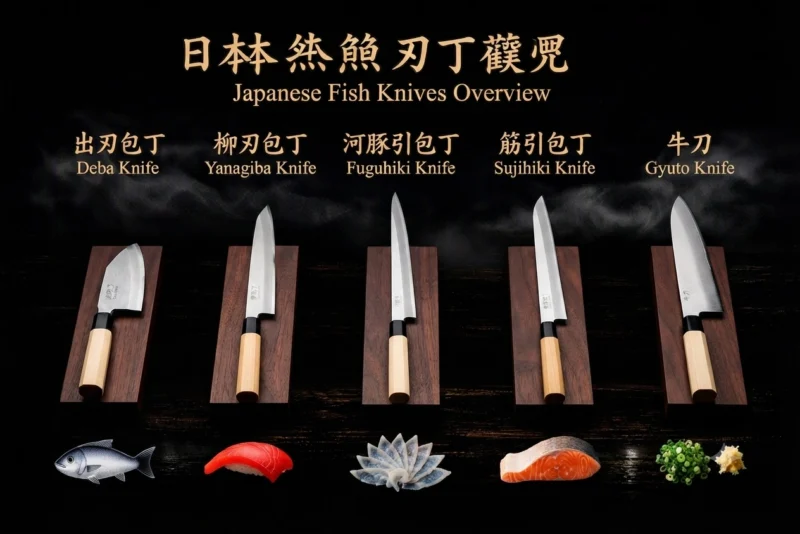
Essential Knives for Fish Preparation
Professional chefs rarely use one knife for every task.
Different stages require different blade shapes.
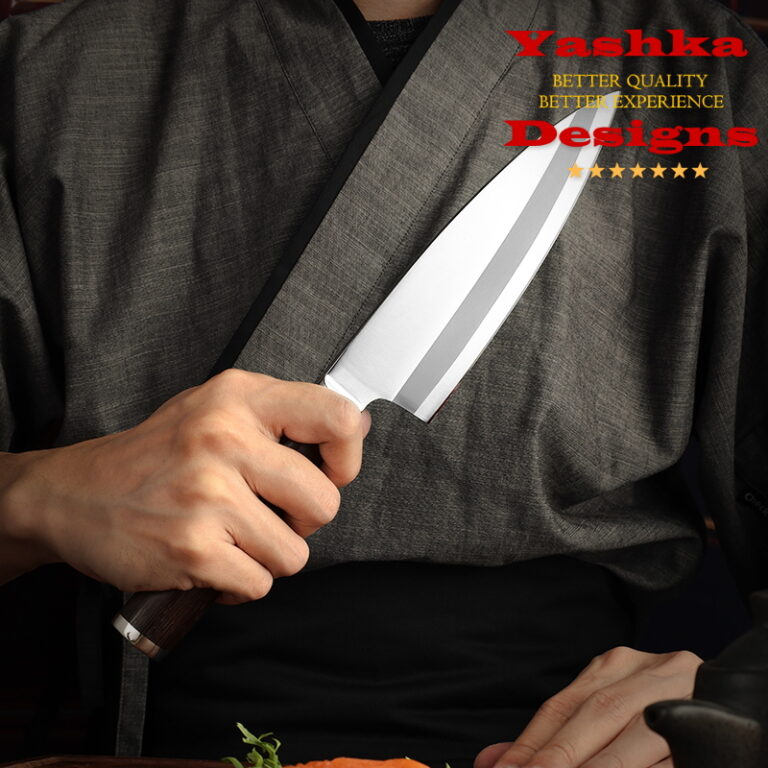
Deba Knife
Best for Breaking Down Whole Fish
The Deba is the traditional Japanese fish butchering knife.
Characteristics:
- Thick spine
- Heavy blade
- Single bevel edge
- Excellent control
Uses:
- Removing heads
- Splitting fish
- Cutting through small bones
- Initial filleting
A Deba should not be confused with a cleaver. While it is robust, it is designed for precision rather than heavy chopping.
https://yashkadesigns.com/chef-kitchen-knife-yanagiba-knives-sashimi-salmon-home-cooking-tools
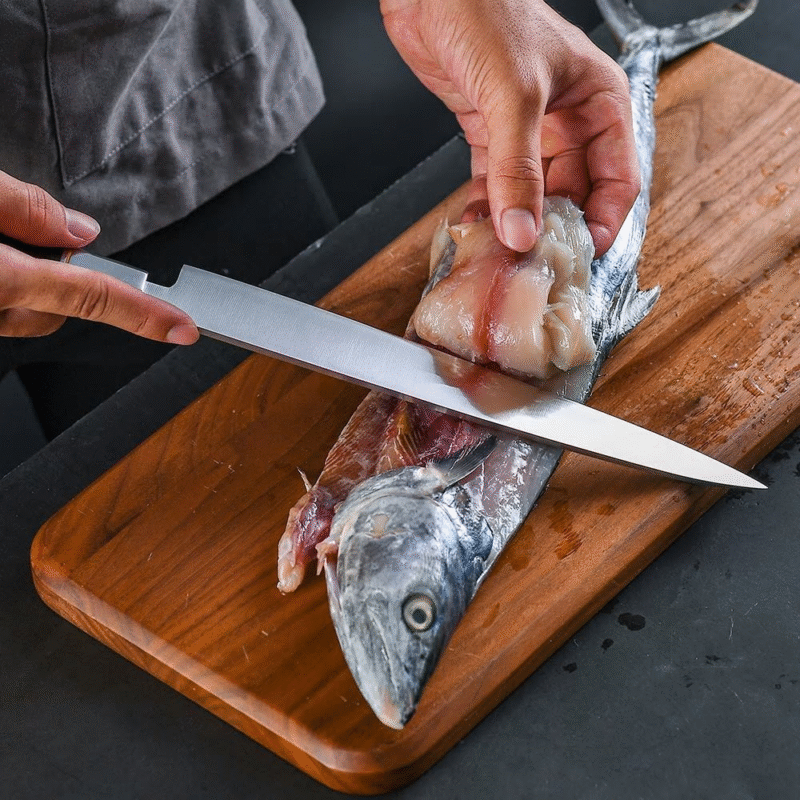
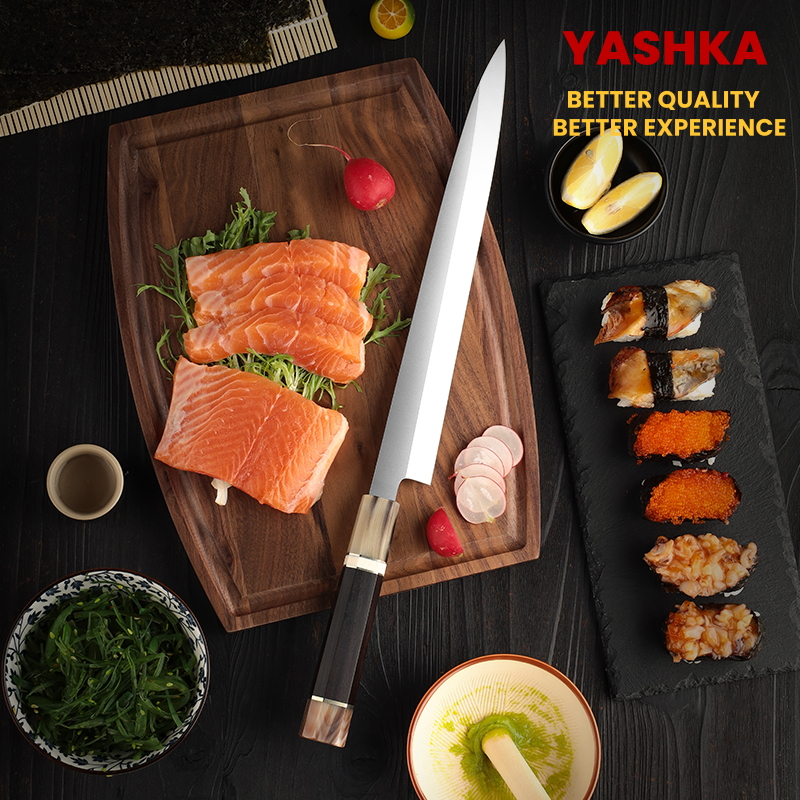
Yanagiba Knife
Best for Slicing Sashimi
The Yanagiba is used after the fish has already been filleted and trimmed.
It excels at:
- Sashimi
- Nigiri toppings
- Thin fish slices
The long blade allows a single smooth pull, producing clean surfaces with minimal damage to the flesh.
Sujihiki Knife
The Modern Fish Slicer
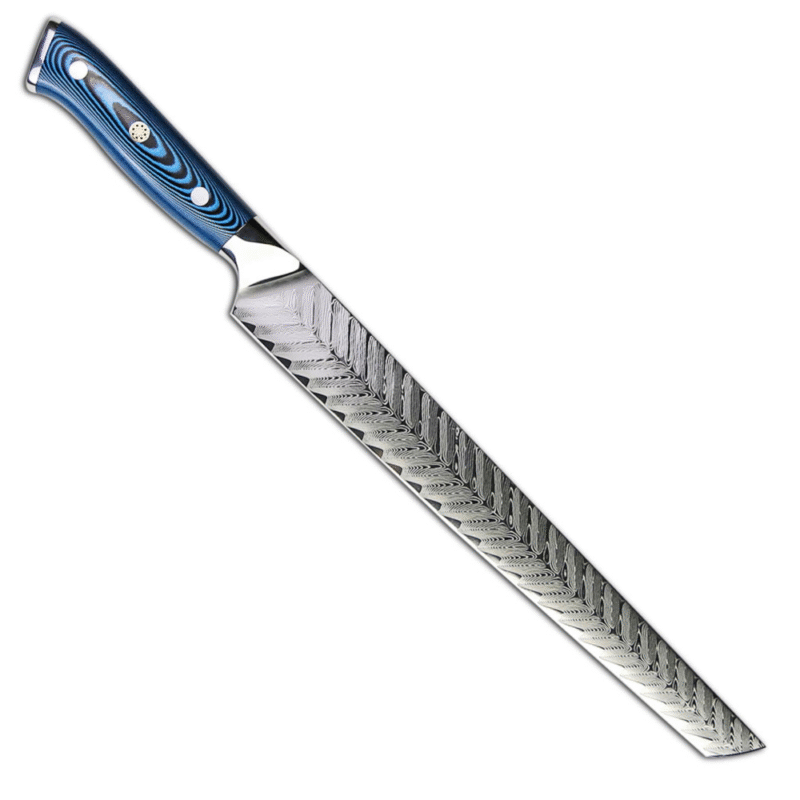
The Sujihiki is a double-bevel slicing knife.
Many home cooks prefer it because it is:
- Easier to sharpen
- More versatile
- Excellent for salmon and tuna
- Suitable for meat as well
Gyuto Knife
The Best All-Purpose Option
A Gyuto cannot completely replace a Yanagiba or Deba, but it performs very well when you want one knife for many kitchen tasks.
Good for:
- Portioning fillets
- Skin removal
- Trimming
- General slicing
Check Our Guide Japanese Gyuto Knife Guide
Flexible Fillet Knife
Western-style flexible fillet knives remain popular for skinning and trimming.
Advantages:
- Flexible blade
- Easy skin removal
- Good for large fillets
Many chefs combine Japanese and Western knives depending on the task.
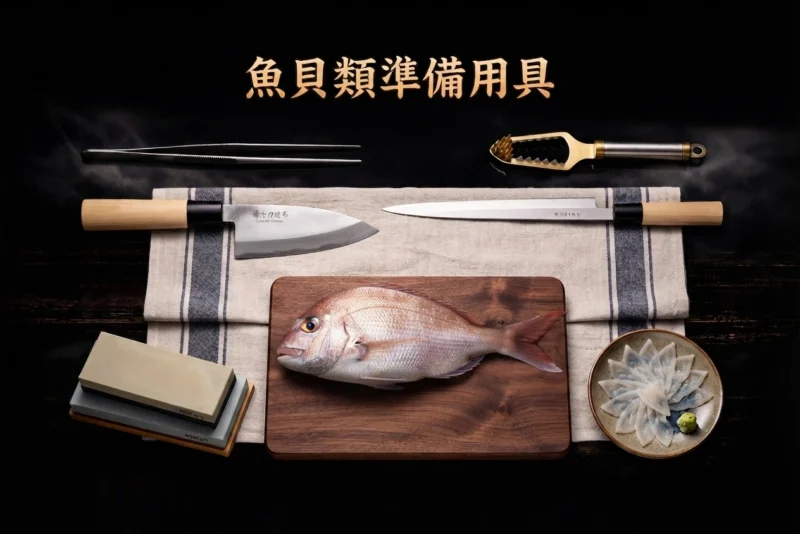
Essential Fish Preparation Equipment
Besides knives, a few simple tools make fish preparation easier.
Large Cutting Board
A stable cutting board provides enough space for safe knife work.
Wood and high-quality food-safe synthetic boards are both excellent choices.
Fish Tweezers
Pin bones can remain after filleting.
Fish tweezers allow you to remove them without damaging the fillet.
Fish Scaler
Scaling tools remove scales quickly while reducing mess.
Kitchen Towels
Keeping fish dry improves grip and makes cutting more precise.
Pat the fish dry before slicing.
Water Stones
Sharp knives are essential.
Recommended sharpening stones:
- 1000 grit
- 3000 grit
- 6000 grit
- 8000 grit (optional finishing)
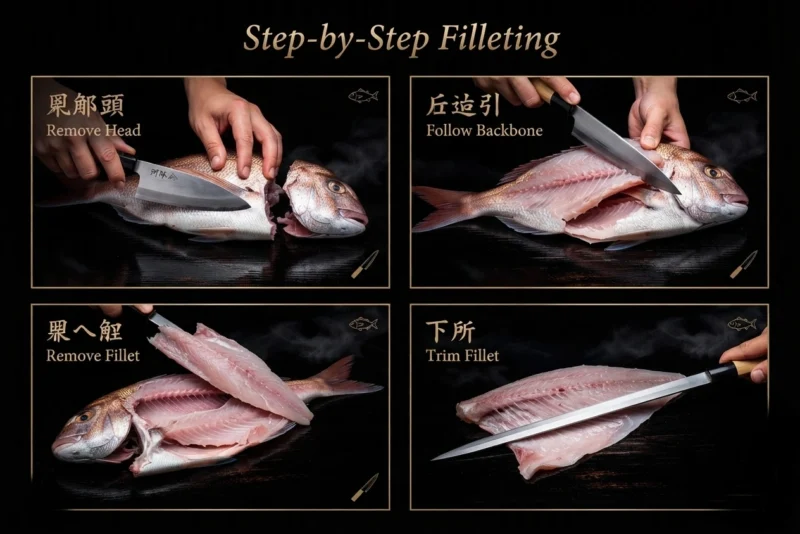
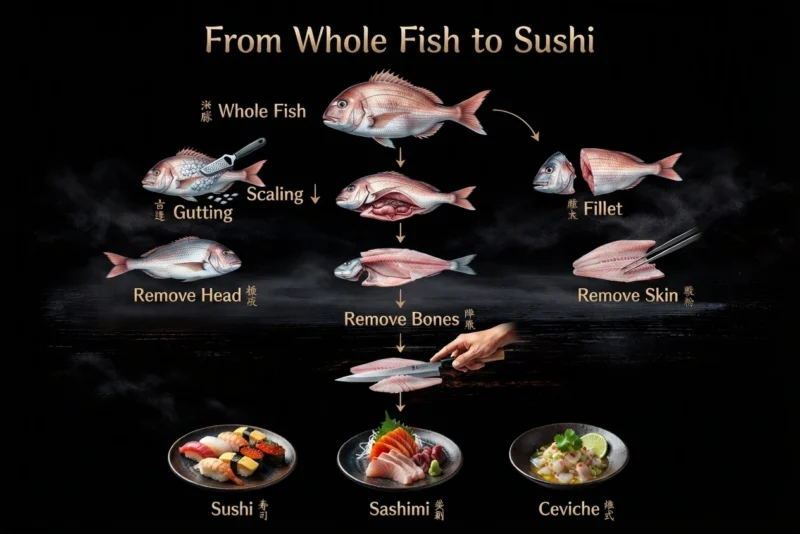
Step-by-Step: Preparing a Whole Fish
Professional preparation follows a logical sequence.
Step 1: Scale the Fish
Hold the fish firmly by the tail.
Using a fish scaler or the back of a knife, scrape from tail toward the head.
Rinse away loose scales.
Step 2: Trim the Fins
Kitchen shears or a Deba knife can be used to remove sharp fins.
This makes the fish easier and safer to handle.
Step 3: Gut the Fish
Make a shallow cut along the belly.
Remove the internal organs carefully.
Avoid puncturing the gall bladder, which can leave a bitter taste.
Rinse the cavity thoroughly with cold water.
Step 4: Remove the Head
Using the Deba knife:
- Cut behind the pectoral fin.
- Slice down to the backbone.
- Rotate the fish.
- Complete the cut from the opposite side.
Use controlled pressure rather than excessive force.
https://yashkadesigns.com/chef-slicing-knife
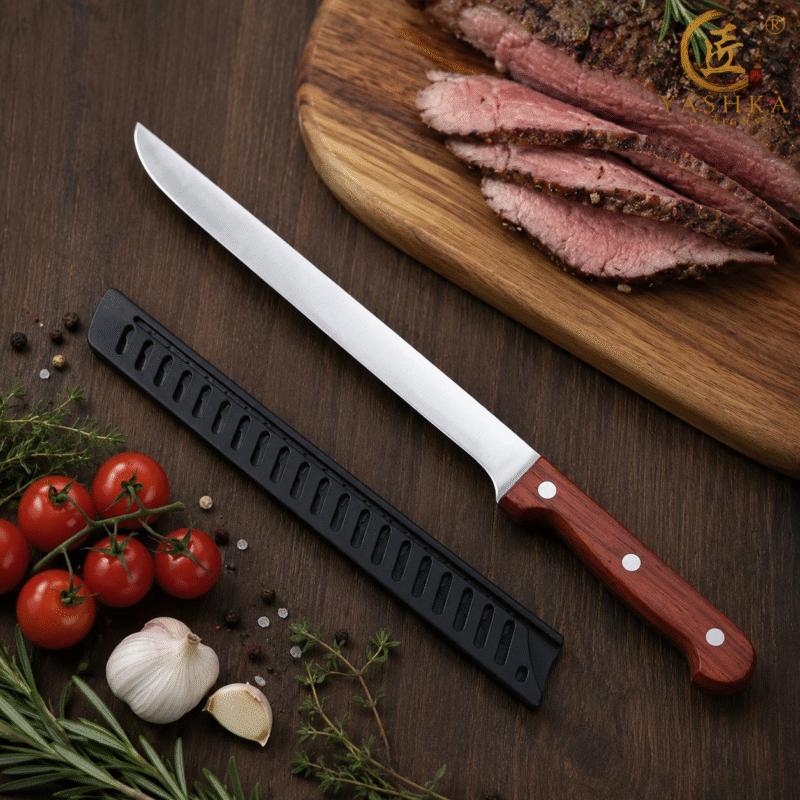
How to Fillet a Round Fish
Examples:
- Sea bass
- Snapper
- Salmon
- Trout
Step 1
Lay the fish on its side.
Step 2
Starting behind the head, cut down until you reach the backbone.
Step 3
Turn the blade so it lies almost flat against the bones.
Step 4
Use long, smooth strokes while following the rib cage.
Step 5
Continue toward the tail in a single controlled motion.
Step 6
Repeat on the opposite side.
A sharp knife should glide along the skeleton with very little resistance.
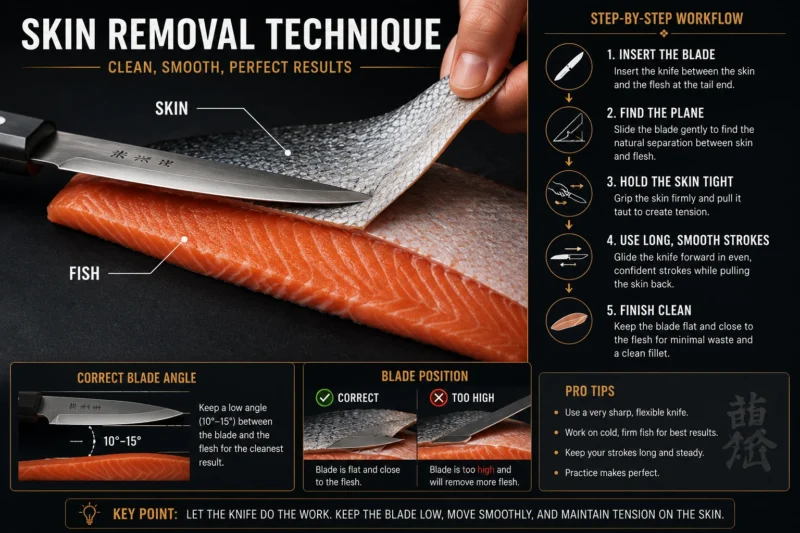
Removing the Skin
Whether to leave the skin on depends on the recipe.
For sashimi, many preparations use skinless fillets.
To remove the skin:
- Place the fillet skin-side down.
- Hold the tail end firmly.
- Insert the knife between the flesh and skin.
- Angle the blade slightly downward.
- Pull the skin while pushing the knife forward in a smooth, steady motion.
A flexible fillet knife or a sharp Gyuto works especially well for this technique.
From Fillet to Perfect Portions
Once a fish has been cleaned, filleted, and trimmed, the next step is transforming it into beautifully cut portions.
Professional chefs understand that slicing fish is not simply about making pieces smaller. Every cut affects:
- Texture
- Appearance
- Mouthfeel
- Flavor perception
- How the fish absorbs sauces and seasonings
A properly sliced piece of tuna or salmon reflects light evenly, feels smooth on the tongue, and highlights the fish’s natural structure.
The knife, the angle, and the direction of the cut all contribute to the final result.
Understanding Fish Muscle Grain
Like beef or chicken, fish has muscle fibers (grain).
The direction in which you slice those fibers changes how the fish feels when eaten.
Cutting Across the Grain
This is the preferred method for most sashimi.
Benefits:
- More tender texture
- Cleaner bite
- Easier chewing
- Better presentation
Cutting With the Grain
Usually avoided because it produces:
- Longer fibers
- Chewier texture
- Less attractive slices
Professional Japanese chefs almost always pay attention to grain direction before making the first cut.
https://yashkadesigns.com/curved-butcher-knife-high-carbon
The Importance of Knife Sharpness
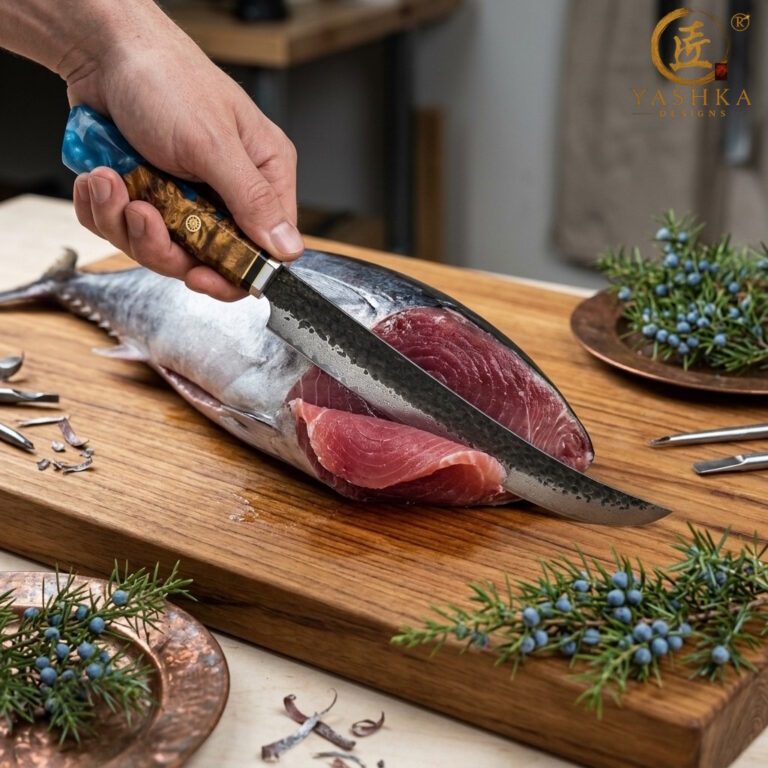
Raw fish should never be crushed.
A dull knife:
- Tears the flesh
- Damages cell walls
- Releases juices
- Produces uneven slices
An extremely sharp knife glides through the fish with very little pressure.
This preserves both appearance and texture.
Check Our Guide All Kinds of Knife Sharpening Tools
The Traditional Japanese Pull Cut
Perhaps the biggest difference between Japanese and Western slicing techniques is the cutting motion.
Instead of pushing downward repeatedly, Japanese chefs use a long pulling stroke.
Correct Technique
- Place the heel of the blade on the fish.
- Draw the knife toward yourself.
- Complete the cut in one smooth motion.
- Lift the knife.
Avoid sawing back and forth.
One continuous stroke produces the cleanest cut.
Why One Long Stroke Matters
A single slicing motion:
- Creates a smooth surface
- Preserves the natural structure of the fish
- Produces more attractive sashimi
- Reduces moisture loss
This is why long knives such as the Yanagiba are preferred.
Traditional Japanese Sashimi Cutting Styles
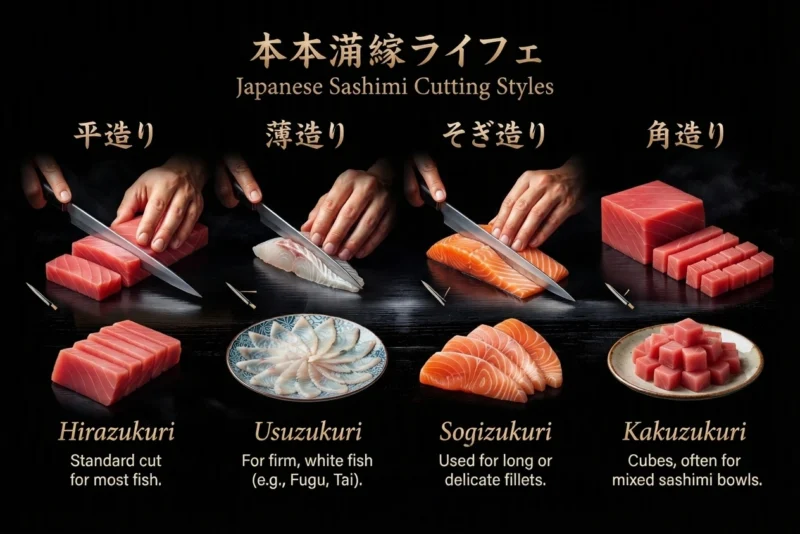
Japanese cuisine includes several classic slicing methods.
Each creates a different texture and presentation.
Hirazukuri (平造り)
Standard Sashimi Cut
Hirazukuri is the most common sashimi cutting technique.
Characteristics:
- Thick rectangular slices
- Uniform size
- Slight angle
Typical thickness:
8–12 mm
Best fish:
- Tuna
- Salmon
- Yellowtail
- Sea bream
Recommended knife:
🏆 Yanagiba
Why Hirazukuri Works
This cut highlights:
- Texture
- Color
- Fat distribution
It is often the first technique learned by sushi apprentices.
Usuzukuri (薄造り)
Ultra-Thin Sashimi
Usuzukuri means:
“Thin slicing.”
The slices are almost transparent.
Common thickness:
1–3 mm
Traditionally used for:
- Fugu
- White fish
- Delicate seafood
Recommended knife:
🏆 Fuguhiki
Challenges of Usuzukuri
Extremely thin slices require:
- Perfect knife control
- Extremely sharp edge
- Long blade
- Smooth pulling motion
Even a slight hesitation becomes visible.
Sogizukuri (そぎ造り)
Angled Slicing Technique
Instead of cutting straight down, the knife is held at an angle.
Advantages:
- Larger slice surface
- Attractive appearance
- Softer texture
- Better presentation
Excellent for:
- Sea bream
- Snapper
- Halibut
Kakuzukuri (角造り)
Thick Cubed Sashimi
Kakuzukuri creates larger cubes.
Often used for:
- Tuna
- Fatty fish
The thicker shape emphasizes richness.
Itozukuri (糸造り)
Thread-Like Slices
One of the most advanced techniques.
Slices are:
- Extremely thin
- Narrow
- Decorative
Usually served in high-end Japanese restaurants.
Best Knife for Every Cutting Technique
| Technique | Best Knife |
|---|---|
| Hirazukuri | Yanagiba |
| Usuzukuri | Fuguhiki |
| Sogizukuri | Yanagiba |
| Kakuzukuri | Yanagiba or Gyuto |
| Itozukuri | Fuguhiki |
Preparing Fish for Sushi
Sushi preparation differs from sashimi.
The fish must fit neatly on seasoned rice while maintaining a balanced thickness.
Step 1: Trim the Fillet
Remove:
- Belly membrane
- Bloodline
- Dark tissue
- Damaged edges
A clean fillet produces more consistent sushi pieces.
Step 2: Remove Pin Bones
Run your fingers along the center of the fillet.
Use fish tweezers to pull each bone in the direction it naturally points.
This prevents tearing the flesh.
Step 3: Dry the Surface
Pat the fish gently with paper towels.
Removing excess moisture helps produce cleaner cuts and better presentation.
Step 4: Slice for Nigiri
A typical nigiri slice:
- 5–7 cm long
- About 3–5 mm thick
- Slight diagonal angle
The fish should drape naturally over the rice without folding excessively.
Step 5: Slice for Sushi Rolls
Fish used inside maki rolls is usually cut into long, even strips.
Consistency is important so every roll contains the same amount of fish.
Recommended knives:
- Yanagiba
- Gyuto
- Sujihiki
Preparing Fish for Sashimi
Sashimi places all attention on the fish itself.
There is no rice to balance texture or flavor.
Every slice must therefore be nearly perfect.
Step 1: Chill the Fish
Cold fish is firmer and easier to slice.
Avoid freezing solid, but keep the fillet well chilled before cutting.
Step 2: Identify the Grain
Observe the direction of the muscle fibers.
Plan each slice before cutting.
Step 3: Position the Knife
The blade should begin near the heel.
A longer blade reduces the need for multiple cutting strokes.
Step 4: Make One Continuous Pull
Pull smoothly from heel to tip.
Do not stop halfway through the cut.
Step 5: Maintain Uniform Thickness
Consistent slices:
- Look more professional
- Eat more evenly
- Improve plating
Preparing Fish for Ceviche
Ceviche uses fresh fish that is marinated in citrus juice.
Unlike sashimi, ceviche depends on small, even pieces that allow the marinade to penetrate quickly.
Best Fish for Ceviche
Excellent choices include:
- Sea bass
- Snapper
- Halibut
- Mahi-mahi
- Grouper
- Tuna
- Salmon (when appropriately sourced and handled)
Firm white fish generally produces the most traditional results.
Check Our Guide Japanese Fish Knives
Cutting Fish for Ceviche
Instead of long slices, ceviche requires cubes.
Recommended size:
Approximately ½ inch (1–1.5 cm)
Uniform cubes ensure even marination.
Why Cube Size Matters
Large cubes:
- Marinate more slowly
- Remain softer inside
Small cubes:
- Marinate faster
- Can become overly firm if left too long
Keeping the pieces similar in size helps achieve consistent texture throughout the dish.
Best Knives for Ceviche
Unlike sashimi, ceviche does not require a traditional single-bevel knife.
Recommended options:
🏆 Sujihiki
Ideal for:
- Long clean cuts
- Portioning fillets
- Consistent cubes
🏆 Gyuto
Excellent for:
- Home kitchens
- General seafood preparation
- Multi-purpose use
How Citrus Changes Fish
Lime and lemon juice do not cook fish with heat.
Instead, the acid denatures proteins, causing the flesh to become firmer and more opaque.
This process gives ceviche its characteristic texture.
Marination times vary depending on the recipe, fish type, and desired texture, but over-marinating can make the fish tough.
Common Cutting Mistakes
Even experienced home cooks make avoidable mistakes.
Using a Dull Knife
Problem:
- Torn flesh
- Ragged slices
- Lost juices
Solution:
Sharpen your knife regularly using water stones.
Sawing Instead of Slicing
Problem:
- Uneven cuts
- Damaged texture
Solution:
Use one smooth pulling motion.
Cutting Warm Fish
Problem:
Soft flesh becomes difficult to control.
Solution:
Keep fish chilled before slicing.
Incorrect Knife Selection
Examples:
Using a Deba for sashimi.
Using a Yanagiba to cut through bones.
Each knife has a specific purpose.
Ignoring Muscle Grain
Cutting with the grain often produces a chewier texture.
Always evaluate the grain direction before slicing.
Uneven Portions
Inconsistent pieces:
- Plate poorly
- Marinate unevenly
- Affect presentation
Take your time and aim for consistent size.
Knife Guide by Task
| Task | Best Knife |
|---|---|
| Scaling | Fish scaler |
| Removing head | Deba |
| Filleting | Deba |
| Removing skin | Flexible fillet knife or Gyuto |
| Removing pin bones | Fish tweezers |
| Sashimi slicing | Yanagiba |
| Ultra-thin sashimi | Fuguhiki |
| Sushi slices | Yanagiba |
| Ceviche cubes | Sujihiki or Gyuto |
| General fish preparation | Gyuto |
Professional Tips
- Chill the fish before slicing for better control.
- Wipe the blade clean between cuts to keep slices pristine.
- Let the knife do the work—avoid pressing down.
- Keep your cutting board stable to improve accuracy.
- Practice long, fluid strokes instead of short sawing motions.
- Sharpen knives regularly; technique cannot compensate for a dull edge.
Classic Ceviche Recipes
Ceviche is one of the world’s most popular raw seafood dishes. Originating in Peru, it has inspired countless regional variations throughout Latin America and beyond.
Unlike sashimi, ceviche relies on citrus juice to denature proteins in the fish, creating a firmer texture and bright, refreshing flavor.
The key to great ceviche is using fresh, high-quality fish intended for raw preparations, cutting the fish into evenly sized pieces, and balancing acidity with herbs, vegetables, and seasoning.
Recipe 1: Classic Peruvian Ceviche
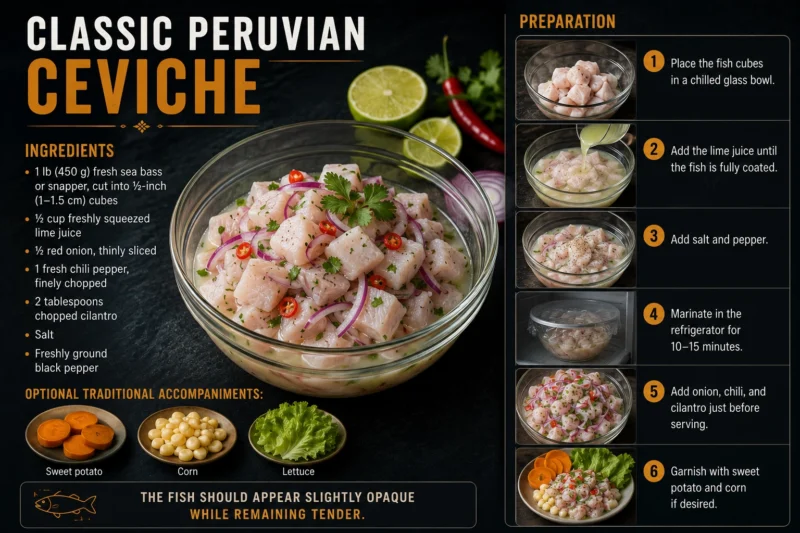
Ingredients
- 1 lb (450 g) fresh sea bass or snapper, cut into ½-inch (1–1.5 cm) cubes
- ½ cup freshly squeezed lime juice
- ½ red onion, thinly sliced
- 1 fresh chili pepper, finely chopped
- 2 tablespoons chopped cilantro
- Salt
- Freshly ground black pepper
Optional traditional accompaniments:
- Sweet potato
- Corn
- Lettuce
Preparation
- Place the fish cubes in a chilled glass bowl.
- Add the lime juice until the fish is fully coated.
- Add salt and pepper.
- Marinate in the refrigerator for 10–15 minutes.
- Add onion, chili, and cilantro just before serving.
- Garnish with sweet potato and corn if desired.
The fish should appear slightly opaque while remaining tender.
Recipe 2: Salmon Ceviche
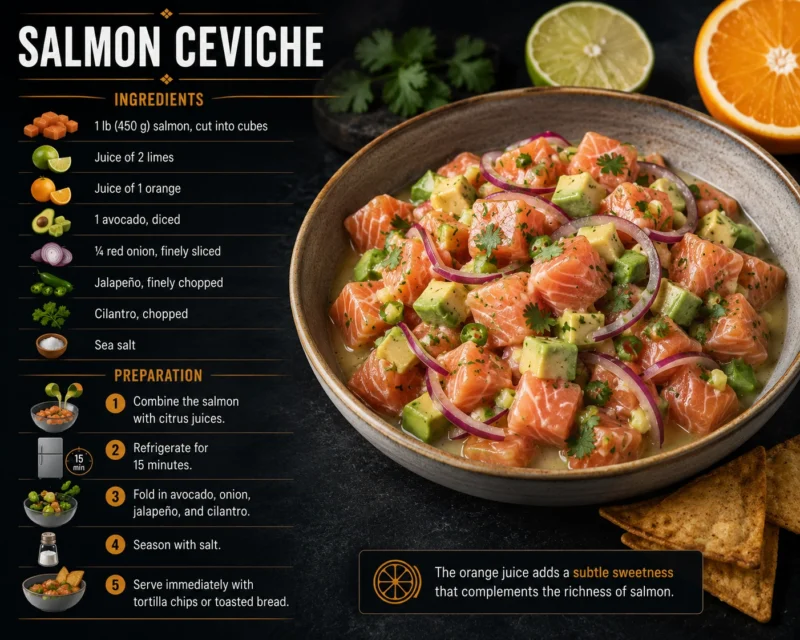
Ingredients
- 1 lb (450 g) salmon, cut into cubes
- Juice of 2 limes
- Juice of 1 orange
- 1 avocado, diced
- ¼ red onion
- Jalapeño, finely chopped
- Cilantro
- Sea salt
Preparation
- Combine the salmon with citrus juices.
- Refrigerate for 15 minutes.
- Fold in avocado, onion, jalapeño, and cilantro.
- Season with salt.
- Serve immediately with tortilla chips or toasted bread.
The orange juice adds a subtle sweetness that complements the richness of salmon.
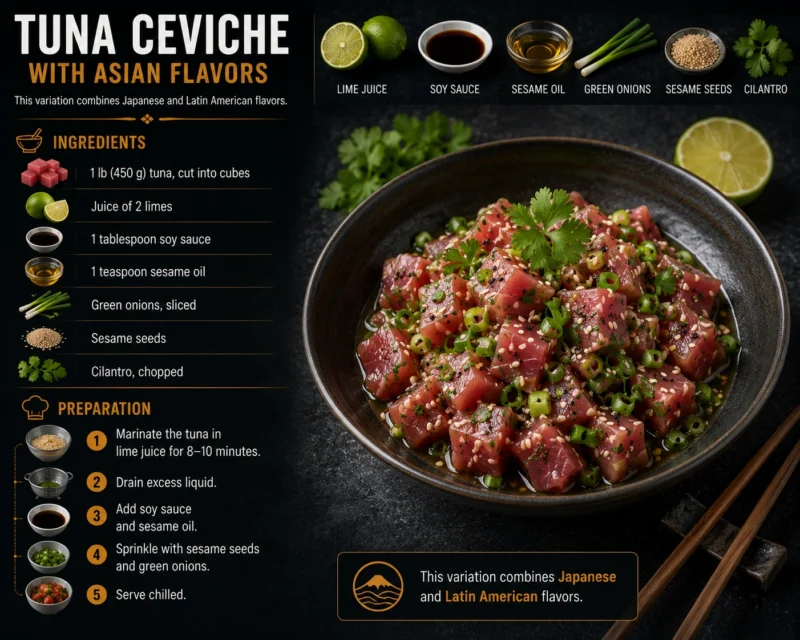
Recipe 3: Tuna Ceviche with Asian Flavors
Ingredients
- 1 lb (450 g) tuna
- Juice of 2 limes
- 1 tablespoon soy sauce
- 1 teaspoon sesame oil
- Green onions
- Sesame seeds
- Cilantro
Preparation
- Marinate the tuna in lime juice for 8–10 minutes.
- Drain excess liquid.
- Add soy sauce and sesame oil.
- Sprinkle with sesame seeds and green onions.
- Serve chilled.
This variation combines Japanese and Latin American flavors.
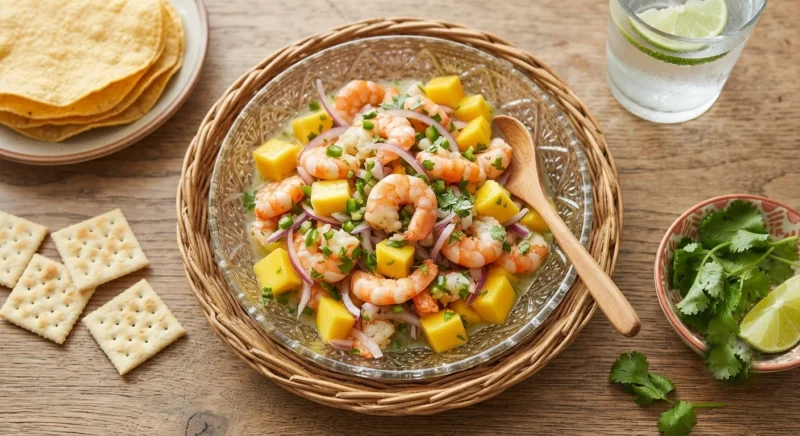
Recipe 4: Shrimp & Mango Ceviche
Ingredients
- 1 lb (450 g) cooked shrimp, chopped
- 1 ripe mango, diced
- Lime juice
- Red onion
- Cilantro
- Jalapeño
- Salt
Preparation
- Combine shrimp and mango.
- Add lime juice and onion.
- Mix in cilantro and jalapeño.
- Chill for 15–20 minutes.
- Serve with crackers or tostadas.
The sweetness of mango balances the acidity beautifully.
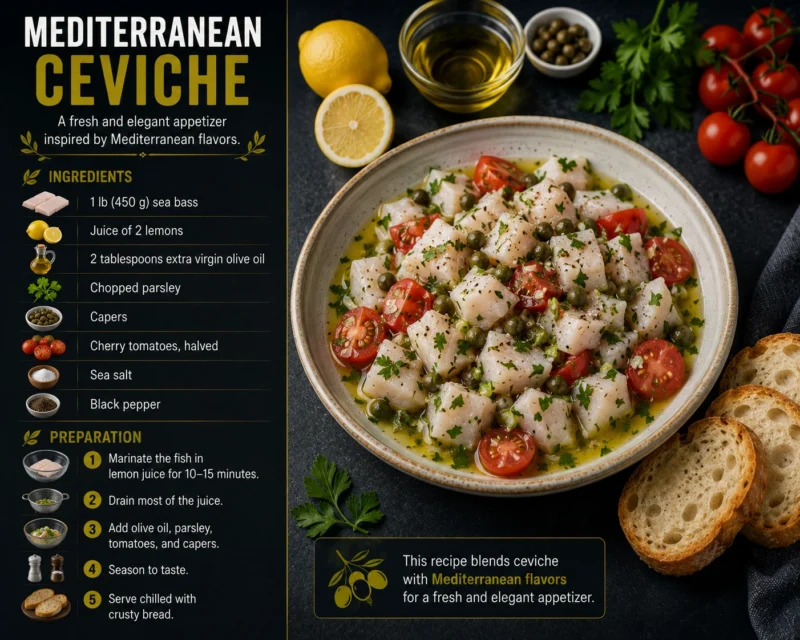
Recipe 5: Mediterranean Ceviche
Ingredients
- 1 lb (450 g) sea bass
- Juice of 2 lemons
- 2 tablespoons extra virgin olive oil
- Chopped parsley
- Capers
- Cherry tomatoes
- Sea salt
- Black pepper
Preparation
- Marinate the fish in lemon juice for 10–15 minutes.
- Drain most of the juice.
- Add olive oil, parsley, tomatoes, and capers.
- Season to taste.
- Serve chilled with crusty bread.
This recipe blends ceviche with Mediterranean flavors for a fresh and elegant appetizer.
Which Knife Is Best for Each Recipe?
| Recipe | Recommended Knife |
|---|---|
| Peruvian Ceviche | Sujihiki |
| Salmon Ceviche | Sujihiki or Gyuto |
| Tuna Ceviche | Yanagiba or Sujihiki |
| Shrimp Ceviche | Gyuto |
| Mediterranean Ceviche | Sujihiki |
Knife Maintenance After Preparing Fish
Raw fish contains proteins, oils, and salt that should never remain on your knife for long.
Proper cleaning helps maintain edge performance and prevents corrosion.
Wash Immediately
After preparing fish:
- Rinse the knife with warm water.
- Use a mild dish soap.
- Avoid abrasive scrubbers.
- Dry immediately with a soft towel.
Never leave knives soaking in water.
Dry Thoroughly
Moisture is the enemy of both carbon steel and wooden handles.
Even stainless steel knives benefit from being dried immediately after washing.
Oil Carbon Steel Knives
If your knife is made from White Steel, Blue Steel, or another carbon steel, apply a thin layer of food-safe mineral oil or camellia oil before storage, especially if it will not be used for several days.
This simple step helps prevent rust and preserves the blade’s finish.
Store Knives Properly
Proper storage protects both the edge and the user.
Recommended options:
- Wooden saya (blade sheath)
- Magnetic knife strip
- Knife block
- Protective blade guard
Avoid storing knives loose in a drawer where the edge can strike other utensils.
Sharpen Regularly
A sharp knife is safer and more efficient than a dull one.
For most home cooks:
- 1000-grit water stone for routine sharpening
- 3000–6000 grit for refining the edge
- 8000+ grit for polishing single-bevel sashimi knives
Regular maintenance reduces the amount of metal removed during sharpening and helps preserve the knife’s geometry.
Food Storage After Cutting Fish
If you’re not serving the fish immediately:
- Keep it refrigerated.
- Cover it tightly to prevent drying and odor transfer.
- Store it on the coldest shelf of the refrigerator.
- Avoid repeated temperature changes.
For raw seafood, follow local food safety recommendations regarding storage times and temperatures.
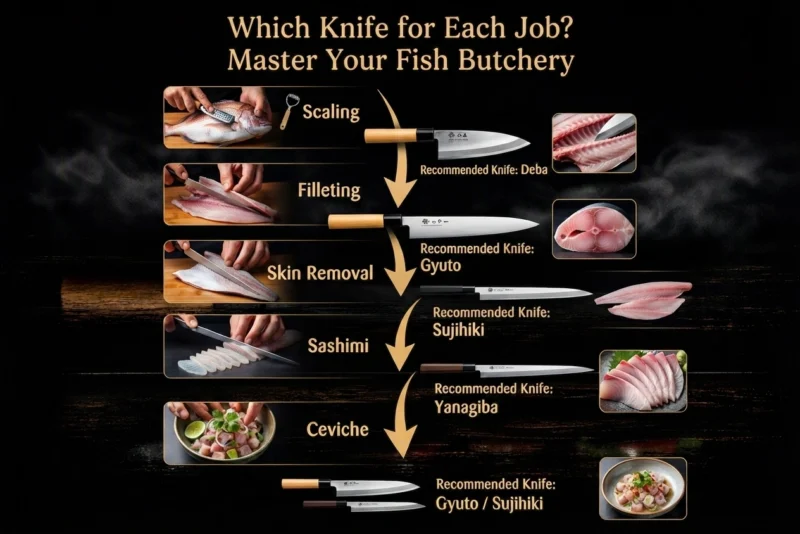
Choosing the Right Knife
The best knife depends on how you prepare fish.
For Sushi Enthusiasts
Best Choice: Yanagiba
Ideal for:
- Nigiri
- Sashimi
- Professional presentation
For Whole Fish
Best Choice: Deba
Perfect for:
- Removing heads
- Filleting
- Cutting through small bones
For Ceviche
Best Choice: Sujihiki
Excellent for:
- Cubing fish
- Portioning fillets
- General slicing
For Home Cooks
Best Choice: Gyuto
One versatile knife that handles:
- Fish
- Meat
- Vegetables
- Everyday meal preparation
For Professional Precision
Best Choice: Fuguhiki
Designed for:
- Ultra-thin sashimi
- Delicate presentation
- Experienced chefs
Frequently Asked Questions (FAQ)
What is the best fish for sashimi?
Popular choices include salmon, tuna, yellowtail, sea bream, and halibut when sourced appropriately for raw consumption.
What knife do sushi chefs use?
Traditional sushi chefs commonly use a Yanagiba for slicing sashimi, a Deba for breaking down whole fish, and an Usuba for precise vegetable work.
Can I use a chef’s knife instead of a Yanagiba?
Yes. A sharp Gyuto can produce excellent results for home cooking, although a Yanagiba offers superior performance for traditional sashimi slicing.
Is a Deba knife used for slicing sashimi?
No. A Deba is designed for butchering and filleting fish, while a Yanagiba is intended for slicing raw fish.
Should I remove the skin before making sashimi?
Many sashimi preparations use skinless fillets, but some traditional styles retain the skin after careful preparation. The choice depends on the fish species and the desired presentation.
How thick should sashimi slices be?
Standard sashimi slices are typically 6–10 mm thick, while ultra-thin styles such as Usuzukuri can be as thin as 1–3 mm.
Can salmon be used for ceviche?
Yes, provided it has been sourced and handled appropriately for raw consumption. Salmon’s rich texture pairs well with citrus, avocado, and fresh herbs.
How long should ceviche marinate?
The ideal time depends on the fish, cube size, and recipe, but many ceviche recipes use a relatively short marination to preserve a tender texture.
Why is my sashimi tearing?
The most common causes are:
- A dull knife
- Sawing instead of using a smooth pull cut
- Fish that is too warm
- Incorrect cutting angle
What is the easiest Japanese knife for beginners?
The Gyuto is generally the easiest Japanese knife for beginners because of its double-bevel edge and versatility.
Final Tips for Better Fish Preparation
Professional chefs often follow a few simple habits that make a noticeable difference:
- Keep fish cold until the moment you slice it.
- Wipe the blade clean between cuts.
- Use long, controlled strokes rather than short sawing motions.
- Remove pin bones carefully to avoid tearing the flesh.
- Match the knife to the task instead of forcing one knife to do everything.
- Practice consistency—uniform slices improve both presentation and texture.
Final Verdict
Preparing fish for sushi, sashimi, and ceviche begins with selecting quality seafood and using the right techniques.
For whole fish, start with a Deba to remove the head and fillet the fish. Once the fillets are trimmed, a Yanagiba delivers clean, elegant slices for sashimi and nigiri. If you prefer a more versatile option, a Sujihiki or Gyuto offers excellent performance for home kitchens while also handling ceviche and general fish preparation with ease.
Whether you’re making classic sashimi, handcrafted sushi, or refreshing ceviche, sharp knives, proper technique, and careful handling are the keys to outstanding results.