Aogami Super
An Independent Guide
Aogami Super steel is one of the most respected traditional Japanese knife steels ever produced. Known in Japan as 青紙スーパー and commonly called Blue Super or Blue Super Steel, it was developed as a high-performance evolution of the Aogami, or Blue Paper, family of carbon steels.
Among serious Japanese kitchen knife enthusiasts, Aogami Super occupies an interesting position. It is not a modern powder metallurgy steel such as SG2 or ZDP-189, and it is not stainless. Instead, it combines traditional Japanese carbon-steel characteristics—excellent sharpness, fine edge geometry, responsive sharpening and outstanding cutting feel—with alloying elements that significantly improve wear resistance and edge retention.
The result is a steel capable of very high hardness while retaining an exceptionally keen cutting edge. Proterial’s Yasugi Specialty Steel data lists a typical composition of approximately 1.40–1.50% carbon, 2.00–2.50% tungsten, 0.30–0.50% chromium and 0.30–0.50% vanadium, with very low phosphorus and sulfur limits. The manufacturer also lists applications including high-quality planes, cutting tools, kitchen knives and sickles.
This combination explains why the steel has become particularly popular in premium Japanese gyuto, santoku, bunka, kiritsuke, nakiri, deba and other high-performance kitchen knives.
But there is an important point that is often overlooked:
Steel alone does not determine how a knife performs.
Heat treatment, blade geometry, edge thickness, sharpening angle, grind, cladding, finishing and the individual maker can have an enormous influence on the finished knife. Two knives made from the same steel can feel completely different in the kitchen.
This complete guide explains the metallurgy behind Blue Super, its chemical composition, hardness, edge retention, toughness, sharpening characteristics, corrosion behavior, heat treatment, comparison with Aogami #1 and #2, comparison with Shirogami, VG10 and modern powder steels, and how to choose a knife made from this remarkable Japanese carbon steel.
What Is Aogami Super Steel?
Aogami Super is a high-carbon Japanese tool and knife steel produced as part of the Yasugi Specialty Steel family. The name Aogami means “Blue Paper,” while Super identifies the particular high-performance grade.
The name does not mean that the steel itself is blue. The traditional name comes from the colored paper historically used to identify different steel grades.
The Aogami family includes several grades, most commonly:
- Aogami #2, also called Blue #2
- Aogami #1, also called Blue #1
- Aogami Super, also called Blue Super
The progression is broadly from a relatively balanced carbon/alloy composition in Blue #2 toward higher carbon and alloy content in Blue #1 and then the more heavily alloyed Super grade.
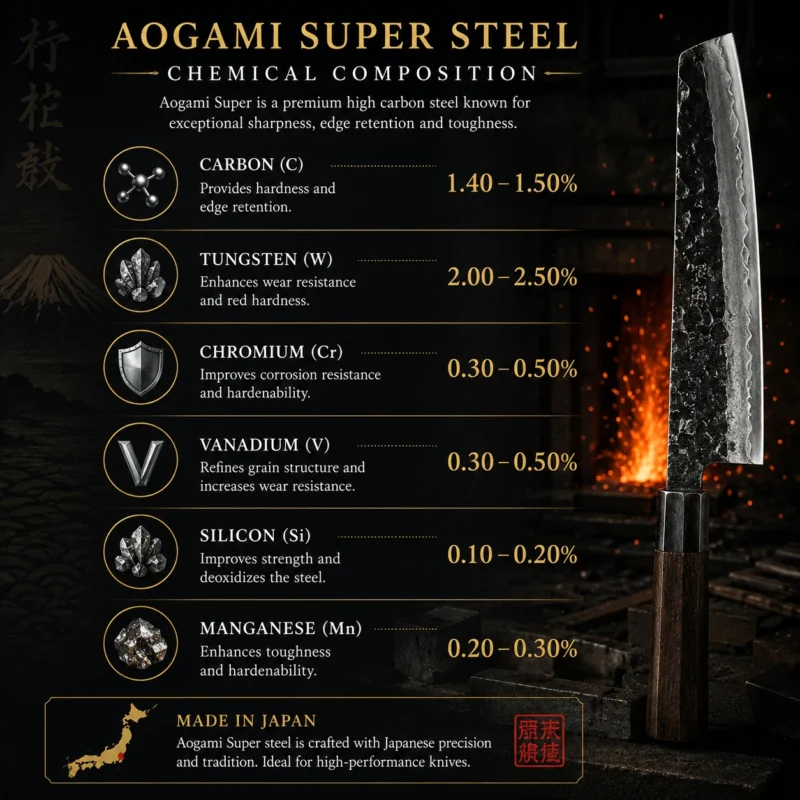
The defining characteristics of the Super grade are its high carbon content combined with substantial tungsten and smaller additions of vanadium and chromium. The official Yasugi Specialty Steel specification gives carbon at 1.40–1.50%, tungsten at 2.00–2.50%, chromium at 0.30–0.50%, and vanadium at 0.30–0.50%.
This chemistry gives the steel the potential for:
- Very high hardness
- Excellent edge retention
- High wear resistance
- Extremely fine cutting edges
- Strong cutting performance
- Good sharpening response compared with many modern high-wear steels
- Traditional carbon-steel patina
- Excellent performance in thin Japanese knife geometry
The trade-off is equally important. This is not a stainless steel. The relatively small chromium content is nowhere near the amount required to make a steel stainless. A knife made from it therefore requires more care than a stainless kitchen knife.
Aogami Super Chemical Composition
Understanding the chemical composition is the best way to understand why this steel behaves differently from simpler carbon steels.
According to Proterial’s published Yasugi Specialty Steel specification, the typical composition is:
| Element | Typical content | Main contribution |
|---|---|---|
| Carbon (C) | 1.40–1.50% | Hardness, carbide formation, edge retention |
| Tungsten (W) | 2.00–2.50% | Wear resistance and hard carbides |
| Chromium (Cr) | 0.30–0.50% | Hardenability and alloy contribution |
| Vanadium (V) | 0.30–0.50% | Carbides and grain refinement |
| Silicon (Si) | 0.10–0.20% | Strength and deoxidation |
| Manganese (Mn) | 0.20–0.30% | Hardenability and strength |
| Phosphorus (P) | ≤0.025% | Kept very low because of brittleness |
| Sulfur (S) | ≤0.004% | Kept extremely low for toughness |
These percentages may look small, but metallurgy is extremely sensitive to alloying additions. The interaction between carbon and carbide-forming elements is especially important.
Carbon
Carbon is the foundation of this steel.
At approximately 1.40–1.50%, the carbon content is very high compared with common stainless kitchen steels. For comparison, many conventional stainless knife steels contain around 0.5–1.1% carbon.
Carbon contributes to hardness and allows the formation of carbides. During heat treatment, the carbon participates in creating the hardened martensitic structure that gives the blade its strength.
More carbon can also increase wear resistance, but it does not automatically mean a better knife. Excessive hardness without appropriate toughness and heat treatment can make an edge more vulnerable to chipping.
That is why the maker’s heat treatment is critical.
Tungsten
Tungsten is one of the most distinctive elements in the Blue Paper family.
At approximately 2.00–2.50%, the tungsten content is substantial. Tungsten is a strong carbide-forming element and contributes to the wear resistance and edge stability for which the steel is famous.
Hard tungsten-containing carbides can resist abrasion during cutting. This helps explain why a well-made Blue Super knife can remain sharp for a surprisingly long time despite using traditional ingot metallurgy.
Tungsten is also one reason this steel should not be thought of simply as “high-carbon steel.” It is an alloyed carbon tool steel with a carefully engineered combination of elements.
Vanadium
Vanadium is another important component.
The published Yasugi specification gives approximately 0.30–0.50% vanadium.
Vanadium is a powerful carbide-forming element. Small amounts can also help refine grain structure during appropriate heat treatment.
Fine grain structure is particularly valuable in a knife because it contributes to the ability to create a keen, stable cutting edge.
This is one of the reasons the steel can combine high hardness and excellent cutting performance without behaving exactly like a simple high-carbon steel.
Chromium
The chromium content is approximately 0.30–0.50%.
This is important because many people see “chromium” in a steel specification and assume the steel is stainless.
It is not.
Stainless steel requires much more chromium—generally around 10.5–13% or more depending on the definition and alloy system, with enough chromium remaining in solution to provide corrosion resistance.
The small amount present here contributes to the alloy’s hardenability and metallurgical characteristics, but it does not provide stainless-steel corrosion resistance.
Therefore, a Blue Super kitchen knife should always be treated as a carbon-steel knife.
Manganese and Silicon
Manganese and silicon occur in relatively small quantities.
Manganese contributes to hardenability and strength, while silicon acts primarily as a deoxidizer and can contribute to strength.
These elements are not the reason enthusiasts buy the steel, but they are part of the carefully controlled overall composition.
Phosphorus and Sulfur
The very low phosphorus and sulfur limits are also significant.
The published specification lists phosphorus at no more than 0.025% and sulfur at no more than 0.004%.
Keeping unwanted impurities low is important when producing high-quality blade steel.
For a knife maker, the goal is not simply to have high carbon. The steel needs a controlled microstructure and predictable behavior during forging and heat treatment.
Why the Composition Matters
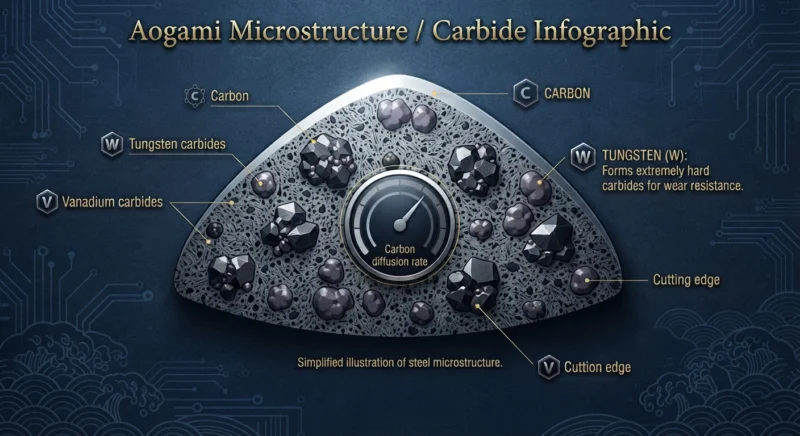
The performance of Aogami Super comes from the interaction between its alloying elements rather than from one ingredient.
High carbon creates the potential for high hardness.
Tungsten contributes hard carbides and wear resistance.
Vanadium contributes carbide formation and grain refinement.
Chromium and manganese influence hardenability and the overall alloy system.
The low impurity levels support the production of high-quality material.
The result is a steel that sits in a fascinating area between traditional carbon steel and more heavily alloyed modern knife steels.
It is still a conventional, traditional Japanese steel, but it has enough alloying content to provide significantly greater wear resistance than simple carbon steels.
Aogami Super Hardness
Hardness is one of the most frequently discussed characteristics of Japanese knife steels.
The official Yasugi data lists a hardening hardness of more than 60 HRC, while knife manufacturers commonly heat-treat finished kitchen knives in the low-to-mid 60s HRC.
Many finished knives are commonly encountered around 62–65 HRC, although exact hardness depends on the maker, heat-treatment process, blade thickness and intended application.
Some examples can be harder or softer.
This distinction matters.
There is no single hardness number that defines every knife made from this steel.
A knife at 62 HRC and another at 65 HRC may have noticeably different behavior. The harder knife may hold an extremely fine edge for longer but may also require more careful use.
The softer knife may sacrifice some edge retention in exchange for greater toughness and reduced chipping risk.
Therefore, when buying a Japanese knife, it is better to evaluate the complete package rather than simply searching for the highest HRC number.
Check Our Guide What Is HRC? Understanding Rockwell Hardness in Kitchen Knives
Does Higher HRC Mean a Better Knife?
Not necessarily.
Hardness is only one property.
A knife needs a balance of:
- Hardness
- Toughness
- Wear resistance
- Edge stability
- Geometry
- Sharpenability
- Corrosion resistance
- Heat-treatment quality
A very hard knife with a poor grind can perform worse than a moderately hard knife with excellent geometry.
Likewise, a knife with spectacular edge retention may be frustrating for someone who prefers easy sharpening.
For a professional chef, a 64 HRC blade with excellent edge retention may be ideal.
For someone who frequently cuts hard food, twists the knife or works quickly without much attention to technique, a slightly tougher knife may be preferable.
Aogami Super Edge Retention
Edge retention is arguably the biggest reason enthusiasts choose this steel.
The combination of high carbon, tungsten and vanadium creates a carbide-rich microstructure capable of resisting wear during cutting.
This does not mean the edge will remain razor-sharp forever.
Every knife eventually dulls.
Instead, it means that compared with many simpler carbon steels, the knife can maintain useful cutting performance for a long period before requiring sharpening.
The exact difference depends heavily on:
- Food being cut
- Cutting board material
- Cutting technique
- Edge angle
- Edge thickness
- Heat treatment
- Blade geometry
- Finishing quality
- User expectations
A thin Japanese knife used exclusively for vegetables may demonstrate outstanding edge longevity.
The same steel used in a thick knife exposed to hard ingredients may behave very differently.
This is why steel comparisons should always be considered alongside blade geometry.
Check Our Guide Edge Retention Explained: 10 Factors What Makes a Knife Stay Sharp Longer
Cutting Feel
One of the most appealing characteristics of this steel is its cutting feel.
Traditional Japanese carbon steels are famous for providing excellent feedback during sharpening and cutting.
A well-made knife can feel extremely direct when passing through food.
There is little of the “slippery” sensation that some users associate with highly corrosion-resistant stainless steels.
The blade can have a crisp, aggressive cutting sensation, particularly when sharpened properly.
This is especially noticeable in thin Japanese knives.
A thin gyuto made from a high-hardness carbon steel can feel almost effortless when cutting vegetables, fish and boneless proteins.
The steel is only part of the equation, however. A poorly designed knife will not magically become excellent because of its steel.
Aogami Super and Sharpening
One of the biggest misconceptions about high-wear steels is that they are impossible to sharpen.
That is not true.
This steel is certainly harder to sharpen than a simple low-alloy carbon steel, but it remains very manageable with good-quality whetstones.
In fact, many experienced sharpeners enjoy sharpening traditional Japanese steels because they provide excellent feedback.
A typical sharpening progression might be:
- 400–600 grit for significant damage or major edge repair
- 800–1,000 grit for establishing the primary edge
- 2,000–3,000 grit for refinement
- 4,000–6,000 grit for a polished working edge
- 8,000+ grit when an extremely refined edge is desired
The ideal progression depends on the knife and intended use.
For a professional kitchen knife, a highly polished edge is not necessarily the best option.
A slightly toothier edge can sometimes cut fibrous vegetables, meat and other foods more effectively.
Check Our Guide All Kinds of Knife Sharpening Tools
What Angle Should You Sharpen?
There is no universal angle.
A practical range for many Japanese kitchen knives is approximately 10–15 degrees per side, but the correct angle depends on blade geometry and intended use.
For a very thin, hard gyuto used for precision cutting, a narrow angle can produce spectacular cutting performance.
For a knife expected to withstand heavier use, a slightly wider angle may provide greater edge stability.
The most important rule is consistency.
Do not repeatedly change the angle from sharpening session to sharpening session.
A stable bevel creates a predictable edge.
Does Aogami Super Take a Fine Edge?
Yes.
This is one of its greatest advantages.
A properly heat-treated blade can take a very fine, highly refined cutting edge.
The combination of high hardness and refined microstructure allows makers to produce thin, precise edges.
This is particularly valuable for:
- Gyuto
- Santoku
- Nakiri
- Bunka
- Kiritsuke
- Petty knives
- Deba
- Yanagiba
- Sujihiki
However, edge fineness must always be matched to the intended use.
A razor-thin edge is excellent for precision cutting but should not be treated like a cleaver.
Is Aogami Super Stainless?
No.
This is probably the most important thing a new owner needs to understand.
Aogami Super is a carbon steel, not a stainless steel.
The chromium level is only around 0.30–0.50%, far below what is required for stainless behavior.
The blade can therefore:
- Develop patina
- Darken with use
- React with acidic foods
- Develop orange rust if neglected
- Stain when left wet
This is not a defect.
It is an inherent characteristic of the steel.
Many knife enthusiasts actually enjoy watching a carbon-steel blade develop a unique patina.
What Is Patina?
Patina is a layer of oxidation that forms naturally on a carbon-steel blade.
Unlike active orange rust, a stable patina can provide a degree of protection against further oxidation.
The color can vary from:
- Silver
- Gold
- Straw
- Blue
- Purple
- Gray
- Dark gray
- Almost black
The exact appearance depends on the food, environment, cleaning routine and steel.
Foods such as onions, apples, citrus and tomatoes can accelerate patina formation.
Many Japanese knife owners consider patina part of the character of a carbon-steel knife.
How to Prevent Rust
Taking care of a carbon-steel knife is simple.
The basic routine is:
- Use the knife.
- Rinse or wipe away food residue.
- Dry the blade thoroughly.
- Never leave the knife sitting wet.
- Apply a thin food-safe oil when storing it for longer periods.
The most important habit is simply keeping the blade dry.
You do not need an elaborate maintenance routine.
A kitchen knife should not be left submerged in water or inside a wet sink.
Avoid dishwashers completely.
Can You Cut Acidic Foods?
Yes, but you need to understand what will happen.
Acidic foods can react strongly with carbon steel.
Tomatoes, citrus, vinegar, onions and some fruits can cause rapid discoloration.
This is not necessarily dangerous or damaging if the blade is cleaned and dried afterward, but it can change the appearance of the steel.
If you want to preserve a bright polished finish, you will need to be more careful.
If you enjoy patina, acidic foods can actually be part of the process.
Aogami Super Toughness
Toughness is where discussions about premium knife steels become more complicated.
High hardness and high wear resistance generally involve trade-offs.
A steel capable of holding a very fine edge at 64–65 HRC should not be expected to behave like a softer, tougher steel.
A high-hardness kitchen knife can chip if abused.
Potential causes include:
- Twisting the blade in food
- Cutting bones
- Cutting frozen food
- Contact with glass or ceramic
- Dropping the knife
- Using excessive lateral force
- Cutting hard materials
- Striking the cutting board aggressively
This is especially important with thin Japanese knives.
The knife may be incredibly strong in normal cutting but vulnerable to sudden lateral or impact forces.
Check Our Guide Wear Resistance vs Toughness: Understanding the Most Important Knife Steel Trade-Off
Can Aogami Super Cut Bones?
The answer depends on the knife.
A thick deba specifically designed for fish processing is a different tool from a thin gyuto.
A knife should always be used according to its design.
A thick, properly constructed deba can handle tasks that would be inappropriate for a thin gyuto.
The fact that the steel is strong does not mean that every knife made from it is a heavy-duty knife.
Geometry comes first.
Aogami Super vs Aogami #1
Aogami #1 and Blue Super are closely related but are not identical.
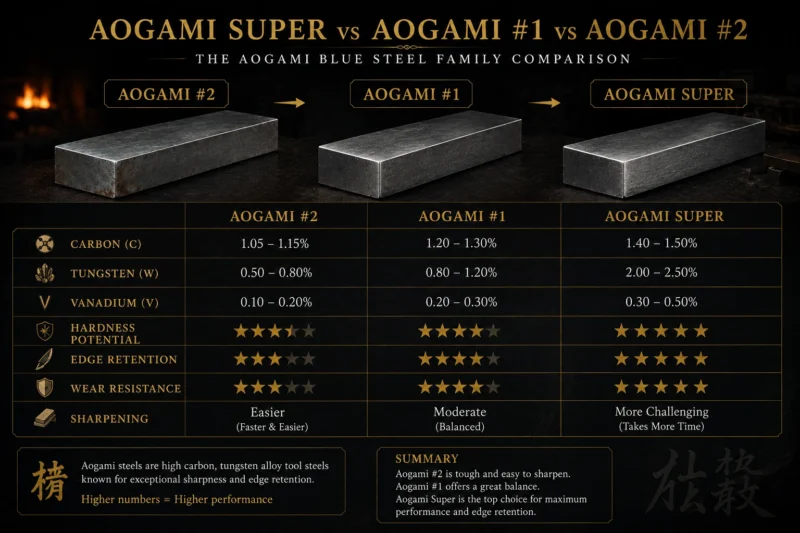
Aogami #1 typically has approximately 1.25–1.35% carbon and around 1.50–2.00% tungsten, while the Super grade increases carbon and tungsten and adds vanadium. Published references give slightly different ranges depending on how the steel is documented, so manufacturer specifications are preferable when exact chemistry matters.
In general, the Super grade offers:
- Higher alloy content
- More carbide-forming elements
- Greater wear resistance
- Excellent edge retention
- Very high hardness potential
Blue #1 can also produce outstanding knives.
The difference is not that Blue #1 is “bad” and Super is “good.”
Both are premium steels.
The Super grade simply takes the alloy design further.
Check Our Guide Aogami Blue Steel N1
Aogami Super vs Aogami #2
Aogami #2 contains less carbon and tungsten than the Super grade.
Published composition data commonly places Blue #2 around 1.05–1.15% carbon and 1.00–1.50% tungsten, although exact specifications should be checked against the manufacturer’s data.
Compared with Blue #2, the Super grade generally provides:
- Higher hardness potential
- Higher wear resistance
- Better edge retention
- More demanding sharpening
- Less tolerance for abuse at very high hardness
Blue #2 is often considered an excellent balance between performance and practicality.
Super is aimed more toward enthusiasts and professionals who prioritize edge retention and high-performance cutting.
Check Our Guide Aogami Steel N2
Aogami Super vs Shirogami
The comparison with Shirogami, or White Paper steel, is particularly interesting.
Shirogami is famous for its purity and ability to take an exceptionally refined edge.
Aogami adds alloying elements such as tungsten and chromium to increase wear resistance and edge retention.
This produces two different philosophies.
Shirogami
Typically offers:
- Extremely clean sharpening feedback
- Excellent sharpness
- Very refined edges
- Relatively easy sharpening
- Excellent cutting feel
- Lower wear resistance
Aogami Super
Typically offers:
- Excellent sharpness
- Higher wear resistance
- Longer edge retention
- High hardness
- Strong cutting performance
- More difficult sharpening
- More alloy carbides
If your priority is the ultimate sharpening experience and effortless refinement, you may prefer White Paper steel.
If your priority is longer edge life while retaining traditional carbon-steel characteristics, Blue Super becomes extremely attractive.
Aogami Super vs VG10
VG10 is one of the most common Japanese stainless knife steels.
The biggest difference is corrosion resistance.
VG10 is designed to resist rust and staining under normal kitchen conditions.
Blue Super is not.
VG10 is therefore much easier for casual users.
You can use a VG10 knife around wet ingredients without worrying nearly as much about immediate rust.
Blue Super requires more attention.
But experienced users may prefer the cutting and sharpening characteristics of the carbon steel.
Another major difference is edge behavior.
A high-quality Blue Super knife can be heat-treated to very high hardness and ground extremely thin.
This can create a distinctive combination of cutting aggression, edge stability and sharpening response.
VG10 remains an excellent practical choice, especially for people who want stainless convenience.
Check Our Guide VG10 Steel Review: Pros, Cons, Edge Retention, Toughness & Real-World Performance
Aogami Super vs SG2
SG2, also known as R2, is a powder metallurgy stainless steel widely used in Japanese kitchen knives.
It offers:
- High hardness
- Excellent edge retention
- Stainless corrosion resistance
- Fine carbide distribution
- Premium performance
Compared with SG2, Blue Super has one major disadvantage: corrosion resistance.
SG2 wins easily for convenience.
However, some traditional knife enthusiasts still prefer the character of Blue Super.
A well-made carbon-steel knife can provide a distinctive sharpening feel and cutting sensation that is difficult to replicate with highly corrosion-resistant steels.
This is why steel selection is not simply a matter of finding the “best” steel.
It is about finding the best steel for the user.
Check Our Guide SG2 Steel Review
Aogami Super vs M390
M390 is a modern powder metallurgy stainless steel designed for very high wear resistance and corrosion resistance.
It contains significantly more chromium and alloying elements than traditional Japanese carbon steels.
M390 is an excellent choice when:
- Corrosion resistance matters
- Very high wear resistance is desired
- Low maintenance is important
- The knife will be used in challenging environments
Blue Super is a different experience.
It is more traditional, more reactive and generally more dependent on careful maintenance.
A knife enthusiast who owns both may appreciate them for completely different reasons.
Check Our Guide M390 Steel Review: Pros, Cons, Edge Retention, Toughness & Real-World Performance
Is Aogami Super Better Than Powder Steel?
Not automatically.
Powder steels can offer extremely high wear resistance because of advanced manufacturing methods and carefully controlled carbide structures.
However, traditional ingot steels remain highly competitive in kitchen knives.
Knife performance is not a simple steel ranking.
A powder steel knife with poor geometry can perform worse than an excellent carbon-steel knife.
The maker matters.
Heat treatment matters.
Edge geometry matters.
Grinding matters.
For many kitchen applications, the difference between two well-made knives can be much smaller than online steel charts suggest.
Check Our Guide Powder Steels for Kitchen Knives
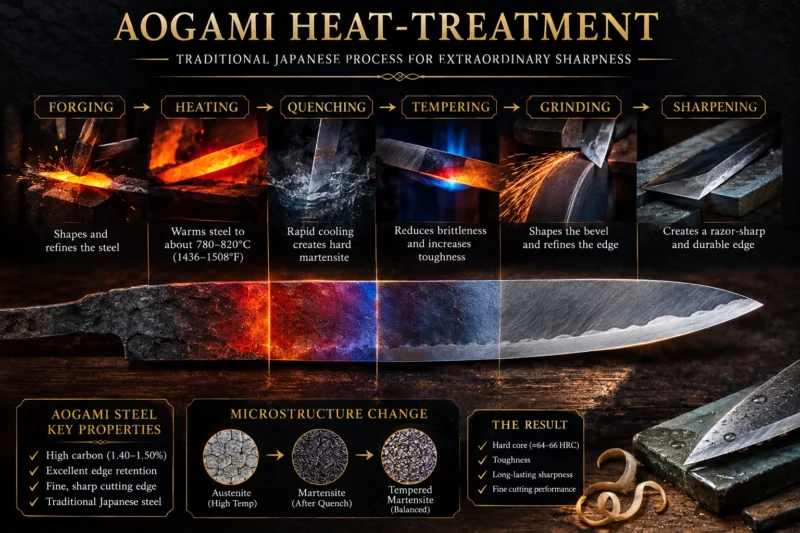
Heat Treatment
Heat treatment is arguably one of the most important aspects of a Japanese knife.
The official Yasugi specification provides standard heat-treatment information including a quenching range around 780–830°C and tempering around 160–230°C, while noting water or oil cooling depending on the process.
These figures should not be interpreted as a universal recipe for every handmade knife.
Professional knife makers develop their own processes.
Heat treatment determines the final microstructure.
It influences:
- Hardness
- Toughness
- Edge stability
- Carbide distribution
- Sharpening behavior
- Resistance to chipping
- Wear resistance
This is why two knives using exactly the same steel can perform differently.
Check Our Guide Steel Heat Treatment Explained
Why the Maker Matters
When buying a premium Japanese knife, the steel name is only one part of the equation.
A reputable maker may produce an outstanding knife from this steel because they understand:
- Forging
- Normalizing
- Heat treatment
- Quenching
- Tempering
- Grinding
- Edge geometry
- Final sharpening
A poorly heat-treated blade may fail to realize the potential of the steel.
Therefore, buying a knife simply because it says “Aogami Super” on the specification sheet is not enough.
The reputation of the maker is important.
Check Our Guide How to Choose a Custom Knife Maker
Forging and Traditional Japanese Knife Making
Many Japanese knives made from this steel are produced using traditional forging methods.
Forging can influence the structure and geometry of the blade, although it is important not to assume that “forged” automatically means better.
The final properties depend on the entire manufacturing process.
Traditional Japanese knife production often combines:
- High-quality steel
- Forging
- Differential construction
- Cladding
- Hand grinding
- Hand sharpening
This is part of the appeal.
A high-end Japanese knife is often as much a crafted tool as it is a steel product.
San Mai and Cladding
Because the steel is reactive, many Japanese makers use cladding.
A common construction is san-mai, in which a hard carbon-steel core is surrounded by softer layers.
The core provides the cutting edge.
The softer outer layers provide structural support and make the blade easier to manufacture and finish.
Cladding can also reduce the amount of exposed reactive steel.
However, if the cutting edge itself is Blue Super, it remains carbon steel and still requires care.
Some knives have stainless cladding over a carbon-steel core.
This can make maintenance easier, although the exposed edge remains reactive.
Check Our Guide What Is San Mai Steel?
Kurouchi Finish
Kurouchi, or blacksmith finish, is common on traditional Japanese knives.
The dark surface is created by leaving part of the forging scale or applying a dark finish.
Kurouchi knives are often paired with carbon-steel cores because the rustic appearance fits the traditional character of the blade.
A Blue Super kurouchi knife can therefore combine:
- High-performance carbon steel
- Traditional Japanese forging
- Rustic aesthetics
- Excellent cutting performance
- Relatively simple maintenance
What Knives Are Best Made From Aogami Super?
This steel can be used in many different knife styles.
Gyuto
The gyuto is probably the most versatile choice.
A thin Blue Super gyuto can provide:
- Excellent vegetable cutting
- Precise protein preparation
- Long edge life
- Strong sharpening performance
- Excellent push-cutting ability
For a serious home cook or professional chef, it is one of the best ways to experience the steel.
Check Our Guide Kiritsuke vs Gyuto: Which Japanese Knife Is Better for Everyday Cooking
Santoku
A santoku provides a shorter, wider blade.
The combination of high hardness and thin geometry can make a Super-grade santoku exceptionally efficient for vegetables and general kitchen work.
Nakiri
Nakiri knives are particularly interesting because their geometry often emphasizes vegetable preparation.
The flat edge and thin blade can take advantage of the high hardness and excellent edge stability.
Check Our Guide Santoku vs Nakiri: Which Japanese Kitchen Knife Is Better
Bunka
A bunka combines a relatively compact blade with a pointed tip.
It is useful for precise vegetable work and general kitchen preparation.
Kiritsuke
A kiritsuke can provide an extremely long, precise cutting edge.
Because the tip can be delicate, users should be particularly careful with lateral stress.
Petty
A small petty knife can benefit from excellent edge retention.
The small blade is particularly useful for detailed cutting and preparation.
Deba
A traditional deba is much thicker and stronger than a gyuto.
When made correctly, it can handle fish-processing tasks that would be inappropriate for a thin chef’s knife.
Yanagiba
Single-bevel Japanese slicing knives can take extraordinary edges.
A hard carbon steel can be particularly well suited to precise slicing of fish.
Check Our Complete Guide to the Best Knives for Sushi, Sashimi, Ceviche & Fish Preparation
Aogami Super for Professional Chefs
Professional kitchens place unusual demands on knives.
A chef may perform hundreds or thousands of cuts during a shift.
Edge retention therefore matters.
A knife that remains sharp for a longer period can reduce interruptions for sharpening.
At the same time, professional kitchens can be wet, busy and acidic.
That creates a conflict.
The performance characteristics of Blue Super can be outstanding for professionals who are willing to maintain the blade.
But a professional who needs a knife that can be left wet for extended periods may prefer stainless steel.
Therefore, the best professional knife depends on the kitchen environment and the chef’s habits.
Aogami Super for Home Cooks
For a home cook, the decision is even more personal.
If you enjoy Japanese knives, sharpening and traditional steel, this can be an exceptional choice.
If you simply want a knife that can be thrown into the sink and forgotten, it is probably the wrong choice.
A home cook who appreciates:
- Sharp edges
- Traditional Japanese craftsmanship
- Long edge retention
- Carbon-steel patina
- Hand sharpening
- Premium knife geometry
may find the steel extremely rewarding.
How Long Does the Edge Stay Sharp?
There is no universal number of hours or meals.
Edge retention depends on the entire knife and how it is used.
A thin knife used on a soft wooden cutting board can stay sharp much longer than a similar knife used on a hard synthetic board.
Cutting meat, vegetables, fish and acidic foods creates different wear patterns.
The sharpening angle also matters.
A very acute edge can provide exceptional cutting performance but may lose its very finest apex sooner.
A slightly more robust edge may retain practical sharpness for longer.
The correct question is therefore not:
“How many days will it stay sharp?”
The better question is:
“How does it maintain useful cutting performance under my specific conditions?”
Common Mistakes With Aogami Super Knives
Even a premium knife can be damaged by improper use.
Leaving It Wet
This is the easiest mistake to avoid.
Dry the blade after use.
Cutting on Glass
Never use a glass cutting board with a high-performance Japanese knife.
Cutting Frozen Food
Do not use a thin kitchen knife to chop frozen food.
Twisting the Blade
Avoid twisting the blade while cutting.
This can damage or chip a thin hardened edge.
Cutting Bones With a Gyuto
A chef’s knife is not a bone cleaver.
Use an appropriate knife for heavy tasks.
Dishwasher Use
The dishwasher combines heat, chemicals and prolonged moisture.
It is extremely unsuitable for a carbon-steel Japanese knife.
Can Aogami Super Rust Easily?
Compared with stainless steel, yes.
Compared with simple reactive carbon steels, the behavior can be somewhat less aggressive because of its alloying additions, but it should still be treated as non-stainless.
The most dangerous situation is prolonged exposure to moisture.
Rust can develop surprisingly quickly if acidic food residue remains on the blade.
Fortunately, prevention is simple.
Wipe the blade during use and dry it afterward.
How to Remove Rust
Light surface rust can often be removed with appropriate rust-removal methods.
For a valuable handmade Japanese knife, aggressive abrasive treatment should be avoided because it can damage the finish or alter the blade surface.
For minor oxidation, specialized rust erasers or appropriate polishing methods can be useful.
If the knife has significant corrosion, professional restoration may be preferable.
Do not aggressively sand a valuable Japanese blade without understanding how the finish will be affected.
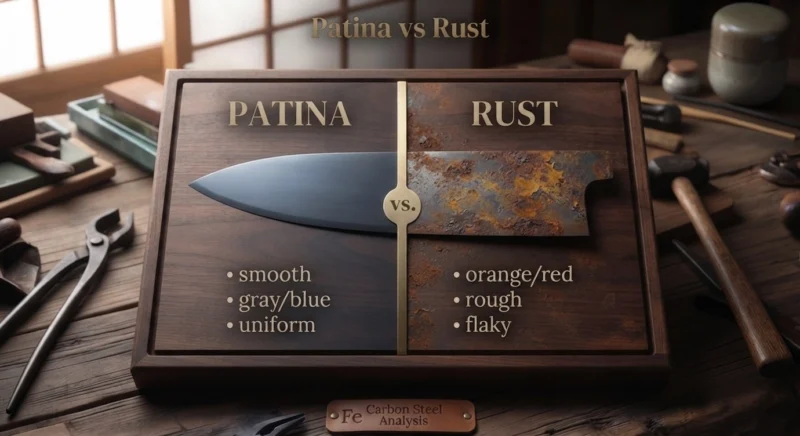
Carbon Steel Patina vs Rust
These should not be confused.
Patina
- Usually dark gray, blue, purple or brown
- Relatively stable
- Often desirable
- Develops naturally
- Can reduce further reactive exposure
Rust
- Orange or reddish
- Powdery or flaky
- Actively damages the steel
- Should be removed
A good owner learns to recognize the difference.
Is Aogami Super Easy to Sharpen?
It is relatively easy compared with many extremely wear-resistant modern steels, but it is not as effortless as simpler carbon steels.
The high carbide content means the sharpening stone must remove more wear-resistant material.
However, compared with some highly wear-resistant powder steels, many sharpeners find it pleasant and responsive.
The choice of stone matters.
High-quality water stones are particularly well suited to Japanese knife steels.
Diamond plates can also be useful for repair work, although they may remove material very aggressively.
What Stones Work Best?
A practical sharpening setup might include:
1000 grit: Main sharpening and edge restoration.
3000 grit: Refinement and smoothing.
6000 grit: Polishing and fine finishing.
8000+ grit: Optional high-polish finishing.
There is no requirement to use extremely high grit.
For many kitchen knives, a 1000–3000 grit working edge is excellent.
If you want maximum slicing refinement, continue to a higher finishing stone.
Does Aogami Super Need Special Maintenance?
Not really.
It needs regular maintenance, not complicated maintenance.
The basic routine is:
Clean → Dry → Store safely.
For long-term storage, apply a thin coat of food-safe mineral oil.
Do not use random industrial oils on a blade intended for food preparation.
If the knife is used every day, oil may not be necessary between every use. Drying is the critical step.
Advantages of Aogami Super
The main advantages are:
Excellent Edge Retention
The high carbon and alloy content provide strong wear resistance.
High Hardness
The steel can be heat-treated to high hardness, allowing thin, stable edges.
Excellent Cutting Performance
A well-ground blade can feel exceptionally sharp and precise.
Traditional Japanese Character
It retains the qualities that make carbon-steel Japanese knives so appealing.
Good Sharpening Response
Compared with many highly wear-resistant modern steels, it remains enjoyable to sharpen.
Beautiful Patina
The reactive surface develops character with use.
Excellent for Thin Geometry
High hardness allows makers to produce very thin edges without excessive deformation.
Disadvantages of Aogami Super
The disadvantages are equally important.
Not Stainless
The blade can rust and stain.
Requires Maintenance
The knife must be kept clean and dry.
Can Chip
High hardness and thin geometry require proper technique.
More Difficult to Sharpen Than Simple Carbon Steel
The alloy carbides increase wear resistance.
More Expensive
Premium steel combined with skilled Japanese craftsmanship can increase the price.
Not Ideal for Abuse
This is a precision cutting tool rather than a general-purpose survival tool.
Who Should Buy an Aogami Super Knife?
This steel is ideal for someone who:
- Loves Japanese knives
- Values edge retention
- Enjoys sharpening
- Understands carbon-steel maintenance
- Wants a very sharp knife
- Appreciates traditional craftsmanship
- Uses proper cutting technique
- Wants a premium knife for serious kitchen work
It is less suitable for someone who:
- Wants zero maintenance
- Frequently leaves knives wet
- Uses a dishwasher
- Cuts frozen food
- Uses knives on glass boards
- Wants a knife that can tolerate abuse
How to Choose a Knife
Do not choose a knife based solely on the steel name.
Look for:
1. Reputable Maker
The maker’s heat treatment can be more important than small differences in chemical composition.
2. Appropriate Geometry
A good grind can transform the performance of the steel.
3. Suitable Hardness
Extremely high hardness is not always desirable.
4. Good Handle Construction
A knife should be comfortable and secure.
5. Appropriate Blade Thickness
Thin blades excel at precision cutting, while thicker blades tolerate more demanding tasks.
6. Good Edge Finish
The final sharpening has a major impact on cutting performance.
7. Cladding
Decide whether you prefer stainless cladding, carbon cladding, kurouchi or a fully exposed finish.
Aogami Super and Japanese Knife Craftsmanship
The steel is closely associated with the traditional Japanese philosophy of making specialized tools for specific tasks.
Instead of designing one knife to do everything, Japanese knife culture often emphasizes specialization.
A gyuto is different from a deba.
A yanagiba is different from a nakiri.
A petty is different from a kiritsuke.
The same steel can therefore behave very differently depending on the knife design.
This is important when shopping for a Japanese blade.
You should first determine what you want to cut and how you cut it.
Then select the knife.
Then consider the steel.
Why Enthusiasts Love Aogami Super
There is a certain appeal to using a knife made from a traditional Japanese carbon steel.
The blade changes over time.
The patina becomes unique.
The edge can be maintained on whetstones.
The knife can be sharpened repeatedly.
And when the geometry is excellent, cutting performance can be extraordinary.
This creates a relationship between the user and the tool that is different from using an inexpensive stainless kitchen knife.
The attraction is not only technical.
It is also tactile and cultural.
Is Aogami Super the Best Japanese Knife Steel?
There is no universal best steel.
If you want maximum corrosion resistance, stainless or powder stainless steels may be better.
If you want maximum toughness, another steel may be preferable.
If you want the easiest sharpening experience, a simpler carbon steel may be more suitable.
If you want traditional carbon-steel characteristics combined with exceptional edge retention and high hardness, however, Aogami Super is one of the most compelling options available.
That is why it continues to be popular despite the availability of newer steels.
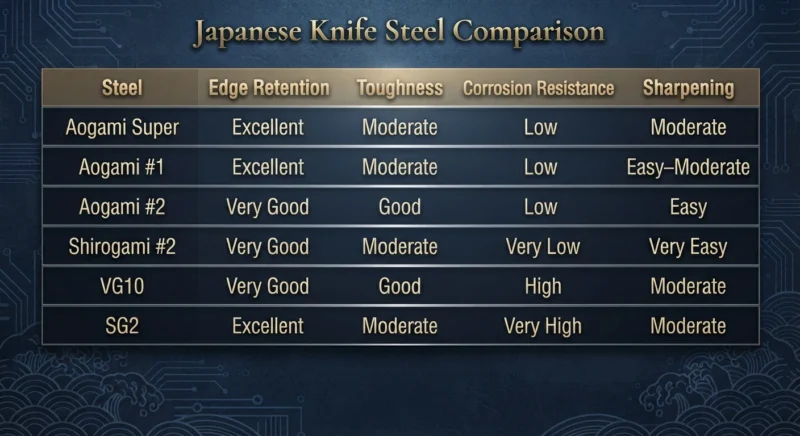
Aogami Super vs Modern Knife Steels
Modern steel development has produced impressive materials.
Steels such as:
can offer combinations of corrosion resistance, toughness and wear resistance that were difficult to achieve in traditional steels.
Yet traditional steels have not disappeared.
Why?
Because knife performance is not determined only by laboratory properties.
A chef may prefer the sharpening feedback of a traditional carbon steel.
Another user may prefer the effortless maintenance of stainless.
Another may prioritize maximum toughness.
Another may want the visual character of patina.
The “best” steel is therefore highly dependent on the user.
Aogami Super for Slicing
One of the strongest applications is precision slicing.
The steel’s hardness allows a knife to maintain a fine apex.
This is valuable when cutting:
- Fish
- Meat
- Vegetables
- Fruit
- Herbs
A thin edge can glide through food rather than forcing the user to push the blade through.
This is one reason premium Japanese knives can feel dramatically different from inexpensive kitchen knives even when both are technically sharp.
Edge Geometry Matters More Than Many People Think
Imagine two knives.
Both use the same steel.
One has a 0.5 mm edge behind the bevel.
The other has a 0.2 mm edge.
Even if both are sharpened at exactly the same angle, they will behave differently.
The thinner knife will generally cut more easily.
The thicker knife may tolerate more abuse.
Therefore, steel comparisons without geometry are incomplete.
A high-performance knife is the combination of:
Steel + heat treatment + geometry + sharpening + technique.
How to Maintain Maximum Edge Life
To get the most from a Blue Super knife:
Use a suitable cutting board
Wood or appropriate soft synthetic boards are generally preferable.
Avoid lateral force
Let the edge cut rather than forcing it sideways.
Keep the knife sharp
A dull knife often requires more force, increasing the risk of damage.
Use the correct knife
Do not ask a gyuto to perform cleaver work.
Maintain the blade
Clean and dry it after use.
Sharpen before it becomes extremely dull
Frequent light maintenance is generally easier than repeated heavy repairs.
Frequently Asked Questions
Is Aogami Super good for kitchen knives?
Yes. It is particularly well suited to premium Japanese kitchen knives because it combines high hardness, excellent edge retention, high wear resistance and the ability to take a very fine cutting edge.
Is Aogami Super stainless?
No. Its chromium content is far too low to make it stainless. It should be treated as a reactive carbon steel.
Does Aogami Super rust?
Yes. If left wet or exposed to acidic residue for extended periods, it can rust.
Does it develop patina?
Yes. Patina is a normal and often desirable characteristic of the steel.
Is Aogami Super better than VG10?
Neither is universally better. Blue Super offers a traditional carbon-steel experience and excellent edge retention, while VG10 provides substantially better corrosion resistance and easier maintenance.
Is Aogami Super better than SG2?
Not universally. SG2 offers stainless corrosion resistance and excellent wear resistance. Blue Super offers a different traditional carbon-steel experience.
Is it difficult to sharpen?
It is harder to sharpen than simpler carbon steels, but good water stones make sharpening quite manageable.
Can it get extremely sharp?
Yes. A properly heat-treated blade can take an exceptionally fine edge.
Can it chip?
Yes, especially when hardened aggressively and ground very thin. Proper technique is important.
Is 65 HRC too hard?
Not necessarily. Many Japanese knives operate successfully at high hardness. However, higher hardness generally requires more careful handling.
Does every Blue Super knife have the same performance?
No. Heat treatment, geometry, grinding and sharpening can create significant differences between knives.
Final Verdict
Aogami Super represents one of the most successful combinations of traditional Japanese steelmaking and high-performance knife metallurgy.
Its chemistry is carefully balanced: approximately 1.40–1.50% carbon provides a high-hardness foundation; 2.00–2.50% tungsten contributes substantial wear resistance; vanadium supports carbide formation and grain refinement; chromium and other alloying elements contribute to hardenability and overall performance. The official Yasugi Specialty Steel specification confirms these ranges and identifies kitchen knives among its intended applications.
The result is a steel that can support extremely sharp, thin and durable cutting edges.
But its greatest strength is not simply hardness.
It is the combination of properties.
You get much greater edge retention than many simple carbon steels while retaining the sharpening feel and cutting character associated with traditional Japanese blades.
The price for that performance is maintenance.
This is not a knife you should leave wet in a sink.
It is not a knife you should put in a dishwasher.
It is not a knife you should use to chop frozen food or bones unless the particular knife was specifically designed for that task.
Instead, it rewards careful technique.
Keep it dry.
Use an appropriate cutting board.
Avoid lateral force.
Sharpen it correctly.
And respect the geometry of the blade.
For cooks and knife enthusiasts who appreciate those requirements, the reward can be exceptional.
A beautifully made Japanese knife using Aogami Super can combine traditional craftsmanship, high hardness, outstanding edge retention and extraordinary cutting performance in a way that remains difficult to replace with newer steels.
That is ultimately why this steel continues to have such a strong reputation among serious Japanese knife users.
It may not be the easiest steel.
It may not be the most corrosion-resistant steel.
It may not be the toughest steel.
It may not be the newest steel.
But when the goal is a traditional Japanese carbon-steel knife capable of taking and maintaining an exceptionally keen edge, Aogami Super remains one of the most interesting choices in the world of kitchen cutlery.
Aogami Super Steel: Quick Reference
| Property | Aogami Super |
| Japanese name | 青紙スーパー |
| Common name | Blue Super / Blue Super Steel |
| Steel type | High-carbon alloy tool/knife steel |
| Carbon | 1.40–1.50% |
| Tungsten | 2.00–2.50% |
| Chromium | 0.30–0.50% |
| Vanadium | 0.30–0.50% |
| Silicon | 0.10–0.20% |
| Manganese | 0.20–0.30% |
| Stainless? | No |
| Typical knife hardness | Approximately low-to-mid 60s HRC, depending on maker |
| Edge retention | Excellent |
| Wear resistance | Excellent for traditional ingot steel |
| Toughness | Moderate; depends strongly on heat treatment and geometry |
| Sharpening | Moderate difficulty |
| Corrosion resistance | Low |
| Patina | Yes |
| Best suited for | Premium Japanese kitchen knives |
| Maintenance | Keep clean and dry; oil for storage |
The published manufacturer data gives the official chemical-composition ranges and identifies kitchen knives among the applications for this steel.
This article is for independent informational purposes only and is not affiliated with, sponsored by, or endorsed by any steel manufacturer. All product names, trademarks, and registered trademarks are the property of their respective owners.
https://www.proterial.com/e/yss/search/aogami_super.html?utm_source=chatgpt.com
Aogami Super