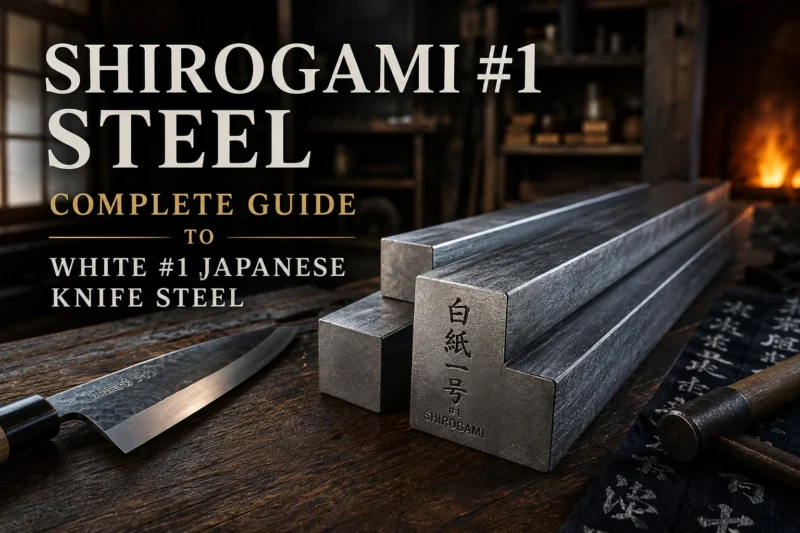
Shirogami #1
An Independent Guide
Shirogami #1 is one of the most respected traditional carbon steels used in Japanese kitchen knives. Known for its exceptionally clean composition, high potential hardness, excellent edge quality, and remarkable sharpening response, it has become a favorite among professional chefs, sharpening enthusiasts, and collectors of traditional Japanese knives.
Unlike modern stainless and powder metallurgy steels, this steel is intentionally simple. It does not try to combine maximum corrosion resistance, extreme wear resistance, and high toughness into one material. Instead, its design focuses on producing a very refined cutting edge that can be sharpened easily and feel exceptionally smooth when cutting.
For knife enthusiasts who value cutting performance and sharpening characteristics over low maintenance, Shirogami #1 offers a particularly interesting combination of properties.
This guide explains the composition, hardness, edge retention, toughness, sharpening behavior, corrosion resistance, maintenance requirements, heat treatment, and practical applications of this traditional Japanese carbon steel.
What Is Shirogami #1?
Shirogami #1 is a traditional Japanese carbon steel commonly known in English as White #1 steel. The name “Shirogami” literally refers to “white paper,” a reference to the white paper used by Hitachi to identify the steel.
It belongs to the family of traditional Japanese carbon steels commonly called White Steel. Within this family, White #1 has a higher carbon content than White #2.
The steel is intentionally formulated with relatively few alloying elements. Its performance comes primarily from its carbon content, iron matrix, and the quality of the heat treatment rather than from large quantities of chromium, molybdenum, vanadium, or other alloying elements.
This simplicity is one of its most important characteristics.
A knife made from a well-treated White #1 steel can develop an extremely fine edge and can be sharpened to a very high level of refinement. At the same time, the lack of significant chromium means the blade is not stainless and requires considerably more care than a stainless kitchen knife.
For this reason, this steel is often selected for traditional Japanese knives where edge quality, sharpening performance, and cutting feel are more important than corrosion resistance.
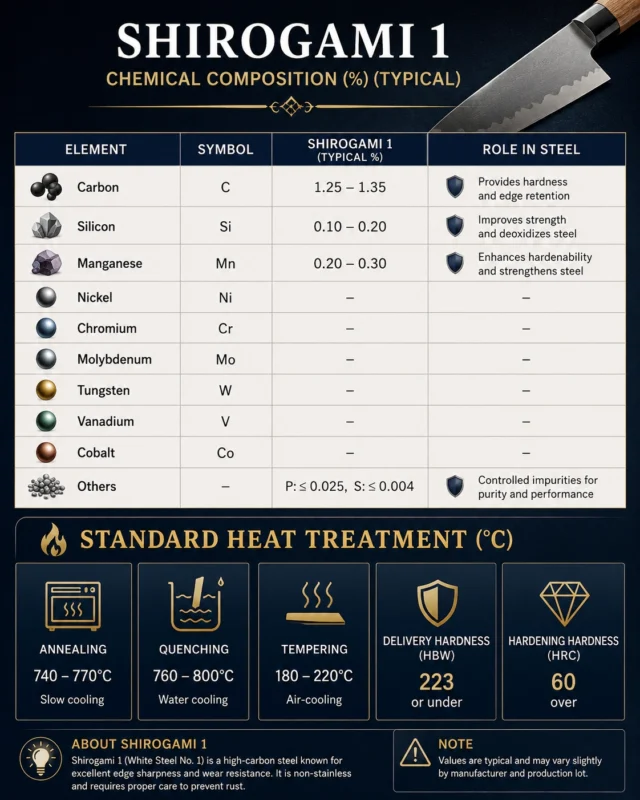
Shirogami #1 Steel Composition
The exact composition can vary slightly depending on the production specification and source, but traditional White #1 steel is primarily a high-carbon steel with very low levels of alloying elements.
A typical composition is approximately:
| Element | Typical Amount |
|---|---|
| Carbon | Around 1.3–1.4% |
| Silicon | Very low |
| Manganese | Very low |
| Chromium | Very low |
| Tungsten | Very low |
| Vanadium | Very low |
| Iron | Balance |
The most important element is carbon.
The relatively high carbon content allows the steel to reach a high hardness after appropriate heat treatment. It also allows the formation of a fine carbide structure that contributes to edge stability and cutting performance.
The low amount of alloying elements is equally important.
Modern high-alloy steels often contain substantial quantities of chromium, vanadium, molybdenum, tungsten, or niobium. These elements can dramatically improve properties such as wear resistance, corrosion resistance, or hardenability.
White #1 takes a different approach.
Its comparatively simple chemistry allows bladesmiths to produce a very fine-grained structure when the steel is properly forged and heat treated. This contributes to the distinctive sharpening experience associated with traditional Japanese carbon-steel knives.
Why Is Shirogami #1 Considered a Premium Knife Steel?
The answer is not simply hardness.
Many modern steels can reach very high hardness values. Some also provide much greater wear resistance and corrosion resistance.
The appeal of White #1 is the combination of several characteristics:
- High achievable hardness
- Very fine edge potential
- Excellent sharpening response
- Relatively low sharpening effort
- Excellent cutting feel
- Fine edge stability when properly heat treated
- Traditional Japanese knife heritage
- Ability to produce extremely keen edges
A well-made blade can feel very different from a highly wear-resistant modern steel.
When cutting vegetables, meat, fish, or other foods, the knife can feel exceptionally smooth and responsive. Sharpening is also generally much easier than with highly wear-resistant powder steels.
This makes the steel particularly attractive to people who enjoy maintaining their knives rather than simply using them until the edge becomes dull.
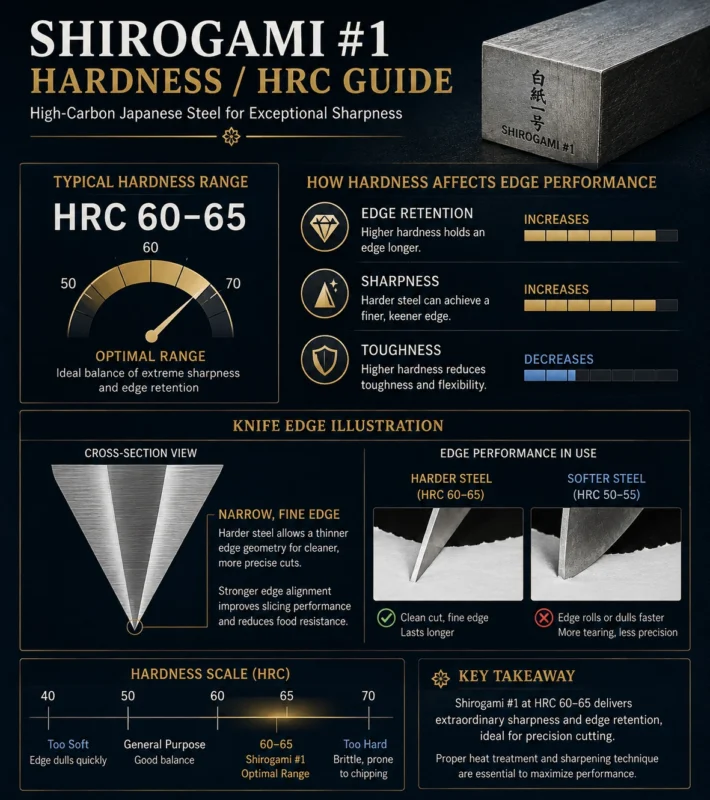
Shirogami #1 Hardness
Hardness is one of the defining characteristics of this steel.
Depending on the maker and heat treatment, knives made from White #1 are commonly hardened to approximately HRC 60–65, although individual knives can fall outside this range.
The exact hardness is determined by much more than the steel specification itself.
Heat treatment, blade geometry, quenching technique, tempering, forging history, and the skill of the maker can all influence the final result.
A knife made from excellent steel but poorly heat treated may perform worse than a knife made from a more ordinary steel with outstanding heat treatment.
For kitchen knives, extremely high hardness is not automatically desirable.
If hardness is pushed too far without sufficient toughness, the edge can become more susceptible to chipping. Japanese kitchen knives are often ground relatively thin, so the combination of thin geometry and high hardness requires careful use.
For this reason, a good maker aims for a balance between hardness and practical edge stability.
Check Our Guide What Is HRC? Understanding Rockwell Hardness in Kitchen Knives
Edge Retention
One of the most common questions about White #1 steel is how long its edge will remain sharp.
The answer depends heavily on what the knife is cutting and how it is used.
This steel can provide excellent edge retention for a traditional carbon steel, but it should not be confused with modern high-wear-resistance steels.
Its relatively simple composition means it does not contain large quantities of hard vanadium or niobium carbides. Consequently, it generally does not resist abrasive wear as effectively as many modern powder steels.
However, edge retention is not determined by carbide volume alone.
A highly refined edge combined with excellent hardness and geometry can remain extremely effective during normal kitchen work. In practical cooking, a thin, well-sharpened blade can continue cutting efficiently even when a more wear-resistant blade may technically retain more of its abrasive wear resistance.
The type of cutting also matters.
Preparing vegetables, fish, boneless meat, and other relatively soft foods places different demands on an edge than cutting hard squash, bones, frozen food, or abrasive materials.
For normal kitchen use, White #1 can offer very satisfying edge longevity while remaining easy to restore on a sharpening stone.
Check Our Guide Edge Retention Explained
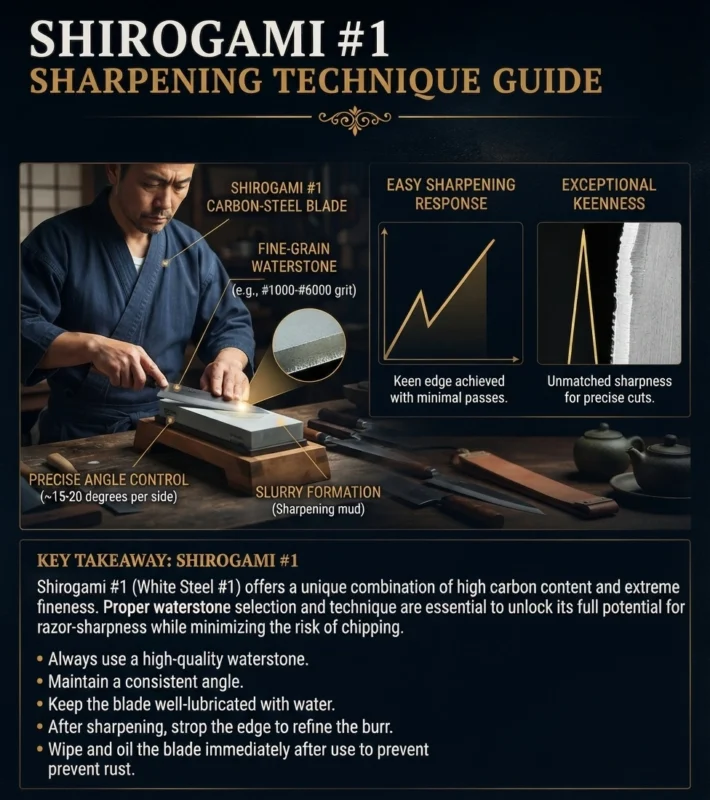
Sharpening Shirogami #1
Sharpening is arguably one of the strongest reasons to choose this steel.
White #1 is famous among sharpening enthusiasts because it responds exceptionally well to waterstones.
The steel generally feels much easier to abrade than highly wear-resistant modern steels. A properly heat-treated blade can develop a very refined edge without requiring excessive sharpening time.
This makes it particularly suitable for people who enjoy Japanese waterstone sharpening.
A typical sharpening progression might involve:
- Coarse stone for repairing or significantly changing the edge
- Medium stone for establishing the primary edge
- Fine stone for refining the edge
- Optional finishing stone for polishing and maximizing refinement
The exact progression depends on the knife and intended cutting performance.
A relatively low-grit stone is unnecessary for routine maintenance. If the knife is still reasonably sharp, a medium or fine stone can restore the edge without removing unnecessary amounts of steel.
One of the advantages of this steel is that you can maintain the edge frequently with very little material removal.
What Does Shirogami #1 Feel Like on a Sharpening Stone?
Experienced sharpeners often describe traditional White steels as having a particularly pleasant sharpening response.
The feedback from the stone can be easy to feel, and the steel tends to generate a useful amount of sharpening swarf.
Compared with extremely wear-resistant steels, less time may be required to establish a fresh apex.
This makes the steel particularly attractive for people who sharpen their knives regularly.
There is also a practical advantage: you do not necessarily need an extremely sophisticated sharpening system.
A good quality Japanese waterstone and proper technique can produce an exceptionally sharp edge.
This does not mean sharpening is effortless.
The knife still requires correct angle control, consistent pressure, and proper stone maintenance. But the steel itself is generally cooperative and predictable when properly heat treated.
Check our guide The Ultimate Guide to Caring for a Damascus Steel Knife
Corrosion Resistance
Corrosion resistance is one of the major disadvantages of White #1 steel.
It is not stainless steel.
Because the composition contains very little chromium, the blade can react with moisture, acids, salts, and food residues.
This means a knife made from this steel should not be treated like a stainless kitchen knife.
After use, the blade should be washed and dried promptly.
Do not leave the knife sitting wet beside the sink.
Do not leave acidic food residue on the blade for extended periods.
Do not store the knife while it is damp.
With proper care, however, corrosion does not have to be a major problem.
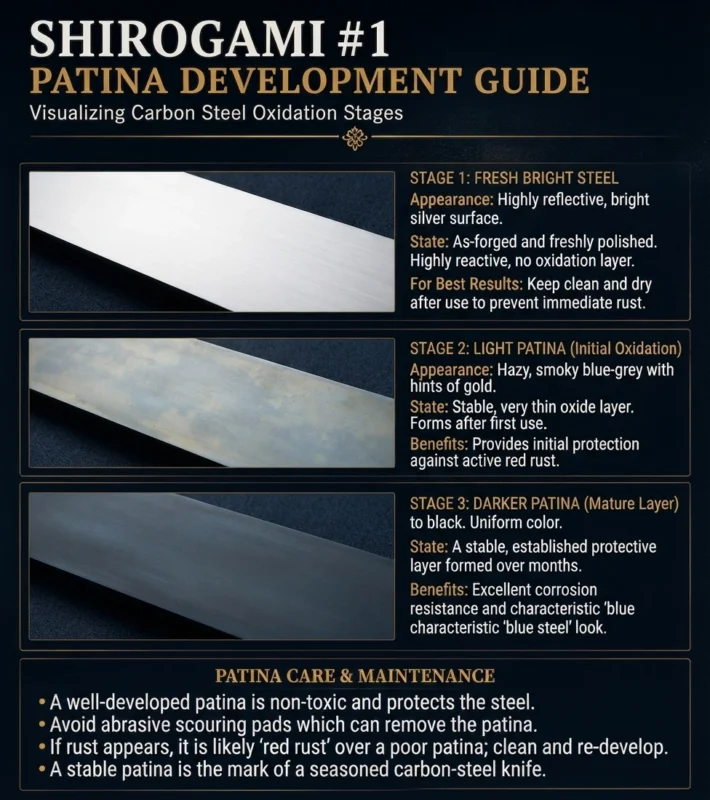
Instead of remaining bright and polished forever, a carbon-steel blade often develops a patina.
What Is Patina?
A patina is a thin layer that forms naturally on the surface of reactive carbon steel.
Depending on the foods being cut and the environment, a patina may appear gray, blue, gold, brown, or nearly black.
A stable patina can provide some additional protection against further reactive oxidation, although it does not make the knife stainless.
The appearance of a patina is often considered part of the character of a traditional Japanese carbon-steel knife.
Many owners actually prefer the changing appearance because it demonstrates that the knife is being used.
However, active rust is different from patina.
Rust is generally reddish-orange and should be removed rather than allowed to continue developing.
How to Maintain a Shirogami #1 Knife
Proper maintenance is simple but important.
After cutting food, rinse the blade when necessary and wipe it completely dry.
For particularly acidic foods such as tomatoes, citrus, onions, or some fruits, cleaning the blade promptly is especially useful.
When the knife will not be used for an extended period, applying a very thin layer of food-safe blade oil can provide additional protection.
A basic maintenance routine is:
During use:
Wipe the blade regularly with a clean cloth.
After use:
Wash carefully, rinse, and dry immediately.
During storage:
Keep the blade completely dry and store it safely.
For long-term storage:
Consider applying a thin protective layer of food-safe mineral oil.
This routine is not complicated, but it does require consistency.
Shirogami #1 and Heat Treatment
Heat treatment is critically important for traditional carbon steels.
The same steel specification can produce significantly different results depending on how it is heat treated.
The basic process involves heating the steel to the appropriate austenitizing temperature, quenching it, and then tempering it to achieve the desired balance between hardness and toughness.
For a high-carbon Japanese knife steel, precise temperature control is particularly important.
Overheating can damage the grain structure. Poor quenching can produce inadequate hardness or undesirable internal stresses. Incorrect tempering can also affect the final properties.
This is why the reputation of the knife maker matters.
When purchasing a traditional carbon-steel knife, the steel name alone does not tell the complete story.
A skilled bladesmith can produce a remarkably fine blade from relatively simple steel, while poor heat treatment can compromise even premium material.
Check Our Guide Different Heat Treatment Methods Explained
Grain Structure and Cutting Performance
Fine grain is another important characteristic associated with traditional Japanese carbon steels.
A refined grain structure can contribute to a stable and responsive cutting edge.
This is particularly important when a knife is sharpened to a very acute angle.
A highly refined edge can feel extremely smooth when slicing food.
This is one reason traditional Japanese knives can provide a distinctive cutting experience even when their measured edge retention may not compete with modern high-alloy steels.
The goal is not simply to create the hardest possible blade.
The goal is to create a blade with a controlled microstructure that performs effectively at the edge.
Is Shirogami #1 Tough?
White #1 is not generally considered a high-toughness steel.
Its high carbon content and ability to reach high hardness mean that the edge can be relatively brittle compared with softer, tougher steels.
However, toughness depends on the complete knife design.
Blade thickness, edge angle, heat treatment, grain structure, and hardness all influence how the knife behaves.
A properly made kitchen knife can be perfectly reliable for normal food preparation.
The problem arises when the knife is used outside its intended role.
A thin Japanese chef knife should not be used for chopping bones, frozen food, hard objects, or twisting cuts.
If significant lateral force is applied to a thin, hard edge, chipping can occur.
This is not necessarily a defect. It is a consequence of the design priorities.
Chipping and Edge Stability
Chipping is one of the most important considerations when using a high-hardness carbon-steel knife.
The thinner and harder the edge, the more important correct technique becomes.
Avoid:
- Cutting bones
- Cutting frozen food
- Twisting the blade inside food
- Using excessive lateral force
- Cutting on glass or stone surfaces
- Using the knife for tasks it was not designed for
Instead, use a suitable cutting board and a controlled cutting technique.
With proper use, a high-hardness carbon-steel kitchen knife can maintain a remarkably fine edge.
Best Cutting Boards for Traditional Carbon Knives
The cutting board has a significant effect on edge life.
Wood and softer synthetic cutting boards are generally more appropriate than extremely hard surfaces.
Avoid glass cutting boards whenever possible.
Glass is unforgiving to knife edges and can rapidly damage a finely sharpened blade.
A quality wooden cutting board can be an excellent match for a traditional Japanese knife.
The goal is to create a cutting environment that supports the thin edge rather than unnecessarily stressing it.
Check Our Guide Types, Materials, Sizes, Maintenance & the Best Boards for Your Knives
What Types of Knives Use Shirogami #1?
White #1 is particularly associated with traditional Japanese kitchen knives.
It can be used for a wide variety of blade styles, including:
- Gyuto
- Santoku
- Petty
- Nakiri
- Bunka
- Kiritsuke
- Deba
- Yanagiba
- Sujihiki
- Other traditional Japanese kitchen knives
The best choice depends on the intended cutting tasks.
A gyuto made from this steel can be an excellent general-purpose chef knife.
A petty knife can benefit from the ability to maintain an extremely fine edge.
Traditional single-bevel knives can also take advantage of the steel’s sharpening characteristics.
Check Our Complete Guide to Japanese Knives
Shirogami #1 for Gyuto Knives
A gyuto is one of the most practical applications for this steel.
The gyuto is a versatile Japanese chef knife designed for tasks such as cutting vegetables, meat, herbs, and fish.
The combination of a thin blade and high hardness can provide excellent cutting performance.
However, the user must respect the edge.
A White #1 gyuto is not the ideal choice for someone who wants a completely maintenance-free knife.
It is better suited to someone who appreciates sharpening and is willing to wipe and dry the blade during use.
Check Our Guide Japanese Gyuto Knife
Shirogami #1 for Nakiri Knives
A nakiri is another excellent application.
Its straight cutting edge is particularly effective for vegetables.
A well-sharpened carbon-steel nakiri can produce very clean cuts and a smooth cutting experience.
Because vegetables often contain water and acids, however, maintenance remains important.
The blade should be wiped and dried frequently when preparing large quantities of produce.
Shirogami #1 vs Shirogami #2
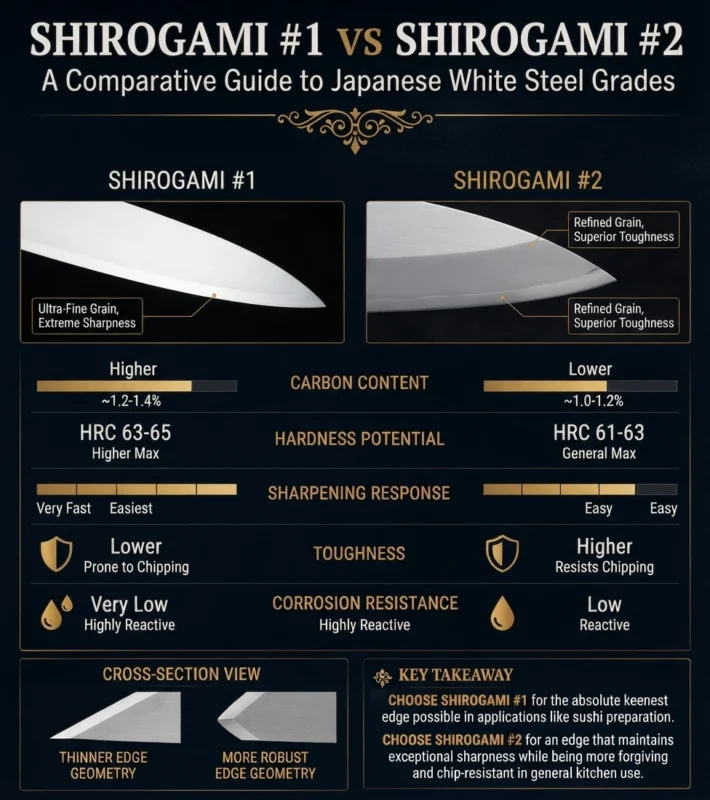
White #1 and White #2 are closely related steels, but their carbon content differs.
White #1 generally contains more carbon than White #2.
This can allow it to reach somewhat higher hardness and provide excellent edge potential.
White #2, meanwhile, is extremely popular because it provides a highly attractive balance between hardness, toughness, sharpening response, and practicality.
A simplified comparison looks like this:
| Property | White #1 | White #2 |
| Carbon content | Higher | Lower |
| Potential hardness | Very high | High |
| Sharpening | Excellent | Excellent |
| Edge refinement | Excellent | Excellent |
| Toughness | Moderate to lower | Generally somewhat better |
| Corrosion resistance | Poor | Poor |
| Maintenance | High | High |
| Traditional use | Excellent | Excellent |
The differences should not be exaggerated.
Knife geometry and heat treatment can have a greater practical influence than the relatively small difference in chemistry.
A superbly made White #2 knife can outperform a poorly heat-treated White #1 knife.
Is Shirogami #1 Stainless?
No.
This is an important point for anyone purchasing a knife made from this steel.
White #1 is a reactive carbon steel and should be maintained accordingly.
It can develop patina and may rust if neglected.
This characteristic is not a disadvantage for every user.
For many enthusiasts, the need for maintenance is simply part of owning a traditional carbon-steel knife.
If you want a knife that can be left wet in the sink without concern, a stainless steel would be more appropriate.
If you value sharpening response and traditional carbon-steel performance, the extra maintenance may be worthwhile.
Check Our Guide Stainless Steel Myths: The Complete Truth About Modern Knife Steels
Shirogami #1 vs Modern Powder Steels
Modern powder steels are designed around different priorities.
Many of them offer excellent wear resistance, high corrosion resistance, or a combination of properties that traditional carbon steels cannot match.
White #1 generally gives up some of these advantages in exchange for excellent sharpening behavior and traditional edge performance.
A modern powder steel may stay cutting effectively for a very long time, particularly when used on abrasive foods or materials.
White #1 may require more frequent sharpening.
However, sharpening White #1 is usually much less demanding.
For someone who enjoys maintaining a knife every few weeks or even more frequently, this can be an advantage rather than a disadvantage.
Check Our Guide Powder Steels for Kitchen Knives
Who Should Buy a Shirogami #1 Knife?
This steel is particularly suitable for:
- Experienced home cooks
- Professional chefs who enjoy carbon-steel knives
- Japanese knife enthusiasts
- Sharpening enthusiasts
- Collectors of traditional Japanese knives
- Users who value extreme edge refinement
- People who do not mind regular maintenance
It may be less suitable for:
- Beginners who want zero maintenance
- People who routinely leave knives wet
- Users who cut bones or frozen food
- Anyone who strongly prefers stainless steel
- People unwilling to sharpen their knives
Choosing the right steel is ultimately about matching the material to the user’s priorities.
Advantages of Shirogami #1
The main advantages include:
Excellent Sharpening Response
The steel can be sharpened quickly and refined to an exceptionally high level.
High Hardness Potential
Proper heat treatment can produce a very hard blade suitable for fine kitchen edges.
Excellent Edge Quality
It is capable of producing an extremely keen and refined cutting edge.
Traditional Japanese Character
It is closely associated with traditional Japanese knife craftsmanship.
Predictable Maintenance
Although maintenance is necessary, the behavior of the steel is relatively straightforward. Keep it clean, dry, and protected.
Excellent Cutting Feel
Many enthusiasts appreciate the smooth and precise cutting experience associated with thin, hard carbon-steel blades.
Disadvantages of Shirogami #1
There are also important disadvantages.
Low Corrosion Resistance
The blade can rust if neglected.
Regular Maintenance Required
The knife should be cleaned and dried promptly.
Potential for Chipping
A hard, thin edge requires careful cutting technique.
Lower Wear Resistance
It generally will not match high-wear-resistance powder steels in long-term abrasive edge retention.
Not Ideal for Abuse
This is a precision kitchen steel rather than a material intended for rough utility work.
How to Get the Best Performance From Shirogami #1
The best way to use this steel is to respect its strengths.
Keep the knife sharp rather than waiting until the edge becomes extremely dull.
Use an appropriate cutting board.
Avoid twisting and lateral force.
Wipe the blade regularly when cutting acidic foods.
Clean and dry the knife immediately after use.
Store it safely.
Sharpen it with quality stones and avoid excessive pressure.
A properly maintained knife can remain an outstanding kitchen tool for many years.
Can Beginners Use Shirogami #1?
Yes, but it depends on the beginner.
Someone completely unfamiliar with carbon steel may initially find the maintenance requirements inconvenient.
However, the sharpening characteristics can actually make this steel an excellent material for someone who wants to learn traditional knife sharpening.
The important thing is understanding that the knife is a precision tool.
Once the basic habits become routine—wipe, wash, dry, store—the maintenance is not particularly difficult.
How Often Should a Shirogami #1 Knife Be Sharpened?
There is no universal sharpening schedule.
The correct time to sharpen depends on usage.
A professional chef using the knife for many hours every day will obviously need to sharpen more frequently than someone who prepares dinner several times per week.
Rather than following a fixed calendar, pay attention to cutting performance.
If the knife begins to feel less controlled or requires more pressure to make clean cuts, it may be time for a light sharpening.
Frequent light sharpening is generally preferable to waiting until the edge becomes severely dull.
Can Shirogami #1 Be Polished?
Yes.
The steel is particularly well suited to traditional Japanese polishing and sharpening techniques.
Its relatively simple composition allows skilled sharpeners to create highly refined surfaces and edges.
The exact appearance of the blade will depend on the grinding and finishing method.
A knife may have a mirror-like polished surface, a satin finish, a forged texture, or another traditional finish.
This visual variation is one of the appealing characteristics of handmade Japanese-style knives.
Does Shirogami #1 Develop a Patina Quickly?
It can.
Because the steel has very little chromium, it reacts noticeably with moisture and acidic foods.
The speed at which patina develops depends on the food being cut, humidity, frequency of use, and how often the blade is wiped.
Some knives develop visible coloration within the first few uses.
Others change much more gradually.
A patina is not necessarily something that needs to be removed.
Many owners consider it part of the knife’s personality and history.
Is a Patina the Same as Rust?
No.
A stable patina is generally a thin layer of oxidation that changes the appearance of the steel.
Rust is a more destructive form of corrosion and should be removed.
If you notice reddish-orange spots, roughness, or active corrosion, the blade should be cleaned and treated rather than simply ignored.
Regular drying is the easiest way to prevent most problems.
Frequently Asked Questions
Is Shirogami #1 a good knife steel?
Yes. It is an excellent choice for users who prioritize sharpening performance, edge refinement, high hardness, and traditional Japanese carbon-steel characteristics.
Is Shirogami #1 stainless?
No. It is a reactive carbon steel and requires more maintenance than stainless steel.
How hard can Shirogami #1 get?
Depending on the heat treatment and maker, knives can commonly reach approximately HRC 60–65, although individual results vary.
Does Shirogami #1 hold an edge well?
It provides good to excellent edge retention for a traditional carbon steel, but it generally does not compete with highly wear-resistant modern powder steels.
Is Shirogami #1 easy to sharpen?
Yes. Its excellent sharpening response is one of its biggest advantages.
Can Shirogami #1 rust?
Yes. Moisture, acids, and improper storage can cause rust.
Does Shirogami #1 develop a patina?
Yes. Patina development is normal and is often considered part of the character of a carbon-steel knife.
Is Shirogami #1 brittle?
At high hardness and with a thin edge, it can be susceptible to chipping if misused. Proper technique is important.
What is better, White #1 or White #2?
Neither is universally better. White #1 offers higher carbon content and excellent hardness potential, while White #2 is known for its excellent balance of properties. Heat treatment and geometry can be more important than the small chemical difference.
Is White #1 suitable for professional chefs?
Yes, especially for chefs who appreciate extremely sharp carbon-steel knives and are comfortable with regular maintenance.
Can you sharpen White #1 with a whetstone?
Yes. Waterstones are particularly well suited to this steel.
Can you use White #1 for vegetables?
Absolutely. It is an excellent choice for vegetable knives, gyutos, nakiris, and other kitchen blades.
Final Verdict
Shirogami #1 represents a traditional approach to knife steel that remains highly relevant despite the development of increasingly sophisticated modern alloys.
Its strength is not extreme corrosion resistance or maximum wear resistance. Instead, its appeal lies in the ability to combine high hardness, fine edge potential, excellent sharpening response, and an exceptional cutting experience.
For someone who wants a maintenance-free kitchen knife, there are better choices.
For someone who enjoys sharpening, appreciates traditional Japanese craftsmanship, and wants an exceptionally refined cutting edge, White #1 can be an outstanding material.
The most important point is that the steel designation is only part of the equation. Heat treatment, blade geometry, grinding quality, edge angle, and the skill of the maker all influence the final performance of the knife.
A well-made carbon-steel knife should be treated as a precision instrument. Keep it dry, sharpen it properly, avoid abusive cutting tasks, and maintain the edge regularly.
In return, this traditional Japanese steel can provide an exceptionally satisfying combination of sharpness, control, and sharpening performance.
For knife enthusiasts who appreciate the relationship between the steel, the maker, and the user, White #1 remains one of the most interesting traditional Japanese knife steels available.
This article is for independent informational purposes only and is not affiliated with, sponsored by, or endorsed by any steel manufacturer. All product names, trademarks, and registered trademarks are the property of their respective owners.
https://www.proterial.com/e/yss/search/shirogami1.html?utm_source
Shirogami #1