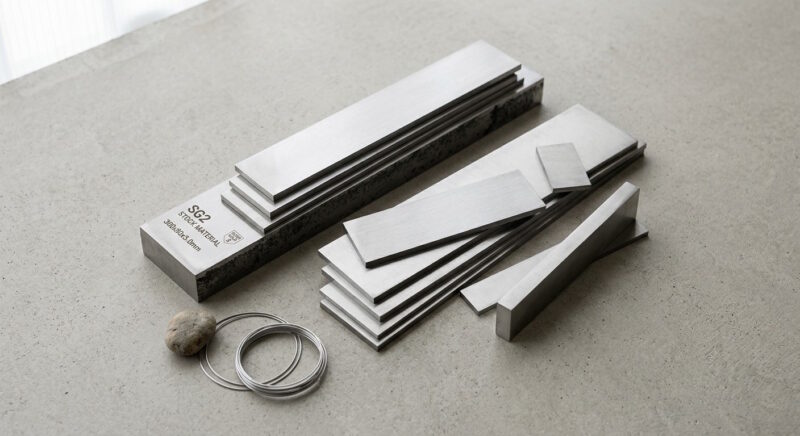
An Independent Guide
SG2 Steel Review
If you’ve been researching premium Japanese kitchen knives, you’ve almost certainly come across SG2 steel. Found in many high-end chef’s knives from renowned Japanese manufacturers, SG2 has earned an outstanding reputation for combining exceptional edge retention with excellent corrosion resistance and an incredibly refined cutting feel.
But is SG2 really worth the premium price?
How does it compare with VG10, R2, MagnaCut, AEB-L, or M390?
Is it too difficult to sharpen?
In this comprehensive SG2 steel review, we’ll answer every important question and explain why SG2 has become one of the most respected stainless powder metallurgy steels in the world.
What Is SG2 Steel?
SG2 is a Japanese powder metallurgy stainless steel.
The steel was designed specifically for premium cutting tools where superior wear resistance, excellent hardness, and high corrosion resistance are essential.
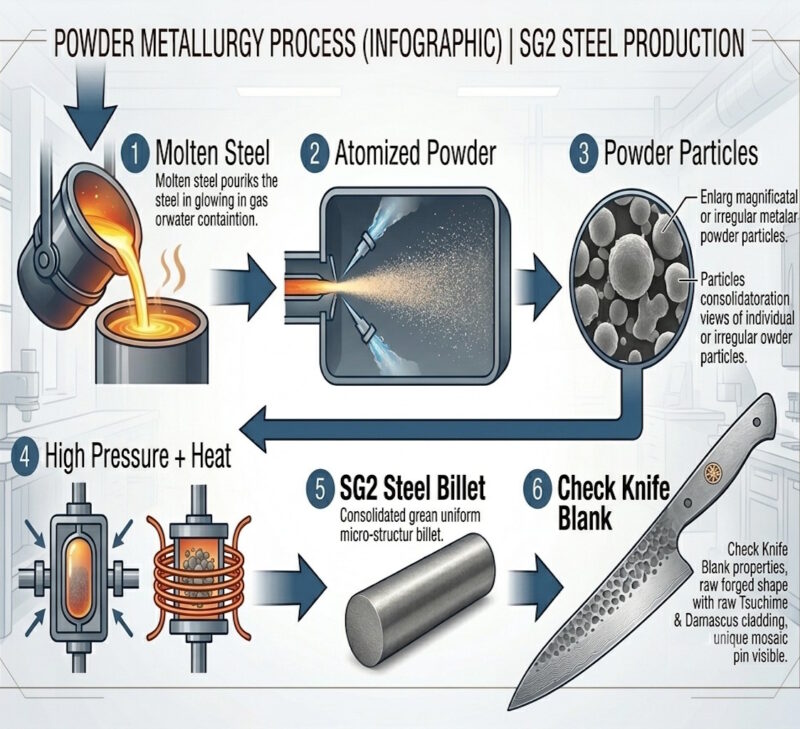
Unlike conventional stainless steels that are cast as large ingots, SG2 is manufactured using powder metallurgy (PM) technology.
The process involves:
- melting the steel
- atomizing it into microscopic powder particles
- compressing the powder
- hot isostatic pressing
- forging into finished steel
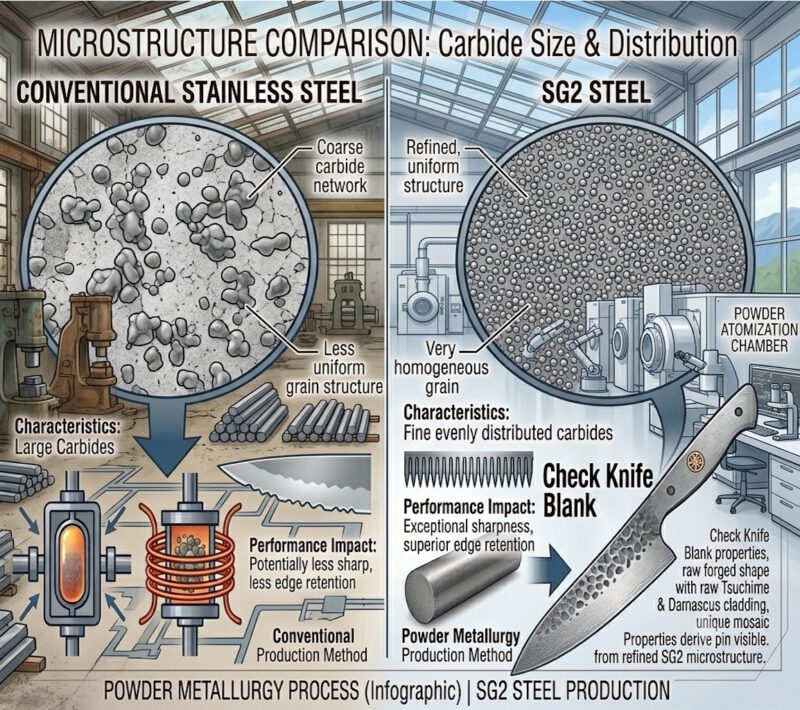
This creates an extremely fine and uniform carbide structure that cannot be achieved with traditional steelmaking.
The result is:
- outstanding edge stability
- extremely fine cutting edges
- better wear resistance
- improved consistency
- fewer weak points
Is SG2 the Same as R2 Steel?
One of the biggest sources of confusion is the relationship between SG2 and R2.
The short answer:
Yes—for practical purposes, SG2 and R2 are essentially the same steel.
Different manufacturers may use different naming conventions, but both refer to nearly identical powder metallurgy stainless steels produced to very similar specifications.
Knife enthusiasts generally treat SG2 and R2 as interchangeable.
When shopping, don’t worry if one knife says “R2” while another says “SG2.”
Performance differences are usually caused by:
- heat treatment
- blade geometry
- sharpening quality
- manufacturer
—not the name stamped on the blade.
SG2 Steel Chemical Composition
Typical composition:
| Element | Content |
|---|---|
| Carbon | ~1.25% |
| Chromium | ~15% |
| Molybdenum | ~2.8% |
| Vanadium | ~2.3% |
| Tungsten | ~1.8% |
Each alloying element has an important role.
Carbon
High carbon content allows SG2 to achieve hardness well above most stainless kitchen steels.
This improves:
- edge retention
- wear resistance
- sharpening potential
Chromium
Approximately 15% chromium gives SG2 excellent corrosion resistance.
Unlike carbon steels:
- it resists rust
- tolerates acidic foods
- performs well in humid kitchens
Vanadium
Vanadium forms extremely hard carbides.
Benefits include:
- longer edge life
- improved wear resistance
- refined grain structure
Molybdenum
Molybdenum contributes:
- corrosion resistance
- strength
- toughness
- heat treatment stability
Tungsten
Tungsten further increases:
- hardness
- edge stability
- abrasion resistance
SG2 Hardness
Most manufacturers heat treat SG2 to:
HRC 62–64
Some custom makers push hardness to:
HRC 65
This is significantly harder than:
- VG10
- AUS-10
- 14C28N
- 440C
- X50CrMoV15
The high hardness allows extremely acute edge angles.
Check Our Guide What Is HRC? Understanding Rockwell Hardness in Kitchen Knives
Edge Retention
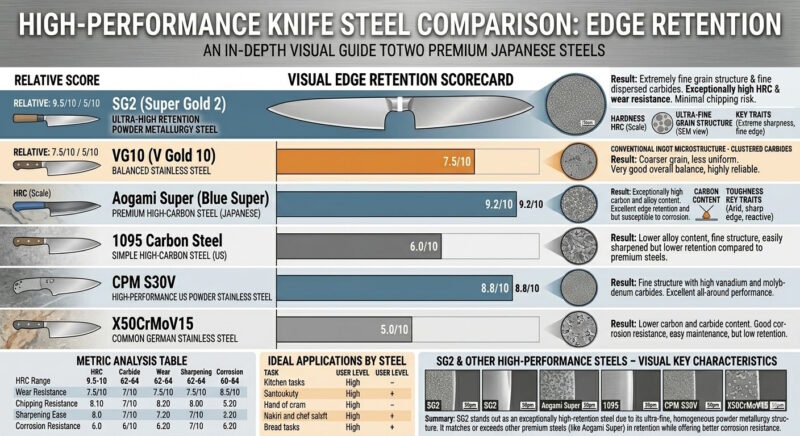
This is where SG2 truly shines.
Thanks to powder metallurgy and high hardness, SG2 offers exceptional edge retention.
For home cooks:
- months between sharpening
For professionals:
- noticeably longer working life than VG10
It excels during:
- vegetable prep
- fish
- meat
- herbs
- precision slicing
Cutting Performance
SG2 has become a favorite among Japanese knife makers because it supports an incredibly thin edge.
Thin blades produce:
- effortless slicing
- less food cracking
- reduced wedging
- cleaner cuts
Many users describe SG2 as feeling “laser-like.”
Corrosion Resistance
SG2 is fully stainless.
It handles:
- onions
- tomatoes
- citrus
- fruit
- wet environments
Unlike carbon steel, it requires no special rust prevention beyond normal cleaning.
Toughness
SG2 is harder than many stainless steels.
As hardness increases, toughness decreases.
That means SG2 is not intended for:
- frozen food
- bones
- twisting cuts
- chopping through hard materials
Instead, it excels in precision cutting.
Wear Resistance
SG2 offers outstanding wear resistance.
This comes from:
- vanadium carbides
- tungsten carbides
- PM manufacturing
The edge simply lasts longer.
Sharpening SG2
Many buyers worry that SG2 is impossible to sharpen.
Fortunately, that’s largely a myth.
Although SG2 takes longer than softer steels, quality water stones make sharpening very manageable.
Recommended progression:
- 1000 grit
- 3000 grit
- 6000 grit
SG2 responds especially well to splash-and-go ceramic stones.
Does SG2 Take a Sharp Edge?
Absolutely.
One of SG2’s defining characteristics is its ability to support an extremely refined apex.
Professional sharpeners often polish SG2 to:
- hair-shaving sharpness
- push-cut performance
- effortless paper slicing
| Steel | Edge | Toughness | Corrosion | Sharpening |
|---|---|---|---|---|
| SG2 | ⭐⭐⭐⭐⭐ | ⭐⭐⭐ | ⭐⭐⭐⭐⭐ | ⭐⭐⭐ |
| VG10 | ⭐⭐⭐⭐ | ⭐⭐⭐⭐ | ⭐⭐⭐⭐⭐ | ⭐⭐⭐⭐ |
| MagnaCut | ⭐⭐⭐⭐⭐ | ⭐⭐⭐⭐⭐ | ⭐⭐⭐⭐⭐ | ⭐⭐⭐⭐ |
| M390 | ⭐⭐⭐⭐⭐ | ⭐⭐⭐ | ⭐⭐⭐⭐⭐ | ⭐⭐ |
| AEB-L | ⭐⭐⭐ | ⭐⭐⭐⭐⭐ | ⭐⭐⭐⭐ | ⭐⭐⭐⭐⭐ |
Best Uses
SG2 performs exceptionally well for:
- chef knives
- gyutos
- santokus
- bunka knives
- petty knives
- nakiris
- sujihikis
Not Ideal For
Avoid using SG2 for:
- cleavers
- bone chopping
- frozen foods
- pry cuts
- opening cans
Like most premium Japanese knives, SG2 rewards proper technique.
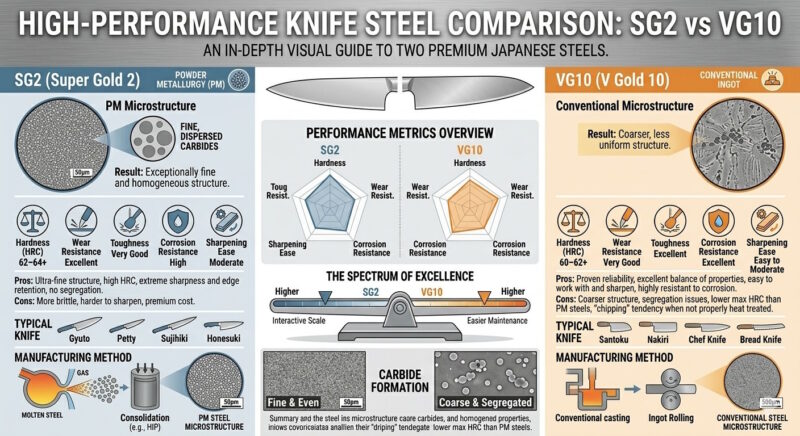
SG2 vs VG10
VG10 has long been the benchmark premium Japanese stainless steel.
However, SG2 improves upon it in several important areas.
| Feature | SG2 | VG10 |
|---|---|---|
| Edge retention | Excellent | Very Good |
| Hardness | Higher | Lower |
| Wear resistance | Better | Good |
| Sharpening | Slightly harder | Easier |
| Corrosion resistance | Excellent | Excellent |
Winner:
SG2
Check Our Guide VG10 Steel Review
SG2 vs MagnaCut
MagnaCut is one of the newest premium stainless steels.
Compared with SG2:
SG2 offers:
- finer kitchen edge
- thinner geometry
- exceptional slicing
MagnaCut offers:
- better toughness
- easier maintenance
- outdoor versatility
Kitchen winner:
SG2
Outdoor winner:
MagnaCut
Check Our Guide MagnaCut Steel Review
SG2 vs M390
Both are powder metallurgy steels.
M390 has:
- even higher wear resistance
- slightly better corrosion resistance
SG2 generally offers:
- easier sharpening
- finer kitchen edge
- better cutting feel
Many chefs actually prefer SG2 despite M390’s higher wear resistance.
Check Our Guide M390 Steel Review
SG2 vs AEB-L
AEB-L is famous for:
- incredible toughness
- easy sharpening
- fine grain
SG2 offers:
- much longer edge life
- higher hardness
- better wear resistance
Professional kitchen users often choose SG2.
Busy sharpening enthusiasts often enjoy AEB-L.
Check Our Guide AEB-L Steel Review
SG2 vs S35VN
S35VN was designed primarily for folding knives.
Compared with SG2:
SG2 provides:
- thinner kitchen geometry
- finer edge
- superior slicing
S35VN offers:
- more toughness
Kitchen winner:
SG2
Check Our Guide S35VN Steel Review
SG2 vs Elmax
Elmax has:
- better toughness
- excellent corrosion resistance
- strong edge retention
SG2 generally wins for:
- laser geometry
- food release
- refined kitchen performance
Check Our Guide ELMAX Steel Review
SG2 vs 14C28N
14C28N is excellent value steel.
However:
SG2 offers
- much longer edge retention
- higher hardness
- premium cutting feel
14C28N remains easier to sharpen.
Heat Treatment Matters
Steel alone never determines knife performance.
Excellent SG2 knives rely on:
- precise heat treatment
- careful grinding
- thin geometry
- skilled sharpening
A mediocre SG2 knife can easily perform worse than an expertly made VG10 knife.
Always evaluate the manufacturer, not just the steel.
Check Our Guide Different Heat Treatment Methods Explained
Maintenance Tips
To maximize performance:
- Wash by hand.
- Dry immediately.
- Avoid dishwashers.
- Store safely.
- Use wood or soft plastic cutting boards.
- Hone gently if needed.
- Sharpen with quality water stones.
Proper care can keep SG2 performing at its best for many years.
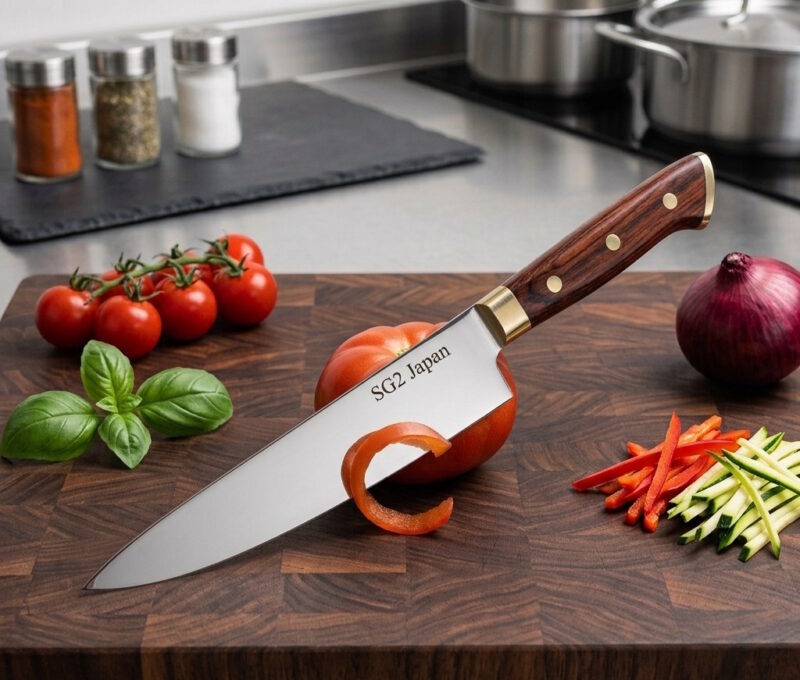
Popular SG2 Kitchen Knives
Many respected Japanese makers offer SG2 knives, especially in their premium lines. You’ll commonly find SG2 used in:
- Gyuto (Japanese chef’s knife)
- Santoku
- Bunka
- Nakiri
- Petty
- Sujihiki
These knives are favored by professional chefs because SG2 supports very thin blade grinds without sacrificing excellent edge retention.
Who Should Buy an SG2 Knife?
SG2 is an excellent choice if you:
- Want exceptional edge retention.
- Prefer Japanese-style kitchen knives.
- Enjoy razor-sharp cutting performance.
- Cook frequently at home.
- Work in a professional kitchen.
- Don’t mind sharpening a little less often but spending a bit more time when you do.
It may not be the best choice if you:
- Frequently cut through bones or frozen foods.
- Prefer very tough Western-style workhorse knives.
- Need a steel that can tolerate rough handling.
Common Myths About SG2
Myth 1: SG2 Chips Easily
Not necessarily. While SG2 is harder than many steels, proper heat treatment and sensible use make chipping uncommon. Most chips occur from misuse, such as twisting the blade, striking bone, or cutting frozen foods.
Myth 2: SG2 Is Impossible to Sharpen
False. It does take more time than softer steels like 14C28N or AUS-8, but quality water stones can restore a razor edge without excessive effort.
Myth 3: All SG2 Knives Perform the Same
Blade geometry, heat treatment, grind, and craftsmanship have a major impact. Two SG2 knives from different makers can feel very different in use.
Myth 4: SG2 Is Only for Professionals
While many professionals use SG2, enthusiastic home cooks can benefit just as much from its long-lasting sharpness and excellent cutting performance.
Frequently Asked Questions
Is SG2 stainless?
Yes. With around 15% chromium, SG2 is considered a true stainless steel and offers excellent resistance to rust and staining when cared for properly.
What hardness is SG2?
Most manufacturers harden SG2 to 62–64 HRC, with some custom makers reaching 65 HRC.
Is SG2 better than VG10?
In terms of edge retention, wear resistance, and maximum hardness, yes. VG10 is generally easier to sharpen and can be slightly more forgiving.
Is SG2 the same as R2?
For practical purposes, yes. SG2 and R2 are essentially the same powder metallurgy stainless steel, and performance differences usually come from the knife maker rather than the steel designation.
Does SG2 rust?
Under normal kitchen use, SG2 is highly resistant to rust. Hand washing and drying the blade after use are still recommended to maintain its finish and edge.
Is SG2 good for beginners?
Yes, provided you are willing to use proper cutting techniques and avoid hard impacts. Its long edge life makes it a rewarding choice even for less experienced users.
Final Verdict
SG2 has earned its reputation as one of the finest stainless steels available for kitchen knives. Its combination of powder metallurgy technology, high hardness, exceptional edge retention, fine grain structure, and excellent corrosion resistance makes it a standout performer for both professional chefs and passionate home cooks.
While it isn’t designed for heavy chopping or abuse, SG2 excels where precision matters most: effortless slicing, clean cuts, and a razor-sharp edge that lasts. Compared with traditional stainless steels like VG10 and 440C, it offers a clear performance upgrade, while still remaining more kitchen-focused than many modern super steels designed for outdoor or tactical knives.
If your priority is a knife that stays sharp through long prep sessions, glides through food with minimal resistance, and rewards careful maintenance with years of outstanding performance, SG2 is one of the best choices on the market. For anyone investing in a premium Japanese kitchen knife, SG2 remains a benchmark steel that continues to justify its reputation.
The History of SG2 Steel
To understand why SG2 has become one of the world’s most respected kitchen knife steels, it helps to look at its origins. During the late twentieth century, Japanese knife manufacturers faced a growing demand for stainless steels that could match the cutting performance of traditional high-carbon steels while requiring less maintenance. Professional chefs wanted knives that stayed sharp longer, resisted corrosion in busy kitchens, and could support the extremely thin blade geometries characteristic of Japanese cutlery.
Traditional stainless steels such as 440C and AUS-8 offered good corrosion resistance but often lacked the edge retention and hardness required for premium chef’s knives. At the same time, high-carbon steels like White Steel (Shirogami) and Blue Steel (Aogami) delivered phenomenal sharpness but required careful maintenance to prevent rust.
To bridge this gap, Japanese steel producers invested heavily in powder metallurgy technology. Among the companies leading this development was Takefu Special Steel, which introduced SG2 as a high-performance stainless powder steel specifically designed for premium cutting tools.
The steel quickly gained recognition among custom knifemakers and established Japanese brands. Today, SG2 is commonly found in high-end gyutos, santokus, bunkas, nakiris, and petty knives produced by many respected manufacturers.
One of the reasons for SG2’s continued popularity is its remarkable balance. Rather than focusing exclusively on maximum wear resistance or extreme toughness, SG2 combines excellent hardness, superior corrosion resistance, fine grain structure, and practical sharpenability into a package that suits everyday kitchen work exceptionally well.
More than two decades after its introduction, SG2 remains one of the benchmark steels against which newer premium stainless steels are measured.
Understanding Powder Metallurgy
Powder metallurgy is the single biggest reason SG2 performs differently from conventional stainless steels.
Instead of casting molten steel into large ingots, the molten alloy is sprayed into tiny droplets that rapidly cool into microscopic powder particles. Each particle contains an extremely fine and uniform microstructure.
These powder particles are then compressed under enormous pressure and heat into solid steel billets.
The benefits of this manufacturing process are significant.
Smaller Carbides
Conventional steels often develop large carbide clusters during solidification. These clusters can reduce edge stability and make sharpening more difficult.
Powder metallurgy creates much finer carbides distributed evenly throughout the steel.
This allows SG2 to support thinner cutting edges without becoming unstable.
Better Wear Resistance
Because the carbides are evenly dispersed, the edge wears more uniformly over time.
Instead of developing weak spots, SG2 maintains a consistent cutting edge for much longer.
Improved Sharpening
Although SG2 is harder than VG10, its fine grain structure allows it to sharpen surprisingly well for such a wear-resistant steel.
Many users are pleasantly surprised by how refined an edge SG2 can achieve.
Greater Manufacturing Consistency
Powder metallurgy also improves consistency from one production batch to another.
Professional knife makers appreciate this because they know exactly how the steel will respond during grinding, heat treatment, and finishing.
Carbide Structure Explained
Knife enthusiasts often talk about carbides, but what exactly are they?
Carbides are extremely hard particles formed when carbon bonds with alloying elements such as vanadium, chromium, molybdenum, and tungsten.
These particles determine many of the steel’s performance characteristics.
Vanadium Carbides
Vanadium carbides are among the hardest carbides found in knife steels.
They dramatically improve wear resistance while helping refine the steel’s grain structure.
The result is a longer-lasting edge that can still be sharpened to an incredibly fine point.
Chromium Carbides
Chromium provides corrosion resistance, but it also forms chromium carbides.
These contribute additional wear resistance while helping the blade resist staining and rust.
Tungsten Carbides
Tungsten increases hot hardness and abrasion resistance.
Although kitchen knives never reach extremely high temperatures during normal use, tungsten contributes to SG2’s excellent edge stability.
Molybdenum Carbides
Molybdenum improves strength, corrosion resistance, and hardenability.
It also helps maintain toughness despite SG2’s relatively high hardness.
Together, these carbides create a balanced steel that excels in kitchen applications.
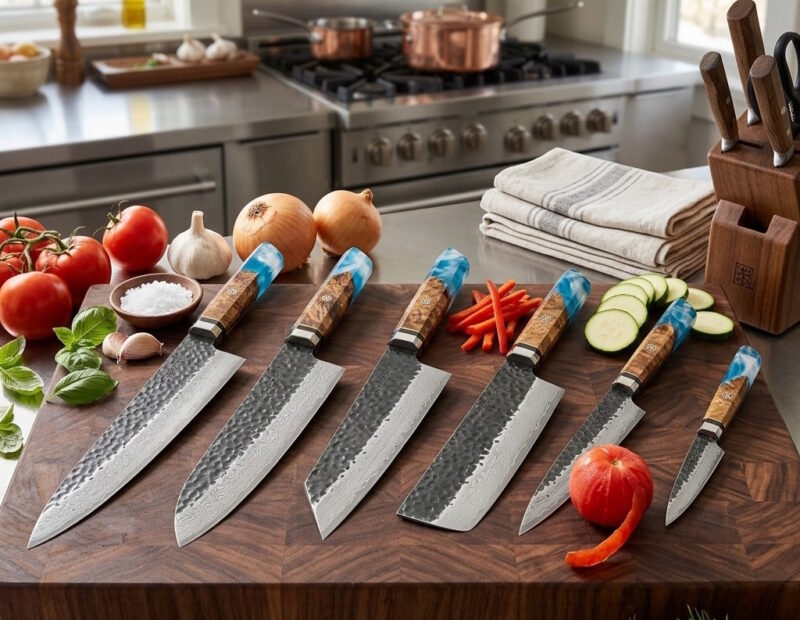
Real-World Kitchen Performance
Specifications and laboratory tests tell only part of the story. What really matters is how SG2 performs on the cutting board.
Vegetables
SG2 truly shines when preparing vegetables.
The combination of high hardness and fine grain allows the knife to glide effortlessly through onions, carrots, cucumbers, cabbage, peppers, and herbs.
Thin slices remain clean without excessive cracking or tearing.
Many chefs describe the cutting experience as smooth and almost frictionless.
Meat
SG2 performs exceptionally well on both raw and cooked meats.
It easily trims silver skin, portions steaks, slices poultry, and carves roasts with minimal resistance.
Because the edge remains sharp for a long time, the knife continues making clean cuts even during extended food preparation sessions.
Fish
Japanese knives are famous for seafood preparation, and SG2 is an outstanding steel for fish.
Its razor-sharp edge produces precise cuts while minimizing damage to delicate flesh.
Whether preparing salmon, tuna, snapper, or sushi ingredients, SG2 delivers impressive control.
Herbs
Fresh herbs often bruise when cut with dull knives.
SG2’s fine edge cleanly slices basil, parsley, cilantro, dill, and mint while preserving their appearance and aroma.
Fruit
Apples, pears, citrus fruits, tomatoes, and peaches all benefit from SG2’s sharpness.
The knife passes through skins easily without crushing the interior.
Choosing the Right Cutting Board
Even the best steel can lose its edge prematurely if paired with the wrong cutting surface.
To maximize SG2’s edge retention, use:
- End-grain hardwood boards
- Soft maple cutting boards
- Walnut cutting boards
- Cherry cutting boards
- Quality polyethylene cutting boards
Avoid:
- Glass boards
- Marble
- Granite
- Ceramic
- Steel countertops
Hard surfaces can dull or chip the edge regardless of steel quality.
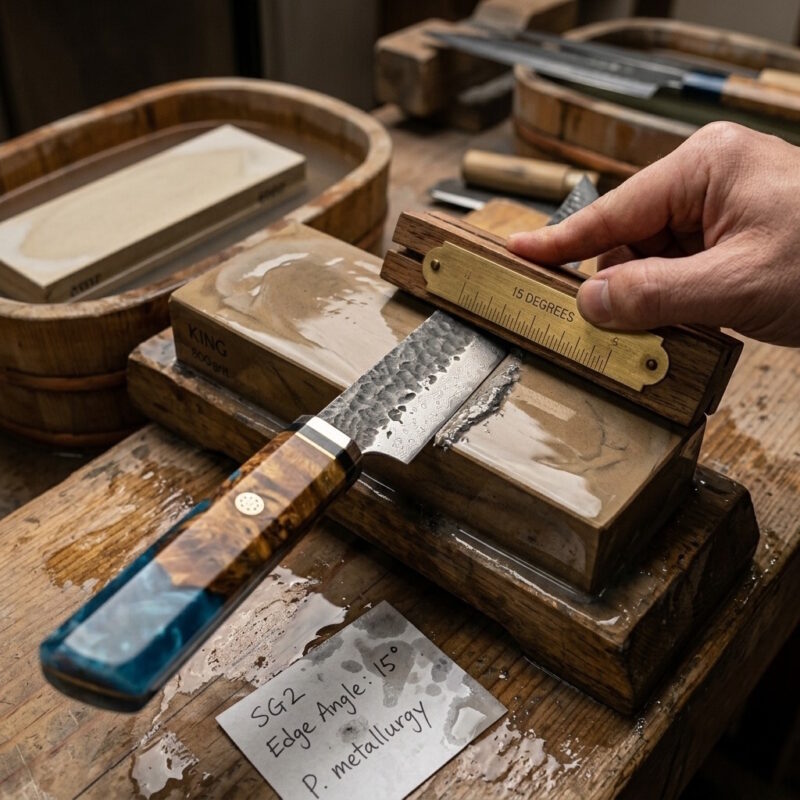
Complete Sharpening Guide
Many people hesitate to buy SG2 because they assume it is too difficult to sharpen.
In reality, SG2 simply rewards proper technique.
Recommended Stones
A practical progression includes:
- 400 grit (repairs only)
- 1000 grit (primary sharpening)
- 3000 grit (refinement)
- 6000–8000 grit (polishing)
Professional sharpeners often finish SG2 on fine splash-and-go ceramic stones.
Sharpening Angle
Most SG2 kitchen knives perform best between 12° and 15° per side.
This produces exceptional slicing performance while maintaining adequate durability.
Burr Removal
Removing the burr carefully is essential.
Light alternating strokes followed by stropping on leather or newspaper help produce a cleaner, longer-lasting edge.
Stropping
Occasional stropping extends the time between sharpening sessions.
Leather loaded with fine polishing compound works particularly well.
Common Mistakes to Avoid
Even premium steel can be damaged through improper use.
Avoid these common mistakes:
- Cutting frozen food
- Chopping through bones
- Twisting the blade while cutting
- Scraping food with the edge
- Putting SG2 knives in the dishwasher
- Leaving acidic food on the blade for extended periods
Proper technique allows SG2 to perform at its highest level for many years.
Buying an SG2 Knife
When shopping for an SG2 knife, remember that steel is only one part of the equation.
Also consider:
- Heat treatment quality
- Blade geometry
- Grind consistency
- Handle ergonomics
- Balance
- Fit and finish
- Reputation of the manufacturer
A well-made SG2 knife can easily outperform a poorly executed knife made from a more expensive steel.
This article is for independent informational purposes only and is not affiliated with, sponsored by, or endorsed by any steel manufacturer. All product names, trademarks, and registered trademarks are the property of their respective owners.
SG2 Steel Review
https://yashkadesigns.com/japanese-nakiri-knife-zdp-189-composite-steel-kitchen-vegetables-tool