An Independent Guide
ZDP-189 Steel Review
Introduction
When knife enthusiasts discuss premium blade steels with extraordinary edge retention, one name almost always enters the conversation: ZDP-189 steel. Developed in Japan, this remarkable stainless steel has earned a reputation for achieving incredibly high hardness while maintaining impressive corrosion resistance. It is considered one of the most wear-resistant steels available in production folding knives and has become a favorite among collectors, chefs, and everyday carry (EDC) enthusiasts who value long-lasting sharpness.
Unlike many modern powder metallurgy steels that aim to balance toughness, corrosion resistance, and edge retention, ZDP-189 focuses primarily on maximizing hardness and cutting performance. Properly heat treated, it can reach hardness levels of 65–67 HRC, significantly higher than most premium knife steels. This exceptional hardness allows blades to retain a razor-sharp edge through prolonged cutting tasks, making them ideal for users who prefer minimal sharpening.
However, ZDP-189 is not a perfect steel. Its extraordinary hardness comes with trade-offs, including reduced toughness and increased sharpening difficulty. Whether these compromises are worthwhile depends entirely on how you intend to use your knife.
In this comprehensive ZDP-189 steel review, we’ll examine everything you need to know, including its chemical composition, hardness, edge retention, corrosion resistance, toughness, sharpening characteristics, advantages, disadvantages, real-world performance, and how it compares to other popular premium steels such as MagnaCut, M390, Elmax, S90V, and VG10.
Whether you’re considering purchasing a ZDP-189 knife or simply want to understand why it has become legendary among knife enthusiasts, this guide will help you make an informed decision.
What Is ZDP-189 Steel?
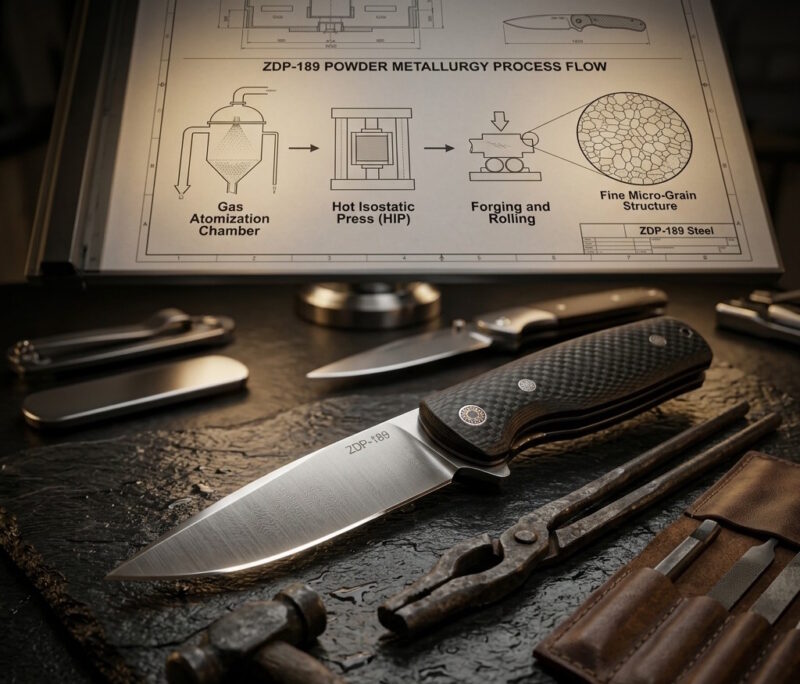
ZDP-189 is a powder metallurgy stainless steel manufactured in Japan. It was specifically engineered to achieve exceptionally high hardness without completely sacrificing corrosion resistance.
Unlike conventional stainless steels, ZDP-189 contains an unusually high carbon content—around 3% carbon, nearly three times more than many premium knife steels. Combined with approximately 20% chromium, the alloy forms a massive amount of extremely hard chromium carbides, dramatically increasing wear resistance and edge retention.
The steel is produced using powder metallurgy, a manufacturing process that creates a more uniform distribution of carbides compared to traditional ingot steels. This results in a finer microstructure, allowing the steel to achieve extreme hardness while remaining more usable than a conventionally cast steel with similar chemistry.
Today, ZDP-189 is most commonly found in premium folding knives from Japanese manufacturers and is especially popular among users who prioritize cutting performance above all else.
History of ZDP-189 Steel
ZDP-189 was developed as premium steel lineup designed for industrial cutting tools and high-performance knives. The goal was ambitious: create a stainless steel capable of achieving hardness levels previously associated only with high-carbon tool steels while maintaining adequate corrosion resistance.
The result was a steel unlike almost anything else available.
Spyderco played a significant role in introducing ZDP-189 to the global knife market. Their Japanese-made folding knives quickly demonstrated just how impressive the steel’s edge retention could be, and many collectors still consider those models among the finest production knives ever made.
Over the years, ZDP-189 has earned a reputation as one of the best steels for users who demand exceptional cutting longevity.
Chemical Composition of ZDP-189 Steel
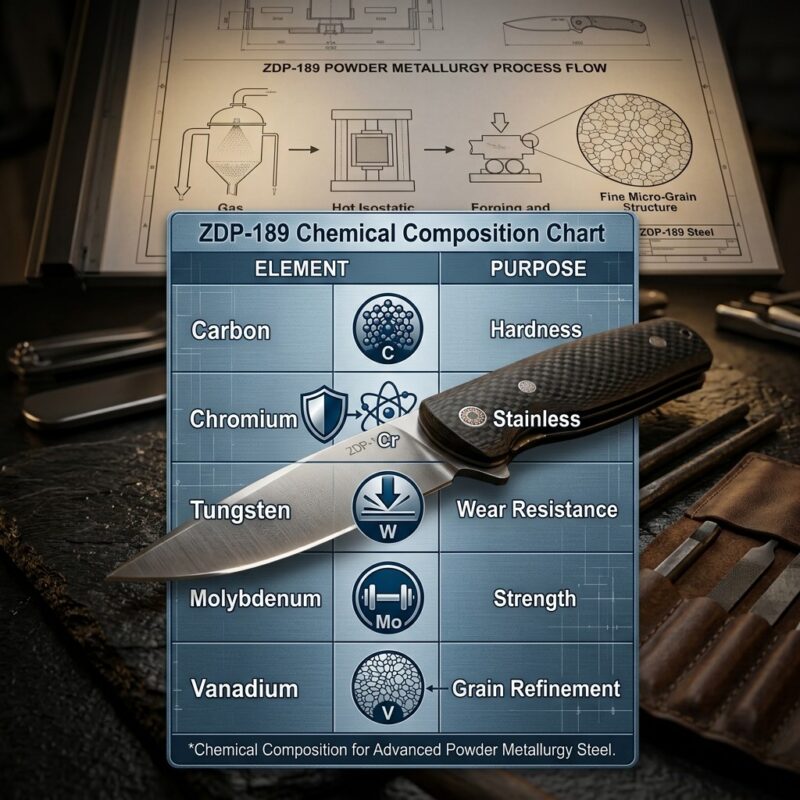
The approximate composition is:
| Element | Percentage | Purpose |
|---|---|---|
| Carbon (C) | 3.0% | Increases hardness and wear resistance |
| Chromium (Cr) | 20.0% | Provides corrosion resistance and forms hard carbides |
| Tungsten (W) | 1.4% | Improves wear resistance and hardness |
| Molybdenum (Mo) | 1.4% | Enhances corrosion resistance and strength |
| Vanadium (V) | 0.1% | Refines grain structure |
| Silicon (Si) | 0.5% | Improves manufacturing stability |
| Manganese (Mn) | 0.5% | Increases toughness and hardenability |
Understanding the Chemistry
Carbon – The Secret Behind Incredible Edge Retention
Most premium stainless knife steels contain between 0.8% and 1.5% carbon.
ZDP-189 contains approximately 3% carbon, an exceptionally high amount for a stainless steel.
This allows it to form a tremendous quantity of hard carbides that resist abrasion during cutting. As a result, the edge wears away much more slowly than steels with lower carbide content.
This is the primary reason ZDP-189 can remain sharp for an extremely long time.
Chromium – Stainless Performance
With approximately 20% chromium, ZDP-189 easily exceeds the 13% threshold generally required for stainless classification.
However, because much of that chromium becomes locked into carbides, the steel doesn’t offer corrosion resistance equal to steels like LC200N or Vanax.
Instead, users can expect good stainless performance with reasonable care.
Tungsten and Molybdenum
These alloying elements contribute to:
- Better wear resistance
- Higher hot hardness
- Improved strength
- Increased carbide stability
Together they enhance the steel’s already impressive cutting performance.
Hardness (HRC)
One of ZDP-189’s defining characteristics is its extremely high hardness.
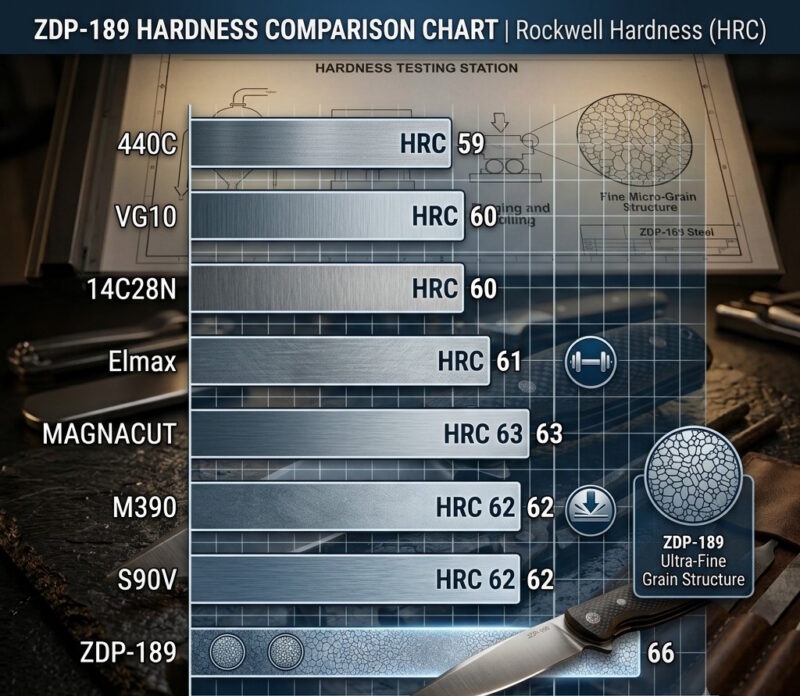
Typical production knives are heat treated to:
64–67 HRC
Some manufacturers even approach 67 HRC, making ZDP-189 one of the hardest stainless knife steels in regular production.
For comparison:
| Steel | Typical HRC |
| 440C | 58–60 |
| VG10 | 59–61 |
| 14C28N | 58–60 |
| Elmax | 60–62 |
| MagnaCut | 61–64 |
| M390 | 60–62 |
| S90V | 60–62 |
| ZDP-189 | 64–67 |
The higher hardness directly contributes to outstanding edge retention, but it also reduces toughness and makes sharpening more challenging.
Check Our Guide What Is HRC? Understanding Rockwell Hardness
| Steel | Rating |
|---|---|
| VG10 | ⭐⭐⭐⭐ |
| 154CM | ⭐⭐⭐⭐ |
| Elmax | ⭐⭐⭐⭐⭐ |
| MagnaCut | ⭐⭐⭐⭐⭐ |
| M390 | ⭐⭐⭐⭐⭐⭐ |
| S90V | ⭐⭐⭐⭐⭐⭐⭐ |
| ZDP-189 | ⭐⭐⭐⭐⭐⭐⭐⭐ |
Edge Retention – One of the Best in the Industry
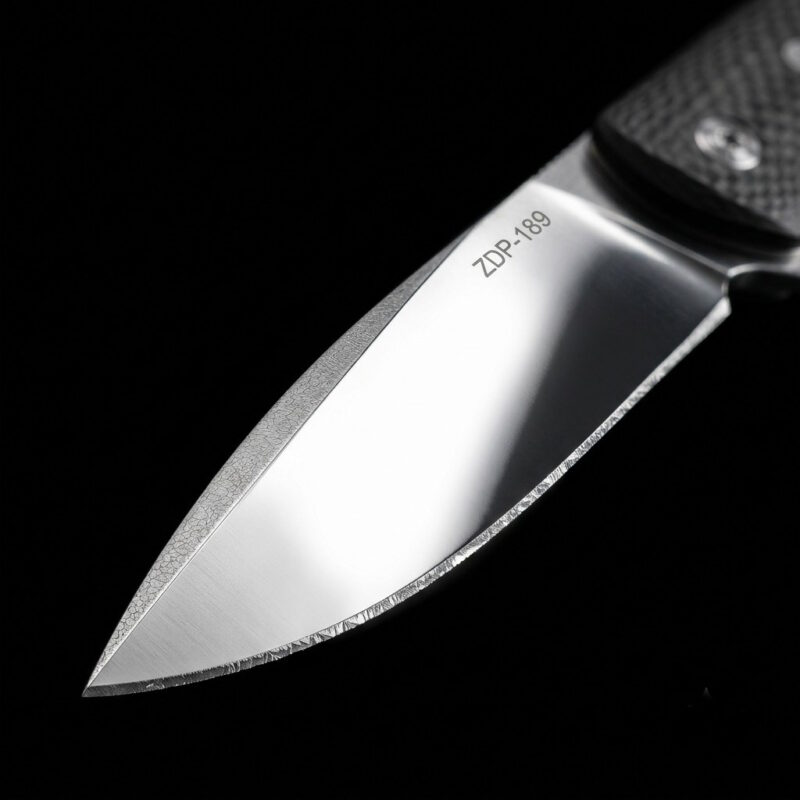
If there is one category where ZDP-189 truly excels, it is edge retention.
Few production steels can match its ability to continue cutting long after other blades have become dull.
Thanks to its combination of:
- Extremely high hardness
- Massive carbide volume
- Powder metallurgy manufacturing
ZDP-189 is capable of maintaining razor sharpness through thousands of cuts.
In practical use, this means:
- Opening countless cardboard boxes
- Food preparation
- Precision slicing
- Everyday carry tasks
- Utility cutting
…without requiring frequent sharpening.
For users who dislike sharpening their knives every week, ZDP-189 is a dream steel.
Real-World Cutting Performance
One reason enthusiasts continue to admire ZDP-189 is that its exceptional laboratory properties translate into real-world cutting ability.
Users often report that a properly sharpened ZDP-189 knife remains noticeably sharper than many competing steels after extended use. Tasks such as slicing cardboard, cutting rope, trimming plastics, and food preparation can often be completed over long periods with little loss of cutting performance.
This makes the steel particularly attractive for:
- Warehouse workers who break down large numbers of boxes.
- Tradespeople who rely on a consistently sharp utility knife.
- Hunters processing game where a long-lasting edge is valuable.
- Outdoor enthusiasts who may not have sharpening equipment readily available.
- Collectors who appreciate exceptional cutting performance.
Because the steel wears so slowly, the edge tends to degrade gradually rather than suddenly becoming unusable. Regular stropping on leather or fine abrasive compounds can often restore much of the original sharpness without the need for full resharpening.
Wear Resistance
Wear resistance refers to how well a blade resists being worn away during cutting, especially when working with abrasive materials.
This is another area where ZDP-189 performs exceptionally well.
Its large volume of hard chromium carbides significantly slows edge wear, allowing it to outperform many well-known premium steels during prolonged cutting tests.
Users cutting materials such as:
- Cardboard
- Rope
- Plastic strapping
- Carpet
- Heavy packaging
will immediately notice how slowly the edge dulls compared to conventional stainless steels.
For people who use a knife every day, this can mean fewer sharpening sessions over the life of the blade and more consistent cutting performance between maintenance intervals.
| Steel | Rating |
|---|---|
| 1095 | ⭐ |
| D2 | ⭐⭐⭐ |
| VG10 | ⭐⭐⭐⭐⭐ |
| M390 | ⭐⭐⭐⭐⭐⭐ |
| MagnaCut | ⭐⭐⭐⭐⭐⭐⭐ |
| LC200N | ⭐⭐⭐⭐⭐⭐⭐⭐⭐ |
| Vanax | ⭐⭐⭐⭐⭐⭐⭐⭐⭐ |
| ZDP-189 | ⭐⭐⭐⭐⭐⭐⭐ |
Corrosion Resistance – Better Than Many Expect
Given its very high carbon content, some users assume ZDP-189 behaves like a carbon steel and rusts easily. In reality, that is not the case.
With roughly 20% chromium, ZDP-189 qualifies as a stainless steel and offers respectable resistance to staining and corrosion under normal conditions.
In everyday environments—such as office use, general EDC tasks, or kitchen food preparation—it performs well as long as the blade is cleaned and dried after use.
However, because much of its chromium is tied up in carbides, it does not match the corrosion resistance of specialized stainless steels such as LC200N, Vanax, or MagnaCut.
For users in humid climates or around saltwater, occasional maintenance is still recommended to keep the blade looking its best.
| Steel | Rating |
|---|---|
| ZDP-189 | ⭐⭐⭐ |
| M390 | ⭐⭐⭐⭐ |
| Elmax | ⭐⭐⭐⭐⭐ |
| MagnaCut | ⭐⭐⭐⭐⭐⭐⭐ |
| CPM 3V | ⭐⭐⭐⭐⭐⭐⭐⭐⭐ |
Toughness – The Trade-Off for Extreme Hardness
No knife steel excels in every category, and the price of ZDP-189’s incredible edge retention is reduced toughness.
At hardness levels approaching 67 HRC, the steel becomes more susceptible to chipping if subjected to heavy impacts, twisting, prying, or chopping. It is designed for precise cutting rather than abusive tasks.
This doesn’t mean ZDP-189 is fragile—it performs very well within its intended role—but users should avoid treating it like a survival or demolition knife.
The best applications are those where clean slicing is more important than impact resistance.
Ease of Sharpening – The Biggest Challenge
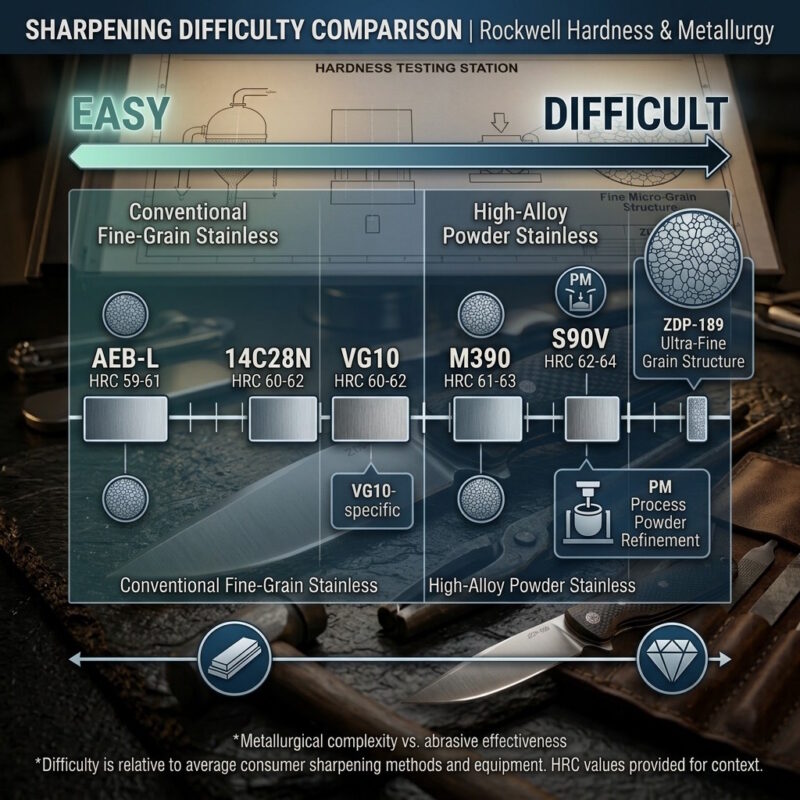
If there is one characteristic of ZDP-189 that discourages some knife owners, it is sharpening. The same wear resistance that keeps the blade sharp for an incredibly long time also makes removing steel much slower when the time finally comes to resharpen it.
Unlike steels such as 14C28N, AEB-L, or VG10, which sharpen relatively quickly on conventional water stones, ZDP-189 demands more patience and better sharpening equipment.
Why Is ZDP-189 Difficult to Sharpen?
The answer lies in its metallurgy. With approximately 3% carbon, 20% chromium, and an extremely high volume of hard chromium carbides, the abrasive particles in traditional sharpening stones struggle to remove material efficiently.
For best results, most experienced sharpeners recommend:
- Diamond stones
- CBN (Cubic Boron Nitride) stones
- High-quality ceramic finishing stones
- Leather strops with diamond compound
Using inexpensive aluminum oxide stones is possible, but sharpening sessions can become significantly longer.
Tips for Sharpening ZDP-189
If you own a ZDP-189 knife, these practices will help maintain its performance:
- Touch up the edge before it becomes completely dull.
- Strop the blade regularly to extend edge life.
- Maintain a consistent sharpening angle.
- Avoid aggressive grinding unless repairing damage.
- Use diamond abrasives whenever possible.
Fortunately, because ZDP-189 retains its edge for so long, sharpening is required far less frequently than with most knife steels.
Heat Treatment Matters
Like every premium knife steel, ZDP-189’s performance depends heavily on proper heat treatment.
A poorly heat-treated blade can lose much of the steel’s potential, while an expertly treated blade delivers the outstanding performance that made ZDP-189 famous.
High-quality manufacturers generally harden ZDP-189 to 64–67 HRC, balancing maximum wear resistance with acceptable toughness.
When evaluating a knife, the manufacturer’s reputation is almost as important as the steel itself. Many Brands and several Japanese custom makers have built excellent reputations for their ZDP-189 heat treatments.
Check Our Guide Steel Heat Treatment Explained
Best Uses for ZDP-189 Steel
Because of its unique characteristics, ZDP-189 excels in specific applications.
Everyday Carry (EDC)
For many enthusiasts, this is where ZDP-189 truly shines.
An EDC knife made from ZDP-189 can remain razor sharp through months of normal cutting tasks, making it ideal for users who value cutting performance over heavy-duty toughness.
Typical EDC tasks include:
- Opening packages
- Cutting cardboard
- Rope and cord
- Plastic packaging
- Office and warehouse work
Kitchen Knives
Japanese kitchen knives frequently emphasize edge retention, making ZDP-189 an attractive choice for chefs who prioritize precision.
Advantages include:
- Outstanding slicing performance
- Long-lasting razor edge
- Excellent food preparation efficiency
However, users should avoid:
- Chopping frozen food
- Cutting through bones
- Twisting the blade in hard ingredients
Proper technique helps maximize the steel’s lifespan.
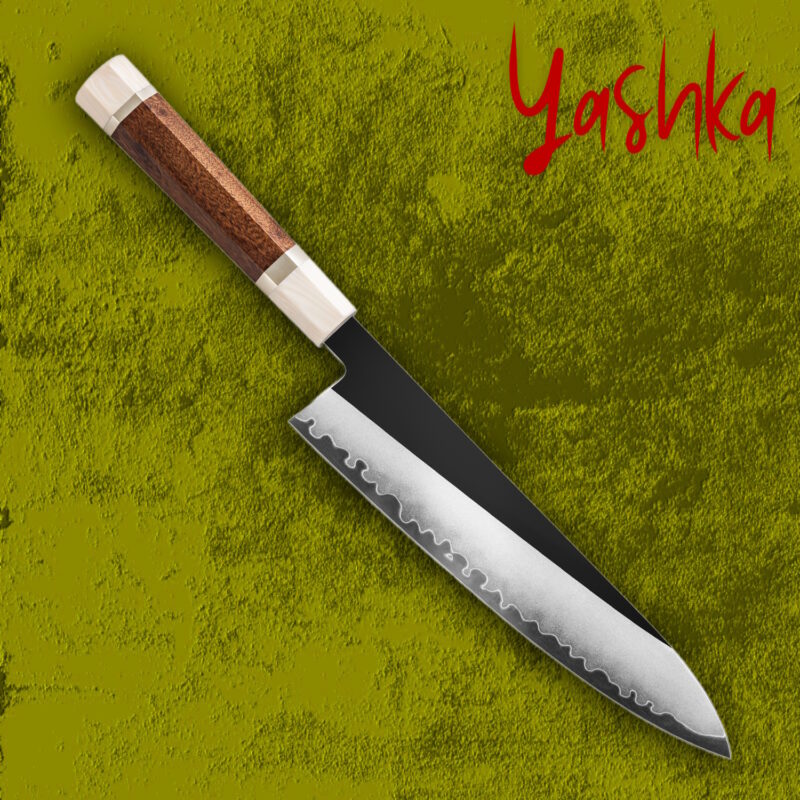
Looking for a great kitchen knife made of ZDP-189 steel?
Hunting Knives
Hunters often appreciate ZDP-189 because a single sharpening can last through extensive game processing.
Benefits include:
- Exceptional slicing ability
- Long-lasting sharpness
- Clean skinning performance
Still, users should avoid using the blade for prying joints or chopping bone.
Outdoor and Camping
ZDP-189 can certainly be used outdoors, but it is not the ideal survival steel.
Tasks it handles well include:
- Food preparation
- Feather sticks
- Rope cutting
- Light camp chores
Tasks better suited for tougher steels include:
- Batoning wood
- Heavy chopping
- Digging
- Prying
For those applications, steels such as MagnaCut, CPM 3V, or Cru-Wear are generally better choices.
ZDP-189 vs MagnaCut
This is one of today’s most interesting comparisons.
| Property | ZDP-189 | MagnaCut |
|---|---|---|
| Edge Retention | ⭐⭐⭐⭐⭐ | ⭐⭐⭐⭐½ |
| Toughness | ⭐⭐½ | ⭐⭐⭐⭐⭐ |
| Corrosion Resistance | ⭐⭐⭐⭐ | ⭐⭐⭐⭐⭐ |
| Sharpening | ⭐⭐ | ⭐⭐⭐⭐ |
Which Should You Choose?
Choose ZDP-189 if your highest priority is maximum edge retention and slicing performance.
Choose MagnaCut if you want the best all-around balance of toughness, corrosion resistance, edge retention, and ease of maintenance.
For most users, MagnaCut is the more versatile steel, while ZDP-189 remains a specialist for those who want exceptional cutting longevity.
Check Our Guide MagnaCut Steel Review
ZDP-189 vs M390
M390 has become one of the benchmark premium stainless steels.
ZDP-189 Advantages
- Higher achievable hardness
- Longer edge retention
- Better fine-edge stability
M390 Advantages
- Better toughness
- Easier sharpening
- More balanced overall performance
Winner
- Long-term cutting: ZDP-189
- Everyday versatility: M390
Check Our Guide M390 Steel Review
ZDP-189 vs Elmax
Elmax is known for balancing wear resistance, toughness, and corrosion resistance.
Compared to Elmax:
- ZDP-189 keeps an edge longer.
- Elmax is noticeably tougher.
- Elmax is easier to sharpen.
- Elmax tolerates harder use.
If you need a workhorse knife, Elmax may be the better choice.
If you primarily slice and cut, ZDP-189 offers superior edge longevity.
Check Our Guide ELMAX Steel Review
ZDP-189 vs S90V
S90V is another steel famous for remarkable edge retention.
Similarities
- Outstanding wear resistance
- Premium pricing
- Excellent cutting performance
Differences
S90V relies heavily on vanadium carbides, while ZDP-189 relies primarily on chromium carbides combined with extremely high hardness.
Many users find:
- ZDP-189 develops an exceptionally keen edge.
- S90V offers slightly better toughness.
- Both require diamond sharpening equipment.
Choosing between them often comes down to personal preference.
Check Our Guide CPM S90V Steel Review
ZDP-189 vs VG10
VG10 is one of Japan’s most popular stainless knife steels.
Compared to VG10:
- ZDP-189 lasts significantly longer between sharpening sessions.
- VG10 sharpens much more easily.
- VG10 is tougher.
- VG10 is more forgiving for beginners.
If you’re just entering the premium knife market, VG10 is often the easier steel to own.
For experienced enthusiasts seeking maximum performance, ZDP-189 offers clear advantages.
Check Our Guide VG10 Steel Review
Advantages of ZDP-189 Steel
One reason ZDP-189 has remained popular for years is that it excels in the areas enthusiasts care about most.
Pros
- Exceptional edge retention
- Extremely high hardness (64–67 HRC)
- Outstanding wear resistance
- Fine, razor-sharp cutting edge
- Good stainless performance
- Excellent for precision slicing
- Premium Japanese metallurgy
- Ideal for collectors and enthusiasts
Disadvantages of ZDP-189 Steel
No knife steel is perfect.
Cons
- Difficult to sharpen
- Lower toughness than many premium steels
- Can chip under abuse
- Expensive
- Not ideal for survival or heavy-impact tasks
- Requires quality sharpening equipment
Understanding these trade-offs is essential before investing in a ZDP-189 knife.
Who Should Buy a ZDP-189 Knife?
ZDP-189 is an excellent choice for:
- Knife collectors
- EDC enthusiasts
- Warehouse workers
- Office users
- Professional chefs
- Hunters
- Users who dislike frequent sharpening
You may want another steel if you frequently:
- Baton wood
- Pry objects
- Chop branches
- Use your knife roughly
- Prefer quick field sharpening
Frequently Asked Questions
Is ZDP-189 better than M390?
Neither steel is universally better. ZDP-189 generally provides longer edge retention, while M390 offers a more balanced combination of toughness, corrosion resistance, and easier maintenance.
Does ZDP-189 rust?
It is a stainless steel and resists corrosion well under normal conditions. However, it is not as corrosion-resistant as LC200N, Vanax, or MagnaCut, so cleaning and drying the blade after use is still recommended.
Is ZDP-189 brittle?
At very high hardness levels, ZDP-189 has lower toughness than many modern premium steels. It performs best as a slicing steel rather than for heavy impact or prying.
Is ZDP-189 difficult to sharpen?
Yes. Its exceptional wear resistance makes sharpening slower than with most stainless steels. Diamond or CBN stones make the process much easier.
Is ZDP-189 good for kitchen knives?
Absolutely. Its ability to hold an incredibly sharp edge makes it an excellent choice for chefs who prioritize precision slicing and are comfortable with proper knife care.
Final Verdict: Is ZDP-189 Worth It?
ZDP-189 is one of the most specialized and impressive knife steels ever developed. Rather than attempting to excel equally in every category, it focuses on delivering extraordinary cutting performance and edge retention.
For users who value a knife that stays razor sharp through extended use, very few steels can compete. It excels in everyday carry, precision cutting, and kitchen applications where slicing ability matters more than impact resistance.
Its drawbacks—reduced toughness and more demanding sharpening—are real, but for many enthusiasts they are an acceptable trade-off for such remarkable cutting longevity.
If your priorities are maximum edge retention, exceptional wear resistance, and premium Japanese craftsmanship, ZDP-189 remains one of the finest choices available.
However, if you prefer a more balanced steel that combines toughness, corrosion resistance, and easier maintenance, options like MagnaCut or M390 may better suit your needs.
Overall Ratings
| Property | Rating |
| Edge Retention | ⭐⭐⭐⭐⭐ (10/10) |
| Wear Resistance | ⭐⭐⭐⭐⭐ (10/10) |
| Hardness | ⭐⭐⭐⭐⭐ (10/10) |
| Corrosion Resistance | ⭐⭐⭐⭐☆ (8.5/10) |
| Toughness | ⭐⭐⭐☆☆ (6/10) |
| Ease of Sharpening | ⭐⭐☆☆☆ (4/10) |
| Overall Performance | ⭐⭐⭐⭐⭐ (9.4 |
This article is for independent informational purposes only and is not affiliated with, sponsored by, or endorsed by any steel manufacturer. All product names, trademarks, and registered trademarks are the property of their respective owners.
https://yashkadesigns.ecrater.com/c/2444215/nakiri-knives
ZDP-189 Steel Review