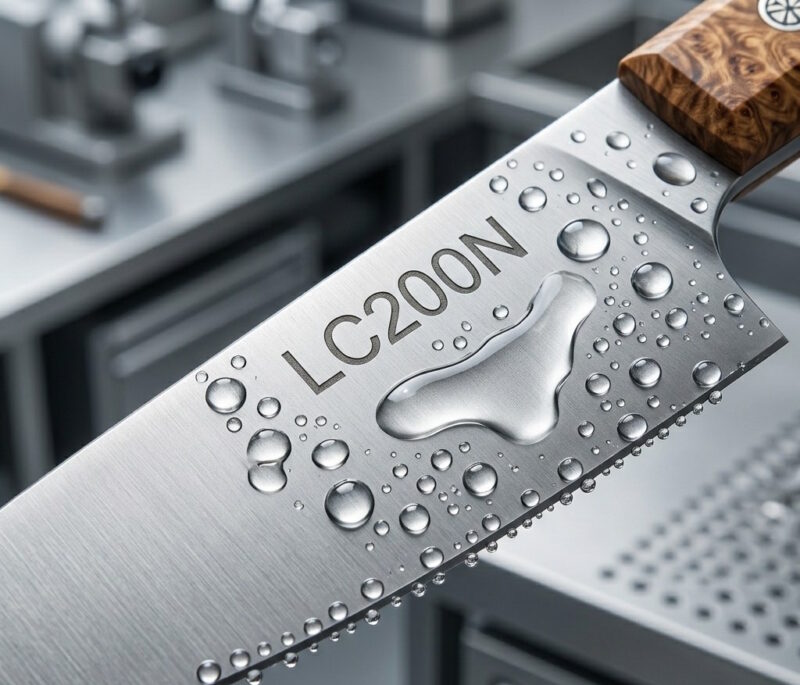
An Independent Guide
LC200N Steel Review
Introduction: Why LC200N Steel Is So Highly Respected
In the modern knife world, steel performance is often judged by two things: edge retention and hardness. But LC200N steel plays a completely different game.
Instead of focusing on being the hardest or longest-lasting edge steel, LC200N is engineered for one primary mission:
👉 near-total corrosion resistance in extreme environments
That makes it one of the most unique and specialized knife steels ever developed.
Originally created for aerospace and high-performance industrial applications, LC200N has become extremely popular in:
- Marine and fishing knives
- Professional kitchen knives
- Diving and saltwater tools
- High-end EDC knives for humid climates
But is it really as close to “rust-proof” as people say? And what are the trade-offs compared to modern super steels like MagnaCut and M390?
This complete LC200N steel review breaks everything down in detail.
What is LC200N Steel?
LC200N is a high-nitrogen stainless steel produced in Germany. It belongs to a family of ultra-corrosion-resistant steels originally designed for extreme engineering environments.
It is sometimes associated with:
- Cronidur 30 (related aerospace-grade steel family)
- Z-FiNit (trade name used in some applications)
Unlike traditional knife steels, LC200N is not carbide-heavy. Instead, it uses nitrogen as a key strengthening element, which significantly changes its structure and behavior.
Core idea:
👉 LC200N prioritizes corrosion resistance and toughness over extreme hardness.
Origins: From Aerospace to Knife Blades
LC200N was originally designed for environments where failure is not an option:
- Aerospace bearing systems
- High-load industrial machinery
- Saltwater and humidity-exposed components
- High-speed mechanical systems
These applications require materials that:
✔ Do not rust
✔ Do not degrade under moisture
✔ Maintain stability under stress
Knife manufacturers later recognized its potential and adapted it for blades, especially in environments where rust is a constant problem.
Chemical Composition of LC200N Steel
Typical composition:
- Chromium (Cr): ~15%
- Nitrogen (N): ~0.5%
- Carbon (C): ~0.2–0.3%
- Molybdenum (Mo): ~1%
- Nickel (Ni): ~0.5%
Why This Composition Matters
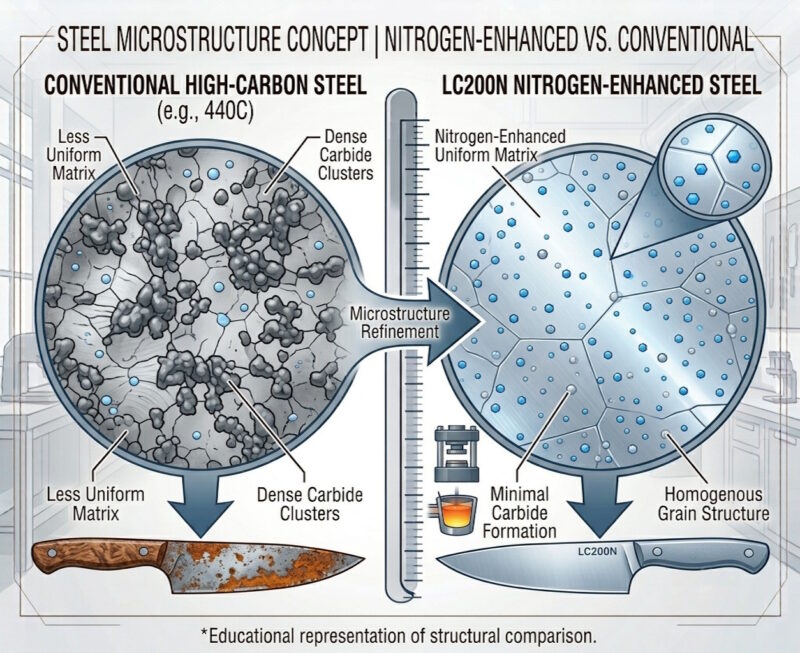
Most knife steels rely heavily on carbon to form carbides, which increase hardness and wear resistance. However, carbides often reduce corrosion resistance and toughness.
LC200N takes a different path:
👉 It minimizes carbide formation and strengthens the steel using nitrogen instead.
Result:
✔ Extremely uniform microstructure
✔ Exceptional corrosion resistance
✔ High toughness
✔ Very stable performance in wet environments
In simple terms:
LC200N behaves more like a precision engineering alloy than a traditional knife steel.
Key Properties of LC200N Steel
🔒 Corrosion Resistance – Industry Leading
This is where LC200N dominates almost every other knife steel.
It is widely considered:
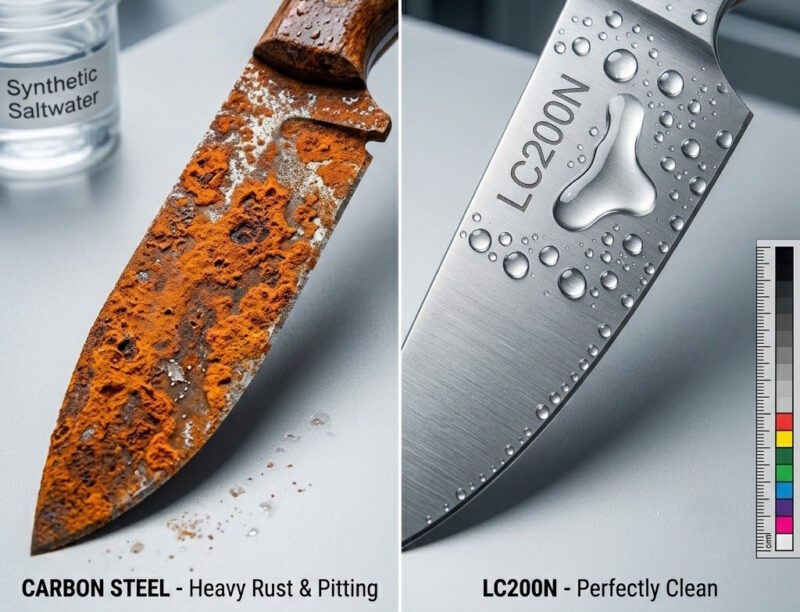
✔ One of the most corrosion-resistant knife steels ever produced
✔ Highly resistant to saltwater and humidity
✔ Extremely stable in acidic environments
Even prolonged exposure to salt spray environments shows minimal corrosion compared to most stainless steels.
Comparison:
This is why it is heavily used in:
- Fishing knives
- Marine tools
- Food processing equipment
- Medical-grade environments
👉 In real-world use, LC200N behaves almost like a “rust-proof steel.”
🔪 Edge Retention – Moderate Performance
LC200N is not designed to compete with carbide-heavy super steels.
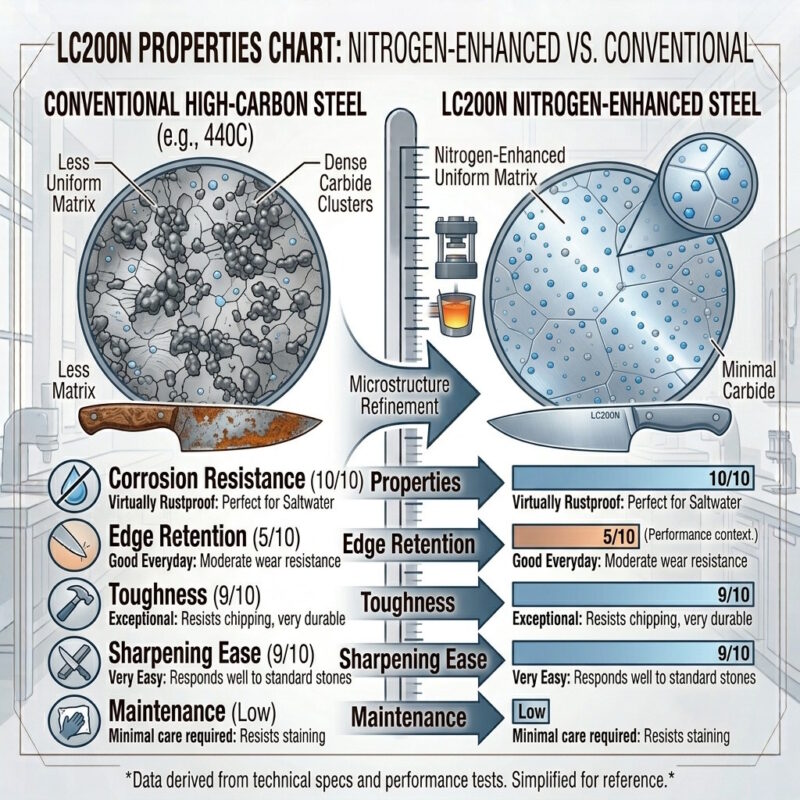
Its edge retention sits in the mid-range category:
- Similar to VG10
- Similar to AEB-L
- Slightly below 14C28N in some heat treatments
Real-world behavior:
✔ Holds a usable working edge
✔ Requires more frequent sharpening than powder steels
✔ Performs best in slicing tasks rather than abrasive cutting
Comparison:
- S30V → better edge retention
- M390 → significantly better
- S90V → far superior
- MagnaCut → better balance overall
👉 LC200N sacrifices edge longevity for corrosion immunity.
🧱 Toughness – One of Its Strongest Features
LC200N has excellent toughness due to its low carbide content.
That means:
- High resistance to chipping
- Excellent durability under stress
- Flexibility in thin blade designs
It performs similarly to:
- AEB-L
- 14C28N
But with dramatically better corrosion resistance.
Ideal uses:
- Fillet knives
- Kitchen knives
- Rescue tools
- Outdoor utility blades
🪒 Sharpening – Extremely Easy
One of LC200N’s biggest advantages is how easy it is to sharpen.
Even beginners can achieve razor sharpness quickly.
Benefits:
✔ Fast edge formation
✔ Easy maintenance in the field
✔ Excellent stropping response
✔ Low skill requirement
Compared to steels like M390 or S90V, LC200N is significantly easier to maintain.
Performance Summary
| Property | Rating |
|---|---|
| Corrosion Resistance | ⭐⭐⭐⭐⭐⭐⭐⭐⭐⭐ |
| Edge Retention | ⭐⭐⭐⭐ |
| Toughness | ⭐⭐⭐⭐⭐⭐ |
| Sharpening Ease | ⭐⭐⭐⭐⭐⭐ |
Real-World Performance of LC200N Steel
🐟 Marine & Fishing Use
LC200N is one of the best steels ever used in saltwater environments.
Users consistently report:
- No rust after repeated ocean exposure
- No staining from fish acids
- Minimal maintenance required
This makes it a top-tier choice for:
- Fishing knives
- Boat tools
- Diving knives
👉 Few steels can match its performance in saltwater conditions.
🍳 Kitchen Use
LC200N performs exceptionally well in professional kitchens.
Advantages:
✔ Resistant to acidic foods (tomato, lemon, vinegar)
✔ Easy to clean and sanitize
✔ Maintains appearance over time
Trade-off:
- Requires more frequent sharpening than high-end powder steels
Still, many chefs prefer it for its low-maintenance reliability.
🏕 Outdoor & EDC Use
In outdoor environments, LC200N offers:
✔ Excellent corrosion resistance in rain and humidity
✔ Strong toughness for utility work
✔ Easy field sharpening
Limitations:
- Not ideal for heavy chopping
- Not optimized for long edge retention
LC200N vs Other Popular Knife Steels
⚔️ LC200N vs VG10
VG10 is a classic Japanese stainless steel.
- VG10 → better edge retention
- LC200N → far superior corrosion resistance
Winner depends on use:
- Kitchen slicing → VG10
- Wet environments → LC200N
⚔️ LC200N vs S30V
- S30V → better edge retention and wear resistance
- LC200N → better toughness and rust immunity
Winner:
- Dry EDC use → S30V
- Marine/kitchen use → LC200N
⚔️ LC200N vs MagnaCut
This is the most important modern comparison.
- MagnaCut → best overall balance of performance
- LC200N → superior corrosion resistance in extreme conditions
- LC200N → easier to sharpen
- MagnaCut → much better edge retention
Verdict:
- Overall winner → MagnaCut
- Extreme saltwater winner → LC200N
Check Our Guide MagnaCut Steel Review
⚔️ LC200N vs M390
- M390 → elite edge retention and wear resistance
- LC200N → rust-proof reliability and toughness
Winner:
- Cutting performance → M390
- Wet environment durability → LC200N
⚔️ LC200N vs Elmax
- Elmax → balanced premium steel
- LC200N → specialized corrosion-resistant steel
Verdict:
- General use → Elmax
- Wet environments → LC200N
Advantages of LC200N Steel
✔ Near-perfect corrosion resistance
✔ Excellent toughness
✔ Very easy to sharpen
✔ Ideal for marine and wet environments
✔ Food-safe performance
✔ Low maintenance requirements
Disadvantages of LC200N Steel
❌ Moderate edge retention
❌ Not a super steel for cutting endurance
❌ More expensive than mid-range steels
❌ Not ideal for heavy abrasive tasks
Final Verdict: Is LC200N Worth It?
LC200N is not designed to compete with modern “super steels” in edge retention.
Instead, it dominates a very specific category:
👉 absolute corrosion resistance with excellent toughness
Choose LC200N if you want:
✔ A knife that will not rust
✔ Low-maintenance performance
✔ Marine or kitchen reliability
✔ Easy sharpening in the field
Avoid LC200N if you need:
❌ Maximum edge retention
❌ Heavy-duty chopping performance
❌ Long wear resistance under abrasive use
Summary
LC200N steel is a high-nitrogen stainless steel designed for extreme corrosion resistance, toughness, and low maintenance performance. While it does not match premium powder steels in edge retention, it outperforms nearly all steels in rust resistance, making it ideal for marine, kitchen, and humid environments.
This article is for independent informational purposes only and is not affiliated with, sponsored by, or endorsed by any steel manufacturer. All product names, trademarks, and registered trademarks are the property of their respective owners.