An Independent Guide
Vanax Steel Review
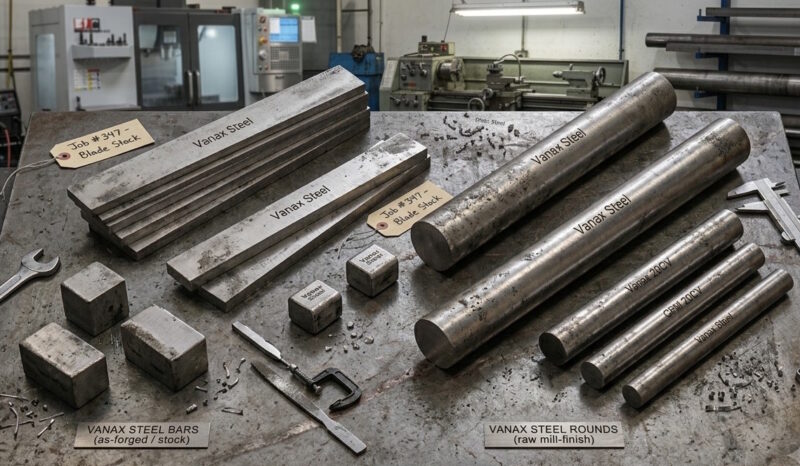
Among premium knife steels, few materials have generated as much excitement as Vanax. Developed using advanced powder metallurgy technology, Vanax offers a combination of exceptional corrosion resistance, excellent edge retention, and impressive toughness that was once considered impossible in a stainless knife steel.
For years, knife enthusiasts believed they had to choose between corrosion resistance and cutting performance. Steels like LC200N resisted rust exceptionally well but offered only moderate wear resistance, while steels such as CPM S110V or M390 delivered outstanding edge retention but could not match the corrosion resistance required for marine environments.
Vanax changed that equation.
Vanax was engineered to perform in some of the harshest environments imaginable. Whether exposed to saltwater, humidity, blood, or acidic foods, Vanax remains remarkably resistant to corrosion while still providing the cutting performance expected from a modern “super steel.”
But is Vanax really better than MagnaCut? How does it compare with M390 or CPM S90V? Is it worth its premium price, and what are its strengths and weaknesses?
This comprehensive review answers those questions and explores every aspect of Vanax, including its metallurgy, hardness, sharpening characteristics, real-world performance, and comparisons with other premium knife steels.
What Is Vanax Steel?
Vanax is a high-performance stainless powder metallurgy steel, one of the world’s leading specialty steel manufacturers based in Sweden.
Unlike traditional stainless steels, Vanax was designed to maximize corrosion resistance while maintaining excellent wear resistance and toughness. It achieves this through a unique nitrogen-alloyed composition combined with powder metallurgy manufacturing.
One of Vanax’s defining characteristics is that it uses nitrogen as a primary alloying element instead of relying solely on carbon. Nitrogen contributes to hardness and corrosion resistance while reducing the formation of chromium carbides, allowing more chromium to remain available for rust protection.
As a result, Vanax offers corrosion resistance approaching that of specialty marine steels while delivering cutting performance comparable to many premium knife steels.
Today, Vanax is used in:
- Premium folding knives
- Everyday carry (EDC) knives
- Saltwater fishing knives
- Diving knives
- Hunting knives
- Kitchen knives
- Custom high-end knives
Its combination of corrosion resistance and cutting performance has made it increasingly popular among enthusiasts who live in humid or coastal environments.
The History of Vanax Steel
Vanax was developed by Swedish company with more than 350 years of experience in advanced metallurgy. The goal was ambitious: create a steel that could resist corrosion even in aggressive environments without sacrificing the cutting performance demanded by premium knife users.
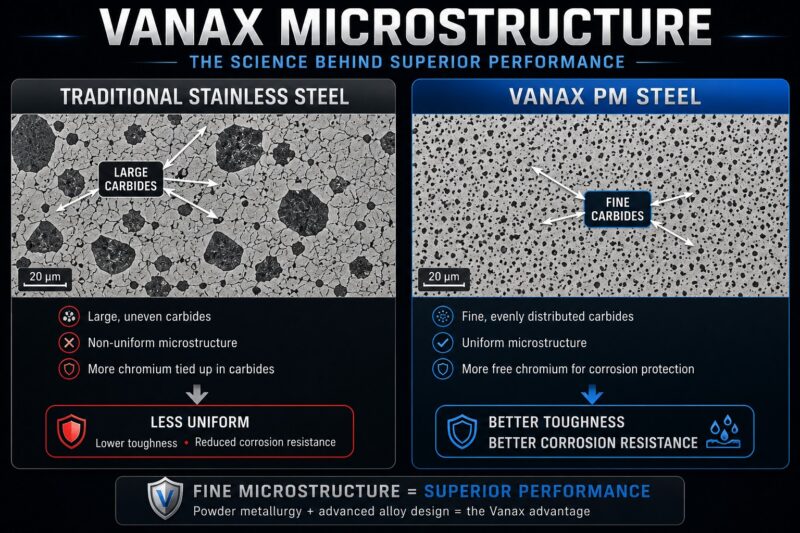
Traditional stainless steels achieve corrosion resistance primarily through chromium. However, adding more chromium often reduces toughness or wear resistance. This challenge was addressed by incorporating nitrogen into the alloy while using powder metallurgy to create an exceptionally fine and uniform microstructure
The result was Vanax—a steel originally developed for demanding industrial applications but quickly adopted by custom knifemakers and premium manufacturers. As knife enthusiasts recognized its unique balance of properties, Vanax gained a reputation as one of the finest corrosion-resistant steels available.
Today, it is often compared directly with CPM MagnaCut, LC200N, and M390 when discussing premium stainless knife steels.
Powder Metallurgy: Why It Matters
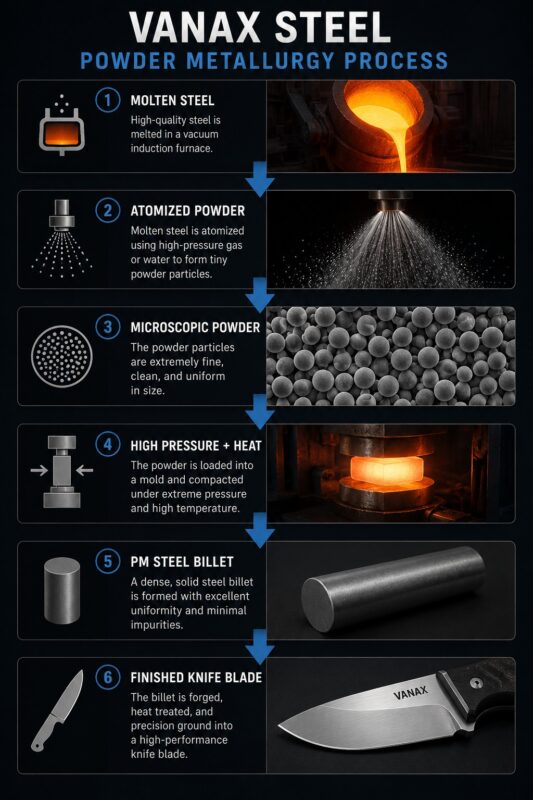
Vanax is manufactured using powder metallurgy (PM), an advanced production process that creates cleaner and more uniform steel than conventional casting.
The process begins by atomizing molten steel into microscopic powder particles. These particles cool rapidly, preventing the formation of large carbides.
The powder is then compressed under high pressure and temperature to produce solid steel billets.
This method provides several advantages:
- Extremely fine grain structure
- Uniform carbide distribution
- Improved toughness
- Better edge stability
- Consistent wear resistance
- Reliable manufacturing quality
Powder metallurgy is one of the reasons Vanax can combine excellent toughness with high corrosion resistance.
Vanax Chemical Composition
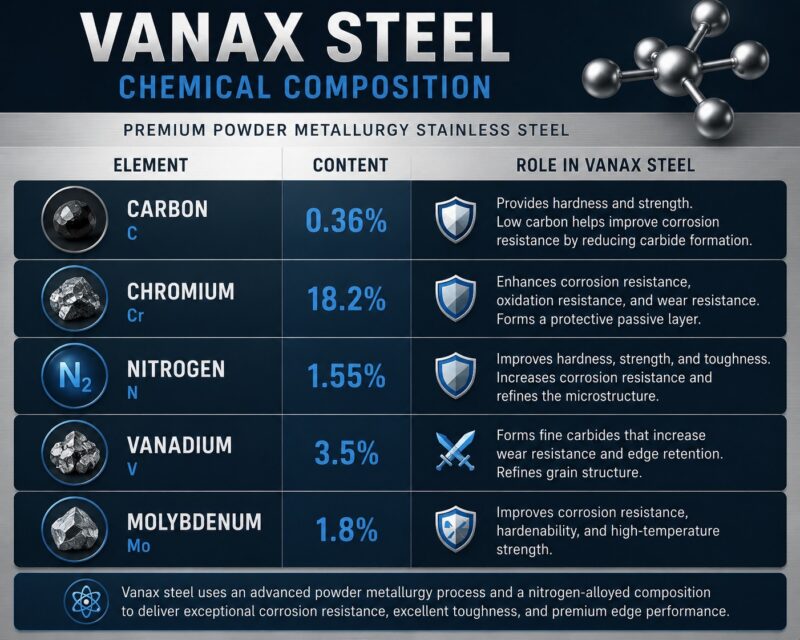
The exact composition varies slightly between production batches, but Vanax typically contains approximately:
| Element | Approximate Content |
|---|---|
| Carbon | ~0.36% |
| Chromium | ~18.2% |
| Nitrogen | ~1.55% |
| Molybdenum | ~1.8% |
| Vanadium | ~3.5% |
Rather than relying on extremely high carbon content, Vanax uses nitrogen to improve performance.
Let’s examine the role of each major element.
Carbon
Compared with most premium knife steels, Vanax contains relatively little carbon.
This may seem surprising, but lower carbon helps prevent excessive chromium carbide formation, allowing more chromium to remain dissolved in the steel where it improves corrosion resistance.
Chromium
With approximately 18% chromium, Vanax contains more chromium than many premium stainless steels.
Chromium contributes:
- Outstanding corrosion resistance
- Rust prevention
- Stain resistance
- Oxidation resistance
This high chromium content makes Vanax one of the best choices for humid environments and marine use.
Nitrogen
Nitrogen is the defining feature of Vanax.
Instead of relying solely on carbon, nitrogen contributes:
- Increased hardness
- Excellent corrosion resistance
- Improved toughness
- Fine grain structure
- Better edge stability
Nitrogen also allows more chromium to remain available for corrosion protection.
Vanadium
Vanadium contributes to:
- Wear resistance
- Edge retention
- Fine grain structure
- Carbide formation
Although Vanax contains less vanadium than CPM S90V or S110V, it still provides excellent cutting performance.
Molybdenum
Molybdenum improves:
- Corrosion resistance
- Strength
- Hardenability
- High-temperature stability
Together with chromium and nitrogen, molybdenum helps produce Vanax’s remarkable resistance to rust.
Vanax Hardness
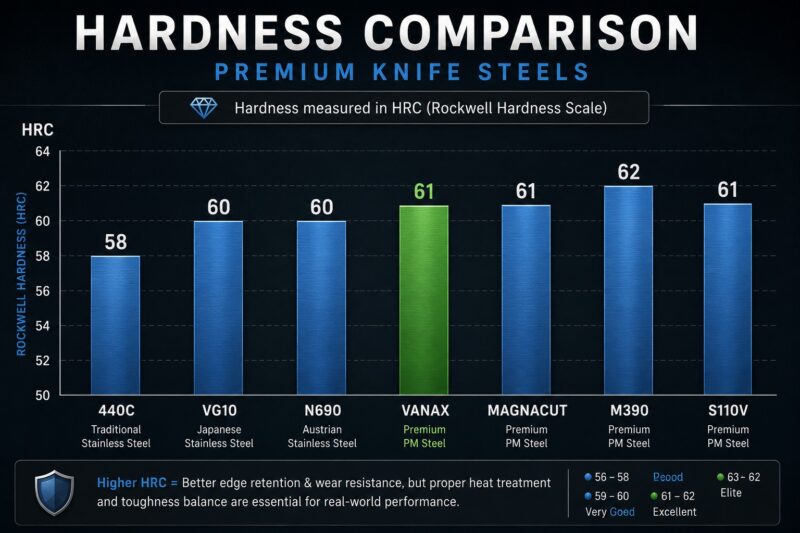
Most manufacturers heat treat Vanax between 60 and 62 HRC.
Some custom makers target slightly higher hardness, while others prefer lower hardness for increased toughness.
At around 61 HRC, Vanax offers an excellent balance of:
- Edge retention
- Toughness
- Corrosion resistance
- Ease of maintenance
Check Our Guide What Is HRC? Understanding Rockwell Hardness
Edge Retention
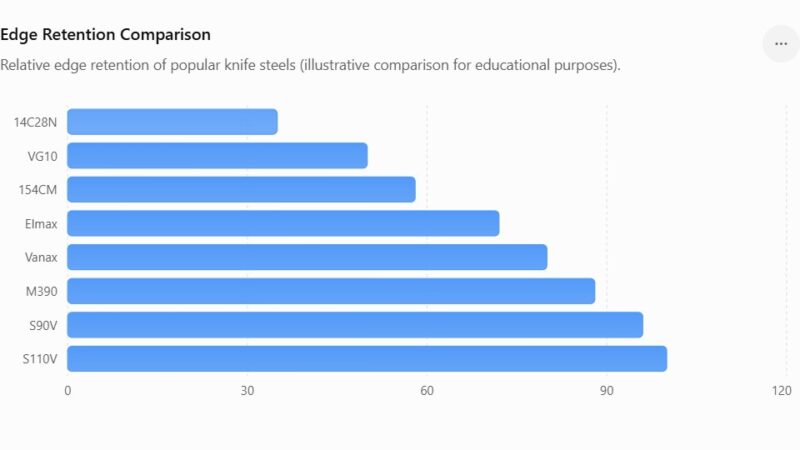
Although Vanax is best known for corrosion resistance, its edge retention is also impressive.
Thanks to its powder metallurgy structure and carefully balanced alloy composition, Vanax maintains a sharp edge significantly longer than traditional stainless steels such as 440C, AUS-8, or N690.
While it does not quite match the extreme wear resistance of CPM S110V or CPM S90V, it still performs at a very high level and comfortably competes with many premium stainless steels.
For everyday carry and outdoor use, many users find Vanax provides more than enough edge life between sharpening sessions.
Corrosion Resistance
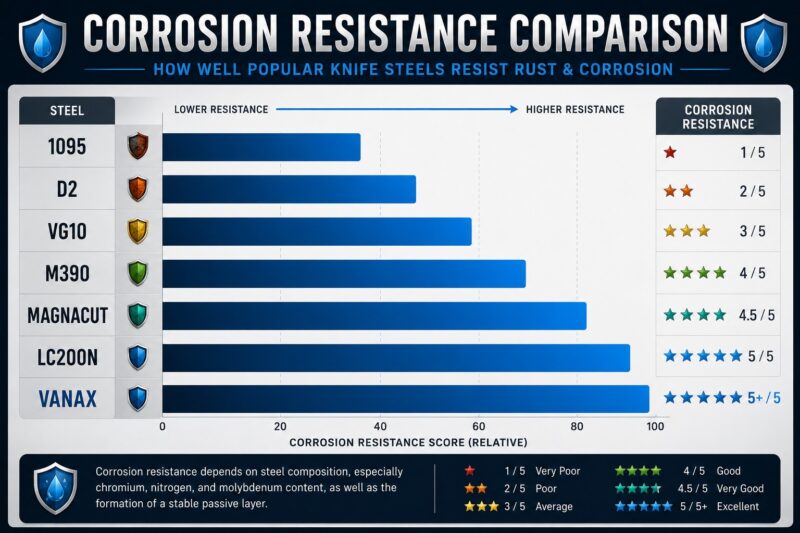
This is where Vanax truly stands apart.
Many knife enthusiasts consider Vanax among the most corrosion-resistant knife steels ever developed.
It performs exceptionally well against:
- Saltwater
- Humidity
- Sweat
- Blood
- Acidic foods
- Rain
- Marine environments
Even users who regularly carry knives near the ocean report excellent resistance to staining and rust.
This makes Vanax one of the best choices for:
- Fishermen
- Divers
- Sailors
- Coastal residents
- Professional chefs
- Hunters
Although no steel is completely immune to corrosion, Vanax comes remarkably close under normal conditions.
Wear Resistance
Vanax provides excellent wear resistance despite prioritizing corrosion resistance.
Its vanadium-rich powder metallurgy structure allows it to resist abrasive materials effectively.
Common cutting tasks include:
- Rope
- Cardboard
- Leather
- Plastic
- Wood
- Food
While steels such as S110V and S90V outperform Vanax in pure wear resistance, the difference is often less noticeable during everyday use than many buyers expect.
Toughness
One of Vanax’s greatest strengths is its balanced toughness.
Compared with many ultra-high wear-resistant steels, Vanax resists chipping surprisingly well.
This makes it more forgiving during demanding cutting tasks.
Although it is not intended for extreme impact work like CPM 3V, Vanax performs very well in general outdoor use and everyday carry applications.
Many users appreciate that it combines:
- Excellent edge retention
- Outstanding corrosion resistance
- Practical toughness
without heavily sacrificing one property for another.
Is Vanax Difficult to Sharpen?
Vanax is easier to sharpen than many high-vanadium steels.
Compared with:
- CPM S110V
- CPM S90V
Vanax generally requires less effort to restore a sharp edge.
Diamond stones still produce the fastest results, but high-quality ceramic stones also perform well.
For most users, Vanax strikes an appealing balance between long edge life and reasonable sharpening effort.
Does Vanax Take a Sharp Edge?
Absolutely.
Vanax is capable of achieving an extremely refined cutting edge.
Proper sharpening can produce:
- Hair-shaving sharpness
- Clean push cuts
- Excellent slicing ability
- Long-lasting edge stability
Its fine powder metallurgy grain structure supports very consistent sharpening results.
Best Uses for Vanax
Vanax is remarkably versatile.
Ideal applications include:
- Everyday carry (EDC)
- Folding knives
- Saltwater fishing knives
- Diving knives
- Hunting knives
- Kitchen knives
- Food preparation
- Outdoor knives
- Utility knives
Few steels perform equally well across such a wide range of environments.
Applications Where Vanax Is Less Suitable
Although Vanax is highly versatile, it is not the perfect steel for every task.
Users who prioritize maximum edge retention above everything else may prefer:
- CPM S110V
- CPM S90V
Likewise, those performing extremely heavy chopping or batoning may benefit from tougher tool steels such as CPM 3V or CruWear.
For the majority of everyday cutting tasks, however, Vanax remains an outstanding all-around performer.
Vanax vs MagnaCut
These two steels are frequently compared because both offer exceptional corrosion resistance and excellent overall balance.
| Feature | Vanax | MagnaCut |
|---|---|---|
| Corrosion Resistance | Outstanding | Outstanding |
| Edge Retention | Excellent | Excellent |
| Toughness | Excellent | Outstanding |
| Sharpening | Moderate | Slightly Easier |
| Marine Performance | Outstanding | Outstanding |
Vanax generally has a slight advantage in extreme corrosion resistance, while MagnaCut often offers slightly better toughness and easier sharpening.
Check Our Guide MagnaCut Steel Review
Vanax vs M390
M390 has long been considered one of the world’s best premium stainless knife steels.
Compared with M390:
Vanax offers:
- Better corrosion resistance
- Better toughness
- Outstanding performance in marine environments
M390 offers:
- Slightly higher wear resistance
- Longer edge retention in abrasive cutting
- Wider availability
For users working around saltwater or humid conditions, Vanax is often the preferred choice.
Check Our Guide M390 Steel Review
Vanax vs CPM S90V
Although both Vanax and CPM S90V are premium powder metallurgy steels, they were designed with different priorities.
CPM S90V emphasizes maximum wear resistance and edge retention, while Vanax focuses on achieving exceptional corrosion resistance without sacrificing overall cutting performance.
| Feature | Vanax | CPM S90V |
|---|---|---|
| Edge Retention | Excellent | Outstanding |
| Wear Resistance | Excellent | Outstanding |
| Toughness | Better | Good |
| Corrosion Resistance | Outstanding | Excellent |
| Sharpening | Easier | More Difficult |
For users who frequently work near saltwater or in humid climates, Vanax is usually the better option. If the goal is to maximize edge retention during abrasive cutting tasks, CPM S90V still has the advantage.
Check Our Guide CPM S90V Steel Review
Vanax vs CPM S110V
These two steels occupy the premium end of the knife steel market but serve different audiences.
Vanax Advantages
- Superior corrosion resistance
- Better toughness
- Easier sharpening
- Better resistance to chipping
CPM S110V Advantages
- Longer edge retention
- Higher wear resistance
- Better performance on abrasive materials
For everyday carry, many users find Vanax easier to live with, while S110V appeals to enthusiasts who want the longest possible cutting life between sharpening sessions.
Check Our Guide CPM S110V Steel Review
Vanax vs Elmax
Elmax has earned a reputation as one of the most balanced stainless powder steels available.
Vanax
- Better corrosion resistance
- Slightly better toughness
- Excellent marine performance
Elmax
- Slightly better wear resistance
- Longer edge retention
- Often available at a lower price
Both steels are excellent choices, but Vanax stands out in wet, salty, or highly corrosive environments.
Check Our Guide ELMAX Steel Review
Vanax vs LC200N
This comparison is especially interesting because both steels are famous for corrosion resistance.
LC200N
- Nearly immune to rust
- Excellent toughness
- Easy sharpening
- Moderate edge retention
Vanax
- Similar corrosion resistance
- Better wear resistance
- Longer edge retention
- Premium cutting performance
If rust prevention is the only concern, both steels perform exceptionally well. However, Vanax provides noticeably better edge retention, making it the more capable all-around knife steel.
Vanax vs CPM 20CV
CPM 20CV is closely related to M390 and CTS-204P.
Vanax
- Better corrosion resistance
- Better toughness
- Easier maintenance
CPM 20CV
- Slightly better wear resistance
- Longer edge retention
- Excellent stainless performance
For users in dry climates, the performance gap is relatively small. For coastal environments, Vanax has a clear advantage.
Vanax vs SG2
Although both are powder metallurgy steels, they are commonly found in different types of knives.
SG2
- Premium Japanese kitchen knives
- Excellent slicing
- Fine cutting geometry
- Easy food preparation
Vanax
- Folding knives
- Hunting knives
- Fishing knives
- Outdoor use
- Marine environments
If your primary use is cooking, SG2 remains an outstanding option. For everyday carry and outdoor use, Vanax is generally the better choice.
Check Our Guide SG2 Steel Review
Vanax vs CPM CruWear
CruWear is a high-performance tool steel designed with toughness in mind.
Vanax
- Stainless
- Outstanding corrosion resistance
- Better for wet environments
CruWear
- Superior toughness
- Better impact resistance
- Excellent heavy-duty performance
For bushcraft and survival knives, CruWear is often preferred. For users who need corrosion resistance alongside premium cutting performance, Vanax is difficult to beat.
| Steel | Edge | Toughness | Corrosion | Sharpening |
|---|---|---|---|---|
| Vanax | ⭐⭐⭐⭐ | ⭐⭐⭐⭐ | ⭐⭐⭐⭐⭐ | ⭐⭐⭐⭐ |
| MagnaCut | ⭐⭐⭐⭐ | ⭐⭐⭐⭐⭐ | ⭐⭐⭐⭐⭐ | ⭐⭐⭐⭐⭐ |
| M390 | ⭐⭐⭐⭐ | ⭐⭐⭐⭐ | ⭐⭐⭐⭐ | ⭐⭐⭐ |
| S90V | ⭐⭐⭐⭐⭐ | ⭐⭐⭐ | ⭐⭐⭐⭐ | ⭐⭐ |
| S110V | ⭐⭐⭐⭐⭐ | ⭐⭐ | ⭐⭐⭐⭐⭐ | ⭐ |
Real-World Performance
Laboratory testing provides useful data, but daily use reveals how a steel truly performs.
Cardboard
Cardboard contains glue, recycled fibers, and abrasive particles that quickly wear many knife edges.
Vanax performs very well during prolonged cardboard cutting. While it does not quite match the extreme wear resistance of S90V or S110V, it comfortably outperforms many traditional stainless steels.
Rope
Synthetic rope is another demanding material.
Vanax maintains a sharp edge through repeated rope cutting while remaining less prone to chipping than some ultra-high wear-resistant steels.
Leather
Leatherworkers appreciate Vanax because it maintains consistent slicing performance throughout extended projects.
Its combination of edge stability and corrosion resistance also makes it suitable for workshop environments where moisture may be present.
Plastic Packaging
Industrial plastic straps, shrink wrap, and heavy packaging materials are surprisingly abrasive.
Vanax handles these materials extremely well while resisting corrosion from dirty or damp working conditions.
Food Preparation
Vanax has become increasingly popular for premium kitchen knives.
Its advantages include:
- Excellent stain resistance
- Resistance to acidic foods
- Long-lasting sharpness
- Fine cutting ability
- Easy cleaning
Professional chefs and home cooks alike appreciate how little maintenance Vanax requires compared with many high-carbon steels.
Heat Treatment Matters
Even the finest steel cannot perform well without proper heat treatment.
Heat treatment determines:
- Hardness
- Toughness
- Edge stability
- Corrosion resistance
- Sharpening characteristics
Two Vanax knives from different manufacturers may perform noticeably differently if the heat treatment is not optimized.
When buying a Vanax knife, always consider the reputation of the manufacturer, not just the steel itself.
Check Our Guide Steel Heat Treatment Explained
Complete Sharpening Guide
One of Vanax’s strengths is that it offers premium performance without being excessively difficult to sharpen.
Recommended Sharpening Equipment
For the best results, use:
- Diamond plates
- Diamond water stones
- Premium ceramic stones
- Leather strops with diamond compound
Although standard aluminum oxide stones can sharpen Vanax, diamond abrasives are generally faster and more efficient.
Sharpening Angle
Most folding knives perform well between:
17–20 degrees per side
Kitchen knives may benefit from slightly lower angles, while hunting knives often use wider angles for increased durability.
Burr Removal
Finish sharpening with progressively lighter alternating strokes until the burr disappears completely.
Removing the burr carefully improves edge stability and cutting performance.
Stropping
A leather strop loaded with fine diamond compound helps maintain the edge between sharpening sessions.
Regular stropping can significantly delay the need for complete resharpening.
Maintenance Tips
Although Vanax is one of the most corrosion-resistant knife steels available, basic maintenance is still recommended.
Best practices:
- Wash after food preparation.
- Dry thoroughly.
- Keep folding knife pivots clean.
- Apply a light lubricant for long-term storage.
- Rinse after prolonged saltwater exposure.
These simple habits will help preserve both the blade and the knife’s moving parts.
Common Myths About Vanax
Myth 1: Vanax Is Completely Rust-Proof
No knife steel is entirely immune to corrosion.
However, Vanax comes remarkably close under normal use and is among the most corrosion-resistant steels available.
Myth 2: Vanax Has Poor Edge Retention
While it does not outperform S110V or S90V in pure wear resistance, Vanax still provides excellent edge retention for everyday use.
Myth 3: Nitrogen Makes the Steel Soft
Nitrogen contributes to hardness, toughness, and corrosion resistance.
Its inclusion is one of the reasons Vanax performs so well.
Myth 4: Vanax Is Only for Marine Knives
Although it excels around saltwater, Vanax is equally suitable for everyday carry, hunting, utility work, and kitchen use.
Its versatility is one of its greatest strengths.
Buying Guide
Before purchasing a Vanax knife, consider the following.
Choose Vanax if you want:
- Outstanding corrosion resistance
- Excellent toughness
- Premium stainless performance
- Low maintenance
- Everyday carry reliability
- Marine or coastal use
Consider another steel if you prioritize:
- Maximum wear resistance (S110V or S90V)
- Heavy chopping (CruWear or CPM 3V)
- Budget-friendly pricing
Check Our Guide 15 Signs of a High-Quality Kitchen or Hunting Knife
Frequently Asked Questions
Is Vanax stainless?
Yes. Vanax is a true stainless powder metallurgy steel with exceptional corrosion resistance.
What hardness is Vanax?
Most knives are heat treated between 60 and 62 HRC.
Is Vanax better than MagnaCut?
Neither steel is universally better. Vanax offers outstanding corrosion resistance, while MagnaCut generally provides slightly better toughness and is often easier to sharpen.
Does Vanax rust?
Vanax is one of the most rust-resistant knife steels ever developed. Under normal conditions, rust is extremely unlikely with basic care.
Is Vanax good for saltwater?
Yes. Vanax was specifically designed to excel in highly corrosive environments, making it one of the best steels for fishing, boating, and diving.
Is Vanax good for hunting knives?
Absolutely. Its corrosion resistance and edge retention make it an excellent choice for processing game, especially in wet conditions.
Is Vanax suitable for kitchen knives?
Yes. Vanax resists staining, acidic foods, and moisture while maintaining a sharp edge, making it an outstanding kitchen knife steel.
Can Vanax chip?
Like any premium steel, Vanax can chip if abused. However, its toughness is generally better than many ultra-high wear-resistant steels.
Is Vanax difficult to sharpen?
No. Compared with S90V and S110V, Vanax is noticeably easier to sharpen while still offering excellent edge retention.
How long does Vanax stay sharp?
For most everyday tasks, Vanax remains sharp for a long time. Although it may not equal S110V in laboratory wear tests, many users find its balance of edge retention, toughness, and corrosion resistance more practical.
VANAX
★★★★★ Corrosion Resistance
★★★★☆ Edge Retention
★★★★☆ Toughness
★★★★☆ Wear Resistance
★★★★☆ Sharpening Ease
Final Verdict
Vanax is one of the most impressive modern knife steels available because it solves a challenge that knife makers faced for decades: combining exceptional corrosion resistance with premium cutting performance. Thanks to its nitrogen-alloyed powder metallurgy design, it offers outstanding resistance to rust while still delivering excellent edge retention, wear resistance, and toughness.
Its greatest strength is balance. While CPM S110V and CPM S90V surpass it in pure wear resistance, and CPM 3V exceeds it in toughness, Vanax performs exceptionally well across nearly every category without major compromises. This makes it an excellent choice for users who need a knife that can handle humid climates, saltwater exposure, food preparation, outdoor adventures, or everyday carry with minimal maintenance.
Whether you’re a fisherman, diver, hunter, chef, or EDC enthusiast, Vanax deserves its reputation as one of the finest premium stainless knife steels on the market. It may come with a higher price tag, but for those who value reliability, corrosion resistance, and long-term performance, it is an investment that continues to prove its worth in real-world use.
https://yashkadesigns.ecrater.com/c/2444215/nakiri-knives
This article is for independent informational purposes only and is not affiliated with, sponsored by, or endorsed by any steel manufacturer. All product names, trademarks, and registered trademarks are the property of their respective owners.