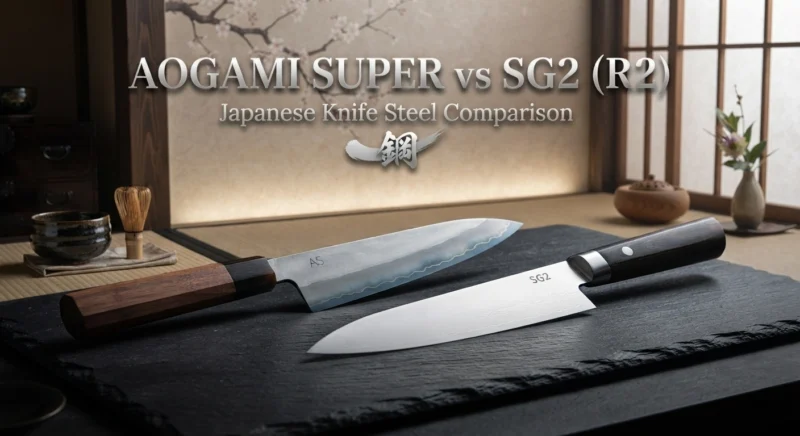
Aogami Super vs SG2
An Independent Guide
When choosing a high-performance Japanese kitchen knife, two steels that frequently appear at the top of the conversation are Aogami Super and SG2, also known as R2.
At first glance, they may seem like direct competitors.
Both can be hardened to very high levels. Both can produce exceptionally sharp edges. Both are used in premium Japanese kitchen knives. Both are capable of excellent edge retention, and both are popular among serious knife enthusiasts.
But they are very different steels.
Aogami Super is a high-carbon Japanese tool steel derived from the Aogami family. It is a reactive carbon steel, famous for its combination of high hardness, excellent edge retention, impressive toughness for its hardness, and exceptional sharpening response.
SG2/R2 is a powder metallurgy stainless steel. It uses a much more highly alloyed composition to achieve very high wear resistance while retaining excellent corrosion resistance and the ability to support an extremely fine edge.
That creates a fascinating comparison.
Aogami Super offers the traditional Japanese carbon-steel experience: exceptional sharpness, excellent feedback on stones, and a beautiful patina that develops with use.
SG2/R2 offers modern convenience: stainless corrosion resistance, very high wear resistance, and long-lasting edge retention.
So which one is better?
There is no universal winner.
If you want traditional Japanese steel characteristics, excellent sharpening response, high toughness, and a beautiful reactive blade, Aogami Super is difficult to beat.
If you want maximum practical edge retention, stainless convenience, and a high-performance modern steel, SG2/R2 is the stronger choice.
This detailed comparison will look at the two steels from every important kitchen-knife perspective: chemical composition, hardness, carbide structure, edge retention, toughness, corrosion resistance, sharpening, cutting feel, edge stability, maintenance, geometry, price, and real-world kitchen performance.
Aogami Super vs SG2 at a Glance
Here is the short version before we get into the details.
| Property | Aogami Super | SG2 / R2 |
|---|---|---|
| Steel type | High-carbon alloy tool steel | Powder metallurgy stainless steel |
| Stainless? | No | Yes |
| Carbon | ~1.4–1.5% | ~1.4–1.5% |
| Chromium | ~0.3–0.5% | ~14% |
| Tungsten | ~1.5–2% | Very low/none |
| Molybdenum | ~0.3–0.5% | ~2.5–3% |
| Vanadium | ~0.3–0.4% | ~1.8–2.2% |
| Typical knife hardness | ~61–65 HRC | ~62–64 HRC |
| Edge retention | Excellent | Excellent–very high |
| Wear resistance | High | Very high |
| Toughness | Very good | Moderate |
| Sharpening | Excellent | Good–very good |
| Corrosion resistance | Low | Excellent |
| Patina | Yes | No significant patina |
| Maintenance | High | Low |
| Fine edge potential | Excellent | Excellent |
| Best characteristic | Sharpening + cutting feel | Edge retention + stainlessness |
The exact figures vary depending on the manufacturer, heat treatment, and specific product.
That last point is important.
Steel composition tells us what a steel can potentially do. Heat treatment and blade geometry determine how that potential becomes actual knife performance.
What Is Aogami Super Steel?
Aogami Super, commonly called Blue Super or Aogami Super Blue, is one of the most highly regarded traditional Japanese knife steels.
It belongs to the Aogami family of carbon steels associated with Hitachi’s Yasugi Specialty Steel.
The word Aogami means “Blue Paper” and refers to the blue paper used to identify the steel in the traditional Japanese steel-making system.
Aogami Super is an enhanced version of the Aogami family.
Its composition includes:
- high carbon
- chromium
- tungsten
- molybdenum
- vanadium
The relatively high carbon content allows the steel to reach very high hardness.
Tungsten, molybdenum, and vanadium contribute to hardenability, wear resistance, and carbide formation.
Unlike stainless steels, however, Aogami Super contains nowhere near enough chromium to be considered stainless.
It is therefore reactive.
That means the blade can develop a patina and can rust if neglected.
For some knife enthusiasts, this is not a disadvantage.
It is part of the appeal.
Check Our Guide Aogami Super Steel
What Is SG2 / R2 Steel?
SG2 is a premium Japanese powder metallurgy stainless steel.
It is widely known in the Japanese knife market as R2.
The steel contains approximately:
- 1.4–1.5% carbon
- around 14% chromium
- around 2.5–3% molybdenum
- around 2% vanadium
The exact composition depends on the specification.
SG2 is produced using powder metallurgy, which creates a highly refined microstructure and allows high levels of alloying elements to be incorporated while maintaining relatively fine carbide distribution.
The result is a high-hardness stainless steel with excellent wear resistance.
SG2 has become extremely popular in premium Japanese kitchen knives because it offers something traditional carbon steels cannot:
very high edge retention without requiring constant corrosion maintenance.
Check Our Guide SG2 Steel Review
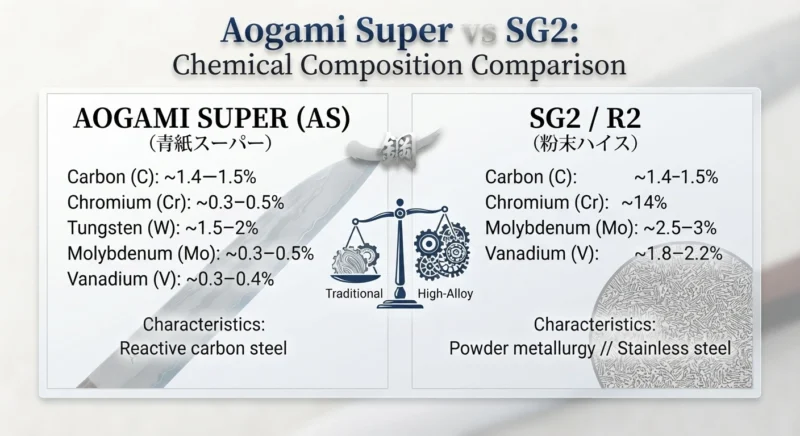
Aogami Super vs SG2: Chemical Composition
The chemistry of these two steels tells an interesting story.
Approximate compositions:
| Element | Aogami Super | SG2 / R2 |
| Carbon | ~1.4–1.5% | ~1.4–1.5% |
| Chromium | ~0.3–0.5% | ~14% |
| Molybdenum | ~0.3–0.5% | ~2.5–3% |
| Vanadium | ~0.3–0.4% | ~1.8–2.2% |
| Tungsten | ~1.5–2% | Very low/none |
| Manganese | ~0.2–0.4% | ~0.4% |
| Silicon | ~0.1–0.3% | ~0.5% |
The most obvious difference is chromium.
Aogami Super has very little chromium.
SG2 has enough chromium to be stainless.
The second major difference is the quantity of alloying elements.
SG2 contains substantially more molybdenum and vanadium.
This contributes to its high wear resistance.
Aogami Super, meanwhile, contains significant tungsten along with vanadium and molybdenum.
This gives it a different carbide structure and cutting character.
Carbon Content: Aogami Super vs SG2
Interestingly, both steels contain roughly similar amounts of carbon.
That surprises many people.
If SG2 has better wear resistance, it isn’t simply because it has more carbon.
The difference comes from the entire alloy system and manufacturing process.
Carbon interacts with chromium, tungsten, molybdenum, and vanadium to form carbides.
The type, size, distribution, and quantity of those carbides influence:
- wear resistance
- sharpening
- edge stability
- toughness
- cutting feel
SG2’s powder metallurgy production helps create a refined carbide distribution.
Aogami Super has a more traditional alloy structure.
Both can be excellent.
They simply behave differently.
Chromium: The Biggest Difference
Chromium is the element that fundamentally separates these steels from a maintenance perspective.
Aogami Super has very little chromium.
Therefore, it is a carbon steel.
SG2 has approximately 14% chromium.
Therefore, it is a stainless steel.
This means the knives behave very differently after cutting acidic or wet foods.
With Aogami Super, you need to dry the blade.
With SG2, you can be much more relaxed.
This distinction is perhaps more important to an everyday cook than a small difference in edge retention.
Aogami Super vs SG2: Hardness
Both steels are capable of high hardness.
Aogami Super kitchen knives are commonly found around 61–65 HRC.
SG2 knives are often around 62–64 HRC.
Exact hardness depends heavily on the maker.
Aogami Super is famous for being able to achieve very high hardness while maintaining useful toughness.
SG2 is also capable of high hardness, but its behavior is influenced by its powder metallurgy structure and higher alloy content.
It is important not to assume that a 64 HRC SG2 knife is automatically better than a 63 HRC Aogami Super knife.
Hardness is only one variable.
Does Aogami Super Have Better Toughness Than SG2?
Generally, this is where Aogami Super has a strong advantage.
Aogami Super is often regarded as having an impressive toughness-to-hardness balance.
It can maintain a very fine edge while offering more resistance to chipping than many high-hardness powder steels.
SG2 is not particularly fragile.
A well-made SG2 knife can be extremely durable in normal kitchen use.
But its high carbide content and high hardness mean that it should be treated as a precision tool.
If abused, an SG2 edge can chip.
Aogami Super generally gives the user a little more forgiveness.
Winner: Aogami Super
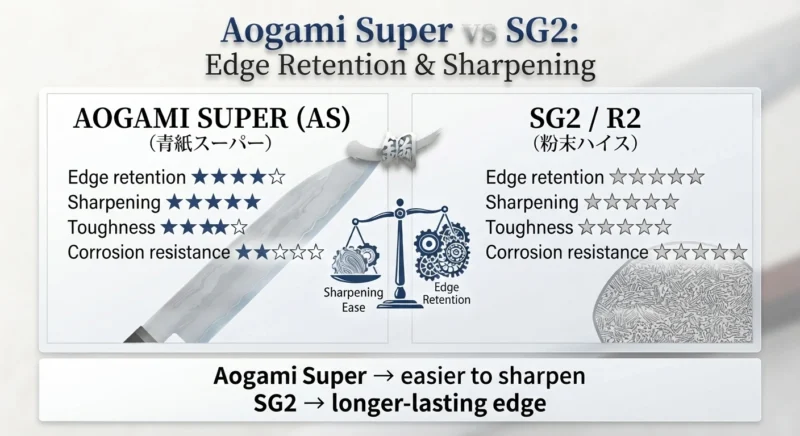
Aogami Super vs SG2: Edge Retention
Now we reach one of SG2’s strongest categories.
SG2 generally has the advantage in wear resistance and edge retention.
Its powder metallurgy composition and high volume of hard alloy carbides allow it to resist abrasive wear extremely well.
Aogami Super also has excellent edge retention.
In fact, compared with many conventional carbon steels, Aogami Super can hold an edge for a surprisingly long time.
But SG2 is optimized more strongly toward wear resistance.
The difference is especially noticeable during prolonged cutting sessions.
A professional cook preparing large quantities of food may appreciate SG2’s longer working edge.
A home cook who sharpens regularly may find the difference much less important.
Winner: SG2
Check Our Guide Edge Retention Explained: 10 Factors What Makes a Knife Stay Sharp Longer
Aogami Super vs SG2: Sharpening
This is one of Aogami Super’s biggest advantages.
Aogami Super is famous for its excellent sharpening response.
On a good Japanese water stone, it can feel extremely satisfying.
The steel removes relatively predictably.
The edge responds quickly.
It can be refined to a very high level.
SG2 is more demanding.
This doesn’t mean SG2 is difficult to sharpen.
It simply takes more effort.
The high wear resistance that allows SG2 to hold its edge also means that abrasive stones need to work harder.
For someone who sharpens their own knives regularly, the difference can be substantial.
Winner: Aogami Super
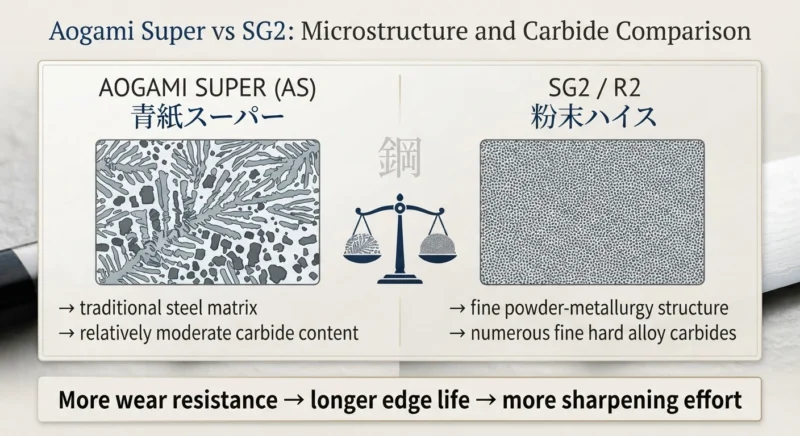
Why Is SG2 Harder to Sharpen?
The answer is largely related to carbides.
SG2 contains substantial amounts of chromium, molybdenum, and vanadium.
These elements form hard carbides.
Vanadium carbides in particular are extremely wear resistant.
That is excellent when you are cutting food.
But sharpening is essentially controlled abrasive wear.
The same properties that prevent the edge from wearing quickly also make it more resistant to the sharpening stone.
This is a fundamental knife-steel trade-off.
The steel that is harder to wear away is also harder to sharpen.
Check Our Guide All Kinds of Knife Sharpening Tools
Aogami Super vs SG2: Cutting Feel
Cutting feel is difficult to measure scientifically, but experienced knife users notice it immediately.
Aogami Super has an excellent reputation for producing a crisp, lively cutting sensation.
A properly sharpened Aogami Super knife can feel extremely responsive.
The blade can seem to “grab” food cleanly and initiate cuts effortlessly.
SG2 can also feel phenomenal.
A high-quality SG2 gyuto with thin geometry can glide through ingredients.
However, many enthusiasts describe the feel of traditional carbon steel as somewhat different from highly alloyed powder steel.
This is subjective.
The biggest determinant remains geometry.
A thin SG2 knife can feel dramatically better than a thick Aogami Super knife.
Aogami Super vs SG2: Fine Edge Capability
Both steels can support extremely fine edges.
Aogami Super is particularly famous for this.
Traditional Japanese carbon steels have long been valued for their ability to take extremely sharp edges.
SG2 can also be sharpened to an exceptionally fine apex.
Its high hardness helps maintain that apex.
The difference isn’t that one can become sharp and the other cannot.
Both can become extremely sharp.
The difference is how they behave during and after sharpening.
Aogami Super: easier to achieve and refine.
SG2: harder to sharpen but longer-lasting once properly sharpened.
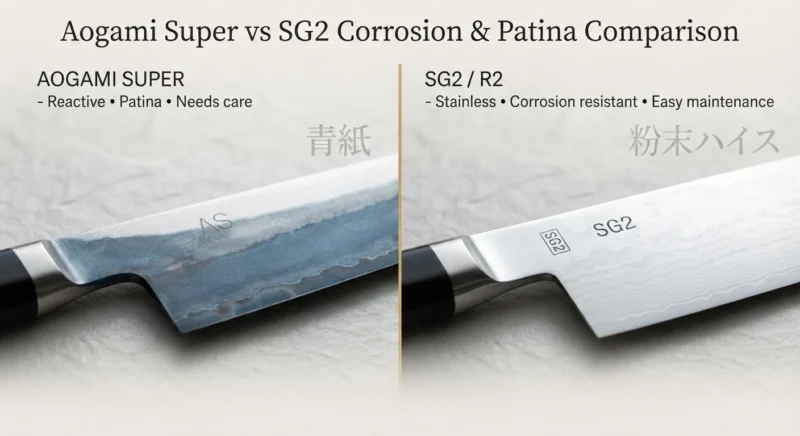
Aogami Super vs SG2: Corrosion Resistance
This is not a close competition.
SG2 wins by a huge margin.
Aogami Super is reactive.
It can:
- develop patina
- discolor
- rust
- react with acidic foods
SG2 is stainless and highly corrosion resistant.
For a busy kitchen, this is a major practical advantage.
You can cut tomatoes with SG2 and simply rinse and dry the blade.
With Aogami Super, you should pay much closer attention to moisture.
Does Aogami Super Rust?
Yes.
Aogami Super is a carbon steel.
It is not stainless.
However, “reactive” does not mean that the knife will instantly rust.
With proper care, Aogami Super can be used for decades.
The basic maintenance routine is simple:
- Wipe the blade during use.
- Wash it after use.
- Dry it immediately.
- Don’t leave it in water.
- Don’t store it wet.
- Apply food-safe oil if storing for extended periods.
A controlled patina can actually reduce the blade’s tendency to react compared with a freshly polished surface.
Does SG2 Develop a Patina?
Not normally.
SG2 is stainless.
You may occasionally see discoloration from contamination or harsh environments, but it does not behave like Aogami Super.
If you want a knife that changes appearance over time and develops a unique patina, Aogami Super is the more interesting choice.
If you want the blade to remain visually stable, SG2 is much easier.
Aogami Super vs SG2: Maintenance
This is perhaps the largest practical difference.
Aogami Super maintenance
You need to:
- wipe the blade
- dry it promptly
- avoid leaving food residue
- monitor patina
- prevent rust
- occasionally oil the blade during storage
SG2 maintenance
Usually:
- wash
- rinse
- dry
- store
That’s it.
For a busy household, SG2 is much easier.
For enthusiasts who enjoy traditional Japanese knives, Aogami Super’s maintenance can be part of the experience.
Aogami Super vs SG2: Edge Stability
Both can have excellent edge stability.
Aogami Super benefits from its excellent toughness.
SG2 benefits from high hardness and refined powder metallurgy.
When sharpened to extremely thin angles, the behavior can change.
An SG2 blade at 64 HRC with an extremely thin edge should be treated carefully.
Aogami Super at 63 HRC may provide slightly more tolerance.
This is why the final edge geometry is so important.
A very hard steel does not mean you should automatically make the edge as thin as physically possible.
Aogami Super vs SG2: Micro-Chipping
Micro-chipping can happen with either steel if the edge is excessively thin or abused.
SG2 can be more prone to visible micro-chipping when subjected to lateral stress.
Typical causes include:
- twisting through food
- cutting frozen ingredients
- hitting bones
- chopping hard food aggressively
- using a poor cutting board
- dropping the knife
- striking another hard object
Aogami Super generally has a more forgiving character.
But it is not indestructible.
A 64 HRC carbon-steel knife with a very thin edge can also chip.
Aogami Super vs SG2: Edge Angle
There is no universal best edge angle.
The correct angle depends on:
- knife geometry
- hardness
- blade thickness
- intended use
- user’s technique
Both Aogami Super and SG2 can support relatively acute edges.
However, the harder and thinner the edge becomes, the more important proper technique becomes.
For everyday kitchen work, a slightly stronger edge can provide a better balance between sharpness and durability.
Don’t choose an edge angle based only on the steel name.
Aogami Super vs SG2: Blade Thickness
Blade thickness can completely change the performance of a knife.
Aogami Super and SG2 are both capable of being ground extremely thin.
A thin blade reduces the force required to cut food.
But a thin blade also demands better technique.
A thick SG2 knife may hold its edge beautifully but cut poorly.
A thin Aogami Super knife may feel dramatically better.
This is why experienced knife buyers look beyond steel.
The most important characteristics include:
- spine thickness
- edge thickness
- distal taper
- grind
- blade height
- balance
Check Our Guide Best Blade Thickness for Different Uses
Aogami Super vs SG2: Toughness and Thin Geometry
This is where Aogami Super can be particularly impressive.
Its combination of hardness and toughness allows makers to produce very thin edges without making the knife excessively fragile.
SG2 can also be ground thin.
In fact, many premium SG2 knives are famous for excellent cutting performance.
But the user needs to be somewhat more disciplined.
For a careful cook, SG2 can be superb.
For someone who occasionally abuses knives, Aogami Super may be more forgiving.
Check Our Guide Wear Resistance vs Toughness: Understanding the Most Important Knife Steel Trade-Off
Aogami Super vs SG2 for Home Cooks
For the average home cook, the choice comes down largely to maintenance.
Aogami Super is ideal if:
You enjoy Japanese knife traditions.
You don’t mind wiping the blade.
You like developing patina.
You enjoy sharpening.
You value cutting feel.
You want a high-performance carbon steel.
SG2 is ideal if:
You want stainless convenience.
You want long edge retention.
You don’t want to worry about patina.
You sharpen infrequently.
You want a premium modern steel.
For many modern home kitchens, SG2 is the easier choice.
For knife enthusiasts, Aogami Super can be much more rewarding.
Aogami Super vs SG2 for Professional Kitchens
Professional kitchens create a stronger argument for SG2.
A chef who uses a knife for hours every day can benefit greatly from longer edge retention.
At the same time, professional cooks may appreciate how quickly Aogami Super can be sharpened.
There is another issue: maintenance.
In a busy kitchen, leaving a reactive knife wet for even a short period can cause staining.
SG2 eliminates much of this concern.
For a professional environment where convenience is critical, SG2 is usually the more practical choice.
Aogami Super vs SG2 for Sushi
This comparison is especially interesting for sushi and sashimi.
Traditional Japanese sushi knives often use carbon steels because they can take exceptional edges and provide excellent sharpening response.
Aogami Super is a natural fit for this philosophy.
It can produce an extremely keen edge and offers excellent control when slicing fish.
SG2 offers a modern alternative.
It provides stainless corrosion resistance while still allowing an extremely fine edge.
For a chef who wants traditional Japanese sharpening and doesn’t mind maintenance, Aogami Super is compelling.
For someone who wants easier maintenance, SG2 is the obvious alternative.
Check Our Guide How to Prepare Fish for Sushi, Sashimi & Ceviche
Aogami Super vs SG2 for Vegetables
Both steels are outstanding for vegetables.
A properly sharpened knife made from either steel can glide through:
- onions
- carrots
- potatoes
- cabbage
- tomatoes
- peppers
- herbs
- cucumbers
SG2 has the advantage during very long cutting sessions because of its superior wear resistance.
Aogami Super may feel more responsive when freshly sharpened.
For home cooking, both are excellent.
Aogami Super vs SG2 for Meat
Both are suitable for boneless meat.
They are excellent for:
- slicing
- trimming
- portioning
- cutting poultry
- preparing steaks
Neither should be used to chop through bones.
Aogami Super may have an advantage if the edge experiences occasional lateral stress.
SG2 is ideal if the knife is used carefully and you want long edge life.
Check Our Ultimate American BBQ Meat Guide: How to Cut Chicken, Steak & Ribs + 8 Easy BBQ Recipes
Aogami Super vs SG2 for Fish
Both steels are excellent for fish.
The main issue is corrosion.
Fish preparation involves a lot of moisture.
Aogami Super requires more attention.
SG2 is much more forgiving.
If you are working with fish for long periods and need a low-maintenance knife, SG2 has a significant practical advantage.
If you’re comfortable wiping and drying the blade frequently, Aogami Super can deliver an exceptional cutting experience.
Check Our Guide How to Prepare and Cut Seafood
Aogami Super vs SG2 for Gyuto Knives
The gyuto is one of the most popular Japanese chef’s knife designs.
Both steels are excellent choices.
Aogami Super gyuto
Best for:
- enthusiasts
- sharpening lovers
- traditional Japanese knife fans
- fine-edge enthusiasts
- cooks who appreciate patina
SG2 gyuto
Best for:
- busy cooks
- professionals
- users who dislike sharpening
- stainless-steel enthusiasts
- people who prioritize edge retention
A high-quality gyuto in either steel can be exceptional.
Aogami Super vs SG2 for Santoku
Santoku knives are often used for vegetables, meat, and fish.
Both steels work beautifully.
Aogami Super can provide an exceptionally keen edge.
SG2 can retain that edge longer.
If you want maximum convenience, choose SG2.
If you want maximum traditional character, choose Aogami Super.
Check Our Guide Santoku vs Nakiri: Which Japanese Kitchen Knife Is Better?
Aogami Super vs SG2 for Nakiri
Nakiri knives are vegetable specialists.
Aogami Super is a classic choice for a high-performance nakiri.
Its fine-edge capability is excellent for vegetables.
SG2 offers similar cutting performance but with greater stainless convenience.
Again, geometry matters more than many buyers realize.
A thin SG2 nakiri can outperform a thick Aogami Super nakiri by a significant margin.
Aogami Super vs SG2 for Petty Knives
Petty knives perform small, precise tasks.
They are often used for:
- trimming
- fruit
- vegetables
- herbs
- meat preparation
Both steels can be excellent.
SG2 has a particularly useful advantage for a petty because the knife may be used repeatedly throughout the day.
Aogami Super is attractive if you want maximum sharpening response.
Aogami Super vs SG2: Which Is Easier to Sharpen?
Aogami Super.
This is one of the clearest answers in the entire comparison.
Aogami Super is one of the most enjoyable high-performance Japanese steels to sharpen.
SG2 is significantly more wear resistant.
A good stone and proper technique make SG2 manageable, but it will generally take longer.
If sharpening is something you genuinely enjoy, Aogami Super is likely to be the more satisfying steel.
Aogami Super vs SG2: Which Holds an Edge Longer?
SG2 generally wins.
Its powder metallurgy structure and higher alloy carbide content provide greater wear resistance.
However, Aogami Super remains excellent.
It can outperform many stainless steels in edge retention and can provide a long-lasting working edge.
The difference becomes most noticeable during heavy use.
Aogami Super vs SG2: Which Is Sharper?
Neither is inherently “sharper.”
Both can be sharpened to an extremely sharp apex.
Sharpness depends on:
- sharpening skill
- edge geometry
- stone progression
- burr removal
- apex condition
- edge angle
Aogami Super may be easier to sharpen to an extremely refined edge.
SG2 may maintain that edge longer.
So the practical difference is:
Aogami Super: easier to achieve extreme sharpness.
SG2: easier to maintain that sharpness for longer.
Aogami Super vs SG2: Which Is Better for a Razor-Fine Edge?
Both.
Traditional carbon steels have an excellent reputation for fine edges.
Aogami Super can produce an exceptionally crisp apex.
SG2 can also produce a refined edge because its fine powder metallurgy microstructure allows excellent edge geometry.
The final result depends more on the sharpening process than the name printed on the box.
Aogami Super vs SG2: Which Has Better Wear Resistance?
SG2.
This is one of its defining characteristics.
SG2 contains a much more highly alloyed carbide structure.
The result is greater resistance to abrasive wear.
Aogami Super has respectable wear resistance but remains much easier to abrade on a sharpening stone.
Aogami Super vs SG2: Which Has Better Toughness?
Aogami Super generally has the advantage.
Its balance of hardness and toughness is one of the reasons it is so highly regarded.
SG2’s high hardness and wear resistance come with a greater need for careful use.
Neither is a heavy-duty steel.
But Aogami Super is generally the more forgiving choice.
Aogami Super vs SG2: Which Is More Corrosion Resistant?
SG2 by a very large margin.
Aogami Super is reactive carbon steel.
SG2 is stainless.
If corrosion resistance is important, SG2 is the obvious winner.
Aogami Super vs SG2: Which Requires More Maintenance?
Aogami Super.
This isn’t even close.
Aogami Super requires attention to moisture and acids.
SG2 generally requires normal washing and drying.
If you don’t want to think about patina or rust, SG2 is much easier.
Aogami Super vs SG2: Which Is Better for Knife Enthusiasts?
This is subjective.
Many enthusiasts love Aogami Super because it provides:
- traditional Japanese character
- excellent sharpening feedback
- beautiful patina
- exceptional sharpness
- excellent edge performance
Other enthusiasts prefer SG2 because it represents modern steel technology.
It offers:
- powder metallurgy
- high hardness
- high wear resistance
- stainless convenience
- excellent edge retention
There is no wrong answer.
Aogami Super vs SG2: Which Is More Traditional?
Aogami Super.
If you want the traditional Japanese carbon-steel experience, Aogami Super is much closer to it.
SG2 is a modern powder metallurgy stainless steel.
It represents a very different approach to knife steel.
Aogami Super vs SG2: Which Is More Modern?
SG2.
Powder metallurgy allows much more sophisticated alloy design.
The steel combines high hardness, high wear resistance, and stainless corrosion resistance.
This is one reason SG2 has become so popular in contemporary premium Japanese knives.
Aogami Super vs SG2: Which Is Better for Long-Term Ownership?
Both can last for decades.
A high-quality Japanese knife is not a disposable product.
Aogami Super has one advantage: it is relatively easy to maintain and reshape with conventional sharpening stones.
Even if the edge is damaged, the blade can often be restored.
SG2 can also last a very long time, but repairing significant damage can require more aggressive abrasives and more patience.
The key is taking care of either knife.
Aogami Super vs SG2: Sharpening Stones
Aogami Super works beautifully on Japanese water stones.
A typical progression might be:
- 800–1000 grit for repairs
- 2000–3000 grit for general sharpening
- 4000–6000 grit for refinement
- optional higher-grit finishing stone
SG2 can also be sharpened on water stones.
However, because of its wear resistance, harder and more abrasive stones can be particularly useful.
Diamond abrasives can also be helpful for serious SG2 sharpening.
The exact stone choice depends on the knife and user’s preferences.
Aogami Super vs SG2: Does SG2 Need Diamond Stones?
No.
This is an important misconception.
SG2 can absolutely be sharpened using quality water stones.
You don’t need diamond stones simply because the steel is powder metallurgy.
However, diamond or other high-performance abrasives can make sharpening more efficient.
For normal maintenance, a good water-stone setup is perfectly capable.
Aogami Super vs SG2: Stropping
Both steels can benefit from careful stropping.
Aogami Super responds very well to fine finishing.
SG2 can also be stropped, especially with suitable abrasive compounds.
But be careful.
Aggressive stropping can round the apex.
The goal is to refine or maintain the edge rather than continuously polishing it.
Aogami Super vs SG2: Cutting Board Choice
A good cutting board is essential for both steels.
Recommended options include:
- wood
- quality synthetic boards
- Japanese rubber boards
Avoid:
- glass
- ceramic
- stone
- extremely hard surfaces
This is especially important for high-hardness SG2 and Aogami Super knives.
A fine edge needs a forgiving cutting surface.
Aogami Super vs SG2: Dishwasher?
Neither should go in the dishwasher.
This is particularly important for Aogami Super because of corrosion.
But SG2 knives can also suffer from dishwasher conditions.
Dishwashers expose knives to:
- aggressive detergents
- heat
- moisture
- contact with other utensils
Hand washing is always preferable.
Aogami Super vs SG2: Price
Price varies enormously.
Aogami Super knives range from relatively affordable production knives to extremely expensive handmade Japanese blades.
SG2 knives also range from moderately priced production knives to premium handmade knives.
SG2 often commands a premium because powder metallurgy production is more expensive and because the steel is popular in high-end Japanese cutlery.
However, the steel alone does not justify a high price.
The craftsmanship matters.
Aogami Super vs SG2: Is More Expensive Better?
Not necessarily.
You can buy an expensive SG2 knife with mediocre geometry.
You can also buy a reasonably priced Aogami Super knife with outstanding geometry and heat treatment.
The final cutting performance depends on:
- steel
- heat treatment
- grind
- edge geometry
- sharpening
- handle design
- balance
- manufacturing quality
A good knife is a complete system.
Aogami Super vs SG2: Common Misconceptions
“SG2 is always sharper.”
No.
Both steels can be sharpened to extremely high levels.
“Aogami Super is fragile.”
Not necessarily.
It can actually have excellent toughness for its hardness.
“SG2 never chips.”
False.
Any very hard, thin knife can chip if abused.
“Aogami Super rusts immediately.”
No.
It is reactive, but proper maintenance is straightforward.
“SG2 never needs sharpening.”
No.
All knife edges eventually wear.
SG2 simply extends the time between sharpening.
“Powder steel is automatically better.”
No.
It is better for certain performance goals.
“Higher HRC means a better knife.”
Not automatically.
Hardness is only one characteristic.
Aogami Super vs SG2: Heat Treatment Matters
Heat treatment can completely change the practical behavior of a knife.
Two Aogami Super knives can feel very different.
Two SG2 knives can also feel very different.
Heat treatment influences:
- hardness
- toughness
- carbide precipitation
- edge stability
- sharpening response
- resistance to chipping
This is why experienced buyers often care more about the maker than the steel designation.
A beautifully heat-treated Aogami Super blade can be spectacular.
A poorly heat-treated SG2 blade can be disappointing.
Aogami Super vs SG2: Geometry Matters Even More
Suppose you have:
Knife A: Aogami Super, 65 HRC, thick edge
Knife B: SG2, 63 HRC, extremely thin geometry
Knife B may cut dramatically better.
The reason is geometry.
Cutting performance is strongly influenced by:
- edge thickness
- blade thickness
- grind
- distal taper
- blade height
- convexity
A steel comparison is useful, but it should never replace evaluation of the actual knife.
Aogami Super vs SG2: Real-World Edge Retention
The theoretical advantage of SG2 is clear.
But real-world edge retention is more complicated.
Consider two home cooks.
Cook A
Uses the knife for 15 minutes every evening and sharpens every few weeks.
The difference between Aogami Super and SG2 may be relatively small.
Cook B
Uses the knife for several hours every day.
The advantage of SG2 becomes much more meaningful.
Therefore, the more intensively you use the knife, the more valuable high wear resistance becomes.
Aogami Super vs SG2: Real-World Sharpening
The opposite is also true.
Someone who sharpens frequently will notice the difference immediately.
Aogami Super responds quickly.
SG2 takes longer.
Therefore, if sharpening time matters to you, the difference becomes more important.
This is why steel selection is ultimately personal.
Two cooks can use the same knife and reach completely different conclusions about which steel is better.
Aogami Super vs SG2: Which One Feels More “Japanese”?
If by Japanese you mean traditional Japanese knife culture, Aogami Super.
It offers:
- reactive carbon steel
- patina
- water-stone sharpening
- extremely fine edges
- traditional craftsmanship
SG2 is also very Japanese in terms of modern knife manufacturing.
But it belongs to a more contemporary philosophy.
It is about achieving maximum performance while reducing maintenance.
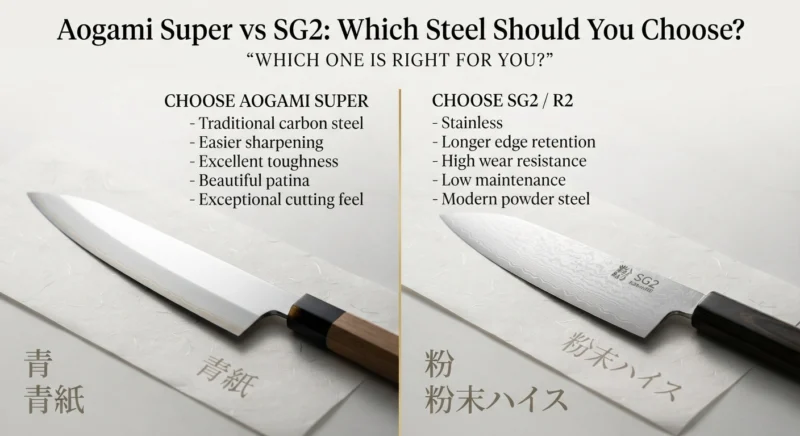
Aogami Super vs SG2: Which One Should You Buy?
Choose Aogami Super if you:
- enjoy sharpening
- want a reactive carbon steel
- appreciate patina
- want excellent cutting feel
- want excellent toughness
- value traditional Japanese knife character
- don’t mind maintenance
- want a steel that responds beautifully to water stones
Choose SG2/R2 if you:
- want stainless convenience
- want maximum edge retention
- dislike frequent sharpening
- use your knife heavily
- want very high wear resistance
- prefer a modern powder steel
- want excellent corrosion resistance
- are willing to be careful with a high-hardness edge
Aogami Super vs SG2: Pros and Cons
Aogami Super Pros
- Exceptional sharpness
- Excellent fine-edge capability
- Excellent sharpening response
- Very good toughness
- Excellent cutting feel
- High hardness
- Excellent edge retention
- Beautiful patina
- Traditional Japanese character
- Excellent water-stone compatibility
Aogami Super Cons
- Reactive
- Can rust
- Requires immediate drying
- Requires more maintenance
- Cannot be left wet
- Not ideal for users who want zero-maintenance stainless steel
SG2 / R2 Pros
- Excellent edge retention
- Very high wear resistance
- High hardness
- Stainless
- Excellent corrosion resistance
- Fine edge capability
- Powder metallurgy microstructure
- Long intervals between sharpening
- Very practical for professional use
SG2 / R2 Cons
- More difficult to sharpen
- Less forgiving of abuse
- Can micro-chip with inappropriate use
- Often more expensive
- Requires better sharpening abrasives for efficient maintenance
Aogami Super vs SG2: Complete Scorecard
| Category | Aogami Super | SG2 / R2 | Winner |
| Hardness | Excellent | Excellent | Tie |
| Edge retention | Excellent | Excellent–very high | SG2 |
| Wear resistance | High | Very high | SG2 |
| Toughness | Very good | Moderate | Aogami Super |
| Sharpening | Excellent | Good–very good | Aogami Super |
| Corrosion resistance | Low | Excellent | SG2 |
| Fine edge | Excellent | Excellent | Tie |
| Cutting feel | Excellent | Excellent | Aogami Super |
| Edge stability | Excellent | Excellent | Tie |
| Maintenance | Moderate–high | Very low | SG2 |
| Patina | Yes | No | Aogami Super |
| Traditional character | Excellent | Moderate | Aogami Super |
| Modern performance | Very good | Excellent | SG2 |
| Professional convenience | Moderate | Excellent | SG2 |
| Sharpening enjoyment | Excellent | Good | Aogami Super |
Aogami Super vs SG2: The Fundamental Trade-Off
The comparison can be reduced to one basic question:
Do you want to maintain the knife, or do you want the knife to maintain its edge for you?
Aogami Super rewards the user who enjoys sharpening and caring for the knife.
SG2 rewards the user who wants to sharpen less frequently.
Aogami Super gives you the traditional experience.
SG2 gives you modern convenience.
Aogami Super gives you a beautiful evolving patina.
SG2 gives you stainless stability.
Aogami Super is more forgiving.
SG2 is more wear resistant.
Neither is universally better.
The Verdict: Aogami Super vs SG2
So, which steel wins?
If we judge only by edge retention and corrosion resistance, SG2 wins.
If we judge by sharpening response, toughness, and traditional cutting character, Aogami Super wins.
For a busy professional kitchen, SG2 is probably the more practical choice.
For a knife enthusiast who enjoys sharpening, Aogami Super may be more rewarding.
For someone who wants maximum stainless convenience, choose SG2.
For someone who wants traditional Japanese carbon-steel performance, choose Aogami Super.
For someone who wants long edge life, choose SG2.
For someone who wants exceptional sharpening feedback, choose Aogami Super.
Which Would I Choose?
If I were choosing a Japanese kitchen knife based purely on performance and maintenance balance, I would consider how I use the knife first.
For everyday convenience:
SG2/R2.
For the pleasure of traditional Japanese knife ownership:
Aogami Super.
There is something special about a well-made Aogami Super knife.
You sharpen it.
You use it.
The blade develops a patina.
You sharpen it again.
Over time, the knife becomes a record of how it has been used.
SG2 offers a different experience.
The blade stays stainless.
The edge stays sharp for a long time.
Maintenance is simple.
You can concentrate almost entirely on cooking.
Both approaches are excellent.
They simply appeal to different users.
Frequently Asked Questions
Is Aogami Super better than SG2?
Neither is universally better. Aogami Super generally offers better sharpening response and toughness, while SG2 offers better wear resistance, edge retention, and corrosion resistance.
Is SG2 harder than Aogami Super?
Typical kitchen knives made from both steels can have similar high hardness, although SG2 is frequently around 62–64 HRC and Aogami Super can range around 61–65 HRC.
Which holds an edge longer?
SG2 generally has the advantage because of its higher wear resistance.
Which is easier to sharpen?
Aogami Super is considerably easier and more pleasant to sharpen.
Which is tougher?
Aogami Super generally has better toughness.
Which is more corrosion resistant?
SG2 by a very large margin.
Does Aogami Super rust?
Yes. It is a reactive carbon steel and must be dried after use.
Does SG2 rust?
SG2 is stainless and highly corrosion resistant, although no steel should be considered completely immune to corrosion.
Does Aogami Super develop a patina?
Yes. Patina is one of the characteristic features of reactive carbon-steel knives.
Does SG2 develop a patina?
Not normally. SG2 is stainless.
Is SG2 a powder steel?
Yes. SG2/R2 is a powder metallurgy stainless steel.
Is Aogami Super stainless?
No. Aogami Super is a reactive high-carbon alloy steel.
Which is better for sushi?
Both can be excellent. Aogami Super offers traditional sharpening and cutting characteristics, while SG2 provides stainless convenience.
Which is better for a gyuto?
Both. Choose Aogami Super for traditional character and easy sharpening; choose SG2 for edge retention and low maintenance.
Which is better for a home cook?
SG2 is generally easier because it is stainless. Aogami Super is excellent if the cook enjoys knife maintenance.
Which is better for a professional chef?
SG2 often has the advantage because of edge retention and corrosion resistance, although some professionals strongly prefer the sharpening response of Aogami Super.
Which is sharper?
Neither is inherently sharper. Both can be sharpened to an extremely sharp edge.
Which is more expensive?
SG2 knives often cost more, but pricing depends heavily on the maker, construction, geometry, and finishing.
Can SG2 be sharpened with water stones?
Yes. Quality water stones can sharpen SG2 effectively.
Does SG2 need diamond stones?
No. Diamond abrasives can be useful, but they are not mandatory.
Which steel is better for beginners?
SG2 is easier from a maintenance perspective because it is stainless. Aogami Super requires more attention to moisture and rust.
Final Thoughts
The debate between Aogami Super vs SG2 (R2) is ultimately a debate between two different philosophies of knife steel.
Aogami Super represents the traditional Japanese approach.
It is reactive, hard, fine-edged, tough for its hardness, and exceptionally pleasant to sharpen.
SG2 represents the modern approach.
It uses powder metallurgy and a highly alloyed composition to deliver excellent wear resistance, high hardness, and stainless convenience.
If you want a knife that becomes part of your cooking routine—something you sharpen, maintain, and watch develop character over time—Aogami Super is an exceptional choice.
If you want a knife that simply performs at a very high level while requiring minimal maintenance, SG2/R2 is extremely difficult to beat.
The important thing is not to ask which steel is “the best.”
Ask which steel is best for you.
For the traditionalist:
Aogami Super.
For the low-maintenance performance enthusiast:
SG2/R2.
For the sharpening enthusiast:
Aogami Super.
For maximum edge retention:
SG2/R2.
For corrosion resistance:
SG2/R2.
For toughness and forgiveness:
Aogami Super.
For modern powder-steel technology:
SG2/R2.
And for pure cutting performance?
That depends on the knife.
A superbly made Aogami Super blade with excellent geometry can outperform an average SG2 knife.
A superb SG2 knife can outperform a poorly made Aogami Super knife.
Steel is only the beginning.
The real performance comes from the combination of steel, heat treatment, geometry, grinding, sharpening, and craftsmanship.
That is what makes Japanese kitchen knives so fascinating—and why both Aogami Super and SG2 continue to have dedicated followers among serious cooks and knife enthusiasts.
This article is for independent informational purposes only and is not affiliated with, sponsored by, or endorsed by any steel manufacturer. All product names, trademarks, and registered trademarks are the property of their respective owners.