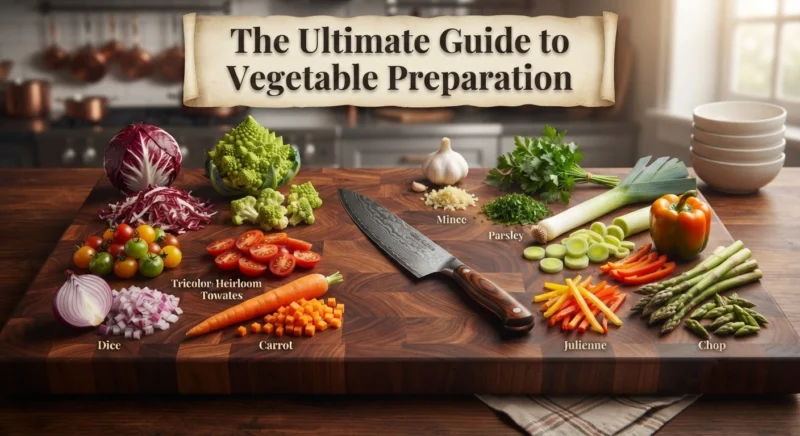
Best Knives for Vegetables
Introduction
Vegetable preparation is one of the most important skills in cooking. Whether you are making a simple salad, preparing a stir-fry, cooking soup, creating a curry, or preparing a professional restaurant meal, the way vegetables are cut directly affects:
- Cooking time
- Texture
- Flavor distribution
- Presentation
- Overall quality of the dish
A carrot cut into large uneven pieces will cook differently from a perfectly uniform julienne. An onion chopped incorrectly can release excessive moisture and create bitterness. A tomato sliced with a dull knife can become crushed instead of cleanly cut.
Professional chefs understand that vegetable preparation begins with the right tools.
A sharp, well-balanced kitchen knife allows you to:
- Cut vegetables faster
- Create consistent pieces
- Preserve freshness
- Reduce waste
- Work more safely
In this complete guide, you will learn:
- The best knives for cutting vegetables
- Chef knife vs Santoku knife for vegetables
- Japanese vegetable knives explained
- How to cut common vegetables
- Professional vegetable cutting techniques
- How to choose the right knife steel
- Knife maintenance tips
- The best vegetable preparation setup for home cooks
Why Proper Vegetable Cutting Matters
Many home cooks underestimate the importance of knife skills. However, professional cooking relies heavily on consistent cutting.
1. Even Cooking
Vegetables release moisture and heat at different speeds.
For example:
A large carrot cube requires much more cooking time than a thin carrot slice.
Uniform cutting ensures:
- Every piece cooks evenly
- Better texture
- Better flavor
2. Better Flavor
Cutting changes how vegetables release:
- Aromas
- Juices
- Natural sugars
An onion finely diced for a sauce behaves completely differently from a thick onion slice used for grilling.
3. Better Presentation
Restaurants often use precise vegetable cuts because appearance affects appetite.
Professional cuts include:
- Julienne
- Brunoise
- Dice
- Batonnet
- Chiffonade
- Paysanne
4. Less Food Waste
A sharp knife allows you to:
- Follow vegetable shapes
- Remove less usable material
- Create cleaner cuts
A dull knife often crushes vegetables and wastes more food.
The Best Knives for Vegetable Preparation
Different knives have different strengths. While almost any sharp kitchen knife can cut vegetables, some designs are much better suited for vegetable preparation.
https://yashkadesigns.com/chef-knife-japanese-damascus-vg10-super-steel-kitchen-tool
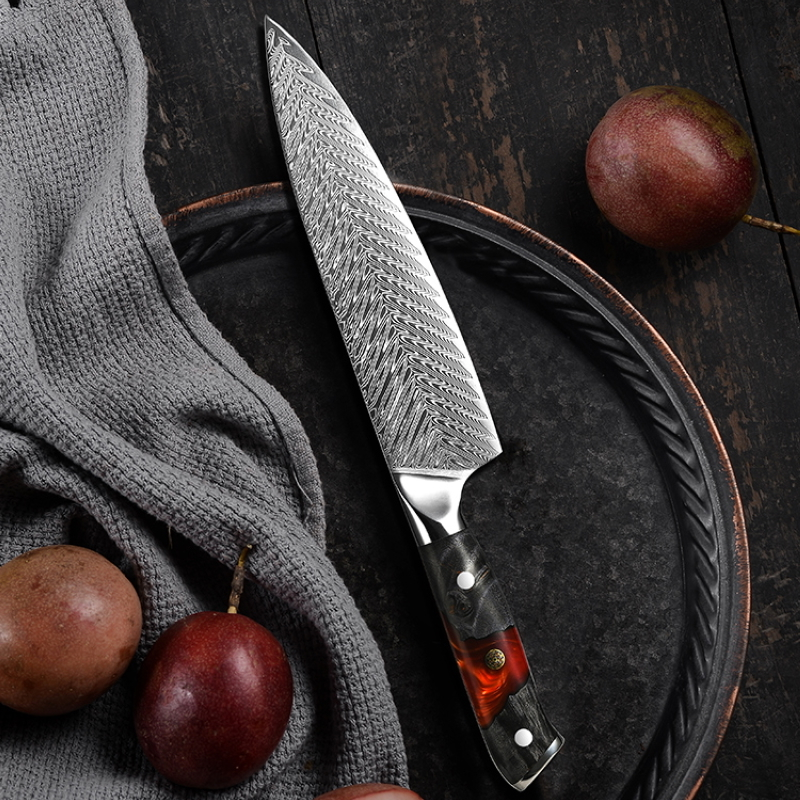
1. Chef Knife – The Best All-Purpose Vegetable Knife
A chef knife is the most versatile knife in the kitchen.
A typical chef knife:
- Blade length: 8 inches
- Wide blade
- Strong tip
- Comfortable handle
- Balanced weight
It can handle almost every vegetable preparation task.
Best Uses:
✔ Chopping onions
✔ Cutting carrots
✔ Slicing cabbage
✔ Dicing potatoes
✔ Mincing garlic
✔ Cutting herbs
The rocking motion of a chef knife makes it ideal for:
- Large quantities of vegetables
- Meal preparation
- Professional cooking
Advantages of Chef Knives
Versatility
One knife can replace several smaller knives.
Power
The wider blade provides enough strength for:
- Squash
- Pumpkin
- Large vegetables
Speed
Experienced cooks can process large amounts of vegetables quickly.
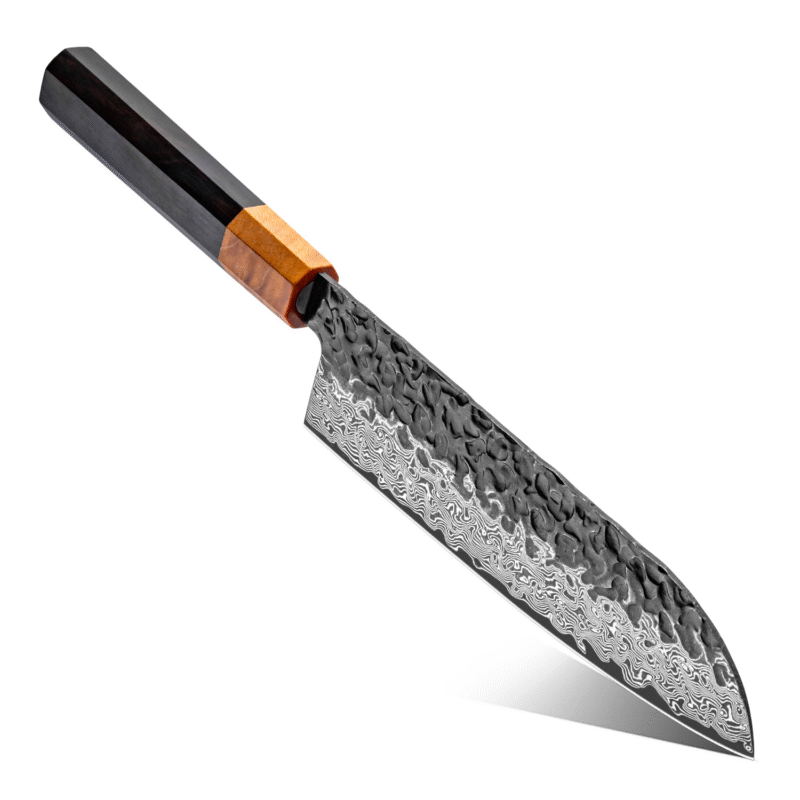
2. Santoku Knife – The Japanese Vegetable Specialist
The Santoku knife is one of the most popular Japanese kitchen knives.
The word Santoku means:
“Three virtues”
Referring to:
- Slicing
- Dicing
- Chopping
The Santoku was designed especially for home cooks who prepare vegetables, meat, and fish.
Why Santoku Is Excellent for Vegetables
Santoku knives usually have:
- Wide blade
- Flat cutting edge
- Lightweight construction
- Thin Japanese-style geometry
They excel at:
- Precise vegetable cuts
- Thin slices
- Fast chopping
Best Vegetables for Santoku
A Santoku is excellent for:
- Onion
- Garlic
- Carrots
- Zucchini
- Cucumber
- Eggplant
- Bell peppers
- Mushrooms
Santoku vs Chef Knife for Vegetables
| Feature | Chef Knife | Santoku Knife |
|---|---|---|
| Origin | Western | Japanese |
| Blade | Curved | Flatter |
| Best Motion | Rocking | Up-and-down |
| Weight | Usually heavier | Usually lighter |
| Large vegetables | Excellent | Very good |
| Precision cuts | Very good | Excellent |
| Beginners | Good | Excellent |
Which is better?
For most home cooks:
Santoku = excellent vegetable knife
For professional kitchens:
Chef knife = more versatile
Many cooks own both.
https://yashkadesigns.com/nakiri-knife-170-mm-vegetables-kitchen-tool
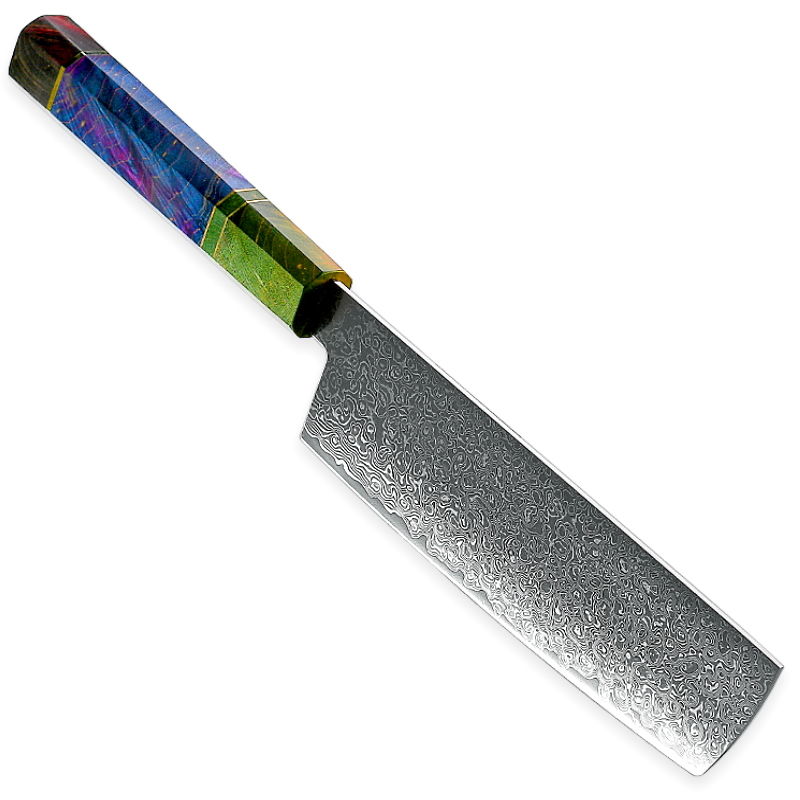
3. Nakiri Knife – The Traditional Japanese Vegetable Knife
The Nakiri is one of the most specialized vegetable knives.
It has:
- Straight cutting edge
- Rectangular blade
- Thin profile
- Flat blade design
Unlike a chef knife, the Nakiri is not designed for rocking.
Instead, it uses:
- Straight downward cuts
- Vertical chopping motion
Best Uses for Nakiri Knife
Perfect for:
- Leafy greens
- Cabbage
- Carrots
- Root vegetables
- Squash
- Vegetable slicing
Why Chefs Like Nakiri Knives
The straight edge creates:
- Extremely precise cuts
- Uniform vegetable pieces
- Clean slices
The tall blade also protects your fingers and makes transferring vegetables easier.
https://yashkadesigns.com/chef-knife-handmade-chinese-cleaver-home-kitchen-butcher-tool
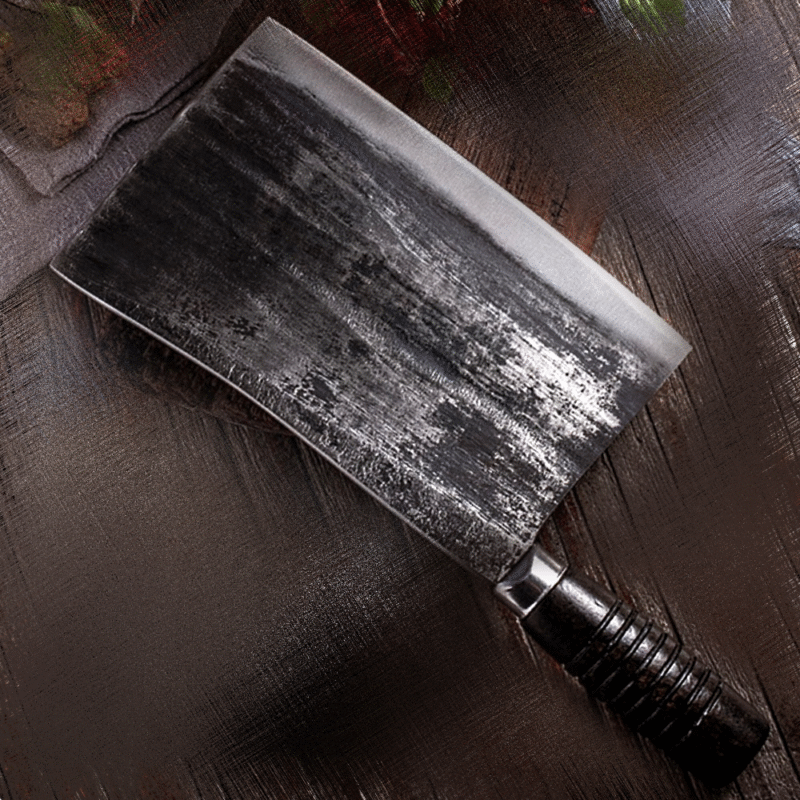
4. Chinese Cleaver – Excellent for Vegetables
A Chinese vegetable cleaver looks similar to a heavy meat cleaver, but many are designed specifically for vegetables.
A vegetable cleaver offers:
- Large blade surface
- Efficient chopping
- Easy food transfer
It is excellent for:
- Cabbage
- Bok choy
- Large vegetables
- Stir-fry preparation
Important:
A vegetable cleaver is not the same as a heavy butcher cleaver.
https://yashkadesigns.com/damascus-steel-paring-knife-chef-kitchen-tool-cutlery-cookware
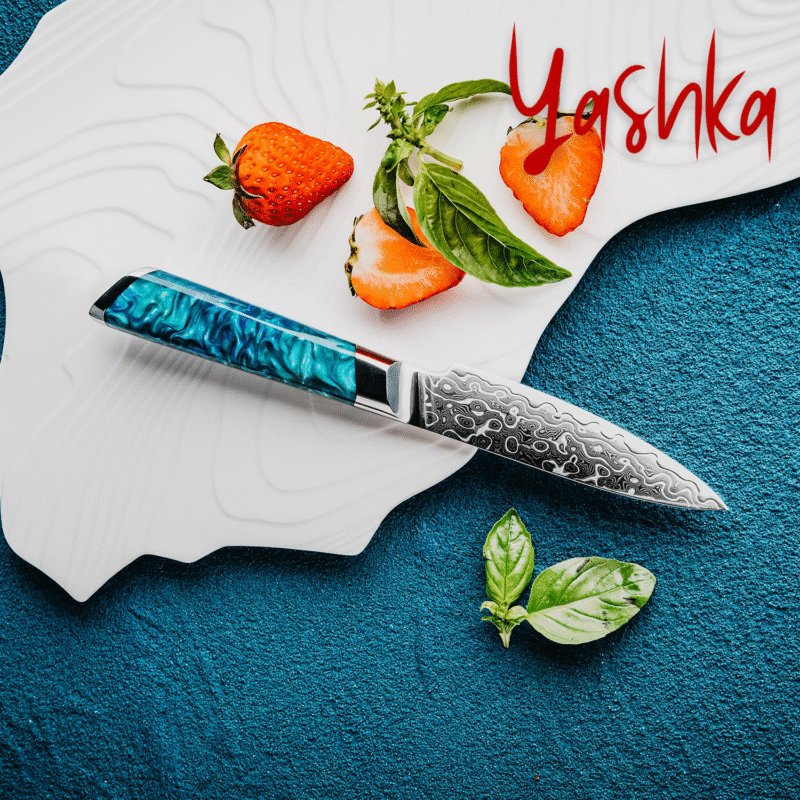
5. Paring Knife – Precision Vegetable Work
A small paring knife is essential for detailed preparation.
Best for:
- Peeling
- Removing stems
- Cutting small vegetables
- Decorative work
Examples:
- Cherry tomatoes
- Garlic
- Mushrooms
- Small peppers
https://yashkadesigns.com/japanese-style-petty-knife-chef-utility
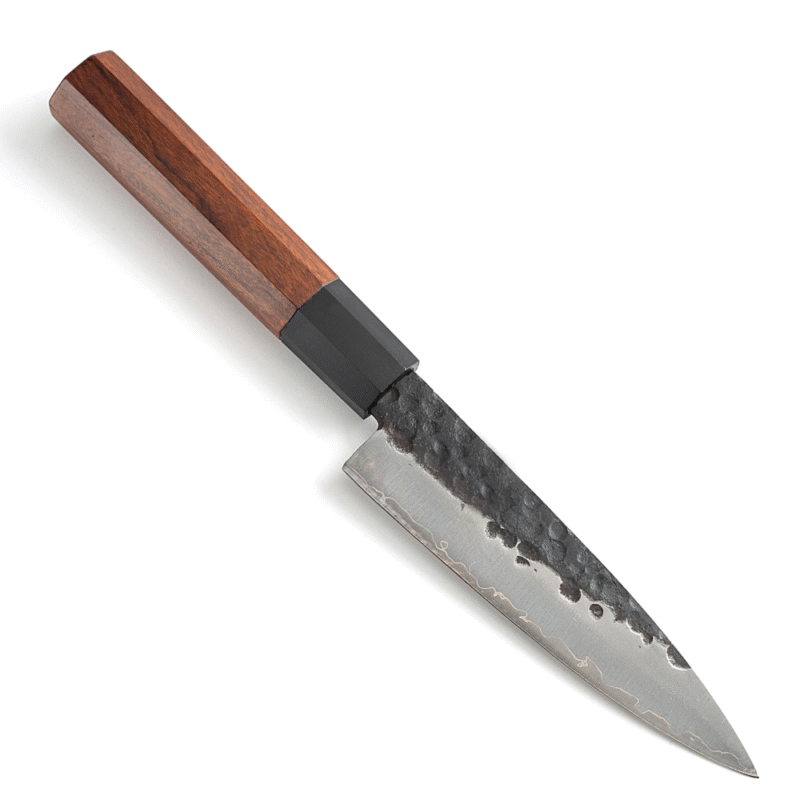
6. Utility Knife – Medium Vegetable Tasks
A utility knife sits between a chef knife and paring knife.
Useful for:
- Cucumbers
- Tomatoes
- Small fruits
- Sandwich vegetables
Japanese Vegetable Knives: Complete Guide
Japanese knives are famous for:
- Sharp edges
- Thin blades
- Precision cutting
Popular vegetable-focused Japanese knives include:
Nakiri
Best for:
- Vegetables only
- Precise chopping
Usuba
A professional Japanese vegetable knife.
Used by chefs for:
- Traditional Japanese cuisine
- Decorative vegetable cutting
- Extremely precise cuts
Santoku
Best everyday Japanese knife.
Great for:
- Vegetables
- Meat
- Fish
Gyuto
Japanese version of the Western chef knife.
Excellent for:
- Professional kitchens
- All-purpose preparation
Best Knife Steel for Vegetable Knives
The best steel depends on your cooking style.
VG10 Stainless Steel
One of the most popular Japanese knife steels.
Advantages:
- Excellent sharpness
- Good edge retention
- Corrosion resistant
Great for:
- Santoku
- Nakiri
- Chef knives
Check Our Guide VG10 Steel Review
AUS-10 Steel
A balanced Japanese stainless steel.
Advantages:
- Tough
- Easy sharpening
- Good performance
Excellent everyday choice.
Check Our Guide VG10 vs AUS10 Steel
SG2 / R2 Powder Steel
Premium Japanese powder steel.
Advantages:
- Very high edge retention
- Extremely sharp
- Premium performance
Best for:
- High-end Santoku
- Nakiri knives
Check Our Guide VG10 vs SG2 Steel Comparison
X50CrMoV15 Steel
Popular German stainless steel.
Advantages:
- Easy maintenance
- Tough
- Beginner friendly
Common in:
- European chef knives
Check Our Guide X50CrMoV15 Steel Review
Carbon Steel Vegetable Knives
Carbon steel provides:
- Exceptional sharpness
- Easy sharpening
- Professional performance
However:
Requires:
- Drying after use
- More maintenance
- Protection from rust
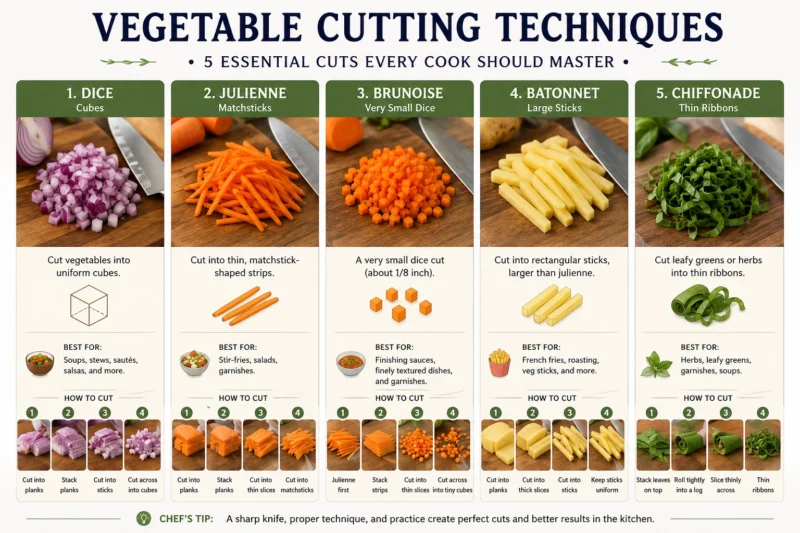
Essential Vegetable Cutting Techniques
Professional vegetable preparation uses several standard cutting methods.
1. Dice
Dicing creates small cubes.
Used for:
- Onion
- Carrots
- Celery
- Potatoes
Sizes:
Small Dice
About ¼ inch
Used for sauces and soups.
Medium Dice
About ½ inch
Used for stews.
Large Dice
About ¾ inch
Used for roasting.
2. Julienne
Julienne means cutting vegetables into thin matchsticks.
Common vegetables:
- Carrots
- Zucchini
- Bell peppers
Typical size:
2–3 inches long
Very common in:
- Asian cooking
- Salads
- Stir fry
3. Batonnet
A larger version of julienne.
Size:
Approximately:
½ inch × ½ inch × 2–3 inches
Used for:
- French fries
- Vegetable sticks
4. Brunoise
The smallest professional dice.
Created by cutting:
Julienne → small cubes
Used for:
- Garnishes
- Sauces
- Fine dining
5. Chiffonade
Used for leafy vegetables and herbs.
Examples:
- Basil
- Spinach
- Lettuce
Method:
Roll leaves tightly and slice into thin ribbons.
How to Cut Onions Like a Professional
Onions are one of the most frequently prepared vegetables in the kitchen. Learning proper onion cutting technique improves speed, safety, and consistency.
A sharp chef knife or Santoku knife is ideal for onions because the thin blade allows clean cuts without crushing the layers.
A dull knife often damages onion cells and releases more sulfur compounds, causing stronger irritation and a harsher flavor.
How to Dice an Onion
Step 1: Prepare the Onion
- Cut off the top stem end.
- Cut the onion in half through the root.
- Remove the outer skin.
- Keep the root end attached.
The root helps hold the onion together during cutting.
Step 2: Make Horizontal Cuts
Place the onion flat side down.
Using a sharp knife, make horizontal cuts toward the root.
Do not cut completely through the root.
Step 3: Make Vertical Cuts
Create vertical slices from top to bottom.
Keep the knife controlled and consistent.
Step 4: Slice Across
Cut across the previous cuts.
The result:
Perfect onion dice.
Best Knife for Cutting Onions
Santoku Knife
Excellent because:
- Lightweight
- Extremely sharp
- Easy control
Chef Knife
Excellent because:
- Faster for large quantities
- Rocking motion works well
How to Cut Garlic
Garlic preparation requires precision because the size of the cut changes the flavor.
Garlic Cutting Methods
Thin Slices
Used for:
- Pasta
- Stir fry
- Roasted dishes
Minced Garlic
Used for:
- Sauces
- Marinades
- Soups
The smaller the garlic pieces, the stronger the flavor release.
Professional Garlic Technique
- Place garlic clove on cutting board.
- Press gently with knife side.
- Remove skin.
- Slice.
- Chop repeatedly until desired size.
A chef knife with a wide blade is ideal because the flat side can crush garlic easily.
How to Cut Carrots
Carrots are one of the best vegetables for practicing knife skills.
They can be prepared in many ways:
- Slices
- Dice
- Julienne
- Batonnet
- Matchsticks
How to Slice Carrots
For simple slices:
- Peel carrot if desired.
- Cut into sections.
- Slice evenly.
Thickness depends on cooking method.
Thin slices:
For:
- Stir fry
- Salads
Thick slices:
For:
- Stews
- Roasting
How to Julienne Carrots
Julienne carrots are common in:
- Asian cuisine
- Salads
- Garnishes
Steps:
- Cut carrot into 2–3 inch sections.
- Create flat sides.
- Cut thin rectangular slices.
- Stack slices.
- Cut into matchsticks.
A Nakiri knife or Santoku knife works especially well.
How to Cut Bell Peppers
Bell peppers are used in many cuisines:
- Cajun cooking
- Mexican dishes
- Asian stir fry
- Mediterranean recipes
A sharp knife is important because peppers have slippery skin.
Professional Bell Pepper Technique
Step 1
Cut off the top and bottom.
Step 2
Remove seeds and white membrane.
Step 3
Flatten the pepper.
Step 4
Cut into:
- Strips
- Dice
- Julienne
Best Knife for Bell Peppers
A Santoku knife is excellent because:
- Thin blade slices cleanly
- Wide blade helps transfer pieces
How to Cut Tomatoes
Tomatoes are difficult because they are soft and contain a lot of moisture.
A dull knife often:
- Crushes tomatoes
- Releases too much juice
- Creates uneven cuts
Best Knife for Tomatoes
A serrated knife is traditionally excellent.
However, a very sharp chef knife can also work.
How to Slice Tomatoes
- Use a sharp blade.
- Apply gentle pressure.
- Let the knife do the work.
- Avoid pressing downward.
How to Dice Tomatoes
- Remove the stem.
- Cut tomato into halves.
- Remove excess seeds if needed.
- Slice.
- Cut into cubes.
How to Cut Cabbage
Cabbage requires a strong, sharp knife because it is dense.
The best options:
- Chef knife
- Nakiri knife
- Chinese vegetable cleaver
How to Shred Cabbage
Step 1
Remove damaged outer leaves.
Step 2
Cut cabbage in half.
Step 3
Remove the core.
Step 4
Place flat side down.
Step 5
Slice thinly.
Thin cabbage slices are ideal for:
- Coleslaw
- Stir fry
- Kimchi
- Soups
How to Cut Potatoes
Potatoes are versatile and require different cutting styles.
Potato Dice
Used for:
- Soups
- Stews
- Jambalaya
- Roasted dishes
Steps:
- Cut potato into slabs.
- Cut into sticks.
- Cut across into cubes.
Potato Wedges
- Cut potato lengthwise.
- Cut each half into wedges.
French Fry Cut
Professional size:
Batonnet:
Approximately:
½ inch × ½ inch × 3 inches
How to Cut Mushrooms
Mushrooms are delicate and should not be crushed.
Mushroom Slicing
- Clean mushrooms.
- Remove the stem if needed.
- Hold mushroom firmly.
- Slice evenly.
A small utility knife or chef knife works well.
How to Cut Zucchini
Zucchini can be prepared as:
- Coins
- Half moons
- Sticks
- Dice
- Ribbons
Zucchini Ribbons
Use:
- Vegetable peeler
- Very sharp knife
Excellent for:
- Salads
- Pasta alternatives
How to Cut Broccoli
Broccoli preparation requires separating:
- Florets
- Stem
Cutting Broccoli Florets
- Cut stem from crown.
- Separate florets.
- Cut large pieces smaller.
Using the Stem
Do not waste broccoli stems.
Remove tough outer layer.
The inside can be:
- Sliced
- Julienned
- Added to stir fry
How to Cut Leafy Greens
Examples:
- Spinach
- Lettuce
- Kale
- Herbs
Chiffonade Technique
- Stack leaves.
- Roll tightly.
- Slice into thin ribbons.
Best knife:
- Chef knife
- Santoku knife
Vegetable Cutting Safety Tips
Proper technique improves both safety and speed.
1. Use a Stable Cutting Board
A moving cutting board is dangerous.
Solutions:
- Place a damp towel underneath
- Use a non-slip mat
2. Use the Claw Grip
Professional chefs protect fingers by using:
- Curled fingertips
- Knuckles facing the blade
The knife should touch your knuckles, not fingertips.
3. Keep Knife Sharp
A sharp knife is safer than a dull knife.
Why?
A dull knife requires:
- More pressure
- Less control
- More slipping risk
4. Cut Away From Your Body
Always maintain control of the blade.
Best Cutting Boards for Vegetable Preparation
A good knife needs a good cutting surface.
Wooden Cutting Boards
Advantages:
✔ Knife friendly
✔ Beautiful appearance
✔ Durable
Popular woods:
- Walnut
- Maple
- Teak
Plastic Cutting Boards
Advantages:
✔ Easy cleaning
✔ Dishwasher safe
✔ Affordable
Good for:
- Raw meat
- Seafood preparation
End Grain Cutting Boards
Premium option.
Advantages:
- Gentle on knife edges
- Self-healing surface
- Long lifespan
Often used by professional cooks.
How to Maintain Vegetable Knives
A good knife can last decades with proper care.
1. Regular Honing
A honing rod realigns the edge.
Recommended:
Before or after regular cooking.
2. Sharpening
Sharpening removes metal and creates a new edge.
Methods:
- Whetstone
- Professional sharpening service
- Electric sharpener
Check Our Guide Edge Retention Explained: 10 Factors What Makes a Knife Stay Sharp Longer?
3. Proper Cleaning
Avoid:
- Dishwasher
- Long soaking
- Leaving food on blade
Wash and dry immediately.
4. Safe Storage
Good options:
- Magnetic strip
- Knife block
- Blade guard
Avoid loose drawer storage.
Common Vegetable Cutting Mistakes
Mistake 1: Using a Small Knife for Everything
A small knife creates:
- More work
- Less control
- Slower preparation
A quality chef knife or Santoku is much more efficient.
Mistake 2: Cutting Vegetables Unevenly
Different sizes cook differently.
Practice consistent cuts.
Mistake 3: Using Too Much Force
A sharp knife should cut smoothly.
Do not push aggressively.
Mistake 4: Choosing the Wrong Knife
Examples:
Using a heavy meat cleaver for delicate herbs.
Using a small paring knife for large squash.
The right tool makes preparation easier.
Professional Vegetable Preparation Setup
A complete home vegetable preparation station includes:
Essential:
- 8-inch Chef Knife
- Santoku Knife
- Paring Knife
- Cutting Board
- Honing Rod
Advanced:
- Nakiri Knife
- Vegetable Cleaver
- Japanese Gyuto
- Quality Whetstone
Best Knife Combination for Home Cooks
For most kitchens:
Option 1: Minimal Setup
- Chef knife
- Paring knife
Covers 90% of vegetable preparation.
Option 2: Japanese Style Setup
- Santoku
- Nakiri
- Petty knife
Excellent for vegetable-focused cooking.
Option 3: Professional Setup
- Gyuto
- Nakiri
- Petty knife
- Deba or specialty knives
Chef Knife vs Santoku vs Nakiri: Which Is the Best Vegetable Knife?
One of the most common questions home cooks ask is:
“What is the best knife for cutting vegetables?”
The answer depends on your cooking style.
There is no single perfect vegetable knife for everyone. A professional chef preparing hundreds of vegetables daily may prefer a large chef knife, while a home cook preparing vegetables for family meals may prefer a lightweight Santoku or Nakiri.
Vegetable Knife Comparison Chart
| Knife Type | Best For | Blade Style | Skill Level |
|---|---|---|---|
| Chef Knife | All vegetables, large quantities | Curved edge | Beginner to professional |
| Santoku | Everyday vegetable preparation | Flat Japanese edge | Beginner |
| Nakiri | Precise vegetable cutting | Straight edge | Intermediate |
| Usuba | Professional Japanese vegetable work | Single bevel | Advanced |
| Gyuto | Professional all-purpose cooking | Japanese chef knife | Intermediate |
| Cleaver | Large vegetables and cabbage | Wide blade | Intermediate |
| Paring Knife | Small vegetables and details | Small blade | Beginner |
Best Vegetable Knife for Beginners
Winner: Santoku Knife
For most home cooks, the Santoku is one of the easiest knives to use.
Why?
- Lightweight
- Comfortable
- Easy control
- Excellent sharpness
- Perfect for vegetables
A Santoku is ideal if you prepare:
- Salads
- Stir fries
- Soups
- Pasta dishes
- Everyday meals
Best Professional Vegetable Knife
Winner: Chef Knife or Gyuto
Professional cooks often choose a larger knife because speed matters.
A chef knife allows:
- Faster chopping
- Rocking motion
- Large cutting capacity
- More versatility
A Japanese Gyuto provides similar versatility with:
- Thinner blade
- Lighter weight
- More precise cutting
Best Knife for Cutting Leafy Vegetables
Winner: Nakiri Knife
The Nakiri is especially good for:
- Cabbage
- Lettuce
- Spinach
- Kale
- Herbs
The straight blade creates clean cuts without damaging delicate vegetables.
Best Knife for Large Vegetables
Examples:
- Pumpkin
- Squash
- Large cabbage
- Sweet potatoes
Best choices:
Chef Knife
or
Vegetable Cleaver
The extra weight and blade height provide more control.
Best Knife for Precision Vegetable Work
Winner: Japanese Usuba
The Usuba is a traditional Japanese vegetable knife used by professional chefs.
It is designed for:
- Decorative vegetable cutting
- Fine slicing
- Traditional Japanese cuisine
Examples:
- Garnishes
- Vegetable flowers
- Extremely thin slices
However, it requires more skill because it uses a single-bevel edge.
Japanese vs Western Vegetable Knives
Both styles have advantages.
Japanese Vegetable Knives
Examples:
- Santoku
- Nakiri
- Usuba
- Gyuto
Advantages:
✔ Extremely sharp
✔ Thin blades
✔ Precise cuts
✔ Lightweight design
Best for:
- Vegetables
- Fish
- Precision cooking
Check Our Guide The Complete Guide to Japanese Knives
Western Vegetable Knives
Examples:
- Chef knife
- Utility knife
- Paring knife
Advantages:
✔ Stronger blade design
✔ More forgiving
✔ Easier maintenance
Best for:
- General cooking
- Larger ingredients
- Heavy use
Check Our Guide Best European Kitchen Knives
Blade Thickness: Why It Matters for Vegetables
Vegetable preparation benefits from a thinner blade.
A thin blade:
- Slices more easily
- Creates less resistance
- Produces cleaner cuts
Japanese knives often have thinner blades because they prioritize precision.
However, extremely thin blades require more care.
Avoid:
- Cutting frozen food
- Twisting the blade
- Hard surfaces
Check Our Guide Best Blade Thickness for Different Uses
Blade Length Guide for Vegetable Knives
6-inch Knife
Good for:
- Small vegetables
- Small kitchens
- Beginners
7-inch Santoku
Excellent everyday size.
Good balance between:
- Control
- Cutting capacity
8-inch Chef Knife
The professional standard.
Best for:
- Large vegetables
- Faster preparation
9–10 inch Chef Knife
Used by experienced cooks.
Advantages:
- More cutting power
- Larger work area
How to Choose a Vegetable Knife
Before buying, consider these factors.
1. Your Cooking Style
Ask:
Do you cook mostly:
Vegetables?
Choose:
- Nakiri
- Santoku
Mixed meals?
Choose:
- Chef knife
- Gyuto
Asian cuisine?
Choose:
- Santoku
- Nakiri
- Chinese cleaver
2. Knife Weight
Heavy knives:
Advantages:
- More power
- Easier for large vegetables
Disadvantages:
- More tiring
Light knives:
Advantages:
- Better control
- Faster precision work
Disadvantages:
- Less power for hard vegetables
3. Handle Comfort
A good handle should feel:
- Secure
- Balanced
- Comfortable
Popular materials:
- Wood
- Micarta
- G10
- Stainless steel
- Pakkawood
4. Steel Choice
For most vegetable preparation:
Best Overall:
VG10
Excellent balance:
- Sharpness
- Edge retention
- Maintenance
Best Premium:
SG2 / R2 Powder Steel
For cooks who want:
- Long edge retention
- Maximum performance
Best Easy Maintenance:
X50CrMoV15
Great for:
- Beginners
- Busy kitchens
Best Budget Performance:
AUS-8 / AUS-10
Good combination:
- Toughness
- Sharpness
- Easy sharpening
The Best Vegetable Knife Set
A practical vegetable-focused kitchen does not need dozens of knives.
A professional setup can be simple.
Essential Set
1. Santoku Knife
Daily vegetable work.
2. Chef Knife
Large vegetables and general cooking.
3. Paring Knife
Small detailed tasks.
4. Nakiri Knife
Dedicated vegetable preparation.
5. Utility Knife
Medium-size cutting jobs.
How to Improve Your Vegetable Cutting Skills
Knife skill improves with practice.
Practice 1: Onion Dice
The foundation of cooking.
Practice:
- Even size
- Speed
- Control
Practice 2: Julienne Carrots
Improves:
- Precision
- Knife control
Practice 3: Chiffonade Herbs
Improves delicate cutting.
Practice 4: Vegetable Platter Preparation
Practice:
- Different shapes
- Presentation
- Consistency
Frequently Asked Questions (FAQ)
What is the best knife for cutting vegetables?
The best overall vegetable knife depends on your needs. A Santoku knife is excellent for most home cooks, while a chef knife offers maximum versatility.
Is a Santoku better than a chef knife for vegetables?
A Santoku is often easier for vegetable preparation because it is lighter and has a flatter edge. A chef knife is better for larger tasks and professional cooking.
Is a Nakiri knife worth buying?
Yes, especially if you prepare many vegetables. Its straight edge and thin blade make it excellent for precise vegetable cuts.
Can I use a chef knife for all vegetables?
Yes. A quality chef knife can handle almost every vegetable preparation task.
What size knife is best for vegetables?
For most cooks:
- 7-inch Santoku
- 8-inch chef knife
are excellent choices.
Are Japanese knives better for vegetables?
Japanese knives are often preferred for vegetables because they are thinner and sharper, allowing precise cuts.
However, high-quality Western knives also perform extremely well.
What is the sharpest vegetable knife?
High-quality Japanese knives made from steels such as:
- SG2
- VG10
- Aogami Blue Steel
can achieve extremely sharp edges.
How often should I sharpen a vegetable knife?
For regular home use:
- Hone frequently
- Sharpen every few months depending on use
Should vegetable knives go in the dishwasher?
No.
Dishwashers can:
- Damage edges
- Harm handles
- Cause corrosion
Always hand wash and dry.
https://en.wikipedia.org/wiki/Kitchen_knife
Best Knives for Vegetables