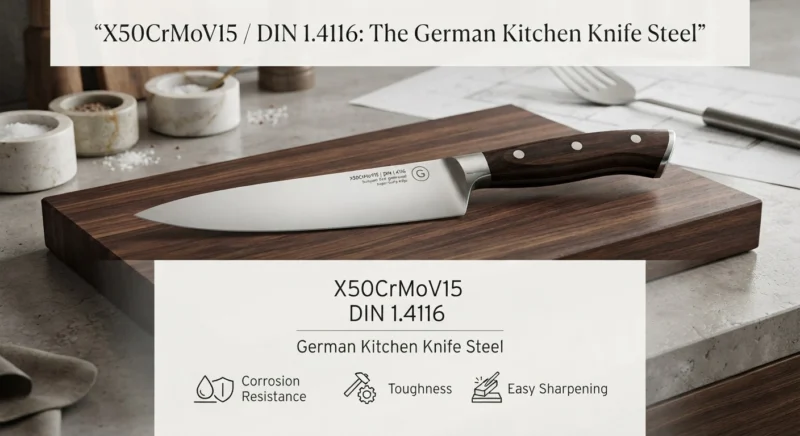
X50CrMoV15 Steel Review
An Independent Guide
Introduction: Why X50CrMoV15 Became the German Kitchen Knife Standard
When people think about German kitchen knives, they usually imagine:
- Strong forged blades
- Comfortable handles
- Heavy-duty construction
- Reliable daily performance
Behind many of these famous kitchen knives is one steel grade:
X50CrMoV15
Also known as:
- DIN 1.4116
- 1.4116 stainless steel
- German knife steel
- Krupp 4116
- X50CrMoV15 stainless steel
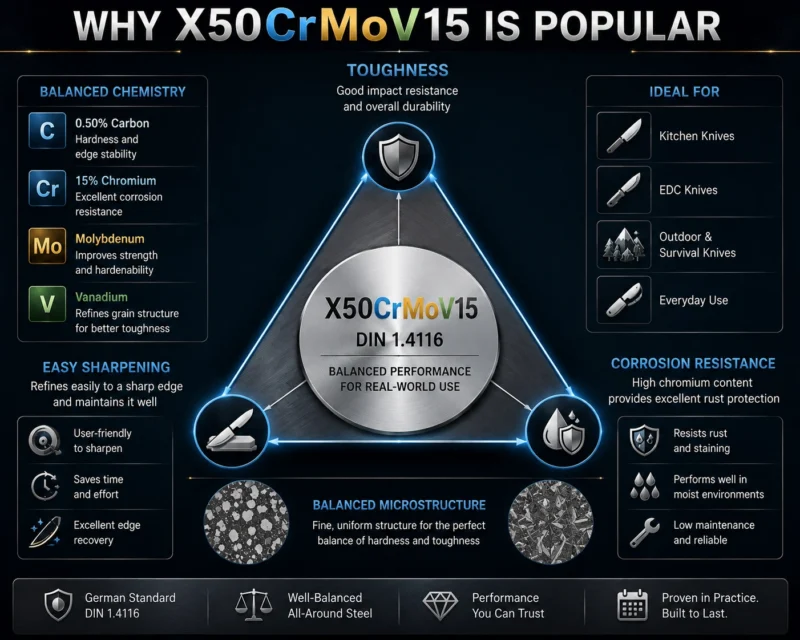
This steel has become one of the most recognizable materials in the kitchen knife industry because it offers an excellent balance between:
- Corrosion resistance
- Toughness
- Ease of sharpening
- Everyday durability
Unlike some modern premium steels that focus mainly on extreme edge retention, X50CrMoV15 was designed around a different philosophy:
A kitchen knife should be reliable, easy to maintain, and ready for everyday cooking.
That philosophy explains why this steel remains popular in Western-style chef knives.
X50CrMoV15 / DIN 1.4116 is a martensitic stainless steel grade used extensively for cutlery applications. It belongs to the German stainless steel system and is classified under EN/DIN standards.
What Is X50CrMoV15 / DIN 1.4116 Steel?
X50CrMoV15 is a high-carbon stainless steel designed specifically for applications requiring:
- Good hardness
- Strong corrosion resistance
- Easy processing
- Reliable toughness
The steel is especially popular for:
- Chef knives
- Paring knives
- Utility knives
- Kitchen sets
- Professional restaurant knives
Many traditional German-style kitchen knives use this steel because it matches their design philosophy:
- Thicker blade geometry
- Strong edge
- Easy maintenance
- Long service life
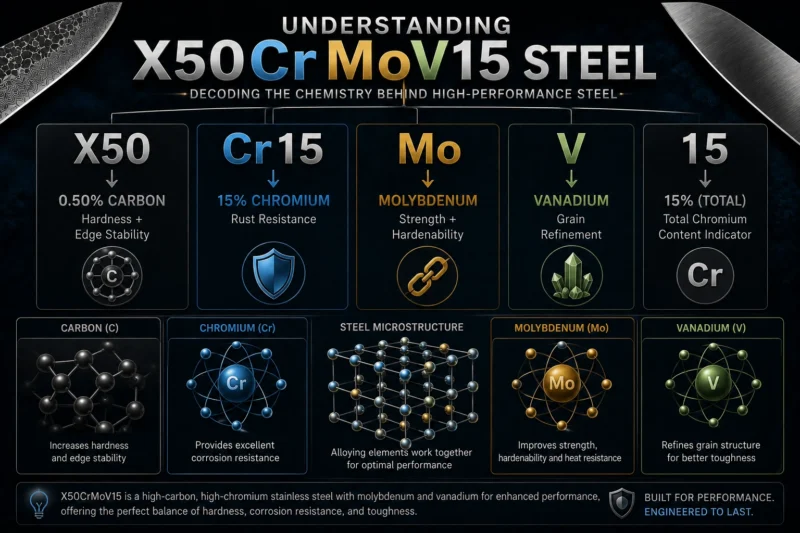
Understanding the Name X50CrMoV15
The name looks complicated, but it actually tells us about the chemistry.
X50
The “X” indicates a high-alloy stainless steel.
The number:
50
represents approximately:
0.50% carbon
Carbon is one of the most important elements in knife steel.
It improves:
- Hardness
- Edge retention
- Wear resistance
Cr
Cr means:
Chromium
Chromium provides:
- Stainless properties
- Rust resistance
- Corrosion protection
Mo
Mo means:
Molybdenum
Molybdenum improves:
- Hardenability
- Strength
- Corrosion resistance
V
V means:
Vanadium
Vanadium helps:
- Refine grain structure
- Improve wear resistance
- Increase edge stability
15
The number:
15
means approximately:
15% chromium
So the simplified meaning:
X50CrMoV15 = approximately 0.5% carbon + 15% chromium + molybdenum + vanadium
Chemical Composition of X50CrMoV15
Typical composition:
| Element | Percentage | Function |
|---|---|---|
| Carbon (C) | 0.45–0.55% | Hardness and edge retention |
| Chromium (Cr) | 14–15.5% | Corrosion resistance |
| Molybdenum (Mo) | 0.5–0.8% | Strength and hardenability |
| Vanadium (V) | 0.1–0.2% | Grain refinement and wear resistance |
| Manganese (Mn) | ~1% | Strength improvement |
| Silicon (Si) | ~1% | Improves hardness |
| Iron (Fe) | Balance | Main structure |
How Each Element Affects Knife Performance
Carbon: The Hardness Element
At around 0.5% carbon, X50CrMoV15 has enough carbon to achieve useful hardness without becoming difficult to maintain.
Higher carbon generally means:
✓ Better edge retention
✓ Higher hardness
✓ Better cutting performance
However, too much carbon can reduce toughness.
X50CrMoV15 chooses balance rather than maximum hardness.
Chromium: The Stainless Protection
The approximately 15% chromium content is one of the biggest advantages.
Chromium creates a passive layer that protects the steel from corrosion.
Benefits:
- Excellent rust resistance
- Easy kitchen maintenance
- Suitable for wet environments
This makes X50CrMoV15 very practical for everyday cooking.
Molybdenum: Improving Performance
Molybdenum is added in smaller amounts but provides important benefits.
It improves:
- Hardenability
- Strength
- Corrosion resistance
It helps the steel achieve consistent performance after heat treatment.
Vanadium: Small Addition, Important Effect
Vanadium content is low compared with modern powder steels, but it still contributes.
Benefits:
- Finer grain structure
- Better edge stability
- Improved wear resistance
The amount is not enough to make X50CrMoV15 an extreme wear-resistant steel, but it improves overall balance.
X50CrMoV15 Hardness (HRC)
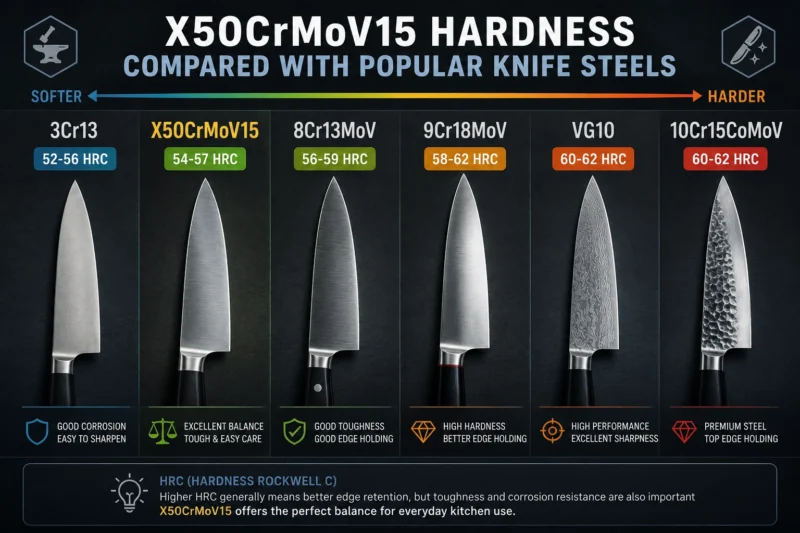
Typical hardness:
54–57 HRC
depending on:
- Heat treatment
- Blade thickness
- Manufacturer requirements
This hardness range is intentional.
Many premium Japanese kitchen knives use harder steels around:
- 60–62 HRC
However, German-style knives often prioritize:
- Toughness
- Edge durability
- Easy sharpening
A softer blade is less likely to chip during aggressive kitchen use.
https://yashkadesigns.com/paring-knife-home-kitchen-cutting-tool-best-chef-knives
Why German Knives Often Use Lower HRC
A common misunderstanding is:
“Higher HRC always means a better knife.”
This is not true.
A kitchen knife needs balance.
A very hard knife:
Advantages:
- Longer edge retention
Disadvantages:
- More brittle
- More difficult sharpening
- More sensitive to impact
A 55–57 HRC X50CrMoV15 knife:
Advantages:
✓ Tough
✓ Easy sharpening
✓ Resistant to damage
✓ Reliable daily performance
This makes it excellent for home cooks and professional kitchens where knives must survive constant use.
Check Our Guide Best Kitchen Knives for Groomsmen Gifts
Edge Retention of X50CrMoV15
Edge retention is the area where X50CrMoV15 is often misunderstood.
It is not designed as an extreme edge-holding steel.
Compared with:
- VG10
- 9Cr18MoV
- 10Cr15CoMoV
- S35VN
it will lose sharpness faster.
However, its advantage is:
Fast recovery and easy sharpening.
A professional chef can quickly restore the edge with:
- Honing rod
- Sharpening stone
- Ceramic rod
Summary
X50CrMoV15 / DIN 1.4116 became successful because it offers a practical combination:
| Property | Performance |
|---|---|
| Corrosion Resistance | Excellent |
| Toughness | Excellent |
| Sharpening | Easy |
| Edge Retention | Medium |
| Hardness | 54–57 HRC |
| Maintenance | Very Easy |
It is not a competition steel.
It is something different:
A dependable professional kitchen steel designed for real-world cooking.
X50CrMoV15 Edge Retention Performance
One of the most common questions about any knife steel is:
“How long will it stay sharp?”
The answer for X50CrMoV15 is:
Moderate edge retention with excellent ease of maintenance.
This steel was not designed to compete with:
- Powder metallurgy steels
- High-vanadium steels
- Ultra-hard Japanese steels
Instead, it focuses on balance.
A typical X50CrMoV15 kitchen knife at around:
54–57 HRC
will provide enough hardness for daily cooking while remaining easy to sharpen.
What Affects Edge Retention?
The cutting performance depends on more than steel chemistry.
Important factors include:
1. Heat Treatment
A properly heat-treated X50CrMoV15 blade will perform significantly better than a poorly treated one.
Heat treatment controls:
- Martensite formation
- Carbide structure
- Final hardness
- Edge stability
Research on 1.4116 stainless steel shows that heat treatment parameters strongly influence hardness, microstructure, and corrosion performance.
Check Our Guide Different Heat Treatment Methods Explained
2. Blade Geometry
A thin edge cuts better and feels sharper.
A German-style chef knife often uses:
- Moderate thickness
- Strong edge angle
- Durable geometry
This design favors reliability over extreme slicing ability.
Check Our Guide Blade Geometry Explained
3. Sharpening Angle
A typical X50CrMoV15 kitchen knife works well around:
- 15–20 degrees per side
A thinner edge:
- Cuts better
- Feels sharper
A thicker edge:
- Lasts longer
- Handles abuse better
X50CrMoV15 Corrosion Resistance
This is one of its strongest advantages.
The steel contains approximately:
- 14–15% chromium
- Molybdenum addition
which provides excellent stainless properties.
For kitchen use, this means:
✓ Resistant to water
✓ Resistant to food acids
✓ Low maintenance
✓ Suitable for humid kitchens
A chef can use the knife daily without worrying about immediate rust formation.
Kitchen Knife Steel Comparison
| Steel | HRC | Edge Retention | Toughness |
|---|---|---|---|
| X50CrMoV15 | 54-57 | Medium | ★★★★★ |
| 9Cr18MoV | 58-62 | High | ★★★★ |
| 10Cr15CoMoV | 60-62 | High | ★★★★ |
Why German Kitchen Knives Prefer X50CrMoV15
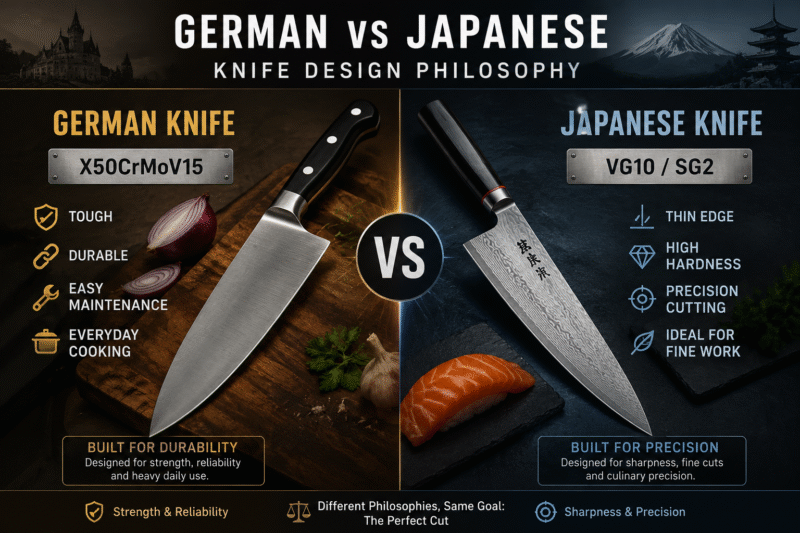
Many Western kitchen knives follow a different philosophy compared with Japanese knives.
German Knife Philosophy
Focus:
- Durability
- Toughness
- Easy maintenance
- Everyday reliability
Japanese Knife Philosophy
Focus:
- Maximum sharpness
- Thin cutting geometry
- Higher hardness
- Precision cutting
X50CrMoV15 fits perfectly into the German approach.
It creates a knife that can:
- Cut vegetables
- Prepare meat
- Handle daily kitchen work
- Survive accidental misuse
Toughness of X50CrMoV15
Toughness is the ability of steel to resist:
- Chipping
- Cracking
- Breaking
This is an area where X50CrMoV15 performs very well.
Because the hardness is moderate, the blade has good flexibility.
For a professional kitchen environment, toughness is extremely valuable.
A chef knife may experience:
- Contact with cutting boards
- Small twisting forces
- Accidental side pressure
A very hard steel may chip.
X50CrMoV15 usually bends or rolls before catastrophic failure.
Sharpening X50CrMoV15
One of the biggest advantages of this steel:
It is very easy to sharpen.
Recommended tools:
- Water stones
- Ceramic rods
- Honing steels
- Standard sharpeners
For beginners, this is an excellent steel because mistakes are easier to correct.
X50CrMoV15 Sharpening Difficulty Compared
| Steel | Sharpening Difficulty |
|---|---|
| 3Cr13 | Very Easy |
| 5Cr15MoV | Easy |
| X50CrMoV15 | Easy |
| 8Cr13MoV | Easy-Medium |
| VG10 | Medium |
| 9Cr18MoV | Medium |
| 10Cr15CoMoV | Medium |
X50CrMoV15 is especially popular among professional cooks because maintaining the edge does not require advanced sharpening skills.
Advantages of X50CrMoV15 Steel
1. Excellent Corrosion Resistance
This is probably its strongest feature.
A kitchen knife made from X50CrMoV15 can handle:
- Water
- Steam
- Food acids
- Frequent washing
with minimal maintenance.
2. Excellent Toughness
The steel resists:
- Chipping
- Edge damage
- Accidental impact
This makes it suitable for busy kitchens.
3. Easy Sharpening
Unlike many modern high-hardness steels:
X50CrMoV15 can be restored quickly.
This is important for professionals who cannot spend excessive time sharpening.
4. Balanced Performance
X50CrMoV15 does not specialize in one extreme property.
Instead, it provides:
- Good hardness
- Good corrosion resistance
- Good toughness
- Easy maintenance
This balance explains its long-term popularity.
5. Affordable Premium Performance
Although it is associated with German kitchen knives, the steel itself is not an exotic material.
It provides excellent practical performance without the high cost of advanced steels.
Disadvantages of X50CrMoV15
1. Average Edge Retention
The biggest weakness:
It does not hold an edge as long as premium steels.
Compared with:
- VG10
- 9Cr18MoV
- 10Cr15CoMoV
it requires more frequent sharpening.
2. Lower Maximum Hardness
At approximately 55–57 HRC, it is softer than many modern kitchen steels.
Advantages:
- Tougher
- Easier sharpening
Disadvantages:
- Less wear resistance
Check Our Guide What Is HRC? Understanding Rockwell Hardness
3. Not Ideal for Ultra-Thin Japanese Geometry
A very thin Japanese-style blade often benefits from higher hardness.
X50CrMoV15 works better with:
- German chef knives
- Western-style blades
- Durable cutting tools
X50CrMoV15 vs VG10
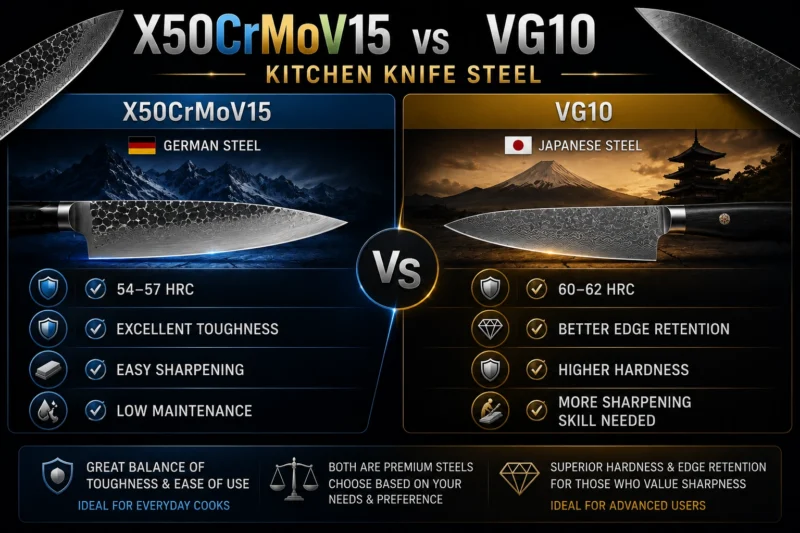
This is one of the most common comparisons.
VG10
Typical characteristics:
- Higher carbon
- Higher hardness
- Better edge retention
Typical hardness:
60–62 HRC
X50CrMoV15
Characteristics:
- Better toughness
- Easier sharpening
- Lower maintenance
Typical hardness:
54–57 HRC
Comparison Table
| Feature | X50CrMoV15 | VG10 |
|---|---|---|
| Hardness | 54–57 HRC | 60–62 HRC |
| Edge Retention | Medium | High |
| Corrosion Resistance | Excellent | Excellent |
| Toughness | Excellent | Good |
| Sharpening | Easy | Medium |
| Professional Use | Excellent | Excellent |
Winner:
For maximum sharpness:
🏆 VG10
For easy daily use:
🏆 X50CrMoV15
X50CrMoV15 vs 9Cr18MoV
Both are stainless steels commonly used in kitchen knives.
9Cr18MoV Advantages:
- Higher carbon
- Higher hardness
- Better edge retention
Typical hardness:
58–62 HRC
Check Our Guide The Ultimate Guide to Chinese Knife Steels
X50CrMoV15 Advantages:
- Better toughness
- Easier sharpening
- More forgiving
| Feature | X50CrMoV15 | 9Cr18MoV |
|---|---|---|
| Carbon | 0.5% | 0.9% |
| Hardness | 54–57 HRC | 58–62 HRC |
| Edge Retention | Medium | High |
| Toughness | Excellent | Good |
| Maintenance | Very Easy | Medium |
Winner:
Professional slicing:
🏆 9Cr18MoV
Everyday kitchen durability:
🏆 X50CrMoV15
X50CrMoV15 vs 10Cr15CoMoV
10Cr15CoMoV represents a newer generation of premium Chinese kitchen steels.
10Cr15CoMoV
Advantages:
- Higher hardness
- Better edge retention
- More premium cutting performance
Typical hardness:
60–62 HRC
X50CrMoV15
Advantages:
- Easier maintenance
- Better toughness
- Lower sharpening difficulty
| Feature | X50CrMoV15 | 10Cr15CoMoV |
|---|---|---|
| Hardness | 54–57 HRC | 60–62 HRC |
| Edge Retention | Medium | High |
| Toughness | Excellent | Good |
| Sharpening | Easy | Medium |
| Price Level | Medium | Higher |
Winner:
Performance:
🏆 10Cr15CoMoV
Practical everyday use:
🏆 X50CrMoV15
Best Applications for X50CrMoV15
This steel is excellent for:
Chef Knives
Probably the best-known application.
It works well for:
- Vegetable cutting
- Meat preparation
- General cooking
Paring Knives
Small knives benefit from:
- Easy sharpening
- Corrosion resistance
Kitchen Knife Sets
Because of its balanced characteristics, it is ideal for complete knife collections.
Restaurant Knives
Professional kitchens value:
- Reliability
- Easy maintenance
- Toughness
Who Should Buy an X50CrMoV15 Knife?
Best For:
✓ Home cooks
✓ Professional chefs
✓ Beginners
✓ People who dislike difficult sharpening
✓ Users who want low maintenance knives
Not Ideal For:
✗ Knife collectors seeking exotic steels
✗ Users wanting maximum edge retention
✗ Competition cutting enthusiasts
Summary
X50CrMoV15 / DIN 1.4116 is successful because it does not chase extreme numbers.
Instead, it provides what many cooks actually need:
| Property | Rating |
|---|---|
| Corrosion Resistance | ★★★★★ |
| Toughness | ★★★★★ |
| Sharpening Ease | ★★★★★ |
| Edge Retention | ★★★☆☆ |
| Hardness | ★★★☆☆ |
It is a classic example of a steel designed around real kitchen requirements.
Heat Treatment: The Secret Behind X50CrMoV15 Performance
Many knife buyers focus only on steel names.
However, the same steel can perform very differently depending on manufacturing quality.
A knife is not simply:
Steel = Performance
The real formula is:
Steel + Heat Treatment + Geometry + Sharpening
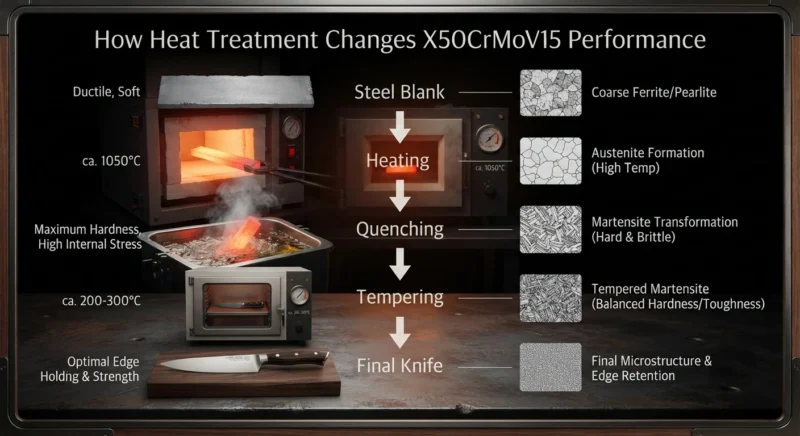
Why Heat Treatment Matters
Heat treatment changes the internal structure of the steel.
The process includes:
- Heating the steel
- Austenitizing
- Quenching
- Tempering
The goal is to create a balanced structure with:
- Enough hardness
- Good toughness
- Stable edge performance
Research on DIN 1.4116 shows that heat treatment parameters influence hardness, microstructure, and corrosion behavior.
What Happens With Poor Heat Treatment?
A poorly treated X50CrMoV15 blade may have:
Too Low Hardness
Results:
- Faster edge wear
- Softer cutting feel
- Frequent sharpening
Too High Hardness
Results:
- Increased brittleness
- Higher risk of chipping
- Less toughness
A good manufacturer finds the balance.
For kitchen knives, the typical target is around:
54–57 HRC
This gives:
✓ Good durability
✓ Easy sharpening
✓ Reliable edge stability
How To Maintain an X50CrMoV15 Knife
One of the biggest advantages of this steel is simple maintenance.
1. Wash and Dry After Use
Although X50CrMoV15 has excellent corrosion resistance, proper care increases blade life.
Recommended:
✓ Wash with warm water
✓ Dry immediately
✓ Avoid leaving food residue on the blade
Especially avoid long contact with:
- Salt
- Lemon juice
- Vinegar
- Tomato acids
2. Use the Correct Cutting Surface
Even a tough steel can be damaged by bad cutting boards.
Best:
✓ Wood cutting boards
✓ Soft plastic boards
Avoid:
✗ Glass
✗ Stone
✗ Ceramic surfaces
Hard surfaces damage the edge faster than the steel itself.
3. Regular Honing
German-style knives often work well with honing rods.
A honing rod does not remove much steel.
Instead, it realigns the edge.
For daily kitchen use:
- A few strokes before cooking
- Occasional sharpening when needed
can keep the knife performing well.
Check Our Guide The Ultimate Guide to Caring for a Damascus Steel Knife
4. Sharpening X50CrMoV15
When honing is no longer enough:
Use:
- 1000 grit stone for general sharpening
- 3000–6000 grit for finishing
Recommended angle:
15–20 degrees per side
For German-style chef knives:
- 18 degrees is a good compromise
It provides:
- Sharpness
- Durability
Blade Geometry and X50CrMoV15
Steel is only one part of cutting performance.
A well-designed X50CrMoV15 knife can outperform a more expensive steel with poor geometry.
German Style Geometry
Traditional German knives usually have:
- Thicker spine
- Stronger edge
- More belly curve
Advantages:
✓ Durable
✓ Good for rocking cuts
✓ Resistant to damage
Japanese Style Geometry
Japanese knives often use:
- Thinner blades
- Higher hardness
- More delicate edges
Advantages:
✓ Extremely sharp
✓ Excellent slicing ability
However:
- More sensitive to misuse
Is X50CrMoV15 Good for Chef Knives?
Yes.
In fact, it is one of the most practical steels for chef knives.
It works especially well for:
Home Cooking
Excellent because:
- Easy maintenance
- Rust resistance
- Easy sharpening
Restaurant Kitchens
Professional chefs appreciate:
- Reliability
- Quick sharpening
- Toughness
Beginner Users
It is forgiving.
A beginner can learn:
- Cutting technique
- Sharpening
- Knife care
without worrying about damaging an expensive blade.
Complete X50CrMoV15 Comparison Chart
| Steel | HRC | Edge Retention | Corrosion Resistance | Toughness | Sharpening |
|---|---|---|---|---|---|
| 3Cr13 | 52–56 | Low | Excellent | Good | Very Easy |
| 5Cr15MoV | 55–57 | Medium | Excellent | Good | Easy |
| X50CrMoV15 | 54–57 | Medium | Excellent | Excellent | Easy |
| 8Cr13MoV | 56–59 | Medium | Good | Good | Easy |
| VG10 | 60–62 | High | Excellent | Medium | Medium |
| 9Cr18MoV | 58–62 | High | Excellent | Good | Medium |
| 10Cr15CoMoV | 60–62 | High | Excellent | Good | Medium |
X50CrMoV15 vs Modern Premium Steels
Modern knife steels often advertise:
- Extreme hardness
- Long edge retention
- High wear resistance
Examples:
- S30V
- S35VN
- M390
- MagnaCut
These steels can outperform X50CrMoV15 in edge retention.
However, they often require:
- More expensive knives
- More difficult sharpening
- More specialized maintenance
X50CrMoV15 wins in practicality.
Why Some Chefs Still Prefer X50CrMoV15
A professional kitchen is not a laboratory.
A chef needs a knife that:
- Works every day
- Can be sharpened quickly
- Does not chip easily
- Survives heavy use
A knife that holds an edge for two weeks but takes 30 minutes to sharpen is not always better.
Common Myths About X50CrMoV15
Myth 1:
“German steel is outdated.”
Reality:
X50CrMoV15 is not designed to be the hardest steel.
It is designed to be reliable.
Myth 2:
“Higher HRC always means better.”
Reality:
Hardness is only one property.
A good kitchen knife needs:
- Hardness
- Toughness
- Corrosion resistance
Myth 3:
“Expensive steel automatically makes a better knife.”
Reality:
Blade design and heat treatment are equally important.
Frequently Asked Questions
Is X50CrMoV15 good steel?
Yes.
It is one of the best balanced stainless steels for everyday kitchen knives.
Its strengths are:
- Corrosion resistance
- Toughness
- Easy sharpening
Is X50CrMoV15 better than VG10?
Not necessarily.
VG10 has:
- Higher hardness
- Better edge retention
X50CrMoV15 has:
- Better toughness
- Easier sharpening
The better choice depends on the user.
Is X50CrMoV15 the same as 1.4116?
Yes.
DIN 1.4116 is the material number designation for X50CrMoV15.
Does X50CrMoV15 rust?
It has excellent corrosion resistance.
Normal kitchen use should not cause rust if the knife is maintained properly.
How often should I sharpen X50CrMoV15?
Frequency depends on use.
Typical home cooking:
- Every few weeks to months
Professional kitchen:
- More frequently
Regular honing can extend the sharpening interval.
Final Verdict: Is X50CrMoV15 Still a Good Kitchen Knife Steel?
After decades of use, X50CrMoV15 remains one of the most practical kitchen knife steels available.
It does not compete by having the highest hardness.
It succeeds because it offers balance.
Strengths:
★★★★★ Corrosion resistance
★★★★★ Toughness
★★★★★ Easy sharpening
★★★★☆ Everyday edge retention
★★★★☆ Value
Weaknesses:
- Not the longest edge-holding steel
- Not designed for extreme cutting performance
Who Should Choose X50CrMoV15?
Choose this steel if you want:
✓ A reliable chef knife
✓ Easy maintenance
✓ Rust resistance
✓ A durable everyday blade
✓ Simple sharpening
Avoid it only if your priority is:
- Maximum edge retention
- Ultra-premium steel performance
- Collecting advanced steels
Final Conclusion
X50CrMoV15 / DIN 1.4116 steel represents the German philosophy of knife design: practical, durable, and dependable.
While newer steels may offer higher hardness or longer edge retention, few materials match its combination of:
- Toughness
- Stainless performance
- Ease of maintenance
- Real-world kitchen usability
For home cooks and professionals who want a knife that simply works every day, X50CrMoV15 remains one of the most proven kitchen knife steels in the world.
This article is for independent informational purposes only and is not affiliated with, sponsored by, or endorsed by any steel manufacturer. All product names, trademarks, and registered trademarks are the property of their respective owners.