Chinese Knife Steels
An Independent Guide
Introduction: Why Chinese Knife Steels Deserve More Attention
When people hear the term Chinese Knife Steels, many immediately think about inexpensive kitchen knives with average performance. This reputation comes from decades of mass production, where some manufacturers focused mainly on reducing costs rather than maximizing quality.
However, modern knife manufacturing in China is much more diverse. Today, Chinese Knife Steels range from simple budget stainless materials used in everyday kitchen knives to advanced stainless alloys capable of delivering excellent cutting performance.
The most important point to understand is:
Steel quality is not determined only by the name written on the blade.
A knife’s performance depends on several factors:
- Chemical composition
- Heat treatment
- Blade thickness
- Edge geometry
- Grinding quality
- Final sharpening
A properly heat-treated 5Cr15MoV knife can outperform a poorly manufactured knife made from a more expensive steel.
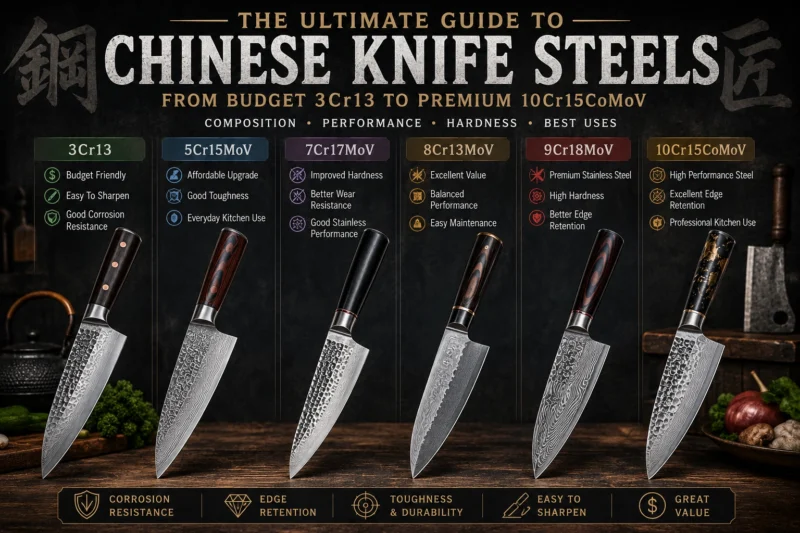
The Chinese steel industry produces many stainless grades specifically designed for cutlery applications. The most common families include:
- 3Cr13
- 4Cr13
- 5Cr15MoV
- 6Cr13
- 7Cr17MoV
- 8Cr13MoV
- 8Cr14MoV
- 9Cr18MoV
- 10Cr15CoMoV
Each steel represents a different balance between:
- Hardness
- Edge retention
- Corrosion resistance
- Toughness
- Sharpening difficulty
- Cost
This guide explains the entire progression from entry-level Chinese Knife Steels to premium stainless options.
Understanding Chinese Steel Naming
Before comparing individual steels, it is important to understand how Chinese Knife Steels are named.
Example:
5Cr15MoV
The first number:
5
means approximately:
0.5% carbon content
The letters:
Cr
mean chromium.
The number after chromium:
15
means approximately:
15% chromium
Additional letters:
- Mo = Molybdenum
- V = Vanadium
Therefore:
5Cr15MoV means:
- Carbon: approximately 0.5%
- Chromium: approximately 15%
- Molybdenum addition
- Vanadium addition
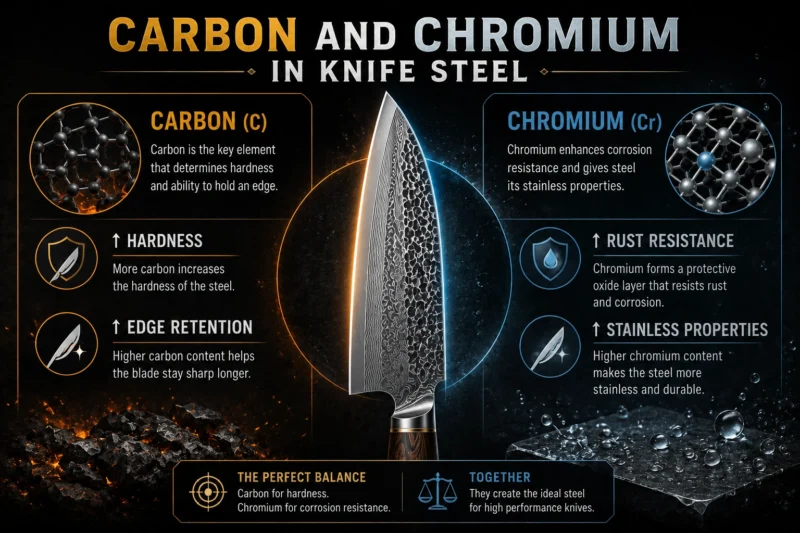
Why Carbon Matters in Knife Steel
Carbon is one of the most important elements in Chinese Knife Steels.
Increasing carbon generally improves:
Hardness
More carbon allows steel to form harder structures after heat treatment.
Higher hardness usually means:
- Better edge stability
- Longer cutting performance
Edge Retention
A higher carbon content allows the blade to maintain sharpness longer.
However, too much hardness can reduce toughness.
A very hard blade may:
- Hold an edge longer
- But become more sensitive to impact
A good knife steel is always a balance.
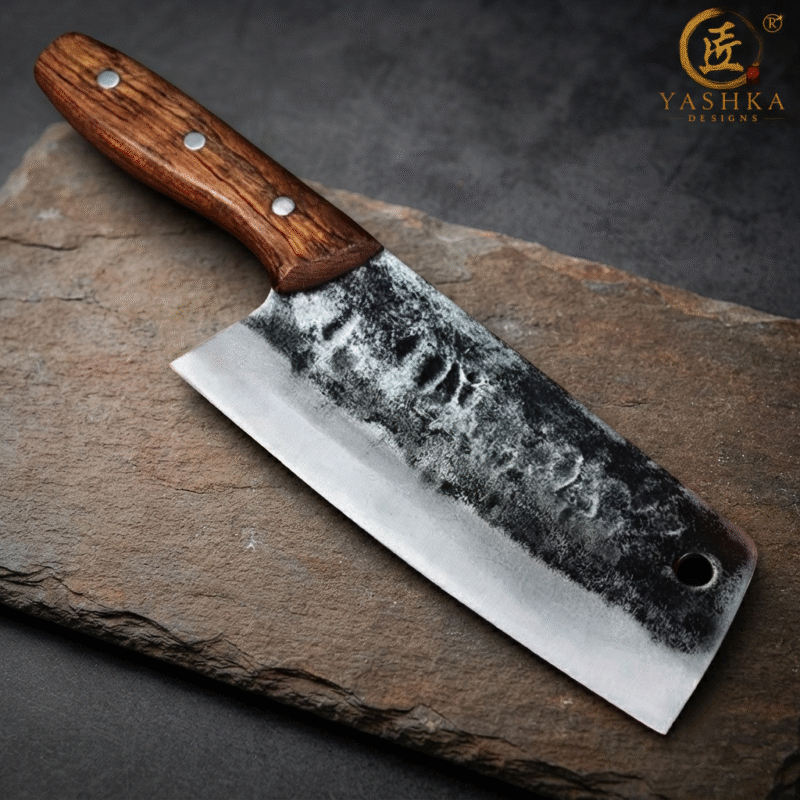
https://yashkadesigns.com/hand-forged-high-carbon-steel-chinese-cleaver
Why Chromium Matters
Chromium is responsible mainly for stainless properties.
A higher chromium level improves:
- Rust resistance
- Corrosion resistance
- Easier maintenance
For kitchen knives, chromium is especially valuable because blades regularly contact:
- Water
- Vegetables
- Meat
- Acidic ingredients
Most stainless Chinese Knife Steels contain enough chromium to provide good corrosion resistance.
3Cr13 Stainless Steel
The Entry-Level Chinese Stainless Steel
3Cr13 is one of the most widely used budget Chinese Knife Steels.
It is commonly found in:
- Affordable kitchen knives
- Utility knives
- Folding knives
- Beginner chef knives
Typical composition:
| Element | Amount |
|---|---|
| Carbon (C) | 0.25–0.35% |
| Chromium (Cr) | 12.5–14.5% |
| Manganese (Mn) | ~1% |
| Silicon (Si) | ~1% |
Typical hardness:
52–56 HRC
Advantages of 3Cr13
1. Excellent Corrosion Resistance
Because of its chromium content, 3Cr13 performs well in wet environments.
For kitchen use, this is a major advantage.
A beginner can use this steel without worrying about immediate rust problems.
2. Very Easy Sharpening
One of the strongest advantages of 3Cr13 is maintenance.
It can be sharpened easily with:
- Basic whetstones
- Ceramic rods
- Simple sharpeners
This makes it practical for everyday users.
3. Good Toughness
Because it is not extremely hard, 3Cr13 is relatively resistant to chipping.
It can handle normal kitchen tasks such as:
- Vegetable preparation
- Meat slicing
- General cooking work
Disadvantages of 3Cr13
Lower Edge Retention
The biggest weakness is that the blade loses sharpness faster compared with higher-carbon steels.
Compared with:
- 8Cr13MoV
- 9Cr18MoV
- 10Cr15CoMoV
3Cr13 requires more frequent sharpening.
Not Designed for Heavy Professional Use
A chef cutting hundreds of ingredients daily may prefer a harder steel.
3Cr13 is better suited for:
✓ Home cooking
✓ Beginners
✓ Budget knives
Who Should Choose 3Cr13?
3Cr13 is a good choice for:
- First kitchen knife
- Affordable cooking knife
- Users who want easy maintenance
It is not the best choice for:
- Professional kitchens
- Maximum edge retention
- Premium knife collectors
4Cr13 Stainless Steel
The Next Step Above 3Cr13
4Cr13 increases carbon content compared with 3Cr13.
Typical composition:
| Element | Amount |
|---|---|
| Carbon (C) | 0.35–0.45% |
| Chromium (Cr) | 12.5–14.5% |
Typical hardness:
54–57 HRC
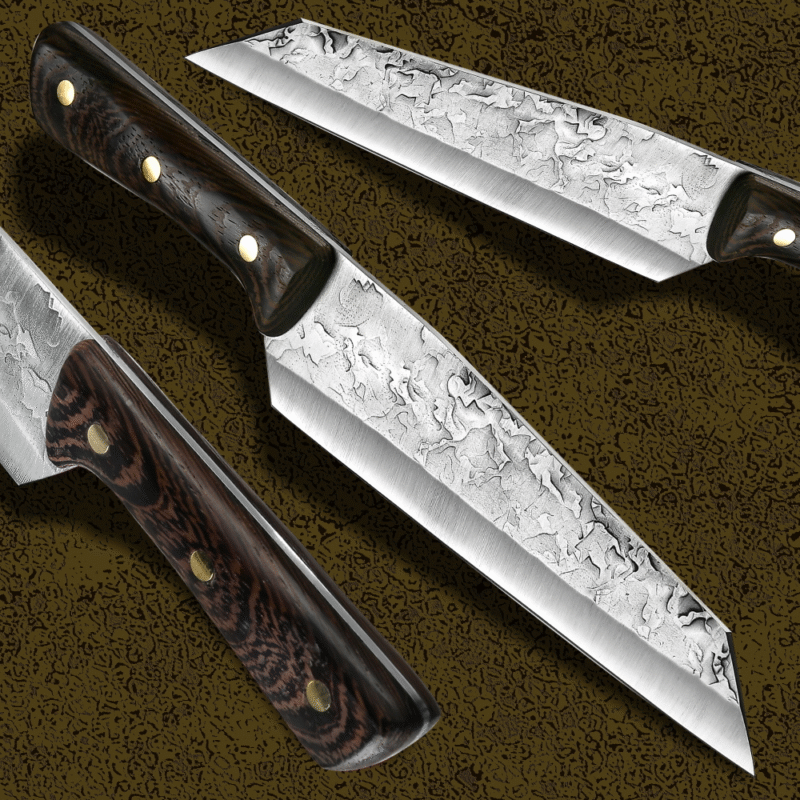
https://yashkadesigns.com/chef-knife-full-tang-blade-6-7-inch-home-bbq-cooking-tool
What Changes from 3Cr13 to 4Cr13?
The additional carbon provides:
- Slightly higher hardness
- Better edge stability
- Improved cutting ability
The difference is not dramatic, but experienced users can notice better performance.
Advantages of 4Cr13
Better Hardness
Compared with 3Cr13:
- Holds an edge slightly longer
- Feels more refined during cutting
Still Easy to Sharpen
4Cr13 remains user-friendly.
It does not require expensive sharpening equipment.
Good Balance
4Cr13 provides a practical balance:
- Affordable price
- Stainless performance
- Reasonable hardness
Disadvantages of 4Cr13
Still Limited Edge Retention
Although better than 3Cr13, it is still a budget steel.
For demanding applications, higher carbon steels perform better.
Common Uses of 4Cr13
4Cr13 is used for:
- Kitchen knives
- Chinese cleavers
- Utility blades
- Scissors
- Affordable outdoor knives
It is especially popular where manufacturers need a balance between cost and performance.
5Cr15MoV Stainless Steel
The Popular Kitchen Knife Steel
5Cr15MoV is one of the most common Chinese Knife Steels used for kitchen knives.
It represents a major improvement over basic steels.
Typical composition:
| Element | Amount |
|---|---|
| Carbon (C) | ~0.5% |
| Chromium (Cr) | ~15% |
| Molybdenum (Mo) | Added |
| Vanadium (V) | Added |
Typical hardness:
55–57 HRC
https://yashkadesigns.com/high-carbon-steel-chef-knife-7-2-inch
Why 5Cr15MoV Became Popular
The reason is simple:
It offers a very practical balance.
A kitchen knife does not always need extreme hardness.
Many cooks prefer:
- Easy sharpening
- Toughness
- Corrosion resistance
- Affordable price
5Cr15MoV delivers all four.
Advantages of 5Cr15MoV
1. Better Edge Retention Than Budget Steels
Compared with:
- 3Cr13
- 4Cr13
5Cr15MoV stays sharp longer.
2. Excellent Corrosion Resistance
The chromium content provides strong stainless performance.
It works well in:
- Home kitchens
- Restaurants
- Humid environments
3. Easy Maintenance
Even beginners can maintain a 5Cr15MoV knife.
It sharpens easily and does not require specialized tools.
4. Good Toughness
A kitchen knife must survive daily use.
5Cr15MoV has enough toughness to resist:
- Small impacts
- Edge damage
- Accidental misuse
Disadvantages of 5Cr15MoV
Not a High-End Steel
Compared with premium Chinese Knife Steels such as:
- 9Cr18MoV
- 10Cr15CoMoV
it has:
- Lower hardness
- Lower wear resistance
- Shorter edge life
Best Applications for 5Cr15MoV
Excellent for:
✓ Chef knives
✓ Santoku knives
✓ Kitchen sets
✓ Everyday cooking knives
It is one of the best choices for users who want:
Reliable performance without complicated maintenance.
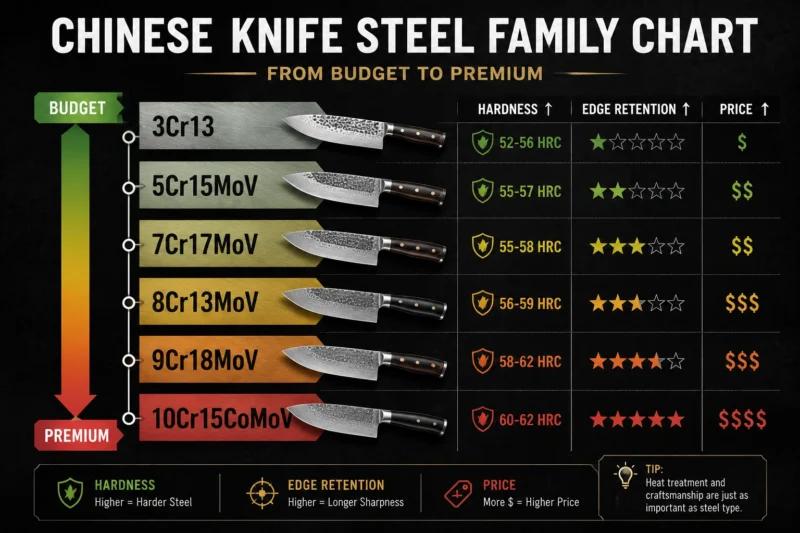
Chinese Knife Steels Progression
| Steel | Carbon | Typical HRC | Performance Level |
|---|---|---|---|
| 3Cr13 | 0.3% | 52–56 | Budget |
| 4Cr13 | 0.4% | 54–57 | Budget+ |
| 5Cr15MoV | 0.5% | 55–57 | Entry Kitchen Performance |
6Cr13, 7Cr17MoV, 8Cr13MoV and 8Cr14MoV: The Middle Class of Chinese Knife Steels
This middle group includes:
- 6Cr13
- 7Cr17MoV
- 8Cr13MoV
- 8Cr14MoV
These steels are among the most widely used Chinese Knife Steels for:
- Kitchen knives
- Chef knives
- Folding knives
- Outdoor knives
- Everyday carry blades
They represent an important balance between price and performance.
6Cr13 Stainless Steel
The Bridge Between Budget and Performance
6Cr13 (also written as 6Cr14MoV in some cases) sits between 5Cr15MoV and 7Cr17MoV.
It was developed to provide a higher hardness potential while maintaining good corrosion resistance.
Typical composition:
| Element | Approximate Amount |
|---|---|
| Carbon (C) | ~0.55–0.65% |
| Chromium (Cr) | ~13–14% |
| Molybdenum (Mo) | Small addition |
| Vanadium (V) | Small addition |
Typical hardness:
55–58 HRC
What Does 6Cr13 Mean?
Following the Chinese naming system:
6
means approximately:
0.6% carbon
Cr13
means approximately:
13% chromium
Additional alloy elements such as molybdenum and vanadium improve:
- Wear resistance
- Strength
- Edge stability
Advantages of 6Cr13
1. Better Hardness Than 5Cr15MoV
The increased carbon content allows 6Cr13 to achieve higher hardness.
Benefits:
- Better edge stability
- Improved cutting performance
- Longer sharpness
Compared with 5Cr15MoV, users may notice:
- A cleaner cutting feel
- Slightly longer edge life
2. Good Corrosion Resistance
With chromium content above the stainless threshold, 6Cr13 performs well in kitchen environments.
It handles:
- Water exposure
- Food acids
- Humidity
better than many carbon steels.
3. Easy Sharpening
Although harder than entry-level steels, 6Cr13 remains easy to maintain.
It works well with:
- Water stones
- Ceramic rods
- Standard sharpening systems
Disadvantages of 6Cr13
Moderate Edge Retention
While better than basic steels, it cannot compete with:
- 9Cr18MoV
- 10Cr15CoMoV
- Premium powder steels
For professional chefs who cut all day, higher-performance steels are usually preferred.
Best Applications for 6Cr13
6Cr13 is suitable for:
✓ Kitchen knives
✓ Utility knives
✓ Budget chef knives
✓ Everyday cutting tools
It is a practical choice for users who want something better than basic stainless steel without paying premium prices.
7Cr17MoV Stainless Steel
The Corrosion-Resistant Workhorse
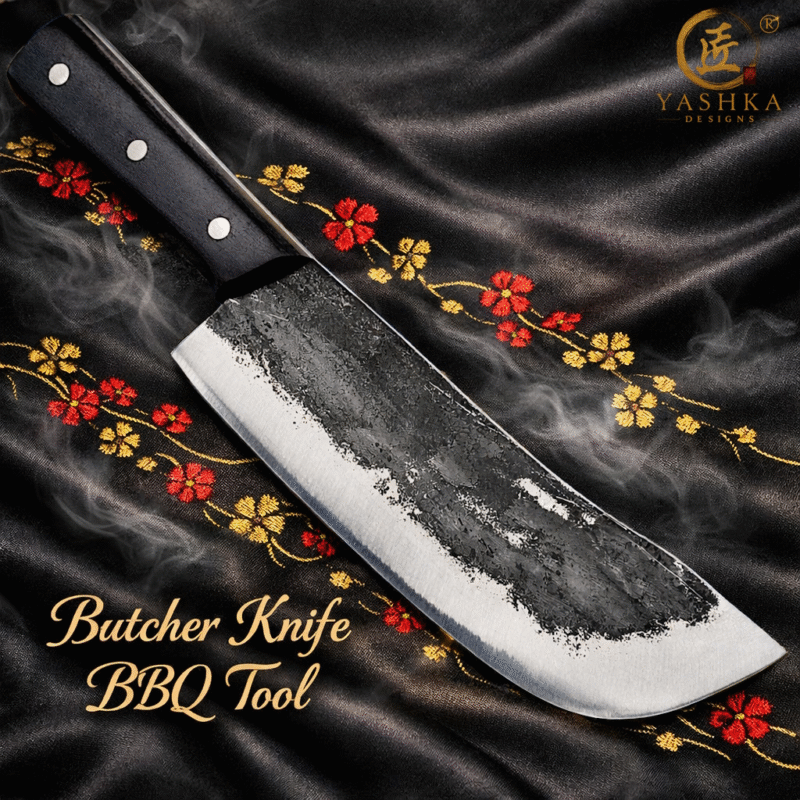
7Cr17MoV is one of the most popular Chinese Knife Steels in affordable quality knives.
It is often compared with 440A stainless steel because of its chemical structure. It adds vanadium modifications that can improve strength and wear resistance.
Typical composition:
| Element | Approximate Amount |
|---|---|
| Carbon (C) | ~0.7% |
| Chromium (Cr) | ~17% |
| Molybdenum (Mo) | Small amount |
| Vanadium (V) | Small amount |
Typical hardness:
55–58 HRC
https://yashkadesigns.com/traditional-chinese-forged-butcher-knife
Why 7Cr17MoV Is Popular
The main advantage of 7Cr17MoV is balance.
It combines:
- High corrosion resistance
- Good toughness
- Easy sharpening
- Affordable cost
It is especially useful for kitchen knives because kitchens are demanding environments.
A kitchen knife must survive:
- Water
- Salt
- Acidic foods
- Frequent washing
Advantages of 7Cr17MoV
1. Excellent Stainless Performance
With around 17% chromium, this steel has very good corrosion resistance.
This makes it ideal for:
- Kitchen knives
- Fishing knives
- Outdoor knives
2. Good Toughness
7Cr17MoV is not an extremely hard steel.
This can actually be an advantage.
A tougher blade is less likely to:
- Chip
- Crack
- Fail under impact
3. Easy Maintenance
Sharpening is simple.
A normal user can restore the edge without expensive equipment.
Disadvantages of 7Cr17MoV
Lower Edge Retention Compared With Higher Carbon Steels
Compared with:
- 8Cr13MoV
- 9Cr18MoV
it generally holds an edge for a shorter time.
Not Designed for Extreme Cutting
It is not a competition-level steel.
However, for everyday kitchen use, it performs very well.
7Cr17MoV vs 8Cr13MoV
This is one of the most common comparisons in Chinese Knife Steels.
| Feature | 7Cr17MoV | 8Cr13MoV |
|---|---|---|
| Carbon | ~0.7% | ~0.8% |
| Chromium | Higher | Lower |
| Corrosion Resistance | Excellent | Good |
| Edge Retention | Good | Better |
| Toughness | Better | Good |
| Sharpening | Easy | Easy |
In simple terms:
7Cr17MoV = better corrosion resistance
8Cr13MoV = better cutting performance
8Cr13MoV Stainless Steel
The Most Famous Chinese Value Steel
Among all Chinese Knife Steels, 8Cr13MoV is probably the most recognized internationally.
It became famous because it provides excellent value:
- Affordable price
- Good hardness
- Easy sharpening
- Reliable performance
It is often compared with Japanese AUS-8 steel.
Chemical Composition of 8Cr13MoV
| Element | Approximate Amount |
|---|---|
| Carbon (C) | ~0.8% |
| Chromium (Cr) | 13–14% |
| Molybdenum (Mo) | Small amount |
| Vanadium (V) | Small amount |
Typical hardness:
56–59 HRC
Why 8Cr13MoV Became Popular
The secret is balance.
Many expensive steels improve one area while sacrificing another.
8Cr13MoV provides a practical combination:
- Good hardness
- Good toughness
- Easy sharpening
- Good corrosion resistance
Advantages of 8Cr13MoV
1. Better Edge Retention
Compared with:
- 3Cr13
- 4Cr13
- 5Cr15MoV
8Cr13MoV holds an edge noticeably longer.
The higher carbon content helps create a harder cutting edge.
2. Excellent Sharpening Ability
One reason many users like this steel:
It is not difficult to sharpen.
Unlike some premium steels containing large amounts of carbide-forming elements, 8Cr13MoV can be restored easily.
3. Good Toughness
The steel can handle everyday abuse.
Applications include:
- Folding knives
- Kitchen knives
- Outdoor knives
Disadvantages of 8Cr13MoV
Moderate Wear Resistance
Compared with:
- 9Cr18MoV
- 10Cr15CoMoV
it loses sharpness faster.
Not a Premium Steel
It is a very good value steel, but not designed for luxury knives.
Best Uses for 8Cr13MoV
Excellent for:
✓ Everyday carry knives
✓ Affordable chef knives
✓ Utility knives
✓ Outdoor knives
For many users, 8Cr13MoV is the point where Chinese Knife Steels become genuinely impressive.
8Cr14MoV Stainless Steel
A Close Relative of 8Cr13MoV
8Cr14MoV is one of the most discussed Chinese Knife Steels because many people wonder:
“What is the difference between 8Cr13MoV and 8Cr14MoV?”
The answer:
The difference is very small.
Both steels have very similar compositions and performance characteristics.
Chemical Composition of 8Cr14MoV
Typical:
| Element | Approximate Amount |
|---|---|
| Carbon (C) | ~0.8% |
| Chromium (Cr) | ~14% |
| Molybdenum (Mo) | Small amount |
| Vanadium (V) | Small amount |
Check Our Guide Chinese Knives Guide
8Cr14MoV Performance
In practical knife use:
8Cr14MoV provides:
- Similar hardness
- Similar edge retention
- Similar corrosion resistance
to 8Cr13MoV.
The differences are usually smaller than differences caused by:
- Heat treatment
- Blade geometry
- Sharpening angle
Advantages of 8Cr14MoV
✓ Good edge retention
✓ Easy sharpening
✓ Affordable
✓ Good stainless performance
Disadvantages of 8Cr14MoV
Like 8Cr13MoV:
- Not a premium steel
- Moderate wear resistance
- Requires sharpening more often than higher-end steels
8Cr13MoV vs 8Cr14MoV
| Feature | 8Cr13MoV | 8Cr14MoV |
|---|---|---|
| Carbon | ~0.8% | ~0.8% |
| Chromium | ~13–14% | ~14% |
| Performance | Very similar | Very similar |
| Sharpening | Easy | Easy |
| Value | Excellent | Excellent |
The difference is usually not noticeable in normal kitchen or EDC use.
Chinese Knife Steels Middle Range
| Steel | HRC | Main Advantage | Best Use |
|---|---|---|---|
| 6Cr13 | 55–58 | Balanced performance | Kitchen knives |
| 7Cr17MoV | 55–58 | Corrosion resistance | Kitchen/outdoor |
| 8Cr13MoV | 56–59 | Best value balance | EDC/kitchen |
| 8Cr14MoV | 56–59 | Similar to 8Cr13MoV | Budget performance |
The middle group of Chinese Knife Steels represents the best price-to-performance category.
For many users:
- 7Cr17MoV is excellent for wet environments
- 8Cr13MoV is the better all-around performer
- 8Cr14MoV offers almost identical value
9Cr18MoV and 10Cr15CoMoV: The Premium Level of Chinese Knife Steels
When we move into premium kitchen knives, two Chinese Knife Steels become especially important:
- 9Cr18MoV
- 10Cr15CoMoV
These steels represent the upper level of traditional Chinese stainless knife steels and are widely used in higher-quality chef knives, Damascus kitchen knives, and professional-style cutting tools.
9Cr18MoV Stainless Steel
The Premium Stainless Workhorse
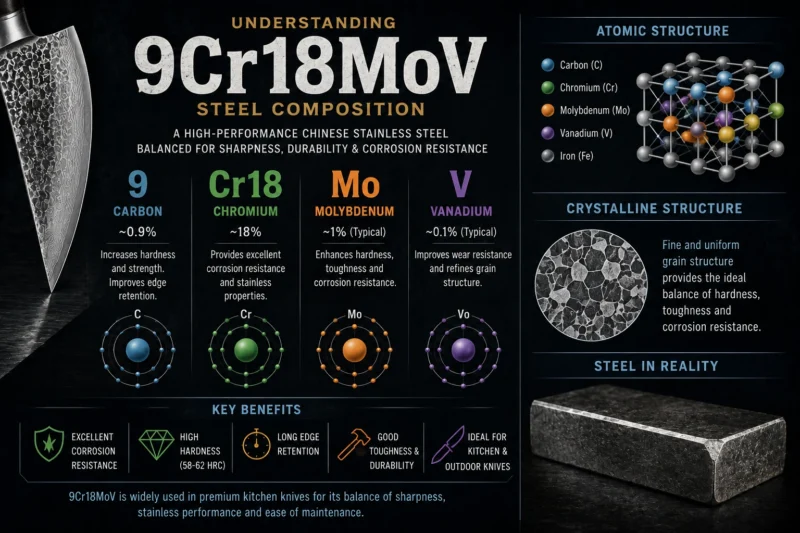
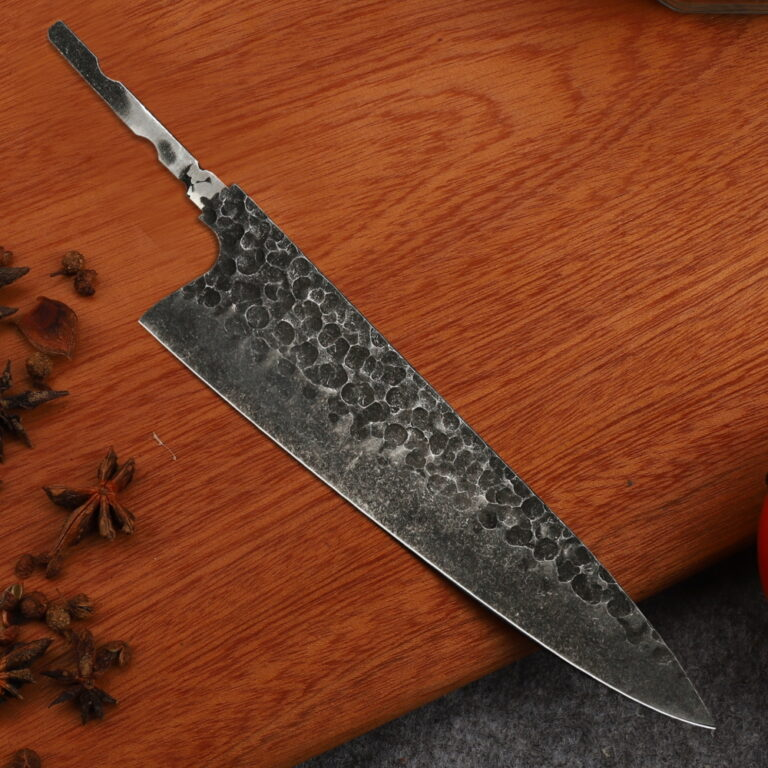
9Cr18MoV is one of the most respected Chinese Knife Steels for kitchen applications.
It is often considered the point where Chinese stainless steels move from “budget performance” into the professional category.
This steel is frequently compared with:
- 440C stainless steel
- Japanese high-carbon stainless steels
because of its combination of:
- High carbon content
- High chromium content
- Good hardness
- Excellent corrosion resistance
https://yashkadesigns.com/chef-knife-8-5-inch-blank-blade-craft-supplies-home-hobby-minimalist
Chemical Composition of 9Cr18MoV
Typical composition:
| Element | Approximate Amount |
|---|---|
| Carbon (C) | ~0.9–1.0% |
| Chromium (Cr) | ~18% |
| Molybdenum (Mo) | ~1% |
| Vanadium (V) | ~0.1–0.2% |
| Silicon (Si) | ~1–2% |
| Iron (Fe) | Balance |
The name explains the composition:
9
≈ 0.9% carbon
Cr18
≈ 18% chromium
Mo
Molybdenum addition
V
Vanadium addition
Why 9Cr18MoV Performs Well
1. High Hardness Potential
With proper heat treatment, 9Cr18MoV can typically reach:
58–62 HRC
This gives it:
- Better edge retention
- Strong cutting ability
- Good blade stability
For kitchen knives, this hardness range is very useful.
The blade can be ground thin enough for excellent slicing while still maintaining durability.
2. Excellent Corrosion Resistance
The approximately 18% chromium content gives 9Cr18MoV excellent stainless properties.
This is especially important for kitchen knives because they regularly contact:
- Water
- Vegetables
- Meat
- Salt
- Acidic foods
Compared with carbon steels, maintenance is much easier.
3. Better Edge Retention Than 8Cr13MoV
Moving from 8Cr13MoV to 9Cr18MoV brings noticeable improvements.
8Cr13MoV:
- Easier sharpening
- Good toughness
- Moderate edge retention
9Cr18MoV:
- Higher hardness
- Better wear resistance
- Longer cutting performance
For serious home cooks, the difference can be clearly felt.
Advantages of 9Cr18MoV
Excellent Stainless Performance
One of the biggest strengths.
A user can enjoy high hardness without worrying about constant rust prevention.
Good Balance of Properties
9Cr18MoV offers:
✓ Good edge retention
✓ Good corrosion resistance
✓ Good toughness
✓ Reasonable sharpening difficulty
It avoids many disadvantages of extremely hard steels.
Great Value for Premium Kitchen Knives
Compared with expensive imported steels, 9Cr18MoV offers excellent performance for the price.
It is one of the reasons modern Chinese Knife Steels have become competitive internationally.
Disadvantages of 9Cr18MoV
Sharpening Is Slightly More Difficult
Compared with:
- 3Cr13
- 5Cr15MoV
- 8Cr13MoV
it requires more effort.
However, it is still much easier to sharpen than many advanced powder steels.
Not the Highest Edge Retention Steel
Although very good, it is not at the level of some premium powder metallurgy steels.
For most kitchen users, however, the difference is less important.
Best Uses for 9Cr18MoV
Excellent for:
✓ Chef knives
✓ Santoku knives
✓ Gyuto-style knives
✓ Hunting knives
✓ High-quality EDC knives
For many cooks, 9Cr18MoV represents the ideal balance between performance and maintenance.
10Cr15CoMoV Stainless Steel
The Premium Chinese Kitchen Knife Steel
At the top of the traditional Chinese Knife Steels family is:
10Cr15CoMoV
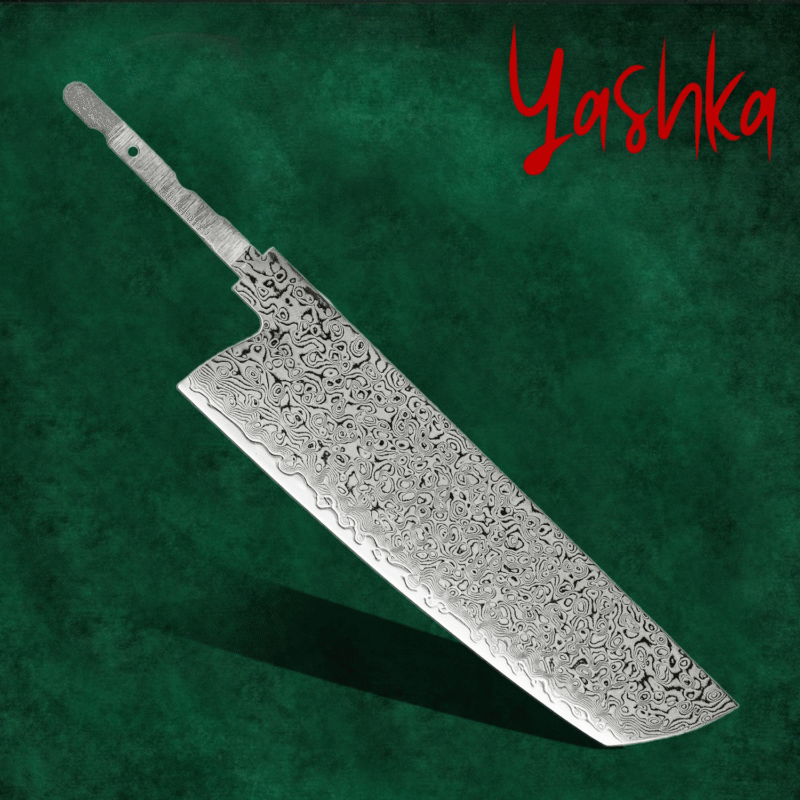
This steel has become extremely popular in premium Chinese kitchen knives, especially:
- Damascus chef knives
- Professional-style kitchen knives
- High-end handmade knives
It is often compared with Japanese VG10 because of its alloy design and performance characteristics.
Chemical Composition of 10Cr15CoMoV
Typical composition:
| Element | Approximate Amount |
|---|---|
| Carbon (C) | 0.95–1.05% |
| Chromium (Cr) | 14.5–15.5% |
| Cobalt (Co) | 1.3–1.8% |
| Molybdenum (Mo) | 0.8–1.2% |
| Vanadium (V) | 0.2–0.35% |
| Manganese (Mn) | Small amount |
Understanding the Name
10
≈ 1.0% carbon
Higher carbon improves:
- Hardness
- Edge retention
- Wear resistance
Cr15
≈ 15% chromium
Provides:
- Stainless properties
- Corrosion resistance
Co
Cobalt addition helps improve hardness capability.
Mo
Molybdenum improves:
- Toughness
- Hardenability
- Corrosion resistance
V
Vanadium helps:
- Grain refinement
- Edge stability
Why 10Cr15CoMoV Is Considered Premium
1. Excellent Edge Retention
The higher carbon content allows this steel to achieve approximately:
60–62 HRC
depending on heat treatment.
This provides:
- Longer sharpness
- Better slicing performance
- More refined cutting feel
2. Excellent Fine Edge Capability
One reason chefs like premium stainless steels:
They can be sharpened to a very thin edge.
This makes them excellent for:
- Vegetable slicing
- Fish preparation
- Precision cutting
3. Excellent Corrosion Resistance
Although it has high hardness, 10Cr15CoMoV remains a stainless steel.
It is suitable for kitchens where easy maintenance matters.
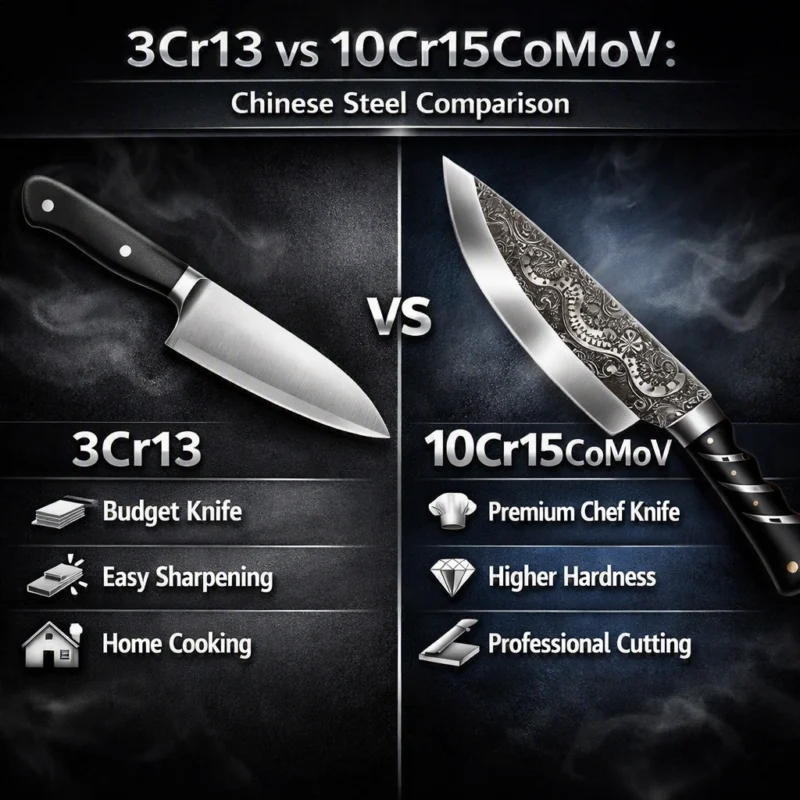
10Cr15CoMoV vs 9Cr18MoV
This is one of the most interesting comparisons in Chinese Knife Steels.
| Feature | 9Cr18MoV | 10Cr15CoMoV |
|---|---|---|
| Carbon | ~0.9% | ~1.0% |
| Chromium | ~18% | ~15% |
| Cobalt | No | Yes |
| HRC | 58–62 | 60–62 |
| Edge Retention | High | Higher |
| Corrosion Resistance | Excellent | Excellent |
| Price Level | Premium | High Premium |
10Cr15CoMoV Advantages
Professional Cutting Performance
This steel is excellent for users who want:
- A sharper edge
- Longer cutting ability
- Premium kitchen experience
Excellent for Damascus Kitchen Knives
Many modern Damascus kitchen knives use 10Cr15CoMoV as the core steel because it combines:
- Performance
- Attractive finishing ability
- Stainless properties
Disadvantages of 10Cr15CoMoV
More Difficult Sharpening
Compared with lower steels:
- Requires better technique
- Benefits from quality sharpening stones
Higher Price
A knife made from 10Cr15CoMoV usually costs more because:
- Steel cost is higher
- Heat treatment requirements are higher
- Manufacturing quality is usually higher
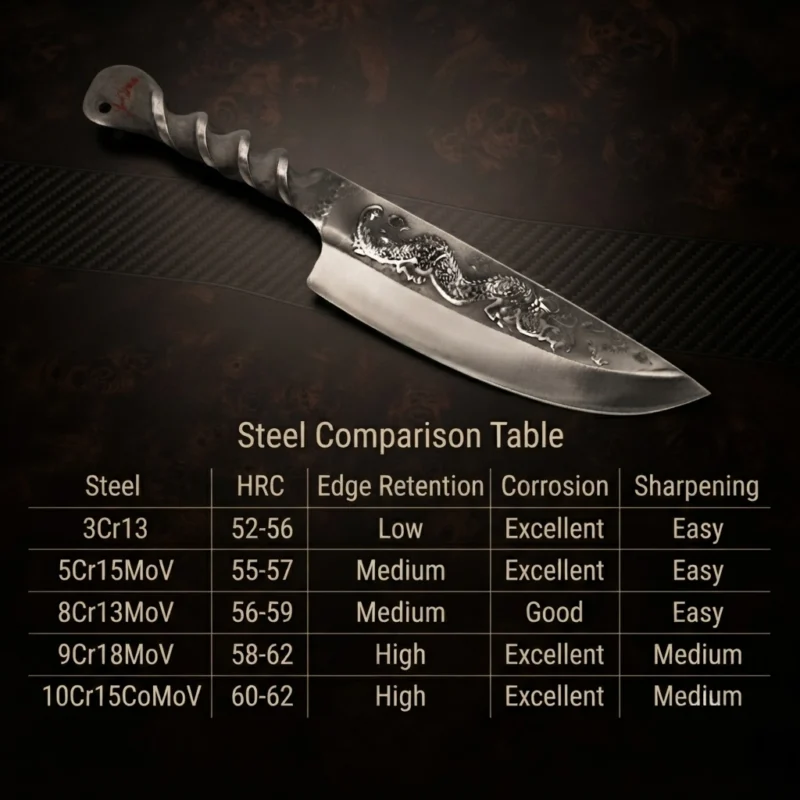
Complete Chinese Knife Steels Comparison Chart
| Steel | Carbon | Typical HRC | Edge Retention | Corrosion Resistance | Sharpening |
|---|---|---|---|---|---|
| 3Cr13 | 0.3% | 52–56 | Low | Excellent | Very Easy |
| 4Cr13 | 0.4% | 54–57 | Low-Medium | Excellent | Easy |
| 5Cr15MoV | 0.5% | 55–57 | Medium | Excellent | Easy |
| 6Cr13 | 0.6% | 55–58 | Medium | Good | Easy |
| 7Cr17MoV | 0.7% | 55–58 | Medium | Excellent | Easy |
| 8Cr13MoV | 0.8% | 56–59 | Medium | Good | Easy |
| 8Cr14MoV | 0.8% | 56–59 | Medium | Good | Easy |
| 9Cr18MoV | 0.9% | 58–62 | High | Excellent | Medium |
| 10Cr15CoMoV | 1.0% | 60–62 | High | Excellent | Medium |
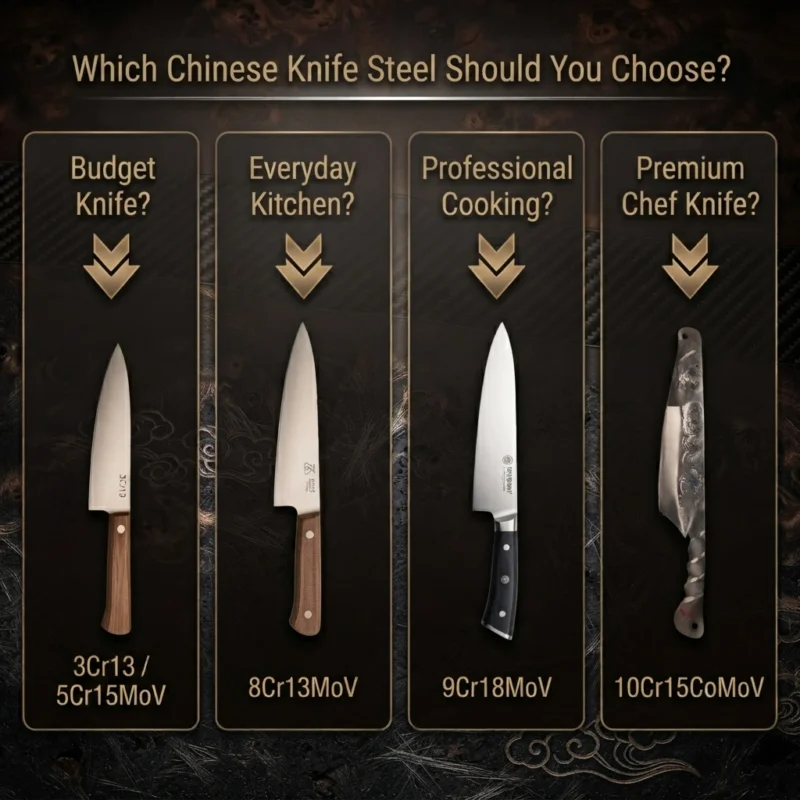
Best Chinese Knife Steel for Different Users
Beginner Home Cook
Best choices:
3Cr13
or
5Cr15MoV
Why:
- Affordable
- Easy sharpening
- Low maintenance
Everyday Kitchen User
Best choices:
7Cr17MoV
or
8Cr13MoV
Why:
- Better cutting performance
- Still easy to maintain
Serious Cooking Enthusiast
Best choice:
9Cr18MoV
Why:
- Professional hardness
- Excellent stainless properties
- Great value
Premium Kitchen Knife Buyer
Best choice:
10Cr15CoMoV
Why:
- Higher hardness
- Excellent edge retention
- Premium cutting feel
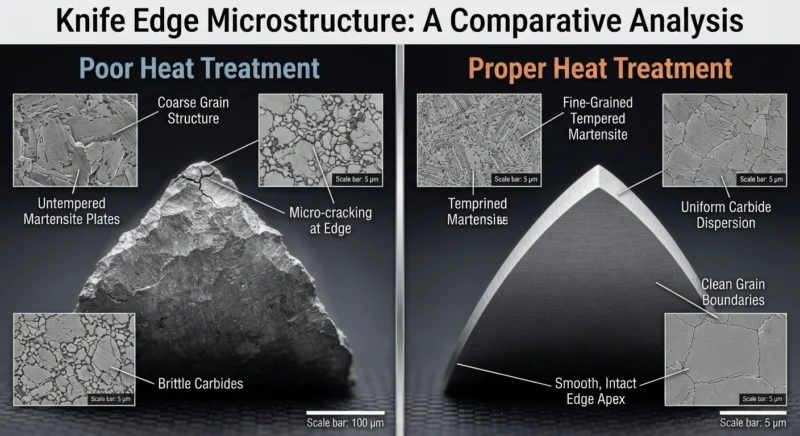
The Importance of Heat Treatment in Chinese Knife Steels
A common mistake is judging a knife only by steel name.
The same steel can perform very differently depending on heat treatment.
Heat treatment controls:
- Hardness
- Toughness
- Edge stability
- Grain structure
A well-treated 8Cr13MoV knife can outperform a poorly treated 9Cr18MoV knife.
Steel is the material.
Heat treatment creates the performance.
Check Our Guide Steel Heat Treatment Explained
Frequently Asked Questions About Chinese Knife Steels
Is Chinese Knife Steel Good?
Yes.
Modern Chinese Knife Steels cover everything from affordable household knives to premium chef knives.
The important factors are:
- Correct steel selection
- Proper heat treatment
- Good blade design
Which Chinese Knife Steel Is Best?
There is no single best steel.
For kitchen knives:
- Budget: 5Cr15MoV
- Value: 8Cr13MoV
- Premium: 9Cr18MoV
- High performance: 10Cr15CoMoV
Is 10Cr15CoMoV Better Than 9Cr18MoV?
Generally yes for edge retention and premium cutting performance.
However, 9Cr18MoV may have slightly better corrosion resistance because of its higher chromium content.
Is 8Cr13MoV a Good Knife Steel?
Yes.
It is one of the best value Chinese Knife Steels.
It offers:
- Good hardness
- Easy sharpening
- Good toughness
- Affordable price
Final Conclusion: Understanding Chinese Knife Steels
The world of Chinese Knife Steels is much larger than many people realize.
From simple 3Cr13 kitchen knives to premium 10Cr15CoMoV chef knives, Chinese manufacturers offer solutions for almost every user.
The progression is clear:
3Cr13 → Easy maintenance and affordability
5Cr15MoV → Practical kitchen performance
8Cr13MoV → Excellent value balance
9Cr18MoV → Premium stainless performance
10Cr15CoMoV → High-performance professional kitchen steel
The best knife is not necessarily the one with the most expensive steel.
The best knife is the one where:
Steel + Heat Treatment + Geometry + Design
work together.
Modern Chinese Knife Steels prove that affordable manufacturing does not automatically mean poor quality. When properly produced, these steels can create reliable, sharp, and long-lasting knives for home cooks, professionals, and knife enthusiasts around the world.
This article is for independent informational purposes only and is not affiliated with, sponsored by, or endorsed by any steel manufacturer. All product names, trademarks, and registered trademarks are the property of their respective owners.