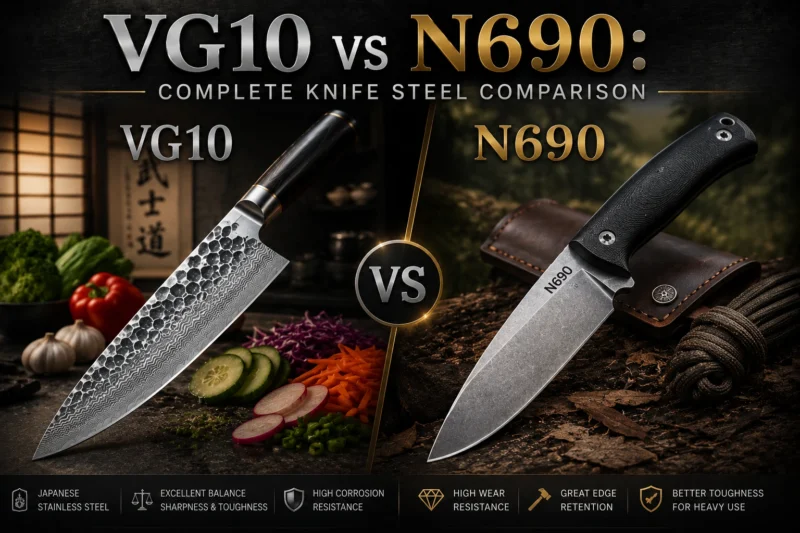
VG10 vs N690
An Independent Guide
Choosing the right knife steel can be confusing. Modern knives are available in dozens of different steels, each offering a unique balance of sharpness, durability, corrosion resistance, and maintenance requirements. Two steels that are frequently compared by knife enthusiasts, kitchen professionals, and everyday users are VG10 and N690.
The debate of vg10 vs n690 is interesting because both steels belong to the premium stainless steel category and offer excellent performance for many types of knives. Neither steel is simply “better” in every situation. Instead, each one has different characteristics that make it more suitable for specific applications.
VG10 has become widely recognized as a high-performance stainless steel for kitchen knives because of its excellent edge retention, corrosion resistance, and ability to achieve an extremely sharp edge. N690 is also a popular stainless steel known for its balanced performance, good toughness, easy sharpening, and reliable everyday usability.
Understanding the differences between these two steels helps you choose a knife that matches your needs, whether you are looking for a chef knife, outdoor blade, hunting knife, or everyday carry tool.
What Is VG10 Steel?
VG10 is a high-quality stainless steel designed for knife applications where sharpness, edge stability, and corrosion resistance are important.
It belongs to the category of stainless steels with a balanced combination of carbon, chromium, molybdenum, cobalt, and vanadium. This carefully designed composition allows VG10 to achieve excellent cutting performance while remaining relatively easy to maintain.
One of the main reasons VG10 became popular is its ability to take a very fine edge. The steel can be sharpened to a high level of precision, which is especially valuable for kitchen knives used for slicing vegetables, fish, meat, and other foods.
VG10 typically reaches a hardness range around:
60–61 HRC
depending on heat treatment and manufacturing quality.
At this hardness level, VG10 provides:
- Excellent edge retention
- Very good slicing ability
- High corrosion resistance
- Good wear resistance
- Reasonable sharpening difficulty
VG10 is especially appreciated by users who want a premium stainless steel that combines performance with manageable maintenance.
Unlike some extremely hard steels, VG10 does not require specialized sharpening equipment. A quality whetstone is usually enough to restore the edge.
Check Our Guide VG10 Steel Review
What Is N690 Steel?
N690 is a stainless steel developed for knife production where a balance between hardness, corrosion resistance, and toughness is required.
It contains chromium, molybdenum, cobalt, and carbon, creating a steel that performs well in both kitchen and outdoor environments.
N690 is often compared with other well-balanced stainless steels because it offers a combination of:
- Good edge retention
- Strong corrosion resistance
- Good toughness
- Easy sharpening
- Reliable everyday performance
Typical hardness for N690 knives is approximately:
58–60 HRC
depending on the heat treatment process.
Compared with many basic stainless steels, N690 offers significantly improved cutting performance and durability.
One of the advantages of N690 is its balanced behavior. It is not designed only for maximum hardness or maximum wear resistance. Instead, it provides a practical combination of properties that many knife users appreciate.
For outdoor knives, EDC blades, and general-purpose cutting tools, N690 can be an excellent choice because it handles regular use without becoming difficult to maintain.
Check Our Guide N690 Steel Review
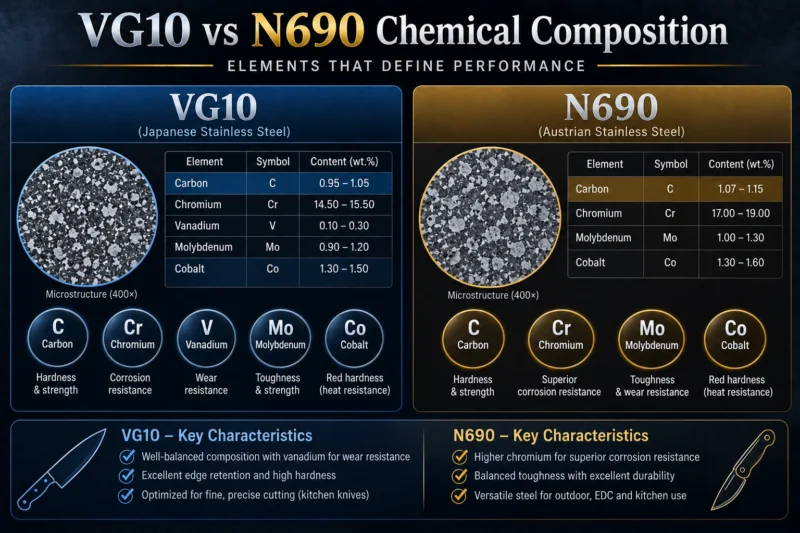
VG10 vs N690 Chemical Composition Comparison
The chemical composition of knife steel strongly influences performance. Small differences in carbon, chromium, and alloying elements affect hardness, toughness, corrosion resistance, and edge stability.
| Element | VG10 | N690 |
|---|---|---|
| Carbon | Higher carbon content | Similar premium stainless level |
| Chromium | High | High |
| Molybdenum | Present | Present |
| Cobalt | Present | Present |
| Vanadium | Present | Usually lower influence |
| Stainless properties | Excellent | Excellent |
Both steels are considered stainless because their chromium content provides strong resistance against rust and staining.
The difference between vg10 vs n690 comes mainly from the balance of alloying elements and how each steel behaves after heat treatment.
VG10 is generally optimized toward:
- Fine edge formation
- Cutting precision
- Kitchen performance
N690 focuses more on:
- Balanced toughness
- General-purpose durability
- Ease of maintenance
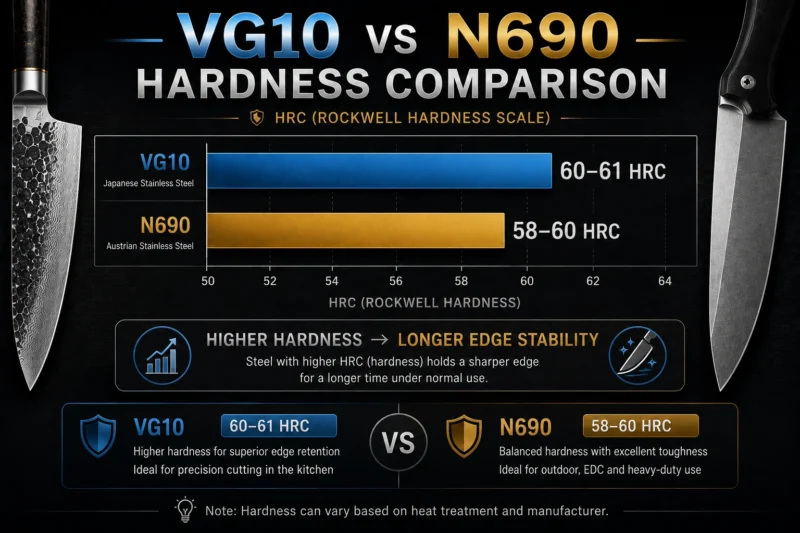
VG10 vs N690 Hardness Comparison
Hardness is one of the most important factors affecting knife performance.
A harder steel can usually maintain an edge longer because the blade resists deformation during cutting. However, excessive hardness can reduce toughness and increase the risk of chipping.
VG10 commonly reaches:
60–61 HRC
N690 commonly reaches:
58–60 HRC
This means VG10 often has a slight hardness advantage.
Higher hardness can provide:
- Better edge stability
- Longer cutting performance
- Improved wear resistance
However, hardness is not the only factor that determines real-world performance.
A well-treated N690 blade can outperform a poorly heat-treated VG10 blade. Heat treatment quality, blade geometry, and sharpening angle often have a bigger impact than the steel name alone.
For kitchen knives where precise slicing is important, VG10’s hardness advantage can be beneficial.
For outdoor knives where impact resistance matters more, N690’s slightly softer characteristics can be an advantage.
Check Our Guide Edge Retention Explained
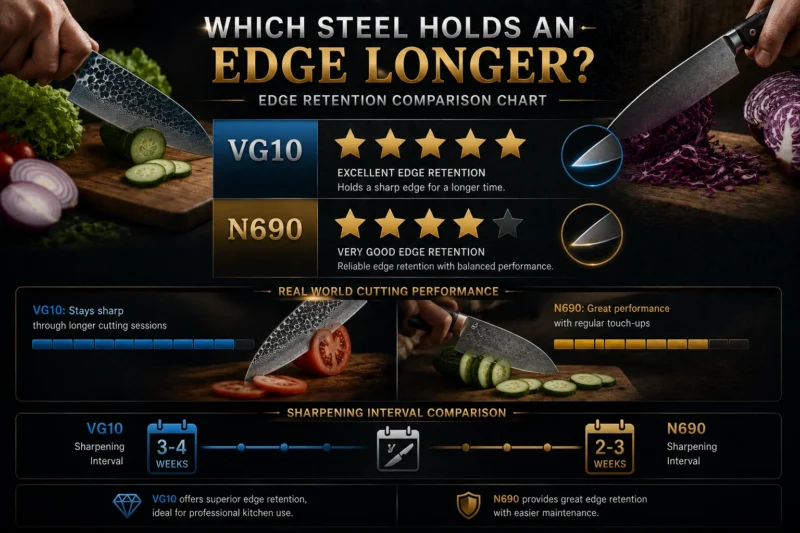
VG10 vs N690 Edge Retention Comparison
Edge retention is one of the most important factors when choosing a knife steel. It determines how long a knife can continue cutting effectively before it needs sharpening.
The edge retention of a steel depends on several factors:
- Carbon content
- Carbide structure
- Hardness level
- Heat treatment quality
- Blade geometry
- Cutting material
When comparing vg10 vs n690, both steels provide very good edge retention compared with basic stainless steels. However, their performance characteristics are slightly different.
VG10 generally has a small advantage in edge retention because it is often hardened to a higher level and has a refined carbide structure designed for cutting performance.
A properly heat-treated VG10 knife can maintain a sharp edge through:
- Vegetable preparation
- Meat slicing
- Fish processing
- Everyday kitchen tasks
The steel is especially effective when the knife is used for controlled slicing rather than heavy chopping.
N690 also offers excellent edge retention. While it may not always hold an edge quite as long as VG10, it provides a very balanced performance profile.
N690 performs well for:
- Outdoor cutting
- General utility tasks
- EDC use
- Hunting applications
The slightly different characteristics mean that the winner depends on the intended use.
For professional kitchen work where thousands of precise cuts are performed, VG10 may have an advantage.
For an everyday knife that experiences different types of use, N690 offers excellent reliability.
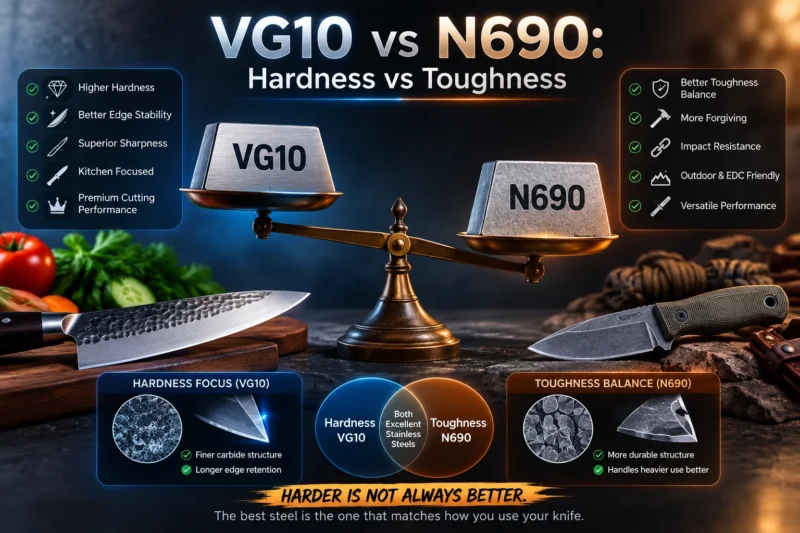
Edge Retention vs Toughness: Finding the Right Balance
Many knife buyers focus only on edge retention, but the hardest steel is not always the best steel.
A knife blade needs a balance between:
- Hardness
- Wear resistance
- Toughness
- Corrosion resistance
Extremely hard steels can keep an edge for a very long time, but they may become more vulnerable to impact damage.
For example:
A thin kitchen knife slicing vegetables benefits from hardness and edge stability.
A camping knife cutting wood or performing outdoor tasks benefits from toughness.
This is where the comparison of vg10 vs n690 becomes interesting.
VG10 is slightly more focused toward cutting performance.
N690 is slightly more focused toward balanced durability.
Neither approach is wrong. They are simply designed with different priorities.
VG10 vs N690 Corrosion Resistance
Corrosion resistance is another important factor, especially for kitchen knives that regularly contact water, food acids, and moisture.
Both VG10 and N690 are stainless steels with excellent corrosion resistance.
They can resist:
- Rust formation
- Staining
- Oxidation
- Food-related corrosion
VG10 performs very well in kitchen environments because it was designed for frequent contact with moisture and food.
A VG10 kitchen knife can handle:
- Tomatoes
- Citrus fruits
- Onions
- Fish
- Meat
without significant corrosion problems when properly maintained.
N690 also provides excellent corrosion resistance. It is suitable for outdoor environments where knives may be exposed to:
- Humidity
- Rain
- Sweat
- Outdoor conditions
In many practical situations, the corrosion resistance difference between VG10 and N690 is very small.
The user’s maintenance habits often matter more than the steel itself.
Even stainless steel knives should be:
- Cleaned after use
- Dried before storage
- Avoided from long exposure to salt water
A neglected knife can eventually develop corrosion regardless of the steel grade.
Check Our Guide The Ultimate Guide to Caring for a Damascus Steel Knife
VG10 vs N690 Toughness Comparison
Toughness describes a steel’s ability to resist cracking, breaking, or chipping under stress.
This property is especially important for:
- Outdoor knives
- Hunting knives
- Survival knives
- Heavy-duty cutting tools
VG10 offers good toughness, but because it is commonly hardened to higher levels, it can be slightly more sensitive to impact compared with tougher steels.
For normal kitchen use, this is rarely a problem.
A VG10 chef knife is not designed for:
- Cutting bones
- Twisting cuts
- Hard frozen foods
- Impact chopping
Used correctly, VG10 performs extremely well.
N690 has a reputation for being a very balanced steel. It offers good toughness while still maintaining strong edge performance.
This makes it attractive for users who want one knife that can handle different situations.
In the vg10 vs n690 comparison, N690 may have a small advantage when toughness is the priority.
For example:
A camping knife may encounter accidental impacts, harder materials, or more unpredictable use. In these situations, toughness becomes more important than maximum sharpness.
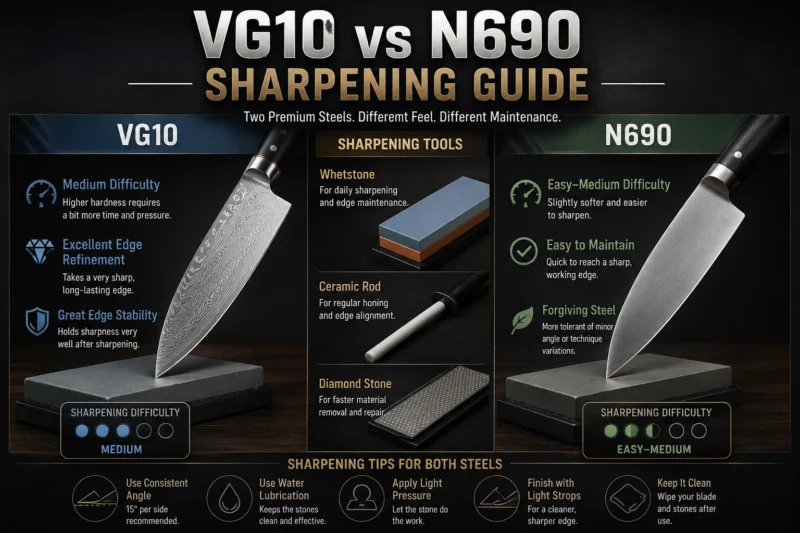
Sharpening VG10 vs N690
Sharpening ability is often overlooked when choosing knife steel.
A steel that holds an edge extremely well but is very difficult to sharpen may not be ideal for many users.
Sharpening VG10
VG10 is considered a relatively user-friendly premium steel.
Advantages:
- Takes a very sharp edge
- Works well with whetstones
- Responds predictably during sharpening
- Can achieve excellent polish
Most users can maintain VG10 with:
- Water stones
- Ceramic sharpeners
- Diamond stones
Because VG10 has good hardness, it may require slightly more sharpening effort than softer stainless steels, but it is still considered manageable.
Sharpening N690
N690 is also easy to sharpen compared with many modern high-performance steels.
It offers:
- Good response on sharpening stones
- Smooth edge refinement
- Easy maintenance
For people who sharpen their own knives regularly, N690 can be very convenient.
The difference between VG10 and N690 during sharpening is relatively small.
VG10 may require slightly more effort because of its higher hardness, but it can usually achieve a finer edge.
N690 may feel slightly easier and faster to restore.
Cutting Performance: VG10 vs N690
The actual cutting performance of a knife depends not only on steel but also on:
- Blade thickness
- Grind geometry
- Edge angle
- Heat treatment
- Blade design
A thin N690 knife can easily outperform a thick VG10 knife.
A well-designed blade allows the steel properties to work effectively.
VG10 Cutting Characteristics
VG10 is excellent for:
- Push cutting
- Slicing
- Precision work
- Fine kitchen preparation
It is especially good for:
- Chef knives
- Santoku knives
- Gyuto-style knives
- Slicing knives
Its ability to maintain a refined edge makes it popular among users who value precision.
N690 Cutting Characteristics
N690 provides excellent all-around cutting performance.
It works well for:
- Utility knives
- Outdoor blades
- EDC knives
- General-purpose kitchen knives
Its balanced characteristics make it suitable for users who want reliability without complicated maintenance.
Which Steel Is Better for Kitchen Knives?
For kitchen knives, VG10 usually has a slight advantage.
Reasons:
- Higher typical hardness
- Excellent edge stability
- Fine cutting ability
- Strong corrosion resistance
- Premium slicing performance
Professional cooks and home enthusiasts often appreciate VG10 because it delivers a sharp, precise cutting experience.
However, N690 is also a very capable kitchen knife steel.
It can be a better choice for users who prefer:
- Easier sharpening
- More forgiving performance
- A versatile everyday knife
The final choice depends on cutting style.
A careful cook who values precision may prefer VG10.
A user who wants simple maintenance and durability may prefer N690.
VG10 vs N690 for Outdoor Knives
Although VG10 is strongly associated with kitchen knives, it can also perform well in outdoor applications. N690, however, is often considered a more natural choice for outdoor and everyday-use blades because of its balanced properties.
Outdoor knives face different challenges compared with kitchen knives.
A camping or hunting knife may be used for:
- Cutting rope
- Preparing wood
- Processing game
- Opening packages
- General utility work
These tasks require a combination of:
- Edge retention
- Toughness
- Corrosion resistance
- Easy maintenance
In the vg10 vs n690 comparison, N690 has a slight advantage for outdoor use because of its balanced toughness and practical sharpening characteristics.
A knife used outdoors may experience more stress than a kitchen knife. Accidental impacts, harder materials, and less controlled cutting angles are common.
N690 handles these situations very well because it provides a good balance between hardness and durability.
VG10 can also be used outdoors, especially for:
- Lightweight knives
- Folding knives
- Precision cutting tools
However, it is better suited for controlled cutting rather than heavy impact tasks.
A VG10 outdoor knife should not be treated like a chopping tool.
Avoid:
- Batoning wood
- Twisting the blade
- Cutting metal objects
- Striking hard surfaces
VG10 vs N690 for EDC Knives
Everyday carry knives require versatility.
An EDC knife should be able to handle many different tasks:
- Opening packages
- Cutting cardboard
- Preparing food
- Cutting cord
- Daily utility work
For EDC use, both steels are excellent choices.
VG10 offers:
✓ Excellent sharpness
✓ Long-lasting edge
✓ Premium cutting feel
✓ High corrosion resistance
N690 offers:
✓ Good edge retention
✓ Strong durability
✓ Easy sharpening
✓ Reliable everyday performance
The choice depends on personal preference.
Users who enjoy maintaining a very sharp knife and appreciate precision cutting may prefer VG10.
Users who want a practical knife that can handle unpredictable daily tasks may prefer N690.
Check Our Guide Best Hunting Knife Features Explained
The Importance of Heat Treatment
When discussing vg10 vs n690, many people focus only on chemical composition.
However, heat treatment is one of the most important factors affecting knife performance.
Heat treatment controls:
- Hardness
- Carbide formation
- Toughness
- Edge stability
- Wear resistance
The same steel can perform very differently depending on how it is processed.
A properly heat-treated N690 knife can outperform a poorly treated VG10 knife.
A properly heat-treated VG10 blade can provide outstanding cutting performance.
Important heat treatment stages include:
Hardening
The steel is heated to a specific temperature and then rapidly cooled.
This creates a harder structure capable of holding an edge.
Tempering
After hardening, the steel is tempered to reduce brittleness and improve toughness.
A good balance between hardness and toughness is essential.
Cryogenic Treatment
Some manufacturers use cryogenic processing to improve carbide structure and stability.
This can contribute to:
- Better wear resistance
- More consistent performance
- Improved edge durability
However, the quality of the complete manufacturing process is more important than any single treatment.
Check Our Guide Different Heat Treatment Methods Explained
Blade Geometry Often Matters More Than Steel
Many knife buyers assume that premium steel automatically creates a better knife.
In reality, blade geometry often has a greater influence on cutting performance.
Important geometry factors include:
Blade Thickness
A thinner blade usually cuts more efficiently.
For example:
A thin VG10 kitchen knife can glide through vegetables easily.
A thick VG10 blade may feel less efficient.
The same applies to N690.
A well-designed thin N690 blade can provide excellent cutting performance.
Edge Angle
The sharpening angle affects:
- Sharpness
- Durability
- Cutting ability
Typical kitchen knife angles:
- 10–15 degrees per side for very fine cutting
- 15–20 degrees per side for general use
Outdoor knives often use wider angles for increased durability.
Grind Type
Different grinds change how a knife performs.
Full Flat Grind
Excellent slicing performance.
Hollow Grind
Very thin cutting ability.
Convex Grind
Good combination of cutting and durability.
Saber Grind
More durable for outdoor use.
The best steel cannot compensate for poor geometry.
Check Our Guide Blade Geometry Explained
VG10 vs N690 Maintenance Requirements
Both steels are stainless and relatively easy to maintain.
However, proper care improves performance and extends the life of any knife.
VG10 Maintenance
Recommended:
- Wash after use
- Dry immediately
- Use proper sharpening stones
- Avoid cutting hard materials
VG10 does not require special oils in normal kitchen environments.
For long-term storage, keeping the blade dry is recommended.
N690 Maintenance
N690 has excellent corrosion resistance and is suitable for humid environments.
Maintenance routine:
- Clean after use
- Dry the blade
- Sharpen when needed
- Store safely
For outdoor use, occasional protective oil can provide additional protection, especially in coastal or wet environments.
VG10 vs N690 Pros and Cons
VG10 Advantages
✓ Excellent edge retention
✓ Very sharp cutting ability
✓ Premium kitchen performance
✓ Strong corrosion resistance
✓ Good wear resistance
✓ Takes a refined edge
VG10 Disadvantages
✗ Slightly harder to sharpen than softer steels
✗ Can chip if abused
✗ Not ideal for heavy impact use
✗ Usually costs more than basic stainless steels
N690 Advantages
✓ Excellent balance of properties
✓ Good toughness
✓ Easy sharpening
✓ Strong corrosion resistance
✓ Reliable everyday performance
✓ Suitable for outdoor and EDC use
N690 Disadvantages
✗ Slightly lower edge retention than VG10 in many cases
✗ Not designed for maximum wear resistance
✗ May require more frequent sharpening in heavy cutting tasks
VG10 vs N690: Which One Is More Premium?
Both steels are considered premium stainless steels, but they target slightly different users.
VG10 is often viewed as a precision cutting steel.
Its strengths are:
- Sharpness
- Edge refinement
- Kitchen performance
N690 is often viewed as a balanced working steel.
Its strengths are:
- Reliability
- Toughness
- Versatility
The word “premium” does not always mean “harder.”
A steel should be judged by how well it matches the intended application.
A professional chef may consider VG10 the better option.
An outdoor enthusiast may prefer N690.
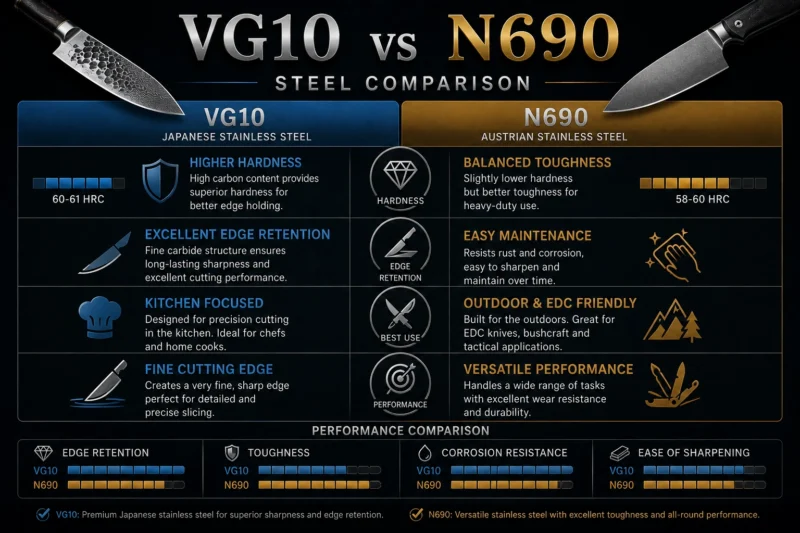
VG10 vs N690 Complete Performance Comparison
After examining composition, hardness, edge retention, toughness, corrosion resistance, and maintenance, we can create a more complete comparison.
| Performance Category | VG10 | N690 |
|---|---|---|
| Edge Retention | ⭐⭐⭐⭐⭐ | ⭐⭐⭐⭐ |
| Sharpness Potential | ⭐⭐⭐⭐⭐ | ⭐⭐⭐⭐ |
| Corrosion Resistance | ⭐⭐⭐⭐⭐ | ⭐⭐⭐⭐⭐ |
| Toughness | ⭐⭐⭐⭐ | ⭐⭐⭐⭐+ |
| Ease of Sharpening | ⭐⭐⭐⭐ | ⭐⭐⭐⭐⭐ |
| Wear Resistance | ⭐⭐⭐⭐+ | ⭐⭐⭐⭐ |
| Kitchen Performance | ⭐⭐⭐⭐⭐ | ⭐⭐⭐⭐ |
| Outdoor Performance | ⭐⭐⭐⭐ | ⭐⭐⭐⭐⭐ |
| EDC Performance | ⭐⭐⭐⭐+ | ⭐⭐⭐⭐⭐ |
| Maintenance Ease | ⭐⭐⭐⭐ | ⭐⭐⭐⭐⭐ |
The comparison shows that neither steel completely dominates the other.
VG10 focuses more on:
- Cutting precision
- Edge refinement
- Premium kitchen performance
N690 focuses more on:
- Versatility
- Toughness
- Practical everyday use
Which Steel Holds an Edge Longer: VG10 or N690?
When comparing vg10 vs n690 for edge retention, VG10 usually has a small advantage.
The reasons include:
- Higher typical hardness
- Fine carbide structure
- Excellent edge stability
A VG10 knife can maintain a razor-sharp edge through long periods of slicing work.
This makes it especially suitable for:
- Chef knives
- Gyuto knives
- Slicing knives
- Precision cutting tools
However, the difference is not dramatic.
A well-made N690 knife with excellent heat treatment can provide very impressive edge performance.
In real-world use, factors such as:
- Cutting technique
- Blade thickness
- Sharpening angle
- Cutting surface
may influence performance more than the steel difference.
For example:
A VG10 knife used on a glass cutting board may lose sharpness quickly.
A properly maintained N690 knife used on a soft cutting board may perform exceptionally well.
Which Steel Is Easier to Sharpen?
Sharpening is an important consideration because every knife eventually requires maintenance.
N690 generally has a slight advantage in sharpening ease.
Reasons:
- Slightly lower hardness range
- Predictable sharpening behavior
- Smooth response on stones
For beginners, N690 may feel more forgiving.
VG10 is still considered easy to sharpen compared with many modern high-performance steels.
It provides excellent feedback during sharpening and can achieve an extremely fine edge.
For experienced users who enjoy sharpening, VG10 offers a rewarding experience because it can reach a very refined cutting edge.
Best Steel for Professional Kitchen Knives
For professional kitchen applications, VG10 is usually the preferred choice.
Professional cooks often value:
- Long-lasting sharpness
- Precise cutting ability
- Thin edge performance
- Stainless properties
VG10 performs especially well when preparing:
- Vegetables
- Fish
- Meat
- Herbs
- Delicate ingredients
A properly designed VG10 chef knife can provide:
- Smooth slicing
- Minimal food resistance
- Excellent control
N690 can also work well in kitchen environments, especially for users who want easier maintenance.
However, for maximum cutting refinement, VG10 has an advantage.
Check Our Guide Best Kitchen Knives for Groomsmen Gifts
Best Steel for Outdoor and Hunting Knives
For outdoor knives, N690 often becomes the more practical choice.
Outdoor users usually need:
- Reliable toughness
- Easy maintenance
- Corrosion resistance
- Balanced performance
A hunting or camping knife may experience:
- Different cutting angles
- Outdoor moisture
- Harder materials
- Longer periods between sharpening
N690 handles these conditions very well.
It provides enough hardness for good cutting performance while maintaining durability.
VG10 can also work for outdoor knives, especially lightweight folding knives, but it is better suited for controlled cutting tasks.
Best Steel for Everyday Carry (EDC)
The answer depends on how the knife is used.
If your EDC knife is mainly used for:
- Opening packages
- Cutting paper
- Food preparation
- Light utility work
VG10 is an excellent option.
If your EDC knife is used for:
- Outdoor tasks
- Rope cutting
- General tools
- More demanding situations
N690 may be the better choice.
The advantage of N690 is its balanced nature.
It does not specialize in only one area. Instead, it provides dependable performance across many different tasks.
VG10 vs N690 Price and Value
Price depends on:
- Manufacturing quality
- Heat treatment
- Blade design
- Handle materials
- Production standards
The steel itself is only one part of the knife’s total value.
A well-designed knife with excellent heat treatment will usually outperform a poorly made knife using more expensive steel.
VG10 knives are often positioned in the premium kitchen knife category because of their reputation and cutting performance.
N690 knives often provide excellent value because they offer premium stainless performance without extreme cost.
For buyers looking for maximum performance per dollar, N690 can be very attractive.
For buyers prioritizing cutting refinement, VG10 is often worth considering.
Common Myths About VG10 and N690
Myth 1: Harder Steel Is Always Better
Not necessarily.
Higher hardness can improve edge retention, but excessive hardness may reduce toughness.
The best knife steel is a balance.
Myth 2: Stainless Steel Never Rusts
All stainless steels can corrode under certain conditions.
Proper maintenance is still important.
Myth 3: Steel Determines Everything
Steel is only one part of knife performance.
The final result depends on:
- Heat treatment
- Blade geometry
- Edge angle
- Manufacturing quality
A well-made knife using a balanced steel can outperform a poorly designed knife with a more expensive steel.
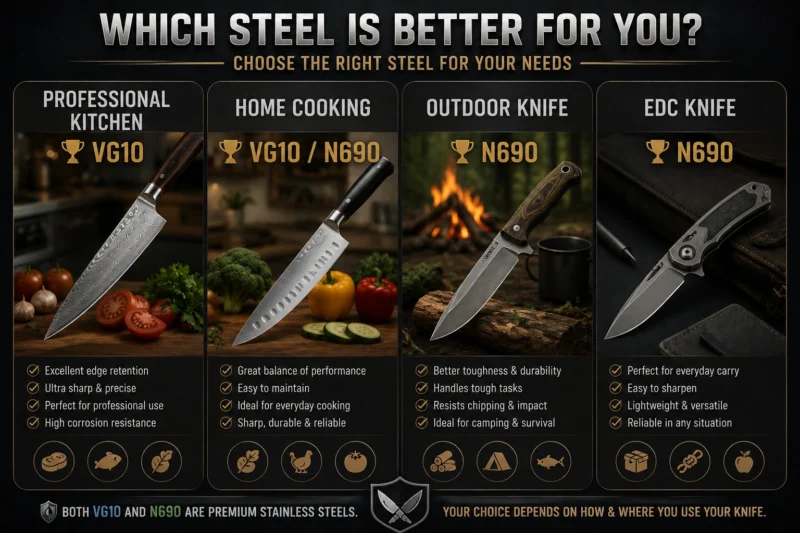
VG10 vs N690: Final Verdict
The final choice between VG10 and N690 depends on your priorities.
Choose VG10 if you want:
✓ Maximum cutting precision
✓ Excellent edge retention
✓ Premium kitchen performance
✓ A very sharp refined edge
✓ A high-performance chef knife
VG10 is an excellent choice for cooks, food enthusiasts, and anyone who values slicing performance.
Choose N690 if you want:
✓ Balanced performance
✓ Easier sharpening
✓ Good toughness
✓ Reliable everyday use
✓ Outdoor and EDC versatility
N690 is an excellent choice for users who want one dependable knife that can handle many different tasks.
Final Answer: VG10 vs N690 — Which Is Better?
There is no universal winner in the vg10 vs n690 comparison.
VG10 is generally the better choice for precision cutting and professional kitchen knives because it offers excellent sharpness and edge retention.
N690 is generally the better choice for versatile everyday knives because it provides a strong balance of toughness, corrosion resistance, and easy maintenance.
If your priority is the finest cutting experience, choose VG10.
If your priority is durability and versatility, choose N690.
Both steels represent a significant step above basic stainless steels and can provide many years of reliable knife performance when properly heat-treated and maintained.
The best knife is not simply the one with the strongest steel — it is the one whose steel characteristics match the way you use it.
This article is for independent informational purposes only and is not affiliated with, sponsored by, or endorsed by any steel manufacturer. All product names, trademarks, and registered trademarks are the property of their respective owners.