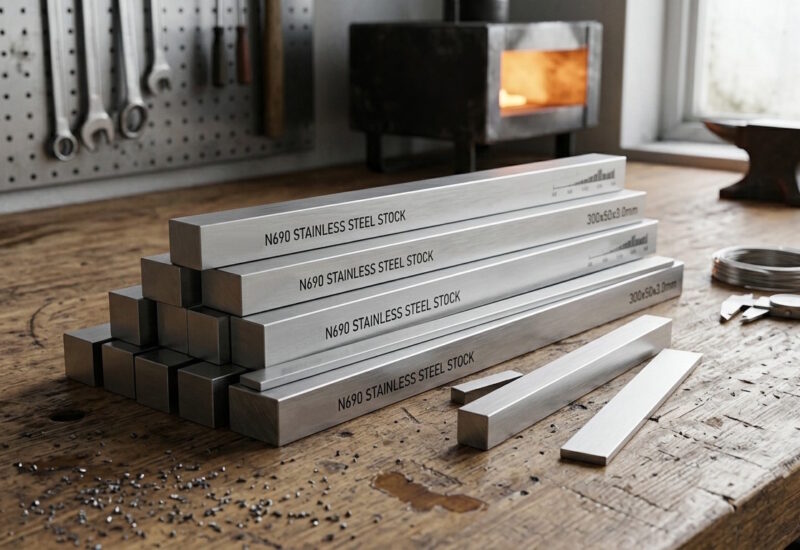
N690 Steel Review
An Independent Guide
When knife enthusiasts discuss premium stainless steels, names such as VG10, 14C28N, MagnaCut, SG2, and M390 often dominate the conversation. However, one steel has quietly earned a reputation as one of the most balanced and practical knife steels available today: N690.
For decades, N690 has been a favorite among custom knife makers, European manufacturers, outdoor enthusiasts, and kitchen knife craftsmen. It offers a combination of corrosion resistance, toughness, edge retention, and ease of maintenance that makes it attractive for both professional and everyday users.
Unlike some modern “super steels” that focus heavily on extreme wear resistance, N690 aims for balance. As a result, many knife makers consider it one of the best all-around stainless steels for real-world use.
But how good is N690?
Can it compete with modern powder metallurgy steels?
Is it suitable for kitchen knives?
And why do so many custom knife makers continue to use it despite the arrival of newer steels?
In this complete guide, we’ll explore everything you need to know about N690 steel.
What Is N690 Steel?
N690 is a premium stainless steel produced by the Austrian steel manufacturer.
It was originally developed for applications requiring:
- Corrosion resistance
- Wear resistance
- Toughness
- Reliable performance
Over time, knife makers discovered that N690 possessed characteristics that made it exceptionally well-suited for blade production.
Today, N690 is commonly used for:
- Chef knives
- Kitchen knives
- Hunting knives
- Outdoor knives
- EDC knives
- Tactical knives
- Handmade custom knives
Its versatility is one of the reasons for its enduring popularity.
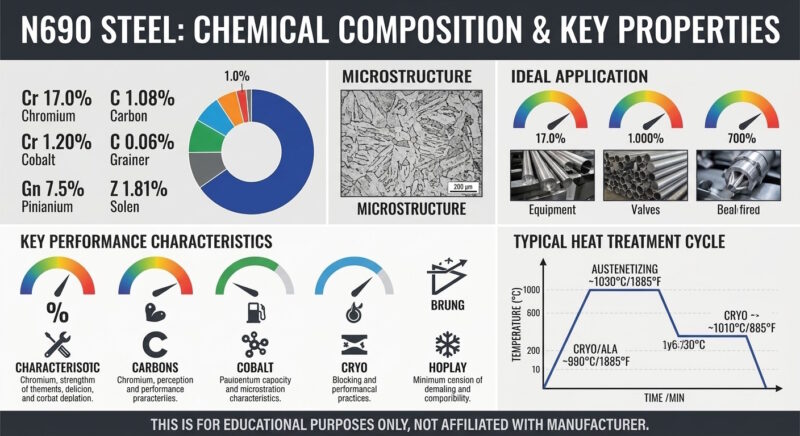
N690 Steel Composition
Typical composition:
| Element | Percentage |
|---|---|
| Carbon | 1.07% |
| Chromium | 17.3% |
| Cobalt | 1.5% |
| Molybdenum | 1.1% |
| Vanadium | 0.1% |
| Manganese | 0.4% |
| Silicon | 0.4% |
This alloy composition provides a highly balanced combination of properties.
The relatively high chromium content contributes to excellent corrosion resistance, while carbon and molybdenum improve hardness and wear resistance.
One particularly interesting feature is the addition of cobalt.
The cobalt helps improve heat treatment response and contributes to overall performance.
Is N690 Stainless Steel?
Yes.
N690 is considered a true stainless steel.
With over 17% chromium, it offers excellent protection against:
- Rust
- Staining
- Kitchen acids
- Humidity
- Food moisture
For kitchen knife users, this means significantly less maintenance compared with carbon steels such as:
- 1095
- 52100
- White Steel #2
- Blue Steel #2
Most users only need basic cleaning and drying after use.
Check Our Guide 52100 Steel Review
Why Knife Makers Love N690
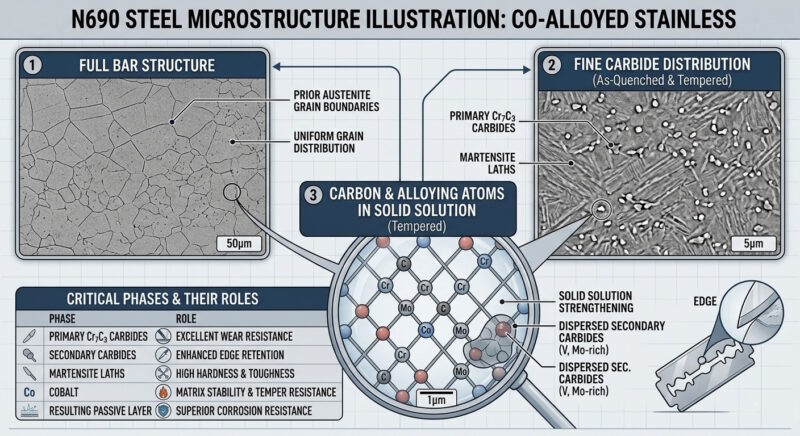
Many custom makers appreciate N690 because it provides a rare balance between performance and practicality.
Advantages include:
- Excellent corrosion resistance
- Good edge retention
- Reliable toughness
- Easy maintenance
- Attractive finish quality
For handmade knives, these characteristics are particularly valuable because they appeal to a wide range of customers.
Hardness of N690
Most N690 knives operate between:
58–61 HRC
Typical hardness ranges:
| Knife Type | HRC |
| Kitchen Knife | 59–61 |
| Hunting Knife | 58–60 |
| EDC Knife | 59–61 |
| Outdoor Knife | 58–60 |
A properly heat-treated N690 kitchen knife is often found around 60 HRC.
This provides an excellent balance between:
- Edge retention
- Toughness
- Sharpen ability
Check Our Guide What Is HRC? Understanding Rockwell Hardness in Kitchen Knives
Edge Retention
Edge retention is one of N690’s strongest attributes.
While it may not compete with extreme wear-resistant steels such as:
- M390
- S90V
- S110V
it still offers very respectable edge life.
For most kitchen users, the difference is often less noticeable than expected.
Benefits include:
- Long-lasting working edge
- Reliable performance
- Good wear resistance
Many users find N690 stays sharp long enough while remaining much easier to sharpen than many super steels.
Check Our Guide M390 Steel Review
Toughness
Toughness is an area where N690 performs well.
Advantages include:
- Reduced chipping risk
- Better durability
- Reliable edge stability
This makes N690 suitable for a wide variety of knife designs.
Kitchen knives especially benefit because they often encounter lateral stresses during food preparation.
Sharpening Performance
Many knife owners underestimate the importance of sharpening ease.
A steel that takes twice as long to sharpen may not be practical for every user.
N690 offers:
- Relatively easy sharpening
- Predictable burr formation
- Good polishing response
- Excellent edge refinement
Compared with high-carbide powder steels, sharpening N690 is significantly easier.
This is one reason professional sharpeners often appreciate it.
Corrosion Resistance
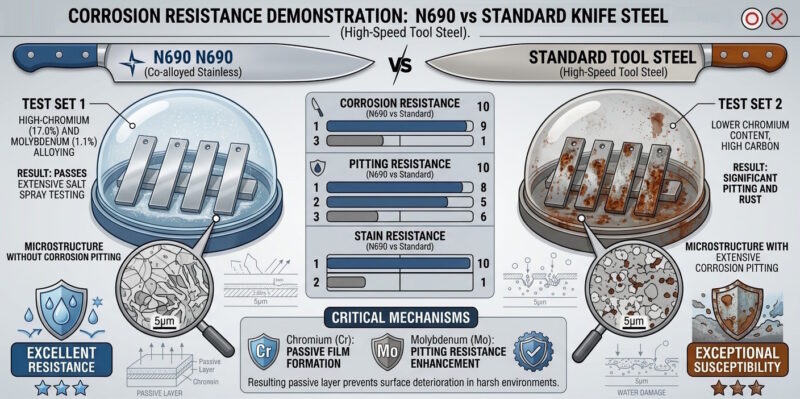
This is arguably N690’s greatest strength.
Its high chromium content provides outstanding corrosion resistance.
Benefits include:
- Excellent rust resistance
- Resistance to kitchen acids
- Low maintenance requirements
For cooks working with:
- Tomatoes
- Citrus fruits
- Onions
- Vinegar
N690 performs exceptionally well.
Many users never experience corrosion issues at all.
Check Our Guide Kitchen Knife Care Guide
N690 for Kitchen Knives
N690 has become increasingly popular in handmade kitchen knives.
Why?
Because kitchen knives demand:
- Corrosion resistance
- Good edge retention
- Easy maintenance
- Reliable toughness
N690 delivers all four.
Many custom makers consider it one of the safest recommendations for home cooks.
N690 vs VG10
This is one of the most common comparisons.
Both steels are widely used in kitchen knives.
VG10 Advantages
- Slightly higher hardness potential
- Better wear resistance
N690 Advantages
- Better toughness
- Easier sharpening
- Improved edge stability
Many users find N690 more forgiving in daily use.
Check Our Guide VG10 Steel Review
N690 vs 14C28N
Both are highly respected stainless steels.
14C28N Advantages
- Exceptional toughness
- Fine grain structure
N690 Advantages
- Better wear resistance
- Higher corrosion resistance
- Slightly longer edge retention
For kitchen knives, both are excellent choices.
Check Our Guide 14C28N and Other Swedish Knife Steels Review
N690 vs AEB-L
This comparison is particularly interesting.
AEB-L Advantages
- Finer grain structure
- Better toughness
- Superior sharpening characteristics
N690 Advantages
- Better corrosion resistance
- Better wear resistance
- Longer edge retention
The choice often comes down to personal preference.
Check Our Guide AEB-L Steel Review
N690 vs 52100
52100 is a legendary carbon steel.
52100 Advantages
- Better toughness
- Easier sharpening
- Traditional cutting feel
N690 Advantages
- Stainless properties
- Better corrosion resistance
- Easier maintenance
Most kitchen users will find N690 more practical.
Check Our Guide 52100 Steel Review
N690 vs MagnaCut
This comparison highlights the difference between modern and traditional steel design.
MagnaCut Advantages
- Better toughness
- Better corrosion resistance
- Better edge retention
N690 Advantages
- Lower cost
- Easier availability
- Proven performance
MagnaCut may outperform N690 on paper, but N690 remains an outstanding value.
N690 Steel Review
Common Myths About N690
Myth #1: N690 Is Just European VG10
Partially true, but oversimplified.
While similarities exist, the steels have distinct properties and behaviors.
Myth #2: N690 Is Outdated
False.
Many modern custom makers continue to use N690 successfully.
Myth #3: Super Steels Make N690 Obsolete
False.
Many users prefer N690 because it balances performance and maintenance.
Myth #4: N690 Is Only for Beginners
False.
Professional chefs and custom knife enthusiasts continue to appreciate N690.
N690 vs SG2 (R2)
SG2, also known as R2 steel, is one of the most respected Japanese powder metallurgy steels.
Both N690 and SG2 are excellent kitchen knife steels, but they target different users.
SG2 Advantages
- Superior edge retention
- Higher hardness potential (62–64 HRC)
- Exceptional wear resistance
- Premium Japanese knife reputation
N690 Advantages
- Easier sharpening
- Better toughness
- Lower cost
- Less risk of chipping
Kitchen Performance Comparison
| Property | N690 | SG2 |
|---|---|---|
| Corrosion Resistance | 9/10 | 9/10 |
| Edge Retention | 7/10 | 9/10 |
| Toughness | 8/10 | 6/10 |
| Sharpening Ease | 8/10 | 5/10 |
| Value | 9/10 | 7/10 |
For professional chefs who sharpen regularly, N690 can be a fantastic choice. For users who want maximum edge life, SG2 often wins.
N690 vs M390
M390 is frequently marketed as a premium “super steel.”
M390 Advantages
- Exceptional wear resistance
- Outstanding edge retention
- Premium status
N690 Advantages
- Much easier sharpening
- Better value
- More forgiving edge behavior
Many knife owners discover that although M390 stays sharp longer, N690 is often easier to live with day-to-day.
For kitchen knives, the performance gap is often smaller than expected.
N690 vs 440C
Before modern powder steels became popular, 440C was one of the most respected stainless knife steels.
440C Advantages
- Proven history
- Easy availability
N690 Advantages
- Better corrosion resistance
- Better heat treatment response
- Improved edge retention
- Better overall balance
Many knife makers consider N690 a modern evolution of the classic 440C concept.
Heat Treatment: The Secret Behind Great N690 Knives
Many buyers focus entirely on steel type.
Experienced knife makers know that heat treatment often matters even more.
Proper heat treatment determines:
- Final hardness
- Toughness
- Edge stability
- Wear resistance
A well-treated N690 knife can outperform a poorly treated premium steel.
This is why reputable custom makers invest significant time into heat treatment protocols.
Check Our Guide Steel Heat Treatment Explained
Why Handmade N690 Knives Often Perform Better
Handmade knives frequently benefit from:
Individual Heat Treatment
Each blade receives more attention during manufacturing.
Optimized Geometry
Handmade kitchen knives are often thinner behind the edge.
Better Finishing
Refined grinds improve cutting performance.
Attention to Detail
Small improvements throughout production can dramatically affect real-world performance.
For this reason, many handmade N690 knives outperform mass-produced factory knives.
https://yashkadesigns.com/handmade-chinese-knives
Best Uses for N690 Steel
N690 is remarkably versatile.
Excellent Applications
- Chef knives
- Gyuto knives
- Santoku knives
- Bunka knives
- Petty knives
- Hunting knives
- EDC knives
- Outdoor knives
Particularly Good For
- Home cooks
- Professional chefs
- Outdoor enthusiasts
- First custom knife buyers
N690 in Professional Kitchens
Professional kitchens place unique demands on knives.
A chef’s knife may experience:
- Hours of daily cutting
- Constant moisture exposure
- Acidic foods
- Frequent cleaning
N690 performs exceptionally well in these conditions.
Advantages include:
- Excellent stain resistance
- Low maintenance
- Reliable sharpness
- Strong durability
Many chefs appreciate not having to worry about rust while still enjoying premium cutting performance.
Does N690 Develop Rust?
Under normal kitchen use, rust is uncommon.
However, no stainless steel is completely rust-proof.
Potential causes include:
- Long-term salt exposure
- Dishwasher use
- Poor storage
- Neglect
Basic care includes:
- Hand washing
- Drying after use
- Proper storage
These simple steps will keep N690 knives looking excellent for years.
Is N690 Good for Beginners?
Absolutely.
In fact, N690 may be one of the best steels for first-time premium knife buyers.
Why?
Because it offers:
- Easy maintenance
- Good edge retention
- Corrosion resistance
- Reasonable sharpening difficulty
Unlike some exotic steels, N690 does not require specialized knowledge.
Why N690 Remains Popular in Europe
European knife makers have long appreciated N690.
Reasons include:
- Reliable availability
- Consistent quality
- Excellent stainless properties
- Versatility
Many custom makers continue to choose N690 even when newer steels are available.
This speaks volumes about its practical performance.
Real-World Cutting Performance
Specifications only tell part of the story.
In actual kitchen use, N690 performs extremely well because of its balanced nature.
Users often describe it as:
- Smooth cutting
- Predictable
- Reliable
- Easy to maintain
Rather than excelling in one area and sacrificing others, N690 performs well across the board.
This balance is one of its greatest strengths.
N690 Performance Ratings
| Property | Rating |
|---|---|
| Corrosion Resistance | 9/10 |
| Toughness | 8/10 |
| Edge Retention | 7.5/10 |
| Sharpening Ease | 8/10 |
| Edge Stability | 8/10 |
| Kitchen Performance | 9/10 |
| Value for Money | 9/10 |
Who Should Buy an N690 Knife?
N690 is ideal for:
Home Cooks
Easy maintenance and reliable performance.
Professional Chefs
Excellent balance of edge retention and toughness.
Knife Enthusiasts
Great all-around stainless steel.
Gift Buyers
Low-maintenance knives make excellent gifts.
Who Might Prefer Another Steel?
Consider alternatives if you want:
Maximum Edge Retention
Look at:
- M390
- S90V
- SG2
Traditional Carbon Steel Experience
Look at:
- 52100
- White Steel #2
- Blue Steel #2
Ultimate Modern Performance
Look at:
- MagnaCut
Quick Questions and Answers
Is N690 a good knife steel?
Yes. N690 is widely considered one of the best all-around stainless knife steels available.
Is N690 stainless?
Yes. With approximately 17% chromium, it offers excellent corrosion resistance.
Is N690 better than VG10?
Many users prefer N690 for toughness and easier sharpening, while VG10 often offers slightly better wear resistance.
Does N690 rust?
Under normal use, N690 is highly resistant to rust.
Is N690 good for kitchen knives?
Absolutely. It is one of the most practical stainless steels for kitchen use.
Is N690 easy to sharpen?
Yes. It sharpens much easier than many modern powder metallurgy steels.
What hardness is N690?
Most knives fall between 58 and 61 HRC.
Final Verdict
N690 may not receive the same marketing attention as modern powder metallurgy steels, but it remains one of the most balanced and practical knife steels available today.
Its combination of:
- Excellent corrosion resistance
- Good edge retention
- Strong toughness
- Easy maintenance
- Reasonable sharpening effort
makes it an outstanding choice for kitchen knives, outdoor knives, and everyday carry blades.
For cooks seeking a stainless steel that performs reliably without demanding constant maintenance, N690 is difficult to beat.
While newer steels may outperform it in specific categories, few offer the same combination of performance, practicality, and value.
More than two decades after becoming popular among knife makers, Böhler N690 continues to prove why it remains one of the most trusted stainless knife steels in the world.
FAQ
What is N690 steel?
N690 is a premium stainless steel produced by Böhler-Uddeholm, widely used for kitchen, outdoor, and custom knives.
Is N690 good for kitchen knives?
Yes. N690 offers excellent corrosion resistance, toughness, and edge retention for kitchen applications.
Is N690 better than VG10?
Both are excellent steels. N690 generally offers better toughness and easier sharpening, while VG10 may provide slightly longer edge retention.
Does N690 rust?
N690 is highly corrosion resistant but should still be cleaned and dried after use.
What HRC is N690?
Most N690 knives are heat treated to approximately 58–61 HRC.
Is N690 a super steel?
Not typically. However, many knife makers consider it one of the best balanced stainless steels available.
N690 Steel Review
“This article is for independent informational purposes only and is not affiliated with, sponsored by, or endorsed by any steel manufacturer. All product names, trademarks, and registered trademarks are the property of their respective owners.”