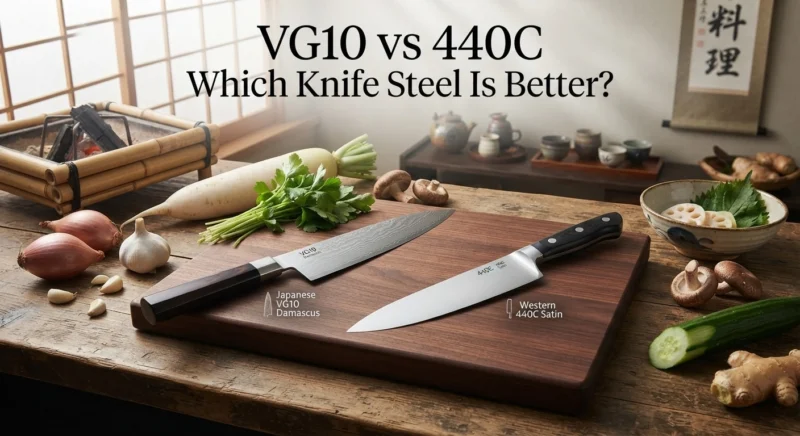
VG10 vs 440C: Which Knife Steel Should You Choose?
An Independent Guide
Choosing the right knife steel can make a significant difference in cutting performance, maintenance, durability, and overall satisfaction. Among the many stainless steels available today, VG10 vs 440C remains one of the most frequently discussed comparisons. Both steels have earned strong reputations for producing dependable, high-performing knives, yet they offer noticeably different characteristics.
Whether you’re shopping for a chef’s knife, an outdoor utility blade, or simply want to understand how these steels compare, knowing their strengths and weaknesses will help you make an informed decision.
In this comprehensive VG10 vs 440C guide, we’ll examine every important aspect of these two popular stainless steels, including:
- Steel composition
- Manufacturing process
- Hardness
- Edge retention
- Toughness
- Corrosion resistance
- Ease of sharpening
- Wear resistance
- Maintenance
- Best applications
- Overall value
Neither steel is universally “better.” Instead, each excels in different situations depending on how the knife will be used.
What Is VG10 Steel?
VG10 is a premium stainless cutlery steel developed specifically for high-performance knives. It is designed to combine excellent hardness, strong corrosion resistance, impressive edge retention, and relatively good toughness.
One of the reasons VG10 vs 440C is such a popular comparison is that both steels are widely used in quality kitchen and everyday knives, yet they achieve their performance in different ways.
VG10 belongs to the modern generation of stainless knife steels that are engineered to produce a fine carbide structure. This allows the blade to take an extremely refined edge while maintaining excellent cutting ability.
Unlike many conventional stainless steels, VG10 contains multiple alloying elements that work together to improve wear resistance without sacrificing stainless properties.
Common characteristics include:
- High hardness
- Excellent edge retention
- Fine grain structure
- High polish capability
- Outstanding stain resistance
- Stable heat treatment response
VG10 is particularly appreciated by cooks who perform long slicing sessions because it stays sharp longer than many traditional stainless steels.
Check Our Guide VG10 Steel Review
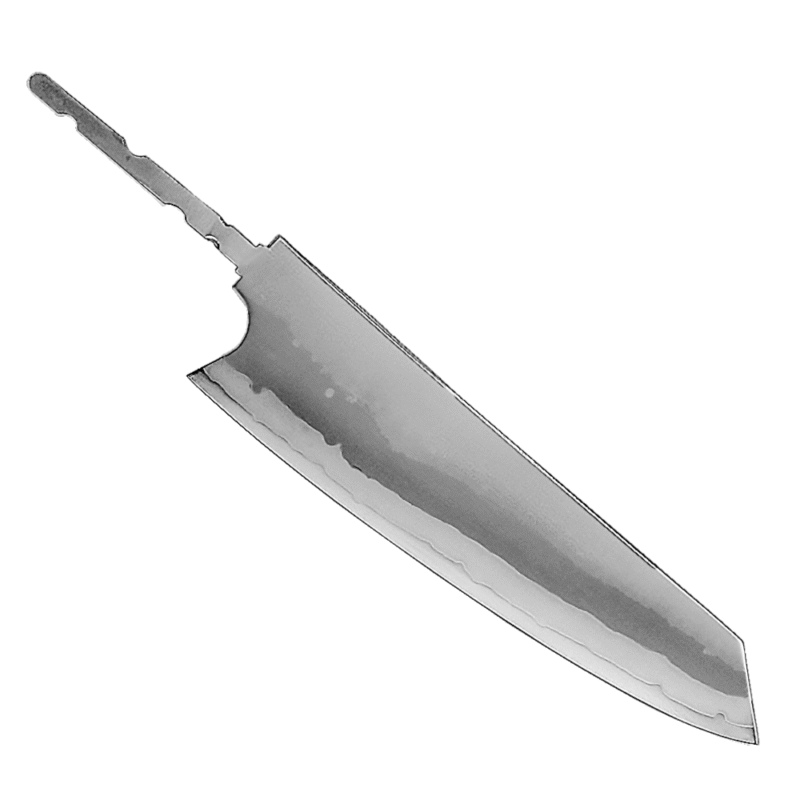
https://yashkadesigns.com/440c-blade-chef-knife-blank-diy-knife-making
What Is 440C Steel?
440C is one of the most famous stainless steels ever produced for knives. Introduced decades ago, it became an industry standard because it offered an excellent balance of hardness, corrosion resistance, affordability, and ease of manufacturing.
Even today, VG10 vs 440C continues to be relevant because 440C remains widely available and performs reliably when properly heat treated.
440C belongs to the high-carbon version of the 440 stainless family. Compared with other steels in the same series, it contains the highest carbon content, allowing it to achieve considerably greater hardness after heat treatment.
Its popularity comes from several practical advantages:
- Good corrosion resistance
- Easy maintenance
- High polish finish
- Good wear resistance
- Relatively easy sharpening
- Proven long-term reliability
Many knife enthusiasts consider 440C one of the classic stainless steels because it has been successfully used for decades across countless knife styles.
Although newer steels have appeared, properly heat-treated 440C remains an excellent choice for everyday users.
Check Our Guide 440C Steel Review
Chemical Composition Comparison
The chemical composition of a steel determines nearly every aspect of its performance. Even small differences in alloy content can dramatically affect hardness, corrosion resistance, toughness, and edge retention.
Below is a simplified comparison.
| Element | VG10 | 440C |
|---|---|---|
| Carbon | ~1.0% | ~1.1% |
| Chromium | ~15% | ~17% |
| Molybdenum | Yes | Yes |
| Vanadium | Yes | Minimal |
| Cobalt | Yes | No |
| Manganese | Small | Small |
| Silicon | Small | Small |
At first glance, the steels appear fairly similar because both contain high carbon and high chromium levels.
However, the smaller alloy additions create noticeable performance differences.
Carbon
Carbon largely determines the maximum hardness a steel can achieve.
Both steels contain enough carbon to become quite hard after heat treatment.
VG10 typically contains around 1.0% carbon.
440C contains slightly more.
In practical use, this small difference does not automatically mean that 440C holds an edge longer. Other alloying elements influence performance just as much.
Chromium
Chromium is responsible for stainless behavior.
Both steels easily exceed the amount required to qualify as stainless steel.
VG10 contains approximately 15% chromium.
440C generally contains around 17%.
Higher chromium usually improves corrosion resistance, but it also influences carbide formation, which affects sharpening and wear resistance.
Vanadium
This is where VG10 vs 440C begins to separate.
VG10 contains vanadium.
Vanadium creates extremely hard carbides that:
- Improve wear resistance
- Increase edge stability
- Produce finer grain
- Allow a sharper edge
440C contains little or no vanadium.
This means its carbide structure differs significantly.
Cobalt
VG10 also includes cobalt.
Cobalt improves heat-treatment performance and helps the steel achieve greater hardness while maintaining stability.
440C does not normally contain cobalt.
Molybdenum
Both steels contain molybdenum.
Its primary functions include:
- Improving corrosion resistance
- Increasing hardenability
- Enhancing high-temperature stability
- Supporting wear resistance
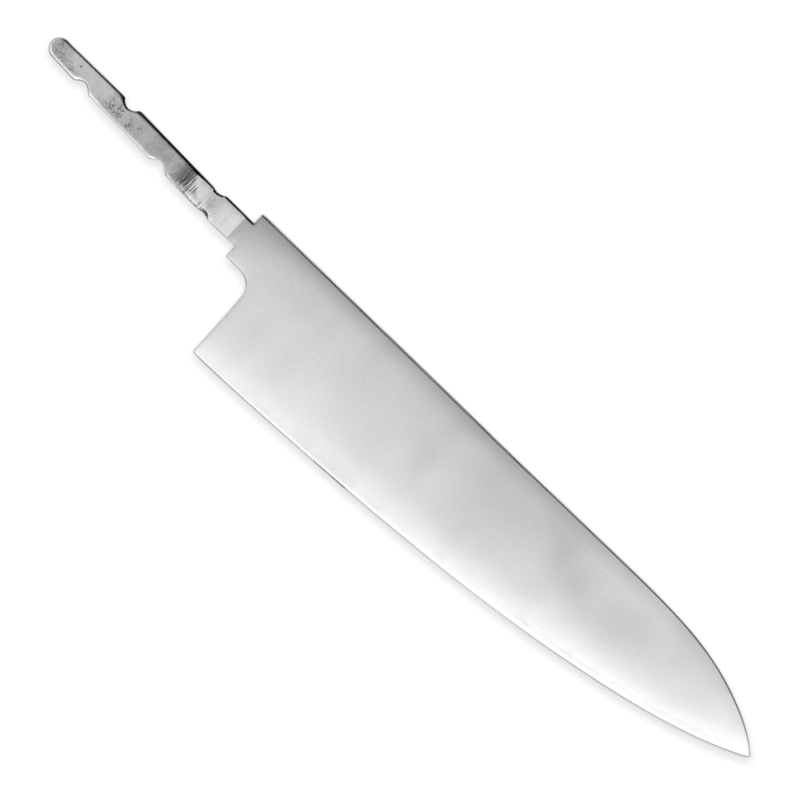
https://yashkadesigns.com/440c-steel-chef-knife-blank-blade
How Composition Affects Performance
Many knife buyers assume higher carbon automatically creates a better blade.
In reality, steel performance depends on the interaction of every alloying element.
This explains why the VG10 vs 440C debate has continued for years.
VG10 uses a more modern alloy recipe.
Instead of relying primarily on carbon and chromium, it incorporates vanadium and cobalt to create a finer, more wear-resistant microstructure.
This generally results in:
- Longer edge life
- Better slicing performance
- Higher achievable hardness
- Improved edge stability
440C follows a more traditional formula.
Its relatively simple composition makes it easier to manufacture consistently while providing dependable all-around performance.
Many users appreciate its predictable behavior, especially when sharpening.
Manufacturing Differences
Composition is only half the story.
Heat treatment and manufacturing determine whether the steel reaches its full potential.
Two knives made from identical steel can perform very differently if processed incorrectly.
VG10 Manufacturing
VG10 typically undergoes carefully controlled heat treatment to maximize hardness while preserving toughness.
The process usually involves:
- Precision austenitizing
- Controlled quenching
- Multiple tempering cycles
- Optional cryogenic treatment
Because VG10 contains several alloying elements, precise temperature control is essential.
Small variations can noticeably affect edge retention and toughness.
440C Manufacturing
440C is generally easier to heat treat than many newer stainless steels.
Manufacturers have decades of experience processing it, making consistent results easier to achieve.
Typical processing includes:
- High-temperature hardening
- Oil or air quenching
- Tempering
- Final grinding and polishing
Properly treated 440C performs considerably better than poorly treated premium steels.
Microstructure Differences
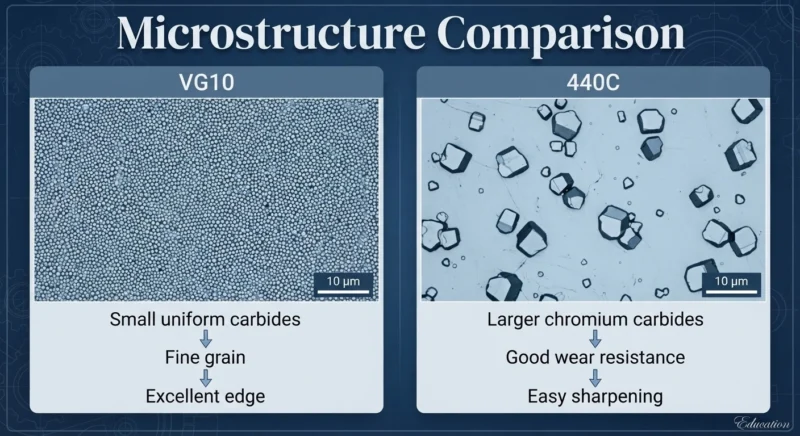
One of the biggest differences in VG10 vs 440C lies beneath the microscope.
VG10 develops a finer carbide distribution thanks to vanadium and cobalt additions.
Smaller carbides generally create:
- Cleaner cutting
- Better edge stability
- Higher polish
- Improved slicing efficiency
440C typically forms larger chromium carbides.
These provide respectable wear resistance but may not support as refined an edge as VG10.
This difference becomes more noticeable during precision slicing rather than heavy chopping.
Initial Performance Overview
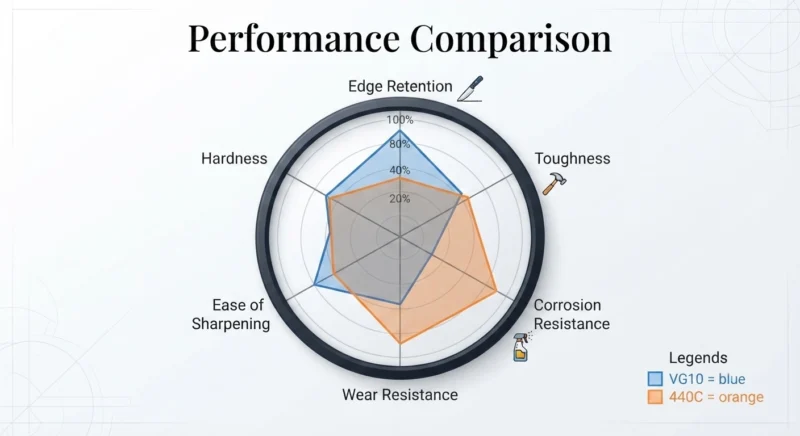
Before diving into detailed testing categories in the next section, here’s a quick overview.
| Property | VG10 | 440C |
|---|---|---|
| Hardness | ⭐⭐⭐⭐⭐ | ⭐⭐⭐⭐☆ |
| Edge Retention | ⭐⭐⭐⭐⭐ | ⭐⭐⭐⭐☆ |
| Corrosion Resistance | ⭐⭐⭐⭐☆ | ⭐⭐⭐⭐⭐ |
| Toughness | ⭐⭐⭐⭐☆ | ⭐⭐⭐☆☆ |
| Ease of Sharpening | ⭐⭐⭐⭐☆ | ⭐⭐⭐⭐⭐ |
| Fine Edge | ⭐⭐⭐⭐⭐ | ⭐⭐⭐⭐☆ |
From this initial comparison, it’s already clear why VG10 vs 440C remains such an interesting discussion. VG10 leans toward higher cutting performance and longer-lasting sharpness, while 440C emphasizes dependable corrosion resistance, straightforward maintenance, and ease of sharpening.
Hardness Comparison
Hardness is one of the first specifications buyers notice when comparing knife steels. It affects how well a blade resists deformation, how long it holds a sharp edge, and how much abuse it can tolerate before the edge begins to roll.
In the VG10 vs 440C comparison, VG10 generally has the advantage because it can be heat treated to a slightly higher hardness while maintaining good toughness.
Typical Hardness
| Steel | Typical Hardness (HRC) |
|---|---|
| VG10 | 59–61 HRC |
| 440C | 57–60 HRC |
Although these numbers appear close, even one or two Rockwell points can noticeably improve edge retention.
It’s important to remember that hardness depends largely on heat treatment. A well-made 440C knife can outperform a poorly heat-treated VG10 knife.
Why Hardness Matters
Higher hardness offers several advantages:
- Better edge retention
- Improved slicing performance
- More stable cutting edge
- Better wear resistance
- Less frequent sharpening
However, increasing hardness too much may reduce toughness, making the edge more susceptible to chipping under heavy impacts.
Fortunately, both VG10 and 440C are designed to maintain a practical balance between hardness and durability.
Check Our Guide What Is HRC? Understanding Rockwell Hardness
Edge Retention
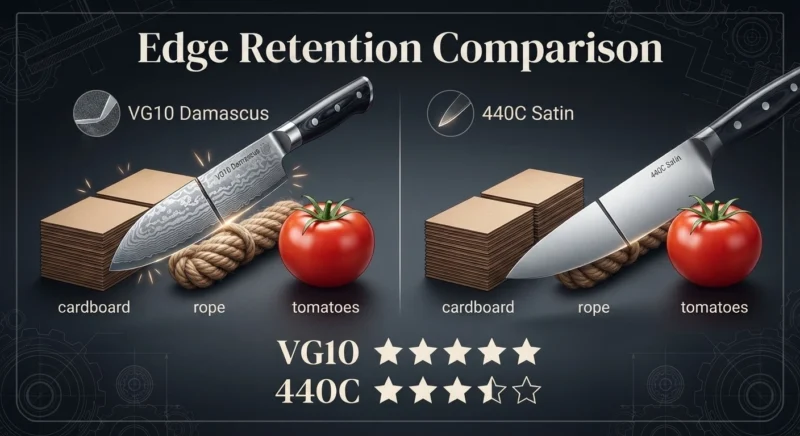
One of the biggest reasons buyers compare VG10 vs 440C is edge retention.
Nobody enjoys sharpening a knife every few days. A steel that stays sharp longer saves time and delivers a more consistent cutting experience.
Why VG10 Usually Stays Sharp Longer
VG10 benefits from alloying elements like vanadium and cobalt, which create harder carbides within the steel.
These carbides slow down edge wear during everyday cutting.
As a result, VG10 generally keeps its sharp edge longer than 440C when both are heat treated correctly.
Typical cutting tasks include:
- Vegetables
- Fruit
- Boneless meat
- Fish
- Herbs
- Cardboard
- Rope
- Leather
Across most of these materials, VG10 usually requires less frequent sharpening.
440C Edge Performance
440C still offers very respectable edge retention.
For many home cooks, the difference may not even become noticeable until after weeks of regular kitchen use.
440C performs especially well when:
- Properly heat treated
- Sharpened at an appropriate angle
- Used on quality cutting boards
- Maintained correctly
Its reputation as a dependable all-around stainless steel is well deserved.
Edge Retention Rating
| Performance | VG10 | 440C |
|---|---|---|
| Edge Retention | ⭐⭐⭐⭐⭐ | ⭐⭐⭐⭐☆ |
VG10 usually wins this category by a modest but noticeable margin.
Wear Resistance
Wear resistance refers to the blade’s ability to resist gradual abrasion during cutting.
Every slice slowly removes microscopic amounts of steel from the edge.
The slower this happens, the longer the knife remains sharp.
VG10
The vanadium carbides found in VG10 are significantly harder than chromium carbides.
This provides:
- Longer cutting life
- Better resistance to abrasive materials
- Slower edge degradation
440C
440C relies mainly on chromium carbides.
These still provide good wear resistance but are generally not as effective as vanadium carbides over long cutting sessions.
This is one reason VG10 typically maintains its sharpness longer.
Cutting Performance
Edge retention is only one part of cutting performance.
The way a knife feels during slicing is equally important.
VG10 Performance
VG10 excels during:
- Push cutting
- Precision slicing
- Vegetable preparation
- Fine meat trimming
- Fish preparation
Its fine grain allows a very refined edge that moves smoothly through food.
Many users describe the cutting sensation as effortless.
440C Performance
440C performs extremely well for general-purpose work.
It easily handles:
- Daily kitchen preparation
- Utility cutting
- Outdoor tasks
- Food preparation
- Packaging
- Rope
Although the edge may lose peak sharpness slightly sooner than VG10, it remains very capable.
Toughness
Toughness measures a steel’s resistance to cracking or chipping when subjected to stress.
A tough knife survives accidental twisting, minor impacts, and demanding cutting better than a brittle one.
Many people assume harder steels are always more fragile.
In reality, modern heat treatment allows both steels to maintain useful toughness.
VG10 Toughness
VG10 offers respectable toughness considering its hardness.
It performs well during:
- Normal kitchen use
- Food preparation
- Light outdoor tasks
- Everyday cutting
However, like most harder stainless steels, it should not be abused.
Avoid:
- Chopping frozen food
- Cutting bone
- Prying
- Striking hard surfaces
440C Toughness
440C generally provides similar or slightly lower toughness depending on heat treatment.
Its somewhat lower hardness can sometimes help resist small chips during rough use.
Many users appreciate 440C because it is forgiving during everyday tasks.
Toughness Comparison
| Property | VG10 | 440C |
|---|---|---|
| Toughness | ⭐⭐⭐⭐☆ | ⭐⭐⭐☆☆ |
The difference is relatively small.
Neither steel is intended for extreme survival knives or heavy chopping.
Edge Stability
Edge stability refers to how well the very apex of the cutting edge maintains its shape.
This is different from edge retention.
A steel with excellent edge stability can support extremely thin sharpening angles.
VG10 performs exceptionally well here.
Its fine grain structure allows:
- Cleaner slicing
- Very fine polished edges
- Excellent kitchen performance
440C performs well but generally benefits from slightly wider edge angles for maximum durability.
Sharpening Angles
VG10
Recommended angle:
12–15 degrees per side
This creates exceptional slicing performance.
440C
Recommended angle:
15–20 degrees per side
The slightly wider angle improves durability for general-purpose use.
Performance During Daily Kitchen Use
Let’s compare how these steels behave during common cooking tasks.
Vegetable Preparation
VG10 glides through onions, tomatoes, peppers, cucumbers, and herbs with very little resistance.
Its excellent edge stability makes thin slices easier to produce.
440C also performs well but may require sharpening slightly sooner with frequent use.
Winner: VG10
Meat Preparation
Both steels perform very well when trimming meat.
VG10 keeps its razor edge longer.
440C remains highly capable and easier to touch up if the edge begins to dull.
Winner: VG10
Fish Preparation
Fine slicing is where VG10 truly shines.
Its ability to support an extremely keen edge produces clean, smooth cuts.
440C still performs well for everyday fish preparation.
Winner: VG10
Outdoor Food Preparation
Camping meals often involve varied cutting tasks.
Both steels resist corrosion well.
440C’s ease of sharpening makes field maintenance slightly simpler.
Winner: 440C (slight advantage)
Edge Retention During Heavy Use
Suppose both knives are sharpened equally.
After repeated cutting of:
- Vegetables
- Meat
- Fruit
- Cardboard
- Rope
VG10 will generally retain its shaving sharp edge longer.
440C will slowly lose its razor edge but usually continues cutting effectively for quite some time.
This difference is one of the primary reasons enthusiasts often favor VG10 in the VG10 vs 440C debate.
Summary So Far
After examining hardness, wear resistance, cutting ability, toughness, and edge retention, a clear pattern begins to emerge.
VG10 is optimized for users who want exceptional slicing performance, a finer edge, and longer intervals between sharpening. Its modern alloy composition and fine carbide structure make it especially attractive for kitchen knives where precision matters.
440C, meanwhile, remains an excellent all-around stainless steel. It delivers reliable performance, is easier to sharpen, and has proven its durability over decades of use. For many users, especially those who value simple maintenance, it continues to be a practical and dependable choice.
Corrosion Resistance
One of the biggest reasons stainless steels dominate the knife market is their ability to resist rust and staining. Whether you’re preparing acidic foods in the kitchen or carrying a knife outdoors, corrosion resistance directly affects the blade’s lifespan and appearance.
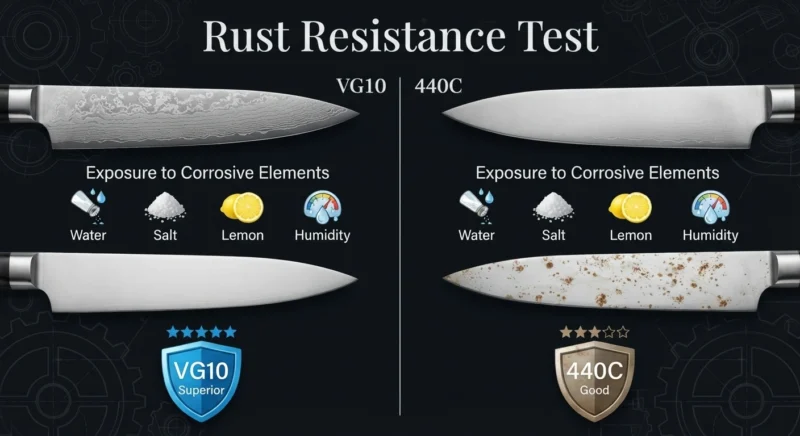
When comparing VG10 vs 440C, both steels perform exceptionally well. However, there are subtle differences worth understanding.
Why Stainless Steel Resists Rust
Stainless steels contain enough chromium to form an invisible chromium oxide layer on the surface. This protective layer prevents oxygen and moisture from attacking the steel beneath it.
Both VG10 and 440C contain far more than the minimum chromium required to be classified as stainless steel.
VG10 Corrosion Performance
VG10 contains approximately 15% chromium along with molybdenum, both of which contribute to excellent corrosion resistance.
In everyday use, VG10 easily handles exposure to:
- Water
- Fruit juices
- Vegetables
- Meat
- Fish
- Humid kitchens
It performs particularly well when cleaned shortly after use.
Although highly stain-resistant, VG10 is not completely maintenance-free. Leaving food residue or saltwater on the blade for extended periods may eventually lead to discoloration or minor staining.
440C Corrosion Performance
440C typically contains around 17% chromium.
This slightly higher chromium content gives it an excellent reputation for corrosion resistance.
Many users choose 440C specifically because it tolerates humid environments extremely well.
It performs reliably during:
- Kitchen cooking
- Outdoor food preparation
- Camping
- Fishing trips
- Everyday carry
When properly maintained, 440C rarely develops rust.
Corrosion Resistance Comparison
| Property | VG10 | 440C |
|---|---|---|
| Corrosion Resistance | ⭐⭐⭐⭐☆ | ⭐⭐⭐⭐⭐ |
The difference is relatively small, but 440C generally has a slight advantage.
Performance with Acidic Foods
Kitchen knives regularly come into contact with acidic ingredients that can challenge even stainless steels.
Examples include:
- Tomatoes
- Citrus fruits
- Pineapple
- Vinegar
- Apples
- Onions
Both steels resist staining extremely well.
However, neither should be left dirty after food preparation.
Good knife habits include:
- Rinse after use
- Dry immediately
- Store clean
- Avoid prolonged contact with acidic foods
These simple practices dramatically increase the life of any knife.
Ease of Sharpening
Every knife eventually becomes dull.
The ease with which a steel can be sharpened often matters more than how long it stays sharp.
This is another area where VG10 vs 440C becomes interesting.
Sharpening VG10
VG10 can achieve an exceptionally sharp edge.
Because it contains harder vanadium carbides, sharpening generally takes a little longer than 440C.
Fortunately, the steel responds well to quality sharpening stones.
Many users appreciate that VG10 develops an incredibly refined edge capable of effortless slicing.
Recommended sharpening tools include:
- Water stones
- Diamond stones
- Ceramic finishing stones
Sharpening 440C
440C is widely regarded as one of the easiest premium stainless steels to sharpen.
It responds quickly to:
- Water stones
- Oil stones
- Diamond sharpeners
- Guided sharpening systems
This makes it an excellent choice for beginners.
Small touch-ups restore sharpness relatively quickly compared with many modern high-alloy steels.
Sharpening Comparison
| Property | VG10 | 440C |
|---|---|---|
| Ease of Sharpening | ⭐⭐⭐⭐☆ | ⭐⭐⭐⭐⭐ |
440C wins this category because it requires less effort to restore a sharp edge.
Burr Formation
During sharpening, a tiny burr develops at the cutting edge.
How easily this burr forms—and how cleanly it can be removed—affects sharpening quality.
VG10 forms a relatively fine burr.
Once removed, the edge becomes extremely sharp.
440C forms a slightly larger burr that is generally easier for beginners to detect and eliminate.
Edge Polish
One characteristic many enthusiasts appreciate is the ability to polish a knife to a mirror-like cutting edge.
VG10 excels here.
Its fine grain structure supports:
- Highly polished bevels
- Extremely smooth slicing
- Fine push cutting
440C also polishes well, although its larger carbide structure may not produce quite the same level of refinement.
Everyday Maintenance
Fortunately, both steels require only basic maintenance.
Daily care includes:
✔ Wash by hand
✔ Dry immediately
✔ Store in a dry location
✔ Use wooden or plastic cutting boards
✔ Hone regularly
✔ Sharpen when necessary
Avoid:
- Dishwashers
- Cutting frozen food
- Twisting the blade
- Cutting bone with thin kitchen knives
Following these simple guidelines helps either steel maintain peak performance for many years.
Long-Term Durability
Durability depends on much more than hardness alone.
Proper use greatly influences how long a knife lasts.
VG10 Long-Term Performance
VG10 maintains its cutting ability for an impressively long time.
Many owners notice:
- Longer intervals between sharpening
- Stable cutting performance
- Excellent stain resistance
- Consistent slicing ability
With routine maintenance, VG10 can remain a dependable kitchen companion for years.
440C Long-Term Performance
440C has proven its reliability over decades of use.
Its strengths include:
- Excellent corrosion resistance
- Easy maintenance
- Straightforward sharpening
- Reliable everyday performance
Although it may require sharpening a bit more often than VG10, many users appreciate how quickly a keen edge can be restored.
Kitchen Performance
Most buyers researching VG10 vs 440C are looking for the best kitchen knife steel.
Let’s compare several common cooking tasks.
Vegetable Preparation
VG10 slices cleanly through:
- Carrots
- Peppers
- Cucumbers
- Herbs
- Onions
- Tomatoes
Its fine edge makes precise cuts easier.
440C performs well too, though frequent cooks may notice it needs sharpening sooner.
Winner: VG10
Check Our Guide Kitchen Knife Care Guide
Meat Preparation
Both steels handle boneless meats with ease.
VG10 stays razor-sharp for longer sessions, while 440C remains dependable and easier to touch up.
Winner: VG10
Fish Preparation
Preparing fish often demands thin, controlled slices.
VG10’s refined edge makes it especially well suited for this type of work.
440C still performs admirably for everyday use.
Winner: VG10
Fruit Preparation
Acidic fruits challenge both edge retention and corrosion resistance.
Both steels perform well when cleaned promptly.
The practical difference is minimal.
Result: Tie
Outdoor Performance
Kitchen use isn’t the only consideration.
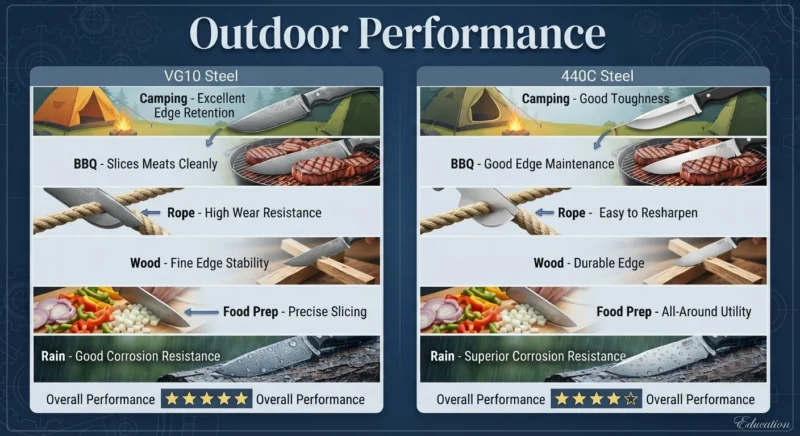
Many people use stainless knives while camping, hiking, or preparing food outdoors.
Moisture Resistance
Both steels resist humidity well.
440C’s slightly higher chromium content provides a small advantage in consistently wet environments.
Field Maintenance
Sharpening away from home often means using portable sharpeners.
Because 440C sharpens more quickly, many campers and hunters appreciate its simplicity.
VG10 requires slightly more patience but rewards the effort with longer edge life.
Food Preparation Outdoors
Preparing vegetables, meat, and fish while camping presents no challenge for either steel.
Both resist staining and clean easily.
Which Steel Is Better for Different Users?
Choose VG10 if you:
- Want longer edge retention
- Enjoy precision slicing
- Prefer less frequent sharpening
- Cook often
- Appreciate a finer cutting edge
Choose 440C if you:
- Prefer easy sharpening
- Want excellent corrosion resistance
- Value proven reliability
- Need a versatile everyday knife
- Are new to knife maintenance
Mid-Article Verdict
At this stage of the VG10 vs 440C comparison, both steels have demonstrated why they remain popular choices.
VG10 stands out for its modern metallurgy, finer grain structure, superior edge retention, and exceptional slicing performance. It is an excellent option for users who spend a lot of time in the kitchen and want a blade that stays sharp through extended food preparation.
440C continues to prove that a classic stainless steel can still compete. Its outstanding corrosion resistance, forgiving sharpening characteristics, and dependable long-term performance make it a practical choice for everyday use, especially for those who prefer low-maintenance knives.
Price and Value
When comparing VG10 vs 440C, price is often one of the deciding factors. While both steels are considered premium stainless options compared to entry-level cutlery steels, they occupy different positions in the market.
Generally speaking, knives made from VG10 command a higher price because the steel contains additional alloying elements and requires more precise heat treatment. Producing a high-quality VG10 blade demands tighter manufacturing tolerances, which contributes to its premium reputation.
440C, on the other hand, has been used successfully for decades. Its widespread availability and well-established manufacturing processes help keep production costs lower. This allows buyers to obtain a dependable stainless steel knife without paying a premium.
That doesn’t necessarily mean one steel offers better value than the other. Instead, value depends on your priorities.
If you want maximum edge retention and outstanding slicing performance, spending more on VG10 may be worthwhile. If you prefer a reliable knife that’s easy to sharpen and offers excellent corrosion resistance at a more accessible price, 440C remains an outstanding option.
Performance Scorecard
| Property | VG10 | 440C |
|---|---|---|
| Hardness | ⭐⭐⭐⭐⭐ | ⭐⭐⭐⭐☆ |
| Edge Retention | ⭐⭐⭐⭐⭐ | ⭐⭐⭐⭐☆ |
| Wear Resistance | ⭐⭐⭐⭐⭐ | ⭐⭐⭐⭐☆ |
| Corrosion Resistance | ⭐⭐⭐⭐☆ | ⭐⭐⭐⭐⭐ |
| Toughness | ⭐⭐⭐⭐☆ | ⭐⭐⭐☆☆ |
| Ease of Sharpening | ⭐⭐⭐⭐☆ | ⭐⭐⭐⭐⭐ |
| Fine Edge | ⭐⭐⭐⭐⭐ | ⭐⭐⭐⭐☆ |
| Maintenance | ⭐⭐⭐⭐☆ | ⭐⭐⭐⭐⭐ |
| Overall Kitchen Performance | ⭐⭐⭐⭐⭐ | ⭐⭐⭐⭐☆ |
| Overall Value | ⭐⭐⭐⭐⭐ | ⭐⭐⭐⭐⭐ |
Although VG10 earns slightly higher scores in several categories, the differences are not dramatic. Both steels are capable of delivering years of excellent service when properly heat treated and maintained.
Advantages of VG10
VG10 has become one of the most respected stainless knife steels because it offers an impressive balance of performance and practicality.
Pros
- Excellent edge retention
- High hardness
- Fine grain structure
- Outstanding slicing performance
- Very good corrosion resistance
- Holds highly polished edges
- Suitable for professional and home kitchens
- Less frequent sharpening required
Cons
- Usually more expensive
- Slightly more difficult to sharpen
- Can chip if used improperly
- Heat treatment quality is especially important
VG10 is ideal for people who prioritize cutting performance and want a knife that stays sharp through extended food preparation.
Advantages of 440C
Despite being an older stainless steel, 440C continues to earn respect because of its dependable performance.
Pros
- Excellent corrosion resistance
- Easier to sharpen
- Proven long-term reliability
- Good wear resistance
- Readily available
- Often offers excellent value
- Performs well in humid environments
- Easy to maintain
Cons
- Slightly shorter edge retention than VG10
- Larger carbide structure
- Doesn’t usually achieve the same ultra-fine edge
- May require sharpening more frequently
For many users, these disadvantages are relatively minor, especially considering how quickly the blade can be restored to full sharpness.
Which Steel Is Better for Different Uses?
Choosing between VG10 vs 440C depends largely on how you plan to use your knife.
Home Cooking
For most home cooks, both steels perform exceptionally well.
If you cook several times each week and appreciate a razor-sharp edge that lasts longer, VG10 is likely the better choice.
If you prefer simple maintenance and don’t mind sharpening occasionally, 440C remains an excellent option.
Winner: VG10
Professional Kitchens
Professional chefs often spend hours preparing ingredients every day.
Long-lasting sharpness reduces interruptions and helps maintain consistent cutting performance.
VG10 generally has the advantage here because of its superior edge retention.
Winner: VG10
Outdoor Cooking
Camping and outdoor cooking introduce additional challenges, including moisture, dirt, and limited sharpening equipment.
440C’s excellent corrosion resistance and ease of sharpening make it especially practical for outdoor use.
Winner: 440C
Everyday Utility
Opening packages, preparing food, cutting rope, and performing daily tasks require a steel that balances durability and easy maintenance.
Both steels perform well, but 440C is often easier for casual users to maintain.
Winner: 440C
Collectors
Knife enthusiasts often appreciate steels that combine excellent cutting ability with refined metallurgy.
VG10’s fine grain structure and exceptional edge quality make it especially appealing to collectors who enjoy high-performance kitchen knives.
Winner: VG10
Check Our Guide Best European Kitchen Knives
Maintenance Tips
No matter which steel you choose, proper care is essential for long-term performance.
Daily Care
- Wash by hand after every use.
- Dry immediately with a soft towel.
- Store in a dry location.
- Use a wooden or plastic cutting board.
- Avoid dishwashers.
- Hone the edge regularly.
Sharpening
VG10 responds well to quality water stones and diamond stones, while 440C is forgiving and sharpens quickly on a wide variety of sharpening systems.
Sharpen only when needed rather than waiting until the knife becomes completely dull.
Storage
Store knives in:
- A knife block
- A magnetic strip
- A blade guard
- A knife roll
Avoid storing loose knives in a drawer, where the edge can become damaged.
Frequently Asked Questions
Is VG10 better than 440C?
In terms of edge retention, fine edge quality, and overall cutting performance, VG10 generally has the advantage. However, 440C offers easier sharpening and slightly better corrosion resistance, making it an excellent choice for many users.
Which steel stays sharp longer?
VG10 typically retains its edge longer due to its fine carbide structure and modern alloy composition.
Which steel is easier to sharpen?
440C is generally easier to sharpen and responds quickly to both water stones and guided sharpening systems.
Is 440C still a good knife steel?
Absolutely. Even after decades of use, 440C remains a reliable stainless steel with excellent corrosion resistance and dependable everyday performance.
Which steel resists rust better?
Both steels resist corrosion very well, but 440C usually has a slight advantage because of its higher chromium content.
Which steel is better for chef knives?
VG10 is often preferred for chef knives because it maintains a razor-sharp edge longer and supports excellent slicing performance.
Is VG10 too brittle?
Not when properly heat treated and used correctly. Like any hard kitchen steel, it should not be used to chop bones, pry, or cut frozen food.
Can beginners use either steel?
Yes. Beginners may find 440C easier to maintain because it sharpens more quickly, while VG10 rewards careful maintenance with longer-lasting sharpness.
| Category | VG10 | 440C |
|---|---|---|
| Hardness | ⭐⭐⭐⭐⭐ | ⭐⭐⭐⭐☆ |
| Edge Retention | ⭐⭐⭐⭐⭐ | ⭐⭐⭐⭐☆ |
| Toughness | ⭐⭐⭐⭐☆ | ⭐⭐⭐☆☆ |
| Corrosion | ⭐⭐⭐⭐☆ | ⭐⭐⭐⭐⭐ |
| Sharpening | ⭐⭐⭐⭐☆ | ⭐⭐⭐⭐⭐ |
| Overall | 🏆 Winner | Excellent Value |
Final Verdict
The VG10 vs 440C comparison shows that both steels are excellent choices, but they are optimized for different priorities.
If your goal is maximum cutting performance, longer edge retention, and an exceptionally refined edge, VG10 is the stronger performer. Its fine grain structure, modern alloy composition, and ability to hold a razor-sharp edge make it one of the best stainless steels for kitchen knives.
If you value affordability, excellent corrosion resistance, straightforward maintenance, and easy sharpening, 440C remains one of the most dependable stainless knife steels ever developed. Its long history of reliable performance proves that a well-made classic steel can still compete with newer alternatives.
Rather than asking which steel is universally better, consider which one best fits your needs:
- Choose VG10 if you cook frequently, appreciate precision cutting, and want a blade that stays sharp for longer.
- Choose 440C if you prefer easy maintenance, excellent rust resistance, and a dependable all-around knife for everyday use.
Ultimately, the quality of the knife’s heat treatment, blade geometry, and craftsmanship will influence performance just as much as the steel itself. A well-designed knife made from either VG10 or 440C can provide years of reliable service, making both steels excellent options for home cooks, outdoor enthusiasts, and anyone looking for a durable stainless blade.
This article is for independent informational purposes only and is not affiliated with, sponsored by, or endorsed by any steel manufacturer. All product names, trademarks, and registered trademarks are the property of their respective owners.
VG10 vs 440C