Aogami Super vs Elmax
An Independent Guide
When comparing premium knife steels, few combinations are as interesting as Aogami Super vs Elmax. These two steels come from very different metallurgical traditions, yet both are capable of producing high-performance blades with excellent edge retention and impressive cutting ability.
Aogami Super is a Japanese high-carbon tool steel traditionally associated with fine kitchen knives, high hardness, thin edges, and excellent sharpening response. It is a carbon steel rather than a true stainless steel, so it rewards careful maintenance and can develop a natural patina over time.
Elmax takes a completely different approach. It is a modern powder metallurgy stainless steel designed to combine high wear resistance, good toughness, strong corrosion resistance, and excellent edge retention. It is intended to provide a broad range of performance rather than focusing primarily on the traditional Japanese kitchen-knife experience.
So, which one is better in the Aogami Super vs Elmax comparison?
There is no universal winner.
Aogami Super can be the better choice for someone who wants a very fine edge, high hardness, excellent cutting feel, and easy sharpening.
Elmax can be the better choice for someone who wants stainless corrosion resistance, long edge retention, high wear resistance, and greater versatility.
The difference becomes much clearer when we examine their chemistry, carbide structure, hardness, toughness, edge stability, sharpening behavior, corrosion resistance, and practical applications.
This guide explains Aogami Super vs Elmax in detail and helps determine which steel makes more sense for kitchen knives, EDC knives, outdoor blades, hunting knives, and general-purpose applications.
Aogami Super vs Elmax: Quick Comparison
| Property | Aogami Super | Elmax |
|---|---|---|
| Steel type | High-carbon alloy tool steel | Powder metallurgy stainless steel |
| Stainless | No | Yes |
| Carbon | ~1.4–1.5% | ~1.7% |
| Chromium | ~0.3–0.5% | ~18% |
| Vanadium | ~0.3–0.5% | ~3% |
| Molybdenum | ~0.2–0.4% | ~1% |
| Tungsten | ~2.0–2.5% | — |
| Edge retention | Excellent | Excellent |
| Wear resistance | Very good | Excellent |
| Toughness | Very good for its hardness | Very good |
| Corrosion resistance | Low to moderate | Excellent |
| Sharpening | Relatively easy | More demanding |
| Fine edge potential | Excellent | Very good |
| Patina | Yes | Minimal under normal use |
| Maintenance | Moderate | Low |
| Kitchen performance | Excellent | Excellent |
| EDC versatility | Moderate | Excellent |
| Outdoor performance | Moderate | Excellent |
| Best characteristic | Fine edge and sharpening | Stainless wear resistance and versatility |
The biggest difference is immediately obvious.
Aogami Super is a high-carbon, non-stainless steel designed around cutting performance.
Elmax is a stainless powder metallurgy steel designed around a broader combination of edge retention, wear resistance, toughness, and corrosion resistance.
That difference influences nearly every category in the Aogami Super vs Elmax comparison.
What Is Aogami Super?
Aogami Super is a high-carbon Japanese alloy steel used extensively for high-performance cutting tools and knives.
It belongs to the Aogami family of steels and is known for its high carbon content and carefully balanced alloy additions.
A typical composition is approximately:
- Carbon: 1.4–1.5%
- Chromium: 0.3–0.5%
- Tungsten: approximately 2.0–2.5%
- Vanadium: approximately 0.3–0.5%
- Molybdenum: small addition
- Manganese: relatively low
- Silicon: relatively low
The exact specification can vary slightly depending on the source and standard being referenced.
The important characteristic is that Aogami Super contains a high amount of carbon but relatively little chromium.
That means it can reach high hardness and produce excellent edge performance, but it does not have the chromium content required to behave as a stainless steel.
Aogami Super is therefore a steel for people who are willing to perform more maintenance in exchange for a very refined cutting experience.
Check Our Guide Aogami Super Steel
What Is Elmax?
Elmax is a modern powder metallurgy stainless steel.
It was designed to provide a combination of:
- High hardness
- Excellent wear resistance
- High edge retention
- Good toughness
- Excellent corrosion resistance
- Dimensional stability
- Fine powder metallurgy microstructure
Its approximate composition includes:
- Carbon: ~1.7%
- Chromium: ~18%
- Vanadium: ~3%
- Molybdenum: ~1%
- Manganese: small amount
- Silicon: small amount
The high chromium content makes Elmax a stainless steel.
The combination of high carbon and vanadium provides substantial carbide formation and excellent wear resistance.
The powder metallurgy manufacturing process helps keep the carbide distribution relatively fine and controlled.
This allows Elmax to combine properties that would otherwise be difficult to achieve simultaneously.
Check Our Guide ELMAX Steel Review
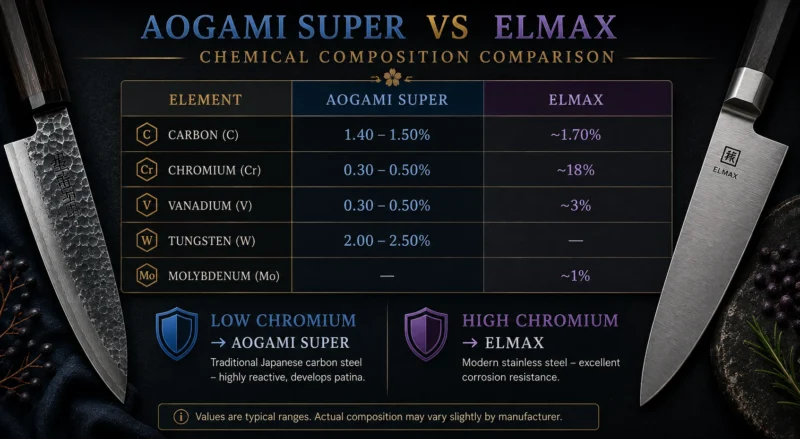
Aogami Super vs Elmax: Chemical Composition
Chemical composition is the best place to begin understanding Aogami Super vs Elmax.
| Element | Aogami Super | Elmax |
| Carbon | ~1.4–1.5% | ~1.7% |
| Chromium | ~0.3–0.5% | ~18% |
| Vanadium | ~0.3–0.5% | ~3% |
| Molybdenum | Small amount | ~1% |
| Tungsten | ~2.0–2.5% | — |
The most dramatic difference is chromium.
Aogami Super contains only a small amount of chromium.
Elmax contains approximately 18%.
This single difference explains why Elmax is stainless while Aogami Super is reactive.
The second major difference is vanadium.
Aogami Super contains a modest amount of vanadium.
Elmax contains approximately 3%.
That makes Elmax considerably more wear resistant.
The third major difference is tungsten.
Aogami Super uses tungsten as part of its alloy design.
This contributes to carbide formation and high-temperature performance.
Elmax uses a different alloy strategy based more heavily on chromium, vanadium, and molybdenum.
This is why the Aogami Super vs Elmax comparison is really a comparison between two very different metallurgical philosophies.
Carbon Content in Aogami Super vs Elmax
Both steels have high carbon content.
Aogami Super contains approximately 1.4–1.5% carbon.
Elmax contains approximately 1.7%.
Carbon contributes to:
- Hardness
- Martensitic transformation
- Carbide formation
- Wear resistance
- Edge retention
- Strength
At first glance, Elmax appears to have an advantage because it contains more carbon.
But carbon does not work alone.
It interacts with chromium, vanadium, tungsten, molybdenum, and the heat-treatment process.
Aogami Super’s alloy design allows a high level of hardness while maintaining a relatively fine and manageable carbide structure.
Elmax uses its additional carbon together with significant chromium and vanadium to produce a highly wear-resistant stainless microstructure.
Therefore, the carbon percentage alone cannot determine which steel is better.
Chromium: The Biggest Difference
Chromium is the element that creates the most obvious practical difference between Aogami Super vs Elmax.
Aogami Super contains only a small percentage of chromium.
This is not enough to make it stainless.
Elmax contains approximately 18% chromium.
This is more than enough to provide strong stainless corrosion resistance.
As a result:
Aogami Super requires more maintenance.
Elmax requires considerably less corrosion maintenance.
This is one of the clearest reasons to choose one steel over the other.
Tungsten in Aogami Super
Tungsten is one of the defining alloying elements in Aogami Super.
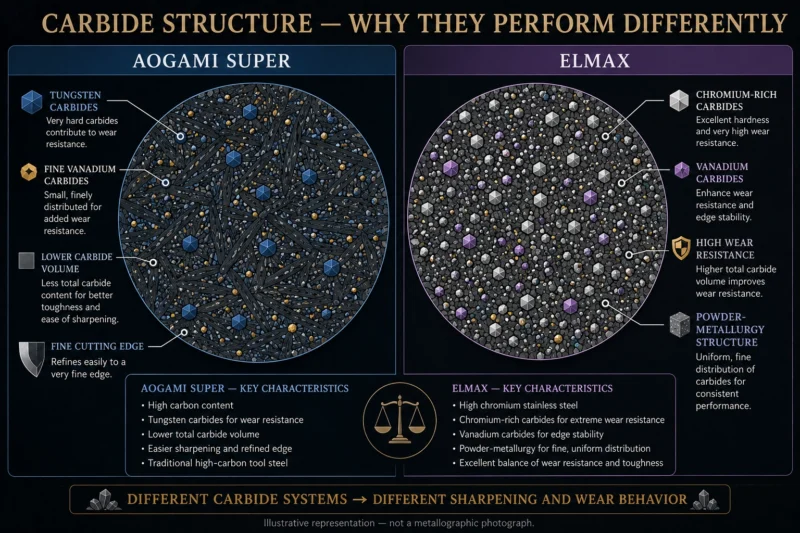
It contributes to carbide formation and helps the steel achieve high hardness and good wear resistance.
Tungsten carbides can be very hard.
However, Aogami Super does not contain the very high vanadium content found in Elmax.
This gives the two steels very different sharpening behavior.
Aogami Super can provide excellent edge retention without becoming excessively difficult to sharpen.
This is one of the characteristics that makes it popular for high-performance kitchen knives.
Vanadium in Elmax
Elmax contains approximately 3% vanadium.
This is a major contributor to its wear resistance.
Vanadium forms extremely hard carbides.
These carbides resist abrasive wear.
That means the cutting edge can remain functional for a long time, particularly when cutting abrasive materials.
This gives Elmax a major advantage in the Aogami Super vs Elmax comparison when maximum edge longevity is the goal.
However, there is a trade-off.
The same hard carbides that help Elmax retain an edge also make sharpening more demanding.
Aogami Super vs Elmax: Hardness
Both steels are capable of high hardness.
Aogami Super is commonly heat treated around the low 60s HRC and can be taken to relatively high hardness when treated appropriately.
Elmax can also commonly be used around the low 60s HRC.
The exact hardness depends on:
- Heat treatment
- Austenitizing temperature
- Quenching
- Tempering
- Cryogenic treatment where used
- Intended application
Therefore, it is incorrect to say that one steel is automatically harder than the other.
A particular Aogami Super knife may be harder than a particular Elmax knife.
Another Elmax knife may be harder than a particular Aogami Super knife.
The steel grade establishes potential, not the final hardness of an individual blade.
Check Our Guide What Is HRC? Understanding Rockwell Hardness in Kitchen Knives
Is Aogami Super Harder Than Elmax?
Not necessarily.
Both steels can achieve high hardness.
Aogami Super is particularly well known for high hardness in thin Japanese kitchen knives.
Elmax is also capable of reaching high hardness while retaining excellent wear resistance and corrosion resistance.
The more interesting difference is what happens at that hardness.
Aogami Super’s relatively simple alloy structure can produce an excellent fine edge and relatively easy sharpening.
Elmax uses a more complex carbide structure to provide greater wear resistance.
Thus, hardness alone does not determine the winner in Aogami Super vs Elmax.
Aogami Super vs Elmax: Edge Retention
Edge retention is one of the most important categories.
Aogami Super has excellent edge retention.
Its high carbon content, tungsten, vanadium, and high achievable hardness allow it to hold a fine edge for a long time.
However, Elmax generally has the advantage in wear resistance.
Its combination of:
- High carbon
- High chromium
- High vanadium
- Molybdenum
- Powder metallurgy
creates a highly wear-resistant structure.
Therefore:
For maximum edge retention, Elmax generally wins.
But there is an important qualification.
Edge retention depends heavily on the type of cutting.
A kitchen knife cutting soft vegetables is exposed to different stresses than an EDC knife cutting cardboard.
The practical difference between the steels can therefore vary significantly depending on use.
Check Our Guide Edge Retention Explained: 10 Factors What Makes a Knife Stay Sharp Longer
Why Elmax Has Higher Wear Resistance
Wear resistance is one of Elmax’s defining strengths.
The steel contains approximately 3% vanadium.
Vanadium carbides are extremely hard.
Elmax also contains high carbon and chromium.
The powder metallurgy process allows these alloying elements to form a relatively fine and controlled carbide distribution.
This produces excellent resistance to abrasive wear.
Aogami Super also has good wear resistance.
Its tungsten and vanadium additions contribute to hard carbides.
But the overall carbide system is less wear-resistant than Elmax.
This gives Elmax the clear advantage in the Aogami Super vs Elmax comparison for abrasive cutting.
Aogami Super vs Elmax: Sharpening
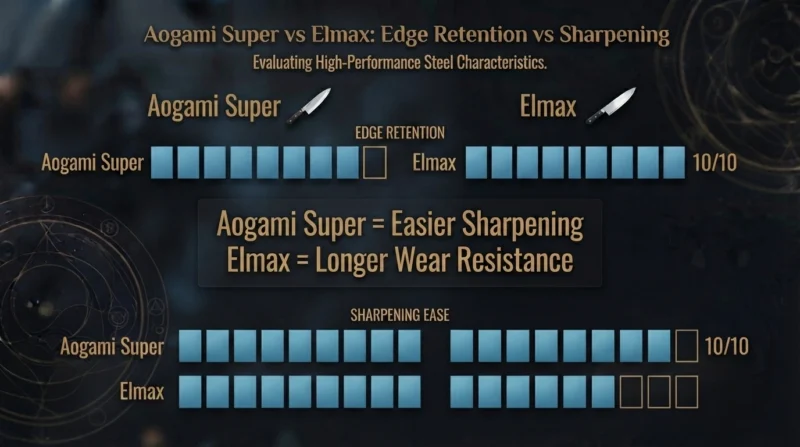
Sharpenability is where the balance begins to move toward Aogami Super.
Aogami Super is relatively easy to sharpen compared with highly wear-resistant stainless powder steels.
It responds very well to conventional water stones.
A burr can be raised relatively efficiently.
The edge can then be refined to a very high level.
Elmax can also be sharpened to an excellent edge.
However, its high wear resistance means that more abrasive work is required.
Hard vanadium carbides can make conventional stones less efficient.
For this reason, diamond or other hard abrasives can be useful.
Therefore:
Sharpening winner: Aogami Super.
Wear-resistance winner: Elmax.
This is one of the central trade-offs in Aogami Super vs Elmax.
Check Our Guide All Kinds of Knife Sharpening Tools
Does Elmax Get Sharper Than Aogami Super?
Both steels can achieve extremely sharp edges.
There is no simple rule saying that Elmax or Aogami Super has a higher maximum sharpness.
Sharpness is strongly affected by:
- Edge angle
- Edge geometry
- Abrasive
- Sharpening technique
- Burr removal
- Final polishing
- Heat treatment
Aogami Super is generally easier to bring to a refined edge.
Elmax can also produce an excellent edge, but may require more effort.
Therefore, the practical difference is not maximum sharpness.
It is how easily the steel reaches and maintains that sharpness.
Aogami Super vs Elmax: Toughness
Toughness is the ability of a steel to resist cracking, chipping, and fracture.
This is particularly important for knives that may experience impact or lateral stress.
Aogami Super has good toughness for a high-hardness steel.
Its relatively low carbide volume can help support good edge stability.
Elmax also has good toughness.
Its powder metallurgy structure allows significant alloying while keeping the carbides relatively fine and evenly distributed.
At similar hardness levels, Elmax can provide a very good balance between wear resistance and toughness.
The exact result depends strongly on heat treatment and edge geometry.
Which Is Tougher: Aogami Super or Elmax?
There is no absolute answer for every knife.
Both can be tough enough for demanding knife applications.
Aogami Super has a simpler carbide system and can perform very well in thin-edge applications.
Elmax offers excellent toughness considering its high wear resistance and stainless chemistry.
For general-purpose use, Elmax has a strong overall balance.
For extremely thin kitchen edges, Aogami Super can be particularly attractive.
The geometry of the blade may matter more than the steel grade itself.
Check Our Guide Wear Resistance vs Toughness: Understanding the Most Important Knife Steel Trade-Off
Aogami Super vs Elmax: Edge Chipping
Edge chipping is affected by:
- Hardness
- Carbide structure
- Edge angle
- Blade thickness
- Heat treatment
- Cutting technique
Aogami Super can support very fine edges.
However, a very thin and very hard edge can chip if used improperly.
Elmax can also support thin edges, but its carbide structure requires appropriate geometry.
Neither steel should be considered immune to chipping.
Avoid using fine knife edges on:
- Bones
- Frozen foods
- Hard pits
- Ceramic plates
- Glass
- Twisting cuts
No premium steel can make an inappropriate edge geometry indestructible.
Aogami Super vs Elmax: Edge Stability
Edge stability is different from simple hardness.
A stable edge maintains its geometry during cutting.
Aogami Super performs extremely well when used at appropriate hardness and geometry.
It is one of the reasons the steel is so popular for fine kitchen knives.
Elmax can also provide excellent edge stability.
Its high wear resistance helps maintain the apex during extended cutting.
The correct answer in the Aogami Super vs Elmax comparison depends on what kind of edge is being used.
For ultra-thin precision cutting, Aogami Super can be excellent.
For longer-lasting general-purpose edges, Elmax has an advantage.
Aogami Super vs Elmax: Corrosion Resistance
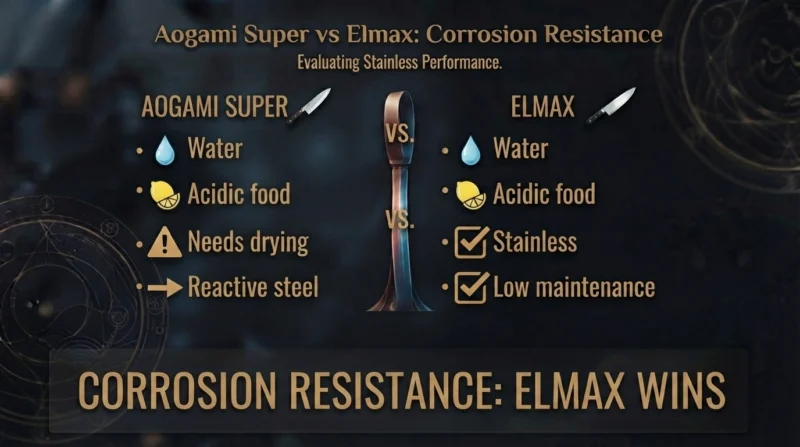
This is the category where the difference is enormous.
Aogami Super
Aogami Super is not stainless.
It can:
- Develop patina
- Rust if neglected
- React with acidic foods
- Require drying
- Require more careful storage
Elmax
Elmax is stainless.
It provides:
- Excellent corrosion resistance
- Low maintenance
- Strong resistance to moisture
- Better resistance to acidic environments
- Better suitability for outdoor carry
Therefore:
Corrosion resistance winner: Elmax by a very large margin.
This is probably the single most obvious practical difference between the two steels.
Does Aogami Super Rust?
Yes.
Aogami Super can rust if exposed to moisture and left wet.
This does not mean it is a poor steel.
It simply means it is a reactive carbon steel.
Many knife enthusiasts deliberately choose carbon steels because they enjoy:
- Patina development
- Traditional sharpening
- Fine edge performance
- Traditional Japanese knife characteristics
The key is maintenance.
After cutting acidic or wet foods, clean and dry the blade.
Do not store it wet.
With reasonable care, Aogami Super can be used for many years.
Does Elmax Rust?
Elmax is highly corrosion resistant.
It is not literally immune to corrosion, because no steel is completely immune under every possible condition.
However, under ordinary knife use, it requires very little corrosion maintenance.
This makes Elmax especially convenient for:
- Outdoor knives
- EDC
- Hunting knives
- Fishing knives
- Kitchen knives
- Humid environments
For users who want to forget about patina and routine blade drying, Elmax is clearly more convenient.
Aogami Super vs Elmax: Patina
Aogami Super can develop a beautiful natural patina.
The patina may range from:
- Golden
- Gray
- Blue-gray
- Dark gray
depending on use and exposure.
Many knife enthusiasts consider patina part of the character of a carbon steel blade.
Elmax generally does not develop the same type of visible patina under normal conditions.
This creates an interesting philosophical difference.
Aogami Super is partly about the relationship between the user and the blade.
Elmax is more about convenience and consistency.
Aogami Super vs Elmax for Kitchen Knives
This is perhaps the most interesting application.
Aogami Super is exceptionally well suited to kitchen knives.
It offers:
- High hardness
- Excellent edge retention
- Fine edge capability
- Excellent cutting feel
- Easy sharpening
- Thin-edge performance
The downside is corrosion.
Elmax offers:
- Excellent corrosion resistance
- Excellent wear resistance
- Long edge retention
- Good toughness
- Low maintenance
The downside is sharpening difficulty.
For a serious kitchen enthusiast who enjoys sharpening and does not mind wiping and drying the blade, Aogami Super is an outstanding choice.
For a chef or home cook who wants stainless convenience, Elmax is extremely practical.
Aogami Super vs Elmax for Vegetable Knives
Vegetable knives often benefit from:
- Thin geometry
- Fine edges
- High hardness
- Excellent edge stability
- Low cutting resistance
Aogami Super is particularly strong in this environment.
A thin, hard Aogami Super blade can provide exceptional cutting performance.
Elmax can also be ground thin.
Its corrosion resistance can be especially useful when cutting wet vegetables.
However, if the primary goal is maximum cutting refinement, Aogami Super has a strong advantage.
Aogami Super vs Elmax for Fish
Fish preparation requires sharpness, thin geometry, and corrosion resistance.
Aogami Super can produce an exceptional fish-cutting edge.
But fish is wet.
This means the user must be careful with cleaning and drying.
Elmax is much more forgiving.
For professional environments where knives are frequently exposed to water, Elmax can be extremely practical.
For an enthusiast who enjoys maintaining a traditional carbon-steel knife, Aogami Super remains an excellent option.
Check Our Guide How to Prepare Fish for Sushi, Sashimi & Ceviche
Aogami Super vs Elmax for Meat
For boneless meat slicing, both steels can perform extremely well.
Aogami Super’s fine edge is excellent for precise slicing.
Elmax offers longer wear resistance and better corrosion resistance.
However, if cutting bones is involved, edge geometry becomes critical.
Neither steel should be used with an ultra-thin edge for aggressive bone contact.
The correct knife design matters more than the steel comparison.
Aogami Super vs Elmax for Seafood
Seafood is one of the applications where Elmax gains a practical advantage.
Salt and moisture are challenging for reactive carbon steel.
Aogami Super requires immediate cleaning and drying.
Elmax is much more resistant to this environment.
For frequent seafood preparation, especially where maintenance time is limited, Elmax is the safer practical choice.
Check Our Guide How to Prepare and Cut Seafood
Aogami Super vs Elmax for EDC
For EDC, Elmax is generally the better choice.
An everyday-carry knife can encounter:
- Rain
- Sweat
- Humidity
- Food
- Cardboard
- Plastic
- Abrasive materials
Elmax handles these conditions extremely well.
Aogami Super can certainly be used as an EDC steel, but it requires significantly more attention.
A person who enjoys carbon steel may happily accept this.
A person who wants a maintenance-free EDC knife probably will not.
Aogami Super vs Elmax for Outdoor Knives
Elmax has a substantial advantage outdoors.
Outdoor environments are unpredictable.
The knife may be:
- Wet
- Dirty
- Exposed to humidity
- Used for abrasive materials
- Stored for extended periods
Elmax’s stainless properties and wear resistance make it especially suitable.
Aogami Super can still work well outdoors, but corrosion becomes a major consideration.
If maintenance is not guaranteed, Elmax is the safer choice.
Check Our Guide Knife Safety Tips for Outdoor Use
Aogami Super vs Elmax for Hunting Knives
Hunting knives often encounter moisture and biological material.
That makes corrosion resistance particularly important.
Elmax is therefore highly attractive.
It provides a combination of:
- Stainless corrosion resistance
- High edge retention
- Good toughness
- High wear resistance
Aogami Super can provide excellent cutting performance, but it needs significantly more maintenance.
For hunting use, Elmax generally makes more practical sense.
Check Our Guide Best Hunting Knife Features Explained
Aogami Super vs Elmax for Utility Knives
Utility work often involves abrasive materials.
Cardboard is particularly abrasive.
Rope, plastics, packaging materials, and other industrial materials can also wear an edge quickly.
This favors Elmax.
Its vanadium carbide structure provides strong resistance to abrasive wear.
Aogami Super will still perform well, but its edge will generally wear faster under highly abrasive cutting conditions.
Aogami Super vs Elmax: Sharpening Stones
Aogami Super is very comfortable on traditional water stones.
This is one reason it is so popular among sharpening enthusiasts.
The steel can be:
- Quickly deburred
- Refined
- Polished
- Sharpened to very acute angles
Elmax can also be sharpened with stones.
However, the high wear resistance means that abrasive selection becomes more important.
Harder stones or diamond abrasives can improve sharpening efficiency.
This does not make Elmax a bad steel to sharpen.
It simply means sharpening takes more effort.
Aogami Super vs Elmax: Sharpening Experience
The sharpening experience is one of the biggest differences between these steels.
Aogami Super tends to feel responsive.
The user can feel the steel being abraded.
The progression from dull to sharp can be relatively quick.
Elmax tends to resist abrasive removal more strongly.
A user may need more time to create a fresh apex.
For someone who sharpens frequently, Aogami Super can be more enjoyable.
For someone who dislikes sharpening, Elmax’s longer edge life can be more valuable.
Aogami Super vs Elmax: Maintenance
Maintenance is another major dividing line.
Aogami Super maintenance:
- Clean after use
- Dry immediately
- Avoid prolonged contact with acids
- Monitor patina
- Prevent rust
- Store dry
Elmax maintenance:
- Clean after use
- Dry normally
- Basic storage precautions
- Sharpen when necessary
Both knives should be cleaned and dried.
But Aogami Super requires considerably more attention.
Aogami Super vs Elmax: Which Is Better for Beginners?
For a beginner who does not want to think about corrosion, Elmax is easier.
It is stainless.
It can be carried without the same concern about humidity.
It can be used in a kitchen without immediately worrying about patina.
However, Aogami Super may be easier for a beginner to sharpen.
This creates a split answer.
Easier maintenance:
Elmax
Easier sharpening:
Aogami Super
For a complete beginner, maintenance is often the more important factor.
Aogami Super vs Elmax for Experienced Knife Enthusiasts
Experienced enthusiasts may appreciate both steels.
Aogami Super offers:
- Traditional Japanese character
- Fine edges
- High hardness
- Excellent sharpening response
- Patina development
Elmax offers:
- Modern metallurgy
- Stainless performance
- High wear resistance
- Long edge life
- Low maintenance
The choice often becomes philosophical.
Do you enjoy caring for the knife?
Or do you prefer the knife to simply work?
Aogami Super rewards involvement.
Elmax rewards convenience.
Aogami Super vs Elmax: Fine Edge Performance
Aogami Super is particularly strong when used with a fine edge.
The steel can be hardened significantly and can support acute geometry.
This makes it excellent for:
- Slicing
- Push cutting
- Precision kitchen work
- Fish preparation
- Vegetable cutting
Elmax can also support fine edges.
However, its strength is more balanced across different applications.
If the knife is designed primarily for ultra-fine cutting, Aogami Super is very compelling.
Aogami Super vs Elmax: Edge Geometry
Steel cannot compensate for poor geometry.
A knife’s cutting performance depends heavily on:
- Blade thickness
- Grind
- Edge angle
- Behind-the-edge thickness
- Heat treatment
- Sharpening
A thin Aogami Super blade can feel dramatically more efficient than a thick Elmax blade.
Likewise, a well-designed Elmax blade can outperform a poorly designed Aogami Super blade.
Therefore, steel should always be considered together with geometry.
Aogami Super vs Elmax: Thin Edges
Aogami Super has an excellent reputation for thin-edge performance.
Its high hardness and relatively fine carbide structure allow it to produce very refined cutting edges.
Elmax can also be made thin.
Its powder metallurgy structure helps maintain a controlled carbide distribution.
But the ideal edge thickness depends on intended use.
A kitchen knife can be much thinner than an outdoor utility knife.
Trying to use the same edge geometry for every application is a mistake regardless of steel choice.
Aogami Super vs Elmax: Edge Angle
A very acute edge can provide excellent cutting efficiency.
But the thinner the apex becomes, the more important edge stability becomes.
Aogami Super is often used at relatively acute angles in kitchen knives.
Elmax can also handle relatively fine edges when properly heat treated.
For harder use, a slightly more robust edge is generally preferable.
There is no universal “best” edge angle for either steel.
Aogami Super vs Elmax: Wear Resistance
If wear resistance is the priority, Elmax wins.
The reason is primarily its:
- High carbon
- High vanadium
- Chromium-rich carbide system
- Powder metallurgy structure
Aogami Super has good wear resistance but is not designed to compete directly with high-wear stainless powder steels.
This is why Elmax is so effective for long-term utility use.
Aogami Super vs Elmax: Toughness at High Hardness
High hardness and toughness are always a balancing act.
Aogami Super can achieve very high hardness while retaining useful toughness.
Elmax can also achieve high hardness while maintaining respectable toughness.
The powder metallurgy process is important because it helps control carbide size.
However, heat treatment remains critical.
Poor heat treatment can ruin the performance of even an excellent steel.
Heat Treatment in Aogami Super vs Elmax
Heat treatment is one of the most important factors in the entire comparison.
Two knives made from the same steel can perform very differently if their heat treatment differs.
Important factors include:
- Austenitizing temperature
- Soaking time
- Quenching method
- Tempering temperature
- Number of tempering cycles
- Cryogenic treatment
- Final hardness
Aogami Super responds strongly to heat treatment.
Elmax also requires carefully controlled treatment to reach its intended balance.
Therefore, a well-treated knife made from either steel can be outstanding.
Check Our Guide Steel Heat Treatment Explained
Why Heat Treatment Matters More Than the Steel Name
Imagine two Aogami Super knives.
One is properly heat treated and hardened to an appropriate level.
The other has poor heat treatment and an unstable edge.
The first may dramatically outperform the second.
The same is true for Elmax.
This is why a steel comparison should describe tendencies rather than promise exact performance.
When buying or making a knife, the steel grade is only one part of the equation.
Aogami Super vs Elmax: Cutting Feel
Cutting feel is difficult to measure objectively.
It depends on:
- Geometry
- Edge finish
- Hardness
- Blade thickness
- Cutting material
- User preference
Aogami Super is often appreciated for its crisp and refined cutting sensation.
Elmax can also feel extremely sharp and controlled.
However, users who enjoy traditional Japanese carbon steels may prefer the character of Aogami Super.
Users who prioritize practicality may prefer Elmax.
Aogami Super vs Elmax: Polishing
Aogami Super responds very well to polishing.
It can produce:
- High polish
- Fine satin
- Traditional finishes
- Refined cutting edges
Elmax can also be polished, although its higher wear resistance can make the process more time-consuming.
The choice of abrasive is important.
For finishing work on Elmax, suitable abrasives can make a significant difference.
Aogami Super vs Elmax: Patina and Appearance
Aogami Super can change appearance with use.
A natural patina develops as the steel reacts with its environment.
This can create a unique appearance over time.
Elmax generally maintains a more consistent stainless appearance.
This means:
Aogami Super changes with use.
Elmax tends to remain visually stable.
Neither is inherently better.
It depends on whether you prefer character or consistency.
Aogami Super vs Elmax: Which Is Better for a Chef?
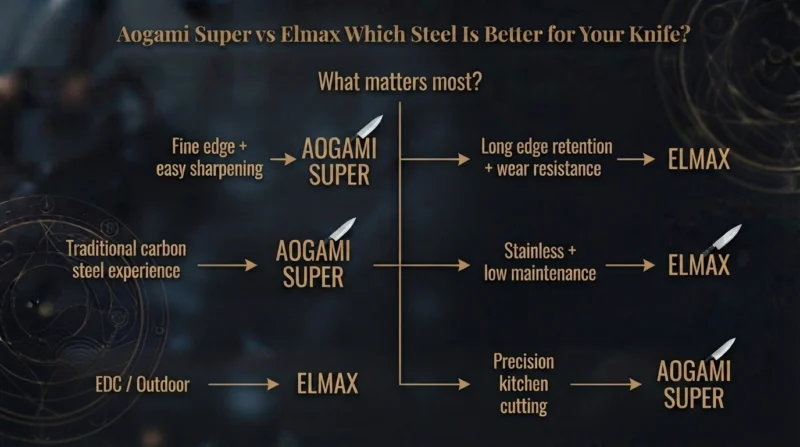
A chef who values:
- Traditional Japanese knives
- Very fine edges
- Easy sharpening
- High hardness
- Excellent cutting feel
may prefer Aogami Super.
A chef who values:
- Stainless steel
- Minimal maintenance
- Long edge life
- Easy corrosion management
may prefer Elmax.
For professional kitchens where many people handle knives and maintenance routines are not always perfect, Elmax has a practical advantage.
For an individual enthusiast who carefully maintains and sharpens the knife, Aogami Super can be exceptionally rewarding.
Aogami Super vs Elmax for Home Cooks
Home cooks have more flexibility.
If you enjoy sharpening and do not mind drying the knife:
Aogami Super is an excellent choice.
If you want to wash, dry, store, and forget about corrosion:
Elmax is easier.
Both can deliver excellent kitchen performance.
The final choice should be based on your maintenance habits rather than marketing claims.
Aogami Super vs Elmax for Professional Kitchens
Professional kitchens often prioritize practicality.
Knives are exposed to:
- Water
- Steam
- Acids
- Salt
- Frequent washing
- Multiple users
This environment strongly favors stainless steel.
Therefore, Elmax has a practical advantage.
Aogami Super can still be used professionally, but it requires a disciplined cleaning and drying routine.
Aogami Super vs Elmax for EDC Users
Elmax is generally the stronger EDC choice.
It combines:
- Corrosion resistance
- High edge retention
- Wear resistance
- Good toughness
An EDC knife may spend hours in a pocket next to sweat and humidity.
A reactive carbon steel requires more care.
Elmax is simply more convenient.
Aogami Super vs Elmax for Outdoor Enthusiasts
Again, Elmax generally wins.
Outdoor knives need to cope with:
- Rain
- Humidity
- Dirt
- Sweat
- Abrasive materials
- Unpredictable storage
Elmax provides a strong combination of corrosion resistance and wear resistance.
Aogami Super can work outdoors, but maintenance becomes a significant part of ownership.
Aogami Super vs Elmax: Which Is More Forgiving?
Elmax is more forgiving from a maintenance perspective.
It does not punish the user as quickly for exposure to moisture.
Aogami Super is more demanding.
If left wet, it can develop rust.
If used with acidic food and not cleaned, its appearance can change quickly.
However, Aogami Super can be very forgiving during sharpening.
This is another example of the different strengths of the two steels.
Aogami Super vs Elmax: Which Is Better for Long-Term Ownership?
Both can last for decades.
A knife does not become unusable simply because its edge wears.
The blade can be sharpened repeatedly.
Aogami Super may require more corrosion care.
Elmax may require more effort during sharpening.
With proper maintenance, either steel can provide extremely long service life.
Aogami Super vs Elmax: Which Is Easier to Maintain?
Elmax.
There is no real contest here.
Its stainless properties make everyday care substantially easier.
Aogami Super requires more discipline.
This is one of the most important reasons people choose stainless steels.
Aogami Super vs Elmax: Which Is Better for Sharpening?
Aogami Super.
It is generally easier to sharpen and especially well suited to water stones.
Its wear resistance is high enough to provide excellent edge life but not so high that sharpening becomes a major project.
Elmax requires more abrasive effort.
However, once sharpened, Elmax can maintain the working edge for a long time.
Aogami Super vs Elmax: Which Holds an Edge Longer?
Elmax generally wins.
Its higher wear resistance gives it an advantage in abrasive cutting.
However, the practical difference depends on what is being cut.
A kitchen knife used on soft foods may not show the same dramatic difference as an EDC knife cutting cardboard.
Aogami Super vs Elmax: Which Has Better Corrosion Resistance?
Elmax wins by a large margin.
Its approximately 18% chromium content makes it a true stainless steel.
Aogami Super is a reactive carbon steel.
This is one of the easiest categories to decide.
Aogami Super vs Elmax: Which Is Better for Fine Cutting?
Aogami Super has the advantage.
Its high hardness, fine carbide structure, and sharpening response make it particularly suitable for thin, refined edges.
Elmax can also produce excellent cutting performance.
But Aogami Super is especially well suited to precision kitchen cutting.
Aogami Super vs Elmax: Which Is More Versatile?
Elmax wins.
It can be used effectively for:
- Kitchen knives
- EDC knives
- Outdoor knives
- Hunting knives
- Utility knives
- General-purpose blades
Aogami Super is more specialized toward high-performance cutting and traditional knife applications.
Aogami Super vs Elmax: Pros and Cons
Aogami Super Advantages
- Extremely fine edge potential
- High hardness
- Excellent sharpening response
- Very good edge retention
- Good wear resistance
- Excellent cutting feel
- Excellent kitchen performance
- Traditional Japanese carbon-steel character
- Develops natural patina
- Works exceptionally well with water stones
Aogami Super Disadvantages
- Not stainless
- Can rust
- Requires drying
- Requires more maintenance
- Less suitable for humid environments
- Less convenient for EDC
- Lower wear resistance than Elmax
Elmax Advantages
- Excellent corrosion resistance
- Excellent wear resistance
- Excellent edge retention
- High hardness
- Good toughness
- Powder metallurgy structure
- Low maintenance
- Excellent EDC performance
- Excellent outdoor performance
- Strong general-purpose versatility
- Good kitchen performance
Elmax Disadvantages
- More difficult to sharpen
- Requires stronger abrasives for efficient sharpening
- Less traditional sharpening feel
- May offer more wear resistance than some kitchen users need
- Does not provide the same carbon-steel patina experience
Aogami Super vs Elmax: Practical Scorecard
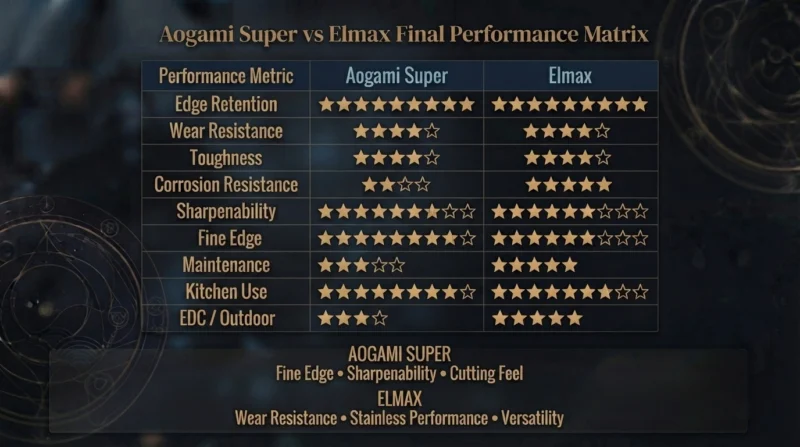
The following ratings are general performance comparisons rather than standardized laboratory measurements.
| Category | Aogami Super | Elmax |
| Edge retention | 9/10 | 9.5/10 |
| Wear resistance | 8/10 | 9.5/10 |
| Toughness | 8/10 | 8.5/10 |
| Corrosion resistance | 3/10 | 9.5/10 |
| Sharpenability | 9.5/10 | 7/10 |
| Fine edge potential | 9.5/10 | 9/10 |
| Edge stability | 9/10 | 9/10 |
| Kitchen performance | 9.5/10 | 9/10 |
| Outdoor performance | 6/10 | 9.5/10 |
| EDC versatility | 6/10 | 9.5/10 |
| Maintenance | 5/10 | 9.5/10 |
| Patina potential | 10/10 | 2/10 |
These ratings are intended to make the trade-offs easier to understand.
They should not be treated as official test scores.
Aogami Super vs Elmax: Who Should Choose Aogami Super?
Aogami Super is an excellent choice if you:
- Love Japanese kitchen knives
- Want a very fine edge
- Enjoy sharpening
- Prefer water stones
- Want high hardness
- Appreciate traditional carbon steel
- Do not mind patina
- Are willing to dry the blade after use
- Prioritize cutting feel over maintenance convenience
For this type of user, Aogami Super can be difficult to beat.
Aogami Super vs Elmax: Who Should Choose Elmax?
Elmax is an excellent choice if you:
- Want stainless steel
- Prefer low maintenance
- Want long edge life
- Cut abrasive materials
- Carry a knife every day
- Work outdoors
- Live in a humid environment
- Want one knife for many different applications
For this type of user, Elmax offers a remarkably balanced package.
Aogami Super vs Elmax: The Kitchen Knife Decision
If your knife will spend most of its life cutting food, Aogami Super deserves serious consideration.
Its strengths align almost perfectly with precision kitchen work.
However, if your kitchen environment is wet, busy, or shared by several users, Elmax may be more practical.
This is a classic choice between:
Performance and involvement
versus
Performance and convenience.
Aogami Super gives you a little more responsibility.
Elmax gives you a little more freedom.
Aogami Super vs Elmax: The EDC Decision
For EDC, Elmax is the clear practical choice.
The knife can remain in a pocket through humidity and sweat with much less concern.
Its edge retention is also excellent.
Aogami Super can still be used as an EDC steel by enthusiasts who appreciate carbon steel.
But it is a specialist choice rather than the easiest choice.
Aogami Super vs Elmax: The Outdoor Decision
For outdoor use, Elmax has the advantage.
The combination of stainless corrosion resistance and high wear resistance is extremely valuable.
Aogami Super is better suited to users who are prepared to maintain the blade carefully.
Aogami Super vs Elmax: The Sharpening Decision
If you enjoy sharpening:
Aogami Super.
If you prefer not to sharpen frequently:
Elmax.
This is one of the simplest ways to make the decision.
Aogami Super vs Elmax: The Maintenance Decision
If you hate wiping and drying a knife:
Elmax.
If you do not mind routine maintenance:
Aogami Super.
Carbon steel is not difficult to maintain.
It simply requires attention.
Aogami Super vs Elmax: The Edge Retention Decision
If maximum edge retention is the priority:
Elmax.
Its high wear resistance gives it a strong advantage.
Aogami Super still performs exceptionally well, but it is not designed to maximize abrasive wear resistance at the expense of other characteristics.
Aogami Super vs Elmax: The Sharpening Enthusiast Decision
If sharpening is part of the enjoyment:
Aogami Super.
The steel responds beautifully to stones.
The process is relatively quick.
The final edge can be extremely refined.
For some knife enthusiasts, this is more important than having the longest possible interval between sharpening sessions.
Aogami Super vs Elmax: The Minimal-Maintenance Decision
If the goal is to do as little maintenance as possible:
Elmax.
Its stainless corrosion resistance removes one of the biggest responsibilities associated with carbon steel.
Its long edge life also reduces sharpening frequency.
This makes Elmax an excellent “use it and forget about it” premium steel.
Aogami Super vs Elmax: Does Stainless Mean Better?
No.
Stainless and non-stainless steels are designed around different priorities.
Aogami Super’s lack of chromium is not a defect.
It allows the steel to focus heavily on hardness, fine edge performance, and sharpening characteristics.
Elmax’s chromium content is not automatically better either.
It simply gives the steel a completely different set of capabilities.
The right question is not:
Which steel is better?
The better question is:
Which steel is better for my application?
Aogami Super vs Elmax: Does More Alloy Mean Better Steel?
No.
Elmax contains significantly more alloying elements than Aogami Super.
But more alloy does not automatically produce better cutting performance.
Alloying creates trade-offs.
More carbide can increase wear resistance but make sharpening more difficult.
More chromium improves corrosion resistance but changes carbide formation.
More vanadium improves wear resistance but increases sharpening demands.
Aogami Super demonstrates how a relatively simpler alloy system can produce extraordinary cutting performance.
Elmax demonstrates how complex alloy design can create excellent overall versatility.
Aogami Super vs Elmax: Why There Is No Universal Winner
Every knife steel is a compromise.
A steel cannot simultaneously maximize:
- Edge retention
- Toughness
- Corrosion resistance
- Sharpenability
- Fine-edge stability
- Wear resistance
without trade-offs.
Aogami Super makes certain compromises.
It sacrifices corrosion resistance to achieve excellent cutting and sharpening characteristics.
Elmax makes different compromises.
It sacrifices some sharpening ease in exchange for corrosion resistance and wear resistance.
That is why the Aogami Super vs Elmax comparison is so useful.
It demonstrates that “better” depends on priorities.
Final Verdict: Aogami Super vs Elmax
After comparing chemistry, hardness, toughness, edge retention, wear resistance, corrosion resistance, sharpening, edge stability, maintenance, and applications, the answer becomes clear.
Aogami Super and Elmax are both premium knife steels, but they are designed for different types of users.
Aogami Super is the specialist.
It is excellent for:
- Fine edges
- Precision cutting
- Japanese kitchen knives
- High hardness
- Easy sharpening
- Traditional carbon-steel enthusiasts
Elmax is the all-rounder.
It is excellent for:
- Long edge retention
- Wear resistance
- Corrosion resistance
- EDC
- Outdoor knives
- Hunting knives
- General-purpose use
- Low-maintenance ownership
If you want the finest possible cutting experience and enjoy sharpening, Aogami Super may be the better choice.
If you want long edge life, stainless performance, and versatility, Elmax may be the better choice.
Aogami Super vs Elmax: Final Comparison Table
| Feature | Better Choice | Why |
| Sharpening | Aogami Super | Easier and more responsive |
| Fine edge | Aogami Super | Excellent thin-edge potential |
| Kitchen cutting | Aogami Super | Excellent precision performance |
| Cutting feel | Aogami Super | Refined and responsive |
| Edge retention | Elmax | Higher wear resistance |
| Wear resistance | Elmax | Strong vanadium carbide system |
| Corrosion resistance | Elmax | High chromium content |
| Toughness | Elmax | Excellent balance for a high-alloy steel |
| EDC | Elmax | Stainless and versatile |
| Outdoor use | Elmax | Excellent corrosion and wear resistance |
| Long sharpening intervals | Elmax | Excellent edge retention |
| Sharpening enjoyment | Aogami Super | Excellent response on stones |
| Maintenance | Elmax | Minimal corrosion concerns |
| Japanese kitchen knives | Aogami Super | Fine edge and sharpening characteristics |
| General-purpose knives | Elmax | Broader performance range |
| Patina | Aogami Super | Develops naturally with use |
Aogami Super vs Elmax: The Short Answer
If you want the shortest possible explanation:
Aogami Super is the better choice for fine cutting, high hardness, easy sharpening, and traditional Japanese knife performance.
Elmax is the better choice for stainless corrosion resistance, long edge retention, wear resistance, and versatility.
Aogami Super asks the owner for more maintenance.
Elmax asks the sharpener for more effort.
That is perhaps the simplest way to understand the Aogami Super vs Elmax difference.
Frequently Asked Questions About Aogami Super vs Elmax
Is Aogami Super better than Elmax?
Not universally. Aogami Super is generally better for fine edges, traditional kitchen knives, and easy sharpening. Elmax is better for corrosion resistance, wear resistance, and versatility.
Is Elmax better than Aogami Super?
Elmax has clear advantages in corrosion resistance, edge retention, and general-purpose use. However, Aogami Super may be more enjoyable for precision kitchen cutting and sharpening.
Which has better edge retention, Aogami Super or Elmax?
Elmax generally has better edge retention because of its high wear resistance and significant vanadium content. Aogami Super still offers excellent edge retention, especially at high hardness.
Which is easier to sharpen, Aogami Super or Elmax?
Aogami Super is generally easier to sharpen. Elmax is more wear resistant and may require harder or more aggressive abrasives.
Is Aogami Super stainless?
No. Aogami Super is a reactive high-carbon steel and can develop patina or rust if it is not maintained properly.
Is Elmax stainless?
Yes. Elmax is a stainless powder metallurgy steel with approximately 18% chromium.
Which has better corrosion resistance?
Elmax has dramatically better corrosion resistance than Aogami Super.
Which is better for kitchen knives?
Aogami Super is particularly attractive for precision kitchen knives and users who enjoy sharpening. Elmax is better for cooks who prioritize stainless convenience and long edge life.
Which is better for EDC?
Elmax is generally the better choice for EDC because of its stainless corrosion resistance, wear resistance, and versatility.
Which is better for outdoor knives?
Elmax generally has the advantage because it combines strong corrosion resistance with excellent wear resistance.
Which is tougher?
Both can offer good toughness when properly heat treated. Elmax has an excellent toughness-to-wear-resistance balance, while Aogami Super can perform extremely well with thin edges.
Which takes a sharper edge?
Both can become extremely sharp. Aogami Super is generally easier to refine to an extremely fine edge.
Does Aogami Super hold an edge well?
Yes. Aogami Super has excellent edge retention, especially at high hardness.
Does Elmax hold an edge well?
Yes. Excellent wear resistance is one of Elmax’s major strengths.
Does Aogami Super rust?
Yes. It can rust if exposed to moisture and not properly maintained.
Does Elmax rust?
Elmax is highly corrosion resistant, although no stainless steel is completely immune to corrosion in every environment.
Which is better for a sharpening enthusiast?
Aogami Super is generally the more enjoyable steel to sharpen.
Which is better for someone who hates sharpening?
Elmax is generally the better choice because its wear resistance allows longer intervals between sharpening.
Which is better for a Japanese-style kitchen knife?
Aogami Super is particularly well suited to Japanese-style kitchen knives because of its hardness, fine-edge potential, and sharpening characteristics.
Which is better for a low-maintenance knife?
Elmax.
Its stainless properties and long edge retention make it particularly convenient.
Does geometry matter more than steel?
Often, yes. Edge angle, blade thickness, grind, heat treatment, and sharpening can dramatically change the performance of a knife.
Is Aogami Super more traditional than Elmax?
Yes. Aogami Super belongs to the traditional family of Japanese high-carbon knife steels, while Elmax represents a modern powder metallurgy approach to stainless knife steel.
Conclusion: Aogami Super vs Elmax
The Aogami Super vs Elmax comparison is ultimately a choice between two different ideas of what a premium knife steel should do.
Aogami Super focuses on the cutting experience.
It offers high hardness, excellent edge retention, fine-edge capability, and a sharpening response that many knife enthusiasts find exceptionally satisfying.
Its main compromise is corrosion resistance.
Elmax focuses on balance and convenience.
It provides excellent corrosion resistance, high wear resistance, long edge life, good toughness, and broad versatility.
Its main compromise is sharpening difficulty.
For a traditional Japanese kitchen knife, Aogami Super is an outstanding choice.
For a modern stainless knife designed for a wide range of environments, Elmax is an outstanding choice.
Neither steel is universally superior.
The right choice depends on your priorities.
Choose Aogami Super when the experience of cutting, sharpening, and maintaining a traditional high-carbon blade is part of what you enjoy.
Choose Elmax when you want a stainless steel that can retain its edge for a long time while requiring relatively little maintenance.
In the end, the best answer to Aogami Super vs Elmax is not about declaring one steel the winner.
It is about matching the steel to the knife, the geometry, the cutting task, and the person using it.
This article is for independent informational purposes only and is not affiliated with, sponsored by, or endorsed by any steel manufacturer. All product names, trademarks, and registered trademarks are the property of their respective owners.