Ginsan vs S45VN
An Independent Guide
When choosing a high-performance knife, the steel is one of the first specifications people look at. Two steels that deserve a particularly close comparison are Ginsan and S45VN.
The Ginsan vs S45VN comparison is interesting because both steels are stainless, both can produce excellent knife edges, and both are capable of impressive performance. However, they achieve that performance through very different alloy designs and manufacturing approaches.
Ginsan is a Japanese stainless steel known for combining many of the desirable characteristics of traditional carbon steels with the convenience of stainless corrosion resistance. It is especially popular for kitchen knives because it can take a fine, responsive edge while requiring considerably less maintenance than reactive carbon steels.
S45VN is a modern powder metallurgy stainless steel designed around a different philosophy. It combines high carbon content with substantial chromium, vanadium, molybdenum, niobium, and nitrogen. The result is a steel with excellent wear resistance, strong corrosion resistance, good toughness, and very good edge retention.
So, which is better in the Ginsan vs S45VN comparison?
The answer depends on what you value most.
If you prioritize a fine, responsive kitchen-knife edge, easy sharpening, and stainless convenience, Ginsan is extremely attractive.
If you prioritize wear resistance, long edge life, corrosion resistance, and broad versatility, S45VN has significant advantages.
This guide examines Ginsan vs S45VN in detail, including chemical composition, hardness, edge retention, toughness, corrosion resistance, sharpening, carbide structure, edge stability, kitchen performance, maintenance, and practical applications.
Ginsan vs S45VN: Quick Comparison
| Property | Ginsan | S45VN |
|---|---|---|
| Steel type | Stainless Japanese knife steel | Powder metallurgy stainless steel |
| Carbon | Approximately 0.95–1.10% | Approximately 1.48% |
| Chromium | Approximately 13–14.5% | Approximately 16% |
| Molybdenum | Approximately 0.8–1.2% | Approximately 2% |
| Vanadium | Very low / not a major alloying element | Approximately 3% |
| Niobium | None significant | Approximately 0.5% |
| Nitrogen | Not a defining addition | Approximately 0.15% |
| Stainless | Yes | Yes |
| Typical knife hardness | Approximately 59–62 HRC, depending on treatment | Approximately 60–62 HRC, depending on treatment |
| Edge retention | Very good | Excellent |
| Wear resistance | Good to very good | Excellent |
| Toughness | Good | Good to very good |
| Corrosion resistance | Excellent | Excellent |
| Sharpening | Relatively easy | More demanding |
| Fine edge potential | Excellent | Very good |
| Maintenance | Low | Low |
| Kitchen performance | Excellent | Excellent |
| Outdoor versatility | Good | Excellent |
| Best characteristic | Fine edge and sharpening | Wear resistance and versatility |
The table already shows why Ginsan vs S45VN is not a simple winner-takes-all comparison.
Ginsan has a relatively simple alloy structure compared with S45VN. It contains enough chromium to be stainless but does not rely on a large amount of vanadium carbide for wear resistance.
S45VN takes a much more heavily alloyed approach.
That difference has consequences for almost every characteristic discussed below.
What Is Ginsan Steel?
Ginsan is a Japanese stainless knife steel designed to provide a combination of corrosion resistance, hardness, edge retention, and sharpening ability.
It is sometimes encountered under different naming conventions, but the important point is that Ginsan is a stainless steel specifically appreciated for knife applications.
A representative composition is approximately:
- Carbon: 0.95–1.10%
- Chromium: 13–14.5%
- Molybdenum: approximately 0.8–1.2%
- Manganese: generally below 1%
- Silicon: generally below 0.5%
Exact published specifications can vary slightly according to the specification being referenced.
The most important feature of Ginsan is its balance.
It contains substantially more chromium than traditional carbon steels, allowing it to behave as a stainless steel, while its carbon content is high enough to produce useful hardness and edge retention.
Ginsan is therefore often described as having some of the cutting characteristics associated with traditional Japanese carbon steels while providing stainless convenience.
That combination makes it particularly interesting for kitchen knives.
What Is S45VN?
S45VN is a modern martensitic stainless knife steel produced using powder metallurgy.
Its representative composition is approximately:
- Carbon: 1.48%
- Chromium: 16%
- Vanadium: 3%
- Molybdenum: 2%
- Niobium: 0.5%
- Nitrogen: 0.15%
This is a significantly more complex alloy than Ginsan.
The high chromium content provides stainless corrosion resistance.
The vanadium contributes to hard carbide formation and wear resistance.
Molybdenum contributes to the alloy’s hardenability and corrosion resistance.
Niobium participates in carbide formation and helps control the microstructure.
Nitrogen contributes to hardness and corrosion resistance.
The result is a modern stainless steel designed to provide a balanced combination of:
- Hardness
- Wear resistance
- Edge retention
- Corrosion resistance
- Toughness
- Edge stability
This makes S45VN especially versatile.
Check Our Guide S45VN Steel Review
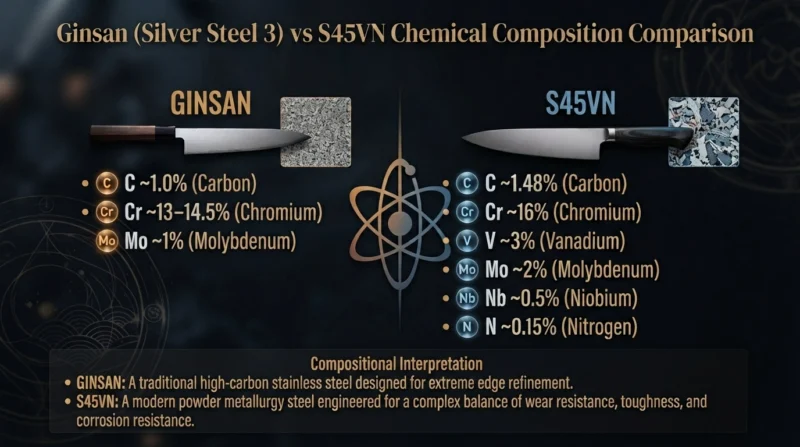
Ginsan vs S45VN: Chemical Composition
Chemical composition is one of the best places to begin when studying Ginsan vs S45VN.
| Element | Ginsan | S45VN |
| Carbon | ~0.95–1.10% | ~1.48% |
| Chromium | ~13–14.5% | ~16% |
| Molybdenum | ~0.8–1.2% | ~2% |
| Vanadium | Very low | ~3% |
| Niobium | — | ~0.5% |
| Nitrogen | Not a defining addition | ~0.15% |
The first major difference is carbon.
S45VN contains significantly more carbon.
The second major difference is chromium.
S45VN contains approximately 16% chromium, while Ginsan contains approximately 13–14.5%.
The third major difference is vanadium.
Ginsan does not depend on large quantities of vanadium carbides for its performance.
S45VN contains approximately 3% vanadium.
This is extremely important because vanadium is a strong carbide-forming element.
The Ginsan vs S45VN comparison therefore involves two fundamentally different approaches to stainless knife steel design.
Carbon Content in Ginsan vs S45VN
Carbon is critical for knife steel.
It contributes to:
- Hardness
- Martensitic transformation
- Carbide formation
- Edge retention
- Wear resistance
- Strength
Ginsan contains approximately 0.95–1.10% carbon.
S45VN contains approximately 1.48%.
Therefore, S45VN has a substantial carbon advantage.
However, more carbon does not automatically mean a better knife.
Carbon interacts with chromium, vanadium, molybdenum, niobium, and other alloying elements.
The heat treatment determines how those elements are distributed between the steel matrix and carbides.
Consequently, simply looking at carbon percentage is not enough to predict real-world performance.
This is an important point when discussing Ginsan vs S45VN.
Ginsan’s lower carbon content does not prevent it from producing an excellent knife edge.
Its relatively simple alloy design can actually contribute to a very pleasant sharpening experience.
Chromium and Corrosion Resistance
Chromium is one of the most important elements in stainless steel.
Ginsan contains approximately 13–14.5% chromium.
S45VN contains approximately 16%.
Both therefore qualify as stainless steels.
S45VN has a higher chromium content, but corrosion resistance cannot be predicted from chromium percentage alone.
Other alloying elements and the steel’s microstructure also matter.
Both steels provide excellent practical corrosion resistance compared with non-stainless carbon steels.
However, the difference between Ginsan and S45VN in normal kitchen use is generally much smaller than the difference between either of them and a highly reactive carbon steel.
This makes both excellent choices for users who do not want to manage patina and rust.
Vanadium: One of the Biggest Differences
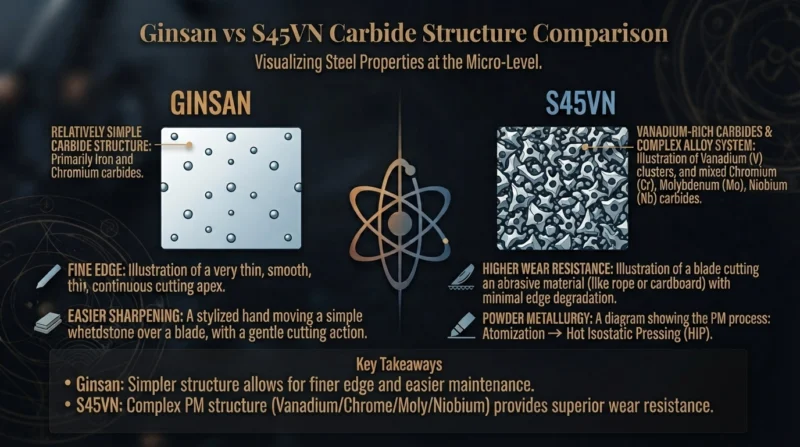
The presence of approximately 3% vanadium in S45VN is one of the most important distinctions in the Ginsan vs S45VN comparison.
Vanadium is a strong carbide-forming element.
Vanadium carbides are extremely hard.
They contribute significantly to wear resistance.
This is one reason S45VN can maintain a working edge for a long time.
Ginsan does not have a comparable amount of vanadium.
Instead, it relies more heavily on its carbon-chromium-molybdenum system and heat treatment.
The result is a different balance.
S45VN generally offers more abrasive wear resistance.
Ginsan generally offers a more straightforward sharpening experience.
Molybdenum
Both steels contain molybdenum, although S45VN contains more.
Molybdenum contributes to:
- Hardenability
- Corrosion resistance
- Strength
- Carbide formation
- High-temperature performance
In S45VN, molybdenum is part of a complex alloy system that also includes vanadium, niobium, chromium, and nitrogen.
In Ginsan, molybdenum contributes to the steel’s ability to maintain good hardness and corrosion resistance without requiring the very high carbide volume found in more heavily alloyed powder steels.
Ginsan vs S45VN: Hardness
Hardness is one of the most commonly discussed properties of knife steel.
Ginsan knives are commonly found around approximately 59–62 HRC, although actual hardness depends on heat treatment, blade design, and intended application.
S45VN is commonly used around approximately 60–62 HRC, again depending on heat treatment.
Therefore, the typical hardness ranges overlap considerably.
This is important.
The Ginsan vs S45VN comparison is not primarily a story of one steel being dramatically harder than the other.
Instead, the major difference is what each steel does with its alloying elements and carbide structure.
A well-treated Ginsan knife can be very hard and can support a fine edge.
A properly treated S45VN knife can also be very hard while offering substantially greater wear resistance.
Check Our Guide What Is HRC? Understanding Rockwell Hardness in Kitchen Knives
Is Ginsan Harder Than S45VN?
Not necessarily.
There is no universal rule that Ginsan is harder than S45VN or that S45VN is harder than Ginsan.
Actual hardness depends on:
- Heat treatment
- Austenitizing temperature
- Quenching
- Tempering
- Cryogenic treatment where applicable
- Blade thickness
- Manufacturer’s intended performance target
A specific Ginsan knife at 62 HRC may be harder than a specific S45VN knife at 60 HRC.
But another S45VN knife may be hardened to a similar or higher level.
Therefore, steel grade alone cannot determine the hardness of an individual knife.
Ginsan vs S45VN: Edge Retention
Edge retention is one of the most important parts of the comparison.
Ginsan provides very good edge retention.
For kitchen knives, it can hold a sharp edge for a considerable amount of cutting before requiring significant sharpening.
S45VN is designed for even greater wear resistance.
Its combination of:
- High carbon
- High vanadium
- Chromium
- Molybdenum
- Niobium
- Nitrogen
- Powder metallurgy
allows it to maintain a working edge very effectively.
Therefore, when comparing Ginsan vs S45VN specifically for abrasive wear and long-term edge retention:
S45VN generally has the advantage.
But that does not mean Ginsan has poor edge retention.
Quite the opposite.
Ginsan is an excellent edge-retaining stainless steel.
The difference becomes more significant when cutting highly abrasive materials or when long periods between sharpening are important.
Check Our Guide Edge Retention Explained: 10 Factors What Makes a Knife Stay Sharp Longer
Why S45VN Has More Wear Resistance
Wear resistance is strongly influenced by carbide content and hardness.
S45VN contains approximately 3% vanadium.
That creates hard vanadium carbides.
It also contains substantial chromium and other carbide-forming elements.
These hard particles resist abrasive wear.
Ginsan has a simpler carbide structure.
That makes it easier to abrade during sharpening.
This is actually an advantage when you need to sharpen the knife.
A steel that is extremely resistant to abrasive wear may retain its edge longer but can also require more effort to restore.
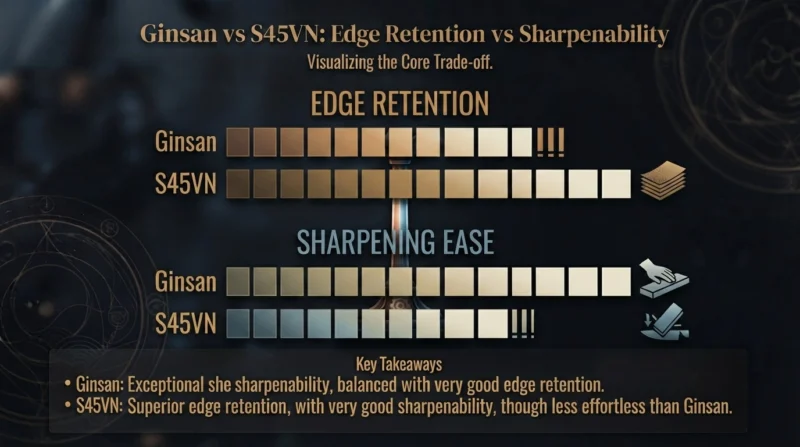
This creates one of the classic trade-offs in the Ginsan vs S45VN comparison:
S45VN tends to win on wear resistance, while Ginsan tends to win on sharpening ease.
Ginsan vs S45VN: Sharpening
For many kitchen-knife users, sharpening is just as important as edge retention.
Ginsan is generally pleasant to sharpen.
Its carbide structure is relatively modest compared with heavily alloyed powder steels.
A quality water stone can remove material efficiently.
The steel can also take a very refined edge.
S45VN can absolutely be sharpened to a high level.
However, it generally requires more abrasive effort.
The presence of hard vanadium-rich carbides means that conventional stones may work more slowly.
This is where diamond or other hard abrasives can become useful.
Therefore:
Easier sharpening:
Ginsan
Greater wear resistance:
S45VN
This is one of the clearest differences between Ginsan vs S45VN.
Does S45VN Get Sharp?
Yes.
S45VN can become extremely sharp.
There is no reason to believe that stainless powder metallurgy steel cannot achieve an excellent apex.
The issue is not whether it can become sharp.
The issue is how much work is required to reach that sharpness.
A properly sharpened S45VN knife can have excellent edge performance.
However, a user accustomed to sharpening simpler carbon or stainless steels may notice that S45VN takes more time.
Does Ginsan Get Sharper Than S45VN?
Both steels can achieve extremely sharp edges.
Ginsan has an advantage in sharpening feel and ease.
That does not necessarily mean it has a higher theoretical maximum sharpness.
The final sharpness depends on:
- Edge geometry
- Abrasive
- Sharpening technique
- Burr removal
- Edge angle
- Surface finish
A well-sharpened S45VN edge can be exceptionally sharp.
A well-sharpened Ginsan edge can be exceptionally sharp as well.
The difference is primarily how the steel behaves during sharpening.
Check Our Guide All Kinds of Knife Sharpening Tools
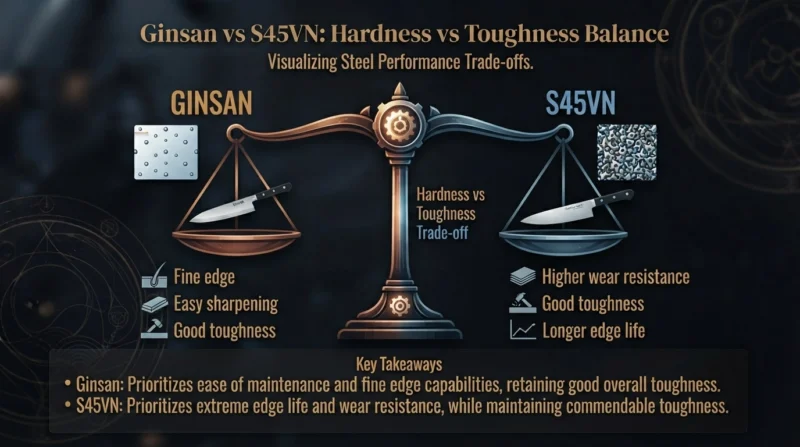
Ginsan vs S45VN: Toughness
Toughness measures resistance to cracking and breaking.
It is different from hardness.
A very hard steel can be relatively brittle.
A somewhat softer steel can be tougher.
Both Ginsan and S45VN can offer good practical toughness when properly heat treated.
Ginsan’s relatively modest carbide volume can be beneficial for edge toughness.
S45VN’s powder metallurgy structure helps control carbide size and distribution despite its more complex alloy composition.
This is important.
A high carbide content does not automatically mean poor toughness.
Powder metallurgy allows S45VN to maintain a fine and controlled microstructure.
In practical terms, S45VN is generally considered a well-balanced stainless knife steel rather than an extreme wear-resistance steel that sacrifices everything else.
Check Our Guide Wear Resistance vs Toughness: Understanding the Most Important Knife Steel Trade-Off
Edge Chipping
Edge chipping is influenced by:
- Hardness
- Carbide size
- Carbide distribution
- Edge thickness
- Edge angle
- Heat treatment
- Cutting technique
Ginsan’s relatively simple carbide system can provide good resistance to micro-chipping in thin kitchen edges.
S45VN can also be used successfully with thin edges.
However, its hard vanadium-containing carbide population means edge geometry remains particularly important.
Neither steel should be treated as indestructible.
A very thin edge can chip if it encounters:
- Bones
- Frozen food
- Hard pits
- Ceramic surfaces
- Twisting forces
- Lateral impacts
The steel cannot compensate for inappropriate use.
Ginsan vs S45VN: Edge Stability
Edge stability is especially important for kitchen knives.
A stable edge resists:
- Rolling
- Deformation
- Micro-chipping
- Apex collapse
Ginsan can provide excellent edge stability at appropriate hardness.
Its ability to take a fine edge is one reason it is so popular for Japanese-style kitchen knives.
S45VN also offers strong edge stability.
Its combination of hardness and carbide structure allows it to maintain a durable cutting apex.
The winner depends strongly on edge geometry.
A poorly designed blade made from an excellent steel may perform worse than a well-designed blade made from another steel.
Thin Edges: Ginsan vs S45VN
Ginsan is particularly attractive for thin kitchen edges.
It can support:
- Thin grinds
- Fine edge angles
- Precise slicing
- Low cutting resistance
The steel’s sharpening behavior also makes it easier to maintain those edges.
S45VN can also be ground thin.
However, when a blade becomes extremely thin, edge stability becomes increasingly dependent on heat treatment and geometry.
For precision kitchen knives, Ginsan is therefore a very compelling option.
For general-purpose knives that need to survive more varied conditions, S45VN may be preferable.
Ginsan vs S45VN for Kitchen Knives
This is where the comparison becomes especially interesting.
Ginsan is extremely well suited to kitchen knives.
It provides:
- Stainless corrosion resistance
- Good hardness
- Very good edge retention
- Fine edge potential
- Easy sharpening
- Good cutting feel
- Low maintenance
It can therefore provide much of the experience people seek from high-carbon Japanese steels without the same corrosion concerns.
S45VN is also excellent for kitchen knives.
Its advantages include:
- Excellent corrosion resistance
- Excellent wear resistance
- Long edge life
- Good toughness
- Low maintenance
- Broad versatility
If the knife will be used primarily for vegetables, meat, fish, herbs, and general food preparation, both steels can perform extremely well.
Which Is Better for a Japanese Kitchen Knife?
For a Japanese-style kitchen knife, Ginsan has a particularly strong argument.
The reason is balance.
It offers stainless convenience without becoming excessively difficult to sharpen.
A user can maintain a very fine edge with relatively conventional sharpening equipment.
S45VN can certainly produce a great kitchen knife.
But its greater wear resistance is not always necessary in the kitchen.
If the primary goal is a refined cutting experience and easy maintenance, Ginsan may be the more attractive choice.
Ginsan vs S45VN for Vegetable Knives
Vegetable cutting is a demanding environment for edge geometry.
Hard vegetables can place significant lateral stress on a thin edge.
A fine, stable edge is extremely valuable.
Ginsan can perform very well here.
It can support thin geometry while remaining relatively easy to sharpen.
S45VN also performs well.
Its excellent wear resistance can be useful for frequent cutting.
However, if the knife is sharpened regularly and the user values sharpening feel, Ginsan may be preferable.
Ginsan vs S45VN for Fish
Fish preparation benefits from:
- Very sharp edges
- Thin geometry
- Controlled cutting
- Corrosion resistance
- Easy maintenance
Ginsan is an excellent fit.
Its stainless character is particularly useful around moisture.
S45VN also handles moisture extremely well.
For a fish-processing environment where corrosion resistance and long edge life are important, S45VN can be extremely practical.
For a chef who enjoys frequent sharpening and wants a refined edge, Ginsan may be more satisfying.
Check Our Guide How to Prepare Fish for Sushi, Sashimi & Ceviche
Ginsan vs S45VN for Meat
Both steels can work very well for meat.
The important factors include the type of meat and whether bones are involved.
For boneless meat and slicing:
Both are excellent.
For cutting around or through bones:
Geometry and knife design become much more important than the steel grade.
Neither a very thin Ginsan edge nor a fine S45VN edge should be used to chop through hard bones unless the knife was specifically designed for that purpose.
Check Our Ultimate American BBQ Meat Guide: How to Cut Chicken, Steak & Ribs + 8 Easy BBQ Recipes
Ginsan vs S45VN for Seafood
Seafood introduces moisture, salt, and sometimes acidic residues.
This makes stainless steel particularly valuable.
Both Ginsan and S45VN are excellent choices compared with reactive carbon steel.
S45VN has a slight advantage in corrosion resistance on paper due to its higher chromium and carefully balanced stainless chemistry.
However, Ginsan is also highly corrosion resistant in normal kitchen conditions.
For most users, both steels provide more than enough corrosion protection.
Ginsan vs S45VN: Corrosion Resistance
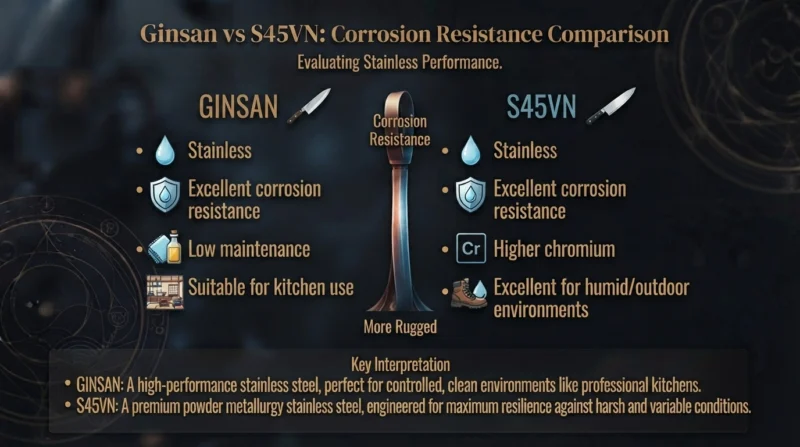
Corrosion resistance is one of the strongest categories for both steels.
Ginsan contains approximately 13–14.5% chromium.
S45VN contains approximately 16% chromium.
Both form a passive protective chromium oxide layer.
This dramatically reduces the risk of rust compared with non-stainless carbon steels.
However, stainless does not mean completely immune to corrosion.
Any stainless steel can eventually corrode under severe conditions.
Potential problems include:
- Saltwater exposure
- Long-term humidity
- Chloride contamination
- Acidic residues
- Poor cleaning
- Storage while wet
In normal kitchen use, however, both Ginsan and S45VN are highly corrosion resistant.
Which Is More Stainless: Ginsan or S45VN?
If we look simply at chromium content, S45VN has the advantage.
Ginsan is around 13–14.5% chromium.
S45VN is around 16%.
But practical corrosion resistance depends on the entire alloy system and microstructure.
The important conclusion is:
Both Ginsan and S45VN are excellent stainless knife steels.
The corrosion-resistance difference is much less dramatic than their difference in wear resistance and sharpening behavior.
Check Our Guide Stainless Steel Myths: The Complete Truth About Modern Knife Steels
Maintenance: Ginsan vs S45VN
Both steels are easy to maintain.
A typical maintenance routine is:
- Wash after use.
- Dry the blade.
- Avoid prolonged exposure to salt or acids.
- Store in a dry location.
- Sharpen or touch up the edge when necessary.
Neither steel requires the same corrosion precautions as a reactive carbon steel.
This makes both excellent choices for users who want performance without constant patina management.
S45VN may have a small practical advantage in extremely demanding environments.
But for ordinary kitchen use, the difference is unlikely to be significant.
Ginsan vs S45VN: Cutting Feel
Cutting feel is subjective but important.
Ginsan is often appreciated for its clean, controlled cutting behavior.
The relatively fine structure and moderate carbide volume can make the edge feel smooth and predictable.
S45VN can also provide excellent cutting performance.
However, the larger carbide population and higher wear resistance give it a somewhat different character.
The difference may be more noticeable during sharpening than during cutting.
A properly sharpened S45VN knife can feel excellent.
But Ginsan is particularly attractive to users who enjoy the traditional Japanese knife experience while wanting stainless steel.
Ginsan vs S45VN: Edge Finish
The desired edge finish depends on the application.
A polished edge can be excellent for:
- Precision slicing
- Fine vegetable preparation
- Fish
- Push cutting
A toothier edge can be useful for:
- Tomatoes
- Rope
- Fibrous materials
- General utility cutting
Ginsan responds well to a range of finishes.
S45VN also performs well with different edge finishes.
Because S45VN has high wear resistance, users may find that a slightly toothier finish provides excellent practical cutting performance.
Again, there is no universal best finish.
Ginsan vs S45VN and Sharpening Stones
Ginsan is generally compatible with traditional water stones.
This makes it attractive for users who enjoy Japanese-style sharpening.
S45VN can also be sharpened with quality stones, but the process may be slower.
A harder abrasive can make a significant difference.
Diamond abrasives are particularly effective against vanadium-rich carbides.
This does not mean every S45VN knife requires diamond stones.
It simply means that abrasive choice becomes more important as wear resistance increases.
Ginsan vs S45VN: Which Is Better for Beginners?
For beginners, both are relatively friendly because both are stainless.
However, Ginsan may have an advantage when the user is learning sharpening.
The steel is relatively easy to abrade.
It can provide useful feedback during sharpening.
S45VN may require more patience.
A beginner may initially think the knife is “hard to sharpen” when the real issue is simply that the steel is highly wear resistant.
With proper technique and suitable abrasives, S45VN is not difficult to sharpen.
It just requires more effort.
Ginsan vs S45VN for Experienced Sharpeners
Experienced sharpeners may appreciate both for different reasons.
Ginsan offers:
- Easy feedback
- Predictable burr formation
- Fine edge potential
- Efficient sharpening
- Excellent polishability
S45VN offers:
- Excellent wear resistance
- Long working edge life
- Strong edge stability
- Excellent stainless performance
If sharpening is part of the hobby, Ginsan can be particularly enjoyable.
If sharpening is something you want to do as rarely as possible, S45VN becomes more attractive.
Ginsan vs S45VN for EDC
S45VN has an advantage for everyday carry.
An EDC knife may encounter:
- Sweat
- Rain
- Humidity
- Food
- Cardboard
- Plastic
- Wood
- Outdoor conditions
S45VN is designed for this type of broad use.
Its combination of stainless performance and wear resistance is extremely practical.
Ginsan can certainly be used for EDC.
Its corrosion resistance is good enough for most everyday environments.
But its greatest strengths are particularly well matched to fine cutting rather than maximum abrasive wear resistance.
Ginsan vs S45VN for Outdoor Knives
For outdoor use, S45VN generally has the advantage.
Outdoor knives can experience unpredictable conditions.
The knife may become wet.
It may contact soil.
It may be exposed to sweat or salt.
It may be used for abrasive cutting.
S45VN’s corrosion resistance and wear resistance make it an excellent combination for these situations.
Ginsan remains a very capable stainless steel, but it is usually more attractive for users who prioritize cutting refinement.
Ginsan vs S45VN for Hunting Knives
For hunting applications, corrosion resistance can be very important.
Moisture and biological material can remain on a blade if it is not cleaned immediately.
S45VN is particularly well suited to this environment.
Its stainless properties reduce maintenance requirements.
Ginsan also performs well, especially for users who prioritize sharpening and fine cutting.
However, for a hard-use hunting knife, overall geometry and toughness should be considered carefully.
Steel selection is only one part of the design.
Check Our Guide Best Hunting Knife Features Explained
Ginsan vs S45VN for General Utility
General utility means the knife may cut many different materials.
Examples include:
- Cardboard
- Plastic
- Food
- Rope
- Packaging
- Fibrous materials
- Wood
This type of use favors wear resistance.
Therefore, S45VN generally has an advantage.
Ginsan can still perform very well, but S45VN’s vanadium-rich carbide system is better suited to abrasive cutting.
Edge Retention vs Sharpenability
One of the most important lessons from the Ginsan vs S45VN comparison is that edge retention and sharpenability are related trade-offs.
A steel that resists abrasive wear extremely well can require more effort to sharpen.
S45VN illustrates this very clearly.
It can maintain a working edge for a long time because of its hard carbide structure.
But when the blade finally becomes dull, removing enough material to restore the apex can take more time.
Ginsan gives up some wear resistance in exchange for easier sharpening.
For many kitchen users, this is an excellent trade.
A quick sharpening session may be preferable to maximizing the number of hours between sharpening sessions.
Ginsan vs S45VN: Wear Resistance
If wear resistance is the primary goal:
S45VN wins.
Its vanadium content is a major reason.
The steel contains approximately 3% vanadium, creating a significant population of hard carbides.
The powder metallurgy process also helps maintain a controlled microstructure.
Ginsan has respectable wear resistance, but it does not compete with S45VN in this particular category.
This is one of the clearest technical advantages in the Ginsan vs S45VN comparison.
Ginsan vs S45VN: Toughness and Carbides
More carbide does not automatically mean worse toughness.
Carbide size and distribution are critical.
S45VN’s powder metallurgy manufacturing process allows alloying elements to be distributed relatively uniformly.
This helps reduce the problems associated with excessively large carbide clusters.
Ginsan has less carbide-forming alloying content.
That can help maintain a relatively fine and forgiving edge.
For extremely thin kitchen edges, this can be valuable.
For general-purpose knives, S45VN provides a strong balance.
Why Powder Metallurgy Matters for S45VN
Powder metallurgy allows complex steel compositions to be manufactured with a more controlled microstructure.
This is especially useful when a steel contains significant amounts of:
- Vanadium
- Molybdenum
- Niobium
- Chromium
- Carbon
These elements can form hard carbides.
The manufacturing process helps control their distribution.
That contributes to S45VN’s combination of wear resistance and toughness.
This is one reason S45VN can provide excellent performance without becoming an extremely brittle steel.
Why Ginsan Is Popular for Kitchen Knives
Ginsan occupies an interesting position in the world of knife steel.
It provides stainless corrosion resistance while retaining many characteristics that appeal to users of traditional Japanese steels.
Its advantages include:
- Fine edge potential
- Good hardness
- Good edge retention
- Easy sharpening
- Stainless performance
- Good cutting feel
This combination makes Ginsan particularly attractive for users who want a Japanese-style kitchen knife but do not want the maintenance associated with reactive carbon steel.
Why S45VN Is Popular for General-Purpose Knives
S45VN takes a broader approach.
It is not optimized solely for kitchen cutting.
Instead, it aims to provide an excellent balance of:
- Corrosion resistance
- Edge retention
- Wear resistance
- Toughness
- Hardness
- Versatility
That makes it useful across a wide range of knife applications.
For someone who wants one stainless steel capable of handling many different tasks, S45VN is an excellent candidate.
Ginsan vs S45VN: Which Is Better for a Chef?
For a chef, the answer depends on priorities.
Choose Ginsan if you want:
- Fine cutting
- Easy sharpening
- Stainless convenience
- Excellent edge refinement
- A Japanese-style knife experience
Choose S45VN if you want:
- Long edge life
- Excellent wear resistance
- Stainless convenience
- Low maintenance
- Broad versatility
Neither is a bad choice.
In fact, both can be excellent professional kitchen steels.
Ginsan vs S45VN: Which Is Better for Home Cooks?
For most home cooks, Ginsan is particularly attractive.
Why?
Because home cooks often want:
- A sharp knife
- Stainless steel
- Easy maintenance
- Easy sharpening
- Good edge retention
Ginsan provides all of these characteristics.
S45VN is also excellent, especially if the user wants maximum time between sharpening sessions.
But the additional wear resistance may not be necessary for many home kitchens.
Ginsan vs S45VN: Which Is Better for Knife Makers?
From a knife-making perspective, the answer depends on the desired product.
Ginsan is attractive when the design emphasizes:
- Kitchen knives
- Fine edges
- Japanese-style geometry
- Easy sharpening
- Stainless convenience
S45VN is attractive when the design emphasizes:
- EDC
- Utility
- Outdoor knives
- High wear resistance
- Long edge life
- Broad versatility
The heat treatment must be appropriate for each steel.
A great steel with poor heat treatment will not produce a great knife.
Heat Treatment: Why It Matters
The heat treatment process can have a tremendous impact on knife performance.
Important variables include:
- Austenitizing temperature
- Soak time
- Quenching
- Tempering
- Number of tempering cycles
- Cryogenic treatment where appropriate
Hardness alone is not enough.
A knife maker may intentionally choose a slightly lower hardness to improve toughness.
Another may choose higher hardness to maximize edge retention.
This is why two knives made from the same steel can behave differently.
The Ginsan vs S45VN comparison should therefore always be understood as a comparison of general steel characteristics rather than an absolute prediction of every finished knife.
Check Our Guide Steel Heat Treatment Explained
Geometry Can Matter More Than Steel
This is perhaps the most important practical point.
Imagine two knives.
The first uses Ginsan but has:
- A thick edge
- Poor geometry
- Inconsistent sharpening
The second uses S45VN but has:
- Excellent geometry
- Thin edge
- Excellent heat treatment
- Precise sharpening
The S45VN knife may cut dramatically better.
Steel is only one component of knife performance.
The complete equation is closer to:
Steel + Heat Treatment + Geometry + Edge Angle + Sharpening + Cutting Technique
This is why the best Ginsan vs S45VN decision should never be made from the steel name alone.
Ginsan vs S45VN: Edge Angle
Edge angle has an enormous effect on cutting performance.
A very acute edge can:
- Cut more efficiently
- Produce less resistance
- Feel sharper
- Perform beautifully on food
But it can also become more vulnerable to:
- Chipping
- Rolling
- Deformation
A slightly thicker edge can sacrifice some cutting efficiency while increasing durability.
Ginsan is well suited to fine kitchen edges.
S45VN can also support thin edges, but its ideal geometry depends strongly on the application.
For EDC or outdoor use, a somewhat more robust edge is often appropriate.
Ginsan vs S45VN: Which Is More Forgiving?
S45VN is generally more forgiving in broad everyday use.
It has:
- Excellent corrosion resistance
- Good toughness
- High wear resistance
- Strong edge retention
Ginsan is also forgiving in terms of corrosion compared with carbon steel.
But its primary appeal is precision rather than maximum abuse tolerance.
If the knife will be used carefully, Ginsan is excellent.
If the knife may be exposed to unpredictable conditions, S45VN has an advantage.
Ginsan vs S45VN: Which Is Better for a Minimal-Maintenance User?
Both are low-maintenance steels.
But S45VN has the edge if the user wants maximum time between sharpening sessions.
Ginsan is easy to maintain because sharpening is relatively straightforward.
S45VN is easy to maintain because it stays sharp for longer and resists corrosion extremely well.
So there are actually two different meanings of “low maintenance.”
Low-effort sharpening:
Ginsan
Long intervals between sharpening:
S45VN
This distinction is extremely useful when deciding between the two.
Ginsan vs S45VN: Which Steel Has Better Corrosion Resistance?
S45VN generally has the advantage based on its higher chromium content and carefully engineered stainless composition.
However, Ginsan is also highly corrosion resistant.
For normal kitchen use, both are excellent.
If you frequently work around:
- Saltwater
- High humidity
- Acidic foods
- Outdoor conditions
S45VN becomes particularly attractive.
Ginsan vs S45VN: Which Steel Is Easier to Sharpen?
Ginsan is easier to sharpen.
The reason is primarily its lower wear resistance and lower carbide complexity.
S45VN’s hard vanadium carbides resist abrasion.
This is excellent for edge retention.
But it also means more work during sharpening.
For users who enjoy sharpening on conventional stones, Ginsan can be particularly satisfying.
Ginsan vs S45VN: Which Steel Holds an Edge Longer?
S45VN generally has the advantage.
Its higher carbon content and much greater vanadium content contribute to a highly wear-resistant carbide structure.
However, Ginsan still provides very good edge retention.
In a kitchen, the practical difference may be less dramatic than laboratory-style comparisons suggest because cutting conditions are different.
Edge geometry, cutting boards, food hardness, and technique all influence actual edge life.
Ginsan vs S45VN: Which Steel Is More Versatile?
S45VN generally wins on versatility.
It works well for:
- Kitchen knives
- EDC knives
- Outdoor knives
- Utility knives
- Hunting knives
- General-purpose blades
Ginsan is especially strong for:
- Kitchen knives
- Fine slicing
- Japanese-style blades
- Precision cutting
- Users who enjoy sharpening
This does not mean Ginsan cannot be used outside the kitchen.
It simply means S45VN has a broader performance profile.
Ginsan vs S45VN: Pros and Cons
Ginsan Advantages
- Excellent corrosion resistance
- Very good edge retention
- Easy sharpening
- Fine edge potential
- Good hardness
- Excellent kitchen performance
- Good cutting feel
- Low maintenance
- Excellent for Japanese-style kitchen knives
Ginsan Disadvantages
- Lower wear resistance than S45VN
- Shorter edge life in highly abrasive cutting
- Less optimized for heavy utility use
- Not as strong a choice when maximum wear resistance is the priority
S45VN Advantages
- Excellent corrosion resistance
- Excellent wear resistance
- Excellent edge retention
- Good toughness
- High chromium content
- High vanadium content
- Powder metallurgy structure
- Low maintenance
- Excellent EDC performance
- Excellent outdoor versatility
- Good kitchen performance
S45VN Disadvantages
- More difficult to sharpen
- Hard carbides require suitable abrasives
- Less traditional sharpening feel
- May offer more wear resistance than some kitchen users actually need
Ginsan vs S45VN: Practical Scorecard
The following scores are general comparisons rather than laboratory measurements.
| Category | Ginsan | S45VN |
| Edge retention | 8/10 | 9/10 |
| Wear resistance | 7.5/10 | 9.5/10 |
| Toughness | 8/10 | 8/10 |
| Corrosion resistance | 9/10 | 9.5/10 |
| Sharpenability | 9/10 | 7/10 |
| Fine edge potential | 9/10 | 8.5/10 |
| Edge stability | 8.5/10 | 9/10 |
| Kitchen performance | 9.5/10 | 9/10 |
| Outdoor performance | 7.5/10 | 9.5/10 |
| EDC versatility | 7.5/10 | 9.5/10 |
| Maintenance | 9/10 | 9.5/10 |
These ratings should not be interpreted as standardized test results.
They are simply a convenient way to visualize the general trade-offs.
Ginsan vs S45VN: Who Should Choose Ginsan?
Ginsan is an excellent choice if you are looking for:
- A stainless Japanese kitchen knife
- Easy sharpening
- A fine cutting edge
- Excellent slicing performance
- Good edge retention
- Low maintenance
- A steel with a relatively simple sharpening response
It is particularly appealing to users who want the feel of a high-performance Japanese kitchen knife without having to maintain reactive carbon steel.
Ginsan vs S45VN: Who Should Choose S45VN?
S45VN is an excellent choice if you want:
- Maximum practical wear resistance
- Long edge life
- Stainless performance
- Good toughness
- Low maintenance
- EDC versatility
- Outdoor versatility
- A highly balanced modern knife steel
It is especially attractive when the knife needs to perform more than one specialized job.
Ginsan vs S45VN for Knife Enthusiasts
Knife enthusiasts may appreciate both steels for different reasons.
Ginsan offers a refined, responsive experience.
S45VN offers modern metallurgy and excellent wear resistance.
Ginsan can be especially satisfying when sharpened frequently.
S45VN can be particularly satisfying when you realize how long the edge remains useful.
The choice often comes down to what you enjoy more:
Sharpening and cutting refinement or maximum edge longevity and versatility.
Ginsan vs S45VN: Which One Is Better Overall?
If we are forced to choose a general-purpose winner, S45VN has a slight advantage because of its broader performance envelope.
It combines:
- Excellent corrosion resistance
- Excellent wear resistance
- Excellent edge retention
- Good toughness
- Good edge stability
However, that does not make it a better kitchen steel for every user.
Ginsan has a very strong argument for kitchen knives because it offers:
- Stainless performance
- Excellent edge refinement
- Easy sharpening
- Good hardness
- Very good edge retention
For a chef or kitchen enthusiast, Ginsan may actually be the more enjoyable steel.
Ginsan vs S45VN: The Best Steel for Kitchen Knives
If your knife is primarily used in the kitchen, the answer becomes more balanced.
Choose Ginsan if:
You sharpen regularly and value a refined edge.
Choose S45VN if:
You want maximum wear resistance and long periods between sharpening.
Both are excellent stainless choices.
Neither requires the level of corrosion maintenance associated with reactive carbon steel.
Ginsan vs S45VN: The Best Steel for EDC
For EDC, S45VN is the stronger choice.
The combination of stainless corrosion resistance and wear resistance makes it particularly practical.
You can use it for a wide variety of tasks without worrying as much about corrosion or premature edge wear.
Ginsan can still make an excellent EDC blade.
But its strengths are better aligned with precision cutting.
Ginsan vs S45VN: The Best Steel for Outdoor Use
S45VN generally wins.
Outdoor use often involves unpredictable environments.
Rain, sweat, humidity, soil, and abrasive materials all favor a steel with strong corrosion and wear resistance.
S45VN was designed around precisely this kind of balanced performance.
Ginsan vs S45VN: The Best Steel for Sharpening Enthusiasts
Ginsan wins.
Its relatively modest carbide structure means it responds well to conventional sharpening stones.
It can be sharpened quickly.
It can take a refined edge.
And the sharpening process itself can be enjoyable.
For someone who views sharpening as part of the knife hobby rather than a chore, Ginsan is particularly attractive.
Ginsan vs S45VN: The Best Steel for Long Edge Life
S45VN wins.
Its combination of carbon, vanadium, chromium, molybdenum, niobium, nitrogen, and powder metallurgy provides excellent wear resistance.
The knife can maintain a useful working edge for a long time.
This is especially valuable for people who do not want to sharpen frequently.
Ginsan vs S45VN: The Best Steel for Low Maintenance
Both are excellent.
If low maintenance means:
“I don’t want to worry about rust.”
Both work well.
If low maintenance means:
“I don’t want to sharpen often.”
S45VN has the advantage.
If low maintenance means:
“When I sharpen, I want it to be quick and easy.”
Ginsan has the advantage.
The Importance of the User
The most important conclusion from Ginsan vs S45VN is that steel selection should be based on the user.
There is no perfect steel.
A professional chef may prefer Ginsan.
An outdoor enthusiast may prefer S45VN.
A sharpening enthusiast may prefer Ginsan.
An EDC user may prefer S45VN.
Someone who wants one knife for everything may prefer S45VN.
Someone who wants a refined stainless kitchen knife may prefer Ginsan.
The best steel is therefore not simply the one with the highest laboratory score.
It is the one whose strengths match your priorities.
Final Verdict: Ginsan vs S45VN
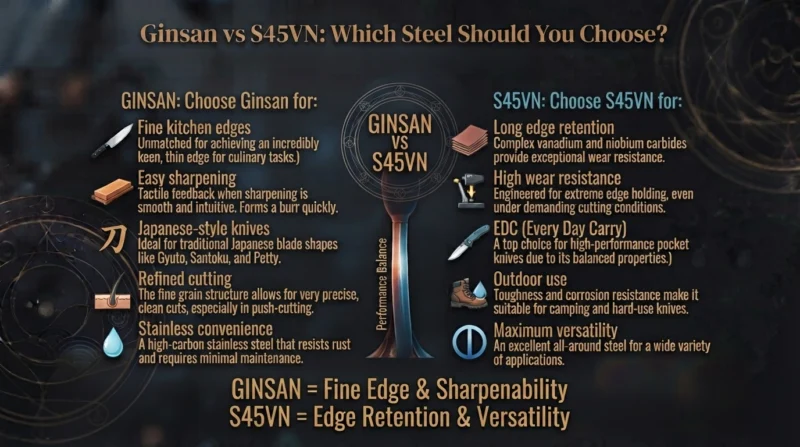
So, after examining the chemistry, hardness, edge retention, toughness, corrosion resistance, sharpening, wear resistance, and practical applications, what is the final answer?
Ginsan and S45VN are both excellent stainless knife steels, but they are optimized differently.
Ginsan emphasizes:
- Fine edge performance
- Easy sharpening
- Good hardness
- Good edge retention
- Excellent corrosion resistance
- Kitchen performance
- Refined cutting characteristics
S45VN emphasizes:
- Wear resistance
- Edge retention
- Corrosion resistance
- Toughness
- Edge stability
- Long service intervals
- General-purpose versatility
The Ginsan vs S45VN decision therefore depends on what matters most to you.
If you want a stainless steel that behaves somewhat like traditional high-performance Japanese knife steels and is pleasant to sharpen, Ginsan is an outstanding choice.
If you want a modern stainless steel with excellent wear resistance, long edge life, and broad versatility, S45VN is an outstanding choice.
Ginsan vs S45VN: Final Comparison Table
| Feature | Better Choice | Reason |
| Sharpening | Ginsan | Easier and more responsive |
| Fine edge | Ginsan | Excellent thin-edge potential |
| Kitchen cutting | Ginsan | Excellent balance for kitchen knives |
| Cutting feel | Ginsan | Refined and responsive |
| Edge retention | S45VN | Higher wear resistance |
| Wear resistance | S45VN | High vanadium carbide content |
| Corrosion resistance | S45VN | Higher chromium and modern stainless chemistry |
| Toughness | Slight S45VN advantage | Balanced powder metallurgy structure |
| EDC | S45VN | Excellent versatility |
| Outdoor use | S45VN | Corrosion and wear resistance |
| Long sharpening intervals | S45VN | Excellent edge retention |
| Sharpening enjoyment | Ginsan | Easier to abrade |
| Low maintenance | S45VN | Excellent corrosion and wear resistance |
| Japanese-style kitchen knife | Ginsan | Fine edge and sharpening characteristics |
| General-purpose knife | S45VN | Broader performance envelope |
Ginsan vs S45VN: The Short Answer
If you want the shortest possible explanation:
Ginsan is the stainless steel for people who value a fine edge and easy sharpening.
S45VN is the stainless steel for people who value wear resistance, long edge life, and versatility.
Neither is universally better.
For a precision kitchen knife, Ginsan can be the more attractive choice.
For an all-purpose knife, EDC blade, or outdoor knife, S45VN generally has the advantage.
The best Ginsan vs S45VN choice is ultimately determined by how you use, sharpen, and maintain your knife.
Frequently Asked Questions About Ginsan vs S45VN
Is Ginsan better than S45VN?
Not universally. Ginsan is generally easier to sharpen and excellent for fine kitchen edges, while S45VN offers greater wear resistance, excellent edge retention, and broader versatility.
Is S45VN better than Ginsan?
S45VN has advantages in wear resistance, edge retention, and general-purpose use. However, Ginsan can be preferable for kitchen knives and users who value easy sharpening.
Which has better edge retention, Ginsan or S45VN?
S45VN generally has better edge retention because of its higher carbon content and substantial vanadium carbide system. Actual edge life depends on hardness, geometry, heat treatment, and the material being cut.
Which is easier to sharpen, Ginsan or S45VN?
Ginsan is generally easier to sharpen. S45VN contains hard vanadium-rich carbides that provide excellent wear resistance but can make sharpening more demanding.
Is Ginsan stainless?
Yes. Ginsan is a stainless knife steel with approximately 13–14.5% chromium.
Is S45VN stainless?
Yes. S45VN contains approximately 16% chromium and is designed as a stainless knife steel.
Which has better corrosion resistance?
Both have excellent corrosion resistance. S45VN generally has an advantage because of its higher chromium content and modern stainless alloy design.
Which is better for kitchen knives?
Ginsan is particularly well suited to kitchen knives because it combines stainless performance, fine-edge capability, good hardness, and easy sharpening. S45VN is also excellent, especially for users who prioritize long edge life.
Which is better for EDC?
S45VN generally has the advantage because of its excellent wear resistance, corrosion resistance, and versatility.
Which is better for outdoor knives?
S45VN is generally the more practical option because outdoor use can involve moisture, humidity, sweat, and abrasive cutting.
Which is tougher?
Both can provide good toughness when properly heat treated. S45VN’s powder metallurgy structure gives it a good balance of toughness and wear resistance, while Ginsan’s relatively modest carbide structure can also support good edge toughness.
Which takes a sharper edge?
Both can become extremely sharp. Ginsan is particularly easy to sharpen and refine, while S45VN can also achieve an excellent edge with appropriate abrasives and technique.
Does Ginsan hold an edge well?
Yes. Ginsan provides very good edge retention for a stainless kitchen steel, although S45VN generally holds an edge longer under abrasive cutting conditions.
Is S45VN difficult to sharpen?
It is not difficult with the right technique, but it is more demanding than Ginsan because of its higher wear resistance and hard alloy carbides.
Is Ginsan good for Japanese kitchen knives?
Yes. Ginsan is particularly attractive for Japanese-style kitchen knives because it combines stainless corrosion resistance with excellent edge refinement and relatively easy sharpening.
Is S45VN good for kitchen knives?
Yes. S45VN can produce excellent kitchen knives, particularly when long edge life, corrosion resistance, and low maintenance are important.
Which steel is better for beginners?
Ginsan may be easier for beginners who are learning to sharpen. Both are relatively beginner-friendly from a corrosion-maintenance perspective because they are stainless.
Which steel is better for experienced knife enthusiasts?
Both are excellent. Ginsan is particularly appealing to sharpening enthusiasts, while S45VN is attractive to users who value advanced stainless wear resistance.
Does geometry matter more than the steel?
In many cases, yes. Blade thickness, edge angle, grind, heat treatment, and sharpening can have an enormous effect on real-world performance. A well-designed knife made from either steel can outperform a poorly designed knife made from the other.
Ginsan vs S45VN: Final Takeaway
The Ginsan vs S45VN comparison is ultimately a comparison between two different approaches to stainless knife performance.
Ginsan focuses on achieving a highly useful balance between stainless corrosion resistance, hardness, edge retention, sharpening response, and fine-edge performance.
S45VN pushes further toward wear resistance and long-term edge retention while maintaining excellent corrosion resistance and good toughness.
For a kitchen enthusiast who wants a stainless knife that is easy to sharpen and capable of a refined edge, Ginsan is an excellent choice.
For someone who wants a highly versatile stainless knife that can retain its edge for a long time and handle demanding environments, S45VN is an excellent choice.
Neither steel needs to be declared the absolute winner.
The better question is:
What do you want your knife to do?
If the answer is precision cutting, easy sharpening, and stainless convenience, choose Ginsan.
If the answer is long edge life, high wear resistance, corrosion resistance, and versatility, choose S45VN.
That is the real answer to Ginsan vs S45VN.
This article is for independent informational purposes only and is not affiliated with, sponsored by, or endorsed by any steel manufacturer. All product names, trademarks, and registered trademarks are the property of their respective owners.