Aogami Super vs S45VN
An Independent Guide
When comparing premium knife steels, Aogami Super vs S45VN is an especially interesting matchup because these two steels approach knife performance from very different directions.
Aogami Super is a high-carbon, non-stainless Japanese steel known for exceptional hardness, fine edge geometry, excellent cutting feel, and long edge retention. S45VN, on the other hand, is a modern stainless powder metallurgy steel designed to combine edge retention, toughness, wear resistance, and corrosion resistance in a much more maintenance-friendly package.
Both can produce excellent knives. Neither is universally better.
The important question is not simply which steel has more carbon, which steel is harder, or which one has the better reputation. The real question is:
Which steel provides the characteristics you need for the way you actually use a knife?
For a kitchen knife enthusiast who values an extremely keen edge and enjoys sharpening, Aogami Super can be exceptionally rewarding. For someone who wants long edge life combined with excellent corrosion resistance and minimal maintenance, S45VN has a major advantage.
This guide compares Aogami Super and S45VN in detail, including chemical composition, hardness, carbide structure, edge retention, toughness, corrosion resistance, sharpening, edge stability, maintenance, kitchen performance, outdoor use, and overall practicality.
Aogami Super vs S45VN: Quick Comparison
| Property | Aogami Super | S45VN |
|---|---|---|
| Steel type | High-carbon alloy steel | Powder metallurgy stainless steel |
| Carbon | Approximately 1.40–1.50% | Approximately 1.48% |
| Chromium | Approximately 0.30–0.50% | Approximately 16% |
| Tungsten | Approximately 2.00–2.50% | None significant |
| Vanadium | Approximately 0.30–0.50% | Approximately 3% |
| Molybdenum | Approximately 0.30–0.50% | Approximately 2% |
| Niobium | None significant | Approximately 0.50% |
| Nitrogen | Very low/none specified | Approximately 0.15% |
| Stainless | No | Yes |
| Typical knife hardness | Around 62–66 HRC, depending on heat treatment | Commonly around 60–62 HRC |
| Edge retention | Excellent | Excellent |
| Wear resistance | Excellent | Excellent |
| Toughness | Moderate; strongly dependent on hardness and geometry | Good for its hardness |
| Corrosion resistance | Low | Very high |
| Sharpening | Moderate | Moderate to difficult |
| Patina | Yes | Normally no significant patina |
| Maintenance | High | Low |
| Thin edge potential | Excellent | Very good |
| Cutting feel | Very refined and crisp | Stable and controlled |
| Best environment | Controlled kitchen use | Kitchen, EDC, outdoor and general use |
| Best for | Maximum cutting refinement | Balanced performance and low maintenance |
The biggest difference is immediately obvious.
Aogami Super prioritizes cutting performance, hardness, and edge refinement. S45VN prioritizes balance, corrosion resistance, and practical durability.
That distinction explains most of the differences between them.
What Is Aogami Super?
Aogami Super is a high-carbon Japanese alloy steel developed for cutting tools and knives. It belongs to the Aogami family of steels and is distinguished by its relatively high carbon content combined with tungsten, chromium, vanadium, and other small alloying additions.
Typical published composition is approximately:
- Carbon: 1.40–1.50%
- Chromium: 0.30–0.50%
- Tungsten: 2.00–2.50%
- Vanadium: 0.30–0.50%
- Molybdenum: approximately 0.30–0.50%
- Manganese: approximately 0.20–0.30%
- Silicon: approximately 0.10–0.20%
The exact composition can vary according to specification and source, so these numbers should be treated as representative ranges rather than the chemistry of every individual piece of steel.
The name Aogami is often translated as “Blue Paper Steel.” The name refers to the traditional identification paper used for the steel rather than the actual color of the material.
Aogami Super is not stainless.
Its chromium content is far too low to provide the corrosion resistance associated with stainless steels. Instead, the alloy is designed around high carbon content, hard carbide formation, fine microstructure, and high achievable hardness.
This produces a steel that can support an exceptionally fine cutting edge.
For kitchen knives, that characteristic is particularly important.
A very thin blade made from properly heat-treated Aogami Super can feel extremely precise when cutting vegetables, meat, fish, herbs, and other foods.
The steel can also produce a very refined edge that responds exceptionally well to conventional sharpening stones.
However, the same characteristics that make Aogami Super exciting also create limitations.
High hardness means less tolerance for abuse.
Low chromium means rust is a genuine concern.
Thin edges require appropriate cutting technique.
And the performance of the finished knife depends heavily on heat treatment and geometry.
Check Our Guide Aogami Super Steel
What Is S45VN?
S45VN is a modern martensitic stainless knife steel produced using powder metallurgy.
Its typical composition is approximately:
- Carbon: 1.48%
- Chromium: 16.00%
- Vanadium: 3.00%
- Molybdenum: 2.00%
- Niobium: 0.50%
- Nitrogen: 0.15%
This chemistry is fundamentally different from Aogami Super.
The carbon content is actually remarkably similar.
Aogami Super contains around 1.40–1.50% carbon, while S45VN contains approximately 1.48%.
Therefore, simply saying that S45VN has less carbon would be incorrect.
The important difference is where the rest of the alloying system goes.
S45VN contains approximately 16% chromium.
That enormous difference is responsible for its stainless character.
It also contains significantly more vanadium, plus molybdenum, niobium, and nitrogen.
These elements influence carbide formation, hardenability, wear resistance, corrosion resistance, and overall performance.
The powder metallurgy production process is also important.
Instead of allowing alloying elements and carbides to become distributed in the same way as conventional ingot steel, powder metallurgy creates a very homogeneous starting material with a fine and controlled distribution of alloying constituents.
That allows S45VN to combine relatively high wear resistance with useful toughness and stainless performance.
A common hardness range for finished knives is approximately 60–62 HRC, although the actual hardness depends on heat treatment and the design goals of the particular blade.
Check Our Guide S45VN Steel Review
Chemical Composition: Aogami Super vs S45VN
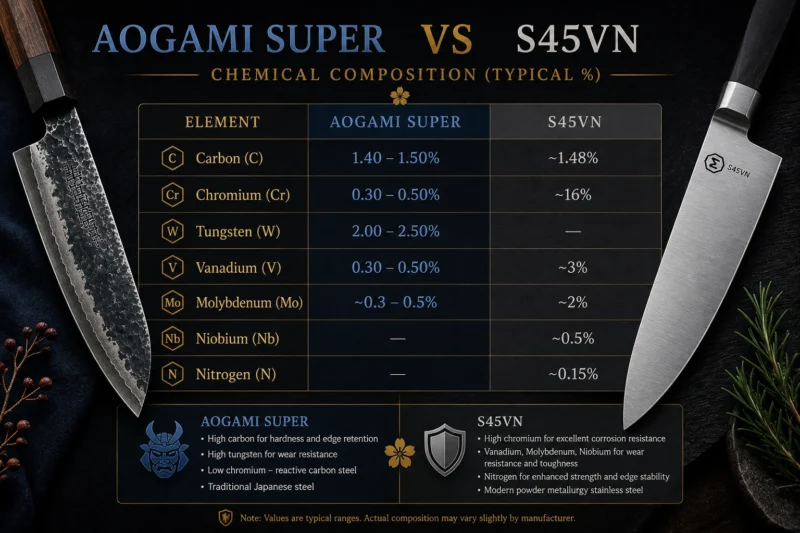
Chemical composition provides the foundation for understanding this comparison.
| Element | Aogami Super | S45VN |
| Carbon | 1.40–1.50% | ~1.48% |
| Chromium | 0.30–0.50% | ~16.0% |
| Tungsten | 2.00–2.50% | — |
| Vanadium | 0.30–0.50% | ~3.0% |
| Molybdenum | ~0.30–0.50% | ~2.0% |
| Niobium | — | ~0.50% |
| Nitrogen | Very low/none specified | ~0.15% |
At first glance, both steels appear to have very high carbon content.
But carbon alone does not determine knife performance.
The interaction between carbon and alloying elements determines which carbides form, how much carbide exists, how those carbides are distributed, and how the steel behaves after heat treatment.
This is where Aogami Super and S45VN take very different paths.
Carbon: Almost a Tie
Carbon is one of the most important elements in knife steel.
It contributes to:
- Hardness
- Martensite formation
- Carbide formation
- Edge retention
- Wear resistance
- Strength
Aogami Super has approximately 1.40–1.50% carbon.
S45VN has approximately 1.48%.
So in terms of carbon content, they are surprisingly close.
This demonstrates why comparing steels by carbon percentage alone can be misleading.
Two steels with almost identical carbon levels can have dramatically different characteristics because their chromium, vanadium, tungsten, molybdenum, niobium, nitrogen, and manufacturing processes are different.
In this comparison, carbon gives both steels the potential for excellent hardness and edge retention.
But the rest of the chemistry determines how that potential is expressed.
Chromium: The Biggest Difference
The most obvious chemical difference is chromium.
Aogami Super contains only around 0.30–0.50% chromium.
S45VN contains approximately 16%.
That is an enormous difference.
Chromium at this level allows S45VN to develop the corrosion resistance expected from stainless steel.
Aogami Super does not.
This single difference changes how the two steels should be used and maintained.
Aogami Super can develop a patina relatively quickly when exposed to moisture and acidic foods.
S45VN is dramatically more resistant to staining and corrosion.
This makes S45VN much easier to use in environments where the knife may encounter:
- Water
- Humidity
- Salt
- Acidic foods
- Sweat
- Outdoor conditions
- Long periods between cleaning
Aogami Super can certainly be used in a kitchen without problems.
But it requires more attention.
Tungsten in Aogami Super
Tungsten is one of the defining alloying elements in Aogami Super.
The steel contains approximately 2.00–2.50% tungsten.
Tungsten is a strong carbide-forming element.
The resulting tungsten-containing carbides contribute to wear resistance and edge retention.
This is one of the reasons Aogami Super can maintain a fine edge for a long time despite being a traditional non-powder steel.
The tungsten addition also helps differentiate Aogami Super from simpler high-carbon steels.
It is not simply a high-carbon steel.
It is an alloyed high-carbon tool steel designed to combine high hardness with improved wear resistance.
Vanadium: A Major Advantage for S45VN
S45VN contains approximately 3% vanadium.
That is considerably more than Aogami Super’s approximately 0.30–0.50%.
Vanadium is an extremely strong carbide-forming element.
Vanadium carbides are very hard and contribute substantially to wear resistance.
This helps explain why S45VN can maintain an edge for a long time even though its typical hardness is lower than that of many Aogami Super knives.
However, more vanadium does not automatically mean a sharper knife.
This is a common misunderstanding.
Large amounts of hard carbide can increase wear resistance, but they can also make sharpening more demanding and influence how the edge behaves at very small dimensions.
The distribution and size of those carbides matter enormously.
This is one reason powder metallurgy is important for S45VN.
Molybdenum, Niobium and Nitrogen
S45VN also uses a combination of molybdenum, niobium, and nitrogen.
These additions are part of the steel’s carefully balanced alloy design.
Molybdenum contributes to hardenability and corrosion resistance and participates in carbide formation.
Niobium is a strong carbide-forming element and helps control the carbide structure.
Nitrogen contributes to hardness and corrosion resistance while also influencing the behavior of chromium in the steel matrix.
The result is a highly engineered stainless alloy designed to balance several properties rather than maximize just one.
This is one of the fundamental differences between the two steels.
Aogami Super represents a traditional high-performance carbon-steel philosophy.
S45VN represents a modern balanced stainless-steel philosophy.
Aogami Super vs S45VN: Hardness
Hardness is one of the most frequently discussed knife-steel properties.
Aogami Super can commonly be heat treated into the low-to-mid 60s HRC, with some knives reaching approximately 64–66 HRC depending on the heat treatment and design.
S45VN is commonly used around 60–62 HRC.
So, on average:
Aogami Super is harder.
But higher hardness is not automatically better.
Hardness affects:
- Edge retention
- Resistance to deformation
- Edge stability
- Sharpening difficulty
- Brittleness
- Impact resistance
A harder blade can maintain a thin apex more effectively.
But if pushed too far, hardness can reduce the margin for abuse.
This distinction is particularly important for kitchen knives.
A thin Aogami Super edge at approximately 64–65 HRC can be extraordinarily effective for precision cutting.
But that same edge should not be treated like a pry bar.
S45VN at approximately 60–62 HRC generally offers a wider margin for everyday abuse.
Check Our Guide What Is HRC? Understanding Rockwell Hardness
Edge Retention: Aogami Super vs S45VN
Edge retention is one of the hardest properties to compare because it depends on much more than steel chemistry.
Important variables include:
- Hardness
- Edge angle
- Edge thickness
- Carbide volume
- Carbide type
- Microstructure
- Heat treatment
- Cutting material
- Cutting board
- Cutting technique
Therefore, it is impossible to say that one steel will always hold an edge exactly twice as long as another.
Still, useful general conclusions can be made.
Aogami Super has excellent edge retention for a traditional ingot steel.
Its high carbon content, tungsten, vanadium, and high achievable hardness give it a strong combination of edge stability and wear resistance.
S45VN also has excellent edge retention.
Its powder metallurgy structure and significant vanadium content provide strong wear resistance, while its stainless matrix makes it particularly practical.
In a controlled kitchen environment, a properly heat-treated Aogami Super blade can maintain a very keen edge for an impressive amount of cutting.
S45VN may provide comparable or superior total edge life depending on hardness, geometry, and cutting conditions.
So the winner is not universal.
For maximum fine-edge performance:
Aogami Super has an advantage.
For long edge life combined with stainless convenience:
S45VN has an advantage.
Check Our Guide Edge Retention Explained: 10 Factors What Makes a Knife Stay Sharp Longer
Why Hardness Changes the Edge-Retention Equation
Imagine two blades.
Blade A is 65 HRC.
Blade B is 61 HRC.
Both have the same edge angle.
The harder blade is less likely to deform plastically at the apex.
That means the edge can remain very thin and sharp for longer before rolling.
But now imagine that Blade A has a very brittle microstructure.
If the blade encounters lateral force or a hard inclusion, part of the edge may chip.
Blade B may instead deform slightly.
The edge may become less acute, but the damage may be easier to recover.
This is why edge retention should not be confused with durability.
A knife that retains a razor edge for a long time is not necessarily the knife that survives abuse best.
Toughness: Which Is Better?
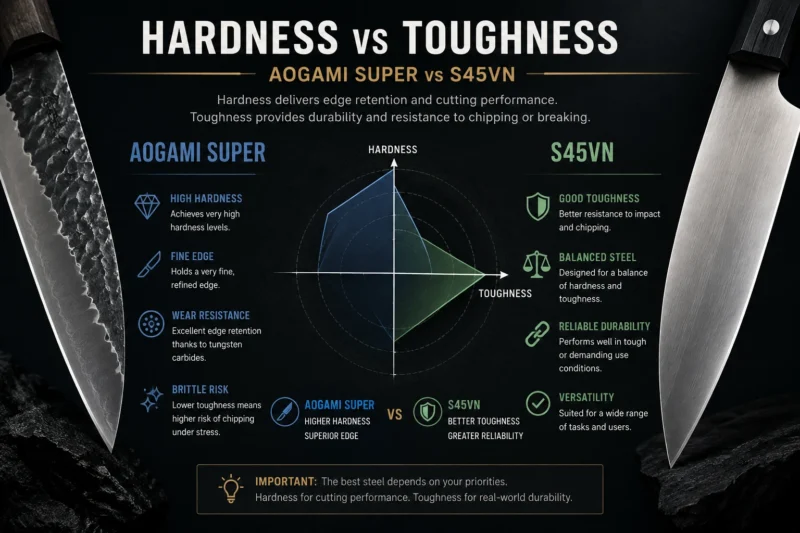
Toughness measures resistance to cracking and breaking under impact or stress.
It is different from hardness.
A steel can be:
- Very hard but relatively brittle
- Relatively soft but very tough
- Or carefully balanced between the two
S45VN generally offers a useful toughness level for a stainless knife with its wear resistance and hardness.
Aogami Super can also have good practical toughness when properly heat treated, but very hard examples should be treated more carefully.
The biggest variable is not simply the name of the steel.
It is the combination of:
heat treatment + hardness + geometry + edge thickness.
Aogami Super at moderate hardness with a robust geometry can behave very differently from an extremely hard, ultra-thin example.
Likewise, S45VN can behave differently depending on how it is heat treated.
General conclusion:
S45VN has the practical advantage in toughness and abuse tolerance.
Aogami Super is better suited to controlled cutting rather than rough treatment.
Edge Stability
Edge stability is especially important for very thin kitchen knives.
It describes how well the edge maintains its geometry under stress.
A highly stable edge does not easily:
- Roll
- Micro-chip
- Collapse
- Deform
Aogami Super has excellent potential for edge stability because it can be hardened to high levels while maintaining a fine microstructure.
This allows very thin edges.
S45VN can also support excellent edge stability.
Its powder metallurgy structure and balanced carbide distribution allow it to be used at relatively thin geometries.
However, extremely thin edges change the equation.
At very acute angles, the geometry may become more important than the difference between the steel grades.
A well-designed 61 HRC S45VN blade can outperform a poorly designed 65 HRC Aogami Super blade.
That is why steel comparisons should never ignore geometry.
Sharpening: Aogami Super vs S45VN
This is where the two steels feel very different.
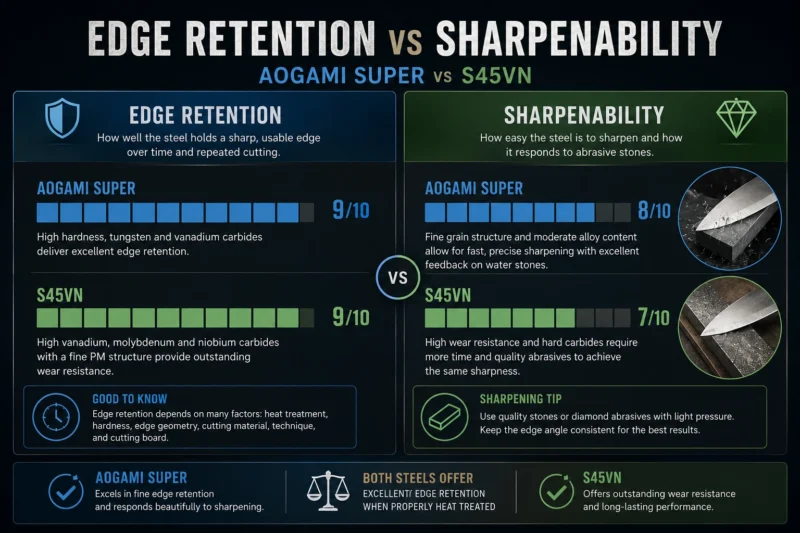
Aogami Super is hard, but its relatively modest alloy content means that many users find it surprisingly pleasant to sharpen.
It responds well to conventional water stones and can develop a very refined apex.
The sharpening sensation is one of the reasons carbon-steel enthusiasts appreciate it.
S45VN is also sharpenable, but the combination of high hardness, high wear resistance, and hard alloy carbides can require more effort.
The steel benefits from appropriate abrasive selection.
Diamond and other hard abrasives can be particularly useful when dealing with highly wear-resistant stainless steels.
For someone who sharpens frequently, Aogami Super may be more enjoyable.
For someone who wants to sharpen as rarely as possible, S45VN may be more attractive.
Check Our Guide All Kinds of Knife Sharpening Tools
Which Is Easier to Get Razor Sharp?
This depends on what “razor sharp” means.
If the goal is a highly refined polished apex with excellent feedback on a water stone, Aogami Super has a strong advantage.
Its fine microstructure can produce an extremely refined edge.
S45VN can also become extremely sharp.
However, its larger quantity of hard carbide-forming alloying elements means that sharpening can feel less responsive on conventional abrasives.
This does not mean S45VN cannot take an excellent edge.
It absolutely can.
It simply behaves differently.
Aogami Super:
Excellent for enthusiasts who enjoy the sharpening process.
S45VN:
Excellent for users who prioritize wear resistance and low maintenance.
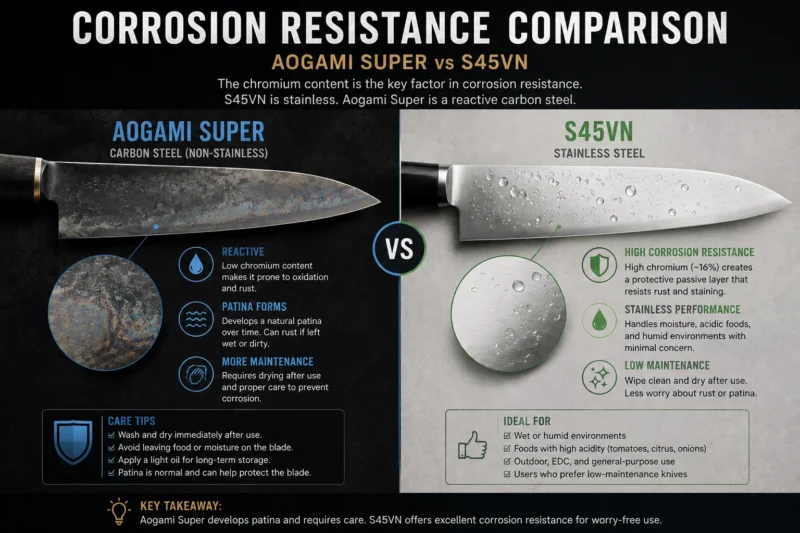
Corrosion Resistance: S45VN Wins Easily
This is the clearest category in the comparison.
There is essentially no contest.
S45VN is stainless.
Aogami Super is not.
The approximately 16% chromium content in S45VN provides a passive oxide layer that significantly protects the steel from corrosion.
Aogami Super has only a fraction of that chromium.
Therefore, it can:
- Develop patina
- Show discoloration
- Rust if left wet
- React with acidic foods
- Require drying after use
This is not necessarily a disadvantage for everyone.
Many knife enthusiasts actually enjoy the patina that develops on carbon steel.
A patina can become part of the character of the knife.
But it is still maintenance.
S45VN is much easier.
You can use it around:
- Tomatoes
- Citrus
- Onions
- Vinegar
- Wet vegetables
- Seafood
- Humid environments
without worrying nearly as much about immediate corrosion.
Aogami Super Patina
Patina is a natural oxidation layer that forms on reactive carbon steel.
It can range from:
- Gray
- Blue-gray
- Purple
- Brown
- Dark gray
- Nearly black
The exact appearance depends on the food, moisture, environment, and use.
Many users consider patina desirable because it gives the blade a unique appearance.
But patina should not be confused with active rust.
A stable patina is generally much less concerning than orange or red rust.
If an Aogami Super knife is kept clean and dry, corrosion can be controlled very effectively.
The steel does not require extraordinary care.
It simply requires more care than stainless steel.
Kitchen Use: Aogami Super vs S45VN
For kitchen knives, the comparison becomes particularly interesting.
Aogami Super is extremely well suited to:
- Gyuto-style knives
- Santoku-style knives
- Nakiri-style knives
- Bunka-style knives
- Kiritsuke-style knives
- Slicing knives
- Vegetable knives
- Fine fish preparation knives
Its greatest strength is the combination of high hardness and excellent edge refinement.
The steel can support thin geometries that produce very low cutting resistance.
S45VN is also suitable for kitchen knives, particularly when low maintenance is important.
It is a particularly practical choice for users who want:
- Stainless performance
- Long edge retention
- Good durability
- Minimal maintenance
- Resistance to acidic foods
- Resistance to humidity
For a busy professional kitchen, S45VN can be extremely practical.
For an enthusiast who enjoys traditional carbon steel, Aogami Super can be more rewarding.
Check Our Guide Best Kitchen Knives for Groomsmen Gifts: Unique Wedding Gifts They’ll Actually Use
Cutting Feel
Cutting feel is difficult to quantify but easy to notice.
Aogami Super is known for producing a very crisp, controlled cutting sensation when properly heat treated and ground.
The combination of high hardness, fine edge geometry, and fine carbide structure can make the blade feel extremely precise.
This is particularly noticeable when slicing:
- Carrots
- Potatoes
- Cabbage
- Onions
- Fish
- Meat
- Herbs
S45VN can also feel excellent, especially with a well-designed grind.
However, its character is different.
It often feels more mechanically robust and less delicate.
For some users, this is preferable.
The ideal knife is not necessarily the knife with the most refined cutting sensation.
Sometimes the ideal knife is the one that requires the least attention.
Food Preparation and Edge Angles
Aogami Super can be used at relatively acute edge angles when the geometry and heat treatment are appropriate.
That is one of its biggest attractions.
A very thin edge can dramatically reduce cutting resistance.
But acute edges are not automatically better.
If the knife is used aggressively or encounters bones, frozen food, hard cutting boards, or twisting forces, an extremely acute edge can become vulnerable.
S45VN offers more flexibility for general-purpose use.
It can still support a fine edge, but users may choose a slightly more robust geometry for maximum durability.
The correct edge angle depends on:
- Blade thickness
- Grind
- Hardness
- Intended use
- Cutting technique
- Sharpening skill
There is no universal perfect angle.
Aogami Super for Fish and Slicing
Aogami Super is particularly interesting for precision slicing.
The high hardness allows the edge to remain very fine.
This can be valuable for:
- Fish
- Sashimi-style preparation
- Boneless meat
- Vegetables
- Fine garnishes
However, it is important to distinguish slicing from cutting through bones.
A high-hardness Aogami Super edge should not be used as a substitute for a heavy-duty cleaver.
Bones and hard objects can produce chipping.
For delicate slicing, the steel can be outstanding.
For impact cutting, another design may be preferable.
S45VN for Outdoor Use
S45VN has a major advantage outside the kitchen.
Outdoor environments often expose knives to:
- Rain
- Humidity
- Sweat
- Soil
- Salt
- Plant material
- Blood
- Wet storage conditions
Aogami Super can handle outdoor use, but it requires considerably more maintenance.
S45VN is much more forgiving.
This makes it attractive for:
- EDC knives
- Outdoor knives
- Hunting knives
- General utility knives
- Camping knives
- Field-use blades
Its stainless properties reduce maintenance requirements dramatically.
For someone who carries a knife every day and does not want to think about corrosion, S45VN is usually the more practical choice.
Aogami Super vs S45VN for EDC
For everyday carry, S45VN generally makes more sense.
The reason is not that it necessarily cuts better.
The reason is that EDC knives encounter unpredictable environments.
You may carry the knife:
- In your pocket
- Outside
- In humid weather
- Near the ocean
- During exercise
- While working
- Around food
- In rain
Aogami Super will demand more attention.
S45VN can simply be used, wiped clean, and stored.
For EDC, convenience is an important performance characteristic.
Wear Resistance
Wear resistance describes how well the steel resists material being removed during cutting and abrasion.
Both steels perform well.
Aogami Super obtains much of its wear resistance from:
- High carbon
- Tungsten
- Vanadium
- High hardness
S45VN uses:
- High carbon
- High chromium
- High vanadium
- Molybdenum
- Niobium
- Nitrogen
- Powder metallurgy
S45VN has a substantial carbide-forming alloy system.
Therefore, it can deliver excellent wear resistance despite being used at somewhat lower hardness than many Aogami Super knives.
This is one area where S45VN can be surprisingly competitive.
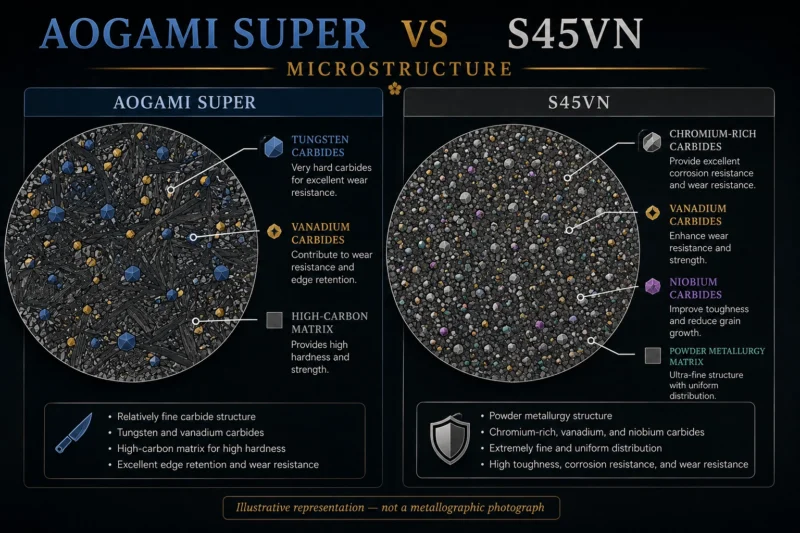
Carbide Structure
Carbides are extremely important to understanding knife steel.
A carbide is a hard compound formed between carbon and certain alloying elements.
Common carbide-forming elements include:
- Chromium
- Vanadium
- Tungsten
- Molybdenum
- Niobium
Carbides can improve wear resistance.
But carbide size and distribution matter.
Very large or poorly distributed carbides can interfere with edge refinement and toughness.
Fine, well-distributed carbides are generally more desirable for thin cutting edges.
Aogami Super is interesting because its alloy content is relatively moderate compared with modern powder steels.
Its tungsten and vanadium additions provide useful wear resistance without creating the extremely high carbide volume found in some highly wear-resistant steels.
S45VN has a more heavily alloyed carbide system.
The powder metallurgy process helps keep the microstructure controlled.
This makes it possible to combine substantial wear resistance with reasonable toughness and edge stability.
Microstructure and Manufacturing Process
One of the most important differences is how the steels are produced.
Aogami Super is a conventional alloy steel.
Its microstructure depends heavily on:
- Forging
- Heat treatment
- Austenitizing
- Quenching
- Tempering
- Grain control
S45VN is produced using powder metallurgy.
Powder metallurgy can provide a highly homogeneous distribution of alloying elements.
This is particularly useful when working with high concentrations of carbide-forming elements.
The resulting microstructure can contain a fine and controlled carbide distribution.
That does not automatically make powder metallurgy steel better.
It simply gives metallurgists more control over complex alloy compositions.
A traditional steel such as Aogami Super can still produce outstanding performance because its chemistry is carefully designed around a fine microstructure and high hardness.
Toughness vs Wear Resistance
This is one of the most important trade-offs in knife steel.
Generally speaking:
More wear resistance does not automatically mean more toughness.
And:
More hardness does not automatically mean a better knife.
Aogami Super is designed toward high hardness and refined cutting performance.
S45VN is designed toward balance.
That means the choice depends on your priorities.
If you want the thinnest possible edge and maximum cutting refinement, Aogami Super is compelling.
If you want a blade that can tolerate a wider range of conditions while resisting corrosion, S45VN is more practical.
Check Our Guide Wear Resistance vs Toughness: Understanding the Most Important Knife Steel Trade-Off
Maintenance: Aogami Super vs S45VN
This category is easy to understand.
Aogami Super maintenance
After use:
- Rinse if necessary.
- Wash with mild soap.
- Dry immediately.
- Avoid leaving the blade wet.
- Keep acidic foods from sitting on the edge.
- Use a light protective oil for long-term storage.
S45VN maintenance
Normally:
- Wash.
- Dry.
- Store normally.
S45VN does not require the same level of corrosion management.
That does not mean stainless steel is completely rustproof.
Stainless steels can still corrode under extreme conditions.
Saltwater, high humidity, contamination, and prolonged exposure can eventually cause corrosion.
But the practical difference between S45VN and Aogami Super is enormous.
Which Steel Is Easier to Maintain?
S45VN wins by a wide margin.
For someone who wants a knife that can be used repeatedly without worrying about patina or immediate drying, S45VN is the obvious choice.
Aogami Super is better suited to someone who appreciates the maintenance ritual.
This distinction is especially important when choosing a knife as a gift.
A knife enthusiast may love Aogami Super.
A casual user may prefer stainless steel.
Aogami Super vs S45VN: Sharpening Frequency
Neither steel needs constant sharpening.
However, the sharpening experience differs.
Aogami Super can maintain a highly refined edge for a long time, especially when used correctly.
Eventually the edge will need sharpening.
When that happens, many users appreciate how the steel responds to water stones.
S45VN may also go a long time between sharpening sessions.
Its wear resistance can make sharpening more time-consuming, particularly if the edge has become significantly dull.
For this reason, users of highly wear-resistant stainless steels may benefit from regular light maintenance rather than waiting until the blade is completely dull.
Honing and Stropping
Honing should be understood differently for very hard knife steels.
Traditional honing is most useful when an edge has rolled slightly.
A very hard Aogami Super edge may be less prone to rolling than a softer steel.
If the edge is actually damaged or chipped, honing will not repair the problem.
Stropping can help refine the apex.
However, excessive stropping can round an extremely fine edge.
For S45VN, the same principle applies.
Abrasive stropping can be useful, but technique matters.
For both steels, the best maintenance strategy is usually:
Use the knife correctly → touch up before it becomes completely dull → perform full sharpening only when necessary.
Which Steel Has Better Edge Retention in the Kitchen?
There is no universal winner.
If both knives are properly heat treated and designed for kitchen use:
Aogami Super
Advantages:
- Very high hardness
- Excellent edge stability
- Excellent fine-edge retention
- Very refined cutting feel
- Excellent sharpening response
S45VN
Advantages:
- Excellent wear resistance
- High edge retention
- Stainless properties
- Good toughness
- Less maintenance
For a chef who values edge refinement and sharpening feel:
Aogami Super is arguably the more interesting choice.
For a chef who values long service intervals and easy maintenance:
S45VN is arguably the better practical choice.
Which Steel Has Better Corrosion Resistance?
There is no debate here.
S45VN wins decisively.
The approximately 16% chromium content gives S45VN a corrosion-resistance level that Aogami Super cannot approach.
Aogami Super should be considered a reactive steel.
S45VN should be considered stainless.
If corrosion resistance is your number-one priority, choose S45VN.
Which Steel Is Tougher?
In practical knife use:
S45VN generally has the advantage.
Aogami Super can be tough enough for normal kitchen work, but extremely hard versions can be more susceptible to edge chipping.
The important qualification is that toughness depends heavily on heat treatment and geometry.
A well-designed Aogami Super knife can be quite durable.
But if two knives are optimized differently, the steel name alone cannot predict their behavior.
Which Steel Gets Sharper?
Both can become extremely sharp.
But they have different strengths.
Aogami Super has a strong reputation for taking a very refined edge.
Its combination of high hardness and fine carbide structure makes it particularly attractive to sharpening enthusiasts.
S45VN can also produce an extremely sharp edge.
However, it tends to be chosen more for the combination of properties rather than maximum traditional carbon-steel sharpening character.
Winner for sharpening feel:
Aogami Super
Winner for low-maintenance performance:
S45VN
Which Steel Is Better for Thin Kitchen Knives?
This is one of Aogami Super’s strongest categories.
Aogami Super can be heat treated to high hardness while maintaining a fine structure.
That allows very thin edges.
A thin edge reduces the amount of material the blade must separate during cutting.
The result can be an extremely low cutting resistance.
However, thinness must always be matched with appropriate technique.
A thin Aogami Super blade should not be:
- Twisted in hard food
- Used on bones
- Used to pry
- Used on frozen food
- Used against hard surfaces
- Dropped onto the edge
For precision kitchen work, however, the combination can be exceptional.
Which Steel Is Better for Heavy-Duty Knives?
S45VN is generally the more practical choice.
But neither steel should automatically be considered a heavy-duty impact steel simply because it is strong.
Heavy-duty knife design requires:
- Appropriate thickness
- Robust geometry
- Suitable hardness
- Adequate toughness
- Proper heat treatment
For demanding outdoor or utility applications, S45VN offers a particularly attractive balance.
Aogami Super is better suited to controlled cutting.
Aogami Super vs S45VN for Professional Chefs
Professional chefs often care about several things simultaneously:
- Edge retention
- Cutting performance
- Sharpening
- Maintenance
- Reliability
- Comfort
Aogami Super can be an excellent professional kitchen steel.
Its high hardness allows long periods of cutting between sharpening sessions.
Its edge can be extremely refined.
But it requires discipline.
A professional using Aogami Super should be comfortable with:
- Immediate drying
- Patina
- Proper cutting boards
- Avoiding bones
- Regular sharpening
- Appropriate knife storage
S45VN is more forgiving.
A chef can use it in a busy environment without worrying as much about corrosion.
For professional kitchens where many people handle the knives, stainless steel often makes logistical sense.
Aogami Super vs S45VN for Home Cooks
For home cooks, the decision depends heavily on personality.
If you enjoy knives, sharpening, and traditional Japanese steel:
Aogami Super can be extremely satisfying.
If you simply want a knife that works every day with minimal maintenance:
S45VN is probably the better choice.
This is one of those situations where the “better steel” depends on the user rather than the specification sheet.
Aogami Super vs S45VN for Beginners
For beginners, S45VN is usually easier to recommend.
Not because it is easier to sharpen.
It is not necessarily easier to sharpen.
The advantage is maintenance.
A beginner can make mistakes with stainless steel without immediately creating a corrosion problem.
Aogami Super requires learning proper care.
A beginner can absolutely use it, but should understand that:
reactive steel needs attention.
Aogami Super vs S45VN for Experienced Knife Enthusiasts
Experienced users may appreciate both steels for completely different reasons.
Aogami Super offers:
- Traditional carbon-steel character
- High hardness
- Excellent edge refinement
- Excellent cutting feel
- Strong sharpening response
- Patina development
S45VN offers:
- Stainless convenience
- Excellent wear resistance
- Good toughness
- High edge retention
- Low maintenance
- Broad versatility
For many experienced users, owning both makes perfect sense.
Aogami Super can become the knife used when maximum cutting performance is desired.
S45VN can become the knife used when convenience matters.
Is Aogami Super Better Than S45VN?
The answer depends on the definition of “better.”
If better means:
More corrosion resistant: S45VN
Easier to maintain: S45VN
More versatile for outdoor use: S45VN
More forgiving: S45VN
Higher typical hardness: Aogami Super
More traditional sharpening experience: Aogami Super
Excellent thin-edge performance: Aogami Super
Patina and carbon-steel character: Aogami Super
Balanced all-around performance: S45VN
Maximum traditional Japanese cutting character: Aogami Super
So the answer is not simply one steel beating the other.
They are optimized differently.
Aogami Super vs S45VN: Detailed Scorecard
The following scores should be treated as general tendencies rather than laboratory measurements.
| Category | Aogami Super | S45VN |
| Edge retention | 9/10 | 9/10 |
| Wear resistance | 8.5/10 | 9/10 |
| Toughness | 6.5/10 | 8/10 |
| Corrosion resistance | 2/10 | 9.5/10 |
| Sharpening feel | 9/10 | 7/10 |
| Maximum sharpness | 9.5/10 | 9/10 |
| Edge stability | 9/10 | 8.5/10 |
| Maintenance | 4/10 | 9.5/10 |
| Thin-edge potential | 9.5/10 | 8.5/10 |
| Outdoor versatility | 5/10 | 9.5/10 |
| Kitchen performance | 9.5/10 | 9/10 |
| Beginner friendliness | 5/10 | 9/10 |
These numbers are not standardized laboratory measurements.
They are a practical way to visualize the trade-offs.
Why Knife Geometry Can Matter More Than Steel
This is perhaps the most important lesson in comparing knife steels.
Imagine two knives.
Knife A uses Aogami Super but has:
- Thick edge
- Poor grind
- Poor heat treatment
- Uneven geometry
Knife B uses S45VN and has:
- Thin edge
- Excellent grind
- Excellent heat treatment
- Precise geometry
Knife B may cut better.
Steel does not exist in isolation.
Finished knife performance is determined by a combination of:
Steel + heat treatment + geometry + edge angle + sharpening + use.
This is why two knives made from the same steel can feel dramatically different.
Heat Treatment Matters
Heat treatment can transform the behavior of a steel.
Important stages include:
- Austenitizing
- Quenching
- Tempering
- Cryogenic treatment in some processes
- Stress relief
The goal is not simply to maximize hardness.
The goal is to create the best balance for the intended application.
Aogami Super can be pushed toward very high hardness.
But a slightly lower hardness may provide a better balance for a particular knife.
S45VN also benefits enormously from correct heat treatment.
A poorly heat-treated S45VN knife can perform worse than an excellently treated blade made from a less expensive steel.
Therefore, when evaluating a finished knife, steel grade should never be the only consideration.
Check Our Guide Different Heat Treatment Methods Explained
Edge Retention vs Sharpenability
There is an important relationship between these two properties.
Generally, as wear resistance increases, sharpening can become more demanding.
This is not an absolute law, but it is a useful practical tendency.
Aogami Super provides strong edge retention without reaching the extreme carbide volume of some modern ultra-wear-resistant steels.
This is one reason it remains attractive to sharpening enthusiasts.
S45VN contains substantially more vanadium and other alloying elements.
It can resist abrasive wear very effectively.
The trade-off is that restoring a completely dull edge may take more work.
For users who sharpen frequently, this difference matters.
Aogami Super vs S45VN: Which One Keeps a Working Edge Longer?
A “working edge” is different from a perfectly polished edge.
A polished edge may feel extremely sharp initially.
But after repeated cutting, the character changes.
Aogami Super tends to retain a very refined cutting edge for a long time.
S45VN also maintains a strong working edge because of its wear resistance.
In some applications involving abrasive materials, S45VN may actually maintain useful cutting performance extremely well.
This is why laboratory-style edge-retention tests do not always translate directly into kitchen experience.
Cutting cardboard, rope, meat, vegetables, or fish produces very different wear mechanisms.
Food Acids and Reactive Steel
One of the most obvious differences appears when cutting acidic foods.
Aogami Super can react noticeably with:
- Lemons
- Tomatoes
- Citrus
- Vinegar
- Apples
- Onions
- Some seafood
The reaction may produce discoloration or patina.
This is normal.
The safest approach is simple:
Cut → rinse → wipe dry.
Do not leave the knife sitting wet in the sink.
Do not put it in a dishwasher.
Do not store it wet inside a sheath.
These simple habits greatly reduce corrosion risk.
S45VN Around Acidic Foods
S45VN is far more forgiving.
Its stainless chemistry makes it well suited to acidic food preparation.
That does not mean it is immune to corrosion.
Stainless steels can still stain or corrode under aggressive conditions.
But normal kitchen exposure is much less problematic.
For a household where several people use the same knife, this can be a major advantage.
Aogami Super vs S45VN for Seafood
Seafood introduces moisture and sometimes salt.
That immediately increases the value of corrosion resistance.
For frequent seafood preparation:
S45VN is the easier choice.
Aogami Super can still perform beautifully for fish.
In fact, the cutting characteristics of a very sharp carbon-steel knife can be excellent for precision fish preparation.
But maintenance becomes important.
If the user is willing to wipe and dry the blade frequently, Aogami Super can be fantastic.
If convenience is more important, S45VN wins.
Check Our Guide 15 Most Popular Seafood Recipes: Easy Fish, Shrimp, Shellfish & More
Which Steel Is Better for a Knife Collector?
For collectors, performance is only one consideration.
Aogami Super has a distinctive traditional identity.
Its patina can develop over time.
Its sharpening characteristics create a strong connection between the user and the blade.
S45VN represents a different philosophy.
It is an example of modern powder metallurgy engineering.
It demonstrates how modern metallurgy can combine corrosion resistance, wear resistance, toughness, and edge retention.
Both can therefore be interesting for a serious knife collection.
Aogami Super vs S45VN: The Philosophy Behind the Steels
The easiest way to understand the comparison is to think of the two steels as different engineering philosophies.
Aogami Super philosophy
“Give the user an exceptionally hard, fine, high-performance cutting edge and accept additional maintenance.”
S45VN philosophy
“Give the user excellent edge retention, corrosion resistance, toughness, and versatility in one stainless package.”
Neither philosophy is wrong.
They simply solve different problems.
Common Myths About Aogami Super
Myth 1: Aogami Super is stainless
False.
It contains only around 0.30–0.50% chromium.
That is nowhere near the chromium level normally associated with stainless knife steels.
It can rust.
Myth 2: More carbon automatically means better edge retention
False.
Carbon is important, but alloy composition, hardness, carbide structure, heat treatment, and geometry also matter.
Myth 3: Harder always means better
False.
Higher hardness can improve edge stability and retention, but it can reduce toughness.
The best hardness depends on the application.
Myth 4: Patina means the knife is damaged
Not necessarily.
A stable patina is a normal characteristic of reactive carbon steel.
Active rust is a different issue.
Common Myths About S45VN
Myth 1: Stainless steel never rusts
False.
Stainless steel is corrosion resistant, not absolutely corrosion proof.
Myth 2: Powder steel is automatically better
False.
Powder metallurgy provides advantages in controlling microstructure, but the final knife still depends on heat treatment and geometry.
Myth 3: S45VN cannot get extremely sharp
False.
S45VN can produce a very sharp edge.
It simply has different sharpening characteristics from fine-grained carbon steels.
Myth 4: High chromium means poor edge retention
False.
S45VN demonstrates why that assumption is wrong.
Its combination of carbon, chromium, vanadium, molybdenum, niobium, and nitrogen provides both stainless properties and excellent wear resistance.
Aogami Super vs S45VN: Pros and Cons
Aogami Super Pros
- Very high achievable hardness
- Excellent edge retention
- Excellent edge stability
- Excellent fine-edge potential
- Outstanding cutting feel
- Excellent sharpening response
- Traditional carbon-steel character
- Develops attractive patina
- Excellent choice for precision kitchen knives
Aogami Super Cons
- Not stainless
- Requires regular drying
- Can rust
- More vulnerable to misuse at very high hardness
- Potentially more prone to chipping
- Requires more maintenance
- Not ideal for wet outdoor environments
S45VN Pros
- Excellent corrosion resistance
- Stainless
- Excellent edge retention
- High wear resistance
- Good toughness
- Good edge stability
- Low maintenance
- Excellent outdoor versatility
- Good choice for EDC
- Good choice for general-purpose knives
- Suitable for demanding environments
S45VN Cons
- Sharpening can require more effort
- Less traditional sharpening feel
- Usually used at lower hardness than Aogami Super
- May not provide the same distinctive carbon-steel character
- Hard carbides can make fine sharpening more demanding
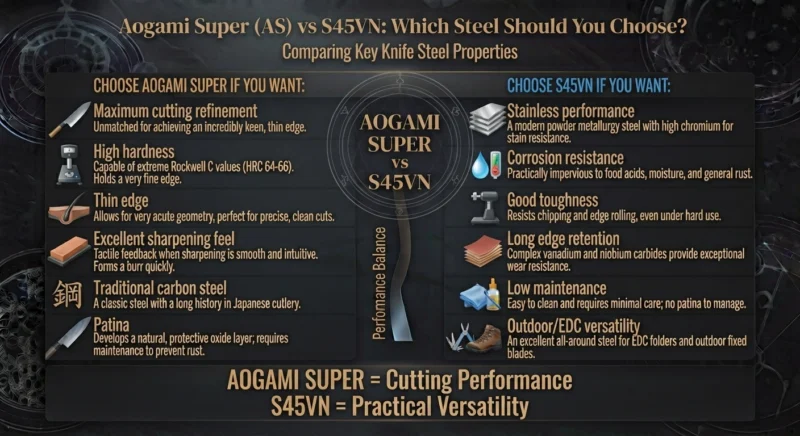
Which Steel Should You Choose?
The simplest decision tree looks like this.
Choose Aogami Super if:
You want:
- Maximum cutting refinement
- Very high hardness
- Excellent edge stability
- A very thin kitchen edge
- Traditional Japanese carbon-steel character
- Excellent sharpening feedback
- Patina
- A knife that rewards careful maintenance
Choose S45VN if:
You want:
- Stainless performance
- Excellent corrosion resistance
- Long edge retention
- Good toughness
- Minimal maintenance
- Outdoor versatility
- EDC capability
- A highly practical all-around steel
Best Choice for a Japanese Kitchen Knife
For a traditional high-performance Japanese kitchen knife, Aogami Super has a strong advantage.
Its ability to combine high hardness, fine edges, excellent cutting feel, and long edge retention makes it particularly well suited to precision kitchen work.
The trade-off is maintenance.
If you are comfortable caring for carbon steel, Aogami Super can be exceptional.
Best Choice for a General-Purpose Knife
For a knife that must perform many different tasks, S45VN is usually the safer choice.
Its combination of:
- Toughness
- Corrosion resistance
- Wear resistance
- Edge retention
makes it much more versatile.
It does not require the same level of attention as Aogami Super.
Best Choice for EDC
S45VN wins.
The reason is simple.
An everyday carry knife needs to survive unpredictable environments.
Stainless performance is extremely valuable.
You can carry the knife outside, use it around food, encounter humidity, and generally worry less about corrosion.
Aogami Super can work for EDC, but it requires more discipline.
Best Choice for a Kitchen Knife Enthusiast
This is more subjective.
If you enjoy sharpening and appreciate the character of traditional carbon steel:
Aogami Super.
If you appreciate engineering, stainless convenience, and low maintenance:
S45VN.
Many serious knife users eventually appreciate both.
Aogami Super vs S45VN: Final Verdict
So, which is better?
The most accurate answer is:
Aogami Super is better for maximum cutting refinement and traditional high-carbon knife performance. S45VN is better for balanced performance, corrosion resistance, toughness, and everyday practicality.
Aogami Super offers:
- Higher typical hardness
- Excellent edge stability
- Exceptional fine-edge potential
- Excellent sharpening characteristics
- Outstanding cutting feel
But it asks for more from the user.
You need to keep it dry.
You need to respect the edge.
You need to avoid unnecessary impact.
You need to accept patina.
S45VN asks much less.
It provides:
- Excellent edge retention
- High wear resistance
- Good toughness
- Very strong corrosion resistance
- Low maintenance
- Broad versatility
Its biggest advantage is not that it dramatically outperforms Aogami Super in every cutting test.
Its advantage is that it combines many desirable properties without requiring much maintenance.
The Bottom Line
If your priority is the finest possible cutting experience from a traditional high-carbon steel, Aogami Super is an outstanding choice.
If your priority is long-lasting performance with stainless convenience, S45VN is the better choice.
If you enjoy sharpening, carbon-steel maintenance, and the development of patina, Aogami Super offers a unique experience that modern stainless steels cannot completely reproduce.
If you want one knife that can live in a pocket, kitchen, workshop, campsite, or outdoor environment without demanding much attention, S45VN is much more practical.
Neither steel is universally superior.
The real winner depends on the user.
Aogami Super vs S45VN FAQ
Is Aogami Super better than S45VN?
Not universally. Aogami Super generally offers higher hardness and excellent fine-edge performance, while S45VN provides much better corrosion resistance, good toughness, and lower maintenance.
Is S45VN harder than Aogami Super?
Usually no. Aogami Super kitchen knives are commonly hardened into the low-to-mid 60s HRC, while S45VN is often used around 60–62 HRC.
Which holds an edge longer?
Both have excellent edge retention. Aogami Super benefits from high hardness and tungsten/vanadium additions, while S45VN benefits from high vanadium content, powder metallurgy, and a complex alloy structure. Actual performance depends heavily on heat treatment and geometry.
Which is easier to sharpen?
Aogami Super is generally considered easier and more pleasant to sharpen than S45VN, particularly on conventional water stones.
Which is more corrosion resistant?
S45VN by a very large margin.
Does Aogami Super rust?
Yes. It is a reactive carbon steel and should be kept clean and dry.
Does S45VN rust?
It is highly corrosion resistant but not completely immune to corrosion. Extreme exposure to salt, moisture, or corrosive environments can still cause staining or corrosion.
Which is better for kitchen knives?
Aogami Super is excellent for enthusiasts who want maximum cutting refinement and do not mind maintenance. S45VN is better for users who prioritize stainless convenience and versatility.
Which is better for outdoor knives?
S45VN is generally the better choice because of its corrosion resistance and balanced toughness.
Which takes a sharper edge?
Both can become extremely sharp. Aogami Super has an advantage in traditional sharpening feel and very fine edge refinement.
Which has better toughness?
S45VN generally has the advantage in practical toughness, although actual toughness depends heavily on heat treatment and blade geometry.
Which has better wear resistance?
Both are highly wear resistant. S45VN has a significant advantage in carbide-forming alloy content, while Aogami Super combines its alloying elements with higher achievable hardness.
Is Aogami Super a stainless steel?
No.
Is S45VN a carbon steel?
It is a high-carbon stainless steel.
Which steel is better for beginners?
S45VN is generally easier for beginners because it requires much less corrosion maintenance.
Which steel is better for experienced knife enthusiasts?
Either can be excellent. Aogami Super is especially rewarding for people who enjoy sharpening and traditional carbon steel, while S45VN is ideal for those who want advanced stainless performance.
Final Comparison Table
| Category | Winner | Why |
| Hardness | Aogami Super | Higher typical knife hardness |
| Edge stability | Aogami Super | Excellent performance at high hardness |
| Fine edge | Aogami Super | Excellent thin-edge potential |
| Sharpening feel | Aogami Super | Responsive and refined on suitable stones |
| Cutting feel | Aogami Super | Excellent high-hardness carbon-steel character |
| Corrosion resistance | S45VN | High chromium stainless chemistry |
| Toughness | S45VN | More balanced for general use |
| Outdoor use | S45VN | Much better corrosion resistance |
| EDC | S45VN | Low maintenance and stainless performance |
| Wear resistance | S45VN | High vanadium and complex carbide system |
| Maintenance | S45VN | Minimal corrosion concerns |
| Patina | Aogami Super | Develops natural carbon-steel patina |
| Traditional character | Aogami Super | Classic high-carbon Japanese steel |
| Versatility | S45VN | Excellent balance of properties |
| Kitchen enthusiast appeal | Aogami Super | Exceptional sharpening and cutting experience |
| General-purpose appeal | S45VN | Easier everyday use |
Aogami Super vs S45VN: The Short Answer
Choose Aogami Super for the edge.
Choose S45VN for the lifestyle.
Aogami Super is about maximizing the relationship between hardness, edge geometry, sharpening, and cutting performance.
S45VN is about maximizing the relationship between edge retention, corrosion resistance, toughness, and convenience.
Both are premium knife steels.
The best one is the steel that matches the way you actually use and maintain your knife.
This article is for independent informational purposes only and is not affiliated with, sponsored by, or endorsed by any steel manufacturer. All product names, trademarks, and registered trademarks are the property of their respective owners.