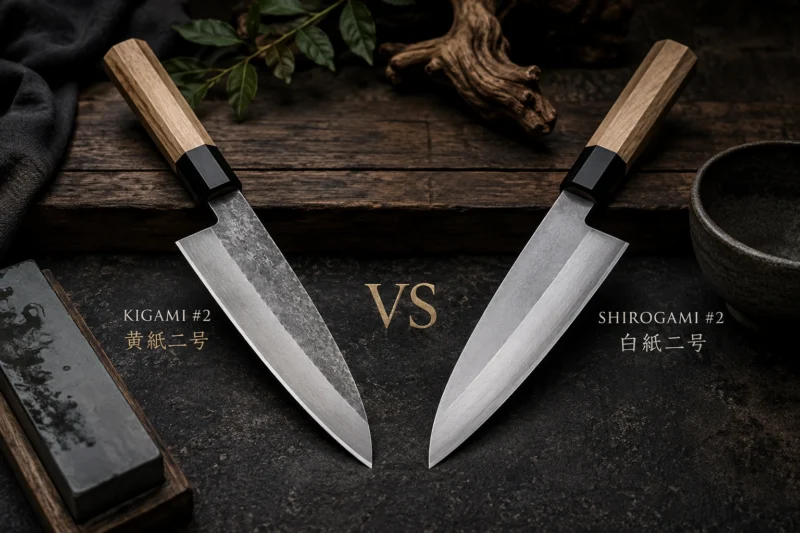
Kigami #2 vs Shirogami #2
An Independent Guide
Kigami #2 and Shirogami #2 are two traditional Japanese carbon steels that often appear surprisingly close on paper.
Both are high-carbon, non-stainless steels. Both can produce extremely sharp kitchen knives. Both respond beautifully to waterstones. Both can develop a natural patina. Both require more maintenance than stainless steel.
And, perhaps most interestingly, their carbon contents are almost the same.
So why are they considered different steels?
Why does Shirogami #2 have such a strong reputation for refined edges and easy sharpening, while Kigami #2 is often described as a more practical or economical alternative?
The answer is more subtle than simply looking at carbon percentage.
Kigami #2 and Shirogami #2 belong to the same general family of traditional Japanese carbon steels, but their specifications place different limits on impurities and therefore emphasize slightly different aspects of steel quality. The differences are not enormous in the way that the difference between a simple carbon steel and a modern powder steel can be enormous. Instead, they are differences at the fine end of the performance spectrum.
That makes this comparison particularly interesting for people who already understand basic knife steel terminology.
If you are choosing between the two, the question is not really:
“Which steel is stronger?”
A better question is:
“What kind of cutting and sharpening experience do I want?”
For many users, Kigami #2 can deliver an excellent traditional carbon-steel experience without requiring the premium associated with more refined grades. Shirogami #2, meanwhile, is especially attractive when sharpening response, edge refinement, and traditional blade-making characteristics matter more than maximum wear resistance.
This guide examines the differences carefully, without reducing either steel to a simplistic rating.
The Short Answer
If you want the quick conclusion before going into the metallurgy:
Shirogami #2 is generally the better choice for maximum edge refinement, predictable sharpening behavior, and the classic Japanese carbon-steel experience.
Kigami #2 is an excellent alternative when you want traditional high-carbon performance, very good sharpenability, and a practical working knife without needing the highest level of chemical purity.
The difference is real, but it is easy to exaggerate.
A well-made Kigami #2 knife can outperform a poorly heat-treated Shirogami #2 knife.
That is one of the most important lessons in knife steel comparisons.
Steel composition matters.
Heat treatment matters.
Blade geometry matters.
Edge angle matters.
Grinding quality matters.
Sharpening matters.
How the knife is actually used matters.
A steel name printed on a specification sheet cannot determine the complete performance of a finished knife.
What Is Kigami #2?
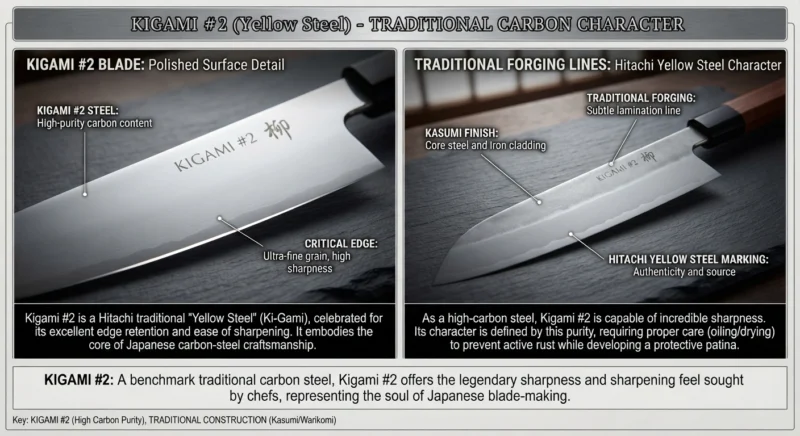
Kigami #2 is a traditional Japanese high-carbon steel commonly associated with the “Yellow Paper” family of steels.
The name Kigami literally refers to the yellow-paper designation historically used to identify the steel. The color is not describing the color of the finished blade.
This naming system is important because it can create confusion for people encountering Japanese knife steels for the first time.
“Yellow,” “White,” and “Blue” do not mean that the finished knife will necessarily have a yellow, white, or blue appearance.
They are traditional identification names associated with the steel grades.
Kigami #2 is a relatively simple carbon steel. Its published composition is centered around approximately 1.05–1.15% carbon, with relatively small quantities of silicon and manganese and tightly controlled phosphorus and sulfur. Independent steel references report essentially the same chemistry.
That chemistry immediately tells us something important.
Kigami #2 does not depend on large additions of chromium, tungsten, molybdenum, or vanadium to create wear-resistant alloy carbides.
It is fundamentally a carbon-steel system.
That makes its behavior quite different from modern high-alloy knife steels.
There is no large chromium addition to make it stainless.
There is no significant tungsten addition designed to increase carbide-related wear resistance.
There is no substantial vanadium addition producing large populations of vanadium-rich carbides.
Instead, Kigami #2 relies primarily on carbon, iron, heat treatment, and careful processing.
That simplicity is one of its strengths.
Check Our Guide Kigami #2 Steel
What Is Shirogami #2?
Shirogami #2 is another traditional Japanese high-carbon steel.
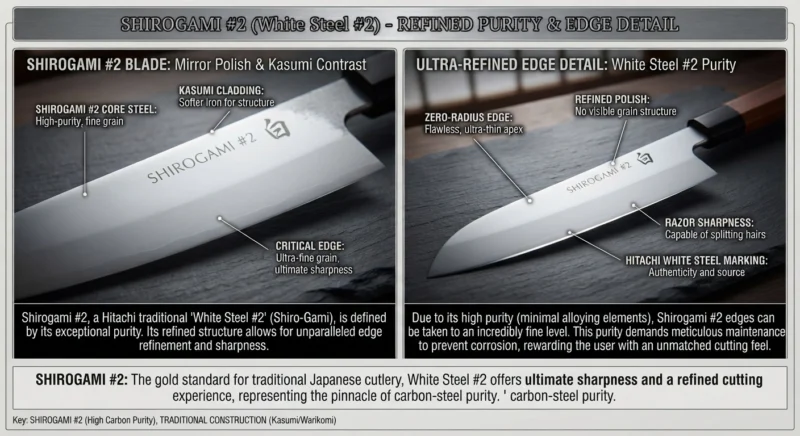
The name means “White Paper,” again referring to the traditional identification paper rather than the appearance of the blade.
Shirogami #2 is also a relatively simple carbon steel.
Its carbon content is generally given in the same approximate 1.05–1.15% range as Kigami #2, with small amounts of silicon and manganese and very low limits for undesirable impurities. Independent references consistently place Shirogami #2 around this carbon range and commonly report finished knife hardness in roughly the low-60s HRC, depending on heat treatment and application.
This is where the comparison becomes interesting.
If you look only at carbon content, Kigami #2 and Shirogami #2 can appear almost identical.
So why aren’t they simply the same steel?
Because carbon percentage is only one part of a steel specification.
The permitted levels of other elements matter too.
And in this case, the most interesting differences involve phosphorus and sulfur.
Check Our Guide Shirogami #2 (White Steel #2)
Kigami #2 vs Shirogami #2: The Chemistry
At first glance, the chemistry of these steels does not look dramatically different.
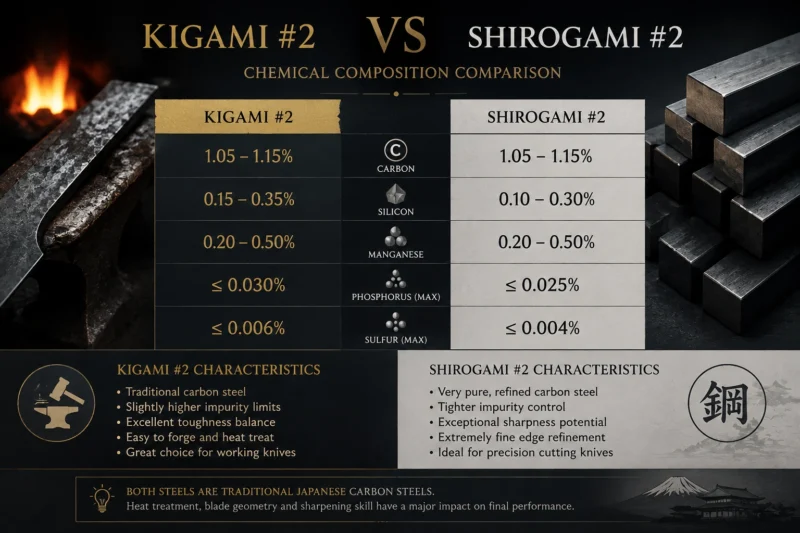
Both contain roughly 1.05–1.15% carbon.
Both contain small amounts of silicon.
Both contain manganese in relatively modest quantities.
Neither is intentionally alloyed like a modern high-wear powder steel.
Neither is stainless.
The important distinction is the degree to which impurities are controlled.
Published specifications and independent references generally place the maximum phosphorus and sulfur limits for Kigami #2 somewhat higher than those for Shirogami #2. One commonly cited specification gives Kigami #2 maximum phosphorus around 0.030% and sulfur around 0.006%, while Shirogami #2 is generally associated with tighter limits around 0.025% phosphorus and 0.004% sulfur.
Those numbers look tiny.
They are tiny.
And that is exactly why this comparison needs some perspective.
It would be misleading to look at a difference of a few thousandths of a percent and claim that the two steels behave like completely different materials.
They do not.
Both are exceptionally simple carbon steels compared with many modern knife steels.
The difference is better understood as a difference in refinement.
Shirogami #2 places tighter restrictions on certain impurities.
Kigami #2 allows somewhat more latitude.
That distinction contributes to the traditional reputation of Shirogami as a very clean, refined steel that responds exceptionally well to forging, grinding, and sharpening.
But the final blade is still determined by much more than the chemical specification.
Why Purity Matters in Carbon Steel
To understand the Kigami #2 vs Shirogami #2 comparison, it helps to understand why steelmakers care about small quantities of phosphorus and sulfur.
Steel is primarily iron and carbon, but practical steels contain many additional elements.
Some are intentionally added.
Others are residuals or impurities.
The distinction matters.
Elements such as tungsten, chromium, vanadium, and molybdenum can be deliberately introduced to change hardenability, wear resistance, corrosion resistance, or carbide structure.
Phosphorus and sulfur are different.
In conventional carbon steels, excessive levels can negatively influence mechanical properties and processing behavior.
Sulfur can be useful in certain free-machining steels because it improves machinability, but a knife steel designed for a refined cutting edge is not trying to maximize machinability in that way.
Phosphorus can contribute to brittleness under certain conditions, particularly when present at undesirable levels.
This is why high-quality steel specifications control them.
The important point is not that Kigami #2 contains “bad” amounts of impurities.
It does not.
Its limits are still quite controlled.
The more accurate interpretation is that Shirogami #2 takes the purification concept further.
That is part of why White Steel developed such a strong reputation among traditional bladesmiths.
Is Shirogami #2 Actually Better Than Kigami #2?
This is where many online comparisons become too simplistic.
If “better” means:
- cleaner chemistry,
- extremely refined sharpening behavior,
- excellent fine-edge potential,
- strong traditional reputation,
then Shirogami #2 has a legitimate advantage.
But if “better” means:
- every knife made from it will cut better,
- it will always hold an edge longer,
- it will always be tougher,
- it will always be easier to use,
then the answer is no.
Steel does not work that way.
A well-made Kigami #2 blade with excellent heat treatment and thin geometry can feel spectacular in the kitchen.
A poorly heat-treated Shirogami #2 blade can feel mediocre.
This is why comparing steel names without considering the finished knife can produce misleading conclusions.
Carbon Content: The Surprisingly Similar Part
One of the most important observations in this comparison is that both steels occupy essentially the same carbon range.
Kigami #2 is generally specified around 1.05–1.15% carbon.
Shirogami #2 is also generally specified around 1.05–1.15% carbon.
That means you should not expect a dramatic difference in potential hardness simply because one is “Yellow” and the other is “White.”
The numbering system also does not mean that Shirogami #2 has more carbon than Kigami #2.
Their carbon ranges overlap.
This is an important correction to a common misunderstanding.
Japanese steel numbering should not be interpreted as a universal ranking system.
For example, Shirogami #1 has more carbon than Shirogami #2, while Shirogami #3 has less. The number identifies the grade; it does not simply mean “better” or “worse.”
In this particular comparison, Kigami #2 and Shirogami #2 are chemically close in carbon content.
Their differences are more subtle.
Hardness: Where Does Each Steel Fit?
Hardness is another area where internet discussions can become confusing.
Traditional Japanese carbon-steel kitchen knives made from Shirogami #2 are commonly found around the low 60s HRC, although exact values depend on the maker and heat treatment. Independent references commonly report approximately 60–63 HRC or a similar range for Shirogami #2.
Published information for Kigami #2 similarly indicates the ability to reach at least around 60 HRC under specified hardening conditions, while independent knife-steel references commonly place practical knife hardness in a somewhat broader range.
This means there is no meaningful basis for saying:
“Kigami #2 is soft and Shirogami #2 is hard.”
That is too crude.
Both can be hardened to levels appropriate for high-performance kitchen knives.
The actual hardness of a particular blade depends heavily on heat treatment.
Check Our Guide What Is HRC? Understanding Rockwell Hardness in Kitchen Knives
And that leads to a much more useful question:
What happens at the edge?
Edge Retention: Kigami #2 vs Shirogami #2
Neither steel is primarily famous for extreme wear resistance.
That is important.
If your only goal is maximum edge retention, neither Kigami #2 nor Shirogami #2 would be the obvious place to stop your research.
Modern alloy steels can contain substantial quantities of elements specifically intended to create hard carbides and increase resistance to abrasive wear.
Kigami #2 and Shirogami #2 take a different approach.
Their appeal is the quality of the edge rather than simply maximizing the amount of time before the edge loses some sharpness.
Shirogami #2 is particularly famous for producing a very refined edge.
Its relatively simple chemistry allows the steel to behave extremely cleanly during sharpening.
Kigami #2 can also produce a very sharp edge.
In practical kitchen use, the difference in edge retention may be much smaller than the difference between either of these steels and a heavily alloyed wear-resistant steel.
This is one reason why choosing between Kigami #2 and Shirogami #2 should not be based exclusively on edge-retention charts.
The person who sharpens frequently may actually prefer a steel with modest wear resistance.
Why?
Because sharpening is fast.
The edge can be restored easily.
You do not need to spend a long time removing highly wear-resistant carbides.
The knife returns to peak cutting condition quickly.
Check Our Guide Edge Retention Explained: 10 Factors What Makes a Knife Stay Sharp Longer
Why Shirogami #2 Feels So Good on a Whetstone
One of the defining characteristics of Shirogami #2 is its sharpening response.
Users often describe it as smooth, direct, predictable, and highly responsive.
There is a mechanical reason for much of this.
Shirogami #2 contains very little alloying content compared with modern wear-resistant steels.
The abrasive on a waterstone is therefore working against a relatively simple steel structure.
There are no large populations of extremely hard alloy carbides comparable to those found in many powder-metallurgy steels.
That can make sharpening feel unusually controlled.
The stone removes material readily.
The burr forms predictably.
The apex can be refined very aggressively.
The result is a steel that encourages frequent sharpening.
Independent knife references consistently describe Shirogami #2 as exceptionally easy to sharpen and capable of taking a very fine edge.
This is one of the reasons experienced sharpeners often appreciate White #2 even when they own knives made from steels with much greater theoretical edge retention.
They are not necessarily choosing the steel that stays sharp the longest.
They are choosing the steel that is enjoyable to maintain.
How Does Kigami #2 Sharpen?
Kigami #2 is also very easy to sharpen compared with highly alloyed steels.
This is not surprising.
Its composition is similarly simple.
There is no major vanadium-carbide population to fight against.
There is no large tungsten addition creating a highly wear-resistant carbide structure.
The steel therefore responds readily to conventional waterstones.
For someone new to traditional Japanese carbon steels, Kigami #2 can be an excellent introduction.
It provides many of the characteristics people associate with traditional carbon knives:
- fast sharpening,
- strong stone feedback,
- easy burr formation,
- excellent edge refinement,
- responsive polishing,
- and a relatively low sharpening burden.
In that respect, the difference between Kigami #2 and Shirogami #2 is much smaller than the difference between either of them and many modern high-wear steels.
Shirogami #2 may have the edge in refinement and consistency of behavior, but Kigami #2 is not difficult to sharpen.
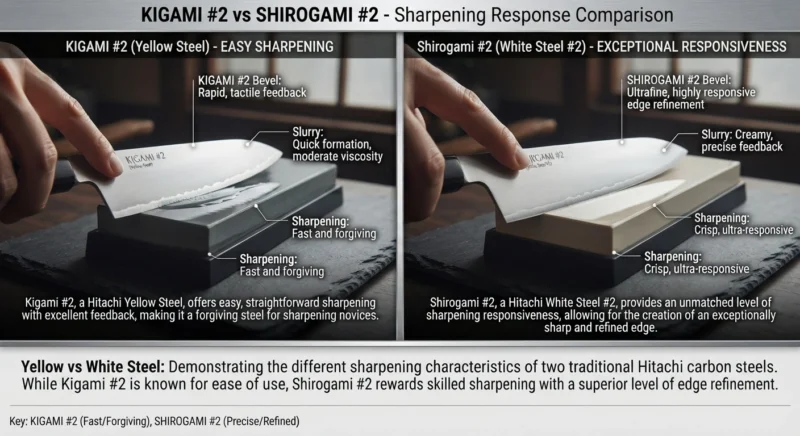
Sharpening Feel: Is There a Big Difference?
For an experienced sharpener, there can be a difference.
For a casual user, the difference may be difficult to identify.
This is an important distinction.
A professional sharpener who has worked with dozens of Japanese carbon steels can notice differences in stone feedback, burr formation, resistance, and finishing behavior.
A home cook who sharpens a knife every few months may simply notice that both steels sharpen quickly.
The difference becomes more meaningful when the knife is very thin and sharpened to a highly refined edge.
At that point, small differences in steel cleanliness, heat treatment, grain structure, and geometry can become more noticeable.
But even then, the quality of the individual blade remains extremely important.
Check Our Guide All Kinds of Knife Sharpening Tools
Fine Edge Potential
This is probably the category where Shirogami #2 has its strongest traditional reputation.
A fine edge is not simply “sharp.”
It is an edge with a very small apex and carefully controlled geometry.
A steel that can support such an edge without excessive instability is highly desirable for precision kitchen cutting.
Shirogami #2 is particularly well suited to this style of knife.
It is often associated with thin, high-performance Japanese blades where the edge is intended to be extremely keen.
Kigami #2 can also produce a very fine edge.
However, Shirogami #2’s tighter purity specification and traditional reputation make it the more natural choice when the objective is to push refinement as far as practical.
That does not mean a Kigami #2 edge cannot be excellent.
It means that Shirogami #2 is more strongly associated with this particular performance philosophy.
Toughness: Don’t Oversimplify This Category
Toughness is one of the most misunderstood knife-steel properties.
People sometimes assume that a simple steel must automatically be tougher than an alloy steel.
That is not necessarily true.
Toughness depends on:
- hardness,
- microstructure,
- grain size,
- heat treatment,
- edge geometry,
- thickness,
- stress,
- and the way the knife is used.
A very thin edge can chip even if the steel itself is reasonably tough.
A thicker edge can survive abuse that would damage a much thinner blade.
Therefore, it would be inaccurate to declare:
“Kigami #2 is tough.”
or:
“Shirogami #2 is brittle.”
Those statements lack enough context.
Both steels can be made into reliable kitchen knives.
Both can also be damaged by inappropriate use.
A hard carbon-steel kitchen knife should not be treated like a heavy-duty chopping tool.
Check Our Guide Wear Resistance vs Toughness: Understanding the Most Important Knife Steel Trade-Off
Edge Stability Matters More Than a Simple Toughness Rating
For kitchen knives, edge stability is often more relevant than a generic toughness score.
Imagine two knives.
Knife A has a relatively soft edge and thick geometry.
Knife B has a very hard, extremely thin edge.
Even if Knife B is made from a steel with excellent intrinsic toughness, it may be more vulnerable to edge damage because the geometry places greater stress on the apex.
This is why two knives made from the same steel can behave completely differently.
The same principle applies to Kigami #2 and Shirogami #2.
If a Kigami #2 blade is ground appropriately and heat-treated well, it can be a very stable cutting tool.
If Shirogami #2 is heat-treated excessively hard and sharpened to an extremely acute angle, it can be more vulnerable to micro-chipping.
The steel name alone cannot predict the outcome.
Corrosion Resistance: Both Require Care
This category is much easier.
Neither Kigami #2 nor Shirogami #2 should be considered stainless.
Their chromium content is not high enough to provide conventional stainless-steel corrosion resistance.
That means both steels can rust.
Both can discolor.
Both can develop patina.
Both should be dried after use.
Acidic foods can accelerate discoloration.
Salt and moisture can accelerate corrosion.
Leaving a carbon-steel knife wet in a sink is a bad idea.
Leaving it under a pile of wet kitchen towels is also a bad idea.
And storing it wet inside a sheath or enclosed container can be even worse.
The good news is that carbon-steel maintenance is simple.
You do not need complicated chemistry.
You need good habits.
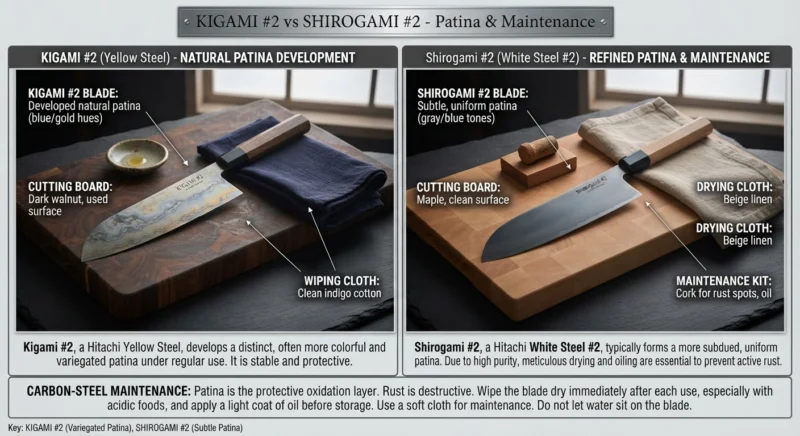
Patina: Rust or Something Different?
A patina is a controlled surface discoloration that develops on carbon steel during use.
It can range from gray to blue, purple, brown, and eventually darker shades.
Patina is not the same thing as active red rust.
Active rust is a corrosion problem.
A stable patina is generally considered part of the normal life of a carbon-steel knife.
This is another area where Kigami #2 and Shirogami #2 behave similarly.
Neither should be selected by someone who wants completely maintenance-free steel.
Both should be selected by someone who is comfortable wiping and drying a knife.
For users who enjoy traditional Japanese knives, the changing appearance of carbon steel can actually be part of the attraction.
Which Rusts Faster?
There is no useful universal rule saying that Kigami #2 always rusts faster than Shirogami #2.
Both are highly reactive compared with stainless steels.
Small differences in impurity levels do not turn either one into a corrosion-resistant steel.
Actual corrosion behavior depends on:
- exposure time,
- acidity,
- salt,
- humidity,
- temperature,
- surface finish,
- patina,
- cleaning,
- and storage.
A carbon-steel knife used in a dry kitchen and wiped immediately may remain in excellent condition for years.
The same steel left wet after cutting acidic fruit can develop spots quickly.
Maintenance habits matter more than the small chemical distinction between these two grades.
Heat Treatment Is the Hidden Variable
If there is one concept worth remembering from this entire article, it is this:
Heat treatment can matter more than the difference between Kigami #2 and Shirogami #2.
Steel chemistry establishes possibilities.
Heat treatment determines how much of that potential becomes useful performance.
During heat treatment, the steel is transformed through controlled heating, hardening, and tempering.
The objective is to produce the desired combination of hardness, toughness, grain structure, and edge stability.
Traditional carbon steels can be particularly demanding because their hardening behavior is less forgiving than many modern alloy steels.
This is one reason why the skill of the bladesmith or heat treater matters so much.
A properly treated simple carbon steel can be extraordinary.
A badly treated premium steel can be disappointing.
Check Our Guide Steel Heat Treatment Explained
Grain Structure and Why It Matters
Steel is not a homogeneous block at microscopic scale.
Its properties depend on microstructure.
Heat treatment affects grain size, carbide distribution, martensitic transformation, retained phases, and other structural features.
For simple carbon steels, controlling the thermal cycle can have a particularly significant effect on the final result.
Fine grain structure is generally desirable for knife edges because it can contribute to edge stability and refinement.
This is one reason traditional Japanese carbon steels have such strong associations with skilled forging and heat treatment.
It is not enough to buy a bar with the correct chemical composition.
The steel must be processed correctly.
Forging Kigami #2
Kigami #2 is traditionally associated with forged Japanese tools and knives.
Its relatively straightforward chemistry makes it practical for traditional blade production.
Compared with some more alloyed steels, it does not demand the same approach to controlling hard alloy carbides.
That does not mean forging it is effortless.
The smith still needs to manage:
- forging temperature,
- deformation,
- grain refinement,
- decarburization,
- normalization,
- hardening,
- and tempering.
But the steel belongs to a traditional family where forging and hand-processing are central to the final result.
This is part of why Kigami #2 remains relevant despite the availability of technologically more advanced steels.
It fits the traditional manufacturing process extremely well.
Forging Shirogami #2
Shirogami #2 is also strongly associated with traditional Japanese blade making.
Its very clean chemistry makes it especially attractive for makers pursuing refined cutting performance.
But the simplicity of the composition should not be confused with simplicity of heat treatment.
Simple carbon steels can have relatively narrow hardening windows.
Water quenching is commonly associated with traditional White Steel processing, and this can demand considerable skill because the thermal and quenching cycle must be controlled carefully. Independent Japanese knife references describe Shirogami #2 as a steel that rewards skilled heat treatment and is commonly hardened into the low-60s HRC range.
The finished performance therefore reflects not only the steel grade but also the skill used to transform it into a blade.
Kigami #2 vs Shirogami #2 for Kitchen Knives
Now we can move away from metallurgy and look at actual kitchen use.
Suppose you are choosing between two otherwise comparable kitchen knives.
One uses Kigami #2.
The other uses Shirogami #2.
What should you expect?
Both can provide:
- excellent sharpness,
- very good sharpening response,
- high hardness,
- a fine cutting edge,
- traditional carbon-steel behavior,
- and strong feedback on waterstones.
The Shirogami knife may have a slight advantage if your priority is the most refined edge possible.
The Kigami knife may offer a more economical route to very similar traditional performance.
The differences become more noticeable for advanced sharpeners and less noticeable for ordinary users.
Gyuto
A gyuto is one of the best places to appreciate either steel.
A thin gyuto made from Kigami #2 can provide excellent slicing performance.
A Shirogami #2 gyuto can be even more rewarding for someone who enjoys frequent sharpening and very fine edges.
Because a gyuto is normally used for a wide variety of ingredients, edge stability matters.
The knife should not be pushed through bones.
It should not be twisted aggressively in hard foods.
It should not be used on glass, ceramic, or other inappropriate surfaces.
With sensible technique, either steel can perform extremely well.
Check Our Japanese Gyuto Knife Guide: Everything You Need to Know
Nakiri
Nakiri knives can also work beautifully with both steels.
The straight edge encourages precise vegetable preparation.
Because the knife often uses a thin geometry, the edge can feel exceptionally crisp.
Shirogami #2 is particularly attractive for this type of knife because its sharpening characteristics make it easy to maintain a highly refined edge.
Kigami #2 can deliver much of the same experience.
For a user who sharpens regularly, the difference may be more about preference than capability.
Check Our Guide Santoku vs Nakiri: Which Japanese Kitchen Knife Is Better?
Santoku
A santoku made from either steel can be an excellent general-purpose kitchen knife.
The shorter blade makes it easy to control.
The fine edge can be extremely effective for vegetables, herbs, meat, and boneless fish.
Again, the important point is that the steel should not be treated as a substitute for proper knife technique.
Neither Kigami #2 nor Shirogami #2 is intended to be abused.
Single-Bevel Knives
This is where Shirogami #2 becomes particularly interesting.
Traditional single-bevel knives demand very precise sharpening.
The geometry is highly specialized.
The flat side and primary bevel need to be maintained correctly.
Because Shirogami #2 responds so well to waterstones, it has become strongly associated with this type of sharpening-intensive blade.
Kigami #2 can also be used successfully in traditional cutting tools, but Shirogami #2 has the stronger reputation for the most refined single-bevel applications.
This is not because Kigami #2 suddenly becomes unsuitable.
It is because the advantages of very clean sharpening response become more valuable when the geometry itself is highly specialized.
Check Our Guide Japanese Fish Knives
Which Is Easier to Sharpen?
Winner: Shirogami #2 — but only by a small margin for many users.
Both steels are easy to sharpen.
Shirogami #2 is particularly famous for its stone feedback and ability to form a highly refined edge.
Kigami #2 is also straightforward and pleasant to sharpen.
If you are moving from stainless steel to either one, you may notice a dramatic difference.
If you are an experienced sharpener comparing the two side by side, the distinction becomes more subtle.
Which Takes a Sharper Edge?
Winner: Shirogami #2, especially at the extreme end of refinement.
Both can become extremely sharp.
The difference is not that Kigami #2 cannot become razor sharp.
It can.
The difference is that Shirogami #2 has an especially strong reputation for producing an exceptionally refined apex.
The practical difference in a kitchen can be small.
A properly sharpened Kigami #2 knife can still produce effortless cuts.
Which Holds an Edge Longer?
Slight advantage: Shirogami #2 in many traditional applications, but do not expect a dramatic difference.
This category requires caution.
Neither steel contains the kind of alloy additions associated with extreme wear resistance.
Therefore, neither should be expected to compete with heavily alloyed modern steels simply because it is hardened to 60+ HRC.
Edge retention depends on:
- hardness,
- geometry,
- edge angle,
- abrasive exposure,
- cutting board,
- food,
- technique,
- and sharpening finish.
The difference between two individual knives can easily be larger than the nominal difference between the steel grades.
Which Is Tougher?
There is no responsible universal winner.
A steel’s toughness cannot be reduced to a simple label.
Heat treatment and geometry matter enormously.
If two blades are heat-treated differently, the harder one may have less practical resistance to impact damage even if the underlying chemistry is similar.
Likewise, a thin edge can chip more readily than a thicker one.
Therefore, treat toughness claims about Kigami #2 vs Shirogami #2 as general tendencies rather than absolute laws.
Which Is More Corrosion Resistant?
Neither.
Both are reactive carbon steels.
If corrosion resistance is your priority, neither is the obvious choice.
A stainless steel would be more appropriate for someone who wants minimal maintenance.
But if you are specifically looking for a traditional Japanese carbon-steel experience, corrosion is simply part of the trade-off.
Which Is Better for Beginners?
This depends on what kind of beginner you mean.
If you are completely new to carbon steel and want a forgiving, low-maintenance knife, neither is ideal.
Choose stainless instead.
If you are new to carbon steel but already comfortable with basic knife care, Kigami #2 can be a very attractive entry point.
It offers traditional performance without requiring the user to chase the absolute highest level of refinement.
If you are interested in learning sharpening and want to experience one of the classic traditional Japanese steels, Shirogami #2 is arguably the more rewarding teacher.
It makes sharpening feel like part of using the knife rather than merely a maintenance chore.
Which Is Better for Professional Cooks?
There is no universal answer.
Professional kitchens have different demands.
A chef who sharpens frequently and values an extremely fine edge may love Shirogami #2.
A chef who wants a traditional carbon-steel blade but prefers a practical working grade may be perfectly happy with Kigami #2.
The real question is maintenance discipline.
If a busy kitchen cannot keep carbon steel dry, neither steel is ideal.
If the user can maintain the knife properly, both can work extremely well.
Which Is Better for Home Cooks?
For many home cooks, Kigami #2 offers enough performance that the additional refinement of Shirogami #2 may not justify choosing it solely on steel chemistry.
This is especially true if the knife geometry is similar.
A properly made Kigami #2 knife can become extremely sharp.
It can slice vegetables cleanly.
It can perform beautifully on meat and fish.
It can be maintained quickly on a waterstone.
The advantage of Shirogami #2 becomes more meaningful when the user specifically values its sharpening character and fine-edge potential.
Does Kigami #2 Feel Like a “Cheap” Steel?
No.
This is an important misconception to avoid.
Kigami #2 is sometimes described as a lower-grade traditional steel because it sits below Shirogami in perceived prestige.
But “lower prestige” does not mean “poor knife steel.”
The difference is largely one of specification and refinement.
Kigami #2 remains a high-carbon Japanese steel capable of producing excellent knife performance.
Calling it “cheap steel” without qualification is misleading.
It is better described as a practical traditional carbon steel.
Is Shirogami #2 a Premium Steel?
Within the traditional Japanese carbon-steel world, it is certainly highly respected.
But “premium” does not mean universally superior.
Shirogami #2 is premium for a particular purpose:
fine edges, sharpening response, traditional craftsmanship, and highly refined cutting performance.
It is not premium if your definition of premium is:
- stainless,
- extremely corrosion resistant,
- maximum edge retention,
- almost no maintenance.
For those goals, other steels are more appropriate.
The Biggest Myth: Carbon Percentage Determines Everything
It is tempting to compare:
Kigami #2 = 1.05–1.15% carbon
Shirogami #2 = 1.05–1.15% carbon
and conclude that they must perform identically.
That is not correct.
Steel chemistry is multidimensional.
Two steels can contain similar carbon levels while having different limits for other elements.
And even two batches with nearly identical chemistry can produce different finished blades depending on processing.
The lesson is simple:
Carbon percentage is important, but it is not the entire steel.
The Second Biggest Myth: White Steel Is Always Sharper
Shirogami has earned a legendary reputation for sharpness.
But a steel name does not sharpen itself.
A poorly sharpened Shirogami #2 knife will not outperform a beautifully sharpened Kigami #2 knife simply because “White Steel” is written on the specification.
Edge geometry is fundamental.
Apex formation is fundamental.
Sharpening skill is fundamental.
Stone choice matters.
Pressure matters.
Deburring matters.
Even the final sharpening angle matters.
The steel provides the material platform.
The sharpener creates the edge.
The Third Biggest Myth: Harder Means Better
Suppose one Kigami #2 knife measures 60 HRC and another Shirogami #2 knife measures 63 HRC.
It would be tempting to say the 63 HRC knife is automatically better.
That is not true.
Higher hardness can support better edge stability and retention under some conditions.
But excessive hardness can also make a blade less forgiving.
A knife is a system.
The optimal hardness depends on:
- blade thickness,
- edge angle,
- intended use,
- heat treatment,
- and desired toughness.
A kitchen knife is not a hardness competition.
The Role of Blade Geometry
Imagine taking the same piece of steel and making two knives.
Knife A has a thick edge.
Knife B has an extremely thin edge.
Even though the steel is identical, the knives can feel completely different.
Knife B may cut dramatically better because it requires less force to pass through food.
But its thin edge may also be more sensitive to misuse.
This is why a steel comparison should never be separated completely from geometry.
A great Kigami #2 knife can outperform a mediocre Shirogami #2 knife simply because the Kigami blade has better geometry.
This is not unusual.
It is normal.
Edge Angle and Kigami #2
Kigami #2 can support a fine cutting edge.
However, the appropriate edge angle depends on the specific knife.
A thin Japanese kitchen knife may tolerate a more acute edge than a thick utility blade.
The harder the steel and thinner the geometry, the more carefully the knife should be used.
Avoid treating an acute carbon-steel edge as an all-purpose wedge.
Do not twist the knife through hard ingredients.
Do not use it to separate joints.
Do not cut frozen food.
Do not scrape food aggressively with the edge.
These practices can damage almost any fine kitchen knife.
Edge Angle and Shirogami #2
Shirogami #2 is particularly attractive for users who enjoy highly refined edges.
The steel can support very keen sharpening when properly heat-treated.
But again, extreme sharpness has a price.
The thinner and more acute the edge becomes, the less tolerant it may be of lateral stress.
This is why the best performance often comes from finding the balance between maximum keenness and sufficient edge stability.
The sharpest possible edge is not always the most useful edge.
Waterstones and These Two Steels
Both Kigami #2 and Shirogami #2 are excellent matches for traditional waterstone sharpening.
A basic progression might begin around a medium stone for routine sharpening and move toward finer stones depending on the desired finish.
The exact grit progression is less important than the fundamentals:
- establish the correct bevel;
- create a consistent apex;
- raise a controlled burr where appropriate;
- remove the burr carefully;
- refine the edge;
- finish with light pressure.
Because both steels are relatively easy to abrade, sharpening does not need to become a major project.
That is one of the pleasures of traditional carbon steel.
Should You Use Very Fine Stones?
Not necessarily.
This is another common misconception.
A very fine stone can produce an extremely polished edge, but a polished edge is not always the best edge for every food.
A slightly toothier edge can sometimes provide better initial bite on certain ingredients.
For general kitchen work, a medium-fine finish can be extremely effective.
Shirogami #2 gives you the freedom to experiment.
Kigami #2 does too.
The important thing is to match the finish to the knife and the foods you prepare.
Maintenance After Cutting
The basic routine for either steel is simple.
After cutting:
Wipe the blade.
If necessary:
Rinse it.
Then:
Dry it completely.
Do not leave moisture on the edge.
Do not put the knife into a drawer while wet.
Do not leave acidic food residue on the blade.
If the knife will be stored for an extended period, an appropriate food-safe protective oil can be used.
That is generally enough.
Carbon steel does not require complicated rituals.
It requires consistency.
What About Lemon, Tomato, Onion, and Fruit?
Acidic foods can accelerate patina formation.
This is normal.
When using Kigami #2 or Shirogami #2, you may notice discoloration after cutting tomatoes, citrus, apples, onions, or other acidic ingredients.
Do not immediately assume the knife is damaged.
If the discoloration is a stable patina, it may simply be part of normal carbon-steel use.
However, if you see active orange or reddish corrosion, that should be addressed.
The easiest solution is prevention:
wipe the blade during extended food preparation and wash and dry it afterward.
Kigami #2 vs Shirogami #2 for Fish
Both steels can be excellent for fish preparation.
A very sharp edge is useful for precise cuts.
The fine edge possible with these steels is particularly attractive for slicing boneless fish and preparing ingredients where clean cuts matter.
However, seafood can be challenging for carbon steel because moisture and salt accelerate corrosion.
If you work around wet seafood continuously, maintenance becomes even more important.
A carbon-steel knife can still be an excellent choice, but the user needs to be disciplined.
Check Our Guide How to Prepare and Cut Seafood
Kigami #2 vs Shirogami #2 for Vegetables
Both are excellent.
This is probably where the difference between the steels becomes least important.
A properly sharpened knife made from either steel can glide through vegetables with very little resistance.
Geometry often matters more than the small difference in steel purity.
A thin Kigami #2 nakiri can feel spectacular.
A thin Shirogami #2 nakiri can feel spectacular.
The sharpening experience may favor Shirogami #2, but the actual cutting experience can be remarkably close.
Kigami #2 vs Shirogami #2 for Meat
For boneless meat, both steels can perform very well.
For poultry, fish, and trimming tasks, the fine edge can be highly effective.
But neither should be treated as a bone-cutting steel.
Do not use a fine carbon-steel kitchen knife to chop through bones simply because it is hard.
Hardness does not make a knife indestructible.
Check Our Ultimate American BBQ Meat Guide: How to Cut Chicken, Steak & Ribs + 8 Easy BBQ Recipes
Which One Should a Sharpener Choose?
If sharpening itself is one of your hobbies, Shirogami #2 deserves serious consideration.
It provides:
- excellent stone feedback,
- fast material removal,
- easy burr formation,
- fine edge potential,
- and a highly traditional sharpening experience.
Kigami #2 is also enjoyable.
If you want a very good carbon steel that does not demand the prestige or refinement associated with White Steel, it makes excellent sense.
The choice may ultimately come down to whether you enjoy optimizing the last few percent of edge refinement.
Which One Should a Knife Maker Choose?
For a maker, the choice depends on the intended product.
Kigami #2 can make excellent working knives where traditional carbon-steel performance is desired.
Shirogami #2 is attractive when the knife is intended to emphasize:
- refined edge performance,
- traditional craftsmanship,
- specialized cutting,
- and premium carbon-steel characteristics.
The heat-treatment process must be designed around the specific steel.
The maker should not simply copy a heat-treatment schedule from another carbon steel.
Even steels with similar carbon content can behave differently.
Check Our Guide How to Choose a Custom Knife Maker
Why the Difference Can Be Hard to Feel
This may be the most important practical point in the entire comparison.
If you take:
- a well-made Kigami #2 knife,
- a well-made Shirogami #2 knife,
and give both excellent geometry and identical sharpening quality, the difference may be real but subtle.
If you instead compare:
- a poorly ground Shirogami #2 knife,
- with an excellent Kigami #2 knife,
the Kigami knife may feel dramatically better.
That is why steel comparisons should be treated as a framework rather than a ranking.
The steel tells you what kind of material you are dealing with.
The finished knife tells you what you actually bought.
A Practical Performance Ranking
Instead of assigning arbitrary numerical scores, it is more useful to describe the two steels in practical terms.
Sharpening ease
Shirogami #2: exceptional
Kigami #2: excellent
Both are substantially easier to sharpen than many highly wear-resistant modern steels.
Fine-edge potential
Shirogami #2: exceptional
Kigami #2: excellent to very good
The advantage goes to Shirogami when maximum refinement is the goal.
Edge retention
Shirogami #2: moderate
Kigami #2: moderate
Neither is primarily an edge-retention specialist.
Actual results depend heavily on hardness and geometry.
Corrosion resistance
Shirogami #2: very low
Kigami #2: very low
Both require care.
Maintenance
Shirogami #2: high
Kigami #2: high
Both should be cleaned and dried promptly.
Traditional character
Shirogami #2: extremely high
Kigami #2: extremely high
Both belong to the traditional Japanese carbon-steel world.
Forgiveness
Neither should be treated as a careless-use steel.
Both are better suited to users who understand how to protect a fine kitchen edge.
Why Modern Knife Steel Does Not Automatically Replace These Steels
It is reasonable to ask:
Why would anyone choose Kigami #2 or Shirogami #2 when modern steels can offer much greater corrosion resistance and longer edge retention?
The answer is that knife performance is not one-dimensional.
Modern steels can be spectacular.
They can provide:
- high wear resistance,
- excellent corrosion resistance,
- long edge retention,
- high hardness,
- and impressive consistency.
But they can also be harder to sharpen.
Some users prefer a steel that can be restored quickly on a waterstone.
Some users enjoy the feel of a reactive carbon blade.
Some value traditional forging.
Some want an extremely fine edge rather than maximum durability.
Kigami #2 and Shirogami #2 exist because those qualities still matter.
The Emotional Side of Carbon Steel
There is also something difficult to measure.
A traditional carbon-steel knife changes with use.
The blade develops a patina.
The edge is sharpened regularly.
The user learns how the steel responds.
The knife becomes less like a disposable kitchen appliance and more like a tool that is maintained over time.
For some people, that is a major part of the appeal.
Kigami #2 and Shirogami #2 both offer this experience.
Shirogami #2 may be the more prestigious choice, but Kigami #2 can provide the same fundamental relationship between user, blade, stone, and maintenance.
The Real Difference in One Sentence
If we had to reduce the entire comparison to one sentence, it would be this:
Kigami #2 is a very capable traditional carbon steel, while Shirogami #2 takes the concept of a clean, refined carbon-steel edge a step further.
That is a much more accurate description than saying:
“White is good and Yellow is cheap.”
The reality is more nuanced.
Who Should Choose Kigami #2?
Choose Kigami #2 if you want:
- a traditional Japanese carbon steel;
- very good sharpening response;
- a fine cutting edge;
- high-carbon performance;
- a practical working knife;
- relatively simple metallurgy;
- a steel that does not rely on large alloy additions;
- and excellent performance without needing the most refined traditional grade.
Kigami #2 is particularly appealing if you care about how a knife cuts and sharpens rather than simply chasing the highest possible steel prestige.
It is also a sensible option for people who sharpen regularly.
Who Should Choose Shirogami #2?
Choose Shirogami #2 if you want:
- exceptional sharpening feedback;
- very high fine-edge potential;
- traditional Japanese carbon-steel character;
- a highly refined cutting edge;
- a steel particularly suited to precision kitchen knives;
- and a material with very tight impurity control.
Shirogami #2 makes especially good sense for experienced sharpeners who enjoy maintaining a very keen edge.
It is also attractive for traditional knife designs where sharpening precision is part of the entire experience.
Who Should Choose Neither?
There is an equally important third answer.
Choose neither if your main priority is:
- corrosion resistance,
- minimal maintenance,
- long periods between sharpening,
- or resistance to neglect.
A stainless or highly corrosion-resistant steel may be a better fit.
That does not make modern stainless steel “better.”
It simply means the material is better matched to your priorities.
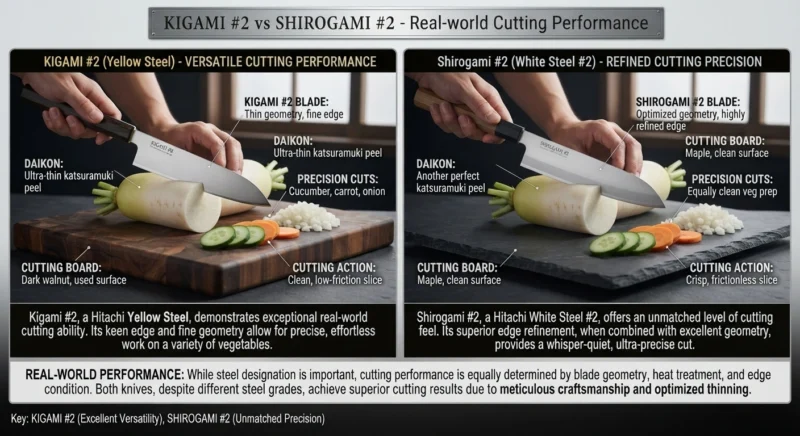
Final Verdict: Kigami #2 vs Shirogami #2
So, which one wins?
Shirogami #2 wins if the priority is maximum traditional refinement.
It has the stronger reputation for exceptionally clean sharpening behavior and fine-edge performance. Its tighter impurity limits help explain why it has become such an important traditional Japanese carbon steel. Independent references consistently describe it as a simple, highly refined carbon steel capable of excellent hardness and exceptional sharpening response.
Kigami #2 wins if the priority is practical traditional performance.
Its chemistry is remarkably close in carbon content, and it remains capable of producing very sharp, high-performance blades. The difference is that its specification allows somewhat higher phosphorus and sulfur limits than Shirogami #2.
But there is a larger lesson.
The difference between Kigami #2 and Shirogami #2 is not the difference between a good steel and a bad steel.
It is the difference between two closely related approaches to traditional carbon-steel knife making.
Shirogami #2 is about refinement.
Kigami #2 is about practicality.
Both are simple steels.
Both are reactive.
Both can take excellent edges.
Both sharpen easily.
Both reward good maintenance.
And both can make exceptional kitchen knives when the heat treatment and geometry are right.
Kigami #2 vs Shirogami #2: The Bottom Line
If you love sharpening and want to explore the finest traditional carbon-steel edge:
Shirogami #2 is probably the better choice.
If you want traditional Japanese carbon-steel performance with excellent sharpening characteristics and do not need the highest level of refinement:
Kigami #2 is an excellent choice.
If you want maximum edge retention:
Look beyond both steels.
If you want stainless convenience:
Look beyond both steels.
If you want a traditional Japanese knife that becomes part of your sharpening routine and develops its own character over time:
Either can be an excellent choice.
And that is ultimately why the Kigami #2 vs Shirogami #2 comparison is more interesting than a simple winner-and-loser ranking.
The steels are close enough that the quality of the finished knife matters enormously.
A beautifully made Kigami #2 blade can be an outstanding knife.
A beautifully made Shirogami #2 blade can be an outstanding knife.
The best choice is not necessarily the steel with the more prestigious name.
It is the steel whose characteristics match the way you cut, sharpen, maintain, and use your knife.
Frequently Asked Questions
Is Kigami #2 the same as Shirogami #2?
No.
They are closely related traditional Japanese carbon steels with similar carbon content, but their specifications differ, particularly in the permitted levels of phosphorus and sulfur.
Is Kigami #2 stainless?
No.
Kigami #2 is a reactive carbon steel and requires normal carbon-steel maintenance.
Is Shirogami #2 stainless?
No.
Shirogami #2 is also a reactive carbon steel and can rust if it is left wet or exposed to corrosive substances.
Which is easier to sharpen?
Both are very easy to sharpen.
Shirogami #2 has the stronger reputation for exceptionally clean sharpening feedback and fine-edge refinement.
Which holds an edge longer?
Neither is designed primarily for extreme wear resistance.
Shirogami #2 can provide good practical edge retention at appropriate hardness, but modern alloy steels can retain an edge considerably longer under abrasive use.
Which is harder?
Both can be heat-treated into the low-60s HRC range, depending on the specific treatment and blade. Kigami #2 specifications also indicate a hardening capability above 60 HRC under specified conditions.
Does Kigami #2 take a sharp edge?
Yes.
A properly heat-treated Kigami #2 blade can take an extremely sharp edge.
Is Shirogami #2 better for Japanese kitchen knives?
It is an excellent choice, particularly when fine-edge performance and sharpening response are priorities.
But a well-made Kigami #2 kitchen knife can also perform exceptionally well.
Which one should I buy?
Choose Shirogami #2 if you prioritize refined sharpening and edge performance.
Choose Kigami #2 if you want excellent traditional carbon-steel performance and value practicality.
Which one is better for beginners?
For a beginner specifically interested in carbon steel, Kigami #2 can be a very sensible starting point.
For someone interested in learning traditional sharpening, Shirogami #2 can be particularly rewarding.
For someone who does not want to maintain a reactive blade, neither is ideal.
Conclusion
Kigami #2 and Shirogami #2 demonstrate why knife steel comparisons cannot be reduced to carbon percentage or hardness numbers.
They are close relatives.
Their carbon contents are essentially in the same range.
Both are simple, reactive carbon steels.
Both can achieve high hardness.
Both sharpen beautifully.
Both can support extremely fine cutting edges.
But Shirogami #2 is produced to tighter purity limits, while Kigami #2 allows somewhat more latitude in certain residual elements. That difference helps explain their different reputations, but it does not create an enormous divide between them.
In real-world knife performance, heat treatment and geometry can easily become more important than the small chemical distinction between the grades.
That is why the best Kigami #2 knife can be better than the worst Shirogami #2 knife.
And it is why experienced knife users do not judge a blade by steel name alone.
If you want the most refined traditional sharpening experience, Shirogami #2 is an excellent choice.
If you want practical traditional carbon-steel performance with outstanding sharpenability, Kigami #2 deserves far more respect than its lower-profile reputation sometimes suggests.
Neither is obsolete.
Neither is universally superior.
They simply represent two slightly different ways of achieving the same fundamental goal:
a very sharp, responsive, traditional carbon-steel cutting edge.
This article is for independent informational purposes only and is not affiliated with, sponsored by, or endorsed by any steel manufacturer. All product names, trademarks, and registered trademarks are the property of their respective owners.