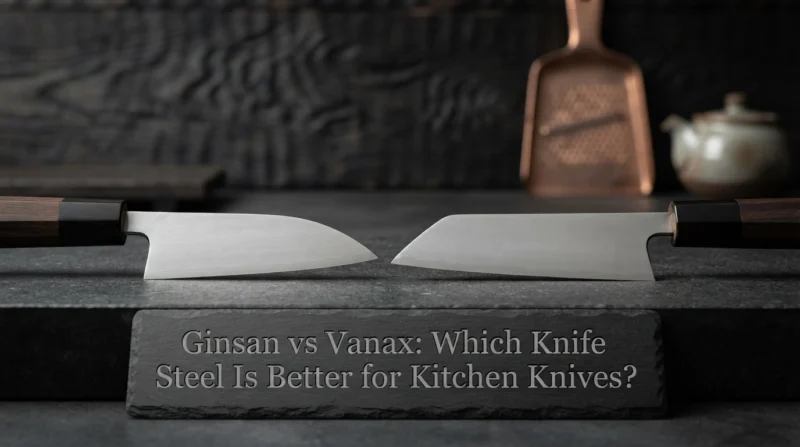
Ginsan vs Vanax
An Independent Guide
When choosing a kitchen knife, the steel matters—but not for just one reason. A knife can have excellent edge retention and still be frustrating to use. Another can be extremely tough but require frequent sharpening. Some steels resist rust exceptionally well, while others develop patina and demand more attention.
Two steels that often attract attention from serious knife enthusiasts are Ginsan and Vanax. Both offer an interesting combination of corrosion resistance, edge performance, and relatively fine cutting characteristics, but they approach the problem from different directions.
So, Ginsan vs Vanax—which one is better?
The short answer is: neither steel is universally better. Ginsan can be an excellent choice when you want a stainless kitchen knife with a fine edge, relatively easy sharpening, and traditional Japanese-style cutting characteristics. Vanax is particularly interesting when maximum corrosion resistance, excellent edge stability, and modern powder-metallurgy performance are priorities.
For a professional cook working in a demanding kitchen, Vanax can be extremely attractive. For someone who enjoys sharpening, appreciates a refined Japanese knife, and wants a stainless steel that behaves more traditionally, Ginsan may be the more satisfying option.
In this guide, we will compare Ginsan and Vanax in detail, including edge retention, toughness, corrosion resistance, hardness, sharpening, edge stability, cutting feel, maintenance, kitchen use, and overall performance.
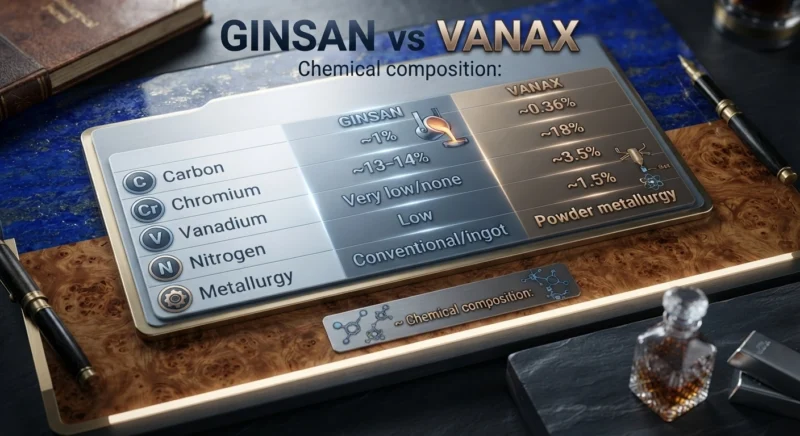
Ginsan vs Vanax at a Glance
Before getting into the details, here is a simplified comparison.
| Property | Ginsan | Vanax |
|---|---|---|
| Steel type | Stainless steel | Powder-metallurgy stainless steel |
| Corrosion resistance | Excellent | Exceptional |
| Edge retention | Very good | Excellent |
| Toughness | Good | Very good |
| Edge stability | Very good | Excellent |
| Sharpening difficulty | Moderate/easy | Moderate |
| Fine edge potential | Excellent | Excellent |
| Patina tendency | Very low | Extremely low |
| Kitchen suitability | Excellent | Excellent |
| Forgiving nature | Good | Very good |
| Maintenance | Low | Very low |
| Best for | Traditional stainless kitchen knives | High-performance modern knives |
These categories should not be interpreted as absolute rankings. Heat treatment, hardness, geometry, edge angle, blade thickness, and sharpening quality can change the actual performance of a knife dramatically.
A well-made Ginsan knife can outperform a poorly made Vanax knife in real kitchen use.
That is an important point throughout this comparison.
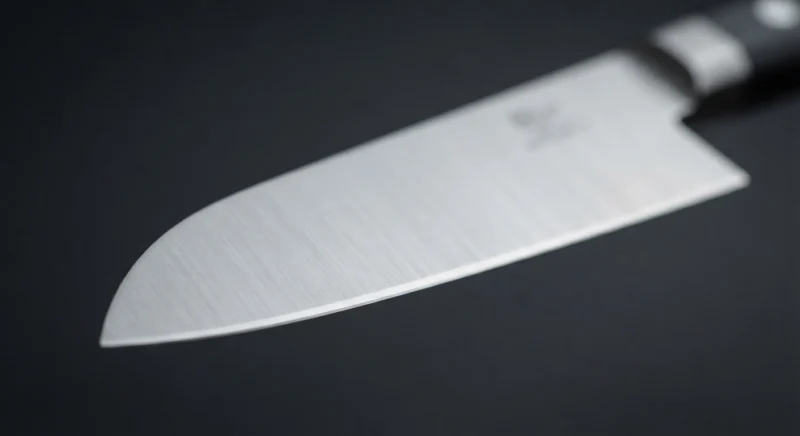
What Is Ginsan Steel?
Ginsan is a stainless Japanese knife steel known for combining several characteristics that traditionally did not always appear together.
It offers:
- high corrosion resistance,
- good edge retention,
- good toughness,
- excellent sharpening response,
- fine edge potential,
- and a relatively clean cutting feel.
Ginsan is sometimes appreciated by knife users who want the performance characteristics associated with traditional carbon-steel kitchen knives but do not want to deal with regular rust prevention and patina.
It is especially well suited to kitchen knives because the steel can take a fine edge while remaining practical for everyday food preparation.
One of the biggest attractions of Ginsan is its balance.
It is not designed simply to maximize wear resistance. Instead, it provides a useful combination of properties.
That makes it particularly interesting for chefs and home cooks who use their knives frequently.
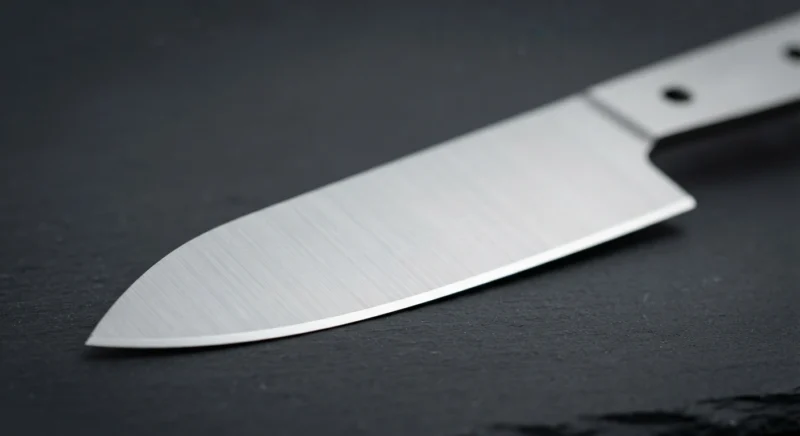
What Is Vanax Steel?
Vanax belongs to a newer generation of high-performance powder-metallurgy stainless steels.
Its design places strong emphasis on:
- corrosion resistance,
- edge retention,
- wear resistance,
- edge stability,
- and modern high-performance cutting applications.
The powder-metallurgy production process allows the steel to contain a carefully controlled combination of alloying elements while maintaining a fine and relatively uniform microstructure.
This is important because knife performance is not determined only by the percentage of individual elements.
The way those elements are distributed through the steel also matters.
Vanax is particularly interesting because it attempts to solve a common problem in high-wear steels.
Many highly wear-resistant steels can become difficult to sharpen or less pleasant at the edge.
Vanax aims to provide high wear resistance while retaining useful toughness and edge stability.
For kitchen knives, that can translate into a blade that stays sharp for a long time while requiring very little concern about corrosion.
Check Our Guide Vanax Steel Review
Ginsan vs Vanax: The Main Difference
The simplest way to understand the difference is this:
Ginsan is a balanced stainless steel with a relatively traditional knife character, while Vanax is a modern powder steel designed for extreme corrosion resistance and high overall performance.
Ginsan focuses on balance.
Vanax pushes performance further in several areas.
This does not automatically make Vanax the better kitchen steel.
A kitchen knife is not a race to see which blade survives the longest without sharpening.
The cutting experience matters.
Sharpening experience matters.
Edge geometry matters.
Toughness matters.
And maintenance matters.
Corrosion Resistance: Vanax vs Ginsan
This is one of the clearest differences.
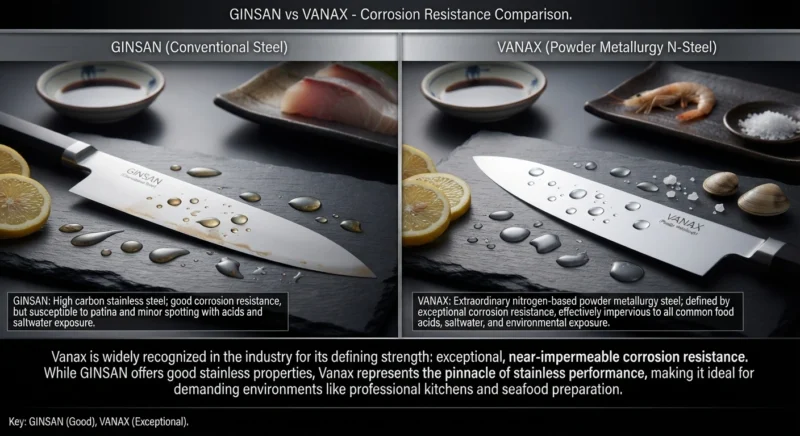
Both steels are stainless and highly corrosion resistant, but Vanax generally has the advantage when corrosion resistance is the highest priority.
Ginsan already performs very well in a kitchen environment.
A properly maintained Ginsan knife should tolerate normal contact with:
- water,
- vegetables,
- fruit,
- meat,
- fish,
- acidic foods,
- and kitchen humidity.
However, stainless does not mean completely immune to corrosion.
Any steel can suffer from problems under sufficiently aggressive conditions.
Vanax takes corrosion resistance much further.
Its composition and microstructure provide exceptional resistance to rust and staining.
This makes it particularly interesting for environments where the knife may experience frequent exposure to water.
For example:
- professional kitchens,
- seafood preparation,
- humid environments,
- outdoor food preparation,
- fishing-related applications,
- and situations where perfect drying is not always practical.
Winner: Vanax
If corrosion resistance is the deciding factor, Vanax is the stronger choice.
Why Corrosion Resistance Matters in a Kitchen Knife
It is easy to underestimate corrosion because a kitchen knife may appear to be exposed only to harmless food.
In reality, food preparation can be surprisingly aggressive toward steel.
Acidic ingredients include:
- lemons,
- limes,
- tomatoes,
- vinegar,
- apples,
- onions,
- and many other fruits and vegetables.
Then there is water.
A knife can be repeatedly exposed to water dozens of times during a single cooking session.
Add salt, food residue, humidity, and inadequate drying, and corrosion becomes a much greater concern.
This is where highly corrosion-resistant steels become attractive.
A knife that requires less maintenance is easier to live with.
Edge Retention: Ginsan vs Vanax
Edge retention is one of the most frequently misunderstood characteristics of knife steel.
People often ask:
Which steel stays sharp longer?
The answer depends on what is causing the edge to become dull.
An edge can lose performance through:
- abrasive wear,
- micro-chipping,
- deformation,
- rolling,
- contact with hard objects,
- or a combination of these factors.
Vanax generally has the advantage in wear resistance and long-term edge retention.
Its powder-metallurgy structure allows it to support a high level of carbide-related wear resistance while maintaining excellent edge performance.
Ginsan offers good edge retention but is not primarily a maximum-wear-resistance steel.
For ordinary kitchen work, however, Ginsan can still hold an edge very well.
A properly heat-treated Ginsan kitchen knife with good geometry may remain impressively sharp through many cooking sessions.
Winner: Vanax
For maximum edge retention, Vanax has the advantage.
Check Our Guide Edge Retention Explained: 10 Factors What Makes a Knife Stay Sharp Longer
Does Better Edge Retention Mean a Better Knife?
Not necessarily.
This is an important distinction.
Imagine two knives.
Knife A stays extremely sharp for a long time but takes significantly more effort to sharpen.
Knife B loses some sharpness sooner but can be restored quickly with a few passes on a sharpening stone.
For someone who enjoys sharpening, Knife B may actually be preferable.
Professional cooks may also value predictable sharpening behavior.
There is no universal definition of the “best” steel.
The best steel is the one whose characteristics match how you actually use your knife.
Toughness: Ginsan vs Vanax
Toughness describes the ability of steel to resist cracking and breaking when subjected to impact or sudden stress.
It is different from hardness.
A very hard steel is not automatically tough.
A tough steel is better able to survive accidental impacts.
In kitchen knives, toughness is important because blades can encounter:
- cutting boards,
- bones,
- frozen food,
- hard vegetable stems,
- twisting forces,
- accidental impacts,
- and improper cutting techniques.
Ginsan has respectable toughness for a stainless knife steel.
Vanax also offers good toughness for a highly wear-resistant powder steel.
The exact result depends heavily on hardness and heat treatment.
If a Vanax blade is hardened aggressively and ground extremely thin, it may behave differently from a thicker, slightly softer blade.
Likewise, Ginsan can be made more or less forgiving depending on how it is heat treated and ground.
General advantage: Vanax
Vanax has an impressive balance of wear resistance and toughness, but Ginsan remains a very practical and forgiving choice for kitchen use.
Check Our Guide Wear Resistance vs Toughness: Understanding the Most Important Knife Steel Trade-Off
Hardness: Ginsan vs Vanax
Hardness is another characteristic that needs context.
Higher hardness can provide:
- better edge retention,
- improved resistance to deformation,
- and the ability to support a thinner edge.
But excessive hardness can also reduce toughness.
Ginsan kitchen knives are commonly heat treated into a range that gives them a good balance between hardness, toughness, and sharpening response.
Vanax is capable of higher hardness levels while retaining useful performance characteristics.
However, the steel’s nominal capability does not tell you what a particular knife will actually be like.
Two knives made from the same steel can feel completely different if their hardness differs.
For example, a relatively soft Vanax knife may not deliver the edge retention expected from the steel.
Likewise, a carefully heat-treated Ginsan blade can perform exceptionally well.
Winner: Depends on heat treatment
The steel specification alone is not enough.
Check Our Guide What Is HRC? Understanding Rockwell Hardness in Kitchen Knives
Sharpening Ginsan
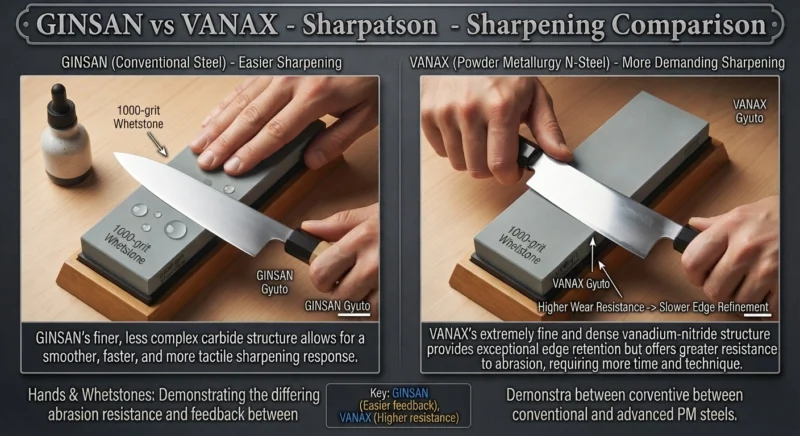
One of Ginsan’s most attractive characteristics is its sharpening behavior.
Compared with many modern high-wear powder steels, Ginsan can feel relatively straightforward on conventional sharpening stones.
It can produce a fine, clean apex.
This is particularly attractive for users who enjoy maintaining their knives themselves.
A good sharpening routine might include:
- a coarse stone for repairs,
- a medium stone for regular sharpening,
- and a fine stone for refining the edge.
Ginsan responds well to controlled sharpening.
It does not require an elaborate sharpening system.
For many home cooks, this is a major advantage.
Sharpening Vanax
Vanax can also be sharpened successfully, but the experience can be different.
Because of its high wear resistance and alloy structure, it may require more patience than Ginsan.
Abrasives matter.
High-quality diamond or other suitable high-performance abrasives can make sharpening much easier.
This does not mean Vanax is impossible to sharpen.
Far from it.
The real issue is that you should not expect a very high-wear powder steel to behave exactly like a simpler stainless steel.
If you are accustomed to traditional Japanese kitchen steels, Vanax may initially feel slower.
Once you adapt your sharpening technique, however, maintaining a Vanax knife becomes much more manageable.
Winner: Ginsan
For ease and pleasant sharpening response, Ginsan has the advantage.
Check Our Guide All Kinds of Knife Sharpening Tools
Edge Stability
Edge stability is particularly important for modern kitchen knives.
It describes how well the fine cutting edge resists damage and deformation.
A knife may have excellent bulk toughness but still suffer from micro-chipping if its edge is extremely thin and hard.
This is where Vanax is impressive.
Its combination of fine microstructure, wear resistance, and good toughness allows it to support very refined edges.
Ginsan can also produce excellent edges.
Its relatively clean sharpening behavior makes it popular for thin Japanese-style kitchen knives.
But when pushed to extreme edge conditions, Vanax can have an advantage.
Winner: Vanax
Cutting Feel: Ginsan vs Vanax
This is where things become more subjective.
Steel is only one part of cutting feel.
Blade geometry is often more important.
A thin Ginsan gyuto can feel dramatically different from a thick Vanax chef’s knife.
The following factors strongly affect cutting feel:
- blade thickness,
- grind geometry,
- edge angle,
- blade height,
- weight,
- balance,
- surface finish,
- and sharpening quality.
Therefore, it is difficult to say that one steel automatically “cuts better.”
However, Ginsan is often appreciated for producing a clean, refined edge.
Vanax can also provide an extremely crisp edge, particularly when properly sharpened.
For users who enjoy the sensation of a finely sharpened Japanese kitchen knife, both can be excellent.
Result: Tie
The knife’s geometry matters more than the steel name alone.
Ginsan for Japanese Kitchen Knives
Ginsan is particularly well suited to Japanese kitchen knife designs.
It works well for:
- Gyuto,
- Santoku,
- Nakiri,
- Petty,
- Bunka,
- Sujihiki,
- and other general-purpose kitchen knives.
Its stainless nature makes it easier to use than traditional reactive carbon steels.
You can cut acidic foods without constantly worrying about immediate patina formation.
For a home cook who wants a Japanese-style knife without demanding maintenance, Ginsan is a very sensible option.
Vanax for Kitchen Knives
Vanax is also highly suitable for kitchen knives.
Its greatest advantage is its ability to combine high corrosion resistance with excellent edge performance.
This can be particularly useful for cooks who want a knife that can handle heavy daily use without demanding much maintenance.
Vanax can be especially attractive for:
- professional kitchens,
- seafood preparation,
- humid environments,
- outdoor kitchens,
- users who dislike patina,
- and people who sharpen infrequently.
It is also interesting for knife makers who want to experiment with modern high-performance blade geometry.
Ginsan vs Vanax for Sushi and Fish Preparation
Fish preparation places unusual demands on a knife.
A sushi or fish knife needs:
- excellent edge sharpness,
- controlled cutting,
- good edge stability,
- corrosion resistance,
- and predictable maintenance.
Both steels can perform very well.
Vanax has an advantage in corrosion resistance, which can be particularly useful when dealing with wet fish repeatedly.
Ginsan, however, offers excellent sharpening behavior and can produce a very refined cutting edge.
For someone who frequently sharpens their knives and values traditional sharpening characteristics, Ginsan remains extremely attractive.
For someone who wants maximum corrosion resistance and long intervals between sharpening, Vanax is compelling.
Slight advantage: Vanax
Especially for wet environments.
Check Our Guide Japanese Fish Knives
Ginsan vs Vanax for Home Cooks
For the average home cook, the difference may be less dramatic than expected.
Most home cooks do not cut enough food every day to fully exploit the maximum wear resistance of Vanax.
A Ginsan knife can remain sharp for a long time under normal household use.
It is also relatively easy to maintain.
For someone who sharpens their knife every few weeks or months, depending on usage, Ginsan can be a very practical choice.
Vanax becomes more attractive when:
- the knife is used heavily,
- maintenance needs to be minimal,
- corrosion resistance is critical,
- or long edge life is a priority.
Winner for simplicity: Ginsan
Winner for maximum performance: Vanax
Ginsan vs Vanax for Professional Chefs
Professional kitchens are different.
A chef may use the same knife for hours every day.
Over weeks and months, differences in edge retention become much more significant.
A knife that stays functional longer can reduce sharpening interruptions.
Corrosion resistance is also important because professional knives can be exposed to water and food continuously.
For these reasons, Vanax can make a lot of sense in professional environments.
But professional chefs have another consideration: sharpening.
A chef who maintains knives frequently may appreciate Ginsan’s easier sharpening behavior.
So the choice often comes down to workflow.
Sharpen frequently and value easy maintenance → Ginsan.
Sharpen less frequently and prioritize long edge life → Vanax.
Ginsan vs Vanax: Maintenance
Both steels are relatively low-maintenance compared with carbon steels.
Nevertheless, “stainless” should never be interpreted as “maintenance-free.”
The best maintenance routine is simple.
After using the knife:
- Rinse away food residue.
- Wash it with mild dish soap.
- Dry it completely.
- Store it safely.
- Avoid leaving it submerged in water.
Do not leave any knife sitting wet overnight.
Even highly corrosion-resistant steels benefit from proper care.
Vanax simply gives you a larger safety margin.
Can Ginsan Rust?
Yes, although it is highly resistant to corrosion.
Stainless steel is corrosion resistant, not corrosion impossible.
Long exposure to:
- salt,
- moisture,
- acidic food,
- chemicals,
- dishwasher detergents,
- and humid environments
can eventually cause problems.
The better the maintenance, the less likely this is to happen.
Can Vanax Rust?
Vanax is exceptionally corrosion resistant.
Under normal kitchen conditions, it is extremely resistant to staining and rust.
However, no steel should be deliberately exposed to corrosive conditions.
Proper care remains recommended.
If your priority is minimizing corrosion risk as much as technically possible, Vanax is one of the most interesting choices available.
Ginsan vs Vanax for a Thin Edge
Thin edges are one of the main reasons people choose high-performance knife steels.
A thinner edge can cut with less resistance.
However, the thinner the edge becomes, the greater the demands placed on the steel.
A good knife steel must resist:
- rolling,
- chipping,
- deformation,
- and premature wear.
Ginsan can support thin edges very well.
Vanax can also support extremely refined edges.
Its edge stability is one of its strengths.
The important factor is that the geometry must match the steel’s properties.
A very thin edge combined with excessive hardness can still chip, regardless of how advanced the steel is.
Ginsan vs Vanax and Edge Angle
Edge angle has a huge influence on performance.
A relatively thick edge at 20 degrees per side can feel very different from a very thin edge at 10–12 degrees per side.
Ginsan performs well with refined kitchen-knife edges.
Vanax can also handle highly refined geometry when properly heat treated.
However, the thinner you go, the more important technique becomes.
Do not judge steel solely by the manufacturer’s or maker’s recommended edge angle.
Your cutting style matters.
Someone who slices vegetables carefully can use a much finer edge than someone who frequently twists the blade through hard food.
Carbides and Why They Matter
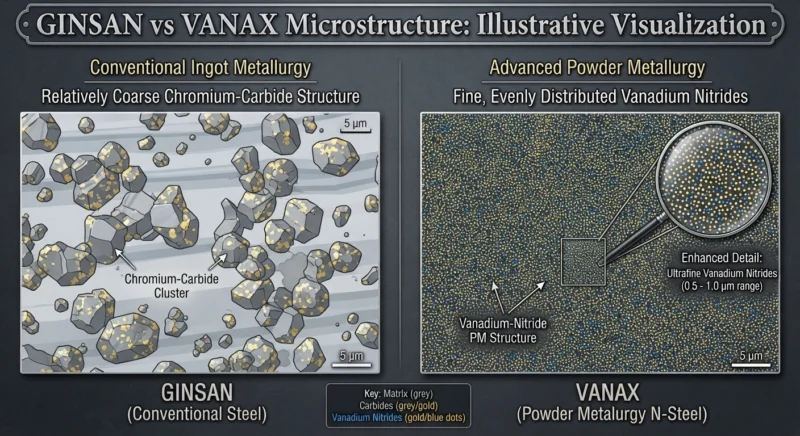
One of the fundamental differences between simpler stainless steels and modern powder steels is their carbide structure.
Carbides are hard particles within the steel matrix.
They can significantly improve wear resistance.
This is one reason high-wear steels stay sharp for longer.
But there is a trade-off.
Large or poorly distributed carbides can interfere with fine edge stability.
Powder-metallurgy technology helps control the distribution and size of these hard phases.
This is part of why modern powder steels can achieve combinations of properties that are difficult to reproduce with older manufacturing methods.
Vanax benefits from this type of controlled microstructure.
Ginsan has a different balance and generally feels more straightforward during sharpening.
Why Powder Metallurgy Matters
Powder metallurgy is more than a marketing term.
Traditional steelmaking involves producing steel in larger molten batches and then processing the resulting material.
Powder metallurgy starts with very fine particles.
These particles can be rapidly solidified and then consolidated.
The result can be a much more uniform microstructure.
This allows alloying elements to be distributed more evenly.
For knife steel, that can provide advantages in:
- carbide distribution,
- wear resistance,
- edge stability,
- consistency,
- and high-alloy performance.
This is one reason modern powder steels can be so impressive.
Check Our Guide Powder Steels for Kitchen Knives
Ginsan vs Vanax: Which Is Easier to Sharpen?
If sharpening is a major consideration, Ginsan wins.
Ginsan generally feels more familiar on conventional water stones.
Vanax may require more abrasive power and patience.
Diamond abrasives can be particularly useful for high-wear steels.
That said, sharpening difficulty should not be exaggerated.
Vanax is not an impossible steel.
It simply rewards using appropriate equipment.
For someone who already has experience with modern powder steels, sharpening Vanax may not be a major concern.
Which Steel Is Better for Beginners?
For a beginner, Ginsan may be the easier choice.
It offers:
- high corrosion resistance,
- good edge retention,
- relatively easy sharpening,
- good toughness,
- and excellent kitchen performance.
It does not require the user to develop advanced maintenance habits.
Vanax is better suited to someone who specifically wants the advantages of modern high-performance steel.
If you are buying your first premium kitchen knife, Ginsan can be an excellent introduction to stainless Japanese-style knife steels.
Which Steel Is Better for Knife Enthusiasts?
This is much harder to answer.
Knife enthusiasts often enjoy sharpening as part of the hobby.
For these users, Ginsan can be extremely satisfying.
The steel responds well to sharpening and can produce a very refined edge.
Vanax appeals to a different type of enthusiast.
It is interesting because it pushes the boundaries of what stainless knife steel can do.
The combination of corrosion resistance, wear resistance, and edge stability is genuinely impressive.
So:
For sharpening enjoyment: Ginsan.
For modern steel performance: Vanax.
Ginsan vs Vanax: Real-World Performance
Laboratory measurements are useful, but kitchen knives are used in the real world.
Consider a normal cooking session.
You prepare:
- onions,
- carrots,
- tomatoes,
- herbs,
- meat,
- fish,
- and fruit.
You wash the knife several times.
You put it down.
You pick it up again.
You wipe it.
You cut more food.
You rinse it.
This is where corrosion resistance becomes useful.
The knife should not require constant attention.
Both Ginsan and Vanax perform well here.
The differences become more obvious over longer periods.
A heavy user may appreciate Vanax’s longer edge life.
A sharpening enthusiast may appreciate Ginsan’s easier maintenance.
Ginsan vs Vanax: Does Vanax Cut Better?
Not automatically.
This is worth repeating because steel comparisons often become misleading.
A knife’s cutting performance depends heavily on geometry.
A thin, well-ground Ginsan knife can outperform a thick Vanax knife.
A poorly sharpened Vanax knife can feel worse than a properly sharpened Ginsan knife.
Important factors include:
- behind-the-edge thickness,
- edge angle,
- grind type,
- blade thickness,
- blade height,
- convexity,
- sharpening quality,
- and cutting technique.
Steel provides the foundation.
Geometry determines how that foundation is used.
Ginsan vs Vanax for Vegetables
Vegetable preparation is one of the best applications for thin Japanese-style knives.
Both steels can perform beautifully.
Ginsan offers:
- excellent edge refinement,
- easy sharpening,
- good corrosion resistance,
- and a clean cutting feel.
Vanax offers:
- excellent edge stability,
- long edge life,
- and exceptional corrosion resistance.
For someone who frequently cuts large amounts of vegetables, Vanax’s wear resistance can become valuable.
For someone who values effortless sharpening and a traditional knife experience, Ginsan may be preferable.
Ginsan vs Vanax for Meat
Meat preparation generally does not demand extreme wear resistance in the same way that abrasive foods can.
Both steels are more than capable.
The more important factors are:
- blade geometry,
- edge stability,
- toughness,
- and edge angle.
If the knife may contact bone, avoid extremely thin edges regardless of steel.
No modern steel can make a delicate kitchen edge immune to abuse.
Ginsan vs Vanax for Acidic Foods
This is another area where both steels perform well.
Acidic foods can be hard on less corrosion-resistant steels.
Tomatoes, citrus, vinegar, and fruit can accelerate staining and patina formation.
Ginsan handles these foods very well.
Vanax goes even further.
If you frequently prepare acidic ingredients and do not want to think about corrosion, Vanax is particularly attractive.
Ginsan vs Vanax: Which Has Better Edge Retention?
Vanax.
But there is an important qualification.
The difference in edge retention becomes much more meaningful with heavy use.
For occasional home cooking, Ginsan’s edge retention may already be more than sufficient.
If you cook every day and use your knife for hours, Vanax’s additional wear resistance becomes more valuable.
Ginsan vs Vanax: Which Has Better Toughness?
Both are capable of good toughness.
Ginsan has a useful balance of hardness and toughness.
Vanax is impressive because it combines high wear resistance with respectable toughness.
In a properly designed kitchen knife, Vanax can provide excellent edge durability.
However, toughness is affected by:
- hardness,
- blade thickness,
- geometry,
- heat treatment,
- and edge angle.
Therefore, it is not accurate to assume that every Vanax knife will automatically be tougher than every Ginsan knife.
Ginsan vs Vanax: Which Is More Stainless?
Vanax.
This is probably the easiest category to decide.
Ginsan is already highly corrosion resistant.
Vanax takes corrosion resistance to an even higher level.
If your number-one concern is avoiding rust and staining, Vanax has the advantage.
Check Our Guide Stainless Steel Myths: The Complete Truth About Modern Knife Steels
Ginsan vs Vanax: Which Is Easier to Sharpen?
Ginsan.
Ginsan is more approachable for traditional sharpening.
Vanax is more demanding because of its wear resistance.
A quality sharpening stone can maintain Ginsan comfortably.
Vanax benefits from more aggressive abrasives, particularly when significant material must be removed.
Ginsan vs Vanax: Which Holds a Finer Edge?
Both can support very fine edges.
The final result depends on:
- heat treatment,
- hardness,
- geometry,
- sharpening technique,
- and the abrasive used.
Ginsan has an excellent reputation for taking a clean, refined edge.
Vanax can also achieve excellent edge stability.
For normal kitchen use, both can produce extremely sharp knives.
Ginsan vs Vanax for Japanese Knife Geometry
Japanese kitchen knives are often ground relatively thin.
That puts additional demands on the steel.
The steel needs to resist deformation while maintaining sufficient toughness.
Ginsan is well suited to this application.
Vanax is also particularly interesting for thin modern blades because its combination of wear resistance and edge stability allows makers to explore very refined geometries.
Again, however, geometry must be appropriate.
A steel cannot compensate for bad grinding.
The Importance of Heat Treatment
If there is one thing to remember from this entire article, it should be this:
Steel type is only part of the equation.
Heat treatment can dramatically affect performance.
The same steel can behave differently depending on:
- austenitizing temperature,
- quenching method,
- cryogenic treatment,
- tempering,
- final hardness,
- and the exact thermal cycle.
Two knives made from the same steel can have noticeably different:
- toughness,
- edge retention,
- sharpening response,
- and edge stability.
Therefore, when comparing two actual knives, you should consider the complete construction rather than only the steel name.
Check Our Guide Different Heat Treatment Methods Explained
Geometry Can Matter More Than Steel
Imagine two chef knives.
The first has:
- thin geometry,
- a clean edge,
- excellent heat treatment,
- and good balance.
The second has:
- thick geometry,
- poor edge refinement,
- and average heat treatment.
Even if the second uses a theoretically superior steel, the first knife may cut much better.
This is why steel comparison charts should never be treated as absolute rankings.
Steel matters.
But knife design matters too.
Ginsan vs Vanax: Maintenance Routine
Regardless of which steel you choose, follow a simple maintenance routine.
After each use
Wash the blade with mild dish soap.
Rinse thoroughly
Remove food residue completely.
Dry immediately
Do not leave the knife wet.
Store safely
Use a knife block, magnetic holder, saya, or another suitable storage method.
Sharpen before it becomes extremely dull
Regular maintenance is easier than repairing a severely dull edge.
Avoid the dishwasher
High temperatures, harsh detergents, water pressure, and contact with other objects can damage both the blade and handle.
Common Mistakes With Stainless Knife Steels
Many users assume that stainless steel can be treated carelessly.
That is a mistake.
Avoid:
- leaving the knife submerged,
- storing it wet,
- cutting directly on glass or stone,
- twisting the edge through hard food,
- cutting frozen products with a thin edge,
- using the knife on bones unless designed for it,
- and sharpening at an uncontrolled angle.
Good steel deserves good technique.
Which Steel Should You Choose?
Now we can answer the practical question.
Choose Ginsan if you want:
- a stainless Japanese-style kitchen knife,
- easy maintenance,
- good sharpening response,
- excellent edge refinement,
- good corrosion resistance,
- balanced performance,
- and a more traditional knife experience.
Choose Vanax if you want:
- exceptional corrosion resistance,
- excellent edge retention,
- high wear resistance,
- strong edge stability,
- modern powder-steel performance,
- and minimal concern about staining or rust.
Ginsan vs Vanax: Pros and Cons
Ginsan Pros
- Excellent corrosion resistance
- Good edge retention
- Very good sharpening response
- Fine edge potential
- Good toughness
- Excellent for Japanese kitchen knives
- Relatively easy maintenance
- Balanced performance
Ginsan Cons
- Does not match Vanax for extreme corrosion resistance
- Does not offer the same level of wear resistance
- Edge may require more frequent sharpening under heavy use
Vanax Pros
- Exceptional corrosion resistance
- Excellent wear resistance
- Excellent edge retention
- Very good edge stability
- Modern powder-metallurgy structure
- Excellent for demanding environments
- Very low maintenance
- Strong performance for high-use kitchen knives
Vanax Cons
- More demanding to sharpen
- May require better abrasives
- Can be unnecessarily advanced for casual users
- Premium performance may not be fully noticeable in light household use
Is Vanax Overkill for a Kitchen Knife?
Sometimes.
For someone who cooks a few times per week, Ginsan may already provide everything they need.
Vanax becomes more useful when you have specific reasons to want its advantages.
For example:
A chef who uses a knife for several hours every day may benefit from the longer edge life.
A seafood specialist working around water may appreciate exceptional corrosion resistance.
A knife enthusiast interested in modern powder steels may value the technical performance.
But if you simply want a reliable stainless kitchen knife, Ginsan can be an excellent choice.
Is Ginsan Outdated Compared With Vanax?
No.
This is another common misconception.
Newer steel does not automatically make older steel obsolete.
Steel development is not a simple progression where every new alloy replaces everything that came before it.
Different steels offer different compromises.
Ginsan remains attractive because of its balance.
It offers the characteristics many kitchen knife users actually want:
- stainless performance,
- good edge retention,
- easy sharpening,
- fine edge capability,
- and practical toughness.
Vanax simply pushes certain characteristics further.
Ginsan vs Vanax: The Best Steel Depends on You
There is no single winner because different users have different priorities.
If you rank your priorities like this:
1. Corrosion resistance
Vanax wins.
2. Edge retention
Vanax wins.
3. Sharpening ease
Ginsan wins.
4. Traditional sharpening feel
Ginsan wins.
5. Fine kitchen edge
Both perform very well.
6. Low maintenance
Vanax wins.
7. Balanced performance
Ginsan is excellent.
8. High-performance modern steel
Vanax wins.
Final Verdict: Ginsan vs Vanax
So, which is better—Ginsan or Vanax?
The answer depends on what you expect from your knife.
Ginsan is the better choice for balance and simplicity.
It offers excellent corrosion resistance, good edge retention, fine edge capability, good toughness, and relatively easy sharpening. For a traditional Japanese-style kitchen knife, it is one of the most practical stainless options.
Vanax is the better choice for maximum corrosion resistance and high-performance edge durability.
It offers exceptional resistance to corrosion together with excellent wear resistance and edge stability. For heavy users, demanding kitchens, wet environments, and knife enthusiasts interested in modern powder metallurgy, it is a fascinating option.
If you rarely sharpen your knife and want it to stay sharp as long as possible, Vanax is likely the better match.
If you enjoy sharpening, want a refined Japanese kitchen knife, and prefer a more balanced steel, Ginsan may be the better choice.
And there is one final point that matters more than the steel name:
A well-designed, properly heat-treated knife will almost always be more satisfying than a poorly made knife using a theoretically superior steel.
Blade geometry, heat treatment, edge angle, sharpening quality, and cutting technique all work together.
The best kitchen knife is not necessarily the one with the most advanced steel.
It is the one that gives you the combination of sharpness, durability, maintenance, cutting feel, and reliability that fits the way you cook.
Ginsan vs Vanax FAQ
Is Vanax better than Ginsan?
Vanax is better in corrosion resistance, wear resistance, and generally edge retention. Ginsan is easier to sharpen and offers a very balanced combination of properties.
Is Ginsan stainless?
Yes. Ginsan is a stainless knife steel with excellent corrosion resistance.
Is Vanax stainless?
Yes. Vanax is an extremely corrosion-resistant stainless powder steel.
Which holds an edge longer?
Vanax generally holds an edge longer because of its higher wear resistance.
Which is easier to sharpen?
Ginsan is generally easier and faster to sharpen.
Which is better for kitchen knives?
Both are excellent. Ginsan is particularly attractive for users who want balance and easy sharpening, while Vanax is attractive for maximum corrosion resistance and long edge life.
Which is better for wet environments?
Vanax has the advantage because of its exceptional corrosion resistance.
Which steel is better for a beginner?
Ginsan is generally easier for a beginner because it is straightforward to maintain and sharpen.
Which steel is better for professional chefs?
Either can work very well. Heavy users who prioritize edge retention and corrosion resistance may prefer Vanax, while chefs who sharpen frequently may prefer Ginsan.
Does Vanax require special sharpening stones?
It can be maintained with conventional sharpening equipment, but high-performance abrasives can make sharpening significantly easier, especially when removing more material.
Can Ginsan take a very sharp edge?
Yes. Properly heat-treated Ginsan can take an excellent fine edge suitable for demanding kitchen work.
Can Vanax take a fine edge?
Yes. Vanax can support a very refined edge when the heat treatment and geometry are appropriate.
Which steel needs less maintenance?
Vanax has the advantage because of its exceptional corrosion resistance and long edge life. However, both steels should be washed and dried after use.
Does steel determine how well a knife cuts?
No. Geometry, edge angle, blade thickness, grind, heat treatment, and sharpening are all extremely important.
Conclusion
Ginsan and Vanax represent two different approaches to stainless knife performance.
Ginsan offers a highly practical balance of corrosion resistance, edge retention, toughness, sharpening response, and fine-edge performance.
Vanax takes several of those characteristics further, especially corrosion resistance and wear resistance, while retaining the edge stability needed for demanding cutting applications.
For a classic, refined stainless kitchen knife, Ginsan remains an excellent choice.
For a modern, low-maintenance, high-performance kitchen knife, Vanax is difficult to ignore.
Ultimately, the right choice comes down to your priorities.
Ginsan: balance, refinement, and easier sharpening.
Vanax: extreme corrosion resistance, high wear resistance, and long-lasting edge performance.
Both can make exceptional kitchen knives when the steel is properly heat treated and paired with good geometry.
This article is for independent informational purposes only and is not affiliated with, sponsored by, or endorsed by any steel manufacturer. All product names, trademarks, and registered trademarks are the property of their respective owners.