Aogami Super vs Vanax
An Independent Guide
When comparing Aogami Super vs Vanax, you are looking at two knife steels that take almost completely different approaches to achieving high performance.
Aogami Super is a traditional Japanese high-carbon steel known for extremely fine edges, high hardness, strong edge retention, and the distinctive cutting characteristics that many Japanese kitchen-knife enthusiasts value.
Vanax is a modern powder-metallurgy stainless steel designed around a very different goal: combine high wear resistance and useful toughness with exceptional corrosion resistance by using a large amount of nitrogen instead of relying primarily on carbon.
Both can produce excellent knives.
But they are excellent for different reasons.
Aogami Super is a steel for someone who is willing to accept maintenance and reactivity in exchange for a very refined cutting edge, high hardness, and the particular sharpening experience of a traditional Japanese carbon steel.
Vanax is aimed at the opposite problem. It is designed for people who want a high-performance blade that can tolerate water, humidity, salt, acidic foods, and demanding environments while still offering strong edge retention.
That creates an interesting question:
Which is better — Aogami Super or Vanax?
There is no universal answer.
For a traditional Japanese kitchen knife where edge feel, sharpening response, and very high hardness are important, Aogami Super can be exceptional.
For someone who wants stainless performance, extreme corrosion resistance, long edge life, and much less maintenance, Vanax is the more practical choice.
This article compares the two steels in detail, including composition, hardness, edge retention, toughness, corrosion resistance, sharpening, cutting feel, edge stability, kitchen use, outdoor use, maintenance, and overall performance.
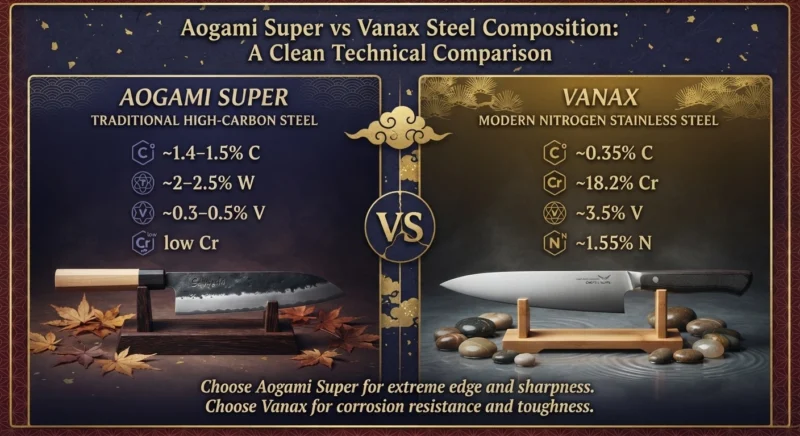
Aogami Super vs Vanax at a Glance
The simplest comparison looks like this:
| Property | Aogami Super | Vanax |
|---|---|---|
| Steel type | High-carbon alloy steel | Nitrogen-alloyed stainless PM steel |
| Carbon | About 1.40–1.50% | About 0.35% |
| Chromium | About 0.30–0.50% | About 18.2% |
| Vanadium | About 0.30–0.50% | About 3.5% |
| Molybdenum | About 0.30–0.50% | About 1.1% |
| Nitrogen | Essentially none | About 1.55% |
| Tungsten | About 2.00–2.50% | None significant |
| Typical hardness | Often around 63–66 HRC in knives | Commonly around 59–62 HRC |
| Corrosion resistance | Low | Extremely high |
| Wear resistance | High for a traditional carbon steel | Very high |
| Edge retention | Excellent | Excellent |
| Toughness | Moderate and strongly dependent on hardness | Good for a high-wear stainless steel |
| Sharpening | Relatively easy for its hardness | Moderate; benefits from good abrasives |
| Fine edge | Exceptional | Excellent |
| Maintenance | High | Very low |
| Patina | Yes | No normal carbon-steel patina |
| Best known for | Fine cutting and traditional Japanese knife performance | Corrosion resistance plus high performance |
| Best applications | Japanese kitchen knives | Kitchen, EDC, outdoor, marine and wet environments |
These figures should not be treated as guarantees for every knife.
Steel composition defines potential, but the finished knife depends heavily on heat treatment, hardness, blade geometry, edge thickness, sharpening angle, and manufacturing quality.
That distinction becomes particularly important when comparing a traditional carbon steel with a modern powder-metallurgy stainless steel.
What Is Aogami Super?
Aogami Super is a high-carbon Japanese knife steel designed to provide very high hardness and excellent cutting performance.
Its published composition is approximately:
- Carbon: 1.40–1.50%
- Tungsten: 2.00–2.50%
- Chromium: 0.30–0.50%
- Vanadium: 0.30–0.50%
- Molybdenum: 0.30–0.50%
- Manganese: 0.20–0.30%
- Silicon: 0.10–0.20%
Phosphorus and sulfur are kept very low.
The chemistry tells you immediately that Aogami Super is very different from stainless powder steels.
It contains a lot of carbon.
It contains a significant amount of tungsten.
It contains small additions of vanadium and molybdenum.
But it contains very little chromium.
That last point is critical.
Aogami Super is not stainless steel.
The chromium level is far too low to provide the chromium-rich passive layer associated with stainless steels.
Instead, the steel is designed primarily around hardness, carbide formation, edge retention, and fine cutting performance.
That is one reason Aogami Super has such a strong reputation among Japanese kitchen-knife enthusiasts.
Check Our Guide Aogami Super Steel
What Is Vanax?
Vanax is a modern nitrogen-alloyed powder-metallurgy stainless steel.
Its approximate composition is:
- Carbon: 0.35%
- Chromium: 18.2%
- Vanadium: 3.5%
- Molybdenum: 1.1%
- Nitrogen: 1.55%
The unusual feature is the very high nitrogen content combined with relatively low carbon.
This is not simply a conventional stainless steel with some nitrogen added.
The nitrogen is fundamental to the design.
A large portion of the carbon found in conventional high-wear stainless steels is replaced by nitrogen.
That helps preserve a large amount of chromium in the steel matrix, which is extremely important for corrosion resistance.
At the same time, nitrogen participates in forming very hard vanadium-rich nitrides and carbonitrides.
The result is a steel that combines:
- extremely high corrosion resistance
- strong wear resistance
- useful toughness
- high edge retention
- good performance at thin geometries
The combination is unusual.
Check Our Guide Vanax Steel Review
The Fundamental Difference Between Aogami Super and Vanax
The easiest way to understand the comparison is to look at what each steel is trying to accomplish.
Aogami Super
High carbon + tungsten + vanadium + high hardness
The goal is excellent cutting performance and edge retention in a traditional carbon-steel system.
Vanax
High chromium + nitrogen + vanadium + powder metallurgy
The goal is to provide high performance while retaining extremely strong corrosion resistance.
So the basic philosophy is almost opposite.
Aogami Super accepts corrosion and maintenance in order to maximize traditional carbon-steel characteristics.
Vanax is designed specifically to eliminate corrosion as a major weakness while retaining high-performance characteristics.
Carbon: Aogami Super vs Vanax
Carbon is one of the biggest differences.
Aogami Super contains approximately 1.40–1.50% carbon.
Vanax contains approximately 0.35% carbon.
That is a huge difference.
Carbon contributes to:
- hardness
- carbide formation
- wear resistance
- edge retention
- martensitic strength
Aogami Super’s high carbon content is one reason it can achieve very high hardness.
Vanax takes a different route.
Instead of relying on extremely high carbon, it uses nitrogen as an important alloying element.
This is one of the most interesting aspects of Vanax metallurgy.
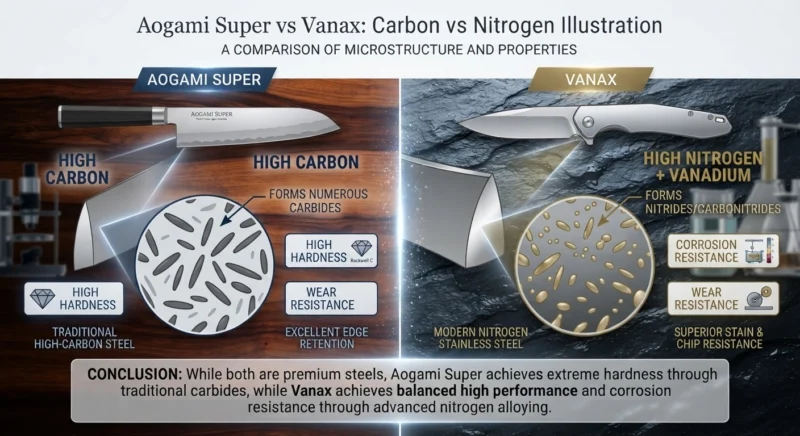
Nitrogen: The Secret Behind Vanax
Nitrogen is the element that makes this comparison particularly interesting.
Vanax contains approximately 1.55% nitrogen.
That is an exceptionally high nitrogen level for a knife steel.
Nitrogen can contribute to hardness and can participate in the formation of hard nitrides and carbonitrides.
But its most important role in Vanax is connected to corrosion resistance.
Nitrogen behaves differently from carbon when interacting with chromium.
A large amount of carbon in a highly alloyed stainless steel can tie up chromium in chromium carbides.
That can reduce the amount of chromium available in the steel matrix for corrosion resistance.
Nitrogen allows the steel designer to obtain hardness and hard particles while keeping a larger amount of chromium available in solution.
This is a major reason Vanax can achieve such unusual corrosion resistance.
Metallurgical analysis of Vanax shows that the use of nitrogen allows significantly more chromium to remain in solution compared with similar high-chromium steels.
That is the foundation of its stainless performance.
Chromium: The Biggest Corrosion Difference
Aogami Super contains only about 0.30–0.50% chromium.
Vanax contains approximately 18.2% chromium.
There is no meaningful contest here.
Vanax is vastly more corrosion resistant.
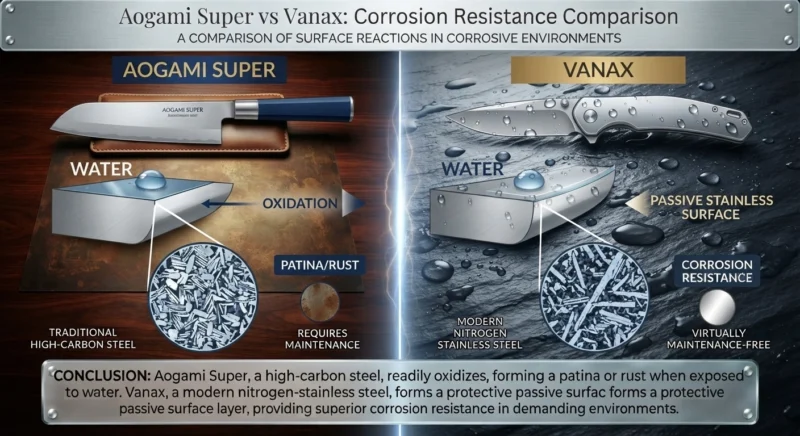
Aogami Super is a reactive carbon steel.
Vanax is an extremely corrosion-resistant stainless steel.
That difference affects almost every aspect of ownership.
Aogami Super should be wiped and dried after use.
It should not be left wet.
Acidic foods can quickly produce discoloration.
Salt and moisture can accelerate corrosion.
Vanax is much more forgiving.
It can tolerate wet environments, salty conditions, acidic foods, and humidity far better.
This is one of the biggest reasons to choose Vanax.
Does Aogami Super Rust?
Yes.
Aogami Super is not stainless.
It will develop a patina during normal use, especially when cutting acidic foods.
A patina is not necessarily a defect.
Many knife enthusiasts actually appreciate the appearance of a natural patina.
But there is a difference between a stable patina and active rust.
A patina can be a thin, relatively stable surface oxide layer.
Rust is a more aggressive corrosion process.
If an Aogami Super blade is left wet or contaminated with food residue for too long, corrosion can progress beyond simple patination.
Therefore:
Aogami Super requires active maintenance.
Does Vanax Rust?
Vanax is designed for extremely high corrosion resistance.
Its approximately 18.2% chromium content, combined with its nitrogen-rich chemistry, gives it an unusually large corrosion-resistance margin.
It should still be cleaned and maintained like any quality knife.
“Stainless” does not mean that a blade can be abused indefinitely.
But compared with Aogami Super, the difference is enormous.
You can use Vanax around:
- water
- salt
- acidic foods
- humidity
- sweat
- outdoor moisture
with dramatically less concern.
For users who dislike carbon-steel maintenance, this alone can make Vanax the obvious choice.
Hardness: Aogami Super vs Vanax
This is another major difference.
Aogami Super is commonly hardened to approximately 63–66 HRC in high-performance kitchen knives.
Vanax is generally used around 59–62 HRC.
That does not mean Aogami Super is automatically “better.”
Hardness is only one property.
Higher hardness can improve:
- edge stability
- wear resistance
- resistance to edge deformation
But it can also reduce tolerance to impact and lateral stress.
Vanax’s lower typical hardness is intentional.
The steel is designed around a balance between:
- corrosion resistance
- wear resistance
- toughness
- edge retention
- thin-edge stability
Its heat-treatment response is also different because of the high chromium and nitrogen content. Metallurgical testing has found that Vanax generally tops out around the low-60s HRC rather than reaching the extreme hardness levels possible with some high-carbon knife steels.
Check Our Guide What Is HRC? Understanding Rockwell Hardness
Is Aogami Super Harder Than Vanax?
Usually, yes.
A well-made Aogami Super kitchen knife is often several HRC points harder than a typical Vanax knife.
But this should not automatically be interpreted as:
Aogami Super = better edge.
The real relationship is more complicated.
Vanax’s powder-metallurgy structure, vanadium nitrides, high chromium in solution, and nitrogen chemistry allow it to perform extremely well despite its lower hardness.
This is one of the reasons Vanax is such an interesting steel.
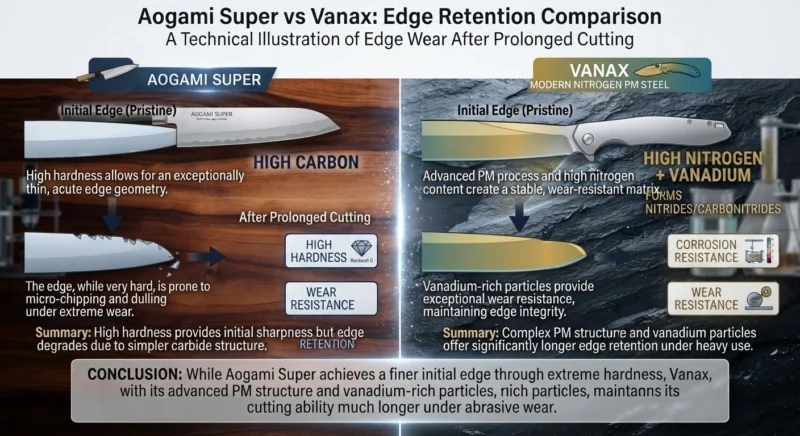
Edge Retention
This is one of the hardest categories to declare a simple winner.
Aogami Super has excellent edge retention for a traditional Japanese carbon steel.
Its high carbon content, tungsten, vanadium, and high achievable hardness allow it to maintain a fine cutting edge for a long time.
Vanax also has excellent edge retention.
It combines high hardness with substantial vanadium-containing hard particles and a fine powder-metallurgy structure.
So which holds an edge longer?
For pure abrasive wear resistance:
Vanax can be extremely competitive.
For a very hard, thin Japanese kitchen edge:
Aogami Super can deliver exceptional practical edge life.
The result depends heavily on the knife’s geometry and hardness.
A 65 HRC Aogami Super blade with a very thin edge can behave very differently from a 60 HRC Vanax blade with a thicker geometry.
Check Our Guide Edge Retention Explained: 10 Factors What Makes a Knife Stay Sharp Longer
Aogami Super Edge Retention
Aogami Super is famous for edge retention.
That reputation is deserved.
Compared with simpler carbon steels, the combination of high carbon and alloy additions allows Aogami Super to retain its working edge for a long time.
The tungsten and vanadium contribute to the formation of hard carbides.
The high hardness further improves resistance to edge deformation and wear.
For kitchen work, this can mean a knife remains extremely effective through extended cutting sessions.
But edge retention is not simply about how long the knife stays “razor sharp.”
A kitchen knife can lose some apex sharpness while still cutting extremely well.
This is especially true when the blade has excellent geometry.
Vanax Edge Retention
Vanax also has strong edge retention.
Its approximately 3.5% vanadium is important here.
Vanadium forms extremely hard nitrides and carbonitrides.
The powder-metallurgy process also helps produce a fine and relatively uniform microstructure.
Research on Vanax microstructure has shown significantly smaller particles than some comparable high-alloy steels, which is important for edge stability and overall performance.
The result is a steel that can hold a fine edge while also offering extremely high corrosion resistance.
That combination is one of its biggest strengths.
Toughness
Toughness measures resistance to cracking and fracture under stress.
This is different from hardness.
Aogami Super can reach very high hardness.
That makes it excellent for cutting performance.
But at very high hardness, it should not be treated as a tough, impact-resistant steel.
The thinner and harder the edge becomes, the more important correct use becomes.
Vanax has an advantage here.
Its powder-metallurgy structure and lower carbon content allow it to maintain useful toughness despite high wear resistance.
It is not an ultra-tough steel designed specifically for heavy impact.
But for a highly wear-resistant stainless steel, its toughness is quite respectable.
Which Is Tougher?
For comparable knife applications:
Vanax generally has the toughness advantage.
This becomes particularly relevant when the blade may encounter:
- lateral forces
- harder materials
- outdoor use
- accidental impacts
- thinner edges
- less controlled cutting
Aogami Super should be treated more carefully.
That does not mean it is fragile.
A properly heat-treated Aogami Super knife can be extremely reliable.
But its high hardness means you should respect its limitations.
Edge Stability
Edge stability is especially important when comparing these two steels.
A knife can have excellent edge retention but still fail if the apex chips or deforms easily.
Aogami Super benefits from:
- high hardness
- fine carbide structure
- fine grain
- excellent heat treatment potential
This allows very thin edges to remain highly effective.
Vanax benefits from:
- fine PM structure
- very fine vanadium-rich nitrides
- useful toughness
- high corrosion resistance
- controlled hardness
Both can support excellent edge stability.
But they get there differently.
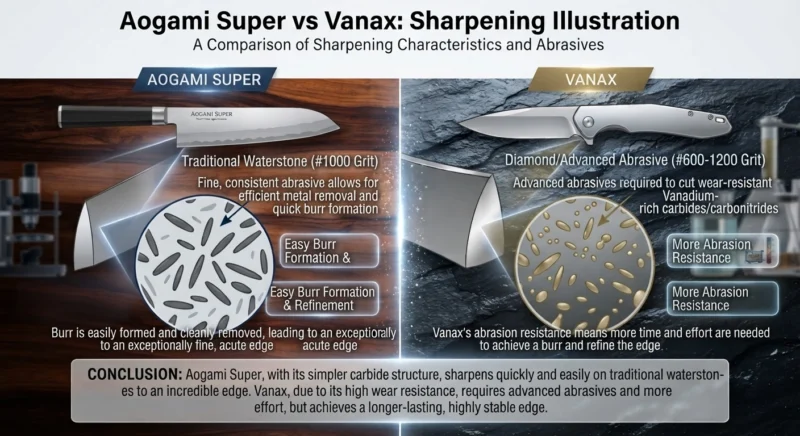
Sharpening Aogami Super
Aogami Super is one of the steels that makes traditional Japanese sharpening especially enjoyable.
Despite its high hardness, it generally responds well to quality waterstones.
The steel has enough wear resistance to hold an edge for a long time, but it is nowhere near as resistant to abrasive removal as some extremely high-carbide powder steels.
This creates a very satisfying sharpening cycle.
You can:
- Establish the bevel.
- Refine the apex.
- Remove the burr.
- Polish or leave a toothier finish.
- Produce an extremely sharp edge.
The feedback from the stone can be very good.
This is one of the reasons Aogami Super is so popular among people who enjoy sharpening.
Sharpening Vanax
Vanax is also sharpenable.
But the experience is different.
Its hard vanadium-rich nitrides mean that abrasive selection matters.
A good sharpening stone can work, but a high-quality abrasive system can make the process considerably easier.
Diamond abrasives can be particularly useful when dealing with high-wear PM steels.
The important thing is not to think of Vanax as “impossible to sharpen.”
It isn’t.
It simply rewards a more capable sharpening system.
The good news is that Vanax does not require frequent sharpening because of its strong edge retention.
Which Is Easier to Sharpen?
Aogami Super.
For someone who enjoys traditional whetstones, Aogami Super is the more natural choice.
Vanax requires more abrasive effort, particularly when significant metal removal is necessary.
However, the difference should not be exaggerated.
Vanax is still much more manageable than some of the most wear-resistant powder steels.
Its fine microstructure helps keep the sharpening experience relatively civilized for a high-performance stainless steel.
Check Our Guide All Kinds of Knife Sharpening Tools
Which Takes a Finer Edge?
Both can take extremely fine edges.
But Aogami Super has a special reputation here.
The combination of high hardness, fine grain, and relatively controlled carbide structure makes it possible to create an exceptionally refined apex.
This is especially noticeable in Japanese kitchen knives.
Vanax can also produce a very fine edge.
Its fine PM structure and relatively small hard particles are beneficial.
However, the subjective sharpening feel can be different.
Aogami Super often feels more traditional.
Vanax feels more modern.
Cutting Feel
This is where specifications become less useful.
Cutting feel depends on:
- edge angle
- blade thickness
- thickness behind the edge
- blade geometry
- hardness
- sharpening finish
- carbide/nitride structure
- food being cut
Aogami Super is often associated with a very aggressive, clean cutting feel.
A thin blade can pass through vegetables with very little resistance.
It can also produce a distinctive “bite” that many cooks appreciate.
Vanax can be just as sharp.
But its greatest advantage is not a particular traditional feel.
Its advantage is that it can provide excellent cutting performance without requiring carbon-steel maintenance.
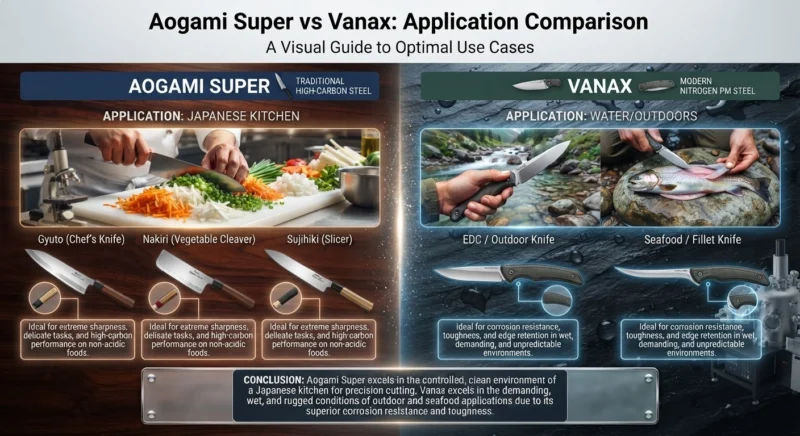
Aogami Super for Japanese Kitchen Knives
This is the environment where Aogami Super makes the most sense.
It works beautifully in:
- Gyuto
- Santoku
- Bunka
- Nakiri
- Petty
- Sujihiki
- single-bevel knives
The steel’s high hardness allows thin geometry.
Its edge retention is excellent.
Its sharpening response is rewarding.
And its ability to take a highly refined edge is one of its defining characteristics.
For a serious home cook or professional who enjoys traditional Japanese knife maintenance, Aogami Super can be extremely satisfying.
Check Our Guide Japanese Fish Knives
Vanax for Kitchen Knives
Vanax is a fascinating alternative for someone who wants Japanese-style performance without carbon-steel maintenance.
It can be used in:
- chef knives
- gyuto-style blades
- slicers
- utility knives
- vegetable knives
- seafood knives
The main advantage is obvious.
You can have a very high-performance blade without constantly worrying about moisture and patina.
That is particularly useful for people who:
- cook acidic foods
- work around water
- do not enjoy maintaining carbon steel
- want a knife that can be left wet briefly without immediate consequences
- want long edge retention
Aogami Super vs Vanax for Professional Kitchens
Professional kitchens are demanding environments.
Knives may be used continuously.
They may be washed frequently.
They may encounter:
- water
- acids
- salt
- food residue
- cleaning chemicals
- busy work conditions
Aogami Super can perform exceptionally well in a professional kitchen, but it demands discipline.
The blade should be wiped and dried frequently.
It should not be left sitting wet.
Vanax is much more forgiving.
For a professional who prioritizes performance but does not want to think about corrosion every few minutes, Vanax has a major practical advantage.
Aogami Super vs Vanax for Home Cooks
This is more subjective.
If you enjoy:
- sharpening
- patina
- traditional Japanese knives
- high hardness
- thin edges
then Aogami Super can be extremely rewarding.
If you want:
- low maintenance
- stainless performance
- high edge retention
- easy cleanup
- resistance to acidic foods
then Vanax is more convenient.
The choice is really about personality as much as metallurgy.
Aogami Super vs Vanax for Outdoor Knives
For outdoor use, Vanax has a major advantage.
Outdoor knives encounter unpredictable conditions.
They may be exposed to:
- rain
- sweat
- humidity
- saltwater
- mud
- wet vegetation
- blood
- food
- condensation
Aogami Super can perform extremely well as a cutting steel, but corrosion becomes a serious consideration.
Vanax is far better suited to these conditions.
Its corrosion resistance is one of its defining advantages.
Check Our Guide How to Maintain an Outdoor Knife
Aogami Super vs Vanax for EDC
For everyday carry, Vanax is generally the more practical steel.
An EDC knife spends a lot of time in contact with:
- sweat
- humidity
- pockets
- lint
- moisture
And many users do not sharpen their EDC knife frequently.
Vanax’s combination of corrosion resistance and edge retention is ideal for this environment.
Aogami Super would be a more unusual choice.
It could certainly work.
But you would need to be much more careful about maintenance.
Corrosion Resistance: The Biggest Winner
If there is one category where the result is absolutely clear:
Vanax wins by a huge margin.
Aogami Super has approximately 0.3–0.5% chromium.
Vanax has approximately 18.2%.
More importantly, Vanax’s nitrogen chemistry helps keep chromium available in the steel matrix.
This is one of the fundamental reasons nitrogen-containing stainless steels can achieve unusual corrosion resistance.
For wet environments, the difference is enormous.
Can Aogami Super Be Made Stainless?
No.
Not through ordinary heat treatment.
Aogami Super’s chemistry simply does not contain enough chromium to behave as a stainless steel.
Some Aogami Super kitchen knives are clad in stainless steel.
That reduces maintenance on the sides of the blade.
But the exposed cutting edge is still Aogami Super.
Therefore, the edge itself can still patina and rust.
This is an important distinction when buying a clad Japanese knife.
Vanax and Saltwater
Vanax is particularly interesting in marine environments.
Saltwater is one of the most aggressive environments for knife steels.
Many stainless steels that perform well in the kitchen can still develop corrosion when exposed to saltwater for extended periods.
Vanax was specifically designed around extremely high corrosion resistance.
Its nitrogen-rich chemistry allows a high level of chromium to remain available for corrosion protection.
That makes it one of the most interesting choices for:
- fishing knives
- marine knives
- diving-related cutting tools
- coastal EDC
- wet outdoor environments
Aogami Super is almost the opposite.
Saltwater exposure is something you would want to avoid.
Wear Resistance
Wear resistance is another category where both steels perform well, but for different reasons.
Aogami Super obtains much of its wear resistance from:
- high carbon
- tungsten
- vanadium
- high hardness
Vanax obtains it from:
- vanadium
- nitrogen
- carbon
- hard nitrides and carbonitrides
- powder metallurgy
- high hardness
Vanax’s hard particle structure is particularly interesting because the particles can remain very fine.
This helps balance wear resistance with edge stability.
Check Our Guide Wear Resistance vs Toughness: Understanding the Most Important Knife Steel Trade-Off
Which Has Better Wear Resistance?
This is a closer comparison than corrosion resistance.
Vanax is a modern high-wear PM stainless steel.
Aogami Super has very good wear resistance for a traditional Japanese carbon steel.
In abrasive cutting, Vanax can have the advantage.
But in a kitchen knife, the difference may be less obvious because geometry and hardness have such a strong influence on cutting performance.
A very thin Aogami Super edge can feel extremely aggressive even if the steel does not have the same theoretical wear resistance as Vanax.
Why Hardness Isn’t Everything
Suppose you have:
Aogami Super at 65 HRC
and
Vanax at 61 HRC.
It is tempting to assume that Aogami Super will automatically hold its edge longer.
That is not necessarily true.
Vanax contains a much larger amount of vanadium and a unique nitrogen-rich microstructure.
The type, size, and distribution of hard particles matter.
So does the amount of chromium in solution.
And so does the geometry.
Knife performance is a system.
Not a single number.
Edge Geometry: A Critical Factor
Imagine two blades:
Knife A
Aogami Super
65 HRC
Very thin behind the edge
12° per side
Knife B
Vanax
61 HRC
Much thicker behind the edge
17° per side
Even if Vanax has superior corrosion resistance and excellent wear resistance, Knife A may feel dramatically more capable when slicing vegetables.
This is why steel comparisons should always be interpreted in the context of the finished knife.
Geometry can matter more than steel choice for the first few millimeters behind the edge.
Thin Edges and Aogami Super
Aogami Super is particularly well suited to thin Japanese geometry.
Its high hardness allows the edge to resist deformation.
Its fine structure allows a highly refined apex.
That combination produces the cutting performance that Japanese kitchen knives are famous for.
But there is a limit.
Extremely thin, extremely hard edges can chip.
This is why you should not:
- twist the knife in hard food
- cut bones
- cut frozen food
- pry
- use glass or ceramic cutting boards
- chop aggressively with a delicate edge
Aogami Super rewards controlled cutting.
Thin Edges and Vanax
Vanax is also capable of very thin edges.
In fact, the steel’s toughness and fine PM structure make thin geometry one of its attractive applications.
The steel was specifically investigated for thin kitchen-knife edges because of its unusual combination of corrosion resistance, hardness, toughness, and wear resistance.
That makes Vanax a very interesting modern alternative to traditional carbon steels.
You can have a thin, high-performance edge without the corrosion concerns associated with Aogami Super.
Chipping
Chipping is not simply a property of the steel.
It depends on:
- hardness
- heat treatment
- edge angle
- thickness behind the edge
- carbide/nitride structure
- cutting technique
- impact
Aogami Super at 65 HRC should be treated carefully.
Vanax at around 60–62 HRC generally offers more tolerance.
Neither steel should be considered indestructible.
Aogami Super vs Vanax for Sharpening Enthusiasts
This is where I would strongly favor Aogami Super.
If you enjoy sharpening knives, Aogami Super provides an extremely satisfying experience.
You can feel the steel responding to the stone.
The high hardness means it takes a little more work than simpler carbon steels, but the result can be spectacular.
A well-sharpened Aogami Super blade can develop an extremely refined edge.
Vanax is more utilitarian in this regard.
It sharpens well enough, but it is not the steel I would choose primarily because I enjoy sharpening.
I would choose Vanax because I want the blade to stay sharp and remain corrosion resistant.
Aogami Super vs Vanax for Low Maintenance
This category has an obvious winner:
Vanax.
Aogami Super needs attention.
Vanax largely does not.
With Aogami Super:
Cut → wipe → dry → occasionally oil or otherwise protect the blade.
With Vanax:
Cut → wash → dry.
That difference becomes particularly important for people who use knives every day.
Patina: Aogami Super vs Vanax
Aogami Super can develop a beautiful patina.
The patina may range from:
- gray
- blue-gray
- purple
- brown
- dark gray
depending on the food, environment, and steel surface.
Many knife enthusiasts consider patina part of the personality of carbon steel.
Vanax does not behave that way.
It is designed to remain highly corrosion resistant and visually stable.
So this becomes a matter of preference.
Aogami Super
Character + patina + traditional feel
Vanax
Clean appearance + stainless convenience
Aogami Super vs Vanax: Which Has Better Cutting Feel?
This is subjective.
But if the comparison is about traditional Japanese kitchen-knife feel, I would give the advantage to Aogami Super.
The combination of high hardness, thin geometry, and sharpening response creates a very distinctive experience.
Vanax can be just as sharp.
It can cut beautifully.
But it feels like a modern engineering solution.
Aogami Super feels like a traditional knife steel optimized for the craft of cutting.
Which Steel Is Better for a Gyuto?
For a traditional Japanese gyuto:
Aogami Super is an excellent choice.
It is especially attractive if:
- you enjoy sharpening
- you want a high-hardness blade
- you want excellent edge retention
- you appreciate patina
- you are comfortable with maintenance
Vanax becomes attractive if:
- you want stainless performance
- you work around water
- you want less maintenance
- you want long edge life
- you want a modern steel in a Japanese-style geometry
Both can be excellent.
Which Steel Is Better for a Nakiri?
Aogami Super has a particularly strong case for a nakiri.
Nakiri knives are often used with very thin geometry and controlled vegetable cutting.
Aogami Super’s high hardness and fine edge make it excellent for this purpose.
Vanax is also excellent, especially for users who want a low-maintenance stainless alternative.
The choice is largely about maintenance philosophy.
Check Our Guide Santoku vs Nakiri: Which Japanese Kitchen Knife Is Better?
Which Steel Is Better for a Slicer?
For a slicing knife, both can work extremely well.
Aogami Super offers:
- high hardness
- fine edge
- excellent bite
- traditional sharpening response
Vanax offers:
- corrosion resistance
- edge retention
- thin-edge stability
- low maintenance
For a professional environment with lots of water and food acids, Vanax may be more practical.
For a home enthusiast who enjoys sharpening, Aogami Super may be more rewarding.
Which Steel Is Better for Fish?
This depends on the environment.
For a dry kitchen:
Aogami Super can be fantastic.
For a wet seafood environment:
Vanax has a major advantage.
Fish preparation involves water and sometimes salt.
A stainless steel with extremely high corrosion resistance is therefore particularly attractive.
If you are processing seafood near the ocean, the advantage becomes even more significant.
Check Our Guide How to Prepare Fish for Sushi, Sashimi & Ceviche
Which Steel Is Better for Hunting?
Vanax.
The reasons are straightforward:
- corrosion resistance
- wet-environment tolerance
- edge retention
- useful toughness
- low maintenance
Aogami Super can certainly make a very effective outdoor knife, but it requires considerably more care.
For a knife that may get wet, dirty, and neglected, Vanax is the safer choice.
Which Steel Is Better for EDC?
Again:
Vanax.
An EDC knife should ideally tolerate being forgotten in a pocket for a while.
Sweat and humidity are unavoidable.
Vanax’s corrosion resistance is particularly useful.
Aogami Super would require much more discipline.
Which Steel Is Better for a Knife Maker?
The answer depends on the type of knife being produced.
Aogami Super makes sense when producing:
- traditional Japanese kitchen knives
- high-hardness blades
- thin cutting tools
- blades intended for enthusiasts
Vanax makes sense when producing:
- premium stainless knives
- EDC knives
- outdoor knives
- marine knives
- high-performance kitchen knives
- low-maintenance cutting tools
The steel selection should follow the intended use.
Heat Treatment Matters
This point deserves emphasis.
Two knives made from Aogami Super can perform very differently.
Two knives made from Vanax can also perform differently.
Heat treatment determines:
- hardness
- retained austenite
- carbide/nitride structure
- edge stability
- toughness
- wear resistance
Vanax is particularly sensitive to heat-treatment details because its high chromium and nitrogen chemistry produces a different transformation behavior from conventional carbon steels.
Aogami Super also benefits enormously from correct thermal processing.
So when comparing two actual knives, do not assume the steel name tells the whole story.
Check Our Guide Different Heat Treatment Methods Explained
Aogami Super and Retained Austenite
At very high hardness, heat treatment becomes particularly important.
Aogami Super can reach very high hardness, but the final structure depends on:
- austenitizing temperature
- quenching
- tempering
- cooling conditions
- cryogenic treatment where appropriate
Too much retained austenite can affect edge stability and hardness.
This is another reason that two knives made from the same steel can behave differently.
Vanax and Retained Austenite
Vanax has an unusual heat-treatment response.
Its high chromium content in solution lowers the martensite-start temperature.
Nitrogen also affects transformation behavior.
This means the steel does not behave like a conventional high-carbon steel.
Careful heat treatment is therefore important to obtain the desired balance of hardness and toughness.
Studies of Vanax heat treatment have demonstrated that its practical hardness range is influenced strongly by chromium in solution and nitrogen content.
Corrosion vs Edge Retention
One of the reasons Vanax is so interesting is that traditionally there has been a tradeoff between corrosion resistance and wear resistance.
Very corrosion-resistant steels often have modest edge retention.
Very wear-resistant steels can contain large amounts of carbide-forming elements that reduce corrosion resistance.
Vanax attempts to solve this problem using nitrogen.
It provides:
very high corrosion resistance + useful wear resistance + good edge stability.
That is the central idea behind the steel.
Aogami Super takes the opposite route.
It accepts corrosion in exchange for an excellent carbon-steel cutting profile.
Is Vanax Better Than Aogami Super?
If “better” means:
- more corrosion resistant
- lower maintenance
- more versatile in wet conditions
- better for EDC
- better for outdoor use
then Vanax wins.
If “better” means:
- higher achievable hardness
- traditional Japanese sharpening
- refined cutting feel
- excellent fine-edge performance
- carbon-steel character
then Aogami Super wins.
So the question is really about priorities.
Is Aogami Super More Premium?
Not necessarily.
“Premium” is not a metallurgical performance category.
Aogami Super is a premium traditional carbon knife steel.
Vanax is a premium modern powder-metallurgy stainless steel.
They represent different technological philosophies.
Comparing them by asking which one is “more premium” is less useful than asking what you want from the knife.
Aogami Super vs Vanax: Maintenance Comparison
| Maintenance factor | Aogami Super | Vanax |
|---|---|---|
| Wipe after cutting | Very important | Recommended |
| Dry after washing | Essential | Recommended |
| Patina | Expected | Minimal |
| Rust risk | High if neglected | Very low |
| Acidic foods | Can cause rapid discoloration | Highly resistant |
| Saltwater | Poor choice | Excellent choice |
| Long-term storage | Needs protection | Much easier |
| Sharpening frequency | Moderate | Moderate |
| Sharpening difficulty | Relatively easy for its hardness | Moderate |
If you want a knife that you can use without thinking about corrosion, Vanax is dramatically easier.
Aogami Super vs Vanax: Performance Comparison
| Category | Winner |
|---|---|
| Corrosion resistance | Vanax |
| Edge retention | Very close; depends on heat treatment and geometry |
| Wear resistance | Vanax |
| Maximum hardness | Aogami Super |
| Sharpening ease | Aogami Super |
| Fine edge | Aogami Super |
| Cutting feel | Aogami Super |
| Toughness | Vanax |
| Thin-edge stability | Both excellent |
| Low maintenance | Vanax |
| Traditional Japanese knives | Aogami Super |
| Wet environments | Vanax |
| Marine use | Vanax |
| EDC | Vanax |
| Sharpening enthusiasts | Aogami Super |
Aogami Super vs Vanax for Edge Retention: A More Careful Answer
This deserves special attention because it is easy to oversimplify.
If you search for knife-steel rankings, you may see Aogami Super and Vanax separated by a large number.
But laboratory edge-retention results depend on the test.
The cutting medium matters.
The edge angle matters.
The hardness matters.
The geometry matters.
The abrasive matters.
The sharpening finish matters.
So I would not claim that one steel universally holds an edge twice as long as the other.
A better conclusion is:
Both provide strong edge retention, but they achieve it differently.
Aogami Super gets there through high carbon, alloy carbides, high hardness, and fine Japanese knife geometry.
Vanax gets there through high vanadium content, nitrogen-rich hard particles, powder metallurgy, and strong stainless performance.
Why Vanax Can Be So Corrosion Resistant
The key is not simply “18% chromium.”
Many stainless steels contain around 18% chromium.
The special feature is how the alloying elements interact.
In high-carbon stainless steels, carbon can combine with chromium to form chromium carbides.
That reduces the amount of chromium available in the matrix.
Vanax replaces much of the carbon with nitrogen.
Nitrogen forms hard vanadium-rich nitrides and carbonitrides while allowing more chromium to remain in solution.
That is one reason Vanax can achieve extremely strong corrosion resistance while retaining high wear resistance.
Why Aogami Super Sharpens So Well
Aogami Super has a relatively traditional alloy structure.
It does contain hard alloy carbides.
But compared with many modern high-wear powder steels, it remains relatively approachable on conventional sharpening stones.
Its high hardness is balanced by its relatively manageable carbide structure.
The result is a knife that can stay sharp for a long time while still being pleasant to sharpen.
That is a rare combination.
Which Steel Is Better for a Beginner?
It depends on the type of beginner.
Beginner who wants simplicity:
Vanax.
You do not have to worry nearly as much about rust.
Beginner who wants to learn traditional sharpening:
Aogami Super.
It can teach you how to maintain a high-performance carbon-steel knife.
But it requires discipline.
If you frequently forget to dry knives, Vanax is the safer choice.
Which Steel Is Better for a Professional Sharpener?
Aogami Super is more enjoyable if the goal is the sharpening experience itself.
Vanax is more interesting if the goal is learning how to sharpen modern PM stainless steels.
Both can be excellent projects for someone who enjoys sharpening.
The difference is that Vanax demands more respect for abrasive selection.
Aogami Super vs Vanax and Blade Thickness
Steel choice cannot compensate for bad geometry.
A thick Aogami Super blade can cut worse than a thin Vanax blade.
A thick Vanax blade can cut worse than a thin Aogami Super blade.
This is why the following specifications matter:
- spine thickness
- distal taper
- edge angle
- thickness behind the edge
- blade height
- grind geometry
When choosing between actual knives, these factors should be considered alongside the steel.
Aogami Super vs Vanax and Edge Angle
Aogami Super can support very fine edge angles.
But extremely acute angles should be reserved for controlled cutting.
A 10–12° per side edge can be spectacular on vegetables.
It can also chip if abused.
Vanax can also support thin edges.
Its combination of fine structure and useful toughness makes it well suited to this kind of geometry.
Still, no steel should be pushed beyond the application for which the knife was designed.
Which Steel Is More Forgiving?
Vanax.
It is more forgiving in terms of:
- moisture
- corrosion
- moderate impact
- everyday neglect
- outdoor use
Aogami Super requires more attention.
But that does not make Aogami Super worse.
It simply makes it more demanding.
Which Steel Has More Character?
This is subjective, but Aogami Super clearly has more traditional character.
It develops patina.
It changes appearance.
It responds beautifully to sharpening.
Its high hardness and thin geometry can create an almost addictive cutting experience.
Vanax is more about engineering efficiency.
It stays clean.
It resists corrosion.
It keeps working.
If Aogami Super is about the relationship between the user and the knife, Vanax is about minimizing the things the user has to worry about.
Aogami Super vs Vanax: The Practical Decision
Here is the simplest decision tree.
Choose Aogami Super if:
You want a traditional Japanese carbon-steel knife.
You enjoy sharpening.
You want very high hardness.
You want a highly refined edge.
You appreciate patina.
You are willing to wipe and dry the blade.
You mostly use the knife in controlled kitchen conditions.
Choose Vanax if:
You want stainless performance.
You work around water.
You process seafood.
You live near the coast.
You want a low-maintenance knife.
You want high edge retention.
You want an EDC or outdoor knife.
You do not want to worry about patina.
You want a high-performance stainless steel capable of very thin geometry.
The Best Steel for a Japanese Kitchen Knife
For a traditional Japanese kitchen knife, I would give Aogami Super the advantage.
Its high hardness and excellent sharpening response make it a natural fit for the Japanese knife philosophy.
But Vanax is one of the most interesting modern alternatives.
It offers something traditional carbon steels cannot:
extreme corrosion resistance without giving up high performance.
For a professional kitchen where maintenance is difficult, that can be a huge advantage.
The Best Steel for a Low-Maintenance Kitchen Knife
Vanax.
There is no real debate here.
If your main goal is:
“I want a very sharp, high-performance knife that I don’t have to worry about rusting,”
Vanax is the better fit.
The Best Steel for a Knife Enthusiast
This depends on what kind of enthusiast you are.
If you love:
- Japanese knives
- whetstones
- patina
- traditional metallurgy
choose Aogami Super.
If you love:
- modern metallurgy
- stainless performance
- unusual alloy design
- high-tech PM steels
- low maintenance
choose Vanax.
Both are fascinating steels.
The Most Important Tradeoff
The comparison can be reduced to one fundamental tradeoff.
Aogami Super
Performance first, maintenance accepted.
Vanax
Performance plus corrosion resistance.
That is why Vanax is such an interesting modern steel.
It does not simply attempt to be another high-wear steel.
It attempts to remove one of the biggest weaknesses of high-performance knife steels: corrosion.
Final Verdict: Aogami Super vs Vanax
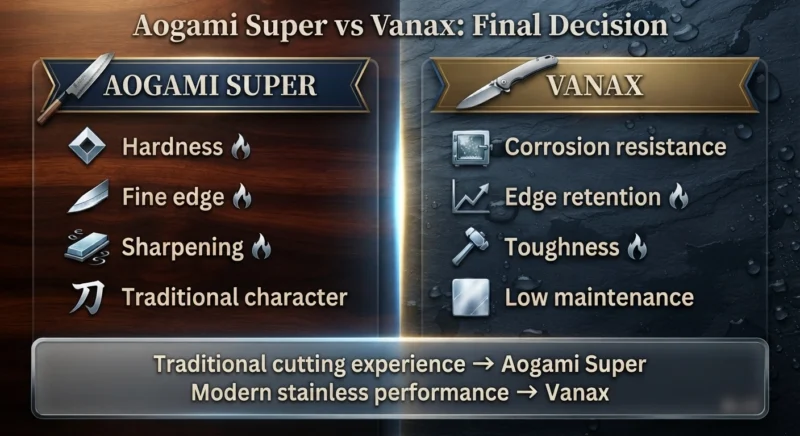
There is no single winner.
But there is a clear winner for different types of users.
Aogami Super wins for:
- Traditional Japanese kitchen knives
- High hardness
- Fine edge performance
- Sharpening feel
- Patina
- Traditional carbon-steel character
- Enthusiasts who enjoy maintenance
Vanax wins for:
- Corrosion resistance
- Low maintenance
- Wet environments
- Saltwater
- Outdoor use
- EDC
- Stainless kitchen knives
- Excellent edge retention combined with extreme corrosion resistance
- Users who want performance without worrying about rust
If you want the traditional Japanese experience, Aogami Super is difficult to beat.
If you want the freedom to use a high-performance knife around water, salt, and acidic foods without constantly thinking about corrosion, Vanax is the much more practical choice.
And there is one final point worth remembering.
A steel comparison does not determine the performance of the finished knife.
The heat treatment, geometry, edge thickness, sharpening quality, and intended use can completely change the experience.
A 65 HRC Aogami Super blade with an excellent grind can be spectacular.
A 61 HRC Vanax blade with excellent geometry can also be spectacular.
The two knives simply achieve that performance in different ways.
Frequently Asked Questions
Is Aogami Super better than Vanax?
Not universally. Aogami Super is better suited to traditional high-hardness Japanese knives and sharpening enthusiasts. Vanax is better for corrosion resistance, low maintenance, wet environments, and modern stainless performance.
Is Vanax stainless?
Yes. Vanax is an extremely corrosion-resistant stainless steel with approximately 18.2% chromium and 1.55% nitrogen.
Is Aogami Super stainless?
No. Its chromium content is only around 0.30–0.50%, so it is a reactive carbon steel rather than a stainless steel.
Which holds an edge longer?
Both have excellent edge retention, but they achieve it differently. Vanax has very high wear resistance, while Aogami Super combines high hardness with tungsten- and vanadium-containing carbides and excellent fine-edge geometry.
Which is harder?
Aogami Super is generally used at a higher hardness, commonly around 63–66 HRC in high-performance kitchen knives. Vanax is generally around 59–62 HRC.
Which is tougher?
Vanax generally has the advantage in toughness, especially when compared with very hard Aogami Super blades.
Which is easier to sharpen?
Aogami Super is generally easier to sharpen, especially on conventional waterstones.
Which is more corrosion resistant?
Vanax by a very large margin.
Which is better for a kitchen knife?
Aogami Super is excellent for traditional Japanese kitchen knives. Vanax is excellent if you want similar high-performance characteristics with dramatically better corrosion resistance.
Which is better for hunting?
Vanax.
Its corrosion resistance, edge retention, and useful toughness make it much more suitable for wet outdoor conditions.
Which is better for EDC?
Vanax is generally the better choice because it combines strong edge retention with extremely high corrosion resistance.
Can Vanax take a very sharp edge?
Yes. Vanax can support an extremely sharp edge and is particularly interesting for thin-edge applications.
Can Aogami Super rust?
Yes. It should be dried promptly after use and should not be left exposed to moisture or acidic food residue.
Does Aogami Super need oil?
For storage or long periods without use, protective treatment can be helpful. During normal kitchen use, the most important habits are cleaning and thoroughly drying the blade.
Does Vanax need special care?
No unusual care is normally required. It should still be cleaned and dried like any quality knife, but corrosion concerns are dramatically lower than with Aogami Super.
Which steel is better for seafood?
Vanax is the more practical choice when the knife is regularly exposed to water and salt. Aogami Super can perform beautifully but requires much more careful maintenance.
Which steel is better for sharpening enthusiasts?
Aogami Super.
Its high hardness combined with relatively manageable sharpening behavior makes it particularly enjoyable on quality waterstones.
Which steel is better for someone who hates sharpening?
Vanax.
Its strong wear resistance and edge retention allow longer intervals between sharpening sessions.
Aogami Super vs Vanax: The Bottom Line
Aogami Super is about the cutting experience.
Vanax is about performance without the maintenance burden.
Aogami Super offers very high hardness, excellent edge retention, a refined edge, and the traditional character of Japanese carbon steel.
Vanax offers an unusual combination of high wear resistance, useful toughness, very high corrosion resistance, and excellent performance at thin edge geometries.
Neither steel replaces the other.
They solve different problems.
If you want a knife that feels like a traditional Japanese cutting tool and you are willing to care for it, choose Aogami Super.
If you want a modern high-performance knife that can handle water, salt, humidity, and everyday neglect with far less concern, choose Vanax.
The best steel is ultimately the one whose compromises match your priorities.
This article is for independent informational purposes only and is not affiliated with, sponsored by, or endorsed by any steel manufacturer. All product names, trademarks, and registered trademarks are the property of their respective owners.