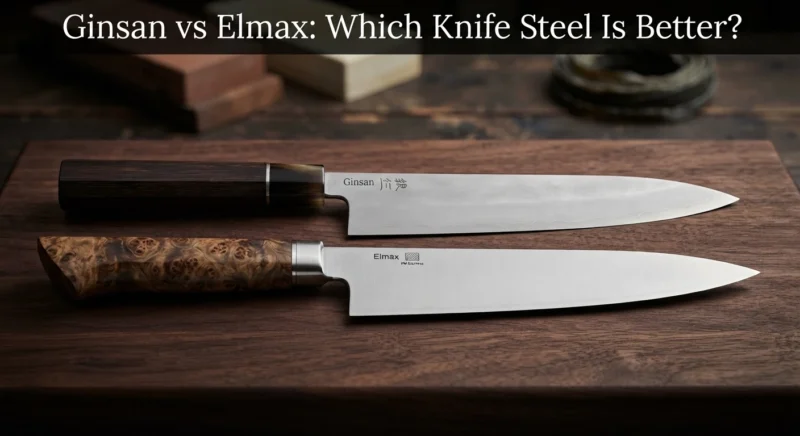
Ginsan vs Elmax
An Independent Guide
When comparing Ginsan vs Elmax, it is easy to get distracted by the word “super steel,” alloy percentages, or Rockwell hardness numbers. Both steels are stainless, both can produce excellent knife blades, and both have earned a strong reputation among people who care about cutting performance.
But they are not the same kind of steel.
Ginsan, also known as Ginsan-ko, Gin-3, or Silver #3, takes a relatively simple Japanese stainless-steel approach. Its chemistry is close to the high-carbon steels traditionally associated with Japanese knives, but with enough chromium to make it stainless. This gives Ginsan a distinctive combination of fine edge geometry, clean cutting feel, and relatively easy sharpening.
Elmax takes a very different approach. It is a powder-metallurgy stainless steel with much higher carbon, significantly more chromium, and substantial vanadium and molybdenum. Its design emphasizes wear resistance, edge retention, corrosion resistance, and a very fine powder-metallurgy structure. The manufacturer describes Elmax as capable of reaching hardness above 60 HRC while maintaining good corrosion resistance and edge retention.
So which is better?
The honest answer is:
It depends on what you want the knife to do.
If your priority is a very fine edge, easy sharpening, and the characteristic cutting feel associated with Japanese high-carbon steels while still having stainless-steel convenience, Ginsan is extremely attractive.
If your priority is longer edge retention, high wear resistance, corrosion resistance, and a steel that performs especially well in hard-use folders and fixed blades, Elmax has the advantage.
This guide compares Ginsan and Elmax in detail, including composition, hardness, edge retention, toughness, corrosion resistance, sharpening, cutting feel, kitchen knives, hunting knives, blade geometry, maintenance, and overall value.
Ginsan vs Elmax at a Glance
Before going into the details, here is the short version.
| Property | Ginsan | Elmax |
|---|---|---|
| Other names | Gin-3, Ginsan-ko, Silver #3 | Elmax SuperClean |
| Steel type | Stainless cutlery steel | Powder-metallurgy stainless steel |
| Carbon | About 0.92–1.10% | About 1.70% |
| Chromium | About 13–14.5% | About 18% |
| Molybdenum | Specification-dependent; commonly around 1% in published references | About 1% |
| Vanadium | Essentially absent in common Ginsan formulations | About 3% |
| Typical knife hardness | Around 59–62 HRC depending on maker and heat treatment | Commonly around 60–62 HRC |
| Corrosion resistance | Very good | Excellent |
| Wear resistance | Moderate to good | Very high |
| Edge retention | Good | Excellent |
| Sharpening | Relatively easy | More demanding |
| Fine edge performance | Excellent | Excellent |
| Toughness | Good for kitchen use, but depends strongly on hardness and geometry | Very good for a high-wear PM stainless steel |
| Best known for | Stainless steel with a carbon-steel-like cutting character | High edge retention and balanced PM performance |
| Best applications | Japanese kitchen knives, fine-edge blades | Folding knives, fixed blades, hard-use knives, kitchen knives |
| Overall character | Simple, fine-grained, easy to maintain | High-performance, wear-resistant, highly alloyed |
The numbers should not be interpreted as absolute performance scores. A well-treated Ginsan blade can outperform a poorly heat-treated Elmax blade, and vice versa.
That is one of the most important points in any knife-steel comparison.
What Is Ginsan Steel?
Ginsan is a Japanese stainless knife steel commonly known as Ginsan-ko, Gin-3, or Silver #3.
It is interesting because its design is relatively simple compared with many modern stainless steels.
Typical published compositions put Ginsan around:
- Carbon: approximately 0.92–1.10%
- Chromium: approximately 13–14.5%
- Manganese: approximately 0.6–1.0%
- Silicon: approximately 0.35%
- Phosphorus: approximately 0.03%
- Sulfur: approximately 0.02%
Exact chemistry can vary according to the specification being referenced.
The important thing is not simply the percentage of each element. It is the overall design.
Ginsan has enough carbon to reach relatively high hardness and form a fine cutting edge, while its chromium level gives it stainless or highly corrosion-resistant behavior under normal knife use.
This is why Ginsan has become particularly popular for Japanese kitchen knives.
It gives the user something that sits between two traditional categories.
It feels more like a high-carbon Japanese blade when sharpening and cutting, but it does not require the same level of corrosion maintenance as a reactive carbon steel.
That combination is the main attraction.
What Is Elmax?
Elmax is a high-performance stainless steel produced using powder metallurgy.
Its published typical chemical composition is approximately:
- Carbon: 1.70%
- Silicon: 0.80%
- Manganese: 0.30%
- Chromium: 18%
- Molybdenum: 1%
- Vanadium: 3%
These figures come directly from the technical information published for Elmax.
That chemistry immediately tells us why Elmax behaves differently from Ginsan.
The carbon content is substantially higher.
The chromium content is also considerably higher.
And most importantly for wear resistance, Elmax contains approximately 3% vanadium.
Vanadium forms extremely hard carbides. Those carbides contribute strongly to abrasion resistance and therefore to edge retention.
Elmax also uses powder metallurgy.
Instead of producing the steel as a conventional large ingot and relying on subsequent processing to break up and distribute the structure, powder metallurgy begins with very small particles. The process allows a fine and relatively uniform microstructure.
That matters enormously in a knife steel.
It helps the steel combine high alloy content with useful toughness and edge stability.
The manufacturer specifically describes Elmax as having a combination of high wear resistance, corrosion resistance, high compressive strength, and dimensional stability. It also lists hand knives among its applications.
Check Our Guide ELMAX Steel Review
Ginsan vs Elmax: The Biggest Difference
The easiest way to understand this comparison is to think of the two steels as following different philosophies.
Ginsan emphasizes simplicity and fine cutting performance.
Elmax emphasizes alloying, wear resistance, and long-term edge retention.
Ginsan does not contain the large amount of vanadium found in Elmax.
That is important.
A blade made from Ginsan generally does not have the same volume of extremely hard vanadium carbides that you find in a powder steel such as Elmax.
This makes Ginsan comparatively friendly to sharpening.
Elmax takes the opposite route.
The hard carbides that make Elmax resistant to abrasion are also part of what makes it more demanding to sharpen.
That is not a defect.
It is the tradeoff.
The same characteristics that help Elmax maintain an edge during extended cutting also mean that removing steel during sharpening requires more abrasive work.
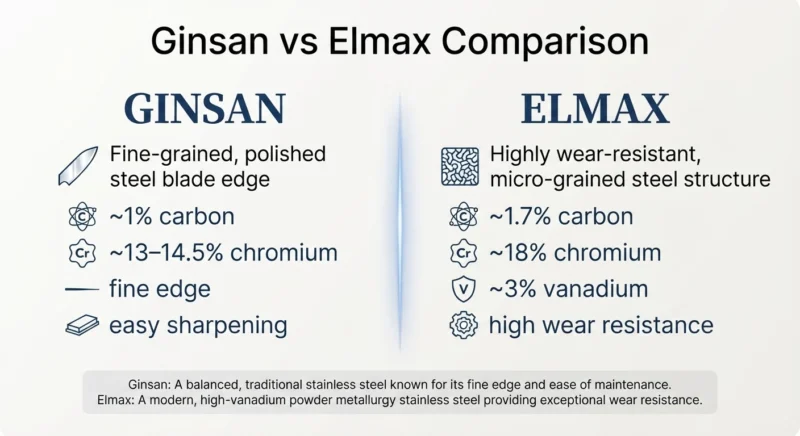
Chemical Composition: Ginsan vs Elmax
Chemistry provides the foundation for understanding the difference between these steels.
Carbon
Ginsan contains roughly 1% carbon.
Elmax contains approximately 1.70%.
Carbon contributes to hardness and plays a central role in carbide formation.
Elmax’s much higher carbon content allows it to support a substantially greater carbide population when combined with chromium, vanadium, and molybdenum.
Ginsan’s lower and simpler alloy design contributes to its different sharpening and cutting behavior.
But it is important not to make the common mistake of assuming:
More carbon = automatically better knife steel.
It does not.
Carbon is only one part of the system.
The final performance depends on the complete alloy, heat treatment, carbide structure, hardness, edge geometry, and intended application.
Chromium
Ginsan generally contains about 13–14.5% chromium.
Elmax contains approximately 18%.
Chromium is essential for corrosion resistance.
Once sufficient chromium is present in the steel matrix, the surface can form a passive chromium-rich oxide layer that helps protect the blade from corrosion.
That does not mean stainless steel cannot rust.
It means corrosion occurs much more slowly under normal conditions.
Elmax’s higher chromium content gives it a strong corrosion-resistance advantage, although the actual behavior of a finished blade depends on heat treatment, surface finish, edge condition, contaminants, and maintenance.
Ginsan is also very corrosion resistant in normal kitchen use, but Elmax generally has the larger corrosion-resistance margin.
Vanadium
This is one of the biggest differences between the two steels.
Ginsan has essentially no significant vanadium addition in the commonly published composition.
Elmax contains approximately 3% vanadium.
Vanadium forms extremely hard vanadium carbides.
These carbides resist abrasive wear.
For a knife, that can translate into excellent edge retention.
The tradeoff is sharpening.
Abrasives must deal with those hard carbides, so Elmax generally benefits from good-quality abrasives and a sensible sharpening strategy.
This is one reason a Ginsan knife can feel dramatically easier to sharpen even if both knives have similar HRC numbers.
Hardness: Is Elmax Harder Than Ginsan?
Not necessarily.
This is an area where knife discussions often become misleading.
A steel does not have one universal HRC value.
The same steel can be heat treated to different hardness levels.
Ginsan knives are commonly found around the high-50s to low-60s HRC, depending on the maker and heat treatment.
Elmax is commonly used around 60–62 HRC, and its technical information specifically discusses achieving hardness above 60 HRC.
So you cannot simply say:
Elmax is harder than Ginsan.
That would be too simplistic.
You can have a 61 HRC Ginsan knife and a 60 HRC Elmax knife.
You can also have a 60 HRC Ginsan knife and a 62 HRC Elmax knife.
The actual heat treatment matters.
And so does the geometry.
A thin 61 HRC blade can behave very differently from a thick 61 HRC blade.
Check Our Guide What Is HRC? Understanding Rockwell Hardness in Kitchen Knives
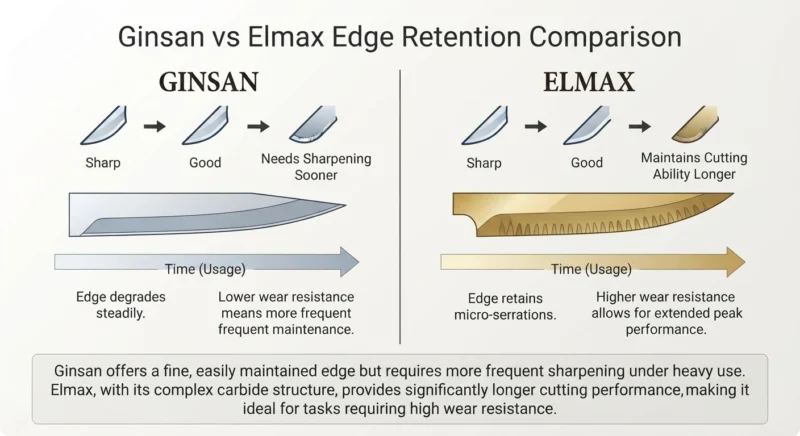
Edge Retention: Ginsan vs Elmax
This is where Elmax has the clearest advantage.
Elmax generally holds an edge longer than Ginsan under abrasive cutting conditions.
The reason is primarily its combination of high hardness, high carbide volume, vanadium, chromium, molybdenum, and powder-metallurgy structure.
The technical documentation for Elmax emphasizes very high wear resistance and excellent edge retention.
Ginsan, by contrast, relies much more on its relatively high carbon content, hardness, and fine microstructure rather than a large population of extremely hard alloy carbides.
That gives it good edge retention, but not the same level of wear resistance as Elmax.
For ordinary kitchen work, however, the difference may not be as dramatic as the steel charts suggest.
Why?
Because most kitchen knife dulling is not simply a laboratory abrasion test.
The edge interacts with:
- food
- cutting boards
- packaging
- bones
- seeds
- grit
- hard surfaces
- twisting forces
- the cutting angle
Blade geometry can completely change the practical experience.
A very thin Ginsan kitchen knife can continue cutting extremely well even after the theoretical edge has degraded somewhat.
Check Our Guide Edge Retention Explained: 10 Factors What Makes a Knife Stay Sharp Longer
Which Holds an Edge Longer?
If both knives are made correctly and used at similar geometry:
Elmax wins.
For long periods of cutting where abrasive wear is the dominant reason the edge becomes dull, Elmax’s high wear resistance is a major advantage.
This is particularly noticeable for:
- working knives
- outdoor knives
- folding knives
- fixed blades
- repetitive cutting
- abrasive materials
- users who dislike frequent sharpening
Ginsan remains very good.
But it is not designed to compete directly with Elmax on maximum wear resistance.
Its attraction is balance.
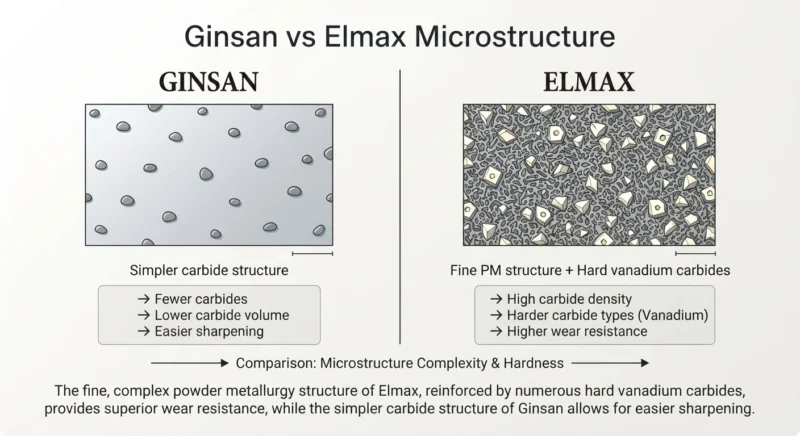
Sharpening: Ginsan vs Elmax
This is where many users will immediately notice the difference.
Ginsan
Ginsan is comparatively pleasant to sharpen.
Its simpler carbide structure means ordinary sharpening systems can work very well.
Waterstones are particularly appropriate for the kind of fine edges commonly associated with Japanese kitchen knives.
A good Ginsan knife can develop a very clean, crisp apex.
This is one of the reasons people who enjoy sharpening often like Ginsan.
You can remove material relatively predictably.
Deburring can also be straightforward when the heat treatment and edge geometry are good.
Elmax
Elmax is not impossible to sharpen.
Far from it.
But it rewards the use of appropriate abrasives.
Because of its hard carbide structure, very soft or low-quality abrasives may feel slow.
Diamond or other high-performance abrasives can make the process considerably easier.
A common mistake is to approach Elmax with the same sharpening expectations as a simple carbon steel.
You may spend much more time than necessary if your abrasive is poorly suited to the steel.
The key is not to fear Elmax.
It is simply a steel that benefits from a better sharpening setup.
Is Ginsan Easier to Sharpen?
Yes.
If sharpening convenience is one of your main priorities, Ginsan has the advantage.
This is especially true for people who sharpen Japanese kitchen knives on waterstones and want a steel that responds quickly.
Elmax can still be sharpened to an excellent edge, but it generally requires more effort and benefits from more capable abrasives.
So:
Sharpening winner: Ginsan.
Check Our Guide All Kinds of Knife Sharpening Tools
Corrosion Resistance
Both steels are stainless.
But stainless does not mean corrosion-proof.
Ginsan has roughly 13–14.5% chromium, which is sufficient for stainless behavior in normal knife applications.
Elmax has approximately 18% chromium, giving it a stronger corrosion-resistance profile.
This makes Elmax particularly attractive for users who expect their knives to see:
- humidity
- outdoor use
- wet environments
- occasional neglect
- sweat
- food acids
- marine or coastal conditions
That does not mean you should abuse an Elmax knife.
Even a highly corrosion-resistant steel should be cleaned and dried after use.
Salt, acids, moisture, and contaminants can eventually create problems on almost any knife steel.
Does Ginsan Rust?
Ginsan is stainless, but it is not immune to corrosion.
If you leave a Ginsan blade wet, dirty, or exposed to aggressive salty or acidic conditions for extended periods, staining or corrosion can still occur.
For normal kitchen use, however, Ginsan is remarkably easy to maintain.
Simply:
- Wash it after use.
- Dry it.
- Avoid leaving it submerged.
- Do not leave acidic food residue on the blade for long periods.
With ordinary care, corrosion should not be a major concern.
Toughness: Ginsan vs Elmax
This is a more complicated comparison.
Toughness is the ability of a material to resist cracking or breaking when subjected to impact or stress.
It is not the same thing as hardness.
A steel can be very hard but relatively brittle.
A steel can also be softer and considerably tougher.
Elmax has an interesting reputation because powder metallurgy allows it to combine high wear resistance with useful toughness.
Its manufacturer describes Elmax as a balanced PM grade and reports strong toughness performance relative to other stainless PM knife steels.
That does not mean Elmax is indestructible.
A thin, highly hardened Elmax edge can still chip if it is struck against hard material.
Likewise, a thin Ginsan edge can chip if the geometry and hardness are inappropriate for the task.
Check Our Guide Wear Resistance vs Toughness: Understanding the Most Important Knife Steel Trade-Off
Which Is Tougher?
For general knife use, Elmax is usually the stronger choice when high wear resistance and toughness must coexist.
But this statement needs context.
A Ginsan kitchen knife with a relatively moderate hardness and sensible geometry can be very reliable.
A thin kitchen edge should not be judged by the same standards as a survival knife.
For a fine Japanese kitchen knife, you normally want:
- thin geometry
- controlled cutting
- minimal lateral stress
- no chopping through bones
- no twisting
Under those conditions, Ginsan works extremely well.
For a hard-use fixed blade, Elmax becomes more attractive.
Cutting Feel: Ginsan vs Elmax
This is one of the most difficult properties to put into a table.
Cutting feel depends on:
- blade geometry
- edge angle
- thickness behind the edge
- surface finish
- sharpening quality
- hardness
- carbide structure
- blade shape
Still, Ginsan has a particular reputation among Japanese knife users.
Its relatively simple alloy design allows it to take a very fine edge.
When sharpened well, a Ginsan kitchen knife can feel extremely clean and precise.
It can slice through vegetables, proteins, herbs, and other foods with very little resistance.
Elmax can also take an excellent edge.
In fact, a properly made Elmax knife can be exceptionally sharp.
But its major strength is not the subjective “feel” of sharpening.
Its strength is maintaining that performance for a long time.
Ginsan vs Elmax for Kitchen Knives
This is where the comparison becomes especially interesting.
Ginsan for kitchen knives
Ginsan is almost tailor-made for users who want:
- stainless convenience
- Japanese cutting performance
- easy sharpening
- high hardness
- a very fine edge
- relatively low maintenance
It works particularly well in:
- Gyuto
- Santoku
- Bunka
- Petty
- Nakiri
- Sujihiki
- small slicing knives
For a home cook who enjoys sharpening every few weeks or whenever necessary, Ginsan can be an excellent choice.
It is also a good steel for someone moving from carbon steel into stainless.
You retain some of the sharpening character associated with simpler high-carbon Japanese steels without having to deal with the same level of reactivity.
Elmax for Kitchen Knives
Elmax can also make an excellent kitchen knife.
Its greatest advantage is edge retention.
If you are using the knife for long periods and want to minimize sharpening, Elmax makes sense.
It is especially attractive when the knife will be used heavily and maintenance time matters.
However, there is a practical consideration.
A kitchen knife does not necessarily need extreme wear resistance.
If you are cutting vegetables, fish, boneless meat, fruit, and herbs on a suitable cutting board, you may appreciate the sharpening behavior of Ginsan more than the extra wear resistance of Elmax.
In other words:
Elmax gives you more edge retention.
Ginsan gives you a more effortless maintenance cycle.
Check Our Guide Best Kitchen Knives for Groomsmen Gifts: Unique Wedding Gifts They’ll Actually Use
Ginsan vs Elmax for Hunting Knives
The situation changes for hunting knives.
A hunting knife may encounter:
- hide
- connective tissue
- meat
- dirt
- moisture
- bone contact
- outdoor abrasion
- repeated use away from a sharpening stone
Here, Elmax becomes very attractive.
Its corrosion resistance is excellent, and its wear resistance is substantially higher than Ginsan’s.
That combination can be valuable in an outdoor knife.
However, blade geometry still matters.
A very thin Elmax edge is not automatically suitable for heavy outdoor work.
If the knife is designed for hard impact or chopping, a different steel or geometry may be more appropriate.
Check Our Guide 15 Signs of a High-Quality Kitchen or Hunting Knife
Ginsan vs Elmax for EDC Knives
For everyday-carry folders, Elmax has another advantage.
EDC knives are often exposed to:
- sweat
- pocket lint
- humidity
- cardboard
- plastics
- food
- abrasive materials
- repeated opening and closing
High corrosion resistance plus high wear resistance is an excellent combination for this application.
Elmax was designed around exactly the sort of balance that makes it attractive for long-life cutting tools.
Ginsan can certainly work as an EDC steel.
But if the goal is maximum edge retention with stainless convenience, Elmax is usually the stronger choice.
Edge Geometry May Matter More Than the Steel
This is one of the most important lessons in knife steel comparisons.
Imagine two knives.
Knife A:
- Ginsan
- 61 HRC
- very thin behind the edge
- excellent heat treatment
- carefully sharpened
Knife B:
- Elmax
- 62 HRC
- thick behind the edge
- mediocre heat treatment
- poorly sharpened
Which knife cuts better?
Probably the Ginsan knife.
Which knife has better theoretical wear resistance?
Probably the Elmax knife.
But theoretical wear resistance does not automatically equal better cutting performance.
A blade has to interact with the material being cut.
A thin edge can require dramatically less force than a thick one.
That is why comparing steels without considering blade geometry can produce misleading conclusions.
Heat Treatment Is Critical
Heat treatment may be even more important than the difference between Ginsan and Elmax in many real-world situations.
A steel’s chemistry provides potential.
Heat treatment determines how much of that potential becomes usable performance.
Poor heat treatment can result in:
- excessive retained austenite
- poor hardness
- weak edge stability
- inconsistent performance
- excessive chipping
- poor wear resistance
Good heat treatment can transform a good steel into an excellent knife.
This is especially important when comparing blades made by different manufacturers or makers.
Do not assume that two knives made from the same steel will perform identically.
They may not.
Ginsan vs Elmax Edge Stability
Edge stability refers to how well the very thin apex survives during cutting.
This is not identical to edge retention.
A steel can have excellent wear resistance but still suffer from edge damage if the geometry is too thin or the heat treatment is inappropriate.
Ginsan can perform very well here when properly heat treated and used at an appropriate angle.
Elmax can also provide excellent edge stability.
Its powder-metallurgy structure and fine carbide distribution help it tolerate high hardness better than many conventional high-alloy steels.
The important point is that edge stability is a system property.
It depends on steel + heat treatment + geometry + sharpening + use.
Which Steel Gets Sharper?
This question sounds simple, but it actually has two meanings.
If you mean:
Which steel can produce a very sharp apex?
Both can.
If you mean:
Which steel is easier to sharpen to a very sharp apex?
Ginsan usually wins.
The relatively simple alloy structure makes it particularly pleasant to sharpen.
Elmax can produce an extremely sharp edge too, but it may take more work.
This distinction is important.
A difficult-to-sharpen steel is not necessarily capable of a better edge.
And an easy-to-sharpen steel is not necessarily inferior.
The sharpening experience and the final edge are separate questions.
Ginsan vs Elmax for Whetstones
For traditional Japanese whetstone users, Ginsan is generally the more natural choice.
A good Ginsan blade responds nicely to conventional sharpening stones.
The steel can be brought to a high level of polish, and the user can easily maintain the apex without needing highly specialized equipment.
Elmax can also be sharpened on stones, but the choice of abrasive becomes more important.
Diamond-containing abrasives can be especially useful when dealing with high-carbide PM steels.
If you already enjoy sharpening and have a good sharpening system, Elmax is not a problem.
If you want simple and pleasant sharpening, Ginsan is easier.
Ginsan vs Elmax for Beginners
For someone buying their first premium stainless knife, Ginsan is arguably easier to live with.
It gives you:
- stainless convenience
- good edge retention
- easy sharpening
- excellent sharpness
- relatively simple maintenance
Elmax is better suited to someone who values long edge life and is willing to spend a little more time learning how to sharpen high-carbide steel.
That does not make Elmax a “professional-only” steel.
It simply has a different maintenance profile.
Corrosion Resistance in Real Life
Laboratory corrosion ratings are useful, but real knives live in real environments.
A kitchen knife may be exposed to:
- lemon juice
- tomato
- onion
- salt
- water
- detergents
- food residue
A hunting knife may encounter:
- blood
- moisture
- sweat
- mud
- rain
- salt air
In both cases, Elmax’s higher chromium content gives it a useful advantage.
Ginsan remains highly corrosion resistant, though.
For ordinary kitchen use, it is more than sufficient for most people.
The difference becomes more important when maintenance is poor or exposure is aggressive.
Which Steel Is More Stainless?
Elmax.
Its approximately 18% chromium content gives it a clear advantage over Ginsan’s approximately 13–14.5%.
However, Ginsan should still be considered a stainless knife steel.
It is not a carbon steel that happens to resist rust slightly better.
It was specifically designed as a stainless cutlery steel.
That is one of the reasons it is so popular in Japanese kitchen knives.
Check Our Guide Carbon Steel vs Stainless Steel Knives: Which Is Better?
Which Steel Has Better Wear Resistance?
Elmax.
This is one of its strongest advantages.
Its high carbon content combined with chromium and approximately 3% vanadium produces a carbide-rich structure with strong resistance to abrasive wear.
Ginsan has good wear resistance for a simple stainless cutlery steel, but it is not in the same class as Elmax for maximum abrasion resistance.
This difference becomes increasingly important when the knife is used for long periods without sharpening.
Which Steel Has Better Edge Retention?
Elmax.
Assuming comparable heat treatment and geometry, Elmax should retain its working edge longer than Ginsan.
The difference is primarily due to its higher wear resistance and carbide structure.
However, remember that edge retention testing can produce different results depending on the test method.
A knife used for slicing soft food is not the same as a knife cutting abrasive cardboard.
So when someone says:
Elmax has better edge retention.
That is generally true.
But the real-world benefit depends on how you use the knife.
Which Steel Is Easier to Maintain?
This depends on what you mean by maintenance.
For corrosion maintenance, Elmax wins.
For sharpening maintenance, Ginsan wins.
That creates an interesting balance.
If you hate wiping and drying your knife, Elmax may be more forgiving.
If you hate sharpening, Elmax may also appeal to you because of its long edge life.
But if you enjoy maintaining a very sharp knife on a whetstone, Ginsan is likely more satisfying.
Ginsan vs Elmax: Pros and Cons
Ginsan Pros
- Excellent stainless performance
- Very good corrosion resistance
- High achievable hardness
- Excellent fine-edge performance
- Relatively easy sharpening
- Pleasant response on waterstones
- Good edge retention
- Excellent choice for Japanese kitchen knives
- Simple alloy design
- Excellent balance between stainless convenience and carbon-steel-like cutting characteristics
Ginsan Cons
- Lower wear resistance than Elmax
- Edge retention is not in the same class as high-carbide PM steels
- Can chip if pushed too hard at very high hardness and thin geometry
- Less attractive for extreme hard-use applications
- Still requires normal stainless-steel maintenance
Elmax Pros
- Excellent edge retention
- Very high wear resistance
- Excellent corrosion resistance
- Powder-metallurgy structure
- High achievable hardness
- Good toughness for a high-wear stainless PM steel
- Excellent for EDC knives
- Excellent for hunting and outdoor knives
- Good choice when long edge life is important
- Can take a very fine edge
Elmax Cons
- More difficult to sharpen than Ginsan
- Benefits from good-quality abrasives
- High carbide content can make sharpening feel slower
- Often unnecessary for users who prefer frequent quick touch-ups
- Premium performance depends heavily on correct heat treatment
Ginsan vs Elmax: Which Is Better for a Chef Knife?
For a chef knife, I would choose based on the user’s priorities.
Choose Ginsan if:
You want a Japanese-style knife with a very fine edge and easy sharpening.
You enjoy using whetstones.
You want stainless convenience without moving too far away from the feel of traditional high-carbon Japanese steels.
You are comfortable touching up the edge periodically.
Choose Elmax if:
You want maximum edge retention.
You use the knife heavily.
You do not want to sharpen frequently.
You want very high corrosion resistance.
You already have a suitable sharpening system for PM steels.
For many home cooks, Ginsan may actually be the more enjoyable steel.
For someone who spends hours every week cutting and wants maximum time between sharpenings, Elmax becomes more attractive.
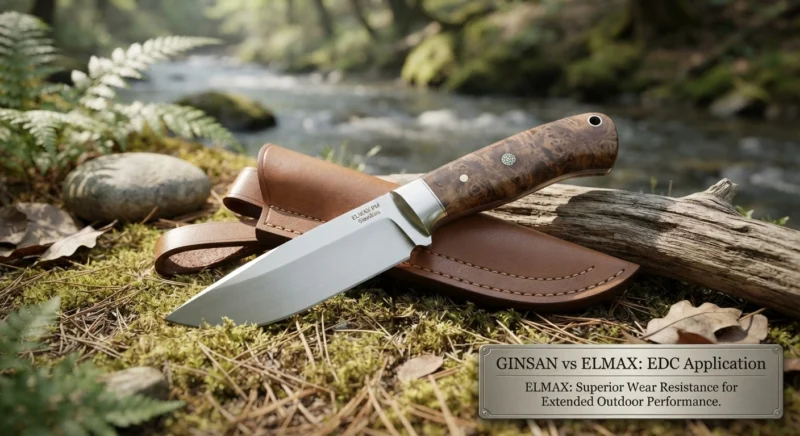
Ginsan vs Elmax: Which Is Better for a Hunting Knife?
For hunting and outdoor use, I would generally favor Elmax.
The combination of corrosion resistance, wear resistance, hardness, and useful toughness is difficult to ignore.
Ginsan can still be a very good hunting knife steel, especially for a thin slicing-oriented blade.
But hunting knives tend to experience more demanding conditions than kitchen knives.
The longer edge life and stronger corrosion resistance of Elmax become meaningful advantages.
The geometry should still be chosen carefully.
A hunting knife is not automatically better simply because it uses a premium steel.
Ginsan vs Elmax: Which Is Better for EDC?
For EDC, Elmax has the edge.
An EDC knife is often carried every day and sharpened relatively infrequently.
The blade may encounter cardboard, plastic, food, rope, packaging materials, and other abrasive materials.
High wear resistance is useful here.
Corrosion resistance is also valuable because the knife may sit in a pocket for hours while being exposed to sweat and humidity.
Ginsan is still a very good EDC choice, especially if easy sharpening matters more to you than maximum edge retention.
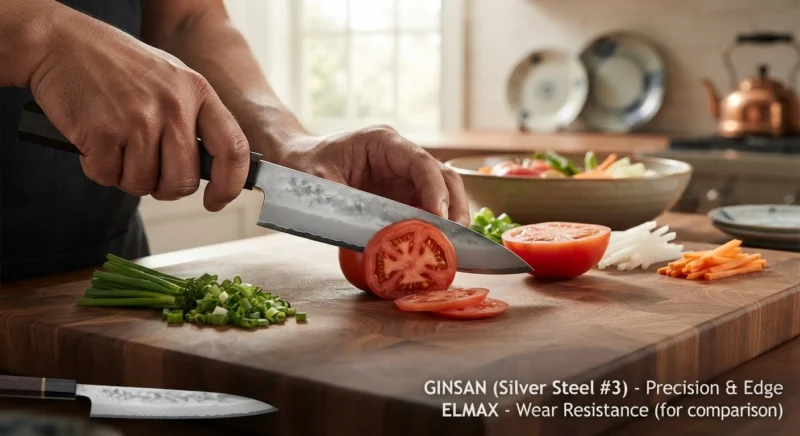
Ginsan vs Elmax: Which Is Better for a Japanese Knife?
This is where Ginsan really shines.
The character of Ginsan is strongly associated with Japanese kitchen knives.
Its ability to combine stainless behavior with fine edge performance makes it particularly suitable for:
- Gyuto
- Santoku
- Bunka
- Petty
- Nakiri
- Sujihiki
If you want a Japanese kitchen knife that behaves more like a traditional carbon-steel blade on the sharpening stone while remaining stainless, Ginsan is one of the most interesting choices available.
Elmax can certainly be used for kitchen knives, but it has a more modern PM-steel character.
Ginsan vs Elmax: Which Is Better for a Thin Edge?
Both can support thin edges.
But the appropriate edge depends on the blade’s intended use.
A Ginsan Japanese kitchen knife can be ground very thin and sharpened at a fine angle.
Elmax can also support thin edges, and its fine PM structure makes it capable of excellent edge stability.
But neither steel should be pushed beyond what the heat treatment and geometry can support.
A 10-degree-per-side edge on a hard-use outdoor knife is a very different proposition from a 10-degree-per-side edge on a delicate slicer.
What About Chipping?
Chipping is often discussed as if it were a fixed property of the steel.
It isn’t.
Chipping depends on:
- hardness
- heat treatment
- carbide structure
- edge thickness
- edge angle
- cutting board
- impact
- lateral stress
- user technique
A very hard, very thin knife can chip regardless of whether the steel is Ginsan or Elmax.
The solution is not necessarily to choose a “tougher” steel.
Sometimes the correct solution is simply a slightly thicker edge or a more appropriate sharpening angle.
For kitchen knives, avoid using either steel to cut through bones, frozen food, or hard objects unless the blade is specifically designed for that job.
Why Elmax Is Considered a Premium Steel
Elmax’s appeal comes from the combination of properties rather than one spectacular characteristic.
It has:
- high wear resistance
- strong corrosion resistance
- high hardness potential
- powder-metallurgy cleanliness
- good dimensional stability
- useful toughness
The manufacturer specifically describes Elmax as combining very good wear resistance and corrosion resistance and lists hand knives among its applications.
That combination is unusual.
Normally, increasing wear resistance can make a steel less pleasant in other areas.
Elmax was developed to balance those competing characteristics.
Why Ginsan Remains So Popular
Ginsan does not try to win every category.
That is precisely why it works so well.
It does not have Elmax’s massive carbide load.
It does not have Elmax’s extreme wear resistance.
Instead, it provides an unusually useful combination:
stainless + hard + fine edge + easy sharpening + good cutting feel.
For a kitchen knife, those characteristics can be more valuable than maximum edge retention.
A chef does not necessarily want a blade that stays sharp for the longest possible time.
They may want a blade that can be restored to peak sharpness quickly.
That is an important distinction.
Ginsan vs Elmax and the “Super Steel” Problem
The term “super steel” is often used too casually.
It can make people think one steel is simply better than another.
Knife steels are not ranked like smartphone processors.
There is no single number that determines overall performance.
Consider four different users:
User 1: wants the easiest sharpening.
User 2: wants maximum edge retention.
User 3: works in a wet environment.
User 4: wants the thinnest possible kitchen edge.
They could reasonably choose four different steels.
So instead of asking:
Which steel is the best?
A better question is:
Which steel has the properties that best match the way I use my knife?
That is the question that makes the Ginsan vs Elmax comparison useful.
Ginsan vs Elmax: Real-World Performance
Imagine two identical kitchen knives.
Same blade length.
Same thickness.
Same edge angle.
Same geometry.
Same cutting board.
Same heat-treatment quality.
One is Ginsan.
The other is Elmax.
If both begin equally sharp, Elmax should generally maintain its cutting performance longer during abrasive cutting.
After both knives become dull, however, Ginsan should generally be faster and easier to restore on a suitable stone.
That creates a simple cycle:
Elmax
Sharpen → cut longer → sharpen less often → spend more time sharpening when needed.
Ginsan
Sharpen → cut very well → touch up more easily → sharpen again sooner.
Neither cycle is inherently better.
It depends on what you prefer.
Which Steel Has the Better Balance?
This is subjective, but Ginsan has a strong argument if the word “balance” means:
good corrosion resistance + high hardness + excellent sharpness + easy sharpening.
Elmax has an equally strong argument if “balance” means:
high edge retention + corrosion resistance + toughness + high hardness.
In other words, they are balanced in different ways.
Ginsan vs Elmax for Knife Makers
For a knife maker, the choice involves more than the end user’s experience.
Heat treatment, grinding, finishing, and sharpening all matter.
Ginsan is attractive for makers producing Japanese-style kitchen knives because it fits naturally with thin geometry and fine-edge finishing.
Elmax is attractive for makers who want a premium PM stainless steel with excellent wear resistance and strong edge performance.
However, Elmax’s higher wear resistance can make grinding and finishing more demanding.
That is one of the tradeoffs associated with choosing a high-carbide steel.
Check Our Laminated Steel Knife Blanks: Complete Guide for Knife Makers
Grinding Ginsan vs Elmax
Ginsan is generally easier to grind than Elmax.
Elmax’s carbide-rich PM structure increases abrasion resistance not only during cutting but also during manufacturing.
That means the maker needs appropriate abrasives and controlled grinding practices.
This does not mean Elmax is difficult to work with professionally.
It means the steel’s strengths require the correct tooling.
For hobby makers, this can be an important practical consideration.
Why Blade Geometry Can Change the Winner
Suppose you have:
Ginsan at 61 HRC, 0.15 mm behind the edge
versus:
Elmax at 62 HRC, 0.35 mm behind the edge.
The Ginsan knife may feel much more aggressive in food because it is significantly thinner.
The Elmax knife may remain sharp longer.
This is not a contradiction.
It simply means:
cutting performance and edge retention are not the same thing.
A steel comparison should therefore never replace evaluation of the complete knife.
Ginsan vs Elmax: Maintenance
Both steels are relatively easy to live with compared with reactive carbon steels.
For either steel:
- wash after use
- dry after washing
- avoid prolonged exposure to salt
- avoid leaving acidic food residue on the blade
- use an appropriate cutting board
- sharpen before the edge becomes excessively damaged
Elmax gives you a little more corrosion tolerance.
Ginsan gives you a little easier sharpening experience.
For most users, both are low-maintenance steels.
Can Ginsan Be Used for Outdoor Knives?
Yes.
There is nothing about Ginsan that limits it to kitchen knives.
It can be used in small fixed blades, utility knives, EDC knives, and other cutting tools.
The question is whether it is the optimal choice.
If the knife will experience a lot of abrasion and you want maximum time between sharpening, Elmax makes more sense.
If the knife is primarily a fine cutting tool and you value easy maintenance, Ginsan may be preferable.
Can Elmax Be Used for Kitchen Knives?
Absolutely.
Elmax can make an excellent kitchen knife.
Its corrosion resistance and edge retention are both useful in the kitchen.
The main question is whether the additional wear resistance is worth the additional sharpening effort.
For someone who wants a premium stainless kitchen knife and does not mind using diamond or other capable abrasives, Elmax can be an excellent choice.
For someone who wants a Japanese-style knife that is especially pleasant to sharpen on waterstones, Ginsan may be more satisfying.
Ginsan vs Elmax: Price and Value
Steel price is only one part of knife value.
A knife can use an expensive steel and still be a poor knife if:
- the heat treatment is bad
- the geometry is poor
- the edge is uneven
- the handle is uncomfortable
- the blade is too thick
- the finishing is poor
Likewise, a well-made Ginsan knife can provide extraordinary value.
For this reason, I would not recommend choosing between Ginsan and Elmax based purely on which steel sounds more premium.
Choose based on the finished knife.
Which Steel Should You Buy?
Here is the simplest way to decide.
Buy Ginsan if you want:
- A Japanese-style stainless knife
- Excellent sharpening response
- Fine edge geometry
- Very good sharpness
- Good edge retention
- Low corrosion concerns
- A steel that feels closer to traditional Japanese carbon steels
Buy Elmax if you want:
- Very long edge retention
- Very high wear resistance
- Excellent corrosion resistance
- A premium powder steel
- A hard-use EDC or outdoor knife
- Less frequent sharpening
- Strong overall performance from a modern PM stainless steel
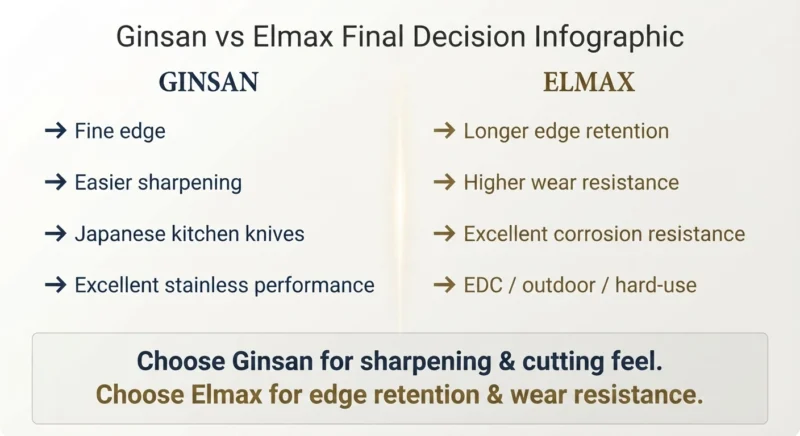
Ginsan vs Elmax: Final Verdict
There is no universal winner.
But if we divide the categories, the result becomes much clearer.
| Category | Winner |
|---|---|
| Edge retention | Elmax |
| Wear resistance | Elmax |
| Corrosion resistance | Elmax |
| Sharpening ease | Ginsan |
| Fine-edge feel | Ginsan |
| Waterstone friendliness | Ginsan |
| High-carbide performance | Elmax |
| EDC | Elmax |
| Hunting/outdoor use | Elmax |
| Japanese kitchen knives | Ginsan |
| Easy everyday maintenance | Ginsan for sharpening, Elmax for corrosion |
| Overall balance for a fine kitchen knife | Ginsan |
| Overall balance for a hard-use stainless knife | Elmax |
So, if I had to summarize the difference in one sentence:
Ginsan is the stainless steel for people who value sharpness and sharpening; Elmax is the stainless steel for people who value edge retention and wear resistance.
That is the real difference.
Ginsan vs Elmax: The Choice Depends on the Knife
The most important conclusion is that the steel should be selected together with the intended knife design.
For a thin Japanese kitchen knife, Ginsan can be an outstanding choice.
Its relatively simple alloy structure, high achievable hardness, stainless behavior, and sharpening response make it particularly well suited to fine cutting.
For an EDC, hunting, or hard-use knife where long edge life and corrosion resistance are more important, Elmax has a stronger case.
Its powder-metallurgy structure and high vanadium content provide substantially greater wear resistance while maintaining useful toughness for a premium stainless steel.
But neither steel eliminates the importance of heat treatment.
A well-made Ginsan knife can outperform a poorly made Elmax knife in almost every practical way that matters to its intended user.
And a properly heat-treated Elmax blade with excellent geometry can deliver an exceptionally long-lasting cutting edge.
That is why experienced knife buyers should look beyond the steel name.
Look at:
- heat treatment
- blade geometry
- edge thickness
- sharpening angle
- blade thickness
- intended use
- maker quality
- maintenance requirements
The steel is the foundation.
The finished knife is the result.
Frequently Asked Questions
Is Ginsan better than Elmax?
Not universally. Ginsan is easier to sharpen and particularly attractive for fine Japanese kitchen knives. Elmax generally offers better edge retention, wear resistance, and corrosion resistance.
Is Elmax harder to sharpen than Ginsan?
Yes. Elmax’s high carbide content, especially its vanadium carbides, generally makes sharpening more demanding. Ginsan is usually easier to sharpen on conventional waterstones.
Does Elmax hold an edge longer than Ginsan?
Yes, assuming comparable geometry and heat treatment. Elmax’s higher wear resistance generally gives it longer edge retention.
Is Ginsan stainless?
Yes. Ginsan contains roughly 13–14.5% chromium and is considered a stainless cutlery steel.
Is Elmax stainless?
Yes. Elmax contains approximately 18% chromium and is designed to provide strong corrosion resistance along with high wear resistance.
Which is better for a Japanese kitchen knife?
For many Japanese kitchen knives, Ginsan is the more natural choice because of its fine-edge performance and relatively easy sharpening.
Which is better for hunting knives?
Elmax generally has the advantage for hunting and outdoor knives because of its combination of edge retention, corrosion resistance, and useful toughness.
Which is easier to sharpen?
Ginsan.
Which has better edge retention?
Elmax.
Which is more corrosion resistant?
Elmax generally has the advantage because of its higher chromium content, although both are stainless steels.
Can Elmax get very sharp?
Absolutely. Elmax can support an extremely sharp edge. Its greater sharpening difficulty does not mean it cannot produce a fine edge.
Can Ginsan hold a very fine edge?
Yes. Fine edge performance is one of Ginsan’s strongest characteristics.
Is Elmax too hard for kitchen knives?
No. Elmax can make an excellent kitchen knife. The question is whether the user values its long edge retention enough to accept the additional sharpening effort.
Is Ginsan a premium steel?
Yes, although it is premium in a different way from modern powder steels. Its strength is its balance of stainless behavior, hardness, fine edge performance, and sharpening response.
Which should I choose: Ginsan or Elmax?
Choose Ginsan if you want a fine stainless kitchen knife that is pleasant to sharpen. Choose Elmax if you want maximum edge retention and wear resistance in a stainless blade.
Final Takeaway
Ginsan and Elmax are both excellent knife steels, but they are optimized around different priorities.
Ginsan is a particularly attractive choice for people who want the cutting character of a high-carbon Japanese steel without giving up stainless convenience.
Elmax is better suited to people who want a modern powder-metallurgy stainless steel with exceptional wear resistance, long edge retention, and strong corrosion resistance.
If sharpening is something you enjoy, Ginsan is hard to beat.
If sharpening is something you would rather do as rarely as possible, Elmax makes more sense.
And if you are choosing a finished knife rather than a piece of steel, remember the most important rule of all:
A great heat treatment and excellent blade geometry can matter more than the name printed on the blade specification sheet.
This article is for independent informational purposes only and is not affiliated with, sponsored by, or endorsed by any steel manufacturer. All product names, trademarks, and registered trademarks are the property of their respective owners.