Kigami #2 Steel
An Independent Guide
When people start exploring Japanese knife steels, they usually hear about three names first: Shirogami (White Steel), Aogami (Blue Steel), and perhaps VG10.
Kigami #2 is often left somewhere in the background.
That is a little unfortunate.
Kigami #2 steel, also known as Yellow Paper Steel #2 or Yellow Steel #2, is one of the traditional Japanese carbon steels used for knives, woodworking tools, and other cutting instruments. It does not have the same glamorous reputation as Aogami Super or Shirogami #1, but that does not mean it is an inferior material.
In fact, Kigami #2 has a very practical character.
It is a high-carbon steel that can take a very sharp edge, responds beautifully to sharpening stones, and can be made into hard-working knives without requiring the same level of fussiness associated with some harder premium steels.
That combination explains why Kigami #2 has remained relevant.
The official Yasugi Specialty Steel specification from Proterial lists Kigami 2 with approximately 1.05–1.15% carbon, 0.10–0.20% silicon, and 0.20–0.30% manganese, with phosphorus limited to 0.030% maximum and sulfur to 0.006% maximum. The specification also gives a hardening hardness of 60 HRC or higher under its stated heat-treatment conditions.
So what is Kigami #2 actually like in a kitchen?
How does it compare with Shirogami #2?
Is it easier to sharpen than Aogami?
Does it rust?
How good is its edge retention?
And, perhaps most importantly, is Kigami #2 a good knife steel?
The short answer is yes — but its strengths are different from those of the steels that usually dominate Japanese knife discussions.
Let’s take a closer look.
What Is Kigami #2 Steel?
Kigami #2 is a traditional Japanese high-carbon tool steel associated with the Yasugi/Yasuki steel tradition.
The Japanese name is commonly written as 黄紙, meaning “Yellow Paper.” The “paper” terminology comes from the colored paper historically used to identify different grades of steel rather than from the appearance of the finished blade.
This is the same naming tradition behind:
- Shirogami (白紙) — White Paper Steel
- Aogami (青紙) — Blue Paper Steel
- Kigami (黄紙) — Yellow Paper Steel
The names can sound almost decorative to someone encountering Japanese knife steels for the first time, but they represent different steel grades and formulations.
Kigami #2 is a non-stainless carbon steel.
That single fact explains much of its behavior.
It can develop a patina.
It can rust if neglected.
It can take a very refined edge.
And it can be sharpened relatively easily compared with many modern wear-resistant stainless and powder steels.
The official Proterial specification identifies Kigami 2 as an original YSS steel for tools and cutlery. Its listed applications include high-hardness cutting tools, chisels, razors, sickles, axes and gravers.
That is an important clue.
Kigami #2 was not created simply as a “budget kitchen knife steel.” It belongs to a broader family of traditional high-carbon tool steels designed around hardness and cutting performance.
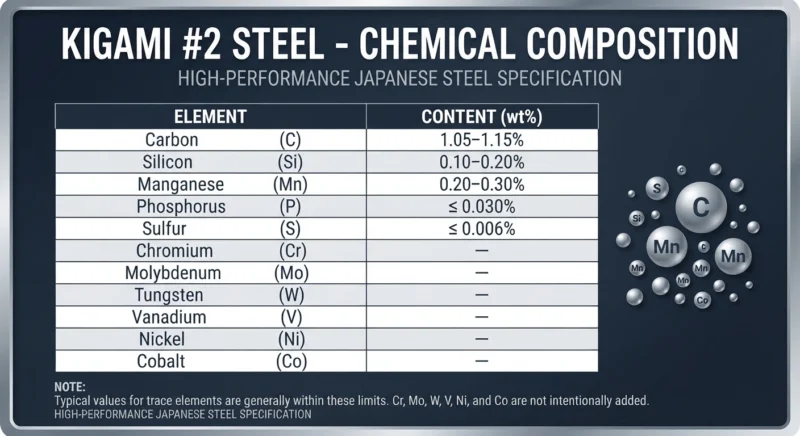
Kigami #2 Chemical Composition
Understanding the chemistry helps explain why this steel behaves the way it does.
According to the official Yasugi Specialty Steel data, the typical composition of Kigami 2 is:
| Element | Typical / Maximum Content |
|---|---|
| Carbon (C) | 1.05–1.15% |
| Silicon (Si) | 0.10–0.20% |
| Manganese (Mn) | 0.20–0.30% |
| Chromium (Cr) | None specified |
| Molybdenum (Mo) | None specified |
| Vanadium (V) | None specified |
| Tungsten (W) | None specified |
| Nickel (Ni) | None specified |
| Phosphorus (P) | ≤0.030% |
| Sulfur (S) | ≤0.006% |
These figures are from Proterial’s current YSS material specification.
Zknives independently lists essentially the same chemistry for Hitachi Kigami 2: approximately 1.05–1.15% carbon, 0.20–0.30% manganese, 0.10–0.20% silicon, sulfur at 0.006% and phosphorus at 0.03%, with no intentional chromium, molybdenum, vanadium or tungsten.
This chemistry immediately tells us something interesting.
Kigami #2 does not rely on large additions of alloying elements to obtain wear resistance.
There is no significant chromium addition like you would see in stainless steels.
There is no tungsten and chromium package like Aogami.
There is no vanadium carbide system like you would find in many modern powder steels.
Instead, the steel gets much of its cutting behavior from its high carbon content and heat treatment.
That is one reason traditional carbon steels can feel so different from modern alloy steels.
Why Is Carbon So Important in Kigami #2?
Kigami #2 contains roughly 1.05–1.15% carbon.
That is a substantial amount.
Carbon is one of the most important elements in traditional knife steel because it allows the steel to become hard through heat treatment.
Higher carbon content can support higher hardness and a fine cutting edge, provided the steel is properly heat treated.
But carbon alone does not tell us exactly how a knife will perform.
This is a very important point.
Two knives made from the same nominal steel can behave differently because of:
- heat treatment
- quenching
- tempering
- forging
- grain refinement
- blade geometry
- edge thickness
- sharpening
- edge angle
- finishing technique
Therefore, saying “Kigami #2 has 1.1% carbon” does not automatically mean every Kigami #2 knife will perform identically.
Steel is the starting material.
The finished knife is the result of the entire manufacturing process.
Check Our Guide Carbon Steel vs Stainless Steel Knives: Which Is Better?
Is Kigami #2 a Carbon Steel?
Yes.
Kigami #2 is a non-stainless high-carbon steel.
There is no meaningful chromium content in the official composition to provide stainless behavior.
That means owners should expect the blade to react with moisture and acids.
A fresh Kigami #2 blade may initially have a bright metallic appearance, but with use it can develop a patina.
A patina is a controlled surface oxidation that often appears gray, blue-gray, brown, or sometimes darker depending on the foods cut, environment, and maintenance.
Patina is not the same thing as active red rust.
That distinction is worth understanding.
A stable patina can actually become part of the character of a carbon-steel knife.
Active rust, on the other hand, should be removed and prevented.
If you cut an acidic tomato with a carbon-steel Kigami #2 knife and leave the blade wet on the counter, you are essentially inviting chemistry to do what chemistry naturally does.
The solution is simple:
wipe the blade, wash it, and dry it.
Kigami #2 does not require complicated rituals.
It requires attention.
Kigami #2 Hardness
Hardness is one of the most frequently misunderstood specifications in knife steel.
The official Proterial specification gives Kigami 2 a hardening hardness of over 60 HRC under its specified heat treatment.
However, this should not be interpreted as saying that every finished Kigami #2 kitchen knife is automatically 60+ HRC.
The final hardness of an individual knife depends on how that particular blade was heat treated and tempered.
This is why a responsible knife description should distinguish between:
steel specification
and
actual finished-knife hardness.
If a maker states that a particular Kigami #2 knife is 60–61 HRC, that is a statement about the finished blade.
If we say that the steel specification supports 60 HRC or higher, we are talking about the material and specified heat treatment.
Those are related, but they are not exactly the same thing.
Check Our Guide What Is HRC? Understanding Rockwell Hardness in Kitchen Knives
What Does 60 HRC Mean for a Knife?
A hardness around 60 HRC is already serious territory for a kitchen knife.
The edge can be made thin.
It can take a very fine apex.
It can maintain a sharp cutting geometry better than a much softer blade.
But hardness always involves trade-offs.
As hardness increases, the edge can become less forgiving of:
- twisting
- lateral force
- bones
- frozen food
- hard cutting boards
- accidental impacts
- poor sharpening technique
This is why a hard Japanese knife should be used as a cutting tool, not as a pry bar.
Kigami #2 rewards controlled cutting.
It is not designed for chopping through bones or performing tasks that require lateral force.
How Sharp Can Kigami #2 Get?
Very sharp.
But there is an important qualification.
Almost any decent knife steel can become extremely sharp when properly sharpened. The interesting question is how easily the steel reaches that condition and how the edge behaves afterward.
This is where Kigami #2 becomes attractive.
Its relatively simple carbon-steel chemistry means that it can respond very well to traditional sharpening stones.
A properly sharpened Kigami #2 knife can produce the kind of clean, low-resistance edge that Japanese carbon-steel enthusiasts love.
Instead of thinking only about “how long does it stay sharp?”, it is useful to think about the complete cycle:
sharpen → cut → touch up → sharpen again.
Kigami #2 fits beautifully into that cycle.
It does not need to remain screaming sharp for weeks to be useful.
It is a steel that can be brought back quickly.
Kigami #2 Sharpening
One of the strongest reasons to choose Kigami #2 is its sharpenability.
Compared with highly wear-resistant modern steels, traditional high-carbon steels generally remove material more readily on conventional water stones.
That can make sharpening much more enjoyable.
A typical sharpening progression might be:
- 400–800 grit for significant damage or repair
- 1,000 grit for establishing the primary edge
- 2,000–3,000 grit for refinement
- 4,000–6,000+ grit for a more polished edge
The exact progression depends on the knife and the desired edge.
You do not need an extremely high grit to make Kigami #2 sharp.
In fact, many cooks prefer a slightly toothier working edge because it can feel excellent when cutting vegetables, proteins and other foods.
The best edge is not necessarily the shiniest edge.
It is the edge that works best for your cutting style.
Check Our Guide All Kinds of Knife Sharpening Tools
Does Kigami #2 Hold an Edge Well?
Yes — but this is where online steel discussions sometimes become misleading.
Kigami #2 can have good edge retention for a traditional carbon steel, but it should not be compared directly with highly wear-resistant powder steels as though they were designed for the same purpose.
Edge retention is strongly influenced by:
- hardness
- carbide volume
- carbide type
- edge geometry
- cutting material
- sharpening angle
- heat treatment
Kigami #2 has high carbon but relatively few alloying elements.
That means it does not develop the same type of hard alloy carbides associated with steels such as S30V, M390, MagnaCut or other modern powder metallurgy steels.
Consequently, Kigami #2’s strength is not maximum wear resistance.
Its strength is the combination of sharpness, responsiveness, and easy maintenance.
That is a different philosophy.
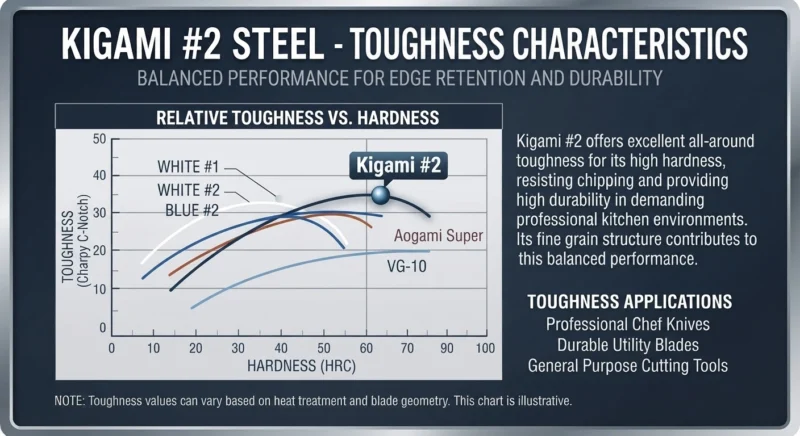
Kigami #2 Toughness
Toughness is another area where steel comparisons need to be handled carefully.
Kigami #2 does not contain large quantities of hard carbide-forming alloying elements.
That can be advantageous because a steel with relatively low carbide volume can have a fine, clean cutting edge.
But the final toughness still depends heavily on heat treatment and blade geometry.
A thin edge made very hard can still chip.
A thick edge made somewhat softer can be considerably more forgiving.
So it is inaccurate to say simply:
“Kigami #2 is tough.”
A better statement is:
Kigami #2 can provide a practical balance of hardness, edge stability and ease of sharpening when properly heat treated and appropriately ground.
That is much closer to the real-world picture.
Check Our Guide Wear Resistance vs Toughness: Understanding the Most Important Knife Steel Trade-Off
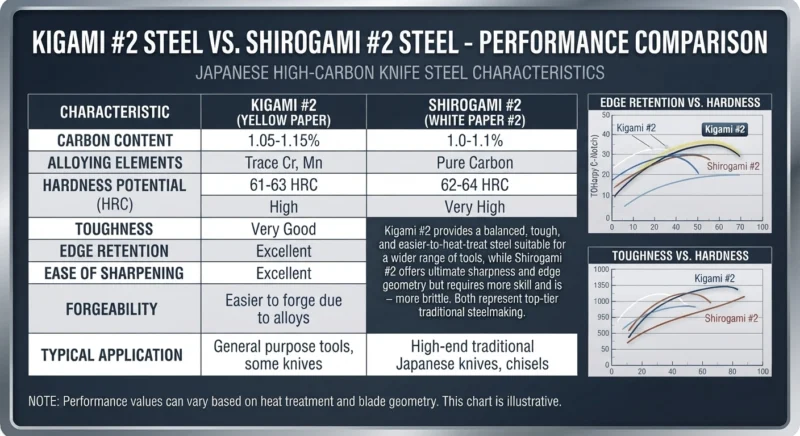
Kigami #2 vs Shirogami #2
This is probably the comparison most readers will want.
Both are traditional Japanese carbon steels.
Both can produce excellent edges.
Both require rust prevention.
Both can be very pleasant to sharpen.
So what separates them?
The answer starts with chemistry.
The official Proterial specification gives Kigami #2 approximately 1.05–1.15% carbon, while Hitachi’s White Steel grades are produced with much tighter impurity limits. Proterial’s Kigami specification allows up to 0.030% phosphorus and 0.006% sulfur.
In traditional discussions, Shirogami is often prized for its purity and predictable behavior during forging and sharpening.
Kigami is less refined in that sense.
But “less refined” should not automatically be translated into “bad.”
Think of the two steels as different tools.
Shirogami #2 is famous for its exceptionally clean cutting behavior and ability to take a refined edge.
Kigami #2 offers excellent cutting performance while generally being positioned as a more economical traditional steel.
Neither one makes the other obsolete.
Check Our Guide Shirogami #2 (White Steel #2)
Kigami #2 vs Aogami #2
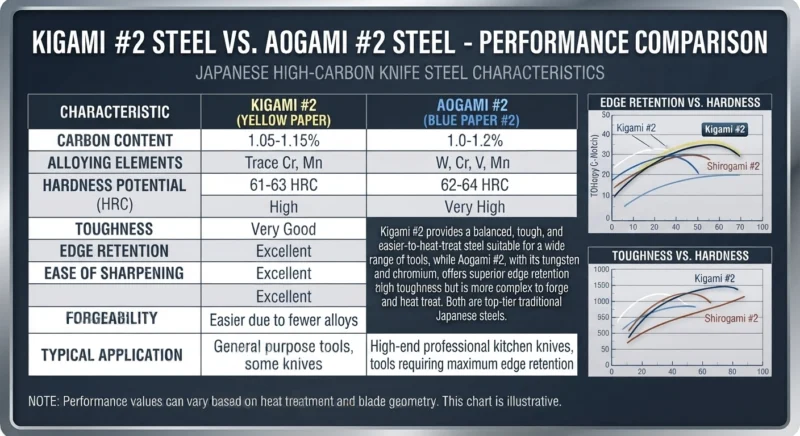
The comparison with Aogami #2 is even more interesting.
Aogami #2 adds alloying elements, particularly tungsten and chromium, to the basic high-carbon steel system.
Those additions change the steel’s wear resistance and heat-treatment behavior.
The result is generally better edge retention than a simple carbon steel, although the price is increased sharpening resistance and more demanding heat treatment.
Kigami #2 takes a simpler route.
It has high carbon and relatively little alloying.
Aogami #2 is therefore usually the better choice if maximum edge retention within the traditional Japanese carbon-steel family is the priority.
Kigami #2 can be the better choice if you value:
- easy sharpening
- traditional carbon-steel feel
- lower material cost
- fast edge maintenance
- a clean, responsive cutting edge
Again, there is no universal winner.
Kigami #2 vs Aogami Super
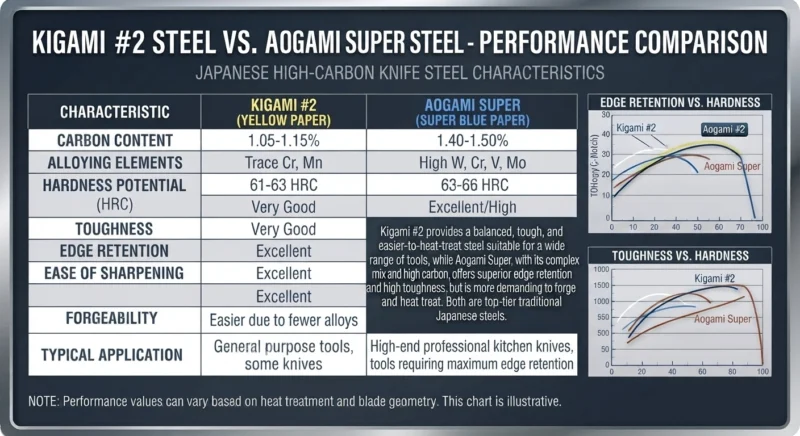
The difference becomes even greater with Aogami Super.
Aogami Super contains additional alloying elements including tungsten and vanadium, and is designed for high hardness and wear resistance.
It can hold an edge for a long time.
It can also be more demanding to sharpen.
Kigami #2 is almost the opposite philosophy.
It says:
“Give me a good stone and a few minutes.”
Aogami Super says:
“Give me a good stone and a little more patience.”
For a professional who values long edge life, Aogami Super can be extremely attractive.
For someone who enjoys sharpening and wants a traditional carbon-steel blade without chasing maximum wear resistance, Kigami #2 can be a much more satisfying choice.
Check Our Guide Aogami Super Steel
Kigami #2 vs Shirogami #3
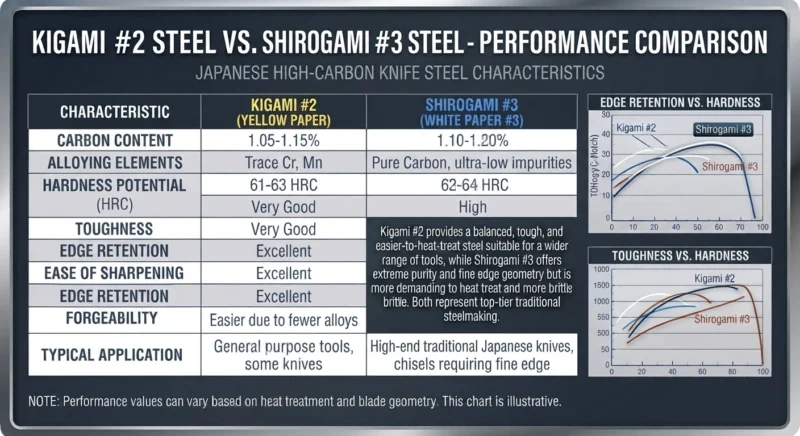
There is also a useful comparison with Shirogami #3.
Both steels sit toward the more traditional end of Japanese knife steel.
Both are relatively easy to sharpen.
Both can develop patina.
But their specifications are not identical.
Proterial lists Kigami #2 at approximately 1.05–1.15% carbon, while the corresponding White Steel #3 specification is approximately 0.80–0.90% carbon.
That difference in carbon content is significant.
Kigami #2 therefore has more carbon available for hardening.
Shirogami #3 is intentionally a lower-carbon grade.
For someone looking for a traditional Japanese steel with a little more hardness potential than Shirogami #3, Kigami #2 is an interesting option.
Check Our Guide Shirogami #3 Steel
Why Is Kigami Called Yellow Steel?
This is one of the fun little details that makes Japanese steel history interesting.
The color names are not descriptions of the finished blade.
Aogami does not mean that the finished blade is blue.
Shirogami does not mean that the blade is white.
Kigami does not mean that the blade is yellow.
The names are connected to the colored paper used to identify different steel products.
That is why the English names “Blue Paper,” “White Paper,” and “Yellow Paper” can sound strange when translated literally.
Once you understand the origin, the naming system becomes much easier to remember.
Is Kigami #2 a Japanese Steel?
Yes.
Kigami #2 belongs to the traditional Japanese steel family associated with Yasugi/Yasuki Specialty Steel.
The current Proterial documentation identifies the product as Kigami 2 under its Yasugi Specialty Steel materials for tools and cutlery.
This is important because the term “Japanese steel” is sometimes used very loosely online.
A knife being made in Japan does not automatically mean that its steel is Japanese.
Likewise, a knife made outside Japan can sometimes use Japanese steel.
The steel origin and knife manufacturing location are separate questions.
For Kigami #2 specifically, however, there is a genuine connection to the Japanese Yasugi steel tradition.
What Knives Use Kigami #2?
Kigami #2 is suitable for many traditional cutting tools.
Its official applications include:
- knives
- chisels
- razors
- sickles
- axes
- gravers
- high-hardness cutting tools
Proterial specifically lists it for applications where high hardness is desirable.
In kitchen knives, Kigami #2 can be used for a variety of traditional Japanese designs.
Depending on the maker and heat treatment, you may encounter it in:
- gyuto
- petty knives
- santoku
- nakiri
- deba
- yanagiba
- other traditional kitchen knives
Its suitability is not limited to one particular blade shape.
The geometry is often more important than the steel name when deciding how a knife should be used.
Kigami #2 for Japanese Kitchen Knives
A Kigami #2 kitchen knife can be a wonderful choice for someone who appreciates traditional carbon steel but does not want to pay a premium purely for the steel name.
Imagine two cooks.
The first cook wants to sharpen once every few months and wants maximum resistance to edge wear.
The second cook enjoys maintaining knives, keeps a water stone nearby, and likes a blade that responds immediately to sharpening.
The second cook is a natural candidate for Kigami #2.
This is why steel selection should always begin with the person rather than the specification sheet.
The “best” steel depends on how you actually use the knife.
Check Our Guide Japanese Fish Knives
Kigami #2 for Professional Kitchens
Kigami #2 can also make sense in professional environments.
The advantage is not necessarily that the edge will survive longer than every modern steel.
It won’t.
The advantage is that maintenance can be straightforward.
A professional cook who touches up a knife regularly may not care whether the steel retains its absolute maximum sharpness for several extra hours.
What matters is whether the knife can be restored quickly.
A steel that takes a fresh edge efficiently can be more useful than a steel that technically holds an edge longer but requires considerably more effort to sharpen.
This is particularly true when knives are maintained frequently.
Kigami #2 for Beginners
There is a misconception that carbon-steel knives are automatically unsuitable for beginners.
They are not.
A beginner simply needs to understand three rules:
Keep it dry.
Do not cut inappropriate materials.
Learn basic sharpening.
Kigami #2 can actually be a good steel for learning sharpening because the response on a stone is easy to understand.
You can feel the blade contacting the abrasive.
You can gradually refine the edge.
You can learn how pressure changes the result.
And because the steel does not have the extreme wear resistance of many modern steels, you can practice without feeling as though every sharpening session is a battle.
Is Kigami #2 Easy to Sharpen?
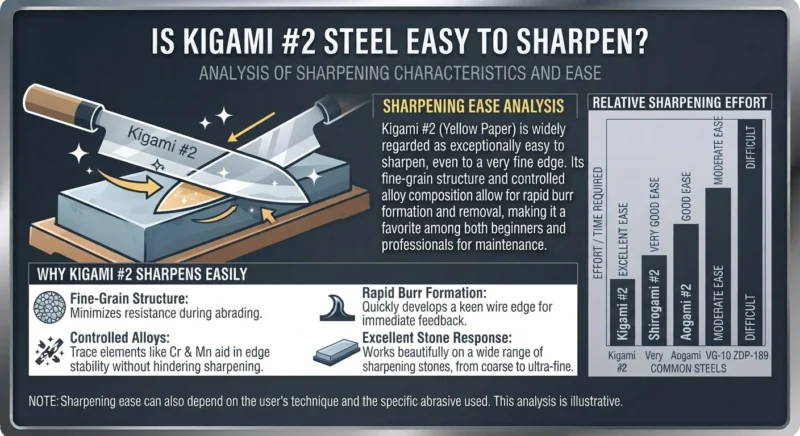
Generally, yes.
This is one of its strongest characteristics.
The absence of large quantities of hard alloy carbides means that conventional sharpening stones can work very effectively.
You do not necessarily need expensive diamond abrasives.
A good synthetic water stone is enough for normal maintenance.
For many users, this is one of the biggest advantages of traditional Japanese carbon steels.
Sharpening becomes maintenance rather than punishment.
What Edge Angle Should You Use?
There is no single correct angle for every Kigami #2 knife.
A reasonable starting point for many kitchen knives is approximately:
12–15 degrees per side.
But the correct angle depends on:
- blade thickness
- edge geometry
- knife construction
- intended use
- hardness
- cutting technique
A very thin Japanese blade may perform beautifully at a relatively acute angle.
A thicker work knife may benefit from a more robust edge.
If you experience repeated micro-chipping, do not immediately blame the steel.
Try a slightly wider edge angle and consider your cutting technique.
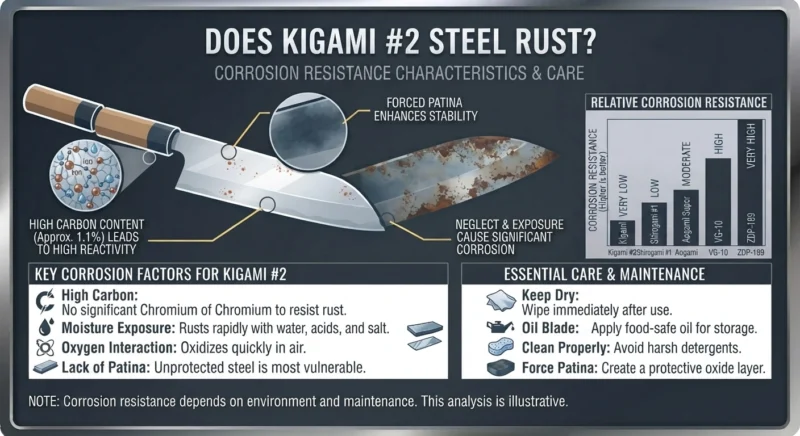
Does Kigami #2 Rust?
Yes.
It is carbon steel, not stainless steel.
But rust should not be exaggerated either.
A carbon-steel knife does not instantly turn orange the moment it touches a tomato.
What matters is exposure time and moisture.
A few seconds of contact with food is normal.
Leaving the knife wet for an hour is another matter.
The basic routine is easy:
- Cut the food.
- Wipe the blade.
- Wash when necessary.
- Dry completely.
- Store safely.
That’s it.
Over time, the blade may develop a patina.
Many owners consider this part of the personality of carbon steel.
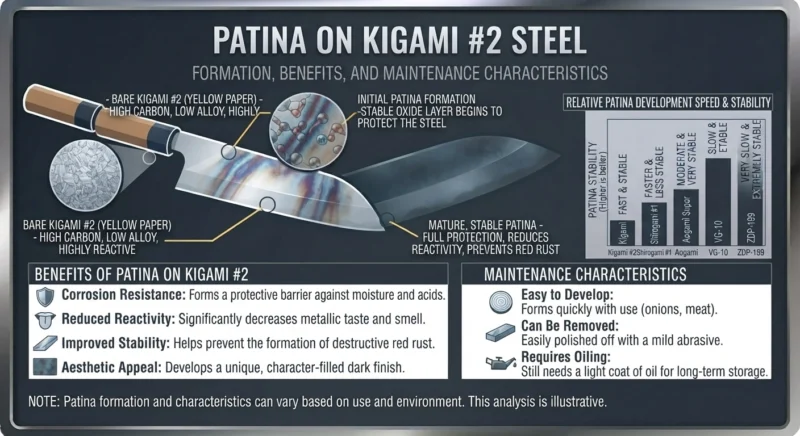
Patina on Kigami #2
A patina is essentially a layer of oxidation that develops on the surface.
The color can vary considerably.
Foods such as:
- onions
- citrus
- apples
- tomatoes
- meat
- fish
can all influence the appearance of the patina.
A carbon-steel knife that is used regularly can become visually unique.
Two Kigami #2 knives that started with nearly identical blades can eventually look quite different.
That is one of the reasons traditional carbon knives have such a strong following.
The blade becomes a record of use.
How to Care for a Kigami #2 Knife
Good maintenance is simple.
1. Keep the blade clean
Food residue should not be allowed to remain on the blade unnecessarily.
2. Dry it
This is the most important habit.
A dry carbon-steel knife is much easier to live with than a wet one.
3. Avoid the dishwasher
High heat, water, detergents and prolonged exposure are not appropriate for a carbon-steel knife.
4. Do not leave it soaking
Never leave a carbon-steel knife sitting in a sink full of water.
5. Use appropriate cutting boards
Wood and softer synthetic cutting boards are generally preferable to glass, stone or other extremely hard surfaces.
6. Sharpen before the knife becomes extremely dull
Regular maintenance is easier than major edge repair.
7. Store it safely
A blade guard, saya, knife block or appropriate storage system can protect both the edge and the user.
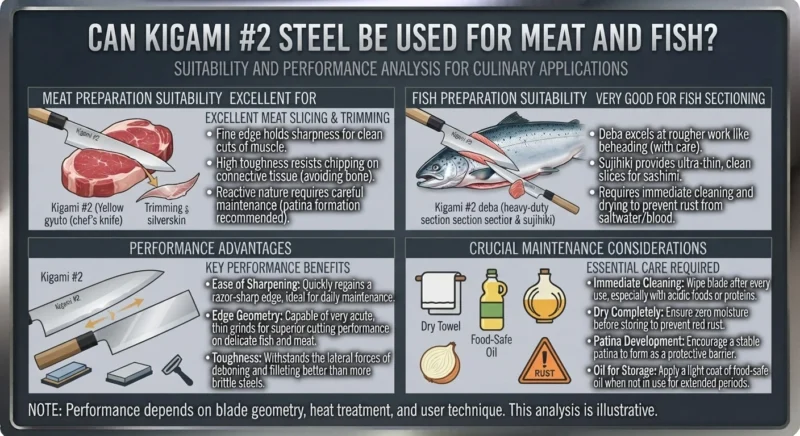
Can Kigami #2 Be Used for Meat?
Yes.
A properly made Kigami #2 knife can be excellent for meat preparation.
But the same rules apply as with other hard Japanese kitchen knives.
Do not use a thin kitchen edge to chop through bones.
Do not twist the blade inside joints.
Do not pry.
For serious bone work, use an appropriate butcher’s knife, cleaver or saw.
Kigami #2 is a cutting steel.
Treat it like one.
Can Kigami #2 Be Used for Fish?
Absolutely.
Traditional Japanese knives are famous for fish preparation, and carbon steels remain popular in this field.
A well-sharpened Kigami #2 knife can provide a very clean edge for:
- trimming
- slicing
- portioning
- vegetable preparation
- fish preparation
For specialized sushi work, geometry becomes particularly important.
The steel is only one part of the knife.
A properly designed yanagiba made from Kigami #2 is a very different tool from a thick gyuto made from the same steel.
Kigami #2 and Food Reactivity
Carbon steels can react with acidic foods.
This does not necessarily make them unsuitable for cooking.
In fact, many professional cooks deliberately use carbon-steel knives every day.
The trick is simple:
don’t let chemistry become neglect.
If a blade develops a patina, that’s normal.
If you see active rust, clean it.
If the knife develops a strange smell or residue, wash it.
The maintenance is part of owning a traditional carbon-steel knife.
Is Kigami #2 Better Than Stainless Steel?
“Better” depends entirely on what you want.
Compared with a typical stainless kitchen steel, Kigami #2 can offer:
- easier sharpening
- excellent fine-edge potential
- traditional carbon-steel character
- responsive sharpening
- high hardness potential
But stainless steel generally offers:
- much better corrosion resistance
- easier ownership
- less maintenance
- better tolerance of careless storage
So if you want a knife that you can leave wet in the sink, Kigami #2 is a poor choice.
If you enjoy sharpening and don’t mind wiping the blade, Kigami #2 can be extremely rewarding.
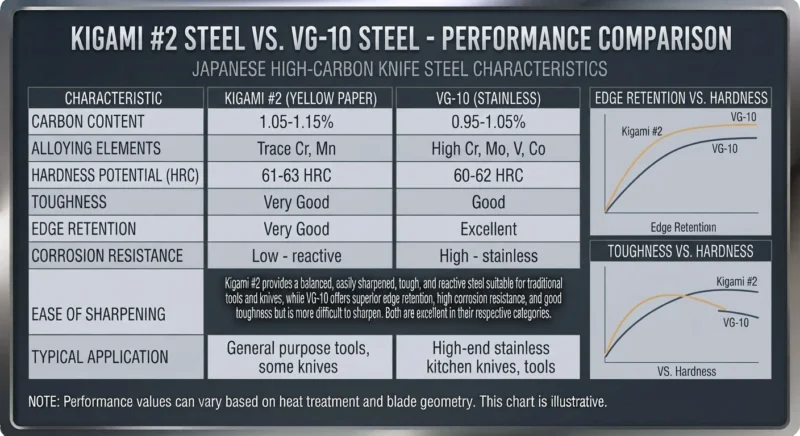
Kigami #2 vs VG10
VG10 is one of the most common stainless steels associated with Japanese kitchen knives.
The difference is dramatic.
VG10 contains significant chromium and other alloying elements and is designed to provide corrosion resistance and good wear resistance.
Kigami #2 is a traditional non-stainless carbon steel with a much simpler chemistry.
The practical difference is easy to summarize:
VG10 = convenience.
Kigami #2 = traditional carbon-steel experience.
Neither is universally superior.
Someone buying a first Japanese knife for a busy household may prefer VG10.
Someone who enjoys maintaining knives may prefer Kigami #2.
Check Our Guide VG10 Steel Review: Pros, Cons, Edge Retention, Toughness & Real-World Performance
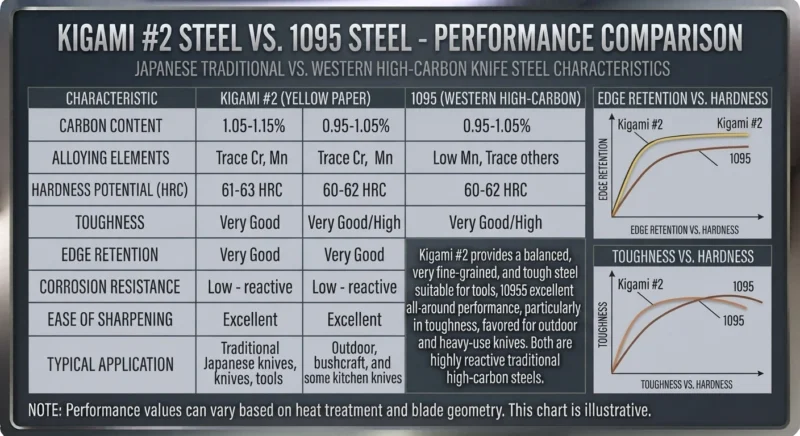
Kigami #2 vs 1095
This is another interesting comparison.
Both are high-carbon steels with relatively simple alloy systems.
Both can become hard.
Both can take a fine edge.
Both are not stainless.
But they are not identical steels, and their manufacturing traditions are different.
Kigami #2 belongs to the Japanese Yasugi steel tradition and is specifically produced for tool and cutlery applications.
1095 is an American-designated high-carbon steel widely used in knives and other tools.
The final behavior of either steel depends heavily on heat treatment and geometry.
This is why a direct “winner” comparison is not particularly useful.
Kigami #2 and Edge Retention
Let’s return to the question most people ask:
How long will Kigami #2 stay sharp?
There is no universal number.
A knife cutting soft vegetables on a wooden board may remain very sharp for a long time.
The same knife used on a hard plastic board in a commercial kitchen can lose its finest edge much sooner.
Edge retention depends on:
- cutting board
- food
- cutting technique
- edge angle
- blade geometry
- hardness
- heat treatment
- sharpening quality
This is why online statements such as “Steel X stays sharp twice as long as Steel Y” should be treated cautiously unless the test conditions are clearly defined.
Steel performance is not a stopwatch.
The Real Strength of Kigami #2
If we had to summarize Kigami #2 in one sentence, it would be:
Kigami #2 is a traditional high-carbon Japanese steel that emphasizes practical cutting performance and easy maintenance rather than maximum alloy-based wear resistance.
That distinction matters.
Modern knife culture often treats edge retention as the ultimate measure of quality.
But a knife that stays sharp for an extremely long time is not automatically the best knife.
A cook might prefer a knife that:
- feels lively
- sharpens quickly
- takes a fine edge
- responds immediately on a stone
- is affordable
- can be maintained without specialized equipment
That is where Kigami #2 makes sense.
Why Kigami #2 Is Often Less Expensive
One reason Kigami #2 has historically occupied a more economical position is its relatively simple chemistry.
It does not require expensive additions of tungsten, vanadium, molybdenum or other alloying elements to create its performance characteristics.
That does not mean that a Kigami #2 knife must be cheap.
A great knife can be expensive even when the raw steel is inexpensive.
Why?
Because the final product also includes:
- forging
- heat treatment
- grinding
- polishing
- sharpening
- handle construction
- fitting
- finishing
- quality control
A highly skilled craftsman can turn relatively economical steel into an exceptional knife.
The steel is important.
It is not the entire knife.
Kigami #2 and Traditional Japanese Craftsmanship
This is perhaps the most interesting part of the story.
Traditional Japanese knife making has never been based solely on buying the most exotic steel available.
A craftsman chooses a material according to the desired result.
Then comes:
forging.
heat treatment.
grinding.
geometry.
sharpening.
Every stage matters.
This is why two knives made from the same Kigami #2 steel can have noticeably different personalities.
One may feel extremely aggressive and precise.
Another may feel more forgiving.
One may have a polished edge.
Another may have a toothier working edge.
The material provides possibilities.
The maker determines how those possibilities are used.
Is Kigami #2 a Good Steel for a Handmade Knife?
Yes.
In fact, Kigami #2 can make a particularly interesting handmade knife because its characteristics allow the maker to focus on geometry and sharpening rather than simply relying on extreme alloy content.
A skilled maker can create a thin, responsive edge.
The result can be an extremely enjoyable cutting tool.
For buyers interested in handmade Japanese-style knives, this can be more important than owning the latest super steel.
There is something satisfying about a knife that asks you to participate in its maintenance.
Check Our Guide How a Handmade Knife Is Made: From Steel to Finished Blade
Who Should Buy a Kigami #2 Knife?
Kigami #2 is particularly suitable for someone who:
- enjoys sharpening knives
- appreciates traditional Japanese steel
- wants a very sharp edge
- does not mind wiping the blade
- prefers carbon steel to stainless steel
- wants a relatively economical traditional steel
- values easy maintenance on water stones
- uses a knife primarily for controlled cutting
It may not be the best choice for someone who:
- wants completely rust-free performance
- leaves knives wet
- uses a dishwasher
- wants maximum possible edge retention
- regularly cuts bones
- wants a zero-maintenance kitchen knife
Knowing which group you belong to is more important than memorizing steel rankings.
Frequently Asked Questions About Kigami #2
Is Kigami #2 the same as Yellow Steel #2?
Yes. Kigami #2, Kigami 2 and Yellow Steel #2 are commonly used names for the same traditional Japanese steel designation.
Is Kigami #2 stainless?
No. Kigami #2 is a non-stainless high-carbon steel.
What is the carbon content of Kigami #2?
The official Proterial/Yasugi specification gives approximately 1.05–1.15% carbon.
What hardness can Kigami #2 reach?
The official specification lists over 60 HRC hardening hardness under its stated heat-treatment conditions. The actual hardness of a finished knife depends on the maker’s heat treatment and tempering.
Is Kigami #2 easy to sharpen?
Yes. Its relatively simple carbon-steel chemistry makes it well suited to conventional water-stone sharpening.
Does Kigami #2 rust?
Yes. It is a carbon steel and should be dried after use.
Does Kigami #2 take a good edge?
Yes. Properly heat-treated Kigami #2 can take a very fine and sharp edge.
Is Kigami #2 better than Shirogami #2?
Not universally. Shirogami #2 is generally more refined in terms of impurity control, while Kigami #2 offers a practical and economical traditional carbon-steel option.
Is Kigami #2 better than Aogami #2?
If maximum edge retention is the priority, Aogami #2 has an advantage because of its alloy additions. If easy sharpening and traditional carbon-steel behavior are more important, Kigami #2 can be preferable.
Is Kigami #2 good for kitchen knives?
Yes. It is suitable for many Japanese-style kitchen knives and traditional cutting tools.
Is Kigami #2 good for beginners?
It can be, provided the user understands carbon-steel care. Its sharpening response can actually make it a good steel for learning how to maintain a knife.
Final Verdict: Is Kigami #2 Worth Choosing?
Kigami #2 does not have the marketing glamour of the newest powder steels.
It does not promise extreme corrosion resistance.
It does not contain a long list of exotic alloying elements.
And it is not the steel you should choose if your only goal is maximum possible edge retention.
But that misses the point.
Kigami #2 represents a different approach to knife making.
It is a high-carbon, traditional Japanese steel with a relatively simple chemistry, high hardness potential, excellent sharpening response and the ability to produce a refined cutting edge.
The official Yasugi specification gives it approximately 1.05–1.15% carbon, with modest silicon and manganese and tightly controlled but somewhat higher impurity limits than the White Steel family. It is specified for hardening above 60 HRC under the manufacturer’s stated heat-treatment conditions.
Its simplicity is not necessarily a weakness.
It is part of its personality.
A Kigami #2 knife asks you to wipe the blade.
It asks you to pay attention.
It asks you to sharpen it occasionally.
In return, it can provide the extremely satisfying experience of a traditional high-carbon Japanese blade.
And perhaps that is the best way to understand Kigami #2.
It isn’t trying to be the most technologically advanced steel in the room.
It is trying to be a very good knife steel.
For the right user, that is more than enough.
Kigami #2 Steel at a Glance
| Property | Kigami #2 |
|---|---|
| Japanese Name | Kigami / 黄紙 |
| English Name | Yellow Paper Steel #2 / Yellow Steel #2 |
| Steel Type | High-carbon, non-stainless |
| Carbon | 1.05–1.15% |
| Silicon | 0.10–0.20% |
| Manganese | 0.20–0.30% |
| Chromium | None specified |
| Tungsten | None specified |
| Vanadium | None specified |
| Molybdenum | None specified |
| Phosphorus | ≤0.030% |
| Sulfur | ≤0.006% |
| Specified Hardening Hardness | Over 60 HRC |
| Corrosion Resistance | Low |
| Sharpenability | Very good |
| Fine Edge Potential | Excellent |
| Wear Resistance | Moderate |
| Maintenance | Requires regular drying |
| Typical Uses | Knives, chisels, razors, sickles, axes, gravers |
This article is for independent informational purposes only and is not affiliated with, sponsored by, or endorsed by any steel manufacturer. All product names, trademarks, and registered trademarks are the property of their respective owners.
https://www.proterial.com/e/yss/search/kigami2.html?utm_source