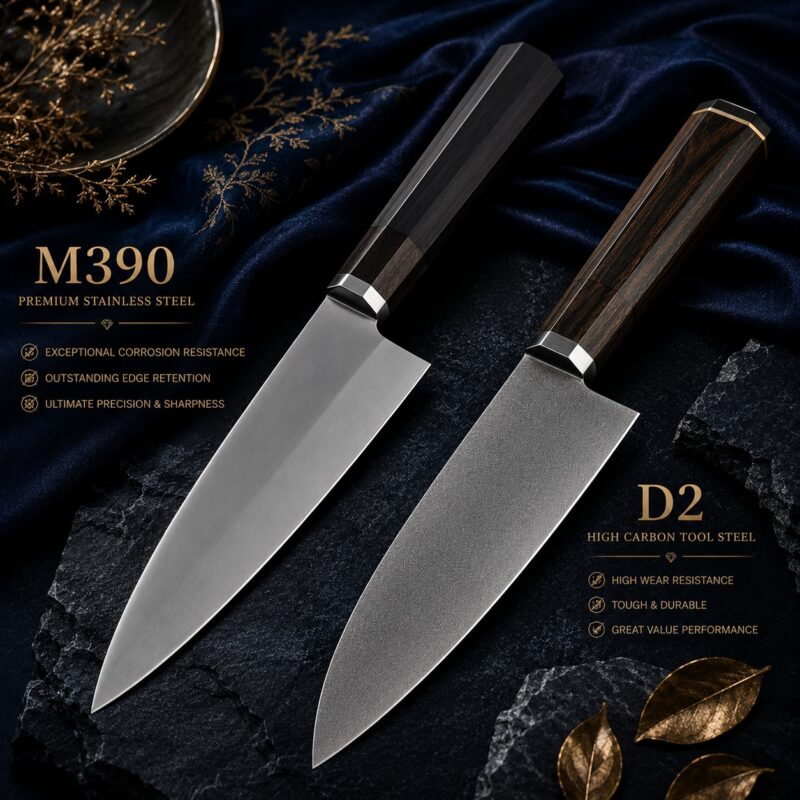
M390 vs D2 Steel
An Independent Guide
Introduction
When choosing a knife, one of the most important decisions is selecting the right blade steel. Steel composition directly influences how a knife performs, how often it needs sharpening, how resistant it is to rust, and how well it withstands demanding cutting tasks.
Among the many knife steels available today, M390 and D2 are two of the most frequently compared. Both have earned strong reputations for excellent cutting performance, but they were developed with different goals in mind.
M390 is a modern powder metallurgy stainless steel designed to provide an outstanding balance of edge retention, wear resistance, corrosion resistance, and overall versatility. It is often chosen by users who want premium performance with minimal maintenance.
D2, by contrast, is a high-carbon tool steel that has been trusted for decades. It is valued for its excellent wear resistance, reliable edge retention, and affordability. Although it is sometimes described as “semi-stainless,” it requires more care than true stainless steels because of its lower corrosion resistance.
Both steels can produce excellent knives, but they perform differently depending on the intended application.
In this comprehensive comparison, you’ll learn how M390 and D2 differ in:
- Edge retention
- Wear resistance
- Toughness
- Corrosion resistance
- Hardness
- Ease of sharpening
- Everyday carry performance
- Outdoor use
- Kitchen applications
- Long-term maintenance
- Overall value
By the end of this guide, you’ll understand which steel is the better choice for your specific needs.
Quick Comparison: M390 vs D2
| Property | M390 | D2 |
|---|---|---|
| Steel Type | Powder metallurgy stainless steel | Conventional tool steel |
| Corrosion Resistance | ⭐⭐⭐⭐⭐ | ⭐⭐☆☆☆ |
| Edge Retention | ⭐⭐⭐⭐⭐ | ⭐⭐⭐⭐☆ |
| Wear Resistance | ⭐⭐⭐⭐⭐ | ⭐⭐⭐⭐☆ |
| Toughness | ⭐⭐⭐⭐☆ | ⭐⭐⭐☆☆ |
| Ease of Sharpening | Moderate | Moderate to Easy |
| Typical Hardness | 60–62 HRC | 58–61 HRC |
| Maintenance | Low | Moderate |
| Best For | Everyday carry, kitchen, outdoor use | Utility work, workshop, outdoor tasks |
Quick Verdict
If you want a premium stainless steel that combines excellent edge retention with outstanding corrosion resistance, M390 is the stronger choice.
If you prioritize durability, solid cutting performance, and good value while accepting additional maintenance, D2 remains an excellent option.
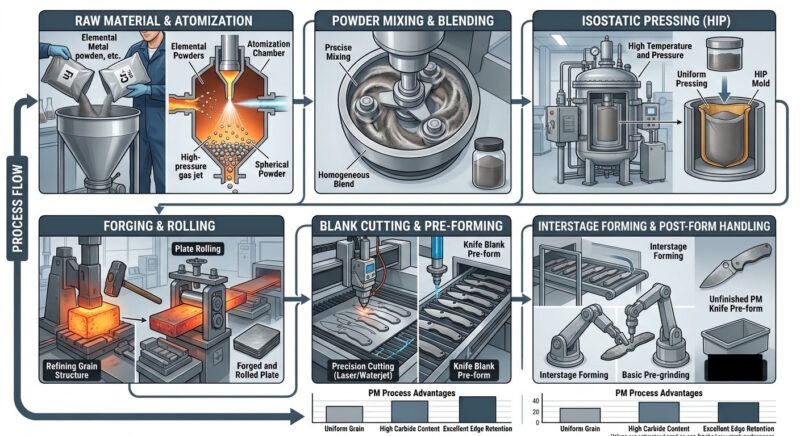
Powder Metallurgy vs Conventional Steel
One of the biggest differences between these steels is how they are manufactured.
Understanding the manufacturing process helps explain why they perform differently.
Check Our Guide Powder Steels for Kitchen Knives
What Is Powder Metallurgy?
Powder metallurgy is an advanced manufacturing process used to produce premium knife steels.
Instead of casting molten steel into large ingots, the molten alloy is atomized into microscopic powder particles.
These particles are then compressed under high pressure and fused into solid steel.
This process creates an extremely fine and uniform carbide distribution.
The benefits include:
- Smaller carbides
- Improved wear resistance
- Better toughness
- More consistent hardness
- Excellent edge stability
- Superior manufacturing precision
M390 is produced using this advanced process.
Check Our Guide M390 Steel Review
Conventional Steel Production
D2 is produced using a traditional steelmaking process.
Molten steel is poured into large molds and allowed to cool into solid ingots.
During cooling, carbides naturally grow larger than those found in powder metallurgy steels.
Modern manufacturing techniques have improved conventional steels significantly, but they still cannot achieve the same carbide uniformity as powder metallurgy.
This does not make D2 a poor steel.
Instead, it creates different performance characteristics.
D2 remains one of the most respected conventional tool steels because it balances hardness, wear resistance, and affordability remarkably well.
Check Our Guide D2 Steel Review
Why Knife Steel Properties Matter
Many buyers assume that hardness alone determines how good a knife will be.
In reality, knife performance depends on balancing several important characteristics.
Let’s examine the most important ones.
Hardness
Hardness measures a steel’s resistance to permanent deformation.
Knife hardness is commonly measured using the Rockwell Hardness Scale (HRC).
Higher hardness generally provides:
- Better edge retention
- Improved wear resistance
- Longer cutting performance
However, increasing hardness too much may reduce toughness if the heat treatment is not properly controlled.
The best knife steels balance hardness with durability.
Toughness
Toughness describes how well steel resists:
- Chipping
- Cracking
- Breaking
- Impact damage
A tougher knife tolerates heavier work, including:
- Wood carving
- Bushcraft
- Utility cutting
- Outdoor tasks
- Twisting forces
Higher toughness often comes at the expense of maximum wear resistance.
Wear Resistance
Wear resistance measures how slowly the cutting edge loses material through repeated use.
Highly wear-resistant steels stay sharp longer when cutting abrasive materials such as:
- Cardboard
- Rope
- Leather
- Wood
- Plastic
- Fiber-based materials
This property directly influences how frequently a knife requires sharpening.
Corrosion Resistance
Corrosion resistance refers to a steel’s ability to resist:
- Rust
- Staining
- Moisture
- Food acids
- Humid environments
This characteristic becomes particularly important for:
- Kitchen knives
- Fishing knives
- Outdoor use
- Everyday carry
- Coastal environments
Ease of Sharpening
Every knife eventually becomes dull.
Some steels sharpen quickly using conventional sharpening stones.
Others contain extremely hard carbides that require diamond abrasives for efficient sharpening.
Generally:
- Higher wear resistance means more sharpening effort.
- Lower wear resistance usually means faster sharpening.
The ideal balance depends on your maintenance preferences.
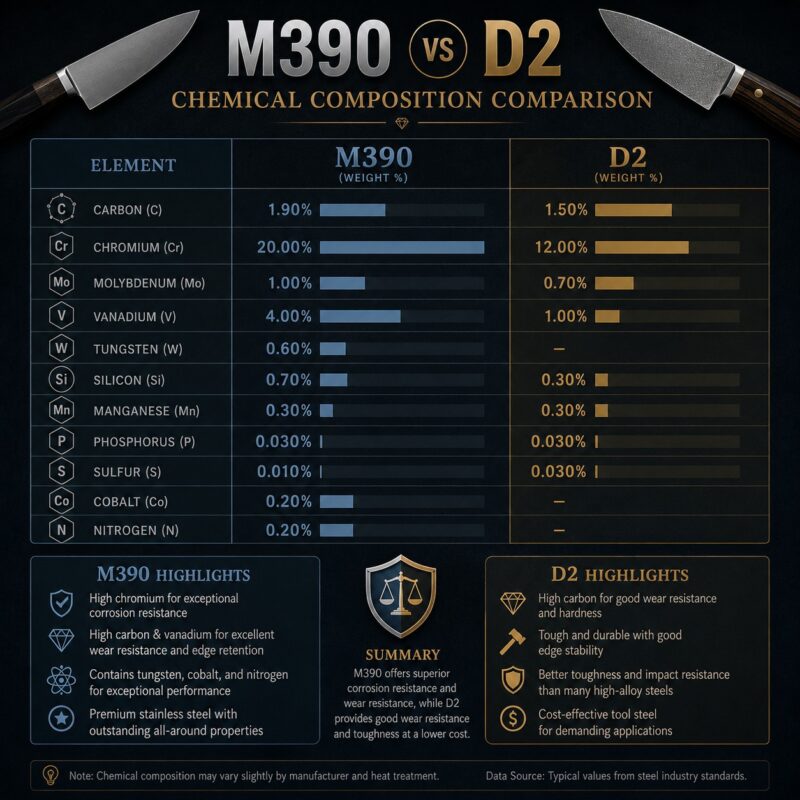
Chemical Composition Comparison
Although exact percentages vary slightly between production batches and heat treatments, the general alloy composition illustrates why these steels perform differently.
| Element | M390 | D2 |
|---|---|---|
| Carbon | High | Very High |
| Chromium | Very High | High |
| Vanadium | High | Moderate |
| Molybdenum | High | Low |
| Tungsten | Small | Small |
| Silicon | Moderate | Moderate |
| Manganese | Moderate | Moderate |
Rather than focusing on precise numbers, understanding the role of each alloying element provides far greater insight.
Carbon: The Foundation of Hardness
Carbon is the primary alloying element responsible for knife hardness.
It contributes to:
- Edge retention
- Wear resistance
- Strength
- Carbide formation
Both M390 and D2 contain enough carbon to achieve premium cutting performance.
However, carbon works together with other alloying elements to determine the steel’s final characteristics.
Chromium: Corrosion Protection
Chromium plays two important roles.
First, it contributes to corrosion resistance.
Second, it forms hard chromium carbides that improve wear resistance.
M390 contains significantly more chromium available for corrosion protection, giving it excellent stainless performance.
D2 also contains considerable chromium, but much of it becomes locked into carbide formation rather than remaining available to protect against rust.
As a result, D2 offers better corrosion resistance than many simple carbon steels but does not perform like a true stainless steel.
Vanadium: Improving Edge Stability
Vanadium forms extremely hard carbides that enhance several important properties.
These include:
- Wear resistance
- Edge retention
- Grain refinement
- Cutting performance
M390 contains more vanadium than D2.
Combined with powder metallurgy, this creates a very fine carbide structure that supports long-lasting sharpness.
D2 also benefits from vanadium carbides, although its larger carbide structure behaves differently during cutting and sharpening.
Molybdenum: Strength and Durability
Molybdenum contributes to:
- Improved strength
- Better wear resistance
- Enhanced hardenability
- Increased resistance to softening
M390 contains a higher amount of molybdenum than D2, contributing to its excellent overall balance of properties.
Why Chemistry Is Only Part of the Story
While alloy composition is important, steel chemistry alone does not determine knife performance.
Other equally important factors include:
- Heat treatment
- Manufacturing process
- Carbide distribution
- Blade geometry
- Edge angle
- Intended use
This explains why two premium steels with very different compositions can both produce exceptional cutting tools.
M390 emphasizes corrosion resistance, wear resistance, and versatility, while D2 focuses on dependable cutting performance, durability, and excellent value.
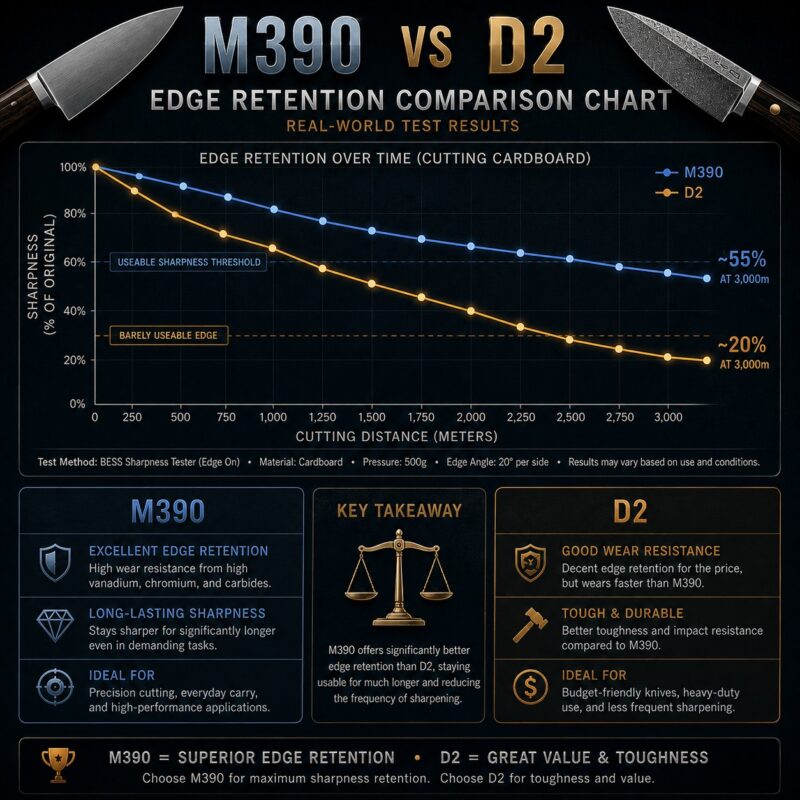
Edge Retention
Edge retention is often the first characteristic buyers consider when comparing knife steels. It refers to how long a blade remains sharp during normal use before requiring sharpening.
While every knife eventually becomes dull, steels with superior edge retention can complete significantly more cutting tasks while maintaining consistent performance.
Both M390 and D2 are known for holding an edge well, but their performance differs because of their manufacturing processes and carbide structures.
M390 Edge Retention
M390 is widely recognized for exceptional edge retention.
Its combination of high carbon, chromium, vanadium, and molybdenum creates a dense network of extremely hard carbides. Thanks to powder metallurgy, these carbides are evenly distributed throughout the steel, producing a refined cutting edge with excellent stability.
During everyday use, M390 performs exceptionally well when cutting:
- Cardboard
- Rope
- Plastic packaging
- Leather
- Paper
- Food
The edge dulls gradually rather than losing sharpness suddenly, allowing the knife to remain useful even after extended use.
For most users, sharpening is needed only occasionally.
D2 Edge Retention
D2 has built its reputation over decades as an excellent edge-holding tool steel.
Its high carbon content and large chromium carbides provide impressive resistance to wear.
D2 performs particularly well when cutting:
- Cardboard
- Leather
- Rope
- Wood
- Rubber
- Utility materials
Although its edge retention is excellent, the larger carbides found in conventionally produced steel can make the cutting edge feel slightly less refined than M390 during precision slicing.
Nevertheless, D2 continues to outperform many mid-range knife steels in long-term cutting performance.
Which Steel Holds an Edge Longer?
In controlled cutting tests involving abrasive materials, M390 generally retains peak sharpness longer than D2.
Its finer carbide structure helps maintain a cleaner, more consistent cutting edge over extended use.
However, D2 remains highly competitive and offers more than enough edge retention for most everyday users.
Winner: M390
Wear Resistance
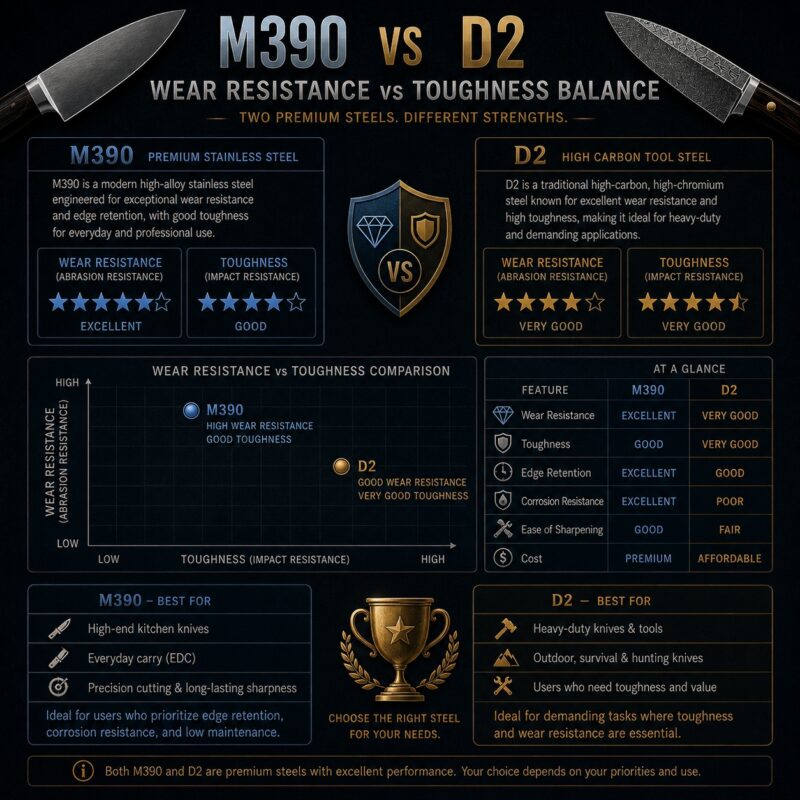
Wear resistance measures how effectively a steel resists abrasion during repeated cutting.
This property directly influences how slowly the edge loses material over time.
M390 Wear Resistance
Wear resistance is one of M390’s defining strengths.
Its combination of vanadium and chromium carbides creates an edge capable of handling highly abrasive materials while maintaining excellent sharpness.
M390 performs exceptionally well when repeatedly cutting:
- Thick cardboard
- Plastic straps
- Rope
- Fiberboard
- Carpet
- Synthetic materials
This allows users to sharpen less frequently while maintaining excellent cutting efficiency.
D2 Wear Resistance
D2 also offers excellent wear resistance.
For many years, it has been regarded as one of the best-performing conventional tool steels for abrasive cutting tasks.
It performs well during:
- Warehouse work
- Workshop projects
- Woodworking
- Packaging
- Outdoor utility tasks
Although M390 generally demonstrates higher wear resistance, the difference during normal household use is often relatively small.
Wear Resistance Comparison
| Property | M390 | D2 |
|---|---|---|
| Abrasion Resistance | Outstanding | Excellent |
| Heavy Cardboard Cutting | Outstanding | Excellent |
| Rope Cutting | Outstanding | Excellent |
| Everyday Utility | Excellent | Excellent |
Winner: M390
Toughness
Toughness describes a steel’s ability to resist cracking, chipping, or breaking when subjected to impacts or lateral forces.
This property becomes increasingly important during demanding cutting tasks.
M390 Toughness
M390 offers good toughness for a premium stainless steel.
Its powder metallurgy structure helps reduce weak points within the steel while supporting a stable cutting edge.
Under normal cutting conditions, M390 performs very well.
However, because its design prioritizes wear resistance, it is not intended for repeated heavy impact or abusive use.
D2 Toughness
D2 provides respectable toughness, but its relatively large carbide structure can make it somewhat more prone to edge chipping than steels specifically designed for maximum impact resistance.
For ordinary cutting tasks, this is rarely an issue.
D2 performs well during:
- Workshop use
- Utility cutting
- Light woodworking
- Outdoor chores
However, repeated impacts or aggressive twisting should be avoided.
Toughness Comparison
| Property | M390 | D2 |
|---|---|---|
| Light Utility | Excellent | Very Good |
| Heavy Utility | Very Good | Good |
| Resistance to Chipping | Very Good | Good |
| General Durability | Excellent | Very Good |
Although neither steel is designed primarily for maximum toughness, M390 generally demonstrates a slightly better balance between hardness and durability.
Winner: M390 (slight advantage)
Corrosion Resistance
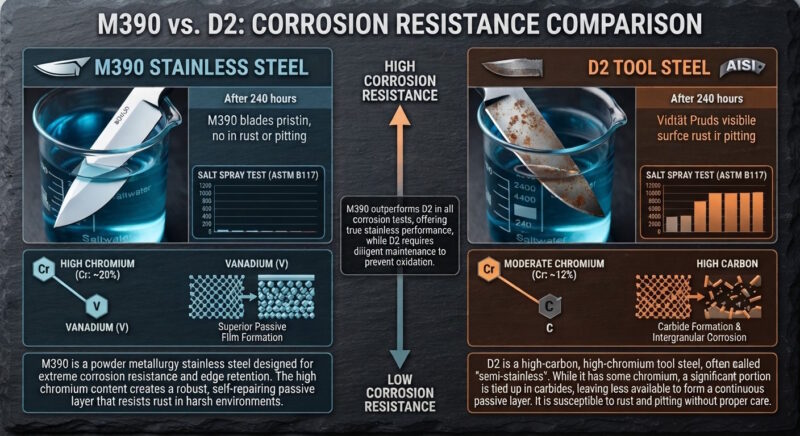
Corrosion resistance represents one of the largest differences between these steels.
For users living in humid climates or regularly preparing food, this category may determine the better choice.
M390 Corrosion Resistance
M390 provides excellent corrosion resistance.
Its high chromium content forms a protective oxide layer that greatly reduces the likelihood of:
- Rust
- Staining
- Pitting
- Surface discoloration
With basic cleaning and drying, M390 performs exceptionally well in:
- Kitchens
- Coastal regions
- Humid environments
- Everyday pocket carry
- Outdoor activities
Routine maintenance is minimal.
D2 Corrosion Resistance
D2 occupies an interesting position.
Although it contains a relatively high chromium content, much of that chromium forms carbides rather than remaining available for corrosion protection.
As a result, D2 is often described as “semi-stainless.”
In practical terms, this means:
- It resists corrosion better than simple carbon steels.
- It is noticeably less corrosion resistant than true stainless steels like M390.
After exposure to moisture or acidic foods, D2 should be:
- Cleaned promptly
- Dried thoroughly
- Lightly oiled before long-term storage
With proper care, corrosion is easily managed.
Corrosion Resistance Comparison
| Environment | M390 | D2 |
|---|---|---|
| Kitchen | Excellent | Good |
| Humid Climate | Excellent | Fair |
| Outdoor Rain | Excellent | Good |
| Coastal Use | Excellent | Fair |
| Long-Term Storage | Excellent | Good with protection |
Winner: M390
Hardness
Hardness helps determine how well a knife supports a sharp cutting edge.
Typical heat treatment ranges are:
| Steel | Typical Hardness |
|---|---|
| M390 | 60–62 HRC |
| D2 | 58–61 HRC |
Both steels achieve hardness suitable for premium cutting tools.
Proper heat treatment, however, remains more important than hardness alone.
A well-treated blade can outperform another knife made from the same steel but processed incorrectly.
Check Our Guide What Is HRC? Understanding Rockwell Hardness
Ease of Sharpening
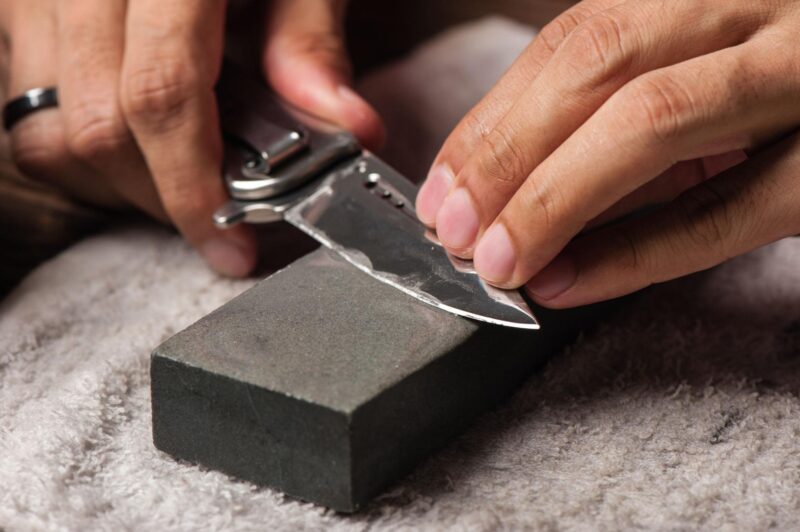
Every knife eventually requires sharpening.
The amount of effort depends largely on wear resistance and carbide structure.
Sharpening M390
M390 requires quality sharpening equipment.
Diamond stones or premium ceramic abrasives generally produce the best results because of the steel’s high wear resistance.
Sharpening requires patience, but M390 is capable of taking an extremely fine, polished edge.
Sharpening D2
D2 is generally easier to sharpen than M390.
Although it remains a wear-resistant steel, conventional abrasives remove material more quickly.
Many users appreciate that D2 reaches a sharp working edge without excessive effort.
This can be especially valuable for those who sharpen frequently.
Sharpening Comparison
| Property | M390 | D2 |
|---|---|---|
| Time Required | Moderate | Moderate to Easy |
| Burr Formation | Moderate | Easy |
| Fine Edge | Excellent | Very Good |
| Diamond Stones Recommended | Yes | Helpful |
Winner: D2
Cutting Feel
Knife enthusiasts often describe different steels as having unique cutting characteristics.
Although subjective, these observations are consistent across many experienced users.
M390
M390 is often described as:
- Smooth
- Refined
- Precise
- Excellent for controlled slicing
Its fine carbide structure supports exceptionally clean cuts through a wide variety of materials.
D2
D2 is frequently described as:
- Aggressive
- Toothy
- Confident
- Excellent for utility cutting
Rather than producing an ultra-refined slicing feel, D2 often maintains a “working edge” that continues cutting effectively even after prolonged use.
This characteristic makes it particularly popular for workshop and outdoor tasks.
Performance Summary
| Category | Winner |
|---|---|
| Edge Retention | M390 |
| Wear Resistance | M390 |
| Toughness | M390 (slight advantage) |
| Corrosion Resistance | M390 |
| Ease of Sharpening | D2 |
| Fine Edge Quality | M390 |
| Utility Cutting Feel | D2 |
At this stage, M390 leads in most technical performance categories, particularly corrosion resistance, wear resistance, and edge retention. D2 remains highly competitive by offering excellent cutting performance, easier sharpening, and strong value for users who don’t mind a little extra maintenance.
Real-World Performance
Technical specifications provide useful information, but they don’t always reflect how a knife performs during everyday use. A blade that looks impressive on paper may not necessarily be the best choice for your daily tasks.
Both M390 and D2 have earned loyal followings because they perform exceptionally well in real-world applications. However, they excel in different situations.
M390 is designed as a premium stainless steel that combines long-lasting sharpness with outstanding corrosion resistance and versatility. D2, on the other hand, is a durable tool steel known for excellent wear resistance, dependable cutting performance, and straightforward maintenance.
Understanding where each steel shines makes choosing between them much easier.
Everyday Carry (EDC)
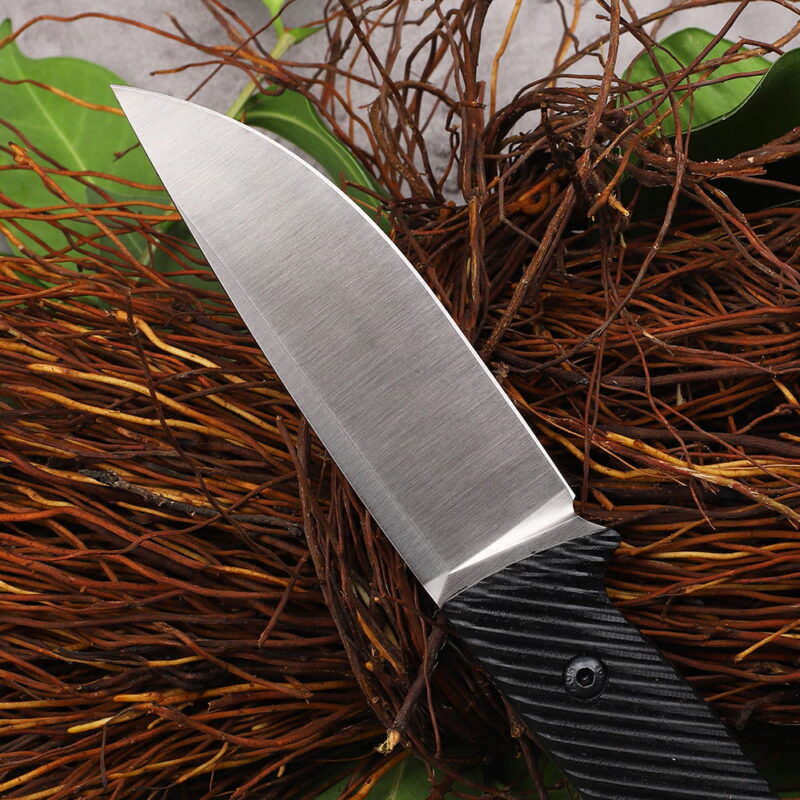
An everyday carry knife should be capable of handling a wide variety of tasks throughout the day.
Typical EDC jobs include:
- Opening packages
- Cutting cardboard
- Trimming rope
- Preparing food
- Opening plastic containers
- General household tasks
- Light outdoor work
For most users, versatility is just as important as maximum edge retention.
Check Our Guide Stainless Steel Myths: The Complete Truth About Modern Knife Steels
M390 for Everyday Carry
M390 is considered one of the best premium steels for everyday carry.
Its excellent corrosion resistance allows users to carry the knife in almost any environment without worrying about rust.
Advantages include:
- Outstanding rust resistance
- Excellent edge retention
- Minimal maintenance
- Smooth slicing performance
- Easy cleaning after food preparation
Whether carried in a pocket every day or used around the house, M390 performs consistently.
D2 for Everyday Carry
D2 has remained a popular EDC steel for decades.
It offers:
- Excellent cutting ability
- Reliable edge retention
- Good durability
- Easy maintenance with proper care
The primary consideration is corrosion.
If exposed to sweat, humidity, or moisture for extended periods, D2 should be cleaned and dried promptly.
Many users carry D2 every day without problems by following simple maintenance habits.
Best Choice for EDC
Both steels perform very well, but M390 requires significantly less maintenance and provides greater corrosion resistance.
Winner: M390

Kitchen Performance
Kitchen knives experience conditions that differ greatly from workshop or outdoor use.
Common challenges include:
- Water
- Fruit acids
- Salt
- Frequent washing
- Moisture
- Humidity
Corrosion resistance becomes especially important.
Check Our Guide Carbon Steel vs Stainless Steel Knives: Which Is Better?
M390 in the Kitchen
M390 excels during food preparation.
Its stainless properties allow it to resist staining while maintaining excellent cutting performance.
Benefits include:
- Smooth slicing
- Long-lasting sharpness
- Easy cleaning
- Excellent resistance to rust
- Minimal maintenance
For users preparing meals every day, M390 offers exceptional convenience.
D2 in the Kitchen
D2 can certainly be used in the kitchen, but it demands more attention.
After cutting foods such as:
- Tomatoes
- Citrus fruits
- Apples
- Onions
the blade should be washed and dried immediately.
Leaving moisture on the blade for extended periods may eventually lead to discoloration or surface rust.
Although many cooks enjoy D2, it is generally less practical than M390 for daily food preparation.
Winner: M390
Outdoor Performance
Outdoor knives often perform a wide variety of tasks.
These include:
- Camp food preparation
- Rope cutting
- Shelter construction
- Fire preparation
- Wood processing
- General campsite chores
Both steels perform well outdoors, but their advantages differ.
Check Our Guide What Size Knife Is Best for Camping?
M390 Outdoors
M390 performs exceptionally well in wet conditions.
Its resistance to corrosion makes it especially valuable during:
- Rain
- Snow
- River crossings
- Coastal camping
- High humidity
For users seeking dependable performance with minimal maintenance, M390 is an excellent outdoor steel.
D2 Outdoors
D2 has a long history of successful outdoor use.
Its excellent wear resistance allows it to continue cutting effectively during prolonged use.
However, after exposure to rain or humidity, the blade should be dried thoroughly.
A light protective oil before storage helps prevent corrosion.
For users willing to perform basic maintenance, D2 remains an excellent outdoor choice.
Outdoor Winner
For wet environments and general camping:
Winner: M390
For dry environments where cutting endurance is the primary concern:
D2 remains highly capable.
Bushcraft Performance
Bushcraft places heavy demands on a knife.
Typical tasks include:
- Feather sticks
- Wood carving
- Shelter building
- Fire preparation
- Camp cooking
These activities require both edge retention and durability.
Check our Guide One Knife for Hunting and Bushcraft: Is It Really Possible?
M390 for Bushcraft
M390 performs well during normal bushcraft activities.
Its excellent wear resistance allows the blade to remain sharp throughout extended carving sessions.
However, users should avoid excessive prying or abusive impact.
D2 for Bushcraft
D2 has long been appreciated for bushcraft applications.
Its strengths include:
- Reliable edge retention
- Strong cutting performance
- Good wear resistance
- Excellent value
Although not the toughest tool steel available, D2 handles typical bushcraft tasks very well.
Many outdoor enthusiasts continue to rely on D2 because of its dependable working edge.
Bushcraft Winner
Neither steel dominates completely.
M390 offers better corrosion resistance.
D2 provides excellent cutting performance at a lower cost.
For overall versatility:
Winner: M390 (slight advantage)
Hunting and Field Dressing
Hunting knives encounter:
- Blood
- Moisture
- Fat
- Tissue
- Outdoor exposure
Corrosion resistance and edge retention are both important.
M390
M390 performs exceptionally well during field dressing.
Its stainless properties simplify cleaning while helping prevent corrosion after contact with moisture.
D2
D2 has also been widely used for hunting knives.
It maintains a sharp working edge during prolonged processing.
However, prompt cleaning is especially important because blood and moisture may accelerate corrosion if left on the blade.
Hunting Winner
Winner: M390
Rope and Cardboard Cutting
These materials quickly reveal differences in wear resistance.
M390
M390 continues cutting cardboard and rope for remarkably long periods before requiring sharpening.
Warehouse workers and users handling frequent packaging often appreciate this durability.
D2
D2 also performs extremely well.
Its aggressive working edge remains highly effective even after extended cutting.
Many users find that D2 continues slicing efficiently despite losing some shaving sharpness.
Winner
For maximum edge longevity:
Winner: M390
Maintenance Requirements
Maintenance often influences long-term satisfaction more than laboratory specifications.
Check Our Guide Knife Safety Tips for Outdoor Use
Caring for M390
Routine care is simple.
Recommended maintenance:
- Wash after food preparation
- Dry thoroughly
- Store in a dry location
- Sharpen when necessary
Protective oils are generally unnecessary during everyday use.
Caring for D2
D2 requires slightly more attention.
Recommended maintenance:
- Dry immediately after use
- Remove food residue promptly
- Apply a light protective oil before long-term storage
- Avoid storing in damp leather sheaths
- Inspect periodically for corrosion
These habits require only a few minutes but significantly improve long-term durability.
Which Steel Requires Less Maintenance?
| Task | M390 | D2 |
|---|---|---|
| Cleaning | Easy | Easy |
| Rust Prevention | Minimal | Moderate |
| Kitchen Use | Excellent | Good |
| Humid Climate | Excellent | Fair |
| Long-Term Storage | Simple | Oil Recommended |
Winner: M390
Common Myths
Many misconceptions surround premium knife steels.
Let’s clarify a few.
Myth 1: D2 Is Stainless
Not exactly.
D2 contains a relatively high amount of chromium, but much of it forms hard carbides rather than remaining available to protect against corrosion.
As a result, D2 is generally considered a semi-stainless tool steel, not a true stainless steel.
Myth 2: Powder Metallurgy Automatically Makes a Better Knife
Powder metallurgy creates a finer and more uniform carbide structure, but it is only one factor.
Heat treatment, blade geometry, and intended use remain equally important.
A well-made D2 knife can outperform a poorly heat-treated premium steel.
Myth 3: Harder Steel Is Always Better
Hardness alone does not determine performance.
Edge geometry, toughness, wear resistance, and sharpening characteristics all influence how well a knife performs in practice.
Myth 4: Premium Steels Never Need Sharpening
Even the most wear-resistant steels eventually become dull.
Premium steels simply require sharpening less frequently.
Proper maintenance remains essential for long-term performance.
Which Steel Is Better for Beginners?
For first-time buyers seeking a premium knife:
M390 offers:
- Outstanding corrosion resistance
- Excellent edge retention
- Low maintenance
- Versatile performance
- Excellent everyday reliability
D2 offers:
- Excellent value
- Easy sharpening
- Reliable cutting performance
- Proven durability
- Strong utility performance
Users who prefer low maintenance generally benefit more from M390.
Users seeking excellent performance at a lower cost often appreciate D2.
Performance Summary
| Category | Winner |
|---|---|
| Edge Retention | M390 |
| Wear Resistance | M390 |
| Toughness | M390 (slight advantage) |
| Corrosion Resistance | M390 |
| Ease of Sharpening | D2 |
| Kitchen Use | M390 |
| Everyday Carry | M390 |
| Hunting | M390 |
| Outdoor Use | M390 |
| Low Maintenance | M390 |
At this stage, M390 leads in most performance categories thanks to its outstanding corrosion resistance, refined edge retention, and overall versatility. D2 remains a highly respected tool steel that offers excellent cutting performance, easier sharpening, and outstanding value, making it an attractive option for users who don’t mind a bit of extra maintenance.
Pros and Cons
M390 and D2 are both highly respected knife steels, but they appeal to different users. M390 is engineered as a premium stainless steel that delivers exceptional all-around performance, while D2 is a proven tool steel that combines durability, excellent edge retention, and strong value.
Understanding the advantages and limitations of each steel makes it easier to select the right knife for your needs.
M390 Pros
✔ Outstanding edge retention
✔ Excellent wear resistance
✔ Superior corrosion resistance
✔ Fine, refined cutting edge
✔ Low maintenance
✔ Excellent for everyday carry
✔ Performs exceptionally well in kitchen environments
✔ Suitable for humid and coastal climates
✔ Long service life with proper care
M390 Cons
✘ More difficult to sharpen than many conventional steels
✘ Usually more expensive than tool steels
✘ Not intended for abusive prying or impact tasks
D2 Pros
✔ Excellent edge retention
✔ High wear resistance
✔ Easier to sharpen than M390
✔ Proven durability
✔ Reliable working edge
✔ Excellent value
✔ Performs well during utility and workshop tasks
✔ Good choice for outdoor use with proper maintenance
D2 Cons
✘ Lower corrosion resistance
✘ Requires regular cleaning and drying
✘ More susceptible to staining and rust
✘ Larger carbides may produce a less refined edge than powder metallurgy steels
Which Steel Should You Choose?
Choosing between M390 and D2 depends more on your intended use than on which steel is technically superior.
Both deliver excellent cutting performance, but they excel in different environments.
Choose M390 If You Want
- Outstanding corrosion resistance
- Long-lasting edge retention
- A premium everyday carry knife
- Excellent kitchen performance
- Minimal maintenance
- High wear resistance
- Reliable performance in humid climates
M390 is an excellent choice for users who want maximum versatility with very little maintenance.
Choose D2 If You Want
- Excellent value
- Strong utility performance
- Easier sharpening
- Reliable edge retention
- Workshop use
- Outdoor cutting
- A dependable all-purpose tool steel
D2 is ideal for users who appreciate dependable cutting performance and don’t mind performing simple maintenance after use.
Best Uses for Each Steel
| Application | Better Choice |
|---|---|
| Everyday Carry | M390 |
| Kitchen Knives | M390 |
| Food Preparation | M390 |
| Humid Climates | M390 |
| Coastal Environments | M390 |
| Warehouse Work | M390 |
| Cardboard Cutting | M390 |
| Rope Cutting | M390 |
| Workshop Use | D2 |
| General Utility | D2 |
| Budget-Conscious Buyers | D2 |
Final Performance Score
| Category | M390 | D2 |
|---|---|---|
| Edge Retention | ⭐⭐⭐⭐⭐ | ⭐⭐⭐⭐☆ |
| Wear Resistance | ⭐⭐⭐⭐⭐ | ⭐⭐⭐⭐☆ |
| Toughness | ⭐⭐⭐⭐☆ | ⭐⭐⭐☆☆ |
| Corrosion Resistance | ⭐⭐⭐⭐⭐ | ⭐⭐☆☆☆ |
| Ease of Sharpening | ⭐⭐⭐☆☆ | ⭐⭐⭐⭐☆ |
| Maintenance | ⭐⭐⭐⭐⭐ | ⭐⭐⭐☆☆ |
| Overall Versatility | ⭐⭐⭐⭐⭐ | ⭐⭐⭐⭐☆ |
Frequently Asked Questions
Is M390 better than D2?
For most users, yes.
M390 offers better corrosion resistance, longer edge retention, finer edge stability, and lower maintenance requirements.
However, D2 remains an outstanding choice for users seeking dependable cutting performance and excellent value.
Which steel stays sharp longer?
M390 generally maintains its edge longer than D2, particularly during prolonged cutting of abrasive materials.
Its fine carbide structure helps preserve cutting performance over extended use.
Is D2 stainless?
No.
Although D2 contains a relatively high chromium content, much of it forms hard carbides instead of contributing to corrosion resistance.
It is commonly described as a semi-stainless tool steel.
Which steel is easier to sharpen?
D2 is generally easier to sharpen than M390.
While M390 benefits from diamond sharpening stones, D2 usually reaches a sharp working edge with less effort.
Which steel is better for kitchen knives?
M390 is clearly the stronger choice.
Its excellent resistance to moisture and food acids makes it far more practical for everyday kitchen use.
Is D2 good for outdoor knives?
Yes.
D2 performs very well outdoors thanks to its strong edge retention and wear resistance.
However, it should always be cleaned and dried after exposure to rain, snow, or humidity to minimize the risk of corrosion.
Does M390 chip easily?
No.
When properly heat treated and used for appropriate cutting tasks, M390 offers a good balance of hardness, wear resistance, and toughness.
Like any premium steel, it should not be used for prying or striking hard objects.
Which steel offers better value?
The answer depends on your priorities.
If you value low maintenance, corrosion resistance, and premium performance, M390 provides outstanding long-term value.
If your focus is strong cutting performance at a lower purchase cost, D2 remains one of the best-value tool steels available.
Final Verdict
M390 and D2 represent two different generations of knife steel development.
M390 showcases the advantages of modern powder metallurgy. Its fine carbide structure, excellent corrosion resistance, outstanding wear resistance, and long-lasting edge retention make it one of the most versatile premium knife steels available. It performs exceptionally well as an everyday carry steel, in kitchen environments, and during outdoor activities where moisture is a concern.
D2 has earned its reputation through decades of reliable service. Despite being a conventional tool steel, it continues to deliver excellent wear resistance, dependable edge retention, and practical cutting performance. It is easier to sharpen than M390 and offers excellent value, making it a favorite among users who prioritize function and affordability.
For users who want the highest level of overall performance with minimal maintenance, M390 is the better choice.
For those seeking a dependable, high-performing steel that offers excellent value and don’t mind spending a little extra time on maintenance, D2 remains an outstanding option.
Rather than asking which steel is universally better, consider the environment in which your knife will be used most often. Choosing a steel that matches your daily tasks will provide the greatest long-term satisfaction.
Conclusion
Both M390 and D2 have earned their place among the most respected knife steels, but they achieve their performance in different ways.
M390 excels through advanced powder metallurgy, offering exceptional corrosion resistance, outstanding wear resistance, and impressive edge retention in a low-maintenance package. It is an ideal choice for users who want premium performance across a wide range of cutting tasks.
D2 demonstrates why a well-designed conventional tool steel remains relevant. Its strong wear resistance, dependable cutting performance, and ease of sharpening make it an excellent option for workshop tasks, outdoor use, and everyday utility work.
Whether you prioritize premium stainless performance or proven tool steel reliability, understanding the strengths of each steel allows you to select the knife that best fits your specific needs and expectations.
This article is for independent informational purposes only and is not affiliated with, sponsored by, or endorsed by any steel manufacturer. All product names, trademarks, and registered trademarks are the property of their respective owners.