M390 vs CruWear Steel
An Independent Guide
Introduction
Choosing the right knife steel can dramatically influence how a knife performs over years of use. While blade geometry, heat treatment, and edge angle all contribute to cutting performance, the steel itself determines many of the characteristics users care about most, including edge retention, toughness, corrosion resistance, wear resistance, and ease of sharpening.
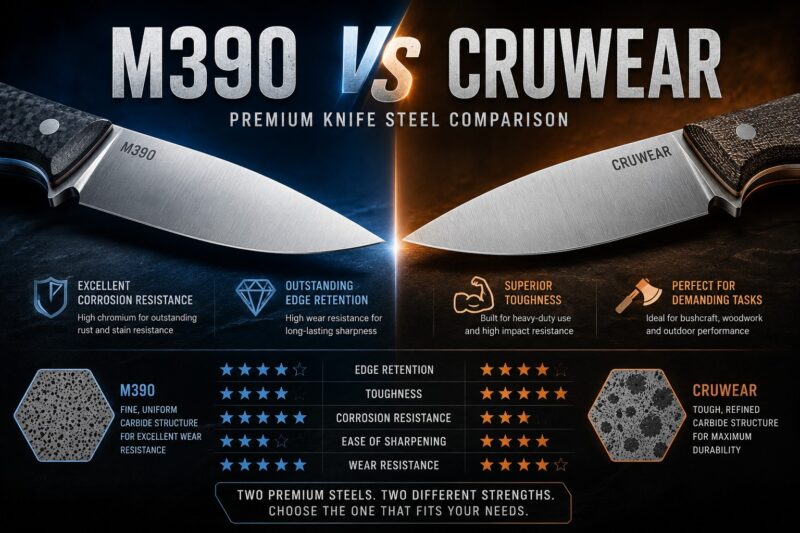
Among today’s premium knife steels, M390 and CruWear are frequently compared because both offer outstanding performance, yet they are engineered with different priorities. M390 is known for combining excellent wear resistance with exceptional corrosion resistance, making it a favorite for users who want a high-performance stainless steel. CruWear, on the other hand, focuses on toughness while still delivering impressive edge retention and wear resistance, making it well suited for demanding cutting tasks.
Although both steels belong to the premium category, they excel in different environments. Understanding their strengths and limitations allows you to choose the steel that best matches your everyday needs rather than relying solely on specifications or marketing claims.
In this comprehensive comparison, you’ll learn how M390 and CruWear perform in every major category, including:
- Edge retention
- Toughness
- Wear resistance
- Corrosion resistance
- Hardness
- Ease of sharpening
- Everyday maintenance
- Outdoor performance
- Kitchen use
- Overall value
By the end of this guide, you’ll have a clear understanding of which steel is the better choice for your intended applications.
Check Our Guide M390 Steel Review
Quick Comparison: M390 vs CruWear
| Property | M390 | CruWear |
|---|---|---|
| Steel Type | Powder metallurgy stainless steel | Powder metallurgy tool steel |
| Corrosion Resistance | ⭐⭐⭐⭐⭐ | ⭐⭐⭐☆☆ |
| Edge Retention | ⭐⭐⭐⭐⭐ | ⭐⭐⭐⭐☆ |
| Wear Resistance | ⭐⭐⭐⭐⭐ | ⭐⭐⭐⭐☆ |
| Toughness | ⭐⭐⭐⭐☆ | ⭐⭐⭐⭐⭐ |
| Ease of Sharpening | Moderate | Moderate to Easy |
| Hardness Range | 60–62 HRC | 60–64 HRC |
| Best For | Everyday carry, kitchen, outdoor use | Bushcraft, heavy-duty work, utility knives |
| Maintenance | Low | Moderate |
Quick Verdict
- Choose M390 if corrosion resistance, versatility, and low maintenance are your priorities.
- Choose CruWear if toughness, durability, and demanding cutting performance are more important.
Understanding Powder Metallurgy
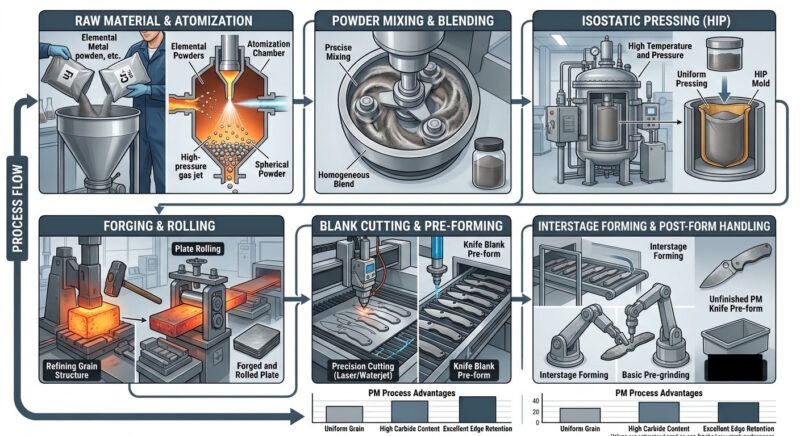
Both M390 and CruWear are produced using powder metallurgy, an advanced manufacturing process that significantly improves the internal structure of steel.
Traditional steel production begins by casting molten steel into large ingots. As these ingots cool, carbides can grow unevenly and form larger clusters. These coarse carbide structures may reduce toughness and make sharpening more difficult.
Powder metallurgy follows a different process.
Instead of cooling into large blocks, molten steel is converted into microscopic powder particles. These particles are then compressed and fused under carefully controlled heat and pressure to form solid steel.
This method creates a much finer and more uniform carbide distribution throughout the material.
The result is steel with several important advantages:
- Smaller carbide particles
- Improved toughness
- Better wear resistance
- More consistent hardness
- Greater manufacturing precision
- Better edge stability
Although both steels benefit from this production method, their chemical compositions give them distinctly different performance characteristics.
Check Our Guide Powder Steels for Kitchen Knives
What Determines Knife Performance?
Many knife buyers assume that hardness alone determines quality.
In reality, a knife’s performance depends on balancing several important characteristics.
Understanding these properties makes comparing steels much easier.
Check Our Guide CPM CruWear Steel Review
Hardness
Hardness measures a steel’s resistance to permanent deformation.
Knife hardness is usually measured using the Rockwell Hardness Scale (HRC).
Higher hardness generally provides:
- Better edge retention
- Higher wear resistance
- Longer cutting performance
However, excessive hardness without sufficient toughness can increase the risk of chipping.
The best-performing steels balance hardness with durability.
Toughness
Toughness measures how well steel resists cracking, chipping, or breaking under stress.
A tough blade tolerates:
- Twisting
- Impacts
- Heavy carving
- Batoning
- Lateral pressure
Outdoor knives and heavy-duty utility knives often prioritize toughness over maximum hardness.
Wear Resistance
Wear resistance describes how slowly the cutting edge loses material during repeated use.
Steels with high wear resistance remain sharp longer when cutting abrasive materials.
These include:
- Cardboard
- Rope
- Leather
- Wood
- Plastic
- Fiber-based materials
Higher wear resistance usually means less frequent sharpening.
Corrosion Resistance
Corrosion resistance determines how effectively steel resists:
- Rust
- Staining
- Pitting
- Moisture
- Food acids
This characteristic becomes especially important in:
- Kitchens
- Coastal environments
- Humid climates
- Fishing
- Everyday pocket carry
Ease of Sharpening
Every knife eventually requires sharpening.
Some steels sharpen quickly using conventional stones, while others require harder abrasives because of their high wear resistance.
Generally speaking:
- Higher wear resistance means more sharpening effort.
- Lower wear resistance usually means easier maintenance.
Finding the right balance depends on how often you’re willing to sharpen your knife.
Chemical Composition Comparison
Knife steel performance begins with chemistry.
Each alloying element contributes specific properties that influence how the finished blade behaves.
The following table summarizes the primary differences.
| Element | M390 | CruWear |
|---|---|---|
| Carbon | High | High |
| Chromium | Very High | Moderate |
| Vanadium | High | Moderate |
| Molybdenum | High | Moderate |
| Tungsten | Low | Moderate |
| Niobium | Small | Small |
Rather than memorizing exact percentages, it’s more useful to understand what each alloying element contributes.
Carbon: The Foundation of Blade Performance
Carbon is the most important alloying element in knife steel.
Without sufficient carbon, steel cannot achieve the hardness required for a long-lasting cutting edge.
Carbon contributes to:
- Hardness
- Edge retention
- Wear resistance
- Carbide formation
Both M390 and CruWear contain enough carbon to achieve premium cutting performance.
However, carbon alone does not determine how the knife behaves.
Its interaction with other alloying elements plays an equally important role.
Chromium: Stainless Protection
Chromium is responsible for corrosion resistance.
When enough chromium remains available within the steel matrix, it forms an invisible oxide layer that protects the blade from oxidation.
This protective layer dramatically reduces:
- Rust formation
- Surface staining
- Pitting
M390 contains a very high chromium content, allowing it to provide excellent corrosion resistance under normal use.
CruWear contains considerably less chromium, meaning it offers moderate corrosion resistance rather than true stainless-level protection.
With proper maintenance, CruWear performs well, but it requires more attention after exposure to moisture.
Vanadium: The Secret Behind Edge Retention
Vanadium is one of the most valuable alloying elements found in premium knife steels.
Its benefits include:
- Extremely hard carbides
- Improved wear resistance
- Better edge stability
- Grain refinement
- Enhanced cutting performance
M390 contains a relatively high amount of vanadium, contributing to its outstanding wear resistance.
CruWear also benefits from vanadium carbides, although its alloy balance emphasizes toughness alongside wear resistance rather than maximizing abrasion resistance alone.
Molybdenum and Tungsten
These alloying elements improve strength and overall blade performance.
Molybdenum contributes to:
- Better hardenability
- Increased wear resistance
- Improved strength
- Better high-temperature stability
Tungsten contributes to:
- Enhanced edge stability
- Increased abrasion resistance
- Greater cutting endurance
Although present in different amounts, these elements help both steels achieve premium performance in demanding cutting applications.
Why Steel Chemistry Matters
No single alloying element determines knife performance.
Instead, every property results from the interaction between:
- Carbon
- Chromium
- Vanadium
- Molybdenum
- Tungsten
- Niobium
- Heat treatment
- Powder metallurgy microstructure
This balance explains why M390 and CruWear can both be considered premium steels while excelling in different areas.
M390 prioritizes corrosion resistance and wear resistance, making it highly versatile for everyday use. CruWear, meanwhile, emphasizes toughness without sacrificing strong edge retention, making it especially attractive for users who subject their knives to demanding cutting tasks.
Edge Retention
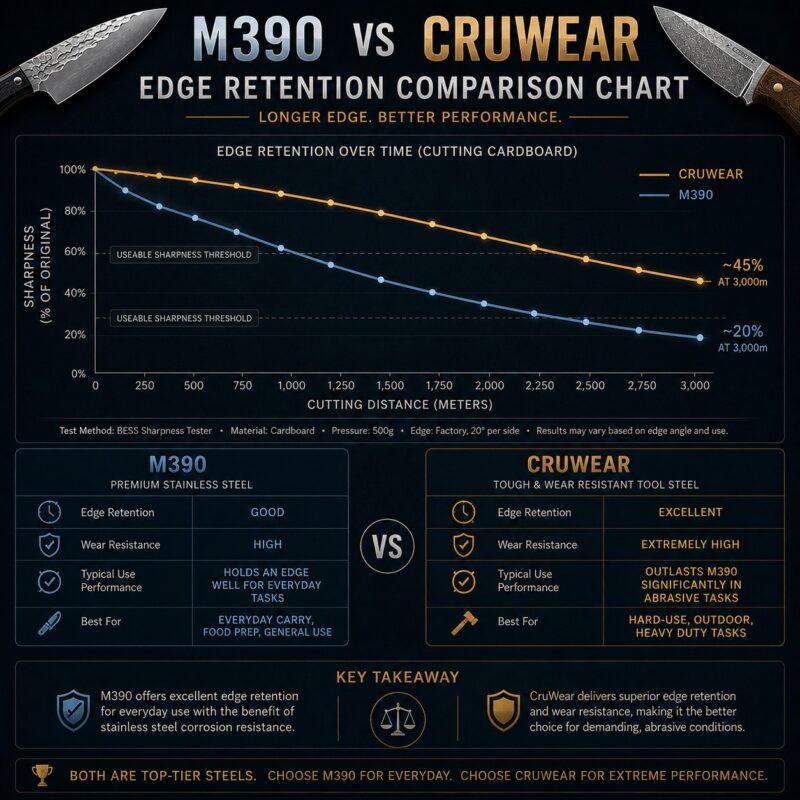
Edge retention is one of the most important factors when evaluating a knife steel. It determines how long a blade remains sharp before it needs to be resharpened. A knife with excellent edge retention can complete more cutting tasks with consistent performance, reducing maintenance and downtime.
Both M390 and CruWear are considered premium steels with impressive edge retention, but they achieve it in different ways.
M390 relies heavily on its high wear resistance and dense concentration of hard carbides, while CruWear combines a balanced carbide structure with exceptional toughness, allowing the edge to remain stable even under demanding use.
Let’s take a closer look at each steel.
M390 Edge Retention
M390 has earned a reputation for outstanding edge retention.
Its combination of high carbon, chromium, vanadium, and molybdenum creates a fine carbide structure that resists wear exceptionally well. Thanks to the powder metallurgy process, these carbides are distributed evenly throughout the steel, helping the blade maintain a sharp edge for extended periods.
During everyday use, M390 performs exceptionally well when cutting:
- Cardboard
- Paper
- Rope
- Plastic packaging
- Leather
- Food
Instead of becoming dull quickly, the edge gradually loses aggressiveness while remaining highly functional.
For most users, sharpening sessions are relatively infrequent compared to many conventional knife steels.
CruWear Edge Retention
CruWear also delivers excellent edge retention, although its design philosophy differs slightly.
Rather than maximizing wear resistance above everything else, CruWear seeks to balance edge retention with toughness.
The result is a blade that not only stays sharp for a long time but also resists micro-chipping during demanding work.
This makes CruWear particularly effective for:
- Wood carving
- Bushcraft
- Utility work
- Workshop tasks
- Outdoor use
Under heavy cutting conditions, many users appreciate how consistently CruWear maintains a usable working edge.
Which Steel Holds an Edge Longer?
Under controlled cutting tests involving abrasive materials, M390 generally has a slight advantage in pure edge retention.
Its higher wear resistance allows the cutting edge to lose material more slowly over time.
However, the difference is often smaller than many people expect.
During normal everyday cutting, both steels remain sharp long enough that most users are unlikely to notice a dramatic difference.
Winner: M390 (slight advantage)
Wear Resistance
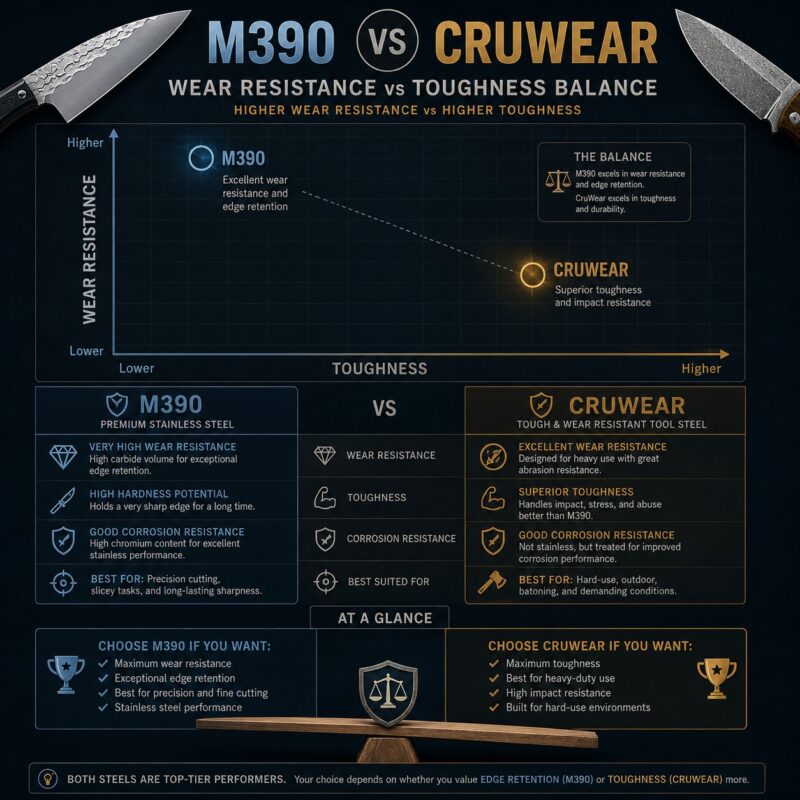
Wear resistance measures how effectively steel resists abrasion during repeated cutting.
Although closely related to edge retention, it specifically refers to the blade’s resistance to losing material through friction.
Several factors contribute to wear resistance:
- Carbide volume
- Carbide hardness
- Carbide distribution
- Heat treatment
- Overall steel chemistry
M390 Wear Resistance
Wear resistance is one of M390’s greatest strengths.
Its high concentration of chromium and vanadium carbides creates an extremely durable cutting edge capable of handling abrasive materials for long periods.
Users who regularly cut:
- Thick cardboard
- Fiberglass-reinforced materials
- Rope
- Plastic strapping
- Carpet
often appreciate how slowly the edge wears.
This makes M390 an excellent choice for users who prefer less frequent sharpening.
CruWear Wear Resistance
CruWear also provides excellent wear resistance, although it intentionally sacrifices a small amount of abrasion resistance to improve toughness.
Its carbide structure remains highly effective for demanding cutting applications.
In practical use, CruWear easily handles:
- Hardwood
- Leather
- Cardboard
- Rope
- Utility cutting
without excessive edge wear.
For most users, the difference between these two steels is relatively small outside prolonged industrial cutting.
Wear Resistance Comparison
| Property | M390 | CruWear |
|---|---|---|
| Abrasion Resistance | Outstanding | Excellent |
| Heavy Cardboard Cutting | Outstanding | Excellent |
| Rope Cutting | Outstanding | Excellent |
| Everyday Utility | Excellent | Excellent |
Winner: M390
Toughness
Toughness measures a steel’s ability to resist cracking, chipping, or breaking under stress.
Unlike wear resistance, toughness becomes increasingly important during demanding work where the blade experiences impacts or twisting forces.
Examples include:
- Carving hardwood
- Batoning
- Bushcraft
- Heavy utility work
- Construction tasks
M390 Toughness
M390 offers good toughness for a premium stainless steel.
The powder metallurgy process produces a refined carbide structure that helps prevent large weak points within the blade.
Under normal cutting conditions, M390 performs very well.
However, because its design emphasizes wear resistance and corrosion resistance, it is not intended for repeated heavy impact work.
Extreme misuse can increase the risk of edge chipping.
CruWear Toughness
Toughness is where CruWear truly stands out.
Its alloy composition was designed specifically to achieve an excellent balance between hardness, wear resistance, and resistance to impact.
This makes CruWear particularly well suited for:
- Bushcraft
- Camping
- Survival knives
- Wood processing
- Heavy carving
- Demanding outdoor use
Even at relatively high hardness levels, CruWear remains remarkably resistant to edge damage.
For users who routinely perform demanding cutting tasks, this additional toughness provides noticeable benefits.
Toughness Comparison
| Property | M390 | CruWear |
|---|---|---|
| Light Utility | Excellent | Excellent |
| Heavy Utility | Very Good | Outstanding |
| Woodworking | Very Good | Outstanding |
| Resistance to Chipping | Good | Excellent |
Winner: CruWear
Corrosion Resistance
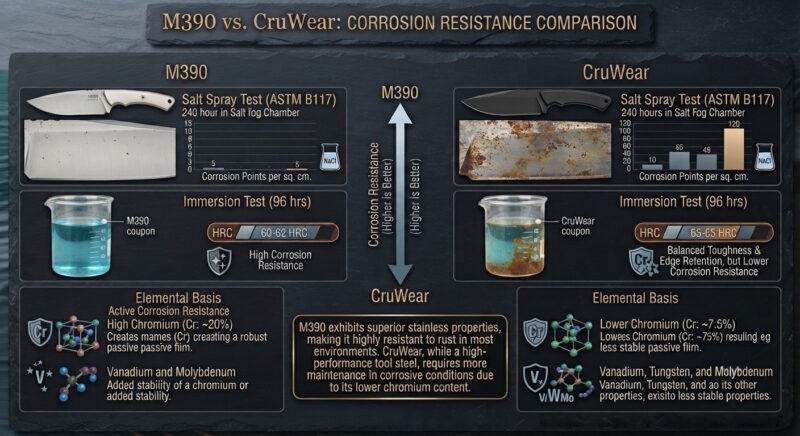
Corrosion resistance is one of the largest differences between these steels.
For users working in wet environments or preparing food regularly, this characteristic may be the deciding factor.
M390 Corrosion Resistance
M390 is widely recognized for its excellent corrosion resistance.
Its high chromium content forms a protective oxide layer that greatly reduces rust formation.
With basic maintenance, M390 performs exceptionally well in:
- Kitchens
- Humid climates
- Coastal regions
- Everyday pocket carry
- Outdoor activities
Simple cleaning and drying after use are generally sufficient.
This makes M390 one of the easiest premium steels to maintain.
CruWear Corrosion Resistance
CruWear offers moderate corrosion resistance.
Although it contains chromium, it does not provide the same level of stainless performance as M390.
If exposed to moisture for prolonged periods, CruWear may develop:
- Surface discoloration
- Patina
- Light rust
Fortunately, preventing corrosion is simple.
Recommended maintenance includes:
- Drying the blade after use
- Cleaning food residue promptly
- Applying a light protective oil during storage
- Avoiding prolonged exposure to moisture
With these habits, corrosion rarely becomes a serious issue.
Corrosion Resistance Comparison
| Environment | M390 | CruWear |
|---|---|---|
| Kitchen | Excellent | Good |
| Humid Climate | Excellent | Moderate |
| Outdoor Rain | Excellent | Good |
| Coastal Use | Excellent | Fair |
| Long-Term Storage | Excellent | Good with protection |
Winner: M390
Hardness
Hardness influences how well a knife resists deformation and supports a sharp edge.
Most knives made from these steels are heat treated within the following ranges:
| Steel | Typical Hardness |
|---|---|
| M390 | 60–62 HRC |
| CruWear | 60–64 HRC |
CruWear is often heat treated slightly harder while still maintaining excellent toughness.
This ability to combine high hardness with durability is one of CruWear’s defining characteristics.
However, hardness alone never tells the complete story.
A properly heat-treated blade can outperform another knife made from the same steel but processed incorrectly.
Check Our Guide What Is HRC? Understanding Rockwell Hardness
Ease of Sharpening
No matter how wear-resistant a steel is, every knife eventually requires sharpening.
Sharpening M390
Because of its exceptional wear resistance, M390 requires more effort than many conventional knife steels.
Diamond or high-quality ceramic sharpening stones generally produce the best results.
Although sharpening takes time, M390 responds well to careful technique and can achieve an extremely refined edge.
Sharpening CruWear
CruWear is generally easier to sharpen than M390.
Its balanced carbide structure allows abrasives to remove material more efficiently while still maintaining excellent edge retention.
Many users appreciate that CruWear reaches a very sharp edge without excessive sharpening time.
For those who sharpen their own knives regularly, this can be a meaningful advantage.
Sharpening Comparison
| Property | M390 | CruWear |
|---|---|---|
| Time Required | Moderate | Moderate to Easy |
| Burr Formation | Moderate | Easy |
| Edge Refinement | Excellent | Excellent |
| Diamond Stones Recommended | Yes | Helpful but not essential |
Winner: CruWear
Cutting Feel
Experienced knife users often describe different steels as having distinct cutting characteristics.
While subjective, these observations are surprisingly consistent.
M390
Users often describe M390 as:
- Smooth
- Refined
- Controlled
- Excellent for slicing
It performs exceptionally well during precise cutting tasks.
CruWear
CruWear is frequently described as:
- Aggressive
- Confident
- Stable
- Powerful through dense materials
Its toughness allows users to apply greater force without worrying as much about edge damage.
Many woodworkers and outdoor enthusiasts appreciate this feeling of confidence during demanding tasks.
Real-World Performance
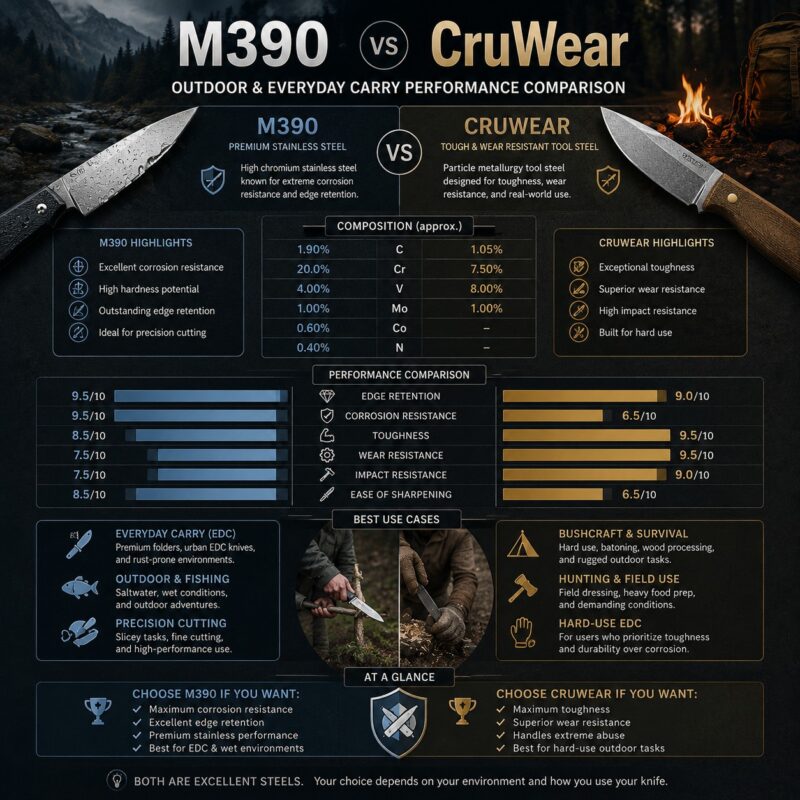
Technical specifications provide an excellent foundation for comparing knife steels, but they don’t always tell the complete story. The true value of a knife becomes clear during everyday use, where repeated cutting, changing environments, and different materials reveal how the steel actually performs.
Although M390 and CruWear are both premium steels produced using powder metallurgy, they were designed with different priorities. M390 emphasizes wear resistance and corrosion resistance, while CruWear focuses on toughness without sacrificing excellent edge retention.
Understanding these differences helps you choose the steel that best matches your daily tasks.
Everyday Carry (EDC)
An everyday carry knife is expected to perform a wide variety of tasks.
Typical daily use includes:
- Opening packages
- Cutting cardboard
- Trimming rope
- Preparing food
- Opening plastic containers
- Light outdoor work
- General household tasks
A good EDC steel should remain sharp, resist corrosion, and require minimal maintenance.
Check Our Guide Carbon Steel vs Stainless Steel Knives
M390 for Everyday Carry
M390 is widely regarded as one of the best all-around steels for everyday carry.
Its combination of long edge life and excellent corrosion resistance makes it suitable for almost any environment.
Advantages include:
- Outstanding resistance to rust
- Excellent wear resistance
- Long intervals between sharpening
- Attractive blade appearance
- Easy cleaning after food preparation
For users who carry a knife every day, M390 offers exceptional convenience.
CruWear for Everyday Carry
CruWear also performs very well as an EDC steel.
Although it requires slightly more attention regarding corrosion, many users appreciate its impressive toughness and dependable cutting performance.
CruWear is especially attractive for people whose everyday tasks include:
- Warehouse work
- Construction
- Workshop projects
- Outdoor maintenance
- Heavy utility cutting
A simple habit of wiping the blade dry after use is usually sufficient for everyday maintenance.
Best Choice for EDC
For most users, M390 provides greater versatility because of its superior corrosion resistance.
Users who frequently perform heavier cutting tasks may prefer CruWear for its additional toughness.
Winner: M390
Kitchen Performance
Kitchen knives encounter a unique set of challenges.
Blades are regularly exposed to:
- Water
- Salt
- Fruit acids
- Vegetables
- Meat juices
- Frequent washing
- High humidity
Corrosion resistance becomes especially important in this environment.
Check Our guide Best Blade Thickness for Different Uses: A Complete Knife Thickness Guide
M390 in the Kitchen
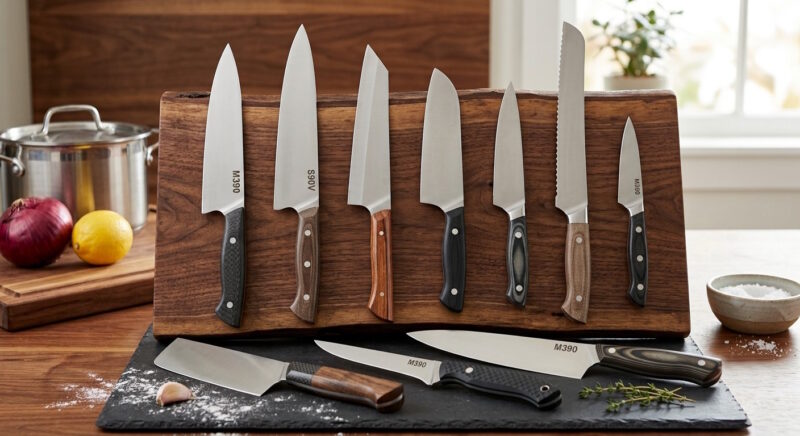
M390 performs exceptionally well in kitchen applications.
Its stainless properties help protect the blade from staining while maintaining excellent cutting performance.
Benefits include:
- Smooth slicing
- Excellent food release
- Long-lasting edge
- Minimal maintenance
- Easy cleaning
Whether preparing vegetables or slicing meat, M390 remains highly dependable.
CruWear in the Kitchen
CruWear can certainly be used in the kitchen, but it requires more care.
After cutting acidic foods such as:
- Tomatoes
- Citrus fruits
- Apples
- Onions
the blade should be washed, dried, and stored properly.
Failure to remove moisture promptly may eventually allow surface discoloration to develop.
Although many users enjoy CruWear in the kitchen, it requires greater attention than M390.
Winner: M390
Bushcraft Performance
Bushcraft places very different demands on a knife than kitchen use.
Common tasks include:
- Feather sticks
- Wood carving
- Shelter building
- Fire preparation
- Food preparation
- Camp chores
Here, toughness becomes just as important as edge retention.
Check Our Guide One Knife for Hunting and Bushcraft: Is It Really Possible?
M390 for Bushcraft
M390 performs well during normal outdoor activities.
Its corrosion resistance makes it particularly useful in wet environments.
Advantages include:
- Excellent resistance to rain
- Easy maintenance
- Long-lasting edge
- Reliable slicing performance
For light to moderate bushcraft, M390 performs admirably.
CruWear for Bushcraft
Bushcraft is one of CruWear’s strongest applications.
Its excellent toughness allows it to tolerate demanding cutting without excessive concern about edge damage.
CruWear performs especially well during:
- Heavy carving
- Hardwood processing
- Camp woodworking
- Repeated utility cutting
- General outdoor tasks
Many users appreciate its confidence-inspiring performance when working with wood.
Winner: CruWear
Woodworking Performance
Wood is surprisingly abrasive.
Hardwoods, knots, and repeated carving place significant stress on a knife edge.
M390
M390 performs very well for precision carving.
Its fine carbide structure supports clean slicing cuts while maintaining excellent edge retention.
It is particularly effective for:
- Detail carving
- Controlled cuts
- Fine woodworking
CruWear
CruWear truly excels in woodworking.
Its combination of toughness and wear resistance makes it ideal for:
- Spoon carving
- Whittling
- Bushcraft carving
- Joinery
- Camp tools
The edge remains stable even during extended carving sessions.
Winner: CruWear
Rope and Cardboard Cutting
These materials quickly reveal differences in edge durability.
Cardboard contains tiny abrasive particles that gradually wear away the cutting edge.
M390
M390 handles cardboard exceptionally well.
For warehouse work, shipping departments, and everyday utility cutting, it maintains a sharp edge for an impressively long time.
CruWear
CruWear also performs extremely well.
Although its wear resistance is slightly lower than M390, its toughness helps prevent micro-chipping when cutting dense materials.
For most users, both steels perform exceptionally well.
Heavy industrial users may notice M390 retaining peak sharpness slightly longer.
Winner: M390 (slight advantage)
Outdoor Survival
Survival situations demand a steel capable of handling a wide variety of tasks.
Examples include:
- Food preparation
- Fire making
- Shelter construction
- Wood processing
- Emergency repairs
M390
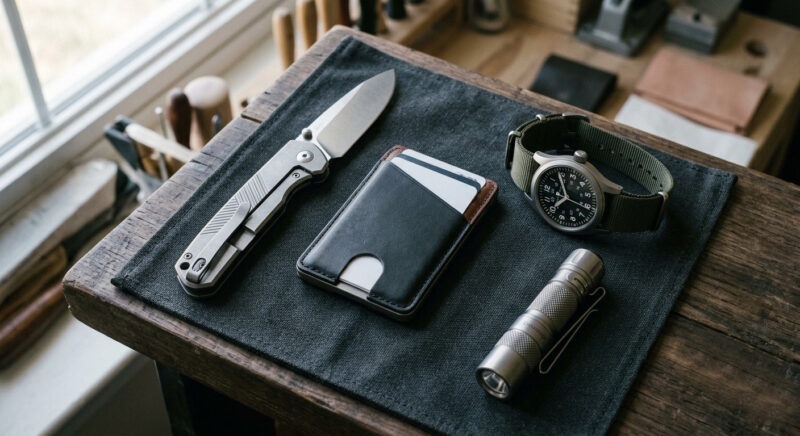
M390 offers excellent versatility.
Its corrosion resistance is especially valuable when weather conditions are unpredictable.
Rain, snow, and humidity have little effect when the blade receives basic care.
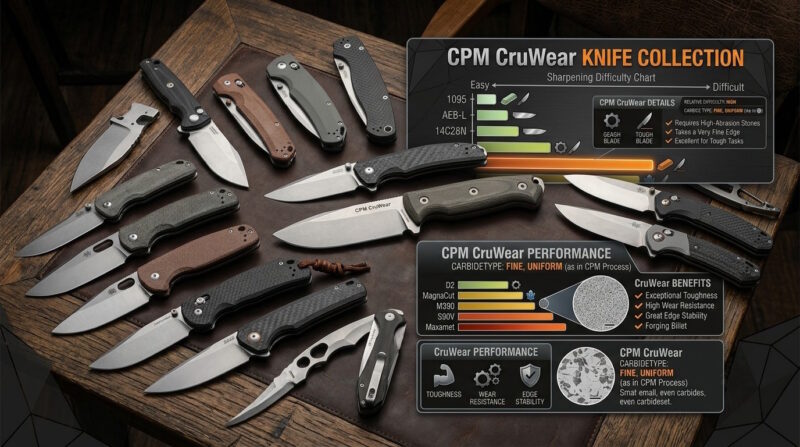
CruWear
CruWear provides exceptional confidence during demanding survival tasks.
Its outstanding toughness allows users to perform heavier work with reduced concern about edge damage.
With reasonable maintenance, CruWear becomes an outstanding outdoor companion.
Winner: CruWear
Maintenance Requirements
Maintenance influences long-term ownership just as much as cutting performance.
Caring for M390
Routine maintenance is straightforward.
Recommended practices include:
- Wash after food preparation
- Dry thoroughly
- Store in a dry location
- Sharpen when necessary
Because of its excellent corrosion resistance, protective oil is generally unnecessary during everyday use.
Caring for CruWear
CruWear benefits from a slightly more disciplined maintenance routine.
Recommended habits include:
- Dry immediately after use
- Remove food residue promptly
- Apply a light protective oil before long-term storage
- Avoid leaving the blade in damp sheaths
- Inspect occasionally for signs of corrosion
These simple steps require very little time but greatly improve long-term durability.
Which Steel Requires Less Maintenance?
| Task | M390 | CruWear |
|---|---|---|
| Cleaning | Easy | Easy |
| Rust Prevention | Minimal | Moderate |
| Food Preparation | Excellent | Good |
| Humid Climate | Excellent | Good |
| Long-Term Storage | Simple | Oil Recommended |
Winner: M390
Common Myths
Many online discussions about premium knife steels contain misunderstandings.
Let’s examine a few of the most common.
Myth 1: Tougher Steel Cannot Hold an Edge
Not true.
CruWear demonstrates that excellent toughness and strong edge retention can exist together when steel chemistry is properly balanced.
Myth 2: Stainless Steel Never Rusts
No knife steel is completely immune to corrosion.
Even highly corrosion-resistant steels benefit from proper cleaning and drying after use.
Myth 3: Harder Steel Always Performs Better
Hardness alone never determines overall performance.
Blade geometry, heat treatment, toughness, and intended use all influence cutting performance.
A balanced steel often outperforms a harder steel used outside its intended purpose.
Myth 4: Premium Steel Eliminates Maintenance
Every knife requires maintenance.
Cleaning, drying, and occasional sharpening remain essential regardless of the steel.
Premium steels simply reduce the frequency of maintenance—they do not eliminate it.
Which Steel Is Better for Beginners?
For first-time buyers of premium knives, ease of ownership is often an important consideration.
M390 is ideal for beginners because it offers:
- Outstanding corrosion resistance
- Excellent edge retention
- Minimal maintenance
- Great versatility
- Consistent performance across many applications
CruWear is an excellent choice for users who:
- Spend significant time outdoors
- Perform woodworking
- Prioritize toughness
- Don’t mind performing simple blade maintenance
Performance Summary
| Category | Winner |
|---|---|
| Edge Retention | M390 |
| Wear Resistance | M390 |
| Toughness | CruWear |
| Corrosion Resistance | M390 |
| Ease of Sharpening | CruWear |
| Kitchen Use | M390 |
| Bushcraft | CruWear |
| Woodworking | CruWear |
| Everyday Carry | M390 |
| Low Maintenance | M390 |
At this point, the comparison shows that neither steel is universally superior. M390 excels in corrosion resistance, wear resistance, and everyday versatility, while CruWear stands out for toughness, outdoor performance, and ease of sharpening.
Pros and Cons
Both M390 and CruWear rank among today’s premium knife steels, but each was designed with a different philosophy. One emphasizes corrosion resistance and wear resistance, while the other prioritizes toughness without sacrificing excellent cutting performance.
Understanding these trade-offs makes choosing the right steel much easier.
M390 Pros
✔ Excellent corrosion resistance
✔ Outstanding edge retention
✔ Exceptional wear resistance
✔ Fine, refined cutting edge
✔ Long intervals between sharpening
✔ Excellent for everyday carry
✔ Performs extremely well in kitchen environments
✔ Low maintenance requirements
✔ Suitable for humid and coastal climates
M390 Cons
✘ More difficult to sharpen than many conventional steels
✘ Toughness is excellent but not class-leading
✘ Usually found in premium-priced knives
CruWear Pros
✔ Outstanding toughness
✔ Excellent edge retention
✔ High wear resistance
✔ Easier to sharpen than many premium wear-resistant steels
✔ Performs exceptionally well during heavy cutting
✔ Excellent edge stability
✔ Outstanding for bushcraft and woodworking
✔ Handles demanding outdoor tasks with confidence
CruWear Cons
✘ Moderate corrosion resistance
✘ Requires more maintenance than stainless steels
✘ Should be dried promptly after exposure to moisture
✘ Less suitable for consistently wet environments
Which Steel Should You Choose?
There is no universal winner because each steel was engineered for different priorities.
Instead of asking which steel is objectively better, it’s more useful to ask which one best matches the way you actually use a knife.
Choose M390 If You Want
- Excellent corrosion resistance
- A premium everyday carry knife
- Long-lasting edge retention
- Low maintenance
- A knife for food preparation
- Reliable performance in humid climates
- Excellent all-around versatility
M390 is an outstanding choice for users who want a premium stainless steel capable of handling almost any daily cutting task.
Choose CruWear If You Want
- Outstanding toughness
- Heavy-duty cutting performance
- A dependable outdoor knife
- Bushcraft capability
- Woodworking performance
- Easier sharpening than ultra wear-resistant steels
- Excellent edge stability under demanding conditions
CruWear is ideal for users who expect their knives to perform demanding work without compromising durability.
Best Uses for Each Steel
| Application | Better Choice |
|---|---|
| Everyday Carry | M390 |
| Kitchen Knives | M390 |
| Food Preparation | M390 |
| Humid Climates | M390 |
| Coastal Areas | M390 |
| Outdoor Camping | CruWear |
| Bushcraft | CruWear |
| Wood Carving | CruWear |
| Heavy Utility Work | CruWear |
| Warehouse Use | M390 |
| Long Cardboard Cutting Sessions | M390 |
| Survival Tasks | CruWear |
Final Performance Score
| Category | M390 | CruWear |
|---|---|---|
| Edge Retention | ⭐⭐⭐⭐⭐ | ⭐⭐⭐⭐☆ |
| Wear Resistance | ⭐⭐⭐⭐⭐ | ⭐⭐⭐⭐☆ |
| Toughness | ⭐⭐⭐⭐☆ | ⭐⭐⭐⭐⭐ |
| Corrosion Resistance | ⭐⭐⭐⭐⭐ | ⭐⭐⭐☆☆ |
| Ease of Sharpening | ⭐⭐⭐☆☆ | ⭐⭐⭐⭐☆ |
| Maintenance | ⭐⭐⭐⭐⭐ | ⭐⭐⭐☆☆ |
| Overall Versatility | ⭐⭐⭐⭐⭐ | ⭐⭐⭐⭐☆ |
Frequently Asked Questions
Is CruWear better than M390?
Neither steel is universally better.
CruWear offers superior toughness and performs exceptionally well during demanding outdoor and heavy-duty cutting tasks. M390 provides significantly better corrosion resistance and slightly better wear resistance, making it the stronger choice for users seeking maximum versatility and low maintenance.
Which steel stays sharp longer?
Both steels provide excellent edge retention.
M390 generally maintains its edge slightly longer during prolonged cutting of abrasive materials because of its higher wear resistance.
Which steel is easier to sharpen?
CruWear is generally easier to sharpen than M390.
Although both steels benefit from quality sharpening stones, CruWear usually requires less time to restore a razor-sharp edge.
Is CruWear stainless?
No.
CruWear offers moderate corrosion resistance but should not be considered a fully stainless steel.
Routine cleaning and drying after use help prevent corrosion and maintain the blade’s appearance.
Which steel is better for kitchen knives?
M390 is generally the better choice because of its excellent resistance to moisture, food acids, and staining.
Its low maintenance makes it particularly well suited for regular food preparation.
Which steel is better for bushcraft?
CruWear is widely regarded as the stronger option for bushcraft.
Its outstanding toughness and excellent edge stability allow it to handle demanding outdoor tasks with confidence.
Does M390 chip easily?
No.
When properly heat treated and used appropriately, M390 offers good toughness alongside exceptional wear resistance.
Like any hard steel, misuse such as prying or striking hard materials can damage the edge.
Which steel offers better overall value?
The answer depends on intended use.
If you prioritize corrosion resistance and everyday versatility, M390 offers outstanding value.
If your work involves woodworking, outdoor use, and heavy utility cutting, CruWear may provide greater long-term satisfaction.
Final Verdict
M390 and CruWear represent two outstanding examples of modern powder metallurgy, yet they were engineered with different performance goals.
M390 is built around wear resistance, corrosion resistance, and long-lasting cutting performance. It excels as an everyday carry steel, performs exceptionally well in kitchens, and requires very little maintenance. For users seeking a premium stainless steel that combines durability with convenience, M390 remains one of the most versatile options available.
CruWear, by contrast, focuses on toughness while maintaining excellent edge retention and wear resistance. Its ability to withstand demanding cutting tasks makes it especially attractive for bushcraft, woodworking, camping, and heavy utility use. Although it requires more care to prevent corrosion, many users consider its combination of toughness and cutting performance well worth the additional maintenance.
Neither steel is objectively superior because they solve different problems.
If you need a knife that performs reliably in wet environments, requires minimal maintenance, and retains a sharp edge through everyday use, M390 is the better choice.
If your priority is maximum durability during demanding cutting tasks, superior toughness, and excellent field performance, CruWear is the stronger option.
Selecting the steel that best matches your real-world needs will always lead to better long-term satisfaction than choosing one based solely on specifications.
Conclusion
Choosing between M390 and CruWear ultimately comes down to understanding how you’ll use your knife.
M390 offers an outstanding balance of corrosion resistance, edge retention, wear resistance, and everyday convenience. It excels in environments where moisture, food preparation, and minimal maintenance are important.
CruWear takes a different approach by emphasizing toughness without sacrificing premium cutting performance. It shines in outdoor environments, woodworking, and demanding utility tasks where durability under stress matters most.
Both steels represent the capabilities of advanced powder metallurgy and demonstrate how carefully balanced alloy compositions can produce exceptional cutting tools. By matching the steel to your intended applications rather than chasing specifications alone, you’ll enjoy better performance and greater satisfaction for years to come.
This article is for independent informational purposes only and is not affiliated with, sponsored by, or endorsed by any steel manufacturer. All product names, trademarks, and registered trademarks are the property of their respective owners.