Aogami vs Shirogami
An Independent Guide
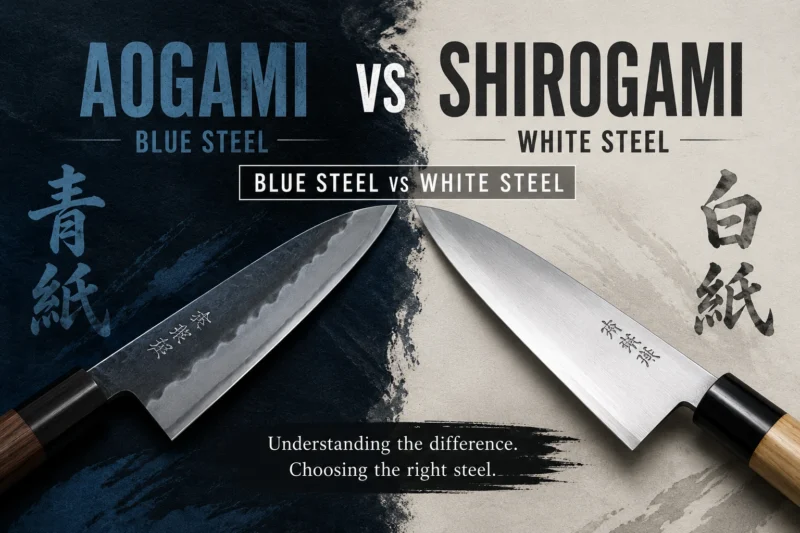
Aogami vs Shirogami is one of the classic comparisons in Japanese knife steel.
Both are famous Japanese carbon steels. Both can take an exceptionally sharp edge. Both are used by traditional Japanese bladesmiths. Both can be found in everything from kitchen knives to woodworking tools.
And yet, they feel quite different in actual use.
Shirogami, commonly called White Steel, is famous for its exceptionally clean composition, easy sharpening, and ability to take an extremely fine edge.
Aogami, commonly called Blue Steel, starts with a similar high-purity carbon-steel base but adds alloying elements, most importantly tungsten and chromium. These additions improve wear resistance and help the edge stay sharp longer.
So, is Aogami better than Shirogami?
Not necessarily.
The real answer is that Aogami and Shirogami are optimized for different priorities.
If you love sharpening, want a very responsive steel, and prioritize maximum edge refinement, Shirogami can be an outstanding choice.
If you want longer edge retention and are willing to accept somewhat more sharpening resistance, Aogami may be the better option.
This is why the Aogami vs Shirogami debate has continued for so long. It is not really a question of good steel versus bad steel. It is a question of what you want from a knife.
In this guide, we will compare Aogami vs Shirogami in detail, including composition, hardness, edge retention, toughness, sharpening, corrosion resistance, edge stability, maintenance, price, and the differences between the individual grades.
Aogami vs Shirogami at a Glance
Before going into the metallurgy, here is the short version.
| Property | Shirogami / White Steel | Aogami / Blue Steel |
|---|---|---|
| Japanese name | 白紙 | 青紙 |
| English name | White Steel / White Paper Steel | Blue Steel / Blue Paper Steel |
| Basic type | High-carbon steel | Alloyed high-carbon steel |
| Carbon | High | High |
| Tungsten | Essentially none | Yes |
| Chromium | Essentially none | Yes |
| Edge sharpness | Excellent | Excellent |
| Maximum edge refinement | Excellent | Excellent |
| Edge retention | Very good | Better |
| Sharpening ease | Excellent | Very good |
| Wear resistance | Lower | Higher |
| Toughness | Good, depending on heat treatment | Generally better |
| Corrosion resistance | Low | Low |
| Patina formation | Yes | Yes |
| Stainless? | No | No |
| Maintenance | High | High |
| Best known for | Sharpness and sharpening feel | Edge retention |
| Typical use | Traditional Japanese knives, fine cutting | Kitchen knives, professional use, tools |
The important point is that both are carbon steels.
Aogami is not a stainless version of Shirogami.
The small amount of chromium in Aogami is nowhere near enough to make it stainless. Both steels can develop a patina, and both can rust if they are left wet or neglected.
What Does Aogami Mean?
Aogami (青紙) literally refers to “Blue Paper.”
The name does not describe the color of the finished steel.
Aogami is called Blue Steel because of the blue-colored paper traditionally used to identify the steel.
The same naming convention applies to Shirogami.
Shirogami (白紙) means “White Paper,” referring to its white paper identification.
The names are therefore essentially identification names rather than descriptions of what the finished blade looks like.
This is an important distinction because someone seeing the words “Blue Steel” for the first time might assume the blade itself is blue.
It is not.
A finished Aogami knife normally looks like steel.
The same is true of Shirogami.
The important difference is the chemistry inside the steel.
Check Our Guide Aogami #1 vs Aogami #2 vs Aogami Super
What Is Shirogami?
Shirogami, or White Steel, is a family of very high-purity carbon steels associated with Japanese knife and toolmaking.
The philosophy behind Shirogami is relatively simple:
keep the steel extremely clean and minimize alloying elements.
The result is a steel that responds exceptionally well to traditional forging, heat treatment, grinding, and sharpening.
Shirogami is particularly appreciated by bladesmiths and knife users who value:
- fine edge geometry;
- excellent sharpening response;
- very high achievable sharpness;
- clean feedback on waterstones;
- traditional Japanese knife performance;
- predictable behavior during sharpening.
Shirogami is available in several grades, most commonly:
- Shirogami #1
- Shirogami #2
- Shirogami #3
The grades primarily differ in carbon content and therefore in potential hardness and performance.
Among them, Shirogami #2 is probably the most familiar general-purpose grade.
Check Our Guide Shirogami #1 vs Shirogami #2 vs Shirogami #3
What Is Aogami?
Aogami, or Blue Steel, is another family of Japanese high-carbon steels.
Like Shirogami, Aogami is based on a high-purity carbon-steel foundation.
The important difference is that Aogami deliberately adds alloying elements.
The most important additions are:
- tungsten;
- chromium.
Aogami Super also adds:
- molybdenum;
- vanadium.
These alloying elements change the steel’s behavior.
In particular, tungsten contributes to the formation of hard carbides, which increase wear resistance and help the edge maintain its cutting ability for longer.
Aogami therefore represents a different design philosophy:
accept a little more complexity in the steel in exchange for better wear resistance and longer edge life.
The main Aogami grades are:
- Aogami #1
- Aogami #2
- Aogami Super
Aogami #2 is generally regarded as the balanced, practical Blue Steel grade.
Aogami #1 increases carbon and tungsten compared with #2.
Aogami Super takes the alloying concept further by adding molybdenum and vanadium.
Aogami vs Shirogami: The Real Chemical Difference
This is where the comparison becomes interesting.
At first glance, Aogami and Shirogami can look very similar on a composition chart.
Both have high carbon content.
Both have very low impurity levels.
Both are designed to produce excellent cutting tools.
The major difference is what happens after the basic carbon-steel foundation.
Shirogami intentionally keeps alloying additions very low.
Aogami adds tungsten and chromium.
For example, published specifications for Shirogami #2 commonly place carbon around 1.05–1.15%, while Aogami #2 has a similar carbon range but adds approximately 1.0–1.5% tungsten and 0.2–0.5% chromium.
That may sound like a relatively small difference.
Metallurgically, however, it matters.
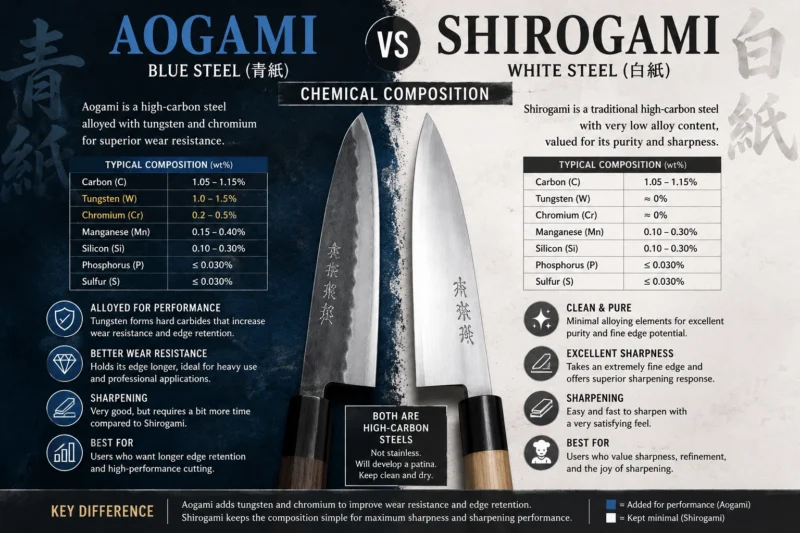
Chemical Composition: Shirogami vs Aogami
A useful simplified comparison is:
| Element | Shirogami #2 | Aogami #2 | Main effect |
|---|---|---|---|
| Carbon | ~1.05–1.15% | ~1.05–1.15% | Hardness and carbide formation |
| Tungsten | Essentially none | ~1.0–1.5% | Wear resistance and hard carbides |
| Chromium | Very low/none specified | ~0.2–0.5% | Hardenability and minor corrosion influence |
| Silicon | Low | Low | Deoxidation and steel properties |
| Manganese | Very low | Low | Deoxidation/hardenability |
| Phosphorus | Very low | Very low | Kept low for toughness |
| Sulfur | Very low | Very low | Kept low for toughness |
The exact chemistry varies by grade and specification, so these numbers should not be treated as a universal composition for every production batch.
But the basic idea is clear:
Shirogami is intentionally simpler. Aogami adds alloying elements.
That difference explains much of what users experience.
Why Does Tungsten Matter?
Tungsten is one of the most important differences between Aogami and Shirogami.
When steel is heat treated, alloying elements can participate in carbide formation.
Aogami contains enough tungsten to create tungsten-containing carbides.
These hard particles contribute to increased wear resistance.
Think about sharpening a knife.
Every time you sharpen, a tiny amount of steel is removed.
Every time you cut, the edge is exposed to abrasion and mechanical stress.
A steel with greater wear resistance can maintain its cutting geometry for longer.
That is one reason Aogami generally holds its edge longer than comparable Shirogami grades.
But there is a tradeoff.
The same hard carbides that help Aogami resist wear also make it somewhat less effortless to grind and sharpen.
This is one of the defining differences in the Aogami vs Shirogami comparison.
Does Chromium Make Aogami Stainless?
No.
This is one of the most common misunderstandings about Aogami.
Aogami contains chromium, but the amount is far below what would normally be associated with stainless steel.
Aogami #2, for example, contains approximately 0.2–0.5% chromium, depending on the specification.
That is nowhere near the chromium content of conventional stainless knife steels.
So:
Aogami is not stainless steel.
You should still treat an Aogami knife as a reactive carbon-steel knife.
It can:
- develop a patina;
- discolor;
- react with acidic foods;
- develop orange rust if neglected.
Shirogami is even more reactive.
Therefore, the corrosion difference between Aogami and Shirogami should not be exaggerated.
If you want a genuinely low-maintenance stainless knife, neither is the correct choice.
Aogami vs Shirogami: Sharpness
This is where Shirogami has earned much of its reputation.
Shirogami can take an exceptionally fine edge.
Its relatively simple composition and low alloy content give it a distinctive sharpening response.
When properly heat treated and ground, Shirogami can produce an extremely refined apex.
For many knife enthusiasts, this is one of the main reasons to choose it.
But there is an important point:
Aogami can also become extremely sharp.
It is incorrect to say that Aogami is a “dull” steel or that it cannot take a fine edge.
A well-made Aogami knife can be extraordinarily sharp.
The more accurate distinction is that Shirogami tends to have an advantage in ultimate edge refinement and sharpening feel, while Aogami tends to have an advantage in how long that edge remains useful.
In other words:
Shirogami rewards the sharpener.
Aogami rewards the user who wants more cutting time between sharpenings.
Check Our Guide All Kinds of Knife Sharpening Tools
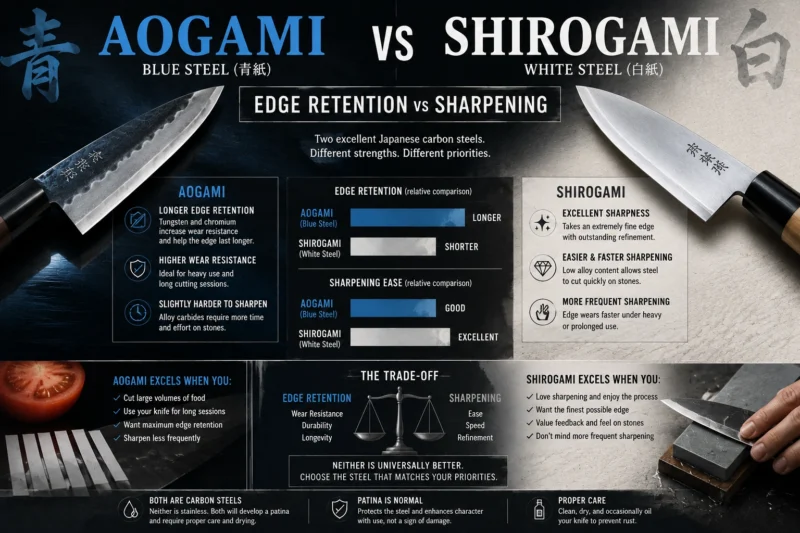
Aogami vs Shirogami: Edge Retention
This is where Aogami generally wins.
Tungsten-containing carbides increase wear resistance.
That means an Aogami edge can generally maintain its cutting ability longer than a comparable Shirogami edge.
The difference is particularly noticeable when:
- preparing large quantities of food;
- cutting repeatedly for long periods;
- working with abrasive foods;
- using the knife frequently between sharpening sessions.
However, edge retention is never determined by steel alone.
This is extremely important.
A knife’s edge retention depends on:
- hardness;
- heat treatment;
- edge angle;
- edge thickness;
- sharpening quality;
- cutting board;
- food being cut;
- cutting technique;
- lateral forces;
- microchipping.
A poorly heat-treated Aogami knife can perform worse than an excellent Shirogami knife.
Likewise, a thin Shirogami blade with excellent heat treatment can feel spectacularly sharp for a surprisingly long time.
So steel composition tells us what the material is capable of.
It does not determine the entire performance of a finished knife.
Check Our Guide Edge Retention Explained
Aogami vs Shirogami: Sharpening
For many experienced knife users, this is one of the most important differences.
Shirogami is generally easier and faster to sharpen.
It tends to have a very clean, responsive feel on waterstones.
The steel comes off the stone relatively easily, and the progression from coarse stone to finishing stone is straightforward.
Aogami is also very sharpenable.
It is not a difficult steel in the way some modern high-wear-resistant powder steels can be.
But compared with Shirogami, Aogami generally offers more resistance because of its alloy carbides.
This can be especially noticeable when:
- repairing an edge;
- changing the edge angle;
- removing chips;
- using fine finishing stones;
- polishing a large bevel.
For someone who enjoys sharpening, this difference may actually be part of the appeal.
Why Do People Love Sharpening Shirogami?
There is a certain feedback that experienced sharpeners describe as “clean” or “responsive.”
The stone and steel communicate very clearly.
You can feel the abrasive working against the steel.
You can quickly create a burr.
You can refine the edge without fighting the material.
This is one reason traditional Japanese knife makers and users have such a strong relationship with White Steel.
The steel does not simply perform when cutting.
It is also pleasant to work with during maintenance.
For someone who enjoys sharpening Japanese knives, this matters.
Aogami vs Shirogami: Toughness
This comparison is slightly more complicated.
It is tempting to say:
Aogami = tough
Shirogami = brittle
But that is too simplistic.
Toughness depends heavily on:
- carbon content;
- hardness;
- heat treatment;
- grain structure;
- blade geometry;
- edge thickness.
A Shirogami #2 knife heat treated at a moderate hardness can be quite durable.
A very hard Shirogami #1 blade with an extremely thin edge can chip more easily.
The same principle applies to Aogami.
Aogami Super at very high hardness and a very thin geometry can also chip.
Therefore, the steel family alone does not determine toughness.
That said, Aogami’s alloying additions can provide advantages in wear resistance and heat-treatment behavior, and Aogami is often selected when a combination of high hardness and better working edge retention is desired.
Check Our Guide Wear Resistance vs Toughness
Aogami vs Shirogami: Hardness
There is no single HRC value for “Aogami” or “Shirogami.”
This is important.
The steel’s chemistry provides a potential range.
The knife maker determines the final hardness through heat treatment.
As a result, two knives made from the same steel can have different HRC values.
Typical kitchen-knife hardness ranges often look approximately like this:
| Steel | Typical knife HRC* |
|---|---|
| Shirogami #3 | ~60–62 |
| Shirogami #2 | ~61–64 |
| Shirogami #1 | ~62–65 |
| Aogami #2 | ~61–64 |
| Aogami #1 | ~62–65 |
| Aogami Super | ~63–66 |
*These are general ranges, not guaranteed specifications. Actual hardness depends on the maker and heat treatment.
The important lesson is:
Do not choose between Aogami and Shirogami based only on an HRC number.
A knife at 63 HRC is not automatically better than one at 61 HRC.
Geometry and heat treatment matter enormously.
Check Our Guide What Is HRC? Understanding Rockwell Hardness
Aogami vs Shirogami: Corrosion Resistance
Neither steel is stainless.
This should be repeated because it is one of the most important practical differences between these steels and modern stainless alternatives.
Shirogami
Shirogami is highly reactive.
It can quickly develop a patina when exposed to:
- water;
- humidity;
- acids;
- onions;
- citrus;
- tomatoes;
- meat juices.
This is not necessarily a problem.
A stable gray or blue-gray patina can actually help protect the surface.
But red rust should be avoided.
Aogami
Aogami is also reactive.
The chromium addition may provide a small improvement in corrosion behavior, but it does not transform Aogami into stainless steel.
Therefore:
Shirogami = reactive
Aogami = reactive
The difference is one of degree, not category.
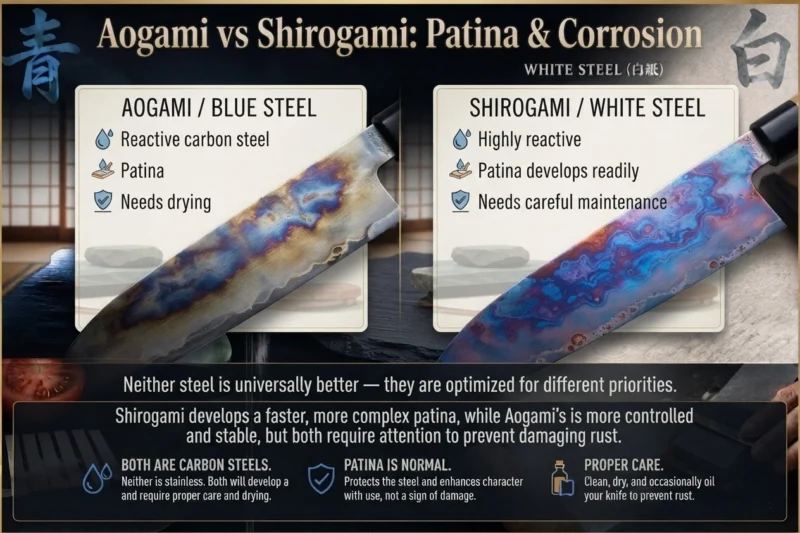
Patina: Is It a Good Thing?
For carbon-steel knife owners, patina can become part of the experience.
A patina is a surface oxidation layer that develops naturally over time.
It can range from:
- gray;
- blue-gray;
- purple;
- brown;
- dark gray.
The exact appearance depends on the steel, food, humidity, usage, and maintenance.
A stable patina is generally much less concerning than active orange rust.
Many Japanese knife enthusiasts actually appreciate the appearance of a naturally developed patina.
It gives the knife a history.
A Shirogami knife can develop a particularly attractive patina because of its highly reactive nature.
Aogami can also patinate.
Aogami vs Shirogami: Maintenance
Neither steel is suitable for someone who wants a completely maintenance-free knife.
The basic routine is simple:
- Use the knife.
- Rinse it when necessary.
- Wipe it dry.
- Do not leave it wet.
- Sharpen it when needed.
- Apply a suitable protective oil if storing it for an extended period.
You do not need to be afraid of carbon steel.
You simply need to respect it.
For everyday kitchen use, drying the blade promptly is usually much more important than constantly worrying about oil.
Which Steel Is Easier for Beginners?
If we are talking strictly about sharpening:
Shirogami is easier.
If we are talking about maintenance:
Neither is particularly beginner-friendly compared with stainless steel.
A beginner who has never owned carbon steel may find both Aogami and Shirogami more demanding than VG10, AUS-10, Ginsan, or other stainless steels.
However, someone who is willing to learn basic knife care can use either without difficulty.
In fact, carbon steel can be an excellent way to learn proper knife maintenance.
Aogami vs Shirogami for Professional Kitchen Use
Professional cooks often have different priorities from hobbyists.
A chef working for several hours every day may value:
- edge retention;
- predictable sharpening;
- durability;
- balance;
- low downtime.
This is where Aogami becomes particularly attractive.
If the knife stays sharp longer, the chef may spend less time returning to the stones.
Aogami #2 is therefore an excellent all-round choice.
However, Shirogami remains extremely popular in traditional Japanese knife making, particularly where extreme sharpness and frequent sharpening are part of the working routine.
For example, traditional single-bevel knives used for precise slicing can benefit enormously from Shirogami’s sharpening characteristics.
So once again, there is no universal winner.
Aogami vs Shirogami for Home Cooks
For a home cook, the decision may be different.
A home cook may only use a knife for 20–30 minutes a day.
In that situation, maximum edge retention may not be as important as sharpening enjoyment and edge quality.
Someone who loves maintaining knives may prefer Shirogami.
Someone who wants to sharpen less often may prefer Aogami.
Aogami #2 is probably the easiest recommendation for someone who wants a balanced carbon-steel experience.
Shirogami #2 is probably the classic choice for someone who specifically wants to experience the character of White Steel.
Shirogami #1 vs Aogami #1
Now we can go deeper into the individual grades.
Both #1 grades contain more carbon than their respective #2 grades.
That generally allows them to achieve higher hardness and potentially greater edge retention.
Shirogami #1
Shirogami #1 is designed for users who want the highest performance possible from the White Steel family.
It can produce an exceptionally fine edge.
However, its higher carbon content also means that the steel can be less forgiving.
It is particularly attractive for:
- fine slicing;
- high-end Japanese knives;
- traditional single-bevel knives;
- experienced sharpeners.
Check Our Guide Shirogami #1 Steel
Aogami #1
Aogami #1 combines higher carbon with tungsten and chromium.
It therefore aims for greater wear resistance than Shirogami #1.
The result is a steel that can hold an excellent edge while offering the characteristic Aogami sharpening experience.
Check Our Guide Aogami Blue Steel N1
Which is better?
If maximum sharpening response and edge refinement are the priority:
Shirogami #1.
If longer edge retention is more important:
Aogami #1.
Shirogami #2 vs Aogami #2
This is arguably the most useful Aogami vs Shirogami comparison.
Both #2 grades are highly practical.
Both have roughly similar carbon content.
The difference is that Aogami #2 contains tungsten and chromium.
That gives Aogami #2 better wear resistance.
Shirogami #2, meanwhile, remains extremely easy to sharpen.
This makes the comparison straightforward:
Choose Shirogami #2 if you want:
- easy sharpening;
- excellent edge refinement;
- traditional White Steel character;
- very high sharpness;
- responsive waterstone feedback.
Check Our Guide Shirogami #2 (White Steel #2)
Choose Aogami #2 if you want:
- longer edge retention;
- excellent sharpness;
- better wear resistance;
- a versatile professional carbon steel;
- fewer sharpening sessions.
Check Our Guide Aogami Steel N2
For many users, Aogami #2 is the safest all-around recommendation.
For sharpening enthusiasts, Shirogami #2 can be more rewarding.
Shirogami #3 vs Aogami #3
There is an important detail here:
Aogami does not have a commonly recognized Aogami #3 equivalent in the same way Shirogami does.
Shirogami #3 has lower carbon content than Shirogami #2.
That makes it somewhat softer and more forgiving.
It can be a practical choice when maximum hardness and edge retention are not the goal.
It is also useful for users who want some of the characteristics of White Steel while accepting a little more toughness and lower hardness.
This is one reason you should not assume that every Aogami grade has a direct Shirogami equivalent.
The numbering systems describe grades within each steel family; they do not create a perfect one-to-one performance scale.
Check Our Guide Shirogami #3 Steel
Aogami Super vs Shirogami
Aogami Super deserves separate attention.
It is not simply “Aogami #1 with a different name.”
Aogami Super contains additional alloying elements, including molybdenum and vanadium, along with higher carbon and tungsten levels.
These additions can increase wear resistance and allow very high hardness.
Aogami Super is therefore often chosen by knife makers who want extremely high edge retention.
But there is a price.
Aogami Super can be more demanding to sharpen than Shirogami.
It can also be less forgiving when used with poor technique or an excessively thin edge.
For an experienced knife enthusiast, however, Aogami Super can be an exceptional material.
Check Our Guide Aogami Super Steel
Does Aogami Really Hold an Edge Longer?
Yes, generally.
This is not just marketing.
The alloy carbides formed by tungsten and other elements contribute to increased wear resistance.
But be careful with claims such as:
“Aogami holds an edge twice as long.”
or:
“Aogami has 50% better edge retention.”
Those numbers are not universally valid.
There is no single edge-retention result for every Aogami knife.
The actual result depends on:
- exact grade;
- heat treatment;
- hardness;
- edge geometry;
- cutting medium;
- sharpening angle;
- knife construction.
Aogami’s advantage is best understood as a general metallurgical tendency toward higher wear resistance, not as a guaranteed percentage improvement.
Does Shirogami Really Get Sharper?
This question is more complicated.
Aogami can also be sharpened to an extremely high level.
The difference is not that Shirogami becomes sharp while Aogami stays dull.
Both can become extraordinarily sharp.
The more meaningful distinction is the ease of reaching and maintaining a very refined apex.
Shirogami’s simple composition and low alloy-carbide content give it excellent sharpening characteristics.
This is why experienced sharpeners often describe Shirogami as having a special “feel.”
It responds quickly.
It feels clean on the stone.
It is easy to refine.
And it can produce an exceptionally keen edge.
Aogami vs Shirogami: Cutting Feel
There is also a subjective component to the comparison.
A knife’s cutting feel depends on:
- steel;
- hardness;
- edge geometry;
- grind;
- blade thickness;
- surface finish;
- sharpening quality.
Still, many experienced users describe Shirogami as having a very clean, refined cutting sensation.
Aogami can feel slightly more “substantial” because the edge tends to remain stable for longer under repeated use.
But these differences are subtle.
A poorly ground Aogami knife will not automatically feel better than a beautifully ground Shirogami knife.
The maker matters enormously.
The Maker May Matter More Than the Steel
This is one of the most important lessons in Japanese knives.
A steel specification is only the starting point.
Two makers can take the same Aogami #2 and produce knives with completely different characteristics.
One may choose:
- 62 HRC;
- thicker edge;
- tougher geometry.
Another may choose:
- 64 HRC;
- very thin edge;
- aggressive grind.
The knives may feel completely different.
The same applies to Shirogami.
Therefore, when buying a Japanese knife, do not look only at:
“Aogami #2”
or:
“Shirogami #2.”
Also investigate:
- who made the knife;
- hardness;
- blade geometry;
- grind;
- blade thickness;
- intended use;
- sharpening instructions.
Aogami vs Shirogami for Gyuto
For a Gyuto, both steels are excellent choices.
A 210 mm or 240 mm Gyuto made from Shirogami #2 can provide an exceptionally responsive edge and very enjoyable sharpening experience.
Aogami #2 is particularly attractive if the Gyuto will be used heavily.
For example:
Home cook + loves sharpening → Shirogami #2
Professional/high-volume use → Aogami #2
This is not an absolute rule, but it is a useful starting point.
Check Our Japanese Gyuto Knife Guide
Aogami vs Shirogami for Nakiri
Nakiri knives are often used for vegetables.
Because vegetable preparation can involve large amounts of repetitive cutting, edge retention can be important.
Aogami #2 can therefore be an excellent choice.
However, Shirogami #2 is also extremely popular because it can produce a very clean, keen edge.
If you frequently sharpen and enjoy the process, Shirogami is hard to beat.
Aogami vs Shirogami for Yanagiba
For traditional slicing knives such as Yanagiba, Shirogami has a particularly strong reputation.
The combination of:
- very high sharpness;
- clean sharpening response;
- fine edge geometry;
makes White Steel a natural choice for precision slicing.
Aogami can also perform beautifully.
But if your primary goal is the traditional Japanese single-bevel experience and maximum edge refinement, Shirogami is especially compelling.
Aogami vs Shirogami for Deba
Deba knives are thicker and heavier than many other Japanese kitchen knives.
For a Deba, toughness and geometry become particularly important.
Either steel can work well, but the final performance depends heavily on how the knife is heat treated and ground.
A very hard, thin-edged carbon-steel knife is not necessarily the best choice for rough work.
With Deba, correct technique is just as important as steel selection.
Aogami vs Shirogami: Which Rusts Faster?
In general:
Shirogami is more reactive.
Aogami’s chromium addition provides some improvement in corrosion behavior, but it remains a carbon steel.
Do not buy Aogami because you think it is “almost stainless.”
It is not.
If corrosion resistance is your main concern, consider stainless steels instead.
If you specifically want the experience of Japanese carbon steel, both Aogami and Shirogami are excellent choices.
Aogami vs Shirogami: Which Is More Expensive?
The steel itself is only one part of the price of a Japanese knife.
Aogami may cost more because the steel is more highly alloyed and can require more demanding processing.
But the final retail price depends on much more:
- maker;
- forging method;
- heat treatment;
- grinding;
- polishing;
- handle;
- finish;
- production volume;
- brand reputation.
A Shirogami knife from a famous craftsman can cost far more than a mass-produced Aogami knife.
Therefore:
Do not use price alone as a measure of steel quality.
Aogami vs Shirogami: Which Is Better for Waterstones?
Both are excellent.
But if sharpening is a major part of why you enjoy Japanese knives, Shirogami has a particularly strong advantage.
It responds quickly to waterstones.
It is easy to create a burr.
It is easy to refine.
It is easy to polish.
Aogami is also very pleasant compared with many modern high-wear-resistant steels, but it generally takes more work.
For someone who wants a steel that feels almost “alive” on a stone, Shirogami is difficult to beat.
Aogami vs Shirogami: Which Is Better for Beginners?
If the beginner specifically wants carbon steel:
Aogami #2 is probably the most balanced choice.
It provides:
- excellent sharpness;
- good edge retention;
- manageable sharpening;
- traditional Japanese carbon-steel character.
If the beginner is interested in sharpening itself, however, Shirogami #2 can be an excellent teacher.
It gives very clear feedback and makes it easy to understand what is happening at the edge.
The real beginner mistake is not choosing Aogami or Shirogami.
The mistake is choosing carbon steel without understanding that it requires basic maintenance.
Aogami vs Shirogami: Pros and Cons
Shirogami Pros
- Extremely fine edge potential
- Excellent sharpening response
- Easy to sharpen
- Excellent waterstone feedback
- Very high sharpness
- Traditional Japanese character
- Excellent for precision cutting
Shirogami Cons
- Lower wear resistance
- Shorter edge retention than comparable Aogami
- Highly reactive
- Can rust quickly if neglected
- Higher grades can be less forgiving
- Requires regular maintenance
Aogami Pros
- Excellent edge retention
- Higher wear resistance
- Extremely sharp
- Excellent balance of sharpness and durability
- Aogami #2 is very versatile
- Aogami Super offers exceptional wear resistance
- Excellent choice for frequent knife use
Aogami Cons
- More difficult to sharpen than Shirogami
- Still highly reactive
- Not stainless
- Higher grades can be demanding
- Can chip if extremely hard and thinly ground
- Generally more expensive than simpler carbon steels
The Most Important Myth: Blue Is Not “Better White”
A common way to describe Aogami is:
White Steel is the basic version. Blue Steel is the upgraded version.
That description is misleading.
Aogami is not simply a superior version of Shirogami.
It is a different design.
Imagine two sports cars.
One is optimized for acceleration.
The other is optimized for high-speed endurance.
It would be meaningless to ask which one is “better” without knowing how you plan to drive.
The same applies to these steels.
Shirogami prioritizes purity, sharpening response, and edge refinement.
Aogami adds alloying elements to improve wear resistance and working edge retention.
That is a tradeoff.
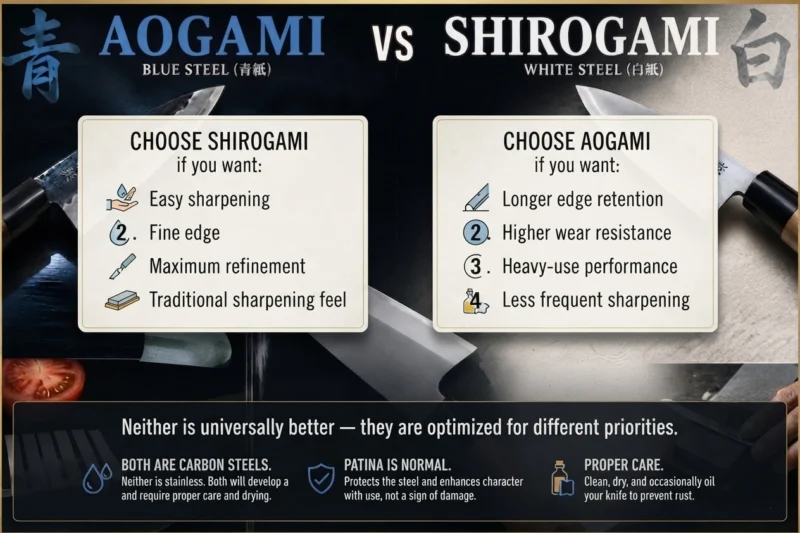
Aogami vs Shirogami: Which One Should You Choose?
Here is the simplest decision guide.
Choose Shirogami if:
- you love sharpening;
- you use waterstones regularly;
- maximum edge refinement matters;
- you want traditional Japanese carbon-steel characteristics;
- you enjoy a very responsive sharpening experience;
- you do not mind more frequent maintenance.
Choose Aogami if:
- you want longer edge retention;
- you use your knife heavily;
- you want a balance between sharpness and durability;
- you sharpen less frequently;
- you still want a traditional carbon-steel knife;
- you are comfortable with carbon-steel maintenance.
Choose Aogami Super if:
- maximum wear resistance is important;
- you are an experienced sharpener;
- you want very high hardness;
- you are comfortable with a more demanding steel.
Aogami vs Shirogami: The Final Verdict
So, which is better?
Neither.
And that is exactly what makes the comparison interesting.
Shirogami and Aogami represent two different approaches to Japanese carbon steel.
Shirogami keeps the formula extremely clean.
That simplicity gives it exceptional sharpening characteristics and the ability to take an extremely refined edge.
Aogami adds tungsten and chromium.
Those additions increase wear resistance and help the edge stay effective longer.
The result is a steel that sacrifices some of Shirogami’s effortless sharpening character in exchange for longer working edge life.
For a traditional knife enthusiast who loves sharpening, Shirogami can be incredibly satisfying.
For a cook who uses a knife heavily and wants to spend less time sharpening, Aogami can be the better practical choice.
And for someone looking for maximum performance from the Blue Steel family, Aogami Super pushes the concept further with additional alloying elements.
But remember the most important rule:
The steel is only part of the knife.
Heat treatment, hardness, geometry, grind, edge angle, blade thickness, sharpening quality, and the skill of the maker can have an enormous effect on real-world performance.
A superbly made Shirogami knife can outperform a mediocre Aogami knife.
A well-designed Aogami knife can hold its working edge considerably longer than a comparable Shirogami knife.
So instead of asking:
“Is Aogami better than Shirogami?”
a better question is:
“Do I value the ultimate sharpening response and edge refinement of Shirogami, or the longer working edge and wear resistance of Aogami?”
Once you answer that question, the choice becomes much easier.
Aogami vs Shirogami: Quick Reference
| Category | Winner |
|---|---|
| Ultimate edge refinement | Shirogami |
| Sharpening ease | Shirogami |
| Waterstone feedback | Shirogami |
| Edge retention | Aogami |
| Wear resistance | Aogami |
| High-volume cutting | Aogami |
| Traditional carbon-steel feel | Tie |
| Corrosion resistance | Neither is stainless |
| Ease of maintenance | Neither |
| Beginner carbon-steel choice | Aogami #2 / Shirogami #2 |
| Precision slicing | Shirogami |
| Long working sessions | Aogami |
| Maximum Aogami performance | Aogami Super |
Frequently Asked Questions
Is Aogami sharper than Shirogami?
Not necessarily.
Both can become extremely sharp. Shirogami is generally favored for its ability to take a highly refined edge and its excellent sharpening response.
Does Aogami hold an edge longer than Shirogami?
Generally, yes. Tungsten and other alloying additions increase wear resistance, giving Aogami an advantage in edge retention.
Is Aogami stainless?
No.
Aogami is a reactive carbon steel. Its chromium content is far too low to make it stainless.
Does Shirogami rust easily?
Yes. Shirogami is highly reactive and should be dried promptly after use.
Which is easier to sharpen?
Shirogami is generally easier and faster to sharpen.
Which is better for a professional chef?
It depends on the chef.
For long periods of cutting and less frequent sharpening, Aogami can be preferable. For chefs who sharpen frequently and prioritize maximum edge refinement, Shirogami can be an excellent choice.
Is Shirogami #2 better than Aogami #2?
Neither is universally better.
Shirogami #2 is easier to sharpen and can take an exceptionally refined edge. Aogami #2 generally provides better wear resistance and longer edge retention.
Is Aogami Super better than Shirogami #1?
Not simply “better.”
Aogami Super has greater alloying and wear resistance, while Shirogami #1 offers the characteristic clean sharpening response and edge refinement of White Steel.
Which steel should I choose for my first carbon-steel knife?
Aogami #2 and Shirogami #2 are both excellent starting points.
If you prioritize easy sharpening, choose Shirogami #2.
If you want longer edge retention, choose Aogami #2.
Do Aogami and Shirogami develop patina?
Yes.
Both are carbon steels and can develop a patina with normal use.
Can I use Aogami or Shirogami for acidic foods?
Yes, but clean and dry the knife promptly afterward.
Acidic foods can accelerate patina formation and corrosion.
Does higher HRC automatically mean a better Aogami or Shirogami knife?
No.
Hardness is only one part of performance.
Heat treatment, geometry, edge thickness, grind, and intended use are equally important.
Conclusion
The Aogami vs Shirogami debate has lasted for decades because both steels are genuinely excellent.
Shirogami is the minimalist.
It keeps alloying additions low and focuses on an exceptionally clean carbon-steel composition, excellent sharpening response, and extremely refined edges.
Aogami is the more alloyed alternative.
By adding tungsten and chromium, it sacrifices some of Shirogami’s simplicity to gain better wear resistance and longer edge retention.
Neither approach is inherently superior.
For someone who enjoys sharpening and wants the finest possible edge, Shirogami remains one of the most rewarding Japanese knife steels available.
For someone who wants excellent sharpness combined with longer edge life, Aogami is one of the classic choices.
And that is ultimately the key to understanding Blue Steel vs White Steel.
Shirogami is not the “cheap” Aogami. Aogami is not the “better” Shirogami. They are two different answers to the same question: how should a high-carbon Japanese knife steel behave?
Choose Shirogami when the sharpening experience and ultimate edge refinement matter most.
Choose Aogami when longer edge retention and wear resistance matter more.
And whichever one you choose, the quality of the heat treatment and the geometry of the finished knife may matter just as much as the name printed on the steel specification.
Aogami vs Shirogami is not a battle between Blue and White. It is a choice between two different philosophies of Japanese knife steel.
This article is for independent informational purposes only and is not affiliated with, sponsored by, or endorsed by any steel manufacturer. All product names, trademarks, and registered trademarks are the property of their respective owners.
https://japanmonozukuri.com/japanese-knife-steel-metallurgy-aogami-shirogami