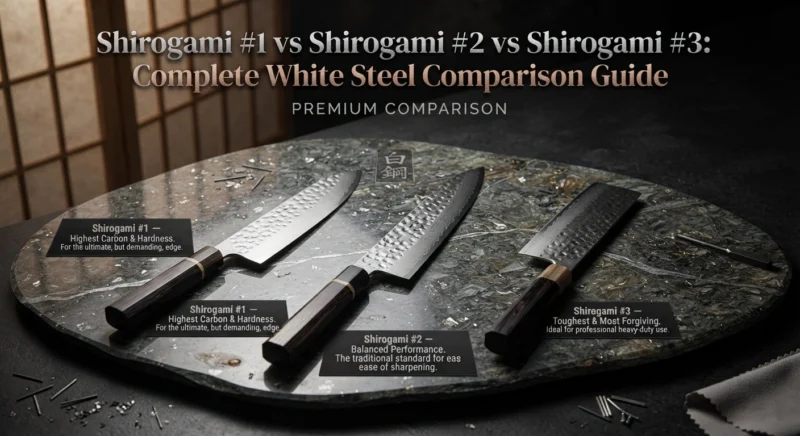
Shirogami #1 vs Shirogami #2 vs Shirogami #3
An Independent Guide
Shirogami, commonly called White Paper Steel or simply White Steel, is one of the most traditional Japanese steels used for high-performance kitchen knives. It has a reputation for taking an exceptionally fine edge, sharpening beautifully on waterstones, and giving the user an unusually direct connection with the cutting edge.
But “Shirogami” is not a single steel grade. The family includes Shirogami #1, Shirogami #2, and Shirogami #3. Although they share the same basic philosophy of extremely clean, simple carbon steel, their carbon contents are different, and that difference affects hardness potential, edge behavior, toughness, sharpening, and the way a finished knife performs.
If you are trying to decide between White Steel #1, #2, and #3, the most important point is this:
Shirogami #1 is the highest-carbon and hardest grade, Shirogami #2 is the balanced middle grade, and Shirogami #3 has the lowest carbon content and is generally the more forgiving option.
The differences are relatively subtle compared with the differences between completely unrelated steels. Heat treatment, blade geometry, sharpening, edge angle, and the skill of the maker can have a tremendous effect on the finished knife. A well-made Shirogami #2 knife can outperform a poorly heat-treated Shirogami #1 knife in practical use.
This guide explains what separates the three grades, how their compositions differ, what that means for sharpness and edge retention, how they compare in toughness and sharpening, and which Shirogami grade makes the most sense for different types of users and knives.
What Is Shirogami Steel?
Shirogami (白紙), usually translated as White Paper Steel, is a family of high-carbon Japanese steels associated with traditional knife making.
The name “White Paper Steel” comes from the white paper traditionally used to wrap the steel material. Shirogami is designed around a very simple concept: keep the steel extremely clean and minimize alloying elements so that the resulting steel can develop a fine, predictable structure suitable for very sharp edges.
Unlike many modern stainless and powder metallurgy steels, Shirogami does not rely on large additions of chromium, vanadium, molybdenum, or other alloying elements to achieve its performance.
That simplicity is a major part of its appeal.
Shirogami is essentially a high-purity carbon steel family, with carbon being the main element responsible for the differences between the grades. The steel also contains small amounts of elements such as silicon and manganese, while phosphorus and sulfur are kept very low.
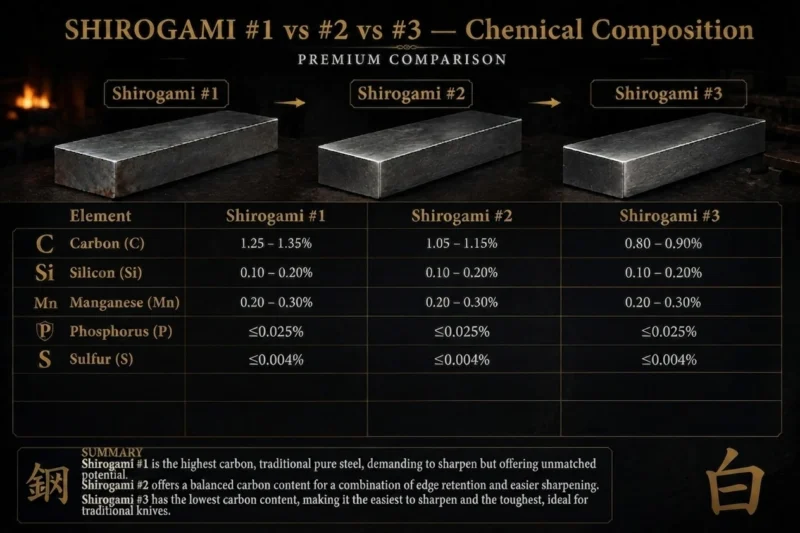
A published composition comparison from Sakai Ichimonji lists White Steel #1 at about 1.3% carbon, White Steel #2 at about 1.1%, and White Steel #3 at about 0.9%. The same source emphasizes that the grades are distinguished primarily by their carbon content.
This is important because the numbers #1, #2, and #3 do not mean first, second, and third quality.
They are grades within the White Steel family.
Shirogami #1 vs #2 vs #3 at a Glance
Before going into the details, here is the simplest way to understand the three grades:
| Characteristic | Shirogami #1 | Shirogami #2 | Shirogami #3 |
|---|---|---|---|
| Carbon content | Highest | Medium | Lowest |
| Approx. carbon | ~1.25–1.35% | ~1.05–1.15% | ~0.80–0.90% |
| Hardness potential | Highest | High | Lower |
| Edge retention | Best of the three | Very good | Lower |
| Maximum keenness | Excellent | Excellent | Very good |
| Toughness | Lowest | Better balance | Generally highest |
| Sharpening | Very easy | Very easy | Extremely easy |
| Corrosion resistance | Very low | Very low | Very low |
| Reactivity | High | High | High |
| Typical role | High-performance traditional knives | All-round choice | More forgiving applications |
| Popularity | Less common than #2 | Most common | Less common |
The exact hardness and performance of a finished knife depend heavily on the maker’s heat treatment and geometry, so these values should not be treated as fixed properties of every Shirogami knife. Published references commonly place #1 around the low-to-mid 60s HRC, #2 around the low-to-mid 60s, and #3 somewhat lower.
The Most Important Difference: Carbon Content
The easiest way to understand Shirogami #1, #2, and #3 is to look at carbon.
Typical published figures are approximately:
- Shirogami #1: 1.25–1.35% carbon
- Shirogami #2: 1.05–1.15% carbon
- Shirogami #3: 0.80–0.90% carbon
These figures can vary slightly depending on the specification and source, but the basic relationship remains the same: #1 contains the most carbon, #2 is in the middle, and #3 contains the least.
Why does that matter?
Carbon is one of the fundamental elements controlling the hardness that a simple carbon steel can achieve after heat treatment. More carbon generally allows the steel to form more hardening structures during quenching.
That creates a chain of consequences:
More carbon → higher hardness potential → stronger resistance to edge deformation → potentially better edge retention, but also less tolerance for abuse.
This does not mean that more carbon automatically makes a knife “better.”
It means the steel can be optimized toward a different balance.
Shirogami #1 pushes further toward maximum hardness and edge performance.
Shirogami #2 sits closer to the middle.
Shirogami #3 moves toward lower hardness and greater forgiveness.
Shirogami #1: The High-Carbon White Steel
Shirogami #1 is the highest-carbon grade in the traditional White Steel family.
With roughly 1.25–1.35% carbon, it has the greatest carbon content of the three commonly recognized Shirogami grades.
That high carbon content gives makers the ability to heat-treat the steel to a very high hardness.
For enthusiasts who prioritize maximum edge refinement and traditional Japanese knife performance, Shirogami #1 can be extremely attractive.
What makes Shirogami #1 special?
The appeal is not simply that it is “hard.”
The combination of high carbon content, very low alloying, and appropriate heat treatment can produce a fine, responsive edge that feels exceptional on the cutting board.
A properly made Shirogami #1 knife can take an extremely fine edge.
It also has the sharpening characteristics that make White Steel famous: the abrasive interaction with a waterstone feels very direct, and the user can quickly create and refine an edge.
This is one reason Shirogami is so closely associated with traditional Japanese knife making and high-end blades.
Shirogami #1 and sharpness
It is common to hear that Shirogami #1 is “sharper” than #2.
That statement needs some qualification.
A steel does not automatically determine the final sharpness of a knife.
A knife’s geometry, edge angle, heat treatment, sharpening technique, burr removal, and finishing stone can all have major effects.
However, Shirogami #1 has a very high potential for producing an exceptionally fine edge when properly heat-treated and sharpened.
So rather than saying:
“Shirogami #1 is always sharper.”
A better statement is:
“Shirogami #1 offers excellent potential for an extremely keen edge, particularly when combined with skilled heat treatment and sharpening.”
That distinction is important.
Shirogami #1 and Edge Retention
Among the three White Steel grades, Shirogami #1 generally has the greatest potential for edge retention when the steels are heat-treated appropriately.
The reason is primarily its higher carbon content and ability to reach higher hardness.
However, Shirogami is not a wear-resistant alloy steel in the same sense as steels containing significant amounts of chromium, vanadium, tungsten, or molybdenum.
This is why a Shirogami #1 knife should not be judged against a modern powder steel using edge-retention expectations alone.
Shirogami’s appeal is different.
It offers:
- very high edge refinement
- excellent sharpening response
- very fine cutting performance
- relatively straightforward maintenance on stones
- traditional carbon-steel behavior
The goal is not necessarily to go the longest possible time without sharpening.
The goal is to make sharpening fast, enjoyable, and capable of restoring an exceptionally fine edge.
Shirogami #1 and Toughness
The major trade-off is toughness.
A very hard, high-carbon edge is generally less tolerant of lateral stress, impacts, twisting, and poor cutting technique.
This does not mean that every Shirogami #1 knife will chip easily.
Knife geometry and heat treatment are extremely important.
A properly treated blade with an appropriate edge thickness can be remarkably useful in the kitchen.
But if you compare the three grades, #1 is generally the least forgiving.
That means you should not use a high-hardness Shirogami #1 knife as though it were a heavy-duty chopping tool.
Avoid:
- bones
- frozen food
- twisting cuts
- hard impacts
- chopping through unnecessarily hard materials
- using the edge as a scraper
Shirogami #1 rewards controlled cutting technique.
Check Our Guide Shirogami #1 Steel
Who Should Choose Shirogami #1?
Shirogami #1 is particularly interesting for:
- experienced Japanese knife users
- professional chefs who understand carbon steel
- sharpening enthusiasts
- collectors
- users who value maximum edge refinement
- traditional Japanese knife enthusiasts
- high-end honyaki and other specialized knives
It is not necessarily the best first carbon-steel knife for someone who has never used reactive steel before.
For a first Shirogami knife, #2 is often easier to recommend.
Shirogami #2: The Balanced White Steel
If Shirogami #1 represents the high-performance end of the family, Shirogami #2 is the balanced middle ground.
With approximately 1.05–1.15% carbon, White Steel #2 sits between #1 and #3 in composition.
It is also the grade most people encounter when they start looking at traditional Japanese White Steel knives.
There is a good reason for its popularity.
Shirogami #2 combines:
- excellent sharpening response
- very high edge potential
- good hardness
- useful edge retention
- better toughness than #1
- relatively forgiving behavior
- traditional carbon-steel characteristics
In other words, it gives up some of #1’s maximum performance potential in exchange for a more practical balance.
Why Shirogami #2 Is So Popular
For many users, Shirogami #2 is the sweet spot.
You still get the classic White Steel experience:
- extremely easy sharpening
- fine edge formation
- excellent cutting feel
- high hardness potential
- strong edge performance
But you do not have to push the steel as far toward the high-carbon end as you do with #1.
This makes #2 a particularly versatile choice for Japanese kitchen knives.
Published guides commonly describe White Steel #2 as the most common or balanced grade in the family.
Shirogami #2 and Sharpness
A well-made Shirogami #2 knife can be extraordinarily sharp.
The difference between #1 and #2 is not something most users should interpret as:
#1 = sharp
#2 = not as sharp
Both are capable of extremely fine edges.
The practical difference is more about the overall balance of the material.
A skilled sharpener can produce a remarkable edge on #2, and many users will find the difference from #1 insignificant in everyday cutting.
This is one reason #2 is such a practical choice.
You get much of the performance people associate with White Steel without requiring the same degree of caution associated with an extremely hard #1 blade.
Shirogami #2 and Edge Retention
Shirogami #2 generally offers very good edge retention for a simple carbon steel.
Its edge retention is typically below that of many modern highly alloyed steels, particularly powder metallurgy steels designed around wear resistance.
But that comparison can be misleading.
Shirogami #2 is designed to excel at a different combination of properties.
The edge can be sharpened quickly, and the steel responds beautifully to traditional waterstones.
For someone who sharpens regularly, the combination can be more attractive than a steel that holds an edge longer but takes significantly more work to sharpen.
This is a recurring theme with Japanese carbon steels:
Long edge life is not the only measure of a good knife steel.
Shirogami #2 and Toughness
Compared with #1, Shirogami #2 provides a more forgiving balance.
It is still a hard carbon steel and should still be treated accordingly.
But the lower carbon content makes it easier to optimize toward a useful balance of hardness and toughness.
This is one reason #2 works so well for general-purpose Japanese kitchen knives.
You can have a very thin, refined cutting edge while retaining a reasonable margin of durability.
Again, heat treatment is critical.
A poorly treated #2 can perform badly.
A superbly treated #2 can be exceptional.
Check Our Guide Shirogami #2 (White Steel #2)
Who Should Choose Shirogami #2?
For many people, this is the easiest recommendation.
Choose Shirogami #2 if you want:
- a traditional Japanese carbon steel
- excellent sharpening feedback
- a very fine edge
- high hardness
- good edge retention
- a practical balance of performance and durability
- a steel suitable for regular kitchen use
It is also an excellent choice for someone buying their first serious White Steel knife.
If you are unsure whether #1 or #3 is right for you, #2 is usually the safest starting point.
Shirogami #3: The Lower-Carbon White Steel
Shirogami #3 is the least carbon-rich of the three grades.
Published specifications commonly put its carbon content at approximately 0.80–0.90%, compared with around 1.05–1.15% for #2 and 1.25–1.35% for #1.
Because it contains less carbon, it has lower maximum hardness potential.
That changes its personality.
Instead of chasing the maximum hardness and edge performance of #1, Shirogami #3 moves toward:
- easier sharpening
- greater toughness
- greater forgiveness
- lower hardness
- shorter edge life
This does not make #3 a “bad” steel.
It simply gives the maker a different set of priorities.
Why Is Shirogami #3 Less Common?
White Steel #3 is less common in the modern knife market than #2.
Sakai Ichimonji notes that White Steel #3 has become less common in product naming and that the material is not always explicitly identified in the knife’s name.
That means a buyer searching specifically for “Shirogami #3” may find considerably fewer knives than when searching for White #1 or White #2.
There are still reasons to use it.
A maker may choose #3 when a somewhat lower hardness and more forgiving edge are desirable.
It can also be interesting for traditional knife designs and for users who prefer a softer, easier-to-maintain carbon steel.
Shirogami #3 and Sharpness
It would be wrong to describe #3 as a dull steel.
Despite its lower carbon content, it can still take a very fine edge.
One of the defining characteristics of Shirogami as a family is its excellent sharpening behavior.
The difference is that #3 does not offer the same maximum hardness potential as #1.
Therefore, the edge may not maintain the same level of performance under use for as long as a harder #1 or #2 blade.
Still, for users who sharpen frequently, this may not be a major disadvantage.
Shirogami #3 and Sharpening
This is where #3 can be especially attractive.
The lower hardness generally makes the steel very easy to work on waterstones.
If your priority is:
“I want a knife that I can sharpen quickly and easily.”
Shirogami #3 deserves consideration.
The steel is also useful for people who are learning sharpening because the response is direct and predictable.
However, beginners should not assume that a softer steel is automatically easier to use overall.
The knife is still reactive.
It still requires care.
And because the edge may deform more readily than a harder edge, it can require more frequent touch-ups.
Shirogami #3 and Toughness
The lower carbon content generally gives #3 the potential for a more forgiving edge.
This makes it attractive when the user values durability over maximum hardness.
That does not mean you should abuse a Shirogami #3 knife.
It remains a carbon-steel kitchen knife and can still be damaged by inappropriate use.
But among the three Shirogami grades, #3 is generally the direction to consider when toughness and forgiveness are more important than maximum edge retention.
Check Our Guide Shirogami #3 Steel
Shirogami #1 vs Shirogami #2
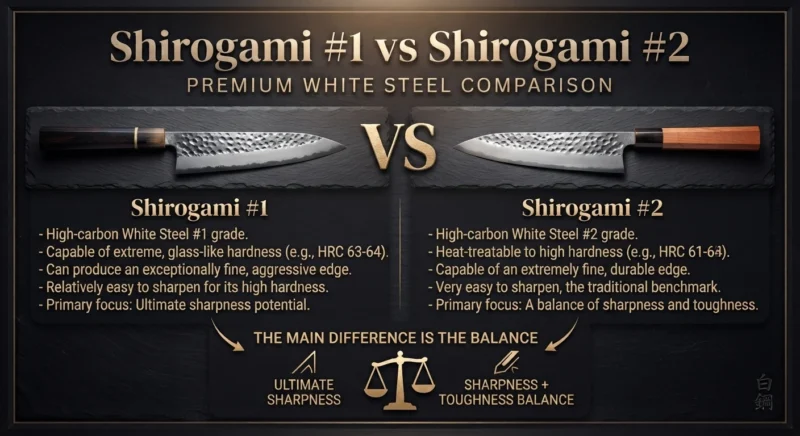
This is probably the most useful comparison for serious Japanese knife buyers.
Both are high-carbon White Steel grades.
Both can be heat-treated to high hardness.
Both can produce extremely fine edges.
Both are easy to sharpen compared with many highly alloyed steels.
The main difference is the balance.
Shirogami #1
- More carbon
- Higher hardness potential
- Greater edge-retention potential
- Extremely fine edge potential
- Less forgiving
- More demanding of technique
Shirogami #2
- Less carbon
- Slightly lower hardness potential
- Excellent edge retention
- Excellent edge refinement
- Better balance
- More practical for general use
For an experienced sharpener looking for the maximum performance of traditional White Steel, #1 can be very appealing.
For someone who wants a high-performance working knife, #2 is usually the more versatile choice.
Shirogami #2 vs Shirogami #3
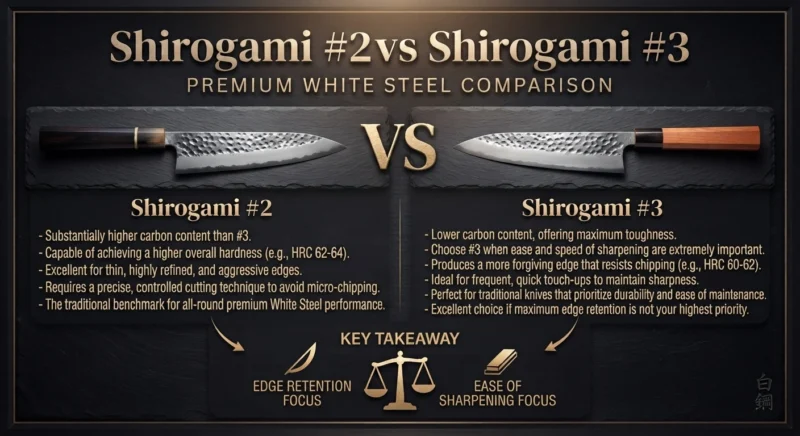
This comparison is more about hardness versus forgiveness.
Shirogami #2 has substantially more carbon than #3.
That allows it to achieve higher hardness and generally hold a refined edge longer.
Shirogami #3 gives up some of that performance in exchange for a more forgiving material.
Choose #2 when:
- edge retention matters
- you want a harder blade
- you want a thin, refined edge
- you use a controlled cutting technique
- you want a traditional all-round White Steel knife
Choose #3 when:
- ease of sharpening is extremely important
- you prefer a more forgiving edge
- you do frequent touch-ups
- you are interested in traditional knives using lower-carbon White Steel
- maximum edge retention is not your priority
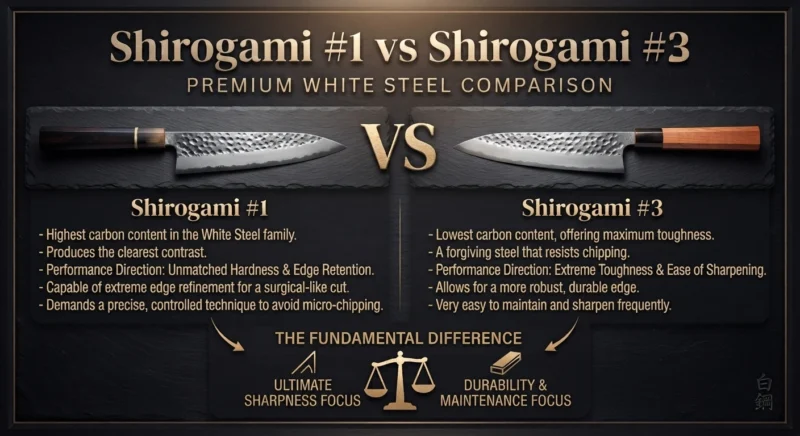
Shirogami #1 vs Shirogami #3
These are the two extremes of the family.
Shirogami #1 has the highest carbon content.
Shirogami #3 has the lowest.
That produces the clearest contrast.
Shirogami #1
Performance direction: hardness, edge retention, extreme edge refinement
Shirogami #3
Performance direction: toughness, ease of sharpening, forgiveness
Shirogami #2 sits between them.
That is why the three grades make more sense as a spectrum than as a simple ranking.
Is Shirogami #1 Sharper Than Shirogami #2?
Not necessarily.
This is one of the most common misunderstandings about knife steels.
Steel composition affects the potential behavior of the edge, but the final sharpness of a knife depends on much more than composition.
Important variables include:
- heat treatment
- blade geometry
- edge angle
- thickness behind the edge
- sharpening technique
- abrasive type
- stone progression
- burr removal
- finishing technique
A poorly sharpened Shirogami #1 knife can be less sharp than a beautifully sharpened Shirogami #2 knife.
Therefore, it is better to say that #1 has greater potential for very high hardness and exceptional edge refinement, rather than claiming that every #1 knife is inherently sharper than every #2 knife.
Check Our Guide All Kinds of Knife Sharpening Tools
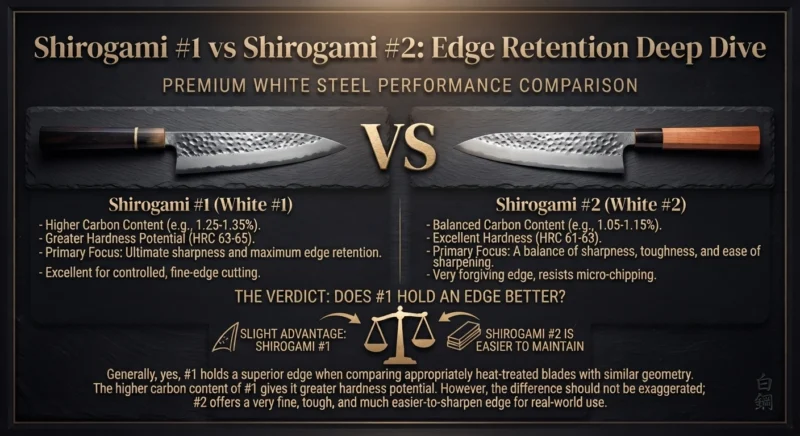
Does Shirogami #1 Hold an Edge Better Than #2?
Generally, yes, when comparing appropriately heat-treated blades with similar geometry.
The higher carbon content of #1 gives it greater hardness potential, and that can contribute to better edge retention.
But the difference should not be exaggerated.
A knife’s edge retention depends on:
- hardness
- carbide structure
- edge geometry
- cutting material
- cutting technique
- sharpening condition
Shirogami #1 and #2 are both relatively simple carbon steels, so neither should be confused with a highly wear-resistant powder steel.
The practical difference between #1 and #2 may be much smaller than the difference between Shirogami and a modern high-wear-resistance steel.
Is Shirogami #3 Easier to Sharpen?
Generally, yes.
All three Shirogami grades are known for excellent sharpening response, but #3 has the lowest carbon content and is generally used at lower hardness.
That can make it particularly easy to sharpen and maintain.
However, “easy to sharpen” and “needs sharpening less often” are different things.
A #3 knife may require more frequent touch-ups because its lower hardness can allow the edge to lose its ideal geometry more quickly.
So the trade-off can be summarized as:
#3: easier sharpening, potentially more frequent sharpening.
Shirogami and Corrosion Resistance
There is one characteristic that all three grades share:
None of them should be considered stainless steel.
Shirogami contains very little chromium and is designed as a highly pure carbon-steel family.
Consequently, #1, #2, and #3 are all reactive.
They can:
- develop a patina
- discolor during use
- react with acidic foods
- develop rust if left wet
- require more maintenance than stainless steel
This is not a defect.
It is simply part of the character of traditional White Steel.
Shirogami Patina
A patina is a surface reaction that changes the appearance of carbon steel over time.
With Shirogami, you may see the blade gradually develop shades ranging from gray to blue-gray, depending on what foods it contacts and how it is maintained.
Many enthusiasts consider this part of the appeal of carbon-steel knives.
However, patina should not be confused with active red rust.
A stable patina can provide some degree of surface protection, while red/orange rust indicates corrosion that should be removed.
The safest habit is simple:
Keep the blade clean and dry.
After cutting acidic foods or wet ingredients, rinse or wipe the blade and dry it promptly.
Does Shirogami #3 Rust Less Than #1?
Not in any meaningful stainless-steel sense.
The three grades all belong to the same reactive White Steel family.
Their primary difference is carbon content, not chromium content.
Since they do not have the chromium level required for stainless behavior, all three require carbon-steel care.
Therefore, you should not choose #3 because you expect it to be corrosion resistant.
Choose #3 for its performance characteristics, not for corrosion resistance.
Shirogami and Waterstones
One of the biggest reasons people love Shirogami is the sharpening experience.
On a suitable waterstone, White Steel tends to feel very responsive.
The steel does not have the large volume of hard alloy carbides found in many modern wear-resistant steels.
As a result, the edge can be refined relatively quickly.
This makes Shirogami especially attractive to people who enjoy sharpening rather than simply wanting to avoid sharpening.
For many users, this is one of the most important differences between traditional carbon steel and modern stainless or powder steels.
Why Sharpening Feel Matters
Edge retention gets a lot of attention in knife-steel discussions.
But there is another question:
How much effort does it take to restore the edge?
Imagine two knives.
Knife A holds its edge for a very long time but is difficult and time-consuming to sharpen.
Knife B loses its ultimate edge sooner but can be restored in a few minutes on a waterstone.
For a professional chef or sharpening enthusiast, Knife B may actually be preferable.
This is where Shirogami becomes particularly interesting.
It is not necessarily trying to win an edge-retention competition.
It is trying to provide an exceptionally refined cutting edge that can be maintained easily.
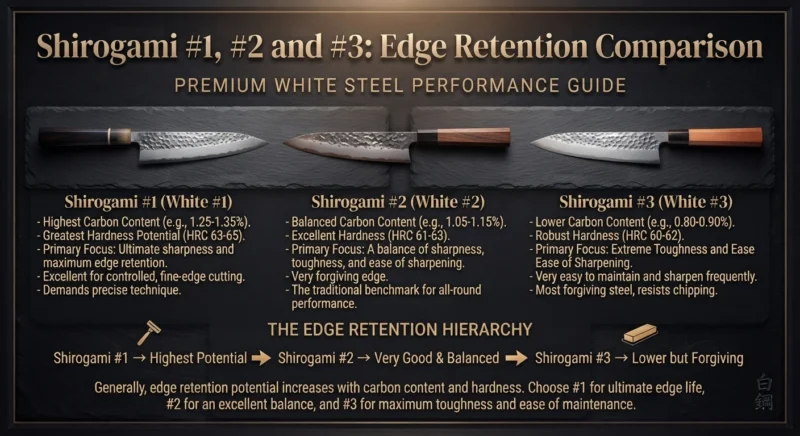
Shirogami #1, #2 and #3: Edge Retention Comparison
If we simplify the three grades:
Shirogami #1 → highest edge-retention potential
Shirogami #2 → very good edge retention with better balance
Shirogami #3 → lower edge retention but easier and more forgiving
This should be treated as a general comparison, not a laboratory ranking for every knife.
A poorly heat-treated #1 can perform worse than an excellent #2.
A thin #3 blade may cut beautifully even though it does not retain the edge as long as a harder #2.
Geometry can sometimes matter more than a small difference in steel composition.
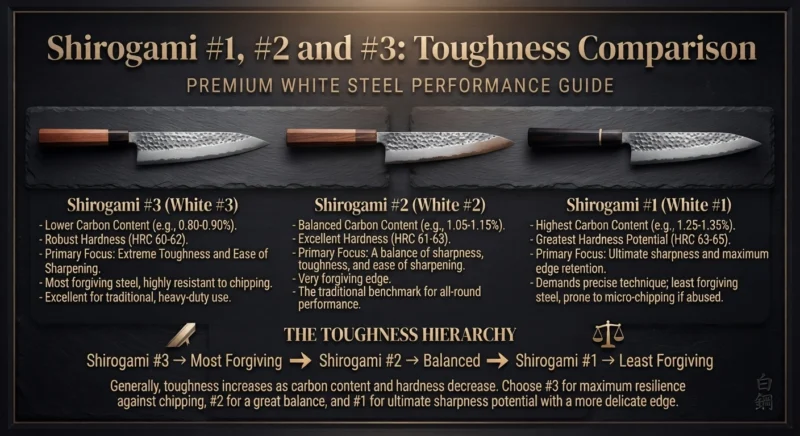
Shirogami #1, #2 and #3: Toughness Comparison
The general direction is the reverse:
Shirogami #3 → most forgiving
Shirogami #2 → balanced
Shirogami #1 → least forgiving
Again, this is a tendency rather than an absolute rule.
Heat treatment is enormously important.
A skilled maker can optimize a steel to produce a surprisingly durable blade.
But if everything else is equal, the lower-carbon #3 gives more room to prioritize toughness, while #1 is naturally more oriented toward high hardness.
Check Our Guide Wear Resistance vs Toughness
What About HRC?
Hardness is another area where online discussions often become too simplistic.
Typical published values vary depending on the manufacturer, maker, and heat treatment.
One reference gives approximate ranges of 63–65 HRC for White #1, 62–64 HRC for White #2, and 60–62 HRC for White #3.
Other published references give somewhat different ranges.
That variation is important.
Shirogami #1 does not have one universal HRC value.
Neither do #2 or #3.
The final hardness of a knife depends on the heat treatment chosen by the maker.
Therefore, when buying a knife, you should not look at the steel name alone.
Consider:
- Steel grade
- Maker
- Heat treatment
- Blade geometry
- Intended use
- Edge angle
- Construction
All seven can influence the actual performance of the finished knife.
Check Our Guide What Is HRC? Understanding Rockwell Hardness
Why Heat Treatment Matters So Much
Steel composition is only the starting point.
A skilled bladesmith can transform the behavior of a steel through:
- heating
- soaking
- quenching
- tempering
- forging
- normalizing
- grain refinement
This is particularly important with traditional carbon steels.
Two knives made from nominally identical Shirogami #2 can perform noticeably differently if their heat treatments are different.
One may have an excellent combination of hardness, toughness, and edge stability.
Another may be too soft.
Another may be excessively hard and brittle.
Therefore, comparing steel grades without considering the maker can give a misleading picture.
Check Our Guide Different Heat Treatment Methods Explained
Shirogami #1 vs #2 vs #3 for Different Japanese Knives
The appropriate steel can also depend on the type of knife.
Yanagiba
Traditional single-bevel slicing knives are often associated with high-carbon Japanese steels.
Shirogami #1 and #2 can both be excellent choices when the maker is skilled in heat treatment and the user understands proper sharpening and maintenance.
The extreme edge refinement possible with White Steel is particularly attractive for precision slicing.
Deba
A deba requires a different balance because the knife is thicker and is often used around fish.
The exact steel choice depends heavily on the knife’s construction and intended work.
The user should never assume that a harder steel automatically makes a better deba.
Usuba
Usuba knives are another traditional application where edge refinement and sharpening characteristics are extremely important.
Shirogami can be a natural choice for users who understand single-bevel sharpening.
Gyuto
For a double-bevel gyuto, Shirogami #2 is often a particularly practical choice.
It offers a strong balance between hardness, edge performance, sharpening ease, and usability.
Shirogami #1 can be excellent for experienced users seeking maximum performance.
Nakiri
Shirogami #2 is particularly appealing for a traditional carbon-steel nakiri.
Shirogami #3 can also make sense where a somewhat more forgiving edge is preferred.
Check Our Guide Japanese Fish Knives
Shirogami #1 vs Shirogami #2 vs Shirogami #3 for Beginners
If you are new to Japanese carbon steel, the three grades should not be approached only from the perspective of sharpness.
The more important question is:
How much maintenance and sharpening are you willing to do?
All three require proper carbon-steel care.
If you forget to dry the knife, all three can rust.
If you use excessive force, all three can be damaged.
If you sharpen regularly, all three can be rewarding.
For most beginners, Shirogami #2 is the easiest recommendation because it offers a balanced combination of performance and forgiveness.
Shirogami #3 can also be attractive for someone who values ease of sharpening and a more forgiving blade.
Shirogami #1 is better suited to users who already understand thin, hard Japanese knives and careful edge maintenance.
Which Shirogami Steel Is Best?
There is no single “best” Shirogami grade.
Instead:
Best for maximum edge potential:
Shirogami #1
Best overall balance:
Shirogami #2
Best for forgiveness and easy sharpening:
Shirogami #3
That is a much more useful way to think about the three grades than calling one of them the best.
Shirogami #1 vs #2 vs #3: Pros and Cons
Shirogami #1
Advantages
- Highest carbon content
- Very high hardness potential
- Excellent edge refinement
- Excellent sharpening response
- Strong edge-retention potential
- Highly attractive for traditional high-performance knives
Disadvantages
- Less forgiving
- Greater potential for chipping if abused
- Requires good technique
- Reactive
- Not ideal for heavy-duty cutting
Shirogami #2
Advantages
- Excellent balance
- Very high edge potential
- Easy to sharpen
- Good edge retention
- Better toughness than #1
- Extremely popular and widely available
- Excellent choice for many kitchen knives
Disadvantages
- Still reactive
- Requires regular maintenance
- Does not have the maximum hardness potential of #1
- Less wear resistant than many modern alloy steels
Shirogami #3
Advantages
- Lowest carbon content
- Very easy to sharpen
- More forgiving
- Good choice when toughness is prioritized
- Retains the characteristic White Steel sharpening feel
- Can be an economical way to experience traditional carbon steel
Disadvantages
- Lower hardness potential
- Lower edge retention
- Less common
- Still highly reactive
- Not the ideal choice when maximum edge retention is the priority
White Steel vs Blue Steel
Another common question is whether Shirogami is better than Aogami.
The answer depends on what you want.
Shirogami is designed around purity and simplicity.
Aogami, or Blue Steel, adds alloying elements such as tungsten and chromium to improve certain performance characteristics.
The result is a fundamental difference in philosophy.
Shirogami emphasizes:
- purity
- sharpening response
- fine edge formation
- traditional carbon-steel behavior
Aogami emphasizes:
- greater wear resistance
- longer edge retention
- alloyed steel performance
- still-excellent sharpening characteristics
That does not mean Aogami is “better.”
It means the two families have different priorities.
If you love sharpening and want an extremely refined traditional carbon-steel edge, Shirogami can be fascinating.
If you want longer edge life and somewhat greater wear resistance, Aogami may be more attractive.
Shirogami vs Stainless Steel
The difference is even more obvious when comparing White Steel with stainless steel.
Shirogami offers:
- extremely easy sharpening
- high edge refinement
- traditional carbon-steel feel
- beautiful patina development
Stainless steels offer:
- much better corrosion resistance
- easier maintenance
- greater tolerance of moisture
- often better resistance to staining
There is no universally superior option.
A chef working in a busy professional kitchen who wants minimal maintenance may prefer stainless.
A sharpening enthusiast who enjoys traditional Japanese knives may prefer Shirogami.
Check Our Guide Stainless Steel Myths
Is Shirogami Good for a Kitchen Knife?
Absolutely.
In fact, kitchen knives are one of the environments where Shirogami makes the most sense.
The steel’s ability to take a very fine edge is particularly useful for:
- slicing
- vegetable preparation
- precision cuts
- fish preparation
- push cutting
- fine chopping
The limitation is maintenance.
Shirogami is not the steel for someone who wants to leave a knife wet in the sink.
After use:
- Wipe the blade.
- Rinse if necessary.
- Dry it completely.
- Store it dry.
- Sharpen when required.
That routine is simple, but it must become a habit.
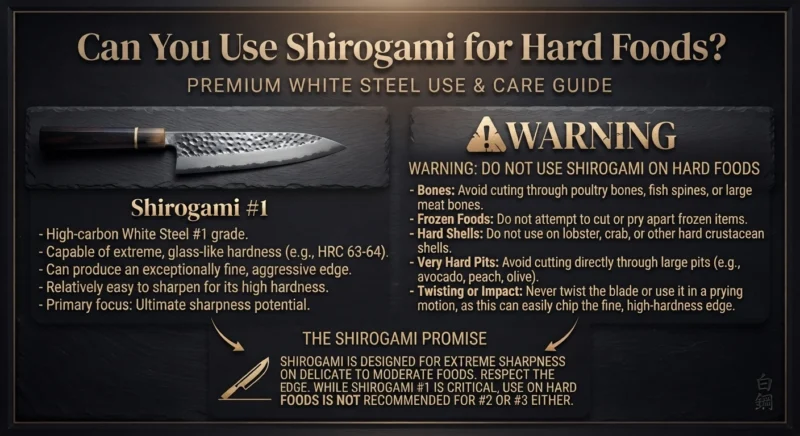
Can You Use Shirogami for Hard Foods?
You can use Shirogami for normal kitchen work, but you should understand its limitations.
Avoid forcing a thin edge through:
- bones
- frozen foods
- hard shells
- very hard pits
- other materials that can twist or impact the edge
This is especially important for high-hardness Shirogami #1.
A knife with excellent edge geometry is designed to cut, not pry.
When the cutting material resists, change your technique rather than increasing force.
Shirogami and Chipping
Chipping is one of the biggest concerns with high-hardness Japanese knives.
A chip occurs when a portion of the edge fractures away.
The likelihood of chipping depends on several factors:
- hardness
- toughness
- edge thickness
- edge angle
- heat treatment
- cutting technique
- cutting material
Shirogami #1, when hardened aggressively, has less tolerance for abuse than #3.
But this does not mean every #1 knife is fragile.
A well-designed knife can have an excellent balance between thin geometry and durability.
The important lesson is:
Steel grade alone does not determine whether a knife will chip.
Why Geometry Can Matter More Than Steel Grade
Suppose you compare:
- a thin, well-ground Shirogami #3 knife
- a thick, poorly ground Shirogami #1 knife
The #3 knife may feel dramatically better in actual cutting.
Why?
Because cutting performance is strongly influenced by geometry.
Important measurements include:
- edge angle
- thickness behind the edge
- blade thickness
- blade profile
- grind geometry
This is why steel comparison charts should always be treated as a starting point.
A steel grade tells you something about the material.
It does not tell you everything about the knife.
Shirogami for Professional Chefs
Professional chefs often value three things:
- Cutting performance
- Predictable sharpening
- Maintenance requirements
Shirogami can score extremely well on the first two.
The third is where it requires discipline.
A professional who uses a knife constantly may actually appreciate the fact that Shirogami sharpens quickly.
Frequent touch-ups are not necessarily a problem when the steel responds immediately to a stone.
For a chef who wants a traditional Japanese knife and does not mind caring for carbon steel, Shirogami #2 can be an outstanding working choice.
Shirogami for Home Cooks
Home cooks have a wider range of needs.
If you cook several times a week and enjoy maintaining your knives, Shirogami can be a wonderful material.
If you want a knife that can sit wet in the sink for hours, it is a poor choice.
The decision is less about skill and more about habits.
A careful beginner can successfully use Shirogami.
An experienced chef who neglects the knife can damage it.
How to Maintain a Shirogami Knife
The basic maintenance routine is simple.
Keep it dry
Moisture is the enemy of reactive carbon steel.
Do not leave a Shirogami knife wet.
Wipe during use
If you are cutting acidic foods such as citrus or tomatoes, wiping the blade periodically can reduce aggressive reactions.
Dry after washing
Never store the knife wet.
Use a suitable stone
Waterstones are an excellent match for Shirogami.
Do not wait until the edge is completely dull
Regular touch-ups are easier than repairing a badly damaged edge.
Does Shirogami Need Oil?
For long-term storage, a very thin protective layer of food-safe mineral oil can be useful.
For normal daily kitchen use, the most important thing is simply keeping the blade clean and dry.
Oil is not a substitute for cleaning.
If the knife is used for food preparation, use an appropriate food-safe product and follow the manufacturer’s recommendations.
Common Myths About Shirogami
Myth 1: Shirogami #1 is always better than #2
Not true.
#1 has more carbon and higher hardness potential, but #2 offers a more balanced combination of performance and durability.
For many users, #2 is the better choice.
Myth 2: Shirogami #3 is low quality
Not necessarily.
#3 is a different grade designed around lower carbon content.
It sacrifices some hardness and edge retention to provide a more forgiving performance profile.
Myth 3: Shirogami is the sharpest steel
This statement is too simplistic.
Shirogami can take an exceptionally fine edge, but sharpness depends on the entire knife system.
Geometry and sharpening are critical.
Myth 4: Harder always means better
No.
Higher hardness can improve edge stability and retention, but it can also reduce toughness.
The best knife is the one with the right balance for its intended use.
Myth 5: Shirogami #3 does not rust as much
It is still reactive carbon steel.
All three Shirogami grades require proper corrosion care.
The Importance of the Maker
When purchasing a Shirogami knife, the name of the steel should not be your only consideration.
Look at the maker.
A skilled Japanese bladesmith can extract exceptional performance from Shirogami.
Heat treatment can change:
- hardness
- toughness
- edge stability
- sharpening response
- durability
The same applies to grinding and finishing.
This is why experienced buyers often choose a knife based on the combination of:
maker + heat treatment + geometry + steel
rather than simply choosing the highest-numbered specification.
Is Shirogami #1 Worth Paying More For?
Sometimes.
If you are an experienced user and specifically want the characteristics associated with high-carbon White Steel #1, the additional cost may be justified.
But if you are simply looking for a very sharp Japanese knife, you do not necessarily need #1.
A well-made Shirogami #2 knife can provide exceptional performance.
In many cases, spending more on a better maker or better geometry can be more worthwhile than simply moving from #2 to #1.
Is Shirogami #2 the Best Value?
For many buyers, yes.
It combines:
- strong performance
- excellent sharpening
- high edge potential
- practical toughness
- broad availability
That makes it one of the most useful traditional Japanese carbon steels.
If you are buying your first White Steel knife and do not have a specific reason to choose another grade, Shirogami #2 is the logical starting point.
Is Shirogami #3 Worth Considering?
Definitely, especially if you understand what it is designed to do.
Shirogami #3 can be interesting for:
- traditional knives
- users who sharpen frequently
- people who prefer more forgiving carbon steel
- makers experimenting with different heat treatments
- users who do not need maximum edge retention
Its lower carbon content should not be interpreted as a failure to achieve high performance.
It simply represents another point on the White Steel performance spectrum.
Shirogami #1 vs #2 vs #3: Which One Should You Buy?
Here is the simplest decision guide.
Choose Shirogami #1 if:
You are an experienced user who wants very high hardness and excellent edge refinement and understands the additional care required from a hard carbon-steel blade.
Choose Shirogami #2 if:
You want the best overall balance of sharpness, edge retention, toughness, sharpening ease, and practicality.
Choose Shirogami #3 if:
You prioritize forgiveness and easy sharpening over maximum hardness and edge retention.
Final Verdict
Shirogami #1, #2, and #3 are not three completely different steels.
They are three grades within the same traditional White Steel family, with their primary distinction being carbon content.
Shirogami #1 contains the most carbon and has the highest hardness potential. It is attractive to experienced users who want an exceptionally refined, high-performance edge.
Shirogami #2 sits in the middle and offers the most balanced combination of properties. For many kitchen-knife users, it is the most practical White Steel grade.
Shirogami #3 contains the least carbon. It gives up some hardness and edge retention but can provide a more forgiving, easy-to-sharpen experience.
The basic progression can be remembered like this:
Shirogami #1 → maximum hardness and edge potential
Shirogami #2 → balanced performance
Shirogami #3 → greater forgiveness and easy maintenance
But the most important lesson is that steel grade is only one part of knife performance.
Heat treatment, geometry, sharpening, edge angle, and the skill of the maker can have an enormous effect on the final result. A beautifully made Shirogami #2 knife can be a better working tool than an average Shirogami #1 knife.
For most people looking for a traditional Japanese White Steel kitchen knife, Shirogami #2 is the safest all-around recommendation. For enthusiasts chasing maximum edge refinement, #1 deserves serious consideration. And for users who value a more forgiving steel and very easy sharpening, #3 remains an interesting and often overlooked option.
Whichever grade you choose, remember that all three are reactive carbon steels. They reward proper maintenance, careful cutting technique, and regular sharpening.
That combination of purity, sharpening response, and traditional craftsmanship is exactly why Shirogami remains one of the most respected Japanese knife-steel families.
Quick Summary
| Feature | Shirogami #1 | Shirogami #2 | Shirogami #3 |
| Carbon | ~1.25–1.35% | ~1.05–1.15% | ~0.80–0.90% |
| Hardness potential | Highest | High | Lower |
| Edge retention | Highest | Very good | Lower |
| Edge refinement | Excellent | Excellent | Very good |
| Toughness | Lowest | Balanced | Highest |
| Sharpening | Very easy | Very easy | Extremely easy |
| Corrosion resistance | Very low | Very low | Very low |
| Best for | Experienced enthusiasts | Most users | Forgiving traditional knives |
Bottom line: There is no universal winner. Shirogami #1 is the specialist, #2 is the all-rounder, and #3 is the forgiving option. The right grade depends on how you use, sharpen, and maintain your knife.
This article is for independent informational purposes only and is not affiliated with, sponsored by, or endorsed by any steel manufacturer. All product names, trademarks, and registered trademarks are the property of their respective owners.
https://knifesteelnerds.com/wp-content/uploads/2020/03/Hitachi-cutlery-steel.pdf