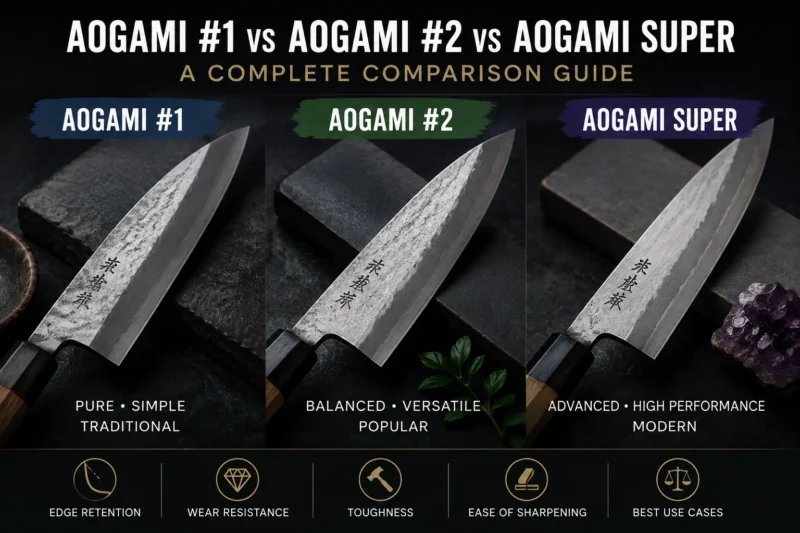
Aogami #1 vs Aogami #2 vs Aogami Super
An Independent Guide
Aogami steel is one of the most respected traditional Japanese knife-steel families. Known as Blue Paper Steel or Blue Steel, Aogami combines high carbon content with carefully controlled alloying elements to produce knives capable of taking a very sharp edge while offering better edge retention than simpler traditional carbon steels.
Within the Aogami family, three grades are especially important:
- Aogami #1
- Aogami #2
- Aogami Super
All three are high-carbon, non-stainless Japanese steels, but they are not identical. Their differences in carbon, tungsten, molybdenum, and vanadium content affect hardness, wear resistance, sharpening behavior, toughness, and edge retention.
For many knife buyers, the question is simple: Which is better, Aogami #1, Aogami #2, or Aogami Super?
The answer depends on what you value.
Aogami #2 is often the most balanced choice. Aogami #1 offers higher carbon content and increased wear resistance. Aogami Super takes the concept further by adding molybdenum and vanadium and is generally regarded as the highest-performance grade in the traditional Aogami family.
However, there is an important misconception to avoid: a steel grade does not automatically determine how good a knife will be. Heat treatment, blade geometry, edge angle, grinding quality, and the skill of the maker can have an enormous effect on the finished knife.
This guide explains the differences between Aogami #1, Aogami #2, and Aogami Super and helps you decide which steel is best for your knife.
What Is Aogami Steel?
Aogami, written 青紙 in Japanese, is commonly translated as Blue Paper Steel or Blue Steel.
The name comes from the blue-colored paper historically associated with the steel designation. Aogami is part of the family of traditional Japanese high-carbon steels associated with Yasugi Specialty Steel and historically produced by Hitachi Metals.
Unlike stainless steels such as VG-10, Aogami steels are not stainless. Their chromium content is far too low to provide stainless behavior.
Instead, Aogami steels are designed around a different philosophy: high carbon content, controlled alloy additions, excellent heat treatment response, fine edge capability, and high cutting performance.
The three principal grades discussed here are Aogami #2, Aogami #1, and Aogami Super.
They can be thought of as progressively more highly alloyed and higher-carbon versions of the Aogami concept.
A simplified progression is:
Aogami #2 → Aogami #1 → Aogami Super
As you move through the family, carbon increases, and Aogami Super adds molybdenum and vanadium in addition to its higher tungsten content.
But this does not mean that every performance characteristic simply increases from #2 to #1 to Super.
For example, greater hardness and wear resistance can make sharpening more demanding. A harder edge can also become less forgiving if the knife is used improperly.
That trade-off is one of the most important things to understand when comparing these steels.
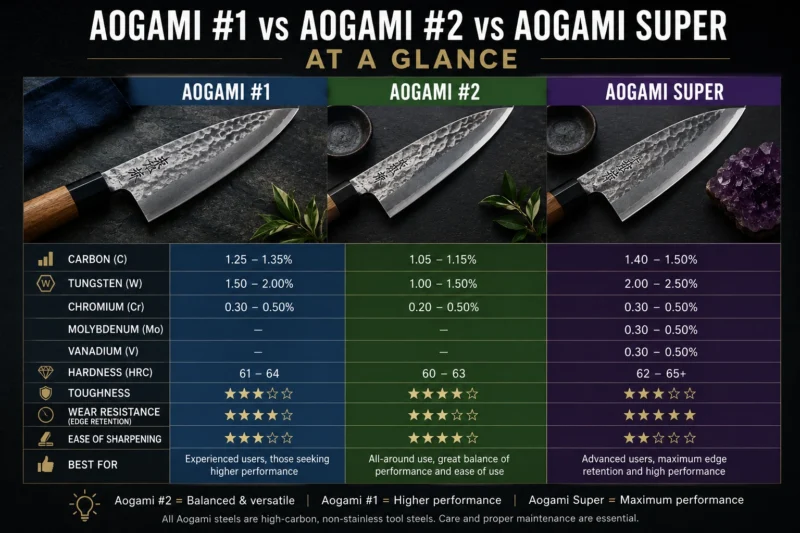
Aogami #1 vs Aogami #2 vs Aogami Super at a Glance
The commonly published composition ranges for the three grades are approximately:
| Property | Aogami #2 | Aogami #1 | Aogami Super |
|---|---|---|---|
| Carbon | 1.05–1.15% | 1.25–1.35% | 1.40–1.50% |
| Tungsten | 1.00–1.50% | 1.50–2.00% | 2.00–2.50% |
| Chromium | 0.20–0.50% | 0.30–0.50% | 0.30–0.50% |
| Molybdenum | Not specified | Not specified | 0.30–0.50% |
| Vanadium | Not specified | Not specified | 0.30–0.50% |
| Stainless? | No | No | No |
| General character | Balanced | Higher performance | Maximum performance |
These composition ranges are published in references describing the Yasuki/Aogami family, but the exact performance of an individual knife depends heavily on heat treatment and geometry.
The simplest way to summarize the three grades is:
Aogami #2: the balanced workhorse.
Aogami #1: more carbon and tungsten, with greater potential for hardness and edge retention.
Aogami Super: the most highly alloyed and highest-carbon member, adding molybdenum and vanadium for an even greater emphasis on edge retention and wear resistance.
Aogami #2: The Balanced Blue Steel
Aogami #2 is often the starting point for people entering the world of Blue Paper steels.
It contains approximately 1.05–1.15% carbon and 1.00–1.50% tungsten, with a small amount of chromium.
Compared with Aogami #1 and Aogami Super, its lower carbon content gives it a somewhat more forgiving balance of properties.
This does not mean Aogami #2 is a low-performance steel.
Quite the opposite.
A properly heat-treated Aogami #2 knife can take an extremely sharp edge and provide excellent edge retention. It is capable of the fine, precise cutting performance that Japanese carbon-steel knives are famous for.
Its appeal is that it does this without pushing the steel quite as far toward maximum hardness and wear resistance as Aogami #1 and Aogami Super.
Aogami #2 Edge Retention
Aogami #2 has excellent edge retention for a traditional carbon steel.
Its tungsten and carbon content allow the formation of hard carbides that contribute to wear resistance. This helps the edge remain functional through extended cutting.
However, Aogami #1 and Aogami Super generally have greater potential for edge retention because of their higher carbon and alloy content.
This difference should not be exaggerated.
Aogami #2 can still outperform many ordinary knife steels in practical cutting performance, particularly when the knife has excellent geometry and heat treatment.
Aogami #2 Sharpening
One of the major attractions of Aogami #2 is its sharpening behavior.
Compared with higher-alloy Aogami grades, it is generally considered easier and more responsive on traditional waterstones.
For a user who enjoys maintaining a knife regularly, this can be a major advantage.
The ability to quickly restore a fine edge is often more important in real-world kitchen use than having the absolute maximum possible wear resistance.
Aogami #2 Toughness
Aogami #2 is generally regarded as the more forgiving grade of the three.
That does not mean it is a tough steel in the same sense as a dedicated high-toughness steel.
It remains a very hard carbon steel and should not be subjected to twisting, prying, chopping bones, or other abusive use.
But within the Aogami family, its balance makes it attractive for general kitchen work.
Who Should Choose Aogami #2?
Aogami #2 is particularly suitable for:
- Home cooks who want traditional Japanese carbon steel
- Professional chefs who sharpen regularly
- Users who want excellent edge retention without maximum sharpening difficulty
- People buying their first Aogami knife
- Users who value a balanced combination of sharpness, edge retention, and maintainability
If you are unsure which Aogami grade to choose, Aogami #2 is often the safest starting point.
Check Our Guide Aogami Steel N2
Aogami #1: More Carbon, More Performance
Aogami #1 takes the traditional Aogami formula further.
It contains approximately 1.25–1.35% carbon and 1.50–2.00% tungsten, compared with approximately 1.05–1.15% carbon and 1.00–1.50% tungsten in Aogami #2.
That additional carbon and tungsten can increase the steel’s ability to achieve high hardness and resist wear.
The result is a steel aimed more toward users who want greater edge retention and are willing to accept a more demanding sharpening and maintenance routine.
Aogami #1 Edge Retention
Aogami #1 generally offers better edge retention than Aogami #2 when both knives are appropriately heat-treated and have comparable geometry.
The higher carbon and tungsten content contribute to a greater carbide-forming potential and increased wear resistance.
This is particularly attractive for users who perform long periods of repetitive cutting.
A professional chef preparing large quantities of vegetables, meat, or fish may appreciate an edge that maintains its cutting performance for longer before requiring a full sharpening.
However, edge retention is never determined by steel composition alone.
A poorly heat-treated Aogami #1 knife can perform worse than an excellent Aogami #2 knife.
This is why steel comparisons should always be treated as comparisons of potential, rather than absolute performance.
Aogami #1 Hardness
Aogami #1 is capable of very high hardness when properly heat-treated.
Published knife references commonly place Aogami #1 knives around the low-to-mid 60s HRC, but actual hardness depends on the maker’s heat-treatment process.
Higher hardness can provide several benefits.
The edge can resist deformation better, allowing a thin cutting edge to maintain its geometry during use.
However, higher hardness can also reduce forgiveness.
If a knife is repeatedly twisted, dropped, used against hard objects, or exposed to lateral forces, the risk of chipping can increase.
Aogami #1 Sharpening
Aogami #1 is generally more demanding to sharpen than Aogami #2.
This is partly related to its higher hardness and alloy content.
Nevertheless, Aogami #1 is still a traditional carbon steel and can be sharpened effectively on quality waterstones.
For experienced sharpeners, this is usually not a serious problem.
For beginners, however, Aogami #2 may provide a more comfortable introduction to high-performance Japanese carbon steel.
Aogami #1 Cutting Feel
One reason enthusiasts seek Aogami #1 is the combination of high hardness and excellent edge stability.
A well-made Aogami #1 knife can feel extremely precise when cutting.
The steel itself does not make a knife sharp automatically. Sharpness is primarily determined by the quality of the edge and geometry.
But Aogami #1 provides an excellent platform for a very refined cutting edge.
Who Should Choose Aogami #1?
Aogami #1 makes sense for:
- Experienced Japanese knife users
- Professional chefs
- Users who prioritize edge retention
- People comfortable with carbon-steel maintenance
- Experienced sharpeners
- Users who want a more premium alternative to Aogami #2
Aogami #1 is often the middle ground between the practical balance of Aogami #2 and the extreme performance orientation of Aogami Super.
Check Our Guide Aogami Blue Steel N1
Aogami Super: The Flagship Blue Steel
Aogami Super is the most distinctive member of the family.
Its composition includes approximately 1.40–1.50% carbon, 2.00–2.50% tungsten, 0.30–0.50% chromium, and additions of approximately 0.30–0.50% molybdenum and vanadium.
The addition of molybdenum and vanadium is one of the defining differences between Aogami Super and Aogami #1 and #2.
This combination gives Aogami Super exceptional potential for hardness, wear resistance, and edge retention.
It is one of the most sought-after traditional Japanese carbon steels for premium kitchen knives.
Aogami Super Edge Retention
Among these three steels, Aogami Super generally has the highest edge-retention potential.
Its higher carbon content and additional vanadium contribute to a carbide structure that can resist wear.
This is particularly valuable for users who want to spend less time performing full sharpening sessions.
Aogami Super is frequently chosen for high-performance gyutos, santokus, yanagibas, and other Japanese knives where maintaining a very refined edge is important.
However, it is important not to confuse edge retention with initial sharpness.
Aogami #2, Aogami #1, and Aogami Super can all be sharpened to extremely high levels.
The difference is primarily how long that edge can maintain its useful cutting performance under a given workload.
Aogami Super Hardness
Aogami Super is capable of very high hardness.
Depending on the maker and heat treatment, knives made from Aogami Super are commonly found around the low-to-mid 60s HRC, with some manufacturers and sources reporting higher values.
Hardness should therefore never be treated as a fixed number for the steel itself.
There is no single HRC value that every Aogami Super knife must have.
The heat treatment determines the final hardness.
Two knives made from the same Aogami Super steel can have noticeably different characteristics because their makers use different heat-treatment protocols.
Aogami Super and Vanadium
Vanadium is particularly important when discussing Aogami Super.
The addition of vanadium contributes to carbide formation and can help improve wear resistance and grain refinement when the steel is properly processed.
This is one reason Aogami Super can maintain an edge for such a long time.
However, vanadium-containing steels can also feel different during sharpening compared with simpler carbon steels.
A user accustomed to very simple carbon steels may notice that Aogami Super requires more patience on the stones.
Aogami Super and Molybdenum
Aogami Super also contains molybdenum.
Molybdenum contributes to hardenability and can help balance some of the disadvantages associated with very high carbon content and hardness.
Again, the exact behavior of a finished knife depends on processing and heat treatment.
It is therefore inaccurate to assume that simply adding molybdenum automatically makes every Aogami Super knife tougher than every Aogami #1 knife.
Steel composition establishes the starting point; heat treatment and geometry determine much of the finished behavior.
Check Our Guide Aogami Super Steel
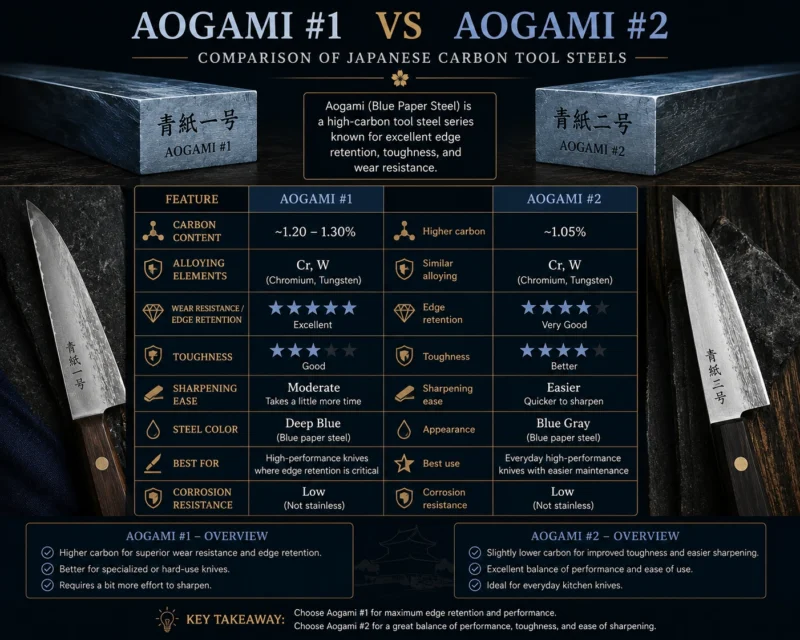
Aogami #1 vs Aogami #2
The difference between Aogami #1 and Aogami #2 is relatively straightforward.
Aogami #1 contains more carbon and generally more tungsten.
| Characteristic | Aogami #1 | Aogami #2 |
| Carbon | Higher | Lower |
| Tungsten | Higher | Lower |
| Potential hardness | Higher | High |
| Edge retention | Higher | Excellent |
| Sharpening | More demanding | Easier |
| Forgiveness | Lower | Higher |
| General use | Performance-oriented | All-purpose |
| Typical user | Experienced | Beginner to advanced |
Aogami #2 is therefore not simply a cheaper or inferior version of Aogami #1.
It is a different balance.
For someone who sharpens frequently and values ease of maintenance, Aogami #2 can actually be the better choice.
For someone who wants longer edge life and does not mind spending more time sharpening, Aogami #1 may be preferable.
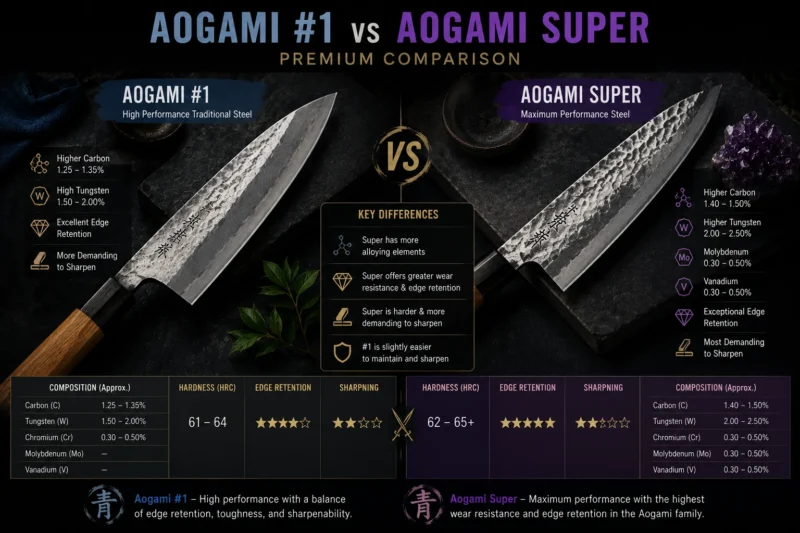
Aogami #1 vs Aogami Super
Aogami #1 and Aogami Super are closer in concept.
Both are high-carbon, high-performance Blue steels.
But Aogami Super pushes the composition further.
It contains more carbon and tungsten than Aogami #1 and adds molybdenum and vanadium.
| Characteristic | Aogami #1 | Aogami Super |
| Carbon | 1.25–1.35% | 1.40–1.50% |
| Tungsten | 1.50–2.00% | 2.00–2.50% |
| Molybdenum | Not specified | 0.30–0.50% |
| Vanadium | Not specified | 0.30–0.50% |
| Edge retention | Excellent | Exceptional |
| Wear resistance | Very high | Extremely high |
| Sharpening | Demanding | More demanding |
| Maintenance | High | High |
| Performance focus | Traditional high-performance | Maximum performance |
Aogami Super is therefore the obvious choice if maximum edge retention and wear resistance are the primary objectives.
But that does not automatically make it the best steel for every person.
Aogami #2 vs Aogami Super
This is perhaps the biggest practical difference within the Aogami family.
Aogami #2 emphasizes balance.
Aogami Super emphasizes maximum performance.
Aogami #2 contains approximately 1.05–1.15% carbon, while Aogami Super contains approximately 1.40–1.50%. The Super grade also has substantially more tungsten and includes molybdenum and vanadium.
The practical difference can be summarized like this:
Aogami #2 = easier, balanced, versatile.
Aogami Super = harder, more wear-resistant, longer edge retention, more demanding.
For someone who cooks at home and enjoys sharpening, Aogami #2 may actually be more enjoyable.
For someone who wants a premium knife with very long-lasting edge performance, Aogami Super becomes more attractive.
Which Aogami Steel Is Sharpest?
This question needs a little clarification.
There is no meaningful rule that says:
Aogami Super is sharper than Aogami #1, which is sharper than Aogami #2.
All three can achieve extremely sharp edges.
Sharpness depends heavily on:
- Edge geometry
- Edge angle
- Grinding quality
- Heat treatment
- Sharpening technique
- Stone quality
- Burr removal
- Final edge finishing
A well-sharpened Aogami #2 knife can easily feel sharper than a poorly sharpened Aogami Super knife.
The advantage of Aogami Super is not that it automatically becomes sharper.
Its major advantage is its ability to maintain a refined edge for longer under suitable conditions.
Check Our Guide All Kinds of Knife Sharpening Tools
Which Aogami Steel Has the Best Edge Retention?
If all other factors are reasonably comparable, the general ranking is:
Aogami Super > Aogami #1 > Aogami #2
in edge-retention and wear-resistance potential.
This follows the increasing carbon and alloy content of the three grades.
Aogami #2 still offers excellent edge retention, but Aogami #1 improves on it, while Aogami Super is designed to push performance even further.
This ranking should not be interpreted as a laboratory guarantee for every knife.
A knife’s geometry and heat treatment can easily alter the practical result.
Check Our Guide Edge Retention Explained: 10 Factors What Makes a Knife Stay Sharp Longer
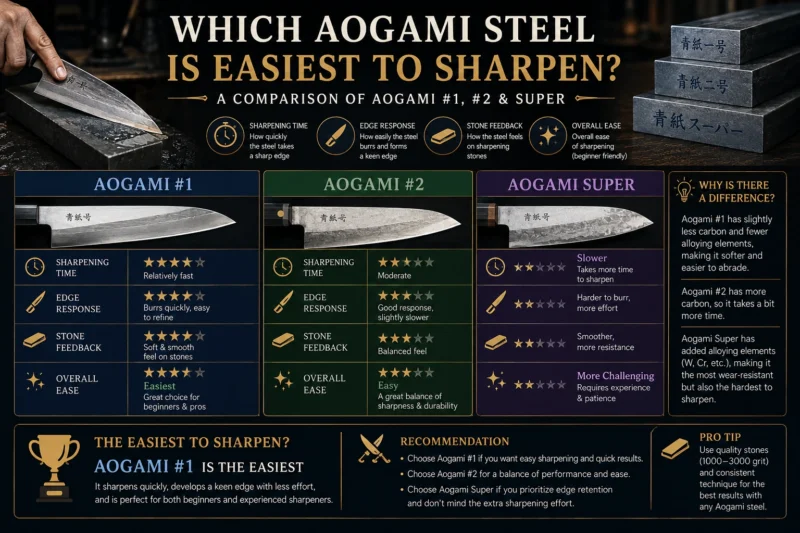
Which Aogami Steel Is Easiest to Sharpen?
The general order is:
Aogami #1 → Aogami #2 → Aogami Super
from easier to more demanding.
Aogami #1 is generally the most approachable.
Aogami #2 requires somewhat more effort.
Aogami Super can require the most patience because of its high hardness and wear resistance.
However, Aogami Super is not impossible to sharpen.
A quality waterstone and appropriate technique are normally sufficient for routine sharpening.
The important point is that greater wear resistance works both ways.
The same characteristics that help an edge resist wear during cutting can also mean that the stone has more work to do when you are removing steel.
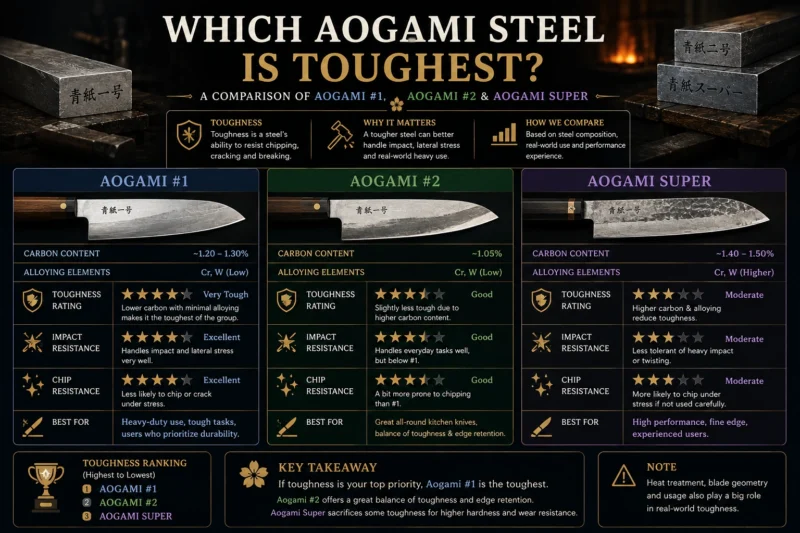
Which Aogami Steel Is Toughest?
This question is more complicated.
Aogami #1 is generally considered the more forgiving of the three, especially when comparing knives at similar hardness and geometry.
Aogami #2 generally trades some forgiveness for higher hardness and edge retention.
Aogami Super is highly alloyed and can offer excellent performance, but its very high hardness means it still needs careful handling.
It is therefore better to think in terms of balance, rather than declaring one grade universally toughest.
The actual toughness of a knife depends on:
- Heat treatment
- Hardness
- Grain structure
- Blade thickness
- Edge thickness
- Geometry
- Tempering
A thick, well-treated Aogami Super blade can behave very differently from an extremely thin Aogami Super laser.
Check Our Guide Wear Resistance vs Toughness: Understanding the Most Important Knife Steel Trade-Off
Are Aogami #1, #2, and Super Stainless?
No.
This is one of the most important facts to understand.
None of the three Aogami grades should be considered stainless steel.
Their chromium content is much too low to provide stainless corrosion resistance.
Aogami Super, despite containing chromium, is still a reactive carbon steel.
This means the exposed edge can develop a patina and can rust if it is left wet or exposed to corrosive substances.
The chromium in Aogami should not be confused with the much higher chromium levels used in stainless knife steels.
Aogami Patina
A patina is a controlled surface oxidation that can develop on carbon-steel knives.
It is not the same thing as active red rust.
Aogami knives commonly develop a gray, blue, purple, or darker patina depending on the steel, foods cut, humidity, and maintenance routine.
Many owners actually appreciate the appearance because it makes the knife visually unique.
A patina can also reduce the tendency of the freshly exposed surface to react as aggressively with certain foods.
However, a patina does not make an Aogami knife stainless.
The knife should still be cleaned and dried after use.
How to Prevent Rust on Aogami Knives
Maintaining an Aogami knife is straightforward if you develop a consistent routine.
After using the knife:
- Rinse or wipe the blade as appropriate.
- Dry it completely.
- Do not leave the knife sitting in water.
- Avoid prolonged contact with acidic foods.
- Store the knife in a dry environment.
- Use a suitable protective oil for longer storage if appropriate.
Never put a carbon-steel Japanese knife away while it is still wet.
This simple habit prevents many corrosion problems.
Aogami Steel and Food Reactivity
Fresh Aogami steel can react noticeably with acidic foods.
Foods such as:
- Tomatoes
- Citrus
- Onions
- Apples
- Vinegar
- Certain meats and fish
can accelerate patina formation.
The reaction is usually strongest when the blade is new and completely unpatinated.
Once a stable patina has formed, the behavior may become more predictable.
Some users deliberately allow a natural patina to develop rather than attempting to keep the blade bright and polished.
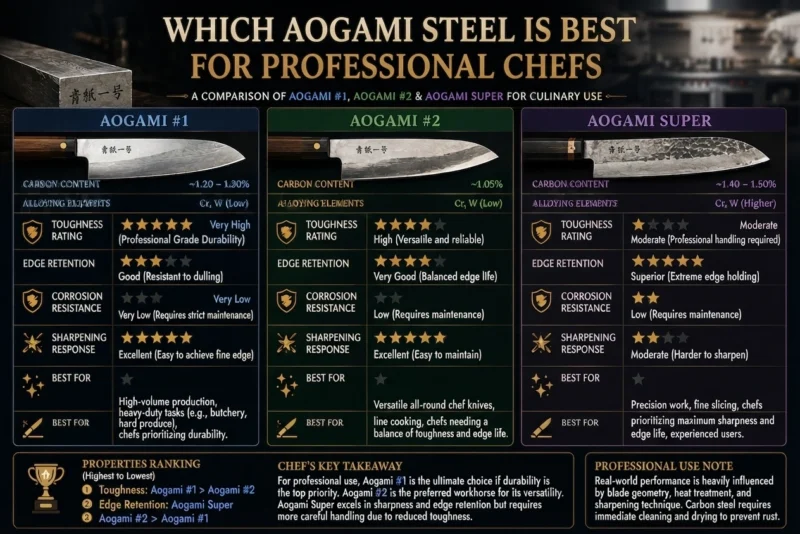
Which Aogami Steel Is Best for Professional Chefs?
There is no universal answer.
A professional chef who wants maximum edge retention may prefer Aogami Super.
A chef who wants an excellent balance of cutting performance and easy maintenance may prefer Aogami #2.
A chef who wants a premium traditional carbon steel between those two extremes may prefer Aogami #1.
The correct choice depends on the workload and sharpening routine.
A chef who sharpens every day may value sharpening speed more than maximum wear resistance.
A chef who spends many hours performing repetitive prep may place a higher value on edge longevity.
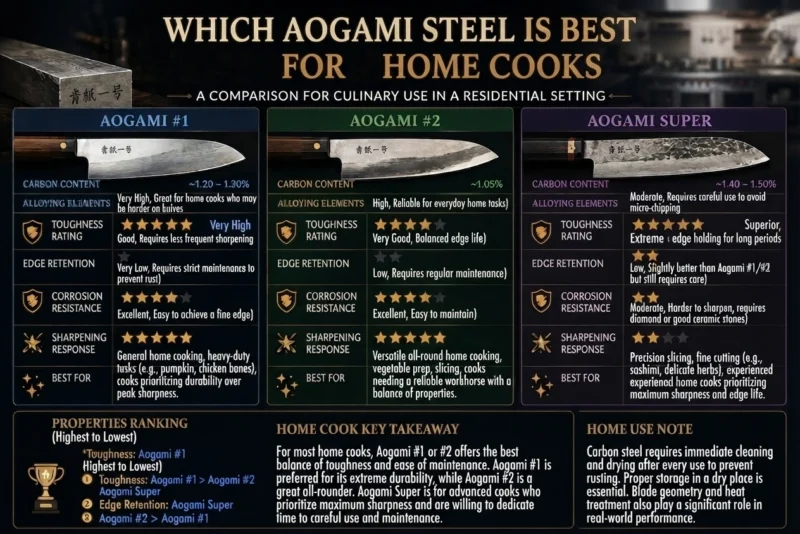
Which Aogami Steel Is Best for Home Cooks?
For many home cooks, Aogami #2 is the most practical choice.
It provides excellent cutting performance without pushing the steel to the extreme.
It is also a good choice for someone learning how to maintain a carbon-steel knife.
Aogami #1 is an excellent upgrade for users who already understand carbon-steel care and want greater edge retention.
Aogami Super is best suited to enthusiasts and experienced users who specifically want its performance characteristics and are willing to accept the maintenance requirements.
Which Aogami Steel Is Best for Beginners?
If you are completely new to Japanese carbon steel, Aogami #2 is usually the easiest recommendation.
It teaches the important habits of carbon-steel ownership:
- Keep the blade dry.
- Learn proper sharpening.
- Avoid twisting the edge.
- Understand patina.
- Use the knife for appropriate cutting tasks.
Once you are comfortable with those requirements, moving to Aogami #1 or Aogami Super becomes much easier.
Aogami Steel and Knife Geometry
Steel is only one part of knife performance.
This is especially important with Japanese knives.
Aogami Super is often associated with very thin, high-performance knives, but the steel itself does not determine blade thickness.
A maker can produce a thick Aogami Super knife or a very thin Aogami Super knife.
The same applies to Aogami #1 and #2.
Geometry affects cutting performance enormously.
A thin edge can cut with very little resistance, but it may also be more vulnerable to chipping or deformation.
A thicker edge may sacrifice some cutting efficiency but offer greater durability.
Therefore, when buying an Aogami knife, never look at the steel designation alone.
Look at:
- Blade thickness
- Edge geometry
- Grind
- Heat treatment
- Hardness
- Maker reputation
- Intended use
Does Aogami Super Make a Better Knife?
Not necessarily.
Aogami Super is a more advanced steel in terms of alloy composition and potential wear resistance.
But “more advanced” does not automatically mean “better for everyone.”
Consider two knives:
Knife A: excellent Aogami #2, outstanding heat treatment, excellent geometry.
Knife B: mediocre Aogami Super, poor heat treatment, poor geometry.
Knife A can easily provide the better cutting experience.
This is why experienced knife buyers often evaluate the maker and construction rather than purchasing purely based on the steel name.
Aogami #1 vs Aogami #2 vs Aogami Super: Sharpening
All three steels can be maintained with traditional Japanese waterstones.
For routine maintenance, the exact stone progression depends on the condition of the edge.
A practical sharpening progression might involve:
- A medium stone for normal sharpening
- A finer stone for refinement
- An optional finishing stone for a more polished edge
The exact grit numbers are less important than using an appropriate stone and technique.
A very worn or damaged knife may require a coarser stone.
A knife that only needs a light touch-up may require a much finer stone.
The most important skill is maintaining a consistent angle and removing the burr properly.
Do You Need Diamond Stones for Aogami Super?
Not necessarily.
Aogami Super can be sharpened on quality waterstones.
Diamond abrasives can be useful because they cut highly wear-resistant steels efficiently, but they are not mandatory for ordinary maintenance.
For many enthusiasts, traditional Japanese waterstones remain the preferred choice because they provide excellent feedback and allow precise edge refinement.
The key is to use a stone appropriate to the task rather than assuming that the hardest steel automatically requires diamond.
Aogami Steel and Chipping
Aogami knives can chip if abused.
This is especially relevant to very hard knives with thin edges.
Avoid using an Aogami knife for:
- Bones
- Frozen food
- Hard shells
- Prying
- Twisting cuts
- Chopping through hard objects
- Cutting on glass or stone boards
Use a suitable cutting board and let the knife perform the cutting motion it was designed for.
A very thin Japanese carbon-steel edge can provide outstanding cutting performance, but it should not be treated like a heavy-duty cleaver.
Aogami #1 vs Aogami #2 vs Aogami Super for Different Knives
Different knife styles can benefit from different Aogami grades.
Gyuto
All three grades can work extremely well in gyutos.
Aogami #2 is a versatile choice.
Aogami #1 is attractive for users who want increased edge retention.
Aogami Super is popular for premium high-performance gyutos where long edge life is a priority.
Check Our Guide Japanese Gyuto Knife Guide
Santoku
Aogami #2 is an excellent option for a general-purpose santoku.
Aogami Super can be attractive for enthusiasts who want maximum edge performance.
Nakiri
All three can perform exceptionally well in vegetable-focused knives.
Aogami #2 provides a balanced option, while Aogami #1 and Super can offer longer-lasting edges.
Yanagiba
Aogami #1 and Aogami Super can be particularly attractive in high-performance single-bevel knives.
However, sharpening geometry is extremely important with yanagibas.
The steel cannot compensate for incorrect sharpening technique.
Petty
Aogami #2 can be particularly practical because small knives are frequently used for detailed work and are often easy to touch up.
Aogami Super is an excellent premium option for enthusiasts who want maximum edge retention.
Aogami Steel vs Shirogami
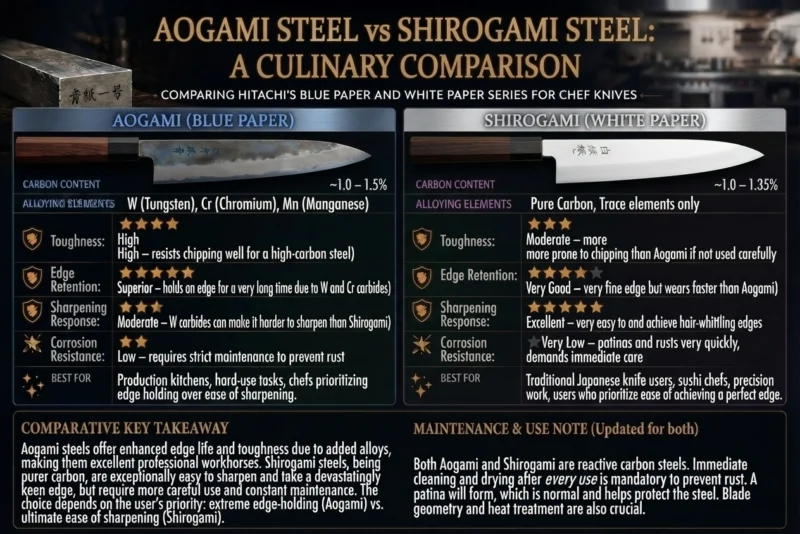
Aogami and Shirogami are closely related traditional Japanese steel families, but they have different alloying philosophies.
Shirogami, or White Paper Steel, is known for its relatively simple composition and excellent sharpening response.
Aogami adds alloying elements such as tungsten and chromium.
This generally increases wear resistance and edge retention but makes the steel more complex.
A simplified comparison is:
Shirogami: maximum simplicity, excellent sharpening feel.
Aogami: greater wear resistance and edge retention.
Within Aogami, the progression is approximately:
#2 → #1 → Super
from more balanced to more performance-oriented.
Check Our Guide Shirogami #1 Steel
Aogami vs Stainless Steel
The biggest difference between Aogami and stainless steel is maintenance.
A stainless knife is much more resistant to corrosion.
An Aogami knife requires more attention.
Why would someone choose Aogami?
Because the appeal is not simply corrosion resistance.
A properly made Aogami knife can offer:
- Excellent edge stability
- Very high hardness
- Outstanding sharpening potential
- Excellent edge retention
- Traditional Japanese knife character
- A distinctive patina
For enthusiasts, these qualities can be worth the additional maintenance.
Is Aogami Super Better Than VG-10?
It depends on what you mean by better.
Aogami Super generally offers greater potential for hardness and edge retention, but VG-10 is dramatically easier to maintain because it is stainless.
VG-10 is therefore better for someone who wants corrosion resistance and low maintenance.
Aogami Super is more attractive to someone who prioritizes traditional carbon-steel performance and does not mind caring for the blade.
This is an important recurring lesson in knife steel comparisons:
There is no universally best knife steel.
There is only the best steel for a particular user.
Check Our Guide VG10 Steel Review: Pros, Cons, Edge Retention, Toughness & Real-World Performance
Aogami #1 vs Aogami #2 vs Aogami Super: Price
Aogami Super knives are often positioned at the premium end of the Japanese knife market.
Aogami #1 is also a premium material.
Aogami #2 can offer an excellent performance-to-price balance.
But steel grade alone does not determine price.
The final price of a Japanese knife also reflects:
- Blacksmith
- Grinding
- Handle
- Cladding
- Finishing
- Polishing
- Brand
- Production volume
- Labor
- Retailer
A well-made Aogami #2 knife can therefore cost more than a basic Aogami Super knife.
Common Misconceptions About Aogami
Myth 1: Aogami means stainless
False.
Aogami is reactive carbon steel.
Myth 2: Aogami Super is automatically sharper
Not necessarily.
All three grades can be sharpened to extremely high levels.
Myth 3: Higher HRC always means a better knife
False.
Hardness is only one characteristic.
Myth 4: Aogami #2 is a low-quality steel
False.
Aogami #2 is a high-performance Japanese carbon steel.
Myth 5: Aogami Super never chips
False.
A very hard, thin edge can chip if misused.
Myth 6: Aogami knives are difficult to maintain
They require more attention than stainless knives, but the maintenance routine itself is simple.
Clean, dry, and store the knife correctly.
Myth 7: Steel determines everything
False.
Heat treatment and geometry are extremely important.
How Heat Treatment Changes Aogami Performance
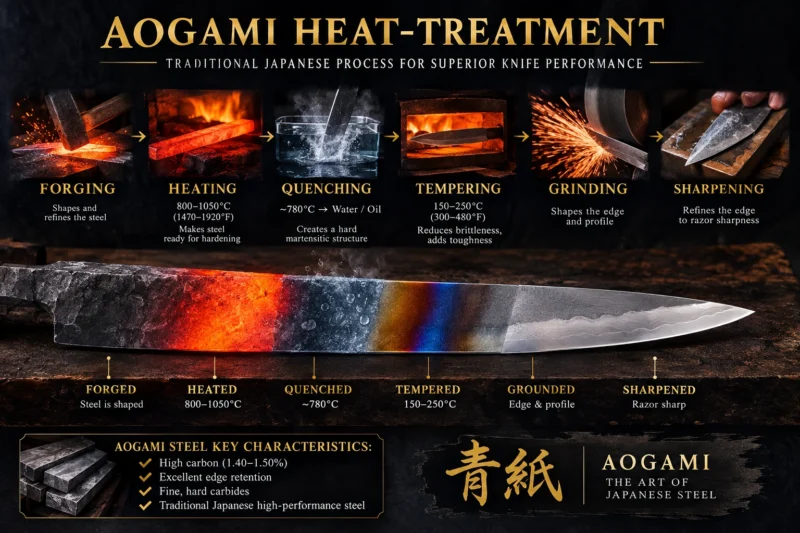
Two knives made from the same steel can behave differently.
This is because steel composition is only the beginning.
Heat treatment controls the microstructure and final hardness of the blade.
Important variables include:
- Austenitizing temperature
- Quenching
- Tempering
- Cooling rate
- Final hardness
- Grain structure
A skilled maker can produce an excellent knife from Aogami #2.
Another maker can produce an excellent Aogami Super knife.
The quality of the heat treatment can matter more than the small differences in chemical composition.
This is why comparing steel grades without considering the maker can produce misleading conclusions.
Check Our Guide Steel Heat Treatment Explained
Aogami Steel for Edge Geometry
Aogami’s ability to reach high hardness makes it particularly attractive for thin cutting edges.
A thin edge reduces cutting resistance.
This is one reason Japanese knives can feel so different from heavy Western-style kitchen knives.
However, thinness comes with a trade-off.
The thinner the edge becomes, the less material supports the edge.
If the steel is very hard, the edge can become susceptible to chipping under lateral or impact forces.
Therefore, high-performance Aogami knives should be used with appropriate technique.
How to Choose Between Aogami #2, #1, and Super
Ask yourself five questions.
1. How often do you sharpen?
If you enjoy frequent sharpening, Aogami #2 may be ideal.
If you want longer periods between full sharpening sessions, Aogami #1 or Super may be preferable.
2. How much maintenance are you willing to do?
All three require carbon-steel care.
If you want minimal maintenance, stainless steel may be a better choice.
3. How experienced are you?
Beginners often find Aogami #2 easier to live with.
Experienced users may appreciate the additional performance of #1 or Super.
4. What do you cut?
For normal vegetables, meat, fish, and other kitchen tasks, all three can work beautifully.
For heavy-duty work, none should be treated as a substitute for a tougher, more impact-resistant knife.
5. Do you want maximum performance?
If maximum traditional Aogami edge retention is the priority, Aogami Super is the obvious candidate.
Final Ranking
If we simplify the three grades:
Best balance: Aogami #2
Aogami #2 offers an excellent combination of sharpness, edge retention, sharpening response, and practicality.
Best traditional high-performance option: Aogami #1
Aogami #1 increases carbon and tungsten content and offers higher edge-retention potential while retaining the character of traditional Blue steel.
Best maximum-performance option: Aogami Super
Aogami Super has the highest carbon and tungsten levels of the three and adds molybdenum and vanadium. It offers exceptional wear resistance and edge-retention potential.
Aogami #1 vs Aogami #2 vs Aogami Super: Final Verdict
There is no single winner for every knife user.
If you want the best balance, choose Aogami #2.
If you want more edge retention and higher performance than #2, choose Aogami #1.
If you want maximum edge retention and wear resistance within the traditional Aogami family, choose Aogami Super.
The overall progression can be summarized as:
Aogami #2 → balanced and practical
Aogami #1 → harder and more wear-resistant
Aogami Super → maximum performance and edge retention
But remember that the steel name is only part of the equation.
A well-designed knife with excellent heat treatment and geometry can outperform a more expensive knife made from a theoretically superior steel.
For that reason, when choosing an Aogami knife, consider the steel, maker, heat treatment, geometry, intended use, and your own sharpening habits together.
That is the best way to choose between Aogami #1, Aogami #2, and Aogami Super.
Frequently Asked Questions
Is Aogami #1 better than Aogami #2?
Aogami #1 generally offers higher carbon and tungsten content and greater edge-retention potential. Aogami #2 is generally more balanced and easier to maintain. Neither is universally better.
Is Aogami Super better than Aogami #1?
For maximum edge retention and wear resistance, Aogami Super generally has the advantage. It contains more carbon and tungsten and adds molybdenum and vanadium. However, Aogami #1 can offer an excellent balance for users who prefer its traditional sharpening characteristics.
Which Aogami steel is easiest to sharpen?
Aogami #2 is generally the easiest of the three to sharpen, followed by Aogami #1 and then Aogami Super.
Which Aogami steel holds an edge the longest?
In general, Aogami Super has the greatest edge-retention potential, followed by Aogami #1 and Aogami #2.
Does Aogami Super rust?
Yes. Aogami Super is reactive carbon steel, not stainless steel. It should be cleaned and dried after use.
Is Aogami #2 good for beginners?
Yes. Aogami #2 is often the most approachable grade for someone who wants to learn how to use and maintain a Japanese carbon-steel knife.
Can Aogami Super be sharpened on waterstones?
Yes. Quality waterstones can be used to sharpen Aogami Super. Its higher wear resistance may simply require more time and an appropriate abrasive.
Which Aogami steel is best for a professional chef?
It depends on the chef’s priorities. Aogami Super is attractive when maximum edge retention is important, while Aogami #2 can be preferable when easy maintenance and frequent sharpening are more important.
Does higher carbon automatically mean better steel?
No. Higher carbon can increase hardness and edge-retention potential, but it can also increase the demands placed on heat treatment and knife use.
What is the main difference between Aogami #1 and Aogami #2?
The primary difference is their composition. Aogami #1 contains more carbon and tungsten, giving it greater potential for hardness and wear resistance.
What makes Aogami Super different?
Aogami Super combines higher carbon and tungsten levels with additions of molybdenum and vanadium. This gives it a distinctive combination of high hardness and wear resistance.
Are Aogami knives suitable for home kitchens?
Yes. They can be excellent home-kitchen knives as long as the owner understands that they require more corrosion care than stainless steel knives.
Conclusion
Aogami #1, Aogami #2, and Aogami Super represent three different approaches to high-performance traditional Japanese carbon steel.
Aogami #2 is the balanced choice.
Aogami #1 moves toward greater hardness and edge retention.
Aogami Super takes the performance concept further with higher carbon and tungsten plus molybdenum and vanadium.
The best choice is ultimately the one that matches your priorities.
If you value easy sharpening and balanced performance, Aogami #2 is an excellent choice.
If you want a harder, more wear-resistant traditional Blue steel, Aogami #1 is worth considering.
If maximum edge retention is your priority and you are comfortable with demanding maintenance and sharpening, Aogami Super is one of the most compelling traditional Japanese carbon steels available.
Most importantly, remember that steel is only one part of a knife. Heat treatment, geometry, grinding, edge thickness, sharpening, and proper use can have just as much influence on your experience.
That is why the best Aogami knife is not necessarily the one with the most expensive steel. It is the knife in which the steel, heat treatment, geometry, craftsmanship, and intended use work together.
This article is for independent informational purposes only and is not affiliated with, sponsored by, or endorsed by any steel manufacturer. All product names, trademarks, and registered trademarks are the property of their respective owners.