GIN-1 Steel
An Independent Guide
When people talk about Japanese knife steels, the conversation usually turns to famous names such as VG-10, Shirogami, Aogami, or some of the newer powder-metallurgy steels.
But there is another Japanese steel that deserves attention.
GIN-1 steel is an older stainless cutlery steel developed within Japan’s Yasugi Specialty Steel tradition. It was designed to offer something that knife makers and users have always wanted: a practical combination of corrosion resistance, hardness, edge performance, and ease of maintenance.
It is not a modern “super steel.” It does not try to achieve extreme wear resistance or extraordinary hardness. Instead, its appeal comes from balance.
That makes GIN-1 particularly interesting for kitchen knives, scissors, utility blades, and other cutting tools.
The steel contains approximately 0.80–0.90% carbon and 15–17% chromium, with smaller additions of manganese, silicon, and molybdenum. The manufacturer’s current specification also lists a hardening hardness of at least 57 HRC.
So what does that chemistry actually mean when you put it into a knife?
How does GIN-1 behave on a sharpening stone?
Does it hold an edge well?
Is it truly stainless?
Is it suitable for Japanese kitchen knives?
And is an older steel like GIN-1 still worth considering when so many modern alternatives exist?
Let’s take a detailed look.
What Is GIN-1 Steel?
GIN-1 is a Japanese stainless steel developed for cutting applications as part of the Yasugi Specialty Steel tradition.
It is sometimes referred to by several related names, including:
- GIN-1
- GIN1
- Gingami 1
- Gin 1
- Silver 1
- Silver #1
- G-1
- G-2
The terminology can be confusing because Japanese specialty steels have historically been identified using several naming systems.
The “Silver” designation does not mean that silver is added to the steel.
Instead, it refers to the traditional Japanese naming system used for certain grades of Yasugi Specialty Steel.
GIN-1 belongs to the stainless side of this family.
Its chemistry is relatively straightforward compared with modern powder steels. It does not contain large quantities of vanadium, niobium, tungsten, or other alloying elements commonly associated with today’s high-wear knife steels.
That simplicity is actually one of its strengths.
GIN-1 was designed to be a practical cutting steel rather than an extreme-performance alloy.
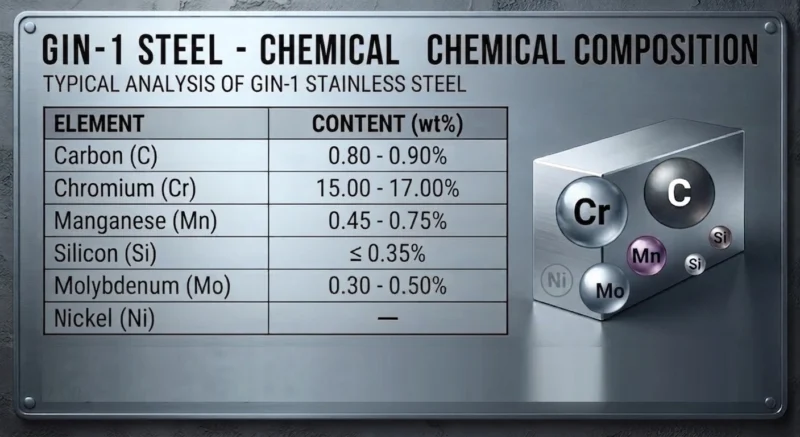
GIN-1 Chemical Composition
The chemical composition tells us much about why GIN-1 behaves the way it does.
The current published specification gives approximately:
| Element | GIN-1 Composition |
|---|---|
| Carbon (C) | 0.80–0.90% |
| Silicon (Si) | ≤0.35% |
| Manganese (Mn) | 0.45–0.75% |
| Chromium (Cr) | 15.00–17.00% |
| Molybdenum (Mo) | 0.30–0.50% |
| Phosphorus (P) | ≤0.030% |
| Sulfur (S) | ≤0.020% |
The specification does not list significant intentional additions of vanadium, tungsten, nickel, or cobalt.
At first glance, the composition may not look particularly exciting.
There is no enormous carbon percentage.
There is no huge vanadium addition.
There is no complex powder-metallurgy chemistry.
But every element has a purpose.
The carbon provides the foundation for hardness.
Chromium gives the steel its stainless character.
Molybdenum contributes to the overall stainless and hardening characteristics.
Manganese and silicon support the steel’s metallurgical behavior.
The result is a balanced stainless cutlery alloy.
Check Our Guide The Secret Code on the Blade
Carbon in GIN-1
Carbon is one of the most important elements in knife steel.
GIN-1 contains approximately 0.80–0.90% carbon.
That is a substantial amount for a stainless steel.
Carbon allows the steel to form a hard martensitic structure during heat treatment. Without enough carbon, a stainless steel may be highly corrosion resistant but unable to support the hardness required for a good knife edge.
GIN-1’s carbon content therefore plays a central role in its cutting performance.
It gives the steel the ability to become significantly harder than basic low-carbon stainless steels.
At the same time, the carbon level is not so extreme that the steel becomes dominated by enormous quantities of hard carbides.
That contributes to its relatively manageable sharpening behavior.
Chromium: The Stainless Element
The most obvious feature of GIN-1 is its high chromium content.
The specification gives approximately 15–17% chromium.
Chromium is what allows stainless steel to form a protective passive layer on the surface.
This microscopic chromium-rich oxide layer helps prevent oxygen and moisture from attacking the underlying steel.
That is why a GIN-1 knife can withstand normal kitchen conditions much better than a traditional carbon-steel blade.
However, it is important to understand what “stainless” actually means.
Stainless does not mean impossible to rust.
Even highly corrosion-resistant stainless steels can corrode under aggressive conditions.
Saltwater, acids, prolonged moisture, chemicals, and poor storage can eventually cause problems.
GIN-1 should therefore be considered strongly corrosion resistant, not completely corrosion-proof.
Molybdenum in GIN-1
GIN-1 contains approximately 0.30–0.50% molybdenum.
That is not a huge amount compared with some modern stainless steels, but it is still significant.
Molybdenum contributes to several important metallurgical properties, including hardenability and resistance to certain forms of corrosion.
In GIN-1, molybdenum is part of the carefully balanced alloy design.
The steel does not depend on a huge quantity of molybdenum to achieve its performance.
Instead, it combines a moderate molybdenum addition with relatively high chromium and useful carbon content.
This is another example of the philosophy behind GIN-1:
balance rather than extremes.
Manganese and Silicon
Manganese is specified at approximately 0.45–0.75%, while silicon is limited to approximately 0.35%.
These elements receive less attention in knife discussions because carbon and chromium are much more obvious.
But they still matter.
Manganese contributes to hardenability and influences the behavior of the steel during heat treatment.
Silicon is commonly used in steelmaking as a deoxidizer and can influence strength and other properties.
The important lesson is that knife steel performance comes from the entire composition.
It is rarely correct to look at one element and assume that it explains everything.
Why GIN-1 Is Stainless
A useful way to understand GIN-1 is to look at the relationship between carbon and chromium.
The steel contains enough carbon to become hard enough for cutting tools.
At the same time, it contains a large amount of chromium.
This is a difficult metallurgical balancing act.
Increasing carbon can improve hardness and edge performance, but it can also tie up chromium in carbides.
If too much chromium becomes locked into carbides, less chromium remains available in the matrix to provide corrosion resistance.
GIN-1 manages this balance relatively conservatively.
The result is a steel with strong stainless behavior without requiring an extremely complicated alloy system.
Check Our Guide Carbon Steel vs Stainless Steel Knives: Which Is Better
GIN-1 and Yasugi Specialty Steel
GIN-1 belongs to the broader tradition of Japanese specialty steels associated with Yasugi.
This tradition has a long connection with cutting tools.
Japanese steelmakers developed different grades for different applications, ranging from traditional carbon steels to stainless cutlery alloys.
GIN-1 represents an important stage in that development.
Traditional Japanese blades were famous for their ability to take extremely sharp edges, but many traditional carbon steels required careful maintenance.
The development of stainless cutlery steels made it possible to combine much of the precision expected from Japanese blades with considerably greater resistance to corrosion.
GIN-1 is part of that story.
It represents a practical approach to stainless knife steel rather than an attempt to create the most extreme alloy possible.
GIN-1 Hardness
Hardness is one of the most frequently discussed characteristics of knife steel.
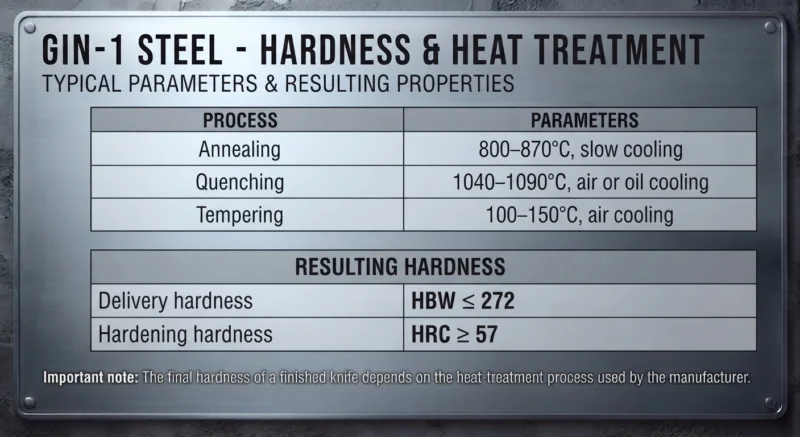
The current manufacturer specification lists a hardening hardness of 57 HRC or higher for GIN-1.
However, there is an important distinction between the steel’s specification and the hardness of an individual finished knife.
A steel does not automatically have one fixed HRC value.
The final hardness depends on:
- heat treatment
- quenching
- tempering
- blade thickness
- manufacturing process
- intended application
A kitchen knife may be heat treated differently from another type of cutting tool.
Therefore, when someone says that GIN-1 is “57 HRC” or “58 HRC,” that should not be interpreted as an absolute value for every GIN-1 blade.
The heat treatment matters enormously.
Check Our Guide What Is HRC? Understanding Rockwell Hardness
Why Heat Treatment Is So Important
You can give two knife makers identical pieces of GIN-1 steel.
They can produce two completely different knives.
Why?
Because steel chemistry is only the beginning.
Heat treatment determines the microstructure.
The manufacturer provides recommended heat-treatment conditions for GIN-1, including a hardening temperature range around 1,040–1,090°C and tempering around 100–150°C.
A professional maker uses these parameters as part of the production process.
The objective is not simply to make the blade “as hard as possible.”
The objective is to create the desired combination of hardness, toughness, edge stability, and corrosion resistance.
That is why a well-treated GIN-1 knife can perform much better than the steel’s reputation on a simple comparison chart might suggest.
Check Our Guide Different Heat Treatment Methods Explained
GIN-1 Edge Retention
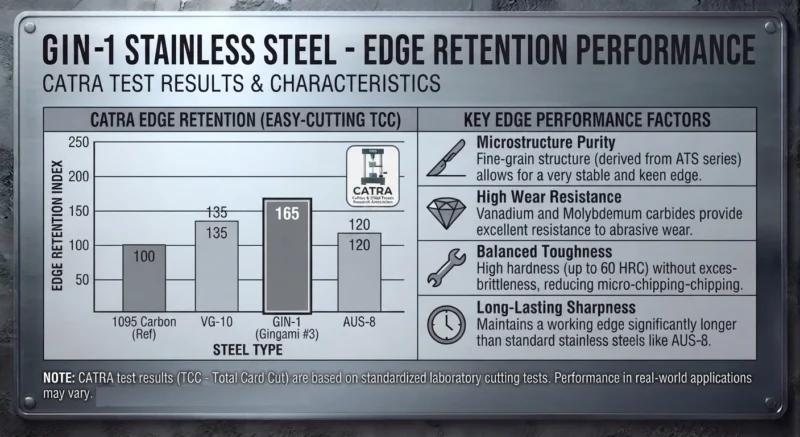
Edge retention is one of GIN-1’s more balanced characteristics.
It can hold a useful edge for a reasonable amount of time, but it was never designed to compete with modern extreme wear-resistant steels.
This makes sense when you examine its chemistry.
GIN-1 does not contain large quantities of vanadium or other strong carbide-forming elements used in many modern high-wear alloys.
That means it does not have the enormous carbide population that allows some modern steels to maintain a cutting edge for exceptionally long periods.
But there is another side to this.
The same characteristic that limits extreme wear resistance can make the steel easier to sharpen.
And for many knife owners, that is a worthwhile trade.
Check Our Guide Edge Retention Explained
What Actually Determines Edge Retention?
It is tempting to think:
Steel X holds an edge for 30% longer than Steel Y.
Real-world knife performance is rarely that simple.
Edge retention depends on:
Hardness
A harder edge generally resists deformation better.
Geometry
A thin edge can cut more efficiently but may be more vulnerable to damage.
Edge angle
A very acute angle may cut beautifully but can be less robust.
Cutting material
Wood, cardboard, meat, vegetables, rope, plastic, and abrasive materials wear an edge differently.
Technique
Twisting and lateral force can damage an edge even when the steel itself has good wear resistance.
Heat treatment
Two knives made from the same steel can behave differently if treated differently.
For this reason, GIN-1 should be evaluated as a complete blade system rather than as a chemical formula alone.
Is GIN-1 Easy to Sharpen?
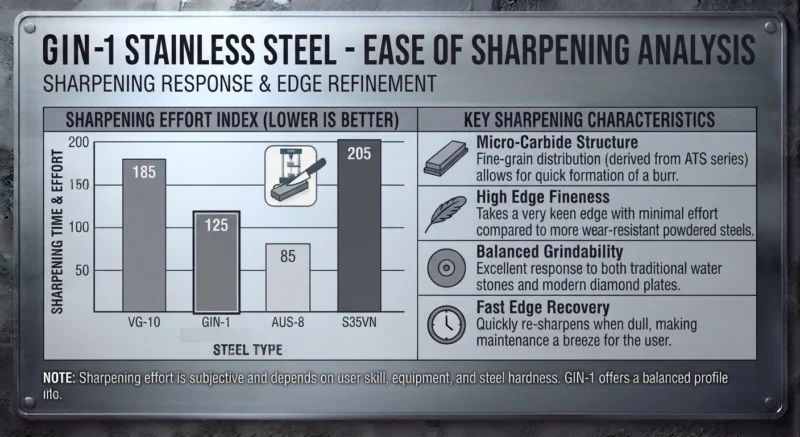
One of GIN-1’s most attractive qualities is its sharpening behavior.
For most users, it is relatively straightforward to sharpen using conventional abrasives.
Suitable options include:
- waterstones
- ceramic stones
- oil stones
- diamond stones
- guided sharpening systems
You do not need an elaborate sharpening setup.
A quality medium-grit stone is sufficient for normal maintenance.
A finer stone can then be used to refine the edge.
This is particularly useful for kitchen knives because frequent light sharpening is often better than waiting until a blade becomes completely dull.
Why Sharpenability Matters
People often focus heavily on edge retention.
But consider what happens when the knife finally becomes dull.
You have two choices:
- Sharpen it.
- Keep using a dull knife.
The second option is obviously undesirable.
Therefore, the real question is not only:
How long does the steel stay sharp?
It is also:
How easy is it to make the steel sharp again?
This is where GIN-1 becomes attractive.
Its moderate wear resistance means that conventional sharpening equipment can remove material efficiently.
For someone who sharpens regularly, this can be more enjoyable than using an extremely wear-resistant steel.
Sharpening a GIN-1 Kitchen Knife
A simple sharpening progression works well for most GIN-1 kitchen knives.
A medium stone around 800–1,200 grit can establish or restore the edge.
A finer stone around 2,000–4,000 grit can refine the edge.
If you enjoy highly polished edges, you can continue to a finer stone.
But there is no requirement to create a mirror finish.
In many kitchen applications, a slightly toothier edge can actually be extremely effective.
The best finishing grit depends on what you cut and how you use the knife.
Check Our Guide All Kinds of Knife Sharpening Tools
GIN-1 and Corrosion Resistance
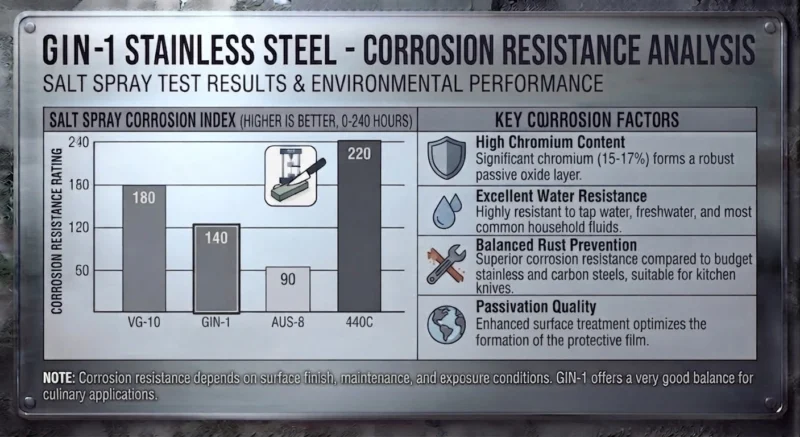
Corrosion resistance is one of the reasons GIN-1 remains attractive.
With approximately 15–17% chromium, the steel provides strong protection against ordinary corrosion.
For kitchen use, this is extremely convenient.
You can cut:
- tomatoes
- citrus
- onions
- meat
- vegetables
- fruit
- fish
without treating the blade like a delicate carbon-steel instrument.
That does not mean you should leave the knife wet.
Good stainless steel still benefits from good care.
But the margin for error is much larger.
Can GIN-1 Rust?
Yes, although normal conditions are unlikely to produce rapid corrosion.
“Stainless” is a description of corrosion resistance, not immunity.
Problems become more likely when a blade is exposed to:
- salt
- seawater
- acidic food residue
- chemicals
- prolonged moisture
- high humidity combined with contamination
A GIN-1 knife should therefore be washed and dried after use.
For long-term storage, keeping the blade clean and dry is sufficient in most environments.
GIN-1 in Kitchen Knives
GIN-1 is particularly well suited to kitchen applications.
The manufacturer specifically lists kitchen knives among its applications.
That makes sense from a practical perspective.
A kitchen knife needs:
- corrosion resistance
- a sharp edge
- reasonable edge stability
- useful hardness
- easy maintenance
- predictable sharpening
GIN-1 offers all of these characteristics.
It may not stay sharp as long as a modern high-wear steel, but a cook who regularly sharpens a knife may not consider that a serious disadvantage.
GIN-1 for Japanese Kitchen Knives
Japanese kitchen knives are often thin and finely ground.
This means that geometry becomes particularly important.
A well-made GIN-1 blade can take advantage of that geometry.
The steel can support a fine edge while its stainless chemistry keeps maintenance relatively simple.
It can be suitable for designs such as:
- Gyuto
- Santoku
- Nakiri
- Petty
- Bunka
- Sujihiki
- Utility knives
The final performance depends heavily on the maker’s grinding and heat treatment.
A beautifully ground GIN-1 knife can feel dramatically different from a thick, poorly finished blade made from the same material.
Check Our Guide The Complete Guide to Japanese Knives
GIN-1 for Scissors and Other Cutting Tools
GIN-1 is not limited to knives.
The manufacturer’s application information also identifies scissors as a suitable use.
That is an interesting clue about the intended balance of the steel.
Scissors require:
- edge stability
- wear resistance
- corrosion resistance
- hardness
- reliable manufacturing
A steel that performs well in both knives and scissors is clearly designed around practical cutting performance.
GIN-1 and Toughness
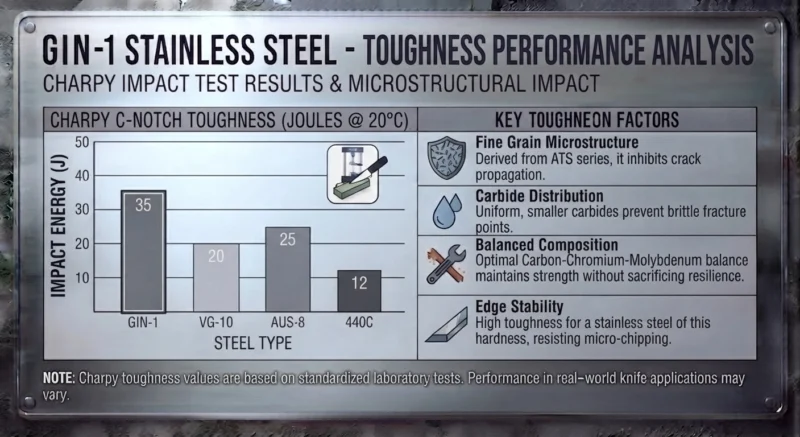
Toughness is the ability of a material to resist cracking and fracture.
It should not be confused with hardness.
Increasing hardness can improve edge retention and edge stability, but excessive hardness can reduce tolerance to impacts.
GIN-1’s moderate hardness profile gives it a useful balance.
It is not a dedicated extreme-toughness steel.
But it is also not designed as an ultra-hard, ultra-fragile material.
For normal knife use, this balance can be very useful.
Check Our Guide Wear Resistance vs Toughness
GIN-1 and Edge Chipping
A properly manufactured GIN-1 knife should not be considered unusually prone to chipping.
But any fine knife edge can chip if it is abused.
Avoid using a thin kitchen knife to:
- chop bones
- cut frozen food
- pry
- twist
- cut hard materials
- strike objects
If an edge repeatedly chips during normal use, the problem may be geometry or heat treatment rather than the steel itself.
A slightly more robust edge angle can often dramatically improve durability.
Edge Geometry Is More Important Than Many People Think
Consider two blades made from GIN-1.
One has a thin geometry with excellent distal taper.
The other has a thick grind.
Even though both use exactly the same steel, they may feel like completely different knives.
The thinner blade may glide through food.
The thicker blade may wedge.
This is why buying a knife based only on the steel name is a mistake.
Look at:
- blade thickness
- grind
- thickness behind the edge
- edge angle
- distal taper
- overall geometry
Steel is only one component of performance.
GIN-1 and Fine Edges
A knife steel’s ability to support a fine edge is particularly important in kitchen knives.
GIN-1’s combination of useful hardness and moderate carbide content makes it suitable for refined cutting edges.
A well-treated blade can be sharpened to a very fine apex.
But “sharper” does not always mean “thinner.”
An extremely acute edge may cut beautifully but may not be appropriate for heavy use.
The ideal edge is the one that matches the application.
Check Our Guide Blade Geometry Explained
GIN-1 and Carbides
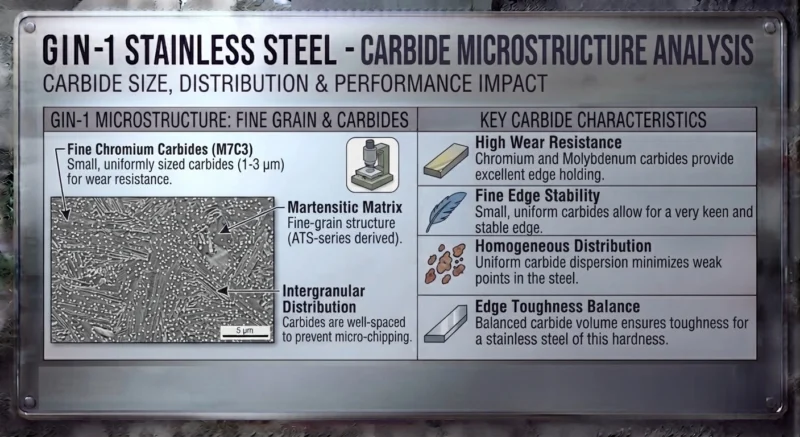
Carbides are hard compounds that form inside steel.
They play a major role in wear resistance.
Modern high-wear steels can contain substantial amounts of carbide-forming elements such as vanadium, tungsten, niobium, and molybdenum.
GIN-1 is much more modest.
Its chemistry is dominated by carbon and chromium, with a relatively small molybdenum addition.
This means its carbide system is less extreme than that of many modern super steels.
That contributes to its practical sharpening behavior.
It also explains why its wear resistance is moderate rather than exceptional.
Why GIN-1 Is Not a Modern Super Steel
The term “super steel” is not a formal metallurgical category.
It is generally used to describe steels offering unusually high performance in areas such as:
- wear resistance
- edge retention
- toughness
- corrosion resistance
- attainable hardness
GIN-1 was never intended to maximize one particular category.
Instead, it provides a balanced set of properties.
That can actually be an advantage.
A knife is rarely used for only one thing.
Most users want a blade that:
- cuts well
- stays reasonably sharp
- resists corrosion
- sharpens easily
- does not require special maintenance
GIN-1 fits that philosophy very well.
GIN-1 for Home Cooks
For the average home cook, extreme wear resistance may not be necessary.
A knife might be used for 20 or 30 minutes a day.
It is then washed and put away.
Under these conditions, GIN-1’s corrosion resistance and easy sharpening can be more valuable than extreme edge retention.
If the edge becomes slightly dull after several weeks, a few minutes on a sharpening stone can restore it.
That is a very reasonable ownership experience.
GIN-1 for Professional Cooks
Professional kitchens are different.
A chef may use the same knife for several hours every day.
Edge retention therefore becomes more important.
But sharpening speed matters too.
A professional may sharpen frequently.
For such a user, a steel that is easy to maintain can still make sense.
GIN-1 provides a good balance between cutting performance and maintenance.
It is not the obvious choice for someone who wants maximum possible edge retention.
But it is a sensible choice for someone who values a predictable, easily maintained knife.
GIN-1 for Everyday Utility Knives
The same characteristics can be useful in general-purpose cutting tools.
An everyday knife may be exposed to:
- humidity
- sweat
- rain
- food
- cardboard
- packaging
- general household use
Corrosion resistance is valuable.
Reasonable toughness is valuable.
Easy sharpening is valuable.
GIN-1 offers a practical combination of these qualities.
GIN-1 and Maintenance
One of the biggest advantages of GIN-1 is that it does not demand complicated maintenance.
A simple routine is enough:
Use it.
Wash it.
Dry it.
Sharpen it when necessary.
Store it properly.
That is all most owners need.
There is no need to treat it like a highly reactive carbon steel.
At the same time, it is still worth remembering that the knife itself may contain other materials—such as carbon steel components, natural wood, or other handle materials—that have their own maintenance requirements.
Check Our Ultimate Guide to Caring for a Damascus Steel Knife
Should a GIN-1 Knife Be Oiled?
For normal kitchen use, regular oiling is generally unnecessary.
The stainless composition already provides strong corrosion resistance.
For long-term storage, however, a light food-safe protective oil can provide an additional layer of protection, particularly in humid environments.
Always use an appropriate food-safe product if the blade will contact food.
Can GIN-1 Go in the Dishwasher?
It is better to avoid the dishwasher.
Even stainless knife steel can suffer from harsh detergents, heat, moisture, and contact with other objects.
More importantly, the knife’s edge and handle can be damaged.
Hand washing is faster and safer.
A quick wash and dry after use is the best routine.
GIN-1 and Sharpening Stones
GIN-1 works well with conventional sharpening stones.
You can use:
Waterstones
Excellent for kitchen knives and traditional sharpening.
Ceramic stones
Useful for routine maintenance.
Oil stones
A traditional and practical option.
Diamond stones
Effective, although not necessary simply because the steel is GIN-1.
Guided systems
Useful if you want very consistent edge angles.
The important point is that GIN-1 does not demand an expensive sharpening setup.
What Kind of Edge Does GIN-1 Take?
GIN-1 can take a clean, refined edge.
You can finish it relatively coarse for a toothy working edge or polish it to a finer finish.
For vegetables and general kitchen work, a medium-fine finish can be excellent.
For slicing, a finer edge may be desirable.
For utility work, a toothier finish may provide more bite.
This versatility is another reason GIN-1 works well as an everyday steel.
Why Easy Sharpening Can Be Better Than Extreme Edge Retention
Imagine two knives.
Knife A stays sharp for a very long time but takes considerable effort to sharpen.
Knife B becomes dull sooner but can be restored in a few minutes.
Which one is better?
There is no universal answer.
If you work in a professional environment and cannot sharpen frequently, Knife A may be better.
If you enjoy sharpening or maintain your knife regularly, Knife B may be preferable.
GIN-1 belongs closer to the second category.
That is not a weakness.
It is a design philosophy.
GIN-1 and Modern Knife Expectations
Modern knife buyers often expect every new steel to outperform older steels.
But steel development does not work like smartphone development.
A newer steel is not automatically better in every category.
A modern alloy may have:
- greater wear resistance
but perhaps:
- more difficult sharpening.
Another may have:
- extreme toughness
but lower edge retention.
Another may have:
- exceptional corrosion resistance
but lower hardness.
GIN-1’s strength is that it offers a useful middle ground.
The Importance of the Maker
If you are choosing a GIN-1 knife, pay attention to the manufacturer of the knife rather than only the steel designation.
Look for information about:
- heat treatment
- blade geometry
- hardness
- grinding quality
- sharpening
- handle construction
- user reviews
A well-treated GIN-1 blade can be an excellent knife.
A poorly made GIN-1 blade can be disappointing.
The same principle applies to almost every knife steel.
GIN-1 Is a Good Example of Balanced Engineering
The best way to understand GIN-1 is not to ask:
“How does it beat modern super steels?”
Instead, ask:
“Why was this particular combination of properties useful?”
The answer is straightforward.
The steel gives manufacturers:
- good stainless behavior
- useful hardness
- practical edge performance
- manageable sharpening
- suitability for thin cutting edges
- reasonable toughness
That is a very sensible combination for everyday cutting tools.
Common Misconceptions About GIN-1
GIN-1 Is an Inferior Steel Because It Is Old
Age does not determine quality.
GIN-1 is an older design, but it remains capable of producing excellent cutting tools.
GIN-1 Cannot Hold an Edge
It can.
Its edge retention is respectable, although many modern high-wear steels will outperform it.
GIN-1 Is Completely Rust Proof
No.
It is highly corrosion resistant, but no stainless steel should be treated as immune to corrosion.
GIN-1 Is the Same as GIN-3
No.
They are related Japanese silver-steel grades, but their compositions are different.
GIN-1 Is Difficult to Sharpen
Generally the opposite.
Compared with many modern highly wear-resistant steels, GIN-1 is relatively easy to sharpen.
GIN-1 Is Only for Kitchen Knives
No.
The steel has also been specified for scissors and other cutting applications.
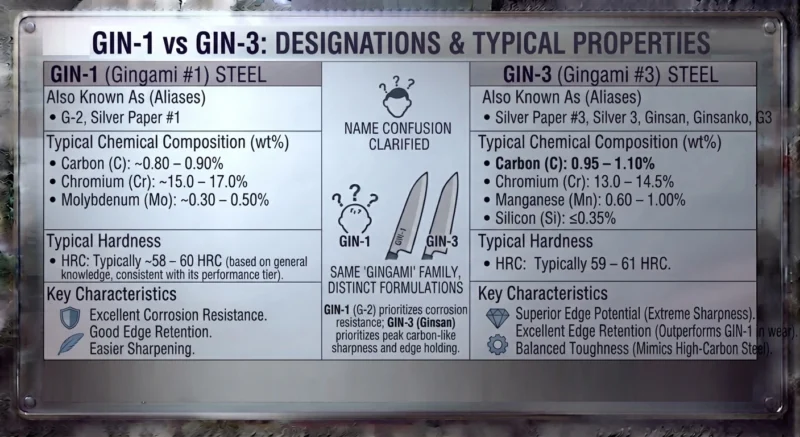
GIN-1 vs GIN-3: Why the Names Cause Confusion
GIN-1 and GIN-3 belong to the same broader family, but they are not identical.
GIN-1 contains approximately:
0.80–0.90% carbon
and
15–17% chromium.
GIN-3 contains a higher carbon range and a somewhat lower chromium range.
This difference changes the balance between hardness, carbide formation, and corrosion resistance.
A dedicated article comparing these two steels would be useful because the differences are significant enough to deserve detailed treatment.
For this article, however, the important point is simple:
GIN-1 and GIN-3 should not be treated as interchangeable names.
GIN-1 and the Development of Stainless Knife Steel
The history of stainless knife steel is essentially a story about compromise.
Traditional carbon steels could take outstanding edges.
But they required maintenance.
Early stainless steels solved the corrosion problem but did not always provide the cutting performance enthusiasts wanted.
As metallurgy improved, steelmakers developed alloys with more carefully balanced carbon, chromium, and additional alloying elements.
GIN-1 belongs to this important development.
It represents a generation of Japanese stainless steel where corrosion resistance and serious cutting performance were brought together in a practical alloy.
That is why the steel remains historically interesting even in an age of powder metallurgy.
Why GIN-1 Still Deserves Attention
There are thousands of knife steels available today.
Why spend time discussing an older Japanese stainless alloy?
Because GIN-1 illustrates something fundamental about knives.
The goal is not always maximum performance.
The goal is appropriate performance.
A chef may prefer a steel that sharpens easily.
A home cook may prefer stainless convenience.
A knife enthusiast may enjoy the feel of traditional sharpening.
A manufacturer may want a steel with predictable processing characteristics.
GIN-1 can satisfy all of these requirements reasonably well.
GIN-1 Steel: Strengths and Weaknesses
| Property | GIN-1 |
|---|---|
| Corrosion resistance | Very good |
| Edge retention | Good |
| Sharpenability | Good to very good |
| Toughness | Good |
| Fine-edge capability | Very good |
| Wear resistance | Moderate |
| Hardness potential | Moderate |
| Maintenance | Low |
| Kitchen knife suitability | Excellent |
| General cutting tools | Excellent |
| Modern super-steel performance | Limited |
| Main advantage | Balanced performance |
| Main limitation | Not designed for extreme wear resistance |
These descriptions should be treated as general characteristics rather than laboratory ratings.
The final performance depends on heat treatment, geometry, hardness, and sharpening.
Who Should Consider GIN-1?
GIN-1 is especially attractive for users who want a balanced stainless knife.
It makes sense for:
Home cooks
You get stainless convenience without complicated maintenance.
Professional cooks
You get a useful cutting edge and straightforward sharpening.
Sharpening enthusiasts
The steel responds well to conventional stones.
Beginners
It is forgiving and relatively easy to maintain.
Utility knife users
It provides corrosion resistance and reasonable edge performance.
People who prefer traditional Japanese steel
GIN-1 has a direct connection to Japan’s specialty-steel tradition while providing stainless characteristics.
Who Might Want a Different Steel?
There are situations where another steel may make more sense.
If your priority is maximum edge retention, modern high-wear steels are likely to be more appropriate.
If you need extreme toughness, specialized tough steels may be better.
If you want very high hardness, other alloys may provide greater potential.
If you want the absolute highest corrosion resistance, there are more advanced stainless and nitrogen-alloyed steels.
GIN-1 is not trying to win those competitions.
Its strength is balance.
GIN-1: A Steel That Makes Sense
The more you study knife steel, the more obvious one thing becomes:
There is no perfect steel.
Every alloy is a compromise.
Increase hardness and you may reduce toughness.
Increase carbide volume and sharpening may become more difficult.
Increase carbon and you may change corrosion behavior.
Increase alloy content and manufacturing becomes more complicated.
GIN-1 accepts these compromises and aims for a practical middle ground.
That is why it works.
GIN-1 Steel Specifications
Here is the essential information in one place.
| Specification | GIN-1 |
|---|---|
| Origin | Japan |
| Steel family | Yasugi Specialty Steel |
| Type | Stainless cutlery steel |
| Carbon | 0.80–0.90% |
| Chromium | 15.00–17.00% |
| Manganese | 0.45–0.75% |
| Silicon | ≤0.35% |
| Molybdenum | 0.30–0.50% |
| Phosphorus | ≤0.030% |
| Sulfur | ≤0.020% |
| Manufacturer hardening hardness | ≥57 HRC |
| Powder metallurgy | No |
| Corrosion resistance | Very good |
| Edge retention | Good |
| Sharpenability | Good |
| Toughness | Good |
| Kitchen knife suitability | Excellent |
| Scissors suitability | Excellent |
| Best characteristic | Balanced stainless performance |
The composition and manufacturer’s hardness specification are based on the current published GIN-1 information.
Frequently Asked Questions About GIN-1 Steel
What is GIN-1 steel?
GIN-1 is a Japanese stainless cutlery steel from the Yasugi Specialty Steel tradition. It was designed for cutting applications including kitchen knives and scissors.
Is GIN-1 stainless steel?
Yes. Its chromium content is approximately 15–17%, giving it strong corrosion resistance.
What is the carbon content of GIN-1?
GIN-1 contains approximately 0.80–0.90% carbon.
What is the chromium content of GIN-1?
The chromium range is approximately 15–17%.
Does GIN-1 contain molybdenum?
Yes. Approximately 0.30–0.50% molybdenum is specified.
How hard is GIN-1?
The manufacturer specifies a hardening hardness of at least 57 HRC. Finished knife hardness can vary depending on heat treatment.
Is GIN-1 easy to sharpen?
Yes. It is generally easier to sharpen than many modern high-wear steels.
Does GIN-1 hold an edge well?
Yes. It offers good practical edge retention, although it is not an extreme wear-resistant steel.
Is GIN-1 good for kitchen knives?
Yes. Kitchen knives are specifically listed among its applications.
Can GIN-1 rust?
It is highly corrosion resistant but not completely corrosion-proof. Cleaning and drying are still recommended.
Is GIN-1 a powder steel?
No. It is a conventional Japanese specialty steel.
Is GIN-1 a super steel?
No. It is better described as a balanced stainless cutlery steel.
Is GIN-1 good for beginners?
Yes. Its combination of corrosion resistance, useful hardness, and straightforward sharpening makes it a practical choice.
Is GIN-1 still a good steel?
Yes. Although newer steels can outperform it in specific categories, GIN-1 remains a practical and versatile stainless knife steel.
Final Thoughts
GIN-1 does not need exaggerated claims to be interesting.
Its chemistry is relatively simple.
Its performance is balanced.
Its history is connected to one of Japan’s most important specialty-steel traditions.
And its intended applications tell us a lot about the material: it was created for serious cutting tools, not merely for inexpensive stainless products.
With approximately 0.80–0.90% carbon, 15–17% chromium, and 0.30–0.50% molybdenum, GIN-1 has enough carbon to support a useful cutting edge while its high chromium content provides the corrosion resistance expected from a stainless knife steel.
It is not the steel to choose simply because you want the longest possible edge retention.
It is not the steel to choose because you want the highest possible hardness.
It is not a modern super steel.
Instead, it offers something that can be more valuable in everyday use:
balance.
It resists corrosion.
It can take a fine edge.
It holds that edge reasonably well.
It is comparatively easy to sharpen.
It does not demand complicated maintenance.
And it works particularly well in applications where practical cutting performance matters more than extreme laboratory numbers.
That is why GIN-1 remains worth knowing.
The knife industry will continue to develop new steels, and some of them will undoubtedly outperform GIN-1 in specific categories.
But a good knife does not need to use the newest alloy available.
Sometimes a well-designed, well-treated steel that simply does its job is exactly what you need.
GIN-1 is one of those steels.
This article is for independent informational purposes only and is not affiliated with, sponsored by, or endorsed by any steel manufacturer. All product names, trademarks, and registered trademarks are the property of their respective owners.