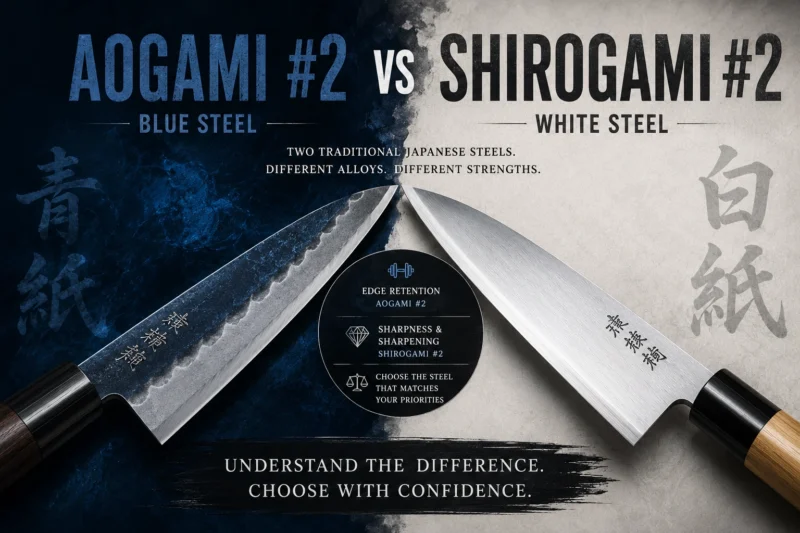
Aogami #2 vs Shirogami #2
An Independent Guide
When choosing a traditional Japanese carbon-steel knife, two names appear again and again: Aogami #2 and Shirogami #2.
Both steels are famous for taking an exceptionally sharp edge. Both are used by Japanese bladesmiths to produce high-performance kitchen knives. Both are reactive carbon steels that require more care than stainless steel. And both can produce a knife that feels remarkably different from an ordinary mass-produced kitchen knife.
So what is the actual difference between Aogami #2 vs Shirogami #2?
The answer is not simply that one steel is “better.”
Shirogami #2 is the simpler steel, with very low alloy content, excellent sharpening response, and outstanding potential for a refined edge.
Aogami #2 starts with a similar high-carbon foundation but adds alloying elements, particularly tungsten and chromium. This gives it greater wear resistance and generally better edge retention.
That difference sounds small on a composition chart, but it can be noticeable when you sharpen and use the finished knife.
For someone who enjoys sharpening and wants an exceptionally responsive carbon-steel knife, Shirogami #2 can be difficult to beat.
For someone who wants a little more edge retention while retaining the character of traditional Japanese carbon steel, Aogami #2 is one of the most balanced choices available.
In this guide, we will take a detailed look at Aogami #2 vs Shirogami #2, including chemical composition, hardness, sharpening, edge retention, toughness, corrosion resistance, patina, cutting performance, maintenance, price, and which steel makes more sense for different types of Japanese knives.
Aogami #2 vs Shirogami #2 at a Glance
If you want the short answer before getting into the details, this table summarizes the main differences.
| Property | Aogami #2 | Shirogami #2 |
|---|---|---|
| English name | Blue Steel #2 | White Steel #2 |
| Japanese name | 青紙2号 | 白紙2号 |
| Steel type | High-carbon alloy steel | High-carbon carbon steel |
| Carbon | Approximately 1.0–1.2% | Approximately 1.0–1.2% |
| Tungsten | Yes | Essentially none |
| Chromium | Small addition | Very low |
| Molybdenum | No significant addition | No significant addition |
| Vanadium | No significant addition | No significant addition |
| Edge retention | Excellent | Very good |
| Wear resistance | Higher | Lower |
| Sharpening ease | Very good | Excellent |
| Sharpening feedback | Excellent | Exceptional |
| Fine edge potential | Excellent | Exceptional |
| Hardness potential | High | High |
| Corrosion resistance | Low | Very low |
| Patina | Yes | Yes |
| Stainless | No | No |
| Maintenance | High | High |
| Best characteristic | Balance of edge retention and sharpness | Sharpening and edge refinement |
The most important point is this:
Aogami #2 and Shirogami #2 are much closer to each other than many modern steel comparisons would suggest.
Both can produce outstanding Japanese knives.
The difference is primarily in how the steel gets there and how it behaves during use and sharpening.
What Is Aogami #2?
Aogami #2, commonly called Blue Steel #2, is one of the most popular traditional Japanese knife steels.
The word Aogami (青紙) is often translated as Blue Paper Steel or Blue Steel.
The “blue” does not refer to the color of the blade. The name comes from the blue paper traditionally associated with the steel designation.
Aogami #2 is a high-carbon steel with additional alloying elements.
Its composition typically includes:
- carbon;
- tungsten;
- chromium;
- small amounts of manganese and silicon;
- very low phosphorus and sulfur.
The important additions are tungsten and chromium.
Tungsten contributes to carbide formation and wear resistance. Chromium improves hardenability and contributes to the overall alloy behavior, although there is far too little chromium to make Aogami #2 stainless.
The result is a steel that combines:
- high hardness;
- excellent edge stability;
- good edge retention;
- very good sharpening characteristics;
- excellent fine-edge performance.
Aogami #2 has become popular because it offers a particularly useful middle ground.
It is more wear-resistant than Shirogami #2 but remains much easier to sharpen than many highly wear-resistant modern powder steels.
Check Our Guide Aogami Steel N2
What Is Shirogami #2?
Shirogami #2, or White Steel #2, is one of the classic Japanese carbon steels.
The word Shirogami (白紙) means White Paper Steel.
Like Aogami, the name refers to the colored paper traditionally used for identifying the steel rather than the appearance of the finished blade.
Shirogami #2 is famous for its high purity and relatively simple composition.
The steel is essentially a high-carbon steel with very low amounts of additional alloying elements.
This simplicity is deliberate.
Instead of adding tungsten, chromium, vanadium, molybdenum, and other alloying elements to increase wear resistance, Shirogami #2 keeps the composition comparatively clean.
That gives it a distinctive combination of properties:
- very high sharpness;
- excellent sharpening response;
- excellent waterstone feedback;
- fine edge stability;
- relatively low wear resistance;
- high reactivity.
For many traditional Japanese knife enthusiasts, the appeal of Shirogami #2 is not simply its cutting performance.
It is the relationship between the knife, the sharpening stone, and the user.
Shirogami #2 responds quickly when sharpened, which makes it particularly enjoyable for people who like maintaining their knives.
Check Our Guide Shirogami #2 (White Steel #2)
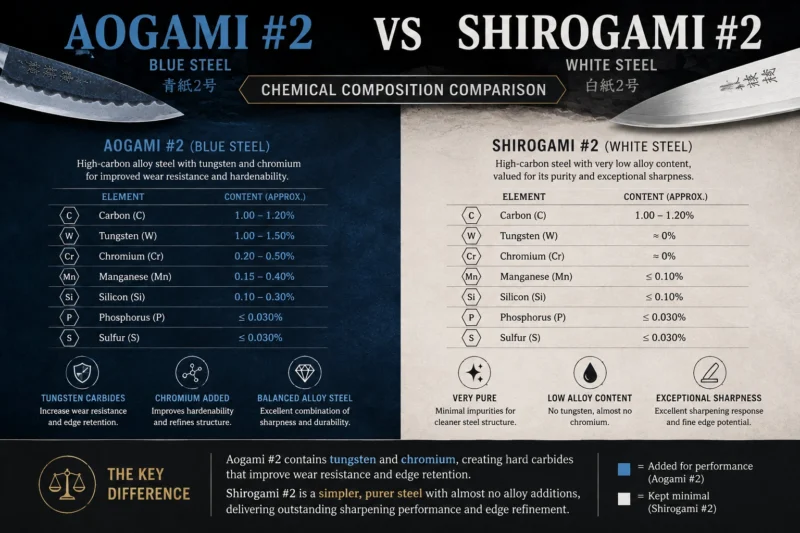
Aogami #2 vs Shirogami #2: Chemical Composition
The chemical composition is the foundation of the entire comparison.
A simplified comparison looks like this:
| Element | Aogami #2 | Shirogami #2 |
|---|---|---|
| Carbon | ~1.0–1.2% | ~1.0–1.2% |
| Tungsten | ~1.0–1.5% | Essentially none |
| Chromium | ~0.2–0.5% | Very low |
| Manganese | Low | Very low |
| Silicon | Low | Very low |
| Phosphorus | Very low | Very low |
| Sulfur | Very low | Very low |
Exact specifications can vary by published standard and steelmaker, so these figures should be treated as representative rather than as a guarantee for every batch.
The interesting part is that the carbon content is relatively similar.
This means the two steels are not fundamentally different because one has dramatically more carbon.
The major difference is the alloying.
Aogami #2 deliberately introduces tungsten and chromium.
Shirogami #2 largely does not.
That difference has consequences for carbide formation, wear resistance, sharpening, and edge retention.
Why Is Tungsten Important in Aogami #2?
Tungsten is one of the key reasons Aogami #2 performs differently from Shirogami #2.
Tungsten can form very hard carbides in steel.
These carbides contribute to wear resistance.
Imagine two knife edges being used under similar conditions.
Every time the edge cuts, microscopic amounts of steel are exposed to:
- abrasion;
- pressure;
- deformation;
- contact with food and cutting surfaces.
A steel with greater wear resistance can generally resist this gradual loss of material more effectively.
This is one reason Aogami #2 tends to hold its working edge longer than Shirogami #2.
But there is a tradeoff.
Those same alloy carbides mean that the abrasive stone has somewhat more resistant material to work through.
This is why Aogami #2 is generally harder to sharpen than Shirogami #2, even though both are considered very sharpenable steels.
Does Chromium Make Aogami #2 Stainless?
No.
This is a very common misunderstanding.
Aogami #2 contains chromium, but the amount is much too low to make it a stainless steel in the normal knife-steel sense.
Aogami #2 should still be treated as a reactive carbon steel.
It can:
- develop a patina;
- discolor;
- react with acidic foods;
- rust if left wet.
Shirogami #2 is even more reactive.
Therefore, if corrosion resistance is your priority, neither Aogami #2 nor Shirogami #2 is the obvious choice.
If you want the performance and traditional character of Japanese carbon steel, however, both are excellent.
Aogami #2 vs Shirogami #2: Edge Retention
This is probably the most important practical advantage of Aogami #2.
Winner: Aogami #2
Aogami #2 generally has better wear resistance than Shirogami #2.
That means it can maintain a useful cutting edge longer under comparable conditions.
The difference becomes more noticeable when the knife is used frequently.
For example, imagine two cooks preparing vegetables for several hours.
The Shirogami #2 knife may begin to lose some of its initial bite earlier.
The Aogami #2 knife will generally maintain its working edge for longer.
That does not mean Shirogami #2 becomes dull quickly.
A well-made Shirogami #2 knife can have excellent practical edge retention.
It simply means that Aogami #2 has an advantage in resisting abrasive wear.
But Edge Retention Is Not Just About Steel
This point is extremely important.
If someone tells you:
“Aogami #2 always holds an edge longer than Shirogami #2.”
the statement is directionally correct, but incomplete.
Real-world edge retention depends on much more than chemical composition.
It also depends on:
- heat treatment;
- hardness;
- edge angle;
- blade thickness;
- edge geometry;
- sharpening quality;
- cutting technique;
- cutting board;
- food being prepared;
- lateral pressure.
A poorly heat-treated Aogami #2 knife can perform worse than an excellent Shirogami #2 knife.
Similarly, an extremely thin Shirogami #2 knife may have exceptional cutting performance despite its lower wear resistance.
This is why steel name alone cannot tell you exactly how a knife will perform.
Check Our Guide Edge Retention Explained
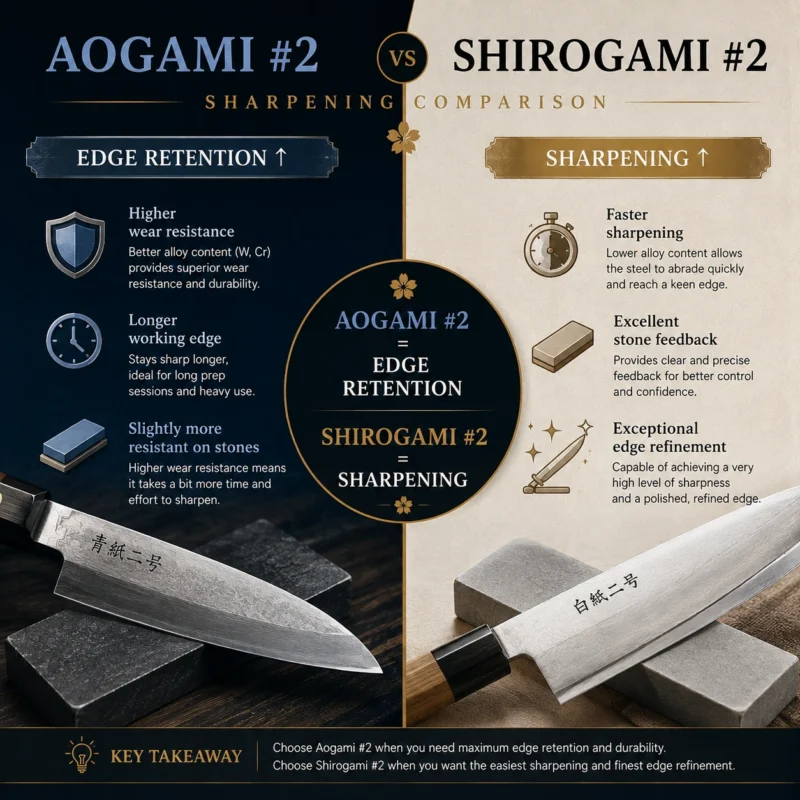
Aogami #2 vs Shirogami #2: Sharpening
If edge retention is the biggest advantage of Aogami #2, sharpening is where Shirogami #2 shines.
Winner: Shirogami #2
Shirogami #2 is widely appreciated for its excellent sharpening characteristics.
It tends to respond quickly to waterstones.
Creating a burr is relatively easy.
Removing that burr is straightforward.
Refining the edge is also relatively easy.
This makes Shirogami #2 particularly attractive to people who enjoy sharpening.
Aogami #2 is still an excellent sharpening steel.
In fact, compared with many modern high-wear-resistant steels, Aogami #2 is quite pleasant on stones.
But the tungsten-containing carbides make it somewhat more resistant to abrasion.
The difference is not enormous.
However, experienced sharpeners can feel it.
What Does Shirogami #2 Feel Like on a Waterstone?
This is difficult to explain unless you have actually sharpened a high-quality carbon-steel knife.
Shirogami #2 tends to give very clear feedback.
As the abrasive stone contacts the bevel, the user can feel the steel being removed.
The progression is easy to understand.
You can quickly:
- establish the bevel;
- raise a burr;
- move to a finer stone;
- remove the burr;
- refine the apex;
- polish the edge.
This is one reason Shirogami #2 is so popular among traditional Japanese knife enthusiasts.
It is not just a steel that cuts.
It is also a steel that sharpens beautifully.
What Does Aogami #2 Feel Like on a Waterstone?
Aogami #2 remains highly responsive, but it generally feels slightly more resistant.
The stone has to work through a more alloyed microstructure.
This is not necessarily a disadvantage.
Some sharpeners actually prefer the slightly more controlled feedback of Aogami.
But if you put an Aogami #2 knife and a Shirogami #2 knife side by side on the same stones, the difference can be noticeable.
Shirogami usually feels faster.
Aogami usually feels a little more deliberate.
Neither is difficult compared with some modern ultra-wear-resistant steels.
Aogami #2 vs Shirogami #2: Sharpness
This is where the comparison becomes more complicated.
Can Aogami #2 become extremely sharp?
Absolutely.
Can Shirogami #2 become extremely sharp?
Absolutely.
Both steels are capable of producing exceptional edges.
It would be misleading to say:
Shirogami is sharp, Aogami is not.
That is simply wrong.
Aogami #2 can produce a remarkably keen edge.
The more meaningful difference is that Shirogami #2 is particularly well suited to very fine edge refinement.
Because it has fewer hard alloy carbides, the sharpening process can be very clean and responsive.
For traditional Japanese single-bevel knives, this characteristic is particularly valuable.
Check Our Guide All Kinds of Knife Sharpening Tools
Aogami #2 vs Shirogami #2: Edge Refinement
If your priority is the finest possible edge, Shirogami #2 has a strong advantage.
This does not mean Aogami #2 cannot be polished to a high level.
It can.
But Shirogami #2 is often chosen specifically for applications where edge refinement is extremely important.
This includes:
- Yanagiba;
- Takohiki;
- Usuba;
- high-end Gyuto;
- traditional single-bevel knives.
A very well-sharpened Shirogami #2 knife can produce an almost effortless cutting sensation.
The edge can feel extremely clean.
For enthusiasts who enjoy that sensation, it is one of the main reasons to choose White Steel.
Aogami #2 vs Shirogami #2: Hardness
Neither steel has one universal HRC value.
This is important because you will often see knife listings stating things like:
Aogami #2 — 62 HRC
or:
Shirogami #2 — 63 HRC.
Those numbers describe the finished knife, not simply the theoretical hardness of the steel.
Heat treatment determines the final result.
Typical Japanese kitchen knives made from these steels may fall roughly into the low-to-mid 60s HRC, depending on the maker and intended use.
A simplified range might look like:
| Steel | Common knife hardness range |
|---|---|
| Aogami #2 | ~61–64 HRC |
| Shirogami #2 | ~61–64 HRC |
These are broad practical ranges, not specifications for every knife.
A particular maker may choose a lower or higher hardness depending on the intended use.
Is 64 HRC Better Than 61 HRC?
Not automatically.
Higher hardness can provide:
- greater edge stability;
- better edge retention;
- resistance to deformation.
But it can also increase:
- chipping risk;
- brittleness;
- sharpening demands.
A knife intended for delicate slicing may benefit from very high hardness.
A knife expected to tolerate more abuse may be better at a slightly lower hardness.
This is why Aogami #2 vs Shirogami #2 should never be reduced to an HRC competition.
The best knife is the one whose hardness and geometry match its intended use.
Check Our Guide What Is HRC? Understanding Rockwell Hardness in Kitchen Knives
Aogami #2 vs Shirogami #2: Toughness
Toughness is another area where simple comparisons can be misleading.
Neither Aogami #2 nor Shirogami #2 should be treated as a “hard-use” steel in the same way as a tough lower-carbon steel.
Both are high-carbon steels capable of high hardness.
Both can chip if:
- used at an excessively thin edge;
- twisted during cutting;
- used against hard objects;
- used on frozen food;
- subjected to lateral force.
However, good heat treatment can make either steel surprisingly durable.
Shirogami #2 is not inherently fragile.
Aogami #2 is not indestructible.
The geometry of the knife often matters more than the name of the steel.
Check Our Guide Wear Resistance vs Toughness: Understanding the Most Important Knife Steel Trade-Off
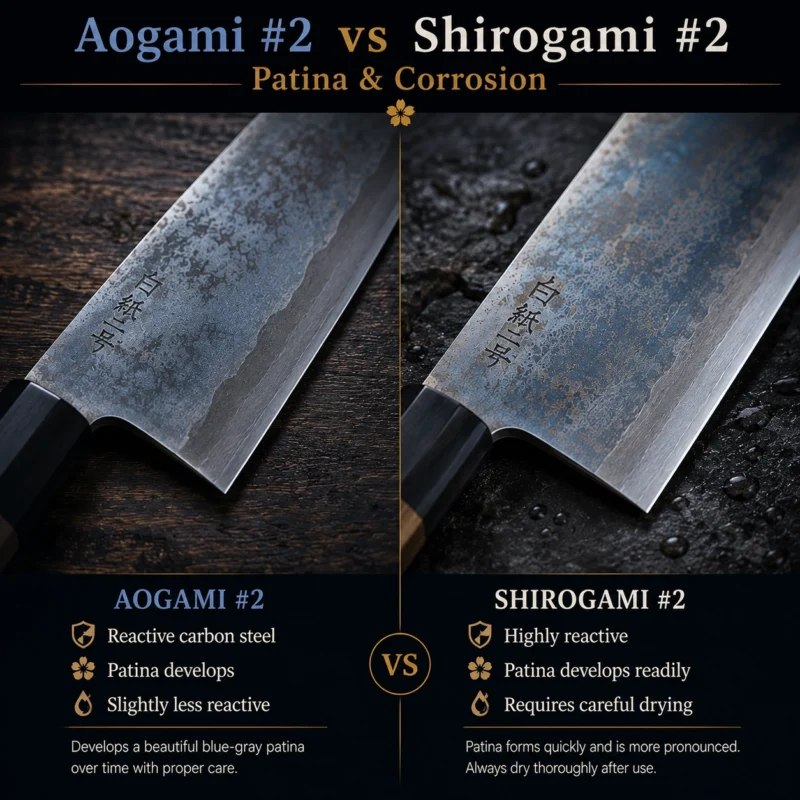
Aogami #2 vs Shirogami #2: Corrosion Resistance
Winner: Neither
Both are reactive carbon steels.
However, Shirogami #2 is generally more reactive than Aogami #2.
Aogami’s chromium addition can provide a modest influence on corrosion behavior, but it is nowhere near enough to make the steel stainless.
A new Aogami #2 or Shirogami #2 knife may develop a patina surprisingly quickly.
This is normal.
The important distinction is between:
patina and active rust.
A stable gray or blue-gray patina is generally not the same thing as damaging orange rust.
What Is a Patina?
A patina is a surface layer that forms on reactive steel through controlled oxidation.
On a Japanese carbon-steel knife, it may appear:
- gray;
- blue-gray;
- purple;
- brown;
- dark gray.
The appearance depends on the steel and what the knife cuts.
For example, different foods can produce very different patina colors.
Many owners deliberately allow a natural patina to develop.
It can give the knife a unique appearance and may provide some additional protection against further oxidation.
Aogami #2 and Shirogami #2 are both capable of developing beautiful patinas.
Which Develops Patina Faster?
Generally:
Shirogami #2 reacts more quickly.
This is partly a consequence of its very simple composition.
Aogami #2 is still reactive, but the alloying additions can make it somewhat less reactive.
The difference should not be interpreted as:
Shirogami rusts immediately, Aogami does not.
Both require proper care.
If you leave either knife wet overnight, you may see corrosion.
How to Maintain Aogami #2 and Shirogami #2
The basic maintenance routine is simple.
After cutting
Wipe the blade regularly during use, especially when working with acidic foods.
After washing
Dry the blade completely.
Do not leave it sitting wet in a sink.
During storage
Keep the knife dry.
If storing the knife for an extended period, a suitable food-safe protective oil can be used.
Sharpening
Use appropriate waterstones and maintain the existing edge geometry.
Rust
If active rust appears, remove it carefully rather than allowing it to spread.
The important thing is consistency.
You do not need to obsess over a carbon-steel knife.
You simply need to avoid prolonged moisture.
Aogami #2 vs Shirogami #2 for Beginners
This depends on what kind of beginner you are.
If you are completely new to Japanese knives and have never used carbon steel, neither is as maintenance-free as stainless steel.
However, both are manageable.
Shirogami #2 for beginners
Shirogami #2 is excellent if you want to learn sharpening.
It gives clear feedback.
It responds quickly.
You can see and feel the effects of your technique.
Aogami #2 for beginners
Aogami #2 is excellent if you want a little more edge retention.
It is still relatively easy to sharpen.
It gives you more time between sharpening sessions.
For a first carbon-steel Japanese knife, Aogami #2 is probably the more balanced recommendation.
For a first knife specifically chosen to learn traditional sharpening, Shirogami #2 is extremely attractive.
Aogami #2 vs Shirogami #2 for Professional Chefs
Professional cooks often care about how long the knife stays useful during a working day.
This gives Aogami #2 an advantage.
A chef who prepares large quantities of ingredients may appreciate the additional wear resistance.
The knife can remain highly functional for longer before requiring sharpening.
But professional cooks who sharpen regularly may prefer Shirogami #2.
Traditional Japanese chefs in particular may value the ability to quickly restore a very fine edge.
Therefore, there is no universal professional choice.
Aogami #2 vs Shirogami #2 for Home Cooks
For home cooks, the answer may actually lean toward Shirogami #2.
Why?
Because a home cook may use the knife for only a short period each day.
The additional edge retention of Aogami #2 may not be especially important.
Instead, the owner may value:
- very high sharpness;
- enjoyable sharpening;
- traditional character;
- beautiful patina.
In that situation, Shirogami #2 can be incredibly satisfying.
If you want to sharpen less often, however, Aogami #2 remains the practical choice.
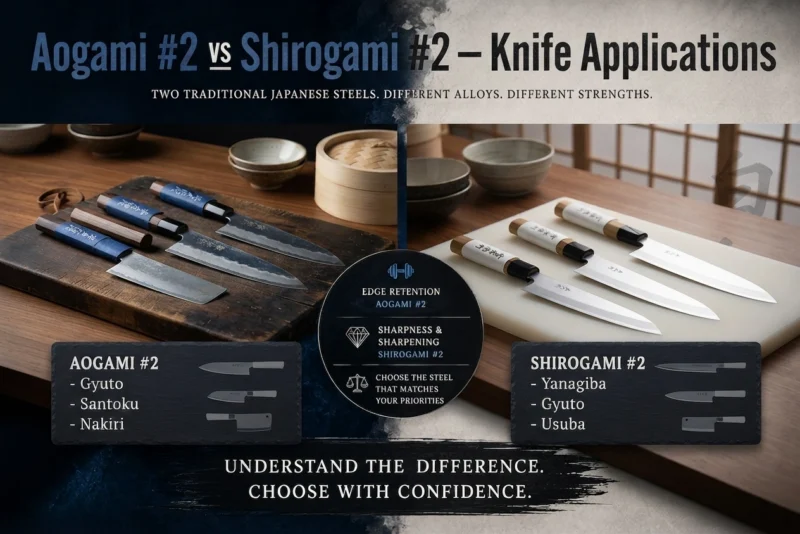
Aogami #2 vs Shirogami #2 for Gyuto
The Gyuto is one of the easiest knife types for comparing these steels.
A 210 mm Gyuto made from Shirogami #2 can be extremely light, thin, and responsive.
It can excel at:
- vegetables;
- herbs;
- meat;
- fish;
- precision slicing.
Aogami #2 can provide similar cutting performance while generally retaining the working edge longer.
For a home cook:
Shirogami #2 = sharpening enthusiast
Aogami #2 = practical all-rounder
For professional use:
Aogami #2 often has the advantage because of edge retention.
Check Our Guide Kiritsuke vs Gyuto: Which Japanese Knife Is Better for Everyday Cooking?
Aogami #2 vs Shirogami #2 for Nakiri
Nakiri knives are designed primarily for vegetable preparation.
Vegetables can be surprisingly abrasive, especially when cutting large quantities.
This makes Aogami #2 an attractive choice.
Its higher wear resistance can help the edge maintain its cutting performance.
However, Shirogami #2 remains a fantastic Nakiri steel.
A very thin Shirogami #2 Nakiri can feel extraordinarily smooth through vegetables.
If your priority is cutting feel and edge refinement rather than maximum edge life, Shirogami #2 can be the more enjoyable option.
Check Our Guide Santoku vs Nakiri: Which Japanese Kitchen Knife Is Better?
Aogami #2 vs Shirogami #2 for Santoku
For a Santoku, both steels work extremely well.
The Santoku is often used as an everyday kitchen knife, making the balance between edge retention and sharpening particularly relevant.
This is arguably where Aogami #2 makes one of its strongest cases.
You get:
- high sharpness;
- good edge retention;
- high hardness;
- excellent sharpening compared with many modern alloy steels.
Shirogami #2 gives you an even more responsive sharpening experience but may need sharpening somewhat more often.
Aogami #2 vs Shirogami #2 for Yanagiba
This is where Shirogami #2 becomes particularly interesting.
Traditional Yanagiba knives are designed for extremely precise slicing.
The knife is typically:
- single bevel;
- thin behind the edge;
- very hard;
- highly polished.
Shirogami #2 is an excellent material for this type of knife.
The ability to create and maintain a highly refined edge is extremely valuable.
Aogami #2 can also be used for Yanagiba and can perform beautifully.
But if the goal is the traditional sharpening experience and maximum edge refinement, Shirogami #2 is often the more natural choice.
Aogami #2 vs Shirogami #2 for Deba
Deba knives are different.
They are substantially thicker than most Japanese slicing knives.
The knife is designed to work with whole fish and around bones.
For a Deba, blade geometry and technique become extremely important.
Both steels can work well.
Aogami #2 provides good wear resistance.
Shirogami #2 provides excellent sharpening response.
But neither steel makes a Deba suitable for chopping through large bones indiscriminately.
Even an extremely hard Aogami #2 blade can chip if used incorrectly.
Check Our Guide Japanese Fish Knives
Aogami #2 vs Shirogami #2: Cutting Feel
This is one of the hardest things to quantify.
A knife’s cutting feel depends on:
- steel;
- hardness;
- grind;
- edge geometry;
- thickness;
- blade finish;
- sharpening.
Still, experienced users often describe Shirogami #2 as having an especially clean and refined cutting sensation.
The edge can feel almost effortless when properly sharpened.
Aogami #2 can feel similarly impressive.
The difference is often subtle.
In many cases, the geometry of the knife will influence cutting feel more strongly than the difference between these two steels.
Heat Treatment: The Hidden Variable
One of the most overlooked aspects of Aogami #2 vs Shirogami #2 is heat treatment.
A steel specification tells you what material went into the knife.
Heat treatment determines much of what comes out.
The maker controls:
- austenitizing temperature;
- soaking;
- quenching;
- tempering;
- grain structure;
- final hardness.
Two knives made from the same steel can therefore perform very differently.
This is why experienced Japanese knife buyers often pay as much attention to the maker as to the steel.
A well-treated Shirogami #2 knife can be extraordinary.
A well-treated Aogami #2 knife can also be extraordinary.
The steel gives the maker a set of possibilities.
The heat treatment determines how successfully those possibilities are realized.
Edge Geometry May Matter Even More
Consider two knives.
Knife A
Aogami #2
64 HRC
Very thin edge
Fine geometry
Knife B
Shirogami #2
62 HRC
Thicker edge
More robust geometry
Which is sharper?
Probably Knife A.
Which holds an edge longer?
Possibly Knife A.
Which is tougher?
Possibly Knife B.
Which is easier to sharpen?
Probably Knife B.
The point is that steel alone does not determine knife performance.
This is why comparing Aogami #2 and Shirogami #2 should always be done in terms of tendencies rather than absolute promises.
Is Aogami #2 More Difficult to Sharpen Than Shirogami #2?
Yes, generally.
But the difference is relatively modest.
This is important.
Aogami #2 is not an extremely difficult steel.
If you have experience sharpening ordinary carbon-steel knives, you should not be intimidated by Aogami #2.
It is much more approachable than many highly wear-resistant modern steels.
The difference is that Shirogami #2 is exceptionally easy and pleasant to sharpen.
So the comparison is better expressed as:
Shirogami #2 = easier
Aogami #2 = still easy, but somewhat more resistant
rather than:
Shirogami = easy
Aogami = difficult
Is Aogami #2 Better for Edge Retention?
Yes, generally.
The tungsten-containing carbide structure gives Aogami #2 a wear-resistance advantage.
However, this does not mean the difference will always be dramatic.
A thin Shirogami #2 edge with excellent heat treatment can perform extremely well.
Also, edge retention measured in a controlled abrasion test is not necessarily identical to what a chef experiences in the kitchen.
Real cutting involves:
- deformation;
- impact;
- abrasion;
- food texture;
- cutting board interaction.
Therefore, Aogami #2 should be considered the edge-retention winner in general, not a guarantee of a particular number of hours of cutting.
Is Shirogami #2 Better for Sharpness?
It is better described as easier to refine to an exceptionally keen edge.
Aogami #2 can also become extremely sharp.
The difference becomes especially interesting when using fine finishing stones.
Shirogami #2 responds beautifully to high-grit stones and can produce a very refined apex.
This is particularly useful for:
- single-bevel knives;
- sushi knives;
- precision slicing;
- high-end Gyuto;
- enthusiasts who enjoy polished edges.
Aogami #2 vs Shirogami #2: Which Is More Forgiving?
There is no simple winner.
A lower-hardness knife may be more forgiving regardless of whether it is Aogami #2 or Shirogami #2.
Likewise, a very hard and thin knife may be less forgiving.
The important variables are:
- hardness;
- edge thickness;
- geometry;
- heat treatment;
- technique.
If you want maximum forgiveness, neither steel should be your first choice for abusive use.
These are precision-oriented high-carbon steels.
Treat them accordingly.
Aogami #2 vs Shirogami #2: Price
Prices vary enormously.
The raw steel cost is only one part of a finished Japanese knife.
Other factors include:
- forging;
- heat treatment;
- grinding;
- polishing;
- handle;
- maker;
- finish;
- production volume.
A high-end Shirogami #2 knife can cost considerably more than an entry-level Aogami #2 knife.
The reverse can also be true.
Therefore, it is impossible to say:
“Aogami #2 is always more expensive.”
A better statement is:
Aogami #2 is often positioned as a premium traditional carbon steel, but the maker and construction have a much greater influence on the final price of the knife.
Aogami #2 vs Shirogami #2: Which One Is More Traditional?
Both.
This is worth emphasizing.
Shirogami has perhaps the stronger reputation for traditional Japanese bladesmithing because of its very simple carbon-steel composition.
But Aogami is also a classic Japanese steel family.
Both have long histories in Japanese knife and tool production.
Choosing Aogami does not mean choosing a modern or less traditional steel.
It simply means choosing a more highly alloyed traditional carbon steel.
Why Do Japanese Bladesmiths Use Both?
Because different jobs require different characteristics.
A bladesmith may choose Shirogami when:
- sharpening response matters;
- edge refinement is critical;
- the knife will have a very fine edge;
- the customer values traditional carbon steel.
The same bladesmith may choose Aogami #2 when:
- edge retention matters more;
- the knife will see heavier use;
- additional wear resistance is desirable;
- the customer wants fewer sharpening sessions.
This is exactly why both steels remain relevant.
There is no need for one to replace the other.
Check Our Guide How to Choose a Custom Knife Maker
Aogami #2 vs Shirogami #2: Pros and Cons
Aogami #2 — Advantages
- Excellent edge retention
- Higher wear resistance
- Extremely sharp
- High hardness potential
- Excellent balance of properties
- Still relatively easy to sharpen
- Excellent for professional use
- Excellent for Gyuto, Santoku, Nakiri, and other Japanese knives
- Traditional carbon-steel character
Aogami #2 — Disadvantages
- Reactive
- Can rust if neglected
- More difficult to sharpen than Shirogami #2
- Can chip when very hard and thin
- Not stainless
- Requires regular maintenance
Shirogami #2 — Advantages
- Exceptional sharpening response
- Extremely easy to sharpen
- Excellent waterstone feedback
- Outstanding edge refinement
- Very high sharpness
- Excellent for traditional Japanese knives
- Excellent for single-bevel knives
- Beautiful patina potential
- Simple, high-purity composition
Shirogami #2 — Disadvantages
- Lower wear resistance
- Shorter edge retention than comparable Aogami #2
- Highly reactive
- Can rust quickly if neglected
- Requires regular maintenance
- Can chip when hardened aggressively and ground very thin
Aogami #2 vs Shirogami #2: Which Is Better for You?
The answer depends on what you value.
Choose Aogami #2 if you want:
Longer edge retention
If you do a lot of cutting and don’t want to sharpen as often, Aogami #2 is the logical choice.
A balanced carbon steel
Aogami #2 sits in a particularly attractive middle ground between sharpening ease and wear resistance.
A professional workhorse
For frequent kitchen use, Aogami #2’s additional edge retention can be valuable.
Excellent sharpness without extreme maintenance
You still have to maintain the knife, but Aogami #2 gives you a little more time between sharpenings.
Choose Shirogami #2 if you want:
The ultimate sharpening experience
If you enjoy waterstones, Shirogami #2 is one of the most rewarding steels to work with.
Maximum edge refinement
For precision slicing and polished edges, Shirogami #2 is outstanding.
Traditional Japanese carbon steel
If the traditional character of Japanese knife making is what attracts you, Shirogami #2 is a classic choice.
Frequent sharpening
If sharpening does not bother you—or you actually enjoy it—the lower wear resistance is not necessarily a disadvantage.
Aogami #2 vs Shirogami #2: The Best Steel for a Gyuto
For an everyday Gyuto, I would describe the choice like this:
Aogami #2 Gyuto
Best for someone who wants:
- longer edge retention;
- frequent use;
- excellent sharpness;
- less frequent sharpening.
Shirogami #2 Gyuto
Best for someone who wants:
- an extremely refined edge;
- excellent sharpening feedback;
- traditional carbon-steel character;
- maximum enjoyment from sharpening.
Both can make exceptional Gyuto knives.
The geometry and maker may ultimately matter more than the steel difference.
Aogami #2 vs Shirogami #2: The Best Steel for a Nakiri
For a Nakiri, I would give Aogami #2 a slight practical advantage.
Vegetable preparation can involve a lot of repetitive cutting.
The additional wear resistance is useful.
But if the knife is intended for a home cook who sharpens regularly, Shirogami #2 can be just as enjoyable.
A thin Shirogami #2 Nakiri can be extraordinarily satisfying to use.
Aogami #2 vs Shirogami #2: The Best Steel for a Yanagiba
For a traditional Yanagiba, I would lean toward Shirogami #2 if the goal is maximum sharpening refinement.
The single-bevel geometry and extremely fine edge are a natural match for White Steel.
Aogami #2 remains an excellent alternative if the user values longer edge retention.
Aogami #2 vs Shirogami #2: The Best Steel for a Santoku
For a general-purpose Santoku:
Aogami #2 has a slight practical advantage.
The additional wear resistance makes sense for an everyday knife.
However, the difference is not enormous.
A well-made Shirogami #2 Santoku can be an outstanding everyday knife.
Aogami #2 vs Shirogami #2: The Best Steel for a Professional
For high-volume professional use, Aogami #2 is often the more practical choice.
A professional chef may value the additional edge retention.
But a traditional Japanese chef who sharpens frequently may still prefer Shirogami #2.
Therefore:
Aogami #2 is the practical choice.
Shirogami #2 is the sharpening enthusiast’s choice.
That is a useful generalization, although individual preferences vary.
Aogami #2 vs Shirogami #2: The Best Steel for a Beginner
If someone has never used carbon steel before, the first thing they need to learn is not sharpening.
It is maintenance.
Both steels need to be:
- kept dry;
- cleaned properly;
- protected during storage;
- sharpened correctly.
Once that is understood, both are accessible.
For a beginner who wants fewer sharpening sessions:
Aogami #2.
For a beginner who specifically wants to learn traditional Japanese sharpening:
Shirogami #2.
Aogami #2 vs Shirogami #2: What About Food Reactivity?
Both steels can react with food.
Acidic ingredients such as:
- tomatoes;
- citrus;
- onions;
- vinegar;
- some fruits;
can accelerate patina formation.
This is normal.
During prolonged preparation of acidic foods, it is a good idea to wipe the blade periodically.
After finishing, clean and dry the knife.
Do not leave a carbon-steel knife covered with food residue.
Can Aogami #2 and Shirogami #2 Be Used for Slicing Meat?
Yes.
Both are excellent for meat preparation.
Their high hardness allows a very fine edge.
For a Gyuto or Petty knife, either steel can perform beautifully.
Aogami #2 may retain the edge longer during repetitive cutting.
Shirogami #2 may offer a more refined sharpening experience.
Can They Cut Frozen Food?
This is where caution is necessary.
Aogami #2 and Shirogami #2 are not designed for chopping through frozen food.
Their high hardness and fine edges can make them vulnerable to chipping or damage when subjected to excessive impact.
Use the knife for the job it was designed to perform.
A very expensive Japanese carbon-steel knife is not automatically a better tool for abuse.
Does Aogami #2 Have Better Toughness Because It Contains Tungsten?
Not necessarily in a simple one-to-one sense.
Toughness is influenced by many factors.
Alloying elements can change hardenability and carbide structure, but the final toughness depends heavily on:
- heat treatment;
- hardness;
- grain structure;
- carbide distribution;
- geometry.
So it is better to say:
Aogami #2 is designed to provide increased wear resistance while maintaining useful toughness and edge stability.
That is more accurate than simply calling it “tougher.”
Aogami #2 vs Shirogami #2: Does the Difference Matter in Real Life?
Yes—but perhaps not as much as you think.
If you are buying your first Japanese carbon-steel knife, the difference between Aogami #2 and Shirogami #2 is probably less important than:
- the maker;
- heat treatment;
- blade geometry;
- edge thickness;
- sharpening technique.
Once those factors are controlled, the steel difference becomes much more meaningful.
This is why two experienced knife users can prefer different steels without either being wrong.
One may value sharpening.
The other may value edge retention.
Both are choosing correctly for their priorities.
Aogami #2 vs Shirogami #2: A Practical Decision Chart
| If you prioritize… | Choose |
|---|---|
| Easy sharpening | Shirogami #2 |
| Waterstone feedback | Shirogami #2 |
| Fine edge refinement | Shirogami #2 |
| Maximum traditional character | Shirogami #2 |
| Edge retention | Aogami #2 |
| Wear resistance | Aogami #2 |
| Less frequent sharpening | Aogami #2 |
| Heavy kitchen use | Aogami #2 |
| Everyday carbon-steel knife | Aogami #2 |
| Traditional single-bevel slicing | Shirogami #2 |
| Professional high-volume cutting | Aogami #2 |
| Sharpening enthusiast | Shirogami #2 |
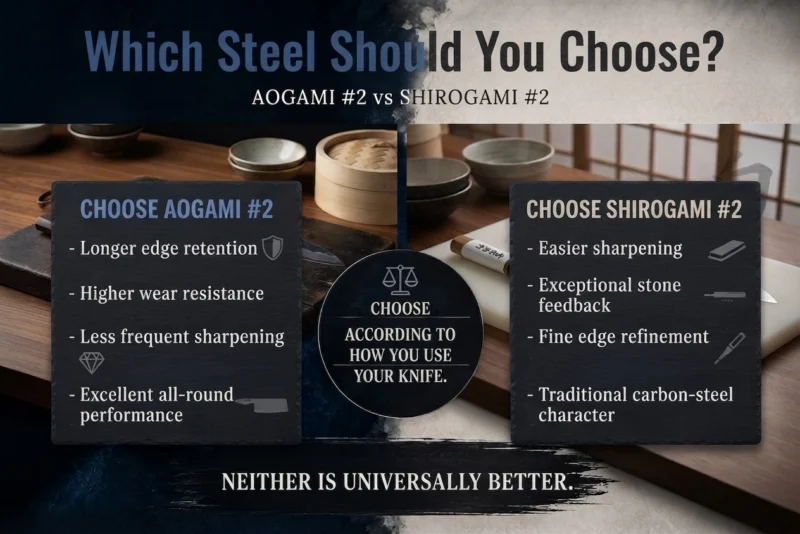
Aogami #2 vs Shirogami #2: Which One Would I Choose?
If I wanted one traditional carbon-steel knife for general kitchen use, I would probably choose Aogami #2.
It provides an excellent balance.
You get:
- very high sharpness;
- good edge retention;
- high hardness;
- excellent cutting performance;
- relatively easy sharpening;
- traditional carbon-steel behavior.
But if the knife were specifically for someone who loves sharpening and wants the most refined edge possible, I would choose Shirogami #2.
That is where the steel becomes special.
The sharpening experience is part of the enjoyment.
Aogami #2 vs Shirogami #2: Why There Is No Universal Winner
The easiest mistake in knife-steel discussions is trying to create a ranking.
People often want something like:
- Aogami #2
- Shirogami #2
But steel does not work that way.
A steel can be better in one category and worse in another.
Aogami #2 wins in:
wear resistance and edge retention.
Shirogami #2 wins in:
sharpening response and edge refinement.
Neither wins everything.
This is exactly why both steels remain popular.
Aogami #2 vs Shirogami #2: Frequently Asked Questions
Is Aogami #2 better than Shirogami #2?
Not universally.
Aogami #2 generally has better wear resistance and edge retention, while Shirogami #2 is easier to sharpen and can provide exceptional edge refinement.
Which is sharper, Aogami #2 or Shirogami #2?
Both can become extremely sharp. Shirogami #2 is particularly well suited to producing a highly refined edge because of its simple composition and excellent sharpening response.
Which holds an edge longer?
Generally, Aogami #2.
Its tungsten-containing alloy structure provides greater wear resistance.
Which is easier to sharpen?
Shirogami #2.
It is one of the most responsive traditional Japanese carbon steels on waterstones.
Is Aogami #2 stainless?
No.
Aogami #2 is a reactive carbon steel.
Does Shirogami #2 rust?
Yes.
Shirogami #2 is highly reactive and should be kept clean and dry.
Does Aogami #2 develop a patina?
Yes.
Aogami #2 can develop a gray, blue-gray, purple, or dark patina depending on use and maintenance.
Which is better for a Gyuto?
Both are excellent.
Aogami #2 is better suited to someone prioritizing edge retention, while Shirogami #2 is especially attractive to sharpening enthusiasts.
Which is better for a Yanagiba?
Shirogami #2 is an excellent choice for a traditional Yanagiba because of its edge refinement and sharpening characteristics.
Which is better for a professional chef?
Aogami #2 often makes more sense for heavy daily use because of its additional edge retention.
However, many professionals prefer Shirogami because they sharpen frequently.
Which is more expensive?
There is no universal answer.
The final knife price depends heavily on the maker, construction, heat treatment, grinding, handle, and finishing.
Can both steels be sharpened on waterstones?
Yes.
Both are particularly well suited to traditional Japanese waterstones.
Is Aogami #2 difficult to sharpen?
No.
It is somewhat more resistant than Shirogami #2, but it remains a relatively approachable steel compared with many modern high-wear-resistant steels.
Which steel is better for a beginner?
Aogami #2 is a good general-purpose choice.
Shirogami #2 is particularly good if the beginner wants to learn and enjoy sharpening.
Final Verdict: Aogami #2 vs Shirogami #2
The Aogami #2 vs Shirogami #2 comparison is ultimately a comparison between two different approaches to traditional Japanese carbon steel.
Shirogami #2 is the simpler steel.
It has very low alloy content and is famous for its exceptional sharpening response, high edge refinement, and ability to produce an extremely keen edge.
Aogami #2 takes a similar high-carbon foundation and adds tungsten and chromium.
Those additions increase wear resistance and give the steel better edge retention while still allowing it to remain relatively easy to sharpen.
So the decision can be summarized very simply:
Choose Shirogami #2 if you value:
- exceptional sharpening;
- fast sharpening;
- waterstone feedback;
- maximum edge refinement;
- traditional Japanese carbon-steel character;
- precision cutting.
Choose Aogami #2 if you value:
- longer edge retention;
- higher wear resistance;
- frequent knife use;
- fewer sharpening sessions;
- a balanced carbon-steel performance;
- excellent sharpness combined with greater working edge life.
Neither steel is universally better.
Aogami #2 is the more practical all-rounder.
Shirogami #2 is the more sharpening-focused steel.
And that distinction explains why both remain so popular among Japanese knife makers and enthusiasts.
The best choice depends not on which steel has the more impressive name, but on how you use your knife and what you enjoy about owning it.
If you want a knife that stays sharp longer and still gives you the character of traditional Japanese carbon steel, Aogami #2 is an outstanding choice.
If you want the pleasure of creating an exceptionally refined edge on a responsive waterstone and don’t mind sharpening more often, Shirogami #2 is hard to beat.
In the end, the most important thing is not simply whether the blade says Aogami #2 or Shirogami #2.
Look at the entire knife:
steel + heat treatment + hardness + geometry + grind + edge thickness + sharpening + maker.
When all of those elements work together, either Aogami #2 or Shirogami #2 can produce an exceptional Japanese kitchen knife.
Aogami #2 gives you more wear resistance. Shirogami #2 gives you an extraordinary sharpening experience. Both can give you an extraordinary knife.
This article is for independent informational purposes only and is not affiliated with, sponsored by, or endorsed by any steel manufacturer. All product names, trademarks, and registered trademarks are the property of their respective owners.
https://japanmonozukuri.com/japanese-knife-steel-metallurgy-aogami-shirogami