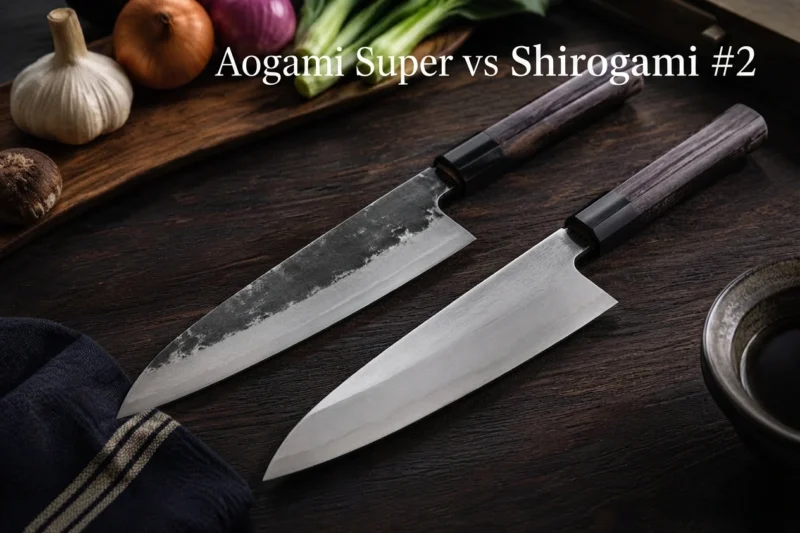
Aogami Super vs Shirogami #2
An Independent Guide
When comparing traditional Japanese kitchen knife steels, few matchups are as interesting as Aogami Super vs Shirogami #2.
At first glance, the two steels seem to represent opposite approaches to knife making.
Shirogami #2 is famous for its relatively simple composition, exceptionally clean sharpening response, and ability to take an extremely refined edge.
Aogami Super takes a much more highly alloyed approach. It contains substantially more carbon and tungsten and also includes chromium, molybdenum, and vanadium. The result is a steel known for very high hardness, strong wear resistance, and unusually long edge retention for a traditional carbon steel.
So which one is better?
The honest answer is that neither steel wins every category.
Aogami Super is generally the stronger choice when edge retention and wear resistance are the priority. Shirogami #2 is generally the better choice when sharpening response, simplicity, and an exceptionally refined edge are the priority.
But that short answer leaves out much of what makes these steels interesting.
A knife is not simply a piece of chemical composition. Heat treatment, geometry, thickness behind the edge, sharpening technique, cutting surface, edge angle, and even the user’s habits can dramatically change how a particular blade performs.
That is why the best way to understand Aogami Super vs Shirogami #2 is to look at what actually happens when these steels become kitchen knives.
What Are Aogami Super and Shirogami #2?
Both Aogami Super and Shirogami #2 belong to the traditional family of Japanese high-carbon steels used extensively for blades and cutting tools.
They are sometimes described as “carbon steels,” but the two materials are quite different in alloy design.
Shirogami #2 is intentionally kept relatively simple. Its carbon content is typically around 1.05–1.15%, while silicon and manganese remain at relatively low levels. Chromium, tungsten, molybdenum, and vanadium are not intentionally added in the quantities found in more highly alloyed steels.
Aogami Super takes a completely different route.
Its carbon content is typically around 1.40–1.50%. It also contains approximately 2.00–2.50% tungsten, around 0.30–0.50% chromium, approximately 0.30–0.50% molybdenum, and a small vanadium addition. Published specifications can vary slightly depending on the reference and specification format, but the overall alloy design is consistent: Aogami Super contains substantially more carbide-forming alloying elements than Shirogami #2.
That difference is responsible for much of the practical distinction between the two steels.
Shirogami #2 emphasizes a relatively uncomplicated steel matrix.
Aogami Super deliberately introduces more alloying elements to improve wear resistance and support very high hardness.
This produces two different personalities on the sharpening stone and in the kitchen.
Shirogami #2 tends to feel direct and responsive.
Aogami Super tends to feel more resistant and deliberate, but rewards the user with longer-lasting edge performance.
Neither philosophy is inherently superior.
They simply prioritize different things.
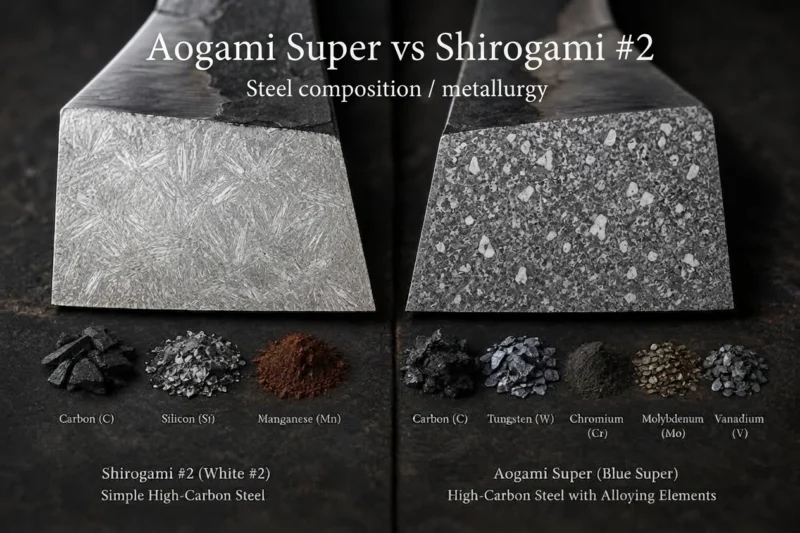
Aogami Super vs Shirogami #2 Composition
The most useful place to begin is chemical composition.
Understanding composition helps explain why the steels behave differently, but it is important not to make the common mistake of assuming that every alloying element translates into one simple performance characteristic.
Steel is a system.
Carbon, tungsten, chromium, molybdenum, and vanadium interact with heat treatment and microstructure. The final carbide population, grain structure, hardness, and toughness are all affected by processing.
Shirogami #2 composition
Shirogami #2 is generally specified at approximately:
- Carbon: 1.05–1.15%
- Silicon: up to about 0.20%
- Manganese: around 0.20–0.30%
- Very low phosphorus
- Very low sulfur
- No intentional tungsten addition
- No significant intentional molybdenum addition
- No significant intentional vanadium addition
- Very little chromium
The important feature is not simply the carbon percentage.
It is the relative simplicity of the alloy.
Shirogami #2 contains enough carbon to reach high hardness and support a very fine cutting edge, while avoiding the larger quantities of carbide-forming alloying elements found in Aogami Super.
That simplicity is one reason experienced sharpeners often describe Shirogami as having unusually pleasant feedback.
There is less alloy complexity interfering with the relationship between the abrasive and the steel.
Aogami Super composition
Aogami Super is substantially more alloyed.
A commonly published specification is approximately:
- Carbon: 1.40–1.50%
- Silicon: 0.10–0.20%
- Manganese: 0.20–0.30%
- Chromium: 0.30–0.50%
- Tungsten: 2.00–2.50%
- Molybdenum: 0.30–0.50%
- Vanadium: approximately 0.20–0.50%
Different references may give slightly different limits for some elements, particularly vanadium, but the central composition is consistent across independent steel references.
The most important differences compared with Shirogami #2 are:
More carbon.
Much more tungsten.
Additional chromium.
Additional molybdenum.
Vanadium.
These additions fundamentally change the behavior of the steel.
Why Does Aogami Super Have More Alloying Elements?
The purpose is not simply to make the steel “stronger.”
The alloying elements influence hardenability, carbide formation, wear resistance, grain structure, and the ability of the steel to maintain a fine edge at high hardness.
Tungsten is particularly important in the Blue Super formulation.
Tungsten can participate in carbide formation, producing hard particles that resist abrasive wear.
Vanadium is even more strongly associated with carbide formation and grain refinement.
Molybdenum contributes to hardenability and high-temperature behavior.
Chromium has several metallurgical functions, although the small quantity present should not be confused with stainless-steel levels of chromium.
The combined effect is a steel capable of very high hardness and significantly greater wear resistance than a simple high-carbon steel.
That is why Aogami Super can maintain a useful edge for a long time while still behaving like a traditional Japanese carbon steel.
Is Aogami Super Stainless Steel?
No.
This is one of the most common misunderstandings surrounding the steel.
Aogami Super contains chromium, but the amount is nowhere near what would normally make a knife stainless.
A stainless knife typically relies on a much larger chromium concentration to create substantial passive corrosion resistance.
Aogami Super does not have that level of chromium.
It is still a reactive carbon steel.
It can develop a patina.
It can discolor.
It can rust.
It should be wiped dry after use.
It should not be left sitting in water.
Acidic foods can accelerate surface reactions.
So if you are looking for stainless-steel convenience, Aogami Super is not a substitute for stainless steel.
The small chromium addition changes the metallurgy, but it does not turn the finished knife into a maintenance-free material.
Is Shirogami #2 Stainless?
Definitely not.
Shirogami #2 is even less alloyed and contains essentially no meaningful chromium addition for stainless behavior.
This gives it its classic carbon-steel characteristics.
A clean Shirogami #2 blade can develop a patina surprisingly quickly depending on what it cuts and how it is maintained.
Some users deliberately allow a controlled patina to develop because it gives the blade character and can provide some additional surface protection.
But patina is not the same thing as stainless corrosion resistance.
Both steels therefore belong in the same general maintenance category:
Use them, wipe them, wash them when necessary, dry them immediately, and store them dry.
Check Our Guide Shirogami #2 (White Steel #2)
Aogami Super vs Shirogami #2: Carbon Content
One of the largest differences is carbon.
Shirogami #2 contains approximately 1.05–1.15% carbon.
Aogami Super contains approximately 1.40–1.50%.
That is a substantial difference.
Carbon is one of the most important elements in knife steel because it allows the steel to transform into hard structures during heat treatment and contributes to carbide formation.
Higher carbon can support higher attainable hardness and increased carbide volume.
But more carbon does not automatically mean a better kitchen knife.
A steel with excessive hardness and insufficient toughness can become more vulnerable to chipping.
That is why comparing carbon percentages alone is misleading.
Aogami Super uses its higher carbon content together with tungsten, chromium, molybdenum, and vanadium.
The entire alloy system matters.
What Does Tungsten Do in Aogami Super?
Tungsten is one of the defining elements of Aogami Super.
The amount is much greater than anything present in Shirogami #2.
One reason tungsten matters is its ability to form very hard carbides.
Carbides are harder particles within the steel matrix.
When a knife cuts food, its edge experiences mechanical contact and abrasion. The steel is gradually worn away.
A suitable carbide population can improve resistance to this wear.
This is a major reason Aogami Super generally retains a working edge longer than Shirogami #2.
But there is an important qualification.
More carbide does not automatically mean a better edge.
A knife edge is extremely small.
If the carbide population becomes too large, too coarse, or poorly distributed, the edge can become less stable.
A high-performance knife steel therefore requires more than simply adding alloying elements.
The manufacturing and heat treatment must allow the steel to develop a useful microstructure.
This is one reason two knives made from the same steel can behave noticeably differently.
What Does Vanadium Do?
Vanadium is another important difference.
Shirogami #2 does not rely on vanadium as part of its alloy design.
Aogami Super contains a small but meaningful vanadium addition.
Vanadium forms extremely hard carbides and can also help control grain growth during heat treatment.
Grain refinement is particularly important in knife steel.
A fine and controlled grain structure can help the blade maintain a stable, keen cutting edge.
This is part of the reason Aogami Super is capable of combining high hardness with an edge that remains remarkably fine.
However, vanadium carbides are also hard on sharpening abrasives.
This contributes to the difference that experienced sharpeners notice between simple carbon steels and more highly alloyed steels.
What Does Molybdenum Do?
Molybdenum is another element that distinguishes Aogami Super from Shirogami #2.
Its role is different from simply making the edge “sharper.”
Molybdenum can improve hardenability and help the steel respond appropriately during heat treatment.
It also contributes to high-temperature strength and resistance to softening.
In a carefully designed alloy, this allows the steel to achieve a useful combination of hardness and structural stability.
Again, however, the final result depends on heat treatment.
The presence of molybdenum on a composition sheet does not guarantee that every Aogami Super knife will behave identically.
Aogami Super vs Shirogami #2 Hardness
Hardness is one of the most frequently discussed properties of Japanese knife steel.
It is also one of the most frequently misunderstood.
There is no single universal HRC number for every knife made from either steel.
The actual hardness depends on:
- Heat treatment
- Quenching
- Tempering
- Blade thickness
- Intended use
- Maker’s process
- Steel batch
- Testing location
Shirogami #2 is commonly found in Japanese kitchen knives around the low 60s HRC.
Aogami Super is commonly hardened into the mid-60s HRC, although actual finished-knife hardness varies. Independent references commonly place well-made Aogami Super knives around 64–66 HRC.
This difference matters.
A harder blade can resist deformation and wear.
But hardness is not the same thing as toughness.
A knife can be extremely hard while still being vulnerable to impact or lateral stress.
That distinction becomes especially important when comparing traditional Japanese knives.
Check Our Guide What Is HRC? Understanding Rockwell Hardness in Kitchen Knives
Hardness vs Toughness
Imagine two knife edges.
One is very hard.
The other is slightly softer.
The harder edge may resist deformation and wear better.
But if both edges are struck against a hard object, the harder edge may be less forgiving.
This is why a very hard Japanese knife should not be used as a pry bar.
Hardness is valuable when cutting.
Toughness is valuable when something goes wrong.
The ideal combination depends on the knife’s intended job.
A thin vegetable knife benefits from hardness and edge stability.
A heavy outdoor knife may need a different balance.
A professional sushi knife has different requirements again.
Therefore, statements such as “Aogami Super is harder, so it is better” are incomplete.
The relevant question is:
Harder for what purpose?
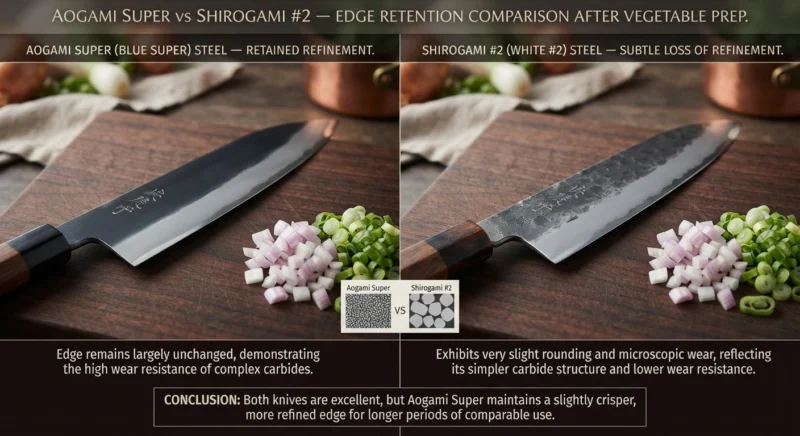
Aogami Super vs Shirogami #2: Edge Retention
This is where Aogami Super has one of its clearest advantages.
Winner: Aogami Super
Aogami Super generally holds a useful cutting edge longer than Shirogami #2 under comparable conditions.
The reason is primarily its combination of:
- Higher carbon
- More tungsten
- Vanadium
- Higher attainable hardness
- Greater wear resistance
The difference can be noticeable for users who cut for long periods without sharpening.
Shirogami #2 can become extremely sharp, but its relatively simple composition gives it less resistance to abrasive wear.
Aogami Super sacrifices some of the effortless sharpening character of Shirogami in exchange for longer edge life.
That is the central trade-off.
Check Our Guide Edge Retention Explained: 10 Factors What Makes a Knife Stay Sharp Longer
Does Aogami Super Stay Sharp Twice as Long?
It is better not to use a fixed multiplier.
You will sometimes see claims that one steel lasts exactly twice as long, three times as long, or a specific number of weeks longer.
Real kitchen use is too variable for such numbers to be universal.
Edge retention depends on:
- Food
- Cutting board
- Edge angle
- Knife geometry
- Hardness
- Cutting technique
- Contact with abrasive particles
- Frequency of honing or stropping
- User expectations for sharpness
Someone who considers a knife “dull” when it loses its shaving edge will report different results from someone who considers it sharp as long as it still slices vegetables efficiently.
Therefore, the scientifically safer conclusion is:
Aogami Super generally has substantially higher wear resistance and longer edge retention than Shirogami #2, but the actual difference in kitchen use varies considerably.
That is more useful than promising an exact number.
Shirogami #2 Edge Retention
Shirogami #2 should not be described as having poor edge retention.
That would be unfair.
A properly heat-treated Shirogami #2 knife can hold an excellent working edge.
Its weakness is relative.
Compared with a highly alloyed steel such as Aogami Super, it has less resistance to abrasive wear.
But Shirogami #2 offers something in return.
It can be sharpened quickly and refined extremely well.
For a cook who enjoys frequent sharpening, this can be an advantage rather than a disadvantage.
Instead of trying to maximize the time between sharpening sessions, the user may prefer a steel that returns to peak sharpness quickly.
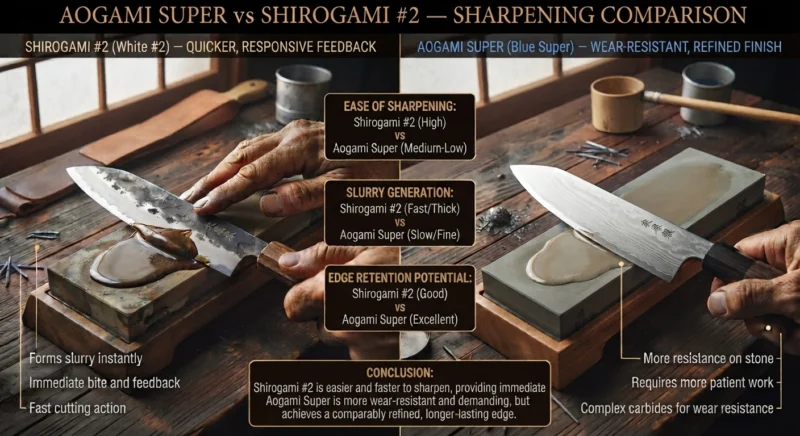
Aogami Super vs Shirogami #2: Sharpening
Winner: Shirogami #2
This is probably the strongest argument for Shirogami #2.
Shirogami #2 is famous for its excellent response on waterstones.
Because the alloy is relatively simple, the stone tends to interact with the steel in a very predictable way.
A burr develops readily.
The bevel becomes easy to refine.
The user can often feel the progression clearly through the stone.
This is especially valuable for people who enjoy sharpening Japanese knives.
Aogami Super is also capable of excellent sharpening performance.
It is not an impossible steel.
It is not comparable to the most difficult modern powder steels simply because it contains vanadium and tungsten.
But it is generally more resistant to abrasion than Shirogami #2.
That difference becomes particularly noticeable on softer stones or when repairing a heavily worn edge.
Check Our Guide All Kinds of Knife Sharpening Tools
Why Does Shirogami #2 Feel So Good on a Waterstone?
Part of the answer comes from the steel’s relative simplicity.
When a sharpening stone contacts the bevel, material is removed through abrasion.
With a relatively simple carbon steel, the response can feel very direct.
The stone cuts.
The steel responds.
The burr forms.
The bevel can then be refined.
This feedback is one of the reasons traditional Japanese sharpeners have long appreciated simpler carbon steels.
The experience is not merely about speed.
It is about communication.
A skilled sharpener can feel changes in pressure, angle, burr formation, and contact area.
Shirogami #2 tends to make these changes easy to perceive.
How Does Aogami Super Feel on a Stone?
Aogami Super can still be enjoyable to sharpen.
But it generally feels more resistant.
The alloy contains hard carbides, particularly tungsten- and vanadium-bearing carbides.
These contribute to wear resistance during cutting, but the same characteristic means that the sharpening stone has more work to do.
This creates a useful relationship:
The property that helps Aogami Super resist wear during cutting also makes it somewhat more resistant to abrasion during sharpening.
That is not a defect.
It is the trade-off built into the alloy.
The better the stone and the more controlled the sharpening technique, the less troublesome this becomes.
Which Is Easier to Sharpen?
For most users:
Shirogami #2 is easier.
Aogami Super:
Still very sharpenable, but more demanding.
This distinction is important.
You should not think of the comparison as:
Shirogami #2 = easy
Aogami Super = extremely difficult
A more accurate description is:
Shirogami #2 = exceptionally responsive
Aogami Super = highly capable but more abrasion-resistant
Someone who already knows how to sharpen Japanese carbon steel should have little reason to fear Aogami Super.
Which Steel Gets Sharper?
This question is surprisingly difficult to answer.
Both steels can reach extremely high levels of sharpness.
The final sharpness of a knife is influenced by:
- Edge geometry
- Burr removal
- Stone quality
- Final grit
- Sharpening technique
- Steel microstructure
- Heat treatment
- Edge angle
Shirogami #2 has a reputation for producing an exceptionally refined edge.
Aogami Super can also produce an extremely keen edge.
Therefore, it is misleading to say that Aogami Super cannot become as sharp as Shirogami #2.
A better distinction is about edge character and sharpening behavior.
Shirogami #2 often feels exceptionally clean and refined when polished on a fine stone.
Aogami Super combines a very fine edge with substantially stronger wear resistance.
In practical kitchen work, both can be extraordinarily sharp.
Aogami Super vs Shirogami #2: Cutting Feel
This category is difficult to quantify, but experienced users often notice a difference.
Shirogami #2 has a reputation for an especially clean and responsive cutting sensation.
It can feel almost effortless when used with a thin geometry.
Aogami Super can produce a similarly impressive cutting edge, but the overall character can feel slightly different because of the harder and more highly alloyed microstructure.
However, geometry is often more important than steel here.
A beautifully ground Shirogami #2 knife can feel completely different from a thick, poorly ground Shirogami #2 knife.
The same applies to Aogami Super.
A steel name cannot compensate for poor geometry.
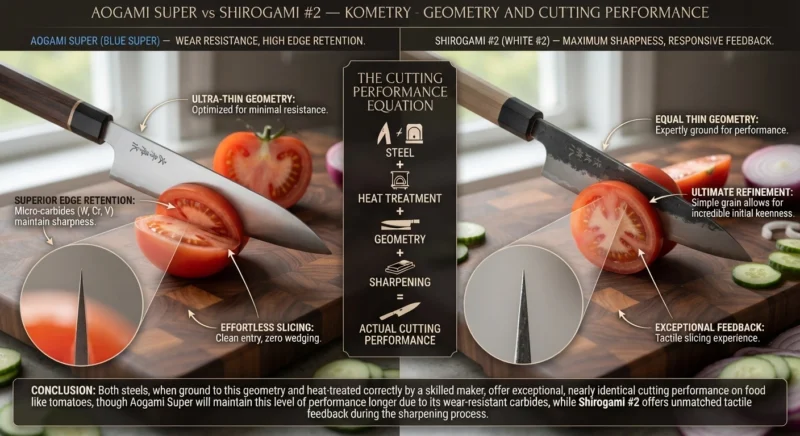
Geometry Can Matter More Than Steel
This is one of the most important points in any knife-steel comparison.
Suppose you have two knives.
Knife A is made from Shirogami #2 and has:
- Thin geometry
- Excellent heat treatment
- A carefully sharpened edge
- Low resistance behind the edge
Knife B is made from Aogami Super but has:
- Thick geometry
- A poor grind
- An inconsistent edge
- Excess material behind the cutting edge
Which knife will feel better while cutting vegetables?
The answer may easily be Knife A.
This does not contradict the steel comparison.
Aogami Super may have superior wear resistance.
But the cutting experience is determined by the entire knife.
Steel is only one component.
Aogami Super vs Shirogami #2: Edge Stability
Edge stability refers to how well the very edge maintains its shape during cutting.
A knife edge can fail in several ways.
It can:
- Wear away gradually
- Roll
- Micro-chip
- Fracture
- Lose its apex through deformation
Hardness can help reduce rolling and deformation.
But extremely thin edges can still chip if subjected to inappropriate forces.
Aogami Super’s high hardness and refined microstructure can provide excellent edge stability when the blade is properly heat treated.
Shirogami #2 can also have outstanding edge stability, particularly when the edge angle is appropriate for the application.
Again, there is no universal “best” angle.
A very thin edge is fantastic for controlled slicing.
It is less suitable for twisting, chopping through hard materials, or careless contact with hard boards.
Is Aogami Super More Brittle?
It can be more demanding than Shirogami #2 when hardened very aggressively.
But “brittle” is too simplistic.
Toughness depends on the entire heat-treated microstructure.
A properly produced Aogami Super knife can be remarkably stable for such a hard steel.
Nevertheless, a knife hardened into the mid-60s HRC should be treated with respect.
Do not:
- Twist the knife through food
- Pry with the edge
- Cut bones
- Cut frozen food
- Chop hard shells
- Strike the cutting board aggressively
- Use the knife as a scraper
These recommendations apply to many high-hardness Japanese knives, not only Aogami Super.
Shirogami #2 and Chipping
Shirogami #2 can also chip.
Its reputation for easy sharpening sometimes creates the impression that it is a forgiving steel.
It is not necessarily forgiving in the same sense as a tougher, softer steel.
A thin Shirogami #2 knife can have a delicate edge.
That is part of what makes it cut so well.
The solution is not to make the edge excessively thick.
Instead, match the edge geometry and sharpening angle to the intended work.
A thin edge for delicate slicing is one thing.
A thin edge used against frozen food is another.
Aogami Super vs Shirogami #2: Toughness
If everything else is equal, Shirogami #2 can have an advantage in practical toughness because it is normally used at lower hardness and has a simpler alloy system.
But this is not an absolute rule.
Heat treatment changes everything.
Two knives made from the same steel can have noticeably different toughness depending on how they were hardened and tempered.
The best way to think about it is:
Aogami Super prioritizes high hardness and wear resistance.
Shirogami #2 offers a simpler route to high hardness while retaining exceptionally easy sharpening and refined edge behavior.
Neither should be treated as an impact-resistant steel.
Both are intended for controlled cutting.
Aogami Super vs Shirogami #2: Corrosion Resistance
Winner: Neither
Both are reactive carbon steels.
Shirogami #2 is particularly reactive because of its extremely low alloy content.
Aogami Super contains some chromium, but not enough to make it stainless.
Therefore, both require maintenance.
The difference in real-world corrosion behavior can vary depending on finish, patina, food exposure, storage, humidity, and surface condition.
The safest approach is to treat both as carbon steel.
How to Maintain Shirogami #2
After cutting:
- Wipe the blade regularly.
- Wash it when necessary.
- Dry it immediately.
- Never leave it submerged.
- Do not put it in a dishwasher.
- Avoid prolonged contact with acidic foods.
- Store it completely dry.
- Use food-safe oil for longer storage if appropriate.
Shirogami #2 rewards careful maintenance.
The reward is not simply performance.
It is also the way the blade changes over time.
A carbon-steel knife can develop a unique patina that records how it has been used.
How to Maintain Aogami Super
The routine is almost identical.
Wipe the blade during extended food preparation.
Wash and dry after use.
Do not leave the knife wet.
Avoid dishwashers.
Avoid soaking.
If the knife will be stored for an extended period, a light food-safe protective oil can be useful.
Do not assume that the chromium in Aogami Super makes maintenance unnecessary.
It does not.
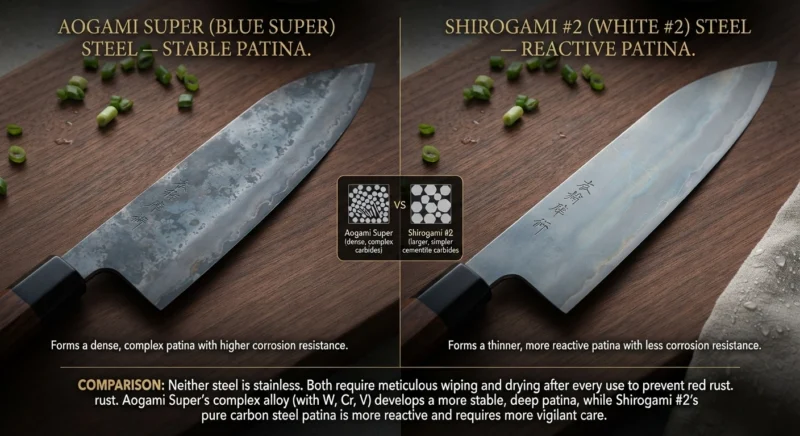
Patina: A Problem or a Feature?
For many carbon-steel knife owners, patina is part of the attraction.
Fresh carbon steel may have a bright or polished appearance.
With use, the surface can gradually change color.
Depending on the food and environment, the patina may appear gray, blue-gray, brownish, or darker.
A stable patina is different from active red rust.
Rust is a corrosion problem.
Patina is generally a surface oxidation layer that develops naturally during use.
Some users deliberately encourage a controlled patina because it gives the knife a distinctive appearance.
Others prefer to keep the blade polished.
Neither approach is inherently wrong as long as active corrosion is prevented.
Aogami Super vs Shirogami #2 for Professional Kitchens
Professional kitchen use creates a particularly interesting comparison.
A professional cook may use a knife for hours.
That makes edge retention important.
At the same time, professional sharpeners may have excellent sharpening skills and access to good stones.
This changes the equation.
For a cook who values maximum time between sharpening sessions, Aogami Super is attractive.
For a cook who prefers frequent touch-ups and values the feel of sharpening, Shirogami #2 can be more satisfying.
There is also a question of cutting style.
A cook who performs precise slicing and maintains an extremely refined edge may prefer Shirogami #2.
Someone preparing large quantities of vegetables and wanting the edge to remain functional longer may appreciate Aogami Super.
Neither is universally better for professional kitchens.
The correct choice depends on workflow.
Aogami Super vs Shirogami #2 for Home Cooks
Home cooks often have a completely different usage pattern.
A knife may be used for 20–40 minutes at a time rather than continuously throughout an entire professional shift.
In that situation, sharpening difficulty becomes less important.
If the knife is sharpened only occasionally, the longer edge life of Aogami Super may be attractive.
But there is another consideration.
Some home cooks genuinely enjoy sharpening.
For them, Shirogami #2 can turn maintenance into part of the hobby.
That is one of the reasons traditional carbon steel remains popular despite the availability of convenient stainless steels.
The user is not simply buying a cutting tool.
They are choosing a particular relationship with the knife.
Which Is Better for Beginners?
This depends on what “beginner” means.
If someone is completely new to carbon steel and has never maintained a reactive blade, neither steel is maintenance-free.
The bigger challenge is learning to:
- Wipe the blade
- Dry it
- Avoid soaking
- Recognize early corrosion
- Sharpen correctly
- Avoid excessive lateral force
For sharpening itself, Shirogami #2 is generally more approachable.
Its feedback is excellent.
Its relatively simple composition makes it easy to understand on a waterstone.
Aogami Super is better suited to someone who already appreciates high-hardness carbon steel and wants more edge life.
Which Steel Is Better for a Gyuto?
Both.
A gyuto is a general-purpose Japanese chef’s knife, so both steels can work exceptionally well.
A Shirogami #2 gyuto can offer:
- Excellent sharpness
- Fine edge potential
- Easy sharpening
- Excellent cutting feel
- Traditional carbon-steel character
An Aogami Super gyuto can offer:
- Excellent sharpness
- High hardness
- Strong edge retention
- High wear resistance
- Fine edge stability
The choice depends on what matters more to the owner.
If you sharpen frequently, Shirogami #2 is compelling.
If you dislike frequent sharpening, Aogami Super becomes more attractive.
Check Our Japanese Gyuto Knife Guide: Everything You Need to Know
Which Steel Is Better for a Nakiri?
Again, both can be excellent.
A nakiri is commonly used for vegetables, where edge geometry and thinness are extremely important.
Shirogami #2 can create a wonderfully responsive vegetable knife.
Aogami Super can provide longer-lasting edge performance for repetitive vegetable preparation.
For a cook cutting large quantities of vegetables every day, the extra wear resistance of Aogami Super may become valuable.
For a home cook who loves an exceptionally refined edge and does regular sharpening, Shirogami #2 can be difficult to beat.
Which Steel Is Better for a Petty Knife?
A petty knife can also use either steel effectively.
Because petty knives are frequently used for detailed cutting, peeling, trimming, and precision work, the ability to maintain a very keen edge is valuable.
Shirogami #2 is particularly attractive for this role because of its sharpening response.
Aogami Super is attractive when the user wants a small knife that retains its edge through repeated detailed work.
Once again, geometry can matter more than the steel label.
Check Our Guide Why Every Home Cook Needs a Petty Knife
Aogami Super vs Shirogami #2 for Single-Bevel Knives
Traditional single-bevel knives introduce another consideration.
A single-bevel knife may be sharpened very frequently and often benefits from an exceptionally refined edge.
Shirogami #2 has a long history of being appreciated for precisely this kind of sharpening.
Its ability to respond quickly to stones makes it particularly attractive.
Aogami Super can also be used successfully in single-bevel designs, especially for users who want greater edge retention.
But the extra wear resistance becomes more noticeable when large amounts of steel need to be removed during maintenance.
For a user who enjoys frequent sharpening, the simpler steel may be preferable.
Aogami Super vs Shirogami #2: Which Has Better Edge Feel?
This is subjective, but Shirogami #2 often gets the advantage.
The combination of simple alloy chemistry, high hardness, fine geometry, and excellent sharpening response creates the characteristic feel that carbon-steel enthusiasts often seek.
Aogami Super can also produce a beautiful edge.
Its advantage is that it combines this cutting performance with greater resistance to wear.
Therefore:
Shirogami #2 emphasizes refinement.
Aogami Super emphasizes refinement plus longevity.
That is a more useful comparison than simply saying one is sharper.
Is Aogami Super “Super Sharp”?
Yes, but the word needs context.
Aogami Super can support an exceptionally sharp edge.
However, the steel does not sharpen itself.
The finished edge depends on:
- Heat treatment
- Grinding
- Edge geometry
- Sharpening technique
- Stone progression
- Burr removal
- Final polishing
A poorly sharpened Aogami Super knife will not magically outperform a beautifully sharpened Shirogami #2 knife.
Likewise, a poorly ground Shirogami #2 blade cannot exploit the full potential of its steel.
Steel provides potential.
The maker and sharpener determine how much of that potential becomes useful.
Why Heat Treatment Matters So Much
Heat treatment is arguably one of the most important variables in the entire discussion.
The composition tells you what the steel is capable of.
Heat treatment determines much of what the finished blade actually becomes.
A knife maker must control processes such as:
- Heating
- Austenitizing
- Quenching
- Tempering
- Cooling
- Grain control
Small differences can influence hardness, toughness, retained austenite, carbide structure, and edge stability.
This is why two Aogami Super knives can feel different.
It is also why two Shirogami #2 knives can behave differently.
The steel designation is not the complete specification of the knife.
Check Our Guide Different Heat Treatment Methods Explained
Does Aogami Super Always Outperform Shirogami #2?
No.
This is an important correction to many simplified online comparisons.
Aogami Super has superior wear resistance.
That does not mean every Aogami Super knife will cut better than every Shirogami #2 knife.
Imagine an excellent Shirogami #2 blade with:
- Excellent heat treatment
- Thin geometry
- A carefully finished edge
- Correct sharpening
- Appropriate edge angle
Now compare it with an Aogami Super blade that is poorly ground or poorly heat treated.
The Shirogami knife can easily be the better performer.
The same principle applies to edge retention.
Steel composition gives a general tendency.
The finished knife determines the actual result.
Does Shirogami #2 Become Dull Quickly?
Not necessarily.
This is another exaggeration worth avoiding.
Shirogami #2 generally loses its peak edge sooner than Aogami Super under comparable abrasive use.
But “sooner” does not mean “quickly.”
A high-quality Shirogami #2 knife can provide excellent working performance for a substantial amount of cutting.
Many professional users are perfectly comfortable with this trade-off because sharpening is part of their routine.
The correct question is therefore not:
“Does Shirogami #2 hold an edge?”
It does.
The better question is:
“How much edge retention do I need before I want to sharpen?”
Which Steel Requires More Maintenance?
In terms of corrosion maintenance, both require care.
In terms of sharpening maintenance, Shirogami #2 is generally easier to refresh.
In terms of frequency of sharpening, Aogami Super may require fewer full sharpening sessions because of its greater wear resistance.
This produces an interesting paradox:
Shirogami #2 requires less effort per sharpening session but may need sharpening more often.
Aogami Super requires more effort when sharpening but may need sharpening less frequently.
That is probably the simplest way to understand the maintenance trade-off.
Aogami Super vs Shirogami #2: Waterstones
Both steels are particularly well suited to waterstone sharpening.
For Shirogami #2, even relatively modest stones can provide excellent results.
The steel responds readily, making it suitable for beginners learning how to create and remove a burr.
Aogami Super benefits from quality abrasives, particularly when substantial metal removal is required.
Diamond-containing or otherwise aggressive abrasives can be useful for repair and reprofiling, while conventional waterstones work extremely well for routine maintenance.
For either steel, technique matters more than having an enormous collection of stones.
A simple progression can produce excellent results.
What Grit Should You Use?
There is no universal grit progression.
For ordinary maintenance, a medium stone is often sufficient.
For damaged edges, a coarse stone can be useful.
For refinement, a finer stone can produce a more polished edge.
Shirogami #2 can particularly reward fine finishing stones.
Aogami Super can also take a highly refined edge, but users should not assume that more polishing automatically means better cutting.
Different foods favor different edge finishes.
A slightly toothier edge can be excellent for certain vegetables.
A polished edge can be excellent for delicate slicing.
The best final finish depends on the application.
Aogami Super vs Shirogami #2 for Food Preparation
For vegetables, both can perform exceptionally well.
For fish, both can provide the clean slicing performance associated with traditional Japanese knives.
For proteins, both can work effectively as long as the edge geometry matches the job.
Neither should be used to cut through bones or frozen food simply because the steel is hard.
The advantage of these steels appears when they are used as precision cutting tools.
Their strength is controlled cutting.
Their weakness is abuse.
Which Steel Has Better Wear Resistance?
Aogami Super
This is one of the easiest categories to answer.
Aogami Super contains substantially more tungsten and also contains vanadium and other alloying elements that contribute to wear resistance.
Shirogami #2 is comparatively simple.
Therefore, Aogami Super has a clear advantage in abrasive wear resistance.
This advantage is one of the main reasons it can maintain an edge longer.
Check Our Guide Wear Resistance vs Toughness: Understanding the Most Important Knife Steel Trade-Off
Which Steel Is Easier to Sharpen?
Shirogami #2
The difference is also relatively clear.
Shirogami #2 generally responds faster and more predictably to waterstones.
Aogami Super is still quite manageable compared with some modern high-wear-resistance steels, but it requires more work.
So if your favorite part of owning a Japanese knife is sharpening it:
Shirogami #2 is hard to beat.
If sharpening is simply a necessary chore:
Aogami Super may be more attractive.
Which Steel Takes the Better Edge?
This is much closer.
Both can take an extremely keen edge.
Shirogami #2 has a particularly strong reputation for achieving an exceptionally refined edge.
Aogami Super can also produce outstanding sharpness while maintaining that edge longer.
Therefore, rather than declaring a universal winner, it is more accurate to say:
Shirogami #2 has the stronger reputation for ultimate sharpening refinement.
Aogami Super offers an excellent refined edge with greater wear resistance.
Which Steel Is More Forgiving?
Neither is particularly forgiving compared with ordinary stainless kitchen steel.
Both require maintenance.
Both dislike lateral force.
Both can chip when abused.
Both should be sharpened with proper technique.
Shirogami #2 may be more forgiving on the sharpening stone.
Aogami Super may be more forgiving in terms of edge longevity.
But neither should be considered a careless-use steel.
Aogami Super vs Shirogami #2: Cost and Value
Steel alone does not determine knife price.
Two knives made from the same steel can have completely different prices.
The final cost can reflect:
- Blade geometry
- Heat treatment
- Grinding
- Finishing
- Handle construction
- Cladding
- Labor
- Quality control
- Design
- Production scale
Aogami Super often appears in premium knives because its alloy and heat treatment can support high performance.
Shirogami #2 is also found in very high-end knives.
A more expensive Shirogami #2 knife is not necessarily “worse” because the steel costs less to produce.
The value comes from the complete knife.
Aogami Super vs Shirogami #2: Which Is Better for Someone Who Sharpens Weekly?
Shirogami #2
If you sharpen frequently, the faster sharpening response of Shirogami #2 can become a genuine advantage.
You can quickly restore the edge.
You can experiment with different finishes.
You can refine the bevel without spending excessive time removing steel.
For sharpening enthusiasts, this can be more enjoyable than maximizing time between sessions.
Which Is Better for Someone Who Sharpens Monthly?
Aogami Super
If you prefer longer periods between sharpening sessions, Aogami Super becomes more attractive.
Its wear resistance allows the edge to remain useful longer under comparable conditions.
When sharpening finally becomes necessary, you will spend somewhat more time at the stones.
For many home cooks, that is a worthwhile exchange.
Which One Should You Choose?
The decision becomes much easier if you stop asking which steel is “best.”
Ask instead what you want the knife to do.
Choose Shirogami #2 if you value:
- Extremely responsive sharpening
- Fine edge refinement
- Traditional carbon-steel character
- Easy waterstone work
- Frequent sharpening
- Excellent cutting feel
- Simplicity of alloy
Choose Aogami Super if you value:
- Longer edge retention
- Greater wear resistance
- Very high hardness
- High-performance edge stability
- Less frequent sharpening
- A highly refined edge combined with greater longevity
- A more alloyed traditional carbon-steel design
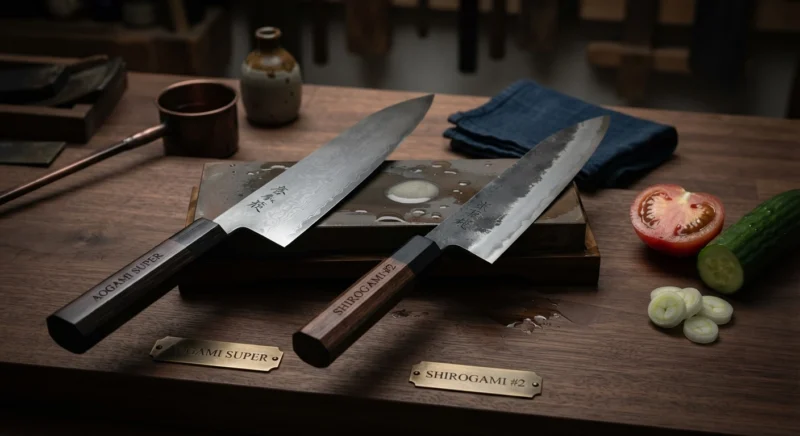
Aogami Super vs Shirogami #2: The Real Trade-Off
The entire comparison can be reduced to one fundamental trade-off.
Shirogami #2 says:
Give me a simple steel, sharpen me easily, and I will reward you with an exceptionally refined edge.
Aogami Super says:
Give me more alloying and more demanding heat treatment, and I will give you a refined edge that survives wear for longer.
Neither philosophy is wrong.
In fact, both represent excellent solutions to different problems.
Shirogami #2 is about interaction.
Aogami Super is about endurance.
Why Experienced Knife Users Often Own Both
It is easy to assume that serious knife enthusiasts eventually choose one steel and abandon the others.
In reality, different steels can make sense for different knives.
A cook may prefer Shirogami #2 for a precision knife.
The same cook may choose Aogami Super for an everyday gyuto.
Another user may prefer Shirogami #2 for a single-bevel knife and Aogami Super for a vegetable knife.
There is no contradiction.
The best steel depends on the knife’s job.
The Importance of Edge Angle
Edge angle can completely change the comparison.
A knife sharpened at a very acute angle can cut exceptionally well.
But a very thin edge has less material supporting the apex.
A more robust angle can survive harder use but may sacrifice some cutting efficiency.
Therefore, if someone compares two steels using different edge angles, the result is no longer a fair steel comparison.
The same principle applies to geometry.
Steel should ideally be compared using knives with similar:
- Thickness
- Edge angle
- Grind
- Hardness
- Blade shape
- Cutting conditions
Without that control, “Steel A lasts twice as long as Steel B” becomes a questionable statement.
The Cutting Board Matters
The cutting board is another overlooked variable.
A knife used on a soft wooden board experiences different stresses from one used on a hard synthetic board.
Repeated contact with a harder surface can accelerate edge wear or deformation.
The effect is not identical for every knife.
This means the same Aogami Super knife may behave differently in two kitchens.
The same is true for Shirogami #2.
If you want maximum edge life from either steel, the cutting environment matters.
Food Matters Too
Different foods interact with the edge differently.
Soft vegetables are relatively gentle.
Hard vegetables can create more stress.
Acidic foods can affect reactive steel chemically.
Protein preparation introduces different cutting patterns.
Frozen foods can create impact.
Bones are another category entirely.
A knife steel cannot compensate for inappropriate use.
The most advanced carbon steel in the world can still chip if the edge is driven into a hard object.
A Note About “Sharpness”
Sharpness is often treated as though it were a single number.
It is not.
A knife can feel extremely sharp because its apex is extremely fine.
Another knife can feel less “laser-like” but retain useful cutting ability for longer.
There is also a difference between:
- Initial sharpness
- Peak sharpness
- Working sharpness
- Edge retention
- Cutting aggression
- Edge smoothness
This distinction is especially important in the Aogami Super vs Shirogami #2 comparison.
Shirogami #2 can provide an exceptional initial and refined edge.
Aogami Super can provide an excellent edge and keep that edge useful longer.
Those are different advantages.
Aogami Super vs Shirogami #2: Final Verdict
There is no universal winner.
But there is a clear winner for specific priorities.
Best for sharpening feel: Shirogami #2
Shirogami #2 is exceptionally responsive on waterstones and is one of the most satisfying traditional steels to sharpen.
Best for edge retention: Aogami Super
Aogami Super has substantially greater wear resistance and generally keeps a working edge longer.
Best for ultimate sharpening simplicity: Shirogami #2
Its relatively simple alloy system makes it exceptionally approachable for manual sharpening.
Best for long periods between sharpening: Aogami Super
The additional alloying elements and higher carbon content give it a clear advantage in wear resistance.
Best for traditional carbon-steel character: Both
Both offer the reactive nature, patina development, high hardness, and refined cutting performance associated with Japanese carbon steel.
Best for corrosion resistance: Neither
Neither is stainless.
Both require proper care.
Best for a sharpening enthusiast: Shirogami #2
If you enjoy spending time on waterstones, Shirogami #2 is difficult to beat.
Best for someone who wants maximum edge life: Aogami Super
If your priority is reducing the frequency of sharpening while retaining excellent cutting performance, Aogami Super is the more logical choice.
Final Thoughts
The Aogami Super vs Shirogami #2 debate is ultimately not about choosing between a good steel and a bad steel.
It is about choosing between two different ideas of what a high-performance carbon-steel knife should be.
Shirogami #2 takes a relatively simple approach.
Its low-alloy character allows it to respond beautifully to sharpening and makes it possible to create an exceptionally refined cutting edge.
Aogami Super takes that traditional concept much further into alloy design.
Higher carbon, significantly more tungsten, and additional molybdenum, vanadium, and chromium create a steel capable of very high hardness and substantially improved wear resistance.
The result is longer edge life, but with a sharpening process that demands somewhat more patience.
For someone who sharpens frequently and enjoys the process, Shirogami #2 can be extraordinarily rewarding.
For someone who wants to cut longer before returning to the sharpening stones, Aogami Super is likely to be the better choice.
But the most important lesson is this:
The steel name is only the beginning.
A well-designed knife with excellent geometry and carefully controlled heat treatment can outperform expectations regardless of which of these two steels it uses.
A poorly made knife cannot be rescued simply by having a prestigious steel designation.
That is why choosing between Aogami Super and Shirogami #2 should ultimately come down to how you use, sharpen, and maintain your knife.
If you love the sharpening process and want the most responsive traditional carbon-steel experience, choose Shirogami #2.
If you want exceptional edge retention while still enjoying the character of traditional Japanese carbon steel, choose Aogami Super.
And if you already have experience with both, the answer may be even simpler:
You do not need to choose just one.
Each steel offers something the other does not.
That is precisely what makes the comparison so interesting.
Frequently Asked Questions
Is Aogami Super better than Shirogami #2?
Not in every category. Aogami Super generally has better wear resistance and edge retention, while Shirogami #2 is easier and faster to sharpen and is highly regarded for its refined edge characteristics.
Which is sharper, Aogami Super or Shirogami #2?
Both can become exceptionally sharp. Shirogami #2 has an especially strong reputation for refined sharpening and fine edges, but Aogami Super can also produce an extremely keen edge.
Which holds an edge longer?
Aogami Super generally holds an edge longer because its higher carbon content and alloying elements provide greater wear resistance.
Is Aogami Super stainless?
No. Aogami Super is a reactive carbon steel. Its chromium content is far too low to provide stainless-steel corrosion resistance.
Does Shirogami #2 rust?
Yes. Shirogami #2 is highly reactive and can rust if left wet or exposed to corrosive conditions.
Is Aogami Super difficult to sharpen?
It is more demanding than Shirogami #2, but it is still quite manageable with appropriate waterstones and technique.
Is Shirogami #2 good for beginners?
It can be, especially for beginners who are willing to learn carbon-steel maintenance and sharpening. Its excellent sharpening response makes it relatively easy to learn on.
Is Aogami Super brittle?
At the high hardness levels commonly associated with Aogami Super knives, the edge can be vulnerable to chipping if abused. It should not be twisted, pried, or used on bones or frozen food.
Can both steels develop a patina?
Yes. Both are reactive carbon steels and can develop a natural patina with use.
Which one is better for a professional chef?
It depends on the chef. Aogami Super is attractive for longer edge retention, while Shirogami #2 is attractive for fast sharpening and highly refined edges.
Which one should I choose for a Japanese gyuto?
Both can be excellent. Choose Shirogami #2 if sharpening feel and refinement are your priorities. Choose Aogami Super if longer edge retention is more important.
Does higher carbon automatically make Aogami Super better?
No. Carbon is only one part of the equation. Heat treatment, microstructure, geometry, toughness, carbide distribution, and edge design all affect knife performance.
Does Aogami Super cut better than Shirogami #2?
Not automatically. Aogami Super has advantages in wear resistance, but cutting performance depends heavily on geometry, sharpening, hardness, and blade construction.
Which steel is easier to maintain?
For corrosion, neither is particularly easy because both are reactive carbon steels. For sharpening, Shirogami #2 is generally easier.
Is Aogami Super worth the extra cost?
It can be if you value high hardness and longer edge retention. But the quality of the finished knife matters more than the steel name alone.
Which steel is better for someone who hates sharpening?
Aogami Super is generally the better choice because its greater wear resistance can reduce how frequently the knife needs a full sharpening.
Which steel is better for someone who enjoys sharpening?
Shirogami #2 is an excellent choice because it provides particularly clear feedback and responds quickly to waterstones.
Conclusion
Aogami Super vs Shirogami #2 is ultimately a comparison between edge longevity and sharpening refinement.
Aogami Super uses a substantially more complex alloy system to achieve high hardness and excellent wear resistance.
Shirogami #2 uses a much simpler composition to provide outstanding sharpening response and fine-edge performance.
Neither steel is stainless.
Neither should be abused.
Both require proper maintenance.
Both can produce extraordinarily sharp Japanese kitchen knives.
The right choice depends on your priorities:
Choose Shirogami #2 for sharpening pleasure, refined edge feel, and traditional simplicity.
Choose Aogami Super for greater wear resistance, longer edge retention, and high-hardness performance.
For many knife enthusiasts, the ideal answer is not deciding which steel is universally superior.
It is understanding why each one exists—and choosing the steel that matches the way you actually use your knife.
This article is for independent informational purposes only and is not affiliated with, sponsored by, or endorsed by any steel manufacturer. All product names, trademarks, and registered trademarks are the property of their respective owners.