Shirogami #2 vs MagnaCut
An Independent Guide
Shirogami #2 and MagnaCut represent two very different approaches to knife steel design.
Shirogami #2 is a traditional Japanese high-carbon steel valued for its simplicity, exceptional sharpening response, and ability to take an extremely refined edge. MagnaCut is a modern powder-metallurgy stainless steel designed around a very different goal: achieving an unusually balanced combination of corrosion resistance, toughness, hardness, and useful edge retention.
At first glance, comparing these two steels may seem almost unfair. One comes from the tradition of relatively simple carbon steels used for generations of Japanese blades. The other was deliberately engineered using modern metallurgy to solve some of the compromises found in conventional stainless knife steels.
But the comparison is actually very useful.
Both can make excellent knives. Both can become extremely sharp. Both can be hardened to levels suitable for high-performance cutting. Yet they behave very differently during sharpening, maintenance, exposure to moisture, and demanding use.
The most important question is therefore not simply:
Which steel is better?
A better question is:
Which steel gives you the characteristics you actually want from your knife?
For someone who enjoys sharpening, values a highly refined edge, and does not mind maintaining carbon steel, Shirogami #2 can be exceptionally rewarding.
For someone who wants high performance with dramatically better corrosion resistance, substantially greater toughness, and longer-lasting performance with less maintenance, MagnaCut is usually the more practical choice.
This article examines the differences in detail, including composition, hardness, toughness, edge retention, sharpening, corrosion resistance, cutting feel, geometry, maintenance, and real-world kitchen use.
Shirogami #2 vs MagnaCut: The Short Answer
If you want the simplest possible conclusion, the comparison looks like this:
Choose Shirogami #2 if you prioritize:
- Extremely fine edge potential
- Excellent sharpening feedback
- Fast and relatively easy sharpening
- Traditional Japanese carbon-steel characteristics
- A refined cutting feel
- Frequent maintenance on waterstones
- Traditional single-bevel knives
- Maximum enjoyment from the sharpening process
Choose MagnaCut if you prioritize:
- Excellent corrosion resistance
- Much greater toughness
- Strong edge stability
- Good edge retention
- High hardness
- Lower maintenance
- A knife that can tolerate demanding environments
- A balance between stainless performance and high-level cutting ability
The biggest difference is not that one steel can become sharp and the other cannot.
Both can become extremely sharp.
The bigger difference is how the steels behave before, during, and after that sharpness is achieved.
Shirogami #2 is comparatively simple and highly responsive on sharpening stones. MagnaCut contains a carefully engineered carbide structure that gives it considerably better wear resistance and toughness while retaining excellent corrosion resistance.
That makes the two steels attractive to almost opposite types of knife users.
What Is Shirogami #2?
Shirogami #2, commonly called White #2, is a high-carbon Japanese steel traditionally associated with high-quality cutting tools and kitchen knives.
Its composition is intentionally simple compared with modern alloy steels.
Typical published composition places carbon around 1.05–1.15%, with relatively small quantities of manganese and silicon and very low levels of phosphorus and sulfur. Chromium and other major alloying additions are essentially absent from the design.
That simplicity is one of its most important characteristics.
The steel does not attempt to achieve high corrosion resistance through a large chromium addition. It does not rely on large quantities of vanadium, niobium, tungsten, or molybdenum carbides to produce high wear resistance.
Instead, the basic philosophy is much simpler:
Use a clean high-carbon steel that can be hardened and sharpened to a very fine edge.
That approach has major advantages.
Shirogami #2 is known for excellent sharpening response, and many users particularly appreciate how clearly the steel communicates with a waterstone. It can be relatively quick to sharpen and can be taken to an extremely fine apex when the geometry and heat treatment are appropriate.
However, the same simplicity creates limitations.
Shirogami #2 is not stainless. It is reactive, can develop patina quickly, and can rust if moisture and food residue are allowed to remain on the blade.
Its wear resistance is also much lower than that of many modern highly alloyed steels.
This means that Shirogami #2 is not trying to win every category.
It is optimized around a particular experience:
fine cutting + excellent sharpening + traditional carbon-steel behavior.
Check Our Guide Shirogami #2 (White Steel #2)
What Is MagnaCut?
MagnaCut belongs to a completely different generation of knife steels.
It is a powder-metallurgy stainless tool steel designed to combine properties that traditionally involved significant compromises.
Its nominal composition is approximately:
- Carbon: 1.15%
- Chromium: 10.7%
- Vanadium: 4.0%
- Molybdenum: 2.0%
- Niobium: 2.0%
- Nitrogen: 0.20%
with iron making up the remainder.
Those numbers can look intimidating compared with Shirogami #2.
But the numbers alone do not explain why MagnaCut behaves differently.
The important part of the design is how those elements are distributed in the microstructure.
MagnaCut was specifically engineered to avoid creating the large amount of chromium carbide found in many conventional stainless knife steels. Instead, much of the carbon available for carbide formation is associated with vanadium and niobium, producing a relatively fine carbide structure while leaving a large amount of chromium available in the steel matrix for corrosion resistance.
That is one of the central ideas behind MagnaCut.
It is not simply a steel with “a lot of everything.”
It is an attempt to put the alloying elements where they provide the desired properties.
The result is a stainless steel capable of reaching approximately the low-to-mid 60s HRC while maintaining unusually strong toughness and corrosion resistance for a steel at that hardness. Testing has also shown a fine microstructure compared with many other powder-metallurgy stainless steels.
In other words, MagnaCut is designed around balance.
Check Our Guide MagnaCut Steel Review
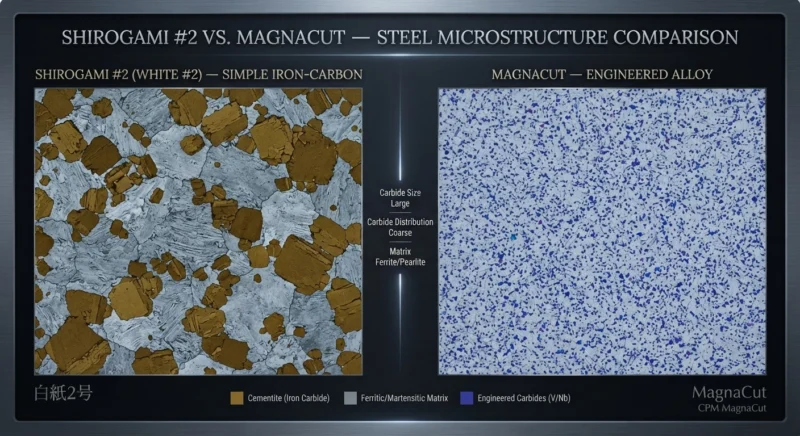
Shirogami #2 vs MagnaCut Composition
The chemical difference between these steels explains much of their behavior.
Shirogami #2 is primarily a high-carbon steel.
Its carbon content is roughly 1.05–1.15%, while the intentional alloy content is very limited.
MagnaCut has a similar amount of carbon at approximately 1.15%, but that is where the similarity largely ends.
MagnaCut adds substantial chromium together with vanadium, molybdenum, niobium, and nitrogen.
The result is two completely different metallurgical strategies.
Shirogami #2 relies heavily on its high carbon content and relatively simple microstructure.
MagnaCut uses a carefully engineered alloy system to create a combination of:
- Hardness
- Wear resistance
- Toughness
- Corrosion resistance
- Edge stability
This distinction is important because it explains why you should not compare steels simply by looking at carbon percentage.
Both steels contain around 1.1% carbon.
Yet their finished properties can be dramatically different.
Carbon is only one part of the equation.
The alloying elements, carbide structure, heat treatment, hardness, grain size, and final geometry all matter.
Why Does Shirogami #2 Feel So Different?
One of the most interesting characteristics of Shirogami #2 is its sharpening behavior.
A relatively simple steel does not create the same sharpening experience as a highly alloyed powder steel.
On a waterstone, Shirogami #2 tends to respond quickly and predictably. The user can often feel the interaction between the stone and the blade very clearly.
This is one reason traditional Japanese carbon steels remain popular among sharpening enthusiasts.
There is very little mystery involved.
You establish the bevel.
You raise a burr.
You remove the burr.
You refine the edge.
The process can feel almost immediate.
The absence of large quantities of hard alloy carbides also means that conventional waterstones can remove material efficiently.
This does not mean Shirogami #2 is soft.
It is not.
A properly heat-treated Shirogami #2 kitchen knife can be quite hard, commonly around the low 60s HRC, depending on the individual knife and heat treatment.
The important distinction is:
hardness is not the same thing as sharpening difficulty.
A hard but relatively simple carbon steel can sometimes be more pleasant to sharpen than a softer steel containing a large amount of extremely hard carbide.
That is one of the reasons Shirogami #2 has such a strong reputation among people who enjoy sharpening.
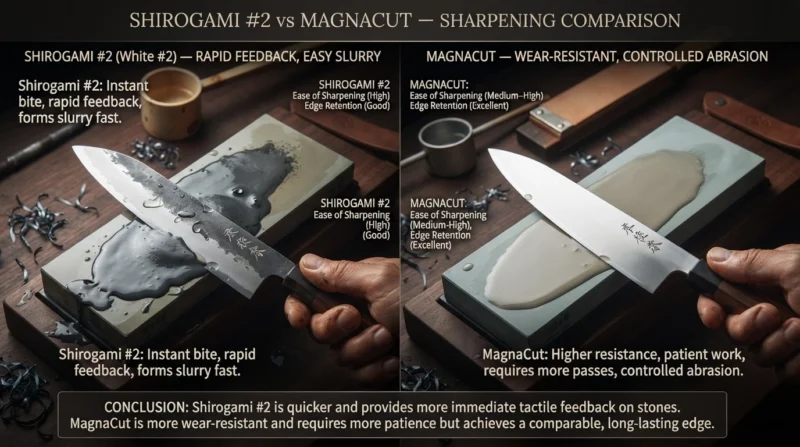
Why MagnaCut Is Different on the Sharpening Stone
MagnaCut is not difficult to sharpen in the way some very wear-resistant steels can be.
This is an important point.
It would be inaccurate to describe MagnaCut as an extremely difficult steel to sharpen.
Published testing and reports from experienced sharpeners indicate that MagnaCut can sharpen quite well on conventional stones, especially because its microstructure is relatively fine.
However, it is still a more highly alloyed steel than Shirogami #2.
The vanadium and niobium carbides are very hard.
They contribute to wear resistance and therefore help the edge resist abrasion during use. But the same characteristics mean that sharpening is not as effortless as it can be with a simple carbon steel.
At moderate hardness, MagnaCut can provide very good sharpening response.
At higher hardness, the steel can feel more resistant and less “creamy” than Shirogami #2.
This creates an interesting situation.
MagnaCut is one of the modern stainless steels that can be relatively pleasant to sharpen.
But Shirogami #2 remains the more traditional, direct, and responsive sharpening experience.
If sharpening itself is one of the pleasures of owning a knife, Shirogami #2 has a significant advantage.
If sharpening is simply maintenance that you want to complete efficiently, MagnaCut may be preferable because you will generally need to perform it less frequently.
Check Our Guide All Kinds of Knife Sharpening Tools
Which Takes a Sharper Edge?
This question is more complicated than it first appears.
Both steels can become extremely sharp.
It would be misleading to say that Shirogami #2 automatically becomes sharper simply because it is a traditional carbon steel.
The final sharpness of a knife depends on many factors:
- Edge geometry
- Edge angle
- Heat treatment
- Blade thickness
- Grinding quality
- Stone progression
- Burr removal
- Finishing technique
- Steel microstructure
- Cutting technique
A poorly sharpened Shirogami #2 knife will not outperform a beautifully sharpened MagnaCut knife simply because of its steel name.
However, Shirogami #2 has an excellent reputation for producing an exceptionally refined apex.
Its simple composition and relatively low carbide complexity make it particularly well suited to fine edge work.
This is one reason traditional Japanese knives using this steel can feel so precise when cutting vegetables, fish, fruit, herbs, and other foods where a clean edge is valuable.
MagnaCut can also produce an excellent edge.
In fact, one of its advantages is that it does not sacrifice fine-edge capability simply because it is stainless.
The important conclusion is therefore:
Shirogami #2 has an advantage in sharpening feel and traditional fine-edge refinement, but MagnaCut is fully capable of producing a very sharp kitchen knife.
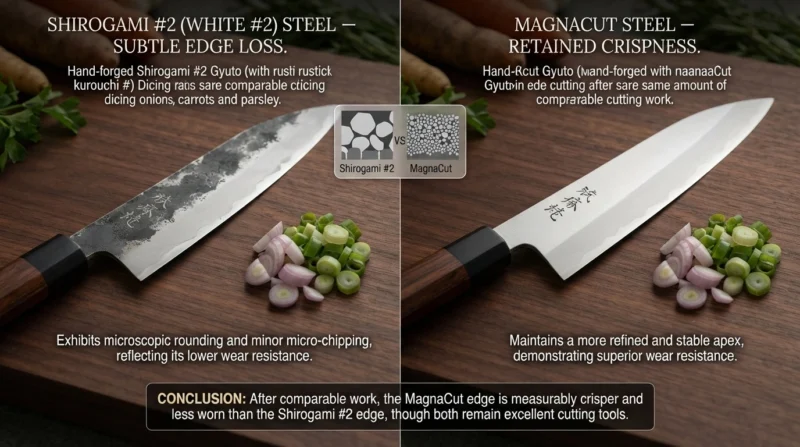
Shirogami #2 vs MagnaCut Edge Retention
This is one category where MagnaCut generally has the advantage.
Shirogami #2 is capable of producing an exceptionally sharp edge, but its relatively simple composition does not provide the same level of wear resistance as a modern alloy steel containing significant quantities of hard vanadium and niobium carbides.
That means the edge gradually loses its finest apex during repeated cutting.
This is particularly noticeable during high-volume preparation.
Imagine cutting several kilograms of vegetables during a professional kitchen shift.
A Shirogami #2 knife may start with an exceptionally refined edge and feel spectacular.
But the user may need to refresh the edge more frequently than with a highly alloyed steel.
MagnaCut is designed to resist this kind of abrasive wear better.
The hard carbide structure helps the edge survive repeated contact with food and cutting boards for longer.
Published CATRA testing places MagnaCut in the general range of several well-regarded high-performance knife steels for edge retention rather than in the extreme top tier of wear-resistant steels. That distinction is important: MagnaCut’s design goal was not maximum possible wear resistance. It was a balanced combination of properties.
So MagnaCut should not be described as an “edge-retention monster.”
Its strength is balance.
Compared with Shirogami #2, however, MagnaCut will generally provide longer-lasting edge performance.
Why More Edge Retention Is Not Always Better
This is an important point for anyone comparing knife steels.
A knife that stays sharp longer is not automatically a better knife.
Imagine two knives.
Knife A stays extremely sharp for a long time but requires significant work when it eventually becomes dull.
Knife B loses some peak sharpness sooner but can be restored in a few minutes on a waterstone.
Which one is better?
The answer depends on the user.
A professional chef who has a sharpening routine may prefer Knife B.
Someone who wants minimum maintenance may prefer Knife A.
This is why Shirogami #2 continues to make sense even in an era of highly advanced stainless steels.
Its lower wear resistance is not necessarily a defect.
For the right user, it is part of the appeal.
Check Our Guide Edge Retention Explained: 10 Factors What Makes a Knife Stay Sharp Longer?
Toughness: MagnaCut Has the Major Advantage
If edge retention is an important difference, toughness is an even bigger one.
MagnaCut was specifically designed to provide unusually high toughness for a stainless steel capable of reaching high hardness.
Testing has shown MagnaCut to have toughness characteristics significantly better than many conventional powder-metallurgy stainless knife steels, with strong results even at relatively high hardness.
Shirogami #2 takes a different approach.
It can be perfectly practical in a kitchen, particularly when the knife has appropriate geometry and is used correctly.
But it should not be treated as a highly impact-resistant steel.
A hard, thin Japanese kitchen knife made from Shirogami #2 is not intended for:
- Chopping bones
- Splitting frozen food
- Twisting through hard ingredients
- Prying
- Striking hard surfaces
- Cutting through shells aggressively
- Lateral abuse
The edge can chip if subjected to inappropriate forces.
MagnaCut gives the user considerably more safety margin.
That does not make a MagnaCut kitchen knife indestructible.
Geometry still matters.
A very thin edge can be damaged regardless of steel.
But when everything else is equal, MagnaCut provides a much more forgiving combination of hardness and toughness.
Check Our Guide Wear Resistance vs Toughness: Understanding the Most Important Knife Steel Trade-Off
Hardness: Shirogami #2 vs MagnaCut
Hardness is another category where simplistic comparisons can create confusion.
Shirogami #2 kitchen knives are commonly found around the low 60s HRC, although actual hardness depends on heat treatment and the individual knife.
MagnaCut has a broader practical range.
Published metallurgical testing has demonstrated that MagnaCut can exceed 63 HRC and reach approximately 64–65 HRC under appropriate heat treatment. At the same time, it can be heat-treated into lower hardness ranges when greater toughness or different performance characteristics are desired.
This flexibility is valuable.
For a thin Japanese-style kitchen knife, a maker may choose a higher hardness to maximize edge stability and retention.
For a tougher general-purpose knife, a somewhat lower hardness may be appropriate.
Therefore, saying “MagnaCut is harder” or “Shirogami #2 is harder” without specifying the actual knife is not particularly useful.
The steel grade provides potential.
The heat treatment determines how much of that potential becomes reality.
Hardness Is Not the Same as Toughness
This distinction deserves special attention.
Hardness measures resistance to deformation and indentation.
Toughness describes the ability of a material to absorb energy before fracturing.
A knife can therefore be very hard while still being relatively vulnerable to impact.
This is why simply searching for the highest possible HRC is not a sensible way to choose kitchen steel.
For example, a very thin blade hardened to an extremely high level can have excellent edge stability during clean slicing but become vulnerable to chipping if used incorrectly.
MagnaCut is particularly interesting because its metallurgy allows relatively high hardness without sacrificing as much toughness as many other stainless steels.
That combination is one of its defining strengths.
Shirogami #2 instead emphasizes the traditional combination of high hardness, fine edge capability, and excellent sharpening behavior.
Neither philosophy is wrong.
They simply prioritize different things.
Check Our Guide What Is HRC? Understanding Rockwell Hardness in Kitchen Knives
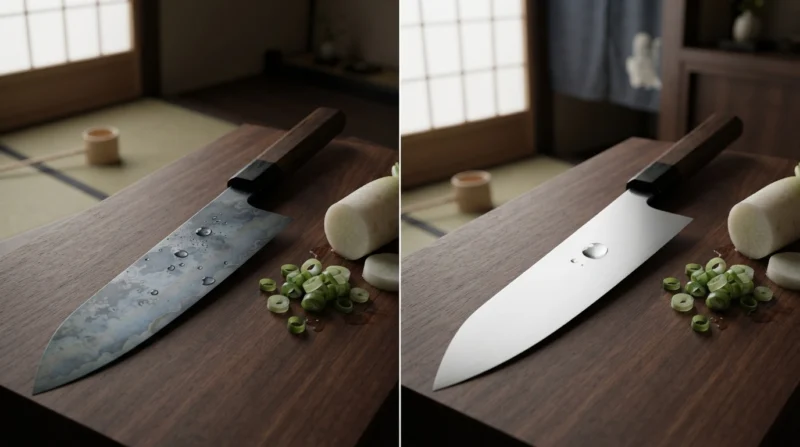
Corrosion Resistance: This Is Not a Close Contest
Here the difference is enormous.
Shirogami #2 is a reactive carbon steel.
MagnaCut is stainless.
Shirogami #2 contains very little chromium and does not have enough chromium in solution to create the corrosion resistance expected from stainless steel.
It can develop patina relatively quickly.
It can also rust if left wet.
Acidic ingredients such as onions, citrus, tomatoes, vinegar, and certain fruits can accelerate visible oxidation and patina formation.
This is not a manufacturing defect.
It is part of the nature of the steel.
MagnaCut is completely different.
Its approximately 10.7% chromium is carefully balanced with the rest of the composition so that a substantial amount remains available in the matrix for corrosion protection. Its microstructure minimizes chromium carbide formation, which helps preserve corrosion resistance.
Actual corrosion testing has shown extremely strong resistance.
Testing of different production material has even shown no rust spots under a standardized 1% saltwater spray test in the reported experiments.
That does not mean MagnaCut is impossible to corrode.
No knife steel should be treated as completely immune to corrosion under every environment.
But compared with Shirogami #2, the difference is dramatic.
Shirogami #2 Patina vs MagnaCut Stainless Finish
For some knife enthusiasts, patina is not a problem.
It is part of the experience.
A Shirogami #2 blade may gradually develop shades of gray, blue, purple, or darker coloration depending on food, humidity, cleaning practices, and use.
Many owners actually like this.
The blade develops a visual history.
Others prefer a clean, bright blade with minimal maintenance.
For those users, MagnaCut is much easier.
You can prepare acidic ingredients without constantly thinking about the blade.
You can work in a humid environment with much less concern.
You can wipe the knife at the end of a meal rather than feeling that every few minutes of neglect could create a rust problem.
This difference becomes especially important outside a controlled home kitchen.
Professional kitchens, catering environments, outdoor cooking, seafood preparation, and humid climates all increase the practical value of corrosion resistance.
Which Steel Is Easier to Maintain?
Shirogami #2 requires more attention.
A basic maintenance routine should include:
- Wipe the blade during use.
- Wash it after use.
- Dry it immediately.
- Never leave it soaking.
- Avoid the dishwasher.
- Store it dry.
- Keep acidic food residue from sitting on the blade.
- Deal with rust early if it appears.
A patina itself is not the same thing as active rust.
Patina is generally a surface oxidation layer that develops gradually.
Rust is a more damaging form of corrosion and should be removed rather than ignored.
MagnaCut makes this routine easier.
Normal good knife care is still recommended, but the steel provides substantially more protection against accidental moisture exposure.
That can be a major quality-of-life improvement.
Shirogami #2 vs MagnaCut Cutting Feel
Cutting feel is one of the hardest characteristics to measure.
It is also one of the characteristics experienced knife users care about most.
A knife’s cutting feel depends on:
- Blade geometry
- Edge thickness
- Grind
- Edge angle
- Hardness
- Steel microstructure
- Sharpening
- Food being cut
- Cutting technique
Shirogami #2 is often associated with a particularly clean and refined cutting sensation.
A properly sharpened, thin Japanese blade can move through vegetables and proteins with very little resistance.
MagnaCut can also provide excellent cutting performance.
The difference is that the steel itself is less likely to be the dominant factor.
A poorly ground MagnaCut knife can feel worse than a beautifully made Shirogami #2 knife.
But a well-designed MagnaCut blade can be extraordinarily capable.
This leads to a very important rule:
Do not buy a steel grade instead of buying a good knife.
The quality of the blade is more important than the name stamped on it.
Geometry Can Matter More Than Steel
Imagine two kitchen knives.
One is made from Shirogami #2 with a thick, poorly finished edge.
The other is made from MagnaCut with a thin, carefully ground edge.
The MagnaCut knife may cut better.
Now reverse the geometry.
A beautifully ground Shirogami #2 blade may dramatically outperform a thick MagnaCut knife.
This is why comparisons based only on steel composition are incomplete.
For kitchen knives, geometry is crucial.
A thin edge reduces the amount of material that the blade must push through food.
A good grind controls friction.
A carefully chosen edge angle determines how efficiently the apex enters the food.
Heat treatment determines whether the steel can support that edge.
Sharpening determines the final condition of the apex.
The steel is one component of a system.
Not the entire system.
Edge Stability: Another Important Difference
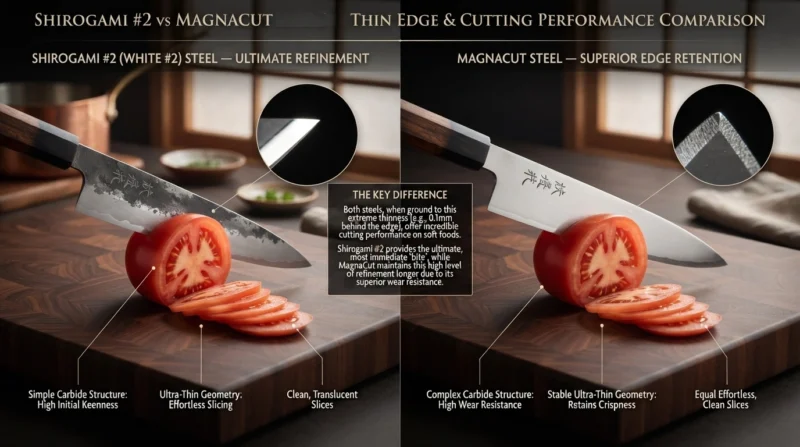
Edge stability describes how well the very edge of the knife resists deformation, chipping, and damage.
A thin edge creates tremendous cutting performance but also creates higher mechanical demands.
Shirogami #2 can support very fine edges, but users need to respect the limitations of a hard carbon-steel blade.
If the edge encounters an unexpected hard object, lateral force, or twisting movement, chipping is possible.
MagnaCut’s combination of fine carbide structure and high toughness gives it a substantial advantage in this area.
This does not mean that you should abuse a MagnaCut knife.
A thin Japanese kitchen knife can still chip.
But the material gives the designer more room to create a thin, hard edge without sacrificing as much toughness.
This is one reason MagnaCut is so interesting for high-performance knives.
It is not simply about being stainless.
It is about making several traditionally conflicting properties coexist reasonably well.
Which Steel Is Better for Professional Kitchens?
The answer depends on the kitchen.
For a chef who enjoys sharpening and works carefully, Shirogami #2 can be an outstanding professional material.
Its sharpening response is excellent.
The edge can become extremely refined.
The cutting experience can be exceptional.
Traditional Japanese single-bevel knives also make particularly good use of the characteristics of simple carbon steels.
But professional kitchens can be harsh environments.
Knives may encounter:
- Constant moisture
- Acidic foods
- Busy prep periods
- Shared workspaces
- Less-than-perfect cleaning
- Frequent use
- Accidental contact with hard surfaces
In that environment, MagnaCut’s corrosion resistance and toughness become extremely attractive.
A chef who wants a high-performance knife without constantly worrying about rust may prefer MagnaCut.
The same is true for professional cooks who sharpen less frequently.
Which Is Better for Home Cooks?
For home cooks, the answer is even more dependent on personal preference.
Shirogami #2 can be fantastic for someone who:
- Enjoys Japanese knives
- Likes sharpening
- Appreciates patina
- Cares about extremely fine edges
- Is willing to wipe and dry the blade
- Cuts mostly vegetables, boneless meat, and fish
- Treats the knife carefully
MagnaCut may be better for someone who:
- Wants stainless performance
- Has limited time for maintenance
- Frequently cooks acidic foods
- Lives in a humid environment
- Wants higher toughness
- Does not want to worry about patina
- Wants good edge retention
- Wants a high-performance knife that is easier to live with
Neither user is making a wrong decision.
They are choosing different priorities.
Shirogami #2 for Traditional Japanese Knives
Shirogami #2 is especially attractive in traditional Japanese knife formats.
Examples include:
- Gyuto
- Nakiri
- Petty
- Santoku
- Yanagiba
- Deba
- Usuba
Its ability to take a fine edge makes it particularly interesting for precision cutting.
Single-bevel knives can be especially rewarding because their sharpening process allows the user to carefully maintain the primary bevel and micro-edge.
In the hands of someone who understands sharpening, Shirogami #2 can become an exceptionally precise cutting tool.
The tradeoff is maintenance.
Traditional carbon-steel knives reward attention.
MagnaCut for Japanese-Style Kitchen Knives
There is no requirement that a Japanese-style knife must use traditional carbon steel.
Modern stainless steels can also be ground extremely thin and sharpened to excellent edges.
MagnaCut is particularly interesting because it can combine:
- High hardness
- Fine edge capability
- Good wear resistance
- Strong toughness
- Excellent corrosion resistance
That makes it suitable for Japanese-style kitchen knives where the user wants a modern maintenance profile.
A thin MagnaCut gyuto can provide excellent performance without requiring the same corrosion-management routine as Shirogami #2.
For many modern home cooks, that is an extremely attractive combination.
Is MagnaCut Harder to Sharpen Than Shirogami #2?
Generally, yes.
But there is an important qualification.
MagnaCut is not an exceptionally difficult modern steel to sharpen.
Published testing reports good sharpening behavior, including successful sharpening on conventional abrasive stones. The fine microstructure is one reason its sharpening behavior can be better than its alloy content might suggest.
Still, Shirogami #2 has the advantage if the primary goal is fast and effortless material removal.
The difference becomes particularly noticeable when repairing a damaged edge or changing the bevel.
Shirogami #2 can usually be worked quite efficiently with traditional waterstones.
MagnaCut may require more time, particularly at higher hardness.
For routine touch-ups, however, the difference may not be dramatic.
And because MagnaCut generally holds its edge longer, you may sharpen it less frequently.
That changes the practical equation.
Which One Is Better for Waterstones?
If you love waterstones, Shirogami #2 is difficult to beat.
It offers excellent feedback.
It responds quickly.
It produces a clear burr.
It can be refined progressively through different grits.
The sharpening process itself becomes part of owning the knife.
MagnaCut can also be sharpened successfully on waterstones.
Modern testing has shown that conventional stones can work well, despite the presence of hard vanadium and niobium carbides.
However, the experience is different.
The steel may feel more resistant, particularly at higher hardness.
Diamond or other highly abrasion-resistant sharpening systems can also be useful for more aggressive work, although a quality conventional stone progression can still produce an excellent edge.
For someone who buys a knife partly because they enjoy sharpening, Shirogami #2 remains extremely appealing.
Which Steel Holds a Fine Edge Longer?
MagnaCut generally wins.
The hard carbide structure provides greater resistance to abrasive wear.
Shirogami #2 can produce an exceptionally fine initial edge, but that edge gradually changes with use.
The important distinction is between:
initial sharpness
and
retention of sharpness.
These are not the same property.
Shirogami #2 can deliver an outstanding initial edge.
MagnaCut can keep a high-performance edge functioning for longer.
This is one of the fundamental tradeoffs between the steels.
Is Shirogami #2 More “Sharp” Than MagnaCut?
Not necessarily.
This is one of the most common misunderstandings in knife-steel discussions.
A steel cannot be declared universally “sharper” without defining how sharpness is measured and controlling the rest of the knife.
A properly sharpened MagnaCut knife can be extremely sharp.
A properly sharpened Shirogami #2 knife can also be extremely sharp.
The difference is often felt more in:
- Sharpening feedback
- Edge refinement
- Cutting feel
- Maintenance
- Edge longevity
rather than in some absolute maximum sharpness number.
A great MagnaCut knife can easily outperform a mediocre Shirogami #2 knife.
Which Steel Is More Forgiving?
MagnaCut.
This is one of its strongest practical advantages.
Its corrosion resistance means you can make small maintenance mistakes without immediately creating a rust problem.
Its toughness gives the edge greater resistance to accidental impact.
Its wear resistance means it can remain functional longer between sharpenings.
Shirogami #2 demands more attention.
It rewards good technique but punishes neglect more quickly.
For an experienced knife enthusiast, that may be part of the fun.
For someone who simply wants a knife that works, MagnaCut is usually easier.
Which Steel Is Better for Seafood?
MagnaCut has a strong practical advantage here.
Fish preparation often involves moisture, salt, and frequent contact with wet surfaces.
Shirogami #2 can certainly be used for seafood.
Traditional Japanese fish knives have demonstrated for generations that reactive carbon steels can perform extremely well in this environment.
But the user must maintain the blade carefully.
MagnaCut dramatically reduces the corrosion burden.
This makes it particularly attractive for modern users who want high-performance cutting without constant concern about oxidation.
For professional seafood preparation, that difference can become especially meaningful.
Check Our Guide 15 Most Popular Seafood Recipes: Easy Fish, Shrimp, Shellfish & More
Which Steel Is Better for Acidic Foods?
Again, MagnaCut has the advantage.
Tomatoes, citrus, vinegar, onions, and many fruits can accelerate patina formation on Shirogami #2.
That does not mean the steel should not be used with them.
It simply means the blade should be wiped and cleaned promptly.
MagnaCut allows much more relaxed use.
If you regularly prepare acidic ingredients and do not enjoy blade maintenance, stainless steel is a significant quality-of-life improvement.
Which Steel Is Better for Outdoor Use?
MagnaCut.
The combination of corrosion resistance and toughness makes it much more suitable for environments where maintenance is difficult.
Think about:
- Camping
- Fishing
- Outdoor cooking
- Humid climates
- Coastal environments
- Hunting camps
- Travel
- Food preparation away from a kitchen
Shirogami #2 can work in these situations, but it requires discipline.
MagnaCut gives you much more room for error.
Check Our Guide Best Handmade Knives for BBQ Season: Upgrade Your Outdoor Cooking Experience
Does MagnaCut Make a Knife Indestructible?
No.
This deserves emphasis.
A tough steel is still capable of damage.
A thin kitchen knife should not be used as:
- A pry bar
- A screwdriver
- A cleaver for bones
- A tool for frozen food
- A lever
- A replacement for an axe
MagnaCut’s toughness gives it more resistance to fracture and chipping, but geometry still matters.
If a blade is extremely thin and hardened to a high level, it can still be damaged by inappropriate use.
Steel selection increases the margin of safety.
It does not eliminate the need for proper knife technique.
Heat Treatment Can Change the Comparison
One of the most important things to understand about knife steel is that the composition is only the beginning.
The same steel can behave differently depending on heat treatment.
Hardness, retained austenite, carbide dissolution, grain size, and other microstructural characteristics can all change.
MagnaCut is a particularly good example.
Testing has demonstrated different combinations of hardness and toughness depending on the heat-treatment parameters. It can be used around the low 60s HRC for a balanced approach or pushed toward the mid-60s when higher hardness and edge stability are desired.
Shirogami #2 is also heavily dependent on heat treatment.
Two knives carrying the same steel designation can feel quite different if they have different hardness, geometry, edge thickness, and sharpening.
Therefore, a steel comparison should always be considered a comparison of potential characteristics, not a guarantee of how every individual knife will perform.
Check Our Guide Different Heat Treatment Methods Explained
The Importance of Edge Angle
Steel does not determine the appropriate edge angle by itself.
A thin kitchen knife can often use a more acute edge than a heavy-duty outdoor knife.
Shirogami #2 is particularly attractive for very fine kitchen edges.
But the thinner the edge becomes, the more important proper technique becomes.
MagnaCut gives the designer more toughness to work with, but even MagnaCut can be damaged if the edge is made excessively thin for the intended application.
The ideal edge is therefore not the thinnest possible edge.
It is the thinnest edge that remains stable for the user’s actual work.
That distinction can make a bigger difference in real-world performance than choosing between two excellent steels.
Shirogami #2 vs MagnaCut for Gyuto Knives
For a gyuto, both steels make sense.
Shirogami #2 Gyuto
A Shirogami #2 gyuto is especially attractive for someone who wants:
- Traditional Japanese carbon steel
- Very fine sharpening
- Excellent cutting feel
- Easy maintenance by sharpening
- A reactive blade that develops patina
- A knife for precision food preparation
It is a knife that rewards care.
MagnaCut Gyuto
A MagnaCut gyuto is attractive for someone who wants:
- Stainless construction
- High toughness
- Excellent corrosion resistance
- Good edge retention
- High hardness
- Fine cutting geometry
- Less maintenance
It is a knife that rewards practicality.
Check Our Japanese Gyuto Knife Guide: Everything You Need to Know
Shirogami #2 vs MagnaCut for Nakiri Knives
Nakiri knives are particularly interesting because their geometry can be extremely thin.
Shirogami #2 works beautifully for vegetable-focused cutting.
The steel can take a refined edge that makes precise vegetable preparation enjoyable.
However, a thin nakiri made from high-hardness carbon steel should be used carefully.
MagnaCut offers more toughness and better corrosion resistance, which can make it a more forgiving choice for daily home use.
If the user values traditional sharpening and patina, Shirogami #2 is compelling.
If the user wants a low-maintenance vegetable knife, MagnaCut has the practical advantage.
Shirogami #2 vs MagnaCut for Petty Knives
A petty knife has a smaller blade, which changes some of the practical considerations.
The smaller size makes sharpening relatively easy regardless of steel.
That means one of Shirogami #2’s disadvantages—frequent sharpening—can become less important.
If you use a petty knife for precise fruit, vegetables, herbs, garnishes, and boneless proteins, Shirogami #2 can be exceptionally enjoyable.
MagnaCut is still attractive when corrosion resistance matters.
For a small knife that is frequently exposed to fruit acids, MagnaCut can eliminate a considerable amount of maintenance.
Check Our Guide Petty Knife vs Paring Knife: Key Differences Explained
Shirogami #2 vs MagnaCut for Single-Bevel Knives
Traditional single-bevel knives are one of the areas where Shirogami #2 remains especially interesting.
The steel’s sharpening behavior fits naturally with a sharpening-intensive knife.
Single-bevel geometry also gives the user considerable control over the edge.
For users who enjoy maintaining the ura and primary bevel, the sharpening experience becomes an important part of the knife.
MagnaCut can certainly be used for single-bevel knives.
But the reason to choose it is different.
The appeal is mainly its modern combination of corrosion resistance, toughness, and high hardness.
If tradition and sharpening experience matter most, Shirogami #2 has the stronger appeal.
Which Steel Is Better for a Sharpening Enthusiast?
Shirogami #2.
This is probably the clearest recommendation in the entire comparison.
If you genuinely enjoy sharpening knives, Shirogami #2 offers something special.
The stone feedback is excellent.
The steel responds quickly.
The edge can be refined easily.
The progression from coarse stone to finishing stone can be very satisfying.
MagnaCut is capable of excellent sharpening performance, but it is ultimately designed to reduce the frequency with which sharpening is necessary.
That creates a philosophical difference.
Shirogami #2 says:
Maintain me frequently and enjoy the process.
MagnaCut says:
Maintain me when necessary and spend more time using the knife.
Both are valid approaches.
Which Steel Is Better for Someone Who Hates Sharpening?
MagnaCut.
This is an easy recommendation.
You will eventually have to sharpen any knife.
But MagnaCut’s stronger wear resistance means you can generally go longer before needing to restore the edge.
Its corrosion resistance also reduces maintenance outside sharpening.
For someone who wants to use a knife rather than maintain it, MagnaCut is much more convenient.
Which Steel Gives Better Value?
That depends on what you consider value.
If value means:
Maximum performance with minimum maintenance, MagnaCut is extremely compelling.
If value means:
The best possible sharpening experience and traditional carbon-steel cutting characteristics, Shirogami #2 can be the better choice.
A knife made from a simple steel is not necessarily inferior to a modern steel.
You are paying for a different combination of properties.
The right question is not whether the steel is technologically newer.
The right question is whether its characteristics match your needs.
Common Myths About Shirogami #2 and MagnaCut
Myth 1: Shirogami #2 is sharper because it is carbon steel
Not automatically.
Both steels can produce extremely sharp edges.
Shirogami #2 has a particularly strong reputation for fine edge refinement and sharpening response, but sharpness depends heavily on geometry and sharpening.
Myth 2: MagnaCut is impossible to sharpen
False.
MagnaCut can sharpen quite well on conventional stones. Its fine microstructure contributes to surprisingly good sharpening behavior for a highly alloyed stainless steel.
It simply does not provide the same effortless sharpening experience as Shirogami #2.
Myth 3: Shirogami #2 has poor edge retention
This is an exaggeration.
Shirogami #2 can provide good edge retention for a simple carbon steel.
The issue is relative performance.
Compared with highly alloyed modern steels, its wear resistance is lower.
Myth 4: MagnaCut has extreme edge retention
Not exactly.
MagnaCut has good edge retention, but its design is about balance rather than maximum wear resistance.
Some specialized steels will outperform it in pure abrasive wear resistance.
MagnaCut’s achievement is combining respectable wear resistance with unusually strong toughness and corrosion resistance.
Myth 5: MagnaCut cannot chip
False.
Any hard, thin knife edge can chip.
MagnaCut simply gives the designer and user a much greater toughness margin than many conventional high-performance stainless steels.
Myth 6: Shirogami #2 must always be polished
No.
A natural patina is normal for reactive carbon steel.
What matters is preventing active rust and maintaining the blade properly.
The Real Tradeoff: Experience vs Convenience
Perhaps the most useful way to compare these steels is to think about the ownership experience.
Shirogami #2 creates a relationship between the user and the knife.
You sharpen it.
You wipe it.
You watch the patina develop.
You learn how the edge behaves.
You gradually become better at maintaining it.
For some people, that is precisely why they buy a traditional Japanese knife.
MagnaCut creates a different relationship.
The steel is designed to remove many of the compromises associated with traditional carbon steel.
You can use the knife around wet ingredients.
You can work with acidic foods.
You can expect greater toughness.
You can sharpen it less frequently.
You can spend more time cooking and less time worrying about the blade.
Neither experience is inherently superior.
It depends on what you enjoy.
Which Steel Should You Choose?
Here is the practical decision.
Choose Shirogami #2 if:
You love sharpening.
You want a traditional Japanese carbon steel.
You want excellent waterstone feedback.
You enjoy creating extremely refined edges.
You appreciate patina.
You are willing to wipe and dry the blade frequently.
You mainly perform controlled kitchen cutting.
You want a steel that makes sharpening part of the ownership experience.
Choose MagnaCut if:
You want stainless performance.
You want excellent corrosion resistance.
You want considerably greater toughness.
You want good edge retention without moving into extremely difficult-to-sharpen steels.
You work around water or acidic ingredients.
You want less maintenance.
You want a high-performance knife that can tolerate more mistakes.
Final Verdict: Shirogami #2 vs MagnaCut
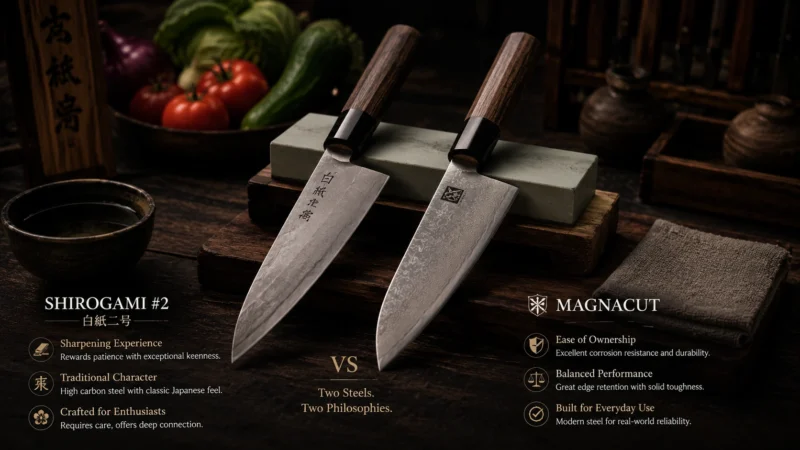
Shirogami #2 and MagnaCut are excellent examples of two completely different philosophies of knife-steel design.
Shirogami #2 is a traditional high-carbon steel with a relatively simple composition. Its strengths include excellent sharpening response, fine edge potential, and a distinctive traditional cutting experience. It is reactive, requires maintenance, and does not offer the wear resistance or toughness of modern highly alloyed steels.
MagnaCut takes the opposite approach.
It uses modern powder metallurgy and a carefully balanced alloy composition to combine high hardness with excellent corrosion resistance, strong toughness, and useful wear resistance. Metallurgical testing has demonstrated that its fine carbide structure and controlled chromium distribution give it an unusual balance of properties.
If the goal is the best sharpening experience, Shirogami #2 is the more attractive choice.
If the goal is maximum convenience, MagnaCut wins.
If the goal is corrosion resistance, MagnaCut wins easily.
If the goal is toughness, MagnaCut has the clear advantage.
If the goal is traditional Japanese carbon-steel character, Shirogami #2 wins.
If the goal is longer-lasting performance with less maintenance, MagnaCut is generally the better option.
And if the question is which steel can make the sharper knife, the answer is more nuanced:
Both can become extremely sharp.
The final performance depends on the knife’s geometry, heat treatment, edge angle, grinding, sharpening, and the skill of the person using it.
That is ultimately the most important lesson.
There is no universally perfect knife steel.
There is only the steel that best matches the knife, the application, and the person holding it.
For a sharpening enthusiast who appreciates traditional Japanese blades, Shirogami #2 remains difficult to replace.
For a modern user who wants high performance without constant corrosion concerns, MagnaCut is one of the most compelling choices available.
Shirogami #2 is about refinement and interaction. MagnaCut is about balance and practicality.
And that is why comparing the two is so interesting.
Frequently Asked Questions
Is Shirogami #2 better than MagnaCut?
Not universally. Shirogami #2 is better for users who prioritize sharpening response, traditional carbon-steel behavior, and extremely refined edges. MagnaCut is better for users who prioritize corrosion resistance, toughness, lower maintenance, and longer-lasting edge performance.
Is MagnaCut sharper than Shirogami #2?
Neither steel is automatically sharper. Both can be sharpened to an extremely fine edge. Knife geometry, heat treatment, sharpening technique, and edge angle have a major influence on final sharpness.
Which has better edge retention?
MagnaCut generally has better edge retention because its alloy system and carbide structure provide greater wear resistance than the relatively simple composition of Shirogami #2.
Which is easier to sharpen?
Shirogami #2 is generally easier and faster to sharpen. MagnaCut is nevertheless considered relatively easy to sharpen for a modern high-alloy stainless steel.
Is Shirogami #2 stainless?
No. Shirogami #2 is a reactive carbon steel and can patina or rust if not maintained properly.
Is MagnaCut stainless?
Yes. MagnaCut is designed as a stainless knife steel with unusually high corrosion resistance for its hardness and overall performance level.
Which is tougher?
MagnaCut has a major toughness advantage. Its metallurgy was specifically developed to achieve much higher toughness than many conventional high-performance stainless steels while retaining high hardness and useful wear resistance.
Which is better for Japanese kitchen knives?
Both can be excellent. Shirogami #2 is especially attractive for traditional Japanese knives and sharpening enthusiasts. MagnaCut is particularly attractive for users who want Japanese-style geometry combined with modern stainless performance.
Which is better for a gyuto?
Either can be excellent. Choose Shirogami #2 for traditional carbon-steel characteristics and sharpening feel. Choose MagnaCut for corrosion resistance, toughness, and lower maintenance.
Which steel needs more maintenance?
Shirogami #2 requires considerably more maintenance because it is reactive. MagnaCut is much more resistant to corrosion and is therefore easier to live with.
Can Shirogami #2 chip?
Yes. Like other hard, fine-edged carbon steels, Shirogami #2 can chip if subjected to impact, twisting, lateral force, bones, frozen food, or other inappropriate use.
Can MagnaCut chip?
Yes. MagnaCut is unusually tough for a high-performance stainless steel, but no knife steel is immune to chipping. Very thin or highly hardened edges can still be damaged by misuse.
Does MagnaCut require diamond stones?
No. MagnaCut can be sharpened successfully with conventional quality waterstones. More aggressive abrasives can be useful when removing significant amounts of steel or repairing an edge, but they are not mandatory for normal sharpening.
Does Shirogami #2 hold its edge well?
It has good edge retention for a simple carbon steel. However, its wear resistance is lower than that of many modern alloyed steels, including MagnaCut.
Is MagnaCut harder than Shirogami #2?
It can be. MagnaCut has the potential to reach the low-to-mid 60s HRC, while Shirogami #2 kitchen knives are commonly around the low 60s. But actual hardness depends on the heat treatment of the individual knife.
Which steel is better for someone who sharpens every week?
Shirogami #2 can be an excellent choice. Its easy sharpening and excellent stone feedback make frequent maintenance enjoyable rather than burdensome.
Which steel is better for someone who rarely sharpens?
MagnaCut is generally the better fit because it combines useful edge retention with excellent corrosion resistance and can tolerate a broader range of everyday conditions.
Which steel is better for wet environments?
MagnaCut by a very large margin. Its corrosion resistance is one of its defining advantages.
Conclusion
The Shirogami #2 vs MagnaCut comparison is ultimately not a battle between old and new.
It is a comparison between two different priorities.
Shirogami #2 emphasizes a clean, traditional steel composition, excellent sharpening behavior, and refined edge performance.
MagnaCut emphasizes balance: corrosion resistance, toughness, hardness, wear resistance, and practical edge stability.
If you want to sharpen your knife often and enjoy every minute of the process, Shirogami #2 can be one of the most satisfying steels available.
If you want a knife that performs at a very high level while demanding less maintenance, MagnaCut is exceptionally difficult to ignore.
The best choice is therefore simple:
Choose Shirogami #2 for the sharpening experience. Choose MagnaCut for the ownership experience.
Both can make outstanding knives.
The better steel is the one whose compromises you are actually willing to live with.
This article is for independent informational purposes only and is not affiliated with, sponsored by, or endorsed by any steel manufacturer. All product names, trademarks, and registered trademarks are the property of their respective owners.