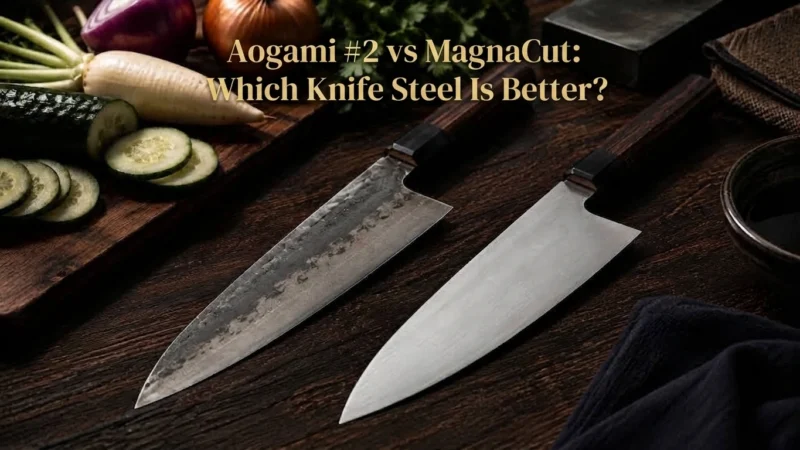
Aogami #2 vs MagnaCut
An Independent Guide
When knife enthusiasts compare Aogami #2 vs MagnaCut, they are really comparing two very different ideas of what a high-performance knife steel should be.
Aogami #2, often called Blue #2, is a traditional Japanese high-carbon alloy steel. It has been used for generations in kitchen knives and other cutting tools where hardness, edge quality, sharpening response, and cutting feel matter more than corrosion resistance.
MagnaCut represents almost the opposite design philosophy. It is a modern powder-metallurgy stainless steel engineered specifically to balance several properties that traditionally fight against each other: hardness, toughness, wear resistance, edge stability, and corrosion resistance.
Both can produce an excellent knife.
Neither is automatically “better.”
The more useful question is:
Which steel gives you the characteristics you actually want from the knife?
For a chef who enjoys sharpening, wants a highly responsive carbon-steel blade, and doesn’t mind wiping and drying the knife during use, Aogami #2 remains extremely attractive.
For someone who wants excellent cutting performance with dramatically easier corrosion management, high toughness, and a broad performance envelope, MagnaCut is difficult to beat.
The interesting part is that the difference isn’t simply traditional versus modern. Aogami #2 and MagnaCut overlap in some important areas. Both can reach high hardness. Both can take very fine edges. Both can perform extremely well in kitchen knives. And neither steel should be judged by hardness alone.
The real differences appear when you examine edge retention, sharpening, corrosion resistance, toughness, edge stability, maintenance, and how the steel behaves at the very thin geometries common in Japanese kitchen knives.
This guide examines those differences in detail.
Aogami #2 vs MagnaCut: The Short Answer
If you want the simplest possible answer:
Choose Aogami #2 if you prioritize sharpening feel, traditional carbon-steel character, fine-edge performance, and the experience of maintaining the knife.
Choose MagnaCut if you prioritize corrosion resistance, toughness, maintenance convenience, and a more balanced combination of modern knife-steel properties.
Aogami #2 is a reactive carbon steel. It can develop patina and can rust if neglected.
MagnaCut is a stainless steel designed to provide unusually high corrosion resistance while retaining high hardness and useful wear resistance.
Aogami #2 uses a relatively simple alloy system with significant carbon and tungsten. The tungsten is important because it increases the amount of hard carbide formation compared with simpler carbon steels. Published compositions commonly place carbon around 1.05–1.15%, tungsten around 1.0–1.5%, and chromium around 0.2–0.5%.
MagnaCut takes a fundamentally different metallurgical approach. Its composition was designed so that enough chromium remains available in the steel matrix for strong corrosion resistance while the microstructure contains relatively small hard carbides rather than large amounts of chromium carbide. This is one of the central reasons the steel can combine corrosion resistance with toughness and high hardness.
So the comparison can be summarized conceptually:
Aogami #2 emphasizes traditional carbon-steel cutting performance.
MagnaCut emphasizes balanced all-around performance with stainless maintenance.
But that summary leaves out most of the interesting details.
What Is Aogami #2?
Aogami #2 is a high-carbon Japanese alloy steel traditionally associated with high-quality kitchen knives and other cutting tools.
The name “Aogami” is commonly translated as “Blue Paper” or “Blue Steel.” The “#2” designation distinguishes it from other grades in the Aogami family.
Its chemistry is intentionally restrained. Carbon is the primary hardening element, while tungsten and small amounts of chromium are added to modify the steel’s behavior.
Representative composition ranges are approximately:
- Carbon: 1.05–1.15%
- Tungsten: 1.0–1.5%
- Chromium: 0.2–0.5%
- Manganese: around 0.2–0.3%
- Silicon: around 0.1–0.2%
The exact specification can vary depending on the published standard and material batch, so these numbers should be regarded as representative rather than a guarantee for every piece of steel sold under the name.
The important feature isn’t simply the amount of carbon.
It is the combination of relatively high carbon with tungsten and small chromium additions.
The tungsten helps form hard carbides and contributes to wear resistance and edge retention. The chromium level is nowhere near what would normally be required to classify the steel as stainless, so Aogami #2 remains a reactive carbon steel.
That chemistry produces a steel that can be hardened significantly while retaining the traditional sharpening behavior associated with Japanese carbon-steel knives.
Aogami #2 is therefore not simply “carbon steel.”
It is an alloyed carbon steel designed to improve on simpler high-carbon steels without becoming heavily alloyed.
That distinction matters when comparing it with MagnaCut.
Check Our Guide Aogami Steel N2
What Is MagnaCut?
MagnaCut was developed around a very different goal.
Instead of starting with a traditional carbon-steel formula and adding a few alloying elements, the steel was designed from the beginning around a target combination of properties.
The goal was to achieve:
- high corrosion resistance
- high hardness
- good toughness
- useful wear resistance
- fine microstructure
- good edge stability
Those properties normally involve compromises.
Increasing carbide volume can improve wear resistance, for example, but excessive carbide content can reduce toughness.
Increasing chromium can improve corrosion resistance, but chromium can also form chromium carbides. Those carbides remove chromium from the surrounding steel matrix and can complicate the balance between corrosion resistance, toughness, and wear resistance.
The design of MagnaCut specifically addressed this problem.
Its approximate nominal composition includes about 1.15% carbon, 10.7% chromium, 4% vanadium, 2% molybdenum, 2% niobium, and about 0.20% nitrogen, with iron making up the remainder.
But simply looking at those percentages doesn’t explain the steel.
The microstructure is more important.
The design intentionally avoids creating the large chromium-carbide structure associated with many conventional high-alloy stainless steels. Instead, it relies heavily on small hard vanadium and niobium carbides while maintaining enough chromium in solution to provide strong corrosion resistance.
That is the key to understanding MagnaCut.
It wasn’t designed merely to be “another stainless steel.”
It was designed to move the usual compromises between stainlessness, toughness, hardness, and wear resistance.
Check Our Guide MagnaCut Steel Review
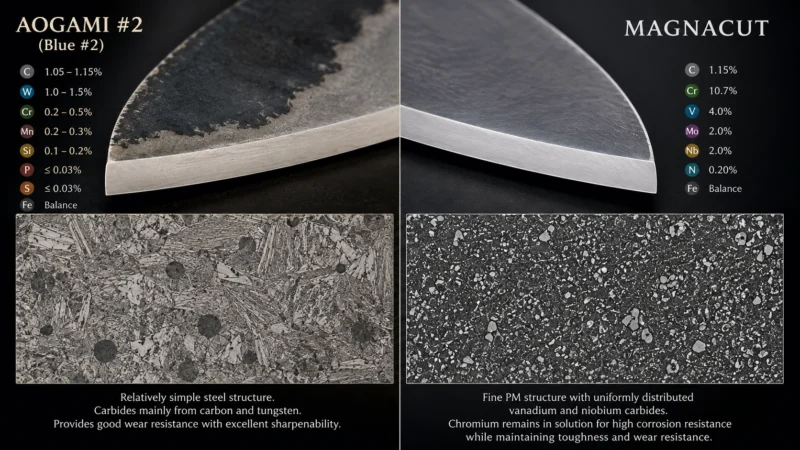
Aogami #2 vs MagnaCut: Composition
The chemistry of these steels immediately explains much of the difference between them.
Aogami #2 has approximately 1.1% carbon and around 1.25% tungsten as representative values, with only a small amount of chromium.
MagnaCut has a much more complex alloy system.
The most important conceptual difference is that Aogami #2 is fundamentally a reactive high-carbon alloy steel, while MagnaCut is a stainless powder-metallurgy steel engineered around controlled carbide formation.
This affects how each steel behaves.
In Aogami #2, tungsten contributes to hard carbide formation. Those carbides increase wear resistance compared with simpler carbon steels.
In MagnaCut, vanadium and niobium contribute very hard, relatively small carbides while chromium is used primarily to maintain corrosion resistance in the matrix rather than being consumed in large chromium-carbide populations.
This is why MagnaCut’s composition can look strange to someone familiar with traditional knife steels.
A person might see roughly 10.7% chromium and assume that the steel should behave like any other stainless steel with similar chromium content.
That would be an oversimplification.
The way chromium is distributed within the microstructure matters enormously.
Likewise, seeing 4% vanadium does not automatically mean that MagnaCut is an extreme wear-resistance steel.
It was deliberately designed to balance wear resistance with toughness rather than maximize wear resistance at any cost. Metallurgical testing has shown that its edge retention is in a useful high-performance range while its toughness and corrosion resistance are unusually strong.
This is an important lesson for both steels:
Chemical composition is the starting point, not the final performance specification.
Heat treatment and microstructure determine how much of that potential actually appears in the finished knife.
Hardness: Aogami #2 vs MagnaCut
Hardness is one of the easiest knife-steel properties to misunderstand.
A higher HRC number does not automatically mean a better knife.
Hardness affects resistance to deformation and contributes to edge stability and edge retention, but toughness, geometry, carbide structure, heat treatment, and corrosion behavior also matter.
Aogami #2 is commonly used around the low-to-mid 60s HRC in Japanese kitchen knives. Published references commonly place finished Aogami #2 knives around 61–64 HRC, depending on the maker and heat treatment.
MagnaCut has a much wider potential hardness window.
Testing has demonstrated that it can exceed 63 HRC and can reach approximately 64–65 HRC under suitable heat treatment, while more balanced treatments commonly produce hardness around the low 60s.
This creates an interesting overlap.
A well-made Aogami #2 kitchen knife and a well-made MagnaCut kitchen knife may both sit around 62–63 HRC.
At that point, simply saying “MagnaCut is harder” or “Aogami #2 is harder” becomes meaningless.
The real question is what happens at comparable hardness.
At comparable hardness, MagnaCut’s advantage comes from its combination of toughness and corrosion resistance.
Aogami #2’s advantage comes from its relatively simple structure, sharpening response, and traditional cutting characteristics.
This is why steel comparisons should never be reduced to a hardness chart.
Check Our Guide What Is HRC? Understanding Rockwell Hardness in Kitchen Knives
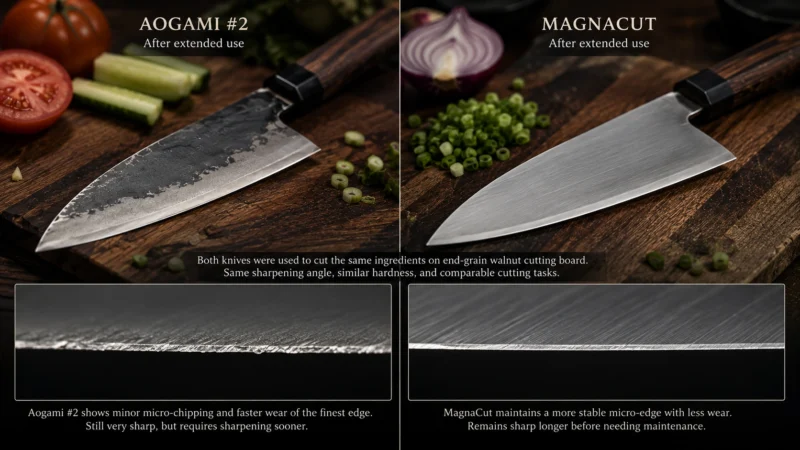
Edge Retention
Edge retention is probably the characteristic most buyers want to know about.
Which one stays sharp longer?
The answer is not as simple as “MagnaCut wins.”
MagnaCut generally has the advantage in overall edge-retention capability, particularly when compared at similar hardness and geometry, but Aogami #2 has respectable edge retention for a traditional carbon steel.
The tungsten carbides in Aogami #2 provide greater wear resistance than a simpler high-carbon steel without making the steel extremely difficult to sharpen.
This is one reason Aogami #2 became so popular.
It gives the user more edge retention than very simple carbon steels while preserving much of the sharpening behavior people enjoy in traditional Japanese knives.
MagnaCut uses a different mechanism.
Its hard vanadium and niobium carbides provide useful wear resistance, while the fine microstructure helps maintain toughness.
Testing reported by Knife Steel Nerds found MagnaCut’s edge retention to be in the general range of steels such as S35VN and CPM-4V under standardized CATRA testing, rather than placing it in the extreme wear-resistance category occupied by steels specifically optimized for maximum abrasion resistance.
That distinction is important.
MagnaCut isn’t designed to win every possible edge-retention contest.
It is designed to provide good edge retention without sacrificing the other properties needed in a practical knife.
For a kitchen knife, that can be more useful than extreme wear resistance.
A blade that retains an edge very well but is difficult to sharpen, less tough, or unpleasant to maintain may not be the best overall tool.
Aogami #2 approaches the problem from the opposite direction.
Its edge retention is good, but the steel remains relatively easy and enjoyable to restore on waterstones.
So the practical difference is often this:
MagnaCut generally stays sharp longer.
Aogami #2 generally makes the journey back to sharpness more enjoyable.
Check Our Guide Edge Retention Explained: 10 Factors What Makes a Knife Stay Sharp Longer
Does MagnaCut Hold an Edge Much Longer Than Aogami #2?
Probably, under many controlled conditions.
But this is one area where it is important not to invent a universal percentage.
There is no meaningful statement such as “MagnaCut lasts exactly twice as long as Aogami #2” that applies to every kitchen knife.
Edge retention depends on:
- hardness
- edge angle
- edge thickness
- sharpening quality
- blade geometry
- cutting material
- cutting board
- pressure
- lateral forces
- corrosion
- microchipping
- testing method
A very thin Aogami #2 knife at excellent heat treatment can outperform a thick MagnaCut knife in practical cutting feel even if the MagnaCut steel has greater wear resistance.
The geometry of the knife is often more important than people expect.
If the MagnaCut blade is sharpened at a robust angle while the Aogami #2 blade has an extremely thin geometry, the two knives may feel dramatically different.
This is why serious steel comparisons should separate steel performance from knife performance.
The steel is only one component.
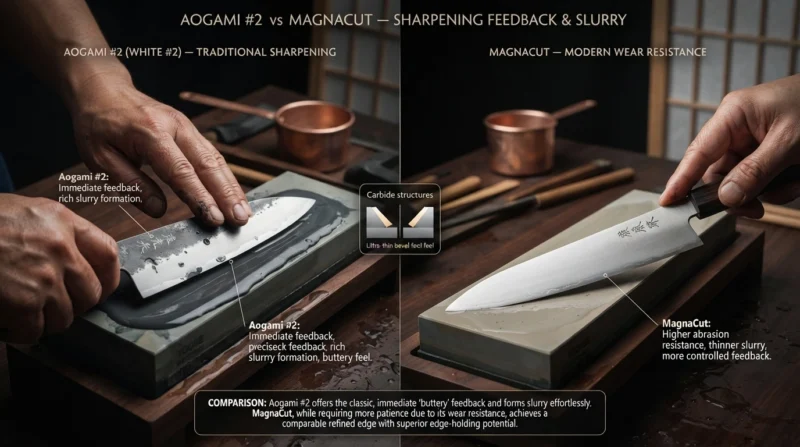
Sharpening: One of the Biggest Differences
This is where Aogami #2 becomes particularly interesting.
For many knife enthusiasts, sharpening isn’t simply maintenance.
It is part of the experience.
Aogami #2 generally has excellent compatibility with conventional Japanese waterstones.
The steel responds predictably to sharpening, forms a manageable burr, and can be refined to a very high level.
Compared with highly wear-resistant stainless steels containing large volumes of hard carbides, Aogami #2 does not feel excessively stubborn on the stone.
This is one reason traditional Japanese carbon steels remain popular despite the availability of modern stainless steels.
The steel communicates with the sharpener.
You can feel what is happening.
MagnaCut has a different reputation, but it is important not to exaggerate the difference.
MagnaCut is not one of those modern steels that automatically requires diamond abrasives.
It can be sharpened on conventional stones.
Testing and practical reports indicate that it can provide good feedback on stones and can be sharpened to a very high level.
However, the experience is still somewhat different.
At similar hardness, MagnaCut’s alloy content and hard carbides mean that it generally takes more work than Aogami #2.
That doesn’t make MagnaCut difficult to sharpen.
It simply means the two steels reward different expectations.
If your idea of sharpening is:
“Put the knife on a stone, establish the bevel, raise a burr, refine it, remove the burr, and enjoy the process”
Aogami #2 is extremely satisfying.
If your attitude is:
“I want to sharpen the knife efficiently when necessary and then forget about maintenance for a while”
MagnaCut becomes more attractive.
Check Our Guide All Kinds of Knife Sharpening Tools
Which Is Easier to Sharpen?
Aogami #2 is generally easier and faster to sharpen.
The difference isn’t necessarily enormous for an experienced sharpener.
A person who regularly sharpens modern stainless steels may find MagnaCut completely manageable.
But if you put the two steels side by side at similar hardness and sharpen them on the same stone, Aogami #2 will generally require less effort to restore the apex.
This becomes especially noticeable during heavier sharpening or when significant steel removal is necessary.
There is also an important distinction between sharpening difficulty and final sharpness.
MagnaCut can become extremely sharp.
The fact that a steel takes longer to sharpen does not mean it cannot produce an excellent edge.
Likewise, the fact that Aogami #2 is easier to sharpen does not mean its edge will always outperform MagnaCut.
Both can produce exceptional edges.
The path to that edge is simply different.
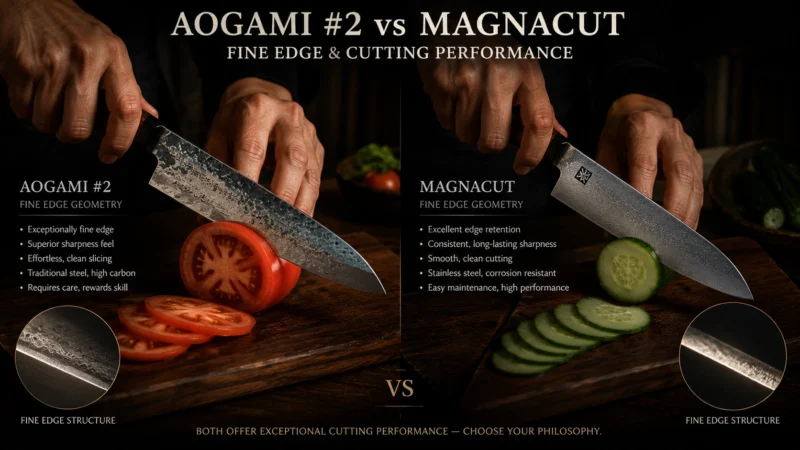
Cutting Feel
Cutting feel is difficult to quantify but extremely important with kitchen knives.
This is one of the areas where steel discussions often become subjective.
Two knives made from the same steel can feel completely different because of blade thickness, bevel geometry, grind, finish, edge angle, and heat treatment.
Nevertheless, steel influences the experience.
Aogami #2 is associated with the classic feel of a hard Japanese carbon-steel knife.
It can support a very fine edge.
It responds well to sharpening.
It can feel extremely direct when cutting vegetables, fish, herbs, and other foods.
Many users describe this kind of knife as having a very “clean” or “lively” cutting sensation.
That description isn’t a measurable metallurgical property, but it reflects a real interaction between geometry, hardness, edge refinement, and sharpening.
MagnaCut can also support extremely thin edges.
In fact, its toughness is one of its major advantages here.
A tough steel can tolerate thinner and more acute edges with less risk of catastrophic chipping than a less tough steel at comparable hardness.
This is one of the most important practical advantages of toughness.
Toughness isn’t only about surviving hard use.
It can allow the maker to push geometry further.
Edge Stability
Edge stability is one of the most useful concepts when comparing Aogami #2 with MagnaCut.
A knife edge can lose performance in several different ways.
It can wear away.
It can plastically deform.
It can chip.
It can corrode.
These are different failure mechanisms.
A steel with high wear resistance isn’t automatically good at resisting microchipping.
A steel with high hardness isn’t automatically tough.
A steel with excellent toughness isn’t automatically good at resisting abrasive wear.
MagnaCut was specifically designed to achieve a strong balance between these properties.
Its fine carbide structure helps it maintain toughness while still providing meaningful wear resistance. Testing has shown very good toughness for a stainless steel even at relatively high hardness.
This is particularly relevant to thin kitchen knives.
A very thin edge is mechanically demanding.
If the edge is pushed too far for the steel, it may chip or deform.
MagnaCut gives the maker a relatively broad performance window.
Aogami #2 also performs extremely well in kitchen knives, but its properties are more traditional.
The steel can support fine edges, but it remains a reactive high-carbon steel and doesn’t offer MagnaCut’s combination of toughness and corrosion resistance.
Toughness
Toughness is another category where MagnaCut has a significant advantage.
Toughness describes resistance to fracture.
It is not the same as hardness.
A hard knife can be tough.
A hard knife can also be brittle.
The relationship between hardness and toughness depends heavily on the steel’s microstructure and heat treatment.
MagnaCut was deliberately engineered for high toughness.
Original testing showed it performing unusually well for a stainless powder-metallurgy steel, with toughness comparable to some highly regarded non-stainless tool steels at similar hardness. More recent testing of current production material reported even stronger toughness results in some hardness ranges.
That makes MagnaCut particularly interesting because it doesn’t have to sacrifice all of its toughness in order to reach useful hardness.
Aogami #2 is not an inherently fragile steel.
A properly heat-treated Aogami #2 kitchen knife can be very durable.
But it is still a high-carbon reactive steel, and aggressive misuse of a thin, hard edge can produce chips.
This doesn’t make Aogami #2 bad.
It simply means the user should understand what kind of knife they have.
A thin Japanese carbon-steel knife is a precision cutting instrument.
It isn’t a pry bar.
The same principle applies to MagnaCut, although MagnaCut gives the designer more toughness margin.
Check Our Guide Wear Resistance vs Toughness: Understanding the Most Important Knife Steel Trade-Off
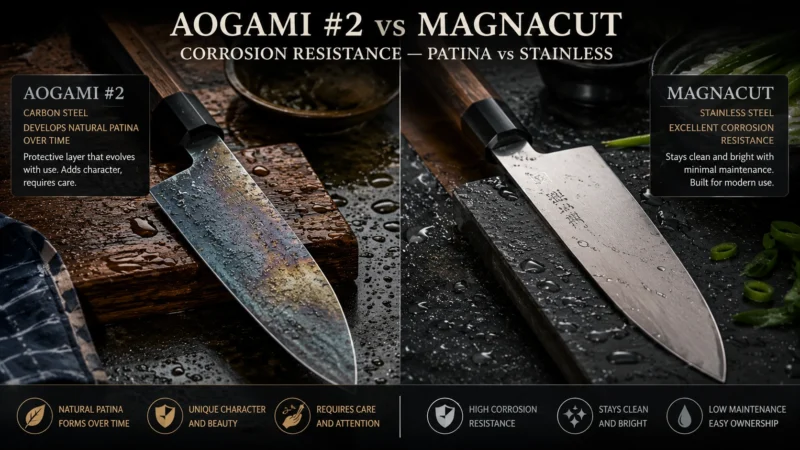
Corrosion Resistance: The Clear Winner
This is the easiest category in the comparison.
MagnaCut wins by a huge margin.
Aogami #2 is not stainless.
The small amount of chromium in its composition is nowhere near enough to provide conventional stainless behavior. Its chromium content is generally around 0.2–0.5%.
The blade can develop patina.
It can discolor.
It can rust.
Aogami #2 requires sensible care.
After cutting acidic foods, wipe the blade.
During longer cooking sessions, keep the blade reasonably dry.
After use, wash it by hand and dry it thoroughly.
Never leave it sitting wet in a sink.
That sounds demanding, but for many users it quickly becomes automatic.
MagnaCut is completely different.
Its corrosion resistance is one of the defining features of the steel.
In standardized testing, MagnaCut showed extremely strong resistance to saltwater corrosion. The original testing reported no visible corrosion after a 72-hour 1% saltwater exposure, while later testing of production material also showed excellent corrosion performance.
That doesn’t mean MagnaCut is literally corrosion-proof.
No knife should be treated as indestructible.
Surface contamination, poor finishing, harsh chemicals, salt exposure, and manufacturing variables can all affect corrosion behavior.
But compared with Aogami #2, the difference is enormous.
Patina vs Rust
This deserves its own discussion because carbon-steel users often misunderstand it.
A patina is not the same thing as active rust.
A properly maintained Aogami #2 knife can develop a gray, blue, purple, or darkened surface over time.
That patina is part of the normal behavior of reactive carbon steel.
It can also provide some additional protection against further oxidation.
Active rust is different.
Orange or reddish corrosion, especially if it is rough or continuing to spread, means the steel is actually corroding.
The best approach is prevention.
Keep the blade clean and dry.
Don’t leave acidic food residue on it.
Don’t put it in the dishwasher.
Don’t store it while wet.
Once those habits become routine, maintaining Aogami #2 is not particularly difficult.
But MagnaCut removes much of this mental overhead.
That is a major advantage for professional kitchens, busy households, outdoor cooking, travel, or anyone who simply doesn’t enjoy thinking about knife maintenance.
Aogami #2 vs MagnaCut for Professional Kitchens
The answer depends heavily on the kitchen.
In a professional environment where the knife is handled carefully by its owner, Aogami #2 can be an outstanding choice.
A chef who appreciates sharpening and knows how to care for carbon steel may prefer it precisely because of its sharpening response and cutting characteristics.
However, professional kitchens can also be harsh environments.
Knives may be exposed to:
- acidic foods
- moisture
- salt
- frequent washing
- multiple users
- rushed storage
- busy work surfaces
In such circumstances, MagnaCut’s corrosion resistance becomes extremely valuable.
A chef may not have to stop and wipe the blade every few minutes.
A knife can remain cleaner and more predictable through a long shift.
This doesn’t make MagnaCut a better chef’s knife in every situation.
It makes it a better maintenance solution.
That distinction matters.
Aogami #2 vs MagnaCut for Home Cooks
For home users, the decision is often easier.
Ask yourself one question:
Do you enjoy maintaining your knife?
If the answer is yes, Aogami #2 is worth serious consideration.
If the answer is no, MagnaCut probably makes more sense.
A home cook who uses a knife for 30 minutes every evening and immediately dries it may have no problem with Aogami #2.
Another home cook may prepare dinner quickly, place the knife on the counter, answer a phone call, clean the kitchen, and forget the blade for an hour.
For that second person, MagnaCut is much more forgiving.
The difference isn’t really about skill.
It is about lifestyle.
Aogami #2 vs MagnaCut for Japanese Kitchen Knives
Both steels can work exceptionally well in Japanese kitchen knives.
Aogami #2 has a long tradition in this category.
It is particularly well suited to:
- gyuto
- santoku
- nakiri
- petty knives
- kiritsuke-style knives
- traditional single-bevel blades
The steel can be hardened to a useful range and sharpened to a refined edge.
MagnaCut can also be excellent in these formats.
In fact, modern stainless steel becomes particularly interesting when combined with Japanese geometry.
A thin MagnaCut gyuto can offer:
- very high corrosion resistance
- good edge retention
- high toughness
- high hardness
- thin edge geometry
- reduced maintenance
That combination would have been difficult to achieve with older stainless steels.
This is one reason MagnaCut has attracted so much attention among knife makers.
Gyuto: Which Steel Makes More Sense?
For a gyuto, both are excellent choices.
Aogami #2 is especially appealing if you want the traditional Japanese experience.
You get a high-carbon blade with a refined edge and excellent sharpening response.
MagnaCut is especially appealing if the gyuto is going to be used heavily and exposed to moisture or acidic ingredients.
If you cook professionally, MagnaCut’s corrosion resistance may outweigh the traditional appeal of Aogami #2.
If you sharpen your own knives and enjoy the ritual, Aogami #2 may be more satisfying.
The geometry of the particular gyuto may matter more than the steel label.
A thin, well-ground Aogami #2 knife can outperform a thick, poorly ground MagnaCut knife in actual cutting.
And the reverse is also true.
Check Our Guide Kiritsuke vs Gyuto: Which Japanese Knife Is Better for Everyday Cooking?
Nakiri: A Particularly Interesting Comparison
Nakiri knives often have very thin edges and are used extensively for vegetables.
That makes edge stability especially important.
Aogami #2 can be superb here.
Its hardness and sharpening behavior make it possible to maintain a very fine vegetable-cutting edge.
But MagnaCut brings an interesting advantage.
Its toughness gives the maker more freedom to combine thin geometry with a high-performance stainless platform.
For users who cut large quantities of vegetables and want minimal maintenance, MagnaCut can be extremely practical.
For users who enjoy the tactile experience of sharpening a traditional carbon nakiri, Aogami #2 remains hard to replace.
Check Our Guide Santoku vs Nakiri: Which Japanese Kitchen Knife Is Better?
Petty Knives
Petty knives often encounter acidic ingredients, fruit, meat, herbs, and small detailed cutting tasks.
That makes corrosion resistance particularly useful.
A MagnaCut petty can be an excellent everyday knife because it can tolerate exposure to moisture and acidic foods far better.
Aogami #2 can still be wonderful, but it demands more attention.
If you are using a carbon petty to cut citrus, tomatoes, onions, apples, or other acidic ingredients, wiping and drying becomes part of the workflow.
For a knife that lives permanently in a home kitchen, that may be fine.
For a knife carried around or used outdoors, MagnaCut becomes increasingly attractive.
Check Our Guide Why Every Home Cook Needs a Petty Knife
Single-Bevel Knives
Traditional single-bevel knives introduce another variable.
Knives such as yanagiba, deba, and usuba are often evaluated as much by their sharpening behavior as their cutting performance.
For this type of knife, Aogami #2 has a strong traditional argument.
The steel responds well to waterstones and can be maintained using the established sharpening methods associated with Japanese single-bevel knives.
MagnaCut can certainly be sharpened, but the traditional carbon-steel experience remains distinctive.
If you are buying a knife specifically because you want to experience traditional Japanese sharpening, Aogami #2 makes more sense.
If you want the same general style of knife but with dramatically improved corrosion resistance, MagnaCut becomes more compelling.
Waterstones: Aogami #2 vs MagnaCut
Waterstones are perfectly appropriate for both steels.
Aogami #2 is generally very cooperative on waterstones.
A typical sharpening progression might involve:
- a coarse stone for repair
- a medium stone for establishing the edge
- a finer stone for refinement
- optional stropping
The exact grit progression depends on the knife and desired finish.
Aogami #2 doesn’t demand exotic abrasives for normal sharpening.
MagnaCut can also be sharpened effectively with quality waterstones.
However, its alloy content means that stone choice and sharpening technique can become more important.
If you are trying to remove significant amounts of MagnaCut, a stone capable of cutting modern high-alloy steel efficiently can save time.
But there is no reason to assume that every MagnaCut knife requires diamond stones.
That is an exaggeration.
The steel can produce an excellent edge using conventional sharpening equipment. Practical testing has specifically reported good stone feedback and responsiveness.
Which Steel Gets Sharper?
This question is often framed incorrectly.
Both can become extremely sharp.
The more useful question is:
Which one makes it easier to achieve and maintain the type of edge you want?
Aogami #2 has a strong reputation for taking a fine, keen edge.
MagnaCut can also be taken to a very refined apex.
The difference is less about maximum sharpness and more about sharpening behavior, edge stability, and how long the chosen edge remains useful.
A knife sharpened to an extremely fine polished edge may feel spectacular initially.
But the best edge isn’t necessarily the most polished one.
Kitchen knives often benefit from an edge that balances refinement with bite.
The optimal finish depends on what you’re cutting.
This is another area where the steel, geometry, sharpening medium, and intended use must be considered together.
Maintenance Requirements
Aogami #2 requires discipline.
MagnaCut requires basic knife care.
That is a meaningful difference.
For Aogami #2:
- Wash by hand.
- Dry immediately.
- Wipe during prolonged use.
- Avoid leaving acidic residue on the blade.
- Never leave it soaking.
- Store it dry.
- Accept that patina is normal.
For MagnaCut:
- Wash by hand when practical.
- Dry after washing.
- Avoid unnecessary prolonged exposure to aggressive chemicals.
- Store normally.
- Sharpen when needed.
MagnaCut doesn’t eliminate knife care.
It simply makes mistakes less consequential.
That is one of its strongest real-world advantages.
Does Aogami #2 Rust Easily?
Yes.
Compared with stainless knife steels, Aogami #2 is highly reactive.
The small chromium addition should not be mistaken for stainless behavior.
The chromium content is far below the levels normally associated with stainless knife steels.
However, “rusts easily” does not mean “difficult to own.”
Many professional chefs use reactive carbon knives every day.
The secret is routine.
Use it.
Wipe it.
Wash it.
Dry it.
Repeat.
Once that becomes automatic, carbon steel is surprisingly easy to live with.
Does MagnaCut Rust?
MagnaCut has excellent corrosion resistance, but “stainless” should never be interpreted as “impossible to corrode.”
Real knives experience conditions that laboratory samples do not.
Surface finish, contamination, heat treatment, exposure time, salt concentration, and manufacturing variables can all influence corrosion behavior.
Still, MagnaCut is exceptional in this area.
Its original corrosion testing showed no visible corrosion after prolonged saltwater exposure under the reported test conditions, and subsequent testing of current production material also showed very strong corrosion resistance.
For normal kitchen use, that places MagnaCut in an entirely different maintenance category from Aogami #2.
Heat Treatment Matters More Than Many Buyers Realize
Steel names are not complete performance specifications.
Aogami #2 can be excellent or disappointing depending on how it is heat treated.
The same is true for MagnaCut.
Heat treatment determines:
- hardness
- retained austenite
- carbide structure
- toughness
- edge stability
- sharpening behavior
A poorly heat-treated premium steel can perform worse than a well-treated simpler steel.
This is why two knives made from the same steel can feel dramatically different.
Aogami #2 is particularly dependent on traditional heat-treatment skill.
MagnaCut also requires careful processing to achieve its intended balance.
Testing has shown that different heat-treatment conditions can change the hardness-toughness balance of MagnaCut substantially.
Therefore, when buying a knife, the reputation and skill of the maker can be as important as the steel designation.
Check Our Guide Steel Heat Treatment Explained
Geometry Can Matter More Than the Steel
This is perhaps the most important point in the entire comparison.
Suppose you have:
Knife A: Aogami #2, excellent heat treatment, thin geometry, carefully sharpened.
Knife B: MagnaCut, excellent heat treatment, thick geometry, poorly sharpened.
Which one cuts better?
Probably Knife A.
The steel doesn’t override physics.
Blade thickness, behind-the-edge thickness, bevel geometry, edge angle, grind, surface finish, and sharpening quality all affect cutting performance.
This is why a knife should never be selected purely by reading a steel chart.
A mediocre knife made from a theoretically superior steel can be much less enjoyable than an expertly made knife from a simpler steel.
The best steel is the one that works with the knife’s intended geometry and the user’s priorities.
Edge Angle and Thinness
Aogami #2 and MagnaCut can both support relatively acute edges.
But the appropriate angle depends on:
- hardness
- geometry
- toughness
- cutting task
- user technique
A very thin edge is wonderful for slicing.
It is also less forgiving.
If you cut hard bones, frozen food, glass cutting boards, or use lateral twisting force, the edge can fail regardless of how expensive the steel is.
MagnaCut’s toughness provides additional margin.
Aogami #2 requires a somewhat more traditional understanding of knife use.
Neither should be abused.
The difference is that MagnaCut gives you more insurance.
Check Our Guide Best Blade Thickness for Different Uses
Aogami #2 vs MagnaCut for Hard Use
If by “hard use” you mean chopping, impact, outdoor work, or situations where the knife may encounter unpredictable forces, MagnaCut is generally the more forgiving choice.
Its combination of hardness and toughness is one of its defining strengths.
Aogami #2 can certainly be used outside the kitchen.
But if the knife is expected to encounter impacts or rough handling, the greater toughness margin of MagnaCut becomes valuable.
For precision kitchen work, however, this advantage may be less important.
A professional chef slicing vegetables is not necessarily benefiting from the same toughness advantage as someone using a knife outdoors.
Application matters.
Aogami #2 vs MagnaCut for Outdoor Knives
This comparison becomes much easier outdoors.
MagnaCut is usually the more practical choice.
Outdoor knives can encounter:
- rain
- humidity
- sweat
- wet food
- saltwater
- dirt
- prolonged storage
- inconsistent maintenance
Aogami #2 can work outdoors, but corrosion management becomes a constant responsibility.
MagnaCut dramatically reduces that burden.
For a knife carried every day, used around water, or stored for long periods, the stainless nature of MagnaCut is a major advantage.
Aogami #2 vs MagnaCut for Collectors
Collectors may value different things.
Aogami #2 has historical and cultural appeal.
The patina changes over time.
The blade develops character.
Sharpening becomes part of ownership.
For someone who appreciates Japanese knife traditions, these characteristics aren’t disadvantages.
They’re the point.
MagnaCut appeals to a different kind of collector.
It represents modern steel design and the ability to combine properties that traditionally required major compromises.
A finely made MagnaCut knife can be a fascinating example of modern metallurgy.
So even here, neither steel wins universally.
They represent different philosophies.
Aogami #2 vs MagnaCut: The Sharpening Experience
If sharpening is something you genuinely enjoy, I would lean toward Aogami #2.
There is something satisfying about the feedback of a traditional high-carbon steel on a waterstone.
The steel responds quickly.
The burr develops predictably.
The apex can be refined without fighting excessive wear resistance.
MagnaCut can also be satisfying, particularly for someone accustomed to modern steels.
But the experience is more about maintaining a high-performance modern material than participating in the traditional carbon-steel sharpening ritual.
This distinction is subjective.
Yet it is real.
Two people can use the same knife and reach opposite conclusions because they value different parts of the ownership experience.
Aogami #2 vs MagnaCut: The Ownership Experience
This may actually be the most useful way to think about the comparison.
Aogami #2 gives you a more involved relationship with the knife.
You notice the blade.
You notice its patina.
You notice when it needs drying.
You notice how it behaves on the stone.
You participate in maintaining it.
MagnaCut allows you to step back.
The knife can be used, washed, dried, and put away with much less concern.
You still maintain it, but the maintenance doesn’t dominate the ownership experience.
So:
Aogami #2 asks for participation.
MagnaCut gives you freedom.
Neither approach is inherently superior.
Common Myths About Aogami #2
Myth 1: Aogami #2 is basically stainless
It isn’t.
The chromium content is far too low for conventional stainless behavior.
It is a reactive carbon steel.
Myth 2: Aogami #2 is extremely brittle
Not necessarily.
Heat treatment and geometry matter enormously.
A well-made Aogami #2 knife can be very durable in normal kitchen use.
Myth 3: Aogami #2 always stays sharper than stainless steels
No.
Its edge retention is good, but many modern steels can provide longer wear resistance.
Myth 4: Carbon steel is always sharper
Not automatically.
Sharpness depends heavily on geometry and sharpening.
Common Myths About MagnaCut
Myth 1: MagnaCut never rusts
No steel should be treated that way.
It has excellent corrosion resistance, but stainless does not mean chemically invulnerable.
Myth 2: MagnaCut is impossible to sharpen
Definitely not.
It can be sharpened effectively on conventional stones, although it generally requires more effort than a simple carbon steel.
Myth 3: MagnaCut has extreme edge retention
It has strong edge retention, but it was designed as a balanced steel rather than an extreme wear-resistance steel.
Its advantage is the combination of properties.
Myth 4: MagnaCut is too tough for kitchen knives
Quite the opposite.
Its toughness can be particularly valuable in thin kitchen-knife edges because it provides additional resistance to chipping.
Which Steel Has Better Edge Retention?
MagnaCut generally wins.
But the difference should not be interpreted as a guarantee for every knife.
Aogami #2 has respectable edge retention and can outperform expectations when paired with excellent heat treatment and geometry.
MagnaCut’s advantage comes from its ability to combine useful wear resistance with hardness and toughness.
If maximum time between sharpening sessions is your priority, MagnaCut is the safer choice.
Which Steel Is Easier to Sharpen?
Aogami #2 wins.
This is one of the clearest advantages of the traditional steel.
MagnaCut isn’t difficult to sharpen, but its harder carbides and more complex alloy structure mean that sharpening usually takes more work.
Which Steel Is Tougher?
MagnaCut wins.
Its fine microstructure and carefully balanced carbide system give it unusually high toughness for a high-performance stainless steel.
Which Steel Resists Corrosion Better?
MagnaCut wins decisively.
This is perhaps the biggest practical difference.
Aogami #2 needs active corrosion management.
MagnaCut needs ordinary stainless-steel care.
Which Steel Takes a Finer Edge?
Both can take excellent edges.
If the question is about sharpening response and the traditional feel of producing a refined edge, Aogami #2 has the advantage.
If the question is whether MagnaCut can produce a genuinely fine, high-performance kitchen edge, absolutely yes.
Which Steel Is Better for a Thin Japanese Knife?
This is a much closer contest.
Aogami #2 has excellent historical credentials here.
Its hardness, sharpening response, and fine-edge behavior make it an outstanding traditional kitchen-steel choice.
MagnaCut’s toughness gives it a different advantage.
It can support thin geometry while providing more resistance to chipping and corrosion.
For a chef who wants traditional character, Aogami #2 is compelling.
For a chef who wants a thin Japanese knife without carbon-steel maintenance, MagnaCut may be the better modern solution.
Which Steel Is Better for Beginners?
That depends on what the beginner wants to learn.
If the beginner wants the simplest maintenance experience:
MagnaCut.
If the beginner wants to learn traditional sharpening and doesn’t mind learning carbon-steel care:
Aogami #2.
Aogami #2 isn’t necessarily difficult.
It simply has consequences for neglect.
Leaving a MagnaCut knife wet for a short period is usually much less serious than doing the same thing with Aogami #2.
That makes MagnaCut more forgiving.
Which One Would I Choose?
If I were selecting a knife primarily for the experience of using and maintaining traditional Japanese carbon steel, I would choose Aogami #2.
It offers a combination that is still extremely difficult to replace:
- high hardness
- excellent edge quality
- useful edge retention
- relatively easy sharpening
- excellent waterstone response
- traditional carbon-steel character
The need for maintenance is part of the package.
If I were selecting a knife primarily for performance with minimum maintenance, I would choose MagnaCut.
Its combination of:
- corrosion resistance
- toughness
- hardness
- useful wear resistance
- edge stability
- modern stainless convenience
makes it an exceptionally practical choice.
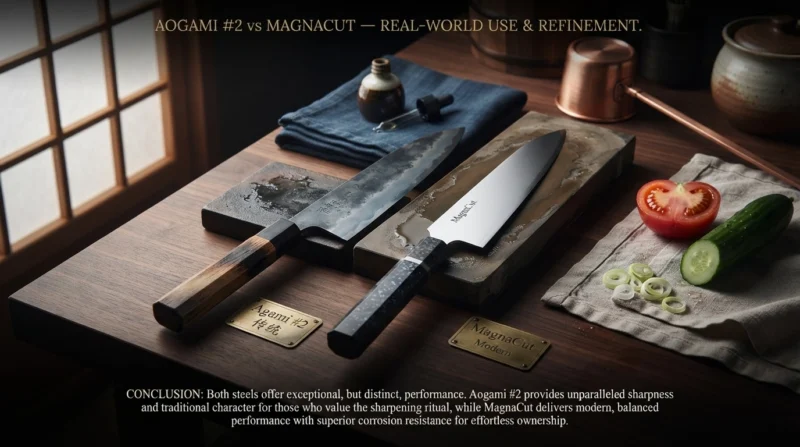
Aogami #2 vs MagnaCut: Final Verdict
There is no universal winner.
The steels are optimized around different priorities.
Aogami #2 is the better choice for the traditionalist, sharpening enthusiast, and carbon-steel enthusiast.
It gives you a highly responsive sharpening experience and the character associated with traditional Japanese high-carbon knives.
It rewards careful ownership.
MagnaCut is the better choice for the performance-oriented user who wants fewer compromises.
It combines excellent corrosion resistance with high hardness, strong toughness, useful wear resistance, and the ability to support thin, stable edges.
Its greatest strength isn’t any single specification.
It is the balance.
That is ultimately what makes this comparison so interesting.
Aogami #2 demonstrates how far a relatively simple alloy system can be pushed through careful metallurgy, heat treatment, and traditional knife making.
MagnaCut demonstrates how modern metallurgical design can deliberately balance properties that historically worked against each other.
One is not the “old version” of the other.
They are different solutions to different problems.
If your favorite part of owning a knife is sharpening it on a waterstone, watching the patina develop, and feeling the edge become refined under your hands, Aogami #2 is hard to beat.
If your favorite part is using the knife heavily without worrying about moisture, acidity, corrosion, or frequent sharpening, MagnaCut is probably the better answer.
The simplest way to remember the difference is this:
Aogami #2 is about the relationship between the user, the edge, and the stone.
MagnaCut is about the relationship between performance and convenience.
And for a serious knife user, both philosophies can make sense.
Frequently Asked Questions
Is Aogami #2 better than MagnaCut?
Not universally.
Aogami #2 is easier to sharpen and offers traditional carbon-steel characteristics. MagnaCut offers much better corrosion resistance and generally higher toughness with strong overall edge performance.
Is MagnaCut sharper than Aogami #2?
Not inherently.
Both steels can be sharpened to extremely high levels. Geometry and sharpening technique often have more influence on perceived sharpness than the steel name.
Does Aogami #2 have better edge retention than MagnaCut?
Generally, no.
MagnaCut normally has the advantage in wear resistance and overall edge retention, although the actual difference depends on hardness, geometry, edge angle, and use.
Is MagnaCut easier to sharpen than Aogami #2?
Generally no.
Aogami #2 is usually faster and more responsive on conventional waterstones.
Does Aogami #2 rust?
Yes.
It is a reactive carbon steel and requires proper drying and maintenance.
Does MagnaCut rust?
It can under sufficiently aggressive conditions, but its corrosion resistance is exceptionally high for a high-performance knife steel. Standard use is dramatically less demanding than Aogami #2.
Is Aogami #2 good for Japanese kitchen knives?
Yes.
It is particularly well suited to users who appreciate high hardness, fine edges, traditional sharpening, and carbon-steel performance.
Is MagnaCut good for Japanese kitchen knives?
Yes.
Its toughness, hardness, corrosion resistance, and edge stability make it particularly interesting for thin modern Japanese-style kitchen knives.
Which one is better for a professional chef?
It depends on the chef.
A chef who enjoys carbon steel and maintains knives carefully may prefer Aogami #2.
A chef who wants minimal corrosion management and strong all-around performance may prefer MagnaCut.
Which one should I buy for home cooking?
Choose Aogami #2 if you enjoy sharpening and don’t mind wiping and drying the blade.
Choose MagnaCut if you want excellent performance with much less maintenance.
Is Aogami #2 difficult to maintain?
It requires more attention than stainless steel, but the routine is simple: keep it clean, dry it promptly, and don’t leave it wet or exposed to acidic residue.
Is MagnaCut an extreme edge-retention steel?
No.
Its strength is balance. It offers good edge retention while maintaining unusually strong toughness and corrosion resistance.
Which one is better for a very thin edge?
Both can work extremely well.
Aogami #2 offers excellent traditional fine-edge performance. MagnaCut offers an additional toughness advantage that can make thin geometry more forgiving.
This article is for independent informational purposes only and is not affiliated with, sponsored by, or endorsed by any steel manufacturer. All product names, trademarks, and registered trademarks are the property of their respective owners.