CPM M4 Steel
An Independent Guide
CPM M4 is one of the most interesting high-performance tool steels used for demanding cutting applications. It was developed for industrial tooling rather than originally being designed as a kitchen or outdoor knife steel, yet its combination of very high wear resistance, high hardness, excellent edge stability, and useful toughness has made it an important choice for high-performance blades.
Unlike stainless steels such as VG-10, S30V, MagnaCut, or many modern powder-metallurgy stainless grades, CPM M4 is a non-stainless high-speed tool steel. Its corrosion resistance is therefore limited. Its strength comes from a different design philosophy: a relatively high carbon content combined with substantial amounts of tungsten, molybdenum, vanadium, and chromium creates a hard martensitic matrix containing a significant population of wear-resistant alloy carbides.
The result is a steel that can hold a very aggressive cutting edge for a long time, particularly when the blade is heat treated to a suitable hardness.
But CPM M4 is not simply “a very hard steel.”
Its behavior is determined by several interacting factors:
- the powder-metallurgy production route,
- its high carbon content,
- vanadium-rich carbides,
- tungsten- and molybdenum-rich carbides,
- heat-treatment temperature,
- quenching conditions,
- tempering,
- final hardness,
- blade geometry,
- edge angle,
- and the type of cutting work being performed.
That is why CPM M4 can be exceptionally impressive in one knife and much less impressive in another.
This guide explains what CPM M4 actually is, how its composition affects performance, why it has such strong wear resistance, how it compares with conventional M4, what its corrosion resistance is like, how it behaves when sharpened, and where it makes the most sense in a knife.
1. What Is CPM M4 Steel?
CPM M4 is a powder-metallurgy high-speed tool steel belonging to the M4 family of high-speed steels.
The “M” designation places it within the molybdenum-type high-speed tool steel group. M4 is designed to retain high hardness and cutting ability under demanding conditions where ordinary carbon and low-alloy steels would lose their performance.
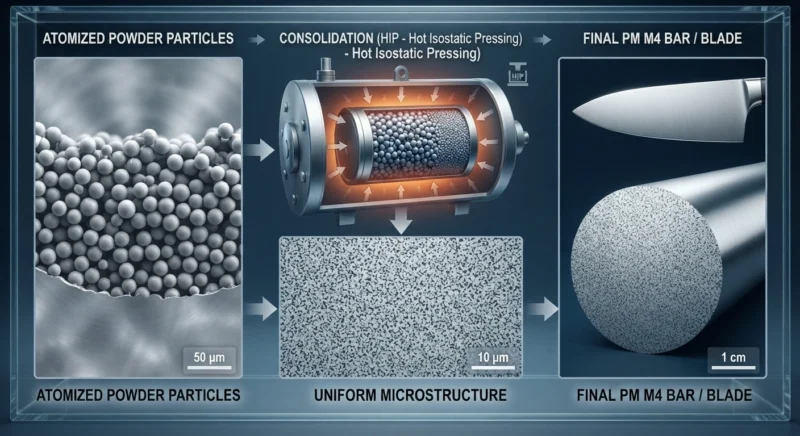
The CPM version is produced using a powder-metallurgy route rather than conventional ingot casting.
That distinction is important.
In conventional steelmaking, molten steel solidifies into an ingot. Alloying elements can segregate during solidification, and carbide networks or relatively large carbide particles can develop. Subsequent processing can reduce these effects, but the original solidification structure still influences the material.
Powder metallurgy takes a different route.
The alloy is atomized into small particles, rapidly solidified, and subsequently consolidated. This allows the alloying elements and carbide-forming elements to be distributed much more uniformly throughout the steel.
The objective is not merely to make a stronger version of ordinary M4.
The objective is to create a more homogeneous microstructure with a fine and controlled distribution of carbides.
Research on CPM/AISI M4 confirms that the material contains a martensitic matrix together with different carbide populations, including MC-type and M₆C-type carbides. These phases are important to the steel’s hardness, wear behavior, and response to heat treatment.
For knife users, this translates into an important practical advantage:
CPM M4 can combine very high edge retention with a level of toughness that would be difficult to obtain from a similarly hard steel containing a less favorable carbide structure.
It is still a hard, high-alloy tool steel, so it should not be treated like a tough carbon steel such as 80CrV2.
But within the group of extremely wear-resistant high-performance steels, its balance is attractive.
2. CPM M4 vs M4: Are They the Same Steel?
The terms can be confusing.
“M4” describes a specific high-speed tool steel grade, while “CPM M4” identifies a powder-metallurgy version of that grade.
The two should not automatically be assumed to have identical microstructures or identical performance.
A conventional M4 steel can be manufactured through a conventional melting and solidification process. CPM M4 is manufactured through powder metallurgy, producing a much more uniform carbide distribution.
This distinction matters because two steels can have broadly similar nominal alloy chemistry while behaving differently because of differences in:
- carbide size,
- carbide distribution,
- segregation,
- grain structure,
- heat treatment,
- and manufacturing history.
For knife applications, it is therefore useful to treat CPM M4 as a powder-metallurgy implementation of the M4 high-speed steel concept, rather than assuming that every steel simply labeled M4 will perform identically.
This is one reason why technical discussions about “M4” sometimes produce apparently contradictory information.
One source may be describing conventional AISI M4.
Another may be discussing powder-metallurgy M4.
A third may be describing a particular high-carbon or high-sulfur modification.
Those materials can share the M4 designation while having meaningful differences in composition, processing, or properties.
3. CPM M4 Chemical Composition
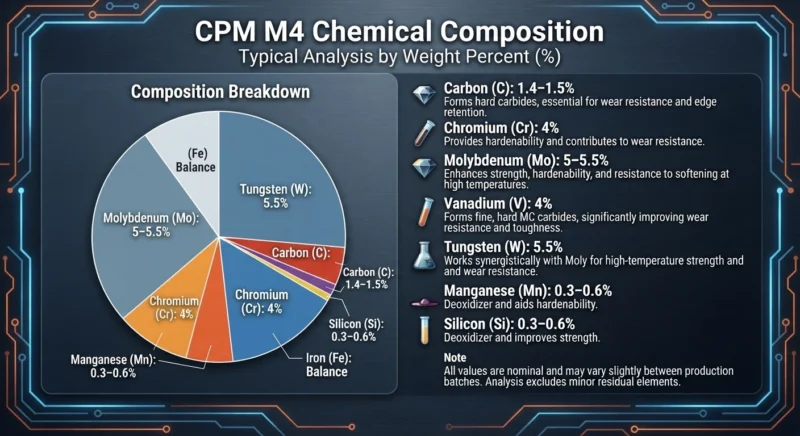
A representative CPM M4 composition contains approximately:
- Carbon: about 1.4–1.5%
- Chromium: about 4%
- Molybdenum: about 5–5.5%
- Vanadium: about 4%
- Tungsten: about 5.5%
- Manganese: roughly 0.3–0.6%
- Silicon: roughly 0.3–0.6%
- Iron: balance
The exact composition depends on the specification and material being examined. For example, a recent metallurgical study of CPM AISI M4 measured approximately 1.47% carbon, 4.42% chromium, 5.41% molybdenum, 4.05% vanadium, and 5.59% tungsten.
Those numbers immediately explain why CPM M4 behaves very differently from ordinary carbon steel.
There is a large amount of alloying material available to form carbides.
But the elements do not all perform the same job.
Carbon
Carbon is fundamental to the hardness potential of M4.
It contributes to martensitic hardness and combines with carbide-forming elements to produce hard carbide phases.
The carbon content is much higher than in many conventional stainless knife steels.
This helps M4 achieve very high hardness, but it also means that heat treatment must be carefully controlled.
Vanadium
Vanadium is particularly important for wear resistance.
It forms extremely hard vanadium-rich MC-type carbides.
These carbides resist abrasion and help protect the cutting edge from gradual material loss.
However, carbides are not automatically beneficial simply because they are hard.
Very large or poorly distributed carbides can become stress concentrators and can make an edge more susceptible to chipping.
Powder metallurgy is therefore particularly valuable here because it permits a much finer and more uniform carbide population.
Tungsten
Tungsten is a major contributor to the high-speed-steel character of M4.
It participates in complex carbide formation and helps the steel maintain hardness at elevated temperatures.
Tungsten-rich carbide phases are also important to wear resistance.
Molybdenum
Molybdenum works alongside tungsten in the high-speed-steel system.
It contributes to secondary hardening during tempering and participates in the formation of M₆C-type carbides.
The interaction between molybdenum, tungsten, carbon, and the rest of the alloy is one reason M4 develops such a complex microstructure.
Chromium
Chromium contributes to hardenability and carbide formation.
But approximately 4% chromium is not enough to make CPM M4 a stainless steel.
This is an important point.
CPM M4 should be considered non-stainless.
Its chromium content provides useful metallurgical functions, but not the level of corrosion resistance associated with modern stainless knife steels.
4. Why Is CPM M4 Made by Powder Metallurgy?
Powder metallurgy is central to understanding CPM M4.
A high-alloy steel containing large quantities of carbon, vanadium, tungsten, and molybdenum has a strong tendency to form carbides during solidification.
The challenge is controlling those carbides.
If carbide particles become excessively large, clustered, or unevenly distributed, they can negatively affect mechanical properties.
For a knife, this matters at the edge.
A cutting edge is extremely thin. Any large brittle inclusion or carbide cluster near the apex can become a location where cracking begins.
Powder metallurgy addresses this problem by rapidly solidifying small alloy particles before consolidating them into dense steel.
The resulting microstructure can contain a much finer and more uniform carbide distribution.
Academic research on M4 and other powder-metallurgy tool steels repeatedly identifies carbide size, type, and distribution as major factors controlling the relationship between hardness, wear resistance, and toughness.
This gives CPM M4 an important advantage over many conventional high-alloy tool steels.
The goal is not to eliminate carbides.
It is to control them.
Check Our Guide Powder Steels for Kitchen Knives
5. The Microstructure of CPM M4
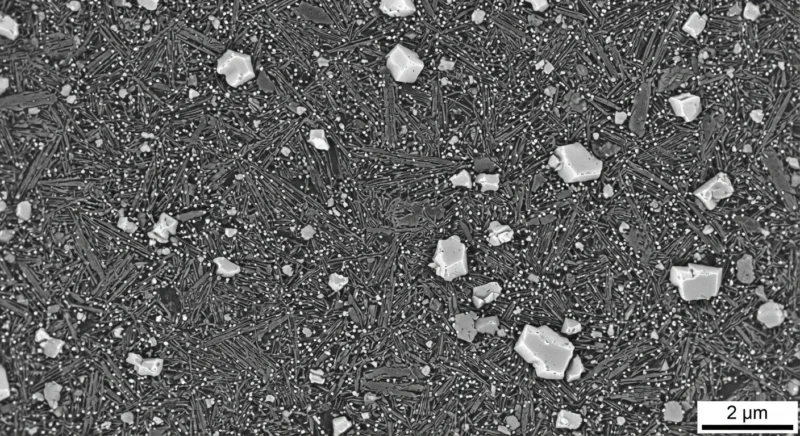
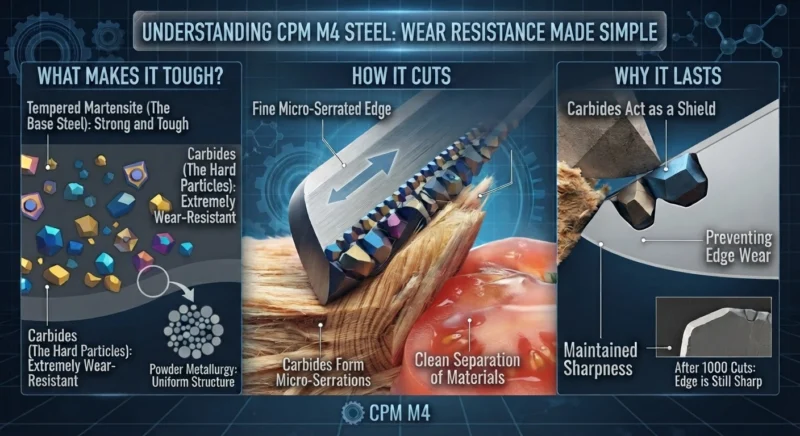
To understand CPM M4 performance, it helps to think of the steel as a composite at the microscopic level.
The main components are:
- a hardened martensitic matrix,
- primary carbides,
- secondary carbides,
- retained austenite depending on heat treatment,
- and the fine-scale structure created during powder processing.
The martensitic matrix provides much of the steel’s hardness and strength.
The carbides provide additional resistance to abrasion.
The balance between these components determines the final performance.
Recent research examining CPM AISI M4 found MC and M₆C carbides in the material. The study also demonstrated that heat treatment changes the phase balance and carbide precipitation behavior.
This is why it is misleading to describe M4 simply as “hard steel.”
Its performance is really the result of a carefully engineered matrix-plus-carbide system.
6. What Makes CPM M4 So Wear Resistant?
Wear resistance is one of the strongest reasons to use CPM M4.
There are several mechanisms involved.
First, the steel reaches very high hardness.
Second, it contains a substantial quantity of hard alloy carbides.
Third, the powder-metallurgy structure keeps these carbides relatively fine and uniformly distributed compared with what can occur in conventional high-alloy steels.
Fourth, the alloy contains both vanadium-rich and tungsten/molybdenum-rich carbide populations.
Research examining M4 has found that the type and quantity of carbide particles strongly influence wear behavior. Studies of M4 deposited by laser processing, for example, have identified tungsten- and molybdenum-rich M₆C carbides and demonstrated that carbide characteristics influence abrasive wear.
For a knife, the practical consequence is straightforward:
The cutting edge can remain effective for a long time before abrasive wear removes enough material to noticeably reduce cutting performance.
This is particularly useful for:
- cardboard cutting,
- rope,
- abrasive food preparation,
- woodworking,
- heavy utility cutting,
- industrial cutting,
- and other repetitive tasks.
However, edge retention is not determined by steel alone.
A thin, acute edge can lose its performance through deformation or chipping even when the steel itself has excellent wear resistance.
That is why geometry and heat treatment remain just as important as alloy composition.
Check Our Guide Wear Resistance vs Toughness: Understanding the Most Important Knife Steel Trade-Off
7. CPM M4 Edge Retention
CPM M4 is widely valued for excellent edge retention.
Its edge-retention performance comes primarily from its combination of:
- high hardness,
- high carbide volume,
- hard vanadium-rich carbides,
- tungsten/molybdenum-rich carbides,
- and a fine powder-metallurgy structure.
This makes it particularly strong in abrasive edge-retention situations.
For example, if a knife repeatedly cuts material that wears away steel through abrasion, CPM M4 can maintain a useful edge for a very long time.
But there is an important distinction between wear resistance and edge stability.
They are related but not identical.
Imagine two blades.
Blade A has extremely hard carbides but an edge that is too thin for the task.
Blade B has slightly lower wear resistance but a more appropriate edge geometry.
Blade A may have better theoretical wear resistance yet suffer small chips during use.
Blade B may remain functional for longer.
This is why “best edge retention” cannot be determined from alloy chemistry alone.
The geometry and heat treatment must be considered together with the steel.
Check Our Guide Edge Retention Explained
8. CPM M4 Toughness
Toughness is where CPM M4 becomes especially interesting.
It would be easy to assume that a steel with approximately 4% vanadium, substantial tungsten and molybdenum, and hardness in the low-to-mid 60s HRC must be extremely brittle.
That is not necessarily the case.
The powder-metallurgy process helps produce a fine and controlled carbide distribution.
This reduces some of the problems associated with coarse carbide networks.
M4 was designed as a high-performance tool steel that needs a useful combination of wear resistance and mechanical strength.
Research on M4 has shown that heat treatment has a significant effect on impact toughness. In one study, different heat-treatment conditions produced measurable changes in hardness, wear behavior, and impact response.
This leads to an important practical conclusion:
CPM M4 has good toughness for its level of wear resistance and hardness, but it is not a general-purpose toughness steel.
It should not be treated like:
- 80CrV2,
- 5160,
- 52100,
- or other steels selected primarily for toughness.
M4 belongs to a different performance category.
It is optimized much more heavily toward high-speed cutting, wear resistance, hardness, and edge retention.
9. Is CPM M4 Stainless?
No.
CPM M4 is a non-stainless high-speed tool steel.
This is one of the most important things to understand before choosing it for a knife.
Its chromium content is around 4%, far below the level normally associated with stainless behavior.
The alloy contains substantial quantities of other elements, but that does not change its basic corrosion classification.
A CPM M4 blade can develop:
- surface discoloration,
- patina,
- staining,
- oxidation,
- and eventually rust
if it is exposed to moisture, salts, acids, or poor storage conditions.
Kitchen environments can be particularly demanding because food acids and salts accelerate corrosion.
M4 therefore requires more maintenance than stainless steels.
10. CPM M4 Corrosion Resistance
Corrosion resistance is one of the major disadvantages of CPM M4.
This does not mean that an M4 blade immediately rusts.
In normal use, a clean and maintained blade can remain attractive for a long time.
But it does mean that the steel does not provide the passive corrosion protection expected from stainless knife steels.
The biggest risks are:
- prolonged exposure to water,
- acidic foods,
- salt,
- humidity,
- fingerprints left on the blade,
- storage while wet,
- and neglect.
A protective coating can reduce the problem.
Some M4 knives use coatings or surface treatments specifically because the underlying steel is not stainless.
But a coating does not change the fundamental metallurgy of the steel.
An uncoated M4 edge still requires care.
For users who prioritize corrosion resistance above all else, stainless steels are generally easier to live with.
For users who prioritize extreme edge retention, M4 becomes more interesting.
11. Does CPM M4 Rust Easily?
“Easy” depends on the environment.
In a dry environment with routine maintenance, M4 can be perfectly manageable.
In a wet kitchen, humid workshop, or outdoor environment where the blade is frequently exposed to moisture and then neglected, corrosion becomes much more likely.
The important distinction is between corrosion resistance and corrosion maintenance.
M4 has limited inherent corrosion resistance, but a user can greatly reduce corrosion through good maintenance.
A simple routine is often enough:
- Clean the blade after use.
- Dry it completely.
- Do not leave acidic food residue on the surface.
- Avoid storing it wet.
- Use a thin protective oil when appropriate.
- Store the knife in a dry environment.
Some users also appreciate the natural patina that develops on carbon and tool steels.
That is a matter of preference.
Patina is not the same thing as uncontrolled active rust.
12. CPM M4 Hardness
CPM M4 can achieve very high hardness.
The exact final hardness depends strongly on heat treatment.
A recent experimental study of CPM AISI M4 found approximately 63–65 HRC after hardening under the tested conditions, while a particular quenched-and-tempered condition measured approximately 57 HRC.
This illustrates an important point:
There is no single universal CPM M4 hardness.
Different heat-treatment schedules can produce substantially different results.
For knives, M4 is often selected in a high-hardness range because its wear resistance and edge stability benefit from appropriate hardness.
But maximum hardness is not automatically the best hardness.
A knife intended for extremely thin slicing may need a different balance from a heavy-duty working knife.
Likewise, a blade used for abrasive cutting may benefit from a different heat treatment than one expected to withstand occasional impacts.
Check Our Guide What Is HRC? Understanding Rockwell Hardness
13. CPM M4 Heat Treatment
Heat treatment is critical to CPM M4.
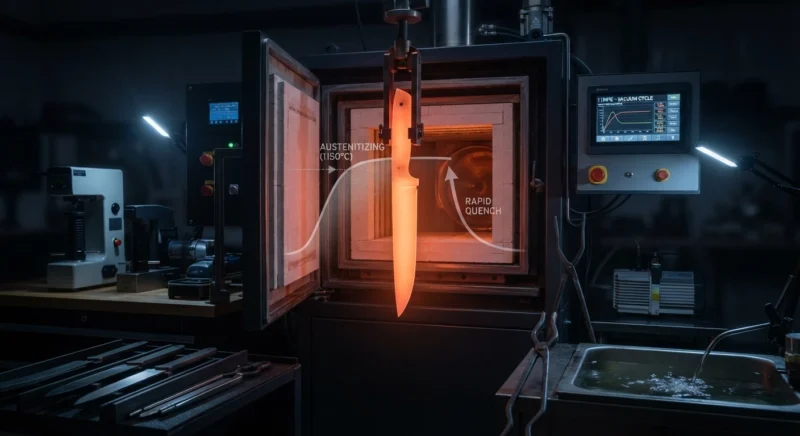
The basic sequence consists of:
- preheating,
- austenitizing,
- quenching,
- and tempering.
The exact temperatures and times depend on the material specification, section thickness, equipment, and desired properties.
Austenitizing is particularly important because the temperature determines how much carbon and alloying elements dissolve into the austenite before quenching.
Too low a temperature can leave excessive undissolved material and reduce the intended hardness.
Too high a temperature can increase grain growth, alter carbide dissolution, increase retained austenite, and potentially reduce toughness.
Recent research on CPM AISI M4 identified approximately 1120°C as an optimum austenitizing region under the conditions studied, with subsequent cooling producing a high-hardness martensitic structure.
That does not mean every knife should simply be heat treated at exactly 1120°C.
Industrial heat treatment requires controlled equipment and a process designed around the specific material.
Check Our Guide Different Heat Treatment Methods Explained
14. Why Tempering Matters So Much in CPM M4
Tempering is not just a finishing step.
It changes the microstructure.
After quenching, the steel contains very hard martensite and may also contain retained austenite.
Tempering reduces stresses, changes the martensitic structure, and promotes precipitation of secondary carbides.
The result can be a much more useful combination of hardness, toughness, dimensional stability, and wear resistance.
Research on CPM AISI M4 has demonstrated that tempering promotes the formation of fine secondary M₆C carbides and changes the resulting hardness and microstructure.
For this reason, professional heat treatment generally uses carefully controlled tempering rather than simply quenching the steel and putting it into service.
The difference between a properly heat-treated M4 blade and a poorly treated one can be enormous.
15. Why CPM M4 Can Have Secondary Hardening
High-speed steels are famous for their ability to respond to secondary hardening.
During tempering at appropriate temperatures, alloying elements can precipitate as fine carbides.
These carbides can increase hardness even as the steel is being tempered.
This is different from the behavior of simple carbon steels, where increasing tempering temperature generally produces a straightforward reduction in hardness.
In M4, the interactions among carbon, molybdenum, tungsten, vanadium, and chromium create a much more complicated response.
This is one of the reasons M4 can retain high hardness after tempering at temperatures that would significantly soften many simpler steels.
16. CPM M4 Edge Stability
Edge stability is an especially important characteristic for knife makers.
A blade can fail at the edge in several ways:
- abrasive wear,
- plastic deformation,
- rolling,
- microchipping,
- or catastrophic fracture.
CPM M4 is very strong against abrasive wear.
It can also maintain a stable edge when heat treated correctly and used at an appropriate geometry.
But its high carbide content means that edge geometry matters enormously.
A very thin edge concentrates stress into a tiny area.
If the knife is used for slicing, this can be excellent.
If the knife is twisted, struck against hard objects, or used for lateral force, the same geometry may be too aggressive.
The correct question is therefore not:
“Can M4 take a very thin edge?”
It can.
The better question is:
“What edge geometry is appropriate for the intended use?”
17. Can CPM M4 Take a Very Fine Edge?
Yes.
CPM M4 can produce an extremely effective cutting edge.
Its high hardness supports good edge stability, while the powder-metallurgy structure helps reduce the problems associated with coarse carbide structures.
However, sharpening behavior becomes more demanding as the steel becomes harder and more wear resistant.
The user may obtain a very sharp edge, but removing steel from M4 takes more work than sharpening a softer carbon steel.
This is particularly noticeable with conventional abrasives.
18. Is CPM M4 Difficult to Sharpen?
CPM M4 is not necessarily difficult to sharpen, but it is slow to sharpen compared with simpler steels.
The reason is its wear resistance.
The same microstructural features that help the blade retain its edge also make the edge resistant to abrasive removal during sharpening.
Diamond and cubic boron nitride abrasives can be particularly useful because they are well suited to high-hardness, high-wear-resistance steels.
High-quality modern ceramic abrasives can also work well.
The important principle is:
Do not wait until the blade is completely dull.
A highly wear-resistant steel can require substantial effort once a large amount of material must be removed.
Regular light maintenance is much easier.
Check Our Guide All Kinds of Knife Sharpening Tools
19. CPM M4 Sharpening Angle
There is no single correct angle for every M4 knife.
A reasonable starting point for a fine cutting knife may be around:
- 15–17° per side for slicing-oriented applications,
- 17–20° per side for more general-purpose use,
- somewhat wider geometry for heavier work.
These numbers are not rules.
Blade thickness, edge geometry, heat treatment, intended use, and user technique all matter.
A very thin M4 kitchen knife can benefit from a fine edge.
A hard-use outdoor knife may need a more conservative edge.
If the edge begins to chip, the solution may not be to sharpen differently.
It may mean that the geometry is too thin for the way the knife is being used.
20. CPM M4 for Kitchen Knives
CPM M4 can make an outstanding kitchen knife, but it is not a maintenance-free kitchen steel.
Its advantages include:
- exceptional edge retention,
- high hardness,
- strong cutting performance,
- good edge stability,
- excellent wear resistance,
- and the ability to support very thin cutting geometry.
Its disadvantages include:
- poor stainless behavior,
- more demanding sharpening,
- greater sensitivity to abuse than tougher low-alloy steels,
- and the need for more careful maintenance.
For a chef who values edge retention and does not mind wiping and drying the blade, M4 can be extremely rewarding.
For a user who wants to leave a knife wet in the sink and forget about it, it is a poor match.
21. CPM M4 for Outdoor and Hard-Use Knives
M4 can also work very well in outdoor knives.
Its wear resistance is particularly valuable when the knife performs repetitive cutting.
However, corrosion becomes more important outdoors.
Rain, humidity, sweat, saltwater, and wet storage can all create problems.
For an outdoor M4 knife, a protective finish can be especially useful.
The user should also understand that “hard-use” does not mean “indestructible.”
M4 is a high-performance cutting steel.
It is not designed to replace a pry bar or chopping tool simply because it is hard.
22. CPM M4 vs 80CrV2
CPM M4 and 80CrV2 represent very different approaches to knife steel design.
80CrV2 is a relatively simple low-alloy carbon steel known for toughness and straightforward heat treatment.
CPM M4 is a highly alloyed powder-metallurgy high-speed tool steel designed around extreme wear resistance and high hardness.
In practical terms:
CPM M4
- much higher wear resistance,
- much higher hardness potential,
- better long-term abrasive edge retention,
- more difficult sharpening,
- lower corrosion resistance,
- less forgiving under severe abuse.
80CrV2
- substantially tougher,
- easier to sharpen,
- easier to heat treat,
- lower wear resistance,
- much lower carbide content,
- generally more forgiving in hard-use applications.
Neither is universally superior.
They are designed for different priorities.
For a thin cutting edge and long edge life, M4 is attractive.
For heavy impact and abuse, 80CrV2 has a fundamentally different advantage.
23. CPM M4 vs CPM 3V
CPM M4 and CPM 3V are particularly interesting to compare because both are powder-metallurgy tool steels, but they emphasize different characteristics.
M4 is more strongly oriented toward wear resistance and high-speed cutting.
3V is famous for an unusually strong combination of toughness and wear resistance.
This produces a meaningful difference for knives.
A properly heat-treated M4 blade can provide extremely long edge life.
A properly heat-treated 3V blade can tolerate substantially more abuse.
This is why the two steels often appeal to different knife users.
A thin slicing knife may benefit from M4’s exceptional wear resistance.
A large hard-use fixed blade may make more sense in 3V.
The difference is not simply “which steel is better.”
It is a question of what the blade needs to survive.
24. CPM M4 vs D2
D2 and M4 are both high-alloy tool steels, but their carbide systems are different.
D2 has high chromium and is commonly considered a semi-stainless tool steel, although its corrosion resistance is far below that of modern stainless steels.
M4 has considerably more tungsten, molybdenum, and vanadium and is designed as a high-speed steel.
M4 generally offers stronger wear resistance and higher hardness potential.
D2 provides somewhat better corrosion resistance.
For knife users, this creates a practical choice:
M4 emphasizes cutting performance and wear resistance.
D2 offers a more forgiving maintenance profile.
Again, the exact behavior depends heavily on heat treatment and geometry.
Check Our Guide D2 Steel Review: Is D2 Still One of the Best Knife Steels?
25. CPM M4 vs M390
M390 and M4 are both high-performance powder-metallurgy steels, but they solve different problems.
M390 is a stainless powder-metallurgy steel with a strong emphasis on corrosion resistance and high wear resistance.
M4 is a non-stainless high-speed steel with a strong emphasis on hardness, wear resistance, and high-temperature tool performance.
The major practical distinction is corrosion.
For a kitchen knife exposed to moisture and food acids, M390 is much easier to maintain.
For a user who prioritizes extreme edge retention and accepts regular maintenance, M4 can be attractive.
The two steels should therefore not be viewed as interchangeable versions of the same concept.
Check Our Guide M390 Steel Review: Pros, Cons, Edge Retention, Toughness & Real-World Performance
26. CPM M4 vs S30V
S30V is a stainless powder-metallurgy knife steel specifically designed for cutting tools.
M4 is a high-speed tool steel with a much older industrial lineage.
S30V offers substantially better corrosion resistance.
M4 generally offers higher hardness potential and extremely strong wear resistance.
The practical choice depends on the application.
For a low-maintenance everyday knife, S30V is easier.
For a high-performance cutting tool where corrosion resistance is secondary, M4 can offer a compelling combination of edge retention and hardness.
27. CPM M4 vs MagnaCut
CPM M4 and MagnaCut are almost opposite examples of modern knife-steel design priorities.
M4 is a non-stainless high-speed tool steel.
MagnaCut was engineered specifically to achieve a more balanced combination of toughness, corrosion resistance, and wear resistance.
M4 has a substantial advantage in wear resistance and high-hardness behavior.
MagnaCut has a major advantage in corrosion resistance and generally offers a more balanced property profile.
For kitchen environments, the corrosion difference can be decisive.
For specialized cutting applications where maximum wear resistance is highly valued, M4 remains extremely interesting.
Check Our Guide MagnaCut Steel Review
28. Is CPM M4 Good for EDC Knives?
Yes, but it is a specialized choice.
For an everyday-carry knife, CPM M4 offers:
- excellent edge retention,
- high edge stability,
- strong cutting performance,
- and a premium high-performance character.
The downside is corrosion.
An EDC knife is exposed to:
- sweat,
- humidity,
- rain,
- fingerprints,
- pocket lint,
- and occasionally food or moisture.
That makes maintenance important.
A coated M4 blade can be a practical solution.
If the blade is uncoated, users should be prepared to wipe it and occasionally apply a protective oil.
29. CPM M4 for Bushcraft
CPM M4 can work for bushcraft, but it depends on the style of bushcraft.
For controlled carving and fine cutting, its edge retention can be excellent.
For repeated batoning, heavy chopping, lateral stress, or contact with hard knots and dirty wood, a tougher steel may be a better match.
This is another example of why hardness alone does not define knife performance.
Bushcraft users often benefit from a steel that can tolerate unexpected impact.
M4 can handle substantial work, but its strengths are more closely aligned with cutting efficiency and wear resistance than with extreme impact tolerance.
30. CPM M4 for Hunting Knives
M4 can make a very capable hunting knife.
The excellent edge retention is valuable during extended cutting work.
However, hunting creates a special corrosion environment.
Blood, moisture, tissue fluids, and salts can remain on the blade if it is not cleaned promptly.
An M4 hunting knife should therefore be cleaned and dried immediately after use.
A protective finish can make the steel more practical for hunting.
For users who are willing to perform that maintenance, M4 can be an excellent performer.
Check Our Guide How to Choose a Hunting Knife for Fishing
31. CPM M4 and Blade Geometry
Steel does not determine knife performance independently of geometry.
A blade made from M4 can be:
- extremely thin,
- moderately robust,
- or relatively thick.
The steel does not automatically tell you which geometry the maker chose.
For high-performance cutting, M4 works particularly well with a thin, carefully controlled edge.
But thinner is not always better.
As edge thickness decreases, cutting resistance falls, but sensitivity to lateral loads and impact increases.
A well-designed M4 knife therefore balances:
hardness + carbide structure + edge thickness + edge angle + intended use.
This combination matters more than any individual specification.
32. CPM M4 and Edge Chipping
One of the most common concerns with high-hardness tool steels is chipping.
M4 can chip if:
- the edge is excessively thin,
- the hardness is pushed too high for the application,
- the knife is twisted,
- the edge strikes hard objects,
- or the knife is used outside its intended cutting function.
The powder-metallurgy structure helps because it provides a finer and more uniform carbide distribution than conventional coarse-carbide structures.
But it does not make the steel immune to chipping.
A carbide is extremely hard, but it is not ductile.
At a sufficiently thin edge, stresses can concentrate around carbide-rich regions.
That is why professional knife design must consider both wear resistance and fracture resistance.
33. CPM M4 and Sharpening Abrasives
Because M4 is highly wear resistant, abrasive selection matters.
Suitable options include:
- diamond stones,
- CBN abrasives,
- high-quality ceramic abrasives,
- and other modern abrasives capable of efficiently cutting high-hardness tool steels.
Traditional softer waterstones can still be used, but sharpening may take considerably longer.
A coarse abrasive is useful when repairing damage or establishing a new bevel.
A finer abrasive can then refine the edge.
For routine maintenance, stropping can help maintain an edge, but stropping cannot replace actual sharpening once significant steel removal is necessary.
34. CPM M4 Patina
Uncoated M4 can develop a patina.
The appearance may range from light gray or brown discoloration to darker coloration depending on the environment and use.
Some users consider this part of the character of a non-stainless tool steel.
Others prefer a clean appearance.
The key distinction is between stable surface patina and active corrosion.
If the surface develops orange or flaky rust, that is a different issue and should be addressed.
A thin protective oil film can significantly reduce the likelihood of unwanted corrosion.
35. CPM M4 Heat Treatment Is More Important Than the Steel Label
Two M4 knives can perform differently even when both are made from genuine CPM M4.
Why?
Because heat treatment determines:
- final hardness,
- martensite structure,
- retained austenite,
- carbide precipitation,
- grain size,
- dimensional stability,
- toughness,
- and edge behavior.
The recent metallurgical literature demonstrates just how sensitive M4 is to heat-treatment conditions. Different austenitizing and tempering schedules produce different phase compositions and hardness levels.
Therefore, when comparing two M4 knives, the steel name alone is not enough.
Important questions include:
- What final hardness was achieved?
- Was the steel properly austenitized?
- How was it quenched?
- How many tempering cycles were used?
- What geometry does the blade have?
- What edge angle was used?
A well-treated M4 blade can be outstanding.
A poorly heat-treated M4 blade can be disappointing.
36. Is CPM M4 Brittle?
Calling M4 simply “brittle” is misleading.
It is a high-hardness tool steel containing substantial hard carbide populations.
That means it is less forgiving than many tough low-alloy steels.
But powder metallurgy allows the carbide structure to be controlled much more effectively than in many conventional high-alloy steels.
The better description is:
CPM M4 is a high-wear, high-hardness steel with useful toughness for its class, but it is not intended to compete with dedicated toughness steels.
That distinction is important.
37. CPM M4 Advantages
The major advantages of CPM M4 include:
Excellent wear resistance
The combination of high hardness and hard alloy carbides gives M4 outstanding resistance to abrasive wear.
Excellent edge retention
For many cutting applications, M4 can retain a highly functional edge for a very long time.
High hardness potential
Properly treated M4 can operate in a very high hardness range.
Fine powder-metallurgy structure
The fine carbide distribution helps balance wear resistance and toughness.
Strong edge stability
At suitable hardness and geometry, M4 can maintain a fine cutting edge very effectively.
Excellent performance in demanding cutting applications
The alloy was designed around high-performance cutting and tooling, which translates well to specialized knives.
38. CPM M4 Disadvantages
M4 also has important disadvantages.
Poor corrosion resistance
It is not stainless.
More difficult sharpening
Its high wear resistance makes steel removal slower.
Less forgiving than tough steels
Heavy impact and lateral forces can damage a fine M4 edge.
Heat treatment sensitivity
The steel requires controlled processing to realize its potential.
Maintenance requirements
Uncoated blades need more attention than stainless steels.
Not ideal for every knife
A steel optimized for abrasive wear is not automatically the best material for a kitchen knife, survival knife, or heavy chopping tool.
39. Who Should Choose CPM M4?
CPM M4 is particularly attractive to users who value:
- maximum practical edge retention,
- high hardness,
- thin cutting edges,
- demanding cutting performance,
- and a willingness to maintain a non-stainless steel.
It is especially interesting for:
- high-performance EDC knives,
- specialized cutting knives,
- utility knives,
- slicers,
- some hunting knives,
- some outdoor knives,
- and custom blades where maximum edge retention is a priority.
It is less attractive to users who prioritize:
- corrosion resistance,
- easy sharpening,
- extreme impact toughness,
- or minimal maintenance.
40. Who Should Avoid CPM M4?
A different steel may be more appropriate if you frequently:
- leave your knife wet,
- work around saltwater,
- cut acidic food without cleaning the blade,
- use the knife for heavy impacts,
- pry with the edge,
- chop hard materials,
- or want the easiest possible sharpening.
In those circumstances, a stainless or tougher steel may better match the application.
This does not make M4 a poor steel.
It simply means that steel selection should follow the job rather than the reputation of the alloy.
41. Is CPM M4 a Good Knife Steel?
Yes, when its characteristics match the intended use.
CPM M4 is one of the more technically interesting high-performance knife steels because it combines:
- very high wear resistance,
- excellent edge retention,
- high hardness,
- a refined powder-metallurgy structure,
- and useful toughness for such a wear-focused steel.
Its principal weakness is corrosion resistance.
Its other limitation is that extreme performance comes with increased sharpening and maintenance requirements.
For someone who wants a knife that can keep cutting for a very long time, M4 is highly attractive.
For someone who wants a knife that can be neglected, M4 is a poor choice.
42. Final Verdict: What Is CPM M4 Best At?
The most accurate way to describe CPM M4 is not simply “super steel.”
It is a powder-metallurgy high-speed tool steel optimized for high hardness, wear resistance, and demanding cutting performance.
Its microstructure explains its behavior.
The powder-metallurgy process allows a fine distribution of alloy carbides.
Vanadium contributes very hard MC-type carbides.
Tungsten and molybdenum contribute to complex carbide formation and secondary hardening behavior.
The martensitic matrix provides the high hardness required for cutting performance.
Heat treatment determines how effectively these ingredients work together.
The result is a steel capable of exceptional edge retention.
But M4 has trade-offs.
It is not stainless.
It is not the easiest steel to sharpen.
It is not the toughest steel available.
And maximum hardness is not automatically maximum knife performance.
The best CPM M4 knife is one in which steel, heat treatment, geometry, edge angle, and intended use are all matched to one another.
That is ultimately what makes M4 so interesting.
It does not try to do everything.
Instead, it concentrates on a demanding group of properties—hardness, wear resistance, edge retention, and cutting performance—and pushes them very far.
For users who understand its maintenance requirements and use it within its strengths, CPM M4 can be an exceptional blade steel.
Frequently Asked Questions About CPM M4
Is CPM M4 stainless?
No. CPM M4 is a non-stainless high-speed tool steel. Its chromium content is not sufficient to provide the corrosion resistance expected from stainless knife steels.
Is CPM M4 good for knives?
Yes. Its high hardness, wear resistance, and edge retention make it particularly suitable for high-performance knives.
Is CPM M4 better than M4?
CPM M4 and conventional M4 belong to the same M4 high-speed-steel family, but the powder-metallurgy production route produces a different and generally finer carbide structure. They should not be assumed to behave identically.
How hard can CPM M4 get?
CPM M4 can reach very high hardness. Published experimental results vary according to heat treatment; one recent study measured approximately 63–65 HRC after hardening and approximately 57 HRC after a particular quenched-and-tempered treatment.
Does CPM M4 hold an edge well?
Yes. Excellent wear resistance and high hardness give CPM M4 very strong edge-retention performance.
Is CPM M4 difficult to sharpen?
It can be. Its high wear resistance means that removing steel takes more effort than with simpler, softer steels. Diamond, CBN, and suitable ceramic abrasives are useful choices.
Does CPM M4 rust?
It can. M4 is not stainless and requires more corrosion maintenance than stainless knife steels.
Is CPM M4 tougher than 80CrV2?
No. 80CrV2 is designed around a much simpler low-alloy composition and is generally selected for its toughness. M4 emphasizes wear resistance and hardness.
Is CPM M4 tougher than CPM 3V?
Generally, CPM 3V is the more toughness-oriented steel, while M4 is more strongly optimized for wear resistance and high-speed cutting performance.
Is CPM M4 good for kitchen knives?
It can be excellent for users who prioritize edge retention and accept regular cleaning and drying. Its lack of stainless corrosion resistance is the main disadvantage in kitchen environments.
Is CPM M4 good for EDC?
Yes, especially when long edge retention is important. A coating can make corrosion management easier.
What makes CPM M4 different from many knife steels?
Its high-speed-tool-steel chemistry and powder-metallurgy structure give it a combination of high hardness, substantial carbide content, and excellent wear resistance that is unusual among conventional knife steels.
This article is for independent informational purposes only and is not affiliated with, sponsored by, or endorsed by any steel manufacturer. All product names, trademarks, and registered trademarks are the property of their respective owners.