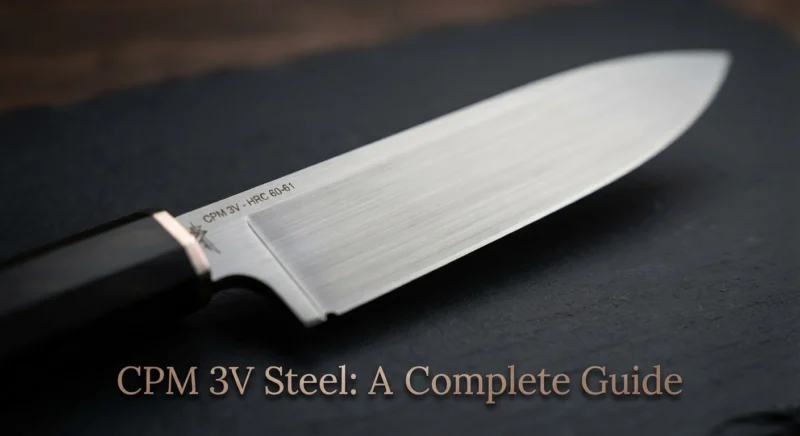
CPM 3V Steel
An Independent Guide
CPM 3V is one of the most interesting tool steels used for high-performance knives. It is not famous because it has the highest possible edge retention, the highest chromium content, or the highest hardness. Its reputation comes from something more difficult to achieve: an unusually strong combination of toughness and wear resistance.
That combination makes CPM 3V particularly attractive for knives that are expected to experience hard use, impact, chopping, twisting, or occasional abuse. A well-made CPM 3V blade can take punishment that would make a more wear-resistant but less tough steel much more vulnerable to chipping or fracture.
At the same time, CPM 3V is not a stainless steel, and it is not a magic material that eliminates the normal trade-offs of high-performance knife steels. It can develop corrosion if neglected, it requires appropriate heat treatment to reach its potential, and its edge-retention characteristics are different from steels specifically designed around very high carbide volume.
The interesting part is precisely this balance.
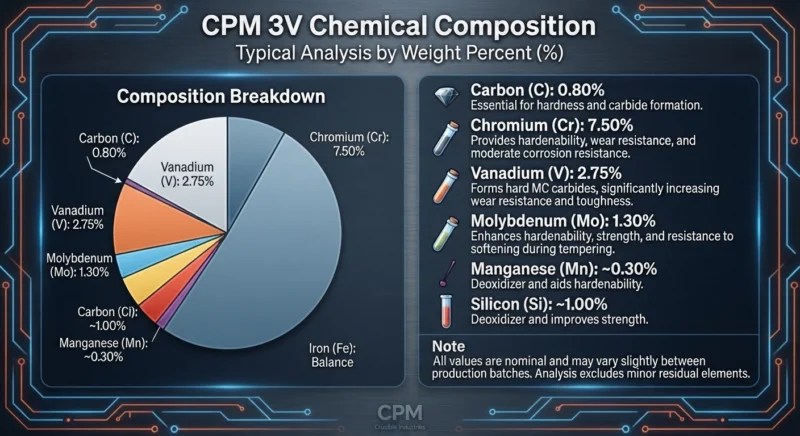
CPM 3V was originally developed as a high-toughness powder-metallurgy tool steel for demanding industrial applications. Its properties also happen to make it exceptionally well suited to hard-use knives. The steel combines approximately 0.8% carbon, 7.5% chromium, 1.3% molybdenum, and 2.75% vanadium, with the balance primarily iron and small additions of other elements.
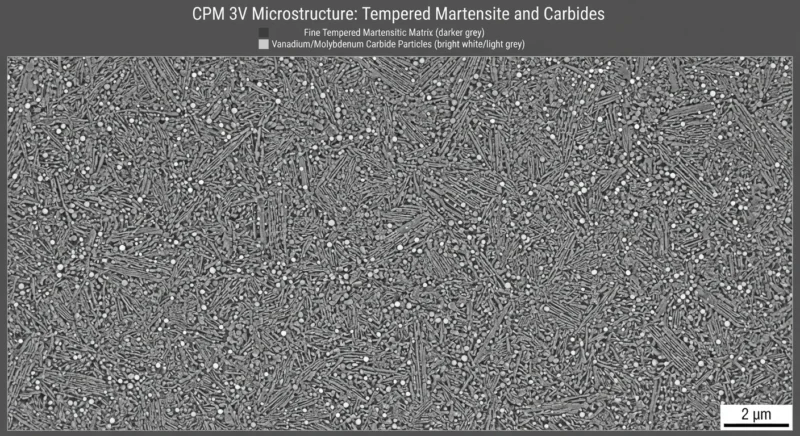
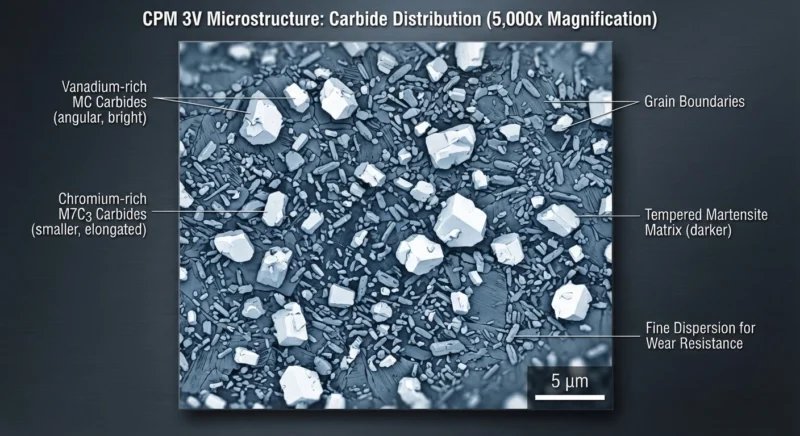
This composition gives CPM 3V a microstructure containing a relatively modest amount of very hard vanadium carbide rather than an enormous volume of different carbides. That distinction is central to understanding why CPM 3V can offer so much toughness while still providing useful wear resistance. Modern research and metallurgical analysis support the importance of its fine, relatively uniform powder-metallurgy microstructure.
So, is CPM 3V a good knife steel?
For the right kind of knife, absolutely.
But the more useful question is why.
This guide examines CPM 3V from the perspective of knife performance: its composition, powder-metallurgy structure, toughness, edge retention, hardness, corrosion resistance, sharpening behavior, heat treatment, blade geometry, and practical applications. We will also compare it conceptually with steels such as M4, 80CrV2, and Vanadis 4 Extra.
What Is CPM 3V Steel?
CPM 3V is a powder-metallurgy cold-work tool steel designed around a combination of high toughness and good wear resistance.
The “3V” designation identifies the particular alloy grade. The “CPM” designation refers to the powder-metallurgy production route rather than being a separate chemical element or performance category.
This distinction matters.
Two steels can contain broadly similar alloying elements but behave very differently because of their microstructure. In conventional steelmaking, alloying elements can segregate during solidification, and carbides can form relatively large particles or clusters. Powder metallurgy can produce a much more homogeneous distribution of alloying elements and smaller carbide populations.
In CPM 3V, that microstructural control is particularly important because the steel is intended to combine properties that normally compete with one another.
Generally speaking:
- More hard carbides can improve abrasive wear resistance.
- Higher hardness can improve edge stability and wear resistance.
- Large or excessive carbide populations can reduce toughness.
- A very tough steel may sacrifice some wear resistance.
- Increasing alloy content does not automatically produce a better knife steel.
CPM 3V was engineered around this balance.
Technical information for the steel describes it as a high-toughness, wear-resistant tool steel intended for applications such as punches, dies, industrial knives, shear blades, blanking tools, and other components where cracking or breakage is a major concern.
That industrial background explains a lot about its behavior in knives.
CPM 3V was not originally created simply to make a knife that holds an edge for as long as possible. It was created for situations where the tool must survive.
That difference is one of the keys to understanding this steel.
CPM 3V Chemical Composition
The commonly specified nominal composition of CPM 3V is approximately:
- Carbon: 0.80%
- Chromium: 7.50%
- Molybdenum: 1.30%
- Vanadium: 2.75%
- Manganese: approximately 0.30%
- Silicon: approximately 1.00%
The remainder is primarily iron, with small amounts of other elements.
Published analyses of actual CPM 3V material can differ somewhat from nominal target values. For example, one peer-reviewed study measured approximately 0.71% carbon, 7.81% chromium, 1.32% molybdenum, and 2.53% vanadium in the tested material. That is normal for an industrial alloy specification: a nominal composition describes the intended grade, while an individual melt or test sample can fall elsewhere within the specification.
The interesting question is not simply what these numbers are.
It is what they do.
What Does Carbon Do in CPM 3V?
Carbon is fundamental to the hardness of CPM 3V.
Carbon combines with alloying elements during heat treatment and contributes to the formation of carbides. It also participates in the transformation of the steel’s matrix during hardening.
At approximately 0.8% carbon, CPM 3V contains enough carbon to reach high tool-steel hardness without relying on the extremely high carbon levels found in some highly wear-resistant tool steels.
This is important because carbon content is not simply a measure of edge retention.
A knife does not become dramatically better just because its steel contains more carbon.
The type, size, distribution, and quantity of carbides matter just as much.
CPM 3V demonstrates this particularly well.
Why Does CPM 3V Contain So Much Chromium?
At approximately 7.5% chromium, CPM 3V contains substantially more chromium than traditional simple carbon knife steels.
However, it should not be classified as stainless steel.
This is a common point of confusion.
Stainless behavior depends not only on how much chromium is added to an alloy, but also on how much chromium remains available in the steel matrix after carbide formation. In CPM 3V, chromium participates heavily in the overall tool-steel microstructure, and the steel does not provide the level of free chromium necessary for conventional stainless classification.
Consequently, CPM 3V should be treated as a non-stainless tool steel.
It can resist corrosion better than some very simple high-carbon steels under certain conditions, but it still benefits from cleaning, drying, and occasional protective maintenance.
A CPM 3V knife should not be treated like a stainless kitchen knife.
The Role of Molybdenum
Molybdenum contributes to the hardenability and high-temperature behavior of CPM 3V and participates in the carbide structure.
It is particularly useful in highly alloyed tool steels because it helps the steel achieve the combination of hardness, strength, and stability required for demanding applications.
Molybdenum is one reason CPM 3V behaves very differently from a simple carbon steel with a similar carbon concentration.
Why Is Vanadium So Important?
Vanadium is probably the most important alloying element to understand when explaining CPM 3V’s wear resistance.
At approximately 2.75%, vanadium is present at a level sufficient to produce a meaningful population of vanadium carbides.
Vanadium carbides are extremely hard.
These particles resist abrasion and therefore contribute to the steel’s ability to maintain an edge during cutting.
But CPM 3V does not contain enormous amounts of carbide.
That is a crucial distinction between CPM 3V and steels designed specifically for extreme wear resistance.
Research and metallurgical analysis have found CPM 3V to contain roughly 5% carbide volume under relevant conditions, with the carbide population strongly associated with vanadium carbide.
The relatively restrained carbide volume is part of the reason the steel can retain excellent toughness.
Why Powder Metallurgy Matters
The production process is one of the most important parts of the CPM 3V story.
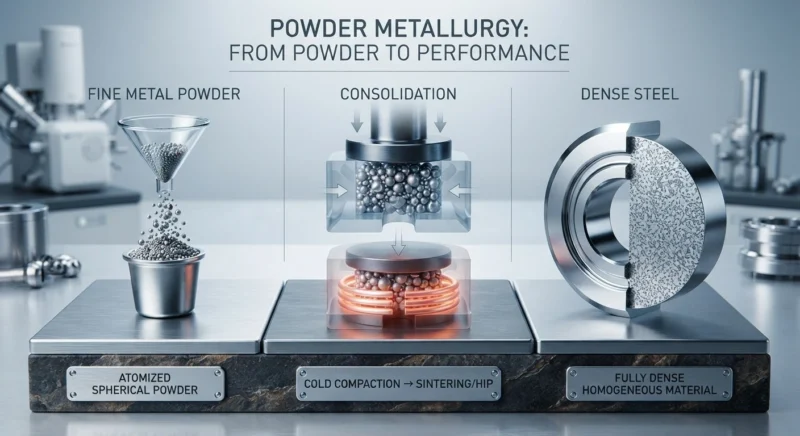
Powder metallurgy begins with steel that is atomized into very small particles. These particles solidify rapidly, limiting the large-scale segregation that can occur during conventional casting.
The powder is then consolidated into a dense steel product.
The result is a much more uniform microstructure.
Why does that matter for a knife?
Imagine two steels with similar chemistry.
One has relatively large carbide clusters.
The other has smaller, more evenly distributed carbides.
The second structure can reduce the size of individual microstructural weak points and improve the consistency of the material.
This is particularly valuable for toughness.
Technical documentation for CPM 3V specifically attributes its toughness and dimensional behavior partly to the homogeneous powder-metallurgy structure and fine carbide distribution.
This does not mean powder metallurgy automatically makes every steel better.
It means that, for a steel like CPM 3V, the production process is an important part of how its alloy design becomes a practical material.
Check Our Guide Powder Steels for Kitchen Knives
CPM 3V Toughness
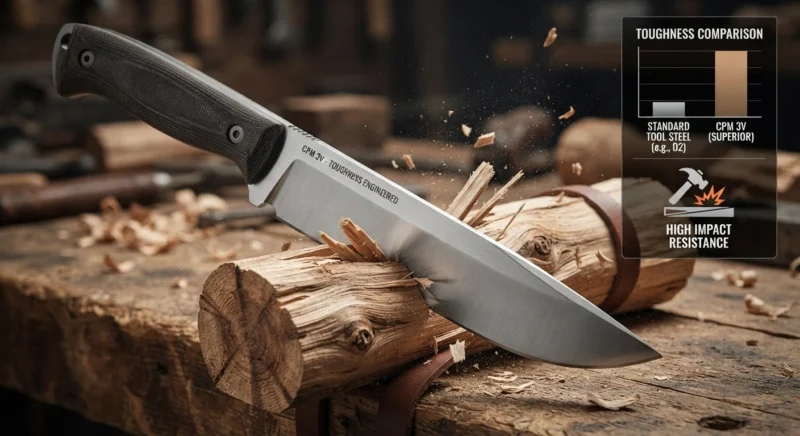
If CPM 3V has one defining characteristic, it is toughness.
Toughness describes a material’s ability to absorb energy and resist fracture.
For knives, this is especially important when the blade encounters:
- impact
- lateral stress
- twisting
- chopping
- accidental contact with hard materials
- knotty or frozen material
- hard outdoor use
- sudden loading
A very hard but relatively brittle edge can chip when subjected to impact.
A tough steel can tolerate considerably more abuse before catastrophic fracture occurs.
CPM 3V was specifically developed to address this type of problem.
Technical data places its impact toughness significantly above several common high-wear tool steels, while still retaining useful wear resistance.
Independent metallurgical research also describes CPM 3V as unusual because it combines high toughness with relatively high wear resistance, a combination that is normally difficult to achieve.
This is why CPM 3V has developed such a strong reputation among makers of hard-use knives.
Check Our Guide Wear Resistance vs Toughness: Understanding the Most Important Knife Steel Trade-Off
What Does Toughness Mean for a Knife?
It is easy to misunderstand toughness.
A tough knife is not necessarily a knife that never bends.
Toughness is not the same thing as hardness.
Hardness tells us about resistance to indentation and, in practical knife applications, often correlates with edge stability and wear behavior.
Toughness describes how much energy the material can absorb before fracturing.
These properties interact, but they are not interchangeable.
A CPM 3V blade at approximately 60 HRC can still have very high toughness compared with many other high-alloy tool steels at similar hardness levels.
That makes it particularly interesting for large fixed blades, outdoor knives, utility blades, and other designs where survival under impact is more important than maximum slicing efficiency.
CPM 3V Edge Retention
Edge retention is where CPM 3V becomes more nuanced.
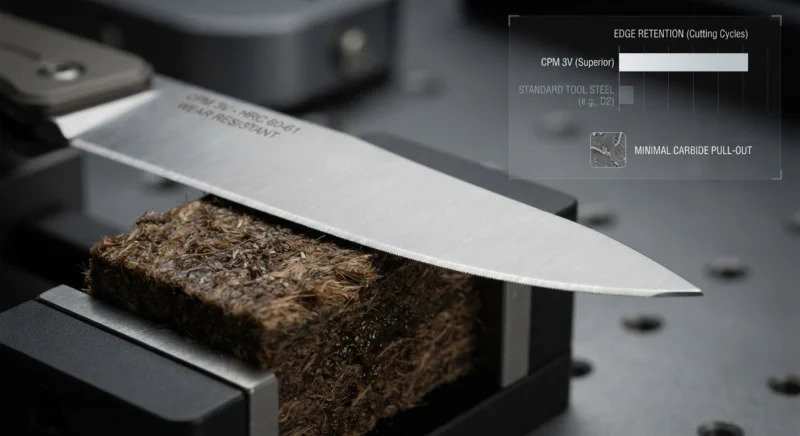
CPM 3V has good to very good wear resistance, but it is not designed to maximize edge retention at any cost.
Its approximately 5% carbide volume is relatively modest compared with highly wear-resistant powder steels containing much larger carbide populations.
That means a CPM 3V blade will generally not compete with the most extreme wear-resistant steels purely in abrasive edge retention.
And that is intentional.
The goal is balance.
For many real-world knives, losing some ultimate edge retention in exchange for dramatically improved resistance to chipping can be a very reasonable trade.
Imagine two knives used for hard outdoor work.
Knife A keeps cutting for a very long time but develops small chips whenever it encounters unexpected impact.
Knife B may require sharpening somewhat sooner but remains structurally intact through the same work.
For a hard-use knife, Knife B may be considerably more practical.
That is the design philosophy behind CPM 3V.
Check Our Guide Edge Retention Explained: 10 Factors What Makes a Knife Stay Sharp Longer?
CPM 3V Hardness
CPM 3V is commonly used in the 58–60 HRC range in its traditional tool-steel applications, while knife makers sometimes use different hardness targets depending on blade geometry, heat treatment, and intended use.
Technical documentation gives different achievable hardness levels depending on austenitizing temperature. Higher austenitizing temperatures can produce higher hardness, but there is a corresponding effect on toughness.
This illustrates a critical principle:
The highest possible hardness is not automatically the best hardness.
For CPM 3V, a heat treatment optimized for a balanced combination of toughness and wear resistance is often more useful than simply chasing maximum HRC.
That is especially true for knives.
Check Our Guide What Is HRC? Understanding Rockwell Hardness in Kitchen Knives
Is CPM 3V a Stainless Steel?
No.
CPM 3V is generally classified as a non-stainless tool steel.
Its chromium content is much higher than that of many traditional carbon steels, but it does not have sufficient chromium remaining in the matrix to provide conventional stainless behavior.
This means:
- It can rust.
- It should be cleaned after exposure to moisture.
- Saltwater requires particular caution.
- Food acids can cause staining.
- Long-term storage benefits from a light protective coating.
- A patina may develop over time.
This is not necessarily a major disadvantage.
For an outdoor knife, workshop tool, or hard-use fixed blade, many users are willing to accept some maintenance in exchange for high toughness.
But CPM 3V is not the material to choose if the primary requirement is maximum corrosion resistance.
For that job, a stainless or highly corrosion-resistant steel makes more sense.
CPM 3V Corrosion Resistance
CPM 3V occupies an interesting middle ground among non-stainless knife steels.
Its chromium content gives it more alloying complexity than simple carbon steels, but the steel does not behave like a stainless grade.
Corrosion resistance is affected by much more than nominal chromium content.
Actual performance depends on:
- surface finish
- heat treatment
- exposure time
- humidity
- salt
- acids
- contaminants
- maintenance
- edge geometry
- storage conditions
A polished CPM 3V blade kept clean and dry can remain attractive for a long time.
A CPM 3V knife left wet in a leather sheath near saltwater is a very different situation.
If you live in a humid environment or use a knife around the ocean, regular maintenance becomes particularly important.
CPM 3V Sharpening
One of the pleasant surprises about CPM 3V is that its sharpening behavior is not as extreme as its reputation might suggest.
It is certainly not a simple carbon steel.
The vanadium carbides are extremely hard and can be difficult for conventional abrasive systems to cut efficiently.
However, CPM 3V does not contain an enormous carbide volume.
That distinction matters.
A good sharpening system using appropriate abrasives can handle CPM 3V without excessive difficulty.
Diamond and high-quality ceramic abrasives are particularly useful for steels containing significant vanadium carbide.
The important thing is not to wait until the edge is badly damaged.
If a CPM 3V knife is maintained regularly, sharpening can remain straightforward.
If the edge is allowed to become severely damaged, the process becomes considerably more time-consuming.
Check Our Guide All Kinds of Knife Sharpening Tools
CPM 3V and Edge Geometry
One of CPM 3V’s greatest advantages is that its toughness allows designers to experiment with relatively thin edges without sacrificing as much durability as they might with a more brittle steel.
But “tough” does not mean “indestructible.”
Edge geometry still matters enormously.
A thin edge experiences greater stress when cutting hard material.
A thicker edge has greater support behind the apex.
CPM 3V can tolerate aggressive geometry, but the correct geometry depends on the task.
For example:
A slicing-oriented outdoor knife can benefit from a relatively thin edge.
A chopping knife may require more material behind the apex.
A heavy-duty utility blade may use a robust secondary bevel.
A thin hunting knife may prioritize cutting efficiency over maximum impact resistance.
The steel provides a large safety margin, but geometry determines how that potential is used.
CPM 3V for Hard-Use Knives
This is where CPM 3V really shines.
A hard-use knife often encounters forces that have little to do with pure slicing.
It may be used for:
- chopping
- batoning
- cutting abrasive materials
- processing wood
- camp construction
- heavy utility work
- outdoor survival tasks
- demanding industrial work
- repeated impacts
In such situations, toughness becomes extremely important.
A knife that keeps an edge beautifully but chips every time it experiences impact is not necessarily a successful hard-use knife.
CPM 3V was essentially designed around avoiding that type of failure.
CPM 3V for Bushcraft Knives
CPM 3V is particularly well suited to bushcraft and outdoor fixed blades.
Bushcraft knives often need a combination of:
- toughness
- edge stability
- reasonable edge retention
- sharpenability
- resistance to accidental damage
The steel’s toughness makes it attractive for batoning and other impact-heavy tasks.
Its wear resistance also gives it a meaningful advantage over simpler carbon steels when cutting abrasive materials.
The main limitation is corrosion.
A CPM 3V bushcraft knife requires more maintenance than a stainless outdoor knife.
For many users, that is an acceptable trade.
Check Our Guide One Knife for Hunting and Bushcraft: Is It Really Possible?
CPM 3V for Chopping Knives
CPM 3V is also well suited to chopping tools.
Chopping produces repeated impact.
That means the blade needs to absorb energy without developing catastrophic cracks or excessive chipping.
A tough steel is therefore highly desirable.
However, geometry remains critical.
A poorly designed CPM 3V chopper can still fail.
The steel cannot compensate for an excessively thin edge, bad heat treatment, or poor blade design.
The best results come from combining CPM 3V’s inherent toughness with an appropriate blade thickness and edge geometry.
CPM 3V for Kitchen Knives
CPM 3V can be used successfully for kitchen knives, but it is not an obvious choice for every kitchen.
Professional kitchen environments often place a high value on corrosion resistance and ease of maintenance.
CPM 3V requires more care than stainless kitchen steels.
Its toughness is also less important for many conventional kitchen tasks because kitchen knives are primarily slicing tools.
There are exceptions.
A heavy-duty outdoor cooking knife, camp kitchen knife, or utility kitchen blade can benefit from CPM 3V.
But for a thin chef knife used around acidic foods and frequently exposed to water, a corrosion-resistant steel may be more practical.
CPM 3V for Hunting Knives
CPM 3V can make an excellent hunting knife.
A hunting knife may encounter:
- bone contact
- twisting
- awkward cutting angles
- hide
- abrasive tissue
- outdoor moisture
- occasional impacts
Toughness is particularly useful when the knife is used in unpredictable conditions.
At the same time, the steel’s wear resistance is sufficient to provide respectable edge life.
Again, corrosion protection must not be ignored.
After processing game, the blade should be cleaned and dried promptly.
CPM 3V for Large Fixed Blades
Large fixed blades are probably among the applications where CPM 3V’s properties make the most intuitive sense.
As blade size increases, the consequences of fracture become more important.
A large knife intended for heavy work benefits from a steel that can absorb substantial impact without becoming excessively brittle.
CPM 3V offers this combination while remaining capable of holding a useful cutting edge.
This makes it particularly attractive for large outdoor knives and heavy utility blades.
CPM 3V Heat Treatment
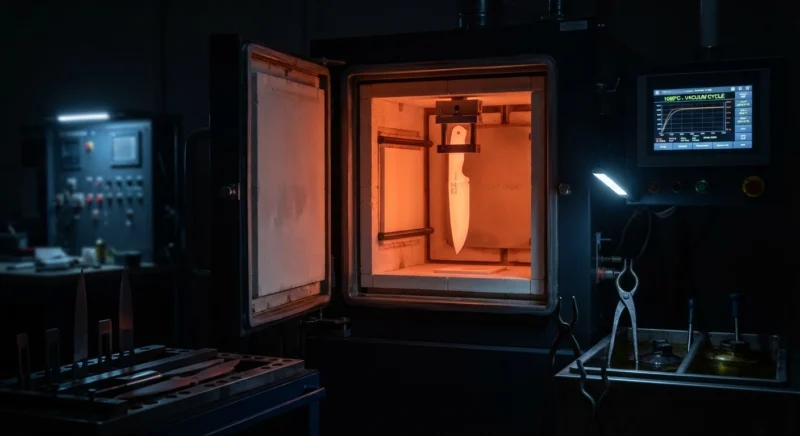
Heat treatment is one of the most important subjects when discussing CPM 3V.
A steel’s datasheet chemistry does not tell the whole story.
The final performance of a blade depends heavily on how the steel is austenitized, quenched, tempered, and finished.
CPM 3V is normally austenitized at temperatures around 1,025–1,120°C depending on the desired combination of hardness and toughness. Technical recommendations identify approximately 1,065°C as a useful balance point for toughness and wear resistance, with higher temperatures capable of producing greater hardness at the expense of some toughness.
The steel is air-hardening, although controlled positive-pressure gas, salt, or appropriate oil processes can be used depending on equipment and section geometry.
After hardening, multiple tempering cycles are recommended.
A commonly specified treatment uses three tempering cycles, with the material cooled between cycles.
The exact procedure should always be adapted to the stock thickness, furnace equipment, atmosphere, quench method, and intended hardness.
Check Our Guide Steel Heat Treatment Explained
Why Heat Treatment Matters So Much with CPM 3V
CPM 3V has a relatively wide performance window, but that does not mean any heat treatment will produce excellent results.
A knife can have the correct steel and still perform poorly.
For example:
- insufficient austenitizing can reduce the achievable hardness
- excessive austenitizing can reduce toughness
- poor temperature control can alter the microstructure
- inadequate quenching can produce unwanted transformations
- incomplete tempering can leave excessive residual stress
- inappropriate tempering can reduce the desired balance of properties
This is why CPM 3V should not be evaluated solely from its alloy composition.
A properly heat-treated CPM 3V blade and a poorly heat-treated CPM 3V blade may behave very differently.
Peer-reviewed research confirms that tempering temperature has a substantial effect on hardness and mechanical behavior in CPM 3V.
Why Triple Tempering Is Used
Multiple tempering cycles are used to stabilize the hardened structure and reduce stresses associated with hardening.
For CPM 3V, technical recommendations commonly call for three tempering cycles.
This is particularly important because the steel is intended for demanding applications where dimensional stability and toughness matter.
Cooling the steel between tempering cycles is also part of the recommended process.
For knife makers, this is one reason professional heat treatment is so valuable.
CPM 3V is not a steel where guessing the temperature with a basic forge and hoping for the best is likely to produce consistent results.
CPM 3V at 58 HRC vs 60 HRC vs Higher Hardness
Hardness should be considered together with blade geometry and intended use.
A CPM 3V knife around 58 HRC can have exceptional toughness.
Increasing hardness can improve wear resistance and edge stability, but the balance shifts.
Technical data illustrates that increasing the austenitizing temperature can produce higher hardness while reducing measured impact toughness.
This leads to an important practical conclusion:
There is no universally perfect CPM 3V hardness.
A large chopping blade and a thinner cutting-focused fixed blade do not necessarily need identical heat treatment.
The intended use should determine the target.
CPM 3V vs M4
CPM 3V and M4 are both powder-metallurgy tool steels used in demanding knife applications, but they emphasize different characteristics.
M4 is generally associated with substantially greater wear resistance and excellent edge retention.
CPM 3V puts much more emphasis on toughness.
This difference comes partly from carbide volume and composition.
M4 has a much higher overall alloy and carbide burden designed around wear resistance and high hardness.
CPM 3V uses a more restrained carbide population, with its microstructure strongly influenced by vanadium carbide.
Technical comparative data places CPM 3V’s impact toughness well above M4 at comparable hardness conditions.
That does not mean one is universally better.
It means they solve different problems.
If maximum edge retention during abrasive cutting is the priority, M4’s characteristics can be attractive.
If resistance to impact and fracture is the priority, CPM 3V becomes particularly interesting.
For your future CPM 3V vs M4 article, this distinction should be one of the central themes rather than simply comparing hardness numbers.
CPM 3V vs 80CrV2
80CrV2 is a very different type of steel.
It is a relatively simple low-alloy carbon tool steel containing chromium and vanadium, but it does not have the highly alloyed powder-metallurgy structure of CPM 3V.
80CrV2 has earned a strong reputation among knife makers because it offers good toughness, straightforward heat treatment, and useful edge performance at a relatively accessible material cost.
CPM 3V takes the concept much further through:
- powder metallurgy
- higher alloy content
- a controlled carbide population
- greater wear resistance
- more complex heat treatment requirements
The comparison becomes especially interesting when considering cost and practicality.
80CrV2 can make an excellent hard-use knife.
CPM 3V offers a different level of wear resistance while retaining exceptional toughness.
The choice therefore depends heavily on the knife’s intended role and the value placed on advanced metallurgy.
For a future CPM 3V vs 80CrV2 article, I would focus heavily on the question:
How much additional performance does the powder-metallurgy steel provide for the specific job?
That is more useful than simply declaring one steel superior.
CPM 3V vs Vanadis 4 Extra
Vanadis 4 Extra is another interesting comparison because it is also a powder-metallurgy cold-work tool steel designed around a combination of toughness and wear resistance.
Both steels occupy a region where the goal is not simply maximum hardness or maximum carbide volume.
However, their alloy designs and carbide populations differ.
CPM 3V has a strong reputation for exceptional impact toughness.
Vanadis 4 Extra is also known for an excellent toughness/wear-resistance balance and is frequently considered when a tool must survive both abrasion and mechanical stress.
This makes the comparison much more interesting than CPM 3V versus a conventional carbon steel.
The important questions are:
- How much carbide does each steel contain?
- What type of carbides dominate?
- How does hardness affect toughness?
- How do they behave at similar hardness?
- Which one is better for impact-heavy knives?
- Which one offers more useful wear resistance?
- How does sharpening differ?
- How does heat treatment affect the result?
Those questions should form the foundation of a detailed CPM 3V vs Vanadis 4 Extra article.
CPM 3V vs D2
D2 is a useful reference point because it illustrates why CPM 3V was developed.
D2 has substantially higher wear resistance than many conventional carbon steels, but its toughness is significantly lower than CPM 3V.
CPM 3V can provide a more balanced combination of toughness and wear resistance.
Technical data specifically identifies CPM 3V as having substantially greater impact toughness than D2 while retaining strong wear resistance.
For a hard-use knife, that difference can be important.
A D2 knife may provide excellent edge life during abrasive cutting.
A CPM 3V knife may tolerate impact and abuse considerably better.
Again, this is not a universal “better steel” question.
It is a question of what failure mode matters most.
Check Our Guide D2 Steel Review: Is D2 Still One of the Best Knife Steels?
CPM 3V vs A2
A2 is another useful comparison.
A2 is a tough cold-work tool steel that has long been used in knives and industrial tooling.
CPM 3V can be viewed as an advanced approach to the same general problem: obtaining high toughness while maintaining useful wear resistance.
Technical data reports greater impact toughness for CPM 3V than A2 under the referenced test conditions.
The powder-metallurgy structure also provides CPM 3V with a more refined carbide distribution.
This is one reason CPM 3V can occupy such a useful middle ground between simpler tough steels and highly wear-resistant tool steels.
CPM 3V vs S7
S7 is a classic shock-resistant tool steel.
It is famous for toughness.
That makes it an especially interesting comparison.
The traditional challenge is that very high toughness often comes with lower wear resistance.
CPM 3V attempts to move toward the center of that trade-off.
Technical information describes CPM 3V as approaching shock-resistant grades in toughness while providing considerably more wear resistance than those steels.
For a knife, this can be a very attractive combination.
You get much of the behavior that makes shock-resistant steels useful while gaining considerably better edge durability.
CPM 3V and Vanadium Carbides
To understand CPM 3V properly, it is worth looking closer at vanadium carbide.
Vanadium carbide is exceptionally hard compared with the surrounding steel matrix.
When a cutting edge wears through abrasive contact, the softer matrix can wear more quickly than the carbide particles.
The carbides therefore contribute to wear resistance.
But there is a price.
Large numbers of hard carbide particles can create stress concentrations and make an edge more vulnerable to fracture or chipping.
CPM 3V’s design limits that problem by keeping the overall carbide volume relatively moderate.
Research has identified approximately 5% carbide volume in CPM 3V under relevant heat-treatment conditions, with the carbide population primarily consisting of very hard vanadium carbide.
That is an important reason the steel behaves differently from ultra-high-wear steels.
Why CPM 3V Is So Tough Despite Being a High-Alloy Steel
At first glance, CPM 3V’s alloy content might seem inconsistent with extreme toughness.
After all, highly alloyed steels often contain many carbides.
But the critical factor is not simply the number of alloying elements.
It is the microstructure.
The powder-metallurgy process creates a fine and homogeneous structure.
The carbide particles are relatively small and distributed more evenly.
This reduces the likelihood that large carbide clusters will act as major fracture initiation points.
The result is a steel that can be highly alloyed while retaining exceptional toughness.
This is one of the best examples of why metallurgy is more complicated than reading a chemical composition table.
Is CPM 3V Brittle?
No.
CPM 3V is specifically regarded as a high-toughness tool steel.
However, no hardened knife steel is completely immune to brittle failure.
At very high hardness, toughness generally decreases.
A thin edge can also chip even in a very tough steel if it is driven into extremely hard material.
And heat treatment remains critical.
Therefore, describing CPM 3V as “unbreakable” or “impossible to chip” would be misleading.
The more accurate statement is that CPM 3V provides unusually high resistance to fracture and chipping for a steel with its level of wear resistance and hardness.
That distinction matters.
Does CPM 3V Chip?
It can.
Any hardened knife edge can chip.
The probability depends on:
- hardness
- heat treatment
- edge thickness
- edge angle
- impact force
- target material
- lateral loading
- manufacturing quality
CPM 3V simply gives the designer a much larger toughness margin than many highly wear-resistant steels.
That is one reason it is popular for hard-use knives.
If a CPM 3V blade chips badly under normal use, the correct response is not automatically to conclude that CPM 3V is a poor steel.
The blade’s geometry and heat treatment should also be considered.
Is CPM 3V Good for Batoning?
Yes, CPM 3V is particularly well suited to knives that may be used for batoning.
Batoning places substantial impact forces on the knife.
The blade can experience:
- repeated shock
- bending
- lateral forces
- edge impacts
- localized stress
A tough steel is desirable in this environment.
However, batoning should never be interpreted as permission to abuse a knife indiscriminately.
A knife with excellent steel can still fail because of a poorly designed tang, inappropriate geometry, hidden defects, or extreme loading.
CPM 3V improves the material’s resistance to fracture; it does not make the entire knife indestructible.
CPM 3V for Survival Knives
CPM 3V is an excellent candidate for a survival knife when the design prioritizes durability.
A survival knife may need to perform many different tasks rather than simply slicing.
That versatility favors toughness.
The ability to resist chipping can be more valuable than squeezing out the maximum possible edge retention.
CPM 3V also offers enough wear resistance that the knife does not behave like a very simple carbon steel that needs constant sharpening.
The primary compromise remains corrosion resistance.
For long-term outdoor use, especially around saltwater, the owner needs to understand that CPM 3V requires maintenance.
CPM 3V for Tactical and Utility Knives
The same characteristics explain CPM 3V’s popularity in hard-use utility knives.
A utility knife may experience impacts and unpredictable loading that a kitchen knife rarely sees.
Toughness therefore becomes a major design consideration.
CPM 3V is particularly attractive when a designer wants a relatively thin, high-performance blade without moving into a very brittle steel.
Its balance of toughness and wear resistance allows the knife to remain useful as a cutting tool while still providing substantial structural durability.
CPM 3V for EDC Knives
CPM 3V can also work well for everyday-carry knives, although its advantages may not always be fully utilized.
EDC tasks usually include:
- cardboard
- food packaging
- rope
- plastic
- light wood
- general utility cutting
These tasks often reward edge retention and corrosion resistance more than extreme toughness.
If the knife is frequently exposed to sweat or moisture, a stainless steel may be more convenient.
But for an EDC knife that is intentionally built as a hard-use tool, CPM 3V makes considerable sense.
CPM 3V Maintenance
Maintaining CPM 3V is simple.
The key is consistency.
After exposure to:
- water
- food
- salt
- blood
- acidic materials
- humidity
clean the blade and dry it thoroughly.
For long-term storage, a light corrosion-inhibiting oil can be useful.
Avoid storing a CPM 3V knife wet inside a leather sheath.
Leather can hold moisture against the steel and create an environment favorable to corrosion.
A patina is not necessarily a problem.
Surface discoloration and active rust are different things.
The goal is to prevent deep corrosion and maintain the edge and surface condition.
CPM 3V Blade Finish and Corrosion
Blade finish can influence practical corrosion behavior.
A rougher surface contains more microscopic areas where contaminants and moisture can remain.
A highly polished surface is generally easier to clean.
Stonewashed and blasted finishes may also be used for aesthetic and practical reasons, but they should not be interpreted as making CPM 3V stainless.
The underlying alloy remains a non-stainless steel.
Surface treatment can change behavior, but it does not transform CPM 3V into a stainless alloy.
Is CPM 3V Difficult to Grind?
CPM 3V is not an easy steel compared with simple carbon steels.
The combination of high hardness and hard vanadium carbides means abrasive selection and grinding technique matter.
During knife production, appropriate abrasives and cooling are important.
Excessive heat during grinding can damage the carefully developed heat-treated structure near the edge.
This is particularly important with high-performance tool steels.
A good heat treatment can be compromised by careless finishing.
For that reason, controlled grinding after hardening is an important part of producing a high-quality CPM 3V knife.
CPM 3V and Edge Stability
Edge stability is related to the ability of the apex to resist deformation or chipping.
This is where CPM 3V can be particularly impressive.
The steel’s combination of hardness and toughness allows a properly designed edge to remain relatively thin without becoming excessively fragile.
However, there is always a limit.
A very thin edge increases cutting efficiency but reduces the amount of material supporting the apex.
A thicker edge provides greater mechanical support.
CPM 3V gives the designer more freedom, but it does not eliminate the basic laws of geometry.
Is CPM 3V Difficult to Sharpen?
It is more difficult than simple carbon steels but easier to manage than some extremely high-wear powder steels.
The main reason is the vanadium carbide content.
Standard inexpensive abrasives may struggle to remove the hardest carbide particles efficiently.
A good diamond abrasive or another abrasive system designed for high-alloy steels can make the process much easier.
For routine maintenance, light sharpening is preferable to allowing the edge to become badly damaged.
This is particularly important with expensive CPM 3V knives.
CPM 3V Edge Retention vs Toughness
The most important way to understand CPM 3V is as a balance steel.
It is not at the extreme end of edge retention.
It is not at the extreme end of corrosion resistance.
It is not designed to achieve the absolute highest hardness.
Instead, it occupies a particularly useful region where several properties remain strong at the same time.
That makes CPM 3V unusual.
The steel gives up some maximum wear resistance in exchange for substantially improved toughness.
For a hard-use knife, that can be an excellent trade.
What Makes CPM 3V Different From “Super Steels”?
The term “super steel” is often used loosely in the knife industry.
It can refer to almost any modern high-performance alloy.
But not all high-performance steels are designed around the same goal.
Some prioritize:
- extreme wear resistance
- corrosion resistance
- high hardness
- edge retention
- toughness
CPM 3V is unusual because toughness is such a central part of its identity.
It demonstrates that a high-performance steel does not need to win a single category.
Sometimes the most useful material is the one that avoids major weaknesses.
Common Misconceptions About CPM 3V
Myth 1: CPM 3V Is Stainless
It is not.
Its chromium content is relatively high, but CPM 3V remains a non-stainless tool steel.
Myth 2: CPM 3V Has the Best Edge Retention
It has good wear resistance, but that is not the same as having the maximum possible edge retention.
Several steels with much greater carbide volume can outperform it in abrasive wear.
CPM 3V’s advantage is the combination.
Myth 3: CPM 3V Cannot Chip
It can.
Toughness reduces the probability of chipping and fracture, but no hardened edge is immune.
Myth 4: Higher Hardness Always Makes CPM 3V Better
Not necessarily.
Increasing hardness can improve wear resistance and edge stability while reducing toughness.
The appropriate hardness depends on the application.
Myth 5: Powder Metallurgy Means the Steel Is Automatically Better
Powder metallurgy is a production method.
Its benefits depend on the alloy design and what the material is intended to accomplish.
CPM 3V benefits significantly from its powder-metallurgy structure because the alloy was designed around that type of microstructure.
Who Should Choose CPM 3V?
CPM 3V makes the most sense for someone who values:
- very high toughness
- resistance to chipping
- strong wear resistance
- hard-use performance
- impact resistance
- outdoor durability
- high-performance fixed blades
- large utility knives
- survival and bushcraft applications
It is especially attractive when the consequences of edge chipping or blade fracture are more serious than having to sharpen somewhat sooner.
Who Might Prefer Another Steel?
CPM 3V may not be ideal if your highest priorities are:
- maximum corrosion resistance
- maximum possible edge retention
- very easy sharpening
- extremely low maintenance
- inexpensive material
- simple home heat treatment
For those applications, other steels may be more appropriate.
This is one of the most important lessons in modern knife metallurgy:
There is no universally best knife steel.
The correct steel depends on the job.
Is CPM 3V Worth It for a Knife?
For a properly designed and heat-treated knife, CPM 3V can be an excellent choice.
Its real strength is not a spectacular number in one category.
It is the way its properties work together.
The steel combines:
- high toughness
- useful wear resistance
- high achievable hardness
- good edge stability
- powder-metallurgy consistency
- strong resistance to impact-related failure
At the same time, it accepts several compromises:
- it is not stainless
- it is not the absolute champion of edge retention
- it needs appropriate heat treatment
- it requires suitable abrasives for sharpening
- it is more expensive and complicated to process than simple carbon steels
For a hard-use knife, those compromises can make sense.
Final Verdict: What Is CPM 3V Best At?
CPM 3V is best understood as a high-toughness, wear-resistant tool steel rather than simply another “super steel.”
Its unusual performance comes from the interaction of alloy composition, powder metallurgy, carbide structure, heat treatment, and mechanical properties.
The steel contains enough vanadium to create hard vanadium carbides and provide useful wear resistance. At the same time, its relatively moderate carbide volume and refined powder-metallurgy microstructure help preserve exceptional toughness.
That makes CPM 3V especially interesting for knives that have to survive more than ordinary slicing.
A thin slicer used only for food preparation may not need what CPM 3V offers.
A large outdoor knife, bushcraft blade, survival knife, hunting knife, or heavy utility blade can make much better use of its strengths.
The most important point is that CPM 3V does not try to eliminate the fundamental trade-offs of knife metallurgy.
Instead, it moves the balance.
It gives the knife maker a material that can combine unusually high toughness with meaningful wear resistance and high hardness.
That is why CPM 3V has remained relevant even as newer generations of high-performance knife steels have appeared.
It solves a very specific problem:
How do you make a high-performance cutting edge that is still exceptionally difficult to break or chip?
CPM 3V is one of the most successful answers to that question.
And for a hard-use knife, that can matter much more than simply having the longest possible edge life.
CPM 3V Steel: Frequently Asked Questions
Is CPM 3V a good knife steel?
Yes. CPM 3V is particularly well suited to hard-use knives because it combines very high toughness with good wear resistance. It is especially attractive for outdoor, survival, bushcraft, hunting, and heavy-duty fixed blades.
Is CPM 3V stainless?
No. CPM 3V is a non-stainless tool steel. It contains approximately 7.5% chromium, but that does not provide conventional stainless behavior.
How tough is CPM 3V?
CPM 3V has exceptionally high impact toughness for a high-alloy tool steel. Published technical data places its toughness substantially above several commonly used wear-resistant tool steels.
Does CPM 3V hold an edge well?
Yes. CPM 3V provides good wear resistance and can hold an edge well, particularly in demanding applications. However, its primary advantage is the combination of wear resistance and toughness rather than maximum possible edge retention.
Does CPM 3V chip?
It can, but it is significantly resistant to chipping compared with many less-tough high-performance steels. Edge geometry, hardness, heat treatment, and use all affect chipping behavior.
Is CPM 3V hard to sharpen?
It is more difficult to sharpen than simple carbon steels because of its hard vanadium carbides. Diamond or other suitable high-performance abrasives make sharpening considerably easier.
What hardness is CPM 3V usually used at?
Traditional technical recommendations commonly target approximately 58–60 HRC for a balanced combination of toughness and wear resistance. Higher hardness is possible with different heat-treatment parameters, but toughness changes as hardness increases.
Is CPM 3V good for bushcraft?
Yes. Its high toughness makes it particularly suitable for bushcraft knives that may experience chopping, batoning, and other impact-heavy tasks.
Is CPM 3V good for hunting knives?
Yes. Its combination of toughness and wear resistance can be very useful for hunting knives. The main consideration is corrosion maintenance because the steel is not stainless.
Is CPM 3V better than M4?
They are optimized differently. M4 generally places more emphasis on wear resistance and edge retention, while CPM 3V places considerably more emphasis on toughness. The appropriate choice depends on the knife’s intended use.
Is CPM 3V better than 80CrV2?
CPM 3V provides a more sophisticated powder-metallurgy combination of toughness and wear resistance, while 80CrV2 is a simpler, more economical carbon tool steel with good toughness. The difference is as much about application and cost as raw performance.
Is CPM 3V better than Vanadis 4 Extra?
Both are advanced tool steels designed to balance toughness and wear resistance. Their alloy compositions, carbide structures, heat-treatment behavior, and performance balance differ, so the comparison is more nuanced than choosing a universal winner.
Can CPM 3V rust?
Yes. Although its chromium content is relatively high compared with many carbon steels, CPM 3V is not stainless and can rust if exposed to moisture, salts, or acids without proper maintenance.
What is CPM 3V best for?
CPM 3V is particularly well suited to hard-use fixed blades, bushcraft knives, survival knives, hunting knives, chopping tools, and utility knives where toughness and resistance to chipping are major priorities.
Final Takeaway
If you are looking for a knife steel that simply keeps an edge for the longest possible time, CPM 3V is not necessarily the first steel you should investigate.
If you want a steel that combines exceptional toughness, useful wear resistance, high hardness, and excellent resistance to chipping, the picture changes.
That is the real reason CPM 3V remains such an important knife steel.
It does not win by maximizing one property.
It wins by maintaining an unusually strong balance between properties that normally work against each other.
For a hard-use knife, that balance can be more valuable than extreme performance in any single category.
This article is for independent informational purposes only and is not affiliated with, sponsored by, or endorsed by any steel manufacturer. All product names, trademarks, and registered trademarks are the property of their respective owners.