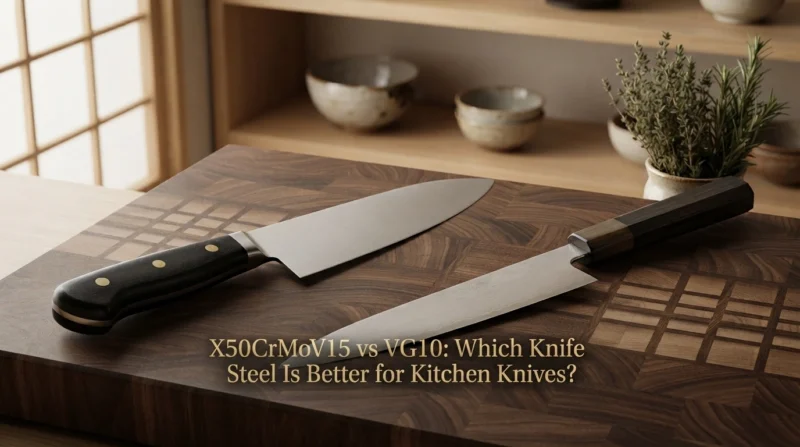
X50CrMoV15 vs VG10
An Independent Guide
Choosing between X50CrMoV15 vs VG10 is not really a question of which steel is universally better.
It is a question of what you want a kitchen knife to do.
X50CrMoV15 has become closely associated with traditional European kitchen knives because it offers a practical combination of corrosion resistance, toughness, easy sharpening, and forgiving edge behavior. VG10 takes a different approach. With substantially more carbon and a carefully balanced alloy, it can be hardened considerably higher and can hold a fine cutting edge for longer.
That difference sounds simple, but the real-world comparison is more interesting.
A knife made from X50CrMoV15 can be extremely pleasant to use because its edge is relatively forgiving. A VG10 knife can feel more precise and stay sharp longer, but the harder edge demands more careful technique. Neither characteristic automatically makes one steel better.
The geometry of the blade, heat treatment, edge angle, thickness behind the edge, sharpening quality, cutting board, and user’s technique can change the experience just as dramatically as the steel itself.
So, if you are comparing X50CrMoV15 vs VG10 for a chef’s knife, santoku, utility knife, or general kitchen blade, this guide will look at the complete picture.
X50CrMoV15 vs VG10: The Short Answer
If you want the shortest possible answer:
Choose X50CrMoV15 if you prioritize toughness, easy sharpening, simple maintenance, and forgiving everyday performance.
Choose VG10 if you prioritize edge retention, a harder edge, thin cutting geometry, and longer periods between sharpening sessions.
For a typical home cook who is rough with knives, X50CrMoV15 is often the safer choice.
For a cook who uses a good cutting board, avoids twisting and prying, appreciates a thin edge, and wants more cutting performance between sharpenings, VG10 is usually the more attractive option.
The important point is that neither steel is a premium or inferior version of the other.
They represent two different approaches to knife design.
What Is X50CrMoV15?
X50CrMoV15 is a martensitic stainless steel commonly used for kitchen knives and other cutting tools.
The designation itself provides useful information.
The “X” identifies the steel as a high-alloy stainless grade under the European naming system. The “50” relates approximately to its carbon content, while “Cr,” “Mo,” and “V” indicate chromium, molybdenum, and vanadium. The “15” refers approximately to its chromium level.
The standardized composition of X50CrMoV15, also designated 1.4116, allows approximately 0.45–0.55% carbon, 14–15% chromium, 0.50–0.80% molybdenum, and 0.10–0.20% vanadium, with silicon and manganese also present within specified limits.
This is a relatively conventional stainless knife steel.
That is not an insult.
In fact, much of the appeal of X50CrMoV15 comes precisely from the fact that it does not try to push every property to an extreme.
It contains enough carbon to become a useful hardened knife steel, enough chromium for good stainless behavior, and relatively modest additions of molybdenum and vanadium to improve the overall balance.
The result is a steel that is generally comfortable to sharpen, resistant to corrosion, and forgiving when used in an ordinary kitchen.
That last characteristic is especially important.
A kitchen knife is not always used under ideal conditions.
It may encounter a hard cutting board, a bone, a partially frozen ingredient, a sideways movement, or a user who has not sharpened it for several months.
X50CrMoV15 tends to tolerate this type of real-world abuse better than harder, more highly stressed knife edges.
Check Our Guide X50CrMoV15 Steel Review: The German Best Standard for Kitchen Knives(DIN 1.4116)
What Is VG10?
VG10 is a Japanese stainless cutlery steel that takes a different approach.
Its carbon content is approximately twice that of X50CrMoV15, while its chromium content remains around the same general level.
Commonly reported VG10 compositions place carbon around 0.95–1.05%, chromium around 14.5–15.5%, molybdenum around 0.9–1.2%, and vanadium in the neighborhood of 0.1–0.3%. VG10 also contains a notable cobalt addition, commonly around 1.3–1.5%.
That higher carbon level is one of the most important differences between the two steels.
Carbon allows a steel to develop higher hardness after appropriate heat treatment.
VG10 is therefore commonly hardened into the low-60s HRC range in kitchen knives, while X50CrMoV15 is often used at a substantially lower hardness. Reported knife hardness varies according to heat treatment and maker, so hardness should never be treated as a fixed property of the alloy alone.
That higher hardness changes almost everything about the knife.
A properly treated VG10 edge can remain stable at a thinner geometry and maintain a fine apex for longer.
But hardness has a price.
When a very hard edge encounters excessive lateral force, impact, or inappropriate cutting technique, it is more likely to chip rather than simply deform.
This is the fundamental trade-off behind much of the X50CrMoV15 vs VG10 discussion.
Check Our Guide VG10 Steel Review: Pros, Cons, Edge Retention, Toughness & Real-World Performance
X50CrMoV15 vs VG10 Composition
The two steels are actually more closely related than their reputations might suggest.
Both are stainless martensitic cutlery steels.
Both contain approximately 15% chromium.
Both use molybdenum.
Both contain small amounts of vanadium.
Both can produce excellent kitchen knives.
The largest difference is the amount of carbon and the resulting hardening potential.
X50CrMoV15 has roughly half the carbon content of VG10.
That difference matters because carbon participates in the formation of the hard phases and carbides that contribute to wear resistance and hardness.
VG10 also contains considerably more cobalt than X50CrMoV15. Cobalt is part of the alloy’s overall design, but it should not be interpreted as a magic ingredient that automatically makes VG10 dramatically sharper.
The important practical result is the steel’s ability to be heat treated into a harder working condition while retaining useful corrosion resistance.
This is why simply looking at chromium percentages can be misleading.
Someone might see approximately 15% chromium in both steels and conclude that their corrosion behavior must be identical.
They are not identical in every situation.
But neither is VG10 suddenly a non-stainless steel simply because it is harder.
Both are stainless knife steels.
The practical difference is more about the balance between hardness, carbide structure, edge geometry, heat treatment, and maintenance.
Why Carbon Makes Such a Difference
Carbon is one of the most important elements in knife steel.
At a simplified level, more carbon gives a steel greater potential for hardness and wear resistance.
But “more carbon” does not automatically mean “better knife.”
Imagine two knife edges.
One is relatively soft and tough.
When it strikes something harder than expected, the edge may deform slightly. Instead of breaking, it can roll.
The other is much harder.
Under normal cutting, it stays stable and sharp.
But when enough force is applied at the wrong angle, the edge has less ability to deform plastically. Instead, a small section can fracture.
This is why hardness and toughness should not be treated as opposites in an absolute sense, but rather as properties that have to be balanced for the intended use.
X50CrMoV15 deliberately sits toward the forgiving side of that balance.
VG10 moves further toward hardness and edge stability.
That does not make VG10 fragile in ordinary kitchen use.
A properly made VG10 knife is perfectly capable of years of service.
It simply rewards more disciplined handling.
X50CrMoV15 vs VG10: Hardness
Hardness is one of the clearest differences between the two.
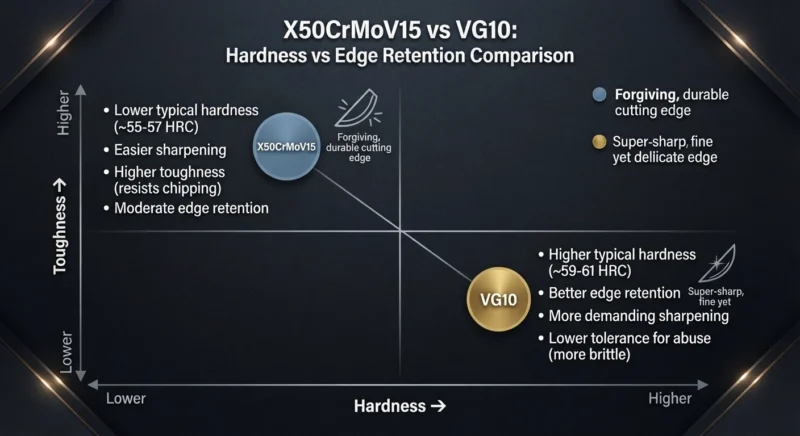
X50CrMoV15 is commonly used in kitchen knives around the mid-to-high 50s HRC, although actual values depend on the particular heat treatment.
VG10 is commonly hardened to around 60–62 HRC.
The difference between, for example, 57 HRC and 61 HRC may not sound enormous.
On a kitchen knife, it can be very noticeable.
A harder edge generally resists deformation better.
That means the apex can stay aligned under cutting pressure for longer.
This is one reason a thin VG10 knife can feel extremely crisp when cutting vegetables, meat, and other food.
X50CrMoV15 can also take a very good edge.
It is not a dull steel.
But when both knives are manufactured well and used at comparable geometry, VG10 normally has the advantage in edge stability and edge retention.
There is an important qualification here.
Steel hardness is not the same thing as knife performance.
A badly heat-treated VG10 knife can perform worse than a well-made X50CrMoV15 knife.
A thick VG10 blade can feel less precise than a thin X50CrMoV15 blade.
A poorly sharpened hard steel can feel worse than an expertly sharpened softer steel.
The alloy is only one part of the knife.
Check Our Guide What Is HRC? Understanding Rockwell Hardness in Kitchen Knives
X50CrMoV15 vs VG10: Edge Retention
This is probably the category where VG10 has the clearest advantage.
Edge retention describes how long a knife maintains useful cutting performance during repeated use.
VG10’s higher carbon content and higher achievable hardness give it better wear resistance than typical X50CrMoV15 kitchen knives.
In practical terms, this means that if two knives are sharpened properly and used under similar conditions, the VG10 knife will generally maintain a useful edge for longer.
The difference is particularly noticeable for cooks who prepare large quantities of food.
If you cut vegetables for several hours, prepare large amounts of meat, or work in a kitchen where repeated cutting is normal, edge retention becomes increasingly valuable.
Instead of periodically stopping to restore the edge, the harder blade can continue cutting effectively for longer.
But edge retention should not be confused with sharpness.
A knife that holds a mediocre edge for a long time is not necessarily better than a knife that takes an exceptionally fine edge and requires occasional maintenance.
The quality of the initial edge matters.
Geometry matters.
Sharpening matters.
And the user’s expectations matter.
Check Our Guide Edge Retention Explained: 10 Factors What Makes a Knife Stay Sharp Longer
Why VG10 Usually Holds Its Edge Longer
There are several reasons.
First, VG10 has substantially more carbon.
Second, it can be hardened considerably more.
Third, its alloy balance supports a harder working edge than typical X50CrMoV15.
The result is greater resistance to deformation and wear at the apex.
This becomes particularly useful when the knife is ground thin.
A thin, hard VG10 blade can combine low cutting resistance with good edge stability.
That combination is one of the reasons VG10 became popular for Japanese-style kitchen knives.
It allows a knife to feel very precise without requiring extremely exotic metallurgy.
VG10 is not an ultra-high-wear powder steel.
There are modern steels that hold an edge considerably longer.
But VG10 occupies an interesting middle ground.
It provides substantially more edge retention than traditional German-style stainless cutlery steels while remaining relatively easy to maintain compared with some much harder modern alternatives.
X50CrMoV15 vs VG10: Toughness
This is where X50CrMoV15 fights back.
Toughness is the ability of a material to absorb energy and resist cracking or breaking.
For kitchen knives, toughness becomes especially relevant when the edge experiences impact or lateral stress.
X50CrMoV15’s lower hardness and relatively simple carbide structure make it a forgiving choice.
If you accidentally twist the knife slightly while cutting, the edge may roll.
That is inconvenient, but it is usually repairable.
You can realign the edge or sharpen it.
A hard VG10 edge may resist deformation better under normal cutting, but if the applied stress exceeds what the edge can tolerate, chipping becomes more likely.
That is why a VG10 knife should not be treated like a small pry bar.
Neither should any kitchen knife, of course.
But the consequences of poor technique can be different.
This distinction is especially important for beginners.
Someone who has not yet developed good knife technique may find X50CrMoV15 more forgiving.
Someone with good technique may appreciate the benefits of VG10 without encountering many of its disadvantages.
Check Our Guide Wear Resistance vs Toughness: Understanding the Most Important Knife Steel Trade-Off
Rolling vs Chipping: The Practical Difference
One of the most useful ways to understand X50CrMoV15 vs VG10 is to forget the steel names for a moment.
Think about two different edge failures.
Edge rolling
An edge roll happens when the apex bends or deforms.
The knife may suddenly feel dull even though material has not necessarily broken away from the edge.
A honing rod or appropriate sharpening can often restore the edge relatively easily.
This behavior is common with softer steels.
Edge chipping
Chipping occurs when a small piece of the edge fractures away.
Instead of bending, the hard material breaks.
A chip generally cannot be fixed simply by stropping or honing.
The damaged section must be removed through sharpening.
VG10 is not inherently a “chippy steel.”
That description is too simplistic.
A properly treated VG10 knife with sensible geometry can be highly durable.
But compared with a softer X50CrMoV15 edge, VG10 generally has less tolerance for abusive lateral forces.
This is one reason Japanese-style knives often require a change in technique from someone accustomed to heavy European chef’s knives.
X50CrMoV15 vs VG10: Corrosion Resistance
Both steels perform well against ordinary kitchen corrosion.
That is an important point.
You should not choose X50CrMoV15 because you believe VG10 is likely to rust quickly.
That would be an unfair characterization.
VG10 contains around 15% chromium, and its stainless behavior is strong enough for normal kitchen use.
X50CrMoV15 also contains around 14–15% chromium and is well established as a stainless cutlery steel. European stainless-steel standards specify this chromium range along with its molybdenum and vanadium additions.
However, stainless does not mean stain-proof.
Both steels can develop staining or corrosion under sufficiently aggressive conditions.
Saltwater, acidic foods, prolonged moisture, food residue, high humidity, and poor cleaning can eventually cause problems.
The best practice for both is simple:
Wash the knife.
Rinse it.
Dry it.
Do not leave it sitting wet in the sink.
Do not store it while covered in food residue.
Do not assume that stainless steel makes proper maintenance unnecessary.
Does VG10 Rust More Than X50CrMoV15?
There is no simple yes-or-no answer that applies to every knife.
In normal kitchen conditions, both should provide very good corrosion resistance.
X50CrMoV15 has a reputation for being particularly forgiving because it combines substantial chromium with relatively modest carbon and alloy complexity.
VG10 has a higher carbon level, but still contains enough chromium to maintain stainless behavior.
Molybdenum also contributes to corrosion resistance, particularly resistance to certain forms of localized corrosion.
So, for normal home cooking, corrosion resistance should not be the deciding factor between these two steels.
If corrosion resistance is your primary concern, the bigger question may be how the knife is used and maintained.
A knife that is washed and dried promptly will generally give you far fewer problems than a theoretically more corrosion-resistant knife that is repeatedly left wet and dirty.
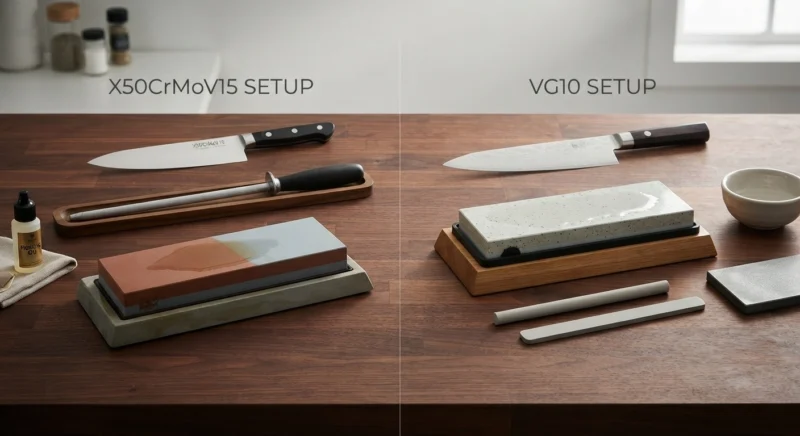
X50CrMoV15 vs VG10: Ease of Sharpening
This is another category where X50CrMoV15 has a clear practical advantage.
X50CrMoV15 is relatively easy to sharpen.
It responds well to conventional sharpening stones and other common sharpening systems.
Because it is not extremely hard, the abrasive does not have to work nearly as aggressively as it would on some harder modern steels.
VG10 is still perfectly reasonable to sharpen.
It is not a sharpening nightmare.
But it generally takes more time and care.
The higher hardness means that restoring a damaged edge can require more work.
The difference becomes especially noticeable when a VG10 blade is allowed to become seriously dull.
A small amount of regular maintenance is much easier than waiting until the edge is badly degraded.
This leads to an important maintenance rule for VG10:
Do not wait until the knife is extremely dull before sharpening it.
Regular light maintenance is easier than aggressive edge restoration.
Check Our Guide All Kinds of Knife Sharpening Tools
Which Is Easier to Sharpen: X50CrMoV15 or VG10?
For most users:
X50CrMoV15 is easier.
The difference is not because VG10 is difficult.
It is because X50CrMoV15 is softer and more forgiving.
A beginner can learn on X50CrMoV15 without worrying as much about overheating the edge, using the wrong abrasive, or spending excessive time removing steel.
VG10 benefits from better technique.
A medium-grit waterstone followed by a suitable finishing stone can produce an excellent edge.
Diamond abrasives can also work well.
The exact sharpening system is less important than consistency.
What matters most is maintaining the correct angle, using appropriate pressure, and avoiding unnecessary grinding.
X50CrMoV15 vs VG10: Which Gets Sharper?
This question is more complicated than it appears.
Both steels can become extremely sharp.
There is no simple rule saying:
“VG10 gets sharp, X50CrMoV15 does not.”
That is incorrect.
A well-sharpened X50CrMoV15 knife can have a beautifully refined edge.
VG10, because of its greater hardness and ability to maintain a fine apex, can often sustain a very refined edge under use for longer.
So the more useful distinction is not maximum sharpness.
It is how long the knife can maintain a useful fine edge.
VG10 generally has the advantage there.
Edge Angle: Where the Comparison Gets More Interesting
Steel does not operate independently of geometry.
This is one of the most important concepts in the entire X50CrMoV15 vs VG10 comparison.
Imagine two knives.
Knife A uses X50CrMoV15 but has a relatively thick blade and robust edge.
Knife B uses VG10 but has a thin blade with a carefully controlled edge geometry.
Knife B may feel dramatically sharper.
But is that entirely because VG10 is a better steel?
No.
Geometry is doing a tremendous amount of the work.
A thinner edge cuts with less resistance.
A thinner blade behind the edge passes through food more efficiently.
A lower edge angle can increase cutting performance.
Harder steel simply allows the manufacturer to push that geometry further without the edge deforming as quickly.
This is one reason VG10 and similar steels are often associated with thin Japanese-style blades.
Why X50CrMoV15 Knives Often Feel Different
Traditional X50CrMoV15 kitchen knives are frequently designed around durability.
That may mean:
- thicker blade stock
- more robust edge geometry
- greater spine thickness
- stronger tips
- heavier construction
Such a knife may not glide through a carrot with the same effortless sensation as a very thin Japanese-style blade.
But that does not necessarily mean the steel is worse.
It may mean the knife was designed for a different working environment.
A robust chef’s knife is expected to survive years of ordinary kitchen use with relatively little fuss.
A thin VG10 knife may prioritize precision and cutting efficiency.
Both are legitimate designs.
X50CrMoV15 vs VG10 for Chef Knives
For a traditional chef’s knife, the decision depends heavily on your cooking style.
X50CrMoV15 chef knife
X50CrMoV15 is a strong choice if you:
- want easy sharpening
- prefer a forgiving knife
- use a wooden or plastic cutting board
- want good corrosion resistance
- occasionally make mistakes with technique
- value durability over maximum edge retention
- prefer a heavier knife
- frequently use a honing rod
- want a knife that is uncomplicated to maintain
It is especially well suited to busy home kitchens where knives are tools rather than objects requiring careful ritual.
VG10 chef knife
VG10 is attractive if you:
- value edge retention
- prefer a thin cutting edge
- use controlled cutting technique
- enjoy precise vegetable preparation
- sharpen with stones
- want longer intervals between full sharpening sessions
- appreciate lighter Japanese-style knives
- are comfortable protecting the edge from lateral stress
The better choice is therefore determined by how you cook.
X50CrMoV15 vs VG10 for Santoku Knives
Santoku knives are particularly interesting because their design naturally works well with harder stainless steels.
A thin santoku made from VG10 can provide excellent slicing performance.
The combination of thin geometry and relatively high hardness creates a very precise cutting tool.
X50CrMoV15 can also make an excellent santoku.
The difference is likely to be more noticeable in edge retention than in basic cutting ability.
A well-ground X50CrMoV15 santoku can still cut beautifully.
But if both knives have comparable geometry and heat treatment, VG10 will normally stay at its original level of sharpness longer.
X50CrMoV15 vs VG10 for Vegetable Preparation
VG10 has a strong argument here.
Vegetable preparation rewards:
- thin geometry
- low cutting resistance
- stable edge alignment
- good edge retention
A properly made VG10 knife can excel at slicing vegetables.
This is especially obvious when preparing large quantities of onions, carrots, peppers, potatoes, herbs, and other produce.
However, vegetables can also expose a knife to lateral forces.
Dense produce can grab the blade.
Frozen food can be extremely damaging.
Twisting the knife while cutting through hard vegetables can produce edge damage.
Therefore, VG10 performs best when used with a clean cutting motion rather than forceful twisting.
X50CrMoV15 vs VG10 for Meat
For boneless meat, both can perform extremely well.
A thin VG10 knife can produce clean slices and maintain its edge for a long time.
X50CrMoV15 also performs well and offers greater forgiveness.
But if you’re cutting around bones, the comparison changes.
Neither X50CrMoV15 nor VG10 should be treated as a bone-cleaving steel.
If the knife is likely to contact bone, joints, or other hard structures, toughness and geometry become much more important.
A robust X50CrMoV15 knife is generally the more forgiving choice for rougher preparation.
For clean boneless slicing, VG10’s hardness and edge retention can be very attractive.
Check Our Ultimate American BBQ Meat Guide: How to Cut Chicken, Steak & Ribs + 8 Easy BBQ Recipes
X50CrMoV15 vs VG10 for Beginners
For a beginner, I would generally lean toward X50CrMoV15.
Not because beginners cannot use VG10.
They can.
But X50CrMoV15 gives a new user more room for mistakes.
If the edge rolls, it can often be corrected relatively easily.
If the user accidentally applies a little too much pressure, the consequences may be less severe.
Sharpening is also more forgiving.
VG10 becomes more attractive once the user understands knife technique.
Once you learn not to twist the knife, not to scrape the edge sideways across the board, not to chop through bones, and not to use the knife as a pry tool, the advantages of VG10 become easier to enjoy.
X50CrMoV15 vs VG10 for Professional Kitchens
Professional kitchens are more complicated.
There is no universal answer because professional cooks have different working styles.
A busy kitchen can benefit enormously from X50CrMoV15 because it is easy to maintain and relatively tolerant of abuse.
A chef who sharpens regularly and treats a knife carefully may prefer VG10.
The key issue is workflow.
If a kitchen has limited time for sharpening and knives are used continuously, VG10’s longer edge retention can be valuable.
But if many employees use the same knives and technique varies significantly, a more forgiving steel may be the better operational choice.
This is why steel should never be selected in isolation.
A kitchen needs a knife system, not merely an alloy.
Heat Treatment Matters More Than Most Buyers Realize
One of the biggest mistakes in knife-steel discussions is treating the alloy name as a guarantee of performance.
It isn’t.
The same nominal steel can behave differently depending on how it was heat treated.
Heat treatment controls the final structure of the steel.
For X50CrMoV15, heat treatment determines the balance between hardness, toughness, and edge stability.
For VG10, it is particularly important because the steel’s performance depends heavily on achieving the intended hardness without creating an unnecessarily brittle edge.
This means two knives labeled “VG10” may not feel identical.
Likewise, two X50CrMoV15 knives may have noticeably different performance.
A manufacturer can choose a more conservative hardness for durability or a higher hardness for edge retention.
The final knife is therefore the result of:
steel + heat treatment + geometry + sharpening + intended use.
That formula is far more useful than simply asking which alloy is “better.”
Check Our Guide Steel Heat Treatment Explained
Why Hardness Numbers Should Not Be Used Alone
It is tempting to say:
“VG10 is 61 HRC and X50CrMoV15 is 57 HRC, therefore VG10 is better.”
That conclusion is incomplete.
Hardness tells you something important, but it does not tell you everything.
A knife is not a test coupon.
A blade can be very hard but poorly ground.
A blade can be moderately hard but exceptionally well designed.
A hard knife can chip if its edge geometry is inappropriate.
A softer knife can roll but remain extremely pleasant to sharpen and maintain.
The correct question is not:
Which steel has the highest hardness?
It is:
Which combination of hardness, toughness, geometry, and maintenance fits the way I use a knife?
That question produces a much better buying decision.
X50CrMoV15 vs VG10: Honing
Honing deserves special attention.
A honing rod is often used on softer kitchen knives to realign a slightly displaced edge.
This makes traditional X50CrMoV15 knives particularly compatible with regular honing.
However, a honing rod should not be used as a substitute for sharpening forever.
Eventually material is lost from the edge and the bevel must be renewed.
VG10 requires more caution.
Because the edge is harder and often thinner, aggressive honing can damage the apex.
A very hard rod used with excessive force is not necessarily helpful.
For many VG10 knives, a fine ceramic rod or a good strop can be a better maintenance option than a traditional aggressive steel rod.
The exact approach depends on the edge geometry and sharpening system.
X50CrMoV15 vs VG10: Which Is Better for a Fine Edge?
VG10 generally has the advantage.
Its higher hardness allows a well-made blade to support a fine edge with less deformation.
That makes it particularly appealing for slicing and precision preparation.
X50CrMoV15 can certainly be sharpened finely.
But if you take two properly made knives and push both toward very thin geometry, VG10 will generally maintain that fine edge more effectively.
This is one of the strongest reasons to choose VG10.
The steel makes sense when the knife design takes advantage of its hardness.
Does VG10 Need to Be Extremely Thin?
No.
This is another common misunderstanding.
A hard steel does not require an ultra-thin edge.
It simply gives the designer more freedom.
A VG10 knife can be made robust.
An X50CrMoV15 knife can be made thin.
The ideal geometry depends on the intended task.
If a knife will be used for delicate slicing, thin geometry is desirable.
If it will be used for heavier preparation, additional material behind the edge can improve durability.
This is why looking only at the steel designation is insufficient when comparing actual knives.
Check Our Guide Best Blade Thickness for Different Uses
X50CrMoV15 vs VG10: Maintenance
Both steels are relatively easy to maintain compared with many carbon steels.
For either knife:
- Wash after use.
- Dry immediately.
- Avoid prolonged contact with acidic or salty food residue.
- Use an appropriate cutting board.
- Never use the knife to pry or twist.
- Store the knife so the edge does not contact other hard objects.
- Sharpen before the edge becomes severely dull.
VG10 benefits from more disciplined edge care.
X50CrMoV15 is more tolerant.
Neither should be treated carelessly simply because it is stainless.
Can You Put X50CrMoV15 or VG10 in the Dishwasher?
It is best not to.
The fact that X50CrMoV15 has good corrosion resistance does not make dishwasher use a good idea.
Dishwashers combine:
- high temperatures
- aggressive detergents
- water
- prolonged exposure
- contact with other objects
All of these conditions are undesirable for quality kitchen knives.
VG10 deserves the same treatment.
Hand washing takes less than a minute.
That small amount of care can significantly improve the life of the knife, regardless of steel type.
X50CrMoV15 vs VG10: Which Is More Forgiving?
X50CrMoV15.
This is one of the easiest conclusions in the comparison.
Its lower hardness allows the edge to deform rather than fracture under stresses that would be more dangerous to a harder edge.
That does not mean X50CrMoV15 is indestructible.
It can still chip.
It can still break.
It can still be damaged by poor technique.
But its normal failure mode is generally more forgiving.
This is why traditional European kitchen knives have such a strong reputation as working tools.
They were not designed around laboratory edge-retention numbers.
They were designed around kitchens.
X50CrMoV15 vs VG10: Which Has Better Edge Stability?
VG10 generally wins.
Edge stability refers to the ability of the edge to remain in its intended shape during cutting.
Harder steel can resist deformation more effectively.
This becomes especially valuable when the edge is thin.
VG10 therefore makes a particularly good combination with thin Japanese-style geometry.
X50CrMoV15 can provide good edge stability at sensible thicknesses and angles, but it will generally deform sooner under the same load.
This is the trade-off.
X50CrMoV15 gives you forgiveness.
VG10 gives you more edge stability.
X50CrMoV15 vs VG10: Which Is Better for Food Prep?
For general food preparation, both are excellent choices.
The deciding factor is your technique.
Choose X50CrMoV15 when:
You want a reliable workhorse.
You do not want to think about the knife very much.
You prefer quick sharpening.
You sometimes use more force than ideal.
You share knives with other people.
You want good stainless performance and easy maintenance.
Choose VG10 when:
You enjoy a precise knife.
You appreciate thin geometry.
You want longer edge retention.
You are comfortable sharpening on stones.
You use controlled cutting technique.
You take care of your knives.
The Importance of the Cutting Board
The cutting board can change the comparison dramatically.
A hard surface increases stress on any knife edge.
Glass, stone, ceramic, and other extremely hard surfaces are poor choices for quality kitchen knives.
A good wood or suitable plastic board provides a much friendlier environment.
This matters particularly with VG10.
If you put a thin VG10 edge against a harsh cutting surface repeatedly, you may experience chipping or premature edge degradation.
X50CrMoV15 may simply roll.
Neither outcome is desirable.
The correct board protects both knives.
X50CrMoV15 vs VG10 and Knife Geometry
Suppose you are comparing two actual knives.
Knife A uses X50CrMoV15 and is 2.5 mm thick behind the spine with a robust edge.
Knife B uses VG10 and is ground very thin behind the edge.
You will almost certainly feel a major difference.
But it would be wrong to attribute that entire difference to the steel.
Blade geometry can have a huge influence on cutting performance.
The thinner knife may pass through food more easily even if the underlying steel has no advantage.
This is why experienced knife buyers often evaluate:
- spine thickness
- distal taper
- grind
- thickness behind the edge
- edge angle
- blade height
- blade profile
rather than buying based solely on steel.
Is VG10 a Premium Steel?
VG10 is better described as a well-established higher-performance stainless cutlery steel rather than an exotic super steel.
It has been used successfully for years because it offers a useful combination of:
- high hardness
- good corrosion resistance
- good edge retention
- reasonable sharpening characteristics
- good kitchen performance
There are steels that outperform VG10 in individual categories.
Some hold an edge longer.
Some are tougher.
Some are more corrosion resistant.
Some are easier to sharpen.
VG10 remains popular because its overall balance is good.
That balance is more important than the word “premium.”
Is X50CrMoV15 a Cheap Steel?
X50CrMoV15 is sometimes dismissed because it is common.
That is a mistake.
A common steel can be a very good steel for its intended purpose.
X50CrMoV15 is not designed to compete with high-end powder metallurgy steels in edge retention.
It does not need to.
Its strengths are different.
It is practical.
It is corrosion resistant.
It is easy to sharpen.
It is relatively forgiving.
It is suitable for high-volume everyday kitchen use.
A well-made X50CrMoV15 knife can be a better tool for some cooks than a considerably more expensive knife made from a harder steel.
X50CrMoV15 vs VG10: Edge Retention in Everyday Cooking
Imagine cooking dinner five nights a week.
You use a chef’s knife for onions, carrots, herbs, meat, potatoes, peppers, and other ingredients.
With X50CrMoV15, you may notice gradual loss of sharpness sooner.
The knife still works.
You simply need to hone or sharpen it more frequently.
With VG10, the knife may retain a more precise edge for longer.
That can make the difference particularly noticeable to someone who dislikes sharpening.
But there is another side.
When the VG10 knife eventually needs sharpening, restoring the edge may take more effort.
X50CrMoV15 may need sharpening more frequently but requires less work each time.
So the maintenance burden is not simply “VG10 sharp, X50 dull.”
It is:
X50CrMoV15 = easier and more frequent maintenance.
VG10 = less frequent but somewhat more demanding maintenance.
Which Steel Is Better for Someone Who Hates Sharpening?
VG10.
If you strongly dislike sharpening and want the knife to remain functional for longer between sharpening sessions, VG10 is the logical choice.
However, there is a catch.
Eventually every knife needs sharpening.
Even an excellent high-hardness steel cannot remain perfectly sharp forever.
So buying VG10 does not eliminate maintenance.
It changes the maintenance interval.
Which Steel Is Better for Someone Who Enjoys Sharpening?
This is more subjective.
X50CrMoV15 is satisfying to sharpen because it responds quickly.
It is relatively easy to create a clean apex.
VG10 is also rewarding once you become familiar with it, particularly because it can take and retain a very refined edge.
For a beginner, X50CrMoV15 is easier.
For an experienced sharpener, either can be enjoyable.
X50CrMoV15 vs VG10: Price and Value
Steel alone should not determine price.
A knife’s value depends on much more than its alloy.
You are paying for:
- blade geometry
- heat treatment
- grinding
- finishing
- handle construction
- fit and finish
- quality control
- sharpening
- overall design
A poorly made VG10 knife is not automatically a better purchase than a well-made X50CrMoV15 knife.
Likewise, a premium-priced X50CrMoV15 knife does not necessarily justify its price simply because it uses a familiar European steel.
The best value comes from matching the knife to the user.
If you never take advantage of VG10’s hardness, paying more for it may not produce a meaningful improvement.
If you want a thin, hard, long-lasting edge, however, VG10 can justify the upgrade.
X50CrMoV15 vs VG10: Common Myths
Myth 1: VG10 is always sharper
Not necessarily.
Sharpening and geometry determine sharpness.
VG10 has advantages in maintaining a fine edge, but a poorly sharpened VG10 knife can be less useful than a properly sharpened X50CrMoV15 knife.
Myth 2: X50CrMoV15 is low quality
Not true.
It is simply optimized for a different balance of properties.
Myth 3: VG10 chips easily
This is exaggerated.
Good VG10 knives can be durable.
They simply require more appropriate technique than very forgiving softer steels.
Myth 4: Stainless steel cannot rust
False.
Stainless steel resists corrosion.
It does not become immune to it.
Myth 5: Higher HRC always means better
False.
Higher hardness improves some properties while reducing tolerance to certain types of abuse.
Myth 6: Steel determines the entire knife
Definitely false.
Geometry and heat treatment can be just as important.
What Does the X50CrMoV15 Name Actually Tell You?
The name is useful, but it does not tell you everything.
X50CrMoV15 indicates the approximate alloy family and major alloying elements.
It does not tell you:
- the final hardness
- exact heat-treatment quality
- edge angle
- blade thickness
- grind
- sharpening quality
- finish
- handle quality
Therefore, when shopping for an X50CrMoV15 knife, don’t stop at the steel name.
Look at the entire knife.
What Does VG10 Tell You?
VG10 identifies a specific Japanese stainless cutlery steel family.
It tells you considerably more about the alloy than generic descriptions such as “high-carbon stainless steel.”
But again, it does not guarantee a particular performance level.
A VG10 blade can be optimized for durability or for maximum cutting performance.
Heat treatment and geometry determine where the knife ends up.
That is why two VG10 knives can feel surprisingly different.
Which Steel Is Better for a Thin Kitchen Knife?
VG10.
If the design goal is a thin blade with a fine edge, VG10 is generally the more suitable steel.
Its higher hardness allows the edge to remain stable at geometries that would be more difficult for softer X50CrMoV15.
That does not mean X50CrMoV15 cannot be thin.
It means that the thinner you make the edge, the more important deformation resistance becomes.
VG10 has an advantage there.
Which Steel Is Better for a Heavy-Duty Kitchen Knife?
X50CrMoV15.
For a knife that may encounter rougher use, X50CrMoV15’s forgiving behavior becomes more attractive.
It is especially suitable when the user values reliability over maximum edge retention.
This does not make it appropriate for chopping bones.
A kitchen knife should always be matched to the task.
But within ordinary food preparation, X50CrMoV15 gives the user more tolerance for mistakes.
X50CrMoV15 vs VG10: Which One Should You Choose?
Here is the practical decision.
Choose X50CrMoV15 if you want:
- excellent everyday stainless performance
- easy sharpening
- good toughness
- forgiving edge behavior
- simple maintenance
- a dependable workhorse
- good performance without demanding special technique
Choose VG10 if you want:
- higher hardness
- longer edge retention
- stronger resistance to edge deformation
- a thin, precise cutting edge
- excellent slicing performance
- a Japanese-style knife experience
- longer intervals between sharpening
If you are uncertain, X50CrMoV15 is the safer general-purpose choice.
If you already know that you prefer hard, thin Japanese-style knives, VG10 is likely to be more satisfying.
X50CrMoV15 vs VG10: A More Honest Winner
If we absolutely have to name winners by category, the result looks like this conceptually:
Edge retention: VG10
Edge stability: VG10
Maximum useful hardness: VG10
Ease of sharpening: X50CrMoV15
Forgiveness: X50CrMoV15
Tolerance of abuse: X50CrMoV15
General corrosion resistance: Both are very good
Fine-edge performance: VG10
Beginner friendliness: X50CrMoV15
Long intervals between sharpening: VG10
Simple maintenance: X50CrMoV15
But notice something important.
There is no overall winner.
VG10 wins the properties associated with a harder, thinner, longer-lasting edge.
X50CrMoV15 wins the properties associated with a forgiving, easy-to-maintain workhorse.
That is the real comparison.
The Most Important Factor: Your Cutting Style
Before choosing either steel, ask yourself how you actually use a knife.
Do you push-cut vegetables carefully?
Do you use a rocking motion?
Do you chop quickly?
Do you twist the blade?
Do you cut directly onto a hard board?
Do you sharpen regularly?
Do you hate sharpening?
Do you use one knife for everything?
Do several people use your knives?
These questions can tell you more than a steel chart.
A careful cook who enjoys precision cutting may get much more from VG10.
A busy cook who wants a dependable tool that can be sharpened quickly may be happier with X50CrMoV15.
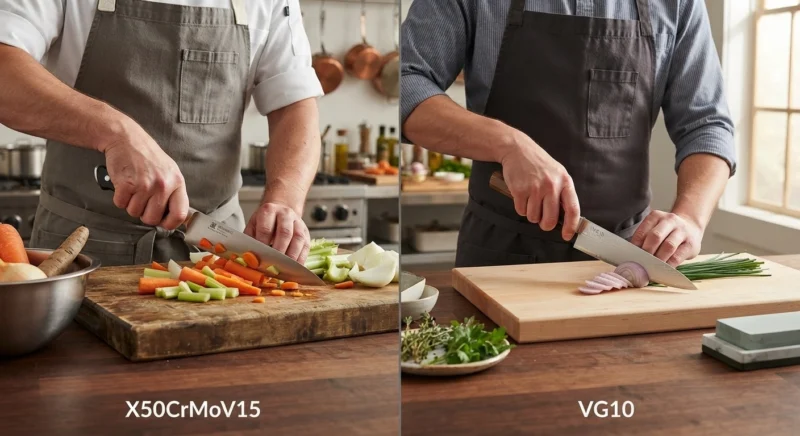
A Real-World Example
Consider two home cooks.
The first cook prepares dinner every evening.
They use a wooden cutting board, sharpen occasionally, and sometimes put more pressure on the knife than they should.
Their knife needs to be reliable.
It doesn’t need to stay razor sharp for weeks.
For this cook, X50CrMoV15 makes a lot of sense.
The second cook enjoys Japanese-style knives.
They use controlled push cuts, keep their knives dry, sharpen on stones, and carefully avoid bones and hard surfaces.
They want the blade to remain extremely precise.
VG10 makes more sense for this cook.
Neither cook made the wrong choice.
They simply selected steel according to their working style.
X50CrMoV15 vs VG10: What About Food Sticking?
Steel itself does not determine food release.
Blade geometry, surface finish, blade thickness, grind, and food type have much greater influence.
A thin VG10 blade may pass through food very easily, but that does not mean VG10 inherently prevents food from sticking.
Likewise, an X50CrMoV15 knife can have excellent food release if its grind and finish are well designed.
This is another example of why steel should not be evaluated in isolation.
Does VG10 Cut Better Than X50CrMoV15?
It can.
But the correct answer is:
A well-designed VG10 knife can provide superior cutting performance because its hardness allows a thin, stable edge.
That is different from saying:
“VG10 automatically cuts better.”
If you take a thick, poorly ground VG10 blade and compare it with an expertly ground thin X50CrMoV15 knife, the result may surprise you.
Knife design always matters.
Can X50CrMoV15 Be a High-Performance Knife Steel?
Absolutely.
High performance does not require exotic chemistry.
A well-treated X50CrMoV15 blade with excellent geometry can be exceptionally effective.
It may not have the edge retention of VG10.
But cutting performance is not measured only in hours between sharpenings.
The knife may be:
- comfortable
- predictable
- easy to maintain
- resistant to corrosion
- tough
- easy to sharpen
- pleasant to use
Those are performance characteristics too.
Why the “German vs Japanese” Argument Is Too Simple
It is common to describe X50CrMoV15 as “German steel” and VG10 as “Japanese steel.”
That is useful as historical context, but not as a technical conclusion.
The more important distinction is between two design philosophies.
One emphasizes:
durability + forgiveness + easy maintenance
The other emphasizes:
hardness + edge retention + cutting precision
Those philosophies are not tied permanently to geography.
A knife made from X50CrMoV15 can be designed with relatively thin geometry.
A VG10 knife can be made robust.
Modern knife manufacturing has blurred the traditional categories considerably.
So think in terms of steel properties and knife design rather than national stereotypes.
X50CrMoV15 vs VG10 for Everyday Home Cooking
For most ordinary home kitchens, both are more than capable.
You are unlikely to reach the limits of either steel while chopping onions for dinner.
The difference becomes more apparent over time.
With X50CrMoV15, you will probably sharpen more frequently.
With VG10, you may spend more time enjoying a sharp edge before needing to sharpen.
But when you eventually damage the VG10 edge, the repair may require more work.
That is the trade.
The best knife is the one whose maintenance requirements match your personality.
If you want to sharpen quickly and forget about the knife afterward, X50CrMoV15 is attractive.
If you want to sharpen carefully and enjoy a refined edge, VG10 is attractive.
Final Verdict: X50CrMoV15 vs VG10
So, which is better?
The honest answer is:
VG10 is the better steel if your priority is edge retention, hardness, and fine-edge performance.
X50CrMoV15 is the better steel if your priority is toughness, easy sharpening, forgiveness, and uncomplicated everyday use.
VG10 has the performance advantage in the areas most enthusiasts notice first.
It can be harder.
It can maintain a fine edge longer.
It can support thinner geometry.
It can provide an exceptionally precise cutting experience.
X50CrMoV15 has a different advantage.
It is forgiving.
It is easy to sharpen.
It resists corrosion well.
It tolerates imperfect technique better.
It is an excellent choice for cooks who want a knife to work rather than demand attention.
The most important conclusion is therefore not that one steel beats the other.
It is that X50CrMoV15 and VG10 are optimized for different priorities.
If you want a dependable kitchen workhorse that can be quickly brought back to a sharp edge, X50CrMoV15 remains an excellent choice.
If you want a harder blade that stays sharp longer and rewards careful technique, VG10 is usually the better fit.
And when comparing actual knives, remember the rule that matters most:
A good knife is more than its steel.
Heat treatment, blade geometry, edge thickness, sharpening quality, handle design, and the way the knife is used all contribute to the final result.
That is why a well-made X50CrMoV15 knife can outperform a mediocre VG10 knife in everyday cooking—and why a beautifully designed VG10 knife can feel dramatically more capable than a conventional X50CrMoV15 blade.
Choose the steel according to the way you cook, not according to which name sounds more advanced.
Frequently Asked Questions
Is VG10 better than X50CrMoV15?
VG10 is generally better for edge retention and maintaining a fine, hard edge. X50CrMoV15 is generally better for ease of sharpening, toughness, and forgiving everyday use.
Is X50CrMoV15 good steel for kitchen knives?
Yes. X50CrMoV15 is a well-established stainless cutlery steel that offers a useful balance of corrosion resistance, toughness, sharpening ease, and everyday performance. Its standardized composition includes approximately 14–15% chromium, 0.45–0.55% carbon, 0.50–0.80% molybdenum, and 0.10–0.20% vanadium.
Is VG10 harder than X50CrMoV15?
Usually, yes. VG10 kitchen knives are commonly heat treated around 60–62 HRC, while X50CrMoV15 knives are typically used at lower hardness levels. Exact hardness depends on the heat treatment and knife design.
Which holds an edge longer, VG10 or X50CrMoV15?
VG10 generally holds its edge longer because its higher carbon content and higher achievable hardness provide greater resistance to edge deformation and wear.
Which is easier to sharpen?
X50CrMoV15 is generally easier and faster to sharpen. VG10 can still be sharpened effectively with ordinary quality sharpening stones, but its greater hardness usually requires more work.
Which steel is tougher?
X50CrMoV15 generally has the advantage in practical toughness and tolerance for rough treatment because it is normally used at lower hardness.
Does VG10 rust?
VG10 is a stainless steel and has good corrosion resistance, but it is not completely immune to corrosion. Washing and drying the knife promptly is recommended.
Does X50CrMoV15 rust?
X50CrMoV15 has good stainless properties and is well suited to kitchen use. Like any stainless steel, however, it can stain or corrode if exposed to sufficiently aggressive conditions or left wet and dirty.
Which steel is better for a Japanese kitchen knife?
VG10 is often a particularly good fit for thin Japanese-style kitchen knives because its higher hardness supports fine edge geometry and good edge retention. However, X50CrMoV15 can also produce excellent Japanese-style knives when properly heat treated and ground.
Which steel is better for beginners?
X50CrMoV15 is usually the more forgiving choice. It is easier to sharpen and generally tolerates mistakes in technique better than a harder VG10 edge.
Which steel is better for professional cooking?
It depends on the kitchen. VG10 is attractive where edge retention and precision are priorities. X50CrMoV15 is attractive where durability, easy maintenance, and tolerance of heavy everyday use matter more.
Is VG10 a super steel?
VG10 is a high-performance stainless cutlery steel, but it is not normally classified in the same category as the most extreme modern powder-metallurgy knife steels. Its appeal comes from its balanced combination of hardness, edge retention, corrosion resistance, and sharpening characteristics.
Is X50CrMoV15 the same as 1.4116?
X50CrMoV15 is the chemical designation associated with EN 1.4116. European standards identify 1.4116 as X50CrMoV15 and specify its chemical composition.
Should I choose X50CrMoV15 or VG10 for a chef knife?
Choose X50CrMoV15 for a forgiving, easy-maintenance workhorse. Choose VG10 for longer edge retention and a harder, more precise cutting edge.
Does higher hardness automatically mean a better knife?
No. Higher hardness can improve edge stability and retention, but it can also reduce tolerance to impact and lateral stress. The best knife balances hardness with toughness and geometry.
Does the steel determine how sharp a knife is?
Not by itself. Sharpening quality and blade geometry have enormous influence on sharpness. Steel primarily affects how the edge behaves and how long it remains sharp under use.
Sources Used for Technical Fact-Checking
The technical information in this article was cross-checked against independent steel references and published materials, including European stainless-steel composition standards and technical data for 1.4116/X50CrMoV15, as well as independent references covering VG10 composition and cutlery behavior.
The article intentionally does not reproduce any third-party comparison table or chart. The comparisons and conclusions above are an original synthesis focused on practical kitchen-knife performance.
https://bssa.org.uk/wp-content/uploads/2021/07/Stainless-Steel-Tables-of-Technical-Properties.pdf