Aogami Super vs MagnaCut
An Independent Guide
When comparing premium knife steels, Aogami Super vs MagnaCut is an especially interesting matchup because these two steels were developed with very different priorities in mind.
Aogami Super is a traditional Japanese carbon steel known for its exceptional ability to take a very sharp edge, excellent edge stability, and relatively straightforward sharpening. It has been used extensively in Japanese kitchen knives and is closely associated with high-performance carbon-steel blades.
MagnaCut represents almost the opposite design philosophy. It is a modern powder metallurgy stainless steel engineered to provide an unusually balanced combination of toughness, wear resistance, corrosion resistance, and edge retention.
So which one is better?
The short answer is: neither steel is universally better.
If you want maximum sharpness, excellent edge feel, easy sharpening, and a traditional carbon-steel experience, Aogami Super can be extremely difficult to beat. If you want a steel that combines high performance with excellent corrosion resistance and considerably greater toughness, MagnaCut is the more versatile choice.
The interesting part is understanding why.
This detailed comparison looks at Aogami Super and MagnaCut from the perspective of chemical composition, hardness, carbide structure, edge retention, toughness, corrosion resistance, sharpening, edge stability, heat treatment, maintenance, and practical knife performance.
Aogami Super vs MagnaCut at a Glance
Before getting into the metallurgy, it helps to see the fundamental differences.
| Property | Aogami Super | MagnaCut |
|---|---|---|
| Steel type | High-carbon tool steel | Powder metallurgy stainless steel |
| Stainless | No | Yes |
| Carbon | High | High |
| Chromium | Relatively low | High |
| Vanadium | Moderate | Moderate |
| Tungsten | Present | Essentially none |
| Molybdenum | Low/moderate | Significant |
| Edge retention | Excellent | Excellent |
| Toughness | Good for its class | Excellent for a high-performance stainless steel |
| Corrosion resistance | Low | Excellent |
| Sharpening | Relatively easy | Moderate |
| Fine edge performance | Excellent | Excellent |
| Patina | Yes | Normally no significant patina |
| Maintenance | High | Low |
| Typical hardness | Around 61–65 HRC depending on treatment | Commonly around 60–64 HRC depending on treatment |
| Best suited for | Japanese kitchen knives and fine edges | Versatile kitchen, outdoor and EDC knives |
| Main advantage | Fine edge and sharpening response | Overall balance |
| Main disadvantage | Corrosion and maintenance | More difficult sharpening and higher carbide content |
These numbers should not be treated as absolute specifications. Heat treatment, geometry, blade thickness, edge angle, and the individual maker’s process can have a major effect on real-world performance.
That last point is extremely important.
A steel grade does not automatically determine how a knife performs.
Two knives made from the same steel can feel completely different.
What Is Aogami Super?
Aogami Super is a Japanese high-carbon tool steel traditionally used for high-performance cutting tools and knives.
The name is often translated as Blue Super, with “Super” distinguishing it from other members of the Aogami family.
It is a high-carbon steel containing significant amounts of carbon and alloying elements such as chromium, tungsten, and vanadium. Its composition is designed to produce a hard matrix containing carbide particles that contribute to wear resistance and edge retention.
Unlike stainless steels, Aogami Super does not contain enough chromium in solution to provide conventional stainless-steel corrosion resistance.
That is one of the defining characteristics of the material.
Aogami Super can develop a patina during use, particularly when exposed to acidic foods, moisture, or prolonged contact with water.
For many knife enthusiasts, however, this is not considered a disadvantage.
It is part of the character of carbon steel.
A properly heat-treated Aogami Super knife can produce a very refined cutting edge. The steel responds particularly well to waterstones, allowing the user to create and maintain a highly polished or highly refined edge.
This makes it especially attractive for Japanese kitchen knives where cutting feel and edge refinement are often more important than extreme corrosion resistance.
Check Our Guide Aogami Super Steel
What Is MagnaCut?
MagnaCut is a modern powder-metallurgy stainless knife steel designed around a different objective.
Rather than maximizing one particular characteristic, its development focused heavily on achieving a strong balance between:
- toughness
- wear resistance
- corrosion resistance
- edge retention
- edge stability
Traditional high-performance stainless steels can involve significant amounts of chromium, vanadium, molybdenum, or other carbide-forming elements.
The challenge is that increasing carbide volume can improve wear resistance while potentially reducing toughness and making sharpening more difficult.
MagnaCut takes a different approach.
Its composition and powder-metallurgy production allow it to achieve a relatively fine and controlled microstructure. Much of its chromium is intended to remain available for corrosion resistance rather than being tied up in excessive chromium carbide formation.
At the same time, the steel contains enough carbon and vanadium to produce useful carbide formation and strong wear resistance.
The result is a steel that occupies a very interesting position.
It can provide excellent corrosion resistance without sacrificing the toughness that many stainless steels lose when pushed toward very high wear resistance.
Check Our Guide MagnaCut Steel Review
Chemical Composition: Aogami Super vs MagnaCut
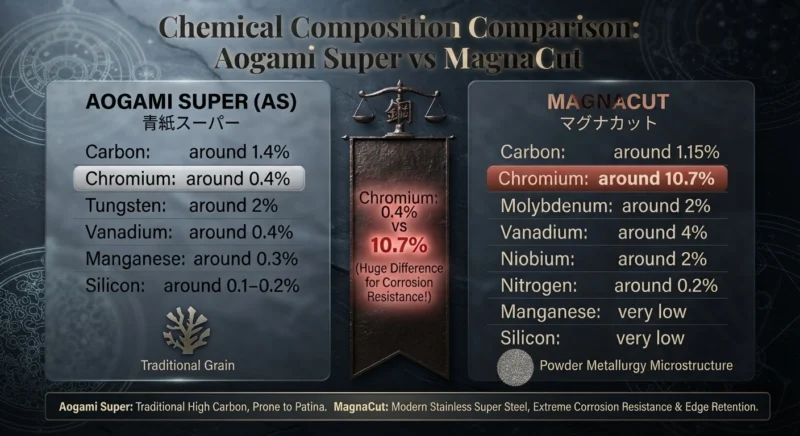
Chemical composition is where the differences between these steels become particularly clear.
Exact specifications can vary slightly depending on the standard or published analysis, but representative compositions illustrate the design philosophy.
Aogami Super
Aogami Super is approximately characterized by:
- Carbon: around 1.4%
- Chromium: around 0.4%
- Tungsten: around 2%
- Vanadium: around 0.4%
- Manganese: around 0.3%
- Silicon: around 0.1–0.2%
The exact numbers vary by specification and production.
The important point is the combination of high carbon, tungsten, and vanadium with relatively low chromium.
MagnaCut
MagnaCut is approximately characterized by:
- Carbon: around 1.15%
- Chromium: around 10.7%
- Molybdenum: around 2%
- Vanadium: around 4%
- Niobium: around 2%
- Nitrogen: around 0.2%
- Manganese: very low
- Silicon: very low
Again, the exact chemistry should be checked against the applicable material specification.
The difference is immediately apparent.
Aogami Super has a traditional high-carbon tool-steel composition with relatively modest chromium.
MagnaCut contains substantially more chromium, along with much larger amounts of vanadium and niobium.
That chemistry gives the two steels dramatically different corrosion behavior and microstructures.
Why Carbon Matters
Carbon is one of the most important elements in knife steel.
It contributes to hardness and allows carbide formation.
A higher carbon content can support a high hardness level, but carbon does not operate independently. The other alloying elements determine what happens to that carbon during heat treatment.
Aogami Super has a very high carbon content.
This contributes to its ability to achieve high hardness and produce a highly refined cutting edge.
MagnaCut also has substantial carbon, but its composition is carefully balanced with chromium, vanadium, niobium, and molybdenum.
The objective is not simply to maximize carbon.
Instead, the goal is to create a useful combination of martensitic matrix hardness, carbide content, corrosion resistance, and toughness.
This is one reason comparing steels purely by carbon percentage can be misleading.
More carbon does not automatically mean a better knife.
Chromium: The Major Difference
The most obvious chemical difference between Aogami Super and MagnaCut is chromium.
Aogami Super contains relatively little chromium.
MagnaCut contains approximately 10.7% chromium.
This has major consequences.
Chromium is responsible for stainless behavior when sufficient chromium remains in the steel’s matrix to form a protective passive oxide layer.
Aogami Super does not have enough chromium available for conventional stainless behavior.
MagnaCut is designed specifically to provide stainless-level corrosion resistance.
This means that the two steels demand very different maintenance routines.
With Aogami Super, drying the blade after use is important.
With MagnaCut, normal kitchen use is much less demanding from a corrosion perspective.
This difference alone can determine which steel is more appropriate for a particular person.
Vanadium and Carbides
Vanadium is important in both steels, but the amount is dramatically different.
Aogami Super contains a relatively modest amount of vanadium.
MagnaCut contains approximately 4% vanadium.
Vanadium forms very hard vanadium carbides.
These carbides can contribute significantly to wear resistance and edge retention.
However, carbide size and distribution are just as important as carbide chemistry.
Large, coarse carbides can create problems at very thin edges.
Fine, evenly distributed carbides can provide wear resistance while maintaining better edge stability.
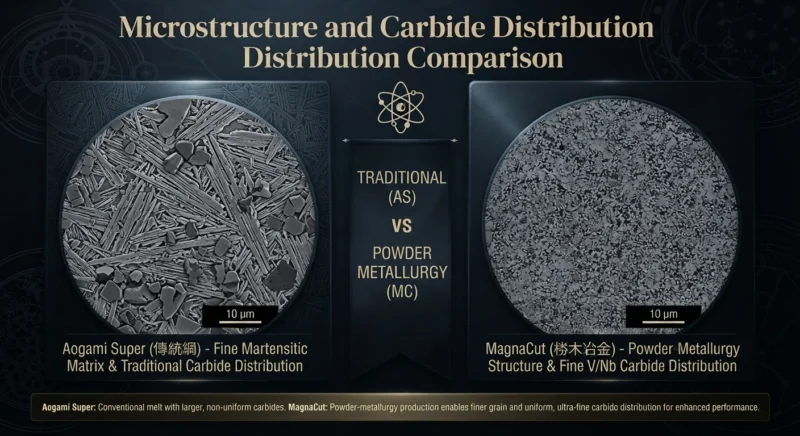
This is where powder metallurgy becomes important for MagnaCut.
The production process allows the alloying elements to be distributed very finely before the steel is consolidated.
Powder Metallurgy vs Conventional Steelmaking
MagnaCut is produced using powder metallurgy.
Aogami Super belongs to a more traditional family of Japanese tool steels.
Powder metallurgy involves producing very fine particles of steel and then consolidating them under controlled conditions.
One major advantage is the ability to achieve a highly uniform distribution of alloying elements.
This can help prevent the formation of very large carbide clusters.
For knife steels, that can be extremely valuable.
The goal is not simply to have more carbides.
The goal is to have the right carbides, in the right amount, with the right size and distribution.
Aogami Super’s traditional metallurgy gives it a different carbide structure and cutting behavior.
It does not attempt to reach the same level of stainless corrosion resistance or high alloy content as MagnaCut.
Instead, it focuses on a relatively simple high-carbon matrix capable of supporting a very fine cutting edge.
Check Our Guide Powder Steels for Kitchen Knives
Microstructure: Where Performance Really Comes From
Chemical composition tells only part of the story.
The real performance of a knife comes from its microstructure.
Microstructure describes the phases, carbides, grain size, and distribution of alloying elements inside the steel.
Heat treatment changes this microstructure dramatically.
For knife steels, important factors include:
- austenitizing temperature
- quenching method
- cryogenic treatment where appropriate
- tempering temperature
- number of tempering cycles
- grain size
- retained austenite
- carbide precipitation
- final hardness
This is why simply saying “Steel X is better than Steel Y” is usually an oversimplification.
A poorly heat-treated MagnaCut knife can perform worse than an excellent Aogami Super knife.
The reverse is also true.
Hardness: Aogami Super vs MagnaCut
Both steels can be heat-treated to high hardness.
Aogami Super is often encountered around 61–65 HRC, although actual hardness depends on the heat treatment and intended application.
MagnaCut is commonly used around 60–64 HRC, again depending on the maker and application.
At first glance, Aogami Super might appear to have an advantage.
But hardness should never be considered in isolation.
A 64 HRC blade is not automatically better than a 61 HRC blade.
Higher hardness can improve:
- edge retention
- resistance to deformation
- edge stability
But excessive hardness can reduce toughness.
For a kitchen knife with an extremely thin edge, the optimum hardness may be different from that of an outdoor knife expected to encounter impacts.
The ideal hardness is a compromise.
Check Our Guide What Is HRC? Understanding Rockwell Hardness in Kitchen Knives
Edge Retention
Edge retention is one of the most frequently misunderstood knife-steel characteristics.
There are actually several different ways an edge can stop cutting effectively.
It can:
- Wear away gradually.
- Roll over.
- Chip.
- Deform.
- Become damaged through corrosion.
- Lose its ideal geometry through repeated sharpening.
Therefore, “edge retention” is not one single property.
It depends on wear resistance, toughness, hardness, edge geometry, and use.
Aogami Super
Aogami Super has excellent edge retention for a relatively traditional carbon steel.
Its high carbon content and alloy carbides provide good resistance to abrasive wear.
At the same time, the steel can support a very fine edge.
For slicing vegetables, proteins, and other food, the practical edge life can be excellent.
MagnaCut
MagnaCut also offers excellent edge retention.
Its vanadium and niobium carbides contribute to wear resistance.
However, its greatest advantage is not necessarily absolute wear resistance.
Instead, MagnaCut offers a remarkably balanced combination of wear resistance and toughness.
In some cutting tests, steels with substantially more carbide volume can outperform MagnaCut in pure abrasive wear.
But that does not mean those steels necessarily make better knives.
A knife that retains a slightly less aggressive edge but is much less prone to chipping can be more useful in real life.
Check Our Guide Edge Retention Explained: 10 Factors What Makes a Knife Stay Sharp Longer
Which Has Better Edge Retention?
If the question is simply:
Which steel will hold an edge longer during abrasive cutting?
The answer is more complicated than simply naming a winner.
MagnaCut generally offers stronger wear resistance than many traditional carbon steels, including Aogami Super, especially when properly hardened.
However, Aogami Super can provide outstanding practical edge retention in kitchen applications because of its hardness, fine edge capability, and excellent sharpening response.
The difference may be much less dramatic in normal food preparation than a steel comparison chart suggests.
If your cutting involves cardboard, abrasive materials, rope, or other highly wear-intensive tasks, MagnaCut’s carbide structure becomes more relevant.
For fine slicing in the kitchen, the advantage may be much less obvious.
Toughness
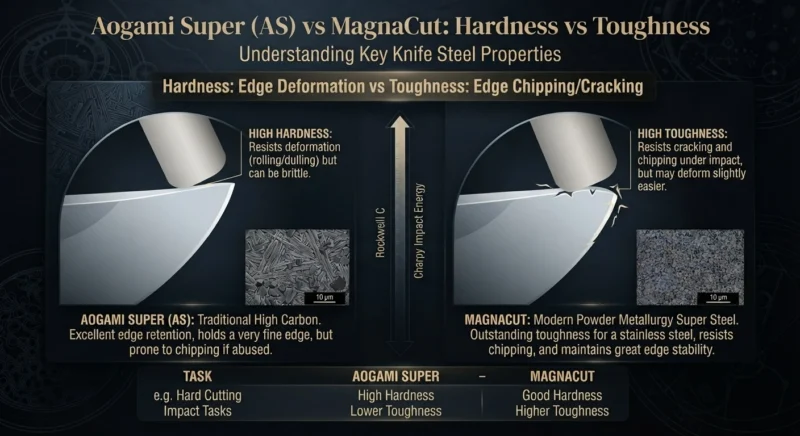
Toughness is one of the most important areas where MagnaCut has a major advantage.
Toughness describes a material’s ability to absorb energy without cracking or breaking.
This is different from hardness.
A very hard material can still be relatively brittle.
Aogami Super is not an exceptionally brittle steel. In fact, compared with many highly alloyed stainless steels, it can offer respectable toughness.
But it is not designed primarily as a maximum-toughness steel.
MagnaCut was specifically engineered to provide unusually high toughness for a stainless steel with its level of wear resistance and corrosion resistance.
This makes MagnaCut particularly attractive for:
- outdoor knives
- EDC knives
- hunting knives
- hard-use knives
- thin-bladed knives
- knives exposed to impacts
The balance is one of MagnaCut’s biggest strengths.
Check Our Guide Wear Resistance vs Toughness: Understanding the Most Important Knife Steel Trade-Off
Edge Stability
Edge stability is closely related to toughness and hardness.
Imagine two blades sharpened to the same thin angle.
One edge may remain perfectly straight after cutting.
Another may roll.
Another may develop microscopic chips.
The actual result depends on hardness, toughness, carbide structure, geometry, and what the edge encounters.
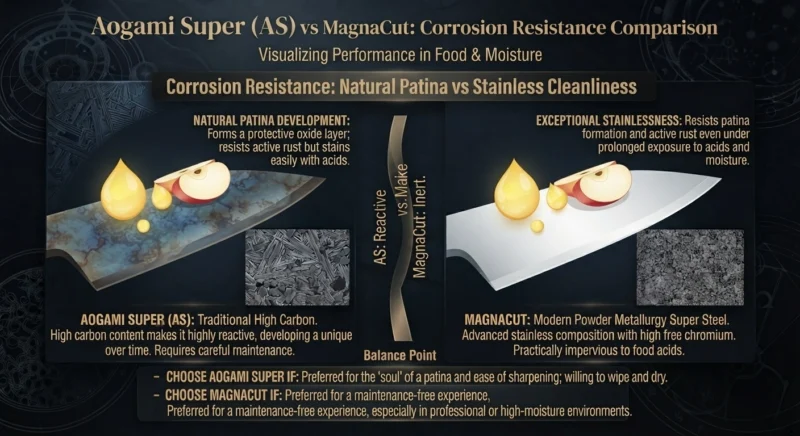
Aogami Super can have excellent edge stability when properly heat-treated.
Its relatively straightforward carbide structure can be very favorable for fine edges.
MagnaCut can also achieve excellent edge stability, particularly considering its stainless nature and high wear resistance.
Its fine carbide structure is a major advantage.
For extremely thin edges, both steels can perform very well when properly heat-treated.
Corrosion Resistance
Here the comparison is much easier.
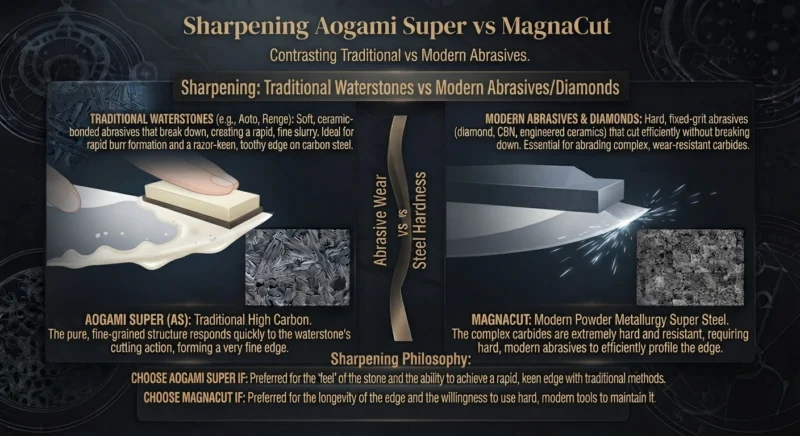
MagnaCut wins by a very large margin.
Aogami Super is a carbon steel.
It can rust if neglected.
It can develop patina relatively quickly when exposed to acidic ingredients.
Tomatoes, citrus, onions, fruit, vinegar, and other foods can accelerate discoloration.
MagnaCut, by contrast, is designed to resist corrosion at a very high level.
It is not completely immune to corrosion.
No steel should be described as absolutely corrosion-proof.
Extreme environments can eventually affect any steel.
However, normal kitchen use is dramatically easier with MagnaCut.
You do not need to treat it like a carbon-steel knife.
Patina: Aogami Super’s Unique Character
For some knife users, the possibility of patina is actually an advantage.
Aogami Super can develop a gray, blue, brown, or darker patina depending on the environment and use.
A patina is different from active red rust.
A stable patina can provide a degree of surface protection while also giving the knife an individual appearance.
Two Aogami Super knives that have been used for years may look completely different.
This is one reason traditional carbon-steel knives have such a strong following.
MagnaCut generally does not develop the same kind of visible patina.
Its stainless behavior is intended to keep the blade looking much closer to its original condition.
So this comes down to personal preference:
Aogami Super: character and patina.
MagnaCut: cleanliness and low maintenance.
Sharpening: A Major Difference
This is one of the areas where many users will immediately notice a difference.
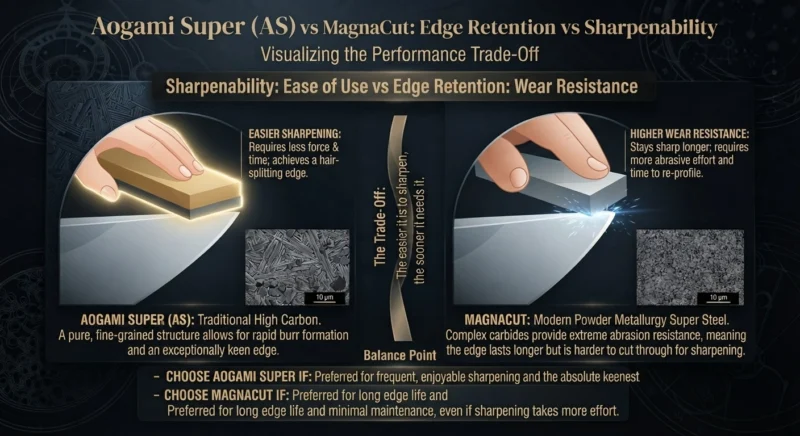
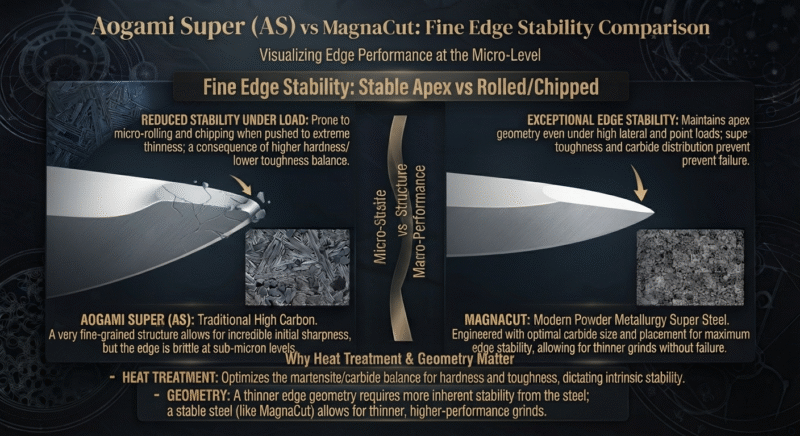
Aogami Super is generally pleasant to sharpen.
It responds well to conventional waterstones and can produce a very refined edge.
The steel has enough wear resistance to hold an edge but does not contain the extremely high carbide volume found in some modern powder steels.
For someone who enjoys sharpening, Aogami Super can be extremely satisfying.
MagnaCut is also sharpenable with quality abrasives, but it is more wear resistant.
It can take longer to remove material, particularly with very fine stones.
Diamond or CBN abrasives can be especially useful when working with modern high-alloy steels.
However, MagnaCut is not an especially difficult modern steel to sharpen.
Compared with some extremely wear-resistant powder steels, it remains reasonably user-friendly.
Which Is Easier to Sharpen?
Aogami Super is easier to sharpen.
That is one of its most attractive qualities.
If you maintain your knife frequently and enjoy using waterstones, Aogami Super offers a very satisfying sharpening experience.
MagnaCut requires more patience and appropriate abrasives.
The difference becomes particularly noticeable when repairing a damaged edge or changing the edge geometry.
Routine touch-ups are easier for both steels than major sharpening jobs.
Fine Edge Performance
A fine edge is where Aogami Super becomes particularly interesting.
Traditional Japanese carbon steels have a long history of being used for very thin, extremely sharp blades.
A properly heat-treated Aogami Super blade can take an exceptionally refined edge.
It can feel very smooth and controlled when slicing food.
MagnaCut can also take an extremely sharp edge.
There is no reason to assume that stainless steel cannot produce excellent sharpness.
The difference is more about how the steel behaves at that edge.
Aogami Super has a reputation for a particularly pleasant combination of sharpening response, edge refinement, and cutting feel.
MagnaCut offers excellent edge performance while adding much stronger corrosion resistance and toughness.
Cutting Feel
“Cutting feel” is difficult to quantify, but experienced knife users often notice it immediately.
Aogami Super can feel very crisp and responsive.
It is particularly well suited to thin Japanese kitchen knives where the blade geometry does much of the work.
MagnaCut can also feel excellent, but the final result depends heavily on heat treatment and geometry.
A thin MagnaCut knife at around 62 HRC can feel dramatically different from a thicker MagnaCut outdoor knife at 60 HRC.
This is a critical point:
Steel does not determine cutting feel by itself.
Blade thickness, grind, edge angle, hardness, surface finish, and sharpening all contribute.
Aogami Super for Kitchen Knives
Aogami Super is particularly well suited to kitchen knives.
It works beautifully for:
- gyuto
- santoku
- nakiri
- bunka
- petty knives
- sujihiki
- yanagiba-style blades
Its ability to take a fine edge makes it attractive to cooks who prioritize precision.
Aogami Super is particularly enjoyable for users who already understand carbon-steel maintenance.
After cutting acidic foods, the blade should be rinsed and dried.
The knife should not be left wet in a sink.
Dishwashers are obviously inappropriate.
With reasonable care, however, maintenance is straightforward.
MagnaCut for Kitchen Knives
MagnaCut is also extremely well suited to kitchen knives.
Its corrosion resistance makes it particularly attractive for cooks who do not want to think about patina.
This can be valuable in busy professional kitchens or households where multiple people use the same knife.
A MagnaCut kitchen knife can offer:
- excellent corrosion resistance
- excellent edge retention
- high toughness
- strong edge stability
- good sharpening response compared with many high-wear stainless steels
It is a very practical choice.
Aogami Super for Outdoor Knives
Aogami Super can certainly be used for outdoor knives.
However, corrosion becomes a serious consideration.
A hunting knife may encounter:
- blood
- moisture
- rain
- humidity
- plant material
- wet leather
- soil
These environments are not ideal for an unprotected carbon-steel blade.
Aogami Super can still perform extremely well, but the user must be prepared to maintain it.
A coating can reduce exposure, but the edge and exposed surfaces still require attention.
Check Our Guide Best Hunting Knife Features Explained
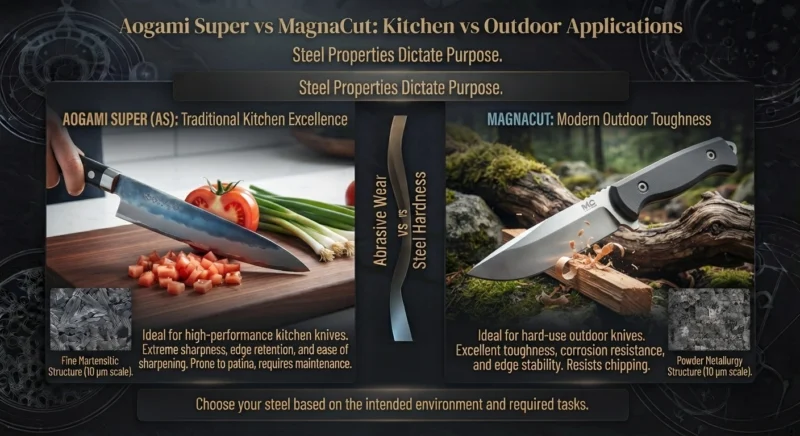
MagnaCut for Outdoor Knives
This is one of MagnaCut’s strongest applications.
An outdoor knife benefits enormously from the combination of:
toughness + corrosion resistance + edge retention.
A knife used outdoors may be exposed to water immediately after sharpening.
It may be stored in a sheath where moisture can accumulate.
It may be used around meat, vegetation, mud, or snow.
MagnaCut’s corrosion resistance dramatically reduces the maintenance burden.
At the same time, its toughness makes it suitable for demanding applications.
This combination is difficult for traditional carbon steels to match.
Aogami Super vs MagnaCut for EDC
For everyday-carry knives, the answer depends on what you value.
Aogami Super offers:
- excellent cutting performance
- easy sharpening
- fine edge potential
- traditional carbon-steel character
But it also requires maintenance.
MagnaCut offers:
- excellent corrosion resistance
- high toughness
- strong edge retention
- excellent edge stability
- relatively low maintenance
For a knife carried every day in humid or unpredictable environments, MagnaCut is generally the safer practical choice.
For someone who enjoys traditional carbon steel and does not mind maintenance, Aogami Super remains compelling.
Edge Angle
Neither steel has one universally correct edge angle.
The appropriate angle depends on:
- blade thickness
- hardness
- intended use
- toughness
- edge geometry
- cutting material
A very thin kitchen knife may work beautifully at a low angle.
A hard-use outdoor knife needs more support behind the edge.
Aogami Super can support very fine edges when properly heat-treated.
MagnaCut can also support surprisingly thin edges because of its combination of toughness and fine carbide structure.
But even MagnaCut can chip if pushed beyond the limits of its geometry.
No steel makes an edge indestructible.
Heat Treatment Matters More Than Most Buyers Realize
When comparing Aogami Super and MagnaCut, it is tempting to look only at the steel designation.
That is a mistake.
Heat treatment can dramatically change performance.
Two blades made from identical steel can have different:
- hardness
- toughness
- retained austenite
- carbide precipitation
- grain size
- edge stability
The best steel on paper can produce an average knife if heat treatment is poor.
Likewise, an excellent maker can extract impressive performance from a steel that appears less exciting on a specification sheet.
This is why real-world knife evaluation should consider the complete blade rather than only the steel name.
Check Our Guide Steel Heat Treatment Explained
Grain Size
Fine grain size is highly desirable for knife blades.
A fine-grained structure can improve toughness and help support a stable cutting edge.
Aogami Super can produce excellent results when properly heat-treated.
MagnaCut’s powder-metallurgy manufacturing helps provide a highly uniform microstructure.
The fine distribution of carbides is one of the reasons MagnaCut can combine substantial wear resistance with good toughness.
This is an important distinction from older high-alloy steels where large carbide clusters could become a limiting factor.
Carbide Volume
Carbide volume is one of the reasons steel comparisons become complicated.
Generally speaking, more hard carbides can improve wear resistance.
But more is not always better.
Large amounts of hard carbides can make sharpening more difficult.
They can also potentially reduce toughness and edge stability if the carbide structure is unfavorable.
MagnaCut deliberately avoids the extremely high carbide volume of some maximum-wear steels.
Instead, it aims for balance.
Aogami Super contains a relatively modest carbide population by modern powder-steel standards.
This contributes to its excellent sharpening behavior and fine-edge characteristics.
Aogami Super vs MagnaCut: Toughness-to-Wear Balance
This is perhaps the most important overall comparison.
Imagine a triangle with three major performance goals:
Toughness
Wear resistance
Corrosion resistance
Many steels perform very well in one or two categories but sacrifice another.
Aogami Super emphasizes:
- high hardness
- fine edge performance
- good wear resistance
- sharpening response
It sacrifices corrosion resistance.
MagnaCut tries to maintain strong performance across all three major categories.
It does not necessarily have the highest wear resistance of every premium steel.
It does not necessarily have the absolute highest toughness of every steel.
But it provides an unusually good balance.
That balance is the fundamental reason MagnaCut has become so interesting to knife makers and users.
Which Steel Gets Sharper?
This question sounds simple but is actually misleading.
Both steels can be sharpened to extremely high levels.
Sharpness is influenced by:
- edge geometry
- abrasive quality
- sharpening technique
- burr removal
- finishing
- stropping
- blade hardness
Aogami Super has a reputation for taking a very refined edge, and that reputation is deserved.
MagnaCut can also become extremely sharp.
The more meaningful distinction is not maximum sharpness but how easy it is to achieve and maintain that sharpness.
Aogami Super generally has the advantage for traditional waterstone sharpening.
Which Steel Holds a Better Polished Edge?
Aogami Super can be an excellent choice for polished edges.
A very fine waterstone finish can produce a smooth, refined edge that performs beautifully on controlled slicing tasks.
MagnaCut can also take a polished edge, although its carbide structure means the sharpening process can behave differently.
Many users prefer a somewhat toothier finish on high-alloy steels because it can provide excellent performance on certain materials.
There is no universally superior finish.
The best edge depends on the application.
Which Steel Is More Forgiving?
In terms of maintenance, MagnaCut is much more forgiving.
You can use the knife around moisture without immediately worrying about rust.
You can put it down briefly while working.
You can use it in humid environments.
Aogami Super demands more attention.
That does not mean Aogami Super is difficult.
It simply requires habits.
After use:
- Rinse the blade.
- Wipe it dry.
- Avoid prolonged moisture.
- Store it in a dry environment.
- Oil it when appropriate for longer storage.
Once these habits become automatic, carbon-steel maintenance is not particularly burdensome.
Which Steel Is Better for Beginners?
For someone completely new to premium knife steels, MagnaCut is generally easier.
The reason is not sharpening.
The biggest reason is corrosion resistance.
A beginner can make mistakes with a MagnaCut knife and usually get away with them.
A beginner can make the same mistakes with Aogami Super and discover rust spots.
However, Aogami Super can be an excellent educational steel.
It teaches the user about:
- edge maintenance
- sharpening
- patina
- corrosion
- blade geometry
- proper storage
For enthusiasts who enjoy learning about knives, that can actually be part of the attraction.
Which Steel Is More Traditional?
There is no contest here.
Aogami Super is the traditional choice.
It belongs to the long-established Japanese carbon-steel tradition.
For someone interested in Japanese knife culture, sharpening stones, patina, and traditional blade maintenance, Aogami Super offers an experience that MagnaCut cannot completely reproduce.
MagnaCut represents the modern approach.
It is about engineering a material around a balanced set of measurable properties.
Both approaches are valuable.
They simply answer different questions.
Which Steel Is Better for Professional Kitchens?
This depends on the kitchen.
A cook who loves traditional Japanese knives and maintains them carefully may prefer Aogami Super.
A professional kitchen where knives are used by many different people may benefit from MagnaCut.
The reason is simple:
corrosion resistance reduces maintenance risk.
A shared kitchen environment is rarely ideal for delicate carbon-steel maintenance.
MagnaCut is much more tolerant of neglect.
For a chef who personally maintains every knife and prioritizes cutting feel, Aogami Super can be fantastic.
For a busy environment where practicality matters, MagnaCut has the advantage.
Which Steel Is Better for Food Preparation?
For precision food preparation, both can be excellent.
Aogami Super has a particularly strong reputation for:
- vegetable slicing
- push cutting
- precision cuts
- fish preparation
- fine slicing
MagnaCut can perform equally well when the blade geometry and heat treatment are excellent.
The difference is that MagnaCut adds a significant safety margin against corrosion and accidental impacts.
Therefore:
Pure cutting experience: Aogami Super has a strong argument.
Overall practicality: MagnaCut has the advantage.
Which Steel Is Better for Hard Use?
MagnaCut.
Its toughness and corrosion resistance make it much better suited to situations where the knife may encounter abuse, moisture, or unpredictable conditions.
That does not mean MagnaCut is indestructible.
A thin edge can still chip.
A hard blade can still break.
A knife is still a cutting tool, not a pry bar.
But compared with Aogami Super, MagnaCut gives the user a wider performance envelope.
Which Steel Is Better for Knife Makers?
This depends on the project.
Aogami Super can be attractive for makers producing traditional Japanese-style kitchen knives.
It is particularly appealing when the final product is intended for users who appreciate carbon steel and traditional sharpening.
MagnaCut is attractive for makers who want a modern premium stainless steel capable of serving a much wider range of applications.
The choice should therefore begin with the intended knife rather than the popularity of the steel.
Ask:
- Is corrosion resistance important?
- Is the knife going to be extremely thin?
- Will it be used outdoors?
- Does the user enjoy sharpening?
- Is patina desirable?
- Is toughness important?
- What hardness will be used?
- What geometry will the blade have?
Once those questions are answered, the steel choice becomes much easier.
Check Our Guide How to Choose a Custom Knife Maker
Aogami Super vs MagnaCut for Thin Blades
Thin blades put unusual demands on steel.
As the edge becomes thinner, the supporting material behind the apex becomes smaller.
This means edge stability becomes increasingly important.
Aogami Super can perform exceptionally well in this environment when properly heat-treated.
Its fine carbide structure and high hardness make it capable of supporting extremely refined edges.
MagnaCut is also excellent for thin blades.
Its toughness is especially valuable because it provides greater resistance to catastrophic failure and edge damage.
For a very thin kitchen knife, either steel can be outstanding.
The heat treatment and geometry may matter more than the difference between the steel grades.
Aogami Super vs MagnaCut for Chipping Resistance
MagnaCut has the advantage.
Its combination of toughness and fine carbide structure makes it unusually resistant to chipping for a high-performance stainless steel.
Aogami Super can also have excellent edge stability.
But if two blades are equally thin and similarly hardened, MagnaCut generally offers more tolerance for accidental impacts.
This is particularly relevant for users who are not careful about cutting technique.
Aogami Super vs MagnaCut for Corrosion-Prone Foods
If you frequently cut:
- lemons
- limes
- tomatoes
- apples
- onions
- vinegar-rich foods
MagnaCut is considerably easier.
Aogami Super can react noticeably with acidic foods.
The resulting patina can be attractive, but some users simply do not want it.
If appearance and low maintenance are important, MagnaCut is the obvious choice.
If patina is part of the appeal, Aogami Super becomes more interesting.
Does Aogami Super Rust?
Yes.
Aogami Super is not stainless.
It can develop patina and, if neglected, active rust.
That does not mean the steel is poor.
It means the steel has been optimized around characteristics other than corrosion resistance.
Many outstanding knives are made from carbon steels.
They simply require appropriate care.
Does MagnaCut Rust?
MagnaCut has excellent corrosion resistance, but “stainless” does not mean absolutely immune to corrosion.
Under normal knife use, it is extremely resistant.
However, prolonged exposure to aggressive chemicals, salt, moisture, or unfavorable storage conditions can eventually affect stainless steels.
It is still good practice to clean and dry a knife after use.
The difference is that MagnaCut gives you a much larger margin for error.
Maintenance Comparison
Aogami Super
Recommended habits include:
- dry immediately after washing
- do not leave in standing water
- avoid dishwasher use
- wipe after cutting acidic foods
- use appropriate food-safe oil for storage
- monitor for rust
- maintain the edge regularly
MagnaCut
Maintenance is simpler:
- wash after use
- dry normally
- avoid prolonged exposure to corrosive chemicals
- sharpen when necessary
- store appropriately
This difference becomes especially important for people who want a premium knife without a maintenance ritual.
Sharpening Stone Selection
Aogami Super works beautifully with traditional waterstones.
Depending on the desired edge, a progression might include:
- coarse stone for repairs
- medium stone for primary sharpening
- fine stone for refinement
- optional finishing stone for polishing
MagnaCut can also be sharpened on waterstones, but modern abrasive technology can be particularly helpful.
Diamond and CBN abrasives can remove high-alloy stainless steel efficiently.
That does not mean traditional stones cannot handle MagnaCut.
They can.
It simply means the user may need more time and technique.
Is MagnaCut Too Difficult to Sharpen?
No.
This is an important misconception.
MagnaCut is not one of the most difficult knife steels to sharpen.
Its wear resistance is significant, but its carbide structure is relatively fine and well controlled.
Compared with some extremely wear-resistant powder steels, MagnaCut remains quite manageable.
A quality diamond or CBN abrasive can make the process straightforward.
For someone accustomed to sharpening simple carbon steels, however, Aogami Super will usually feel easier.
Edge Retention vs Sharpenability
This is one of the classic knife-steel tradeoffs.
Generally:
More wear resistance = more sharpening effort.
Aogami Super sits toward the easier-sharpening side of the premium-steel spectrum.
MagnaCut moves further toward wear resistance while retaining good toughness.
Neither is extreme.
This is why both are excellent choices.
They simply occupy different points on the performance spectrum.
Which Steel Gives Better Value?
Value depends on what you actually use.
If corrosion resistance is irrelevant to you, paying extra for stainless performance may provide little benefit.
Aogami Super can give you exceptional cutting performance without requiring a highly complex alloy.
If you live in a humid environment, work around water, or carry a knife outdoors, MagnaCut’s corrosion resistance can be worth considerably more.
The value of a steel is therefore determined by the environment as much as by the specification sheet.
Aogami Super vs MagnaCut: Overall Score
A simplified comparison might look like this:
| Category | Winner |
|---|---|
| Corrosion resistance | MagnaCut |
| Toughness | MagnaCut |
| Ease of sharpening | Aogami Super |
| Fine-edge feel | Aogami Super |
| Traditional character | Aogami Super |
| Low maintenance | MagnaCut |
| Outdoor use | MagnaCut |
| Hard-use applications | MagnaCut |
| Patina potential | Aogami Super |
| Wear resistance | MagnaCut |
| Edge retention | MagnaCut, depending on use and heat treatment |
| Fine kitchen work | Aogami Super |
| Versatility | MagnaCut |
| Beginner friendliness | MagnaCut |
| Carbon-steel experience | Aogami Super |
This table makes the difference clear.
MagnaCut wins more categories.
But that does not make Aogami Super obsolete.
The Real Winner Depends on the Knife
One of the biggest mistakes in knife-steel discussions is treating steel as the entire knife.
It isn’t.
A knife is a system.
Think about:
Steel + heat treatment + hardness + geometry + edge angle + grind + sharpening + intended use.
A mediocre knife made from MagnaCut will not automatically outperform an exceptional Aogami Super knife.
Likewise, an expertly heat-treated MagnaCut blade with an excellent grind can outperform a poorly executed carbon-steel knife by a large margin.
When buying or making a knife, steel should therefore be one factor among several.
Aogami Super vs MagnaCut: Which One Should You Choose?
The simplest way to choose is to start with your priorities.
Choose Aogami Super if you want:
- a traditional Japanese carbon steel
- excellent fine-edge performance
- easy sharpening
- excellent cutting feel
- high hardness
- the possibility of developing patina
- a traditional knife experience
- a steel that responds beautifully to waterstones
Aogami Super is particularly appealing to enthusiasts who enjoy maintaining their knives.
Choose MagnaCut if you want:
- excellent corrosion resistance
- high toughness
- excellent wear resistance
- low maintenance
- strong edge stability
- a versatile premium steel
- an outdoor or EDC knife
- a modern stainless-steel experience
MagnaCut is particularly appealing to users who want high performance without constantly thinking about corrosion.
Aogami Super vs MagnaCut for Knife Collectors
Collectors may appreciate both for completely different reasons.
Aogami Super represents an important part of the Japanese carbon-steel tradition.
It is associated with the philosophy that a knife should be maintained, sharpened, and used as a precision tool.
MagnaCut represents modern metallurgical engineering.
Its appeal lies in how much performance can be packed into a single steel while maintaining an impressive balance between competing properties.
For a serious collection, there is no reason to choose only one.
They demonstrate two different approaches to knife design.
Is MagnaCut Better Than Aogami Super?
If “better” means more versatile, tougher, more corrosion resistant, and lower maintenance, then yes, MagnaCut has the advantage.
If “better” means easier to sharpen, more traditional, excellent for refined edges, and enjoyable to maintain, Aogami Super may be preferable.
That is why the debate never really has a universal winner.
The two steels were effectively designed around different priorities.
Is Aogami Super Still Worth Choosing?
Absolutely.
Modern stainless steels have not made traditional carbon steels irrelevant.
Aogami Super still offers characteristics that many knife enthusiasts actively seek.
Its combination of high carbon content, hardness, fine edge capability, and sharpening response makes it an excellent material for precision blades.
A chef who enjoys Japanese knives may actually prefer Aogami Super over MagnaCut despite the latter’s superior corrosion resistance.
The reason is simple:
Performance is not only about maintenance. It is also about the experience of using the knife.
Is MagnaCut Overrated?
No, but it is sometimes misunderstood.
MagnaCut is not the best steel at everything.
There are steels with greater wear resistance.
There are steels with greater toughness.
There are steels that are easier to sharpen.
There are steels with even greater corrosion resistance under particular conditions.
MagnaCut’s achievement is its balance.
It manages to combine properties that traditionally involved significant compromises.
That makes it extremely versatile.
The Importance of Heat Treatment
One final warning deserves emphasis.
Never compare Aogami Super and MagnaCut solely by nominal hardness numbers.
A 62 HRC MagnaCut knife from one maker can behave differently from a 62 HRC MagnaCut knife from another.
The same is true for Aogami Super.
Hardness is only one measurement.
The complete heat-treatment process determines much of the resulting microstructure.
A well-made blade can therefore outperform what a simple steel chart might predict.
This is especially important when comparing premium knife blanks or custom knives.
The maker’s heat-treatment quality can be more important than the theoretical difference between two excellent steels.
Final Verdict: Aogami Super vs MagnaCut
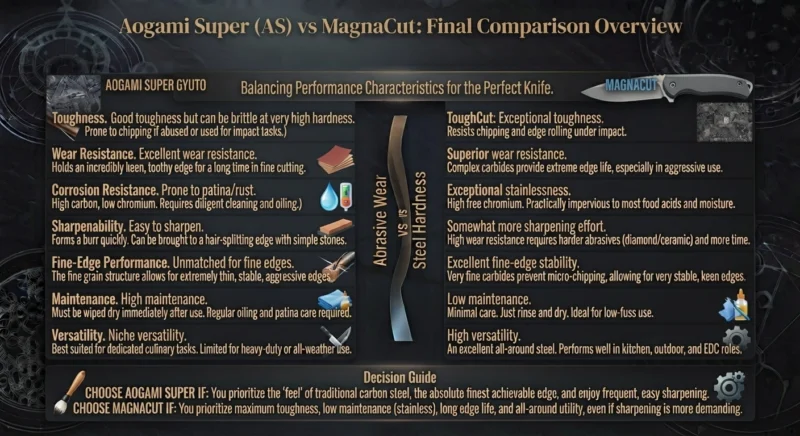
Aogami Super and MagnaCut are both exceptional knife steels, but they represent two very different philosophies.
Aogami Super is the traditional high-performance carbon steel.
It offers excellent hardness, outstanding fine-edge capability, pleasant sharpening characteristics, and the distinctive experience of carbon steel. Its major disadvantage is corrosion resistance. It requires more attention and should be dried and maintained properly.
MagnaCut is the modern balanced stainless steel.
It offers excellent corrosion resistance, very high toughness for its class, strong wear resistance, excellent edge stability, and impressive versatility. It is easier to live with and better suited to environments where moisture, impact, or neglect are possible.
If your priority is traditional Japanese knife performance and sharpening enjoyment, Aogami Super is an excellent choice.
If your priority is maximum versatility, toughness, corrosion resistance, and low maintenance, MagnaCut is the stronger choice.
For a precision kitchen knife used by someone who enjoys sharpening and caring for carbon steel, I would lean toward Aogami Super.
For an all-purpose knife, outdoor knife, hunting knife, EDC knife, or a kitchen knife that needs to tolerate everyday neglect, I would lean toward MagnaCut.
The most important conclusion, however, is this:
There is no single “best” knife steel. There is only the steel that best matches the knife, the user, and the job.
And that is exactly why comparing Aogami Super and MagnaCut is so interesting. One represents the refinement of a traditional carbon-steel approach; the other demonstrates what modern metallurgy can achieve by balancing properties that were once difficult to combine.
Aogami Super vs MagnaCut: Frequently Asked Questions
Is Aogami Super better than MagnaCut?
Not universally. Aogami Super is easier to sharpen and excellent for fine edges, while MagnaCut provides substantially better corrosion resistance and toughness.
Which has better edge retention, Aogami Super or MagnaCut?
MagnaCut generally has the advantage in wear resistance, but real-world edge retention depends heavily on hardness, geometry, sharpening, and the material being cut.
Is Aogami Super stainless?
No. Aogami Super is a carbon steel and can develop patina and rust if it is not properly maintained.
Is MagnaCut stainless?
Yes. MagnaCut is designed as a stainless knife steel with excellent corrosion resistance.
Which is easier to sharpen?
Aogami Super is generally easier to sharpen, particularly on conventional waterstones.
Which is tougher?
MagnaCut has a significant toughness advantage, particularly for a high-performance stainless steel.
Which is better for kitchen knives?
Both can be excellent. Aogami Super is especially attractive for users who prioritize fine-edge performance and traditional carbon steel. MagnaCut is better for users who prioritize corrosion resistance and low maintenance.
Which is better for outdoor knives?
MagnaCut is generally the better choice because of its combination of toughness and corrosion resistance.
Can Aogami Super get a sharper edge than MagnaCut?
Both can be sharpened extremely finely. Aogami Super is particularly well known for its excellent response to fine sharpening and its ability to produce a refined cutting edge.
Does MagnaCut hold an edge longer than Aogami Super?
In many abrasive cutting situations, MagnaCut will offer stronger wear resistance. However, the difference in practical kitchen use can be smaller than a simple steel comparison suggests.
Which steel is better for beginners?
MagnaCut is generally easier for beginners because it requires much less attention to corrosion and moisture.
Which steel is better for experienced knife enthusiasts?
That depends on preference. Enthusiasts who enjoy sharpening and carbon-steel maintenance may prefer Aogami Super, while those who value modern stainless performance may prefer MagnaCut.
Which one should a knife maker choose?
Choose based on the intended knife. Aogami Super is excellent for traditional fine-edge kitchen knives, while MagnaCut is exceptionally versatile for kitchen, outdoor, hunting, and EDC applications.
Aogami Super vs MagnaCut: The Bottom Line
Aogami Super:
Traditional • High carbon • Fine edge • Easy sharpening • Excellent cutting feel • Patina • Higher maintenance
MagnaCut:
Modern • Stainless • Tough • Corrosion resistant • Excellent wear resistance • Versatile • Low maintenance
If you want the classic carbon-steel experience, choose Aogami Super.
If you want modern all-around performance, choose MagnaCut.
Neither one makes the other obsolete—and that is what makes this comparison particularly useful for anyone interested in knife steel, metallurgy, sharpening, and blade performance.
This article is for independent informational purposes only and is not affiliated with, sponsored by, or endorsed by any steel manufacturer. All product names, trademarks, and registered trademarks are the property of their respective owners.